


Abstract
Background/Objectives: Heart failure (HF) remains a major public health challenge, requiring continuous management and high patient adherence to prevent exacerbations. Telenursing offers a scalable, tailored solution for remote monitoring and education; however, evidence regarding optimal individualized intervention models remains heterogeneous, necessitating a systematic synthesis within the framework of precision care. This study aims to identify the effects of telenursing on self-care capacity and health outcomes in patients with heart failure. Methods: A systematic review was conducted following JBI methodology and PRISMA guidelines. Six databases (MEDLINE, Cochrane, CINAHL, Scopus, Web of Science, Google Scholar) were searched for studies (2020–2025). Quality was assessed using JBI Critical Appraisal Tools (threshold > 60%). Results: Fifteen studies were included from the 748 identified. Three core personalized modalities were categorized: tailored self-care digital programs, mobile applications, and integrated telemonitoring systems. Interventions featuring individualized, risk-stratified, and frequent contact demonstrated a significant positive impact on self-care behaviors, NYHA classification, and hospitalization rates. Key components included personalized vital sign alerts, structured virtual interviews, and digital coaching. Nurse-led oversight directly supported clinical responsiveness and medication adherence, though therapeutic efficacy varied according to baseline patient digital literacy and cognitive function. Conclusions: Technology-enabled personalized nursing interventions are highly effective in enhancing self-care skills, health literacy, and clinical stability. Future research should prioritize large-scale trials with prolonged follow-up and cost-effectiveness analyses to support multidisciplinary integration.
1. Introduction
The global population is aging. It is estimated that the number of people aged 60 years and older will double by 2050 and more than triple by 2100 [1]. In Europe, approximately 25% of the population is aged 60 years or older [2].
Population aging has contributed to the increased prevalence of chronic diseases, and cardiovascular diseases remain the leading cause of mortality worldwide. Elevated blood pressure is the main metabolic risk factor for cardiovascular mortality [3]. Among chronic cardiovascular conditions, heart failure (HF) is defined as a chronic condition in which the heart muscle is unable to pump sufficient blood to meet the body’s metabolic demands [4]. Globally, approximately 64.3 million people are living with HF. In developed countries, prevalence is estimated at around 2%, with an annual incidence of 5 to 10 cases per 1000 individuals. Among adults aged 65 years and older, prevalence increases to approximately 11.8% [5]. Chronic heart failure is the leading cause of hospitalization among older adults, with 24% of patients readmitted within 30 days and approximately 50% rehospitalized within six months [6].
Clinically, HF is classified into four phenotypes based on Left Ventricular Ejection Fraction (LVEF): HF with reduced ejection fraction (LVEF ≤ 40%), mildly reduced ejection fraction (LVEF 41–49%), preserved ejection fraction (LVEF ≥ 50%), and improved ejection fraction (reflecting a baseline LVEF ≤ 40% that subsequently increases by at least 10 points to >40%) [7]. To evaluate symptoms and functional capacity, patients are categorized using the New York Heart Association (NYHA) classification on a scale from Class I (no limitation of physical activity) to Class IV (symptoms present even at rest) [8]. The symptom burden experienced by patients with Heart Failure is complex and multifactorial. The primary manifestations, which are most strongly associated with HF-related hospitalizations, are driven by fluid overload, most notably pulmonary edema, dyspnea (shortness of breath), and peripheral edema. Furthermore, the impact of the disease extends to a profound systemic and psychosocial component, with patients frequently reporting debilitating symptoms such as fatigue, chest and general pain, alongside significant levels of anxiety and depression [9,10]. The daily demands of HF self-care frequently exceed the patient’s individual capacity, creating a critical deficit that necessitates targeted and continuous healthcare interventions [11,12]. These limitations in the capacity for self-care can be influenced by health literacy, cognitive and functional decline, the burden of comorbidities, and constraints related to time and environmental resources [13,14].
To improve access to care, continuity, and proximity between individuals and nursing services, telehealth expanded significantly during the COVID-19 pandemic [15]. Telenursing is an innovative paradigm in digital healthcare, defined as the use of information and communication technologies to deliver nursing care from a distance [16]. Situated within the broader domain of eHealth, the overarching application of digital technologies and information systems to healthcare delivery, telenursing encompasses a broad spectrum of activities, ranging from telephone counseling to complex home monitoring via remote devices, effectively transcending spatial limitations [17]. With the technological evolution of mobile health (mHealth) applications, wearable biosensors, and wireless peripherals, telenursing interventions have increasingly leveraged mHealth platforms to enable continuous, real-time data transmission and interactive patient engagement outside traditional clinical settings [18,19]. Telemonitoring is described as a specialized model of care within this eHealth and mHealth framework that involves remote monitoring of biometric parameters, enabling early detection of HF deterioration, improved clinical classification, and timely implementation of preventive interventions [20]. By enabling continuous and coordinated care across different levels of the health system, telenursing allows for prompt, needs-based interventions, positioning itself as a pioneering and rapidly growing delivery system for the modern age [21,22].
Within the European Union, digital health is recognized as a key instrument to improve the efficiency and quality of care, expand access, empower individuals in the management of their health, and support healthcare professionals [23]. Global investment in digital health is supported by the Global Strategy on Digital Health 2020–2025, which aims to strengthen health systems and empower communities in self-care [24]. The justification for this study lies in the critical gap between nurses’ positive attitudes toward telenursing and their currently insufficient telehealth knowledge in cardiac care [25]. Despite the growing evidence on digital health in heart failure, previous systematic reviews have largely focused on macro-clinical endpoints such as mortality and readmission rates [26], overall quality of life [27], or broad technology adoption driven by the COVID-19 pandemic [28]. Consequently, a critical gap remains in synthesizing how structured telenursing—as an active, professional nursing model encompassing direct clinical symptom triage, interactive educational coaching, and structured virtual follow-ups—directly influences daily self-care capacity and specific health outcomes. To bridge this gap and position telenursing as a sustainable chronic care model, this review aims to identify the effects of telenursing on self-care capacity and health outcomes in patients with heart failure.
2. Materials and Methods
This systematic literature review was conducted following the Joanna Briggs Institute (JBI) methodology [29]. The search strategy and article analysis were carried out in accordance with the PRISMA guidelines for systematic reviews and meta-analysis extensions [30] (see Supplementary Materials). The review protocol was registered on the PROSPERO (CRD420251080142) platform to avoid duplication of scientific evidence.
2.1. Eligibility Criteria
The inclusion and exclusion criteria were established a priori based on the Population, Intervention, Comparison, and Outcome (PICO) framework [31], adhering to the guiding principles for systematic reviews. Accordingly, the primary research question was formulated as follows: What are the effects of telenursing interventions (I), compared to standard care, non-digital care, or baseline parameters (C), on self-care capacity and health outcomes (O) among adult patients with heart failure (P)?
The PICO elements were defined as:
- (i)
- Population (P): Adult patients (≥18 years of age) with diagnosed Heart Failure (HF).
- (ii)
- Intervention (I): Telenursing interventions (e.g., nurse-led telemonitoring, mHealth applications, structured virtual coaching, remote symptom triage).
- (iii)
- Comparison (C): Standard care or non-digital nursing care.
- (iv)
- Outcome (O): Primary outcomes included self-care capacity. Secondary outcomes included health-related parameters (NYHA functional class, 30-day readmissions, medication adherence, and health literacy).
Eligible study designs included randomized controlled trials (RCTs), quasi-experimental studies, cohort studies, and analytical cross-sectional studies. For comparative studies (RCTs and quasi-experimental trials), intervention effects were evaluated by extracting available effect estimates (e.g., Mean Differences [MD], Standardized Mean Differences [SMDs], or Odds Ratios [ORs] with 95% Confidence Intervals). Single-group or observational studies were synthesized narratively to provide implementation data.
The search was restricted to articles published in English, Portuguese, and Spanish. Crucially, the search was limited to articles published within the last five years (2020–2025). This temporal restriction is methodologically justified by the rapid evolution and obsolescence of digital health technologies, as well as the unprecedented paradigm shift in telehealth adoption and remote care delivery catalyzed by the COVID-19 pandemic. Including older studies could introduce bias by analyzing obsolete technological frameworks that no longer reflect current clinical practices.
Studies were excluded if they did not explicitly address the research question, lacked a focus on nursing-led care, or did not present clearly defined empirical objectives. Furthermore, non-primary research articles, such as previous literature reviews, editorials, commentaries, and opinion pieces, were excluded to maintain the empirical rigor of the synthesized evidence.
2.2. Search Strategy
To ensure the originality of this systematic review, a preliminary search was conducted, confirming the absence of previously published reviews or registered protocols on this specific topic. For the purpose of this review, telenursing was operationalized as any remote, technology-mediated care delivery, symptom triage, educational coaching, or clinical monitoring performed by or under the direct coordination of registered nurses [16,32].
A literature search was conceptualized and executed by two independent investigators (R.C. and A.R.) and validated by a third author. The search was performed across five major electronic databases: MEDLINE (via PubMed), Cochrane Library, CINAHL Complete, Scopus, and Web of Science. Broad, high-sensitivity search terms were deliberately combined to capture diverse nurse-led digital interventions: “telenursing”, “nursing care”, “patient participation”, “telemedicine”, “digital health”. To complement electronic database searches and reduce publication bias, manual forward and backward citation tracking of all included studies and relevant systematic reviews was performed. Concurrently, grey literature was explored via Google Scholar, while the primary trial registry ClinicalTrials.gov was screened independently to identify completed unpublished studies or relevant ongoing trials. The search period was restricted from 1 January 2020 to 24 June 2025. This timeframe was explicitly selected to isolate contemporary post-2020 digital nursing delivery models, capturing the structural paradigm shift, updated clinical guidelines, and standardized remote care workflows established following the onset of the COVID-19 pandemic.
The search syntax tailored for each database is detailed in Table 1.
Table 1.
Search strategy in the database.
2.3. Evaluation of Risk of Bias and Methodological Quality of Studies
To maintain methodological rigor and minimize potential risk of bias, two researchers independently screened and evaluated the full text of all eligible articles. Methodological quality and certainty of evidence were critically appraised using design-specific Joanna Briggs Institute (JBI) critical appraisal tools [29]. For randomized controlled trials, the 13-item JBI tool was used to evaluate domains such as the randomization process, allocation concealment, baseline group comparability, blinding, consistency of outcome measurement, and follow-up completeness [33]. Quasi-experimental studies were appraised using the 9-item JBI checklist, focusing on causal relationships, group comparability, control of confounding variables, and outcome reliability [34]. Observational evidence was assessed using the 11-item JBI tool for cohort studies (evaluating exposure measurement, confounding management, and follow-up) [35] and the 8-item JBI tool for analytical cross-sectional studies (focusing on inclusion criteria clarity, setting descriptions, exposure/outcome validity, and confounding management) [36]. Each item across the appraisal tools was scored as “yes” (1 point), “no” (0 points), “unclear” (0 points), or “not applicable”. Each item across the appraisal tools was scored as “yes” (1 point), “no” (0 points), “unclear” (0 points), or “not applicable”. The overall score was calculated based on the proportion of fulfilled criteria (X/Y), allowing classification into quality tiers (high quality: >80%; moderate quality: 70–80%; low quality: 60–70%) to provide a standardized overview of methodological strength across study designs [12]. Evaluators resolved discrepancies through consensus with a third reviewer.
We managed the screening and selection process using Rayyan software (Cambridge, MA, USA; 2024, https://www.rayyan.ai/, accessed on 2 April 2026). The literature was sequentially evaluated through title and abstract screening, followed by a full-text review of eligible reports against pre-established inclusion criteria. Table 2 summarizes the methodological quality assessment across all included studies.
Table 2.
Results of the methodological quality assessment of the included manuscripts.
2.4. Data Extraction and Synthesis
Data extraction was performed independently by two investigators (R.C. and A.R.) using a standardized electronic form to ensure consistency and minimize selection bias. Any discrepancies between the reviewers during this stage were resolved through consensus or by consulting a third senior investigator to maintain inter-rater reliability. Data synthesis was organized in six parts: study references (author, year, and country), main aim, study design, sample characteristics (sample size and average age), measure instruments, characteristics of telenursing intervention program (components and delivery time), and clinical outcomes.
2.5. AI Use Statement
During the preparation of this manuscript, the authors used Gemini 1.5 and NotebookLM (Google) (https://sites.google.com/view/notebook-lm?pli=1&authuser=0, accessed on 2 April 2026) for the purposes of text refinement and graphic generation. The authors have reviewed and edited the output and take full responsibility for the content of this publication.
3. Results
3.1. Study Selection
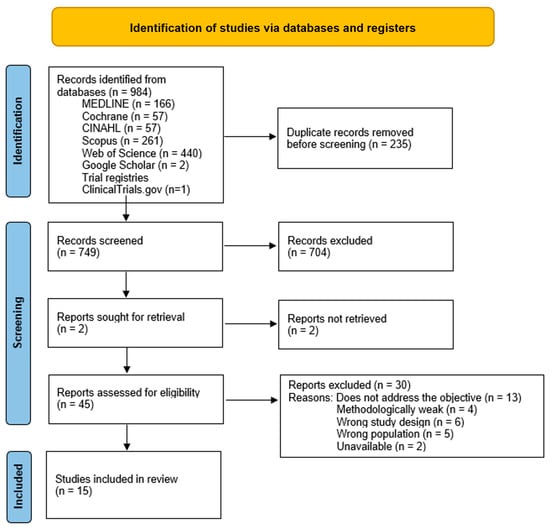
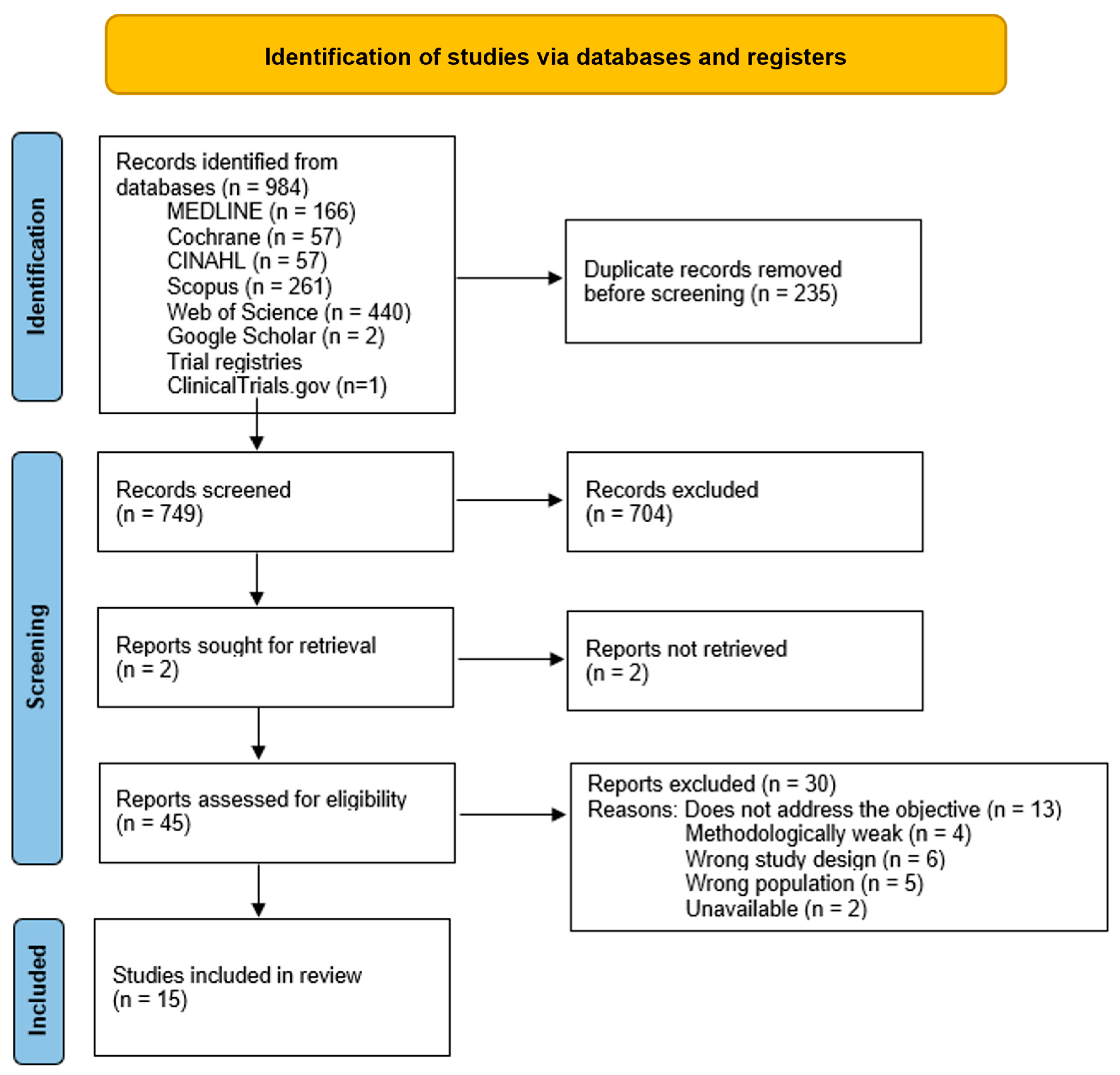
The initial search identified a total of 984 records. After the removal of duplicates (n = 235), 749 records remained. Screening of titles and abstracts led to the exclusion of 704 records, resulting in 45 potentially eligible studies. Following full-text assessment, 30 articles were excluded. The PRISMA flow diagram illustrating the study selection process is presented in Figure 1. A total of 15 studies were included in the final analysis.
Figure 1.
PRISMA flowchart of the article and publication selection process.
3.2. Study Characteristics
A total of 15 studies met the eligibility criteria and were included in this systematic review, as detailed in Table 3 and Table 4. The evidence synthesis reveals a global interest in telenursing for heart failure (HF), with studies spanning four continents: Asia (n = 5: Korea, Japan), North America (n = 5: USA, Canada), Europe (n = 4: Finland, Germany, Italy, United Kingdom), and South America (n = 1: Argentina).
Table 3.
Overall description of the studies included (n = 15).
Table 4.
Effects of telenursing on the self-care and healthcare-related outcomes in CHF.
Regarding study design, the body of evidence is characterized by methodological diversity and is distributed as follows: quasi-experimental studies (n = 7); randomized controlled trials (RCTs) (n = 6); one analytical cross-sectional study (n = 1); and one retrospective case–control study (n = 1).
The cumulative sample size across all studies was 6660 participants, though it is important to note that a single large-scale retrospective study accounted for 6065 of these individuals [50]. Excluding this outlier, the median sample size for primary clinical trials was 41 participants (range: 12 to 101). The population consisted primarily of older adults, with mean ages ranging from 52 to 72.4 years. While most studies targeted the patients exclusively, three studies specifically adopted a dyadic approach, incorporating caregivers into the telenursing intervention to evaluate collaborative self-care. Clinically, the majority of participants were classified within NYHA Classes II and III, reflecting a symptomatic population with a significant need for intensive self-management support.
4. Discussion
The critical analysis of the results from this systematic review is structured around four fundamental axes that provide a holistic understanding of the effects of telenursing on HF self-care, as well as the facilitating factors and barriers to implementation.
4.1. Architecture and Delivery of Personalized Telenursing Interventions
The technological landscape of telenursing for Heart Failure (HF) is characterized by a diverse operational architecture, categorized into three functional modalities. Self-care digital programs represent the most frequent approach, emphasizing structured education and behavioral coaching [38,43,44,45,47,49,50].
These programs often utilize a combination of virtual sessions and manualized support. For example, the REACH-HF program [47] provided patients with an HF manual, exercise and stress management plans, and a progress tracker, complemented by family support materials. Similarly, the CASE-CCT intervention integrated computerized cognitive training (CCT), in which patients navigated complex virtual environments to achieve goals, alongside formal educational sessions [43].
The second modality consists of mobile application-based strategies that prioritize patient-led data entry and asynchronous communication [37,39,42,48]. These interventions often feature personalized components: some utilized a chatbot delivering messages four times weekly [48,49], while others developed an app offering diary monitoring, reminders, and chat support directly guided by cardiac nurses [45]. The third modality, integrated telemonitoring systems, focuses on continuous physiological surveillance [41,44,45,50,51]. These systems typically employ hardware such as digital scales, blood pressure monitors, and Android tablets [51] or voice-activated assistants like Alexa [40] to collect and sync data to cloud-based platforms for nursing review.
The materials utilized across these studies were highly multidimensional. Beyond digital interfaces, several programs incorporated physical and educational resources to ensure a hybrid approach. The study conducted by Longhini et al. [45] offered a choice between mobile apps and paper materials to accommodate different literacy levels. Interventions frequently included personalized SMS [38], video consultations [39], and structured telephone interviews [43,50]. A recurring component was the automated alert system, which triggered nurse notification upon detecting weight gain or symptom exacerbation [41,42,50]. This “human-in-the-loop” feedback loop, where nurses review alerts and provide tailored instructions, remains the decisive factor for success [39].
The temporal scale of the included interventions reflects a transition from acute support to long-term chronic management. The duration of telenursing programs ranged from 8 weeks [38,49] to a maximum of 12 months [44,50]. A significant cluster of studies utilized a 3-month (12-week) monitoring period, which was considered the threshold for observing behavioral stabilization in self-care [37,39,40,41,46]. The dosage or frequency of contact also varied: while telemonitoring was typically a daily habit [37,41,50], educational or coaching sessions were delivered in structured blocks, such as 10 sessions [43] or an average of 5 facilitator sessions totaling nearly 5 h of contact [47]. This variability suggests that while monitoring is continuous, the coaching element is often front-loaded to empower the patient during the early stages of the program.
4.2. Effects of Telenursing on Self-Care Profile and Health Outcomes
The synthesis of available evidence underscores the critical role of telenursing interventions in optimizing the clinical status and behavioral profiles of patients with heart failure. The primary efficacy of these digital health models lies in their impact on self-care behaviors, with ten out of eleven evaluating studies reporting statistically significant positive effects [38,40,41,42,43,45,47,48,49,51]. The single investigation reporting non-significant outcomes in this domain [37] evaluated a substantially older cohort (mean age: 70.3 years) characterized by lower baseline educational attainment, suggesting that advanced age and limited digital literacy may attenuate the translation of digital content into sustained behavioral modification within a 3-month trial period.
Improvements in self-care behaviors are structurally supported by parallel gains in health literacy and disease-specific knowledge [45,48,49]. However, one study [42] observed no significant post-intervention changes in knowledge scores, a finding likely attributable to ceiling effects, as 58% of participants engaged in daily self-monitoring prior to enrollment. Similarly, while telenursing interventions consistently enhanced electronic health literacy [48,49], these benefits did not extend to psychosocial outcomes such as depressive symptoms or caregiver burden, indicating that digital health tools alone are insufficient for addressing complex emotional and psychological needs [48].
Enhanced self-care directly translated into objective clinical improvements. All trials assessing functional capacity via the New York Heart Association classification demonstrated statistically significant favorable shifts [37,39,44]. Furthermore, Health-Related Quality of Life scores improved across most cohorts [39,46,47,48]. The absence of significant quality-of-life gains in specific trials [37,42] may be explained by modest sample sizes and brief follow-up intervals (2 to 3 months), which lack adequate duration to capture longitudinal changes in broad health-related quality of life constructs.
Regarding healthcare utilization, four out of five studies concluded that telenursing effectively attenuated acute care episodes and hospital readmission rates [39,41,48,50]. Notably, Knoll et al. [50] established significant reductions in mortality and total hospital days through integrated telemonitoring combined with structured nurse coaching. Conversely, Shara et al. [40] observed an unintended increase in emergency department presentations and hospital admissions. This paradoxical outcome suggests that while automated voice interfaces successfully augmented symptom awareness, the absence of a structured, nurse-led triage protocol to filter incoming telemetry data precipitated premature acute care utilization. This finding emphasizes that technological infrastructure must be paired with clinical decision-making and a therapeutic nurse–patient relationship to manage stability safely without overburdening acute healthcare systems.
From a biostatistical perspective, the literature exhibits substantial variation in study design, sample size, and analytical power. A subset of small-scale pilot trials and feasibility studies—including Arslanian-Engoren et al. [43] (n = 12), Yokota et al. [42] (n = 24), Kitsiou et al. [38] (n = 27), and Yanicelli et al. [41] (n = 30)—were constrained by small sample sizes, leaving them underpowered to detect differences in secondary hard endpoints such as all-cause mortality or 30-day readmissions. Nevertheless, these investigations demonstrated high feasibility, low attrition, and preliminary efficacy in patient-reported outcome measures, such as self-care maintenance and self-efficacy. Similarly, feasibility trials exploring automated voice interfaces by Shara et al. [40] and remote monitoring protocols by Marier-Tétrault et al. [46] reported reductions in absolute risk for unscheduled healthcare utilization among highly adherent sub-cohorts (adherence > 80%), although several implementation pilots did not report inferential statistics or 95% confidence intervals for these secondary endpoints.
Conversely, large observational cohorts and methodologically rigorous randomized controlled trials provided higher statistical precision and population-level inference. The retrospective cohort study by Knoll et al. [50] (n = 6065) utilized high statistical power to demonstrate significant survival advantages across 1-year and 2-year timeframes under both intention-to-treat (Hazard Ratio = 0.62, 95% CI: 0.56 to 0.69) and per-protocol (Hazard Ratio = 0.47, 95% CI: 0.42 to 0.53) analytical models. Methodological reporting quality varied across the literature: while several studies relied primarily on null hypothesis significance testing (p-values), Kitsiou et al. [38] and Purcell et al. [47] incorporated standardized effect size metrics (Cohen’s d) and explicit confidence intervals alongside minimum clinically important difference thresholds and formal cost-effectiveness estimates.
Longitudinal studies incorporating multivariate modeling demonstrated distinct mechanisms influencing self-care trajectory and clinical deterioration. Son et al. [48] utilized Generalized Estimating Equations modeling across a 6-month follow-up to confirm independent, sustained improvements in dyadic self-care behaviors (beta = 4.68, p = 0.010) and caregiver contributions (beta = 8.76, p < 0.001), supporting earlier observations by Longhini et al. [45] regarding dyadic monitoring dynamics. In evaluating digital intervention complexity, Schmaderer et al. [39] established a dose–response pattern, wherein an advanced mobile health intervention with automated risk alerts significantly reduced 90-day hospital readmissions compared with simple mobile health monitoring or usual care (16% vs. 56% vs. 50%, p = 0.020). Finally, trials accounting for baseline neurocognitive variables by Choi et al. [37] and Kaneko et al. [44] identified executive dysfunction as an independent risk factor for 12-month heart failure readmission (Adjusted Hazard Ratio = 4.97, p = 0.031), illustrating that physiological parameters may improve independently of self-care management changes in populations with cognitive impairment.
4.3. Definitions of Health-Related Outcomes and Instruments Measuring Telenursing Outcomes
To establish conceptual clarity and enable cross-study comparison, primary outcomes across the evaluated literature were operationally defined and measured using validated, multidimensional assessment tools. Self-care was operationalized according to the Middle-Range Theory of Self-Care in Chronic Illness, which differentiates between self-care maintenance (routine adherence to treatment and symptom monitoring), self-care perception/monitoring (symptom recognition), and self-care management (autonomous response to clinical deterioration). Behavioral trajectories were primarily evaluated using the Self-Care of Heart Failure Index (SCHFI) [38,43,45,47] and the European Heart Failure Self-care Behavior Scale (EHFScB) [37,41,42,48,49,50]. While the SCHFI assesses maintenance, management, and self-efficacy domains, the EHFScB quantifies the execution frequency of discrete behavioral protocols, including daily weight tracking, dietary sodium and fluid restriction, and pharmacotherapeutic compliance.
Health-Related Quality of Life (HRQoL) was operationally defined as a multidimensional construct encompassing physical limitations, symptom frequency, social functioning, and psychological well-being. Disease-specific HRQoL was measured via the Kansas City Cardiomyopathy Questionnaire (KCCQ-12) [38,46] and the Minnesota Living with Heart Failure Questionnaire (MLHFQ), whereas generic health state utility was captured using the EuroQol 5-Dimension (EQ-5D) index [39,47,48], evaluating mobility, daily activity performance, pain/discomfort, and anxiety/depression. Clinical functional capacity was operationalized using the New York Heart Association (NYHA) functional classification system [37,39,44] as an objective proxy for physical symptom burden during daily exertion. Healthcare utilization was operationally defined and sub-classified into discrete clinical events: all-cause hospital readmissions, heart failure-specific readmissions, unplanned emergency department (ED) presentations, and index hospitalization length of stay (total hospital days).
Given the digital delivery mechanism of the evaluated interventions, study protocols further incorporated specialized psychometric and cognitive instruments to assess digital literacy, engagement, and baseline cognitive capacity. Specifically, digital literacy and software engagement were evaluated using the eHealth Literacy Scale (eHEALS) to measure patient self-efficacy in acquiring, appraising, and applying electronic health information [48,49], alongside the Mobile Application Rating Scale (MARS) to quantify objective usability and engagement metrics of software interfaces [48,49]. Furthermore, to account for critical neurocognitive prerequisites, the Trail Making Test (TMT Parts A and B) was employed to quantify executive function, cognitive flexibility, and visual processing speed [44], thereby identifying the cognitive thresholds required for autonomous self-monitoring and effective interaction with digital health platforms.
4.4. Facilitators, Barriers, and Implementation Challenges in Digital Health
The heterogeneity across primary studies reflects critical differences in intervention architecture, patient selection, and organizational integration rather than an inherent limitation of digital care. While early telemedicine trials often yielded neutral results due to passive monitoring and unselected cohorts, the COVID-19 pandemic catalyzed a shift toward structured digital models to preserve care continuity [52]. Modern evidence demonstrates that success depends on active nurse-led monitoring, high intervention intensity, and individualized risk stratification.
The real-world implementation of telenursing interventions in heart failure management is governed by a complex interplay of patient-level, technological, and systemic determinants. Key facilitators include enhanced patient-perceived safety, intuitive interface design, and elevated health motivation [49,51]. The presence of a virtual nurse or dedicated digital contact serves as a vital psychological catalyst for sustained engagement [45]. Furthermore, dyadic care models that actively integrate informal caregivers create essential technical and emotional support structures, significantly bolstering protocol adherence and self-care maintenance [47,48].
Conversely, substantial patient-level barriers continue to limit intervention scalability and effectiveness. Limited eHealth literacy and a persistent preference for traditional paper-based self-monitoring tools remain major obstacles, particularly among older populations [45,46]. Baseline clinical vulnerabilities—including executive dysfunction, frailty, advanced age, and lower educational attainment—substantially hinder a patient’s capacity to navigate multi-step digital interfaces and translate telemetry outputs into timely clinical actions [44,45]. These factors raise critical health equity concerns, as socioeconomically disadvantaged or digitally underserved sub-cohorts bear a disproportionate burden of heart failure morbidity yet risk exclusion from non-tailored digital health models, inadvertently widening existing care disparities.
Beyond individual-level barriers, systemic, organizational, and methodological challenges heavily influence intervention outcomes. A primary methodological limitation across the literature is the presence of confounding and unisolated co-interventions. Reported clinical improvements are frequently confounded by concurrent guideline-directed medical therapy titration, multidisciplinary team access, and protocolized specialist follow-ups, making it difficult to isolate the independent effect of digital platforms. Systemically, technical instability, connectivity failures, and a lack of Electronic Health Record interoperability disrupt clinical continuity [46,51]. Simultaneously, continuous remote monitoring introduces significant data privacy risks and governance challenges regarding data transmission security and liability for unreviewed telemetry alerts. From an operational perspective, unfiltered, high-volume data streams generate severe nurse alert fatigue, clinical workflow disruptions, and administrative burden, demonstrating that remote monitoring can paradoxically increase healthcare provider strain if not supported by structured triage protocols.
To overcome these implementation barriers, non-invasive telenursing must be conceptualized within the broader, rapidly evolving landscape of heart failure telemonitoring technologies. As highlighted by Pierucci [53], heart failure telemonitoring spans a wide continuum, ranging from non-invasive mobile software applications to advanced multi-parametric predictive algorithms and implantable hemodynamic sensors, such as CardioMEMS (Abbott Park, Illinois, EUA), HeartLogic (Massachusetts, EUA), and SELENE-HF (Berlin, Germany). While non-invasive telenursing primarily reinforces behavioral self-care, symptom recognition, and patient engagement, automated predictive algorithms and invasive sensors offer subclinical lead times that detect hemodynamic congestion weeks before overt clinical decompensation. Future implementation strategies must therefore leverage a synergistic framework: using multi-parametric diagnostic algorithms to filter false-positive alerts and reduce nursing workload, while preserving nurse-led therapeutic relationships to translate automated telemetry into safe, individualized, and patient-centered clinical care.
Furthermore, future randomized controlled trials employing multi-arm or factorial designs are warranted to dissect the specific active ingredients of telenursing interventions, isolating the relative contribution of nurse contact frequency, remote biometric monitoring, structured education, and behavioral coaching to establish which specific components drive optimal patient outcomes, as highlighted by emerging protocolized frameworks and long-term registry-based clinical trials (ClinicalTrials.gov Identifier: NCT06517836) [54].
4.5. Limitations
Despite the systematic approach, this review has limitations that must be acknowledged. First, the methodological quality of the primary studies is constrained by small sample sizes, specifically within early-phase feasibility trials that lacked statistical power to evaluate secondary clinical endpoints, including all-cause mortality and 30-day readmission rates. Furthermore, the unblinded design inherent to digital behavioral and nursing interventions prevented participant and provider masking, introducing potential selection, performance, and detection biases. Search strategies restricted by language criteria may have excluded additional relevant global datasets.
Second, the body of evidence demonstrates substantial methodological, interventional, and clinical heterogeneity, which precluded pooled quantitative meta-analysis. Included investigations varied in study design (ranging from pilot randomized controlled trials to retrospective observational cohorts), follow-up duration (ranging from 30 days to 24 months), and technological architecture (ranging from automated interactive voice response systems to multi-component mobile applications). Interventions frequently co-occurred with unisolated co-interventions, including protocolized guideline-directed medical therapy titration, multidisciplinary heart failure team access, and scheduled clinical contacts, limiting the isolation of the independent treatment effect of the telenursing component.
Finally, operational definitions and psychometric measurement instruments varied across trials, particularly within self-care maintenance subscales and health-related quality of life domains, where point estimates were reported without consistent standard deviations, standardized effect sizes, or explicit 95% confidence intervals. Population characteristics—ranging from younger, digitally literate individuals to frail, older cohorts with documented executive dysfunction—limit the generalizability of these findings across the overall heart failure population.
5. Conclusions
This systematic review demonstrates that telenursing interventions are a versatile and effective strategy for improving the clinical and behavioral profile of individuals with Heart Failure. The evidence consistently shows that nurse-led digital programs, mobile applications, and telemonitoring systems significantly enhance self-care behavior, health awareness, and eHealth literacy. Furthermore, these interventions have a measurable impact on functional status, as evidenced by improvements in NYHA classification, and play a substantial role in reducing hospitalization rates and enhancing Health-Related Quality of Life.
A key finding of this review is that the success of telenursing is not merely dependent on the technology itself, but on the nurse–patient therapeutic partnership. Providing personalized feedback and clinical triage is essential to prevent the over-utilization of health services and to ensure patient safety. While barriers such as low digital literacy, advanced age, and executive dysfunction persist, they can be mitigated through tailored interventions and the involvement of the patient–caregiver dyad.
For clinical practice, these results suggest that telenursing should be integrated into routine follow-up protocols for HF, particularly for high-risk populations post-discharge. Future research should focus on long-term longitudinal studies (beyond 12 months) and on the standardization of intervention dosages to determine the optimal frequency of contact. In conclusion, telenursing represents a critical evolution in cardiac care, optimizing resources and self-care of the patients to manage their health safely in their home environment.
Supplementary Materials
The following supporting information can be downloaded at: https://www.mdpi.com/article/10.3390/clinpract16100183/s1, PRISMA 2020 checklist.
Author Contributions
Conceptualization, R.C. and A.R.; methodology, R.C., J.M., E.A., C.F. and A.R.; software, R.C., J.M., E.A., C.F. and A.R.; validation, R.C., S.P., I.G., J.M., E.A., C.F. and A.R.; formal analysis, R.C. and A.R.; investigation, R.C. and A.R.; resources, R.C., S.P., I.G., J.M., E.A., C.F. and A.R.; data curation, R.C.; writing—original draft preparation, R.C. and A.R.; writing—review and editing, R.C., S.P., I.G., J.M., E.A., C.F. and A.R.; supervision, A.R.; project administration, A.R. All authors have read and agreed to the published version of the manuscript.
Funding
This research received no external funding.
Institutional Review Board Statement
Not applicable.
Informed Consent Statement
Not applicable.
Data Availability Statement
No new data were created or analyzed in this study. Data sharing is not applicable to this article.
Acknowledgments
During the preparation of this manuscript, the authors used Gemini 1.5 and NotebookLM (Google) for the purposes of text refinement and graphic generation. The authors have reviewed and edited the output and take full responsibility for the content of this publication.
Conflicts of Interest
The authors declare no conflicts of interest.
References
- United Nations. Summary of Results; UN DESA/POP/2024/TR/NO. 9; United Nations: New York, NY, USA, 2024. [Google Scholar]
- World Health Organization. Global Strategy on Digital Health 2020–2025; WHO: Geneva, Switzerland, 2021; Available online: https://www.who.int/docs/default-source/documents/gs4dhdaa2a9f352b0445bafbc79ca799dce4d.pdf (accessed on 20 April 2026).
- World Health Organization. Decade of Healthy Ageing: Baseline Report; WHO: Geneva, Switzerland, 2020; Available online: https://www.who.int/news-room/fact-sheets/detail/ageing-and-health (accessed on 2 April 2026).
- Ndiaye, J.F.; Nekka, F.; Craig, M. Understanding the Mechanisms and Treatment of Heart Failure: Quantitative Systems Pharmacology Models with a Focus on SGLT2 Inhibitors and Sex-Specific Differences. Pharmaceutics 2023, 15, 1002. [Google Scholar] [CrossRef] [Scilit] [PubMed]
- Groenewegen, A.; Rutten, F.H.; Mosterd, A.; Hoes, A.W. Epidemiology of heart failure. Eur. J. Heart Fail. 2020, 22, 1342–1356. [Google Scholar] [CrossRef] [Scilit] [PubMed]
- Baris, R.O.; Tabit, C.E. Heart Failure Readmission Prevention Strategies—A Comparative Review of Medications, Devices, and Other Interventions. J. Clin. Med. 2025, 14, 5894. [Google Scholar] [CrossRef] [Scilit] [PubMed]
- Bozkurt, B.; Coats, A.J.; Tsutsui, H.; Abdelhamid, M.; Adamopoulos, S.; Albert, N.; Anker, S.D.; Atherton, J.; Böhm, M.; Butler, J.; et al. Universal Definition and Classification of Heart Failure: A Report of the Heart Failure Society of America, Heart Failure Association of the European Society of Cardiology, Japanese Heart Failure Society and Writing Committee of the Universal Definition of Heart Failure. J. Card. Fail. 2021, 27, 387–413. [Google Scholar] [CrossRef] [Scilit] [PubMed]
- Bredy, C.; Ministeri, M.; Kempny, A.; Alonso-Gonzalez, R.; Swan, L.; Uebing, A.; Diller, G.-P.; Gatzoulis, M.A.; Dimopoulos, K. New York Heart Association (NYHA) classification in adults with congenital heart disease: Relation to objective measures of exercise and outcome. Eur. Heart J. Qual. Care Clin. Outcomes 2018, 4, 51–58. [Google Scholar] [CrossRef] [Scilit] [PubMed]
- Jering, K.; Claggett, B.; Redfield, M.M.; Shah, S.J.; Anand, I.S.; Martinez, F.; Sabarwal, S.V.; Seferović, P.M.; Saraiva, J.F.K.; Katova, T.; et al. Burden of Heart Failure Signs and Symptoms, Prognosis, and Response to Therapy: The PARAGON-HF Trial. JACC Heart Fail. 2021, 9, 386–397. [Google Scholar] [CrossRef] [Scilit] [PubMed]
- Ali, M.R.; Lam, C.S.; Strömberg, A.; Hand, S.P.; Booth, S.; Zaccardi, F.; Squire, I.; McCann, G.P.; Khunti, K.; Lawson, C.A. Symptoms and signs in patients with heart failure: Association with 3-month hospitalisation and mortality. Heart 2024, 110, 578–585. [Google Scholar] [CrossRef] [Scilit] [PubMed]
- Ramos, A.; Fonseca, C.; Pinho, L.; Lopes, M.; Brites, R.; Henriques, A. Assessment of Functioning in Older Adults Hospitalized in Long-Term Care in Portugal: Analysis of a Big Data. Front. Med. 2022, 9, 780364. [Google Scholar] [CrossRef] [Scilit] [PubMed]
- Pernas, A.; Pires, S.; Gomes, I.; Fonseca, C.; Ramos, A. Technological nursing interventions on nutritional status of middle-aged and older adults undergoing hemodialysis: A systematic review. Int. J. Nurs. Sci. 2025, 12, 493–500. [Google Scholar] [CrossRef] [Scilit] [PubMed]
- Turrise, S.L.; Kleman, C.; Jenkins, C.; Lewis, N.D.; Winslow, H.; Williams, B.; Meyer, K.E.; SooHoo, S.; Lutz, B. Readiness for Heart Failure Self-Care: Commitment and Capacity. Healthcare 2025, 13, 1725. [Google Scholar] [CrossRef] [Scilit] [PubMed]
- Ferreira, P.M.; Dias, J.P.B.; Barbosa, M.; Martins, T.; Pereira, R.P.G.; Nascimento, M.C.D.; Sawada, N.O. Influence of Self-Care on the Quality of Life of Elderly People with Chronic Non-Communicable Diseases: A Systematic Review. Healthcare 2026, 14, 308. [Google Scholar] [CrossRef] [Scilit] [PubMed]
- Kouroutzis, I.; Tzenetidis, V.; Papathanasiou, I.V.; Mantzaris, D.; Apostolakis, I.; Chandrinou, A.; Gortzis, L.; Sarafis, P.; Malliarou, M. Telenursing and Telehealth. Navigating the Digital Transformation in Healthcare and Ethical Challenges: A Narrative Review. Adv. Exp. Med. Biol. 2026, 1489, 109–116. [Google Scholar] [CrossRef] [Scilit] [PubMed]
- Bulto, L.N. The role of nurse-led telehealth interventions in bridging healthcare gaps and expanding access. Nurs. Open 2024, 11, e2092. [Google Scholar] [CrossRef] [Scilit] [PubMed]
- Naditz, A. Telenursing: Front-line applications of telehealthcare delivery. Telemed. e-Health 2009, 15, 825–829. [Google Scholar] [CrossRef] [Scilit] [PubMed]
- Stuijt, D.G.; van Doeveren, E.E.M.; Kos, M.; Eversdijk, M.; Bosch, J.J.; Bins, A.D.; Bak, M.A.; van Oijen, M.G. Remote Patient Monitoring Using Mobile Health Technology in Cancer Care and Research: Patients’ Views and Preferences. JCO Clin. Cancer Inform. 2024, 8, e2400092. [Google Scholar] [CrossRef] [Scilit] [PubMed]
- Liaqat, M.; Mushtaq, M.; Jamil, A.; Mushtaq, M.M.; Ali, H.; Anwar, R.; Raza, A.; Tariq, T.; Hussain, M.; Bakht, D.; et al. Mobile Health Interventions: A Frontier for Mitigating the Global Burden of Cardiovascular Disease. Cureus 2024, 16, e62157. [Google Scholar] [CrossRef] [Scilit] [PubMed]
- Surducan, D.A.; Margan, M.-M.; Gavrilescu, D.-M.; Marginean, A.; Mateescu, D.-M.; Cotet, I.; Tudoran, C.; Folescu, R.; Popa, M.-D.; Ursoniu, S.; et al. Digital Health Strategies in Heart Failure: Effects of Telemedicine and Remote Monitoring on Clinical Outcomes—A Systematic Review and Meta-Analysis. J. Clin. Med. 2026, 15, 3880. [Google Scholar] [CrossRef] [Scilit] [PubMed]
- Masotta, V.; Dante, A.; Caponnetto, V.; Marcotullio, A.; Ferraiuolo, F.; Bertocchi, L.; Camero, F.; Lancia, L.; Petrucci, C. Telehealth care and remote monitoring strategies in heart failure patients: A systematic review and meta-analysis. Heart Lung 2024, 64, 149–167. [Google Scholar] [CrossRef] [Scilit] [PubMed]
- Dias, M.R.; Ramos, A.; Gomes, I.D. TeleNursing in the Prevention and Management of Cardiovascular Risk in Older Adults with Hypertension: A Scoping Review. Pensar Enferm. 2024, 28, 96–103. [Google Scholar] [CrossRef] [Scilit]
- Park, Y.; Heo, H.; Woo, K. Status of Telenursing and Future Use Intentions in Home Health Care in the Post-COVID-19 Era. Home Health Care Manag. Pract. 2024, 36, 314–325. [Google Scholar] [CrossRef] [Scilit]
- European Commission (EC). Digital Health and Care. 2025. Available online: https://health.ec.europa.eu/ehealth-digital-health-and-care/digital-health-and-care_pt (accessed on 30 May 2026).
- Alsultan, D.A.; Jalal, S.M. Knowledge and attitudes of nurses towards telenursing in cardiac care in Al-Ahsa, Saudi Arabia: A cross-sectional study. Front. Cardiovasc. Med. 2025, 12, 1506441. [Google Scholar] [CrossRef] [Scilit] [PubMed]
- Kwaah, P.A.; Olumuyide, E.; Farhat, K.; Malaga-Espinoza, B.; Abdullah, A.; Beasley, M.H.; Sari, N.Y.; Stern, L.K.; Lamprea-Montealegre, J.A.; Dasilva-Deabreu, A.; et al. Non-Invasive Telemonitoring in Heart Failure: A Systematic Review. Medicina 2025, 61, 1277. [Google Scholar] [CrossRef] [Scilit] [PubMed]
- Ariyanto, H.; Rosa, E.M. Effectiveness of telenursing in improving quality of life in patients with heart failure: A systematic review and meta-analysis. J. Taibah Univ. Med. Sci. 2024, 19, 664–676. [Google Scholar] [CrossRef] [Scilit] [PubMed]
- Gondim, M.C.; Silva, R.C.D.; Silva, A.K.B.D.; Vieira, F.V.M.; Guimarães, J.V.; Siqueira, K.M.; Cavalcante, A.M.R.Z. Self-care for people with heart failure: The importance of tele-nursing in the COVID-19 pandemic. Rev. Lat. Am. Enferm. 2024, 32, e4227. [Google Scholar] [CrossRef] [Scilit] [PubMed]
- Aromataris, E.; Lockwood, C.; Porritt, K.; Pilla, B.; Jordan, Z. JBI Manual for Evidence Synthesis; JBI: Adelaide, Australia, 2024. [Google Scholar] [CrossRef] [Scilit]
- Page, M.J.; McKenzie, J.E.; Bossuyt, P.M.; Boutron, I.; Hoffmann, T.C.; Mulrow, C.D.; Shamseer, L.; Tetzlaff, J.M.; Akl, E.A.; Brennan, S.E.; et al. The PRISMA 2020 statement: An updated guideline for reporting systematic reviews. BMJ 2021, 372, n71. [Google Scholar] [CrossRef] [Scilit] [PubMed]
- Frandsen, T.F.; Bruun Nielsen, M.F.; Lindhardt, C.L.; Eriksen, M.B. Using the full PICO model as a search tool for systematic reviews resulted in lower recall for some PICO elements. J. Clin. Epidemiol. 2020, 127, 69–75. [Google Scholar] [CrossRef] [Scilit] [PubMed]
- McVey, C. Telenursing: A Concept Analysis. Comput. Inform. Nurs. 2023, 41, 275–280. [Google Scholar] [CrossRef] [Scilit] [PubMed]
- Barker, T.H.; Stone, J.C.; Sears, K.; Klugar, M.; Tufanaru, C.; Leonardi-Bee, J.; Aromataris, E.; Munn, Z. The revised JBI critical appraisal tool for the assessment of risk of bias for randomized controlled trials. JBI Evid. Synth. 2023, 21, 494–506. [Google Scholar] [CrossRef] [Scilit] [PubMed]
- Barker, T.H.; Habibi, N.; Aromataris, E.; Stone, J.C.; Leonardi-Bee, J.; Sears, K.; Hasanoff, S.; Klugar, M.; Tufanaru, C.; Moola, S.; et al. The revised JBI critical appraisal tool for the assessment of risk of bias for quasi-experimental studies. JBI Evid. Synth. 2024, 22, 378–388. [Google Scholar] [CrossRef] [Scilit] [PubMed]
- Barker, T.H.; Hasanoff, S.; Aromataris, E.; Stone, J.C.; Leonardi-Bee, J.; Sears, K.; Habibi, N.; Klugar, M.; Tufanaru, C.; Moola, S.; et al. The revised JBI critical appraisal tool for the assessment of risk of bias for cohort studies. JBI Evid. Synth. 2025, 23, 441–453. [Google Scholar] [CrossRef] [Scilit] [PubMed]
- Barker, T.H.; Hasanoff, S.; Aromataris, E.; Stone, J.C.; Leonardi-Bee, J.; Sears, K.; Klugar, M.; Tufanaru, C.; Moola, S.; Liu, X.-L.; et al. The revised JBI critical appraisal tool for the assessment of risk of bias for analytical cross-sectional studies. JBI Evid. Synth. 2026, 24, 401–408. [Google Scholar] [CrossRef] [Scilit] [PubMed]
- Choi, E.Y.; Park, J.S.; Min, D.; Ahn, S.; Ahn, J.A. Heart Failure-Smart Life: A randomized controlled trial of a mobile app for self-management in patients with heart failure. BMC Cardiovasc. Disord. 2023, 23, 7. [Google Scholar] [CrossRef] [Scilit] [PubMed]
- Kitsiou, S.; Gerber, B.S.; Buchholz, S.W.; Kansal, M.M.; Sun, J.; Pressler, S.J. Patient-Centered mHealth Intervention to Improve Self-Care in Patients with Chronic Heart Failure: Phase 1 Randomized Controlled Trial. J. Med. Internet Res. 2025, 27, e55586. [Google Scholar] [CrossRef] [Scilit] [PubMed]
- Schmaderer, M.S.; Struwe, L.; Loecker, C.; Lier, L.; Lundgren, S.W.; Wichman, C.; Pozehl, B.P.; Zimmerman, L.P. Mobile Health Self-management Interventions for Patients with Heart Failure: A Pilot Study. J. Cardiovasc. Nurs. 2022, 37, E149–E159. [Google Scholar] [CrossRef] [Scilit] [PubMed]
- Shara, N.; Bjarnadottir, M.V.; Falah, N.; Chou, J.; Alqutri, H.S.; Asch, F.M.; Anderson, K.M.; Bennett, S.S.; Kuhn, A.; Montalvo, B.; et al. Voice activated remote monitoring technology for heart failure patients: Study design, feasibility and observations from a pilot randomized control trial. PLoS ONE 2022, 17, e0267794. [Google Scholar] [CrossRef] [Scilit] [PubMed]
- Yanicelli, L.M.; Goy, C.B.; González, V.D.C.; Palacios, G.N.; Martínez, E.C.; Herrera, M.C. Non-invasive home tele-monitoring system for heart failure patients: A randomized clinical trial. J. Telemed. Telecare 2021, 27, 553–561. [Google Scholar] [CrossRef] [Scilit] [PubMed]
- Yokota, T.; Fukushima, A.; Tsuchihashi-Makaya, M.; Abe, T.; Takada, S.; Furihata, T.; Ishimori, N.; Fujino, T.; Kinugawa, S.; Ohta, M.; et al. The AppCare-HF randomized clinical trial: A feasibility study of a novel self-care support mobile app for individuals with chronic heart failure. Eur. Heart J.-Digit. Health 2023, 4, 325–336. [Google Scholar] [CrossRef] [Scilit] [PubMed]
- Arslanian-Engoren, C.; Giordani, B.; Nelson, K.; Moser, D.K. A pilot study to evaluate a computer-based intervention to improve self-care in patients with heart failure. J. Cardiovasc. Nurs. 2021, 36, 157–164. [Google Scholar] [CrossRef] [Scilit] [PubMed]
- Kaneko, T.; Tanaka, A.; Takamori, A.; Hongo, H.; Sakamoto, Y.; Yajima, A.; Asaka, M.; Ajimi, T.; Kamishita, K.; Inoue, Y.; et al. Home-based telemonitoring care and executive function in patients with heart failure. Hypertens. Res. 2025, 48, 1919–1928. [Google Scholar] [CrossRef] [Scilit] [PubMed]
- Longhini, J.; Canzan, F.; Zambiasi, P.; Toccoli, S.; Gios, L.; Del Greco, M.; Sforzin, S.; Moz, M.; Fracchetti, M.; Saiani, L.; et al. A Nurse-Led Model of Care with Telemonitoring to Manage Patients with Heart Failure in Primary Health Care: A Mixed-Method Feasibility Study. Patient Prefer. Adherence 2023, 17, 2579–2594. [Google Scholar] [CrossRef] [Scilit] [PubMed]
- Marier-Tétrault, E.; Bebawi, E.; Béchard, S.; Brouillard, P.; Zuchinali, P.; Remillard, E.; Carrier, Z.; Jean-Charles, L.; Nguyen, J.N.K.; Lehoux, P.; et al. Remote Patient Monitoring and Digital Therapeutics Enhancing the Continuum of Care in Heart Failure: Nonrandomized Pilot Study. JMIR Form. Res. 2024, 8, e53444. [Google Scholar] [CrossRef] [Scilit] [PubMed]
- Purcell, C.; Purvis, A.; Cleland, J.G.F.; Cowie, A.; Dalal, H.M.; Ibbotson, T.; Murphy, C.; Taylor, R.S. Home-based cardiac rehabilitation for people with heart failure and their caregivers: A mixed-methods analysis of the roll out an evidence-based programme in Scotland (SCOT:REACH-HF study). Eur. J. Cardiovasc. Nurs. 2023, 22, 804–813. [Google Scholar] [CrossRef] [Scilit] [PubMed]
- Son, Y.J.; Choi, J.; Kim, H.M.; Won, H.; Youn, J.C.; Kim, S.W.; Lee, W.-S.; Cho, J.H.; Park, K.; Hong, J.; et al. Development and Evaluation of a Patient-Family Caregiver Dyad mHealth Intervention for Heart Failure Self-Care: Quasi-Experimental Study. J. Med. Internet Res. 2025, 27, e74922. [Google Scholar] [CrossRef] [Scilit] [PubMed]
- Son, Y.J.; Kim, E.Y. The effectiveness and usability of a novel mobile phone-based self-care intervention for patients with heart failure: A mixed-methods pilot study. Eur. J. Cardiovasc. Nurs. 2023, 22, 254–263. [Google Scholar] [CrossRef] [Scilit] [PubMed]
- Knoll, K.; Rosner, S.; Gross, S.; Dittrich, D.; Lennerz, C.; Trenkwalder, T.; Schmitz, S.; Sauer, S.; Hentschke, C.; Dörr, M.; et al. Combined telemonitoring and telecoaching for heart failure improves outcome. npj Digit. Med. 2023, 6, 193. [Google Scholar] [CrossRef] [Scilit] [PubMed]
- Ekola, T.; Virtanen, V.; Koskela, T.H. Feasibility of a noninvasive heart failure telemonitoring system: A mixed methods study. Digit. Health 2024, 10, 20552076241272633. [Google Scholar] [CrossRef] [Scilit] [PubMed]
- Bellicini, M.G.; D’Altilia, F.P.; Gussago, C.; Adamo, M.; Lombardi, C.M.; Tomasoni, D.; Inciardi, R.M.; Metra, M.; Pagnesi, M. Telemedicine for the treatment of heart failure: New opportunities after COVID-19. J. Cardiovasc. Med. 2023, 24, 700–707. [Google Scholar] [CrossRef] [Scilit] [PubMed]
- Pierucci, N.; Laviola, D.; Mariani, M.V.; Nardini, A.; Adamo, F.; Mahfouz, K.; Colaiaco, C.; Ammirati, F.; Santini, L.; Lavalle, C. Remote monitoring and heart failure. Eur. Heart J. Suppl. 2025, 27, i126–i131. [Google Scholar] [CrossRef] [Scilit] [PubMed]
- Almeida Neto, O.P.; Araújo, I.V.; Alcântara, M.E.P.; Merino, A.S.; Santos, L.D.R.; Marchiori, G.F.; Magnabosco, P.; Rabelo-Silva, E.R.; Figura, M.; Vellone, E.; et al. Effectiveness of nurse-led video monitoring for maintaining self-care in heart failure patients: Study protocol for a randomized clinical trial. Am. J. Cardiovasc. Dis. 2025, 15, 296–307. [Google Scholar] [CrossRef] [Scilit] [PubMed]

Disclaimer/Publisher’s Note: The statements, opinions and data contained in all publications are solely those of the individual author(s) and contributor(s) and not of MDPI and/or the editor(s). MDPI and/or the editor(s) disclaim responsibility for any injury to people or property resulting from any ideas, methods, instructions or products referred to in the content. |
© 2026 by the authors. Licensee MDPI, Basel, Switzerland. This article is an open access article distributed under the terms and conditions of the Creative Commons Attribution (CC BY) license.