


Abstract
The evidence of unintentional pediatric exposure to oxandrolone remains limited. This exploratory human biomonitoring study aimed to characterize urinary oxandrolone concentrations in children aged 7–14 years living in a subsistence fishing community in the Lake Chapala region, Mexico. This study included 60 children, from each of whom three urine samples were collected (March 2023, September 2023, and June 2024) and analyzed using high-performance liquid chromatography–tandem mass spectrometry (HPLC-MS/MS). Non-parametric analyses (Friedman tests with Conover post hoc comparisons, Cochran’s Q tests, and Spearman correlations) evaluated temporal variation and associations with anthropometric variables. Oxandrolone was detected in 41.7%, 41.7%, and 56.7% of children in March 2023, September 2023, and June 2024, respectively, despite no reported therapeutic use. While median concentrations were below the limit of quantification in March and September 2023, concentrations in June 2024 were significantly higher than in March and September 2023 (Bonferroni-adjusted p = 0.020 and p < 0.001), with medians of 69.28 ng/mL in males and 113.2 ng/mL in females. Significant temporal variation was observed overall (p < 0.001; Kendall’s W = 0.117), particularly among females (p = 0.002) and adolescents aged 12–14 years (p < 0.001). Weak negative correlations between oxandrolone concentrations and anthropometric variables were found in September 2023, although none remained significant after correction for multiple comparisons. These findings demonstrate the feasibility of detecting urinary oxandrolone in children and provide preliminary biomonitoring evidence that warrants confirmation through larger studies involving both environmental sampling and exposure assessment.
1. Introduction
Oxandrolone is a synthetic hormone classified as an anabolic androgenic steroid structurally related to testosterone. It is prescribed mainly as adjunctive therapy to promote weight gain and muscle mass, particularly when normal weight cannot be achieved or maintained after extensive surgery, chronic infections, or severe trauma. Its adverse effects include an increased risk of heart disease, because oxandrolone raises blood low-density lipoprotein (LDL) levels, lowers high-density lipoprotein (HDL) levels, and promotes the accumulation of cholesterol and fats in the arteries [1], as well as fluid retention and abnormal liver function. In children, its use can cause premature epiphyseal closure, early sexual development in boys, and virilization in girls. These effects may persist for up to 6 months after treatment has been discontinued [2]. Reported side effects include sleeping difficulties, breast enlargement, alterations in sexual desire or ability, short stature in children, and decreased fertility in men [1].
The international literature describes oxandrolone as a treatment for patients with burn injuries and reports adverse effects such as increased transaminase levels [2,3,4,5]. Moreover, oxandrolone is recommended as a growth-promoting agent in neonates who have undergone complex congenital heart surgery [6], and it has been reported to contribute to musculoskeletal protein synthesis and intracellular reuse of amino acids in healthy men [7]. Nonetheless, oxandrolone is an anabolic androgenic steroid (AAS), a class of compounds classified as probably carcinogenic to humans (Group 2A) by the International Agency for Research on Cancer [8]. High doses of AAS negatively affect the expression of enzymes essential for testosterone biosynthesis. These adverse impacts on endogenous testosterone production may contribute to hormonal dysregulation and could underlie certain carcinogenic processes. Moreover, widely available and prevalent AAS, including nandrolone and stanozolol, can initiate and promote specific cancers—such as Leydig cell tumors—via multiple molecular pathways. This harmful potential is exacerbated by the high prevalence of such tumors among young individuals, who are the main users of AAS [9].
Oxandrolone Exposure Routes
Oxandrolone present in the environment may be considered an emerging pollutant, a term that describes chemicals that may occur in the environment and have the potential to harm health but are not routinely monitored [10]. The Pan American Health Organization describes emerging pollutants as new environmental hazards, such as electronic waste, nanoparticles, microplastics, and chemicals considered endocrine disruptors. The Organization also notes that vulnerable populations are particularly sensitive to the effects of environmental pollution [11].
If released to air, oxandrolone is expected to exist solely in the particulate phase due to an estimated vapor pressure of 4.7 × 10⁻¹⁰ mmHg (6.3 × 10⁻⁸ Pa) at 25 °C. These particles are removed from the atmosphere by wet or dry deposition. Because oxandrolone lacks chromophores that absorb at wavelengths above 290 nm, it is not expected to undergo direct photolysis from sunlight. If released to soil, oxandrolone exhibits limited mobility, based on an estimated Koc of 1800. Volatilization from water bodies or moist soils is not considered a significant fate pathway, as indicated by its Henry’s Law constant, estimated at 2.3 × 10⁻⁸ atm·m3/mol (2.3 × 10⁻³ Pa·m3/mol). Furthermore, due to its low vapor pressure, it is not expected to volatilize from dry soils. Currently, there is no information on its biodegradation. If released into water, oxandrolone is expected to bind to suspended solids and sediments, based on the estimated Koc. Its accumulation potential in aquatic organisms is considered low, given an estimated bioconcentration factor of 19. Furthermore, hydrolysis is not expected to be a major environmental degradation pathway, as the molecule lacks functional groups that hydrolyze under ambient conditions. Exposure to oxandrolone can occur occupationally, through dermal contact in facilities where it is produced or handled. Regarding the general population, exposure is limited to people who take Oxandrin (a commercial formulation of oxandrolone) or those who use oxandrolone as a performance-enhancing agent [2].
The screening of free 17-alkyl-substituted anabolic steroids in human urine has been successfully achieved by liquid chromatography–electrospray ionization tandem mass spectrometry. In the study by Leinonen et al. [12], all targeted steroids were selectively identified in urine samples, with detection limits of 0.1–2.0 ng/mL. However, it is not known whether anabolic steroids are distributed into breast milk [2].
Oxandrolone residues were detected in river surface water samples (n = 8; 56% positive) and river sediments (45% positive), in tilapia muscle (n = 32; 47% positive), and in otter feces (n = 40; 100% positive detection). This study was conducted over a two-year period (2018–2020) in the ecosystem of the Ayuquila-Armería River, located in the Mexican state of Jalisco [13].
Although no other specific data on oxandrolone residues were found, the literature indicates that some pharmaceutical compounds are detectable in receiving waters because municipal sewage treatment plants are not designed to remove them efficiently from effluents; in addition, some organic waste compounds may degrade into new and more persistent compounds. This is a public health concern because, in addition to oxandrolone, there are other human and veterinary drugs that may persist in water [14,15].
The Lake Chapala region faces environmental pollution linked to the chemical and food industries, and the lake is also the main water source for the Guadalajara Metropolitan Area, supplying 4.5 m3 of water per second (270,000 L/min) [16]. The local diet is based mainly on fish and charal (Chirostoma) from the lake, as well as corn, chayote, and beans [17].
The Lake Chapala region has been studied from the perspective of environmental public health, including studies of pesticide exposure in children [17,18]. Pesticides have also been studied as emerging pollutants [19]. Other studies in villages around the lake have examined childhood malnutrition [20], tungsten in breast milk [21], and chronic kidney disease of non-traditional origin (CKDnt) in children [22]. Research on families of children with CKDnt in this region has shown that economic disadvantage and social exclusion are common circumstances [23].
Likewise, recent studies have provided strong indications of poor water quality and widespread contamination within the lake itself. Multivariate analysis has attributed the lake’s contamination primarily to domestic, agricultural, and industrial sources. The highest concentrations of metals were recorded during the dry season [24]. An ecological study of water quality assessments conducted between 2010 and 2023 revealed high levels of total dissolved solids, turbidity, pH, and heavy metals, particularly Al, As, Cr, Cu, Mn, Pb, and Zn, frequently exceeding international standards and posing ecological and health risks [25]. In a separate study, coliform bacteria (81.18% in water jugs; 70.05% in tap water) and arsenic (32% in jugs; 61.9% in tap water) were detected in water samples from nearby towns, suggesting that a lack of access to safe drinking water may be contributing to the high regional prevalence of enteric infections and chronic kidney disease [26]. Furthermore, modeling studies using a coupled hydraulic and transport model have shown that pollutants in the lake behave differently depending on their nature. The dispersion coefficients for nutrients were found to be higher than those for metals, suggesting that nutrients spread more extensively [27].
Given these conditions and the lake’s vulnerability to diverse pollution inputs, it is plausible that emerging pollutants such as anabolic steroids, including oxandrolone, could reach the aquatic environment and bioaccumulate, especially considering the water use and regional dietary reliance on lake-sourced fish.
Although numerous contaminants have been reported in the Lake Chapala region, oxandrolone was selected because recent environmental monitoring identified this anabolic steroid in river water, sediments, fish muscle, and otter feces in western Mexico, suggesting that it may represent an emerging contaminant with potential human exposure through aquatic food webs. Despite these findings, no human biomonitoring studies evaluating oxandrolone exposure have been conducted in children.
Therefore, the aim of this study was to assess the presence of oxandrolone in the urine of children aged 7–14 years living in a subsistence fishing village located in the Lake Chapala region, Mexico.
2. Materials and Methods
2.1. Study Design and Sampling
This exploratory longitudinal biomonitoring study used a repeated-measures design to assess urinary oxandrolone concentrations in children living in a subsistence fishing community in the Lake Chapala region, Jalisco, Mexico.
Three urine samples were collected from each participant at three time points approximately six and nine months apart (March 2023, September 2023, and June 2024) to evaluate temporal variability in oxandrolone concentrations.
The study was conducted in Agua Caliente, a rural community located along the Lake Chapala shoreline. The community has approximately 998 inhabitants, of whom around 550 are under 15 years of age. The primary economic activities include subsistence fishing and small-scale agriculture irrigated with lake water [18]. The average weekly household income is approximately 52.63 USD [22].
2.2. Study Population and Sample Size
Children aged 7–14 years attending the local primary and secondary schools in Agua Caliente were invited to participate. Eligibility criteria included:
- Residence in the community for at least 12 months;
- Age between 7 and 14 years;
- Written parental or guardian consent.
Information regarding prior medical use of anabolic steroids was collected through parental self-report. No participant reported current or past therapeutic use of oxandrolone or other anabolic steroids.
A total of 60 children were enrolled, representing a substantial proportion of the eligible school population. Because no prior estimates of oxandrolone exposure in this community were available, formal sample size calculation based on expected prevalence was not feasible. The final sample size was determined by feasibility and school enrollment coverage. All 60 children provided a urine sample at each of the three sampling periods; therefore, there were no missing observations, and the same participants were included in all repeated-measures analyses.
2.3. Urine Collection
Urine samples were collected during three scheduled study visits (March 2023, September 2023, and June 2024).
Participants were instructed to provide a first-morning urine sample (minimum 50 mL) in sterile 100 mL polypropylene containers. Samples were labeled with anonymous identification codes and immediately stored in insulated containers with ice packs (4 °C) during transport.
All samples were transported on the same day to the Applied Pharmacokinetics Laboratory at the Centro Universitario de Ciencias Exactas e Ingenierías, Universidad de Guadalajara, for chemical analysis. The travel time from the community to the laboratory was approximately 1.5 h, and samples were processed and analyzed immediately upon arrival. Consequently, samples were not stored or subjected to freeze–thaw cycles before analysis.
2.4. Instrumental Analysis
Urinary oxandrolone concentrations were determined using high-performance liquid chromatography coupled with tandem mass spectrometry (HPLC–MS/MS). The analytical system consisted of an Agilent Technologies® 1200 Series HPLC system coupled to an Agilent 6430B triple quadrupole mass spectrometer (Agilent Technologies, Santa Clara, CA, USA). Separation and detection conditions were adapted from the method previously described by our group [18], which has also been applied to the determination of oxandrolone in surface water, sediments, fish muscle, and otter feces from western Mexico [13]. The oxandrolone reference standard (purity 99%) was purchased from AccuStandard (New Haven, CT, USA).
Sample preparation consisted of protein precipitation with acetonitrile. An aliquot of 1 mL of urine was mixed with 200 µL of acetonitrile, vortexed for 1 min, and centrifuged at 4500 rpm. The supernatant was injected directly into the HPLC-MS/MS system. No enzymatic hydrolysis was performed; therefore, only free (unconjugated) oxandrolone was determined.
Chromatographic separation was performed on a Zorbax Eclipse XDB-C18 column (Agilent Technologies, Santa Clara, CA, USA) Rapid Resolution column (50 mm × 2.1 mm i.d., 3.5 µm particle size). Mobile phase A consisted of water containing 0.1% formic acid and 0.1% ammonium formate, and mobile phase B consisted of acetonitrile: water (95:5, v/v) with the same additives. Elution started at 40% B and increased linearly to 100% B over 3 min at a constant flow rate of 0.5 mL/min, for a total run time of 3 min. The injection volume was 10 µL, and the injection needle was rinsed in the flush port for 3 s between injections. The relatively short chromatographic gradient (3 min) was selected because the analytical method was designed to monitor a panel of 21 compounds. This approach was intended to reduce analysis time and resource consumption compared with a longer chromatographic method. However, the short retention time does not, by itself, establish analytical selectivity, which was assessed using the available chromatographic and MRM evidence described below.
The mass spectrometer was operated with electrospray ionization in positive mode (ESI+), with a drying gas temperature of 350 °C, a drying gas flow of 12 L/min, a nebulizer pressure of 25 psi, and a capillary voltage of 4.0 kV. Oxandrolone was monitored in multiple reaction monitoring (MRM) mode, using the protonated molecule [M+H]+ at m/z 307.2 as the precursor ion and three product ions: m/z 289.2 (quantifier; collision energy, 10 V), m/z 271.2 (qualifier; 10 V), and m/z 229.1 (qualifier; 15 V). Both quadrupoles were set to unit resolution, with a fragmentor voltage of 100 V, a dwell time of 10 ms, and a cell accelerator voltage of 4 V (Supplementary Table S1).
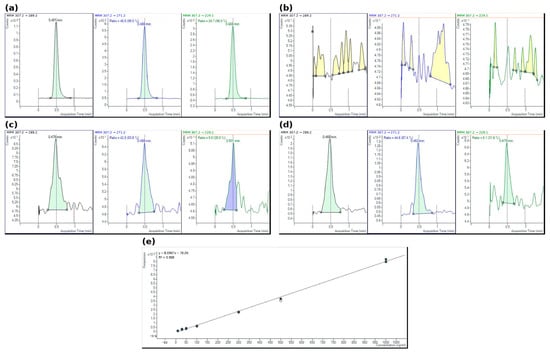
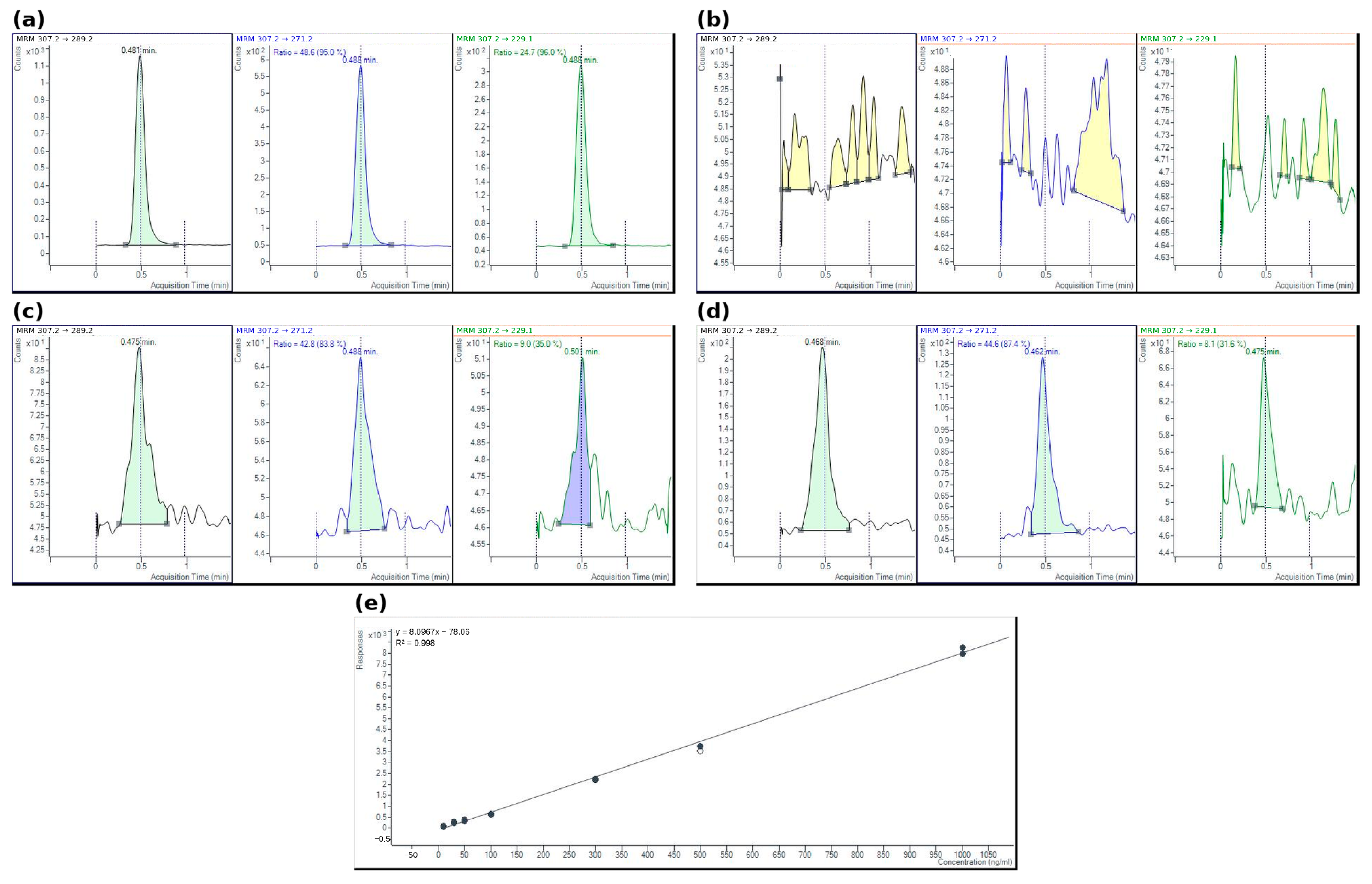
Oxandrolone was considered positively identified when (i) a chromatographic peak was observed within ±0.1 min of the retention time of the reference standard (approximately 0.48 min); and (ii) the quantifier transition (m/z 307.2 → 289.2) and the qualifier transition (m/z 307.2 → 271.2) were both detected. The laboratory-reported acceptance interval for the 271.2/289.2 ion ratio was 40.9–61.3%, whereas the corresponding interval for the 229.1/289.2 ion ratio was 20.6–30.8%. The second qualifier transition (m/z 307.2 → 229.1) was monitored as supporting evidence. In the representative urine samples, the first qualifier ion ratio was within the reported acceptance interval, whereas the second qualifier ion ratio was below its corresponding interval. The laboratory indicated that variability in the urine matrix may contribute to these deviations; however, matrix effects were not formally evaluated. Representative chromatograms of a calibration standard, blank urine, and positive urine samples are shown in Figure 1.
Figure 1.
Representative MRM chromatograms of oxandrolone (m/z 307.2 → 289.2, quantifier; 307.2 → 271.2 and 307.2 → 229.1, qualifiers): (a) calibration standard prepared in blank urine; (b) pooled blank urine from six individuals (shaded areas correspond to baseline noise integrated automatically by the software); (c) positive urine sample with a low oxandrolone signal; (d) positive urine sample with a high oxandrolone signal. (e) Calibration curve of oxandrolone (10–1000 ng/mL; y = 8.0967x − 78.06; R2 = 0.998); the open symbol indicates the replicate excluded from the regression.
Quantification was performed by external calibration using the quantifier transition. Calibration standards at seven concentration levels (10, 30, 50, 100, 300, 500, and 1000 ng/mL) were prepared in blank urine and injected in duplicate. The response was linear over this range (unweighted linear regression: y = 8.0967x − 78.06; R2 = 0.998; Figure 1e), which defined the analytical range of the method (10–1000 ng/mL). Data were acquired and processed with MassHunter Workstation Acquisition and MassHunter Quantitative Analysis software (Agilent Technologies, Santa Clara, CA, USA).
Selectivity was assessed using a pool of blank urine from six different individuals, in which no interfering peak meeting the identification criteria was observed at the retention time of oxandrolone (Figure 1b). Potential interference from structurally related steroids was not evaluated. Analytical precision was assessed by repeated injections, with coefficients of variation below 3%; recovery and matrix effects were not formally evaluated.
The limit of detection (LOD), defined as the concentration producing a signal-to-noise ratio of 3 for the quantifier transition, was 3 ng/mL, and the limit of quantification (LOQ) was 10 ng/mL, corresponding to the lowest calibration level. Additional testing at the reported LOQ of 10 ng/mL yielded a coefficient of variation of 1.1257% for the analytical response. Concentrations below the LOQ were reported as <LOQ in descriptive tables and were assigned a value of LOQ/2 (5 ng/mL) for statistical analyses; throughout the manuscript, samples with concentrations at or above the LOQ are referred to as detectable. Since all inferential analyses were rank-based, the results were unaffected by the specific value assigned to samples below the LOQ, provided that the same value was used for all such samples and remained below the lowest quantified concentration (33.66 ng/mL). This was confirmed in a sensitivity analysis in which these samples were assigned 0, LOQ/2, or LOQ/√2, which yielded identical test statistics and p-values.
2.5. Anthropometric Assessment
Height and weight were measured using standardized procedures. Body mass index (BMI) was calculated as weight (kg) divided by height squared (m2). Height-for-age (HAZ) and BMI-for-age (BAZ) z-scores were calculated with the WHO 2007 Growth Reference for children and adolescents aged 5–19 years [28] using the anthroplus R package. Stunting was defined as HAZ < −2, thinness as BAZ < −2, overweight as BAZ > +1, and obesity as BAZ > +2 [28]. Because only age in completed years was recorded, age in months at the anthropometric assessment (March 2023) was approximated from the age recorded in July 2023, assuming that birthdays were evenly distributed across the year.
2.6. Statistical Analysis
Descriptive statistics were calculated for demographic and anthropometric variables. Continuous variables were assessed for normality using the Shapiro–Wilk test. Because oxandrolone concentrations were not normally distributed and contained a high proportion of non-detectable values, non-parametric statistical methods were applied. Continuous anthropometric variables were summarized as medians and interquartile ranges (IQR). Urinary oxandrolone concentrations were summarized as the 25th, 50th (median), and 75th percentiles and maximum values, together with the number and percentage of samples with detectable concentrations at each sampling period; a percentile was reported as <LOQ when the proportion of non-detectable samples in the group was equal to or greater than that percentile.
To evaluate differences across the three time points, the Friedman test for repeated measures was used. When the Friedman test was statistically significant, pairwise comparisons were conducted using Conover’s all-pairs test for unreplicated blocked designs, with Bonferroni adjustment for three comparisons; for strata with a non-significant Friedman test, pairwise results are reported for completeness only and were not interpreted. Effect size was estimated using Kendall’s W (W = χ2/[n(k − 1)], where n is the number of children and k = 3 sampling periods), with values interpreted as follows: 0.1 = small effect; 0.3 = moderate effect; and ≥0.5 = large effect. Comparisons were stratified by sex and age group (7–8, 9–11, and 12–14 years) [29]. Changes in the proportion of children with detectable oxandrolone across the three sampling periods were assessed with Cochran’s Q test, and differences in detection frequency and detection patterns by sex and age group with Fisher’s exact test.
Spearman correlation coefficients were calculated to assess associations between oxandrolone concentrations and age, weight, height, and BMI. Because 12 correlations were examined (four anthropometric variables at three sampling periods), p-values were additionally adjusted using the Benjamini–Hochberg false discovery rate procedure. Anthropometric measurements obtained in March 2023 were used for all sampling periods, and BMI was calculated from the measured weight and height. All statistical analyses were performed in R (version 4.3.3; R Foundation for Statistical Computing, Vienna, Austria) using the PMCMRplus (version 1.9.12) and anthroplus (version 1.1.0) packages, and the Friedman test results were cross-checked in JASP (version 0.95.3). All tests were two-sided, and statistical significance was defined as p < 0.05.
3. Results
3.1. Participant Characteristics
The study included 60 children, of whom 35 (58.3%) were girls. By age group, 15 (25.0%) were aged 7–8 years, 27 (45.0%) were aged 9–11 years, and 18 (30.0%) were aged 12–14 years. Most participants attended elementary school (47, 78.3%), while 13 (21.7%) attended secondary school. The median age was 11 years (IQR 8.25–12.00), with a median weight of 28 kg (IQR 24–38) and a median height of 1.33 m (IQR 1.24–1.45). According to the WHO 2007 Growth Reference, 56 (93.3%) children had normal height-for-age and 4 (6.7%) were stunted, all of them boys (p = 0.026). For BMI-for-age, 54 (90.0%) had normal BMI, 4 (6.7%) were overweight, 2 (3.3%) had thinness, and none were obese (Table 1).
Table 1.
Demographic and anthropometric characteristics of participants overall and by sex (n = 60).
3.2. Urinary Oxandrolone Concentrations
Table 2 summarizes the distribution of urinary oxandrolone concentrations across the three sampling periods. Oxandrolone was detected in 25 (41.7%), 25 (41.7%), and 34 (56.7%) of the 60 children in March 2023, September 2023, and June 2024, respectively; the proportion of children with detectable concentrations did not differ significantly across periods (Cochran’s Q = 3.86, p = 0.145). In March and September 2023, median concentrations were below the limit of quantification (LOQ) for both sexes, although quantifiable values were observed in the upper percentiles. In June 2024, the overall median concentration was 96.07 ng/mL (69.28 ng/mL in males and 113.20 ng/mL in females). When stratified by age group, the 12–14-year group had the lowest detection frequency in September 2023 (2/18; 11.1%) and the highest median concentration in June 2024 (114.63 ng/mL).
Table 2.
Urinary oxandrolone concentrations by sex and age group across sampling periods (ng/mL).
3.3. Temporal Variation in Oxandrolone Concentrations
Temporal changes in oxandrolone concentrations are summarized in Table 3. The Friedman test indicated a significant overall difference across the three sampling periods (χ2 = 13.99, p < 0.001, Kendall’s W = 0.117, small effect). Bonferroni-adjusted Conover post hoc comparisons showed that concentrations in June 2024 were significantly higher than in March 2023 (p = 0.020) and September 2023 (p < 0.001), whereas March and September 2023 did not differ (p = 0.863). These results were identical when non-detectable values were assigned 0 or LOQ/√2.
Table 3.
Friedman Test and Bonferroni-Adjusted Conover Post Hoc Comparisons of Oxandrolone Concentrations Across Three Time Points, Overall and Stratified by Sex and Age Group. (A) Friedman test results; (B) Bonferroni-adjusted Conover post hoc comparisons.
When stratified by sex, no significant temporal differences were observed among males (p = 0.274), whereas females showed significant variation across measurements (χ2 = 12.61, p = 0.002, W = 0.180), with higher concentrations in June 2024 than in March 2023 (p = 0.028) and September 2023 (p = 0.001). Age-stratified analyses showed no significant temporal variation in the 7–8- and 9–11-year age groups (p = 0.441 and p = 0.156, respectively; no pairwise comparison was significant), but a significant difference in the 12–14-year age group (χ2 = 15.89, p < 0.001, W = 0.441), explained by lower concentrations in September 2023 than in March 2023 (p = 0.027) and June 2024 (p < 0.001); the difference between March 2023 and June 2024 was not significant (p = 0.066).
Spearman correlation analysis showed weak negative correlations between oxandrolone concentrations and anthropometric variables during the September 2023 measurement. Weight (ρ = −0.304, p = 0.018) and height (ρ = −0.313, p = 0.015) were negatively associated with oxandrolone levels, whereas the associations with age (ρ = −0.254, p = 0.050) and BMI (ρ = −0.247, p = 0.057) had p-values close to 0.05. None of these associations remained significant after Benjamini–Hochberg correction for the 12 correlations examined (all adjusted p ≥ 0.108).
No statistically significant correlations were observed for the March 2023 or June 2024 measurements (Table 4).
Table 4.
Correlation of oxandrolone concentrations with anthropometric variables by measurement period.
Patterns of oxandrolone detection across sampling periods did not differ significantly when stratified by sex (p = 0.950) or age group (p = 0.079) (Table 5). The proportion of children with detectable oxandrolone at each sampling period did not differ by sex; by age group, it differed only in September 2023, when detection was lowest among 12–14-year-olds (11.1% vs. 53.3% and 55.6% in the 7–8- and 9–11-year groups; p = 0.006). Within strata, the proportion of detectable samples changed significantly across periods only in the 12–14-year group (Cochran’s Q = 13.29, p = 0.001).
Table 5.
Patterns and frequency of urinary oxandrolone detection by sex and age group. (A) Patterns of urinary oxandrolone detection across sampling periods. Values are n (%); (B) Frequency of urinary oxandrolone detection at each sampling period. Values are n (%).
4. Discussion
This study provides exploratory evidence of the presence of oxandrolone in children residing in a subsistence fishing community, despite the absence of reported therapeutic use. Urinary concentrations exhibited temporal variation across sampling periods; this variation was statistically significant among girls and among 12–14-year-olds, but not among boys or younger children. These findings are notable given the limited human biomonitoring data available for anabolic steroids outside clinical settings and raise concerns about potential environmental exposure pathways in vulnerable pediatric populations. The detection of oxandrolone in children without known medical exposure is consistent with the hypothesis that synthetic steroids present in aquatic environments may reach human populations through indirect routes [13]. However, no environmental or dietary samples were analyzed in the present study, and urinary detection alone does not establish exposure through the aquatic environment.
Friedman tests with Bonferroni-adjusted Conover post hoc comparisons showed significant temporal variation in oxandrolone concentrations, although the overall effect size was small (Kendall’s W = 0.117). In the overall sample and among girls, concentrations in June 2024 were significantly higher than in both March 2023 (p = 0.020 and p = 0.028, respectively) and September 2023 (p < 0.001 and p = 0.001), whereas March and September 2023 did not differ. In the 12–14-year group, the variation was mainly driven by lower concentrations in September 2023, when oxandrolone was detected in only 2 of 18 children, while the difference between March 2023 and June 2024 did not reach significance after adjustment (p = 0.066). Notably, the proportion of children with detectable oxandrolone did not change significantly across periods in the overall sample (Cochran’s Q, p = 0.145), indicating that statistically differences in urinary concentrations were observed, whereas changes in the overall frequency of detection were not statistically significant.
According to de Aquino et al. [30], pharmaceutical compounds from diverse therapeutic classes are classified as Contaminants of Emerging Concern (CEC), primarily originating from the excretion of synthetic hormones by humans and animals into aquatic environments. These substances are typically detected at trace concentrations (ng/L to μg/L), and are therefore often referred to as micropollutants. There is currently no consensus regarding safe exposure thresholds, particularly given their potential role as Endocrine Disrupting Compounds (EDCs) affecting both ecosystems and human health. Conventional wastewater treatment plants remove only a limited fraction of these contaminants [30,31], which constitutes a public health concern in regions with insufficient treatment capacity. In Jalisco, Mexico, only 87 of 231 wastewater treatment plants are reported to be fully operational [32]. Furthermore, approximately 64% of the water entering Lake Chapala from the Lerma River arrives untreated, transporting effluents from industrial and agricultural activities across multiple Mexican states, in addition to contributions from underperforming or non-operational treatment facilities [33]. This scenario raises concerns about unintended pediatric exposure to pharmaceutical contaminants, including oxandrolone, through unidentified environmental pathways, with water representing a plausible exposure route. Notably, approximately 60% of the water supply for the Guadalajara Metropolitan Area originates from Lake Chapala, and study participants reside in communities along its shoreline [16].
Oxandrolone has been detected in surface water, sediments, fish tissue, and otter feces in the Ayuquila–Armería basin, in western Mexico [13]. This basin is a hydrological system different from Lake Chapala; therefore, these findings cannot be directly extrapolated to our study area. They are, nevertheless, similar to previous reports from South China, where steroids were found in aquaculture fish farms with the highest bioaccumulation potential in tilapia tissues [34]. These findings reinforce the classification of oxandrolone as a CEC. This evidence aligns with growing global concern regarding the environmental persistence and ecotoxicological risks associated with pharmaceutical residues, particularly anabolic steroids detected in wastewater systems [35,36,37,38]. In this context, pharmaceuticals may act as endocrine-disrupting compounds when their hormonal activity occurs unintentionally or at supratherapeutic exposure levels, resulting in adverse biological effects [30,39].
Regarding its clinical use, de Mello et al. [31] conducted a systematic review of 24 randomized controlled trials evaluating oxandrolone therapy, with sample sizes ranging from 22 to 235 participants and age ranges between 6 and 90 years. The included studies involved pediatric and adult patients with burn injuries, wasting associated with human immunodeficiency virus infection, Turner and Klinefelter syndromes, Duchenne muscular dystrophy, alcoholic hepatitis, cachexia, multiple trauma, obesity-related muscle loss, inflammatory myopathies, and spinal cord injury. Oxandrolone was reported as an effective adjunctive treatment in several of these conditions, with therapeutic courses extending up to two years. The oral route is the most common mode of administration, with daily doses ranging from 1.25 to 80 mg, although no consensus exists regarding optimal dosing regimens. Alternative administration routes, including subcutaneous delivery, have been explored to reduce hepatic metabolism and potential adverse effects. Adverse effects are strongly associated with dosage, duration of use, and lack of medical supervision. Due to its high bioavailability, oxandrolone may cause hepatotoxicity, hirsutism, testicular atrophy, and behavioral alterations when improperly administered. Overall, oxandrolone is primarily prescribed for burn management and as an adjunct therapy to promote muscle mass recovery and weight gain following major surgery, chronic infections, or severe trauma [2]. The adverse effects described above correspond to therapeutic or supratherapeutic doses. Because the present study did not assess endocrine parameters, clinical outcomes, or other biological effects, the urinary concentrations observed cannot be associated with adverse health effects on the basis of the available evidence.
Although human exposure to oxandrolone is traditionally associated with intentional or clinical use, the detection of this compound in participants from our study—particularly children without any documented pharmacological history—raises the possibility that environmental exposure may contribute to the observed urinary concentrations. While this hypothesis remains speculative, it highlights the need to integrate environmental surveillance with human biomonitoring approaches to better identify non-therapeutic exposure pathways and assess their potential public health implications [40]. The available data in this study were restricted to urinary measurements on three sampling occasions, limiting the ability to evaluate exposure determinants or potential health effects. Future research should focus on identifying specific exposure sources and clarifying environmental fate across water, soil, air, and food matrices, given that anabolic steroids have been detected in fish tissues [13,34], which may represent a relevant exposure pathway for populations residing in fishing communities in the Lake Chapala region.
Limitations
This study has several limitations that should be considered when interpreting the findings. First, the exploratory design and relatively small sample size limit the generalizability of the results beyond the studied community.
Second, urinary creatinine was not measured, so concentrations could not be adjusted for urine dilution. Although first-morning samples were collected at all sampling periods to reduce this variability, differences in hydration status between participants and between sampling occasions may have influenced the observed concentrations, including the higher values found in June 2024.
Third, the analytical procedure did not include an internal standard, and recovery, matrix effects, and potential interference from structurally related steroids were not formally evaluated. Because sample preparation consisted only of acetonitrile precipitation and oxandrolone eluted early (≈0.48 min), ion suppression or enhancement cannot be excluded. The reference standard was injected in a different analytical sequence from the urine samples, and the ratio of the second qualifier transition (229.1/289.2) was lower in urine samples than in the standard. In addition, only free oxandrolone was measured, without hydrolysis of conjugated metabolites, which may underestimate total urinary excretion.
Fourth, anthropometric data were available only for March 2023 and were used for all sampling periods. Age in months for the WHO z-scores was approximated from age in completed years.
Additionally, information on prior pharmacological exposure was based on parental report, which may be subject to recall bias or underreporting. The study also lacked detailed information on dietary patterns, environmental contact behaviors, and potential occupational exposures within households, limiting the ability to identify specific exposure pathways.
Finally, the observational nature of the study prevents establishing causal relationships between environmental sources and detected oxandrolone levels.
5. Conclusions
This exploratory study provides preliminary evidence of the presence of free oxandrolone in urine samples from children living in a fishing community in the Lake Chapala region who reported no therapeutic use of anabolic steroids. Oxandrolone was detected in 42–57% of the children at each of the three sampling occasions, and concentrations were higher in June 2024 than at the two earlier sampling occasions. These findings indicate differences between sampling occasions but do not establish seasonal variation or continuous exposure. The source of exposure, the reasons for the temporal differences, and the potential health implications remain uncertain, and the urinary concentrations reported here cannot be directly associated with adverse health effects. Further studies incorporating fully validated analytical methods, adjustment for urine dilution, environmental and dietary monitoring, and a more comprehensive exposure assessment are needed to confirm these findings and clarify possible exposure pathways in communities of the Lake Chapala region.
Supplementary Materials
The following supporting information can be downloaded at https://www.mdpi.com/article/10.3390/jox16080231/s1, Table S1: HPLC-MS/MS conditions for the determination of urinary oxandrolone.
Author Contributions
Conceptualization, A.A.P.-L.; methodology, instrumental analysis, A.A.P.-L., F.d.J.L.-K., H.G.-T. and N.G.R.V.-S.; formal analysis, N.R.-C., M.G.H.-G., L.E.D.M.-T. and I.R.R.; data curation, N.R.-C. and M.G.H.-G.; writing—original draft preparation, H.G.-T.; writing—review and editing, N.G.R.V.-S.; supervision, H.G.-T.; project administration, F.d.J.L.-K. All authors have read and agreed to the published version of the manuscript.
Funding
This research received no external funding.
Institutional Review Board Statement
The study was conducted in accordance with the Declaration of Helsinki and was approved by the Ethics Committee of the Centro Universitario de Ciencias de la Salud, Universidad de Guadalajara (Approval No. CI-00823, approval date: 15 December 2022).
Informed Consent Statement
Written informed consent was obtained from the parents or legal guardians of all children involved in the study, and assent was received from each child prior to participation.
Data Availability Statement
The data presented in this study are available on request from the corresponding author. The data are not publicly available due to privacy and ethical restrictions involving data from minors.
Acknowledgments
During the preparation of this work, the authors used Claude Opus 5.5 (Anthropic, San Francisco, CA, USA) solely for language editing, including improving English grammar, spelling, clarity, readability, and overall writing style. ChatGPT (GPT-6, OpenAI, San Francisco, CA, USA) was used to assist in preparing the graphical abstract. No AI-assisted technologies were used to generate scientific content, analyze data, interpret results, or formulate conclusions. The authors reviewed and approved all AI-assisted revisions and take full responsibility for the content of the publication.
Conflicts of Interest
The authors declare no conflicts of interest.
Abbreviations
| AAS | Anabolic Androgenic Steroid |
| BAZ | BMI-for-age z-score |
| BMI | Body Mass Index |
| CEC | Contaminants of Emerging Concern |
| CKDnt | Chronic Kidney Disease of non-traditional origin |
| EDCs | Endocrine Disrupting Compounds |
| ESI | Electrospray Ionization |
| HAZ | Height-for-age z-score |
| HDL | High-Density Lipoproteins |
| HPLC-MS/MS | High-Performance Liquid Chromatography coupled with tandem Mass Spectrometry |
| IQR | Interquartile Range |
| Koc | Organic carbon-water partition coefficient |
| LDL | Low-Density Lipoproteins |
| LOD | Limit of Detection |
| LOQ | Limit of Quantification |
| MRM | Multiple Reaction Monitoring |
| WHO | World Health Organization |
References
- MedlinePlus. Oxandrolona: MedlinePlus Medicinas (Oxandrolone: MedlinePlus Drug Information). Available online: https://medlineplus.gov/spanish/druginfo/meds/a604024-es.html (accessed on 1 October 2025).
- National Center for Biotechnology Information. PubChem Compound Summary for CID 5878, Oxandrolone. Available online: https://pubchem.ncbi.nlm.nih.gov/compound/5878 (accessed on 1 October 2025).
- Ring, J.; Heinelt, M.; Sharma, S.; Letourneau, S.; Jeschke, M.G. Oxandrolone in the Treatment of Burn Injuries: A Systematic Review and Meta-analysis. J. Burn Care Res. 2020, 41, 190–199. [Google Scholar] [CrossRef] [Scilit] [PubMed]
- Li, H.; Guo, Y.; Yang, Z.; Roy, M.; Guo, Q. The efficacy and safety of oxandrolone treatment for patients with severe burns: A systematic review and meta-analysis. Burns 2016, 42, 717–727. [Google Scholar] [CrossRef] [Scilit] [PubMed]
- Kiracofe, B.; Coffey, R.; Jones, L.M.; Bailey, J.K.; Thomas, S.; Porter, K. Incidence of oxandrolone induced hepatic transaminitis in patients with burn injury. Burns 2019, 45, 891–897. [Google Scholar] [CrossRef] [Scilit] [PubMed]
- Burch, P.T.; Spigarelli, M.G.; Lambert, L.M.; Loftus, P.D.; Sherwin, C.M.; Linakis, M.W. Use of Oxandrolone to Promote Growth in Neonates following Surgery for Complex Congenital Heart Disease: An Open-Label Pilot Trial. Congenit. Heart Dis. 2016, 11, 693–699. [Google Scholar] [CrossRef] [Scilit] [PubMed]
- Sheffield-Moore, M.; Urban, R.J.; Wolf, S.E.; Jiang, J.; Catlin, D.H.; Herndon, D.N. Short-Term Oxandrolone Administration Stimulates Net Muscle Protein Synthesis in Young Men. J. Clin. Endocrinol. Metab. 1999, 84, 2705–2711. [Google Scholar] [CrossRef] [Scilit] [PubMed]
- International Agency for Research on Cancer-World Health Organization. Androgenic (Anabolic) Steroids. Available online: https://www.inchem.org/documents/iarc/suppl7/androgenicsteroids.html (accessed on 16 October 2025).
- Salerno, M.; Cascio, O.; Bertozzi, G.; Sessa, F.; Messina, A.; Monda, V. Anabolic androgenic steroids and carcinogenicity focusing on Leydig cell: A literature review. Oncotarget 2018, 9, 19415–19426. [Google Scholar] [CrossRef] [Scilit] [PubMed]
- Geissen, V.; Mol, H.; Klumpp, E.; Umlauf, G.; Nadal, M.; van der Ploeg, M. Emerging pollutants in the environment: A challenge for water resource management. Int. Soil Water Conserv. Res. 2015, 3, 57–65. [Google Scholar] [CrossRef] [Scilit]
- Determinantes Ambientales de Salud—OPS/OMS|Organización Panamericana de la Salud. Available online: https://www.paho.org/es/temas/determinantes-ambientales-salud (accessed on 8 October 2025).
- Leinonen, A.; Kuuranne, T.; Kotiaho, T.; Kostiainen, R. Screening of free 17-alkyl-substituted anabolic steroids in human urine by liquid chromatography–electrospray ionization tandem mass spectrometry. Steroids 2004, 69, 101–109. [Google Scholar] [CrossRef] [Scilit] [PubMed]
- Rodríguez-Aguilar, B.A.; Martínez-Rivera, L.M.; Rojas-Mayorga, C.K.; Ceballos-Magaña, S.G.; Aguayo-Villarreal, I.A.; Muñiz-Valencia, R. Occurrence and temporal distribution of oxandrolone and meclizine in surface water, sediments, fish muscle and otter feces of the Ayuquila-Armería basin, Mexico. Sci. Total Environ. 2023, 895, 165130. [Google Scholar] [CrossRef] [Scilit] [PubMed]
- Kolpin, D.W.; Furlong, E.T.; Meyer, M.T.; Thurman, E.M.; Zaugg, S.D.; Barber, L.B. Pharmaceuticals, hormones, and other organic wastewater contaminants in U.S. streams, 1999–2000: A national reconnaissance. Environ. Sci. Technol. 2002, 36, 1202–1211. [Google Scholar] [CrossRef] [Scilit] [PubMed]
- Heberer, T. Occurrence, fate, and removal of pharmaceutical residues in the aquatic environment: A review of recent research data. Toxicol. Lett. 2002, 131, 5–17. [Google Scholar] [CrossRef] [Scilit] [PubMed]
- Gutiérrez-Nájera, R. El lago de Chapala. In Exclusión Social de la Infancia y Enfermedad Renal en el Lago de Chapala, 1st ed.; Lozano-Kasten, F.J., Ed.; Universidad de Guadalajara: Guadalajara, Mexico, 2021; pp. 33–60. [Google Scholar]
- Lozano-Kasten, F.; Sierra-Diaz, E.; Chavez, H.G.; Peregrina Lucano, A.A.; Cremades, R.; Pinto, E.S. Seasonal Urinary Levels of Glyphosate in Children From Agricultural Communities. Dose Response 2021, 19, 15593258211053184. [Google Scholar] [CrossRef] [Scilit] [PubMed]
- Sierra-Diaz, E.; Celis-de la Rosa, A.J.; Lozano-Kasten, F.; Trasande, L.; Peregrina-Lucano, A.A.; Sandoval-Pinto, E.; Gonzalez-Chavez, H. Urinary Pesticide Levels in Children and Adolescents Residing in Two Agricultural Communities in Mexico. Int. J. Environ. Res. Public Health 2019, 16, 562, Erratum in Int. J. Environ. Res. Public Health 2020, 17, 159. https://doi.org/10.3390/ijerph17010159. [Google Scholar] [CrossRef] [Scilit] [PubMed]
- Intisar, A.; Ramzan, A.; Sawaira, T.; Kareem, A.T.; Hussain, N.; Din, M.I. Occurrence, toxic effects, and mitigation of pesticides as emerging environmental pollutants using robust nanomaterials—A review. Chemosphere 2022, 293, 133538. [Google Scholar] [CrossRef] [Scilit] [PubMed]
- Fausto-Guerra, J. Desnutrición infantil en la comunidad de Agua Caliente, Poncitlán Jalisco. In Exclusión Social de la Infancia y Enfermedad Renal en el Lago de Chapala, 1st ed.; Lozano-Kasten, F.J., Ed.; Universidad de Guadalajara: Guadalajara, Mexico, 2021; pp. 61–76. [Google Scholar]
- Lozano-Kasten, F.J.; Espinoza-García, A.S.; Guzmán-Torres, H.; Celis-de la Rosa, A.; Peregrina-Lucano, A.A.; López-León-Murguía, O.J. Evaluation of the Level of Tungsten in Breast Milk, of Mothers Residing in a Subsistence Community of Fishing and Agriculture, in Lake Chapala, Mexico. Health Sci. Res. 2019, 6, 1–4. [Google Scholar]
- Lozano-Kasten, F.; Sierra-Diaz, E.; de Jesus Celis-de la Rosa, A.; Soto Gutiérrez, M.M.; Peregrina Lucano, A.A. Prevalence of Albuminuria in Children Living in a Rural Agricultural and Fishing Subsistence Community in Lake Chapala, Mexico. Int. J. Environ. Res. Public Health 2017, 14, 1577. [Google Scholar] [CrossRef] [Scilit] [PubMed]
- Ruiz-Velazco, N.G.; Lozano-Kasten, F.J.; Guzman-Torres, H.; Mejía-Sanchez, A.I. Social determinants and chronic kidney disease of undetermined origin in childhood: Its communication and understanding described by families in Lake Chapala, Mexico. Front. Nephrol. 2022, 2, 962887. [Google Scholar] [CrossRef] [Scilit] [PubMed]
- Badillo-Camacho, J.; Reynaga-Delgado, E.; Barcelo-Quintal, I.; del Valle, P.F.Z.; López-Chuken, U.J. Water Quality Assessment of a Tropical Mexican Lake Using Multivariate Statistical Techniques. J. Environ. Prot. 2015, 6, 215–224. [Google Scholar] [CrossRef]
- Ramírez-Sánchez, H.U.; Fajardo-Montiel, A.L. Assessment of Water Quality, Ecological and Health Risks of Inland Water Bodies in Mexico: A Case Study of Lake Chapala. Asian J. Environ. Ecol. 2024, 23, 91–108. [Google Scholar] [CrossRef] [Scilit]
- Smith, C.D.; Jackson, K.; Peters, H.; Herrera Lima, S. Lack of Safe Drinking Water for Lake Chapala Basin Communities in Mexico Inhibits Progress toward Sustainable Development Goals 3 and 6. Int. J. Environ. Res. Public Health 2020, 17, 8328. [Google Scholar] [CrossRef] [Scilit] [PubMed]
- Alvarez-Bobadilla, J.I.; Murillo-Delgado, J.O.; Badillo-Camacho, J.; Barcelo-Quintal, I.D.; del Valle, P.F.Z. Modeling Fate and Transport of Nutrients and Heavy Metals in the Waters of a Tropical Mexican Lake to Predict Pollution Scenarios. Water 2023, 15, 1639. [Google Scholar] [CrossRef] [Scilit]
- de Onis, M.; Onyango, A.W.; Borghi, E.; Siyam, A.; Nishida, C.; Siekmann, J. Development of a WHO growth reference for school-aged children and adolescents. Bull. World Health Organ. 2007, 85, 660–667. [Google Scholar] [CrossRef] [Scilit] [PubMed]
- Legendre, P. Coefficient of concordance. In The SAGE Encyclopedia of Research Design, 2nd ed.; Frey, B.B., Ed.; SAGE Publications: Thousand Oaks, CA, USA, 2022. [Google Scholar] [CrossRef] [Scilit]
- de Aquino, S.F.; Brandt, E.M.F.; Bottrel, S.E.C.; Gomes, F.B.R.; Silva, S.d.Q. Occurrence of Pharmaceuticals and Endocrine Disrupting Compounds in Brazilian Water and the Risks They May Represent to Human Health. Int. J. Environ. Res. Public Health 2021, 18, 11765. [Google Scholar] [CrossRef] [Scilit] [PubMed]
- de Mello Gindri, I.; Almeida, G.; Saraiva, C.; Ferrari, G.; Dallacosta, D. The safety and effectiveness of oxandrolone on different clinical conditions: A systematic review. Endocr. Metab. Sci. 2025, 18, 100246. [Google Scholar] [CrossRef] [Scilit]
- Jalisco: Municipios Abandonan Plantas de Tratamiento. Available online: https://www.informador.mx/jalisco-municipios-abandonan-plantas-de-tratamiento-l202602200001.html (accessed on 20 February 2026).
- Fajardo-Montiel, L.; Ramirez-Sanchez, H.U.; Rincon Alvarado, J. Evolution of Wastewater Treatment Plants in Lake Chapala, Mexico (2011–2024). Asian J. Environ. Ecol. 2025, 24, 27–51. [Google Scholar] [CrossRef] [Scilit]
- Liu, S.; Xu, X.R.; Qi, Z.H.; Chen, H.; Hao, Q.W.; Hu, Y.X. Steroid bioaccumulation profiles in typical freshwater aquaculture environments of South China and their human health risks via fish consumption. Environ. Pollut. 2017, 228, 72–81. [Google Scholar] [CrossRef] [Scilit] [PubMed]
- López-Serna, R.; Jurado, A.; Vázquez-Suñé, E.; Carrera, J.; Petrović, M.; Barceló, D. Occurrence of 95 pharmaceuticals and transformation products in urban groundwaters underlying the metropolis of Barcelona, Spain. Environ. Pollut. 2013, 174, 305–315. [Google Scholar] [CrossRef] [Scilit] [PubMed]
- Yu, X.; Yu, F.; Li, Z.; Zhan, J. Occurrence, distribution, and ecological risk assessment of pharmaceuticals and personal care products in the surface water of the middle and lower reaches of the Yellow River (Henan section). J. Hazard. Mater. 2023, 443, 130369. [Google Scholar] [CrossRef] [Scilit] [PubMed]
- Osuoha, J.O.; Anyanwu, B.O.; Ejileugha, C. Pharmaceuticals and personal care products as emerging contaminants: Need for combined treatment strategy. J. Hazard. Mater. Adv. 2023, 9, 100206. [Google Scholar] [CrossRef] [Scilit]
- Yazdan, M.M.S.; Kumar, R.; Leung, S.W. The Environmental and Health Impacts of Steroids and Hormones in Wastewater Effluent, as Well as Existing Removal Technologies: A Review. Ecologies 2022, 3, 206–224. [Google Scholar] [CrossRef] [Scilit]
- Schug, T.T.; Johnson, A.F.; Birnbaum, L.S.; Colborn, T.; Guillette, L.J.; Crews, D.P. Endocrine Disruptors: Past Lessons and Future Directions. Mol. Endocrinol. 2016, 30, 833–847. [Google Scholar] [CrossRef] [Scilit] [PubMed]
- Thirumalai, A.; Anawalt, B.D. Androgenic Steroids Use and Abuse. Urol. Clin. N. Am. 2022, 49, 645–663. [Google Scholar] [CrossRef] [Scilit] [PubMed]

Disclaimer/Publisher’s Note: The statements, opinions and data contained in all publications are solely those of the individual author(s) and contributor(s) and not of MDPI and/or the editor(s). MDPI and/or the editor(s) disclaim responsibility for any injury to people or property resulting from any ideas, methods, instructions or products referred to in the content. |
© 2026 by the authors. Licensee MDPI, Basel, Switzerland. This article is an open access article distributed under the terms and conditions of the Creative Commons Attribution (CC BY) license.