


Abstract
Isometamidium chloride (ISM) is a widely used trypanocidal drug for treating animal trypanosomiasis, despite concerns about toxicity, and emerging drug resistance. A comprehensive in silico evaluation integrating molecular interaction analysis, pharmacokinetic profiling, toxicity prediction, and molecular dynamics simulations has not yet been reported. Owing to the unavailability of a crystal structure for Trypanosoma evansi, the co-crystal structure of the catalytic domain of thymidine kinase from T. brucei (5FUW, 2.20 Å) was used for computational studies. ISM exhibited strong binding affinity and stable protein–ligand interactions throughout a 100 ns MD simulation. ADMET analysis predicted high gastrointestinal absorption, potential CYP-mediated interactions, and toxicity risks. Compared with QS, ISM showed better drug likeness, complete compliance with Lipinski’s rule, and a higher predicted bioavailability score. Collectively, these findings demonstrate that although ISM possesses favorable target affinity, its pharmacokinetic and safety limitations warrant structural optimization and safer formulation strategies for improved trypanocidal therapy.
1. Introduction
Animal trypanosomiasis is a major parasitic disease that affects livestock productivity across sub-Saharan Africa, Asia, and parts of Latin America, causing significant economic losses from anemia, infertility, reduced milk production, weight loss, and death [1,2]. The disease is caused by several species in the genus Trypanosoma, including T. congolense, T. vivax, various subspecies of T. brucei, and T. evansi. However, controlling the insect vectors that transmit these parasites is often difficult due to practical constraints. As a result, drug treatment (chemotherapy) remains the most feasible and widely adopted approach for managing the disease in endemic regions. Therefore, the ongoing effectiveness and safety of available trypanocidal drugs are critically important.
The chemotherapeutic management of animal trypanosomiasis relies on a very limited number of legacy drugs introduced decades ago. Among these, isometamidium chloride (ISM) and quinapyramine sulfate (QS) remain widely used in veterinary practice for their cost-effectiveness and broad-spectrum trypanocidal activity [3]. However, prolonged use has led to increasing reports of treatment failure and reduced drug responsiveness. Field-based studies have documented resistance to commonly used trypanocides, underscoring resistance as a major challenge for sustainable disease control programs [4].
ISM is a cationic trypanocide used for the treatment of the infection. Experimental studies have shown that ISM preferentially accumulates in the kinetoplast DNA (kDNA) of trypanosomes, leading to mitochondrial dysfunction and parasite death [5,6]. However, the same physicochemical properties that make it effective against parasites are also associated with host cell toxicity, which limits its therapeutic window. Strong experimental evidence supports DNA interaction-mediated toxicity of ISM [7].
QS, a quinoline–pyrimidine trypanocide used against T. evansi, is often administered alone or in prosalt formulations. Compared with ISM, quinapyramine has distinct physicochemical properties, including greater molecular flexibility and a different charge distribution, which can influence its pharmacokinetic behavior and interactions with biological targets. However, its clinical use is limited by dose-dependent side effects, including toxicity at higher doses, underscoring the need for improved safety profiling [8,9,10].
In recent years, in silico methods have evolved beyond traditional molecular docking to include machine learning (ML)-based predictive models, as well as MD simulations for analyzing interactions over time. These advanced computational tools enable the integration of physicochemical properties and absorption, distribution, metabolism, excretion, and toxicity (ADMET) endpoints [11,12]. The computational evaluation of QS in the recently published study, focusing on toxicity, mutagenicity risk, multi-parameter ADMET, and pharmacokinetics, offers a modern in silico safety profile of QS [10]. To our knowledge, this is the first study to evaluate the therapeutic potential and toxicity profile of ISM. The study aims to use modern in silico tools (1) to assess ADMET features, toxicity risks, and safety of ISMs, providing a blueprint for rational optimization. Further, we address the research questions: (2) How do ISM and QS differ in their predicted binding affinity and interaction profiles with target proteins? (3) What are the key differences in their physicochemical and pharmacokinetic properties that could affect their safety and efficacy? (4) What are the potential toxicity risks predicted using ML-based tools?
2. Materials and Methods
2.1. Molecular Property and Physicochemical Analysis
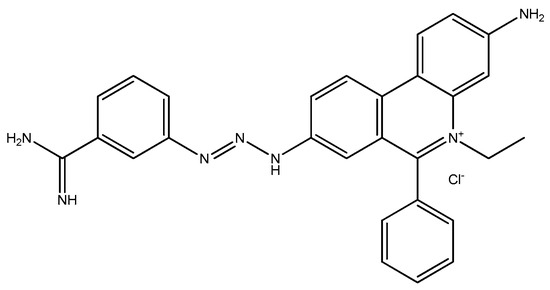
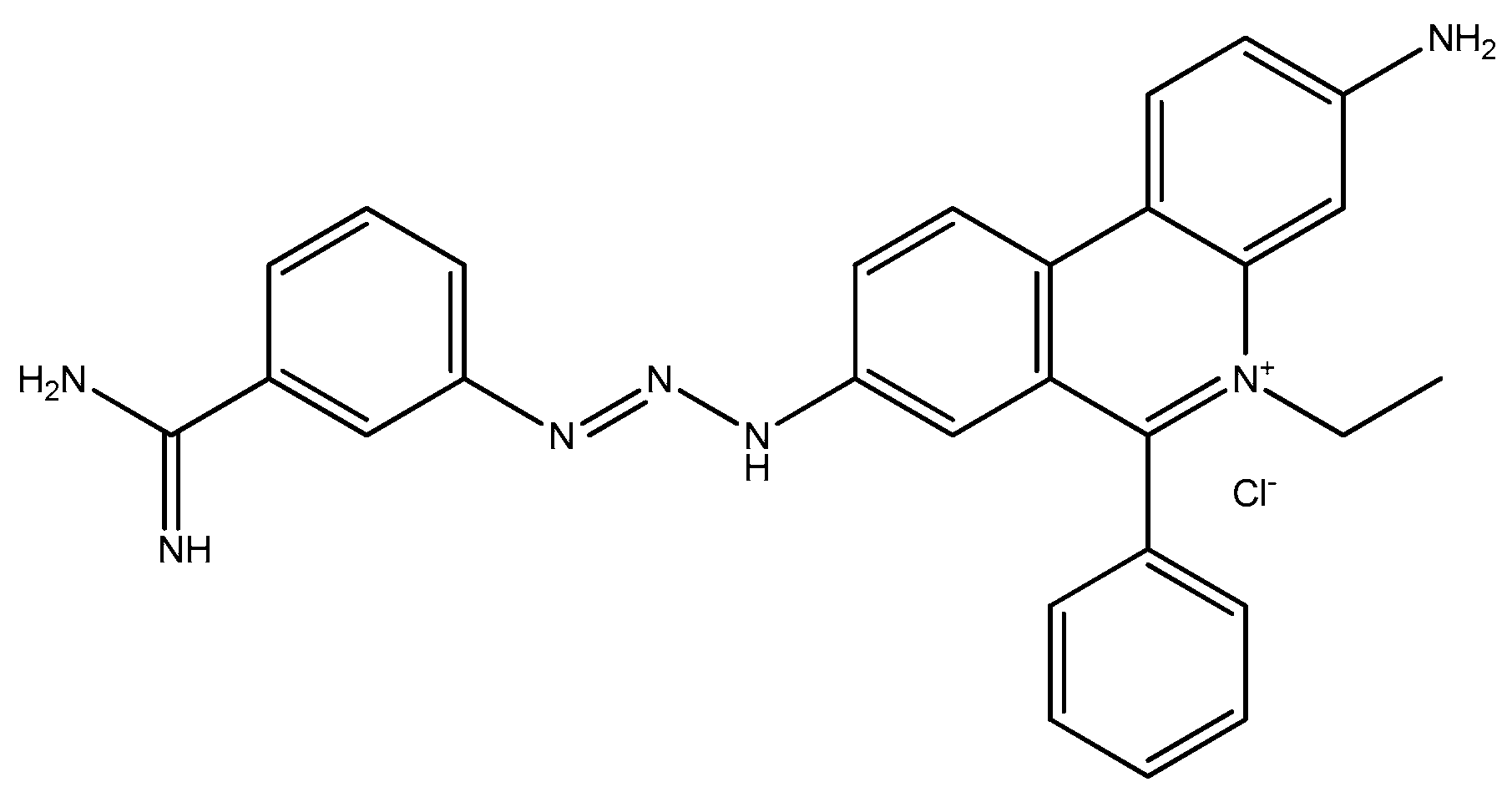
ISM is a veterinary trypanocidal drug widely used for the treatment and prophylaxis of animal trypanosomiasis, as shown in Figure 1 [7]. It is a planar, aromatic structure with a strong positive charge that enhances electrostatic and π–π interactions with negatively charged biological macromolecules, especially nucleic acids. Key molecular descriptors, including molecular weight (MW), aromaticity, fraction of Csp3, hydrogen-bond donors (HBD) and acceptors (HBA), rotatable bonds, molar refractivity (MR), and topological polar surface area (TPSA), were calculated using SwissADME (2024 version; developed by SIB Swiss Institute of Bioinformatics; Lausanne; Switzerland) and related tools. These parameters help assess structural complexity, polarity, and potential bioavailability [13,14].
Figure 1.
Isometamidium chloride structure.
2.2. Docking Experiments
2.2.1. Receptor Preparation
Since the PDB of T.evansi was not available, the co-crystallized structure of T. brucei (PDB ID: 5FUW, co-crystallized ligand: QBT, XYZ coordinates: −16.7547, −23.2847, −2.02167) was used. The T. brucei protein (5FUW) was selected due to its 89% protein sequence homology with T. evansi’s catalytic domain, as explained in our previous study, ensuring biological relevance [10]. Missing residues were modeled, hydrogen atoms were added, water molecules were removed, and Gasteiger charges were assigned [15]. The catalytic pocket was defined using the coordinates of the co-crystallized ligand.
2.2.2. Ligand Preparation
The 2D structure of ISM was converted to a 3D conformation and energy-minimized using the MMFF94 force field [16]. The optimized structure was then converted to PDBQT format for docking. Hydroxychloroquine (HCQ) was used as the reference drug due to its well-established molecular structure, relevant aromatic and ionizable features supporting molecular interactions, and previously reported anti-trypanosomal activity [17]. Therefore, HCQ was considered a suitable comparative reference for the present computational analysis. The docking performance of ISM was evaluated in comparison with QS and HCQ (reference drug).
2.2.3. Docking Procedure
Docking simulations were performed using PyRx (version 0.8; Sargis Dallakyan, The Scripps Research Institute, La Jolla, CA, USA) and visualized with Discovery Studio Visualizer (BIOVIA Discovery Studio Visualizer 2024; Dassault Systèmes BIOVIA; San Diego, CA, USA) [18]. The grid box was centered on the co-crystallized QBT ligand within the catalytic pocket, with a 4 Å margin. The best binding poses were selected based on the lowest binding energy and interaction profile.
2.3. Molecular Dynamics Simulation
The best docked pose of ISM was selected for MD simulation using GROMACS 2021.1 (GROMACS Development Team; Stockholm, Sweden) (https://www.gromacs.org/) to assess the stability of the protein–ligand complex under physiological conditions [19,20]. Input files were generated with the Solution Builder module of the CHARMM-GUI (University of Kansas; Lawrence, KS, USA) (https://www.charmm-gui.org/) web server [21]. The protein–ligand complex was solvated in a TIP3P water box, and sodium and chloride ions were added to neutralize the system.
Energy minimization was performed using the steepest descent algorithm for 5000 steps to remove unfavorable steric contacts. Subsequently, the system was equilibrated under NVT (no. of particles, volume and temperature) and NPT (no. of particles, volume and pressure) conditions at 310.15 K with the CHARMM36m force field. Following equilibration, a 100 ns production MD simulation was conducted to investigate the conformational stability and dynamic behavior of the complex.
The generated trajectories were analyzed using standard structural parameters, including root mean square deviation (RMSD), root mean square fluctuation (RMSF), and radius of gyration (Rg), to assess the stability, flexibility, and compactness of the protein–ligand complex. In addition, principal component analysis (PCA) was performed to characterize the dominant collective motions of the protein during the simulation. PCA is a multivariate statistical method based on the covariance matrix of atomic fluctuations and is widely used to identify large-scale conformational motions while reducing the dimensionality of MD trajectory data [22].
Furthermore, the free energy landscape (FEL) was constructed using RMSD and Rg as reaction coordinates to investigate the thermodynamic stability of the complex [23,24]. The FEL provides information on energetically favorable conformational states and the transitions that occur during the simulation. Low-energy basins correspond to highly populated, stable conformations, whereas higher-energy regions represent less favorable structural states.
2.4. Lipophilicity and Solubility Prediction
Lipophilicity (Log P) was predicted with multiple models (ILOGP, XLOGP3, WLOGP, MLOGP, and SILICOS-IT) to minimize model-specific bias. Aqueous solubility (Log S) was estimated with the ESOL, Ali, and SILICOS-IT models to assess oral absorption potential, given that poor solubility is a common challenge in veterinary drug development [25,26].
2.5. ADMET Data Prediction
Pharmacokinetic parameters, including gastrointestinal absorption, blood–brain barrier permeation, P-glycoprotein interaction, and cytochrome P450 inhibition, were predicted using SwissADME. Toxicity assessment focused on oral toxicity and molecular initiating events, using the ProTox-3.0 platform, which employs AI- based ML models trained on curated toxicological datasets [10,12]. The toxicity classes (Active/Inactive) were reported directly from the ProTox-3.0 output, while the associated probability values were used to indicate prediction confidence. Predictions with probabilities ≥0.7 and <0.7 were interpreted as higher and comparatively lower-confidence predictions, respectively. Although molecular docking was used to evaluate potential interactions, greater emphasis was placed on ML-driven analyses of ADMET and toxicity data. These computational approaches provided insights into pharmacokinetic properties, safety profiles, and potential toxicity risks, thereby supporting a future-oriented framework for trypanocide safety assessment.
3. Results and Discussion
3.1. Docking Analysis
Docking simulations showed that ISM had a stronger binding affinity of −8.4 kcal/mol than QS, which had −5.6 kcal/mol. HCQ, used as a reference compound as shown in Table 1, displayed the strongest binding affinity with −8.8 kcal/mol [10], as indicated by more negative binding energy values. The greater binding stability of ISM can be attributed to its rigid phenanthridinium core, which promotes extensive π–π stacking interactions and electrostatic complementarity within the active site. In contrast, QS demonstrated a comparatively moderate binding affinity, likely due to its more flexible molecular structure, which may reduce the extent of conformational stabilization within the binding pocket.
Table 1.
Comparative molecular docking analysis of ISM, QS and HCQ.
Interaction Analysis
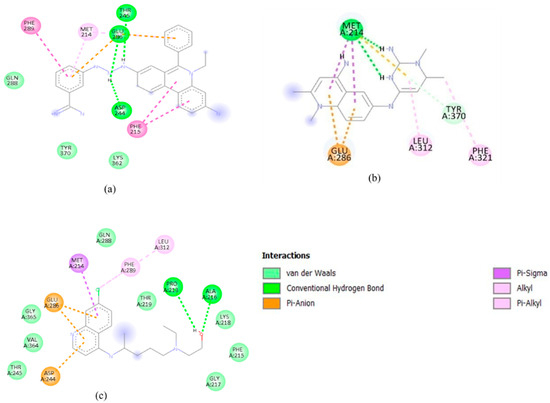
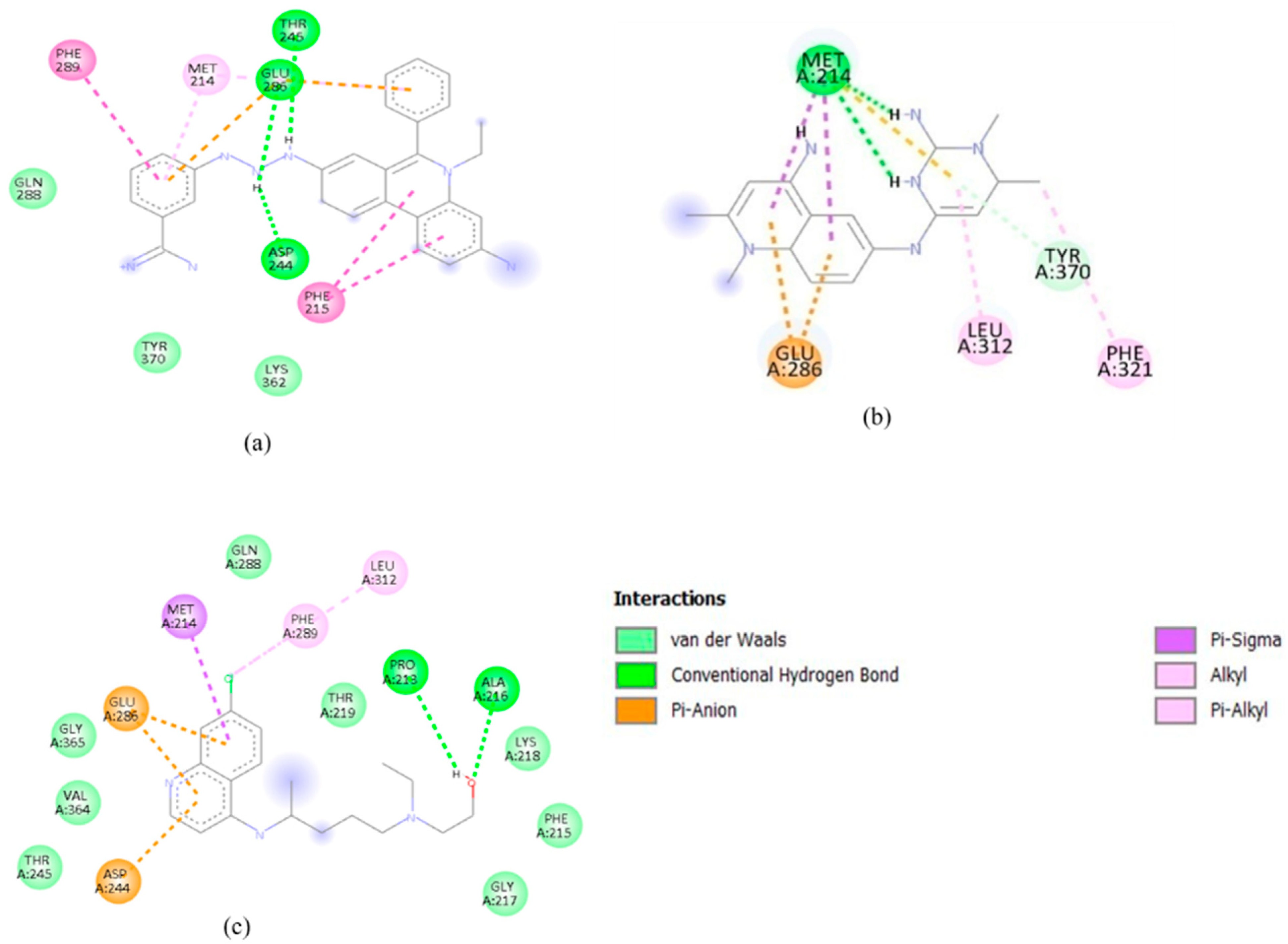
Interaction profiling revealed distinct binding patterns among the three compounds: ISM (A) forms hydrogen bonds with key residues Asp244, Glu286 and Thr245, participates in π–π stacking with Phe289, and makes hydrophobic contacts with Phe215 and Met214 using Discovery Studio, as illustrated in Figure 2. The rigid, planar structure of ISM allows optimal alignment within aromatic-rich binding regions, enhancing binding stability. Its positively charged centers play a crucial role in electrostatic stabilization, especially in environments with negatively charged active sites. However, ISM shows improved aromatic stacking and electrostatic stabilization compared to QS.
Figure 2.
Molecular interaction profiles of (a) ISM, (b) QS, and (c) HCQ with target protein (5FUW), showing key binding interactions. Dashed lines indicate the interactions of the ligand with the key amino acid residues of the receptor.
QS (B) exhibited multiple interactions with key amino acid residues, including Met214, Glu286, Phe321, Tyr370, and Leu312. Compared with ISM, QS exhibited a less favorable predicted binding energy (−5.6 kcal/mol), suggesting weaker predicted binding. It demonstrated a balanced but less extensive interaction network than ISM. Its binding stability mainly relies on hydrogen bonding and moderate hydrophobic interactions rather than extensive aromatic stacking. HCQ (C) showed interactions involving Met214, Glu286, Asp244, Phe289, and Leu312, comprising hydrogen-bond formation, moderate hydrophobic interactions and fewer π–π stacking interactions than ISM, as displayed in Table 2. Thus, HCQ exhibited the most favorable predicted binding energy, followed by ISM, whereas QS showed comparatively weaker binding energy.
Table 2.
Comparative interaction profile of ISM, QS and HCQ.
3.2. MD Trajectory Analysis- RMSD, RMSF and Rg
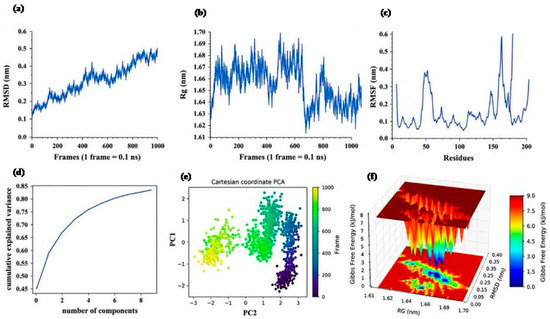
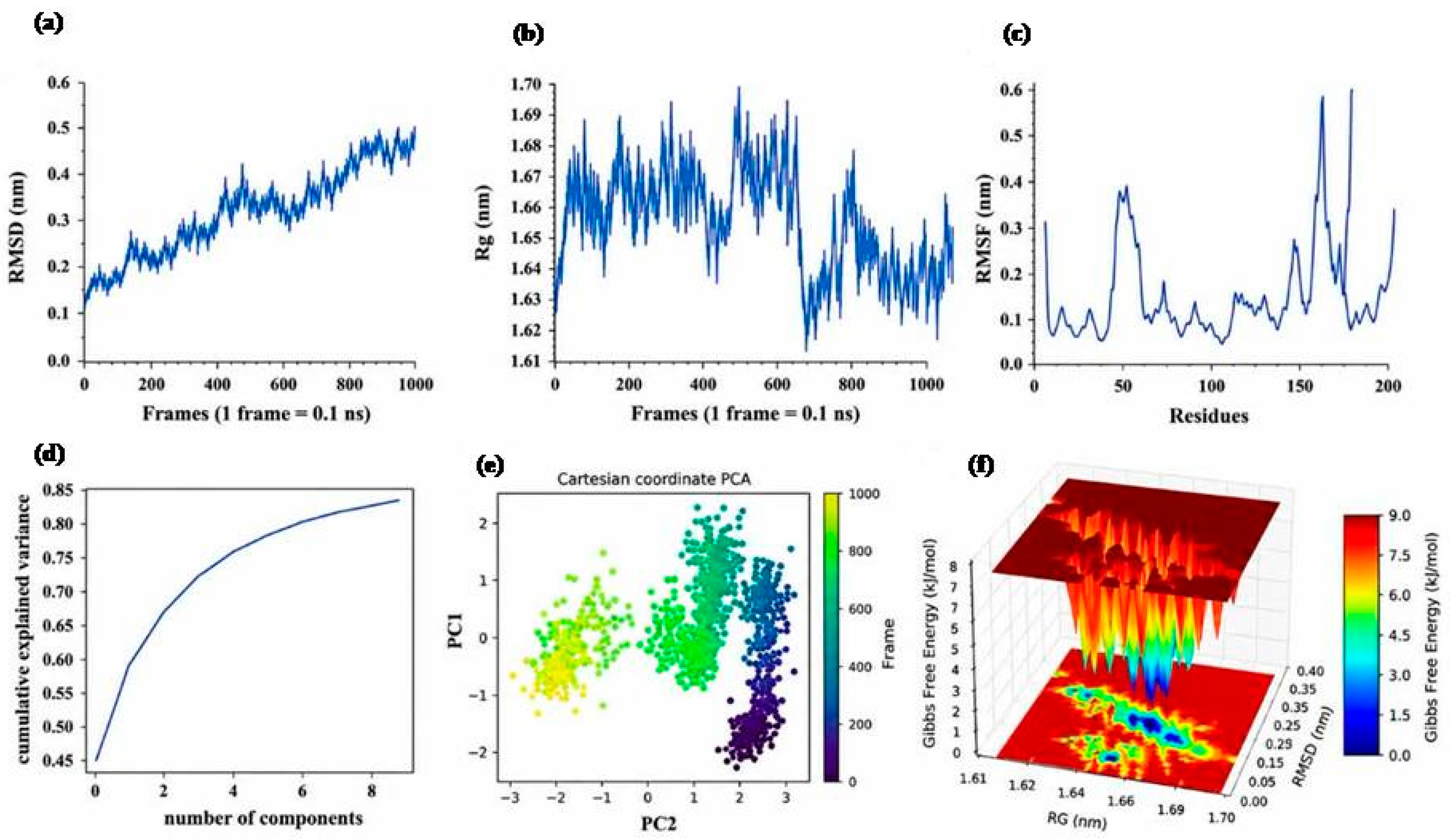
To further validate the docking results and assess the dynamic stability of the protein–ligand complex, a 100 ns molecular dynamics simulation was performed for the ISM–5FUW complex. The RMSD trajectory showed an upward trend during the simulation period, ranging from approximately 0.12 to 0.50 nm with an average of 0.32 nm, indicating that the complex undergoes conformational adjustments before reaching a plateau, as seen in Figure 3. Compared with the previously reported QS complex (0.18–0.42 nm) and HCQ complex (0.20–0.60 nm), the ISM complex exhibited comparable overall fluctuations and reached a stable structural state. Rg varied between 1.61 and 1.70 nm with an average of 1.66 nm, demonstrating preservation of structural compactness and the absence of major unfolding events, despite a slight compaction observed after 650 frames. Residue-wise flexibility analysis revealed low fluctuations across most amino acid residues, with only a few localized peaks around residues 48–55 and a sharp pair of peaks between residues 160–180 reaching up to 0.60 nm, indicating that ligand binding maintained the overall stability of the receptor framework with specific flexible loops. Principal component analysis (PCA) cumulative explained variance showed that the first two components capture over 55% of the total variance, and the motion is mostly accounted for by eight components. The Cartesian coordinate PCA projection showed a structured conformational distribution along the first two principal components, indicating distinct stable conformational states during the simulation period. Similarly, the free energy landscape (FEL) exhibited a well-defined low-energy basin, suggesting the presence of a dominant thermodynamically favorable conformational state during the 100 ns trajectory.
Figure 3.
ISM-5FUW results: (a) RMSD; (b) Rg; (c) RMSF; (d) cumulative explained variance of principal component analysis (PCA) exponential; (e) Cartesian coordinate PCA; (f) free energy landscape.
Previous MD studies on QS and HCQ also reported stable conformational behavior; however, the ISM complex exhibited a more compact conformational distribution and a well-defined energy minimum, indicating enhanced dynamic stability. Collectively, RMSD, RMSF, Rg, PCA, and FEL analyses consistently showed that ISM forms a stable, energetically favorable complex with the target protein throughout the 100 ns simulation, supporting the docking results and indicating that ISM’s rigid aromatic scaffold contributes to stronger, more persistent receptor interactions than QS and HCQ.
3.3. Physicochemical Property Analysis
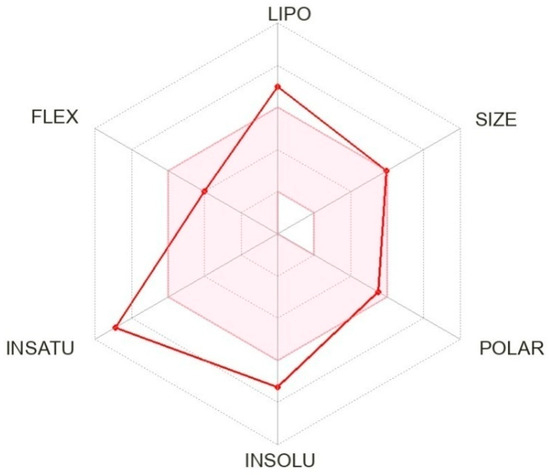
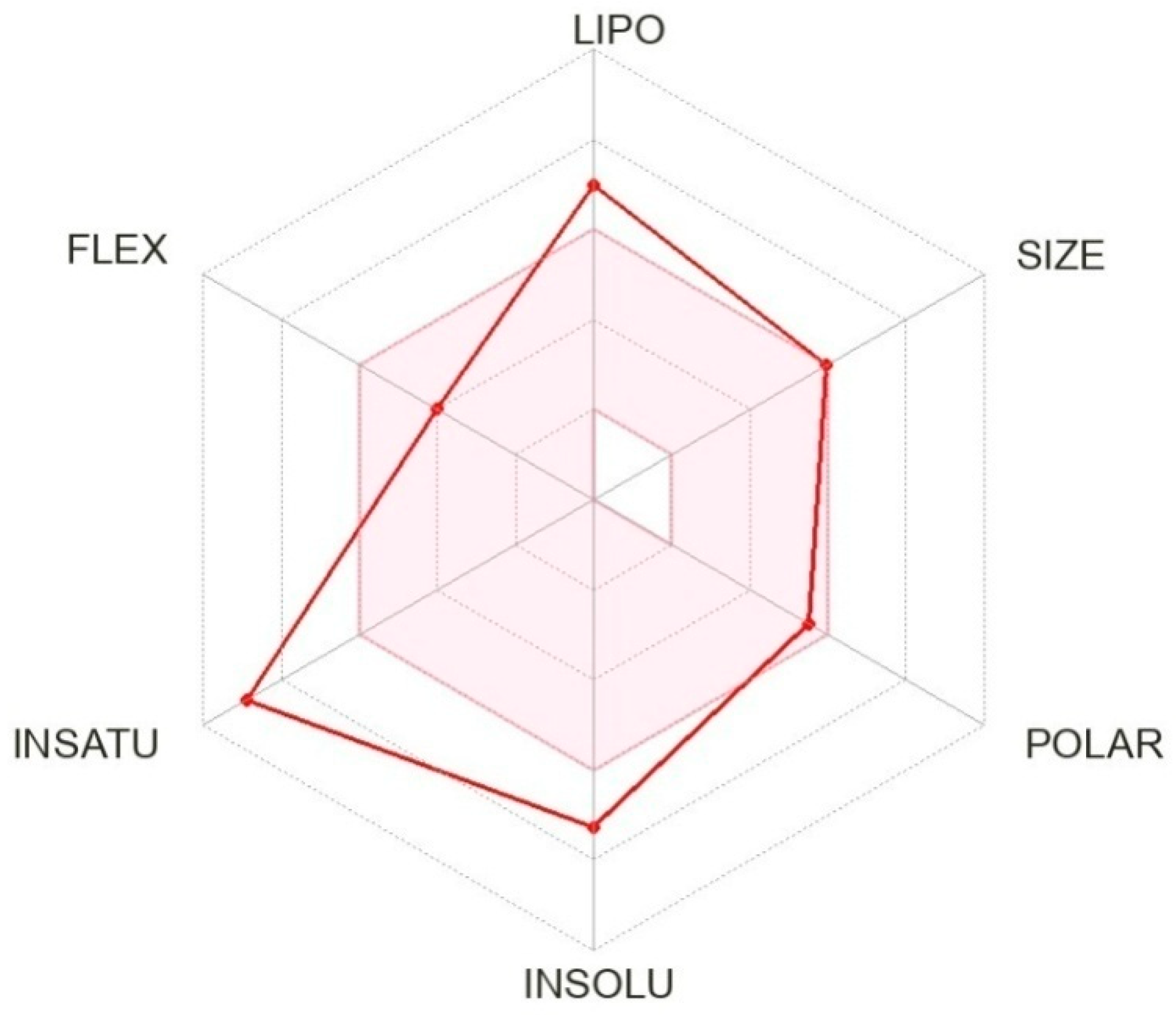
The in silico evaluation of physicochemical properties revealed significant differences between ISM and QS. ISM exhibited high aromaticity and a low fraction of sp3-hybridized carbon atoms, indicating a rigid, planar molecular structure as presented in Figure 4. These features are known to enhance strong π–π stacking and electrostatic interactions with nucleic acids, while also reducing molecular flexibility and permeability. Table 3 illustrates molecular descriptors and physicochemical properties of ISM and QS. It revealed that higher topological polar surface area (TPSA) values further suggest poor membrane permeability of ISM, consistent with established structure–property relationships for cationic aromatic compounds [13].
Figure 4.
The shaded area indicates the ideal physicochemical range for oral bioavailability, while the red line shows the position of the studied drug. LIPO = lipophilicity; SIZE = molecular weight; POLAR = polarity represented by TPSA; INSATU = insaturation indicated by Fraction Csp3; and FLEX = flexibility, based on the number of rotatable bonds.
Table 3.
Molecular descriptors and physicochemical properties of ISM and QS.
In contrast, QS exhibited greater molecular flexibility and lower aromaticity, suggesting distinct interaction patterns with biological macromolecules and potentially improved permeability. Increased molecular flexibility is associated with greater conformational adaptability but may also lead to off-target interactions, which is important for toxicity prediction.
3.4. Lipophilicity and Solubility Prediction
Lipophilicity predictions from multiple computational models (ILOGP, XLOGP3, WLOGP, MLOGP, and SILICOS-IT) as shown in Table 4 indicated that both ISM and QS have suboptimal lipophilicity profiles for oral administration. ISM consistently showed poor aqueous solubility across the ESOL and SILICOS-IT models, a known limitation of highly charged aromatic compounds that directly affects gastrointestinal absorption and systemic exposure [25,27].
Table 4.
Drug-likeness assessment of ISM and QS.
QS showed slightly better predicted solubility than ISM; however, solubility values remained within a low-to-moderate range. Previous computational and experimental studies have emphasized that poor solubility is a key factor in variable pharmacokinetics and therapeutic inconsistency in veterinary trypanocides [28].
3.5. ADMET and Oral Toxicity Profiling
ML-enabled ADMET prediction revealed distinct toxicity risk profiles for ISM and QS. ISM showed high predicted gastrointestinal absorption, no blood–brain barrier permeation, and a tendency to inhibit cytochrome P450 enzymes, indicating potential drug–drug interaction risks as depicted in Table 5. ML-based oral toxicity prediction, as displayed in Table 6, showed ISM in higher toxicity risk categories, reinforcing concerns about its narrow therapeutic margin. These computational toxicity warnings align with previous reports linking aromatic cationic compounds to increased systemic toxicity risk [29].
Table 5.
Predicted pharmacokinetic properties of ISM and QS.
Table 6.
Toxicity comparison of ISM and QS with Tox21 dataset compounds.
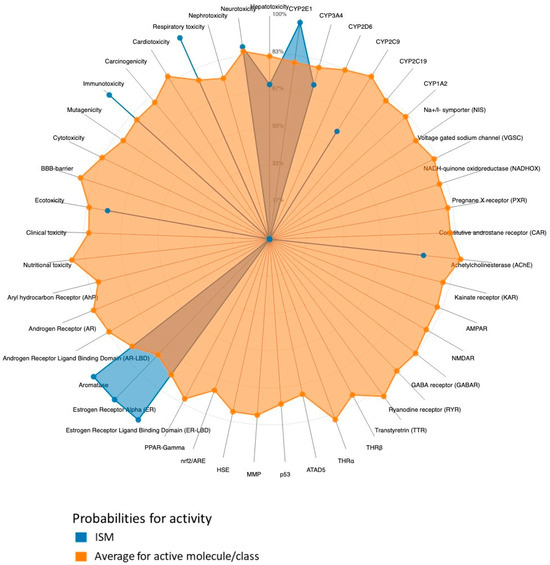
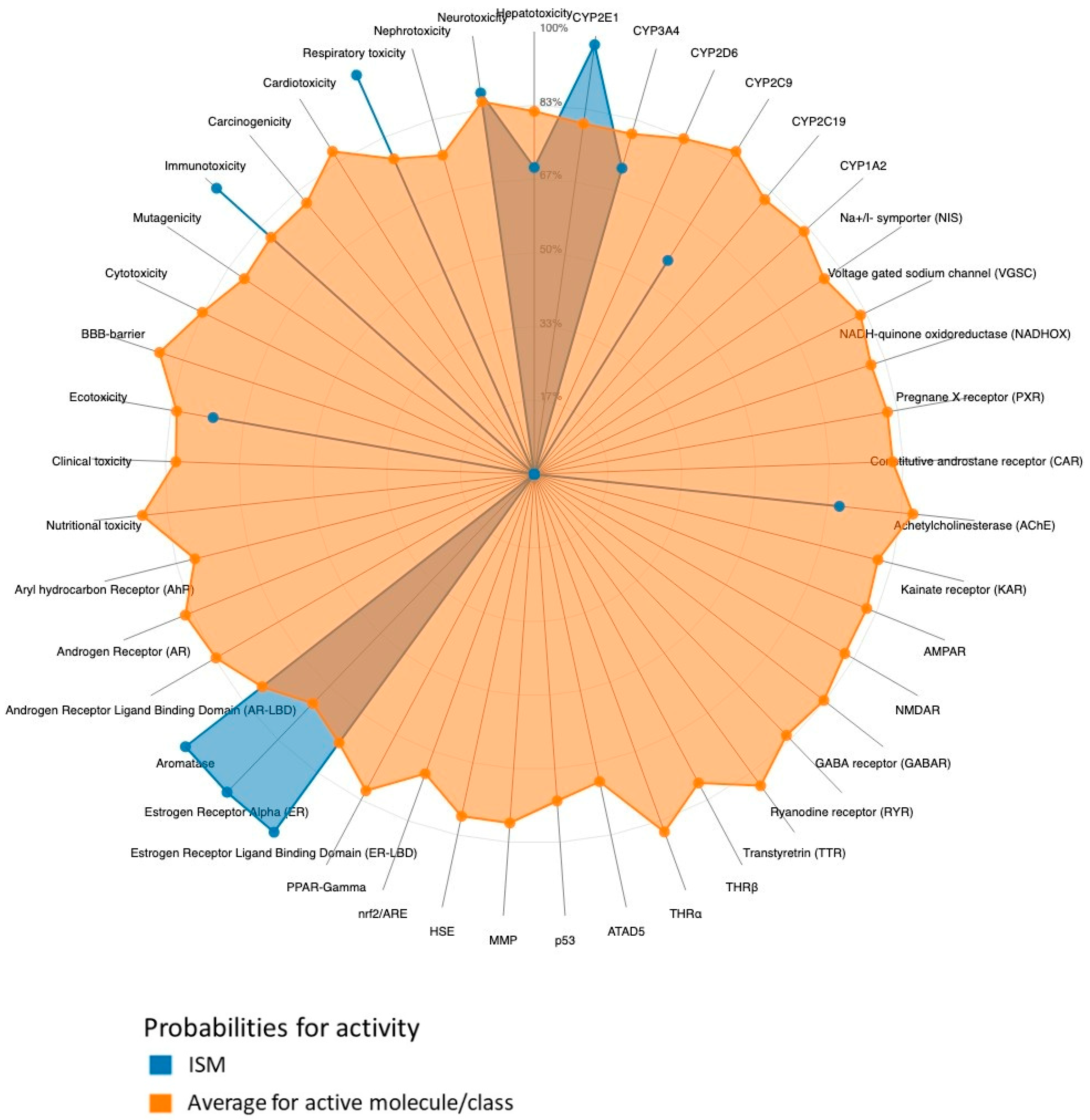
QS showed a unique ADMET profile with predicted warnings for oral toxicity and mutagenicity. The in silico study Batheja et al. (2025) also reported an oral toxicity risk and pharmacokinetic limitations for QS, despite acceptable interaction scores, highlighting that toxicity still limits systemic use [10]. This comparative analysis supports these results and points out safety issues for both compounds. The radar plot in Figure 5 illustrates the comparative toxicity profiles, highlighting variations across multiple biological targets and safety parameters. Although ISM was predicted to be inactive for hepatotoxicity and cytotoxicity, it showed potential toxicity concerns for other endpoints, including neurotoxicity, respiratory toxicity, carcinogenicity, and mutagenicity.
Figure 5.
Toxicity radar chart showing the predicted toxicity profile of ISM compared to other molecules.
An apparent discrepancy was observed between the BBB-related predictions obtained from SwissADME and ProTox-3.0. SwissADME predicted both ISM and QS as non-BBB permeant, whereas ProTox-3.0 classified BBB-barrier toxicity as active for ISM (0.55) and QS (0.64). This difference may reflect variations in the underlying computational models and prediction frameworks. SwissADME’s BOILED-Egg model estimates passive BBB permeation primarily from lipophilicity (WLOGP) and topological polar surface area (TPSA), whereas ProTox-3.0 uses an independently developed ML model based on a distinct training dataset. Thus, “BBB permeant” in Table 5 refers to pharmacokinetic BBB permeability, while “BBB-barrier” in Table 6 represents a separate toxicity endpoint. The Active predictions (0.55 and 0.64) should therefore not be interpreted as direct evidence of BBB permeability or CNS exposure.
3.6. Comparative Assessment of ISM and QS
A direct comparison of ISM and QS revealed that ISM more frequently causes DNA interaction-related toxicity and has poor solubility and better predicted bioavailability, whereas QS exhibits greater physicochemical flexibility but still poses significant risks of oral toxicity and mutagenicity. These results highlight how variations in molecular structure lead to different computational toxicity and pharmacokinetic profiles. Importantly, such in silico comparisons provide mechanistic insights at the molecular-property level without implying experimental causation [30]. Previous studies have reported increased apurinic/apyrimidinic DNA sites in mammalian cells following ISM exposure, confirming its genotoxic potential, while nano-formulation substantially decreased DNA damage [7]. Despite long-term clinical use, the exact molecular mechanisms underlying the efficacy, toxicity, and resistance of both ISM and QS remain incompletely understood. Genetic and genomic studies indicate that resistance is multifaceted and related to changes in how drugs are handled inside cells [31], emphasizing the value of in silico studies as tools to generate hypotheses rather than providing definitive mechanistic explanations.
4. Conclusions
This study demonstrates that ISM exhibits superior target engagement and conformational stability compared with QS. ISM showed a more favorable binding energy (−8.4 kcal·mol−1), formed multiple stabilizing interactions (hydrogen bonds, π–π stacking, hydrophobic contacts) with key active-site residues, and maintained a more stable ISM–protein complex than that of QS. ISM also displayed improved drug-like characteristics, including compliance with Lipinski’s Rule of Five, a lower molecular weight (496.01 g·mol−1), a higher predicted bioavailability score (0.55 versus 0.11 for QS), and was not predicted to be a P-glycoprotein substrate. Despite these favorable findings, ADMET analysis flagged high gastrointestinal absorption, limited pharmacokinetic properties, and potential toxicity. Together, the computational and experimental data indicate that ISM has promising trypanocidal target specificity and binding stability but is limited by suboptimal absorption and safety concerns. Therefore, further development should focus on structural optimization to improve pharmacokinetics and absorption, safer formulation, or targeted delivery strategies to realize ISM’s therapeutic potential.
Author Contributions
Conceptualization, A.M. and B.K.; methodology, S.B. and S.C.; software, S.B., S.C. and S.R.; validation, A.M. and B.K.; formal analysis, S.B. and A.M.; investigation, A.M. and B.K.; resources, A.M.; data curation, A.M., B.K. and R.K.; writing—original draft preparation S.B. and A.M.; writing—review and editing, B.K. and R.K.; visualization, A.M. and B.K.; supervision, A.M.; project administration, A.M.; funding acquisition, A.M. All authors have read and agreed to the published version of the manuscript.
Funding
This research was funded by the Indian Council of Agricultural Research and the Department of Science and Technology, Government of India, grant number DST/NM/NT/2019/Agri-02 (G).
Institutional Review Board Statement
Not applicable.
Informed Consent Statement
Not applicable.
Data Availability Statement
The original contributions presented in this study are included in the article. Further inquiries can be directed to the corresponding author.
Acknowledgments
The authors thank the Indian Council of Agricultural Research-National Research Centre on Equines, Hisar, and the Department of Science and Technology, Government of India, for financial support. During the preparation of this manuscript, the authors used ChatGPT (5.6 Luna) for improving language and graphical abstract. The authors have reviewed and edited the output and take full responsibility for the content of the publication.
Conflicts of Interest
The authors declare no conflicts of interest.
References
- Ungogo, M.A.; de Koning, H.P. Drug resistance in animal trypanosomiases: Epidemiology, mechanisms and control strategies. Int. J. Parasitol. Drugs Drug Resist. 2024, 25, 100533. [Google Scholar] [CrossRef] [Scilit] [PubMed]
- Usman, S.B.; Babatunde, O.O.; Oladipo, K.J.; Felix, L.A.; Gutt, B.G.; Dongkum, C. Epidemiological Survey of Animal trypanosomiasis in Kaltungo Local Government Area Gombe State Nigeria. J. Protozool. Res. 2008, 18, 96–105. [Google Scholar]
- Kasozi, K.I.; MacLeod, E.T.; Ntulume, I.; Welburn, S.C. An update on African trypanocide pharmaceutics and resistance. Front. Vet. Sci. 2022, 9, 828111. [Google Scholar] [CrossRef] [Scilit] [PubMed]
- Eisler, M.C.; Brandt, J.; Bauer, B.; Clausen, P.H.; Delespaux, V.; Holmes, P.H.; Ilemobade, A.; Machila, N.; Mbwambo, H.; McDermott, J.; et al. Standardised tests in mice and cattle for the detection of drug resistance in tsetse-transmitted trypanosomes of African domestic cattle. Vet. Parasitol. 2001, 97, 171–183. [Google Scholar] [CrossRef] [Scilit] [PubMed]
- Delespaux, V.; Geysen, D.; Majiwa, P.A.; Geerts, S. Identification of a genetic marker for isometamidium chloride resistance in Trypanosoma congolense. Int. J. Parasitol. 2005, 35, 235–243. [Google Scholar] [CrossRef] [Scilit] [PubMed]
- Rathore, N.S.; Manuja, A.; Kumar Manuja, B.; Choudhary, S. Chemotherapeutic approaches against Trypanosoma evansi: Retrospective analysis, current status and future outlook. Curr. Top. Med. Chem. 2016, 16, 2316–2327. [Google Scholar] [CrossRef] [Scilit] [PubMed]
- Singh, S.; Kumar, B.; Dilbaghi, N.; Devi, N.; Prasad, M.; Manuja, A. Nanoformulation of a Trypanocidal Drug Isometamidium Chloride Ameliorates the Apurinic-Apyrimidinic DNA Sites/Genotoxic Effects in Horse Blood Cells. J. Xenobiotics 2023, 13, 148–158. [Google Scholar] [CrossRef] [Scilit] [PubMed]
- Amjad, M.; Saleem, M.H.; Iqbal, M.Z.; Hassan, A.; Jabbar, A.; Ashraf, M.; Qasim, M.; Ullah, A.; Tolba, M.M.; Nasser, H.A.; et al. Efficacy of quinapyramine sulphate, isometamedium chloride and diminazene aceturate for treatment of Surra. JAPS J. Anim. Plant Sci. 2022, 32, 663–669. [Google Scholar] [CrossRef] [Scilit]
- Manuja, A.; Dilbaghi, N.; Kaur, H.; Saini, R.; Barnela, M.; Chopra, M.; Manuja, B.K.; Kumar, R.; Kumar, S.; Singh, S.K.; et al. Chitosan quinapyramine sulfate nanoparticles exhibit increased trypanocidal activity in mice. Nano-Struct. Nano-Objects 2018, 16, 193–199. [Google Scholar] [CrossRef] [Scilit]
- Batheja, S.; Choudhary, S.; Manuja, K.; Goyal, R.; Kumar, B.; Manuja, A. Docking simulations and multi-parameter ADMET profiling to decode quinapyramine sulfate’s strength and weakness. In Silico Res. Biomed. 2025, 2, 100145. [Google Scholar] [CrossRef] [Scilit]
- Fairlamb, A.H.; Horn, D. Melarsoprol resistance in African trypanosomiasis. Trends Parasitol. 2018, 34, 481–492. [Google Scholar] [CrossRef] [Scilit] [PubMed]
- Banerjee, P.; Eckert, A.O.; Schrey, A.K.; Preissner, R. ProTox-II: A webserver for the prediction of toxicity of chemicals. Nucleic Acids Res. 2018, 46, W257–W263. [Google Scholar] [CrossRef] [Scilit] [PubMed]
- Lovering, F.; Bikker, J.; Humblet, C. Escape from flatland: Increasing saturation as an approach to improving clinical success. J. Med. Chem. 2009, 52, 6752–6756. [Google Scholar] [CrossRef] [Scilit] [PubMed]
- Ertl, P.; Rohde, B.; Selzer, P. Fast calculation of molecular polar surface area as a sum of fragment-based contributions and its application to the prediction of drug transport properties. J. Med. Chem. 2000, 43, 3714–3717. [Google Scholar] [CrossRef] [Scilit] [PubMed]
- Nnyigide, O.S.; Nnyigide, T.O.; Lee, S.G.; Hyun, K. Protein repair and analysis server: A web server to repair PDB structures, add missing heavy atoms and hydrogen atoms, and assign secondary structures by amide interactions. J. Chem. Inf. Model. 2022, 62, 4232–4246. [Google Scholar] [CrossRef] [Scilit] [PubMed]
- Halgren, T.A. Merck molecular force field. I. Basis, form, scope, parameterization, and performance of MMFF94. J. Comput. Chem. 1996, 17, 490–519. [Google Scholar] [CrossRef] [Scilit]
- Manuja, A.; Rani, R.; Devi, N.; Sihag, M.; Rani, S.; Prasad, M.; Kumar, R.; Bhattacharya, T.K.; Kumar, B. Chitosan-Zinc-Ligated Hydroxychloroquine: Molecular Docking, Synthesis, Characterization, and Trypanocidal Activity against Trypanosoma evansi. Polymers 2024, 16, 2777. [Google Scholar] [CrossRef] [Scilit] [PubMed]
- DeLano, W.L. Pymol: An open-source molecular graphics tool. CCP4 Newsl. Protein Crystallogr. 2002, 40, 82–92. [Google Scholar]
- Singh, H.; Raja, A.; Prakash, A.; Medhi, B. Gmx_qk: An Automated protein/protein–ligand complex simulation workflow bridged to MM/PBSA, based on gromacs and zenity-dependent GUI for beginners in MD simulation study. J. Chem. Inf. Model. 2023, 63, 2603–2608. [Google Scholar] [CrossRef] [Scilit] [PubMed]
- Balaraman, A.D.; Priyadharshini, A.; Shanmugam, D.A.S.; Muthukumaran, S.; Kesavamurthy, A.; Revanasiddappa, P.D. Molecular docking and simulation binding analysis of boeravinone B with caspase-3 and EGFR of hepatocellular carcinoma. Lett. Drug Des. Discov. 2023, 20, 238–244. [Google Scholar] [CrossRef] [Scilit]
- Park, S.J.; Kern, N.; Brown, T.; Lee, J.; Im, W. CHARMM-GUI PDB manipulator: Various PDB structural modifications for bio- molecular modeling and simulation. J. Mol. Biol. 2023, 435, 167995. [Google Scholar] [CrossRef] [Scilit] [PubMed]
- Kagami, L.P.; das Neves, G.M.; Timmers, L.F.; Caceres, R.A.; Eifler-Lima, V.L. Geo-Measures: A PyMOL plugin for protein structure ensembles analysis. Comput. Biol. Chem. 2020, 87, 107322. [Google Scholar] [CrossRef] [Scilit] [PubMed]
- Papaleo, E.; Mereghetti, P.; Fantucci, P.; Grandori, R.; De Gioia, L. Free-energy landscape, principal component analysis, and structural clustering to identify representative conformations from molecular dynamics simulations: The myoglobin case. J. Mol. Graph. Model. 2009, 27, 889–899. [Google Scholar] [CrossRef] [Scilit] [PubMed]
- Baidya, S.K.; Banerjee, S.; Ghosh, B.; Jha, T.; Adhikari, N. Assessing structural insights into in-house aryl sulfonyl L-(+) glutamine MMP-2 inhibitors as promising anticancer agents through structure-based computational modeling approaches. SAR QSAR Environ. Res. 2023, 34, 805–830. [Google Scholar] [CrossRef] [Scilit] [PubMed]
- Delaney, J.S. ESOL: Estimating aqueous solubility directly from molecular structure. J. Chem. Inf. Comput. Sci. 2004, 44, 1000–1005. [Google Scholar] [CrossRef] [Scilit] [PubMed]
- Lipinski, C.A.; Lombardo, F.; Dominy, B.W.; Feeney, P.J. Experimental and computational approaches to estimate solubility and permeability in drug discovery and development settings. Adv. Drug Deliv. Rev. 2012, 64, 4–17. [Google Scholar] [CrossRef] [Scilit]
- Lovering, F. Escape from Flatland 2: Complexity and promiscuity. Med. Chem. Comm. 2013, 4, 515–519. [Google Scholar] [CrossRef] [Scilit]
- Van De Water Beemd, H.; Gifford, E. ADMET in silico modeling: Towards prediction paradise? Nat. Rev. Drug Discov. 2003, 2, 192–204. [Google Scholar] [CrossRef] [Scilit] [PubMed]
- Wu, Z.; Lei, T.; Shen, C.; Wang, Z.; Cao, D.; Hou, T. ADMET evaluation in drug discovery. 19. Reliable prediction of human cytochrome P450 inhibition using artificial intelligence approaches. J. Chem. Inf. Model. 2019, 59, 4587–4601. [Google Scholar] [CrossRef] [Scilit] [PubMed]
- Ekins, S.; Puhl, A.C.; Zorn, K.M.; Lane, T.R.; Russo, D.P.; Klein, J.J.; Hickey, A.J.; Clark, A.M. Exploiting machine learning for end-to-end drug discovery and development. Nat. Mater. 2019, 18, 435–441. [Google Scholar] [CrossRef] [Scilit] [PubMed]
- Tihon, E.; Imamura, H.; Van den Broeck, F.; Vermeiren, L.; Dujardin, J.C.; Van Den Abbeele, J. Genomic analysis of Isometamidium Chloride resistance in Trypanosoma congolense. Int. J. Parasitol. Drugs Drug Resist. 2017, 7, 350–361. [Google Scholar] [CrossRef] [Scilit] [PubMed]

Disclaimer/Publisher’s Note: The statements, opinions and data contained in all publications are solely those of the individual author(s) and contributor(s) and not of MDPI and/or the editor(s). MDPI and/or the editor(s) disclaim responsibility for any injury to people or property resulting from any ideas, methods, instructions or products referred to in the content. |
© 2026 by the authors. Licensee MDPI, Basel, Switzerland. This article is an open access article distributed under the terms and conditions of the Creative Commons Attribution (CC BY) license.