

You are currently viewing a new version of our website. To view the old version click .

Audiology Research, Volume 11, Issue 3

September 2021 - 17 articles

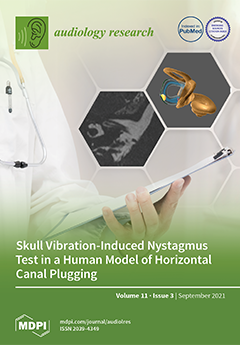
Cover Story: The skull vibration-induced nystagmus test (SVINT) is a recently developed test. It is used as a first line high frequency vestibular test and instantaneously reveals any vestibular asymmetry that may be present. The bone-conducted vibrations stimulate both the canal and otolith type I inner ear hair cells in animals. In human, selective cases with abnormality of only a part of the vestibule are rare situations highlighting the neural basis of the SVINT. Via s selective semicircular canal occlusion model, we provide neurophysiological and anatomical evidence for a better understanding of the test by vestibular practitioners. View this paper.
  • Issues are regarded as officially published after their release is announced to the table of contents alert mailing list .
  • You may sign up for email alerts to receive table of contents of newly released issues.
  • PDF is the official format for papers published in both, html and pdf forms. To view the papers in pdf format, click on the "PDF Full-text" link, and use the free Adobe Reader to open them.

Articles (17)

  • Article
  • Open Access
6 Citations
5,153 Views
17 Pages

Auditory Processing Disorder Test Battery in European Portuguese—Development and Normative Data for Pediatric Population

  • Jorge Humberto Martins,
  • Marisa Alves,
  • Susana Andrade,
  • Isabel Falé and
  • António Teixeira

17 September 2021

There is an increasing need for state-of-the-art Central Auditory Processing assessment for Portuguese native speakers, applicable as early as possible. As a contribution to answering this need, this paper presents a new battery for Central Auditory...

  • Article
  • Open Access
1 Citations
3,977 Views
12 Pages

Genetic and Non Genetic Hearing Loss and Associated Disabilities: An Epidemiological Survey in Emilia-Romagna Region

  • Elisabetta Genovese,
  • Silvia Palma,
  • Valeria Polizzi,
  • Giovanni Bianchin,
  • Michela Cappai,
  • Shaniko Kaleci,
  • Alessandro Martini,
  • Andrea Ciorba and
  • Paolo Stagi

16 September 2021

Hearing loss is one of the most common congenital sensory disorders. It can be associated with several comorbidities, in particular developmental disabilities (DD). In Emilia-Romagna (ER), a region in Northern Italy, Child and Adolescent Mental Healt...

  • Case Report
  • Open Access
2 Citations
3,708 Views
10 Pages

Compound Heterozygosity for OTOA Truncating Variant and Genomic Rearrangement Cause Autosomal Recessive Sensorineural Hearing Loss in an Italian Family

  • Rocco Pio Ortore,
  • Maria Pia Leone,
  • Orazio Palumbo,
  • Antonio Petracca,
  • Eleonora M. C. Trecca,
  • Aurelio D’Ecclesia,
  • Ciro Lucio Vigliaroli,
  • Lucia Micale,
  • Francesco Longo and
  • Salvatore Melchionda
  • + 1 author

9 September 2021

Hearing loss (HL) affects 1–3 newborns per 1000 and, in industrialized countries, recognizes a genetic etiology in more than 80% of the congenital cases. Excluding GJB2 and GJB6, OTOA is one of the leading genes associated with autosomal recessive no...

  • Article
  • Open Access
16 Citations
4,949 Views
12 Pages

9 September 2021

Compare the sensitivity and specificity of cVEMP (500 Hz), oVEMP (500 Hz and 4 kHz) in the identification of SSCD. A secondary objective was to identify the influence of dehiscence size and location on cVEMP and oVEMP responses. Methods: Individuals...

  • Review
  • Open Access
34 Citations
10,355 Views
20 Pages

Genetic Determinants of Non-Syndromic Enlarged Vestibular Aqueduct: A Review

  • Sebastian Roesch,
  • Gerd Rasp,
  • Antonio Sarikas and
  • Silvia Dossena

28 August 2021

Hearing loss is the most common sensorial deficit in humans and one of the most common birth defects. In developed countries, at least 60% of cases of hearing loss are of genetic origin and may arise from pathogenic sequence alterations in one of mor...

  • Article
  • Open Access
13 Citations
4,264 Views
8 Pages

Clinical Trial for Cartilage Conduction Hearing Aid in Indonesia

  • Ronny Suwento,
  • Dini Widiarni Widodo,
  • Tri Juda Airlangga,
  • Widayat Alviandi,
  • Keisuke Watanuki,
  • Naoko Nakanowatari,
  • Hiroshi Hosoi and
  • Tadashi Nishimura

13 August 2021

Hearing improvement represents one of the may valuable outcomes in microtia and aural atresia reconstruction surgery. Most patients with poor development in their hearing function have had a severe microtia. Conventional methods to improve hearing fu...

  • Brief Report
  • Open Access
17 Citations
8,063 Views
5 Pages

Benign Paroxysmal Positional Vertigo (BPPV) in COVID-19

  • Pasqualina Maria Picciotti,
  • Giulio Cesare Passali,
  • Bruno Sergi and
  • Eugenio De Corso

13 August 2021

Objective: The purpose of this article is to describe BPPV in COVID-19 patients by discussing the possible mechanisms underlying the onset of this vertigo. Methods: We studied eight patients (4 F, 4 M, aged between 44 and 69 years) with COVID-19 infe...

  • Article
  • Open Access
19 Citations
4,854 Views
21 Pages

9 August 2021

Acoustic coupling between microphone and loudspeaker is a significant problem in open-fit digital hearing aids. An open-fit compared to a close-fit hearing aid significantly lowers the signal quality and limits the achievable maximum stable gain. Ada...

  • Technical Note
  • Open Access
2,551 Views
5 Pages

6 August 2021

Modulation of microphonics has recently been used to investigate the sensitivity of the utricle in the vestibular organ of the guinea pig. The same technique was used more than 30 years ago to obtain information on the processing of rotational stimul...

  • Case Report
  • Open Access
1 Citations
3,922 Views
11 Pages

5 August 2021

Background: The purpose of this study was to investigate the effectiveness of aural-oral habilitation (AO) over the traditional speech-language therapy, based on the number of vocalization-volubility of a deaf child with late-mapping bilateral cochle...

of 2

Get Alerted

Add your email address to receive forthcoming issues of this journal.

XFacebookLinkedIn
Audiol. Res. - ISSN 2039-4349