


Abstract
Improving stem cutting propagation of grapevine species (Vitis sp.) is important for supporting growing interest in southern grapevine production, particularly for lesser-known cultivars. More efficient and reliable propagation techniques can help nurseries increase the availability of grapevine plants for local growers and support development of the southern U.S. wine industry. Hardwood and semi-hardwood cuttings of four winegrape cultivars, ‘Mamont Noir’, ‘MidSouth’, ‘Miss Blanc’, and ‘Norton’, were subjected to 10 hormone treatments consisting of indole-3-butyric acid (IBA) alone or in combination with ascorbic acid (ASC). Treatments were applied as a three-second basal quick dip. Sixty days after treatment, total shoot and root number, average shoot and root length, rooting percentage, and cutting and root quality were evaluated. Based on the results, semi-hardwood or hardwood ‘Mamont Noir’ cuttings can be propagated using 50 ppm ASC or 50 ppm ASC + 500 ppm IBA. For nurseries where hardwood cuttings better fit the production schedule, ‘Miss Blanc’ cuttings rooted well regardless of hormone treatment. Additional research is needed to optimize hormone treatments for ‘MidSouth’ and ‘Norton’.
1. Introduction
Propagating interspecific hybrid grapevines from stem cuttings can be challenging. Levels of endogenous hormones, the time of year cuttings are taken, and vine genetics can all be limiting factors in a grapevine’s rootability [1,2]. Developing more efficient and reliable techniques will aid nurseries by increasing their ability to supply historically difficult-to-root grapevine plants to local grape growers. This not only expands the availability of grapevines in the market but also plays a pivotal role in bolstering the wine industry in the southern region of the United States where vine availability may be limited [3]. Improved grapevine propagation methods can also contribute to economic development and agricultural diversification, ultimately benefiting local economies.
Grapes are one of the world’s most important fruit crops [4,5,6,7]. They are propagated in several ways, including grafting, layering, seeds, and vegetative cuttings. Clonal propagation via vegetative cutting is generally the most popular way to propagate grapevines. Cuttings may result in a marketable plant faster than seed propagation, are usually more economical, and ensure true-to-type clones [6,8,9]. In general, Vitis vinifera cultivars are easy to propagate with hardwood cuttings [2,8,10]. However, some hybrid cultivars and selections, such as ‘Norton’ [11,12,13], are more difficult to propagate than others because different species used in their lineage are more recalcitrant to propagation.
The use of indole-3-butyric acid (IBA) has been observed to aid in the formation of adventitious roots in cutting propagation [14]. The range of IBA that induces the highest root percentages was 100 to 2500 ppm, depending on the cultivar propagated [15,16,17,18]. Some studies showed that 2000 to 2500 ppm IBA resulted in cuttings with a higher rooting percentage, greater root length, and a larger number of roots [9,16,19,20]. Other studies also showed positive rooting response to concentrations ranging from 100 to 1250 ppm [7,8,16,21,22]. Ascorbic acid (ASC) has been documented to aid in rooting difficult-to-root plant species [23]. Haq [24] observed that 200 ppm ASC in combination with 2000 ppm IBA resulted in increased rooting in ‘Rupestris Du Lot’ grapevine cuttings.
The purpose of this research was to evaluate the effect of hormone treatments on hardwood and semi-hardwood cuttings of four interspecific hybrid southern winegrape cultivars. While the impact of IBA on grapevine propagation has previously been studied, cultivars may differ in their responses to the hormone. This study provides specific propagation data for these four interspecific hybrid cultivars, including Miss Blanc and the recently released Mamont Noir, for which propagation information is limited or unavailable, and shows how hormone responses compare between hardwood and semi-hardwood cuttings for each cultivar. These results will help nurseries develop more efficient and reliable techniques to increase their ability to supply plants of these grapevine cultivars to local grape growers. They will also help researchers wishing to propagate these cultivars for trials.
2. Materials and Methods
The study took place at the Mississippi State University, Mississippi Agricultural and Forestry Experiment Station (MAFES) South Mississippi Branch Experiment Station (SMBES) in Poplarville, MS, USA (lat. 30°85′36″ N, long. 89°49′94″ W, elevation 97 m, USDA hardiness zone 9a). Because propagation schedules vary between growers, both semi-hardwood and hardwood cuttings were evaluated to provide recommendations across the growing season. Three- to four-node, middle of shoot/cane cuttings were taken from stock plants at SMBES, with ages ranging from three to eleven years old. Hardwood cuttings were taken in March 2024, and semi-hardwood cuttings were taken in June 2024. The cuttings were immediately wrapped in a moist paper towel, placed in a plastic storage bag, and stored in a refrigerator between 2 °C and 3 °C (35–38 °F) for 24 h before applying hormone treatments.
Hormone treatments of IBA and ASC were applied as a three-second basal quick dip to the cuttings. Hortus (Hortus IBA Water Soluble Salts™, Phytotronics, Inc.®, Earth City, MO, USA) was utilized as the IBA source, and L(+)-Ascorbic acid (J.T. Baker®, Avantor Performance Materials, LLC, Radnor, PA, USA) was utilized as the ASC source. The 10 hormone treatments were an untreated control (dipped in water), 50 ppm ASC, 500 ppm IBA, 500 ppm IBA + 50 ppm ASC, 1000 ppm IBA, 1000 ppm IBA + 50 ppm ASC, 1500 ppm IBA, 1500 ppm IBA + 50 ppm ASC, 2000 ppm IBA, and 2000 ppm IBA + 50 ppm ASC (Table 1).
Table 1.
Hormone treatment effect on cutting quality, root quality, average length (of the three longest roots), and rooting percentage of ‘Mamont Noir’ across cutting types.
Four cultivars of bunch grapes were evaluated: ‘Mamont Noir’, ‘MidSouth’, ‘Miss Blanc’, and ‘Norton’. Stock plants of ‘Mamont Noir’ were approximately three years old, while ‘MidSouth’, ‘Miss Blanc’, and ‘Norton’ were approximately eleven years old. Mississippi State University cultivar releases, ‘MidSouth’ and ‘Miss Blanc’, are considered to be highly tolerant of Pierce’s disease (Xylella fastidiosa) [25]. ‘MidSouth’ has dark-blue fruit, is low maintenance, and is well-adapted to growing conditions in the Deep South with the potential to be used in red wine blends [26,27]. ‘Miss Blanc’ is a vigorous vine with white to green fruit and lends itself to wine and juice blends [25,26]. Though susceptible to Pierce’s disease, the fruit of ‘Mamont Noir’ offers a dark skin and reddish pulp with mild flavor, making it useful as a teinturier in blends, particularly for winegrowers in the upper South [28]. ‘Norton’ is resistant to many fungal pathogens and has been popular for red wine production in the southeast for many years but is difficult to propagate from cuttings [11,12,29,30,31].
Once the cuttings were treated, they were placed into 11.43 cm (4.5 inch) deep containers to a depth of two inches. The containers were filled with 100% pine bark substrate (50% fresh, 50% aged) and placed in a greenhouse under intermittent mist starting at 6 s every 10 min during daylight hours. Misting frequency and duration were increased or decreased as needed throughout the propagation period based on the moistness of the substrate. No fertilizer was applied during this study.
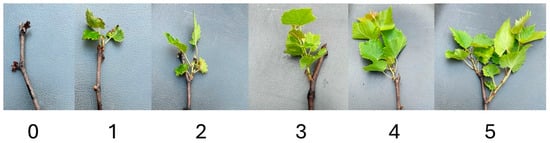
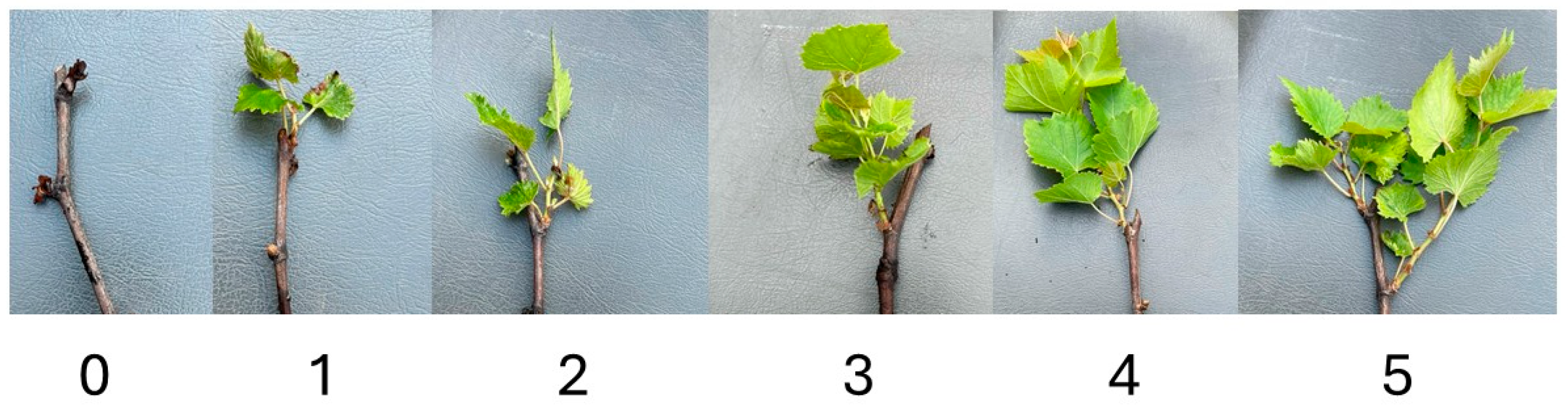
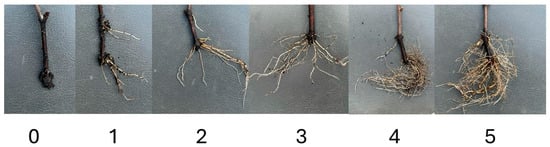
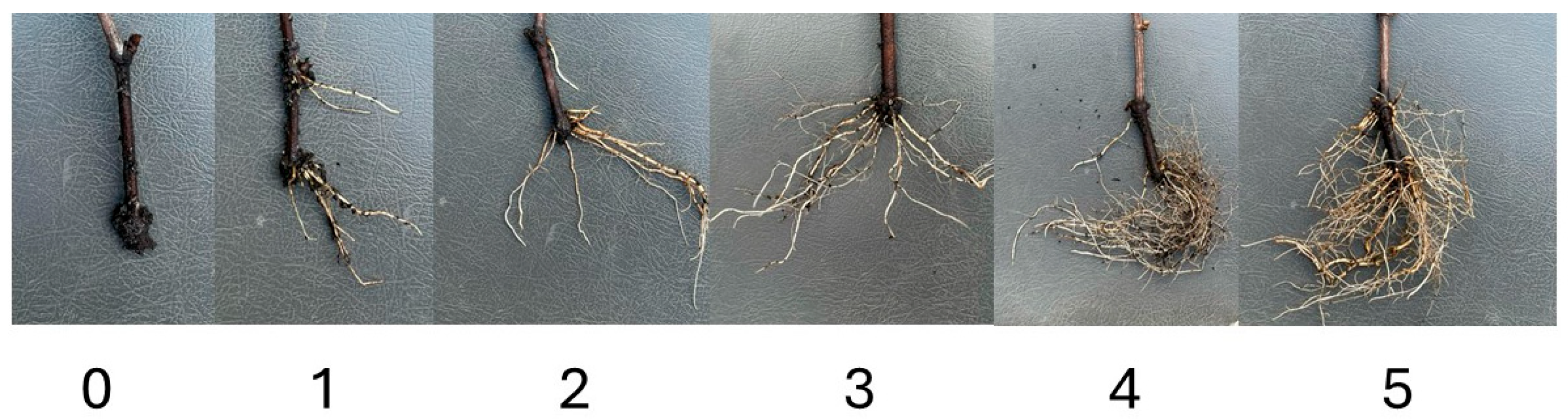
The experiment was conducted in a completely random design with 4 individual plant cutting replications of each treatment combination for both semi-hardwood and hardwood cuttings (40 cuttings per cultivar, 160 cuttings per experiment, 320 cuttings in total). Sixty days after treatment (May 2024 and August 2024), shoot number, average shoot length (of three longest shoots), rooting percentage, cutting quality (0–5, with 0 = dead and 5 = transplant-ready cutting) (Figure 1), total root number, average root length (of three longest roots), and root quality (0–5, with 0 = no roots and 5 = healthy, vigorous root system) (Figure 2) data were collected. Cutting and root quality ratings were determined by the same individual for each trial, utilizing the scoring criteria shown in Figure 1 and Figure 2 to maintain consistency across data collection. These ratings were used as practical quantitative assessments of propagation quality, with increasing scores representing progressively greater cutting or root quality. Data were analyzed using PROC GLIMMIX with mean separation using Tukey’s HSD at α = 0.05 in SAS version 9.4 (SAS Institute INC., Cary, NC, USA). Cultivars were analyzed independently. Hormone treatment, cutting type, and their interaction were incorporated as fixed effects, and replication was utilized as a random effect, making the model response = hormone treatment, cutting type, hormone treatment × cutting type. Rooting percentage was recorded for each cutting as a binary response (0 = not rooted, 1 = rooted), and a binomial distribution with a logit link was evaluated using PROC GLIMMIX. However, the model did not converge as a consequence of the small number of observations per treatment × cutting-type combination and the distribution of the binary response. Therefore, we did not use the non-converged model for statistical inference and instead report rooting as observed rooting percentages.
Figure 1.
Example of the grapevine cutting quality scale (0–5, with 0 = dead and 5 = transplant-ready cutting).
Figure 2.
Example of the grapevine root quality scale (0–5, with 0 = no roots and 5 = healthy, vigorous root system).
3. Results and Discussion
There is a lack of propagation research on many southern grape cultivars. ‘Mamont Noir’, ‘MidSouth’ and ‘Miss Blanc’ all contain percentages of V. rupestris and V. vinifera, which are two species that are associated with being easy to propagate [32]. A review of the available literature revealed no published studies on the propagation of ‘Mamont Noir’, ‘MidSouth’, and ‘Miss Blanc’; thus, direct comparisons of this study’s cultivar performance to other study results were not possible. The literature review did identify studies in which propagation research had been conducted on ‘Norton’; however, further improvements to the propagation process would help provide the highest level of success.
3.1. Overall Cultivar Performance by Cutting Type
While the main goal of this study was to evaluate each cultivar individually, identifying which performed best across the two cutting types allows growers to maximize propagation space and labor by prioritizing propagation of more difficult cultivars during a narrow window based on cutting type and scheduling propagation of easier-to-root cultivars over a wider period.
3.1.1. Hardwood Cuttings
Across all treatments, ‘Miss Blanc’ had higher observed values than ‘Mamont Noir’, ‘MidSouth’, and ‘Norton’. The average number of roots per cutting for ‘Miss Blanc’ was 24.8, with an average root length (of the three longest roots) of 11.6 cm. Rooting percentage for the cultivar was 95%, and cutting and root quality were 3.8 and 3.5 (out of 5), respectively. The average number of shoots per cutting was 1.6, and the average shoot length was 5.7 cm. While ‘Miss Blanc’ performed well regardless of treatment, root number increased to 32.75 roots per cutting, cutting quality increased to 4.5, and rooting quality increased to 4.3 for cuttings treated with 1500 ppm IBA.
3.1.2. Semi-Hardwood Cuttings
For semi-hardwood cuttings, ‘Mamont Noir’ had higher observed values than ‘MidSouth’, ‘Miss Blanc’, and ‘Norton’, regardless of treatment. The average number of roots per cutting for ‘Mamont Noir’ was 10.4, with an average root length (of the three longest roots) of 11.6 cm. Rooting percentage for the cultivar was 47.5%, and cutting and root quality were 1.9 and 1.9 (out of 5), respectively. The average number of shoots per cutting was 0.75, and the average shoot length was 4.0 cm. When 50 ppm ASC was applied alone, rooting percentage increased to 100%, cutting quality increased to 4.3 and rooting quality increased to 3.8.
3.2. Individual Results by Cultivar
3.2.1. Mamont Noir
No significant interactions between cutting type and hormone treatment occurred; however, there were significant differences for hormone treatment across cutting types. Number of shoots, average root length (of the three longest roots), and cutting quality were all significantly higher for cuttings dipped in 50 ppm ASC and 50 ppm ASC + 500 ppm IBA than cuttings dipped in 2000 ppm IBA. The average root length (of the three longest roots) was 17.9 cm for cuttings receiving 50 ppm ASC, 16.7 cm for cuttings receiving 50 ppm ASC + 500 ppm IBA, and 0 cm for 2000 ppm IBA treatments. Root quality and rooting percentage were significantly higher in cuttings receiving 50 ppm ASC + 500 ppm IBA than those receiving 2000 ppm IBA, with rooting percentage being 87.5% compared to 0% for the respective treatments. All other treatments were not significantly different from each other (Table 1). It is estimated that ‘Mamont Noir’ contains 21.1% V. vinifera and 35.9% V. rupestris [28,33]. Over 50% of its background is composed of easy-to-root species, and ‘Mamont Noir’ performed similarly across a wide range of treatments.
3.2.2. MidSouth
No significant interactions between cutting type and hormone treatment or hormone treatment across cutting type were observed for any data parameters collected. However, cutting type across hormone treatment was highly significant over all data parameters (Table 2). Semi-hardwood cuttings had significantly longer average shoot length, higher cutting quality rating, higher root number, longer average root length (of the three longest roots), higher root quality rating and greater rooting percentage compared to hardwood cuttings across all treatments. Semi-hardwood cuttings were observed to have a rooting percentage of 17.5%, with an average of 3.7 roots per cutting, while hardwood cuttings were observed to have a rooting percentage of 2.4%, with an average of 0.2 roots per cutting. Hardwood cuttings had a significantly higher number of shoots compared to semi-hardwood cuttings across all treatments. ‘MidSouth’ is estimated to contain 35.5% V. vinifera and 5.5% V. rupestris parentage [27,33]. While 41% of ‘MidSouth’ parentage is easy-to-root species, it also contains V. champinii ‘De Grasset’ parentage, a known difficult-to-root species [34]. This could at least partially account for the poor results observed in this study.
Table 2.
Cutting type effect on average number of shoots, average shoot length, cutting quality, average number of roots, root quality, average length of three longest roots, and rooting percentage of ‘MidSouth’.
3.2.3. Miss Blanc
Average root length (of the three longest roots) and root percentage exhibited a significant interaction between cutting type and hormone treatment (Table 3). Semi-hardwood cuttings treated with 50 ppm ASC + 1000 ppm IBA had significantly longer average root length (of the three longest roots) (15.7 cm) than semi-hardwood cuttings treated with 50 ppm ASC, 500 ppm IBA, 1000 ppm IBA, 2000 ppm IBA, or 50 ppm ASC + 2000 ppm IBA, which all had a length of 0 cm. Hardwood cuttings treated with no hormone, 50 ppm ASC, 500 ppm IBA, 1000 ppm IBA, 50 ppm ASC + 1000 ppm IBA, 1500 ppm IBA, 50 ppm ASC + 1500 ppm IBA, or 2000 ppm IBA had a significantly higher rooting percentage than semi-hardwood cuttings treated with no hormone, 500 ppm IBA, 1000 ppm IBA, 1500 ppm IBA, 2000 ppm IBA, or 50 ppm ASC + 2000 ppm IBA. Rooting percentages for hardwood cuttings treated with no hormone, 50 ppm ASC, 500 ppm IBA, 1000 ppm IBA, 50 ppm ASC + 1000 ppm IBA, 1500 ppm IBA, 50 ppm ASC + 1500 ppm IBA, or 2000 ppm IBA were all 100%.
Table 3.
Interaction effect of cutting type and hormone treatment on average length of the three longest roots and rooting percentage of ‘Miss Blanc’.
Hardwood cuttings across all treatments also had higher shoot number, average shoot length, cutting quality rating, root number and root quality compared to semi-hardwood cuttings (Table 4). The average number of roots per cutting for hardwood cuttings was 24.8, while semi-hardwood cuttings only had an average of 3.8 roots per cutting. ‘Miss Blanc’ contains an estimated 55.8% V. vinifera and 5.5% V. rupestris [33]. Like ‘Mamont Noir’, ‘Miss Blanc’ has a relatively high percentage of easy-to-root species in its lineage, which was reflected in our results.
Table 4.
Cutting type effect on average number of shoots, average shoot length, cutting quality, average number of roots, and root quality of ‘Miss Blanc’.
3.2.4. Norton
‘Norton’ cuttings did not survive any treatment; therefore, no data was able to be collected for this cultivar. Rooting percentages for ‘Norton’ in previous studies have been observed to range from 10% to 40.9% [35]. However, Keeley et al. [36] did observe that when ‘Norton’ hardwood cuttings received an auxin and/or cold storage treatment and softwood cuttings were taken during the vine’s active growing season, 65–90% rooting was obtained. It has been noted that V. aestivalis is difficult to root from vegetative cuttings [12,37]. In a recent publication, ‘Norton’ was described as a three-generational hybrid, with the F3 containing 62.5% V. aestivalis, 28.125% V. vinifera, and 3.375% V. labrusca [38]. ‘Norton’ has been recorded as being difficult to propagate, which is likely due to the high percentage of V. aestivalis in its pedigree [35,39,40]. In addition to having V. aestivalis in its parentage, ‘Norton’ has also been known to contain fungal endophytes, which have been speculated to negatively impact rooting [41]. The lack of survivability could also be due to the vine being grown outside of its typical range (recommended for hardiness zone 4–8), thus having poor acclimation to growing conditions.
4. Conclusions
IBA was chosen in this study because it is a commonly used auxin for promoting adventitious root formation in cutting propagation, while ASC was selected based on previous reports of its potential to improve rooting in difficult-to-root plant species, potentially due to its ability to regulate reactive oxygen species (ROS) and reduce auxin degradation, which may promote root growth [23,24,42]. IBA has been observed to be highly effective in promoting root formation during cutting propagation and is commonly used as a rooting auxin because of its increased stability when compared with IAA [43,44,45]. IBA has been observed to improve rooting in grapevine cuttings, although responses can vary depending on cultivar and IBA concentration [46,47]. For example, Hussein and Zaili [21] reported that 1000 ppm IBA improved rooting and subsequent growth of ‘Halwani’ and ‘Kamali’ grapevine cuttings, demonstrating the potential of IBA to enhance grapevine propagation. Recent research has also shown that IBA does not consistently improve rooting across grapevine genotypes, with untreated cuttings performing better than IBA-treated cuttings in some rootstocks [48]. IBA and ASC do not always result in increased root growth when applied together, and their effects appear to depend on the species or cultivar being propagated [49]. In this study, neither IBA nor ASC consistently improved rooting across all cultivars and cutting types; however, each treatment improved rooting-related responses in some cultivar and cutting-type combinations.
Under the conditions of these studies, ‘Mamont Noir’ is optimally propagated using a 50 ppm ASC or 50 ppm ASC + 500 ppm IBA treatment applied to semi-hardwood or hardwood cuttings. Nurseries preferring grape propagation using hardwood cuttings could use ‘Miss Blanc’ with a high degree of success regardless of treatment. We propagated ‘MidSouth’ previously, and its performance in this study did not match its past response. ‘MidSouth’ hardwood cuttings previously achieved 87.5% rooting without the addition of rooting hormones (unpublished data). Differences in stock plant health, stock plant age, timing of taking cuttings, cutting diameter and position, number of nodes, or other stress factors, which were not evaluated in this study, can impact rooting percentages. Additionally, holding cuttings for 24 h in a refrigerator between 2 °C and 3 °C (35–38 °F) rather than processing them on the same day could have also negatively impacted rooting. This study was performed in individual nursery pots; however, in production settings, growers sometimes plant cuttings in propagation beds where they are able to stick cuttings closer together and deeper than we did in our pots [50,51]. Increasing the depth of the cuttings to increase the number of nodes below the soil line could aid in increasing rooting success. ‘Norton’ and ‘MidSouth’ will require further research to assess hormone and cutting time combinations to improve rooting for nursery production.
The results of this study provide nursery growers with propagation information on these cultivars that will help them develop more efficient and reliable techniques to increase their ability to supply grapevine plants to local grape growers. The results can also assist researchers wishing to propagate these cultivars for trials.
Author Contributions
Conceptualization, J.B.R., E.T.S., H.N.W. and P.R.K.; methodology, J.B.R., E.T.S., H.N.W. and P.R.K.; data analysis, J.B.R. and H.N.W.; writing—original draft preparation, J.B.R.; writing—review and editing, E.T.S., H.N.W. and P.R.K.; funding acquisition, J.B.R., E.T.S., H.N.W. and P.R.K. All authors have read and agreed to the published version of the manuscript.
Funding
The project was primarily funded through a grant from the Southern Region Small Fruit Consortium, project 2024-R-14 and partly supported by the National Institute of Food and Agriculture, Hatch project under accession number 440157 and U.S Department of Agriculture, Agricultural Research Service, number 59-6062-5-003.
Data Availability Statement
The raw data supporting the conclusions of this article will be made available by the authors on request.
Acknowledgments
This publication is a contribution of the Mississippi Agricultural and Forestry Experiment Station.
Conflicts of Interest
The authors declare no conflicts of interest.
References
- Nicholas, P.R.; Chapman, A.P.; Cirami, R.M. Grapevine propagation. In Viticulture, Practices; Coombe, B.G., Dry, P.R., Eds.; Winetitles: Adelaide, Australia, 1992; Volume 2, pp. 1–22. [Google Scholar]
- Waite, H.; Whitelaw-Weckert, M.; Torley, P. Grapevine Propagation: Principles and methods for the production of high-quality grapevine planting material. N. Z. J. Crop Hortic. Sci. 2015, 43, 144–161. [Google Scholar] [CrossRef] [Scilit]
- Stafne, E.T.; Sleezer, S.; Clark, J.R. Grapevine breeding in the southern U.S. In Grapevine Breeding Programs for the Wine Industry; Reynolds, A.G., Ed.; Woodhead Publishing Ltd.: Cambridge, UK, 2015; pp. 379–408. [Google Scholar]
- Ahmedullah, M.; Himelrick, D.G. Grape management. In Small Fruit Crop Management; Galletta, G.J., Himelrick, D.G., Eds.; Prentice Hall: Englewood Cliffs, NJ, USA, 1990; pp. 383–471. [Google Scholar]
- Harlan, J.R. The Plants and animals that nourish man. Sci. Am. 1976, 235, 88–97. [Google Scholar] [CrossRef] [Scilit]
- Jaleta, A.; Sulaiman, M. A review on the effect of rooting media on rooting and growth of cutting propagated grape (Vitis vinifera L.). World J. Agric. Soil Sci. 2019, 3, 1–8. [Google Scholar] [CrossRef] [Scilit]
- Singh, K.K.; Chauhan, J.S. A Review on vegetative propagation of grape (Vitis vinifera L.) through cutting. Glob. J. Bio-Sci. Biotech. 2020, 9, 50–55. [Google Scholar]
- Patil, V.N.; Cauhan, P.S.; Shivankar, R.S.; Vilhekar, S.H.; Waghmare, V.S. Effect of plant growth regulators on survival and vegetative growth of grapevine cuttings. Agric. Sci. Dig. 2001, 21, 97–99. Available online: https://arccarticles.s3.amazonaws.com/webArticle/articles/asd212008.pdf (accessed on 6 June 2025).
- Rao, K.K. Studies on the Propagation of Grape Rootstocks Through Hardwood and Softwood Cuttings. Master’s Thesis, Acharya N.G. Ranga Agricultural University, Hyderabad, India, 2004. [Google Scholar]
- Buck, K.; Worthington, M.; Conner, P.J. An investigation of factors affecting the rooting ability of hardwood muscadine cuttings. HortScience 2022, 57, 615–623. [Google Scholar] [CrossRef] [Scilit]
- Avery, J.D. Propagation of Norton-Cynthiana. In Proceedings of the 14th Annual Midwest Regional Grape and Wine Conference, Osage Beach, MO, USA, 17–19 January 1999; pp. 1–6. [Google Scholar]
- Husmann, G. The grapes, old and new varieties. Hortic. J. Rural Art Rural Tast. 1867, 22, 17–20. Available online: https://www.biodiversitylibrary.org/page/24449478 (accessed on 6 June 2025).
- Read, P.E.; Bigger, B.B. Propagation and acclimatization of ‘Norton’ grapevine©. Comb. Proc. Int. Plant Propagators’ Soc. 2004, 54, 536. [Google Scholar]
- Grossmann, K. Auxin herbicides: Current status of mechanism and mode of action. Pest Manag. Sci. Former. Pestic. Sci. 2010, 66, 113–120. [Google Scholar] [CrossRef] [Scilit] [PubMed]
- Garande, V.K.; Gawade, M.H.; Sapkal, K.T.; Gurav, S.B. Effect of IBA and number of internodes on rooting of stem cuitings of grape rootstocks. Agric. Sci. Dig. 2002, 22, 176–178. Available online: https://arccarticles.s3.amazonaws.com/webArticle/articles/asd223011.pdf (accessed on 1 June 2025).
- Reddy, V.V.P.; Singh, R.; Murthy, B.N.S. Rooting response of new grape hybrids to growth regulators application. Adv. Hortic. For. 1996, 5, 55–60. [Google Scholar]
- Singh, R.; Singh, P. Effect of callusing and IBA treatments on the performance of hardwood cuttings of Thompson Seedless and Himrod grapes. Punjab Hortic. J. 1973, 13, 166–170. [Google Scholar]
- Sunitha, P. Effect of Auxins and Auxin Synergists on Rooting of Grapevine (Vitis vinifera L.) Cuttings. Master’s Thesis, Acharya N.G. Ranga Agricultural University, Hyderabad, India, 1991. [Google Scholar]
- Fabbri, A.; Lambardi, M. Effects of stock plant CCC treatments on adventitious rooting in “140 Ruggeri” cuttings. Acta Hortic. 1988, 227, 260–262. [Google Scholar] [CrossRef] [Scilit]
- Puri, N.; Mishra, S.; Bahadur, V.; Prasad, V.M. Effect of PGR on growth and establishment of grapes (Vitis vinifera L.) cv. Thompson Seedless under Prayagraj agro climatic condition. Int. J. Plant Soil Sci. 2023, 35, 74–80. [Google Scholar] [CrossRef] [Scilit]
- Hussein, S.A.; Zaili, S.A. Impact of auxin and number of buds left in cuttings for the rooting and growth of grape transplants of cv. Halwani and Kamali. Anbar J. Agric. Sci. 2025, 23, 419–431. [Google Scholar] [CrossRef] [Scilit]
- Shriram, J.M.; Patil, R.A.; Ghangale, T.S.; Sumitha, N.; Ralebhat, B.N.; Kate, P.A. Effect of plant growth regulators on growth of grape rootstock. Int. J. Curr. Microbiol. Appl. Sci. 2021, 10, 728–737. [Google Scholar] [CrossRef] [Scilit]
- Radhi, I.M.; Hussein, K.A. The role of ascorbic acid and IBA in improvement of rooting response of difficult to root cuttings of Acacia spp. AIP Conf. Proc. 2020, 2290, 020003. [Google Scholar] [CrossRef] [Scilit]
- Haq, B. The Effect of Mist and Root Promoting Substances on Rooting of Grape Cuttings; American University of Beirut: Beirut, Lebanon, 1968. [Google Scholar]
- Overcash, J.P.; Hegwood, C.P., Jr.; Stojanovic, B.J. Miss Blanc’ a New Bunch Grape Cultivar; MAFES Research Bulletins 561; Mississippi Agricultural and Forestry Experiment Station (MAFES): Mississippi State, MS, USA, 1982; pp. 1–5. [Google Scholar]
- Stafne, E.T. Mississippi State University Extension Fruit and Nut Review: Bunch Grapes. 2016. Available online: http://extension.msstate.edu/publications/fruit-and-nut-review-bunch-grapes/ (accessed on 22 July 2024).
- Williams, H.N.; Stafne, E.T. Reintroducing a multiuse bunch grape for the Deep South: ‘MidSouth’. J. Am. Pomol. Soc. 2022, 76, 20–26. [Google Scholar]
- Stafne, E.T.; Carroll, B.L.; Williams, H.N.; Coker, C.E.; Sampson, B.J. OK392 (‘Mamont Noir’) a red-pulped bunch grape with potential for Upper South vineyards. J. Am. Pomol. Soc. 2024, 78, 63–69. [Google Scholar] [CrossRef] [Scilit]
- Ambers, C.P. A historical hypothesis on the origin of the Norton grape. J. Wine Res. 2013, 24, 85–95. [Google Scholar] [CrossRef] [Scilit]
- Fung, R.W.; Gonzalo, M.; Fekete, C.; Kovacs, L.G.; He, Y.; Marsh, E.; McIntyre, L.M.; Schachtman, D.P.; Qiu, W. Powdery mildew induces defense-oriented reprogramming of the transcriptome in a susceptible but not in a resistant grapevine. Plant Physiol. 2008, 146, 236–249. [Google Scholar] [CrossRef] [Scilit] [PubMed]
- Stover, E.D.; Aradhya, M.; Yang, J.; Bautista, J.; Dangl, G.S. Investigations into the origin of ‘Norton’ grape using SSR markers. Proc. Fla. State Hortic. Soc. 2009, 122, 19–24. [Google Scholar]
- Atak, A. Vitis species for stress tolerance/resistance. Genet. Resour. Crop Evol. 2025, 72, 2425–2444. [Google Scholar] [CrossRef] [Scilit]
- Maul, E.; Sudharma, K.N.; Ganesh, A.; Hundemer, M.; Walk, M.; vom Weg, S.; Mahler-Ries, A.; Brühl, U.; Töpfer, R.; Kecke, S.; et al. Vitis International Variety Catalogue. 2025. Available online: https://www.vivc.de/ (accessed on 25 June 2025).
- Chapman, A.P.; Hussey, E.E. The value of plant growth regulators in the propagation of Vitis champini rootstocks. Am. J. Enol. Vitic. 1980, 31, 250–253. [Google Scholar] [CrossRef] [Scilit]
- Uhls, A.L.; Jolley, N.; Johnston, T.V.; DuBois, J.D. The effect of sample date and timing of cuttings for maximum propagation efficiency of the grape, Vitis aestivalis “Norton/Cynthiana”. Food Nutr. Sci. 2018, 9, 268–276. [Google Scholar] [CrossRef][Green Version]
- Keeley, K.; Preece, J.E.; Taylor, B.H. Increased rooting of ‘Norton’ grape cuttings using auxins and gibberellin biosynthesis inhibitors. HortScience 2003, 38, 281–283. Available online: https://journals.ashs.org/hort/hort/published/rest/pdf-watermark/v1/journals/hortsci/38/2/article-p281.pdf/watermark-pdf/ (accessed on 30 June 2026). [CrossRef] [Scilit]
- Husmann, G. American Grape Growing And Wine Making; Orange Judd Company: New York, NY, USA, 1880; Volume 19, pp. 21+76. [Google Scholar]
- Sparreo, L.; Talavera, A.; Nie, Z.L.; Johnson, G.; Literman, R.; Handy, S.; Wen, J. Phylogenomic insights into the origin of the Norton grape. Plants People Planet 2025, 7, 1458–1468. [Google Scholar] [CrossRef] [Scilit]
- Keeley, K.; Preece, J.E.; Taylor, B.H.; Dami, I.E. Effects of high auxin concentrations, cold storage, and cane position on improved rooting of Vitis aestivalis michx. Norton cuttings. Am. J. Enol. Vitic. 2004, 55, 265–268. [Google Scholar] [CrossRef] [Scilit]
- Matsui, H.; Ushiyama, M.; Ohkawa, K.; Ohara, H.; Soga, T.; Ochi, M. Rooting ability of hardwood cuttings of Norton grapevine (Vitis aestivalis) under different conditions. In Proceedings of the 54th Annual meeting of the American Society for Enology and Viticulture Reno, NV, USA, 18–20 June 2003; American Society for Enology and Viticulture: Davis, CA, USA, 2003. [Google Scholar]
- Wilson, A.; Fuller, M.; Smith, S.; Johnston, T.; Du Bois, J. A protocol for endophyte-free callus tissue of the grape Vitis aestivalis ‘Norton/Cynthiana’ (Vitaceae). Agric. Sci. 2016, 7, 680–692. [Google Scholar] [CrossRef]
- Yilmaz, H.; Taşkin, T.; Otludil, B. Polyphenol oxidase activity during rooting in cutting of grape (Vitis vinifera L.) varieties. Turk. J. Bot. 2003, 27, 495–498. [Google Scholar]
- Sekhukhune, M.K.; Maila, M.Y. Exogenous IBA stimulatory effects on root formation of Actinidia deliciosa rootstock and Actinidia arguta male scion stem cuttings. Front. Sustain. Food Syst. 2024, 8, 1461871. [Google Scholar] [CrossRef] [Scilit]
- Ercisli, S.; Esitken, A.; Cangi, R.; Sahin, F. Adventitious root formation of kiwifruit in relation to sampling date, IBA and Agrobacterium rubi inoculation. Plant Growth Regul. 2003, 41, 133–137. [Google Scholar] [CrossRef] [Scilit]
- da Costa, C.T.; de Almeida, M.R.; Ruedell, C.M.; Schwambach, J.; Maraschin, F.S.; Fett-Neto, A.G. When stress and development go hand in hand: Main hormonal controls of adventitious rooting in cuttings. Front. Plant Sci. 2013, 4, 133. [Google Scholar] [CrossRef] [Scilit] [PubMed]
- Abuazizah, M.H.; Abuseif, M.I.; Amrajaa, B.N. Influence of IBA Concentrations on the Success and Growth Characteristics of Grape Rooting Cuttings (Vitis vinifera L.). J. Plant Prod. 2023, 14, 497–500. [Google Scholar] [CrossRef] [Scilit]
- Yin, Y.; Mao, Y.; Zhang, Y.; Chen, J.; Tu, M.; Wang, X. Effects of IBA Combined with NAA/Melatonin/Citric Acid on Rooting Characteristics of Grape Rootstocks. Horticulturae 2026, 12, 858. [Google Scholar] [CrossRef] [Scilit]
- de Moraes, J.P.S.; Ono, E.O. Rooting of stem cuttings of grapevine rootstocks with different concentrations of indole butyric acid (AIB). Res. Soc. Dev. 2026, 15, e1715150490. [Google Scholar] [CrossRef] [Scilit]
- Pirdastan, M.; Aboutalebi, J.A.; Hassanzadeh, K.H. Effect of hydrogen peroxide, ascorbic acid and indolic-3-butyric acid on root induction and development in cuttings of Bougainvillea spectabilis. J. Ornam. Plants 2020, 10, 145–154. [Google Scholar]
- Lockwood, D.W.; Robinson, D.K. Grape Growing in Tennessee; Agricultural Extension Service The University of Tennessee PB 1475: Knoxville, TN, USA, 2001; Available online: https://uthort.tennessee.edu/wp-content/uploads/sites/228/2024/01/PB1475-Grape-Growing-in-TN.pdf (accessed on 4 May 2026).
- Herrera, E.; La Vine, P. Propagation of Grape Vine Cuttings: A Practical Guide; Maier, B., Ed.; New Mexico State University Cooperative Extension Service Guide H-322: Las Cruces, NM, USA, 2015; Available online: https://pubs.nmsu.edu/_h/H322.pdf (accessed on 4 May 2026).

Disclaimer/Publisher’s Note: The statements, opinions and data contained in all publications are solely those of the individual author(s) and contributor(s) and not of MDPI and/or the editor(s). MDPI and/or the editor(s) disclaim responsibility for any injury to people or property resulting from any ideas, methods, instructions or products referred to in the content. |
© 2026 by the authors. Licensee MDPI, Basel, Switzerland. This article is an open access article distributed under the terms and conditions of the Creative Commons Attribution (CC BY) license.