

You are currently on the new version of our website. Access the old version .

Microbiology Research, Volume 16, Issue 9

2025 September - 18 articles

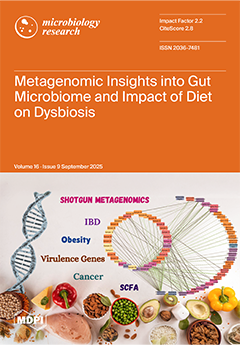
Cover Story: The gut microbiome is a complex community of microorganisms that plays a vital role in supporting immunity, metabolism, and overall health. Dysbiosis of these microorganisms is closely associated with various diseases. In this study, shotgun metagenomics was used to examine gut microbiome composition and influence of diet on associated disease. Analysis of study cohorts, compared with healthy subjects, revealed that a meat-based diet is strongly correlated with higher levels of relative abundance of opportunistic pathogens in gut. A similar pattern was observed in a meat diet with obesity and cancer. Conversely, plant-based diets were associated with a healthier microbial balance in the gut and reduced disease risk. View this paper
  • Issues are regarded as officially published after their release is announced to the table of contents alert mailing list .
  • You may sign up for email alerts to receive table of contents of newly released issues.
  • PDF is the official format for papers published in both, html and pdf forms. To view the papers in pdf format, click on the "PDF Full-text" link, and use the free Adobe Reader to open them.

Articles (18)

  • Article
  • Open Access
1,410 Views
16 Pages

Comparative Virulence Gene Profiling of Campylobacter jejuni and Campylobacter coli Isolates from Avian and Human Sources in Egypt

  • Amr Mekky,
  • Mohamed R. Issa,
  • Amro Hashish,
  • Wafaa Hassan,
  • Ali Wahdan,
  • Islam Hisham,
  • Shymaa Enany and
  • Mohamed Enany

Campylobacter species are considered to be the leading bacterial cause of human gastroenteritis globally. Consumption of undercooked or contaminated food, such as chicken, is the main cause of human campylobacteriosis. Despite this significant zoonot...

  • Communication
  • Open Access
780 Views
9 Pages

Herd-Level Prevalence of Hepatitis E Virus in Greek Pig Farms

  • Efthymia Stamelou,
  • Konstantinos Papageorgiou,
  • Aikaterini Stoikou,
  • Dimitrios Chatzopoulos,
  • Dimitrios Papadopoulos,
  • Ioannis A. Giantsis,
  • Charalambos Billinis,
  • Evanthia Petridou and
  • Spyridon K. Kritas

Hepatitis E virus (HEV) is an emerging zoonotic pathogen, with swine identified as a major reservoir. Despite the global significance of HEV, epidemiological data regarding its presence in Greek pig farms remain limited. This study investigated the p...

  • Article
  • Open Access
915 Views
20 Pages

Characterization of New Yeast Strains Isolated from Local Grape Varieties of the Soufli Region in Northern Greece

  • Anastasios Nikolaou,
  • Ioanna Prapa,
  • Ioanna Karapantzou,
  • Vasiliki Kompoura,
  • Niki Proxenia,
  • Yorgos Kotseridis and
  • Yiannis Kourkoutas

Over the past few years, consumers’ preference for wines with a distinct regional identity has shifted producers to adopt traditional grape varieties and has increased interest in the indigenous grapevine microbiome, due to its potential influe...

  • Article
  • Open Access
935 Views
16 Pages

Extended-Spectrum β-Lactamase-/AmpC-Producing Escherichia coli and Associated Risk Factors in Shelter Dogs: A Baseline Study in North Macedonia

  • Ivana Shikoska,
  • Sanja Duvnjak,
  • Tom Koritnik,
  • Bojana Chapkunovska,
  • Jane Vlahov,
  • Marija Ratkova Manovska,
  • Aleksandar Cvetkovikj and
  • Iskra Cvetkovikj

Antimicrobial resistance (AMR) is a significant public health concern in companion animals, yet systematic surveillance in North Macedonia is lacking. This study investigated the prevalence of resistance in Escherichia coli isolated from 112 fecal sa...

  • Article
  • Open Access
1 Citations
899 Views
16 Pages

Microbial Diversity and Metabolite Changes in Greenhouse Soil Continuously Cropped with Morchella

  • Ping Yu,
  • Nan Tao,
  • Weimin Chen,
  • Jie Zhang,
  • Chunxin Yao and
  • Guoting Tian

True morels (Morchella spp., Morchellaceae, Ascomycota) are a rare and highly valuable edible fungus. As the morel cultivation scale has expanded, obstacles to continuous cropping have come to the fore. This study investigates the specific biological...

  • Article
  • Open Access
895 Views
14 Pages

Thermal algae are extremophilic organisms that live in one of the harshest environments in the world and thrive in waters with temperatures of up to 90 °C. They have gained attention due to their special ecological adaptations, their great biotec...

  • Article
  • Open Access
2,478 Views
15 Pages

CTX-M beta-lactamases have become the predominant extended-spectrum beta-lactamases (ESBLs) globally, contributing to increased patient morbidity, mortality, and healthcare costs. This study investigated the prevalence of biofilm formation and CTX-M...

  • Article
  • Open Access
950 Views
23 Pages

Sentinel or Disperser? The Role of White Storks (Ciconia ciconia) in the Spread of Antibiotic-Resistant Bacteria

  • Teresa Cardona-Cabrera,
  • Sandra Martínez-Álvarez,
  • Yolanda Muela-Trujillo,
  • Alberto Sánchez-Cano,
  • Juan Carlos Montero,
  • Juan Manuel Fernández-Gallego,
  • Carmen Torres and
  • Ursula Höfle

Antimicrobial resistance (AMR) represents a threat to human, animal, and environmental health. This study evaluated the potential role of birds as AMR dispersers in white storks as a model species investigating dispersal between locations connected b...

  • Review
  • Open Access
1 Citations
4,485 Views
41 Pages

The Prevalence of ESKAPE Pathogens and Their Drug Resistance Profiles in Aquatic Environments Around the World

  • Tunde Olarinde Olaniyan,
  • Ana Verónica Martínez-Vázquez,
  • Cesar Marcial Escobedo-Bonilla,
  • Cristina López-Rodríguez,
  • Patricia Huerta-Luévano,
  • Oziel Castrejón-Sánchez,
  • Wendy Lizeth de la Cruz-Flores,
  • Manuel J. Cedeño-Castillo,
  • Erick de Jesús de Luna-Santillana and
  • Virgilio Bocanegra-García
  • + 2 authors

Antimicrobial-resistant bacteria (ARB) in the ESKAPE group include Enterococcus faecium, Staphylococcus aureus, Klebsiella pneumoniae, Acinetobacter baumannii, Pseudomonas aeruginosa, and Enterobacter spp. These pathogens continue to pose a global th...

  • Article
  • Open Access
1,799 Views
18 Pages

Microbiological Analysis of Traditional Sausage in Prishtina, Republic of Kosovo, During Production and Storage

  • Flutura C. Ajazi,
  • Rreze M. Gecaj,
  • Matthias A. Ehrmann,
  • Sarah Shaqiri,
  • Idriz Vehapi,
  • Veton Haziri,
  • Namik Durmishi,
  • Xhavit Bytyçi and
  • Violeta Lajqi-Makolli

Traditional sausage in the Republic of Kosovo has been produced for centuries as a traditional method of preserving the nutritional value of meat. In sausage fermentation, natural microbiota such as lactic acid bacteria (LAB) and Micrococcaceae usual...

of 2

Get Alerted

Add your email address to receive forthcoming issues of this journal.

XFacebookLinkedIn
Microbiol. Res. - ISSN 2036-7481