


Abstract
In recent years, emerging economies have intensified their efforts to promote sustainable mobility as part of global decarbonization strategies. Although Morocco has made substantial investments in renewable energy and electric vehicle (EV) manufacturing, domestic EV adoption remains modest, revealing a structural gap between industrial capacity and consumer uptake. Identifying the behavioral and value-based determinants of EV adoption is therefore essential for accelerating sustainable transport transitions. Building on the Theory of Planned Behavior (TPB) and the Value–Belief–Norm (VBN) theory, this study integrates sustainability-related values, moral responsibility, perceived behavioral control, and institutional trust within a unified behavioral framework to explain EV adoption intention in Morocco. A quantitative cross-sectional survey was conducted among 223 Moroccan consumers aged 18–55. Data were analyzed using Partial Least Squares Structural Equation Modeling (PLS-SEM). The findings indicate that perceived environmental benefits, moral responsibility, perceived behavioral control, and institutional trust significantly influence EV adoption intention. Environmental awareness was not statistically significant in this sample and model, whereas subjective norms and awareness of government incentives did not exert significant effects. The proposed model explains 66.4% of the variance in adoption intention.
1. Introduction
The accelerating impacts of climate change, energy insecurity, and urban air pollution have compelled governments worldwide to intensify the transition toward low-emission transportation systems. Electric vehicles (EVs) have emerged as a central pillar of this transition, offering a cleaner and more sustainable alternative to internal combustion engine (ICE) vehicles. While global EV diffusion has been driven by regulatory frameworks and technological innovation, recent research increasingly recognizes the importance of psychological and value-based determinants such as environmental concern, perceived ecological benefits, and moral responsibility in shaping consumer adoption decisions [1,2,3].
However, many existing studies remain concentrated in developed and Asian markets and primarily emphasize economic incentives, technological readiness, and infrastructure availability [4,5]. Comparatively less attention has been devoted to understanding how moral values, feasibility perceptions, and institutional trust jointly shape EV adoption in emerging and African contexts. This represents a critical theoretical and contextual gap, as consumer decision-making in such markets is strongly conditioned by structural constraints and institutional environments.
This gap is particularly salient in Morocco. Despite ambitious national sustainability strategies aimed at generating more than 52% of electricity from renewable sources by 2030 [6] and significant investments in EV manufacturing, domestic EV adoption remains limited. Morocco currently produces approximately 40,000 electric vehicles annually and aims to reach 100,000 units by 2025, yet only 4.5% of new vehicle sales in 2023 were electrified [7,8]. This apparent disconnect suggests that, beyond industrial capacity, consumer perceptions and behavioral factors may play a critical role in shaping EV adoption in Morocco. Therefore, this study focuses on psychological and institutional determinants of adoption intention rather than structural market conditions.
Although the Moroccan government has introduced regulatory standards, fiscal incentives, and charging infrastructure initiatives to promote electric mobility, consumers continue to face substantial barriers, including high purchase costs, limited charging accessibility, and uncertainty regarding performance and policy effectiveness [8,9]. While these structural inhibitors have been documented, the role of moral responsibility, perceived environmental benefits, perceived behavioral control, and institutional trust in shaping Moroccan consumers’ EV adoption intentions remains underexamined.
To address this gap, the present study extends the Theory of Planned Behavior by integrating value-based (moral responsibility, perceived environmental benefits) and institutional (trust in government) dimensions into a unified behavioral framework. It empirically examines how sustainability-related values, feasibility perceptions, and institutional trust jointly influence Moroccan consumers’ intention to adopt electric vehicles.
Accordingly, this study is guided by the following research questions:
- How does environmental awareness influence Moroccan consumers’ intention to adopt electric vehicles?
- What role do perceived environmental benefits and moral responsibility play in shaping EV preferences relative to conventional ICE vehicles?
- How does perceived behavioral control, reflecting consumers’ perceived financial and infrastructural feasibility of adopting electric vehicles, influence EV adoption intention in Morocco?
- How do institutional trust and awareness of government incentives directly influence Moroccan consumers’ EV adoption intention?
By answering these questions, this study contributes theoretically by extending behavioral adoption models with moral and institutional dimensions and contextually by providing one of the first unified empirical examinations of EV adoption in Morocco. It offers policy-relevant insights into designing culturally adapted and institutionally grounded strategies to accelerate sustainable mobility transitions in emerging markets.
2. Literature Review
Research on electric vehicle (EV) adoption has been primarily grounded in behavioral decision-making frameworks, most notably the Theory of Planned Behavior (TPB), which explains adoption intention through attitudes, subjective norms, and perceived behavioral control [10]. In parallel, sustainability-oriented consumption has been increasingly examined through the Value–Belief–Norm (VBN) theory, which emphasizes moral responsibility as a key driver of pro-environmental behavior [2]. However, these two theoretical perspectives have rarely been integrated within a unified analytical framework in EV adoption research, particularly in African and emerging-market contexts.
Recent studies continue to highlight the multidimensional nature of electric vehicle adoption, emphasizing the interaction between economic, technological, behavioral, and policy-related determinants. For instance, recent research indicates that consumers’ adoption decisions are strongly influenced by perceived environmental benefits, technological reliability, and economic considerations such as purchase cost and long-term savings [11,12]. In addition, sustainable mobility research increasingly emphasizes the importance of behavioral and institutional factors in shaping consumers’ willingness to transition toward electric transportation systems [13]. Public policies and regulatory frameworks also play a critical role in encouraging electric vehicle adoption by improving consumer confidence and reducing perceived financial and infrastructural barriers [8,9]. In the context of emerging markets and the MENA region, recent studies further highlight that institutional support, policy credibility, and infrastructure development are essential for accelerating the diffusion of electric vehicles [14]. These findings reinforce the importance of integrating behavioral, environmental, and institutional perspectives when examining electric vehicle adoption in emerging economies.
Environmental awareness represents individuals’ cognitive recognition of environmental degradation and its consequences. While awareness is generally assumed to encourage pro-environmental evaluations, empirical evidence regarding its effect on EV adoption remains inconsistent. Several studies report positive associations between awareness and favorable evaluations of green technologies [15,16], whereas others indicate that awareness alone does not significantly translate into adoption intention in price-sensitive markets. These mixed findings suggest that environmental awareness may constitute a necessary but insufficient antecedent to EV adoption.
Perceived environmental benefits provide tangible ecological justifications for EV adoption by emphasizing outcomes such as emission reduction and air quality improvement. Empirical research consistently demonstrates that perceived benefits positively influence attitudes toward EVs [17,18]. Nevertheless, the majority of supporting evidence originates from developed or Asian markets, leaving uncertainty regarding the generalizability of these findings to African contexts.
Moral responsibility, conceptualized within the VBN framework, reflects individuals’ perceived obligation to protect environmental and societal welfare [19]. Prior research demonstrates that moral responsibility significantly influences sustainable consumption behaviors, yet their specific role in EV adoption remains under-examined in North African cultural settings where collective welfare values may intensify moral motivations.
Attitude toward EVs constitutes a central determinant of behavioral intention within the TPB framework [20]. Favorable attitudes integrate ethical evaluations, perceived environmental benefits, and pragmatic considerations such as affordability and usability. However, empirical evidence suggests that positive attitudes alone may not guarantee adoption intention when structural constraints persist.
Perceived behavioral control reflects individuals’ perceived feasibility of adopting EVs, considering financial capacity and infrastructure accessibility. Prior studies confirm that perceived behavioral control significantly predicts EV adoption intention, particularly in emerging markets characterized by strong affordability and infrastructural constraints [3,20].
Subjective norms capture perceived social expectations from significant others. While social influence has been shown to facilitate low-carbon technology diffusion [20,21], empirical findings regarding its direct effect on EV adoption remain mixed, especially in early diffusion stages.
Institutional trust reflects consumers’ confidence in government credibility and policy effectiveness. While institutional conditions shape the feasibility of EV adoption, few studies empirically examine how institutional trust and awareness of public incentives jointly influence adoption intention in African markets.
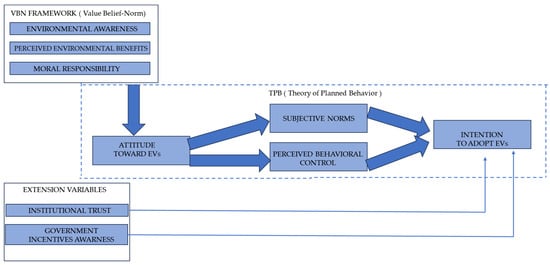
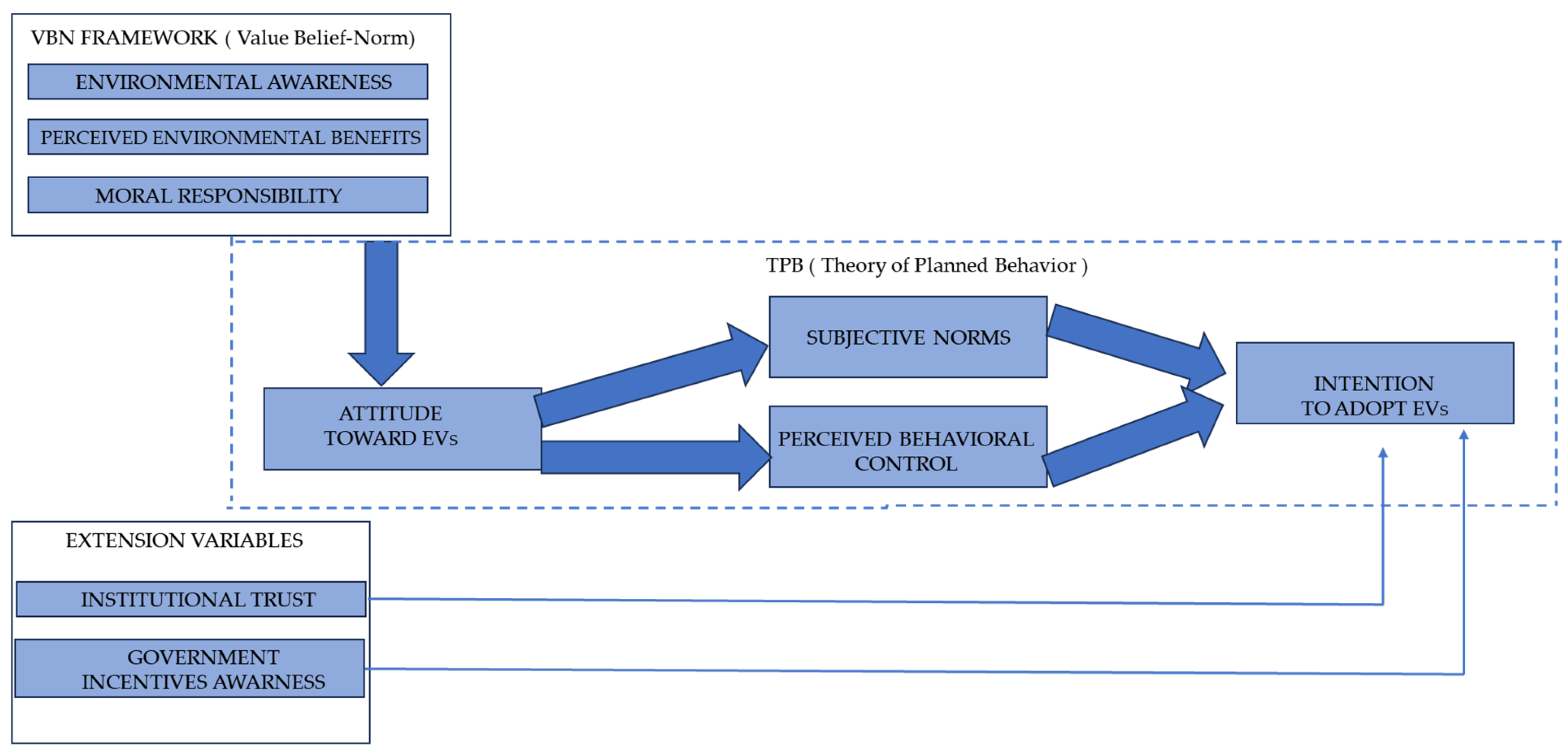
In summary, the existing literature provides fragmented evidence regarding sustainability values, feasibility perceptions, social influence, and institutional trust in EV adoption. Few studies integrate moral responsibility, perceived environmental benefits, perceived behavioral control, and institutional trust within a unified behavioral framework in African contexts. This study addresses this gap by examining how value-based, feasibility, and institutional dimensions jointly shape Moroccan consumers’ intention to adopt electric vehicles. The proposed conceptual framework is presented in Figure 1.
Figure 1.
Integrated conceptual model of electric vehicle (EV) adoption intention.
2.1. Environmental Awareness
Environmental awareness refers to the extent to which individuals recognize environmental problems and understand the environmental consequences of their consumption behaviors. Prior research suggests that higher levels of environmental awareness are generally associated with more favorable evaluations of environmentally friendly technologies and sustainable innovations. In the context of electric vehicles, environmental awareness has been shown to contribute to pro-environmental attitudes by increasing consumers’ sensitivity to issues such as air pollution, climate change, and resource depletion [22].
Although environmental awareness and perceived environmental benefits are related, they capture distinct conceptual dimensions. Environmental awareness refers to individuals’ general knowledge and concern about environmental problems, including the recognition of issues such as climate change, pollution, and resource depletion. In contrast, perceived environmental benefits refer to the extent to which consumers believe that a specific technology, in this case electric vehicles, can contribute to environmental protection, for example through reduced emissions or improved air quality. While environmental awareness reflects a general environmental consciousness, perceived environmental benefits represent an evaluation of the environmental advantages associated with a particular innovation. Distinguishing between these constructs is consistent with prior research showing that general environmental concern does not necessarily translate into favorable evaluations of specific green technologies.
Empirical evidence further indicates that environmental awareness can indirectly shape consumers’ evaluations of electric vehicles by reinforcing the perceived relevance of sustainability-related attributes in the decision-making process. For instance, recent research demonstrates that environmental awareness significantly influences pro-environmental attitudes toward green technologies in the context of electric mobility [22]. In emerging markets such as Morocco, where concerns related to urban air quality and climate-related risks are becoming increasingly salient, environmental awareness is therefore expected to play a meaningful role in shaping attitudes toward electric vehicle adoption.
H1.
Environmental awareness positively influences attitudes toward adopting electric vehicles.
2.2. Perceived Environmental Benefits
Another determinant concerns the perceived environmental benefits associated with EVs, such as reductions in carbon emissions, improvements in air quality, and diminished reliance on fossil fuels. Consumers who clearly recognize these benefits are more inclined to develop positive attitudes toward EV adoption [18]. Recent studies further confirm that the recognition of ecological advantages acts as a catalyst linking pro-environmental values to favorable evaluations of EVs [22]. Accordingly, perceived environmental benefits are expected to represent a strong attitudinal driver in the Moroccan context.
H2.
Perceived environmental benefits positively influence attitudes toward adopting electric vehicles.
2.3. Moral Responsibility
The Value–Belief–Norm (VBN) theory highlights moral responsibility as a central predictor of pro-environmental behavior [19]. Within this framework, individuals develop a sense of personal moral obligation to act in ways that protect environmental and societal welfare. Moral responsibility therefore reflects the perceived obligation to contribute to environmental protection and sustainable consumption practices. More specifically, Moral Responsibility reflects the individual belief that one has a duty to act in ways that safeguard the environment for current and future generations. Prior studies have shown that consumers who ascribe such responsibility to themselves are more inclined to adopt eco-innovations and sustainable technologies [15]. These findings suggest that moral considerations play an important role in shaping individuals’ evaluations of environmentally responsible behaviors, including the adoption of sustainable mobility solutions such as electric vehicles.
In this study, moral responsibility is conceptualized as an antecedent of attitude rather than a direct predictor of intention. Within the extended Theory of Planned Behavior framework, value-based and moral considerations shape individuals’ evaluative judgments toward a behavior, which are reflected in attitudes. These attitudes subsequently influence behavioral intentions. Thus, moral responsibility is expected to indirectly affect adoption intention through the formation of favorable attitudes toward electric vehicles.
In the Moroccan context, where cultural and social norms emphasize community welfare and intergenerational solidarity, moral responsibility is expected to exert a significant influence on consumer attitudes toward EV adoption.
H3.
Moral Responsibility positively influences attitudes toward adopting electric vehicles.
2.4. Attitude Toward EVs
Within the Theory of Planned Behavior (TPB), attitude refers to an individual’s overall evaluative judgment regarding a specific behavior, in this case, the adoption of electric vehicles [20]. A substantial body of empirical research identifies attitude as a key antecedent of behavioral intention in the context of eco-innovations and sustainable technologies. Prior studies show that favorable attitudes toward electric vehicles significantly enhance consumers’ intention to adopt them [3,18].
Attitudes toward electric vehicles are shaped by both rational cognitive evaluations, such as perceived cost savings, technological performance, and convenience, and normative symbolic considerations, including environmental protection and social responsibility. In particular, the perception of electric vehicles as environmentally beneficial and socially desirable contributes to more favorable evaluations, which in turn increase adoption intention. Consequently, attitude plays a central mediating role between underlying beliefs and consumers’ intention to adopt electric vehicles.
H4.
Attitude toward electric vehicles positively influences intention to adopt electric vehicles.
2.5. Subjective Norms
Subjective norms capture the perceived influence of social expectations, including those of family, peers, and broader societal discourse [20]. Although their effect on EV adoption is often found to be weaker than that of attitudes, norms may nonetheless exert significant influence in collectivist cultural settings [21]. In Morocco, where social imitation and community belonging remain strong drivers of consumption patterns, normative endorsement could represent a meaningful determinant of EV adoption, particularly as such vehicles become increasingly visible in the marketplace.
H5.
Subjective norms positively influence intention to adopt electric vehicles.
2.6. Perceived Behavioral Control
Perceived behavioral control (PBC) reflects individuals’ perceptions of their ability to adopt electric vehicles, considering available resources and perceived constraints [20,23]. In the context of electric vehicle adoption, perceived behavioral control captures consumers’ perceived feasibility of adoption, including perceived affordability, access to charging infrastructure, and confidence in managing technological constraints. Within the Theory of Planned Behavior, PBC is a key determinant of behavioral intention, particularly when adoption decisions are shaped by financial and infrastructural barriers.
Prior research shows that high purchase costs, limited charging infrastructure, and technological uncertainty significantly reduce consumers’ perceived feasibility of adopting electric vehicles, thereby constraining adoption intention [6,24]. Empirical evidence further confirms that perceived behavioral control significantly predicts consumers’ intention to adopt electric vehicles [18].
H6.
Perceived behavioral control positively influences intention to adopt electric vehicles.
2.7. Institutional Trust and Government Incentives
Institutional trust refers to the degree to which individuals believe that public institutions and government authorities act competently, reliably, and in the public interest when implementing policies [5]. In the context of emerging technologies such as electric vehicles, institutional trust can play a crucial role in reducing perceived uncertainty regarding infrastructure development, policy continuity, and regulatory support. When consumers trust that governments will maintain consistent environmental policies and continue supporting electric mobility through infrastructure and incentives, they are more likely to perceive electric vehicles as a viable long-term transportation solution. Consequently, institutional trust can increase individuals’ confidence in the transition toward sustainable mobility and strengthen their intention to adopt electric vehicles.
Within the framework of the Theory of Planned Behavior (TPB), trust can reduce perceived uncertainty around a behavior and strengthen intention by increasing the perceived reliability of the policy environment [5,9]. Empirical evidence in sustainable transport policy shows that individuals with higher trust in government exhibit stronger support for mobility and environmental policies [9]. Similarly, research on electric-vehicle infrastructure acceptability indicates that trust-related perceptions are part of the psychological foundations shaping public acceptance of EV-related deployments [25].
H7.
Institutional Trust positively influences intention to adopt electric vehicles.
2.8. Awareness of Government Incentives
Awareness of government incentives refers to consumers’ knowledge of public measures such as tax exemptions, subsidies, or other financial advantages designed to encourage electric vehicle adoption. Government incentives can reduce financial barriers and signal institutional support for sustainable mobility transitions. Within the Theory of Planned Behavior, awareness of such facilitating conditions may strengthen behavioral intention by improving perceived feasibility and reducing financial uncertainty [18].
Empirical studies in the context of electric vehicle diffusion also show that financial incentives can influence adoption rates, particularly when consumers are aware of their existence and potential accessibility [26]. However, awareness alone does not necessarily imply that consumers perceive these incentives as sufficient, accessible, or credible. Rather, policy awareness represents an important first step in the policy communication process, as consumers who are aware of such measures may be more likely to consider electric vehicles as a feasible mobility option.
H8.
Awareness of government incentives is positively associated with intention to adopt electric vehicles.
3. Materials and Methods
3.1. Measures
This study adopts a quantitative, cross-sectional survey design to examine the determinants of electric vehicle (EV) adoption intention among Moroccan consumers. A structured questionnaire was administered to collect primary data and test the proposed research model. The questionnaire was developed based on an extensive review of prior research on EV adoption and sustainable consumption behavior. Measurement items were adapted from well-established and validated scales used in previous studies [15,20,21,27].
The instrument consisted of three sections: (1) an introduction explaining the purpose of the study and assuring anonymity and voluntary participation; (2) demographic questions; and (3) construct measurement items. The final questionnaire included 31 items measured on a five-point Likert scale ranging from 1 (strongly disagree) to 5 (strongly agree).
The questionnaire was originally developed in English and translated into French using the back-translation procedure proposed by Brislin [28] to ensure semantic equivalence. The initial translation from English to French was conducted by a bilingual academic researcher with expertise in marketing and consumer behavior. A second independent bilingual translator subsequently translated the French version back into English. The two English versions were then compared to identify potential discrepancies, which were discussed and resolved collaboratively to ensure semantic consistency between the original and translated instruments. The pilot test confirmed that respondents clearly understood all items.
The final questionnaire was administered in French, as it is widely used in higher education and professional communication in Morocco. Although Arabic and Amazigh are also spoken in Morocco, French was selected to ensure clarity and consistency for respondents participating in the online survey.
Content validity and cultural appropriateness were evaluated by four academic experts specializing in marketing, sustainability, and consumer behavior. A pilot test involving 25 respondents was conducted to verify clarity and internal consistency. Cronbach’s alpha coefficients exceeded the recommended threshold of 0.80 for all constructs, indicating satisfactory reliability.
The target population comprised Moroccan consumers aged 18 to 55 who either own a vehicle or intend to purchase one in the near future. Because official databases of EV users are unavailable, the study employed a non-probability convenience sampling approach.
This study examines behavioral intention rather than actual adoption behavior. While intention is widely used as a proxy for behavior in the Theory of Planned Behavior, actual purchase decisions may be influenced by additional economic and infrastructural constraints. Furthermore, the study employed a non-probability convenience sampling strategy, which may limit the generalizability of the findings.
Survey distribution occurred online using social media (LinkedIn, Facebook, WhatsApp) and automobile commercial mailing lists. Respondents were briefed about EV characteristics to reduce technological bias and enhance understanding of the concept.
A G*Power 3.1 analysis determined that at least 200 valid responses were needed for sufficient statistical power (0.80) with a medium effect size (f2 = 0.15, α = 0.05). After removing incomplete responses, 223 valid questionnaires were retained for analysis, exceeding the recommended threshold [29].
Environmental awareness was measured using items adapted from previous studies examining environmental concern and knowledge. These items capture respondents’ general awareness and understanding of environmental issues such as pollution and climate change.
Perceived environmental benefits were measured using items assessing respondents’ beliefs about the environmental advantages associated with electric vehicles, such as reductions in emissions and improvements in air quality. While environmental awareness reflects general knowledge of environmental problems, perceived environmental benefits capture consumers’ evaluation of the specific environmental advantages associated with electric vehicles.
All constructs were operationalized using validated scales and slightly adapted for the Moroccan context. Table 1 summarizes the variables, example items, and their academic sources.
Table 1.
Measurement Scales and Example Items.
3.2. Data Analysis
Data were analyzed using Partial Least Squares Structural Equation Modeling (PLS-SEM) with SmartPLS 3.0. PLS-SEM was selected because the objective of this study is not only to test theoretical relationships but also to predict consumers’ intention to adopt electric vehicles in an emerging market context. PLS-SEM is particularly suitable for prediction-oriented research and for models that integrate multiple theoretical constructs from different frameworks, as in the present study combining perspectives derived from the Theory of Planned Behavior (TPB) and the Value–Belief–Norm (VBN) framework.
Furthermore, PLS-SEM is appropriate for studies with moderate sample sizes and complex models, and it provides robust parameter estimates even when data distributions deviate from normality [7]. Given these characteristics and the exploratory integration of value-based and institutional factors into the TPB framework, PLS-SEM represents an appropriate analytical approach for the present study.
Following the two-step approach recommended in prior methodological research [4,7], the measurement model was first assessed for indicator reliability, internal consistency reliability (Cronbach’s alpha and composite reliability), convergent validity (average variance extracted), and discriminant validity using the Fornell–Larcker criterion and the heterotrait–monotrait ratio (HTMT). The structural model was subsequently evaluated using path coefficients, coefficients of determination (R2), effect sizes (f2), and predictive relevance (Q2). Bootstrapping with 5000 subsamples was employed to assess the significance of the hypothesized relationships.
To assess potential common method bias (CMB), Harman’s single-factor test was conducted. The results indicated that the first factor accounted for less than 50% of the total variance, suggesting that common method bias is unlikely to pose a serious concern. Although Harman’s single-factor test has been criticized as a relatively weak statistical diagnostic, several procedural remedies were implemented during questionnaire design to mitigate potential bias. Specifically, respondents were assured of anonymity, participation was voluntary, and measurement items were adapted from previously validated scales. In addition, items measuring different constructs were presented in separate sections of the questionnaire, reducing respondents’ ability to infer relationships among variables. These procedural precautions reduce the likelihood that common method bias significantly affects the results.
4. Results
4.1. Sample Characteristics
This section presents the demographic profile of the respondents. Understanding the sample composition helps evaluate the representativeness and generalizability of the findings. Table 2 summarizes the demographic characteristics of the 223 participants included in the analysis.
Table 2.
Demographic profile of respondents (N = 223).
The demographic profile indicates that the sample is relatively young and highly educated, with the majority of respondents aged between 26 and 35 years. Most participants reside in urban areas, reflecting the online distribution of the survey. A large proportion of respondents already own a vehicle, suggesting that the participants have relevant experience with mobility decisions.
4.2. Measurement Model Assessment
4.2.1. Internal Consistency Reliability
Internal consistency reliability was assessed using Cronbach’s alpha, rho_A, and composite reliability, as presented in Table 3.
Table 3.
Measurement model results.
4.2.2. Convergent Validity
Convergent validity was examined using Average Variance Extracted (AVE). All constructs surpassed the 0.50 threshold, with AVE values ranging from 0.609 to 0.872, as shown in Table 3. This demonstrates that each construct explains a majority of the variance in its indicators.
4.2.3. Discriminant Validity
The Fornell–Larcker criterion was used to assess discriminant validity. Table 4 displays the square roots of AVE along the diagonal. For all constructs, the diagonal values exceed the inter-construct correlations, confirming satisfactory discriminant validity.
Table 4.
Discriminant Validity.
For example, the square root of AVE for Attitude (0.897) is greater than its correlations with Environmental Awareness (0.395), Institutional Trust (0.564), and Intention (0.685). Similar patterns are held for all constructs in Table 4.
It should be noted that both Government Incentives and Subjective Norms present identical AVE values (0.872), resulting in the same square-root value (0.934) on the diagonal of the Fornell–Larcker matrix. This duplication arises from similar AVE magnitudes rather than construct overlap. The constructs remain conceptually distinct and are measured using different items capturing institutional policy awareness and social influence, respectively.
4.2.4. HTMT Ratio
In addition to the Fornell–Larcker criterion, discriminant validity was further assessed using the heterotrait–monotrait ratio of correlations (HTMT), which is considered a more stringent method for evaluating discriminant validity in PLS-SEM) [7]. HTMT measures the ratio of between-construct correlations relative to within-construct correlations and provides a robust indication of whether constructs are empirically distinct. According to recommended guidelines, HTMT values should remain below 0.90 to confirm adequate discriminant validity.
As shown in Table 5, the HTMT results indicate that all construct pairs exhibit values below the recommended threshold. Specifically, HTMT values range between 0.167 and 0.872, demonstrating that the correlations between different constructs are sufficiently lower than the correlations within constructs. These findings provide additional support for the discriminant validity of the measurement model and confirm that each construct captures a distinct conceptual dimension within the proposed behavioral framework.
Table 5.
Heterotrait–Monotrait Ratio (HTMT).
4.3. Structural Model Assessment
4.3.1. Model Fit
Model fit indices are presented in Table 6. Model fit was assessed using the standardized root mean square residual (SRMR). The SRMR value for the estimated model is 0.091, which is slightly above the commonly suggested threshold of 0.08. Therefore, the model fit should be interpreted with caution. In PLS-SEM, however, model evaluation places greater emphasis on predictive capability rather than exact global fit [7]. Accordingly, the assessment of the structural model in this study relies not only on SRMR but also on predictive indicators such as R2, f2, and Q2, which together provide a more comprehensive evaluation of model performance. In addition, the saturated model SRMR value of 0.065 suggests that the measurement model demonstrates acceptable fit, whereas the higher estimated SRMR may reflect the complexity of the structural relationships specified in the model.
Table 6.
Model Fit.
4.3.2. Explained Variance (R2)
The model’s explanatory power is shown in Table 7. The R2 value for:
- Attitude = 0.328, indicating moderate explanatory power;
- Intention = 0.664, indicating strong explanatory power.
The results indicate that the model explains 32.8% of the variance in Attitude and 66.4% of the variance in Intention, demonstrating moderate to strong predictive power.
Table 7.
Explained Variance.
4.3.3. Effect Size (f2)
To further assess the contribution of each exogenous construct to the endogenous variables, effect sizes (f2) were examined. The f2 statistic evaluates how strongly an exogenous construct contributes to the explained variance of an endogenous construct by measuring the change in R2 when the predictor is omitted from the model. According to [7], f2 values of 0.02, 0.15, and 0.35 indicate small, medium, and large effects, respectively.
Table 8 presents the effect sizes for all structural relationships in the model. The results indicate that Attitude toward electric vehicles exerts a medium effect on Intention (f2 = 0.193), highlighting its central role in shaping EV adoption decisions. This finding reinforces the theoretical assumptions of the Theory of Planned Behavior, which posits that favorable behavioral evaluations represent a key driver of intention formation.
Table 8.
Effect sizes (f2).
Other predictors of Intention demonstrate small effect sizes, including Institutional Trust (f2 = 0.097), Perceived Behavioral Control (f2 = 0.078), and Government Incentives (f2 = 0.018). These results suggest that although these factors contribute to the explanation of EV adoption intention, their relative impact remains more limited compared to the attitudinal component.
Regarding the determinants of Attitude, Perceived Environmental Benefits (f2 = 0.095) and Moral Responsibility (f2 = 0.076) exhibit small but meaningful effect sizes, confirming their relevance as value-based drivers shaping consumers’ evaluations of electric vehicles. In contrast, Environmental Awareness (f2 = 0.000) shows a negligible effect, indicating that awareness of environmental issues alone does not substantially influence attitudes toward EV adoption in the Moroccan context.
Overall, the effect size analysis confirms that attitudinal evaluation represents the strongest behavioral mechanism linking sustainability-related beliefs to EV adoption intention, while other determinants play complementary but smaller roles.
4.3.4. Predictive Relevance (Q2)
Predictive relevance of the structural model was assessed using the Stone–Geisser Q2 statistic obtained through the blindfolding procedure. According to [7], Q2 values above 0.02, 0.15, and 0.35 indicate small, medium, and large predictive relevance, respectively.
As reported in Table 9, the Q2 values for Attitude (Q2 = 0.250) and Intention (Q2 = 0.549) are both greater than zero, confirming that the model demonstrates predictive relevance for these endogenous constructs. The value for Attitude indicates moderate predictive relevance, while the value for Intention indicates strong predictive relevance, suggesting that the proposed model has good predictive capability in explaining EV adoption intention.
Table 9.
Predictive Relevance (Q2).
4.4. Hypotheses Testing
The hypothesized relationships were examined using the bootstrapping procedure with 5000 subsamples. Table 10 presents the standardized path coefficients, t-values, and p-values for all proposed hypotheses.
Table 10.
Hypothesis testing.
The results indicate that perceived environmental benefits have a significant positive effect on Attitude (β = 0.222, t = 2.576, p = 0.010), supporting H2. Moral Responsibility also exerts a strong and significant positive influence on Attitude (β = 0.359, t = 4.420, p < 0.001), providing support for H3. In contrast, environmental awareness does not demonstrate a statistically significant effect on Attitude (β = 0.069, t = 0.800, p = 0.424), indicating that environmental awareness was not statistically significant in this sample and model; therefore, H1 is not supported.
Regarding the determinants of adoption Intention, Attitude toward electric vehicles significantly influences Intention (β = 0.347, t = 6.364, p < 0.001), confirming H4. Perceived behavioral control also shows a significant positive effect on Intention (β = 0.271, t = 3.620, p < 0.001), supporting H6. Institutional trust significantly predicts Intention (β = 0.245, t = 4.013, p < 0.001), providing support for H7.
Conversely, subjective norms do not exert a statistically significant effect on Intention (β = 0.020, t = 0.573, p = 0.567), awareness of incentives shows a marginal effect on intention (β = 0.111, p = 0.081). Therefore, H5 and H8 are not supported.
5. Discussion
This study examined the determinants of electric vehicle (EV) adoption intention in Morocco by integrating sustainability-related values, feasibility perceptions, social influence, and institutional factors within an extended behavioral framework. The findings indicate that EV adoption intention in Morocco is primarily driven by perceived environmental benefits, moral responsibility, perceived behavioral control, and institutional trust, whereas environmental awareness was not statistically significant in this sample and model, while subjective norms and awareness of government incentives do not exert significant effects. These results highlight the central role of feasibility constraints and institutional credibility in shaping sustainable mobility adoption in emerging markets.
Environmental awareness does not significantly influence attitudes toward electric vehicles, suggesting that general environmental concern does not necessarily translate into favorable evaluations of specific technologies in emerging markets. While respondents may recognize environmental problems such as pollution or climate change, these concerns do not automatically lead to favorable evaluations of specific technologies. In emerging markets, consumers may prioritize practical considerations such as cost, infrastructure availability, and technological reliability over general environmental concerns when making vehicle purchase decisions. This finding supports previous research indicating that environmental awareness alone is often insufficient to drive the adoption of green technologies without strong perceived benefits or facilitating conditions [30,31,32,33]. In Morocco, high purchase costs and limited EV market penetration further reduce the practical relevance of environmental awareness in vehicle purchase decisions.
Similarly, subjective norms do not significantly influence adoption intention. The absence of a significant effect of subjective norms may reflect the limited social visibility of electric vehicles in Morocco, where the diffusion of EV technology remains relatively low. When technology is not widely adopted within social networks, individuals may receive limited social signals encouraging adoption. As a result, peer influence and social pressure may play a weaker role in shaping consumers’ intentions compared to personal evaluations such as attitudes and perceived feasibility. Normative influences tend to emerge at later diffusion stages, once adoption becomes socially observable and symbolically meaningful [34].
Awareness of government incentives also fails to significantly predict adoption intention. The marginal influence of awareness of government incentives suggests that knowledge of policy measures alone may not be sufficient to motivate adoption intentions. Consumers may be aware that certain incentives exist but remain uncertain about their accessibility, adequacy, or long-term continuity. In emerging markets, where policy frameworks are still evolving, individuals may perceive government incentives as temporary or insufficient to offset the perceived costs and uncertainties associated with electric vehicles. This aligns with Moroccan evidence suggesting that fiscal incentives remain weakly embedded in consumers’ decision-making processes due to concerns over affordability and policy implementation [32,33,35,36].
The non-significant relationship between awareness of government incentives and electric vehicle adoption intention may also reflect structural constraints affecting consumers’ evaluations of electric mobility. Even when consumers are aware of existing incentives, they may perceive them as insufficient to offset the relatively high upfront cost of electric vehicles. In addition, structural barriers such as limited charging infrastructure and uncertainty regarding vehicle range or maintenance services may reduce consumers’ perceived behavioral control. Under such conditions, policy awareness alone is unlikely to influence adoption intentions unless incentives are perceived as substantial, reliable, and capable of meaningfully reducing both financial and practical barriers to EV ownership. This finding suggests that consumers evaluate incentives not only in terms of their existence but also in terms of their effectiveness in enhancing the feasibility of adoption.
The marginal effect suggests that knowing incentives exist may not translate into adoption intention because awareness does not capture whether incentives are perceived as attractive, easy to obtain, or credible. This supports the distinction between “awareness” and perceptions of policy effectiveness and implementation.
In contrast, perceived environmental benefits significantly shape favorable attitudes toward EVs, highlighting the importance of tangible, outcome-oriented ecological considerations. Unlike abstract environmental awareness, perceived benefits provide concrete justifications for adoption, particularly in constrained consumption contexts [31,37]. This finding underscores the need to frame EV promotion strategies around visible environmental outcomes rather than abstract sustainability discourse.
Moral Responsibility also exerts a strong positive influence on attitudes toward EVs. Consistent with the Value–Belief–Norm framework, moral obligation toward collective and intergenerational welfare constitutes a key motivational force shaping pro-environmental evaluations [19,30]. Cultural norms emphasizing social solidarity may further amplify the influence of moral responsibility in Morocco.
Attitude toward EVs significantly predicts adoption intention, confirming its central role within the Theory of Planned Behavior. However, positive attitudes alone are insufficient to ensure adoption when feasibility constraints persist. This supports prior evidence indicating that favorable evaluations must be accompanied by perceived feasibility to translate into behavioral intention [20,34,37,38].
Perceived behavioral control emerges as one of the strongest predictors of adoption intention, emphasizing the decisive role of affordability, charging infrastructure accessibility, and perceived ease of use. Structural and resource-related barriers remain dominant inhibitors of EV adoption in Morocco, reinforcing the primacy of feasibility perceptions in emerging-market contexts [39,40].
Beyond psychological determinants, the findings must also be interpreted in light of the structural development of Morocco’s electric mobility ecosystem. Despite strong national commitments to renewable energy production and industrial EV manufacturing, the charging infrastructure network remains limited and unevenly distributed across regions. This infrastructural immaturity may reinforce perceived behavioral constraints and slow the diffusion of electric vehicles. Compared to more advanced EV markets in Europe and parts of Asia, Morocco remains at an early stage of ecosystem consolidation, where institutional coordination, charging accessibility, and long-term policy clarity are critical for accelerating consumer adoption within increasingly complex consumer decision-making processes [41]. Therefore, strengthening the technical and infrastructural foundations of electric mobility is essential to complement behavioral and value-based drivers identified in this study.
Institutional trust also significantly predicts adoption intention, highlighting the importance of policy credibility and consistency. Trust in public institutions reduces perceived uncertainty surrounding electric mobility and strengthens consumers’ confidence in the long-term viability of EV-related policies.
Overall, these findings demonstrate that EV adoption in Morocco follows a distinct behavioral logic in which moral responsibility, tangible environmental benefits, perceived feasibility, and institutional trust outweigh abstract environmental awareness, social norms, and incentive awareness. By integrating sustainability values with feasibility and institutional dimensions, this study advances theoretical understanding of sustainable mobility transitions in emerging markets and provides evidence-based insights for the design of culturally grounded and institutionally credible EV promotion strategies.
6. Contributions, Limitations and Future Research
This study makes several important contributions to the literature on sustainable mobility and electric vehicle (EV) adoption. It extends the Theory of Planned Behavior by integrating moral responsibility derived from the Value–Belief–Norm framework and institutional trust as key contextual determinants of EV adoption intention. By moving beyond purely techno-economic explanations, the study demonstrates that moral and institutional dimensions play a decisive role in shaping sustainable mobility adoption in emerging-market contexts.
The findings also refine existing theoretical assumptions regarding the universality of sustainability-driven motivations. While prior studies often posit environmental awareness and social norms as central drivers of green technology adoption, the present results reveal that, in Morocco, abstract environmental awareness and normative pressure do not significantly influence EV adoption intention. Instead, tangible environmental benefits, perceived feasibility, and institutional trust emerge as the dominant determinants. This highlights a distinct behavioral logic in emerging markets where pragmatic constraints and institutional credibility outweigh abstract environmental discourse.
This study further contributes rare African-context empirical evidence to a literature largely dominated by developed and Asian economies. By providing one of the first unified behavioral examinations of EV adoption in Morocco, it offers a context-sensitive framework that enhances understanding of sustainable mobility transitions in comparable emerging economies.
From a practical and policy perspective, the findings suggest that EV promotion strategies should prioritize improving perceived feasibility through enhanced charging infrastructure, greater financial accessibility, and consistent long-term policy frameworks rather than relying primarily on awareness campaigns. Communication strategies should emphasize tangible environmental benefits and moral responsibility appeals, while strengthening institutional trust through transparent and credible policy implementation.
The findings of this study offer several practical implications for policymakers seeking to accelerate electric vehicle adoption in Morocco. First, policies should prioritize improving perceived feasibility by expanding charging infrastructure, particularly in major urban centers and along key transportation corridors. Public–private partnerships could play an important role in supporting the deployment of charging stations and ensuring convenient access for potential EV users. Strengthening infrastructure availability can significantly enhance consumers’ perceived behavioral control and reduce concerns related to range limitations.
Second, communication strategies should emphasize the concrete environmental and economic benefits of electric vehicles, including reduced greenhouse gas emissions, improved urban air quality, and lower long-term operating costs. Public awareness campaigns and targeted information programs can help consumers better understand the practical advantages of electric mobility.
Third, policymakers should focus on strengthening institutional trust by ensuring policy stability, transparency, and long-term commitment to sustainable mobility initiatives. Clear regulatory frameworks, consistent policy implementation, and reliable information about incentive programs can increase consumer confidence in government-supported EV transitions.
Finally, financial incentive programs should be substantial, transparent, and easy to access, ensuring that they effectively reduce the perceived financial barriers associated with electric vehicle ownership. Increasing awareness of incentive programs alone may not be sufficient; incentives must be perceived as meaningful and capable of offsetting the high initial purchase costs of EVs. Simplifying administrative procedures and clearly communicating eligibility requirements can further enhance their effectiveness. By combining financial incentives with improvements in infrastructure and policy accessibility, governments can more effectively strengthen consumers’ confidence in the feasibility of adopting electric vehicles.
Despite these contributions, the study has limitations that provide directions for future research. Another limitation relates to the use of behavioral intention as the dependent variable rather than actual adoption behavior. Although intention is widely recognized as a reliable predictor of behavior within the Theory of Planned Behavior framework, actual purchase decisions may also depend on additional economic, infrastructural, and market-related constraints that were not captured in this study. The cross-sectional design restricts causal inference and the ability to capture dynamic changes in adoption intention over time. Future research could employ longitudinal designs to examine how EV adoption intentions evolve alongside infrastructure expansion and policy maturation. The use of convenience sampling and self-reported measures may also limit generalizability; future studies are encouraged to apply probability sampling methods and incorporate actual behavioral data.
It should be noted that the present study measures awareness of government incentives rather than perceptions of their adequacy, accessibility, or credibility. Future research could therefore examine more nuanced dimensions of policy perception, such as perceived effectiveness of incentives, perceived ease of claiming subsidies, or trust in policy implementation.
Although the present study identifies several key determinants of EV adoption intention, it does not examine potential moderating effects of socio-demographic factors such as income level or urban–rural residence. Future research could employ multi-group analysis or moderation models to examine whether socio-demographic factors such as income level, urban–rural residence, or institutional perceptions moderate the relationship between perceived feasibility, Government Incentives, and EV adoption intention.
Incorporating additional psychological constructs, including perceived risk, environmental self-identity, and trust in technology, could also refine predictive models. Comparative cross-country studies within African and MENA contexts would be particularly valuable for assessing the generalizability of these findings and for developing regionally adapted sustainable mobility policies.
7. Conclusions
This study examined the determinants of electric vehicle (EV) adoption intention in Morocco by integrating sustainability-related values, perceived feasibility, social influence, and institutional factors within an extended behavioral framework. The findings reveal that EV adoption intention in Morocco is primarily driven by perceived environmental benefits, moral responsibility, perceived behavioral control, and institutional trust, whereas general environmental awareness, subjective norms, and awareness of government incentives do not significantly influence adoption intention.
These results demonstrate that EV adoption in emerging markets follows a distinct behavioral logic in which tangible environmental benefits, moral obligations, perceived feasibility, and confidence in public institutions outweigh abstract environmental awareness and social normative pressure. The findings further indicate that favorable attitudes toward electric vehicles must be supported by perceived feasibility and institutional credibility to translate into meaningful adoption intention.
By providing one of the first unified empirical examinations of EV adoption in Morocco, this study contributes context-sensitive evidence to the literature on sustainable mobility transitions in emerging economies. It underscores the importance of integrating moral and institutional dimensions into behavioral adoption models and highlights the need for policy strategies that prioritize infrastructure development, financial accessibility, and policy credibility over awareness-based campaigns alone.
This study also contributes to electric mobility research by demonstrating that behavioral feasibility and institutional credibility may represent stronger levers than financial incentives in early-stage EV markets. These findings suggest that in emerging ecosystems such as Morocco, accelerating infrastructure deployment and reinforcing policy credibility may be more effective than relying solely on economic incentive schemes to stimulate electric vehicle diffusion.
Overall, this research offers a robust analytical foundation for understanding sustainable mobility adoption in Morocco and comparable emerging markets and provides evidence-based insights to guide the design of effective and culturally grounded electric mobility policies.
Author Contributions
Conceptualization, A.E.G. and I.F.; methodology, A.E.G. and I.F.; software, A.E.G.; validation, A.E.G., I.F. and R.T.; formal analysis, I.F. and R.T.; investigation, A.E.G.; data curation, R.T.; writing—original draft preparation, A.E.G.; writing—review and editing, I.F., R.T. and H.A.; visualization, A.E.G.; supervision, I.F. and H.A.; project administration, A.E.G. All authors have read and agreed to the published version of the manuscript.
Funding
This research received no external funding.
Institutional Review Board Statement
Ethical review and approval were waived for this study due to Ethics Committee of the EMAA Research Center in accordance with the Moroccan Law No. 28-12 (https://www.sgg.gov.ma/fr/loi/28-12).
Informed Consent Statement
Informed consent was obtained from all individual participants included in the study.
Data Availability Statement
The original contributions presented in this study are included in the article. Further inquiries can be directed to the corresponding author.
Acknowledgments
The authors would like to thank the academic experts who provided valuable feedback during the questionnaire validation process, as well as all respondents who participated in the survey. Their contributions were essential to the completion of this research.
Conflicts of Interest
The authors declare no conflicts of interest.
Abbreviations
| EV | Electric Vehicle |
| ICE | Internal Combustion Engine |
| TPB | Theory of Planned Behavior |
| VBN | Value–Belief–Norm Theory |
| PBC | Perceived Behavioral Control |
| PLS-SEM | Partial Least Squares Structural Equation Modeling |
| AVE | Average Variance Extracted |
| SRMR | Standardized Root Mean Square Residual |
| NFI | Normed Fit Index |
| CMB | Common Method Bias |
| R2 | Coefficient of Determination |
| HTMT | Heterotrait–Monotrait Ratio |
| f2 | Effect Size |
| Q2 | Predictive Relevance |
References
- Ahmad, S.; Khan, M.A.; Jamil, F.; Bibi, S. Moving towards sustainable purchase behavior: Determinants of consumers’ acceptance of electric vehicles in Malaysia. PaperASIA 2024, 40, 207–224. [Google Scholar] [CrossRef] [Scilit]
- Jaiswal, D.; Kaushal, V.; Singh, P.K.; Biswas, A. Consumer adoption intention for electric vehicles: Insights and evidence from Indian sustainable transportation. Technol. Forecast. Soc. Change 2021, 173, 121089. [Google Scholar] [CrossRef] [Scilit]
- Simsekoglu, Ö.; Nayum, A. Predictors of intention to buy a battery electric vehicle among conventional car drivers. Transp. Res. Part F 2019, 60, 1–10. [Google Scholar] [CrossRef] [Scilit]
- Anderson, J.C.; Gerbing, D.W. Structural equation modeling in practice: A review and recommended two-step approach. Psychol. Bull. 1988, 103, 411–423. [Google Scholar] [CrossRef]
- Earle, T.C.; Siegrist, M. Trust, confidence and cooperation model: A framework for understanding the relation between trust and risk perception. Int. J. Glob. Environ. Issues 2008, 8, 17–29. [Google Scholar] [CrossRef] [Scilit]
- Egbue, O.; Long, S. Barriers to widespread adoption of electric vehicles: An analysis of consumer attitudes and perceptions. Energy Policy 2012, 48, 717–729. [Google Scholar] [CrossRef] [Scilit]
- Hair, J.F.; Hult, G.T.M.; Ringle, C.M.; Sarstedt, M. A Primer on Partial Least Squares Structural Equation Modeling (PLS-SEM), 3rd ed.; Sage: Thousand Oaks, CA, USA, 2021. [Google Scholar]
- Hardman, S.; Chandan, A.; Tal, G.; Turrentine, T. The effectiveness of financial purchase incentives for battery electric vehicles—A review of the evidence. Renew. Sustain. Energy Rev. 2017, 80, 1100–1111. [Google Scholar] [CrossRef] [Scilit]
- Huber, R.A.; Wicki, M. What explains citizen support for transport policy? The roles of policy design, trust in government, and proximity among Swiss citizens. Energy Res. Soc. Sci. 2021, 75, 101973. [Google Scholar] [CrossRef] [Scilit]
- International Energy Agency. Morocco: Electricity and Renewable Energy Profile. 2023. Available online: https://www.iea.org/countries/morocco/electricity (accessed on 20 September 2025).
- Figueiredo, V.; Baptista, G. Electric Vehicles Sustainability and Adoption Factors. Urban Sci. 2025, 9, 311. [Google Scholar] [CrossRef] [Scilit]
- Kottala, S.Y.; Chanagala, S.; Balaji, C.; Reddy, V.V.N.; Babu, G.N.P.V. Exploring electric vehicle consumer behavior: Impact of digital innovation, environmental concern, perceived value, and social influence on purchase intentions. Front. Sustain. Cities 2025, 7, 1655074. [Google Scholar] [CrossRef] [Scilit]
- Yildiz, B.; Çiğdem, Ş.; Meidutė-Kavaliauskienė, I. Sustainable mobility and electric vehicle adoption: A study on the impact of perceived benefits and risks. Transport 2024, 39, 129–145. [Google Scholar] [CrossRef] [Scilit]
- Barakat, S.; Guven, A.F.; Abdelaziz, A.Y.; Samy, M.M. A comprehensive review of electric vehicles and sustainable urban mobility in the Middle East and North Africa. Renew. Sustain. Energy Rev. 2026, 225, 116154. [Google Scholar] [CrossRef] [Scilit]
- Joshi, Y.; Rahman, Z. Factors affecting green purchase behaviour and future research directions. Int. Strateg. Manag. Rev. 2015, 3, 128–143. [Google Scholar] [CrossRef] [Scilit]
- Kannan, P.K.; Li, H. Digital marketing: Framework, review and research agenda. Int. J. Res. Mark. 2017, 34, 22–45. [Google Scholar] [CrossRef] [Scilit]
- Kotler, P.; Keller, K.L. Marketing Management, 15th ed.; Pearson: London, UK, 2016. [Google Scholar]
- Lai, I.K.W. Factors influencing the behavioral intention toward full electric vehicles: An empirical study in Macau. Sustainability 2015, 7, 12564–12585. [Google Scholar] [CrossRef] [Scilit]
- Stern, P.C. Toward a coherent theory of environmentally significant behavior. J. Soc. Issues 2000, 56, 407–424. [Google Scholar] [CrossRef] [Scilit]
- Ajzen, I. The theory of planned behavior. Organ. Behav. Hum. Decis. Process. 1991, 50, 179–211. [Google Scholar] [CrossRef] [Scilit]
- Pettifor, H.; Wilson, C.; Axsen, J.; Abrahamse, W.; Anable, J. Social influence in the global diffusion of alternative fuel vehicles: A meta-analysis. J. Transp. Geogr. 2017, 62, 247–261. [Google Scholar] [CrossRef] [Scilit]
- Dutta, B.; Hwang, H.-G. Consumers’ purchase intentions of green electric vehicles: The influence of technological and environmental considerations. Sustainability 2021, 13, 12025. [Google Scholar] [CrossRef] [Scilit]
- Ajzen, I. Perceived behavioral control, self-efficacy, locus of control, and the theory of planned behavior. J. Appl. Soc. Psychol. 2002, 32, 665–683. [Google Scholar] [CrossRef] [Scilit]
- Liao, F.; Molin, E.; Van Wee, B. Consumer preferences for electric vehicles: A literature review. Transp. Rev. 2017, 37, 252–275. [Google Scholar] [CrossRef] [Scilit]
- Morton, C.; Larimian, T.; Timmis, A.; Palaiologou, F.; Masera, C.; Monsuur, F. Public acceptability of electric vehicle chargepoint installation in neighbourhoods. Cities 2025, 163, 105961. [Google Scholar] [CrossRef] [Scilit]
- Sierzchula, W.; Bakker, S.; Maat, K.; Van Wee, B. The influence of financial incentives and other socio-economic factors on electric vehicle adoption. Energy Policy 2014, 68, 183–194. [Google Scholar] [CrossRef] [Scilit]
- Rezvani, Z.; Jansson, J.; Bengtsson, M. Consumer motivations for sustainable consumption. Bus. Strategy Environ. 2018, 27, 1272–1283. [Google Scholar] [CrossRef] [Scilit]
- Brislin, R.W. Translation and content analysis of oral and written material. In Handbook of Cross-Cultural Psychology; Triandis, H.C., Berry, J.W., Eds.; Allyn & Bacon: Boston, MA, USA, 1980; Volume 2, pp. 389–444. [Google Scholar]
- Faul, F.; Erdfelder, E.; Lang, A.G.; Buchner, A. G*Power 3: A flexible statistical power analysis program for the social, behavioral, and biomedical sciences. Behav. Res. Methods 2007, 39, 175–191. [Google Scholar] [CrossRef] [Scilit]
- Mostafa, M.M. Gender differences in Egyptian consumers’ green purchase behaviour. Int. J. Consum. Stud. 2007, 31, 220–229. [Google Scholar] [CrossRef] [Scilit]
- Schiffman, L.G.; Wisenblit, J. Consumer Behavior, 12th ed.; Pearson: London, UK, 2019. [Google Scholar]
- Meskine, S.; El Asri, H.; Al-Majeed, S. Investigating barriers to EV adoption in Morocco: Insights from an emerging economy. World Electr. Veh. J. 2025, 16, 672. [Google Scholar] [CrossRef] [Scilit]
- Nasreddin, D.; El Hafdaoui, H.; Jelti, F.; Boumelha, A.; Khallaayoun, A. Inhibitors of battery electric vehicle adoption in Morocco. World Electr. Veh. J. 2024, 15, 6. [Google Scholar] [CrossRef] [Scilit]
- Schuitema, G.; Anable, J.; Skippon, S.; Kinnear, N. The role of instrumental, hedonic, and symbolic attributes in the intention to adopt electric vehicles. Transp. Res. Part A 2013, 48, 39–49. [Google Scholar] [CrossRef] [Scilit]
- Li, S.; Tong, L.; Xing, J.; Zhou, Y. The market for electric vehicles: Indirect network effects and policy design. J. Assoc. Environ. Resour. Econ. 2017, 4, 89–133. [Google Scholar] [CrossRef] [Scilit]
- Boubker, O.; Lakhal, M.; Ait Yassine, Y.; Lotfi, H. Towards sustainable transport in the Moroccan context: The key determinants of electric car adoption intention. World Electr. Veh. J. 2024, 15, 136. [Google Scholar] [CrossRef] [Scilit]
- Wang, S.; Fan, J.; Zhao, D.; Yang, S.; Fu, Y. Predicting consumers’ intention to adopt hybrid electric vehicles. Transportation 2016, 43, 123–143. [Google Scholar] [CrossRef] [Scilit]
- Rezvani, Z.; Jansson, J.; Bodin, J. Advances in consumer electric vehicle adoption research: A review and research agenda. Transp. Res. Part D 2015, 34, 122–136. [Google Scholar] [CrossRef] [Scilit]
- Meyer, K.E.; Peng, M.W. Theoretical foundations of emerging economy business research. J. Int. Bus. Stud. 2016, 47, 3–22. [Google Scholar] [CrossRef] [Scilit]
- Peng, Y.; Fazeli, R.; Ye, W.; Bai, X. Consumer insights on EV policy towards accelerated adoption—Canberra case study. Case Stud. Transp. Policy 2025, 21, 101540. [Google Scholar] [CrossRef] [Scilit]
- Lemon, K.N.; Verhoef, P.C. Understanding customer experience throughout the customer journey. J. Mark. 2016, 80, 69–96. [Google Scholar] [CrossRef] [Scilit]

Disclaimer/Publisher’s Note: The statements, opinions and data contained in all publications are solely those of the individual author(s) and contributor(s) and not of MDPI and/or the editor(s). MDPI and/or the editor(s) disclaim responsibility for any injury to people or property resulting from any ideas, methods, instructions or products referred to in the content. |
© 2026 by the authors. Published by MDPI on behalf of the World Electric Vehicle Association. Licensee MDPI, Basel, Switzerland. This article is an open access article distributed under the terms and conditions of the Creative Commons Attribution (CC BY) license.