1. Introduction
Cloud computing has become one of the fundamental paradigms of modern computing, enabling on-demand access to scalable, flexible, and cost-effective computational resources over the Internet. This rapid evolution has established cloud computing as the fifth utility, enabling ubiquitous access to computational resources through service-oriented delivery models [
1]. At the core of these infrastructures are cloud data centers, which provide the computational, storage, and networking resources required to execute diverse workloads while ensuring service availability and performance. Cloud computing environments must simultaneously address resource management challenges while ensuring secure and reliable service provisioning against evolving operational threats [
2]. These infrastructures are built upon fundamental cloud computing principles such as virtualization, resource sharing, elasticity, and on-demand provisioning, which collectively enable scalable and efficient service delivery across geographically distributed environments [
3]. As cloud environments continue to expand in scale and complexity, efficiently allocating resources and maintaining balanced workloads across heterogeneous computing infrastructures have become increasingly challenging. Consequently, load balancing has become a fundamental component of cloud resource management for improving resource utilization, reducing execution delays, preventing resource bottlenecks, and enhancing the overall Quality of Service (QoS). Effective load balancing also contributes to higher system scalability, improved reliability, better compliance with Service Level Agreements (SLAs), and more efficient utilization of heterogeneous cloud resources under continuously changing workload conditions, making it an essential component of modern cloud computing environments.
Despite these advantages, the overall performance of cloud computing environments largely depends on the effectiveness of task scheduling and resource allocation strategies. Cloud service providers must continuously assign incoming workloads to heterogeneous virtual machines and physical hosts while maintaining high resource utilization, balanced workloads, and acceptable Quality of Service (QoS). However, the dynamic nature of cloud environments, characterized by fluctuating workloads and heterogeneous computing resources, makes efficient scheduling a challenging optimization problem. Moreover, geographically distributed cloud infrastructures introduce additional scheduling complexity because workloads may be dynamically distributed across multiple regions with heterogeneous resource capacities and continuously changing utilization conditions [
4]. Inefficient scheduling decisions often lead to resource underutilization, increased makespan, longer task execution times, higher operational costs, and unnecessary energy consumption, ultimately reducing the overall efficiency and scalability of cloud data centers. Comprehensive surveys on cloud scheduling strategies highlight the persistent challenges of mapping dynamic workloads to heterogeneous computing resources [
5,
6].
Recent advances in cloud scheduling have introduced numerous heuristic, metaheuristic, hybrid, and machine learning-based approaches to improve resource allocation and load balancing in heterogeneous cloud environments [
7,
8]. Comprehensive analyses of cloud scheduling techniques have also established taxonomies that classify classical, heuristic, metaheuristic, and intelligent scheduling models according to their design characteristics and optimization objectives [
9]. Predictive scheduling techniques have also been investigated to estimate future resource utilization and expected execution time before task allocation, enabling more informed scheduling decisions under dynamic workloads [
10,
11]. Auto-scaling dynamic provisioning framework can be utilized to minimize cloud execution costs while ensuring workflow tasks meet strict deadline constraints [
12]. AI-driven scheduling strategies continuously adapt task placements based on real-time execution patterns and system utilization metrics [
8]. Although these methods have demonstrated considerable improvements in scheduling quality, many rely on iterative optimization procedures or computationally expensive search mechanisms, which increase scheduling overhead and limit their applicability in large-scale and highly dynamic cloud environments [
13]. Furthermore, maintaining an effective balance between execution performance, resource utilization, scalability, and energy efficiency remains a significant challenge, particularly in multi-region cloud environments where workloads and resource conditions continuously change [
4]. These limitations highlight the need for lightweight scheduling strategies capable of making fast and adaptive scheduling decisions while preserving high resource utilization and minimizing execution time.
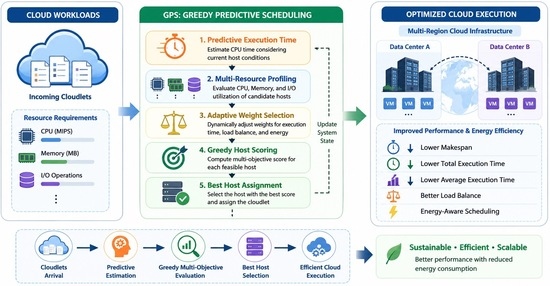
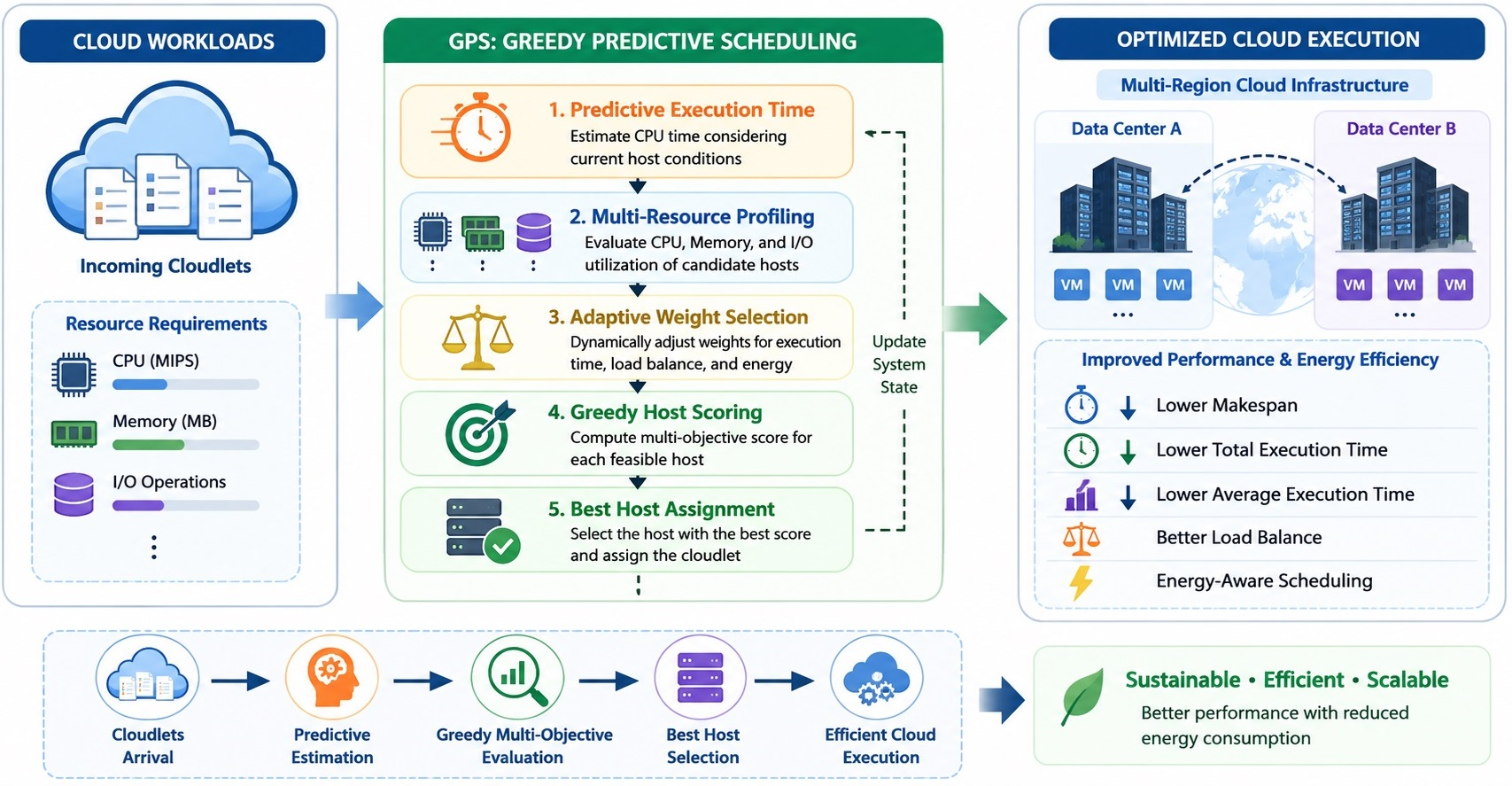
To address these challenges, we propose the Greedy Predictive Scheduling (GPS) algorithm, a lightweight scheduling approach that combines predictive resource estimation with greedy decision making to improve task allocation efficiency in heterogeneous cloud environments. Throughout this paper, the acronym GPS refers exclusively to the proposed Greedy Predictive Scheduling algorithm. Unlike conventional scheduling approaches, GPS dynamically estimates the expected execution state of candidate hosts before assigning tasks, allowing scheduling decisions to better reflect current and predicted resource conditions [
10]. The algorithm simultaneously considers CPU, memory, and I/O utilization to achieve balanced resource allocation across multiple virtual machines while reducing resource contention [
14]. Furthermore, GPS introduces a multi-dimensional scoring mechanism that integrates predicted execution time, workload balancing, and utilization-aware resource selection, making it suitable for geographically distributed multi-region cloud environments [
15]. This design enables the scheduler to improve scalability while maintaining low computational complexity compared with iterative metaheuristic optimization techniques [
13].
Unlike existing heuristic and metaheuristic schedulers, the proposed GPS algorithm does not rely on iterative optimization or population-based search to identify scheduling decisions. Instead, GPS unifies predictive execution-time estimation, multi-resource load balancing, utilization-aware energy consideration, and adaptive weighted greedy decision making within a single lightweight scheduling framework. This integration enables GPS to preserve the low computational complexity of greedy scheduling while improving scheduling quality through predictive and resource-aware decision making, making it particularly suitable for heterogeneous multi-region cloud environments. Consequently, GPS achieves a practical balance between scheduling quality, computational efficiency, scalability, and energy awareness without introducing the optimization overhead associated with population-based metaheuristic algorithms. Unlike population-based metaheuristic schedulers, this lightweight decision process avoids repeated optimization iterations, thereby reducing scheduling overhead while maintaining competitive scheduling quality.
Regarding the energy-aware objective, GPS incorporates CPU utilization as an indicator of energy consumption, allowing scheduling decisions to favor balanced resource utilization without introducing additional optimization overhead. This utilization-aware strategy supports green computing principles by reducing unnecessary resource overloading and improving overall infrastructure efficiency, while preserving the lightweight nature of the proposed scheduler [
16]. Unlike many energy-aware scheduling approaches that rely on computationally intensive optimization algorithms or explicit power models [
17], GPS achieves energy-conscious scheduling through predictive resource utilization and intelligent task assignment, making it more practical for large-scale heterogeneous cloud environments. The proposed algorithm is implemented and evaluated using the CloudSim simulation framework, where two geographically distributed data centers representing multiple cloud regions, thirty virtual machines, and workload sizes ranging from 30 to 500 cloudlets are considered to assess scalability and scheduling performance. The experimental results demonstrate that GPS consistently outperforms the Improved Sparrow Search Algorithm (ISSA) in terms of makespan, total execution time, and average task execution time across all evaluated workload scenarios, confirming its effectiveness as a lightweight, scalable, and resource-aware scheduling solution for heterogeneous multi-region cloud environments [
4].
The remainder of this paper is organized as follows.
Section 2 reviews recent studies on cloud task scheduling, load balancing, predictive resource management, and energy-aware scheduling techniques.
Section 3 presents the proposed Greedy Predictive Scheduling (GPS) algorithm, including its design methodology, mathematical formulation, workflow, and scheduling procedure.
Section 4 describes the experimental setup and evaluates the proposed approach using CloudSim Plus 5.0 under multiple workload scenarios, followed by a comparative performance analysis against the Improved Sparrow Search Algorithm (ISSA). Finally,
Section 5 concludes the paper by summarizing the main contributions and outlining several directions for future research.
2. Related Work
As shown in
Table 1, there is a comparative study of recent research papers related to resource allocation and load balancing in cloud data centers. Each study is analyzed based on its core objective, optimization approach, simulation environment, and dataset used. The table demonstrates the effectiveness of various algorithms, including the newly proposed Multi-objective Survivors Optimization (MO-survivors) [
18] and DA-DBL Federated Learning with RO-COA [
19], along with IC&BA [
20], RASA [
4], PSO-based feedback models [
21], EcoSched [
22], and EMPBT-LB [
23], in tackling key challenges such as task scheduling efficiency, energy consumption, execution cost, and workload distribution. Most studies rely on simulation tools such as CloudSim or Python-based environments, providing controlled evaluation for algorithm performance.
Overall, this comparison emphasizes the ongoing evolution of intelligent and energy-aware scheduling techniques, providing valuable insights for developing more efficient and sustainable cloud resource allocation and management approaches. Heuristic-based workflow scheduling models optimize task execution sequences across heterogeneous cloud platforms to improve system efficiency [
29]. These studies collectively demonstrate that modern cloud scheduling is evolving from traditional heuristic strategies toward predictive, hybrid, and intelligent scheduling frameworks that simultaneously optimize execution efficiency, resource utilization, scalability, and energy awareness [
7,
8]. Load balancing effectively distributes network load and balances the load during the scheduling and allocation process. Hybrid metaheuristic methods like MO-survivors optimization integrate bio-inspired characteristics to reduce makespan, improve throughput, and enhance resource utilization [
18]. Federated learning with RO-COA provides accurate resource prediction and efficient load balancing in dynamic cloud networks [
19]. IC&BA [
20] enhances load balancing and energy efficiency through intercrossed chimp and bald eagle optimization. RASA [
4] focuses on reducing latency and improving workload distribution using coalitional game theory with adaptive chaotic sparrow search. The conditional generative adversarial network (GAN) feedback controller has been used to eliminate single points of failure while achieving high fault tolerance, low energy consumption, and reduced migration time based on PSO-based feedback models [
21]. Cloud computing is a rapidly evolving field that requires efficient resource allocation and distributing tasks fairly to achieve optimal performance and cost-effectiveness.
The integration of heuristic and predictive analysis has been shown to improve scheduling decisions and ensure tasks are assigned optimally [
22]. Load balancing effectively distributes incoming workload across available resources, ensuring no server is overloaded, underutilized, or idle, to enhance overall performance by optimizing metrics such as execution time, response time, or makespan; therefore, EMPBT-LB is used to address dynamic load balancing to enhance system response time and overall performance [
23]. Cloud-edge-end computing is a hybrid computing paradigm that converges the principles of edge and cloud computing using LBAO [
24]. Although these approaches achieve considerable scheduling performance, many rely on sophisticated optimization procedures, iterative search strategies, or AI-based learning models that may introduce additional computational overhead, making real-time scheduling more challenging in large-scale cloud environments [
7,
13].
Cloud computing has revolutionized application and service delivery by offering scalability, flexibility, and cost efficiency. A key challenge in these environments is the efficient distribution of workloads across virtual machines and servers [
25]. Algorithms such as ReT-ELBa [
26] have demonstrated improvements in load balancing, with potential future work focusing on integrating machine learning for further optimization.
Dynamic load balancing is crucial for distributing workloads efficiently and ensuring optimal performance. The integration of reinforcement learning with hybrid Lyrebird–Falcon optimization algorithms [
27] addresses the complexity of dynamic load balancing by optimizing task scheduling and distribution. Job scheduling is a critical aspect of cloud computing, involving the assignment of tasks to suitable resources to enhance performance metrics such as makespan, throughput, and energy efficiency [
28]. Overall, the objective is to optimize resource allocation, improve availability, and provide more reliable, efficient, and cost-effective services in cloud data centers. Scheduling algorithms range from classical heuristics to metaheuristic and hybrid techniques, each aiming to balance performance, resource utilization, and energy consumption. QoS-aware resource scheduling frameworks effectively balance quality-of-service metrics with system performance during workload distribution [
30]. An improved discrete Bat algorithm (MOMDBA) was developed to address the multi-objective task scheduling challenge, incorporating mutation factors to enhance global search capabilities and convergence. The approach aims to optimize the trade-off between makespan reduction and load balancing across virtual machines in cloud environments [
31].
Classical heuristics, such as First Come First Serve (FCFS), Round Robin, Min-Min, and Max-Min, are known for their simplicity and low computational overhead. Although computationally efficient, their scheduling quality may degrade in highly dynamic and heterogeneous cloud environments because scheduling decisions are typically based on fixed rules rather than runtime adaptation [
32,
33,
34]. Systematic reviews on resource scheduling demonstrate the growing reliance on evolutionary approaches for managing multi-objective cloud constraints [
35]. To overcome these limitations, researchers have explored metaheuristic algorithms inspired by natural phenomena [
36], including Particle Swarm Optimization (PSO), Ant Colony Optimization (ACO), Genetic Algorithms (GA), and the Sparrow Search Algorithm (SSA) [
37,
38]. These algorithms can find near-optimal solutions for complex problems, as demonstrated by the Improved Sparrow Search Algorithm (ISSA) [
39]. Depending on the problem characteristics, these algorithms may experience slow convergence, premature convergence to local optima, or increased computational cost when the search space becomes large [
15,
40]. Variable neighborhood search techniques provide structured local search mechanisms to refine scheduling decisions and improve solution quality in dynamic cloud environments [
41]. Hybrid algorithms, such as HEFT combined with Whale Optimization Algorithm (WOA) [
34], leverage multiple techniques to mitigate these limitations. Trust-aware whale optimization algorithms have also been proposed to jointly optimize scheduling performance while incorporating security trust considerations in cloud environments [
42]. Hybrid differential evolution techniques provide effective global search capabilities for complex task scheduling and load balancing optimization problems [
43]. Hybrid discrete evolutionary algorithms further improve multi-objective task scheduling by mitigating premature convergence in large-scale optimization search spaces [
44]. Consequently, improving scheduling quality while preserving the low computational complexity of heuristic scheduling remains an important research challenge in heterogeneous and large-scale cloud environments.
Game theory has emerged as an efficient approach for load balancing, providing low time complexity. For instance, the Regional Awareness Dynamic Scheduling Algorithm (RASA) [
4] combines adaptive chaotic sparrow search optimization with coalitional game theory to improve throughput, reduce latency, and enhance the performance-to-profit ratio. Nevertheless, their performance depends on appropriate parameter configuration and workload characteristics, which may affect their adaptability under rapidly changing cloud conditions.
With the rise in big data and AI, machine learning-based approaches have been developed for resource allocation and management [
10,
45,
46]. Reinforcement learning actor-critic models enable adaptive job scheduling by dynamically learning optimal execution decisions under varying cloud environments [
47]. These methods predict resource demands and workload patterns, enabling adaptive and intelligent scheduling. In particular, predictive resource management techniques estimate future workload behavior before task allocation, allowing scheduling decisions to proactively adapt to changing resource conditions instead of reacting only to the current system state [
10,
11]. Frameworks using predictive analytics [
48] dynamically provide resources based on expected demand, while deep reinforcement learning (DRL) [
13] enables self-adaptive schedulers to learn and optimize in real time. On-demand resource provisioning strategies utilize load estimation to balance service expenditure with workload performance in cloud-edge environments [
49]. A novel approach for Virtual Machine (VM) allocation in cloud data centers was proposed using the Krill Herd algorithm, focusing on minimizing energy consumption while maintaining high Quality of Service (QoS). The simulation results demonstrated that this collective intelligence-based method effectively balances energy efficiency and system performance [
17].
Systematic reviews of cloud scheduling mechanisms categorize current approaches based on the trade-offs between execution speed and decision quality [
50]. Based on the reviewed literature, several research gaps remain. Classical heuristic schedulers generally provide low computational overhead but may experience reduced scheduling quality as workload heterogeneity and system dynamics increase. Metaheuristic and hybrid approaches often achieve better optimization quality; however, this improvement is commonly accompanied by higher computational complexity and longer optimization time. Swarm-based schedulers, including ISSA, have demonstrated competitive load-balancing performance, although their iterative optimization process may limit responsiveness in highly dynamic cloud environments. Consequently, developing lightweight scheduling mechanisms that preserve scheduling quality while improving adaptability and computational efficiency remains an open research challenge.
Despite these advances, no single scheduling strategy simultaneously achieves lightweight execution, predictive resource estimation, multi-resource balancing, utilization-aware scheduling, and low computational overhead without relying on iterative optimization mechanisms. Based on the reviewed literature, the proposed GPS algorithm is designed to address these limitations through a lightweight predictive-greedy scheduling strategy. Unlike classical heuristics that rely solely on instantaneous resource availability, GPS estimates the expected execution state before allocation. Unlike iterative metaheuristic approaches, GPS avoids population evolution and repeated optimization cycles, thereby reducing scheduling overhead while maintaining adaptive decision making. Furthermore, GPS integrates predictive execution-time estimation, multi-dimensional resource balancing, utilization-aware energy consideration, and adaptive weighted greedy scoring into a unified scheduling framework. These characteristics distinguish GPS from existing scheduling approaches and provide an effective compromise between scheduling quality, computational efficiency, and scalability in heterogeneous multi-region cloud environments.
3. Proposed Methodology
The proposed Greedy Predictive Scheduling (GPS) algorithm is designed to achieve efficient, balanced, and energy-aware task scheduling in heterogeneous multi-region cloud environments. Unlike conventional heuristic approaches that rely on fixed decision rules or metaheuristic optimization techniques that often incur considerable computational overhead, GPS adopts a lightweight predictive-greedy scheduling strategy. The proposed scheduler integrates predictive execution time estimation, multi-resource load balancing, and energy-aware host selection into a unified decision-making framework. By combining these complementary objectives through an adaptive weighted scoring mechanism, GPS aims to reduce makespan and total execution time while maintaining balanced utilization of CPU, memory, and I/O resources across heterogeneous cloud hosts. The scheduling problem addressed by GPS can be formulated as a constrained host-selection problem in which each incoming cloudlet is assigned to the most appropriate host while simultaneously considering predicted execution behavior, resource balance, and utilization-aware scheduling. Instead of relying on iterative optimization or population evolution, GPS employs a lightweight predictive-greedy evaluation strategy that approximates efficient scheduling decisions through direct host scoring. This design significantly reduces scheduling overhead while preserving adaptability under heterogeneous and dynamic cloud environments.
3.1. GPS Algorithm Architecture
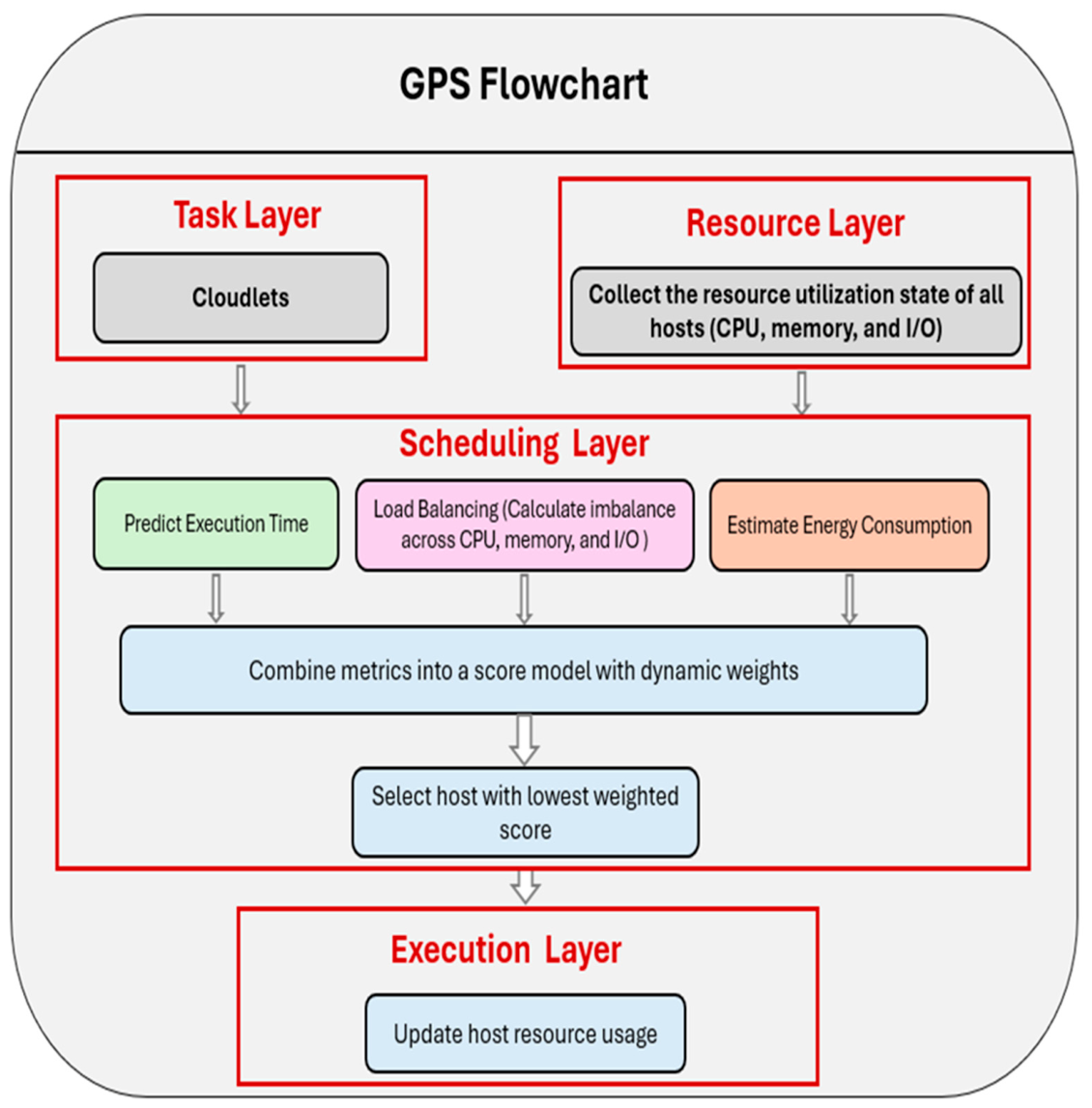
The proposed Greedy Predictive Scheduling (GPS) algorithm operates within a unified multi-objective scheduling architecture that integrates predictive performance estimation, multidimensional resource balancing, and energy awareness into a single decision-making workflow, as shown in
Figure 1. The scheduling mechanism begins with the Task Layer, where incoming cloudlets are defined and profiled based on their computational requirements, including CPU, memory, and I/O demands. This layer ensures that each cloudlet is profiled accurately to enable context-aware scheduling decisions that minimize processing overhead and workload imbalance.
The Resource Layer provides the heterogeneous infrastructure of multi-region cloud data centers, continuously reporting real-time utilization metrics for all active hosts. These metrics form the base for the predictive computations carried out in the scheduling phase. The heterogeneous host configuration adopted throughout the experimental evaluation is summarized in
Table 2, providing the computational characteristics of the simulated cloud infrastructure. The continuous monitoring of host utilization enables the scheduler to perform proactive rather than reactive scheduling decisions by considering the expected execution state before task allocation rather than relying solely on the current resource availability.
At the core of the architecture, the Scheduling Layer implements the GPS algorithm, evaluating all potential host-task mappings using a multi-factor score function. The score is composed of three primary components derived from real-time host metrics and task requirements. Unlike traditional deterministic schedulers that primarily consider a single resource metric, GPS simultaneously evaluates multiple scheduling criteria before assigning each cloudlet.
The first component is the Predicted Execution Time, which estimates how long the cloudlet will require on a particular host based on the CPU load after assignment. As shown in Equation (1), this value is calculated by dividing the total projected CPU usage (current load plus cloudlet demand) over the host’s CPU capacity. A lower value of the predicted execution time indicates a faster expected completion, helping the scheduler avoid hosts that would impose unnecessary delays.
The second component is the Load Imbalance metric, which evaluates how evenly the host’s resources, CPU, memory, and I/O, will be utilized once the task is scheduled. After calculating the predicted utilization of each resource using Equations (1)–(3), the mean utilization is computed as presented in Equation (4). Since the mean alone does not express resource balance, the imbalance variance is calculated using Equation (5). A smaller variance indicates more proportional resource consumption, reducing bottlenecks and improving system stability and reliability.
The third component is the Energy Proxy, which provides a lightweight indicator of the relative energy state of a host based on CPU utilization. Rather than relying on hardware-dependent power models, GPS employs CPU utilization as a practical proxy for incorporating energy awareness into scheduling decisions while preserving the lightweight nature of the proposed scheduler. Previous studies have reported a strong correlation between CPU utilization and server power consumption, supporting the use of CPU utilization as a practical indicator in cloud scheduling research [
16,
51].
Finally, the three components, predicted execution time, load imbalance, and energy proxy, are combined into a unified scheduling score using adaptive weights, as shown in Equation (6). The weighting coefficients (α, β, γ) are dynamically adjusted based on current host utilization; higher utilization leads to weights that give more importance to execution time, while moderate utilization prioritizes balance and efficiency. The host with the best final score is selected, ensuring that the GPS scheduler achieves fast, balanced, and energy-aware task allocation across heterogeneous cloud environments.
The adaptive weighting coefficients (α, β, γ) are determined according to the average resource utilization of each candidate host before task allocation. The average utilization is computed from the current CPU, memory, and I/O utilization values. When the average utilization exceeds a predefined threshold (0.8), the scheduler assigns α = 0.6, β = 0.25, and γ = 0.15 to place greater emphasis on predicted execution time while still considering load balance and energy awareness. Otherwise, GPS adopts α = 0.5, β = 0.3, and γ = 0.2 to provide a more balanced consideration of execution performance, resource utilization, and energy efficiency. These weighting values were selected during the development of the proposed scheduler based on preliminary observations under the adopted simulation configuration, and they were retained throughout the experiments because they provided stable scheduling behavior while preserving the lightweight nature of GPS.
3.2. Mathematical Formulation of GPS
To measure resources’ usage, let CPU
u, MEM
u, and IO
u represent the utilization of CPU, memory, and I/O resources, respectively, after assigning a task. The internal computation of the GPS algorithm begins by calculating the Predicted Execution Time (T
pred) as the primary performance indicator, as shown in Equation (1).
Equations (1)–(3) compute utilization values for the three core resources based on host usage and cloudlet requirements.
The internal computation of the GPS algorithm then proceeds by calculating the mean utilization (μ) across these three core resources, as shown in Equation (4), which reflects the average resource usage after virtual task placement.
This measure provides a general indicator of how intensively a host’s resources will be utilized. However, mean utilization alone does not reveal imbalance among various resources’ aspects. To address this challenge, the imbalance variance (σ2), as shown in Equation (5), is computed to measure unequal distribution among CPU, memory, and I/O. A smaller value of variance indicates that resources are being used more balanced, which leads to improved performance stability and resource management.
In addition to performance and balance, energy efficiency is a key aspect considered. To maintain a lightweight evaluation process, CPU utilization is employed as an energy proxy (E), representing relative power consumption across hosts without relying on complex energy models. The overall scheduling score (S), as illustrated in Equation (6), combines predicted execution time, imbalance variance, and energy consumption into a single metric. Dynamic weighting factors α, β, and γ are adaptively changed based on system utilization to ensure proper prioritization with various load scenarios. Since lower values of CPU utilization, imbalance variance, and energy proxy are preferred, the scheduler selects the host that minimizes the overall scheduling score.
Equations (1)–(6) are derived from multi-objective optimization concepts used in cloud scheduling frameworks [
4], where a weighted sum model is applied to balance competing objectives such as performance, load distribution, and energy conservation. In GPS, these weights are dynamically tuned to reflect the system’s operational state, favoring lower execution time during peak load and emphasizing energy balance during moderate utilization. The weighted-score formulation allows GPS to approximate multi-objective scheduling behavior without introducing iterative optimization procedures. Consequently, scheduling decisions are obtained through a single-pass evaluation of candidate hosts, preserving both computational efficiency and scheduling adaptability.
Once the scheduling decision is completed, the Execution Layer carries out the processing of assigned tasks while continuously monitoring host utilization and task progress. Upon cloudlet completion, updated utilization data is sent back to the Scheduling Layer, establishing a closed feedback loop that enhances real-time adaptivity and maintains global system awareness. This loop ensures that subsequent decisions reflect the most recent infrastructure state, contributing to reduced energy waste by preventing persistent underutilization and enabling dynamic workload redistribution. This continuous feedback mechanism allows subsequent scheduling decisions to reflect the latest system state, improving workload adaptability under continuously changing cloud conditions.
Through the seamless integration of its four interactive layers, the proposed GPS algorithm establishes a scheduling ecosystem that supports predictive modeling, adaptive decision making, and efficient execution. This workflow significantly improves makespan, resource utilization, and energy efficiency, demonstrating high scalability and stability in heterogeneous multi-region cloud environments. The interaction among profiling, predictive evaluation, adaptive scoring, and execution feedback establishes a closed-loop scheduling process that continuously improves scheduling effectiveness during runtime.
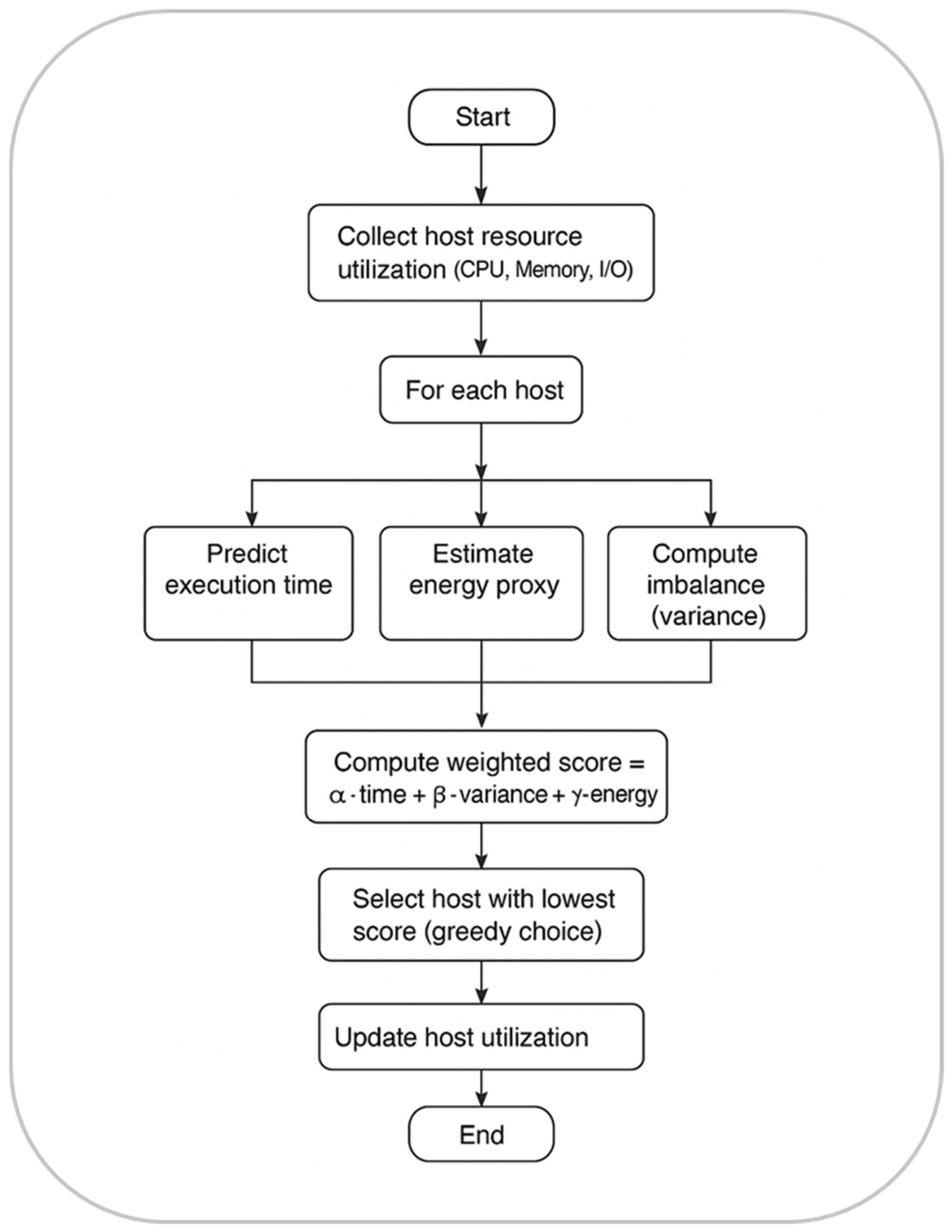
The scheduling process of GPS is illustrated in
Figure 2, which shows the sequential flow of decision making from input collection to final task allocation. The algorithm begins by gathering real-time utilization metrics from all available hosts. For each task, it predicts the expected execution time across the host pool, evaluates the imbalance across CPU, memory, and I/O, and estimates energy consumption using the CPU utilization proxy. These parameters are then combined within the dynamic overall score function defined in Equation (6). The host that has the minimum score is selected as the optimal candidate for task allocation; after that, the system updates the utilization values of that host. This iterative process continues until all the cloudlets are assigned, ensuring efficient and adaptive load balancing across the cloud environment and dynamic workloads. The integration of these scheduling components enables GPS to construct a unified decision framework that jointly optimizes execution efficiency, workload distribution, and utilization-aware energy consideration while preserving the computational simplicity of greedy scheduling.
Figure 2 illustrates the complete operational workflow of GPS, summarizing how predictive estimation, resource evaluation, adaptive scoring, and greedy host selection cooperate to produce the final scheduling decision.
To further clarify the operational logic, the pseudocode presented in Algorithm 1 details the GPS scheduling procedure, where each incoming cloudlet is systematically evaluated against all candidate hosts based on predicted performance metrics and real-time resource states. Dynamic weights α, β, and γ may be tuned depending on the average system utilization; higher α prioritizes execution speed under heavy workloads, while higher β and γ emphasize balance and energy efficiency during lighter loads. This adaptive scoring ensures that the system continuously self-optimizes according to runtime conditions. By adopting this predictive-greedy hybrid model, GPS achieves a trade-off between computational efficiency, scalability, and sustainability, addressing the limitations of static heuristic and high-complexity metaheuristic methods such as ISSA. Overall, the proposed methodology demonstrates predictive intelligence, greedy adaptability, and green awareness, delivering improved scheduling accuracy, reduced makespan, and enhanced energy efficiency in multi-region and heterogeneous cloud computing environments. Overall, GPS provides an efficient compromise between scheduling quality and computational complexity by combining predictive estimation with deterministic greedy decision making rather than relying on computationally expensive population-based optimization techniques.
| Algorithm 1. Proposed GPS Scheduling Algorithm. |
| Step | Procedure |
| Input | Set of hosts , Set of tasks // Inputs: hosts and tasks |
| Output | Task-to-host mapping M // Output: mapping of each task to a host |
| 1: | Initialize M ← ∅ // M will store the assignment of tasks to hosts |
| 2: | Initialize CPU, Memory, and I/O usage of all hosts hj ∈ H // Data structures for tracking host metrics |
| 3: | for (∀ ti ∈ T) do // Iterate over each task |
| 4: | bestHost ← NULL // Best host for current task |
| 5: | bestScore ← ∞ // Best (minimum) score |
| 6: | for (∀ hj ∈ H) do // Evaluate all hosts |
| 7: | if (hj has sufficient CPU, Memory, and I/O resources for ti) then // Check resource feasibility |
| 8: | predictedExecTime ← (hj.cpuUsage + ti.cpuDemand) / hj.cpuCapacity // Predicted execution time |
| 9: | cpuUtilAfter ← (hj.cpuUsage + ti.cpuDemand) / hj.cpuCapacity // CPU utilization after assignment |
| 10: | memUtilAfter ← (hj.memUsage + ti.memDemand) / hj.memCapacity // Memory utilization after assignment |
| 11: | ioUtilAfter ← (hj.ioUsage + ti.ioDemand) / hj.ioCapacity // I/O utilization after assignment |
| 12: | meanUtil ← (cpuUtilAfter + memUtilAfter + ioUtilAfter) / 3 // Average utilization |
| 13: | variance ← Var(cpuUtilAfter, memUtilAfter, ioUtilAfter) // Resource imbalance (variance) |
| 14: | energyProxy ← cpuUtilAfter // Energy proxy based on CPU utilization |
| 15: | if (averageUtilBefore > 0.8) then // Dynamic weight adjustment based on load |
| 16: | (α, β, γ) ← (0.6, 0.25, 0.15) |
| 17: | else |
| 18: | (α, β, γ) ← (0.5, 0.3, 0.2) |
| 19: | end if |
| 20: | score ← α × predictedExecTime + β × variance + γ × energyProxy // Final score for host hj |
| 21: | if (score < bestScore) then // Select host with minimum score |
| 22: | bestScore ← score |
| 23: | bestHost ← hj |
| 24: | end if |
| 25: | end if |
| 26: | end for |
| 27: | if (bestHost ≠ NULL) then // Check if a suitable host is found |
| 28: | Assign ti → bestHost // Assign task to the selected host |
| 29: | Update resource usage of bestHost // Update CPU, Memory, and I/O usage |
| 30: | Add (ti, bestHost) to M // Record the assignment in mapping M |
| 31: | else |
| 32: | Print “No suitable host found for task ti” // No feasible host exists |
| 33: | end if |
| 34: | end for // All tasks have been processed |
| 35: | Return mapping M // Output the final task-to-host mapping |
3.3. Computational Complexity Analysis
The computational efficiency of the proposed Greedy Predictive Scheduling (GPS) algorithm is achieved through its lightweight deterministic scheduling strategy. Unlike population-based metaheuristic approaches, GPS evaluates each candidate host only once for every arriving cloudlet without performing iterative optimization, population evolution, or repeated fitness evaluations. Consequently, the scheduling overhead remains relatively low while preserving adaptive scheduling decisions. Since GPS performs only a single evaluation pass over the feasible hosts for each arriving cloudlet, its computational cost increases linearly with both the workload size and the number of available hosts, making it suitable for large-scale cloud environments.
Assuming that N cloudlets are scheduled over H available hosts, GPS evaluates each feasible host once for every cloudlet. For each host, the scheduler performs a fixed number of arithmetic operations, including predicted execution time estimation, CPU, memory, and I/O utilization calculation, imbalance variance computation, energy proxy estimation, adaptive weight selection, and final score evaluation. Since these operations execute in constant time, the overall computational complexity of the proposed scheduler is O (N × H).
In contrast, the Improved Sparrow Search Algorithm (ISSA) is a population-based metaheuristic whose computational complexity depends on the population size (P), the number of optimization iterations (I), and the number of candidate hosts evaluated during each iteration. Consequently, its computational complexity can be expressed as O (N × P × I × H) because multiple candidate solutions are repeatedly updated and evaluated throughout the optimization process.
Therefore, the proposed GPS scheduler eliminates the iterative optimization process required by ISSA while preserving scheduling effectiveness through predictive resource estimation and greedy decision making. This lightweight computational structure substantially reduces scheduling overhead while maintaining efficient scheduling quality. The theoretical complexity analysis complements the experimental evaluation presented in
Section 4 and supports the observed scalability of GPS under increasing workload sizes, including the additional workload scenario (500 cloudlets) reported in
Table 3, where the proposed scheduler consistently maintains lower makespan, total execution time, and average execution time than ISSA.
4. Results and Discussion
4.1. Experimental Setup
The experiments were conducted using the CloudSim Plus 5.0 simulation toolkit to evaluate the performance of the proposed Greedy Predictive Scheduling (GPS) algorithm. CloudSim Plus provides a flexible and reproducible simulation environment that has been widely adopted for evaluating cloud scheduling and resource allocation algorithms under heterogeneous cloud infrastructures [
33]. Two data centers were deployed to simulate a multi-region cloud environment, representing Region A and Region B. Each data center was configured with heterogeneous custom hosts possessing different CPU, memory, and I/O capacities to simulate realistic operating conditions. The experimental setup included two data centers with four custom heterogeneous hosts in each data center, hosting a total of 30 virtual machines (VMs), where each VM was configured with 1 vCPU, 512 MB of RAM, 1000 MIPS, and 1 Gbps of bandwidth. To evaluate the scalability and efficiency of the proposed approach, five workload scenarios were performed using various workloads of 30, 50, 70, 100, and 500 independent cloudlets.
The performance evaluation was performed based on three key metrics, all measured in seconds. The first metric is the total makespan that represents the maximum completion time among all cloudlets. Lower makespan values indicate faster overall workload completion and improved system responsiveness. The second metric is the total execution time that measures the cumulative CPU execution time consumed across all cloudlets, reflecting the overall computational efficiency of the system. The third metric is the average execution time that represents the mean execution duration per cloudlet and provides insight into the fairness and balance of task scheduling across virtual machines. The performance of the proposed GPS algorithm was compared against the Improved Sparrow Search Algorithm (ISSA) [
4], which serves as a comparison scheduling approach. This comparison aims to assess the effectiveness of GPS in optimizing scheduling efficiency, resource utilization, and execution performance under varying workload conditions. Collectively, these metrics provide a comprehensive assessment of scheduling efficiency, scalability, and resource utilization under heterogeneous multi-region cloud environments.
The Improved Sparrow Search Algorithm (ISSA) was intentionally selected as the baseline because it represents the most closely related state-of-the-art scheduling approach and serves as the primary methodological reference for the proposed GPS scheduler. Furthermore, the original ISSA study comprehensively evaluated its performance against several representative scheduling algorithms, including QMPSO, ACOFTF, and ADA, demonstrating superior performance across multiple scheduling metrics. Therefore, evaluating GPS against ISSA provides a focused and meaningful validation while ensuring that both algorithms are compared under the same simulation environment and experimental configuration. This ensures that the observed performance differences are primarily attributable to the scheduling strategies rather than differences in the experimental setup.
Table 2 summarizes the heterogeneous hardware configuration used throughout the simulation experiments. The simulated infrastructure consists of two geographically distributed data centers comprising eight heterogeneous hosts with different processing, memory, and I/O capacities. This configuration enables the evaluation of GPS under realistic heterogeneous cloud conditions while ensuring experimental reproducibility.
The simulated environment includes 30 virtual machines initially distributed across the eight heterogeneous hosts using a round-robin placement strategy. During execution, the proposed GPS scheduler dynamically determines cloudlet allocation according to the predictive multi-objective scoring mechanism, while the VM deployment remains unchanged throughout the simulation. This deployment strategy provides a consistent execution environment and facilitates the reproducibility and fairness of the experimental evaluation.
4.2. Experimental Results
Table 3 summarizes the comparative performance of the proposed Greedy Predictive Scheduling (GPS) algorithm and the Improved Sparrow Search Algorithm (ISSA) under five workload scenarios consisting of 30, 50, 70, 100, and 500 cloudlets. All experiments were performed using the same simulation configuration to ensure a fair comparison between both scheduling strategies. Lower values of makespan, total execution time, and average execution time indicate superior scheduling performance.
In the first experiment with 30 cloudlets, both algorithms achieved identical performance results, recording a makespan of 2.2 s, total execution time of 36.0 s, and an average execution time of 1.2 s. This result indicates that, under light workload conditions where resource contention is minimal, both scheduling algorithms provide comparable performance because sufficient computing resources are readily available.
When the workload increased to 50 cloudlets, the proposed GPS algorithm began to demonstrate clear performance advantages over ISSA. Specifically, GPS reduced the makespan from 3.20 s to 2.20 s, achieving an improvement of 31.25%. In addition, GPS achieved a lower total execution time of 92.0 s compared to 93.99 s for ISSA, reflecting more efficient task allocation and better utilization of heterogeneous resources. This improvement indicates that GPS begins to exploit its predictive scheduling capability once resource contention starts to increase, enabling more efficient task placement across heterogeneous hosts.
As the workload further increased to 70 cloudlets, the GPS algorithm demonstrated consistent performance gains, reducing the makespan by 23.8%, from 4.20 s to 3.20 s, and lowering the total execution time by 4.5%. The performance improvement becomes more evident under this workload because the predictive execution estimation and adaptive weighted scoring enable GPS to distribute cloudlets more evenly while avoiding heavily loaded hosts. Under the largest workload of 100 cloudlets, GPS continued to outperform ISSA by reducing the makespan by 19.2%, from 5.20 s to 4.20 s, and slightly improving both total and average execution times, demonstrating its scalability and efficiency under high load scenarios. These results demonstrate that the scheduling effectiveness of GPS remains stable as workload intensity increases, indicating good scalability under heterogeneous cloud conditions.
To further evaluate the scalability of the proposed scheduler under heavy workload conditions, an additional experiment was conducted using 500 cloudlets while maintaining the same simulation configuration. As shown in
Table 3, GPS continued to outperform ISSA by reducing the makespan from 18.192 s to 17.195 s, while also achieving lower total and average execution times. These findings confirm that the proposed scheduler maintains its scheduling efficiency and balanced resource utilization even under substantially increased workload demands.
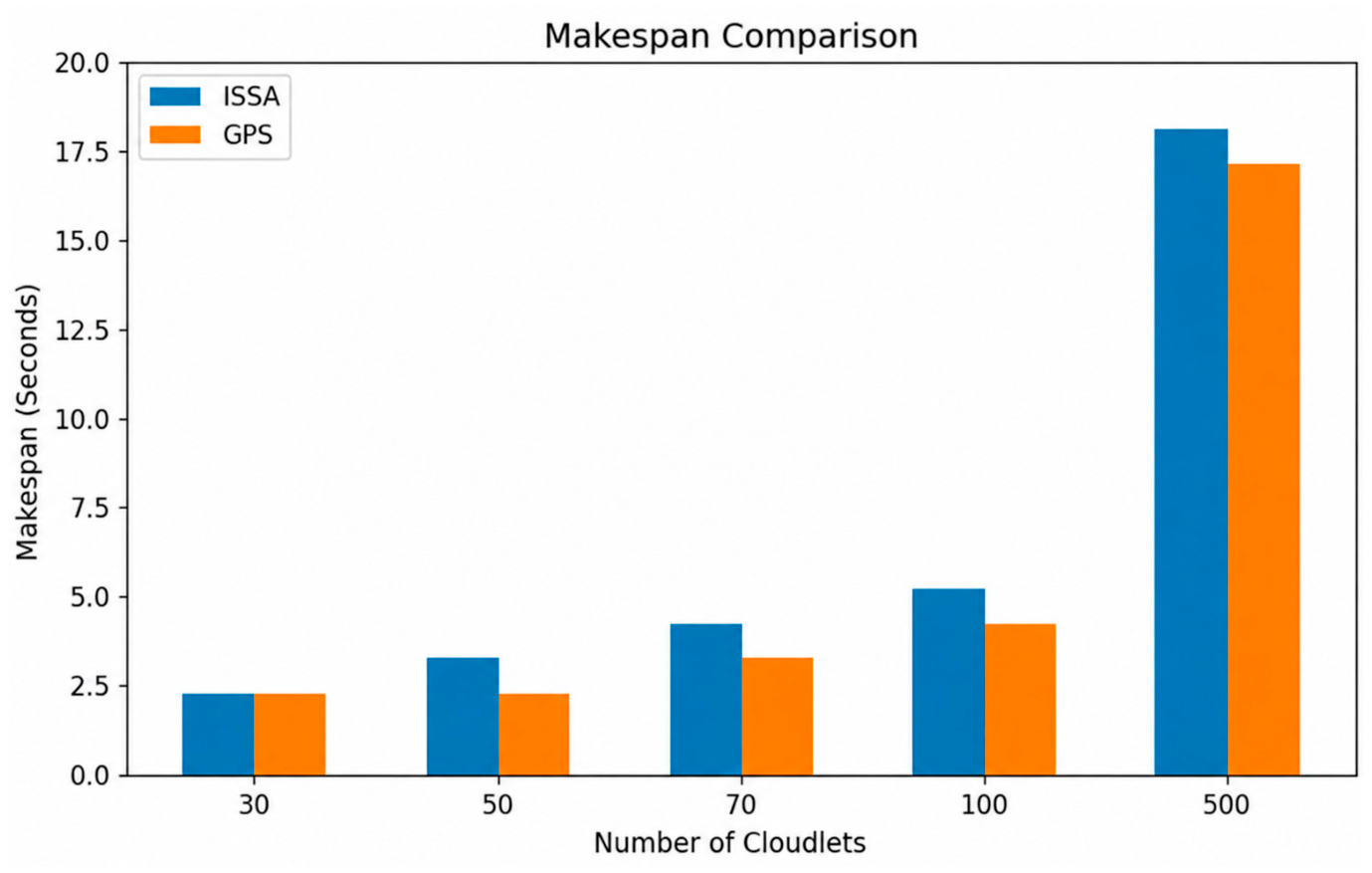
The comparative analysis between the proposed Greedy Predictive Scheduling (GPS) algorithm and the Improved Sparrow Search Algorithm (ISSA) is visually represented through three key performance figures. As illustrated in
Figure 3, the makespan trends for both algorithms across varying numbers of cloudlets highlight the scalability and efficiency advantages of GPS. When the number of cloudlets increases, ISSA shows a noticeable growth in makespan due to its slower convergence and higher overhead during iterative optimization. In contrast, GPS maintains a smoother and more stable makespan curve, demonstrating its ability to adaptively balance workloads in real time. This stability is achieved through GPS’s predictive estimation and dynamic scoring process, which prevent overload on specific hosts and ensure more even task distribution. Consequently, even under substantially larger workloads, up to 500 cloudlets, GPS continues to achieve lower makespan than ISSA. This behavior demonstrates the effectiveness of predictive host evaluation in reducing execution bottlenecks and improving scheduling scalability.
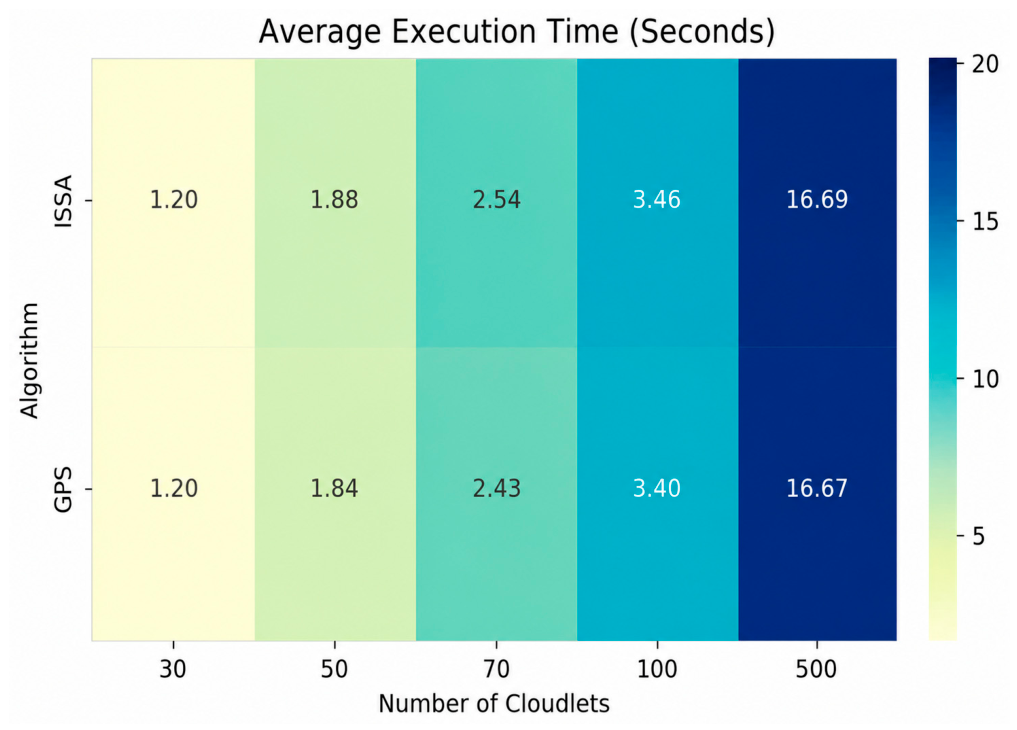
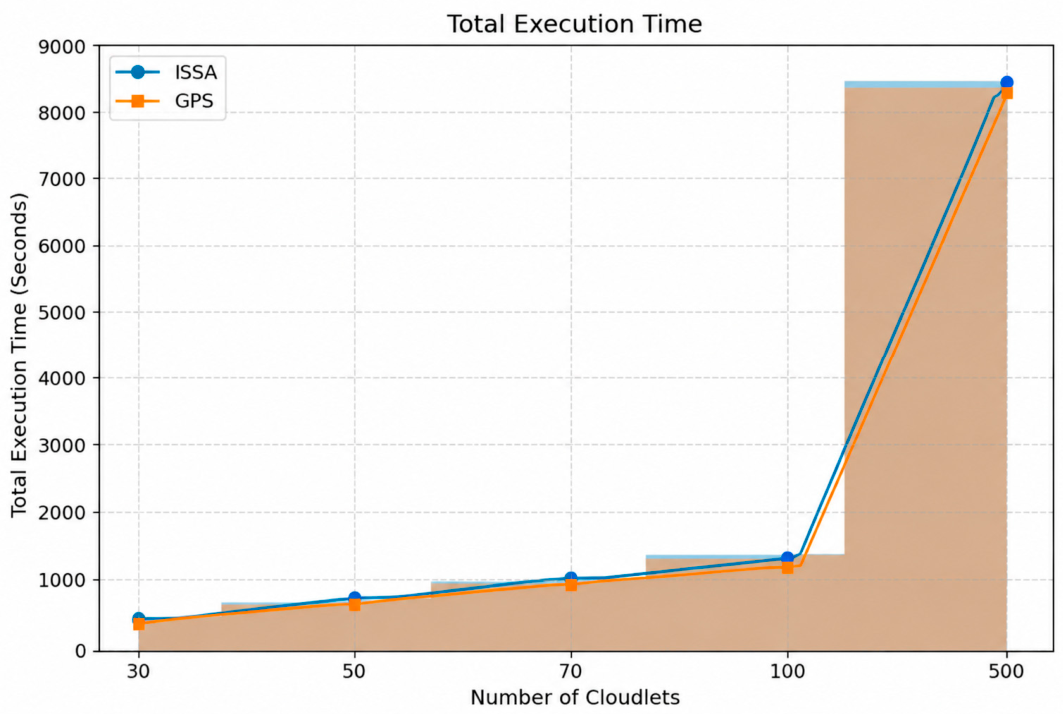
To provide a clearer visualization of the observed performance differences,
Figure 3,
Figure 4 and
Figure 5 illustrate the behavior of both scheduling algorithms with respect to makespan, average execution time, and total execution time under increasing workload sizes.
According to
Figure 4, the comparison of average execution time per cloudlet demonstrates the consistent advantage of GPS as workload intensity increases. The average execution time remains lower for GPS across all experimental scenarios, indicating more efficient completion of cloudlets with reduced queuing delays. The relatively small but consistent improvements indicate that GPS maintains balanced task allocation without introducing additional scheduling overhead. This improvement is primarily attributed to GPS’s greedy decision-making mechanism, which prioritizes hosts based on real-time predictive scores instead of relying solely on stochastic exploration as in ISSA. By integrating multi-objective evaluation, considering execution time, imbalance variance, and energy consumption, GPS minimizes unnecessary task migrations and scheduling overhead. These factors not only improve throughput but also enhance fairness across virtual machines, providing more predictable execution for each task.
Finally,
Figure 5 presents the total execution time comparison, offering a comprehensive perspective on system-level performance. The total execution time of GPS remains consistently lower than that of ISSA across all cloudlet sizes, indicating more efficient load distribution and reduced computational delays. Furthermore, by using CPU utilization as an energy proxy or indicator, GPS enables energy-aware scheduling, minimizing idle time and optimizing power usage without relying on complex energy models. This combination of performance and energy efficiency aligns with the objectives of green computing. Consequently, GPS improves overall infrastructure utilization while preserving computational efficiency.
Overall, the experimental results consistently demonstrate that GPS outperforms ISSA across all evaluated workload scenarios. The proposed scheduler achieves lower makespan, reduced execution time, improved workload balancing, and better scalability while maintaining a lightweight scheduling strategy suitable for heterogeneous multi-region cloud environments.
4.3. Discussion
The experimental results demonstrate that the proposed Greedy Predictive Scheduling (GPS) algorithm consistently outperforms the Improved Sparrow Search Algorithm (ISSA) across all evaluated workload scenarios. The observed improvements become increasingly evident as workload size grows, indicating that GPS maintains its scheduling effectiveness under both moderate and heavy workload conditions. The scalability of GPS becomes more evident as the number of cloudlets increases, with performance gains more pronounced under heavier dynamic workloads. The additional experiment conducted with 500 cloudlets further confirms this observation. This observation is also consistent with the computational complexity analysis presented in
Section 3, where GPS avoids the iterative optimization process required by ISSA, thereby reducing scheduling overhead as workload size increases. GPS continued to outperform ISSA by achieving lower makespan, total execution time, and average execution time, demonstrating that the proposed scheduler maintains its effectiveness and stable performance under substantially larger workloads. This scalability is primarily due to its predictive and greedy design, which adapts effectively to dynamic and heterogeneous environments. The observed performance improvements can primarily be attributed to the integration of predictive execution estimation with adaptive greedy decision making. By estimating the expected resource utilization before task allocation, GPS proactively avoids heavily loaded hosts and distributes cloudlets more efficiently across heterogeneous computing resources.
Furthermore, the utilization variance metric enables GPS to maintain balanced consumption of CPU, memory, and I/O resources simultaneously rather than optimizing a single resource dimension. This balanced allocation reduces resource contention, alleviates execution bottlenecks, and improves overall scheduling stability.
Furthermore, the inclusion of energy awareness enables GPS to balance performance with energy efficiency, achieving an effective trade-off consistent with green computing principles. Although GPS employs CPU utilization as an indirect energy indicator rather than a detailed power model, this lightweight approximation allows energy-aware scheduling decisions without introducing additional computational complexity. Consequently, the scheduler maintains a practical balance between execution efficiency and energy awareness.
Unlike population-based metaheuristic schedulers, GPS performs direct scheduling decisions without iterative optimization or repeated fitness evaluation. Consequently, the proposed scheduler significantly reduces scheduling overhead while preserving competitive scheduling quality, making it particularly suitable for large-scale and dynamic cloud environments.
Overall, the experimental analysis confirms that GPS provides an effective trade-off among scheduling quality, computational efficiency, scalability, workload balancing, and energy awareness. These characteristics make the proposed scheduler particularly suitable for heterogeneous multi-region cloud environments where scheduling decisions must be performed rapidly while adapting to continuously changing workload conditions. Nevertheless, the proposed scheduler was evaluated using simulation-based experiments within the CloudSim Plus 5.0 environment. Investigating its behavior under real cloud deployments and integrating more comprehensive power consumption models remain promising directions for future work. These findings validate the design objectives presented in
Section 3 and demonstrate that predictive greedy scheduling offers an effective alternative to computationally expensive metaheuristic optimization.
5. Conclusions and Future Work
This paper proposed and evaluated the Greedy Predictive Scheduling (GPS) algorithm, a lightweight scheduling approach designed to improve task allocation in heterogeneous multi-region cloud environments. Unlike conventional greedy schedulers that rely on static decision rules, GPS integrates predictive execution-time estimation, multi-resource load balancing, and utilization-aware energy consideration into a unified adaptive scoring mechanism. This combination enables efficient scheduling decisions while preserving the low computational complexity required for dynamic cloud environments.
Experimental evaluation conducted using the CloudSim Plus 5.0 simulator demonstrated that GPS consistently outperformed the Improved Sparrow Search Algorithm (ISSA) across all evaluated workload scenarios. The proposed scheduler achieved lower makespan, total execution time, and average execution time while maintaining balanced utilization of CPU, memory, and I/O resources. Furthermore, the additional large-scale experiment involving 500 cloudlets confirmed the scalability and robustness of GPS under increasing workload conditions. These results indicate that the proposed predictive-greedy strategy provides an effective balance between scheduling quality, computational efficiency, scalability, and utilization-aware energy management.
Although GPS employs CPU utilization as a lightweight proxy for energy awareness rather than a detailed power model, the proposed strategy successfully promotes more balanced resource utilization without introducing additional optimization overhead. This design preserves the practical applicability of the scheduler while remaining consistent with the principles of green cloud computing.
Future work will focus on enhancing the predictive component of GPS by incorporating machine learning-based workload forecasting techniques to further improve scheduling accuracy under highly dynamic cloud environments. Future research will also investigate adaptive parameter tuning strategies, integration with detailed power consumption models, and validation using larger-scale heterogeneous cloud infrastructures with additional data centers, virtual machines, and diverse workload characteristics. Moreover, incorporating fault tolerance, live workload migration, and real-world cloud testbeds represents another promising direction for extending the applicability of the proposed scheduling framework.