


Abstract
Background/Objectives: Avocado (Persea americana Mill.) seed is an agro-industrial by-product with significant pharmacological potential. This study aimed to conduct a preformulation assessment of aqueous seed extracts from Criollo (M1) and Hass (M2) cultivars. Methods: The extracts were characterized for total phenolic content (TPC) and ABTS•+ scavenging capacity, and their compatibility with pharmaceutical excipients was evaluated in binary mixtures by Fourier transform infrared (FTIR) spectroscopy with Pearson correlation and hierarchical cluster analysis (HCA), differential scanning calorimetry (DSC), and isothermal stress testing (50 °C, 15 days) with HPLC quantification of epicatechin (IST-HPLC). Results: M2 showed significantly higher TPC (192.80 ± 4.90 µg GAE/mg) than M1 (27.08 ± 0.51 µg GAE/mg; p < 0.0001). ABTS•+ inhibition was 59.92 ± 1.76% for M1 (0.05 mg/mL) and 50.79 ± 1.19% for M2 (0.01 mg/mL). The DSC transition enthalpies of both extracts did not differ significantly (p = 0.1271). Maltodextrin and gum arabic were compatible with both extracts, suggesting that they could serve as common excipients for both cultivars, whereas the chemical stability of five M2 mixtures could not be determined by IST-HPLC. Sodium carboxymethylcellulose (CMC) was incompatible with M1, as shown by a 29.44 percentage-point decrease in epicatechin recovery (p < 0.0001), separate HCA clustering (Euclidean distance > 0.009), and the lowest FTIR spectral correlation (r = 0.990). Conclusions: These findings provide a scientific basis for the rational development of solid dosage forms from avocado seed extracts.
1. Introduction
Persea americana Mill., commonly known as avocado, is among the most ancient and economically significant edible fruits of the American continent. Ranked as the fifth most important fruit globally, it is native to Mexico, Central America, and the Caribbean. Since its origin, its cultivation has expanded extensively across various regions worldwide [1,2].
Avocado cultivation and processing generate substantial amounts of agro-industrial waste. Among these, the seed represents the primary by-product [3], accounting for approximately 10–25% of the total fruit weight depending on the cultivar [4,5]. Despite commonly being discarded, this by-product is rich in bioactive compounds, including flavonoids, phenolic acids, condensed tannins, and alkaloids [6,7], which confer notable antioxidant activity [8].
Aqueous and hydroalcoholic avocado seed extracts have demonstrated notable pharmacological activity with potential therapeutic applications. In vivo studies in rodent and rabbit models have shown significant antihypertensive effects [9]. These findings are complemented by well-documented hypolipidemic and antioxidant properties that may contribute to the prevention of hyperlipidemia and cardiovascular diseases [10,11].
Furthermore, these extracts exhibit hypoglycemic activity [12,13], anti-inflammatory and analgesic properties [14,15], antibacterial and wound-healing effects [16] and anticancer potential [14]. This phytochemical richness positions the seed extract as a cost-effective alternative to conventional pharmacological treatments [17], supporting its potential application in dietary supplements and phytotherapeutic formulations.
Translating this pharmacological potential into safe, effective, and marketable phytopharmaceutical products requires a rigorous pharmaceutical development process. Ensuring product efficacy, safety, and quality is a prerequisite for regulatory approval and clinical viability [18], particularly for plant extracts whose chemical complexity and matrix variability introduce additional formulation challenges. In this context, preformulation studies represent a critical developmental phase dedicated to the physicochemical characterization of the bioactive compounds and the systematic screening of potential excipient incompatibilities [19]. Given the inherent chemical complexity and matrix variability of avocado seed extracts, such studies are particularly necessary to anticipate deleterious interactions before formulation design. Specifically, physical incompatibilities can alter key parameters such as solubility, polymorphic stability, dissolution profiles, or organoleptic attributes; conversely, chemical incompatibilities induce bioactive compound degradation that may compromise therapeutic efficacy or generate toxic degradation products [19,20].
To evaluate plant extract-excipient incompatibilities, several analytical techniques are employed, valued for their sensitivity, minimal sample requirements, and ability to detect subtle physicochemical changes indicative of molecular interactions or degradation. These include thermal methods such as differential scanning calorimetry (DSC) and thermogravimetry (TG), spectroscopic approaches including Fourier transform infrared spectroscopy (FTIR) and solid-state nuclear magnetic resonance (ssNMR), X-ray diffraction (XRD), and isothermal stress testing (IST) coupled with chromatographic analysis [19,20]. Although originally developed for simpler systems, these techniques have demonstrated suitability for complex matrices such as plant extracts, providing key information for the preformulation stage [20,21,22].
To promote the sustainable valorization of this agro-industrial by-product, this study aimed to perform a preformulation assessment of aqueous seed extracts from Criollo (M1) and Hass (M2) avocado cultivars. Previous studies on avocado seeds have focused mainly on their phytochemical composition and biological activities; however, to our knowledge, preformulation data remain lacking. Here, the extracts were first characterized for their total phenolic content (TPC) and antioxidant capacity (ABTS•+). Their compatibility with excipients commonly used in solid dosage forms was then evaluated in binary mixtures using Fourier transform infrared spectroscopy (FTIR), differential scanning calorimetry (DSC), and isothermal stress testing with HPLC (IST-HPLC). By comparing two cultivars, this work provides cultivar-specific preformulation data to support the rational development of solid dosage forms.
2. Materials and Methods
2.1. Materials
The epicatechin reference standard (purity ≥ 98%, analytical grade) was obtained from Sigma-Aldrich (St. Louis, MO, USA). Reagents for the determination of antioxidant capacity and total phenolic content—including 2,2′-azino-bis(3-ethylbenzothiazoline-6-sulfonic acid) (ABTS), potassium persulfate, Folin-Ciocalteu reagent, sodium carbonate (Na2CO3), and gallic acid—were supplied by Merck KGaA (Darmstadt, Germany). HPLC-grade methanol and acetonitrile were obtained from J.T. Baker (Avantor Performance Materials, Radnor, PA, USA), and trifluoroacetic acid from NEON (Suzano, São Paulo, Brazil).
All excipients were of pharmaceutical grade and sourced from their respective manufacturers: maltodextrin (MD) from Sigma-Aldrich (St. Louis, MO, USA); talc (TC; SM-200 FARM) from Magnesita (São Paulo, Brazil); starch (STR) from Merck KGaA (Darmstadt, Germany); gum arabic (GA) from Êxodo Científica (Sumaré, São Paulo, Brazil); magnesium stearate (MgSt) from AMC (São Paulo, Brazil); sodium croscarmellose (SC) from Blanver (Cotia, São Paulo, Brazil); and sodium carboxymethylcellulose (CMC) from JVER (São Paulo, Brazil). The functional classification of excipients and their recommended concentration ranges are summarized in Table 1.
Table 1.
Functional classification of excipients used in solid dosage forms and their concentration ranges employed in binary mixture preparation for compatibility studies.
2.2. Plant Material
Avocado seeds were collected under the Framework Collection Permit for Specimens of Wild Species for Non-Commercial Scientific Research Purposes, granted by the National Environmental Licensing Authority No. 001579 (ANLA, 25 July 2024). Voucher specimens of P. americana Criollo (M1, COL632202), collected in San Jacinto, Bolívar (9.8455° N, 75.1752° W), and P. americana Hass (M2, COL632203), collected in Sibundoy, Putumayo (1.2081° N, 76.9090° W), were deposited at the National Herbarium of Colombia (Bogotá, Colombia). Seeds were manually separated from the remaining pulp, washed with distilled water, dried at room temperature for 48 h, and stored at −20 °C until further processing.
2.3. Preparation of Aqueous Seed Extracts of Avocado (Persea americana Mill.) Criollo and Hass
Aqueous extracts were prepared by maceration based on the protocol described by Ejiofor et al. [12], with a freezing pretreatment incorporated as a modification. For each cultivar, three independent extraction batches were prepared from separately weighed portions of dried, chopped seeds (252.25 g in total for M1 and 247.50 g for M2), and each batch was processed separately throughout the procedure. Before grinding, the seeds were frozen at −20 °C for 24 h in a freezer (Meling Biology & Medical, Hefei, China) to promote ice crystal formation and cell wall disruption, thereby enhancing the release of phenolic compounds into the extraction solvent [24]. The frozen seeds were then ground in a mechanical blender (Ninja Professional Kitchen System, SharkNinja Operating LLC, Needham, MA, USA), and the resulting powder was macerated in distilled water (1:10, w/v) for 48 h at room temperature, protected from light, with manual stirring every 8 h. Each extract was filtered through Whatman No. 1 filter paper and freeze-dried (BIOBASE, Jinan, China). The dry extracts were stored at −20 °C until analysis.
The extraction yield of each batch was calculated as follows:
where mass extract is the mass of freeze-dried extract (g) and mass seed is the initial mass of dried seed material (g).
Yield (% w/w) = (mass extract/mass seed) × 100
2.4. Evaluation of Antioxidant Capacity
The ABTS•+ radical cation scavenging capacity was evaluated using an adaptation of the methodologies proposed by Hajleh et al. [25] and Proestos et al. [26], based on the original assay described by Re et al. [27]. The radical was generated by reacting an ABTS solution (3.5 mM) with potassium persulfate (1.25 mM final concentration) for 16 h in the dark at room temperature. Prior to use, the resulting solution was diluted with ethanol to an absorbance of 0.70 ± 0.02 at 734 nm. A 30 µL aliquot of each extract was transferred into a 96-well microplate and brought to a final volume of 300 µL with the ABTS•+ solution. After 20 min of incubation in the dark, absorbance was measured at 734 nm using a Varioskan LUX microplate reader (Thermo Scientific, Waltham, MA, USA). A negative control was prepared by replacing the sample with the same volume (30 µL) of ethanol under identical assay conditions, providing the maximum absorbance of the ABTS•+ radical (A0). Gallic acid was used as the positive control.
Antioxidant activity was expressed as percentage inhibition according to the following equation [25,27]:
where A0 is the absorbance of the negative control and A1 is the absorbance of the sample. Data acquisition and processing were performed using SkanIt software version 6.1 RE (Thermo Scientific, USA).
Inhibition (%) = [(A0 − A1)/A0] × 100
2.5. Total Phenolic Content
The Folin-Ciocalteu method was employed to determine total phenolic content (TPC), following the procedure described by Gómez et al. [28], with a modification in sample dilution (1:10 v/v) to ensure absorbance readings within the linear range of the calibration curve. A calibration curve was constructed using gallic acid standard solutions over a concentration range of 3.16 to 100 µg/mL (R2 ≥ 0.999). After 2 h of incubation in the dark, absorbance was measured at 765 nm using a Varioskan LUX microplate reader and SkanIt software v6.1 RE (Thermo Scientific, USA). Results were expressed as micrograms of gallic acid equivalents per milligram of dry extract (µg GAE/mg dry extract).
2.6. Evaluation of Excipient Compatibility
2.6.1. Preparation of Binary Mixtures
Binary mixtures (BM) were prepared by combining the lyophilized aqueous extract of avocado (P. americana Mill.) seed and each selected excipient (Table 1). For thermal (DSC) and spectroscopic (FTIR) analyses, the BM were prepared at a 1:1 (w/w) ratio, as recommended for excipient compatibility screening [19,29]. For isothermal stress testing (IST-HPLC), the ratio of extract to excipient was adjusted to reflect the realistic concentrations typically employed in solid dosage forms, based on their functional classification and recommended concentration ranges [23] (Table 1). In all cases, samples were homogenized using a vortex mixer (MX-S, DLAB Scientific Co., Ltd., Beijing, China) for 2 min. The resulting mixtures were then transferred to polypropylene microtubes and stored at room temperature in the dark until analysis.
2.6.2. Isothermal Stress Testing (IST)
For IST under wet conditions, binary mixtures of the lyophilized aqueous extract and each excipient, prepared at the proportions specified in Table 1, were transferred to glass vials. Distilled water (3.0 mL) was added to each vial and mixed until a homogeneous dispersion was obtained. The vials were hermetically sealed with screw caps fitted with aluminum liner septa and stored at 50 °C for 15 days in a forced-air convection oven (Binder GmbH, Tuttlingen, Germany). Samples were withdrawn at day 0 and day 15 for HPLC quantification of epicatechin.
HPLC Profiling and Quantification of Epicatechin
The epicatechin content in the extracts and binary mixtures was determined using a Shimadzu LC-10 HPLC system (Shimadzu Corp., Kyoto, Japan) equipped with a UV detector. Chromatographic separation was performed on a reverse-phase C18 column (150 × 4.6 mm, 5 µm; PerkinElmer, Waltham, MA, USA) maintained at 35 °C. An isocratic mobile phase consisting of acidified water (0.1% v/v trifluoroacetic acid) and acetonitrile (75:25 v/v) was delivered at a flow rate of 1.0 mL/min. The injection volume was 10 µL and spectrophotometric detection was carried out at 280 nm. Quantification was performed using an external calibration curve of epicatechin standard solutions ranging from 2.5 to 30 µg/mL (R2 ≥ 0.997). The analytical method was previously validated according to the guidelines of the 6th edition of the Brazilian Pharmacopoeia [30].
2.6.3. Fourier Transform Infrared Spectroscopy (FTIR)
FTIR spectra of the lyophilized extracts (M1 and M2), pure excipients, and BM (Table 1) were recorded using a Cary 630 FTIR spectrometer (Agilent Technologies, Santa Clara, CA, USA) operated with MicroLab PC software (v5.8). Spectra were acquired in transmittance mode using an ATR accessory, over the range 4000–650 cm−1, with 32 sample and background scans and a spectral resolution of 8 cm−1, using Happ-Genzel apodization [20,21].
2.6.4. Differential Scanning Calorimetry (DSC)
DSC analyses were performed using a DSC 4000 instrument (PerkinElmer, Waltham, MA, USA), calibrated with indium and zinc standards, under a nitrogen purge atmosphere at a flow rate of 20 mL/min. Lyophilized aqueous extracts of avocado (P. americana Mill.) seed from Criollo (M1) and Hass (M2), pure excipients, and their BMs (Table 1) were evaluated. Samples of approximately 2.0 ± 0.5 mg were accurately weighed into hermetically sealed aluminum pans. The thermal program consisted of an initial equilibration isotherm at 10 °C for 10 min, followed by a linear heating ramp to 400 °C at a constant heating rate of 10 °C/min. Data acquisition and processing were performed using Pyris Manager software (v13.3, PerkinElmer, Waltham, MA, USA).
2.7. Statistical Analyses
Extraction yields, total phenolic content (TPC), and antioxidant capacity (ABTS•+) were determined independently for three extraction batches per cultivar and expressed as mean ± standard deviation (SD, ).
Differences in TPC between the Criollo (M1) and Hass (M2) avocado (P. americana Mill.) seed cultivars were evaluated using an independent-samples Student’s t-test. Normality and homogeneity of variances were verified using the Shapiro–Wilk and Levene tests, respectively; when the assumption of homoscedasticity was not met, Welch’s correction was applied.
For IST, a one-way ANOVA with excipient type as the independent factor was performed, followed by Dunnett’s multiple comparison test to identify significant differences between each binary mixture and the pure extract (control) at day 0.
To evaluate spectral similarities and grouping patterns among extracts, pure excipients, and binary mixtures, the FTIR spectral data were preprocessed by baseline correction and normalization, then analyzed using hierarchical cluster analysis (HCA) with Ward’s linkage method and Euclidean distance. Pearson correlation matrices were constructed to quantify spectral similarity between the pure extract and its binary mixtures.
For DSC thermal analysis, thermodynamic parameters (Tonset, Tendset, Tpeak and ΔH) were compared between M1 and M2 extracts using a two-tailed independent-samples Student’s t-test (n = 6 per group). Thermal compatibility was evaluated using the percentage relative error of enthalpy, ΔΔH (%), calculated as follows:
where ΔH is the experimentally determined enthalpy of the binary mixture and K is the enthalpy of the pure extract from the corresponding cultivar. A threshold of 20% was used to discriminate relevant physical or chemical interactions from measurement variability [19,20,31].
ΔΔH (%) = [(ΔH/K) − 1] × 100
All statistical analyses and graphical representations were performed using GraphPad Prism (v8.0.1, GraphPad Software, San Diego, CA, USA) and OriginPro 2025b (OriginLab Corporation, Northampton, MA, USA). All hypothesis tests were conducted using a two-tailed significance level of α = 0.05.
3. Results and Discussion
3.1. Antioxidant Capacity (ABTS) and Total Phenolic Content (TPC)
The aqueous extraction of avocado (Persea americana Mill.) seeds yielded 7.00 ± 0.14% (w/w) of freeze-dried extract for the Criollo cultivar (M1) and 14.01 ± 0.38% (w/w) for the Hass cultivar (M2); thus, under the conditions tested, the Hass seed material yielded approximately twice as much extract as the Criollo seed material.
Both extracts exhibited ABTS•+ radical cation scavenging activity at the evaluated concentrations. M1 (0.05 mg/mL) showed 59.92 ± 1.76% inhibition, whereas M2 (0.01 mg/mL) exhibited 50.79 ± 1.19% inhibition. Gallic acid, used as the positive reference control, showed 52.38 ± 2.44% inhibition. Although both extracts achieved inhibition percentages close to or above that of the control, their relative antioxidant potency cannot be directly compared because the extracts and control were evaluated at different concentrations. In contrast, M2 showed a significantly higher total phenolic content (TPC) (192.80 ± 4.90 µg GAE/mg) than M1 (27.08 ± 0.51 µg GAE/mg), a difference validated by a Welch-corrected t-test due to heteroscedasticity between groups (t = 58.23, df = 4, p < 0.0001; Table 2). This difference may reflect cultivar-dependent variation in phenolic composition; however, since the two cultivars were collected in different regions, the contribution of genotype cannot be separated from that of growing conditions.
Table 2.
Antioxidant capacity (ABTS•+ assay) and total phenolic content (TPC) of aqueous extracts from Criollo (M1) and Hass (M2) avocado (Persea americana Mill.) seeds.
Escobar-Ramírez et al. [32] reported ABTS•+ inhibition values of 18–25% for seed extracts of Nephelium lappaceum, Manilkara zapota, and Melicoccus oliviformis at 1.0 mg/mL, a concentration 20- to 100-fold higher than those at which M1 and M2 inhibited more than 50% of the radical in the present study. Likewise, the TPC of the Hass seed extract (192.80 µg GAE/mg) was approximately three to eight times higher than the values reported for these species (24.0–66.56 µg GAE/mg), whereas that of the Criollo extract (27.08 µg GAE/mg) fell within this range. Although these data provide a useful reference for the antioxidant potential of agro-industrial by-products, differences in extraction solvents, extract concentrations, and assay conditions preclude a direct comparison of antioxidant potency.
Regarding avocado seeds specifically, Rosero et al. [7] characterized seeds of a Colombian cultivar (Nariño) by UPLC-ESI-MS/MS and identified hydroxycinnamic acids, flavonol glycosides, catechin, epicatechin, and A- and B-type procyanidins, with the high-molecular-weight procyanidin fractions showing the highest antioxidant activity. Miramontes-Corona et al. [33] reported a higher TPC in Hass than in Criollo seed extracts obtained with acetone–water (287.41 vs. 207.01 mg GAE/g), a trend consistent with our findings. In the present study, however, the values obtained with water alone were lower (192.80 and 27.08 µg GAE/mg, equivalent to mg GAE/g), and the difference between cultivars was considerably larger. These results extend previous observations to exclusively aqueous extracts and indicate that water recovers a smaller and more cultivar-dependent phenolic fraction than aqueous–organic solvents.
The observed antioxidant activity at low concentrations may reflect the combined contribution of polyphenols and other bioactive metabolites present in the aqueous extract [34,35], acting through electron and hydrogen transfer mechanisms characteristic of the ABTS•+ assay [36].
By comparison, Proestos et al. [26] reported ABTS•+ inhibition values of 10–25% and TPC values of 7–18 µg GAE/mg for extracts of Origanum vulgare L., Thymus vulgaris L., and Rosmarinus officinalis L. Overall, these results support further investigation of avocado seed extracts as ingredients for functional foods and nutraceutical products [25,37,38].
3.2. Isothermal Stress Testing (IST)
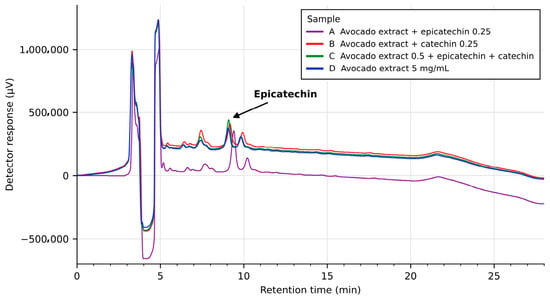
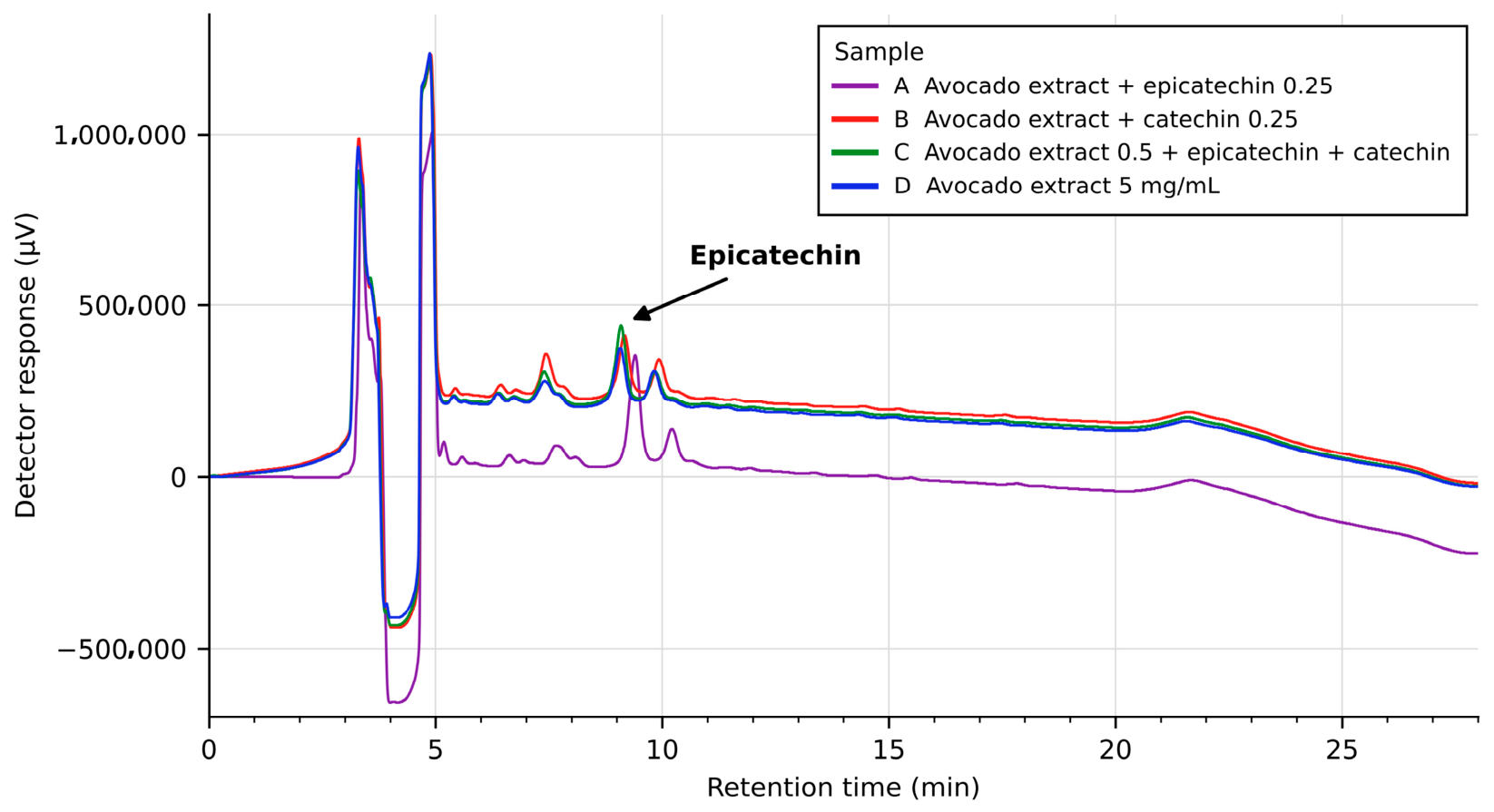
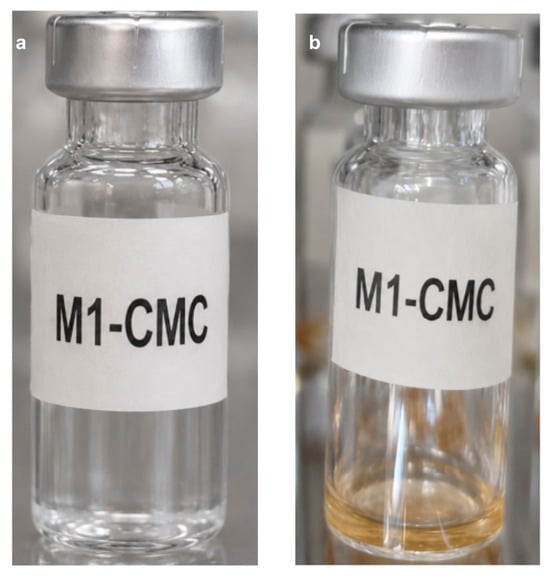
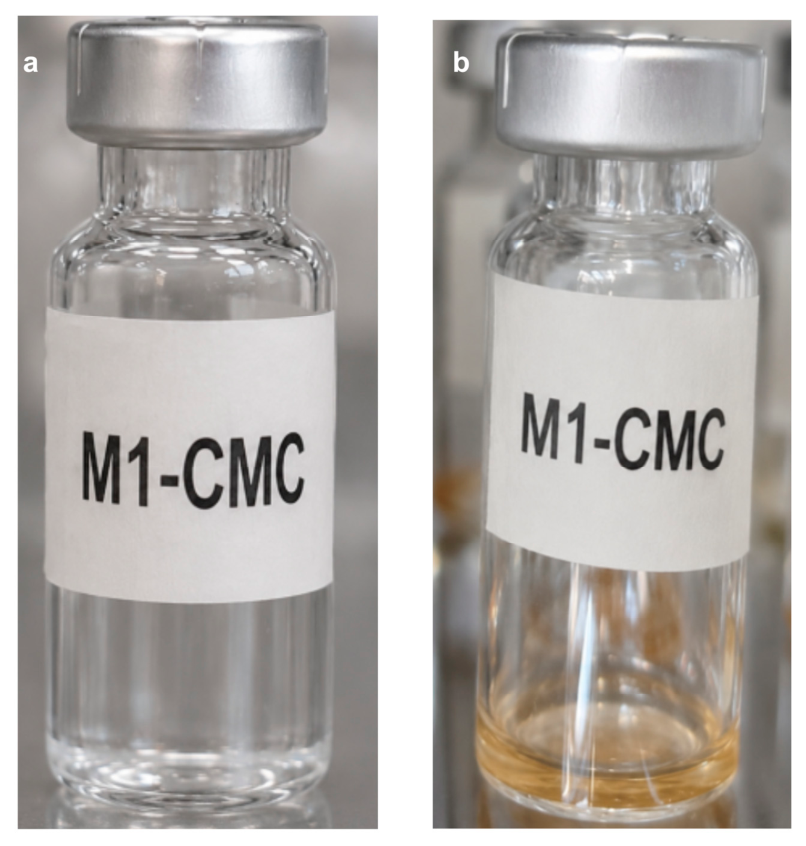
The compatibility of the avocado seed extracts with each excipient was assessed by isothermal stress testing (50 °C, 15 days), monitoring the chemical stability of epicatechin, used as a phenolic marker, by HPLC in binary mixtures. Pure extracts stored under the same conditions were used as controls (see Figure 1), and epicatechin recovery was calculated relative to them. Throughout the study period, all samples exhibited visual and textural changes, including progressive darkening and increased cohesiveness. These modifications are consistent with thermo-oxidative degradation of phenolic compounds, leading to oxidative polymerization and the formation of brown-colored chromophoric structures [39]. Among all samples, the most pronounced browning was observed in the M1–CMC binary mixture (Figure 2).
Figure 1.
Representative HPLC chromatogram of the avocado seed aqueous extract spiked with catechin and epicatechin. Retention times () were approximately 7.4 min for catechin and 9.0 min for epicatechin.
Figure 2.
Representative macroscopic images illustrating the most pronounced browning observed during isothermal stress testing for the binary mixture of Criollo avocado seed aqueous extract (M1) and sodium carboxymethylcellulose (M1–CMC): (a) day 0 and (b) after 15 days of storage at 50 °C.
Evaluation of the Hass cultivar (M2) was restricted to binary mixtures with MD and GA due to precipitation-related chromatographic interference observed with the other excipients. This phenomenon was not observed in the M1 samples under the same analytical conditions. In the affected M2 mixtures, precipitation was associated with critical increases in chromatographic backpressure, preventing reliable epicatechin quantification. This behavior may be related to differences in extract composition and macromolecular characteristics, potentially affecting solubility under the chromatographic conditions employed [40]; however, the underlying mechanism was not experimentally established.
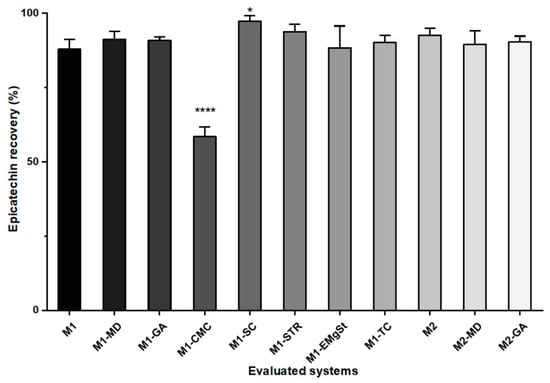
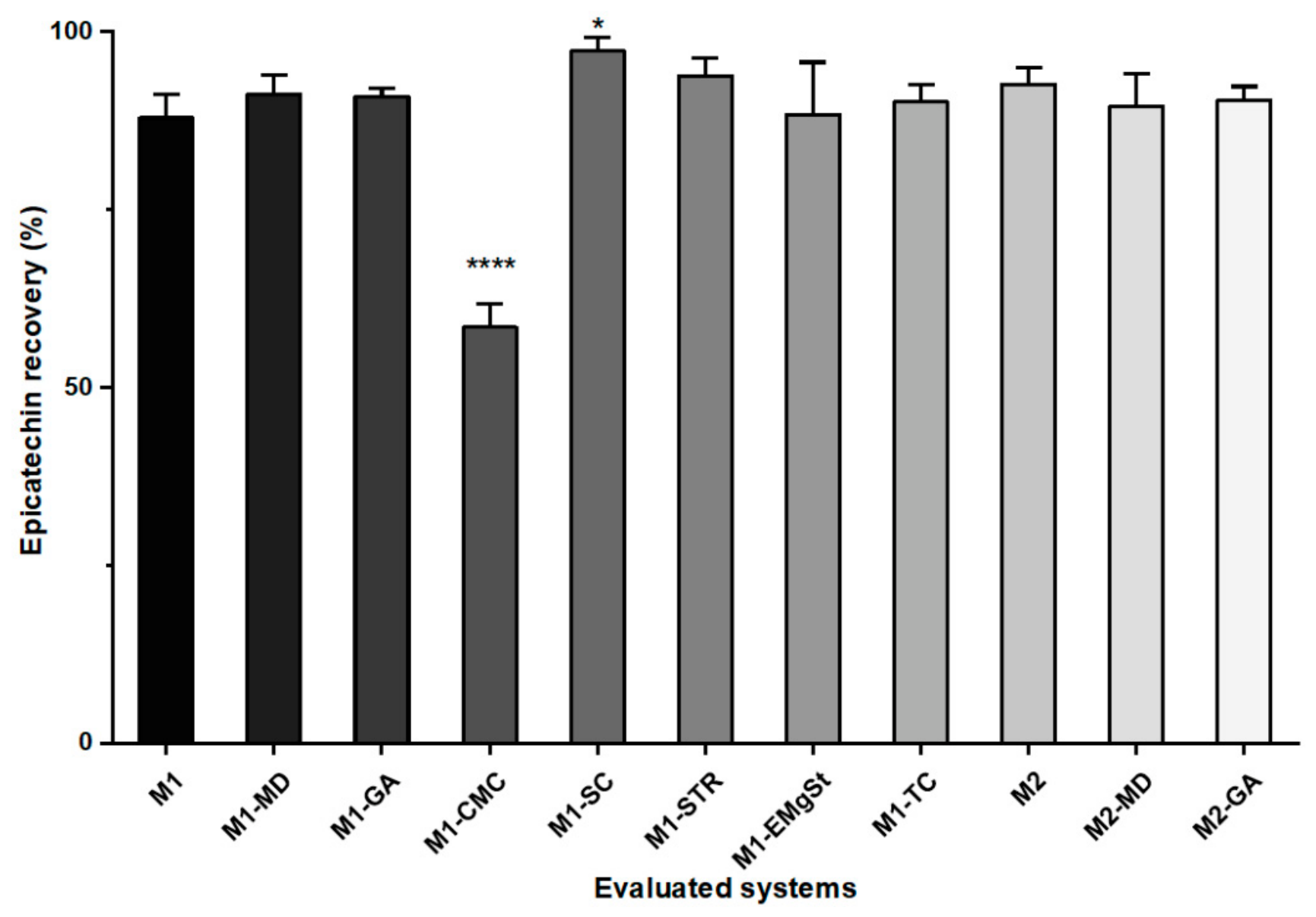
As illustrated in Figure 3, epicatechin demonstrated good chemical stability in most evaluated systems. The M1 pure extract retained 87.91 ± 3.34% of the initial epicatechin content, a recovery considered acceptable for complex plant matrices under thermal stress conditions [20]. In contrast, the M1–CMC binary mixture showed a significant reduction in marker content (29.44%; p < 0.0001; 95% CI: 20.75–38.13%), indicating chemical incompatibility between the extract and sodium carboxymethylcellulose. This reduction was consistent with the macroscopic changes observed in the M1–CMC samples, including progressive darkening and textural modification. These findings align with those reported by Broncel et al. [41], who demonstrated that anionic polymers such as carboxymethylcellulose can promote the degradation of phenolic compounds under combined thermal and humidity stress.
Figure 3.
Epicatechin stability in P. americana extracts and binary mixtures after the isothermal stress test (IST). Epicatechin recovery (%) was determined after 15 days of storage at 50 °C and expressed relative to the epicatechin content measured at day 0 for each sample. Data are expressed as percentage of epicatechin recovery (%) (Mean ± SD; n = 3). M1: aqueous extract of P. americana Mill. Criollo avocado seed; M2: aqueous extract of P. americana Mill. Hass avocado seed; MD: maltodextrin; GA: gum arabic; CMC: sodium carboxymethylcellulose; SC: sodium croscarmellose; STR: starch; MgSt: magnesium stearate; TC: talc. (*) p < 0.05 and (****) p < 0.0001 indicate significant differences with respect to the control (pure extract) using Dunnett’s test.
The incompatibility observed in the M1–CMC system may be attributed to two complementary interaction mechanisms. First, CMC has been shown to interact with protein fractions present in natural extracts, disrupting protein–polyphenol binding equilibria and promoting the formation of insoluble complexes that reduce the concentration of free, chromatographically detectable polyphenols [42,43].
Second, the anionic nature of CMC may further promote oxidative degradation of flavonoids through electrostatic interactions: as a charged polysaccharide, CMC interacts with phenolic compounds via hydrogen bonding and hydrophobic associations, altering their redox availability and accelerating oxidative degradation [44,45]. Together, these mechanisms account for the significant reduction in epicatechin recovery and the macroscopic changes—progressive darkening and textural modification—observed in the M1–CMC binary mixture under thermal stress conditions [46].
In contrast, the M1–SC mixture showed a statistically significant increase in detectable epicatechin content (p = 0.0306), a finding that, far from indicating instability, reflects a facilitating effect of the excipient on marker availability during the analytical reconstitution step. This behavior is consistent with the hygroscopic nature and swelling mechanism of sodium croscarmellose: by absorbing water and expanding up to 4–8 times its original volume [47,48], this superdisintegrant generates capillary and swelling forces that promote matrix disaggregation and increase the surface area available for dissolution. As a result, epicatechin potentially entrapped within polyphenolic aggregates or associated with structural macromolecules in the dry matrix becomes more accessible to the extraction solvent, improving analytical recovery without altering chemical integrity [49]. This interpretation is corroborated by the absence of new absorption bands in the FTIR spectrum and the unchanged DSC thermal profile of the M1–SC mixture, confirming that the increased recovery reflects improved extraction efficiency rather than a degradation artifact.
Binary mixtures of M1 with MD, GA, STR, MgSt, and TC showed epicatechin recoveries between 88.07% and 93.76%, with no statistically significant differences compared to the control (p > 0.05), indicating favorable chemical stability under the tested conditions (Figure 3). The M2 extract also demonstrated good chemical stability, with an overall recovery of 92.61 ± 0.80% and no significant variations across its binary mixtures (F(2,6) = 0.76; p = 0.5081). Dunnett’s test confirmed that both M2–MD (89.45 ± 4.45%) and M2–GA (90.35 ± 1.17%) showed no statistically significant differences from the control (p > 0.05), indicating compatibility with the M2 extract.
Based on these outcomes, MD and GA were identified as the most suitable excipients for the development of solid dosage forms and microencapsulation systems based on aqueous extracts of avocado (P. americana Mill.) seeds. These excipients preserved epicatechin recovery and allowed reliable IST-HPLC analysis of the M2 mixtures under the chromatographic conditions employed. Conversely, the inclusion of CMC in formulations based on these extracts is not recommended, given its demonstrated capacity to promote oxidative degradation of phenolic compounds under thermal stress conditions.
3.3. Fourier Transform Infrared Spectroscopy (FTIR)
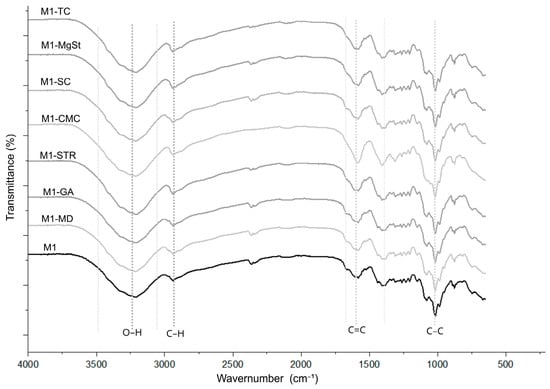
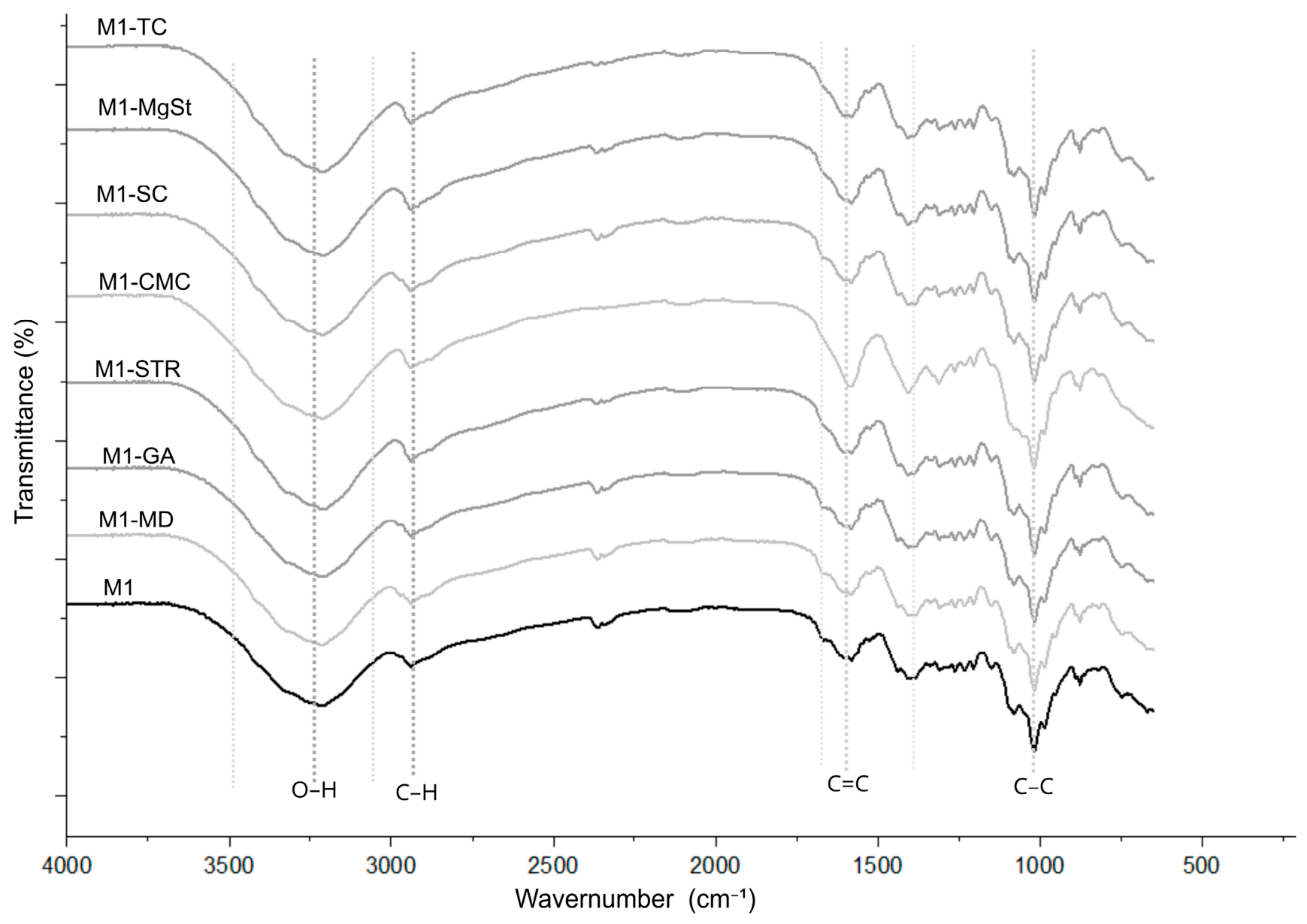
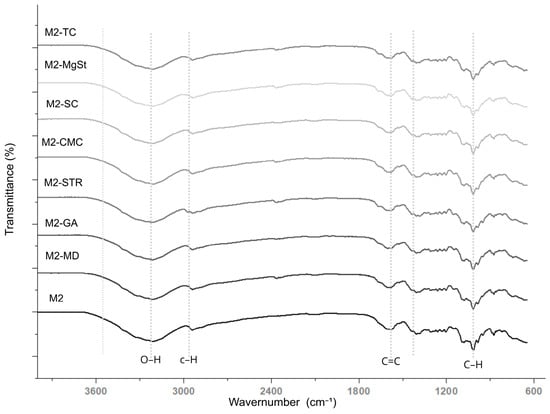
FTIR spectroscopy was employed to evaluate potential molecular interactions between the extracts and excipients in the solid state, with variations in band position, intensity, or the appearance of new absorption bands considered indicative of chemical incompatibility [50]. The spectra of M1 and M2 extracts and their binary mixtures are presented in Figure 4 and Figure 5.
Figure 4.
FTIR spectra of the aqueous extract of P. americana Mill. Criollo avocado seed (M1) and its binary mixtures with pharmaceutical excipients. Spectra were recorded in transmittance mode using an ATR accessory (4000–650 cm−1, 32 scans, 8 cm−1 resolution). MD: maltodextrin; GA: gum arabic; STR: starch; CMC: sodium carboxymethylcellulose; SC: sodium croscarmellose; MgSt: magnesium stearate; TC: talc.
Figure 5.
FTIR spectra of the aqueous extract of P. americana Mill. Hass avocado seed (M2) and its binary mixtures with pharmaceutical excipients. Spectra recorded in transmittance mode using an ATR accessory (4000–650 cm−1, 32 scans, 8 cm−1 resolution). MD: maltodextrin; GA: gum arabic; STR: starch; CMC: sodium carboxymethylcellulose; SC: sodium croscarmellose; MgSt: magnesium stearate; TC: talc.
Both extracts displayed absorption bands characteristic of polyphenolic matrices, consistent with the presence of flavonoids and phenolic acids: a broad band at 3205 cm−1 (O–H stretching of phenolic and aliphatic hydroxyl groups), signals at 2939 cm−1 (aliphatic C–H stretching), 1723 cm−1 (C=O of phenolic acids or esters), 1631 cm−1 (aromatic C=C stretching), and bands at 1267 and 1038 cm−1 associated with C–O and C–C stretching vibrations [21,51].
Comparison of the individual spectra of the extracts and excipients with those of the binary mixtures showed substantial spectral overlap across the evaluated range (4000–650 cm−1). The main absorption bands of the extracts were located at approximately 3205, 2939, 1723, 1631, 1267, and 1038 cm−1. Minor intensity variations were noted within the fingerprint region (1500–650 cm−1), particularly in the spectral regions associated with C–O and C–C vibrations. These differences may reflect overlapping contributions from the extract and excipient signals or weak intermolecular interactions [52]. No new absorption bands or major spectral shifts were identified under the conditions evaluated.
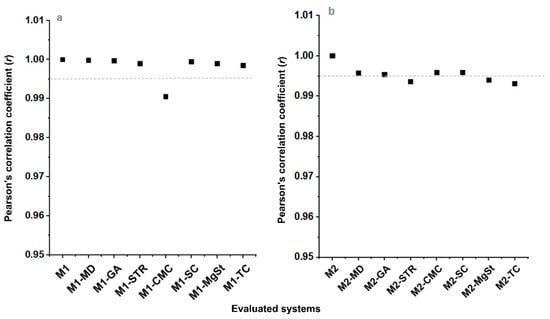
Pearson correlation analysis was performed to quantify spectral similarity between the pure extracts and their binary mixtures (Figure 6). For M1, all binary mixtures except M1–CMC showed correlation coefficients r > 0.999, indicating near-complete preservation of the spectral profile. The M1–CMC mixture exhibited the greatest divergence within the group (r = 0.990, p < 0.0001). However, this value still reflects a strong correlation; the notable difference from the remaining mixtures (Δr ≈ 0.009) may reflect subtle modifications in the chemical microenvironment of functional groups, consistent with the non-covalent interactions identified in the IST analysis.
Figure 6.
Pearson correlation coefficients (r) between FTIR spectra of pure avocado (P. americana Mill.) seed aqueous extracts and their binary mixtures with pharmaceutical excipients (1:1, w/w). (a) Criollo extract (M1); (b) Hass extract (M2). Spectra were compared within the fingerprint region of the ATR-FTIR range (1500–650 cm−1). The dashed line indicates the reference threshold at r = 0.995. The M1–CMC mixture showed the greatest spectral divergence from the pure extract (r = 0.990). MD: maltodextrin; GA: gum arabic; STR: starch; CMC: sodium carboxymethylcellulose; SC: sodium croscarmellose; MgSt: magnesium stearate; TC: talc.
For the M2 extract, correlation coefficients across all binary mixtures ranged from r > 0.993, with no notable outliers or divergent values (Figure 6b). Although these coefficients were marginally lower than those observed for M1 (r > 0.999), the absence of critical divergences suggests a more homogeneous spectral response of the M2 matrix in the presence of the evaluated excipients.
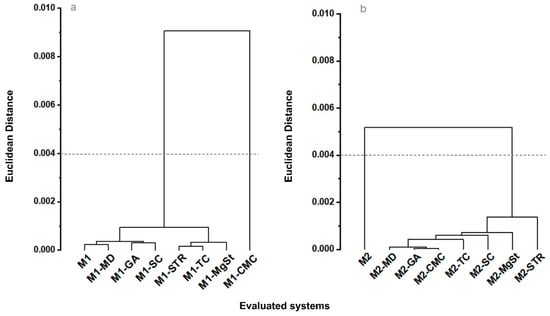
Hierarchical cluster analysis (HCA) using Ward’s linkage method and Euclidean distance was applied to evaluate spectral similarities and grouping patterns among the pure extracts and their binary mixtures. A cutoff threshold of 0.004 was established based on the natural grouping observed in the dendrogram, corresponding to the point of maximum within-group homogeneity.
For the Criollo cultivar (M1), the dendrogram (Figure 7a) revealed two distinct clustering patterns: most binary mixtures grouped at Euclidean distances below 0.002, with M1–SC showing the closest spectral similarity to the pure extract, while the M1–CMC mixture clustered separately at a distance exceeding 0.009. This spectral divergence is consistent with the significant reduction in epicatechin recovery observed for M1–CMC in the IST analysis, supporting the existence of physicochemical interactions between CMC and the extract components.
Figure 7.
Hierarchical cluster analysis (HCA) of FTIR spectral profiles of avocado (P. americana Mill.) seed aqueous extracts and their binary mixtures with pharmaceutical excipients. Dendrograms were constructed using Ward’s linkage method and Euclidean distance. The dashed vertical line indicates the cutoff threshold at a Euclidean distance of 0.004. (a) Criollo extract (M1) and binary mixtures (1:1, w/w); (b) Hass extract (M2) and binary mixtures (1:1, w/w). MD: maltodextrin; GA: gum arabic; STR: starch; CMC: sodium carboxymethylcellulose; SC: sodium croscarmellose; MgSt: magnesium stearate; TC: talc.
For the Hass cultivar (M2), all binary mixtures clustered below the 0.004 threshold (Figure 7b), indicating high spectral homogeneity in the presence of the evaluated excipients. The pure M2 extract joined the main cluster at a slightly greater distance than the binary mixtures, suggesting that excipient addition generates measurable but minor spectral modifications without compromising the integrity of the polyphenolic matrix. This pattern is consistent with the high epicatechin recovery rates obtained in the IST analysis, collectively confirming the compatibility of MD and GA with the M2 extract.
Physicochemical incompatibility between the M1 extract and CMC was confirmed based on converging evidence from three independent analyses: reduced epicatechin recovery by IST-HPLC, progressive macroscopic browning, and chemometric segregation in HCA. Consequently, the M1–CMC binary mixture was excluded from DSC analysis, as the preceding techniques had sufficiently characterized its incompatibility. This approach supports the rational selection of excipients for the development of solid dosage forms that preserve the phytochemical integrity of the extract.
Talc (TC) was also excluded from DSC analysis, though for different reasons. As an inorganic hydrated magnesium silicate, TC exhibits no melting, crystallization, or significant endothermic or exothermic events across the evaluated temperature range, precluding the detection of thermally induced interactions by DSC [53]. Its compatibility with both extracts was adequately demonstrated by IST-HPLC (M1–TC: 88.07 ± 0.49%) and FTIR spectral correlation (r = 0.999 for M1; r = 0.993 for M2), techniques more appropriate for characterizing surface interactions with mineral [53,54]. DSC analysis was therefore considered unnecessary for this system.
3.4. Differential Scanning Calorimetry (DSC)
DSC analysis of aqueous extracts of avocado (P. americana Mill.) seed dry extracts revealed broad endothermic profiles characteristic of complex plant matrices of predominantly amorphous nature. Structurally, plant biomass is defined as a heterogeneous and recalcitrant polymeric matrix, where the intrinsic interaction between lignin, hemicellulose, and cellulose generates a coexistence of amorphous regions and dispersed crystalline domains [55].
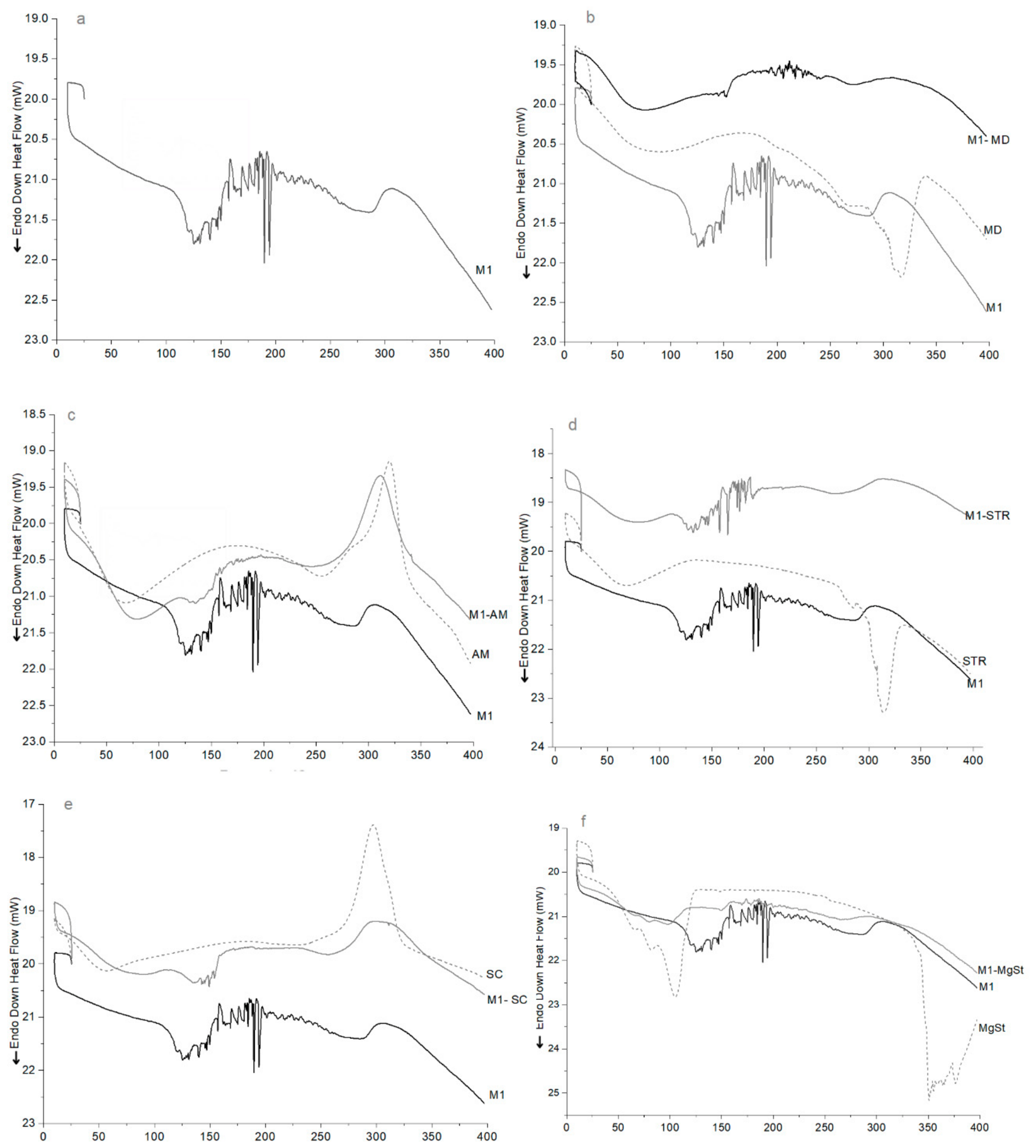
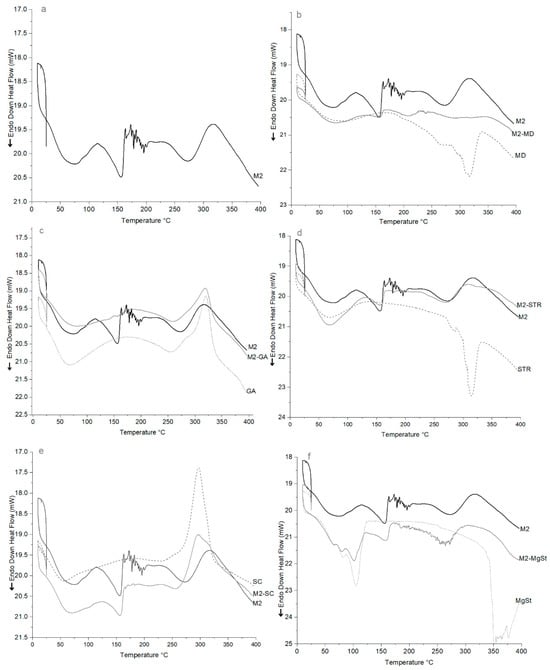
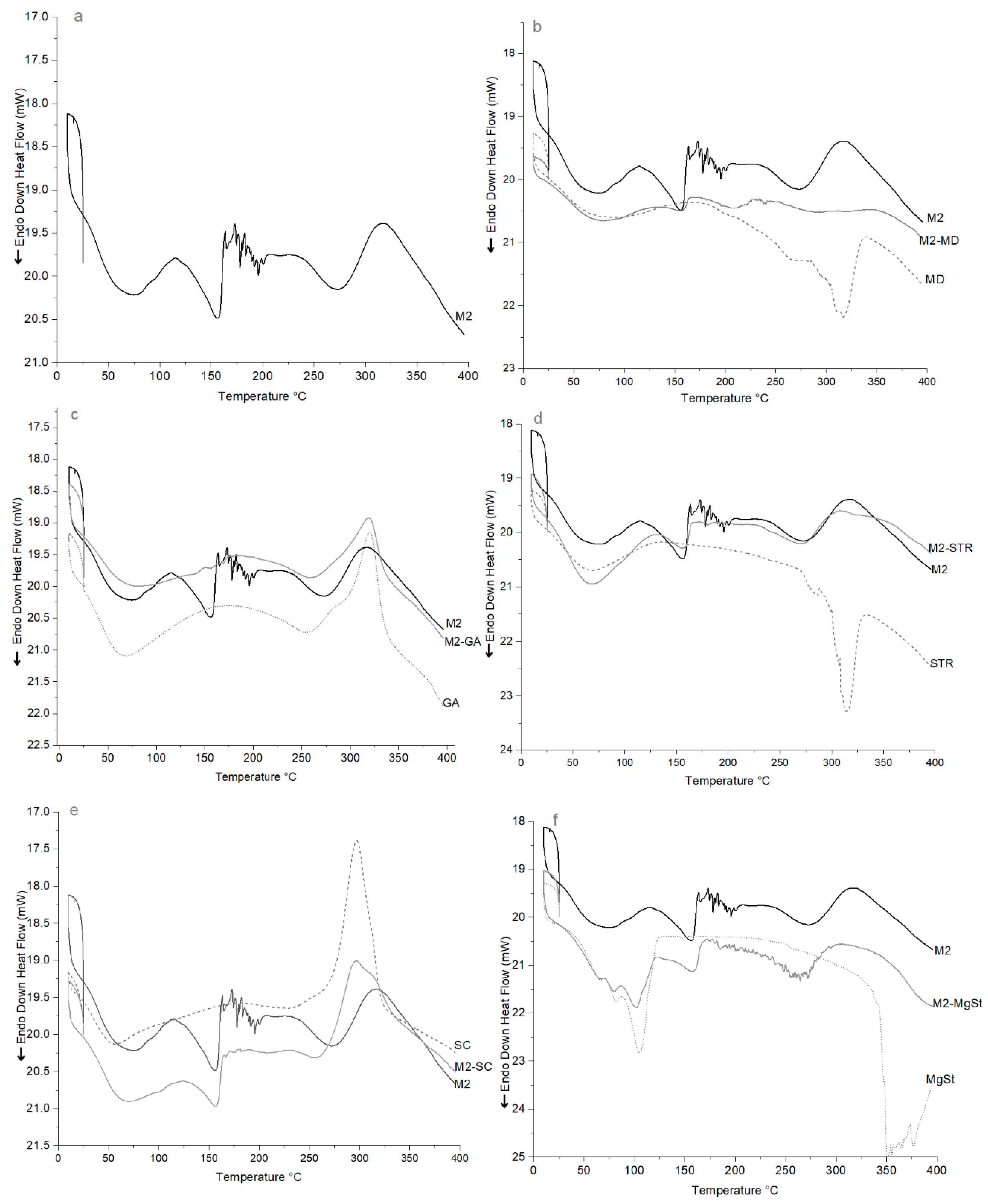
The thermogram of the M1 extract (Figure 8a) showed a broad endothermic event with Tonset = 118.45 °C, Tpeak = 134.82 °C, Tendset = 148.12 °C, and ΔH = 142.65 J/g, associated with moisture loss and structural reorganization of the biopolymeric matrix. The M2 extract (Figure 9a) displayed a comparable profile with slightly different thermal parameters (Tpeak = 131.25 °C; ΔH = 128.92 J/g; thermal interval: 114.20–145.30 °C). Although the thermal intervals of both extracts are shifted to higher temperatures compared to those reported by Fernandes et al. [56] for Ximenia americana L. (33.50–118.58 °C) and Schinopsis brasiliensis Engl. (39.17–126.14 °C) [18], the broad and continuous nature of the endothermic events is consistent with the thermal complexity characteristic of polyphenol-rich dry plant extracts. The absence of sharp melting peaks confirms the predominantly amorphous nature of both extracts (Figure 8a and Figure 9a), a thermodynamic state favorable for bioactive compound solubility but associated with lower physical stability, highlighting the importance of rational excipient selection for solid dosage form development. These findings are in agreement with de Andrade et al. [19], who attributed broad endothermic events in plant extracts to multi-stage moisture loss and macromolecular reorganization.
Figure 8.
DSC thermograms of the aqueous extract of P. americana Mill. Criollo avocado seed (M1), pure excipients, and its binary mixtures with pharmaceutical excipients (1:1, w/w). (a) M1; (b) M1–MD; (c) M1–GA; (d) M1–STR; (e) M1–SC; and (f) M1–MgSt. Each curve is overlaid with those of the pure extract and the corresponding excipient for comparison. Analyses were performed from 10 to 200 °C at a heating rate of 10 °C/min under a nitrogen atmosphere. M1–CMC and M1–TC binary mixtures were excluded from DSC analysis (see Section 3.3). MD: maltodextrin; GA: gum arabic; STR: starch; SC: sodium croscarmellose; MgSt: magnesium stearate.
Figure 9.
DSC thermograms of aqueous extract of P. americana Mill. Hass avocado seed (M2), pure excipients, and its binary mixtures with pharmaceutical excipients (1:1, w/w). (a) M2; (b) M2–MD; (c) M2–GA; (d) M2–STR; (e) M2–SC; (f) M2–MgSt. Each curve is overlaid with those of the pure extract and the corresponding excipient for comparison. Analyses were performed from 10 to 200 °C at a heating rate of 10 °C/min under a nitrogen atmosphere. M2–CMC and M2–TC binary mixtures were excluded from DSC analysis (see Section 3.3). MD: maltodextrin; GA: gum arabic; STR: starch; SC: sodium croscarmellose; MgSt: magnesium stearate.
Comparison of the thermal profiles of M1 (Figure 8) and M2 (Figure 9) with their respective binary mixtures showed no new significant exothermic or endothermic events. The preservation of the characteristic thermal profiles suggests no detectable thermal incompatibility in the mixtures analyzed by DSC [57].
DSC analysis was restricted to temperatures below 200 °C to reflect the operational stability range relevant to pharmaceutical solid dosage form manufacturing. The M1–CMC, M2–CMC, M1–TC, and M2–TC systems were excluded for reasons described in Section 3.3. The complete thermograms (Figure 8a and Figure 9a) show thermal events above 250 °C, attributable to oxidative degradation of residual polysaccharide and phenolic polymeric components in the extract matrix [58]. Within the operational range (25–200 °C), minor Tpeak shifts (<10 °C) and enthalpy variations were observed across binary mixtures, consistent with physical interactions such as hydrogen bonding and moisture redistribution within the hygroscopic system, rather than chemical instability [54].
No significant differences were found between the transition enthalpies of M1 and M2 (p = 0.1271; n = 6), with a mean difference of −12.76 ± 7.66 J/g (95% CI: −29.84 to 4.32 J/g). The relative enthalpy deviation (ΔΔH%) was calculated to quantify the magnitude of extract–excipient thermal interactions, using the transition enthalpy of each pure extract as reference (142.65 J/g for M1; 128.92 J/g for M2; Table 3 and Table 4). Binary mixtures with starch showed the smallest deviations (M1–STR: −8.64%; M2–STR: −10.64%), suggesting minimal thermal interaction. In contrast, MD and MgSt induced greater enthalpic reductions, with (ΔΔH%) values exceeding the 20% threshold (MD: −22.62% for M1, −22.86% for M2; MgSt: −26.64% for M1, −27.67% for M2). However, as these deviations were not accompanied by new thermal events, and both IST-HPLC and FTIR analyses confirmed chemical integrity, these results are attributed to physical rather than chemical interactions. The 20% threshold should therefore be interpreted in conjunction with complementary analytical evidence rather than as an absolute incompatibility criterion.
Table 3.
DSC thermal parameters (Tonset, Tpeak, Tendset, and ΔH) of avocado (P. americana Mill.) Criollo seed aqueous extract (M1) and its binary mixtures with pharmaceutical excipients.
Table 4.
Thermal parameters and enthalpies (ΔH) for the aqueous extract of P. americana Mill. Hass avocado seed (M2) and its binary mixtures.
The enthalpy reduction observed in M1–MD and M2–MD mixtures is consistent with the formation of a protective amorphous matrix, within which extract components may be dispersed, reducing the apparent ΔH of the thermal event. This interpretation is supported by epicatechin recovery exceeding 88% in IST-HPLC, confirming that MD acts as a stabilizing agent rather than promoting degradation. This behavior aligns with the thermal compatibility criteria proposed by Rojek & Wesolowski [31]. According to these criteria, the observed reduction in peak area, in the absence of new exothermic or endothermic signals, is driven by a combination of sample dilution—which reduces the effective thermal mass of the marker—and an excipient-induced transition toward an amorphous state of lower crystallinity that stabilizes the avocado (P. americana Mill.) extract.
For MgSt, the hydrophobic nature of this lubricant may alter surface dehydration kinetics and modify the apparent enthalpy of the thermal transition without inducing chemical changes, as corroborated by stable epicatechin recovery in IST-HPLC and the absence of new absorption bands in FTIR analysis, providing no evidence of degradative interactions. A similar pattern has been reported for synthetic APIs such as modafinil, where DSC revealed enthalpy reductions and minor peak shifts attributable exclusively to physical dilution effects [52].
Integration of results from IST, FTIR, and DSC analyses (Table 5) provides a comprehensive compatibility profile for aqueous extracts of avocado (P. americana Mill.) seeds. Maltodextrin and gum arabic demonstrated the most favorable compatibility profiles across all analytical techniques, supporting their potential use as excipients in future formulation studies. Starch, sodium croscarmellose, and magnesium stearate showed favorable compatibility with M1, whereas for M2, FTIR and DSC revealed no clear incompatibility, but chemical stability remained unconfirmed. Talc also demonstrated compatibility based on IST-HPLC and FTIR results (Table 5), despite its exclusion from DSC evaluation. In contrast, CMC should be excluded from formulations based on the M1 extract, given its demonstrated capacity to promote instability of the polyphenolic matrix, as indicated by significant reduction in epicatechin recovery (p < 0.0001) and spectral segregation confirmed by HCA.
Table 5.
Compatibility profile of binary mixtures of aqueous extracts of avocado (P. americana Mill.) seeds (M1 and M2) and selected excipients.
The chemical stability of epicatechin in most evaluated systems, with recoveries exceeding 88%, is consistent with findings reported by Mankar et al. [51] for extracts of Phyllanthus emblica and Glycyrrhiza glabra, as well as by Mohapatra et al. [59] for Piper longum extract, where FTIR and HPTLC confirmed that commonly used excipients do not compromise the chemical integrity of complex plant matrices. The incompatibility identified in the M1–CMC system is in agreement with Shrivastava et al. [60], who reported CMC as an incompatible excipient with curcumin in Curcuma longa extract, based on interactions detected by HPTLC, DSC, and FTIR.
DSC analysis provided additional evidence of thermal compatibility, with starch showing the smallest enthalpy deviations (ΔΔH (%) < 11%) among all evaluated excipients for both M1 and M2. These results are consistent with de Andrade et al. [19], who reported compatible DSC and TGA profiles between Annona muricata extract and starch, with binary mixture thermograms resembling the additive profiles of individual components and no anomalous thermal events.
This study has some limitations. Particle size and residual moisture of the freeze-dried extracts were not determined, although both parameters are relevant for powder handling and stability. In addition, precipitation-related chromatographic interference prevented reliable epicatechin quantification in certain M2 binary mixtures, limiting conclusions on their chemical stability. Therefore, the compatibility of these mixtures should be interpreted with caution until confirmed with optimized analytical methods. Finally, only binary mixtures were evaluated, so the behavior of these extracts in complete multicomponent formulations remains to be established.
4. Conclusions
This study provides, to our knowledge, the first preformulation compatibility assessment of aqueous extracts of avocado (Persea americana Mill.) seeds from the Criollo (M1) and Hass (M2) cultivars with excipients commonly used in solid dosage forms. Although the Hass extract contained approximately seven times more total phenolics than the Criollo extract (192.80 ± 4.90 µg GAE/mg), DSC revealed no significant difference in their thermal behavior (p = 0.1271).
Maltodextrin and gum arabic emerged as the most promising excipients for the development of solid dosage forms, as their compatibility with both extracts was supported by IST-HPLC, FTIR, and DSC. Starch, sodium croscarmellose, talc, and magnesium stearate showed no evidence of incompatibility with M1 in any of the analyses performed. However, the chemical stability of the corresponding M2 mixtures could not be confirmed. Excluding M1–CMC, epicatechin recoveries exceeded 88% in all binary mixtures quantified by IST-HPLC.
In contrast, a specific incompatibility between M1 and CMC was supported by a low epicatechin recovery (29.44%; p < 0.0001), anomalous spectral segregation in hierarchical cluster analysis (Euclidean distance > 0.009), and progressive browning during stress testing. For M2, chemical stability could not be established in several binary mixtures because of chromatographic interference, which limits conclusions on their compatibility.
These findings provide preformulation data to support the development of solid dosage forms from avocado seed extracts, contributing to the valorization of this agro-industrial by-product, and underline the need for cultivar-specific preformulation studies. Future work should include optimized analytical methods for M2 mixtures, determination of particle size and residual moisture, formulation development, and extended stability testing.
Author Contributions
O.C.-V.: conceptualization, methodology, investigation, writing—original draft. S.P.d.M.: methodology, writing—review and editing. V.L.B.: methodology, writing—review & editing. L.C.-C.: methodology, investigation, writing—review and editing. C.-A.B.R.: project administration, supervision, writing—review and editing. J.R.U.Á.: supervision, writing—review and editing. J.J.C.: supervision, writing—review and editing. B.A.-S.: investigation, formal analysis, writing—review and editing. C.B.-A.: conceptualization, methodology, investigation, supervision, writing—original draft, writing—review and editing. All authors have read and agreed to the published version of the manuscript.
Funding
This work was supported by the Ministerio de Ciencias, Tecnología e Innovación (Minciencias) Colombia and Universidad de Cartagena, Colombia, under grant No. 112721-442-2023, within the project entitled “Desarrollo de un modelo de bioeconomía para la obtención de productos derivados de la semilla de Aguacate Hass con aplicabilidad en el sector agrícola y alimentario en el departamento del Putumayo”.
Institutional Review Board Statement
Not applicable. This study did not involve human or animal subjects; only plant (seed) material was used. Collection of Persea americana Mill. seeds was carried out under Framework Collection Permit for Specimens of Wild Species for Non-Commercial Scientific Research Purposes No. 001579, granted by the National Environmental Licensing Authority (ANLA, Colombia) on 25 July 2024.
Informed Consent Statement
Not applicable.
Data Availability Statement
The data supporting the findings of this study are available from the corresponding author upon request.
Acknowledgments
The authors gratefully acknowledge the support of the Ministerio de Ciencias, Tecnología e Innovación (Minciencias) Colombia, contrato de Financiamiento de Recuperación Contingente No. 112721-442-2023, “Desarrollo de un modelo de bioeconomía para la obtención de productos derivados de la semilla de Aguacate Hass con aplicabilidad en el sector agrícola y alimentario en el departamento del Putumayo” (Código 1107-936-99160). The Research Vice-Rectory of Universidad de Cartagena, Colombia; Programa de Doctorado en Ciencias Farmacéuticas Universidad de Cartagena, Colombia; and the Laboratório de Desenvolvimento Galênico, Faculdade de Farmácia, Universidade Federal do Rio Grande do Sul (UFRGS), Brazil. The authors also express their sincere gratitude to the communities of Sibundoy and Puerto Asís (Putumayo) and Carmen de Bolívar (Bolívar), Colombia, for generously sharing their traditional knowledge on the medicinal and cultural uses of Persea americana Mill. seeds. Access to traditional knowledge was conducted in accordance with applicable national regulations on biological diversity and traditional knowledge. During the preparation of this work, the authors used Claude Sonnet 4.6 (Anthropic, San Francisco, CA, USA; claude.ai) to assist with the translation of the manuscript from Spanish into English. After using this tool, the authors reviewed and edited all translated content as needed and took full responsibility for the accuracy and integrity of the final published work.
Conflicts of Interest
The authors declare no conflicts of interest.
Abbreviations
The following abbreviations are used in this manuscript:
| M1 | Aqueous seed extract of avocado (Persea americana Mill.), Criollo cultivar |
| M2 | Aqueous seed extract of avocado (Persea americana Mill.), Hass cultivar |
| ABTS | 2,2′-azino-bis(3-ethylbenzothiazoline-6-sulfonic acid) |
| TPC | Total phenolic content |
| GAE | Gallic acid equivalent |
| DSC | Differential scanning calorimetry |
| TG/TGA | Thermogravimetry/thermogravimetric analysis |
| FTIR | Fourier transform infrared spectroscopy |
| ATR | Attenuated total reflectance |
| ssNMR | Solid-state nuclear magnetic resonance |
| XRD | X-ray diffraction |
| IST | Isothermal stress testing |
| HPLC | High-performance liquid chromatography |
| HPTLC | High-performance thin-layer chromatography |
| HCA | Hierarchical cluster analysis |
| BM | Binary mixture(s) |
| CMC | Sodium carboxymethylcellulose |
| MD | Maltodextrin |
| GA | Gum arabic |
| STR | Starch |
| SC | Sodium croscarmellose |
| MgSt | Magnesium stearate |
| TC | Talc |
| SD | Standard deviation |
| ANOVA | Analysis of variance |
References
- Rendón-Anaya, M.; Ibarra-Laclette, E.; Méndez-Bravo, A.; Lan, T.; Zheng, C.; Carretero-Paulet, L.; Perez-Torres, C.A.; Chacón-López, A.; Hernandez-Guzmán, G.; Chang, T.-H.; et al. The avocado genome informs deep angiosperm phylogeny, highlights introgressive hybridization, and reveals pathogen-influenced gene space adaptation. Proc. Natl. Acad. Sci. USA 2019, 116, 17081–17089. [Google Scholar] [CrossRef] [Scilit]
- Vega, J.Y. El Aguacate en Colombia: Estudio de Caso de los Montes de María, en el Caribe Colombiano; Documentos de Trabajo sobre Economía Regional y Urbana No. 171; Banco de la República: Cartagena, Colombia, 2012. [Google Scholar] [CrossRef] [Scilit]
- Araújo, R.G.; Rodriguez-Jasso, R.M.; Ruiz, H.A.; Pintado, M.M.E.; Aguilar, C.N. Avocado by-products: Nutritional and functional properties. Trends Food Sci. Technol. 2018, 80, 51–60. [Google Scholar] [CrossRef] [Scilit]
- Coutinho, I.B.; Quezadas, M.B.; de Souza, L.F.G.; Nitz, M.; Andreola, K. Spray drying of avocado pulp using the seed as an adjuvant. Powder Technol. 2022, 408, 117738. [Google Scholar] [CrossRef] [Scilit]
- Tesfaye, T.; Ayele, M.; Gibril, M.; Ferede, E.; Limeneh, D.Y.; Kong, F. Beneficiation of avocado processing industry by-product: A review on future prospect. Curr. Res. Green Sustain. Chem. 2022, 5, 100253. [Google Scholar] [CrossRef] [Scilit]
- Dabas, D.; Shegog, R.; Ziegler, G.; Lambert, J. Avocado (Persea americana) seed as a source of bioactive phytochemicals. Curr. Pharm. Des. 2013, 19, 6133–6140. [Google Scholar] [CrossRef] [Scilit]
- Rosero, J.C.; Cruz, S.; Osorio, C.; Hurtado, N. Analysis of phenolic composition of byproducts (seeds and peels) of avocado (Persea americana Mill.) cultivated in Colombia. Molecules 2019, 24, 3209. [Google Scholar] [CrossRef] [Scilit]
- Bhuyan, D.J.; Alsherbiny, M.A.; Perera, S.; Low, M.; Basu, A.; Devi, O.A.; Barooah, M.S.; Li, C.G.; Papoutsis, K. The odyssey of bioactive compounds in avocado (Persea americana) and their health benefits. Antioxidants 2019, 8, 426. [Google Scholar] [CrossRef] [Scilit]
- Tabeshpour, J.; Razavi, B.M.; Hosseinzadeh, H. Effects of avocado (Persea americana) on metabolic syndrome: A comprehensive systematic review. Phytother. Res. 2017, 31, 819–837. [Google Scholar] [CrossRef] [Scilit]
- Ong, E.S.; Low, J.; Tan, J.C.W.; Foo, S.Y.; Leo, C.H. Valorization of avocado seeds with antioxidant capacity using pressurized hot water extraction. Sci. Rep. 2022, 12, 13036. [Google Scholar] [CrossRef] [Scilit]
- Pahua-Ramos, M.E.; Ortiz-Moreno, A.; Chamorro-Cevallos, G.; Hernández-Navarro, M.D.; Garduño-Siciliano, L.; Necoechea-Mondragón, H.; Hernández-Ortega, M. Hypolipidemic effect of avocado (Persea americana Mill) seed in a hypercholesterolemic mouse model. Plant Foods Hum. Nutr. 2012, 67, 10–16. [Google Scholar] [CrossRef] [Scilit]
- Ejiofor, C.C.; Ezeagu, I.E.; Ayoola, M. Hypoglycaemic and biochemical effects of the aqueous and methanolic extract of Persea americana seeds on alloxan-induced albino rats. Eur. J. Med. Plants 2018, 26, 1–12. [Google Scholar] [CrossRef] [Scilit]
- Okon, A.J.; Etim, D.J.; Daniel, A.I.; Bobson, P.M.; Asuquo, A.E. Effect of ethanolic extracts of Persea americana seed and Zea mays silk on blood glucose levels, body and organ weights of alloxan-induced hyperglycemic albino Wistar rats. Glob. J. Pure Appl. Sci. 2018, 24, 153–168. [Google Scholar] [CrossRef] [Scilit]
- Alkhalaf, M.I.; Alansari, W.S.; Ibrahim, E.A.; ELhalwagy, M.E.A. Anti-oxidant, anti-inflammatory and anti-cancer activities of avocado (Persea americana) fruit and seed extract. J. King Saud Univ. Sci. 2019, 31, 1358–1362. [Google Scholar] [CrossRef] [Scilit]
- Kristanti, C.D.; Simanjuntak, F.P.J.; Dewi, N.K.P.A.; Tianri, S.V.; Hendra, P. Anti-inflammatory and analgesic activities of avocado seed (Persea americana Mill.). J. Pharm. Sci. Community 2017, 14, 104–111. [Google Scholar] [CrossRef] [Scilit]
- Ekom, S.E.; Tamokou, J.-D.-D.; Kuete, V. Methanol extract from the seeds of Persea americana displays antibacterial and wound healing activities in rat model. J. Ethnopharmacol. 2022, 282, 114573. [Google Scholar] [CrossRef] [Scilit]
- Bahru, T.B.; Tadele, Z.H.; Ajebe, E.G. A review on avocado seed: Functionality, composition, antioxidant and antimicrobial properties. Chem. Sci. Int. J. 2019, 27, 1–10. [Google Scholar] [CrossRef] [Scilit]
- Fernandes, F.H.A.; de Almeida, V.E.; de Medeiros, F.D.; da Silva, P.C.D.; Simões, M.O.d.S.; Veras, G.; Medeiros, A.C.D. Evaluation of compatibility between Schinopsis brasiliensis Engler extract and pharmaceutical excipients using analytical techniques associated with chemometric tools. J. Therm. Anal. Calorim. 2016, 123, 2531–2542. [Google Scholar] [CrossRef] [Scilit]
- de Andrade, F.H.D.; de Araújo Batista, R.S.; Melo, T.B.L.; Fernandes, F.H.A.; Macedo, R.O.; de Souza, F.S.; Wanderley, A.G. Characterization and compatibility of dry extract from Annona muricata L. and pharmaceutical excipients. J. Therm. Anal. Calorim. 2021, 143, 237–246. [Google Scholar] [CrossRef] [Scilit]
- Veras, K.S.; Fachel, F.N.S.; Pittol, V.; Garcia, K.R.; Bassani, V.L.; dos Santos, V.; Henriques, A.T.; Teixeira, H.F.; Koester, L.S. Compatibility study of rosmarinic acid with excipients used in pharmaceutical solid dosage forms using thermal and non-thermal techniques. Saudi Pharm. J. 2019, 27, 1138–1145. [Google Scholar] [CrossRef] [Scilit]
- Kolisnyk, T.; Vashchenko, O.; Ruban, O.; Fil, N.; Slipchenko, G. Assessing compatibility of excipients selected for a sustained release formulation of bilberry leaf extract. Braz. J. Pharm. Sci. 2022, 58, e19753. [Google Scholar] [CrossRef] [Scilit]
- Palacio, Y.; Castro, J.P.; Bassani, V.L.; Franco, L.A.; Bernal, C.A. Preformulation studies for the development of a microemulsion formulation from Ambrosia peruviana All., with anti-inflammatory effect. Braz. J. Pharm. Sci. 2023, 59, e22505. [Google Scholar] [CrossRef] [Scilit]
- Sheskey, P.J.; Cook, W.G.; Cable, C.G. Handbook of Pharmaceutical Excipients, 8th ed.; Pharmaceutical Press: London, UK, 2017. [Google Scholar]
- VanderWeide, J.; Del Zozzo, F.; Nasrollahiazar, E.; Kennedy, J.A.; Peterlunger, E.; Rustioni, L.; Sabbatini, P. Influence of freezing and heating conditions on grape seed flavan-3-ol extractability, oxidation, and galloylation pattern. Sci. Rep. 2022, 12, 3838. [Google Scholar] [CrossRef] [Scilit]
- Hajleh, M.N.A.; Khleifat, K.M.; Alqaraleh, M.; Al-Hraishat, E.; Al-limoun, M.O.; Qaralleh, H.; Al-Dujaili, E.A.S. Antioxidant and antihyperglycemic effects of Ephedra foeminea aqueous extract in streptozotocin-induced diabetic rats. Nutrients 2022, 14, 2338. [Google Scholar] [CrossRef] [Scilit]
- Proestos, C.; Lytoudi, K.; Mavromelanidou, O.; Zoumpoulakis, P.; Sinanoglou, V. Antioxidant capacity of selected plant extracts and their essential oils. Antioxidants 2013, 2, 11–22. [Google Scholar] [CrossRef] [Scilit]
- Re, R.; Pellegrini, N.; Proteggente, A.; Pannala, A.; Yang, M.; Rice-Evans, C. Antioxidant activity applying an improved ABTS radical cation decolorization assay. Free Radic. Biol. Med. 1999, 26, 1231–1237. [Google Scholar] [CrossRef] [Scilit] [PubMed]
- Gómez, F.; Sánchez, S.; Iradi, M.; Azman, N.; Almajano, M. Avocado seeds: Extraction optimization and possible use as antioxidant in food. Antioxidants 2014, 3, 439–454. [Google Scholar] [CrossRef] [Scilit]
- Chadha, R.; Bhandari, S. Drug–excipient compatibility screening—Role of thermoanalytical and spectroscopic techniques. J. Pharm. Biomed. Anal. 2014, 87, 82–97. [Google Scholar] [CrossRef] [Scilit]
- Agência Nacional de Vigilância Sanitária (ANVISA). Farmacopeia Brasileira, 6th ed.; ANVISA: Brasília, Brazil, 2019; Volume II—Monografias: Plantas Medicinais.
- Rojek, B.; Wesolowski, M. A combined differential scanning calorimetry and thermogravimetry approach for the effective assessment of drug substance–excipient compatibility. J. Therm. Anal. Calorim. 2023, 148, 845–858. [Google Scholar] [CrossRef] [Scilit]
- Escobar-Ramírez, A.; González Garrido, J.A.; Hernández Abreu, O.; Zenteno, E.; Solórzano Mata, C.J.; Pérez Cervera, Y.; Lefebvre, T.; Dehennaut, V. Investigating the ABTS-based antioxidant potential and antiproliferative activity of pulp, skin and seeds extracts from Nephelium lappaceum, Manilkara zapota, and Melicoccus oliviformis on human prostate and colon cancer cells. Biochem. Biophys. Rep. 2025, 44, 102257. [Google Scholar] [CrossRef] [Scilit]
- Miramontes-Corona, C.; Torres-Santiago, G.; Rodriguez, M.M.J.; Corona-González, R.I.; Toriz, G. Phenolic profile, antioxidant activity and antimicrobial properties of avocado (Persea americana) seed extracts. Chem. Pap. 2024, 78, 5061–5069. [Google Scholar] [CrossRef] [Scilit]
- Joshi, T.; Deepa, P.R.; Sharma, P.K. Effect of different proportions of phenolics on antioxidant potential: Pointers for bioactive synergy/antagonism in foods and nutraceuticals. Proc. Natl. Acad. Sci. India Sect. B Biol. Sci. 2022, 92, 939–946. [Google Scholar] [CrossRef] [Scilit]
- Kostka, T.; Ostberg-Potthoff, J.J.; Stärke, J.; Guigas, C.; Matsugo, S.; Mirčeski, V.; Stojanov, L.; Veličkovska, S.K.; Winterhalter, P.; Esatbeyoglu, T. Bioactive phenolic compounds from lingonberry (Vaccinium vitis-idaea L.): Extraction, chemical characterization, fractionation and cellular antioxidant activity. Antioxidants 2022, 11, 467. [Google Scholar] [CrossRef] [Scilit]
- Gülçin, İ.; Kızıltaş, H.; Bingöl, Z.; Gören, A.C.; Pinar, S.M.; Alwasel, S.H. LC-HRMS profiling of phytochemicals, antidiabetic, anticholinergic and antioxidant activities of evaporated ethanol extract of Astragalus brachycalyx Fischer. J. Chem. Metrol. 2021, 15, 135–151. [Google Scholar] [CrossRef] [Scilit]
- Kabré, P.; Ouattara, L.; Sanou, Y.; Ouédraogo, R.J.; Ouoba, P.; Zanté, A.-A.; Zoungo, D.; Somda, M.B.; Ouédraogo, G.A. Comparative study of polyphenols, flavonoids content, antioxidant and antidiabetic activities of Lophira lanceolata Tiegh. ex Keay (Ochnaceae) extracts. Sci. Afr. 2023, 22, e01922. [Google Scholar] [CrossRef] [Scilit]
- Paternina-Ricardo, S.; Del Castillo, M.D.; Sánchez-Martin, V.; García-Espiñeira, M.; Cervantes-Ceballos, L.; Arroyo-Salgado, B.; Tejeda-Benítez, L. Exploring the efficacy of the biological properties of Persea americana Mill seed: Useful studies and perspectives in functional foods. J. Agric. Food Res. 2025, 24, 102428. [Google Scholar] [CrossRef] [Scilit]
- Herrera-Builes, J.F.; Sepúlveda-Villarroel, V.; Osorio, J.A.; Salvo-Sepúlveda, L.; Ananías, R.A. Effect of thermal modification treatment on some physical and mechanical properties of Pinus oocarpa wood. Forests 2021, 12, 249. [Google Scholar] [CrossRef] [Scilit]
- Kathirgamanathan, K.; Grigsby, W.; Edmonds, N.R.; Al Hakkak, J. Molecular weight fractionation of high polydispersity native celluloses. Cellulose 2017, 24, 5261–5265. [Google Scholar] [CrossRef] [Scilit]
- Broncel, M.; Juszczak, A.; Szczolko, W.; Silvestri, D.; Białek-Dratwa, A.; Wacławek, S.; Kowalski, O.; Ramos, P. Thermal compatibility of new ACEI derivatives with popular excipients used to produce solid pharmaceutical formulations. Pharmaceuticals 2024, 17, 1323. [Google Scholar] [CrossRef] [Scilit]
- Sommer, S.; Weber, F.; Harbertson, J.F. Polyphenol–protein–polysaccharide interactions in the presence of carboxymethyl cellulose (CMC) in wine-like model systems. J. Agric. Food Chem. 2019, 67, 7428–7434. [Google Scholar] [CrossRef] [Scilit]
- Vilas-Boas, A.A.; Pintado, M.; Oliveira, A.L.S. Natural bioactive compounds from food waste: Toxicity and safety concerns. Foods 2021, 10, 1564. [Google Scholar] [CrossRef] [Scilit] [PubMed]
- García-Peñas, A.; Liang, W.; Hashmi, S.; Sharma, G.; Saeb, M.R.; Stadler, F.J. Hydrogen bonds in blends of poly(N-isopropylacrylamide), poly(N-ethylacrylamide) homopolymers, and carboxymethyl cellulose. J. Compos. Sci. 2021, 5, 240. [Google Scholar] [CrossRef] [Scilit]
- Shao, X.; Sun, H.; Jiang, R.; Yu, Y. Physical and antibacterial properties of corn distarch phosphate/carboxymethyl cellulose composite films containing tea polyphenol. J. Food Process. Preserv. 2020, 44, e14401. [Google Scholar] [CrossRef] [Scilit]
- Claus, H.; Tenzer, S.; Sobe, M.; Schlander, M.; König, H.; Fröhlich, J. Effect of carboxymethyl cellulose on tartrate salt, protein and colour stability of red wine. Aust. J. Grape Wine Res. 2014, 20, 186–193. [Google Scholar] [CrossRef] [Scilit]
- Rojas, J.; Guisao, S.; Ruge, V. Functional assessment of four types of disintegrants and their effect on the spironolactone release properties. AAPS PharmSciTech 2012, 13, 1054–1062. [Google Scholar] [CrossRef] [Scilit]
- Rowe, R.C.; Sheskey, P.J.; Quinn, M.E. Handbook of Pharmaceutical Excipients, 6th ed.; Pharmaceutical Press: London, UK; American Pharmacists Association: Washington, DC, USA, 2009. [Google Scholar]
- Huang, W.X.; Desai, M.; Tang, Q.; Yang, R.; Vivilecchia, R.V.; Joshi, Y. Elimination of metformin–croscarmellose sodium interaction by competition. Int. J. Pharm. 2006, 311, 33–39. [Google Scholar] [CrossRef] [Scilit]
- Bogatinovska, E.C.; Geškovski, N.; Petrushevski, G.; Stefov, V. Multivariate analysis for rapid screening and prediction of solid-state compatibility in pharmaceutical preformulation studies—Paving the road for machine learning. Maced. J. Chem. Chem. Eng. 2024, 43, 99–113. [Google Scholar] [CrossRef] [Scilit]
- Mankar, S.D.; Musale, P.; Bhawar, S.B.; Siddheshwar, S.S.; Dighe, S.B. Exploring the synergistic effect in polyherbal chewable antacid tablets: Formulation and evaluation study. Curr. Issues Pharm. Med. Sci. 2024, 37, 153–161. [Google Scholar] [CrossRef] [Scilit]
- Omari, D.; Sallam, A.; Al-Hmoud, H.; Rashid, I. Modafinil–excipient compatibility study using differential scanning calorimetry. J. Adv. Pharm. Technol. Res. 2023, 14, 75–81. [Google Scholar] [CrossRef] [Scilit]
- Fuliaş, A.; Ledeţi, I.; Vlase, G.; Popoiu, C.; Hegheş, A.; Bilanin, M.; Vlase, T.; Gheorgheosu, D.; Craina, M.; Ardelean, S.; et al. Thermal behaviour of procaine and benzocaine Part II: Compatibility study with some pharmaceutical excipients used in solid dosage forms. Chem. Cent. J. 2013, 7, 140. [Google Scholar] [CrossRef] [Scilit]
- Liltorp, K.; Larsen, T.G.; Willumsen, B.; Holm, R. Solid state compatibility studies with tablet excipients using non thermal methods. J. Pharm. Biomed. Anal. 2011, 55, 424–428. [Google Scholar] [CrossRef] [Scilit]
- Choi, J.; Lee, J.; Makarem, M.; Huang, S.; Kim, S.H. Numerical simulation of vibrational sum frequency generation intensity for non-centrosymmetric domains interspersed in an amorphous matrix: A case study for cellulose in plant cell wall. J. Phys. Chem. B 2022, 126, 6629–6641. [Google Scholar] [CrossRef] [Scilit]
- Fernandes, F.H.A.; Santana, C.P.; Santos, R.L.; Correia, L.P.; Conceição, M.M.; Macêdo, R.O.; Medeiros, A.C.D. Thermal characterization of dried extract of medicinal plant by DSC and analytical techniques. J. Therm. Anal. Calorim. 2013, 111, 443–447. [Google Scholar] [CrossRef] [Scilit]
- Ridichie, A.; Bengescu, C.; Ledeţi, A.; Rusu, G.; Bertici, R.; Vlase, T.; Vlase, G.; Peter, F.; Ledeţi, I.; Rădulescu, M. Thermal stability, preformulation, and kinetic degradation studies for gestrinone. J. Therm. Anal. Calorim. 2025, 150, 6785–6799. [Google Scholar] [CrossRef] [Scilit]
- Tu, P.; Zhang, G.; Wei, G.; Li, J.; Li, Y.; Deng, L.; Yuan, H. Influence of pyrolysis temperature on the physicochemical properties of biochars obtained from herbaceous and woody plants. Bioresour. Bioprocess. 2022, 9, 131. [Google Scholar] [CrossRef] [Scilit]
- Mohapatra, D.; Kumar, D.N.; Shreya, S.; Pandey, V.; Dubey, P.K.; Agrawal, A.K.; Sahu, A.N. Quality by design–based development and optimization of fourth-generation ternary solid dispersion of standardized Piper longum extract for melanoma therapy. Drug Deliv. Transl. Res. 2023, 13, 3094–3131. [Google Scholar] [CrossRef] [Scilit]
- Shrivastava, A.; Sharma, J.; Jain, S.; Aggrawal, K. Incompatibility studies by high performance thin-layer chromatography: In case of curcumin. Asian J. Pharm. 2013, 7, 103–109. [Google Scholar] [CrossRef] [Scilit]

Disclaimer/Publisher’s Note: The statements, opinions and data contained in all publications are solely those of the individual author(s) and contributor(s) and not of MDPI and/or the editor(s). MDPI and/or the editor(s) disclaim responsibility for any injury to people or property resulting from any ideas, methods, instructions or products referred to in the content. |
© 2026 by the authors. Licensee MDPI, Basel, Switzerland. This article is an open access article distributed under the terms and conditions of the Creative Commons Attribution (CC BY) license.