

You are currently viewing a new version of our website. To view the old version click .

Pharmaceutics, Volume 15, Issue 1

January 2023 - 304 articles

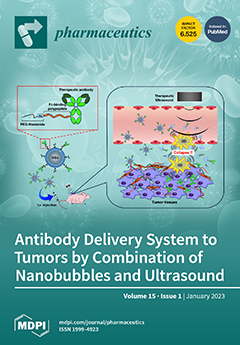
Cover Story: The efficacy of therapeutic antibodies has been limited in solid tumors due to the poor distribution of antibodies within tumor tissues. We have reported that the combination of ultrasound-responsive nanobubbles (NBs) and therapeutic ultrasound (TUS) increases the efficiency of the delivery of macromolecular drugs to target tissues. In this study, we developed therapeutic antibody-modified NBs using an Fc-binding polypeptide that can quickly load antibodies to nanocarriers and assessed the utility of combining the NBs and TUS as an antibody delivery system. The combination system can enable efficient antibody drug delivery to tumors, while retaining the original antibody activity. Hence, this system has the potential to maximize the therapeutic effects in antibody therapy for solid tumors. View this paper
  • Issues are regarded as officially published after their release is announced to the table of contents alert mailing list .
  • You may sign up for email alerts to receive table of contents of newly released issues.
  • PDF is the official format for papers published in both, html and pdf forms. To view the papers in pdf format, click on the "PDF Full-text" link, and use the free Adobe Reader to open them.

Articles (304)

  • Review
  • Open Access
28 Citations
5,336 Views
22 Pages

Liposome-based drug delivery systems are nanosized spherical lipid bilayer carriers that can encapsulate a broad range of small drug molecules (hydrophilic and hydrophobic drugs) and large drug molecules (peptides, proteins, and nucleic acids). They...

  • Article
  • Open Access
27 Citations
4,442 Views
16 Pages

Iron oxide nanoparticle (IONP) possesses unique advantages over other nanoparticles in the use of cancer imaging and therapy. Specifically, it has drawn great attention in the emerging research field of photothermal cancer therapy. Herein, we develop...

  • Article
  • Open Access
7 Citations
4,245 Views
9 Pages

Change of CGRP Plasma Concentrations in Migraine after Discontinuation of CGRP-(Receptor) Monoclonal Antibodies

  • Bianca Raffaelli,
  • Maria Terhart,
  • Mira Pauline Fitzek,
  • Kristin Sophie Lange,
  • Jasper Mecklenburg,
  • Lucas Hendrik Overeem,
  • Anke Siebert,
  • Elisabeth Storch and
  • Uwe Reuter

Discontinuation of treatment with monoclonal antibodies (mAb) targeting the Calcitonin Gene-Related Peptide (CGRP) pathway leads to an increase in migraine frequency. We aimed to assess changes in free and total CGRP plasma concentrations after the d...

  • Article
  • Open Access
2 Citations
3,032 Views
14 Pages

The Influence of Blonanserin Supersaturation in Liquid and Silica Stabilised Self-Nanoemulsifying Drug Delivery Systems on In Vitro Solubilisation

  • Amalie Møller,
  • Hayley B. Schultz,
  • Tahlia R. Meola,
  • Paul Joyce,
  • Anette Müllertz and
  • Clive A. Prestidge

Reformulating poorly water-soluble drugs as supersaturated lipid-based formulations achieves higher drug loading and potentially improves solubilisation and bioavailability. However, for the weak base blonanserin, silica solidified supersaturated lip...

  • Article
  • Open Access
9 Citations
4,132 Views
30 Pages

Combined Use of Antimicrobial Peptides with Antiseptics against Multidrug-Resistant Bacteria: Pros and Cons

  • Maria S. Zharkova,
  • Aleksey S. Komlev,
  • Tatiana A. Filatenkova,
  • Maria S. Sukhareva,
  • Elizaveta V. Vladimirova,
  • Andrey S. Trulioff,
  • Dmitriy S. Orlov,
  • Alexander V. Dmitriev,
  • Anna G. Afinogenova and
  • Anna A. Spiridonova
  • + 1 author

Antimicrobial peptides (AMPs) are acknowledged as a promising template for designing new antimicrobials. At the same time, existing toxicity issues and limitations in their pharmacokinetics make topical application one of the less complicated routes...

  • Article
  • Open Access
29 Citations
4,822 Views
24 Pages

Combination chemo-photothermal therapy with nanomaterials can reduce the dose of chemotherapeutic drugs required for effective cancer treatment by minimizing toxic side effects while improving survival times. Toward this end, we prepare hyaluronic ac...

  • Article
  • Open Access
35 Citations
6,306 Views
15 Pages

Enhancing Intradermal Delivery of Lidocaine by Dissolving Microneedles: Comparison between Hyaluronic Acid and Poly(Vinyl Pyrrolidone) Backbone Polymers

  • Delly Ramadon,
  • Lissa Florencia Putri Sutrisna,
  • Yahdiana Harahap,
  • Kurnia Sari Setio Putri,
  • Fathin Ulayya,
  • Pietradewi Hartrianti,
  • Qonita Kurnia Anjani and
  • Ryan F. Donnelly

Lidocaine hydrochloride (LiH), an amide-type local anesthetic agent, is commonly used in dermatological procedures. LiH is categorized as a BCS (biopharmaceutics classification system) class III group, which has high solubility and poor permeability....

  • Review
  • Open Access
3 Citations
5,888 Views
38 Pages

Protein Transduction Domain-Mediated Delivery of Recombinant Proteins and In Vitro Transcribed mRNAs for Protein Replacement Therapy of Human Severe Genetic Mitochondrial Disorders: The Case of Sco2 Deficiency

  • Androulla N. Miliotou,
  • Parthena F. Foltopoulou,
  • Alexandra Ingendoh-Tsakmakidis,
  • Asterios S. Tsiftsoglou,
  • Ioannis S. Vizirianakis,
  • Ioannis S. Pappas and
  • Lefkothea C. Papadopoulou

Mitochondrial disorders represent a heterogeneous group of genetic disorders with variations in severity and clinical outcomes, mostly characterized by respiratory chain dysfunction and abnormal mitochondrial function. More specifically, mutations in...

  • Article
  • Open Access
2,330 Views
16 Pages

The Anti-Tubercular Aminolipopeptide Trichoderin A Displays Selective Toxicity against Human Pancreatic Ductal Adenocarcinoma Cells Cultured under Glucose Starvation

  • Johanes K. Kasim,
  • Jiwon Hong,
  • Anthony J. R. Hickey,
  • Anthony R. J. Phillips,
  • John A. Windsor,
  • Paul W. R. Harris,
  • Margaret A. Brimble and
  • Iman Kavianinia

Pancreatic ductal adenocarcinoma remains a highly debilitating condition with no effective disease-modifying interventions. In our search for natural products with promising anticancer activity, we identified the aminolipopeptide trichoderin A as a p...

  • Article
  • Open Access
12 Citations
3,389 Views
13 Pages

Stimuli-Responsive Triblock Terpolymer Conversion into Multi-Stimuli-Responsive Micelles with Dynamic Covalent Bonds for Drug Delivery through a Quick and Controllable Post-Polymerization Reaction

  • Eva Hlavatovičová,
  • Roberto Fernandez-Alvarez,
  • Katarzyna Byś,
  • Sami Kereïche,
  • Tarun K. Mandal,
  • Leonard Ionut Atanase,
  • Miroslav Štěpánek and
  • Mariusz Uchman

Stimuli-responsive copolymers are of great interest for targeted drug delivery. This study reports on a controllable post-polymerization quaternization with 2-bromomethyl-4-fluorophenylboronic acid of the poly(4-vinyl pyridine) (P4VP) block of a comm...

of 31

Get Alerted

Add your email address to receive forthcoming issues of this journal.

XFacebookLinkedIn
Pharmaceutics - ISSN 1999-4923