


Abstract
Norovirus is a leading cause of acute gastroenteritis globally, with an annual economic burden of approximately US$60.3 billion. Traditional clinical surveillance is limited by underreporting and delays. Wastewater-based epidemiology (WBE) offers a promising alternative, capable of detecting emerging variants earlier. This review critically evaluates research progress on norovirus early warning models based on wastewater metagenomic sequencing and machine learning. We critically synthesize the technical framework, model construction strategies, and validation processes. We identify a prevalent “accuracy-centric” tendency and propose that the field must confront the “impossible trinity” of simultaneously achieving high accuracy, strong generalization, and interpretability. Key challenges in model validation, standardization, and practical deployment are discussed. We conclude by advocating for future directions that prioritize deployable systems, actionable decisions, and measurable public health impact, particularly in resource-limited settings. This article is a narrative critical review rather than a systematic review; the literature search and selection strategy is described in the Introduction, and evidence drawn from other pathogens or from non-norovirus wastewater modeling is identified explicitly wherever it is used. It should also be noted that the norovirus metagenomic studies reviewed here primarily characterize viral diversity and genotype distribution; evidence supporting metagenomic sequencing as a diversity-surveillance tool is far more mature than evidence for the prospective performance of predictive early warning models built directly on metagenomic data, which remains largely unquantified.
1. Introduction
Norovirus is a leading cause of acute gastroenteritis worldwide, and individuals of all ages are susceptible [1,2]. Children under five and the elderly bear the highest disease burden, with nearly all children infected at least once before age five [2,3]. The elderly are also affected to varying degrees. For elderly individuals with underlying health conditions, severe dehydration caused by vomiting and diarrhea can even be life-threatening [2]. Globally, norovirus imposes substantial socioeconomic costs, estimated at US$60.3 billion annually [4]. Two-thirds of these costs are attributed to children under the age of five [5]. Advancing norovirus surveillance and early warning systems is therefore crucial.
However, traditional surveillance methods—clinical monitoring, nucleic acid testing, and rapid diagnostics—face limitations including underreporting, misdiagnosis, high false-negative rates, data errors, and monitoring delays [6,7]. These approaches also rely heavily on known viral sequences, making early warning systems difficult to establish. Rapid immunochromatographic tests are convenient for field use but markedly less sensitive than molecular assays, and the two formats frequently disagree when viral loads are low [8,9].
Wastewater-based epidemiology (WBE) offers a promising alternative. Wastewater sequencing can detect new variants on average 14 days earlier than clinical surveillance [10] and avoids selection biases inherent in healthcare-seeking behavior [11]. These advantages indicate that WBE holds significant potential for norovirus monitoring and early warning.
Existing WBE early warning models, initially developed for COVID-19, ref. [12], have increasingly integrated machine learning [13]. This underscores the potential of machine learning and deep learning for WBE modeling, although many methodological issues remain to be identified and resolved.
This article is a narrative critical review rather than a systematic review, and its selection procedure is stated openly. Records were retrieved from PubMed, Web of Science, and CNKI (January 2010–June 2026) using combinations of the terms “norovirus”, “wastewater-based epidemiology”, “wastewater surveillance”, “metagenomic sequencing”, “machine learning”, “early warning”, and “prediction model”. Studies were eligible if they (i) reported primary wastewater data for norovirus or other enteric viruses, (ii) described a surveillance, sequencing, or modeling workflow relevant to wastewater-based early warning, or (iii) provided methodological guidance on the development, validation, or reporting of prediction models. Titles and abstracts were screened by two authors (Z.L. and L.G.), full texts of potentially relevant records were assessed, and disagreements were resolved in discussion with the senior author (Y.Z.). No risk-of-bias instrument and no meta-analysis were applied, and no review protocol was registered, which is consistent with the narrative design.
Three grades of evidence are distinguished throughout and are labeled explicitly at the point of use: (i) studies that develop or evaluate early warning models using norovirus wastewater data (direct norovirus evidence); (ii) studies that apply the same analytical methods to other pathogens, to clinical surveillance, or to wastewater-treatment process data (methodological analogies); and (iii) conceptual and methodological literature on prediction modeling. Statements resting only on grade (ii) or (iii) evidence are identified as such rather than being attributed to norovirus, and Table 1 summarizes representative studies by pathogen, surveillance method, model type, dataset characteristics, validation strategy, and principal finding, together with an explicit indication of the grade of evidence. Quantitative performance figures quoted in this review, including those in Table 2, were traced back to the original studies, and the prediction task and performance metric are specified wherever such figures are cited.
Table 1.
Structured summary of representative studies: pathogen and target, surveillance method, data and scale, model type, validation strategy, and principal finding, with an explicit indication of whether the evidence is direct norovirus evidence or a methodological analogy.
Table 2.
Comparison of prediction models and their applicable scenarios.
2. Pathogenic and Epidemiological Characteristics of Norovirus
2.1. Classification and Genotypic Evolution of Norovirus
Norovirus classification is based on the capsid protein VP1 and the polymerase RdRp because recombination occurs frequently between their encoding genes [19,32]. This indicates that the polymerase and capsid proteins of norovirus originate from different genetic ancestors, so a dual-typing approach is necessary to accurately characterize a circulating strain [32,33]. In the current International Committee on Taxonomy of Viruses (ICTV) classification, norovirus is divided into 10 genogroups, of which the genogroups primarily infecting humans are GI, GII, GIV, GVIII, and GIX. Among these genogroups, GII is the dominant genogroup, and the majority of human norovirus infections belong to GII [33]. Within genogroups, norovirus is further classified into genotypes and P-types. Genotypes are defined by the VP1 gene encoding the viral capsid protein, while P-types are defined by the RdRp gene encoding the RNA-dependent RNA polymerase. The cited sources report 49 capsid genotypes and 60 P-types as of their publication date; because these counts change with successive taxonomy updates, they should be read as version-specific [19,34].
The norovirus genome consists of a single-stranded positive-sense RNA. The single-stranded RNA genome evolves rapidly owing to the absence of error correction. GII.4 is responsible for over 50% of global outbreaks, driven by antigenic drift. A meta-analysis and systematic review focusing on Asia showed that GII.4 is the dominant genotype in India, China, and Vietnam [35], and surveillance studies in Brazil also indicate that GII.4 is the predominant circulating strain in that country [33]. Together, these studies underscore the long-standing predominance of GII.4 among circulating norovirus strains. This is primarily attributable to GII.4′s ability to accumulate mutations in its antigenic epitopes, thereby evading existing immunity in the population—a phenomenon known as “antigenic drift” [19].
2.2. Disease Burden and Epidemiological Characteristics of Norovirus
Norovirus causes significant health and economic burdens, especially among children under five and the elderly [2]. Those over 65 face high risks of severe illness and death [2]. Low- and middle-income countries bear the highest mortality [36], with global economic costs reaching $60 billion [36,37].
In temperate regions, norovirus peaks in winter [2,38] and spreads easily in enclosed settings such as hospitals and schools [2,37]. For example, in the United States, 62% of norovirus outbreaks occur in hospitals, while a study from China indicates that most norovirus outbreaks occur in schools; these observations provide strong evidence of the virus’s clustering in specific settings [37,39]. Transmission of norovirus occurs via person-to-person contact, contaminated surfaces, food, water, and aerosols [2,40,41].
2.3. Norovirus Wastewater Surveillance
The rapid evolution of norovirus poses challenges for clinical surveillance, which is limited to known strains. Wastewater metagenomic sequencing captures broader viral diversity. A study on global wastewater surveillance published in Water Research detected 34 capsid genotypes and 44 polymerase P-types (i.e., the types observed in that survey, not the total number of classified genotypes) [19]. Furthermore, the study identified entirely new gene clusters in regions with traditionally weak surveillance [19]. The potential of wastewater monitoring was recognized decades ago. A study from Italy demonstrated that the diversity of norovirus detected in wastewater is greater than that reported in clinical settings, suggesting that the prevalence of GI-type norovirus in the environment has been significantly underestimated [42]. These capabilities provide a key biological foundation for constructing early warning models based on wastewater surveillance.
3. Technical Framework for Wastewater Metagenomic Sequencing
Before the technical workflow is described, a terminological distinction is necessary, because the evidence base of this field mixes methods that are often conflated. Metagenomic sequencing—shotgun metaviromics of the total nucleic acid pool recovered from wastewater—is untargeted: it can recover known and unanticipated viruses and supports genotyping and variant discovery, but it is semi-quantitative, comparatively expensive, and analytically demanding. Targeted methods—RT-qPCR or RT-ddPCR, multiplex PCR panels, and targeted or capture-enrichment sequencing—are quantitative and sensitive for preselected targets, but they detect only what is being sought. Wastewater-treatment process monitoring based on physicochemical indicators (effluent quality parameters) is not pathogen surveillance at all and is used in this review solely as a methodological analogy for model construction.
Three consequences follow, and they organize the remainder of this review. First, most quantitative norovirus wastewater time series available for model training and validation worldwide are generated by RT-qPCR rather than by metagenomic sequencing; models built on such series provide direct evidence on early warning performance, but not evidence on metagenomics-based early warning. Second, metagenomic studies contribute mainly to genotype and variant surveillance—the question of what is circulating—and their quantitative output is usually compositional (relative abundance) rather than an absolute concentration, which limits their direct use as a regression target. Third, where a study cited here used targeted methods, other pathogens, or process-engineering data, this is stated explicitly at the point of citation, and its performance figures are not attributed to metagenomic norovirus early warning.
3.1. Optimization of Wastewater Sampling Strategies
There are generally two types of wastewater sampling strategies: time-proportional sampling and flow-proportional sampling. The former typically involves sampling at fixed intervals over a 24-h period, while the latter collects more samples during periods of high flow and fewer during periods of low flow. In the comparative study cited here, time-proportional sampling performed well for norovirus [43]. Furthermore, time-proportional sampling has been shown to be more cost-effective, and simulation studies indicate that, when carefully designed, its accuracy does not differ significantly from that of flow-proportional sampling [44]. Sampling location along the sewer network is an equally consequential decision: a transport-modeling comparison of sewer sampling methods showed that the distance between the sampling point and the emission source, together with the travel time, materially changes the detected signal, so sampling points must be chosen to match the surveillance objective [45].
With respect to sample preservation and holding time, studies conducted under specific storage conditions have reported substantial decay of norovirus RNA in raw sewage, including loss of RT-qPCR signals after prolonged storage at –80 °C [44]. Time-proportional pooled sampling is also relatively rapid, further supporting its suitability for norovirus wastewater monitoring [46].
Two cautions apply to these recommendations. First, viral infectivity and viral RNA persistence are not equivalent: molecular methods detect nucleic acid, which may persist after the virus has lost infectivity, so decay estimated by RT-qPCR or sequencing describes the detectability of RNA under particular conditions—temperature, holding time, freeze–thaw cycles, solids content, and the concentration and extraction procedure—and should not be generalized to infectious virus or transferred to other matrices. Second, the sampling mode should follow the hydrological context: time-proportional sampling is convenient and adequate where flow is stable, whereas flow-proportional or flow-weighted sampling is preferable where diurnal and storm-driven flow variation is substantial, because virus concentrations in raw sewage covary with flow and suspended solids. Neither mode is universally optimal, and the choice should be reported together with holding time, transport temperature, and any freeze–thaw episodes, since these pre-analytical variables frequently exceed the analytical differences between extraction kits.
3.2. Nucleic Acid Extraction and Inhibitor Removal
Inhibitor removal and nucleic acid extraction are critical for data quality in wastewater metagenomic sequencing. Humic acids, heavy metals, and RNases can reduce reverse transcription efficiency and compromise results if not properly addressed [47].
3.2.1. Removal of Inhibitors
Humic acid is the most common PCR inhibitor, co-extracted with nucleic acids and interfering with polymerase activity [48]. In the comparative evaluation cited here, DAX-8 was the most effective of the tested inhibitor-removal options for humic substances that co-extract with nucleic acids [48]. DAX-8 can therefore be regarded as a reasonable default where humic inhibition is the dominant problem, but its benefit depends on the wastewater matrix, the upstream concentration method, and the downstream assay, so it should be validated locally rather than presented as a universal standard. Because most inhibitor-removal evidence has been generated with RT-qPCR endpoints, its transferability to shotgun metagenomic libraries—where inhibitors act at library preparation and sequencing as well as at amplification—requires specific verification.
RNase control must occur during sample storage and handling. Lysis buffers containing guanidinium thiocyanate in commercial kits inactivate RNase, with the MO BIO PowerViral kit performing best. RNase inhibitors can be added after extraction [49].
For other RT-qPCR inhibitors, a comprehensive removal strategy should be adopted.
3.2.2. Selection of Nucleic Acid Extraction Kits
Iker et al. compared three kits: MO BIO PowerViral, Qiagen QIAamp Viral, and Zymo ZR Virus. The Zymo kit performed worst and is generally not recommended [47]. MO BIO PowerViral has the strongest inhibitor-removal capacity for biological solids, while Qiagen QIAamp Viral performs comparably under low-inhibitor conditions [47]. However, Qiagen QIAamp Viral offers a higher overall detection rate [47]. Provided that pretreatment is thorough and appropriate, the Qiagen QIAamp Viral Kit is a reasonable choice where a high detection rate is the priority, although no single kit is universally optimal: performance depends on the solids content of the matrix, the concentration chemistry and the downstream assay (RT-qPCR versus metagenomic library preparation), and metagenome-specific kit comparisons remain scarce. Beyond this single comparative study, kit selection should also consider viral recovery efficiency for non-enveloped viruses, compatibility with the upstream concentration method, and the balance between inhibitor removal and nucleic-acid yield.
3.3. Strategies for Selecting Metagenomic Library Construction and Sequencing Platforms
Targeted enrichment sequencing is preferred for specific known pathogens such as norovirus, improving detection rates and yielding more focused libraries [23].
Currently, sequencing primarily relies on next-generation sequencing (NGS) methods, and there are numerous NGS platforms available, including Illumina, BGI-Seq, Thermo Fisher, and BGI. In addition to NGS, third-generation sequencing (TGS) is gradually being integrated into testing workflows. At present, the main TGS platforms are Oxford Nanopore and PacBio. Beyond platform choice, the bioinformatic toolchain built around a platform also determines what can be recovered from the data; head-to-head comparisons of third-generation sequencing tools show that base-modification calling and assembly quality vary substantially between pipelines [50].
Among these, Illumina and Oxford Nanopore are the most commonly used. In terms of sequencing principle, the former employs sequencing-by-synthesis (SBS), whereas the latter relies on nanopore electrical signals [51,52]. Illumina provides high accuracy and throughput, making it well suited to short-read applications [53,54]. Oxford Nanopore offers long-read, real-time sequencing, beneficial for outbreak monitoring [53,55]. However, if long read lengths and rapid sequencing are not required, the moderate accuracy of the Oxford Nanopore platform may unnecessarily compromise the sequencing workflow. If a hybrid strategy is to be implemented in the absence of a norovirus outbreak and rapid sequencing is not required, and provided accuracy is not compromised, the third-generation Oxford Nanopore sequencing platform can be replaced with the PacBio sequencing platform. It can directly detect base modifications, offering unique advantages when studying individual base pairs [56,57].
4. Strategies for Constructing Early Warning Models
4.1. Comparison of the Performance of Different Models in Actual Norovirus Surveillance
4.1.1. Advantages, Disadvantages, and Application Conditions of Different Models
Early warning models, including time series and machine- and deep-learning models, can be further classified, each with distinct characteristics and application conditions.
Table 2 compares model families, but the comparison is conceptual rather than empirical: the studies behind each row used different datasets, different prediction targets (concentration, case counts, or outbreak probability), different forecast horizons, and different validation procedures, and no head-to-head evaluation on a shared norovirus dataset has been published. The performance statements in the table therefore indicate what each model family can in principle deliver rather than a ranking. Several of the references supporting the table (e.g., dengue, influenza, tuberculosis and cholera forecasting) are methodological analogies rather than norovirus-specific evidence and are marked as such in the note below the table. Where a numerical value is given, the metric and its source study are identified, and coefficients of determination or correlation coefficients are not described as classification accuracy.
4.1.2. Comparison of the Effectiveness of Different Models in Actual Norovirus Surveillance
In practical norovirus wastewater monitoring and early warning systems, the models listed in Table 2 have distinct applications. Model choice also depends on the deployment scale: a multi-city forecasting framework has to remain transferable across catchments, a requirement that single-site studies never face [58].
Time series models also have their respective advantages. Autoregressive integrated moving average (ARIMA) models are mainly used for short-term trend prediction in norovirus surveillance. Long short-term memory (LSTM) networks capture nonlinear relationships effectively and are widely used in norovirus early warning explorations [59]. This study suggests that adding more covariates such as wind speed and population mobility may further enhance its performance. Although the Prophet model is easy to operate and suitable for routine seasonal early warning, its performance is limited when addressing non-seasonal outbreaks of norovirus. Machine learning models are powerful, but each has its own strengths. Random Forest is commonly used for feature screening and preliminary modeling in norovirus early warning. Chen et al. employed this model to analyze 15 potential factors, including temperature, rainfall, pH, and ammonia nitrogen, identifying “temperature” and “rainfall with a seven-day lag” as key predictors affecting viral concentration in wastewater [16]. Extreme gradient boosting (XGBoost) excels in classification tasks and outbreak risk stratification. In wastewater virology it has been applied to estimate total virus particle concentrations from routine physicochemical parameters, where the gradient-boosted model outperformed random forest across influent, aerobic, sand-filter and membrane-bioreactor matrices [15]. Light gradient boosting machine (LightGBM) demonstrates significant training efficiency advantages in large-scale, multi-site surveillance. Its histogram-based binning, gradient-based one-side sampling and exclusive feature bundling reduce training time and memory use relative to level-wise gradient boosting, an advantage that becomes decisive once a monitoring network expands to many sites. At that scale, a two-year survey of five wastewater treatment plants in Shenzhen, China showed that wastewater norovirus concentrations tracked clinically calibrated infection estimates far more closely than reported case counts, and supported a one-week-ahead forecast of the epidemic trend [14]. Taken together, these studies suggest—but do not demonstrate by head-to-head comparison—that recurrent and gradient-boosted models can capture nonlinear and non-stationary dynamics that ARIMA and Prophet represent less well. Because the underlying studies differ in dataset, prediction target, forecast horizon, and validation design, no quantitative ranking across model families can be derived from the current norovirus literature, and the ordering that emerges should be read as a working expectation to be tested on shared benchmark datasets [59]. Subject to that caveat, ARIMA and Prophet appear more suitable for scenarios with strong regularity and small data volumes; Random Forest is appropriate for preliminary exploration and feature screening; XGBoost excels in classification accuracy and interpretability; whereas LightGBM achieves the highest training efficiency in large-scale, multi-site applications. In practice, the choice among these models—or their combination—should be guided by data scale, prediction objectives, and computational resources.
4.2. Multi-Source Data Fusion Methods and Specific Cases in Norovirus Surveillance
Data fusion methods include early fusion, mid-stage fusion, and late fusion [60]. Early fusion involves the direct concatenation of data, where all feature data are fed into the model. This is a relatively straightforward method, suitable for the initial stages [60]. Mid-stage fusion achieves higher accuracy than early fusion; it first extracts features from each data source and then fuses them based on similar features, fully leveraging LSTM’s temporal analysis capabilities [60]. For example, LSTM can first be used to extract sequence features of norovirus in wastewater; static meteorological features can then be extracted, and the two are finally fused for prediction. Finally, late fusion involves building independent models for each dataset, obtaining their respective predictions, and then combining them by weighted averaging [60].
Li et al. developed a deep learning model based on multi-source data fusion to predict effluent quality in industrial wastewater treatment plants. By directly concatenating water quantity, process parameters, energy consumption, and water quality indicators as inputs to LSTM and GRU models, the authors obtained R2 values significantly higher than those of the multilayer perceptron (improvement of 1.36–31.82%) and traditional machine learning algorithms such as random forest (improvement of 9.10–47.75%). This case—drawn from industrial wastewater treatment rather than from norovirus surveillance—illustrates that under conditions of synchronous multi-source data and controllable feature dimensionality, early fusion can effectively improve prediction accuracy [21]. This study suggests that with an appropriate data fusion method, conventional modeling approaches can achieve accuracy surpassing that of traditional machine learning algorithms. This reveals a potential contradiction: the previous literature often lacks a unified description of data fusion methods when comparing models, introducing uncertainty in the results. Therefore, future research should strive to standardize or parallelize data fusion approaches to ensure fairness in comparisons. Its relevance here is methodological: it shows how early fusion is implemented and how much gain may be expected when heterogeneous sources are synchronous, but it does not establish that the same gain transfers to norovirus outbreak prediction, and no norovirus study with a comparable design has yet been published.
Fu et al. conducted a four-month multi-pathogen wastewater surveillance study in Nanchang, integrating qPCR, amplicon sequencing, and metavirome sequencing data. Through integrated analysis of pathogen concentration, genotype, and viral spectrum characteristics obtained via the three techniques, they revealed an abnormal resurgence pattern of norovirus following the decline of SARS-CoV-2. The results showed that the peak concentration of norovirus GII appeared in the third week, earlier than that of other pathogens, confirming the advantage of the mid-stage fusion strategy in capturing the temporal dynamics of multiple pathogens.
Zulli et al. proposed an infectious disease prediction method that integrates Google search trends with wastewater surveillance data. Using three models—simple linear regression, stepwise selection regression, and principal component analysis—they independently modeled the two types of data before integration. The study found a significant correlation between Google Trends data and wastewater norovirus viral load, with a maximum reported association coefficient of 0.66 (a correlation-type measure, not classification accuracy). Using the 2021 norovirus outbreak in Hartford, Connecticut, USA, as a case study, Google Trends indicators and wastewater viral concentrations rose synchronously, potentially providing earlier warnings than clinical case reports [18].
Synthesizing the above cases, the three fusion methods each have distinct emphases: early fusion offers the highest computational efficiency and is suitable for scenarios with synchronized data and simple feature relationships; mid-stage fusion preserves the unique information of each source and is suitable for heterogeneous data that require separate feature extraction; late fusion provides greater flexibility when data correlations are weak due to its capability for independent modeling. The choice of method should be based on the linear or nonlinear relationships among variables and on the sample size. It should be noted that in the above cases, the selection of data fusion methods still did not fully account for data quality, inter-modal dependency structures, and specific task objectives. Future research should more systematically evaluate the impact of these confounding factors on fusion performance.
4.3. Threshold Determination and Alert Levels for Norovirus
There are differences in the alert levels for norovirus warnings among various regions and countries. Regarding early warning thresholds for wastewater monitoring, a study in France collected 187 samples from three cities. The researchers calculated thresholds using ROC curves and the Youden index, finding that the thresholds calculated for the three cities were relatively close, suggesting that these thresholds may exhibit cross-regional stability [22]. In other words, while this threshold may be widely applicable, it requires validation before implementation.
Furthermore, the classification of early warning levels or risk levels for norovirus varies across different regions. For example, Beijing classifies norovirus GII into five levels [61], while Shenzhen uses the classic three-level, four-color warning system [62].
Differences in threshold setting across regions may stem not only from varying levels of public health tolerance but also from regional epidemiological characteristics, wastewater treatment systems, population characteristics, climatic conditions, and policies. For example, the United States tends to establish unified standards based on quantitative microbial risk assessment (QMRA), while European countries such as the Netherlands place greater emphasis on coordination with existing clinical surveillance systems—this reflects how policy orientation affects threshold setting [15]. Furthermore, in temperate regions, norovirus exhibits a distinct winter peak, whereas in tropical regions it occurs sporadically throughout the year or peaks during the rainy season. Such epidemiological differences make it difficult for a single threshold to apply across different climatic zones, directly leading to variations in threshold determination. Technical differences in wastewater treatment systems also play a role: even within the same country, different wastewater treatment plants may serve areas with distinct population structures, sewer network characteristics, and hydraulic retention times, which can result in the same viral RNA concentration corresponding to different community infection burdens [14].
Therefore, threshold setting for norovirus WBE early warning should fully account for regional variations in risk standards, epidemiological characteristics, climatic conditions, and wastewater treatment system conditions, while incorporating a local calibration mechanism that continuously adjusts thresholds based on multi-source data [28,63]. We recommend that future research further explore how to establish a threshold-setting framework that balances local adaptability with cross-regional comparability, thereby enhancing the operability of WBE early warning systems.
4.4. Model Validation and Calibration
4.4.1. Methods and Types of Model Validation and Calibration
Once a warning model has been established, it is essential to validate the accuracy of the model’s predictions and calibrate certain parameters within the model to continuously refine it. A review of the literature indicates that validation is best performed using data the model has not previously encountered; otherwise, an overly optimistic impression of model performance may result [64,65]. Validation methods include cross-validation, external validation, retrospective validation, and assessment of the model’s generalization ability. Cross-validation involves dividing the existing data into two subsets: one for training the model and the other for validating it, repeating this process multiple times [64]. A common form of cross-validation required for time series models is time series cross-validation. It cannot use random partitioning but must follow a chronological order: data prior to time step t are used for training, and time step t + 1 is used for validation [66]. For example, in a study conducted in Beijing, researchers trained an ARIMA model using data from Week 22 of 2023 to Week 21 of 2024 and validated it using data from Weeks 22 to 26 of 2024 [17]. External validation, on the other hand, involves validating the model using data that are completely independent of the model itself. Such data typically come from different times, locations, and populations, so they better reflect the model’s generalizability [64,67]. For example, if a model is built using data from City A, Time A, and Population A, it is later validated using data from Time B, City B, and Population B. The most common validation method in WBE is retrospective validation, which uses historical data to validate the model; if the model made accurate predictions in the past, it is likely to make accurate predictions in the present as well [67]. Another important aspect is the model’s generalization ability, which reflects the stability of its predictions across different times, locations, and populations [66,67]. However, under different epidemiological and geographical conditions, enhancing the transferability of models remains a core issue. There are many ways to improve a model’s generalization ability. For example, in the development of a norovirus early warning model, data can be calibrated using indicators such as fecal indicator viruses and process-control virus recovery rates [28]; environmental covariates such as temperature, precipitation, and flow rate can be incorporated during model development [68]; the model can be validated at different wastewater treatment plants [17,69]. Furthermore, one study found that incorporating wastewater data significantly improves model prediction performance, with the model demonstrating good transferability across different cities [63]. Therefore, during wastewater monitoring, it is advisable to collect as much wastewater data as possible to enhance model performance.
A note on terminology is needed, because these terms are frequently used interchangeably in the WBE literature and are not equivalent. Internal validation, including cross-validation and temporal hold-out, estimates performance on data drawn from the same sampling frame as the training data. External validation applies a frozen model to independent data from different sites, periods, or populations. Prospective evaluation applies the model to data generated after model finalization, with the alert threshold fixed in advance, and is the only design that estimates operational performance. Hyperparameter optimization (grid or Bayesian search over model settings) is a training step that must be nested within the training folds; it is not validation. Calibration, in the strict sense, is the agreement between predicted probabilities and observed event rates, assessed by calibration-in-the-large, the calibration slope, or a calibration plot, and it is distinct both from discrimination (AUROC) and from data normalization or parameter adjustment. WBE studies would be more informative if these components were reported separately, since a model can discriminate well yet be badly calibrated—a combination with direct consequences for threshold-based alerting.
In predictive modeling, model calibration refers to the alignment between predicted probabilities and actual occurrence rates. This definition excludes several procedures that are often loosely described as calibration in the wastewater literature: parameter tuning, data normalization, model updating, and residual correction are model-development, preprocessing, and maintenance procedures that improve overall fit but do not by themselves align predicted probabilities with observed event rates. Their applications in WBE also vary. Parameter tuning adjusts parameters or parameter combinations within the model; multi-factor data normalization, a preprocessing step, contributed to a 46% relative reduction in the mean cross-validated RMSE of predicted case rates when combined with lasso regression and random-forest-modeled residuals, compared with a linear model on raw, unnormalized data [28]; model updating involves continuously upgrading the model to adapt to changing environments, thereby improving model accuracy and sensitivity [17]; and residual correction involves modeling prediction residuals to refine the underlying model [28].
Metric choice should follow the prediction task. For regression of concentrations or case counts, MAE and RMSE should be reported in the units of the target, together with R2 or the concordance correlation coefficient, and the forecast horizon should be stated. For binary classification of outbreak or alert status, sensitivity, specificity, precision, F1 and AUROC should be reported together with the operating threshold and the outcome prevalence in the evaluation set, because AUROC alone can conceal a poor positive predictive value at the low prevalences typical of outbreak detection. For time-series forecasting of epidemic trends, scale-free or scaled errors (MAPE, MASE) are appropriate, and, most importantly, the alert lead time—the interval between the first true alert and clinical or laboratory confirmation of the upswing—should be reported together with the false-alarm rate per unit time. Lead time and false-alarm burden, rather than R2, determine whether an alert is operationally useful. Throughout this review, the term “prediction accuracy” is used only for classification tasks; correlation coefficients and coefficients of determination are reported as association or goodness-of-fit measures.
4.4.2. Process of Model Validation and Calibration (Figure 1)
Before model training, data preprocessing is essential. WBE data exhibit spatial heterogeneity, and differences in virus recovery rates and sampling frequencies across wastewater treatment plants may result in the same true infection burden in a community manifesting as several-fold or even greater differences at the data level [70]. Therefore, it is advisable to use internal controls such as pepper mild mottle virus (PMMoV) for normalization during preprocessing, and to appropriately handle outliers and missing values. However, most published studies lack unified standards in the data preprocessing stage, with some using raw concentrations directly, which poses considerable risks for subsequent validation. Future model studies should pay greater attention to data preprocessing.
Next, internal validation and preliminary calibration are required. The former assesses the fitting capability and stability of the model on the training data. For example, for time series models, it is best to use time series cross-validation as mentioned above rather than random K-fold cross-validation to prevent future data leakage [66]. The latter primarily involves hyperparameter tuning to optimize models such as LSTM and XGBoost. However, a common issue in the literature is that many studies use overly optimistic validation methods in internal validation, resulting in models that perform well in retrospective validation but poorly in practical applications. This issue of missing or insufficient validation warrants attention.
Figure 1.
Flowchart of the four-stage model validation and calibration workflow discussed in Section 4.4.2: (i) data preprocessing; (ii) internal validation and preliminary calibration; (iii) external validation at the generalization stage; and (iv) continuous monitoring and dynamic calibration after deployment. Arrows indicate the sequence of the four stages; the colors of the boxes distinguish the stages; warning icons mark common shortcuts and pitfalls. Citations that originally appeared inside the figure have been moved to this caption: refs. [64,67] correspond to external validation across different time periods, regions, and population structures, and ref. [66] corresponds to the risk of overly optimistic internal validation.
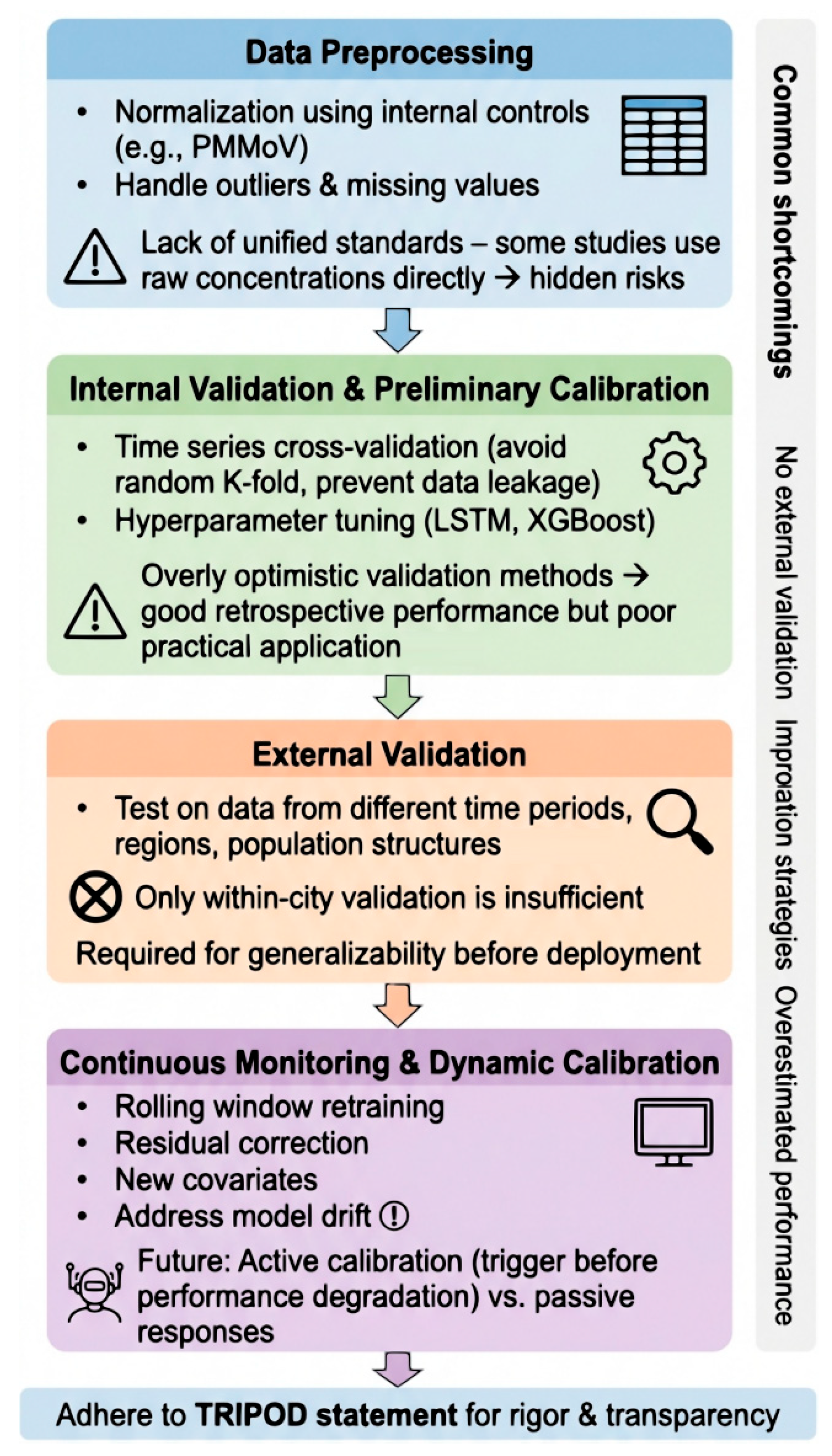
At the generalization stage, external validation is needed to assess model generalizability. Internal validation alone is insufficient to evaluate a model’s generalizability; this requires validation using data from different time periods, regions, and population structures [64,67]. Only after meeting external validation standards can a model achieve relatively good performance in practical applications and be deployed. However, the vast majority of current WBE early warning studies lack rigorous external validation; some studies only validate across different areas within the same city, which is insufficient to demonstrate model transferability.
After model deployment, continuous monitoring and dynamic calibration are necessary. This is because pathogen epidemiological characteristics, environmental conditions, and population immunity levels change over time, and model performance will decline without maintenance. Therefore, regular retraining using new data through rolling windows, residual correction, or the introduction of new covariates is needed to address such “model drift” [28,68]. However, dynamic calibration still faces challenges such as real-time data latency and a lack of standardized update frequencies. Future research should strive to explore “active calibration” mechanisms that trigger calibration before performance degradation, rather than passive responses.
In summary, a rigorous model validation and calibration process includes: data preprocessing, internal validation and preliminary calibration, external validation, and continuous monitoring with dynamic calibration. However, current WBE early warning model studies still have numerous shortcomings in the validation phase, particularly the absence of external validation and improper selection of validation strategies, which can easily lead to overestimation of model performance. Future research should selectively adopt relevant reporting items from the TRIPOD statement [71] while recognizing its boundary conditions. Because TRIPOD was originally developed for individual-level clinical diagnostic and prognostic prediction models, it cannot be applied wholesale to population-level WBE outputs, which involve distinct ecological data structures and sampling biases. Selected TRIPOD items (outcomes, predictors, sample size and validation design) can be adopted, while community-level WBE prediction models require further domain-specific reporting standards to be developed by the WBE community.
Table 1 summarizes representative studies in this structured format.
5. WBE and Model Application Cases and Challenges
5.1. WBE Application Cases and Challenges
Several international and Chinese case studies demonstrate the potential of wastewater metagenomic sequencing for norovirus early warning. Wastewater surveillance has been used to track a wide range of epidemic viruses, and the lessons drawn from that experience, particularly on signal normalization and variant resolution, carry over directly to norovirus [72]. For instance, a global wastewater metagenomic survey led by a medical university in the Netherlands [19] analyzed 327 samples from 62 cities worldwide and constructed global diversity maps for 34 capsid genotypes and 44 polymerase P-types, identified rare genotypes missed by clinical surveillance, revealed seasonal patterns in regions like the Arctic and the tropics, and confirmed that wastewater data can fill gaps in clinical surveillance—particularly in resource-limited areas such as Africa [19]. Another example is the Detroit viral diversity screening model in the United States, led by a team from the University of Michigan. Using samples from a treatment plant serving 3 million people, researchers established a two-step “screening–quantification” approach (whole-genome sequencing followed by qPCR validation). Correlation analysis confirmed that wastewater-detected viruses aligned closely with clinical diseases, validating WBE’s public health utility [73]. Additionally, the U.S. Air Force Academy’s gastroenteritis etiology tracing model also utilized wastewater sequencing technology. The team conducted continuous wastewater sampling at the academy for 16 weeks and employed a probe-enrichment technique capable of capturing all vertebrate viruses for sequencing [74]. The model revealed that acute gastroenteritis clinically attributed to norovirus was actually caused by adenovirus F1 serotype 41, demonstrating WBE’s ability to correct diagnostic errors based on symptoms alone [74].
The Nanchang City epidemic resurgence early warning model in China is a typical time-series early warning model. The team combined metagenomic and targeted amplicon sequencing to track SARS-CoV-2, norovirus and rotavirus. This descriptive time-series analysis found that norovirus GII peaked in week three—earlier than other viruses—highlighting WBE’s early warning capability [20].
It is important to distinguish what these cases establish. The global wastewater survey and the Detroit screening study are metagenomic or targeted sequencing studies demonstrating the resolution of wastewater sequencing for variant and pathogen detection; they are not validated outbreak-forecasting models. The Nanchang study is a descriptive time-series analysis of pathogen resurgence rather than a prospectively evaluated early warning model. The evidence assembled here therefore supports the surveillance value and the methodological feasibility of wastewater metagenomics, whereas the predictive performance of metagenomics-based early warning models remains largely unquantified.
Despite these successes, significant challenges remain. These challenges fall into two broad categories: technical and methodological issues, and biological and modeling issues. The technical and methodological issues include the “masking” of target signals—specifically, the dominance of bacterial DNA in wastewater, resulting in extremely low abundances of viral targets [75]; insufficient detection sensitivity, meaning that the expected relative abundance of norovirus in metagenomic data is extremely low during detection [76,77]; the genetic diversity of norovirus can lead to false negatives, as up to 51.4% of the loci in the norovirus GII genotype consist of variable nucleotides, which causes probe failure [78]; additionally, viruses exhibit preferences for enrichment methods, and there are significant differences in enrichment efficiency among different viruses [75]. The biological and modeling challenges primarily fall into two categories. The first is the uncertainty in extrapolating from RNA concentrations to the infected population, which involves three key variables: analytical and detection uncertainty, variability in viral shedding, and degradation within sewage pipes [79]; the second is the lack of a standardized gold standard [80]. The challenges in constructing early warning models for norovirus from wastewater metagenomic sequencing are multifaceted. To address these challenges, the following strategies are recommended. For example, in terms of methodology, more advanced enrichment methods should be developed, combining physical and chemical approaches to enrich target viruses prior to sequencing. Regarding biological and modeling challenges, back-calculation models can be refined by integrating more detailed sewer flow dynamics and viral decay kinetics, and machine learning methods can be used to analyze patterns of variation in viral shedding [79]. To address the issue of rapid mutation rates, we can combine targeted and non-targeted methods: using highly sensitive targeted methods to track known circulating strains of norovirus, while simultaneously employing non-targeted methods for real-time metagenomic screening to continuously monitor mutating strains [75,80]. Although technical and methodological issues represent the fundamental bottleneck, we can compensate for the shortcomings of different methods by integrating them, thereby maximizing both sensitivity and specificity. Meanwhile, the challenges in biology and model development require a deeper understanding of the models and the incorporation of additional models to facilitate adjustment and optimization.
We also note that some of the quantitative sensitivity estimates currently available in this area are preprints or web resources rather than peer-reviewed primary studies, and that the online model-validation guidance cited in Section 4.4 is a community resource; these sources provide provisional methodological context and should be replaced by peer-reviewed evidence as it becomes available. The same caution applies to the non-peer-reviewed cholera forecasting preprint cited in Table 2.
WBE raises several ethical issues that cannot be overlooked. For example, there are risks related to group privacy and discrimination, as well as the secondary use and overgeneralization of data. Regarding group privacy, when monitoring data are broken down to the level of schools, workplaces, or residential buildings and a location is designated as an epidemic zone, that community may face discrimination from the outside [81]. In fact, as early as the first use of wastewater for drug testing, authorities in some countries monitored areas where migrant workers congregated and then conducted targeted, mandatory drug testing and prosecutions [82]. This stigmatization is even more severe among low-income populations or groups that are already subject to discrimination [81,83]. In addition to viral information, wastewater samples contain human DNA and antibiotic metabolites; this information could be used for purposes other than public health, which constitutes secondary data use [84]. Recent studies have shown that human mitochondrial DNA can be detected in wastewater and used to estimate the distribution of maternal haplogroups, which violates the principle of anonymity [84]. We must also pay attention to data sharing and re-identification risks, the lack of informed consent, and the erosion of public trust during research practice, in order to avoid repeating such mistakes.
We can take appropriate measures to minimize these ethical and privacy risks, for example, establishing a legally binding ethical framework, implementing a tiered data disclosure strategy [81,83], and continuously strengthening community engagement and transparent communication [81,84]. Data minimization and privacy-enhancing technologies can also help; for example, researchers can be allowed to work in controlled environments without direct access to raw data [85]. Regarding the sharing of pathogen genetic data, for example, metadata—which depend heavily on pathogen genetic data—can be de-identified prior to sharing. By addressing the source of pathogen data at the metadata level, this approach effectively reduces the risk of privacy exposure at its root [85]. In summary, ethical and privacy safeguards are an essential component of WBE research and should be addressed from the study-design stage onward.
5.2. Challenges Facing Models in Practical Public Health Applications
Models face multiple practical challenges. First, generalization is problematic. Most models are trained and internally validated on single-region data, but WBE data depend heavily on local wastewater systems and population structures. Without rigorous external validation, model performance likely declines when applied to new regions, populations, or seasons. Moreover, different teams use different methods, causing several-fold deviations in data representing the same region [70]. We therefore hypothesize that if a standardized model is introduced into a region without standardized procedures, data quality may degrade or the model may fail entirely.
Second, practitioner trust is a challenge. Black-box models like LSTM and XGBoost are difficult to interpret. Even Shapley additive explanations (SHAP) analysis remains distant from epidemiologists’ causal reasoning habits [86]. Practitioners may thus prefer traditional surveillance models. Future efforts should therefore develop more interpretable architectures to enhance decision-maker acceptance.
Third, the greatest advantage of WBE early warning models lies in their ability to provide early warnings, which relies on real-time data collection, processing, and modeling. However, in practice, the complete process from wastewater sampling and monitoring to data uploading already takes considerable time. By the time the model finally issues a warning, the outbreak may have already reached a clinically identifiable stage, thereby undermining the early warning value of WBE [87]. This is a core challenge faced by model-based early warning. Whether the efficiency of wastewater and data processing can be improved in the future is crucial to addressing this issue.
Fourth, funding is a major barrier. WBE models require high-performance computing and stable funding, yet regions with the highest norovirus burden are often low-income [36]. The current literature rarely discusses model application in resource-limited settings.
Additionally, translating predictions into concrete public health actions remains unresolved. False negatives or false positives could cause severe consequences or resource waste. How decision-makers should act under such uncertainty remains unresolved, and this is a key reason many predictions are not integrated into public health surveillance systems.
Operational evaluation also requires separating two claims that the literature frequently merges. The first is early detection of viral circulation: whether wastewater signals rise before clinical indicators, which is a property of the surveillance system and can be assessed from existing time series without any predictive model. The second is prediction of clinical cases or outbreaks: whether a model trained on wastewater and covariates forecasts a future clinical outcome with usable discrimination and calibration. A system may succeed at the first and fail at the second, and for norovirus the evidence for the first is considerably stronger than the evidence for the second, so reports should state which claim is being made. The operational consequences of error are asymmetric and deserve explicit statement: a false negative delays outbreak investigation and can create a false sense of control, whereas repeated false positives erode stakeholder credibility and consume laboratory and response capacity. Reporting delay and laboratory turnaround time set a floor on achievable lead time—no model can warn earlier than the data it receives allow—so surveillance latency should be reported alongside model performance, and thresholds should be set with the response capacity of the receiving authority in view, for example by calibrating a threshold to a predefined investigation protocol. Prospective evaluation with a pre-registered threshold, even in a single sentinel catchment, would support deployment far more strongly than further retrospective optimization.
In summary, the problems of model application in practical public health are multifaceted. Future research should look beyond model accuracy and address each of the dimensions discussed above; only then can models become genuinely useful in public health practice. These barriers also suggest classifying early warning models along two axes—model complexity and resource requirements—a classification we develop in the Conclusions.
6. Future Prospects for WBE Applications and Model Development for Norovirus
6.1. Technical Standardization
Technical standardization remains a bottleneck for WBE in norovirus research. Significant variations across research teams in sampling, nucleic acid extraction, detection methods, and data analysis hinder data integration and comparison [63,68]. The National Institute of Standards and Technology (NIST) notes that the lack of standardized reporting guidelines and external validation limits WBE data utility [88]. This suggests that considerable room remains for improving the technical standardization of WBE applications to norovirus modeling.
First, cross-laboratory protocols must be established. Sampling should occur at least twice to smooth temporal variability, using a unified 24-h solid–liquid two-phase method (viruses distribute unevenly between phases). PMMoV should serve as the internal control [63,89]. In the future, the international community should continue to promote standardization of WBE sampling methods to ensure data comparability. Sample holding time before processing matters as much as sampling itself, because infectious norovirus can persist in estuarine and surface water for extended periods, so delays between collection and extraction bias the measured concentration [90].
Standardization should accommodate multiple approaches rather than relying on a single technology—multiplex PCR for routine surveillance, probe-capture sequencing for variant tracing, and untargeted metagenomic sequencing for emerging-pathogen early warning. Novel tools like aptamer sensors (femtomolar detection limits) show promise for rapid on-site detection [91] but will require standardized protocols. Whichever assay format is adopted, its analytical performance must be established through a systematic validation framework of the kind already used for metagenomic pathogen detection tests [92].
If these technologies are applied to wastewater monitoring, standardized detection protocols will need to be established. Given the wide variety of data normalization and modeling methods available, some have proposed that, regardless of the normalization method used, raw data should be reported simultaneously to ensure these data can be used for additional trend analysis [63,88].
Standardizing QMRA is also crucial for norovirus, given its low infectious dose (10–100 particles) [93]. However, the link between WBE and QMRA remains broken; future integrated WBE-QMRA models should incorporate wastewater concentrations, population data, viral decay kinetics, and dose–response relationships into a unified Bayesian hierarchical model.
Technical standardization should focus on core standards while allowing local optimization for different genotypes and regional strains.
6.2. Enhancing Model Generalization and Real-Time Monitoring Capability
Poor generalization of current models stems largely from insufficient external validation. Future efforts should make external validation mandatory—establishing standardized multi-center, multi-regional WBE datasets for unified testing. Domain adaptation, transfer learning, and meta-analysis approaches should be developed to identify key covariates affecting generalization and enable rapid model adaptation to new regions.
Real-time monitoring may advance through aptasensors enhanced with nanomaterials, integrated microfluidic chips, and wireless transmission modules [94]. AI-driven data fusion platforms are also promising: a 2025 study demonstrated norovirus outbreak prediction (a reported association coefficient of 0.66) by combining Google Trends with wastewater data, revealing a strong correlation between search data and viral loads [18]. This suggests that artificial intelligence will increasingly be integrated with WBE-based norovirus early warning models. The powerful computational capability of AI can also accelerate model-based early warning, thereby maintaining and enhancing the early warning value of models.
6.3. Incorporation of the “One Health” Framework
Norovirus surveillance aligns with the One Health philosophy owing to its potential zoonotic spillover risks, environmental persistence [95] and its fecal–oral transmission characteristics. It should be emphasized that the established transmission pathways of human norovirus are person-to-person spread by the fecal–oral route, together with contaminated food, water and fomites; animal-to-human transmission remains a hypothesis supported mainly by the detection of norovirus or norovirus-like sequences in animals and by occasional recombinant strains, not by documented outbreak investigations. The One Health argument for norovirus is therefore one of surveillance coverage—integrating human, animal and environmental signals so that any unexpected change is detected early—rather than one of established zoonotic transmission, and animal reservoirs should be monitored without being presented as confirmed sources of human infection. Integration nonetheless remains challenging. Future WBE must expand to broader environmental monitoring to capture human–animal–environment interconnections. To pursue this vision, an integrated “human–animal–environment” monitoring system could be established, supported by cross-sectoral data sharing and the development of international frameworks. At the human level, continuous wastewater surveillance and clinical sentinel surveillance should be conducted. At the animal level, regular testing of excreta from farms, slaughterhouses, pet clinics, and other facilities should be carried out. At the environmental level, viral monitoring should be performed on environmental matrices such as surface water, irrigation water, and shellfish farming areas. These three tiers of data should be integrated under a unified spatiotemporal coordinate system to construct a “One Health map” of norovirus transmission risk.
7. Conclusions
This review critically synthesizes the research progress on norovirus early warning models based on wastewater metagenomic library construction, covering viral epidemiology, wastewater surveillance frameworks, model construction strategies, multi-source data fusion, threshold setting and validation, and practical challenges. Despite significant advances, several critical bottlenecks remain.
A prevailing “accuracy-centric” mindset has led models to overemphasize R2 and F1 scores at the expense of interpretability, robustness, and accessibility. This results in a dual dilemma: black-box models like LSTM create a “trust deficit” in public health decision-making [86], while high-performance models demand expensive computational resources—contrasting sharply with the scarcity of resources in norovirus-burdened regions, creating a technological accessibility paradox [36]. This trend not only limits real-world deployment but may also exacerbate global health inequities. Based on model complexity and resource requirements, we propose four categories: high-complexity/high-resource, low-complexity/high-resource, high-complexity/low-resource, and low-complexity/low-resource. Future research should clearly identify a model’s category and justify its fit to the intended deployment environment rather than blindly pursuing accuracy. Notably, the high-complexity/low-resource category remains a gap and deserves more attention.
As a conceptual framework proposed by this review—rather than an empirically established law—we posit an “impossible trinity” for norovirus surveillance models: high accuracy, strong generalization, and interpretability that supports causal reasoning (going beyond post-hoc SHAP explanations) are extremely difficult to achieve simultaneously, and systematic empirical testing of this trilemma remains an open task. In the studies reviewed here, most appear to sacrifice generalization for short-term accuracy, a weakness often masked by internal cross-validation. We argue that the field should honestly confront this trade-off and prioritize according to application scenarios—emphasizing robustness and interpretability in resource-limited, data-scarce settings, while deploying ensemble models with rigorous dynamic validation in data-rich, continuously calibratable environments.
Moreover, several aspects remain underexplored. Published failure cases are rare; almost all reported models claim success, with few examples of false negatives or false positives, hindering learning from failures. Few studies evaluate the added benefit of model-based early warning over traditional approaches, and virtually none propose practical methods to enhance model accessibility, leaving many regions unable to implement such systems. Additionally, existing research rarely addresses what concrete actions should follow a model warning—translating alerts into actionable public health responses remains a major challenge.
A final caveat concerns the evidence base itself. The norovirus metagenomic studies reviewed here primarily characterize viral diversity and genotype distribution rather than develop or validate predictive early warning models; evidence supporting metagenomic sequencing for norovirus diversity surveillance is therefore considerably more mature than evidence demonstrating the prospective performance of early warning models built directly on metagenomic data. Strengthening this evidence base will require prospective studies in which metagenomic data feed operational warning models evaluated against pre-specified performance criteria.
In summary, wastewater metagenomic sequencing for norovirus early warning stands at a crossroads: one path leads to more complex models, sophisticated algorithms, and higher retrospective accuracy; the other leads to deployable systems, actionable decisions, and measurable public health impact. This review unequivocally advocates for the latter.
Author Contributions
Z.L.: Conceptualization, Writing—original draft, Writing—review & editing, Visualization. L.G.: Literature search and data curation. L.S.: Conceptualization, Methodology, and Visualization. Y.S.: Writing—review & editing, Supervision. Y.Z.: Writing—review & editing, Supervision. All authors have read and agreed to the published version of the manuscript.
Funding
This research received no external funding.
Institutional Review Board Statement
Not applicable. This is a review article and does not involve new studies with human or animal subjects performed by the authors.
Informed Consent Statement
Not applicable. This review does not involve studies with human participants.
Data Availability Statement
No new data were created or analyzed in this study. Data sharing is not applicable to this article.
Acknowledgments
The authors thank colleagues who offered helpful discussions during the preparation of this review. During the preparation of this work, the authors used an earlier version of DeepSeek for language polishing and grammar checking. After using this tool, the authors reviewed and edited the content as needed and take full responsibility for the content of the published article.
Conflicts of Interest
The authors declare that they have no known competing financial interests or personal relationships that could have appeared to influence the work reported in this paper.
References
- Österreichische Agentur für Gesundheit und Ernährungssicherheit GmbH. Norovirus—Information. Available online: https://www.ages.at/en/human/disease/pathogens-from-a-to-z/norovirus?sword_list%5B0%5D=Norovirus&sword_list%5B1%5D=Was&sword_list%5B2%5D=essen&cHash=b8536151e43880f3e4b06f4387b101ad (accessed on 22 May 2026).
- Mirza, S.A.; Vinjé, J. Norovirus. In CDC Yellow Book: Health Information for International Travel; Oxford University Press: New York, NY, USA, 2025. [Google Scholar]
- Pires, S.M.; Fischer-Walker, C.L.; Lanata, C.F.; Devleesschauwer, B.; Hall, A.J.; Kirk, M.D.; Duarte, A.S.R.; Black, R.E.; Angulo, F.J. Aetiology-specific Estimates of the Global and Regional Incidence and Mortality of Diarrhoeal Diseases Commonly Transmitted Through Food. PLoS ONE 2015, 10, e0142927. [Google Scholar] [CrossRef] [Scilit] [PubMed]
- Bartsch, S.M.; A Lopman, B.; Ozawa, S.; Hall, A.J.; Lee, B.Y. Global Economic Burden of Norovirus Gastroenteritis. PLoS ONE 2016, 11, e0151219. [Google Scholar] [CrossRef] [Scilit] [PubMed]
- Lopman, B.A.; Steele, D.; Kirkwood, C.D.; Parashar, U.D. The Vast and Varied Global Burden of Norovirus: Prospects for Prevention and Control. PLoS Med. 2016, 13, e1001999. [Google Scholar] [CrossRef] [Scilit] [PubMed]
- Hofmann, F.M.; Olawumi, E.; Michaelis, M.; Hofmann, F.; Stößel, U. Challenges in Infection Epidemiology: On the Underreporting of Norovirus Gastroenteritis Cases in Germany. Int. J. Environ. Res. Public Health 2020, 17, 314. [Google Scholar] [CrossRef] [Scilit] [PubMed]
- Ammerman, M.L.; Mullapudi, S.; Gilbert, J.; Figueroa, K.; Cruz, F.d.P.N.; Bakker, K.M.; Eisenberg, M.C.; Foxman, B.; Wigginton, K.R. Norovirus GII Wastewater Monitoring for Epidemiological Surveillance. PLoS Water 2024, 3, e0000198. [Google Scholar] [CrossRef] [Scilit]
- Ranuh, R.G.; Athiyyah, A.F.; Pa, D.A.; Darma, A.; Raharjo, D.; Shirakawa, T.; Sudarmo, S.M. Assessment of the Rapid Immunochromatographic Test as a Diagnostic Tool for Norovirus-related Diarrhea in Children. Folia Med. Indones. 2019, 55, 48–53. [Google Scholar] [CrossRef] [Scilit]
- Katic, L.; Mihaljevic, B.; Pirija, M.; Goic-Barisic, I.; Tonkic, M.; Novak, A. Comparison of AccuPower Diarrhea V1&V2 RT-PCR to a Chromatographic Immunoassay for Detecting Viral Pathogens from Human Diarrheal Stool Specimens. Trop. Med. Infect. Dis. 2025, 10, 33. [Google Scholar] [CrossRef] [Scilit] [PubMed]
- Karthikeyan, S.; Levy, J.I.; De Hoff, P.; Humphrey, G.; Birmingham, A.; Jepsen, K.; Farmer, S.; Tubb, H.M.; Valles, T.; Tribelhorn, C.E.; et al. Wastewater Sequencing Reveals Early Cryptic SARS-CoV-2 Variant Transmission. Nature 2022, 609, 101–108. [Google Scholar] [CrossRef] [Scilit] [PubMed]
- Mroweh, M.; Hergelian, L.; Serrieh, B.; Youssef, A.; Santana-Garces, M.; Crooker, K.; Zervos, M.; Kilgore, P.; Melhem, N.M. Wastewater Surveillance of Rotavirus, Norovirus, and Hepatitis A Virus in the Middle East and North Africa Region: A Systematic Review. BMC Public Health 2026, 26, 398. [Google Scholar] [CrossRef] [Scilit] [PubMed]
- Ciannella, S.; González-Fernández, C.; Gomez-Pastora, J. Recent Progress on Wastewater-based Epidemiology for COVID-19 Surveillance: A Systematic Review of Analytical Procedures and Epidemiological Modeling. Sci. Total Environ. 2023, 878, 162953. [Google Scholar] [CrossRef] [Scilit] [PubMed]
- Zhuang, X.; Vo, V.; Moshi, M.A.; Dhede, K.; Ghani, N.; Akbar, S.; Chang, C.-L.; Young, A.K.; Buttery, E.; Bendik, W.; et al. Early Detection of Emerging SARS-CoV-2 Variants from Wastewater Through Genome Sequencing and Machine Learning. Nat. Commun. 2025, 16, 6272. [Google Scholar] [CrossRef] [Scilit] [PubMed]
- Rankin, N.; Saiyed, S.; Du, H.; Gardner, L.M. A multi-city COVID-19 forecasting model utilizing wastewater-based epidemiology. Sci. Total Environ. 2025, 960, 178172. [Google Scholar] [CrossRef] [Scilit] [PubMed]
- Baker, O.; Ziran, Z.; Mecella, M.; Subaramaniam, K.; Palaniappan, S. Predictive Modeling for Pandemic Forecasting: A COVID-19 Study in New Zealand and Partner Countries. Int. J. Environ. Res. Public Health 2025, 22, 562. [Google Scholar] [CrossRef] [Scilit] [PubMed]
- Shamkhali Chenar, S.; Deng, Z. Integrated Application of Random Forest and Artificial Neural Network Algorithms to Predict Viral Contamination in Coastal Waters; AGU Fall Meeting Abstracts; American Geophysical Union: Washington, DC, USA, 2017; Abstract H33C-1684. [Google Scholar]
- Myshkevych, Y.; N’Doye, I.; Medina, J.S.; Aljehani, F.K.; Xiong, Y.; Laleg-Kirati, T.M.; Hong, P.Y. Combining Flow Virometry with Tree-based Machine Learning Models for Rapid Virus Particle Estimation in Different Wastewater Matrices. Water Res. 2025, 284, 123905. [Google Scholar] [CrossRef] [Scilit] [PubMed]
- Chen, S.; Zhang, H.; Wan, J.; Li, Y.; Shi, X.; Lin, H.; Pan, R.; Zhou, S.; Chen, C.; Kuang, C. Wastewater-based Surveillance and Early Warning-forecasting Framework for Norovirus: A Two-year Longitudinal Study in Shenzhen, China. Front. Microbiol. 2026, 17, 1821841. [Google Scholar] [CrossRef] [Scilit] [PubMed]
- Izquierdo-Lara, R.W.; Worp, N.; Olthof, M.; Oude Munnink, B.B.; Schapendonk, C.M.E.; Prasad, D.K.; Aarestrup, F.M.; Koopmans, M.P.G.; de Graaf, M. Tracking Norovirus Diversity at a Global Scale Through Wastewater Metagenomics. Water Res. 2025, 287, 124257. [Google Scholar] [CrossRef] [Scilit] [PubMed]
- Liu, Z.; Yin, Z.; Mi, Z.; Guo, B.; Zheng, Z. A comparative analysis of three data fusion methods and construction of the fusion method selection paradigm. Mathematics 2025, 13, 1218. [Google Scholar] [CrossRef] [Scilit]
- Zhang, S.; Cao, J.; Gao, Y.; Sun, F.; Yang, Y. A Deep Learning Algorithm for Multi-source Data Fusion to Predict Effluent Quality of Wastewater Treatment Plant. Toxics 2025, 13, 349. [Google Scholar] [CrossRef] [Scilit] [PubMed]
- Zulli, A.; Zhang, Z.; Ruedaflores, M.; Sahly, J.; Angel, D.; Rohatgi, K.; Malik, W.; Hao, R.; Shepherd, J.; Peccia, J. Utilizing Internet Search Trends and Wastewater Surveillance to Identify Infectious Disease Outbreaks in Communities. Environ. Sci. Technol. 2025, 59, 3401–3410. [Google Scholar] [CrossRef] [Scilit] [PubMed]
- Yan, S.; Xu, G.; Ding, X.; Zhao, L.; Gao, Q.; Li, C.; Wang, H.; Tao, Z.; Sun, Z. Epidemiological Dynamics and Early Warning of Norovirus and Rotavirus A in Yantai City in 2023-2024 Based on Wastewater Surveillance. Front. Microbiol. 2026, 16, 1761343. [Google Scholar] [CrossRef] [Scilit] [PubMed]
- McCall, C.; Wu, H.; Miyani, B.; Xagoraraki, I. Identification of Multiple Potential Viral Diseases in a Large Urban Center Using Wastewater Surveillance. Water Res. 2020, 184, 116160. [Google Scholar] [CrossRef] [Scilit] [PubMed]
- Mechikoff, M.A.; Collins, J.P.; Golder, P.; Ingersoll, C.M.; McGarry, R.E.; Lu, X.J.; Gokden, A.; Cuff, A.; Webber, B.J.; Wallace, A.B.; et al. Application of wastewater surveillance for gastroenteritis etiology tracing at the U.S. Air Force Academy. Med. Surveill. Mon. Rep. 2024, 31, 12–18. [Google Scholar]
- Soose, L.J.; Krauss, M.; Landripet, M.; Laier, M.; Brack, W.; Hollert, H.; Klimpel, S.; Oehlmann, J.; Jourdan, J. Wastewater Surveillance Combined with Metaviromic Data Revealed the Unusual Resurgence of Infectious Diseases Following the First Wave of the COVID-19 Outbreak. Sci. Total Environ. 2025, 958, 177998. [Google Scholar] [CrossRef] [Scilit] [PubMed]
- Child, H.T.; Airey, G.; Maloney, D.M.; Parker, A.; Wild, J.; McGinley, S.; Evens, N.; Porter, J.; Templeton, K.; Paterson, S.; et al. Comparison of Metagenomic and Targeted Methods for Sequencing Human Pathogenic Viruses from Wastewater. mBio 2023, 14, e01468-23. [Google Scholar] [CrossRef] [Scilit] [PubMed]
- Nikiforuk, A.M.; Anwar, M.Z.; Kwan, J.; Irvine, M.A.; Prystajecky, N.A.; McVea, D.A. Implementing Wastewater Surveillance for Viral Pathogens: Lessons Learned from SARS-CoV-2, Monkeypox Virus, Norovirus, and Influenza A Viruses. npj Clean Water 2026, 9, 26. [Google Scholar] [CrossRef] [Scilit]
- Grimm, S.L.; Kaufman, J.T.; Rice, D.P.; Whittaker, C.; Bradshaw, W.J.; McLaren, M.R. Inferring the Sensitivity of Wastewater Metagenomic Sequencing for Early Detection of Viruses: A Statistical Modeling Study. Lancet Microbe 2025, 6, 101187. [Google Scholar] [CrossRef] [Scilit] [PubMed]
- Grimm, S.; Rice, D.; Mclaren, M. Estimating the Sensitivity of Wastewater Metagenomic Sequencing Using Nasal Swabs. Available online: https://securebio.org/blog/swab-based-p2ra/ (accessed on 23 March 2026).
- Oh, C.; Zhou, A.; O’Brien, K.; Schmidt, A.R.; Geltz, J.; Shisler, J.L.; Keefer, L.; Brown, W.M.; Nguyen, T.H. Improved Performance of Nucleic Acid-based Assays for Genetically Diverse Norovirus Surveillance. Appl. Environ. Microbiol. 2023, 89, e00331-23. [Google Scholar] [CrossRef] [Scilit] [PubMed]
- Chang, J.; Lee, J.; Andrews, K.; Hadfield, J.; Li, A.; Kistler, K.; Huddleston, J.; Bedford, T. New Resources for Norovirus. Available online: https://nextstrain.org/blog/2026-01-14-norovirus (accessed on 11 March 2026).
- Costa, J.N.D.; Siqueira, J.A.M.; Teixeira, D.M.; Lobo, P.D.S.; Guerra, S.F.D.S.; Souza, I.M.; Cardoso, B.T.M.; Farias, L.S.S.; Resque, H.R.; Gabbay, Y.B.; et al. Epidemiological and Molecular Surveillance of Norovirus in the Brazilian Amazon: Description of Recombinant Genotypes and Improvement of Evolutionary Analysis. Rev. Inst. Med. Trop. São Paulo 2024, 66, e22. [Google Scholar] [CrossRef] [Scilit] [PubMed]
- Khan, M.K.; Alam, M.M. Norovirus Gastroenteritis Outbreaks, Genomic Diversity and Evolution: An Overview. Mymensingh Med. J. 2021, 30, 863–873. [Google Scholar] [PubMed]
- Singh, A.K.; Nagar, J.; Tandekar, A.; Singh, S.; Diwan, V.; Ravindran, G.C.; Tiwari, R.R.; Mishra, P.K.; Nema, R.K. The Evolving Landscape of Norovirus GII Genotypes in Asia: A Systematic Review and Meta-analysis. J. Clin. Virol. 2025, 179, 105809. [Google Scholar] [CrossRef] [Scilit] [PubMed]
- World Health Organization. Norovirus. Available online: https://www.who.int/teams/immunization-vaccines-and-biologicals/diseases/norovirus (accessed on 12 March 2026).
- De, J.; Pabst, C.R.; Montazeri, N.; Jones, M.K.; Schneider, R.G.; Schneider, K.R. Preventing Foodborne Illness: Norovirus. Available online: https://ask.ifas.ufl.edu/publication/FS129 (accessed on 12 March 2026).
- Zhejiang Provincial Center for Disease Control and Prevention. Scientifically Preventing Norovirus to Protect Health and Safety. Available online: https://www.cdc.zj.cn/jksd/202509/t20250912_22171.shtml (accessed on 12 March 2026).
- Xu, Y.; Gao, J.; Jiao, Y.; Xu, Y.; Zhang, J.; Zhang, Z.; Xue, L. Epidemiological Characteristics of Norovirus Outbreaks in Mainland China: A Systematic Review. Mod. Prev. Med. 2026, 53, 577–581+601. [Google Scholar] [CrossRef]
- Kwon, K.S.; Cho, S.; Gwack, J.; Lee, J.H. A Systematic Review of Factors Contributing to Norovirus Outbreaks in Korea and Worldwide. J. Agric. Med. Community Health 2025, 50, 422–442. [Google Scholar]
- Tan, M.; Tian, Y.; Zhang, D.; Wang, Q.; Gao, Z. Aerosol Transmission of Norovirus. Viruses 2024, 16, 151. [Google Scholar] [CrossRef] [Scilit] [PubMed]
- La Rosa, G.; Iaconelli, M.; Pourshaban, M.; Muscillo, M. Detection and Molecular Characterization of Noroviruses from Five Sewage Treatment Plants in Central Italy. Water Res. 2010, 44, 1777–1784. [Google Scholar] [CrossRef] [Scilit] [PubMed]
- Farkas, K.; Marshall, M.; Cooper, D.; McDonald, J.E.; Malham, S.K.; Peters, D.E.; Maloney, J.D.; Jones, D.L. Seasonal and Diurnal Surveillance of Treated and Untreated Wastewater for Human Enteric Viruses. Environ. Sci. Pollut. Res. 2018, 25, 33391–33401. [Google Scholar] [CrossRef] [Scilit] [PubMed]
- Farkas, K.; Fletcher, J.; Oxley, J.; Ridding, N.; Williams, R.C.; Woodhall, N.; Weightman, A.J.; Cross, G.; Jones, D.L. Implications of Long-term Sample Storage on the Recovery of Viruses from Wastewater and Biobanking. Water Res. 2024, 265, 122209. [Google Scholar] [CrossRef] [Scilit] [PubMed]
- Ban, M.J.; Kim, K.; Kim, S.; Kim, L.H.; Kang, J.-H. Comparative Assessment of Sewer Sampling Methods for Infectious Disease Surveillance: Insights from Transport Modeling and Simulations of SARS-CoV-2 Emissions. Water Res. 2025, 278, 123373. [Google Scholar] [CrossRef] [Scilit] [PubMed]
- Li, Y.; Ash, K.T.; Joyner, D.C.; Williams, D.E.; Alamilla, I.; McKay, P.J.; Iler, C.; Hazen, T.C. Evaluating Various Composite Sampling Methods for Detecting Pathogenic SARS-CoV-2 Virus in Raw Sewage. Front. Microbiol. 2023, 14, 1305967. [Google Scholar] [CrossRef] [Scilit] [PubMed]
- Iker, B.C.; Bright, K.R.; Pepper, I.L.; Gerba, C.P.; Kitajima, M. Evaluation of Commercial Kits for the Extraction and Purification of Viral Nucleic Acids from Environmental and Fecal Samples. J. Virol. Methods 2013, 191, 24–30. [Google Scholar] [CrossRef] [Scilit] [PubMed]
- Hamza, I.A.; Leifels, M. Assessment of PCR Inhibitor Removal Methods to Monitor Viruses in Environmental Water Samples: DAX-8 Outperforms Competitors. Water Air Soil Pollut. 2024, 235, 20. [Google Scholar] [CrossRef] [Scilit]
- Sanchez-Quete, F.; Chiang, L.; Sequeira, F.C.; Goitom, E.; Tsitouras, A.; Maere, T.; Vanrolleghem, P.A.; Dorner, S.; Frigon, D.; Loeb, S.K. Suspended Solids and Optimal RNase Inhibitors Impact the Partitioning and Decay of SARS-CoV-2 in Wastewater. ACS ES T Water 2024, 4, 5247–5259. [Google Scholar] [CrossRef] [Scilit]
- Lu, B.; Guo, Z.; Liu, X.; Ni, Y.; Xu, L.; Huang, J.; Li, T.; Feng, T.; Li, R.; Deng, X. Comprehensive Comparison of Third-generation Sequencing Tools for Bacterial 6mA Profiling. Nat. Commun. 2025, 16, 4412. [Google Scholar] [CrossRef] [Scilit] [PubMed]
- Slatko, B.E.; Gardner, A.F.; Ausubel, F.M. Overview of Next-generation Sequencing Technologies. Curr. Protoc. Mol. Biol. 2018, 122, e59. [Google Scholar] [CrossRef] [Scilit] [PubMed]
- Udaondo, Z.; Sittikankaew, K.; Uengwetwanit, T.; Wongsurawat, T.; Sonthirod, C.; Jenjaroenpun, P.; Pootakham, W.; Karoonuthaisiri, N.; Nookaew, I. Comparative Analysis of PacBio and Oxford Nanopore Sequencing Technologies for Transcriptomic Landscape Identification of Penaeus Monodon. Life 2021, 11, 862. [Google Scholar] [CrossRef] [Scilit] [PubMed]
- Lorenzin, G.; Carlin, M. Comparative Meta-analysis of Long-read and Short-read Sequencing for Metagenomic Profiling of Lower Respiratory Tract Infections. Microorganisms 2025, 13, 2366. [Google Scholar] [CrossRef] [Scilit] [PubMed]
- Macip, G.; Soler-Comas, A.; Palomeque, A.; Motos, A.; Llonch, B.; Canseco-Ribas, J.; Bueno-Freire, L.; Calabretta, D.; Kiarostami, K.; Cabrera, R.; et al. Comparative Analysis of Illumina and Oxford Nanopore Sequencing Platforms for 16S rRNA Profiling of Respiratory Microbial Communities. Sci. Rep. 2025, 15, 33688. [Google Scholar] [CrossRef] [Scilit] [PubMed]
- Holm, R.H.; Chigwechokha, P.; Strike, W.D.; Nyirenda, R.L.; Tandwe, C.; Noble, A.; Keck, J.; Berry, S. Multi-pathogen Wastewater Surveillance in Malawi: An Assessment of Culture-based, RT-PCR, and Long-read Metagenomics Methods with Multiple Ongoing Outbreaks. Sci. Total Environ. 2025, 992, 179946. [Google Scholar] [CrossRef] [Scilit] [PubMed]
- Ling, X.; Wang, C.; Li, L.; Pan, L.; Huang, C.; Zhang, C.; Huang, Y.; Qiu, Y.; Lin, F.; Huang, Y. Third-generation Sequencing for Genetic Disease. Clin. Chim. Acta 2023, 551, 117624. [Google Scholar] [CrossRef] [Scilit] [PubMed]
- Bowen, M. Technology Spotlight: Long-read Sequencing for Hematologic Malignancies. Hematologist 2025, 22, 2025618. [Google Scholar] [CrossRef] [Scilit]
- Schlosser, O.; Courtois, S.; Bryche, P.; Fressinet, C.; Revel, N.; Loret, J.F. Defining Alarm Thresholds for the Load of Pathogenic Viruses in Wastewater for Decision Making: An Application to Three French Cities. Int. J. Hyg. Environ. Health 2025, 266, 114563. [Google Scholar] [CrossRef] [Scilit] [PubMed]
- Han, T.; Gao, Y.; Zhang, S.; Jiao, Y.; Zhao, J.; Zhao, J.; Liu, Y.; Liu, K.; Lu, P.; Fan, R.; et al. Initial Establishment of a Warning Model for the Epidemic Intensity of Norovirus GII Associated with Acute Gastroenteritis in Beijing Based on the Synthetic Index Method. Viruses 2025, 17, 473. [Google Scholar] [CrossRef] [Scilit] [PubMed]
- Shenzhen Daily. SZ Launches Disease Alert System. Available online: https://www.sz.gov.cn/en_szgov/news/latest/content/post_8131679.html (accessed on 17 March 2026).
- Pellett, C.; Farkas, K.; Williams, R.C.; Wade, M.J.; Weightman, A.J.; Jameson, E.; Cross, G.; Jones, D.L. Multi-factor Normalization of Viral Counts from Wastewater Improves the Detection Accuracy of Viral Diseases in the Community. Environ. Technol. Innov. 2024, 36, 103720. [Google Scholar] [CrossRef] [Scilit]
- National Academies of Sciences, Engineering, and Medicine. Data Analysis, Integration, and Interpretation for Endemic Pathogens. In Increasing the Utility of Wastewater-Based Disease Surveillance for Public Health Action: A Phase 2 Report; National Academies Press: Washington, DC, USA, 2024. [Google Scholar]
- Amigo, J.M.; Ayastuy, E. The Importance of Choosing a Proper Validation Strategy in Predictive Models: A Tutorial with Real Examples. Anal. Chim. Acta 2023, 1275, 341532. [Google Scholar] [CrossRef] [Scilit] [PubMed]
- Vabalas, A.; Gowen, E.; Poliakoff, E.; Casson, A.J. Machine Learning Algorithm Validation with a Limited Sample Size. PLoS ONE 2019, 14, e0224365. [Google Scholar] [CrossRef] [Scilit] [PubMed]
- Wang, L.; Amarasiri, M.; Oishi, W.; Sano, D. From Wastewater to Epidemiological Insights: A Systematic Review of Modeling Strategies for Infectious Disease Surveillance. Water Res. 2026, 289, 124977. [Google Scholar] [CrossRef] [Scilit] [PubMed]
- Han, T.; Zhao, J.; Zhang, S.; Liu, K.; Zhang, Y.; Ren, X.; Gao, Y.; Jiao, Y.; Zhao, J.; Liu, Y.; et al. Wastewater Surveillance and Fitting Analysis of Norovirus in Chaoyang District, Beijing, 2023–2024. J. Environ. Hyg. 2025, 15, 992–1000, 1007. [Google Scholar] [CrossRef]
- Reps, J.M.; Ryan, P.; Rijnbeek, P.R. Investigating the Impact of Development and Internal Validation Design When Training Prognostic Models Using a Retrospective Cohort in Large US Observational Healthcare Data. BMJ Open 2021, 11, e050146. [Google Scholar] [CrossRef] [Scilit] [PubMed]
- Chen, J.; N’doye, I.; Monjed, M.K.; Hong, P.-Y. Zero-shot Generalization for Predicting Viral Concentrations and Evaluating Removal Efficiencies Across Wastewater Matrices. Sci. Rep. 2025, 15, 41726. [Google Scholar] [CrossRef] [Scilit] [PubMed]
- Ahmed, W.; Bertsch, P.M.; Bivins, A.; Bibby, K.; Farkas, K.; Gathercole, A.; Haramoto, E.; Gyawali, P.; Korajkic, A.; McMinn, B.R.; et al. Comparison of Virus Concentration Methods for the RT-qPCR-based Recovery of Murine Hepatitis Virus, a Surrogate for SARS-CoV-2 from Untreated Wastewater. Sci. Total Environ. 2020, 739, 139960. [Google Scholar] [CrossRef] [Scilit] [PubMed]
- Collins, G.S.; Reitsma, J.B.; Altman, D.G.; Moons, K.G. Transparent Reporting of a Multivariable Prediction Model for Individual Prognosis or Diagnosis (TRIPOD): The TRIPOD Statement. BMJ 2015, 350, g7594. [Google Scholar] [CrossRef] [Scilit] [PubMed]
- Girón-Guzmán, I.; Sánchez, G.; Pérez-Cataluña, A. Tracking Epidemic Viruses in Wastewater. Microb. Biotechnol. 2024, 17, e70020. [Google Scholar] [CrossRef] [Scilit] [PubMed]
- Guo, Y.; Li, J.; O’Brien, J.; Sivakumar, M.; Jiang, G. Back-estimation of Norovirus Infections Through Wastewater-based Epidemiology: A Systematic Review and Parameter Sensitivity. Water Res. 2022, 219, 118610. [Google Scholar] [CrossRef] [Scilit] [PubMed]
- Schaeffer, J.; Desdouits, M.; Besnard, A.; Le Guyader, F.S. Looking into Sewage: How Far Can Metagenomics Help to Detect Human Enteric Viruses? Front. Microbiol. 2023, 14, 1161674. [Google Scholar] [CrossRef] [Scilit] [PubMed]
- Persad, G.; Barnhill, A.; MacKay, D. Displaying Wastewater Surveillance Data: An Ethics Framework. J. Law Biosci. 2025, 12, lsaf001. [Google Scholar] [CrossRef] [Scilit] [PubMed]
- Liang, C.; Wagstaff, J.; Aharony, N.; Schmit, V.; Manheim, D. Managing the Transition to Widespread Metagenomic Monitoring: Policy Considerations for Future Biosurveillance. Health Secur. 2023, 21, 34–45. [Google Scholar] [CrossRef] [Scilit] [PubMed]
- Honda, R.; Murakami, M.; Hata, A.; Ihara, M. Public Health Benefits and Ethical Aspects in the Collection and Open Sharing of Wastewater-based Epidemic Data on COVID-19. Data Sci. J. 2021, 20, 27. [Google Scholar] [CrossRef] [Scilit]
- Jacobs, D.; McDaniel, T.; Varsani, A.; Halden, R.U.; Forrest, S.; Lee, H. Wastewater Monitoring Raises Privacy and Ethical Considerations. IEEE Trans. Technol. Soc. 2021, 2, 116–121. [Google Scholar] [CrossRef] [Scilit]
- Holden, N.J. Data Sharing Considerations to Maximize the Use of Pathogen Biological and Genomics Resources Data for Public Health. J. Appl. Microbiol. 2024, 135, lxae204. [Google Scholar] [CrossRef] [Scilit] [PubMed]
- Rudin, C. Stop Explaining Black Box Machine Learning Models for High Stakes Decisions and Use Interpretable Models Instead. Nat. Mach. Intell. 2019, 1, 206–215. [Google Scholar] [CrossRef] [Scilit] [PubMed]
- Bivins, A.; North, D.; Ahmad, A.; Ahmed, W.; Alm, E.; Been, F.; Bhattacharya, P.; Bijlsma, L.; Boehm, A.B.; Brown, J.; et al. Wastewater-based Epidemiology: Global Collaborative to Maximize Contributions in the Fight Against COVID-19. Environ. Sci. Technol. 2020, 54, 7754–7757. [Google Scholar] [CrossRef] [Scilit] [PubMed]
- Keenum, I.; Lin, N.J.; Logan-Jackson, A.; Gushgari, A.J.; D’sOuza, N.; Steele, J.A.; Kaya, D.; Gushgari, L.R. Optimizing Wastewater Surveillance: The Necessity of Standardized Reporting and Proficiency for Public Health. Am. J. Public Health 2024, 114, 892–895. [Google Scholar] [CrossRef] [Scilit] [PubMed]
- Choi, S.; Um, J.Y.; Kim, S.; Kim, J.; Bang, S.; Kim, H.J.; Ahn, J.H.; Kim, Y. Monitoring of Enteric Viruses in the Community Through Wastewater-based Surveillance in South Korea. Korean J. Microbiol. 2025, 61, 141–157. [Google Scholar] [CrossRef]
- Rexin, D.; Rachmadi, A.T.; Hewitt, J. Persistence of Infectious Human Norovirus in Estuarine Water. Food Environ. Virol. 2024, 16, 58–64. [Google Scholar] [CrossRef] [Scilit] [PubMed]
- Wang, Y.; Amarasiri, M.; Oishi, W.; Kuwahara, M.; Kataoka, Y.; Kurita, H.; Narita, F.; Chen, R.; Li, Q.; Sano, D. Aptamer-based Biosensors for Wastewater Surveillance of Influenza Virus, SARS-CoV-2, and Norovirus: A Comprehensive Review. Water Res. 2025, 279, 123484. [Google Scholar] [CrossRef] [Scilit] [PubMed]
- Schlaberg, R.; Chiu, C.Y.; Miller, S.; Procop, G.W.; Weinstock, G. Validation of Metagenomic Next-generation Sequencing Tests for Universal Pathogen Detection. Nat. Rev. Genet. 2017, 18, 719–732. [Google Scholar] [CrossRef] [Scilit] [PubMed]
- Sun, C.; Gong, W.; Pan, G.; Mortimer, R.J.; Yao, E.; Wen, S.; Chen, M.; Zhong, J. Wastewater-based Epidemiology for Assessing Infectious Disease Prevalence: A Systematic Review and Meta-analysis. J. Hazard. Mater. 2025, 483, 136789. [Google Scholar] [CrossRef] [Scilit] [PubMed]
- Singh, R.; Ryu, J.; Lee, W.H.; Kang, J.-H.; Park, S.; Kim, K. Wastewater-borne Viruses and Bacteria, Surveillance and Biosensors at the Interface of Academia and Field Deployment. Crit. Rev. Biotechnol. 2025, 45, 413–433. [Google Scholar] [CrossRef] [Scilit] [PubMed]
- Casado-Martín, L.; Hernández, M.; Yeramian, N.; González-Peña, M.J.; Eiros, J.M.; Rodríguez-Lázaro, D. Wastewater-based Epidemiology for Monitoring Enteric Viruses: A Case Study in Valladolid, Spain (2020–2021). Front. Microbiol. 2025, 16, 1586478. [Google Scholar] [CrossRef] [Scilit] [PubMed]
- Chen, X.; Moraga, P. Assessing Dengue Forecasting Methods: A Comparative Study of Statistical Models and Machine Learning Techniques in Rio de Janeiro, Brazil. Trop. Med. Health 2025, 53, 52. [Google Scholar] [CrossRef] [Scilit] [PubMed]
- Chen, E.; Yu, X. A transferable machine learning model for real-time forecast of epidemic dynamics and pre-trigger event warning. AI Civ. Eng. 2025, 4, 8. [Google Scholar] [CrossRef] [Scilit]
- Cheng, W.L.; Mao, J.J.; Wang, Y.Z.; Wu, J.B. Analysis of Holiday Effects on Influenza and Prediction Performance Based on the Prophet-LSTM Model. J. Public Health Prev. Med. 2026, 37, 8–12. [Google Scholar]
- Li, S.Y.; Zhang, Y.J. Application of LSTM and Prophet Models in Predicting the Incidence of Pulmonary Tuberculosis. Henan Sci. 2020, 38, 173–178. [Google Scholar]
- Farkas, K.; Pântea, I.; Woodhall, N.; Williams, D.; Lambert-Slosarska, K.; Williams, R.C.; Grimsley, J.M.S.; Singer, A.C.; Jones, D.L. Diurnal Changes in Pathogenic and Indicator Virus Concentrations in Wastewater. Environ. Sci. Pollut. Res. 2023, 30, 123785–123795. [Google Scholar] [CrossRef] [Scilit] [PubMed]
- Adewumi, I.O. AI for Cholera Outbreak Prediction, Real-time Tracking, and Low-resource Diagnostics Using Federated and Privacy-preserving Machine Learning. Res. Sq. 2025. [Google Scholar] [CrossRef] [Scilit] [PubMed]
- Omankwu, O.C.B.; Etuk, E. Optimizing Cholera Outbreak Prediction in Nigeria: A Comparative Analysis of Machine Learning Models for Public Health Applications. Trans. Niger. Assoc. Math. Phys. 2024, 20, 121–128. [Google Scholar] [CrossRef]

Disclaimer/Publisher’s Note: The statements, opinions and data contained in all publications are solely those of the individual author(s) and contributor(s) and not of MDPI and/or the editor(s). MDPI and/or the editor(s) disclaim responsibility for any injury to people or property resulting from any ideas, methods, instructions or products referred to in the content. |
© 2026 by the authors. Licensee MDPI, Basel, Switzerland. This article is an open access article distributed under the terms and conditions of the Creative Commons Attribution (CC BY) license.