


Abstract
Viruses shape microbial communities and biogeochemical cycles, yet their ecology in anthropogenically impacted freshwater sediments remains underexplored. Here, we present viral communities in Baiyangdian Lake sediments (BYDS) using metagenomics, recovering 1000 viral operational taxonomic units (vOTUs, ≥3 kb). Only 9.2% of the vOTUs were assigned to known viral families, revealing a largely unexplored viral diversity. Viral community structure differed significantly across zones, with diversity indices shaped by anthropogenic pressures. Host prediction linked 10.7% of the vOTUs (n = 107) to putative hosts across 5 bacterial, 8 eukaryotic, and 1 archaeal phylum, predominantly Pseudomonadota, Actinomycetota, and Discosea. Functional annotation uncovered 239 auxiliary metabolic genes (AMGs) involved in carbohydrate, sulfur, and methane metabolism, with notably higher abundances than in marine and polar environments (3-10-fold). Additionally, 67 antibiotic resistance genes (ARGs) conferring resistance to 14 antibiotic classes were detected, predominantly bacitracin and macrolide-lincosamide-streptogramin types, with efflux pumps as the primary mechanism. These findings establish the first viral genome repository for this lake and highlight the role of viruses as key drivers of biogeochemical cycling and reservoirs of antibiotic resistance in anthropogenically stressed freshwater ecosystems.
1. Introduction
Viruses are the most abundant biological entities on Earth, with global populations estimated at 1031 particles [1,2]. Through lytic infection, lysogeny, and AMGs expression, viruses regulate microbial mortality, community structure, and biogeochemical cycles in aquatic ecosystems [3]. Such AMGs span diverse metabolic categories, including carbon, sulfur, nitrogen, and phosphorus cycling, positioning viruses as key modulators of biogeochemical processes [4,5].
In recent years, research on virus ecology in aquatic ecosystems has made remarkable progress, particularly in marine environments [6,7,8], estuaries [9,10] and lakes [11,12,13]. Microorganisms in sediments are a critical component of aquatic ecosystems, exhibiting extremely high densities and playing a key role in biogeochemical cycling of elements, thereby maintaining Earth’s ecosystem balance [14,15]. Since viruses are obligately dependent on their prokaryotic (bacterial and archaeal) and eukaryotic hosts for survival and propagation, the distribution of sediment viruses is inevitably influenced by host community structure and environmental gradients. However, viral communities in freshwater lake sediments remain poorly explored, and our understanding of their diversity and ecological functions is still limited. Recent metagenomic studies have begun to fill this gap: a 20-year Lake Mendota study reveals diverse viruses (mainly Caudoviricetes) with AMGs for photosynthesis and methane oxidation, driven by hosts, inorganic C, NH4+, and evolutionary selection [11]. Chaohu Lake sediments harbor diverse lytic (dominant) and temperate viruses, shaped by depth, moisture, and DOC, with AMGs involved in C/N/S cycling [13]. Despite recent advances, our understanding of how human activities shape sediment viral distribution and ecological roles remains limited.
Freshwater lakes globally are experiencing accelerating anthropogenic degradation from nutrient enrichment, pollutant discharge, hydrological modification, and climate change. These environmental stressors can fundamentally restructure viral communities, alter virus–host dynamics, and select for viral populations harboring adaptive AMGs [16]. Of particular concern is the capacity of viruses to serve as vectors for ARG dissemination via transduction [17,18]. Anthropogenically impacted water bodies receiving substantial inputs of antibiotics, heavy metals, and resistant bacteria from agricultural runoff, aquaculture operations, and wastewater discharge represent potential hotspots for phage-mediated horizontal transfer of ARGs [19]. Sediment harbors distinct viral communities due to anoxia, high organic matter, and limited mixing [20,21]. Marine sediment viromes encode diverse AMGs involved in carbon, sulfur, and methane cycling [4,20]. However, comparable studies in anthropogenically stressed freshwater sediments remain scarce. Baiyangdian (BYD), the largest freshwater lake in northern China, supports vital ecosystem services but has suffered severe anthropogenic disturbances (nutrient overloading, heavy metals, organic pollutants) from rapid urbanization and industrialization, leading to eutrophication and community shifts [14]. While its bacterial communities have been studied, the viral component remains completely unexplored. These same BYDS metagenomes were previously used to characterize sediment pathogens and their antimicrobial-resistance profiles in relation to environmental factors [19]; the present study extends this analysis to the viral compartment of the sediment microbiome.
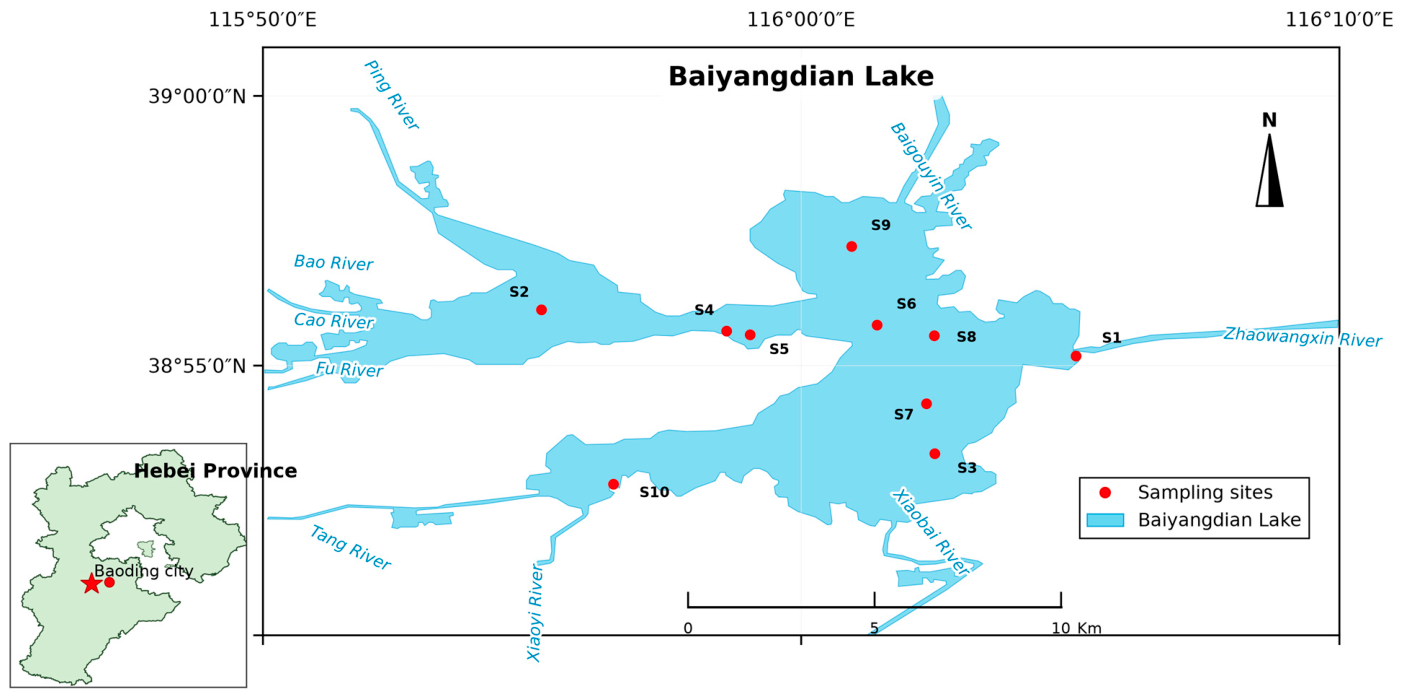
Baiyangdian Lake is simultaneously exposed to three spatially distinct anthropogenic pressures. Agricultural runoff and untreated domestic sewage enter the areas of the lake dominated by farmland and villages; recreational boat traffic and lotus cultivation shape the central open-water and vegetated areas; and municipal wastewater discharged into the lake is partially purified as it passes through extensive reed wetlands. In the study from which the present metagenomes were obtained, the sediment sites were grouped according to the dominant anthropogenic influence acting on each site, yielding three zones [22]: R1 (S1, S5 and S9), influenced by agricultural and domestic sewage; R2 (S2, S3, S4 and S6), influenced by boat tourism and lotus cultivation; and R3 (S7, S8 and S10), affected by urban sewage dispersal and purification through reed-wetland filtration. These areas differ not only in the type of anthropogenic pressure but also in the associated sediment properties: R1 sites carry the highest total phosphorus (TP) and organophosphorus pesticide (OPP) loads; R2 sites represent an environment shaped mainly by recreational and lotus-cultivation activities; and R3 sites occupy an intermediate position, their nutrient and organic-carbon levels reflecting the partial retention of sewage-derived inputs during reed-wetland filtration. Because this zonation is pre-established rather than derived from the viral data, it provides an independent framework for testing whether anthropogenic pressures structure sediment viral communities, and it was therefore adopted throughout the analyses reported below.
In this study, we performed the first comprehensive metagenomic survey of DNA viruses in BYDS across ten sampling sites. We characterized the taxonomic composition, diversity, and community structure of the sediment viral assemblages. We predicted virus–host linkages across the dominant prokaryotic lineages. We identified viral AMGs involved in carbohydrate, sulfur, and methane metabolism and quantified their enrichment relative to marine and polar ecosystems. We further evaluated the abundance, diversity, and resistance mechanisms of virus-associated ARGs. Together, these analyses establish the first viral genomic repository for BYDS and clarify the ecological roles of viruses in an anthropogenically stressed freshwater ecosystem.
2. Materials and Methods
2.1. Study Site, Sample Collection, and Sequencing Data
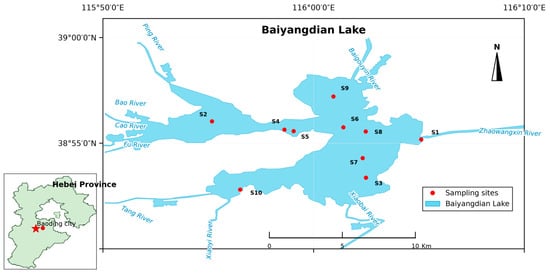
Baiyangdian Lake (38°43′–39°02′ N, 115°38′–116°07′ E; Figure 1) is in central Hebei Province and covers an area of 781 km2. To identify viral sequences and their auxiliary metabolic genes (AMGs) in lakes under strong anthropogenic impacts, we retrieved shotgun metagenomic data of BYDS (PRJNA908081) from the NCBI-SRA [23]. To our knowledge, it was the only publicly available shotgun metagenomic dataset for BYDS. Its ten spatially distributed sites spanned the principal anthropogenic gradients of the lake, which supported the zone-comparative design. All libraries were constructed on the same Illumina platform within a single study, which minimized inter-study batch effects. The total data volume (40.37 Gb) was sufficient for co-assembly and viral contig recovery.
Figure 1.
The geographical distribution of the sampling sites involved in this study.
Surface sediments (0–10 cm) were collected on 25–26 November 2021 with a grab sampler; four to six grab replicates per site were mixed into a single composite sample. Seven physicochemical variables were determined on the same sediment samples to characterize the environmental setting of each site: pH, electrical conductivity (EC, μS/cm), total nitrogen (TN, mg/kg), total phosphorus (TP, mg/kg), sediment organic carbon (SOC, %), the mass ratio of TN to TP (N/P), and the summed concentration of organophosphorus pesticides (OPPs, μg/kg) [23].
Total genomic DNA was extracted directly from fresh sediment using the ZNA® Bacterial DNA Kit for Soil (Omega Biotech, Norcross, GA, USA) according to the manufacturer’s instructions. DNA integrity was verified on 2% agarose gels, and extracts were stored at −80 °C prior to library construction. Paired-end libraries were sequenced on the Illumina HiSeq 2500 platform. Only high-quality Illumina paired-end reads (mean length > 100 bp) were retained for downstream analysis.
2.2. Sequence Quality Control, Genome Assembly and Binning
The raw reads were quality-trimmed using FastP (version 0.23.4) [24]. The resulting clean reads from each sediment sample were then assembled independently into contigs with the metaWRAP v1.3.2 assembly module, which invokes MEGAHIT v1.2.9 under default settings [25]. These contigs were subsequently binned into metagenome-assembled genomes (MAGs) using the metaWRAP binning module, integrating three algorithms: CONCOCT [26], MaxBin2 [27], and metaBAT2 [28]. The multiple binning outputs were refined and consolidated into a single, higher-quality bin set via the metaWRAP Binning refinement module, retaining bins with ≥70% completeness and <10% contamination (−c 70 −x 10) [29]. The refined MAGs were finally dereplicated using CD-HIT v4.8.1 (parameters: -c 0.95 -G 0 -M 0 -aS 0.8 -T 8 -n 9) [30]. For taxonomic classification, the classify_wf workflow in GTDB-TK v2.3.2 was used with the parameters -skip_ani_screen–extension fa, referencing the GTDB database release 214 [31].
2.3. Viral Contigs Assembly and Identification
Contigs ≥ 1.5 kb from assemblies were used to recover viral sequences. Three mainstream pipelines, including VirSorter2 v2.2.3 [32], DeepVirFinder v1.0 [33], and VIBRANT v1.2.1 [34], were used to identify viruses from co-assembled contigs. Then, a more precise procedure was used to screen and retain viral genomes according to the following criteria: (i) high confidence level (score ≥ 0.7 and hallmark genes) of VirSorter2 (parameters: --keep-original-sequence), (ii) identified by VirSorter2 (score ≥ 0.5), DeepVirFinder (score ≥ 0.7 and p ≤ 0.05), and VIBRANT simultaneously. (iii) identified by any two of VirSorter2 (score ≥ 0.5), DeepVirFinder (score ≥ 0.7 and p ≤ 0.05), and VIBRANT, and further screened by CheckV v1.0.1 [35] with at least one viral hallmark gene. The provirus regions were extracted from recovered viral genomes based on the CheckV contamination estimates.
The detected viral contigs were classified into vOTUs if they shared 95% nucleotide identity across ≥80% of shorter viral contigs using CD-HIT v4.8.1 (parameters: -c 0.95 -G 0 -M 0 -aS 0.8 -T 8 -n 9) [30]. The open reading frames (ORFs) of vOTUs were predicted by Prodigal with default parameters and searched against the NR protein database using DIAMOND [36]. The Prodigal v2.6.3 (-p meta) software was used to predict viral genes in viral genomes after removing host contamination. The representative genome of each vOTU (≥1.5 kb) was used as input to CheckV to evaluate genome completeness. The vOTUs (≥5 kb) and circular genomes (1.5~5 kb) were used for subsequent analyses. The lifestyle of the high-quality viruses was predicted by Vibrant using the default parameters [34].
2.4. Taxonomic Classification, Calculating Relative Abundances and Diversity
The viral taxonomy identification of the vOTUs was annotated using geNomad v1.5.1 [37], VITAP [38] and PhaGCN2.1 [39] based on sequence similarity fitting and classification extension utilizing a bipartite graph. The vOTUs that could not be assigned to viral taxonomy were manually searched against the NCBI database.
The clean reads from each sample were mapped to vOTUs using bowtie2 [40] and counted using CoverM v0.3.1 (https://github.com/wwood/CoverM) accessed on 19 October 2025 (parameters: -min-read-percent-identity 0.95 -min-read-aligned-percent 0.75) [41].
2.5. Abundance Quantification of vOTUs and MAGs
The abundances of vOTUs and MAGs were quantified as reads per kilobase per million mapped reads (RPKM). Quality-trimmed metagenomic reads were mapped against the dereplicated vOTUs and MAGs using the contig and genome modules of CoverM, respectively. To ensure mapping fidelity, alignments with read identity below 95% or aligned length below 75% were discarded (−min-read-percent-identity 95 −min-read-aligned-percent 75) [42]. To ensure mapping fidelity, alignments with read identity below 95% or aligned length below 75% were discarded (−min-read-percent-identity 95 −min-read-aligned-percent 75) [43]. The relative abundance of each vOTU and MAG was expressed as their proportion of the total RPKM count within each sample.
2.6. Host Prediction of Viruses
Virus–host linkages were predicted with iPHoP (v1.2.0), an integrated phage host prediction tool that combined host-based (BLAST, CRISPR, VirHostMatcher, WIsH, PHP) and phage-based (RaFAH) approaches [44]. To improve prediction accuracy, we used MAGs reconstructed from the total metagenomes as the host reference database [44]. We estimated lineage-specific virus–host abundance patterns at the phylum level and other taxonomic levels. Microbial host abundance was calculated by summing the abundance of all MAGs assigned to the same taxon. Similarly, viral abundance was calculated by summing the abundance of all vOTUs assigned to the same taxonomic level as their predicted hosts [45].
2.7. Identification of AMGs and ARGs
The AMGs identified by VIBRANT in the above section were first filtered according to the following criteria [34]: (1) Edge-located AMGs (AMGs located at either end of a scaffold) were filtered. (2) AMGs that had any KEGG v-score or Pfam v-score (assigned by VIBRANT) ≥1 were filtered. (3) AMGs with flanking genes (four genes on either the upstream or downstream sites) having a KEGG v-score < 0.25 were filtered. The filtered AMGs were then summarized by adding information, including date and season, KO hit and name, Pfam hit and name, and KEGG metabolism, pathway, and module [46]. To generate abundance profiles for AMGs, clean reads were mapped to the metagenome using bowtie2, and the RPKM values of each gene were calculated. The sum of the RPKM values of genes with the same KO annotations was used to represent the relative abundance of each gene category.
The ARGs were identified by predicted ORFs against the database of Structured Antibiotic Resistance Genes (SARG) [47] (-query-cover 70, -id 80, -e-value 1 × 10⁻⁵). To calculate the relative abundance of ARGs, clean reads were mapped to the metagenomes using coverM, and RPKM values were calculated for each gene. The heatmap for antimicrobial resistance genotypes was generated using TBtools v2.136 [48].
2.8. Comparison to Specific AMGs from Other Habitats
To investigate the distribution and abundance of AMGs associated with carbohydrate, sulfur, photosynthesis, and methane metabolism across diverse habitats, we conducted a comparative analysis between BYD and other environmental datasets, including GOV 2.0 (EPI, BATHY, MES, ANT, ARC) [49] and coastal zone metagenomes. Contigs encoding functional annotations related to carbohydrate, sulfur, photosynthesis, and methane metabolism were identified using the KEGG database. These contigs were subsequently analyzed using CoverM v0.6.1 to quantify their coverage profiles across metagenomic datasets (parameters: -p bwa-mem --min-read-percent-identity 0.95 --min-read-aligned-percent 0.75 -m tpm -t 20).
2.9. Statistical Analysis
All statistical analyses were performed in R v4.2.2. Redundancy analysis (RDA) was performed in R with vegan using the relative abundance of each vOTU and environmental factors. Pearson correlation analysis was performed using the corrplot package to reveal the potential relationship between viral diversity and viral communities. Alpha diversity was calculated using the R package vegan [50]. Non-metric multidimensional scaling (NMDS) analysis was used to reveal viral β-diversity from vOTUs based on Bray–Curtis distance by the function vegdist (method “bray”). Heatmaps were generated by the pheatmap R package v1.0.12 and TBtools v2.136. All other plots were generated by the ggplot2 package v3.5.1 [51].
3. Results
3.1. Overview of DNA Viruses in BYDS
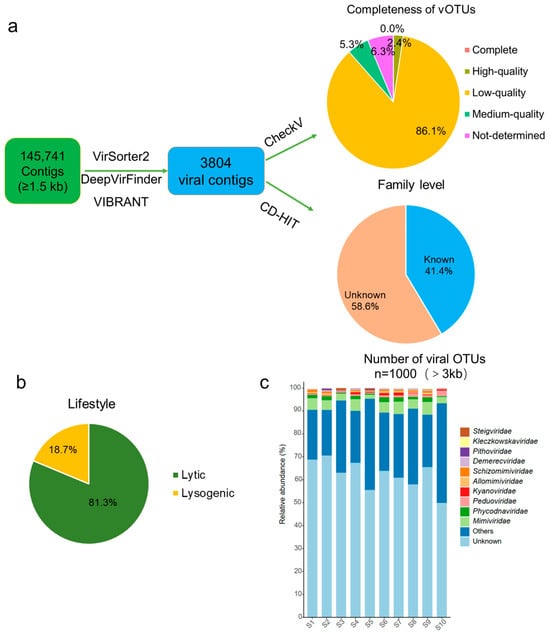
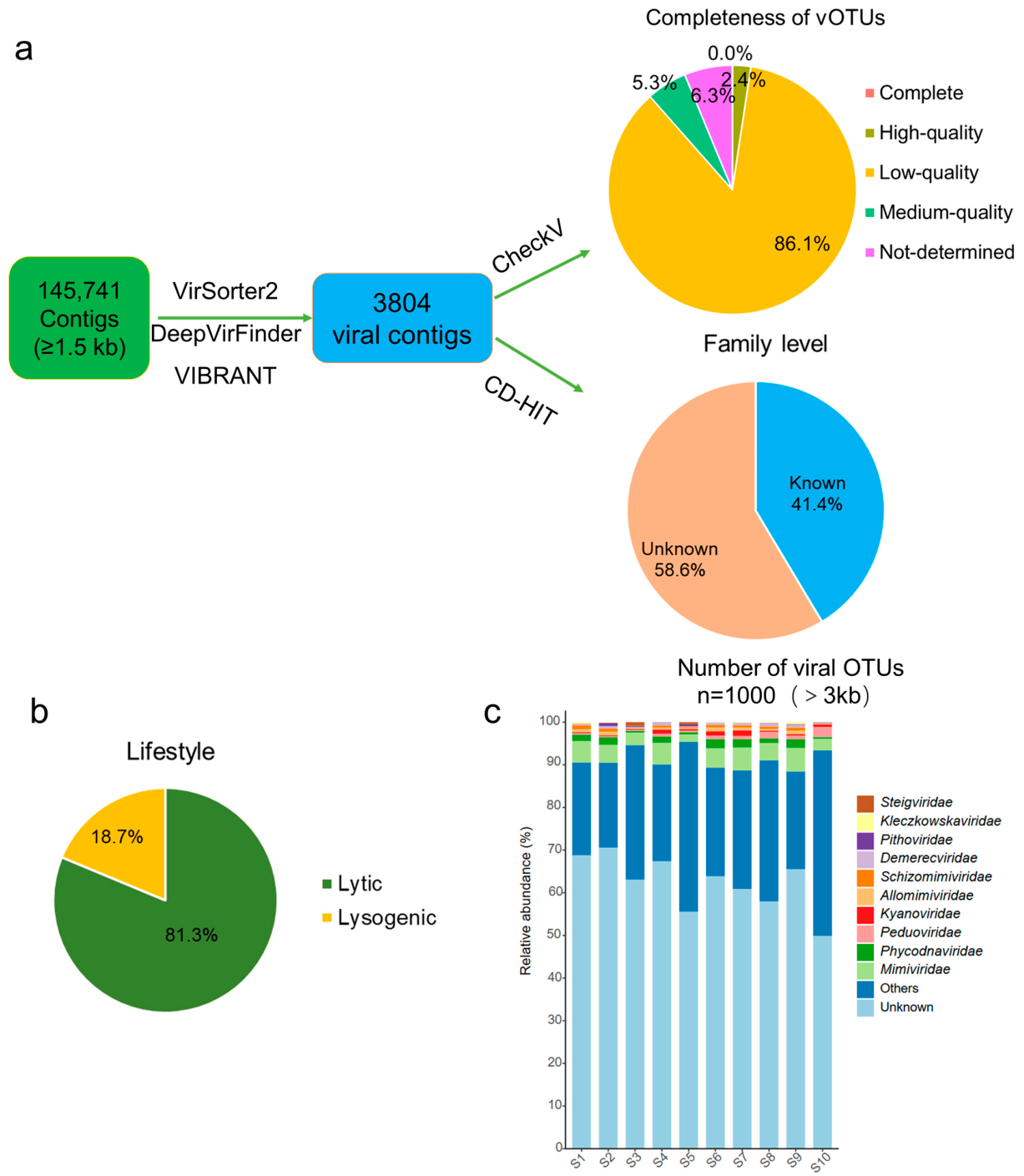
The ten sediment samples previously described underwent metagenomic sequencing, each generating approximately 6.5 Gb of clean data (Supplementary Table S1). A total of 145,741 contigs (≥1.5 kb) were assembled, of which 3804 viral contigs were identified using a combination of VirSorter2, DeepVirFinder, and VIBRANT. After clustering (95% average nucleotide identity), we generated 3664 vOTUs (≥1.5 kb). Furthermore, we utilized 1000 vOTUs (≥3 kb or ≥1.5 kb and circular) for subsequent analysis (Figure 2a). By CheckV, only 2.5% (n = 25) were found to be classified as having more than 90% genome integrity or high-quality viral genomes. Notably, we recovered one complete provirus genome, carrying 19 viral genes. The viruses’ lifestyle showed that lytic viruses dominated (81.3%), while lysogenic viruses accounted for only 18.7% (Figure 2b). To our best knowledge, this dataset established in this study was the first viral genome repository in BYDS.
Figure 2.
Viral community structure of Baiyangdian Lake sediment (BYDS). (a) The identification workflow of viral operational taxonomic units (vOTUs). A total of 546,794,968 sequencing reads from the ten sediment samples were assembled into 145,741 contigs (≥1.5 kb), which were further classified into 3804 viral contigs by three methods. The viral contigs were clustered into 1000 vOTUs based on nucleotide sequence similarity analysis. The relative proportion of unknown and known vOTUs in the entire dataset. Quality distribution of recovered viral genomes. (b) Proportion of lytic and lysogenic viruses in BYDS. (c) Taxonomic composition of the viral community at the family level.
Taxonomic annotation of vOTUs showed that 414 of 1000 vOTUs could be classified to known taxa, of which Duplodnaviria was dominant (83.1%), followed by Varidnaviria (Figure S1). Among the annotated vOTUs, Uroviricota was the dominant phylum (84.0%), whereas Nucleocytoviricota accounted for 15.0% (Figure S2). At the family level, only ~9.2% (n = 92 vOTUs) were assigned to known taxa, with ~90.8% (n = 908 vOTUs) remaining unclassified at the family level, highlighting the vast unexplored viral diversity in BYDS. Among the classified vOTUs, 27 families were identified, dominated by Mimiviridae (32.6%), Phycodnaviridae (9.8%) and Kyanoviridae (8.7%) (Figure S3). For analytical clarity, the ten metagenomic samples—originally designated SRR22515684 through SRR22515693—were relabeled as S1 to S10, respectively. Specifically, viral community composition at the family level was analyzed across 10 samples (Figure 2c). Mimiviridae, Phycodnaviridae, and Kyanoviridae were the main viral communities at each sample. However, sample S8 and S10 exhibited a distinct compositional profile: Kyanoviridae exceeded that of Phycodnaviridae, contrasting with the pattern observed in the remaining eight samples. Overall, the 10 samples exhibited highly inconsistent viral community structure at the family level, but were characterized by an absolute dominance of unclassified viruses. This reflects the high diversity and insufficient taxonomic characteristics of viral communities in this environment.
3.2. Anthropogenic Zones Shape Viral Community Composition and Diversity in BYDS
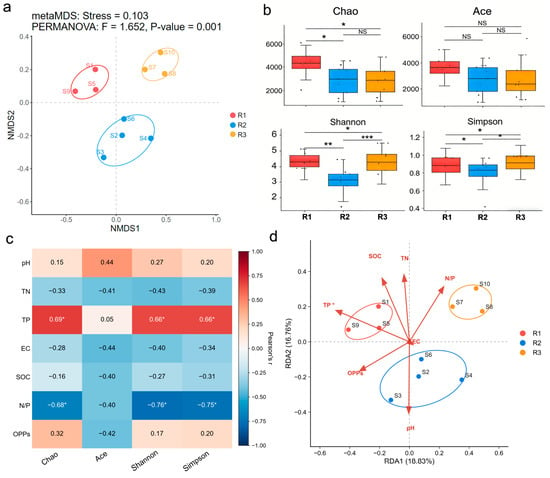
To investigate the community diversity characteristics of sediment DNA viruses in Baiyangdian, we performed beta diversity analysis using NMDS on 10 viral metagenomes. The results revealed distinct clustering of the R1, R2, and R3 sample groups in the two-dimensional ordination plot (Stress = 0.103; Figure 3a). PERMANOVA analysis further confirmed highly significant differences in viral community structure among the three groups (p = 0.001), indicating that the literature-based zonation was also reflected in the viral community composition rather than being imposed on the data.
Figure 3.
Analyses of the diversity of the viral community in BYDS. (a) Nonmetric multidimensional scaling (NMDS) of viral β-diversity based on the Bray–Curtis dissimilarity matrix calculated from the relative abundances of vOTUs across the three site groups. PERMANOVA showed the statistical significance of viral community composition. (b) The α-diversity indices of the viral community in BYDS of different groups, including Chao, ACE, Shannon index, and Simpson index. Significance levels: * p < 0.05, ** p < 0.01, *** p < 0.001. (c) Relationship between viral diversity and environmental factors. The size and shade of each square are proportional to the degree of correlation. Blue and red represent positive and negative correlations between viral diversity and environmental factors, respectively. (d) Redundancy analysis (RDA) of the relationship between vOTUs and environmental factors. Different colors represent different groups.
Alpha diversity analysis showed that the Chao index was significantly higher in the R1 group than in the R2 group (p < 0.05), though no significant difference was observed between the R3 and R2 groups (Figure 3b). The Ace index showed no significant differences among the three groups. Notably, both the Shannon and Simpson indices showed a consistent trend of R1 > R3 > R2, with significant differences among groups (p < 0.05 or p < 0.01), suggesting that the R1 group had the highest species diversity and evenness, while the R2 group exhibited the lowest. Viral α-diversity differed among the three zone groups, being highest in R1 and lowest in R2 (Chao, Shannon, and Simpson indices; p < 0.05).
To explore the environmental drivers of viral diversity, Pearson correlation analysis was performed between physicochemical factors and viral alpha diversity indices, which showed that TP was significantly positively correlated with the Chao, Shannon, and Simpson indices (r = 0.69, 0.66, and 0.66, respectively; p < 0.05), whereas N/P was significantly negatively correlated with the same indices (r = −0.68, −0.76, and −0.75, respectively; p < 0.05). TN, EC, and SOC were negatively but not significantly correlated with all four diversity indices (Figure 3c). Consistently, redundancy analysis (RDA) showed that the first two axes explained 18.83% and 16.76% of the total variation, respectively, and clearly separated the three groups along RDA1 (Figure 3d). TP was the only environmental factor significantly associated with viral community structure, with R1 samples oriented toward the TP and OPPs vectors, R3 samples toward the N/P, SOC, and TN vectors, and R2 samples separated in the opposite direction, indicating contrasting environmental associations among the three zones.
3.3. Virus–Host Linkages
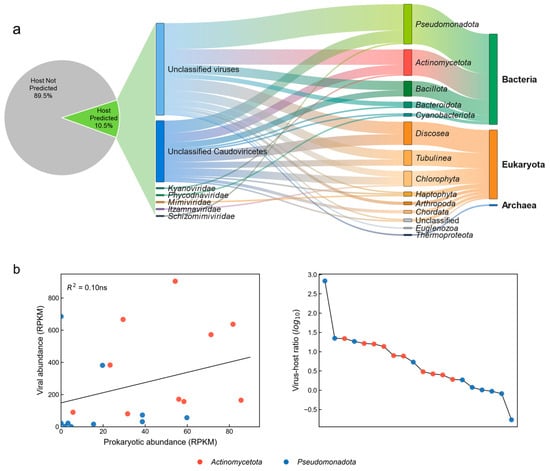
A total of 20 MAGs were recovered from the total metagenomes, consisting of 19 bacterial and 1 archaeal MAGs (Table S3). All MAGs were integrated into the iPHoP standard database to link viruses to their potential hosts. By using multiple host prediction methods, we linked 107 vOTUs, accounting for 10.7% of the total vOTUs, to host 49 genera, spanning 5 bacterial, 8 eukaryotic, and 1 archaeal phylum-level lineages, with Bacteria (57.2%) and Eukaryota (42.1%) dominating the host-associated viruses, whereas Archaea accounted for merely 0.7% (Table S4). Among bacterial hosts, Pseudomonadota, Actinomycetota, and Bacillota emerged as the most prevalent; eukaryotic associations were primarily attributed to Discosea, Tubulinea, and Chlorophyta, and Thermoproteota represented the sole archaeal lineage (Figure 4a). These lineages are among the most abundant and active eukaryotic and prokaryotic plankton in the lake ecosystem [52]. Notably, only 4.7% of host-associated vOTUs could be assigned to a viral family (Kyanoviridae, Phycodnaviridae, Mimiviridae, Itzamnaviridae, and Schizomimiviridae), leaving 95.3% unclassified at the family level, further indicating a wide range of uncharacterized viral diversity in BYDS.
Figure 4.
Virus–host linkages and abundance patterns. (a) vOTUs were linked to predicted hosts at the phylum level; (b) Linear regression model analysis between the relative abundance of viruses and their microbial hosts at the phylum level and virus–host abundance ratios.
To gain insights into viral infection dynamics, we selected predicted host MAGs and their associated vOTUs for further analysis. Viral abundance showed a weak positive association with host abundance, but this relationship was not statistically significant (R2 = 0.10, P = 0.181). At the phylum level, log10-transformed virus-to-host abundance ratios ranged from −0.77 to 2.84 (Figure 4b). Overall, virus–host abundance coupling was weak in this system. However, the wide variation in virus-to-host ratios pointed to lineage-specific infection dynamics.
3.4. Viral AMGs Modulate Biogeochemical Element Cycling in BYDS
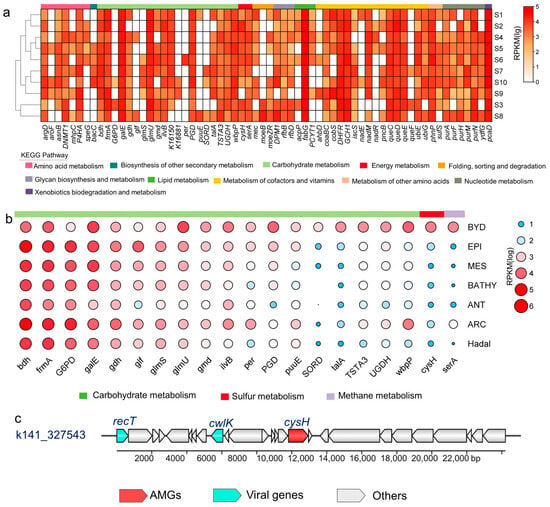
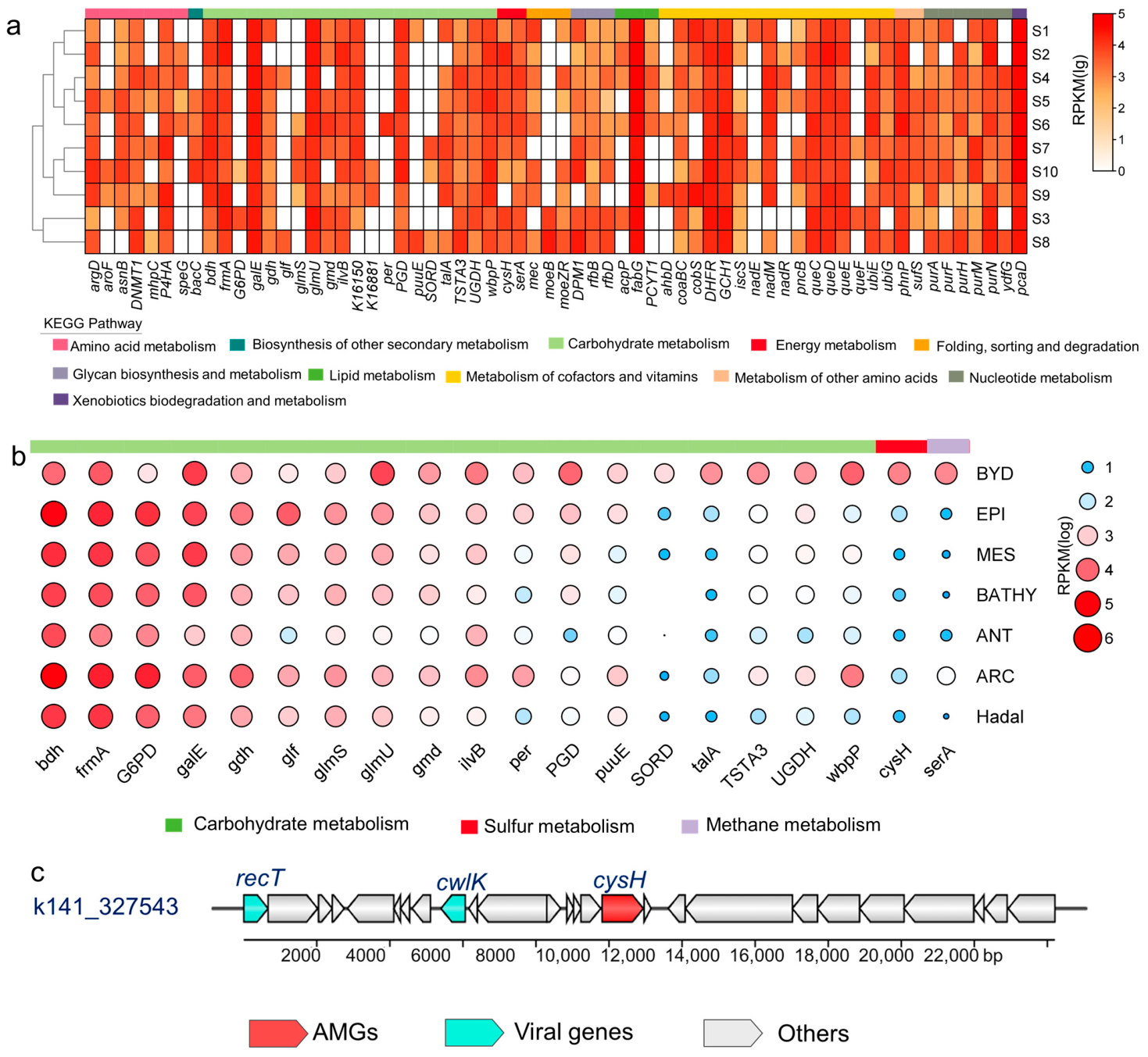
As an important component of the microbial ecosystem, viruses not only shape the structure of the microbial community by lysis of the host, but also regulate the metabolic processes of the host by encoding AMGs, thereby driving the biogeochemical cycling of key elements such as carbon, sulfur, and methane [3]. To better understand the ecological potentials of viruses in BYD, we performed a comprehensive search of AMGs in viral genomes and calculated their relative abundances. To further investigate the potential ecological functions of viruses in BYDS, a total of 239 potential AMGs were identified based on the annotation results of VIBRANT and DRAM-v (Figure S4); these AMGs were predominantly involved in carbohydrate metabolism, cofactor and vitamin biosynthesis, and amino acid metabolism. BYDS virus-encoded AMGs showed different expression patterns in different samples (Figure 5a), and AMGs involved in energy metabolism were found, including those related to sulfur metabolism and methane metabolism. The AMGs related to sulfur metabolism included the gene encoding phosphoadenosine phosphate sulfate reductase (cysH).
Figure 5.
Function and abundance profiles of virus-encoded auxiliary metabolic genes (AMGs). (a) Relative abundance of viral AMGs obtained from viral contigs in different BYDS samples. The main metabolic categories are colored according to the legend; (b) Relative abundance of carbohydrate, sulfur, and methane metabolism-related AMGs in the ECSSC, GOV 2.0 (EPI, BATHY, MES, ANT, ARC), and Hadal. (c) Viral gene-map related to sulfur metabolism.
In this study, AMGs related to carbohydrate, sulfur, and methane metabolism encoded by viruses in BYDS were compared with those in GOV 2.0 and the hadal environment (Figure 5b). The results showed that the abundance of AMGs in BYDS viruses during these key metabolic processes was significantly different from that in the marine environment. The carbohydrate metabolism-related AMGs, such as talA, SORD, and TSTA3, were 3–8 times more abundant than those in polar, pelagic, and deep-sea environments. The abundance of genes related to sulfur metabolism, such as cysH, was 4–9 times higher than that of other regions. The methane metabolism-related gene serA was 5–10 times more abundant than in other seas. In addition, we identified three genes recT (DNA recombination/repair), cwlK (host cell lysis), and cysH in viral contigs (Figure 5c).
3.5. ARGs Are Enriched in BYDS Viruses
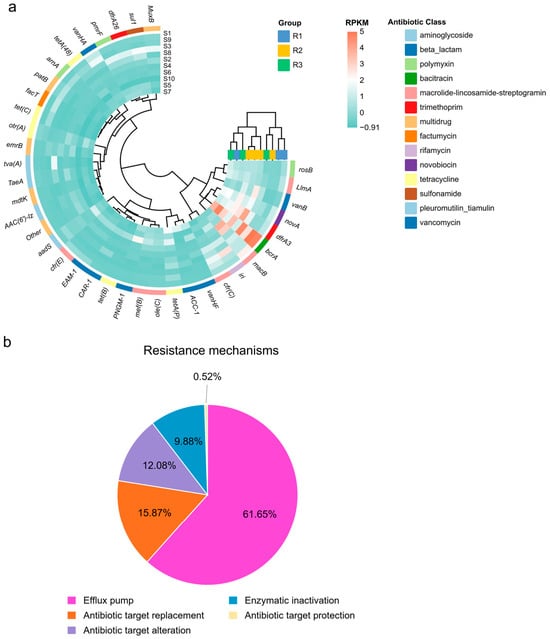
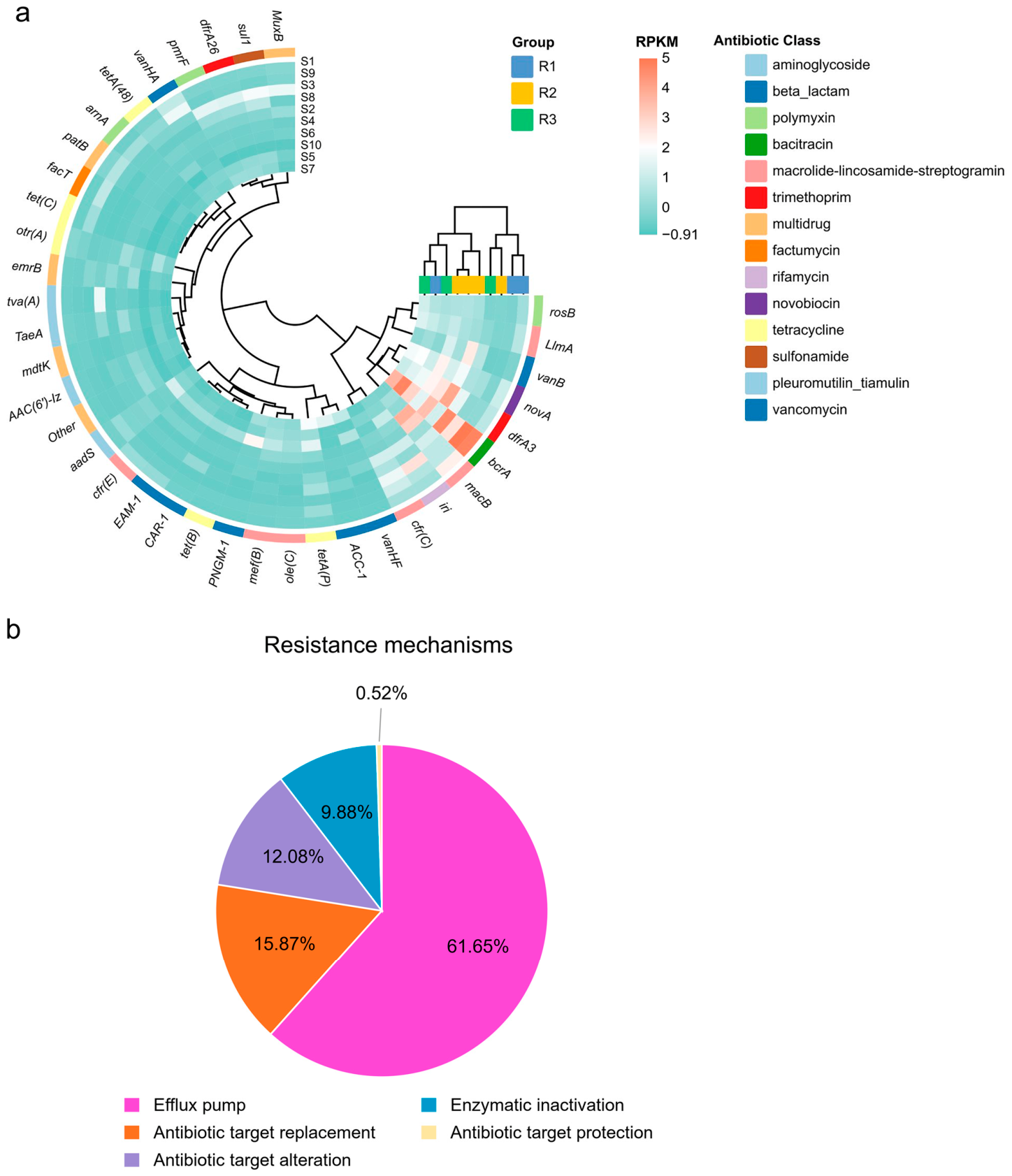
A total of 67 ARGs were identified, with bcrA (bacitracin resistance), dfrA3 (trimethoprim resistance), and macB (macrolide-lincosamide-streptogramin resistance) emerging as the most abundant (Figure 6a). The predominance of bcrA likely reflects the historical widespread use of bacitracin as a growth promoter in agricultural settings, whereas the high abundance of macB suggests the potential for horizontal transfer of clinically relevant resistance determinants within the virome, raising concerns regarding the role of soil viruses in the dissemination of medically important ARGs.
Figure 6.
Identification of predicted ARGs carried by viral genomes in BYDS. (a) ARG types, ARG abundance, and groups were correlated by a circular heat map. (b) Proportions of identified ARGs categorized by resistance mechanisms. The figure was also redrawn at 300 dpi to meet the journal’s resolution requirement.
Fourteen resistance types were identified in BYDS viral contigs, with bacitracin (20.4%), macrolide-lincosamide-streptogramin (MLS, 15.4%), and trimethoprim (12.8%) constituting the three most dominant categories (Figure S5). The co-occurrence of MLS and trimethoprim resistance is particularly noteworthy, as these two resistance classes are frequently co-selected in environments subjected to sustained anthropogenic pressures, suggesting that agricultural inputs—including the application of manure or antibiotic-containing amendments—may serve as key drivers of resistance gene enrichment in BYDS.
At the class level, taxonomic analysis revealed that 66.8% of viral contigs carrying ARGs remained unclassified, underscoring the vast and largely unexplored diversity of ARG-harboring viruses in this ecosystem. Among the classified fraction, we find that Caudoviricetes accounted for 28.44% and Megaviricetes for 5.21% (Figure S6). The predominance of Caudoviricetes is consistent with their well-documented capacity for horizontal gene transfer, mediated through both temperate phage integration and generalized transduction, which may facilitate the broad dissemination of ARGs across diverse bacterial hosts. Regarding resistance mechanisms, efflux pump-mediated resistance was the most prevalent, accounting for 61.65% of all identified mechanisms (Figure 6b), reflecting the broad-spectrum and energetically efficient nature of this resistance strategy. In addition, antibiotic target alteration, target protection, and target replacement collectively represented a substantial proportion, indicating the functional diversity of resistance mechanisms encoded within BYDS viruses and highlighting the multifaceted routes through which viral ARG reservoirs may contribute to resistance phenotypes in associated microbial communiti.
4. Discussion
This study provides the first comprehensive metagenomic inventory of DNA viruses in BYDS, establishing a genomic baseline for sediment viral communities in a large, anthropogenically impacted freshwater lake of North China. Viruses play a crucial role in the distribution of organisms and contribute to global biogeochemical cycles in the aquatic ecosystem [53]. While the taxonomic diversity and functional repertoires of sediment viruses in freshwater systems remain largely underexplored—particularly in lakes undergoing sustained anthropogenic disturbances—our findings offer novel insights into the ecological roles of sediment viruses in eutrophic freshwater habitats.
4.1. Comparison of Viral Community Composition Across Freshwater Ecosystems
Of the 1000 vOTUs, 414 (41.4%) could be assigned to any recognized taxon, but only 92 (9.2%) could be resolved to family level, leaving 908 (90.8%) unclassified. A comparably large uncharacterized fraction has been reported for other freshwater systems: in Lake Mendota, a 20-year metagenomic time series showed that most viral species falling within Caudoviricetes could not be resolved further and that fewer than 20% of the community could be linked to a host [11], while a survey of 204 samples from the Yangtze River recovered 18,865 vOTUs with a substantial proportion remaining unassigned [54,55]. The recurrence of this pattern across a shallow eutrophic lake, a deep temperate lake and a large river indicates that freshwater sediments collectively constitute a major reservoir of undescribed viral diversity. Among the assignable vOTUs, Duplodnaviria dominated (83.1%), and Uroviricota was the prevailing phylum (84.0%), a composition typical of sediment viromes in which tailed double-stranded DNA bacteriophages predominate [19,20]. Two features nevertheless distinguish BYDS. First, Nucleocytoviricota accounted for 15.0% of the assignable vOTUs, a proportion that is high for a sediment virome and that implies a substantial community of large eukaryotic viruses. Second, among the 92 vOTUs resolved to family level, the assemblage was headed by Mimiviridae (32.6%), Phycodnaviridae (9.8%), and Kyanoviridae (8.7%) rather than by the Caudoviricetes-affiliated families that often dominate lacustrine viromes [11,13]. Because Mimiviridae and Phycodnaviridae infect protists and algae whereas Kyanoviridae infect cyanobacteria, this composition suggests that eukaryotic hosts, and not only bacteria, are an important substrate for viral replication in BYDSs—a suggestion independently corroborated by the host-prediction analysis in Section 4.3. Three non-exclusive explanations account for the high proportion of unclassified vOTUs, and distinguishing among them matters for interpretation. Assembly fragmentation is one: only 2.5% of vOTUs were estimated to exceed 90% completeness by CheckV, so many sequences are gene-poor fragments carrying limited phylogenetic signal. Reference-database bias is a second, because viral taxonomy rests on sequence similarity to databases still skewed toward marine, cultured and clinically relevant viruses [22]. Genuine novelty is a third. The present data cannot separate these contributions; we therefore treat the unclassified fraction as an upper bound on novelty rather than as evidence that most BYDS viruses are new to science. Discriminating among these alternatives will require long-read or single-virus sequencing and targeted isolation.
The high proportion of unclassified vOTUs (90.8%) in BYDS aligns with observations from other freshwater sediment metagenomes. In Fuxian Lake, a deep freshwater lake in China, only 18% of 11,523 viral OTUs recovered from 44 surface sediment samples could be annotated to the family level [9]. The 20-year time-series study in Lake Mendota (471 metagenomes, 2000–2019) revealed that most viral species identified within Caudoviricetes could not be taxonomically classified further, with less than 20% of the viral community receiving host prediction assignments [11]. A comprehensive virome analysis across four habitats using 204 samples from the Yangtze River identified 18,865 vOTUs, with a substantial proportion remaining uncharacterized [54,55]. This recurrent pattern across diverse freshwater systems—from shallow eutrophic lakes to deep oligotrophic lakes to large river systems—suggests that sediments harbor a substantial reservoir of novel viruses that have remained underexplored relative to marine environments.
4.2. Anthropogenic Influence on Viral Community Diversity and Virus–Host Linkage
Viral community composition differed significantly among the three a priori zones (PERMANOVA: pseudo-F = 1.652, p = 0.001; NMDS stress = 0.103). Alpha diversity followed a consistent R1 > R3 > R2 gradient in both the Shannon and Simpson indices, with the R2–R3 contrast the most pronounced of the pairwise comparisons; the Chao index was significantly higher in R1 than in both R2 and R3, whereas no differences were detected for the ACE index. The direction of this gradient deserves to be stated plainly: the zone receiving the most direct agricultural and domestic wastewater input (R1) supported the most diverse viral community, whereas the tourism and lotus-cultivation zone (R2) supported the least diverse communities. For sediment bacteria in Baiyangdian, stronger anthropogenic pressure has been associated with reduced diversity, and anthropogenic activity has been shown more generally to mediate the stratification and stability of microbial communities in freshwater sediments [14,56].
The viral pattern is therefore not a simple mirror of the bacterial one. A bottom-up interpretation fits our data better: because viruses depend on host availability, conditions that broaden the host assemblage should raise viral diversity. The environmental correlations support this explanation. TP was the only physicochemical variable significantly correlated with viral alpha diversity, correlating positively with the Chao, Shannon, and Simpson indices, whereas the N/P mass ratio correlated negatively with the same indices. RDA agreed with this pattern (RDA1 = 18.83%, RDA2 = 16.76%), separating the three zones along the first axis and orienting R1 samples toward the TP vector [16]. Mechanistically, phosphorus enrichment in R1 would be expected to relieve nutrient limitation and enlarge the bacterial and algal host pool, thereby supporting a richer and more even viral assemblage, whereas the higher N/P ratios characteristic of the R2 sites indicate a stoichiometric imbalance that would constrain that pool. The intermediate position of R3 is compatible with partial attenuation of sewage-derived nutrients during passage through reed wetlands. The concordance among the zonation, the diversity gradient, and the phosphorus-related correlations indicates that sediment viral assemblages respond to anthropogenic gradients in this lake, consistent with earlier work relating BYDS microbial structure to environmental factors [22].
Host availability is the proximate link in this bottom-up chain, so identifying putative hosts offers a direct test of the proposed mechanism. Host prediction linked 105 of the 1000 vOTUs (10.5%) to a putative host that is consistent with the low host-assignment rates reported for other aquatic viromes [11,13,57]. Among the assigned vOTUs, putative hosts spanned all three domains: Bacteria accounted for 56.2%, Eukaryota for 42.9%, and Archaea for 1.0%. The eukaryotic fraction is unexpectedly large and is the most consequential outcome of this analysis, and its plausibility rests on its independent agreement with the taxonomic composition. Mimiviridae and Phycodnaviridae, the two families that headed the classified fraction, are giant viruses of protists and algae. The predicted eukaryotic hosts are dominated by precisely the lineages these families are known to infect: amoebozoans (Discosea; Tubulinea) account for 25 of the 45 eukaryotic assignments, followed by chlorophytes and haptophytes. Notably, haptophytes are largely known as marine protists; only sparse records of freshwater haptophytes exist, and these belong to phylogenetically distinct lineages [22]. Our prediction of viral hosts affiliated with Haptophyta suggests putative virus-haptophyte interactions in freshwater sediments, though these assignments require further experimental confirmation. This under-appreciated host–virus relationship merits further investigation in future studies. Ecologically, amoebae are abundant in freshwater sediments and can serve as reservoirs in which giant viruses replicate, and the presence of chlorophyte- and haptophyte-infecting viruses points to viral control of algal populations in this eutrophic system [11,13].
Bacterial hosts were dominated by Pseudomonadota, Actinomycetota, and Bacillota, which are among the abundant bacterial phyla reported for BYDS; this agreement is consistent with the expectation that dominant viruses track dominant hosts when viral abundance is governed by host density [11,13]. Only one vOTU was linked to an archaeal host (Thermoproteota). Given that archaea mediate methane cycling in freshwater sediments, this single linkage almost certainly reflects the scarcity of archaeal virus reference genomes rather than a genuine absence of archaeal viruses. This pattern aligns with the “kill-the-winner” hypothesis, which posits that the most numerically dominant bacterial populations are disproportionately susceptible to viral infection—thereby shaping microbial community structure, dynamics, and ecological balance [1].
Across the selected vOTU-MAG pairs, viral abundance was only weakly and non-significantly associated with host abundance (R2 = 0.10, P = 0.181), in contrast to the positive virus–host coupling reported for some aquatic systems [11,13]. This weak coupling may reflect post-lysis particle dispersal and asynchronous infection, whereas the wide variation in virus-to-host ratios (log10 −0.77 to 2.84) points to lineage-specific infection strategies [58]. Given the small number of vOTU-MAG pairs, the non-significant correlation more likely reflects limited statistical power than a true absence of coupling, and larger datasets with validated host links are needed.
4.3. Viruses as Modulators of Biogeochemical Cycling in BYDS
The identification of 239 AMGs—over-represented in carbohydrate, sulfur, and methane metabolism relative to marine and hadal datasets (3–10-fold)—positions BYDS viruses as active participants rather than passive passengers in elemental cycling. Notably, cysH encodes phosphoadenosine phosphosulfate (PAPS) reductase, a key enzyme of the assimilatory sulfate reduction pathway that catalyzes the reduction of PAPS to sulfite [4]. The enrichment of this sulfur-metabolism AMG in BYDS viruses is therefore particularly notable, given that sulfate reduction and sulfide flux are tightly coupled to organic-matter remineralization in shallow eutrophic lakes [10]. By introducing these capacities into their hosts, such AMGs may enhance host adaptability to ambient sulfur conditions, with potential consequences for the efficiency of sulfur and energy flow through the ecosystem [16]. Comparable virus-encoded metabolic potentials have been reported in other freshwater systems, including cyanophage-associated energy, sulfur, and phosphorus AMGs during harmful algal blooms in Utah Lake [59]. Moreover, the co-localization of recT, cwlK, and cysH on a single contig indicates that viruses can simultaneously reprogram host DNA repair, cell lysis, and sulfur assimilation during infection, potentially decoupling sulfur flow from host control [60]. From the viral perspective, these AMGs likely manipulate host metabolism to enhance viral replication [16]. Collectively, the elevated abundances of carbohydrate, sulfur, and methane metabolism genes relative to marine and hadal datasets indicate that these pathways are central to the ecological functioning of BYDS viruses and contribute to their adaptation to this anthropogenically impacted freshwater environment. Accordingly, virally encoded AMGs are best viewed not as curiosities but as quantitatively important contributors to lake biogeochemistry.
4.4. Viral-Encoded ARGs and the Risk of Resistance Dissemination
The detection of 67 viral ARGs spanning 14 resistance classes—dominated by bacitracin and MLS types, with efflux pumps as the leading mechanism—extends the growing recognition of phages as environmental reservoirs of resistance determinants [61,62,63]. The predominance of bacitracin resistance (bcrA) is consistent with the historical widespread agricultural use of bacitracin as a growth promoter, a pattern repeatedly observed in freshwater systems impacted by livestock runoff [19,64]. Mechanistically, Caudoviricetes accounted for the largest classified fraction of ARG-carrying contigs, a finding that is biologically coherent given the well-documented capacity of tailed phages for generalized transduction and temperate-phage integration [65,66]. Experimental studies in river sediments corroborate that ARGs are enriched in the phage fraction, especially downstream of urban influence, and that phages can package ARGs and mobile genetic elements at higher relative frequencies than chromosomal DNA [67]. Because BYD receives substantial agricultural runoff, aquaculture discharge, and municipal wastewater, its sediments meet the criteria for a hotspot of phage-mediated ARG dissemination. We therefore highlight viruses as an under-appreciated, mobile compartment of the freshwater resistome that warrants explicit inclusion in environmental risk frameworks [68,69].
Several limitations should be acknowledged. First, AMGs and ARGs annotations were based on sequence homology and should be complemented by metatranscriptomics to confirm in situ expression [70]. Secondly, because the dataset is a single-time-point snapshot, seasonal and inter-annual dynamics—shown to be pronounced in long-term lake studies—remain unexplored. Thirdly, because the metagenomes were obtained from total sediment DNA without virion enrichment or DNase treatment, the viral relative abundances reported here reflect the total sediment DNA pool; viral-particle-resolved metagenomics would be required to quantify the encapsulated fraction. Future work should pair viral metagenomics with metatranscriptomics, quantify infectivity and transduction frequency experimentally to clarify the functional and public-health relevance of the BYDS viromes [71].
Supplementary Materials
The following supporting information can be downloaded at: https://www.mdpi.com/article/10.3390/v18121318/s1. Figure S1: Proportion of taxonomic realm identified in BYDS viral populations; Figure S2: Proportion of taxonomic phylum identified in BYDS viral populations; Figure S3: Proportion of taxonomic families identified in BYDS viral populations; Figure S4: Classification of AMGs into KEGG metabolic categories; Figure S5: The mean proportion of antimicrobial resistance types in BYDS of 10 metagenomes; Figure S6: The classified composition of viral groups carrying ARGs in BYDS. Table S1: Sample and assembly information of BYDS metagenomes; Table S2: Physicochemical properties of sediment samples from Baiyangdian Lake; Table S3: Taxonomic annotation of MAGs using GTDB-Tk; Table S4: Virus–host linkages predicted by iPHoP.
Author Contributions
Conceptualization, X.G.; methodology, X.G.; software, X.G.; formal analysis, X.G.; investigation, X.G., J.S., and X.C.; writing—original draft preparation, X.G.; writing—review and editing, X.G., H.M., and S.W.; visualization, X.G.; supervision, X.G., J.S., and X.C.; project administration, X.G.; funding acquisition, X.G. All authors have read and agreed to the published version of the manuscript.
Funding
This research was financially supported by the Scientific Research Foundation of Hebei Normal University of Science and Technology (2026YB005).
Institutional Review Board Statement
Not applicable.
Informed Consent Statement
Not applicable.
Data Availability Statement
Data will be made available on request.
Conflicts of Interest
The authors declare no conflicts of interest.
References
- Suttle, C.A. Marine viruses—Major players in the global ecosystem. Nat. Rev. Microbiol. 2007, 5, 801–812. [Google Scholar] [CrossRef] [Scilit] [PubMed]
- Jansson, J.K.; Wu, R. Soil viral diversity, ecology and climate change. Nat. Rev. Microbiol. 2023, 21, 296–311. [Google Scholar] [CrossRef] [Scilit] [PubMed]
- Breitbart, M. Marine viruses: Truth or dare. Ann. Rev. Mar. Sci. 2012, 4, 425–448. [Google Scholar] [CrossRef] [Scilit] [PubMed]
- Kieft, K.; Zhou, Z.; Anderson, R.E.; Buchan, A.; Campbell, B.J.; Hallam, S.J.; Hess, M.; Sullivan, M.B.; Walsh, D.A.; Roux, S.; et al. Ecology of inorganic sulfur auxiliary metabolism in widespread bacteriophages. Nat. Commun. 2021, 12, 3503. [Google Scholar] [CrossRef] [Scilit] [PubMed]
- Tian, F.; Wainaina, J.M.; Howard-Varona, C.; Domínguez-Huerta, G.; Bolduc, B.; Gazitúa, M.C.; Smith, G.; Gittrich, M.R.; Zablocki, O.; Cronin, D.R.; et al. Prokaryotic-virus-encoded auxiliary metabolic genes throughout the global oceans. Microbiome 2024, 12, 159. [Google Scholar] [CrossRef] [Scilit] [PubMed]
- Shen, J.; Han, M.; Sun, J.; Yu, H.; Yang, Y.; Shen, K.; Su, Y.; Chen, X.; He, H.; Shao, H.; et al. Diversity and ecological potential of sediment viruses from Chinese continental shelf seas. npj Biofilms Microbiomes 2026, 12, 113. [Google Scholar] [CrossRef] [Scilit] [PubMed]
- Su, Y.; Yu, H.; Sun, S.; Zheng, K.; Wang, Z.; Gao, C.; Li, G.; Liu, X.; Shao, H.; Paez-Espino, D.; et al. Viruses in the sediments around the trenches harbor diverse survival mechanisms. iMetaOmics 2026, 3, e70124. [Google Scholar] [CrossRef] [Scilit] [PubMed]
- Wang, C.; Zheng, R.; Sun, C. Deep-sea viral diversity and their role in host metabolism of complex organic matter. Nat. Commun. 2025, 16, 10134. [Google Scholar] [CrossRef] [Scilit] [PubMed]
- Shi, W.; Liu, L.; Wu, L.; Wang, X.; Peng, Y.; Liu, X.; Li, C.; Xu, J.; Wu, Z.; Dong, X.; et al. Salinity-driven adaptations and evolution of DNA viruses in estuarine-coastal ecosystems. mSystems 2026, 11, e0035426. [Google Scholar] [CrossRef] [Scilit] [PubMed]
- Luo, X.Q.; Wang, P.; Li, J.-L.; Ahmad, M.; Duan, L.; Yin, L.-Z.; Deng, Q.-Q.; Fang, B.-Z.; Li, S.-H.; Li, W.-J. Viral community-wide auxiliary metabolic genes differ by lifestyles, habitats, and hosts. Microbiome 2022, 10, 190. [Google Scholar] [CrossRef] [Scilit] [PubMed]
- Zhou, Z.; Tran, P.Q.; Martin, C.; Rohwer, R.R.; Baker, B.J.; McMahon, K.D.; Anantharaman, K. Unravelling viral ecology and evolution over 20 years in a freshwater lake. Nat. Microbiol. 2025, 10, 231–245. [Google Scholar] [CrossRef] [Scilit] [PubMed]
- Yuan, L.; Yu, P.; Huang, X.; Zhao, Z.; Chen, L.; Ju, F. Seasonal succession, host associations, and biochemical roles of aquatic viruses in a eutrophic lake plagued by cyanobacterial blooms. Environ. Int. 2024, 193, 109125. [Google Scholar] [CrossRef] [Scilit] [PubMed]
- Zheng, Y.; Gao, Z.; Wu, S.; Ruan, A. Community Structure, Drivers, and Potential Functions of Different Lifestyle Viruses in Chaohu Lake. Viruses 2024, 16, 590. [Google Scholar] [CrossRef] [Scilit] [PubMed]
- Wang, H.; Wang, Z.; Yu, J.; Ma, C.; Liu, L.; Xu, D.; Zhang, J. The function and keystone microbiota in typical habitats under the influence of anthropogenic activities in Baiyangdian Lake. Environ. Res. 2024, 247, 118196. [Google Scholar] [CrossRef] [Scilit] [PubMed]
- Kallmeyer, J.; Pockalny, R.; Adhikari, R.R.; Smith, D.C.; D’Hondt, S. Global distribution of microbial abundance and biomass in subseafloor sediment. Proc. Natl. Acad. Sci. USA 2012, 109, 16213–16216. [Google Scholar] [CrossRef] [Scilit] [PubMed]
- Zheng, X.; Jahn, M.T.; Sun, M.; Friman, V.-P.; Balcazar, J.L.; Wang, J.; Shi, Y.; Gong, X.; Hu, F.; Zhu, Y.-G. Organochlorine contamination enriches virus-encoded metabolism and pesticide degradation associated auxiliary genes in soil microbiomes. ISME J. 2022, 16, 1397–1408. [Google Scholar] [CrossRef] [Scilit] [PubMed]
- Balcazar, J.L. Bacteriophages as vehicles for antibiotic resistance genes in the environment. PLoS Pathog. 2014, 10, e1004219. [Google Scholar] [CrossRef] [Scilit] [PubMed]
- Kilcher, S.; Loessner, M.J. Engineering Bacteriophages as Versatile Biologics. Trends Microbiol. 2019, 27, 355–367. [Google Scholar] [CrossRef] [Scilit] [PubMed]
- Chen, B.; Yang, Y.; Liang, X.; Yu, K.; Zhang, T.; Li, X. Metagenomic profiles of antibiotic resistance genes (ARGs) between human impacted estuary and deep ocean sediments. Environ. Sci. Technol. 2013, 47, 12753–12760. [Google Scholar] [CrossRef] [Scilit] [PubMed]
- Li, Z.; Pan, D.; Wei, G.; Pi, W.; Zhang, C.; Wang, J.-H.; Peng, Y.; Zhang, L.; Wang, Y.; Hubert, C.R.J.; et al. Deep sea sediments associated with cold seeps are a subsurface reservoir of viral diversity. ISME J. 2021, 15, 2366–2378. [Google Scholar] [CrossRef] [Scilit] [PubMed]
- Cai, L.; Jørgensen, B.B.; Suttle, C.A.; He, M.; Cragg, B.A.; Jiao, N.; Zhang, R. Active and diverse viruses persist in the deep sub-seafloor sediments over thousands of years. ISME J. 2019, 13, 1857–1864. [Google Scholar] [CrossRef] [Scilit] [PubMed]
- Xiao, R.; Hu, Y.; Wang, Y.; Li, J.; Guo, C.; Bai, J.; Zhang, L.; Zhang, K.; Jorquera, M.A.; Acuña, J.J.; et al. Pathogen profile of Baiyangdian Lake sediments using metagenomic analysis and their correlation with environmental factors. Sci. Total Environ. 2024, 913, 169628. [Google Scholar] [CrossRef] [Scilit] [PubMed]
- Kuang, B.; Xiao, R.; Hu, Y.; Wang, Y.; Zhang, L.; Wei, Z.; Bai, J.; Zhang, K.; Acuña, J.J.; Jorquera, M.A.; et al. Metagenomics reveals biogeochemical processes carried out by sediment microbial communities in a shallow eutrophic freshwater lake. Front. Microbiol. 2023, 13, 1112669. [Google Scholar] [CrossRef] [Scilit] [PubMed]
- Chen, S.; Zhou, Y.; Chen, Y.; Gu, J. Fastp: An ultra-fast all-in-one FASTQ preprocessor. Bioinformatics 2018, 34, i884–i890. [Google Scholar] [CrossRef] [Scilit] [PubMed]
- Li, D.; Luo, R.; Liu, C.-M.; Leung, C.-M.; Ting, H.-F.; Sadakane, K.; Yamashita, H.; Lam, T.-W. MEGAHIT v1.0: A fast and scalable metagenome assembler driven by advanced methodologies and community practices. Methods 2016, 102, 3–11. [Google Scholar] [CrossRef] [Scilit] [PubMed]
- Alneberg, J.; Bjarnason, B.S.; de Bruijn, I.; Schirmer, M.; Quick, J.; Ijaz, U.Z.; Lahti, L.; Loman, N.J.; Andersson, A.F.; Quince, C. Binning metagenomic contigs by coverage and composition. Nat. Methods 2014, 11, 1144–1146. [Google Scholar] [CrossRef] [Scilit] [PubMed]
- Wu, Y.; Simmons, B.A.; Singer, S.W. MaxBin 2.0: An automated binning algorithm to recover genomes from multiple metagenomic datasets. Bioinformatics 2016, 32, 605–607. [Google Scholar] [CrossRef] [Scilit] [PubMed]
- Kang, D.D.; Froula, J.; Egan, R.; Wang, Z. MetaBAT, an efficient tool for accurately reconstructing single genomes from complex microbial communities. PeerJ 2015, 3, e1165. [Google Scholar] [CrossRef] [Scilit] [PubMed]
- Parks, D.H.; Imelfort, M.; Skennerton, C.T.; Hugenholtz, P.; Tyson, G.W. CheckM: Assessing the quality of microbial genomes recovered from isolates, single cells, and metagenomes. Genome Res. 2015, 25, 1043–1055. [Google Scholar] [CrossRef] [Scilit] [PubMed]
- Fu, L.; Niu, B.; Zhu, Z.; Wu, S.; Li, W. CD-HIT: Accelerated for clustering the next-generation sequencing data. Bioinformatics 2012, 28, 3150–3152. [Google Scholar] [CrossRef] [Scilit] [PubMed]
- Chaumeil, P.; Mussig, A.J.; Hugenholtz, P.; Parks, D.H. GTDB-Tk v2: Memory friendly classification with the genome taxonomy database. Bioinformatics 2022, 38, 5315–5316. [Google Scholar] [CrossRef] [Scilit] [PubMed]
- Guo, J.; Bolduc, B.; Zayed, A.A.; Varsani, A.; Dominguez-Huerta, G.; Delmont, T.O.; Pratama, A.A.; Gazitúa, M.C.; Vik, D.; Sullivan, M.B.; et al. VirSorter2: A multi-classifier, expert-guided approach to detect diverse DNA and RNA viruses. Microbiome 2021, 9, 37. [Google Scholar] [CrossRef] [Scilit] [PubMed]
- Ren, J.; Song, K.; Deng, C.; Ahlgren, N.A.; Fuhrman, J.A.; Li, Y.; Xie, X.; Poplin, R.; Sun, F. Identifying viruses from metagenomic data using deep learning. Quant. Biol. 2020, 8, 64–77. [Google Scholar] [CrossRef] [Scilit] [PubMed]
- Kieft, K.; Zhou, Z.; Anantharaman, K. VIBRANT: Automated recovery, annotation and curation of microbial viruses, and evaluation of viral community function from genomic sequences. Microbiome 2020, 8, 90. [Google Scholar] [CrossRef] [Scilit] [PubMed]
- Nayfach, S.; Camargo, A.P.; Schulz, F.; Eloe-Fadrosh, E.; Roux, S.; Kyrpides, N.C. CheckV assesses the quality and completeness of metagenome-assembled viral genomes. Nat. Biotechnol. 2021, 39, 578–585. [Google Scholar] [CrossRef] [Scilit] [PubMed]
- Buchfink, B.; Xie, C.; Huson, D.H. Fast and sensitive protein alignment using DIAMOND. Nat. Methods 2015, 12, 59–60. [Google Scholar] [CrossRef] [Scilit] [PubMed]
- Camargo, A.P.; Roux, S.; Schulz, F.; Babinski, M.; Xu, Y.; Hu, B.; Chain, P.S.G.; Nayfach, S.; Kyrpides, N.C. Identification of mobile genetic elements with geNomad. Nat. Biotechnol. 2024, 42, 1303–1312. [Google Scholar] [CrossRef] [Scilit] [PubMed]
- Zheng, K.; Sun, J.; Liang, Y.; Kong, L.; Paez-Espino, D.; Mcminn, A.; Wang, M. VITAP: A high precision tool for DNA and RNA viral classification based on meta-omic data. Nat. Commun. 2025, 16, 2226. [Google Scholar] [CrossRef] [Scilit] [PubMed]
- Xia, H.L.; Liang, P.-Y.; Yuan, W.-G.; Cao, X.-D.; Sun, Y.; Jiang, J.-Z.; Yuan, L.-H. PhaGCN_Cluster: A Scalable and Robust Framework for Automated Classification and Discovery of Viral Dark Matter from Metagenomes. Interdiscip. Sci. Comput. Life Sci. 2026, in press. [Google Scholar] [CrossRef] [Scilit] [PubMed]
- Langmead, B.; Salzberg, S.L. Fast gapped-read alignment with Bowtie 2. Nat. Methods 2012, 9, 357–359. [Google Scholar] [CrossRef] [Scilit] [PubMed]
- Aroney, S.T.N.; Newell, R.J.P.; Nissen, J.N.; Camargo, A.P.; Tyson, G.W.; Woodcroft, B.J. CoverM: Read alignment statistics for metagenomics. Bioinformatics 2025, 41, btaf147. [Google Scholar] [CrossRef] [Scilit] [PubMed]
- Shi, L.; Dong, X.; Liu, Z.; Yang, Y.; Lin, J.-G.; Li, M.; Gu, J.-D.; Zhu, L.-Z.; Zhao, H.-P. A mixed blessing of viruses in wastewater treatment plants. Water Res. 2022, 215, 118237. [Google Scholar] [CrossRef] [Scilit] [PubMed]
- Liu, Y.; Jiao, N.; Zhong, K.X.; Zang, L.; Zhang, R.; Xiao, X.; Shi, Y.; Zhang, Z.; Tao, Y.; Bai, L.; et al. Diversity and function of mountain and polar supraglacial DNA viruses. Sci. Bull. 2023, 68, 2418–2433. [Google Scholar] [CrossRef] [Scilit] [PubMed]
- Roux, S.; Camargo, A.P.; Coutinho, F.H.; Dabdoub, S.M.; Dutilh, B.E.; Nayfach, S.; Tritt, A. IPHoP: An integrated machine learning framework to maximize host prediction for metagenome-derived viruses of archaea and bacteria. PLoS Biol. 2023, 21, e3002083. [Google Scholar] [CrossRef] [Scilit] [PubMed]
- Emerson, J.B.; Roux, S.; Brum, J.R.; Bolduc, B.; Woodcroft, B.J.; Bin Jang, H.; Singleton, C.M.; Solden, L.M.; Naas, A.E.; Boyd, J.A.; et al. Host-linked soil viral ecology along a permafrost thaw gradient. Nat. Microbiol. 2018, 3, 870–880. [Google Scholar] [CrossRef] [Scilit] [PubMed]
- Mistry, J.; Chuguransky, S.; Williams, L.; Qureshi, M.; Salazar, G.A.; Sonnhammer, E.L.L.; Tosatto, S.C.E.; Paladin, L.; Raj, S.; Richardson, L.J.; et al. Pfam: The protein families database in 2021. Nucleic Acids Res. 2021, 49, D412–D419. [Google Scholar] [CrossRef] [Scilit] [PubMed]
- Myall, A.C.; Perkins, S.; Rushton, D.; David, J.; Spencer, P.; Jones, A.R.; Antczak, P. An OMICs-based meta-analysis to support infection state stratification. Bioinformatics 2021, 37, 2347–2355. [Google Scholar] [CrossRef] [Scilit] [PubMed]
- Chen, C.; Chen, H.; Zhang, Y.; Thomas, H.R.; Frank, M.H.; He, Y.; Xia, R. TBtools: An Integrative Toolkit Developed for Interactive Analyses of Big Biological Data. Mol. Plant 2020, 13, 1194–1202. [Google Scholar] [CrossRef] [Scilit] [PubMed]
- Gregory, A.C.; Zayed, A.A.; Conceição-Neto, N.; Temperton, B.; Bolduc, B.; Alberti, A.; Ardyna, M.; Arkhipova, K.; Carmichael, M.; Cruaud, C.; et al. Marine DNA Viral Macro- and Microdiversity from Pole to Pole. Cell 2019, 177, 1109–1123.e14. [Google Scholar] [CrossRef] [Scilit] [PubMed]
- R Core Team. R: A Language and Environment for Statistical Computing; R Core Team: Vienna, Austria, 2013. [Google Scholar]
- Ito, K.; Murphy, D. Application of ggplot2 to Pharmacometric Graphics. CPT Pharmacomet. Syst. Pharmacol. 2013, 2, e79. [Google Scholar] [CrossRef] [Scilit] [PubMed]
- Lian, K.; Liu, F.; Li, Y.; Wang, C.; Zhang, C.; McMinn, A.; Wang, M.; Wang, H. Environmental gradients shape microbiome assembly and stability in the East China sea. Environ. Res. 2023, 238, 117197. [Google Scholar] [CrossRef] [Scilit] [PubMed]
- Zimmerman, A.E.; Howard-Varona, C.; Needham, D.M.; John, S.G.; Worden, A.Z.; Sullivan, M.B.; Waldbauer, J.R.; Coleman, M.L. Metabolic and biogeochemical consequences of viral infection in aquatic ecosystems. Nat. Rev. Microbiol. 2020, 18, 21–34. [Google Scholar] [CrossRef] [Scilit] [PubMed]
- Peng, L.; Yang, F.; Zhang, J.; Shang, J.; Xu, W.; Sheng, S.; Li, Q.; Zou, Y.; Yue, Z. Ecological drivers and functional roles of phage communities in the Yangtze River’s freshwater ecosystems. J. Hazard. Mater. 2025, 500, 140564. [Google Scholar] [CrossRef] [Scilit] [PubMed]
- Wu, Q.; Wu, D.; Wang, J.; Wang, H.; Peng, J.; Zhao, Y.; Chen, J.; Yuan, Q. Lytic viruses drive the decrease in polyphosphate-accumulating and phosphate-solubilizing potential of microbial communities with increasing reservoir age. Appl. Environ. Microbiol. 2026, 92, e0248125. [Google Scholar] [CrossRef] [Scilit] [PubMed]
- Zhou, X.; Lennon, J.T.; Lu, X.; Ruan, A. Anthropogenic activities mediate stratification and stability of microbial communities in freshwater sediments. Microbiome 2023, 11, 191. [Google Scholar] [CrossRef] [Scilit] [PubMed]
- Paez-Espino, D.; Eloe-Fadrosh, E.A.; Pavlopoulos, G.A.; Thomas, A.D.; Huntemann, M.; Mikhailova, N.; Rubin, E.; Ivanova, N.N.; Kyrpides, N.C. Uncovering Earth’s virome. Nature 2016, 536, 425–430. [Google Scholar] [CrossRef] [Scilit] [PubMed]
- Coutinho, F.H.; Silveira, C.B.; Gregoracci, G.B.; Thompson, C.C.; Edwards, R.A.; Brussaard, C.P.D.; Dutilh, B.E.; Thompson, F.L. Marine viruses discovered via metagenomics shed light on viral strategies throughout the oceans. Nat. Commun. 2017, 8, 15955. [Google Scholar] [CrossRef] [Scilit] [PubMed]
- Bhattarai, B.; Bhattacharjee, A.S.; Coutinho, F.H.; Li, H.; Chadalavada, S.; Goel, R. Bacteriophages carry auxiliary metabolic genes related to energy, sulfur and phosphorus metabolism during a harmful algal bloom in a freshwater lake. Chemosphere 2025, 370, 143819. [Google Scholar] [CrossRef] [Scilit] [PubMed]
- Kosmopoulos, J.C.; Klier, K.M.; Langwig, M.V.; Tran, P.Q.; Anantharaman, K. Viromes vs. mixed community metagenomes: Choice of method dictates interpretation of viral community ecology. Microbiome 2024, 12, 195. [Google Scholar] [CrossRef] [Scilit] [PubMed]
- Debroas, D.; Siguret, C. Viruses as key reservoirs of antibiotic resistance genes in the environment. ISME J. 2019, 13, 2856–2867. [Google Scholar] [CrossRef] [Scilit] [PubMed]
- Balcázar, J.L. How do bacteriophages promote antibiotic resistance in the environment? Clin. Microbiol. Infect. 2018, 24, 447–449. [Google Scholar] [CrossRef] [Scilit] [PubMed]
- Sagrillo, C.; Changey, F.; Bellanger, X. Bacteriophages vehiculate a high amount of antibiotic resistance determinants of bacterial origin in the Orne River ecosystem. Environ. Microbiol. 2022, 24, 4317–4328. [Google Scholar] [CrossRef] [Scilit] [PubMed]
- Luo, Y.; Mao, D.; Rysz, M.; Zhou, Q.; Zhang, H.; Xu, L.; Alvarez, P.J.J. Trends in antibiotic resistance genes occurrence in the Haihe River, China. Environ. Sci. Technol. 2010, 44, 7220–7225. [Google Scholar] [CrossRef] [Scilit] [PubMed]
- Zheng, Q.; Jiao, N.; Zhang, R.; Chen, F.; Suttle, C.A. Prevalence of psbA-containing cyanobacterial podoviruses in the ocean. Sci. Rep. 2013, 3, 3207. [Google Scholar] [CrossRef] [Scilit] [PubMed]
- Zhu, Y.G.; Zhao, Y.; Li, B.; Huang, C.-L.; Zhang, S.-Y.; Yu, S.; Chen, Y.-S.; Zhang, T.; Gillings, M.R.; Su, J.-Q. Continental-scale pollution of estuaries with antibiotic resistance genes. Nat. Microbiol. 2017, 2, 16270. [Google Scholar] [CrossRef] [Scilit] [PubMed]
- Zhao, Q.; Wang, D.; Lin, H.; Zhou, T.; Zhang, J.; Shang, J.; Cai, D.; Sun, Y.; Hu, Z.; Zhang, J. Unraveling the activity of phage-carrying antibiotic resistance genes in constructed wetlands. Front. Cell Infect. Microbiol. 2026, 16, 1764958. [Google Scholar] [CrossRef] [Scilit] [PubMed]
- Lin, Z.; Yuan, T.; Zhou, L.; Cheng, S.; Qu, X.; Lu, P.; Feng, Q. Impact factors of the accumulation, migration and spread of antibiotic resistance in the environment. Environ. Geochem. Health 2021, 43, 1741–1758. [Google Scholar] [CrossRef] [Scilit] [PubMed]
- Kenzaka, T.; Tani, K.; Nasu, M. High-frequency phage-mediated gene transfer in freshwater environments determined at single-cell level. ISME J. 2010, 4, 648–659. [Google Scholar] [CrossRef] [Scilit] [PubMed]
- Yuan, L.; Ju, F. Potential Auxiliary Metabolic Capabilities and Activities Reveal Biochemical Impacts of Viruses in Municipal Wastewater Treatment Plants. Environ. Sci. Technol. 2023, 57, 5485–5498. [Google Scholar] [CrossRef] [Scilit] [PubMed]
- Zhang, Z.; Zhang, Q.; Wang, T.; Xu, N.; Lu, T.; Hong, W.; Penuelas, J.; Gillings, M.; Wang, M.; Gao, W.; et al. Assessment of global health risk of antibiotic resistance genes. Nat. Commun. 2022, 13, 1553. [Google Scholar] [CrossRef] [Scilit] [PubMed]
Disclaimer/Publisher’s Note: The statements, opinions and data contained in all publications are solely those of the individual author(s) and contributor(s) and not of MDPI and/or the editor(s). MDPI and/or the editor(s) disclaim responsibility for any injury to people or property resulting from any ideas, methods, instructions or products referred to in the content. |
© 2026 by the authors. Licensee MDPI, Basel, Switzerland. This article is an open access article distributed under the terms and conditions of the Creative Commons Attribution (CC BY) license.