


Abstract
Human adenovirus type 55 (HAdV-55) causes severe respiratory infections in both children and adults and has been circulating in China for nearly two decades. To elucidate its molecular epidemiology, we performed whole-genome sequencing of 17 HAdV-55 isolates from eight sentinel provinces in China (2006–2024) and analyzed them alongside 122 HAdV-55 genomes worldwide (1969–2025), including 49 from China, to characterize the genotype spatiotemporal distribution and genomic variation in China. Phylogenetic analysis showed that five genotypes (55p and 55a–55d) were detected in China, among which genotype 55d was predominant and has been detected exclusively in China since 2006. Compared with the 1969 prototype strain, the 55d genome showed high consistency (>98.2%) and higher conservation (>99.0%) across the 13 functional regions and the immune evasion-associated E3 region. Only 75 high-frequency variant sites were identified in 55d isolates, 23 of which were 55d-specific, including 19 deletions and four synonymous substitutions; comparison with the earliest Chinese 55d strain in 2006 revealed only two high-frequency variant sites in circulating strains, one in a noncoding region and the other a synonymous substitution in E3. Despite its predominance, 55d showed no cellular replication advantage over other genotypes. These findings enrich the genomic epidemiological data on HAdV-55 and provide a scientific basis for continued surveillance, prevention, and control in China.
1. Introduction
Human adenovirus (HAdV) is a non-enveloped double-stranded DNA virus of the genus Mastadenovirus within the family Adenoviridae [1]. HAdVs are classified into seven species (A–G) and at least 118 genotypes (http://hadvwg.gmu.edu, accessed on 26 September 2026). HAdV-55 (species B) is a novel genotype generated from recombination between HAdV-11 and HAdV-14 [2]. Whole-genome sequencing (WGS)-based phylogeny further resolved genotype 55 into five genotypes (prototype 55p and 55a–55d) [3].
Although HAdV-55 was first described during an acute respiratory infection outbreak in Shaanxi Province, China in 2006 [4], phylogenetic tracing showed that it was actually isolated as early as 1969 at a Spanish military camp [5]. Since then, infections and outbreaks have been reported in numerous countries worldwide [6]. A six-decade meta-analysis estimated the incidences of pneumonia among patients infected with HAdV-55 at approximately 24.86% and overall mortality at 0.22% [3], indicating a public health burden warranting attention.
In China, HAdV-55-related severe respiratory infections frequently occurred in military camps [7], schools [8], hospitals [9], and training facilities [10]. Despite a highly conserved genome and nearly two decades of circulation in China, molecular epidemiological data of HAdV-55 indicate that it continues to undergo microevolution [11]. Therefore, we performed WGS of 17 HAdV-55 strains isolated from eight provinces in Northern and Southern China between 2006 and 2024, combined these with corresponding GenBank sequences, conducted a genotype spatiotemporal distribution and genomic variation analysis of the circulating strains, and compared them in vitro growth kinetics of representative strains from the genotypes to provide a scientific basis for the sustained surveillance, prevention, and control of HAdV-55 in China.
2. Materials and Methods
2.1. Virus Strains
From 2006 to 2024, 17 HAdV-55 strains were isolated in eight Chinese sentinel surveillance provinces in Northern and Southern China. Except for two strains isolated incidentally in Shanxi in 2006 as part of acute flaccid paralysis (AFP) surveillance, all isolates were from febrile respiratory syndrome (FRS) surveillance. Clinical data were available for 13 patients (median age, 14 years; range, 2 months to 52 years); 11 (84.62%) were hospitalized, and two were in outpatient/emergency settings. Eight patients (61.54%) had lower respiratory tract infections (LRTIs), and five had upper respiratory tract infections (URTIs) (Table 1).
Table 1.
The list of 17 HAdV-55 strains in this study.
2.2. Whole-Genome Sequencing
Viral DNA was extracted using the QIAamp DNA Mini Kit (Qiagen, Hilden, Germany), and WGS was performed using probe-based hybridization capture and an Illumina next-generation sequencing platform by iGeneTech (Hangzhou, China). Complete genomic coverage (100%) was obtained for all 17 isolates, with more than 1 Gb of sequencing data generated per isolate and an average depth exceeding 8000×. Genome sequences were subsequently annotated in Geneious Prime 2024.0.5 (Biomatters Ltd., Auckland, New Zealand), with MN654395 serving as the reference genome.
2.3. Dataset Construction
In addition to the 17 newly sequenced HAdV-55 isolates, a total of 122 HAdV-55 WGSs with complete sequence data and associated information were retrieved from GenBank (Supplementary Table S1). These sequences were from nine countries spanning 1969–2025, including China (49, 2006–2024), Russia (41, 2022–2025), South Korea (11, 2009–2019), Egypt (11, 2000–2009), USA (3, 1976–2006), Singapore (3, 2005), Spain (2, 1969), Argentina (1, 2005), and Japan (1, 2012). A final dataset of 139 sequences was assembled. The historical earliest strain (273; accession no. MN654395), isolated in Spain in 1969, was used as the prototype strain of HAdV-55. The earliest HAdV-55 strain from China (strain QS-DLL, accession no. FJ643676), isolated in Shaanxi Province in 2006, was used as the Chinese reference strain.
2.4. Bioinformatics Analysis
Sequences were aligned using MAFFT v7.490 [12], and identities were calculated using BioEdit v7.0.4.1 [13]. The maximum likelihood (ML) phylogeny was constructed using IQtree v2.4.0 [14], with branch support estimated from 1000 bootstrap replicates. Nucleotide variations were summarized and visualized using the Snipit package, showing only sites with ≥80% mutation frequency. Selection pressure was analyzed using the Datamonkey adaptive evolution webserver (http://datamonkey.org, accessed on 20 June 2026) with four complementary codon-based methods: single-likelihood ancestor counting (SLAC), fixed-effects likelihood (FEL), mixed-effects model of evolution (MEME), and fast unconstrained Bayesian approximation (FUBAR). The analysis included codon-aligned sequences of 54 genotype 55d strains. SLAC, FEL, and MEME were used to identify codons potentially subject to positive or negative selection, with statistical significance defined as p < 0.05. FUBAR was used to identify sites under positive or negative selection based on a posterior probability threshold of >0.95. Only sites identified as being under positive selection by at least two different methods were considered to be positively selected sites.
2.5. Viral Growth Kinetics
A549 cells (Cell Resource Center, Institute of Basic Medical Sciences, Chinese Academy of Medical Sciences, Beijing, China; resource number: 1101HUM-PUMC000002) were inoculated with a representative strain of each HAdV-55 genotype at a multiplicity of infection (MOI) of 0.01. Then, after 2 h of viral adsorption, the inoculum was replaced with maintenance medium, and cells and culture supernatants were harvested at 24, 48, 72, 96, and 120 h post-infection (hpi). Viral titers were determined using 50% tissue culture infectious dose (TCID50/mL) assays. Each strain was tested in three independent experiments, with three replicate wells at each time point. Viral titers at each time point are expressed as the mean ± standard deviation (SD) of the three independent experiments. Viral growth kinetics were analyzed using two-way ANOVA followed by Bonferroni’s multiple comparison test using GraphPad Prism v8.0 (GraphPad Software, San Diego, CA, USA). Statistical significance was set at p < 0.01.
3. Results
3.1. Genomic Characteristics
The WGSs of the 17 HAdV-55 isolates were 34,755–34,779 bp long, with GC contents of 48.75–48.78%. Consistent with the reference strain, all isolates harbored 37 conserved protein-coding regions. The pairwise nucleotide identities were 99.7–100%. These strains also shared high nucleotide identity with both the HAdV-55 prototype and Chinese reference strains, at 99.7–99.8% and 99.8–99.9%, respectively.
3.2. Phylogenetic Analysis
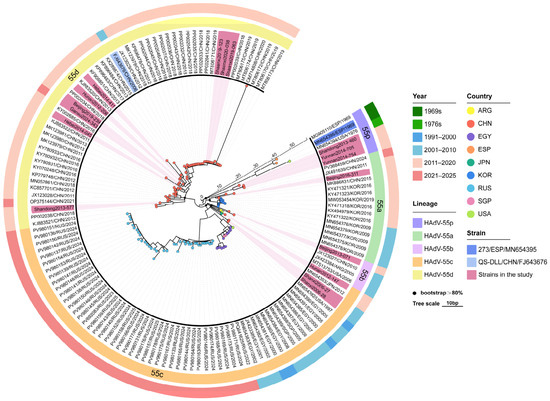
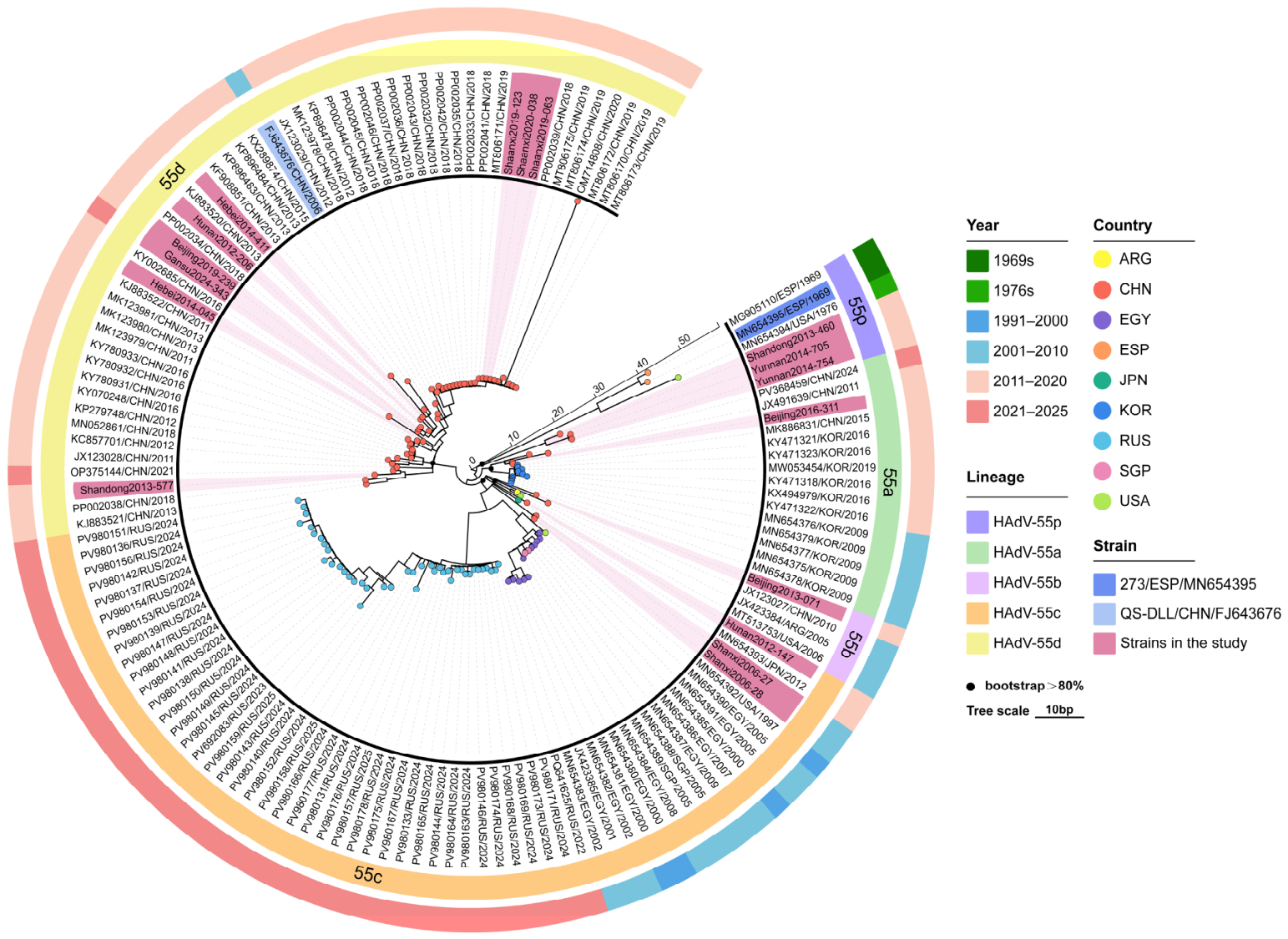
Phylogenetic analysis resolved the 139 global strains into five previously reported genotypes (55p and 55a-d) [3] (Figure 1, Supplementary Table S2). The 17 newly sequenced Chinese strains were classified as follows: (1) Three strains (Shandong, 2013; Yunnan, 2014) clustered with the genotype 55p, with a genetic distance of 0.002 from the early foreign isolates (Spain, 1969; USA, 1976); (2) one strain (Beijing, 2016) belonged to 55a, with a distance of 0.0002 from the Chinese strains (Beijing, 2011 and 2015; Yunnan, 2024) and 0.0003 from Korean isolates (11 strains, 2009–2019); (3) one strain (Beijing, 2013) was assigned to 55b, with a distance of 0.0007 from a Chongqing isolate (2010) and 0.0005 from foreign isolates (Argentina, 2005; USA, 2006); (4) three strains (Shanxi, 2006; Hunan, 2012) fell within 55c at a distance of 0.0007 from foreign isolates (USA, 1997; Egypt, 2000–2009; Japan, 2012; Russia, 2022–2025; Singapore, 2005), among which the Russian strains formed a distinct cluster; and (5) nine strains (Shandong, 2013; Hebei, 2014; Gansu, 2024; Beijing, 2019; Hunan, 2012; Shaanxi, 2019–2020) belonged to 55d at a distance of 0.0003 from 45 GenBank strains from 13 Chinese provinces (2006–2024). Notably, all genotype 55d strains originated in China, including the 2006 reference strain, QS-DLL. These 55d sequences accounted for 81.82% (54/66) of the Chinese sequences in the dataset, indicating that 55d is the predominant genotype in China and has been circulating since 2006. Therefore, subsequent analyses were focused on this genotype.
Figure 1.
Maximum-likelihood phylogenetic tree of HAdV-55 constructed using the whole-genome sequences of 139 global strains. The outer ring indicates the origin year of each strain, the inner ring indicates the genotype, and the circle at each node indicates the country of origin. The strains newly sequenced in this study are highlighted in red; the 1969 prototype strain (273/ESP/MN654395) is highlighted in dark blue; and the first reported Chinese strain from 2006 (QS-DLL/CHN/FJ643676) is shown in light blue. Branch nodes with bootstrap support values >80% are marked with black circles.
3.3. Sequence Identity Among HAdV-55d Strains
The nucleotide sequence identity of the 54 55d strains (9 from this study, 45 from GenBank) was 98.2–100%. These strains shared 98.2–99.8% nucleotide identity with the 1969 prototype strain. Further comparison of the 13 functional regions between these strains and the prototype strain (major capsid proteins penton base, hexon, and fiber; core proteins pV, pVII, pTP, pX, pIVa2, and protease; and minor capsid proteins pIX, pIIIa, pVI, and pVIII) revealed that 10 regions were highly conserved across all strains (nucleotide: ≥99.5%; amino acid: ≥99.2%), whereas the fiber (98.4–99.6%), pV (98.8–100%), and pVII (98.4–100%) showed relatively lower amino acid identities. The reduced identity in the fiber proteins was largely attributable to a six-nucleotide deletion (nt 751–756) in the knob region of strain TJ01 (KP896484, 2013), whereas the reduced identity in pV and pVII mainly resulted from amino acid substitutions in strain BJ-446 (OM714808, 2020). Compared with the Chinese reference strain, the circulating strains showed 98.4–99.9% nucleotide identity, with only strains TJ01 and BJ-446 showing similar differences in the fiber gene and pV/pVII regions, respectively. In addition, the immune evasion-associated E3 region was also highly conserved, with 99.5–99.9% sequence identity (Supplementary Table S3).
3.4. Genetic Variation in HAdV-55d
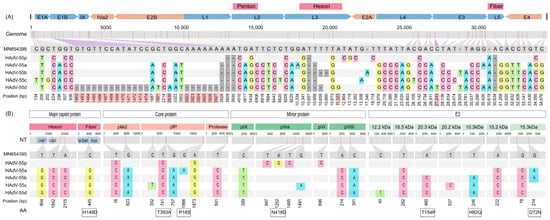
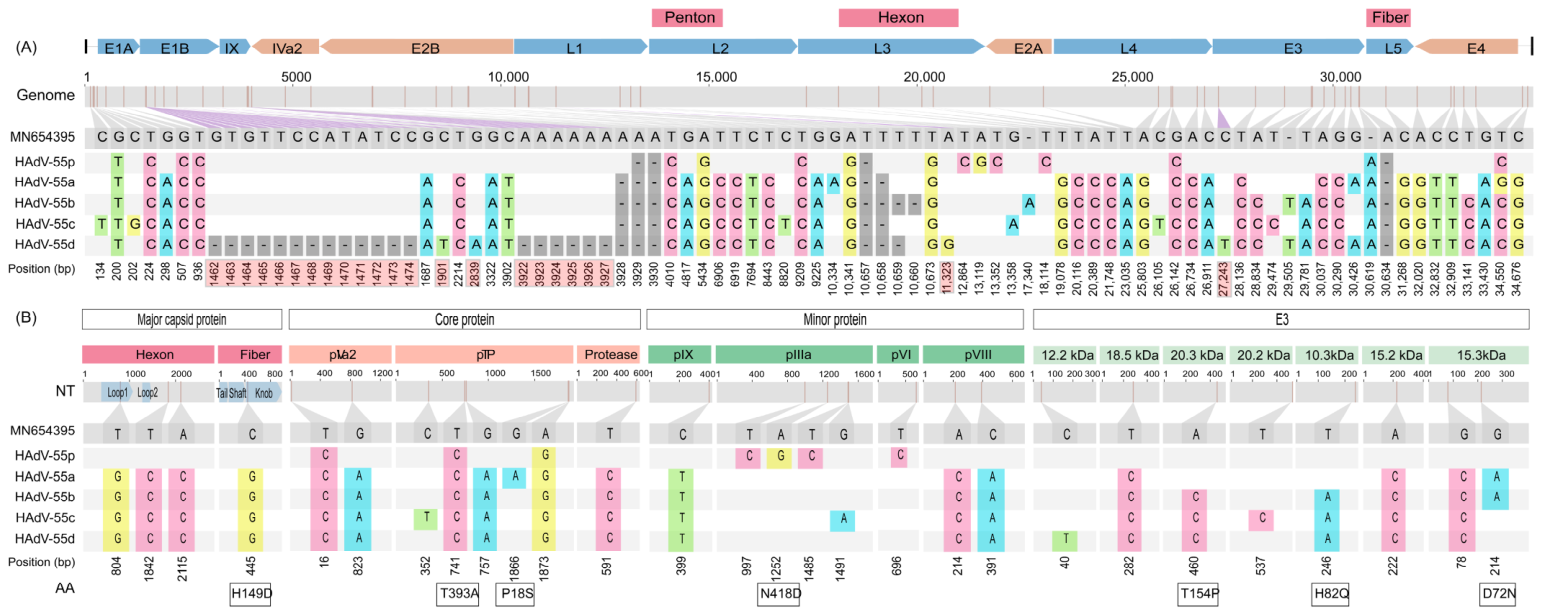
Using the HAdV-55 prototype strain as a reference, WGS-based analysis of the genetic variation identified 342 nucleotide variant sites in the genotype 55d strains (Supplementary Table S4), accounting for 0.98% of the genome length. Of these sites, 75 had a mutation frequency of ≥80%, including two insertions and 26 deletions (Figure 2). Of these, 52 were shared with other genotypes, and 23 were 55d-specific. Of the 55d-specific variants, 19 were deletions, located predominantly in noncoding regions of E1A (13 bp-deletion) and E1B (6 bp-deletion); and the remaining 4 were synonymous substitutions located in coding regions of the E1B-encoded 20.8 kDa protein (C270T) and 54.7 kDa protein (G903A), the L1-encoded 43.9 kDa protein (A642G), and the E3-encoded 12.2 kDa protein (C40T). Compared with the Chinese reference strain, only two sites had mutation frequencies ≥80%, which were located in a noncoding region (insertion A within the poly(A) sequence between nt17320-n17328) and within the E3 gene encoding a 20.3 kDa protein (G498A, synonymous substitution). Notably, no significant positively selected sites were identified in functional regions.
Figure 2.
Analysis of the genetic variation among HAdV-55 genotypes. (A) Genomic nucleotide variations using the HAdV-55 prototype strain as the reference: nucleotide variation sites with a frequency ≥80% are shown; “−” denotes a nucleotide deletion. The genotype-specific variation sites in HAdV-55d are shown with a pale pink background in the bottom line. (B) Nucleotide and amino acid variations in major functional proteins, namely the major capsid proteins, core proteins, minor proteins and the E3 region are indicated in red, pale pink, green and light green, respectively. Fiber domains (tail, shaft, and knob) and hexon loops (Loop1 and Loop2) are indicated in blue. NT, nucleotide; AA, amino acid. Boxed entries indicate amino acid changes caused by nucleotide variations at the corresponding sites.
3.5. Proliferative Capacity of HAdV-55d Strains in A549 Cells
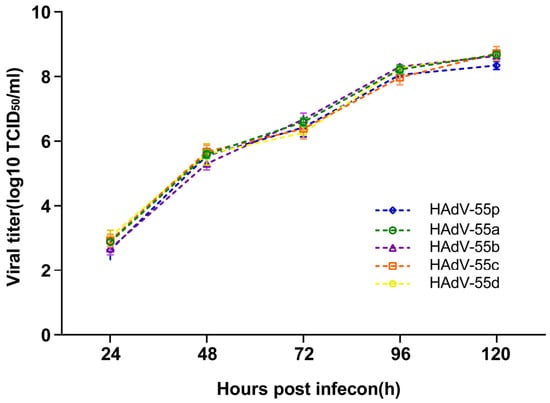
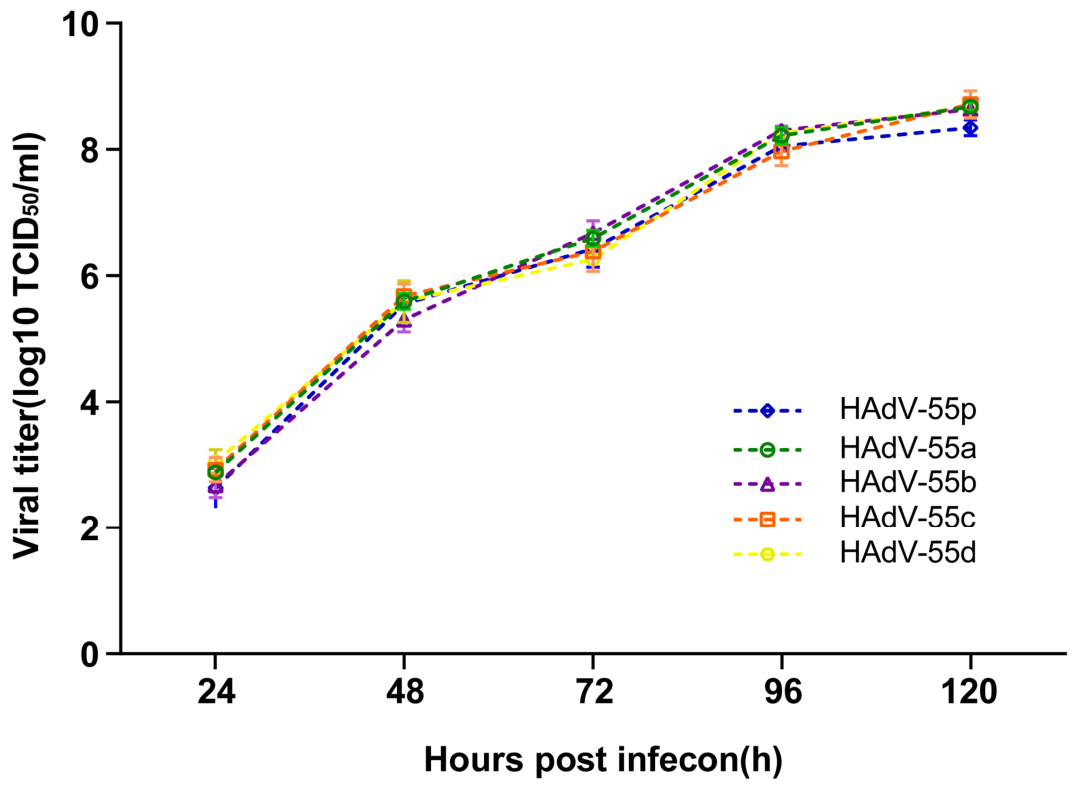
One representative strain from each genotype (55p: Yunnan2014-705; 55a: Beijing2016-311; 55b: Beijing2013-071; 55c: Shanxi2006-28; 55d: Hebei2014-045) was inoculated into the A549 cells. All strains replicated efficiently; viral titers increased significantly by 24 hpi (3.89 × 10²–1.02 × 10³ TCID50/mL) and plateaued at ~96 hpi (8.51 × 10⁷–1.82 × 10⁸ TCID50/mL) (Figure 3, Supplementary Table S5). Genotype 55d showed viral titers and cytopathic effects comparable to those of the other genotypes, with no significant differences in replication kinetics (p = 0.0157).
Figure 3.
Growth curves of five HAdV-55 strains of different genotypes in A549 cells at 24, 48, 72, 96, and 120 h post-infection (hpi). Data are presented as the mean ± SD from three independent biological experiments (n = 3).
4. Discussion
A detailed understanding of the genomic epidemiology of HAdV-55 is of considerable public health value for tracing viral transmission and variation [15]. We obtained WGSs of 17 HAdV-55 strains from eight provinces during 2006–2024 through the AFP and FRS surveillance systems, and integrated these with genomes from GenBank to assemble a dataset of 139 HAdV-55 WGSs, thus enabling a systematic genomic epidemiological analysis among HAdV-55 strains circulating in China. HAdV-55 has been genotyped either by the presence or absence of an insertion upstream of the E1A poly(A) site [11] or by whole-genome phylogeny [3]. As our study addresses the genetic and evolutionary relationships of HAdV-55 circulating in China, we adopted the latter, phylogeny-based five-genotype framework.
Phylogenetic analysis assigned the 66 HAdV-55 strains from China (17 from this study and 49 from GenBank) to five genotypes (55p and 55a–55d), thus revealing the genetic diversity of HAdV-55 circulating in China during 2006–2024. Genotype 55d was most frequent (81.82%). It was first identified in Shaanxi Province in 2006 and has since been detected in at least 16 provinces, becoming the predominant genotype in China. Notably, 55d has been reported exclusively in China, and its detection in both the FRS and AFP surveillance systems points to its predominant status among circulating HAdV-55 strains. Similar geographic clustering was observed for 55c in Russia [16]. In contrast, a few strains of other genotypes (55p, 55a-c) identified in China were genetically closely related to foreign strains, which is consistent with sporadic introduction events [17]. Overall, the HAdV-55 population in China is characterized by the sustained endemic circulation of 55d, with sporadic introduction of other genotypes. Nevertheless, sustained and broader surveillance remains necessary to track the epidemic dynamics of 55d in China over time.
Genetic variation analysis revealed that 55d strains were highly consistent with the 1969 prototype strain (>98.2%) and showed higher conservation (>99.0%) across the 13 functional regions and immune evasion-associated E3 region, indicating strong functional constraints on core structural/functional proteins. Among the 54 55d strains (2006–2024), only 75 high-frequency variant sites were identified, 23 of which were 55d genotype-specific. When compared with the earliest Chinese 55d strain in 2006, these strains harbored only two high-frequency variant sites. Notably, none of the genotype-specific variants led to amino acid changes, suggesting remarkable stability over nearly two decades of circulation. This finding is consistent with the overall high conservation of HAdV-55, which provides a basis for developing broadly protective vaccines against different HAdV-55 genotypes [18]. Similar genomic conservation is seen in other recombinant types, such as HAdV-114. A recombinant of HAdV-3 and HAdV-7, HAdV-114 has circulated for nearly four decades with a sequence identity above 98.3% [19]. Growth curve analysis revealed that 55d had no significant cellular replication advantage over the other genotypes, suggesting that its predominant circulation in China may arise from the combined influence of epidemiological and host factors.
HAdV-55 originated from the recombination between an HAdV-14 backbone and a partial hexon gene fragment of HAdV-11. Its parental HAdV-14 variant, 14p1, is a major cause of severe pneumonia in adults and is characterized by a 6-nucleotide deletion in the fiber gene (nt 751–756) [20]. Interestingly, sequence alignment identified the same deletion in the fiber gene of a 55d strain (TJ01, 2013) [11], suggesting that the HAdV-14 fragments in HAdV-55 may have multiple origins. Recombination is a key evolutionary driver of adaptive evolution in HAdVs [2]. For example, HAdV-114 (a type 3/7 recombinant) has remained highly stable since 1988 [19]; however, during circulation, its fiber gene underwent a second recombination with HAdV-7, generating the novel genotype HAdV-117, which causes severe pneumonia [21]. Given that HAdV-55 can cause outbreaks and lead to severe respiratory infections in both children and adults [22,23], and that five of the nine 55d strains identified in this study were from LRTIs, strengthened whole-genome surveillance of HAdV-55 is warranted, particularly for dynamic monitoring of recombination and variation in the dominant 55d, so as to provide relevant genetic data for identifying outbreaks and controlling HAdV-55-related infection.
The limitations of this study are as follows: (1) the HAdV-55 strains analyzed in this study cover only a subset of countries worldwide and provinces within China, and therefore the geographic coverage is subject to sampling bias; (2) growth kinetics were compared using a single representative strain per genotype, and a few variants, including the fiber-deleted strain TJ01 and the pV/pVII-mutant strain BJ-446, were not tested, which somewhat limits the representativeness of the results; (3) replication of representative strains from each genotype was compared only in vitro, without in vivo and serological cross-reactivity validation.
5. Conclusions
This study showed that 55d is the predominant HAdV-55 genotype in China, and has been in circulation since 2006. Its genome is highly conserved and confers no significant replication advantage over other genotypes. These findings enrich the genomic epidemiological data on HAdV-55 and provide a scientific basis for the future development of antiviral drugs and vaccines.
Supplementary Materials
The following supporting information can be downloaded at: https://www.mdpi.com/article/10.3390/v18121310/s1, Table S1: The list of HAdV-55 sequences from the GenBank dataset; Table S2: Spatiotemporal distribution of HAdV-55 genotypes; Table S3: Sequence identity between genotype HAdV-55d and the reference strains; Table S4: Nucleotide variations identified in 54 HAdV-55d strains; Table S5: Growth kinetics of representative strains of the five HAdV-55 genotypes in A549 cells.
Author Contributions
Data curation, H.Z. and Y.J.; Methodology, H.Z., Y.J., W.H., H.D., J.T., J.T., Y.L., Q.W.; Resources, J.X., Y.Z. (Yun Zhu), X.H., X.X., Y.H., J.Y. (Jianfang Yang), J.Y. (Jie Yin), X.G., J.C., Q.L., B.X. and A.C.; Supervision, Z.Z., N.M. and Y.Z. (Yan Zhang); Validation, Z.Z., and N.M.; Writing—original draft, H.Z. and Y.J.; Writing—review and editing, Z.Z. and N.M. All authors have read and agreed to the published version of the manuscript.
Funding
This research was funded by the National Key R&D Program of China (2022YFC2305303).
Institutional Review Board Statement
This study was approved by the second session of the Ethics Review Committee of the National Institute for Viral Disease Control and Prevention (IVDC) at the China Centers for Disease Control and Prevention (CDC). All methods used in this study were performed according to the relevant guidelines and regulations.
Informed Consent Statement
Not applicable.
Data Availability Statement
The genome sequences of the 17 HAdV-55 strains used in this study have been deposited in the China National Microbiology Data Center (NMDC; https://nmdc.cn/resource/search, accessed on 12 October 2026) under accession numbers NMDCN000DFBC–NMDCN000DFBS.
Acknowledgments
The study used only viral strains and did not involve sample collection. We sincerely thank the eight Chinese sentinel surveillance provinces for providing the viral strains and associated data.
Conflicts of Interest
The authors declare no conflicts of interest.
References
- Benkő, M.; Aoki, K.; Arnberg, N.; Davison, A.J.; Echavarría, M.; Hess, M.; Jones, M.S.; Kaján, G.L.; Kajon, A.E.; Mittal, S.K.; et al. ICTV virus taxonomy profile: Adenoviridae 2022. J. Gen. Virol. 2022, 103, 001721. [Google Scholar] [CrossRef] [Scilit] [PubMed]
- Walsh, M.P.; Seto, J.; Jones, M.S.; Chodosh, J.; Xu, W.; Seto, D. Computational analysis identifies human adenovirus type 55 as a re-emergent acute respiratory disease pathogen. J. Clin. Microbiol. 2010, 48, 991–993. [Google Scholar] [CrossRef] [Scilit] [PubMed]
- Luo, W.; Guo, W.; Li, Y.; Zhao, C.; Weng, Z.; Duan, B.; Wu, J.; Yu, X.; Chen, Z.; Seto, D.; et al. High pathogenicity of human adenovirus type 55 in adult males: A meta-analysis and phylogenetic study of HAdV-55 epidemics worldwide over the past six decades. Emerg. Microbes Infect. 2026, 15, 2648885. [Google Scholar] [CrossRef] [Scilit] [PubMed]
- Yang, Z.; Zhu, Z.; Tang, L.; Wang, L.; Tan, X.; Yu, P.; Zhang, Y.; Tian, X.; Wang, J.; Zhang, Y.; et al. Genomic analyses of recombinant adenovirus type 11a in China. J. Clin. Microbiol. 2009, 47, 3082–3090. [Google Scholar] [CrossRef] [Scilit] [PubMed]
- Hierholzer, J.C.; Pumarola, A.; Rodriguez-Torres, A.; Beltran, M. Occurrence of respiratory illness due to an atypical strain of adenovirus type 11 during a large outbreak in Spanish military recruits. Am. J. Epidemiol. 1974, 99, 434–442. [Google Scholar] [CrossRef] [Scilit] [PubMed]
- Hang, J.; Kajon, A.E.; Graf, P.C.F.; Berry, I.M.; Yang, Y.; Sanborn, M.A.; Fung, C.K.; Adhikari, A.; Balansay-Ames, M.S.; Myers, C.A.; et al. Human adenovirus type 55 distribution, regional persistence, and genetic variability. Emerg. Infect. Dis. 2020, 26, 1497–1505. [Google Scholar] [CrossRef] [Scilit] [PubMed]
- Wang, W.; Liu, Y.; Zhou, Y.; Gu, L.; Zhang, L.; Zhang, X.; Chen, M.; Zou, Z.; Qiu, W.; Hu, X.; et al. Whole-genome analyses of human adenovirus type 55 emerged in Tibet, Sichuan and Yunnan in China, in 2016. PLoS ONE 2017, 12, e0189625. [Google Scholar] [CrossRef] [Scilit] [PubMed]
- Liu, H.; Li, Q.; Xiang, Y.; Li, H.; Liu, K.; Du, X.; Yang, C.; Liu, H.; Shi, M.; Hu, X.; et al. An outbreak of acute respiratory disease caused by HAdV-55 in Beijing, China, 2020. J. Med. Virol. 2022, 94, 6111–6115. [Google Scholar] [CrossRef] [Scilit] [PubMed]
- Yi, L.; Zou, L.; Lu, J.; Kang, M.; Song, Y.; Su, J.; Zhang, X.; Liang, L.; Ni, H.; Ke, C.; et al. A cluster of adenovirus type B55 infection in a neurosurgical inpatient department of a general hospital in Guangdong, China. Influenza Other Respir. Viruses 2017, 11, 328–336. [Google Scholar] [CrossRef] [Scilit] [PubMed]
- Li, X.; Kong, M.; Su, X.; Zou, M.; Guo, L.; Dong, X.; Li, L.; Gu, Q. An outbreak of acute respiratory disease in China caused by human adenovirus type B55 in a physical training facility. Int. J. Infect. Dis. 2014, 28, 117–122. [Google Scholar] [CrossRef] [Scilit] [PubMed]
- Chen, S.Y.; Liu, W.; Xu, Y.; Qiu, S.; Chen, Y.; Tian, X.; Zhou, R. Epidemiology and genetic variabilities of human adenovirus type 55 reveal relative genome stability across time and geographic space in China. Front. Microbiol. 2020, 11, 606195. [Google Scholar] [CrossRef] [Scilit] [PubMed]
- Katoh, K.; Standley, D.M. MAFFT multiple sequence alignment software version 7: Improvements in performance and usability. Mol. Biol. Evol. 2013, 30, 772–780. [Google Scholar] [CrossRef] [Scilit] [PubMed]
- Hall, T.A. BioEdit: A user-friendly biological sequence alignment editor and analysis program for Windows 95/98/NT. Nucleic Acids Symp. Ser. 1999, 41, 95–98. [Google Scholar]
- Minh, B.Q.; Schmidt, H.A.; Chernomor, O.; Schrempf, D.; Woodhams, M.D.; von Haeseler, A.; Lanfear, R. IQ-TREE 2: New models and efficient methods for phylogenetic inference in the genomic era. Mol. Biol. Evol. 2020, 37, 1530–1534. [Google Scholar] [CrossRef] [Scilit] [PubMed]
- Evans, D.; Kunerth, H.; Mumm, E.; Namugenyi, S.; Plumb, M.; Bistodeau, S.; Cunningham, S.A.; Schmitt, B.; Martin, K.; Como-Sabetti, K.; et al. Genomic epidemiology of human respiratory syncytial virus, Minnesota, USA, July 2023–February 2024. Emerg. Infect. Dis. 2024, 30, 2414–2418. [Google Scholar] [CrossRef] [Scilit] [PubMed]
- Yolshin, N.D.; Ivanova, A.A.; Perederiy, A.A.; Amosova, I.V.; Timoshicheva, T.A.; Stolyarov, K.A.; Danilenko, D.M.; Lioznov, D.A.; Komissarov, A.B. Nationwide genomic surveillance of human respiratory adenoviruses in 2023–2024: Evidence of extensive diversity and recombination in Russia. Viruses 2026, 18, 136. [Google Scholar] [CrossRef] [Scilit] [PubMed]
- Yoo, H.; Gu, S.H.; Jung, J.; Song, D.H.; Yoon, C.; Hong, D.J.; Lee, E.Y.; Seog, W.; Hwang, I.U.; Lee, D.; et al. Febrile respiratory illness associated with human adenovirus type 55 in South Korea military, 2014–2016. Emerg. Infect. Dis. 2017, 23, 1016–1020. [Google Scholar] [CrossRef] [Scilit] [PubMed]
- Feng, Y.; Shu, T.; Li, L.; Sun, X.; Yu, C.; Liu, W.; Hong, L.; Li, J.; Zhao, S.; Zeng, W.; et al. A replication-incompetent adenovirus type 55 vaccine induces broad and durable protective immunity against pathogenic adenoviruses. Mol. Ther. 2026, 34, 1597–1615. [Google Scholar] [CrossRef] [Scilit] [PubMed]
- Li, C.; Jin, Y.; Xu, J.; Feng, D.; Chen, H.; Zhang, F.; Ma, X.; Xie, Z.; Li, M.; Chu, Y.; et al. Genomic analysis reveals dominance of human adenovirus genotype B114 among circulating strains historically identified as B3. J. Med. Virol. 2026, 98, e70993. [Google Scholar] [CrossRef] [Scilit] [PubMed]
- Jin, Y.; Wang, J.; Mao, N.; Zhu, C.; Zhou, H.; He, W.; Ding, H.; Xia, B.; Cui, A.; Zhang, Y.; et al. Genomic insights into the 2024 HAdV-14p1 strain in China: Traced to early prevalent strains. China CDC Wkly. 2026, 8, 195–200. [Google Scholar] [CrossRef] [Scilit] [PubMed]
- Wang, J.; Jing, L.; Duan, Y.; Guan, X.; Cui, Y.; Ai, J.; Wang, R.; Chen, X.; Bi, Y.; Liu, X.; et al. Identification of novel recombinant human adenovirus genotype B117 from pediatric cases, China. Emerg. Infect. Dis. 2026, 32, 950–958. [Google Scholar] [CrossRef] [Scilit] [PubMed]
- Cao, B.; Huang, G.H.; Pu, Z.H.; Qu, J.X.; Yu, X.M.; Zhu, Z.; Dong, J.P.; Gao, Y.; Zhang, Y.X.; Li, X.H.; et al. Emergence of community-acquired adenovirus type 55 as a cause of community-onset pneumonia. Chest 2014, 145, 79–86. [Google Scholar] [CrossRef] [Scilit] [PubMed]
- Liu, M.C.; Xu, Q.; Li, T.T.; Wang, T.; Jiang, B.G.; Lv, C.L.; Zhang, X.A.; Liu, W.; Fang, L.Q. Prevalence of human infection with respiratory adenovirus in China: A systematic review and meta-analysis. PLoS Negl. Trop. Dis. 2023, 17, e0011151. [Google Scholar] [CrossRef] [Scilit] [PubMed]

Disclaimer/Publisher’s Note: The statements, opinions and data contained in all publications are solely those of the individual author(s) and contributor(s) and not of MDPI and/or the editor(s). MDPI and/or the editor(s) disclaim responsibility for any injury to people or property resulting from any ideas, methods, instructions or products referred to in the content. |
© 2026 by the authors. Licensee MDPI, Basel, Switzerland. This article is an open access article distributed under the terms and conditions of the Creative Commons Attribution (CC BY) license.