


Abstract
Continuous genomic surveillance of influenza virus is critical for monitoring viral evolution, detecting emerging variants, and informing vaccine strain selection. While partial-gene Sanger sequencing has traditionally underpinned national surveillance programs, whole-genome sequencing (WGS) enables simultaneous characterization of all eight genomic segments, providing resolution not achievable through conventional approaches. This is the first published, systematic, whole-genome-based influenza surveillance study reported from Greece. We sequenced and characterized influenza viruses circulating in Southern Greece (S. Greece) during two consecutive influenza seasons, 2024–2025 and 2025–2026, using Oxford Nanopore Technologies (ONT) sequencing. A total of 40 samples were analyzed, with complete or near-complete genome assembly achieved in the vast majority of them. During 2024–2025, co-circulation of A(H1N1)pdm09 (subclades C.1.9.3 and D.3.1), A(H3N2) (subclades J.1.1 and J.2.2), and B/Victoria (C.5 subclades, predominantly C.5.7) influenza viruses was confirmed, with the detection of an oseltamivir-resistant H1N1 variant carrying NA H275Y as a clinically significant finding. Extension of surveillance into 2025–2026 revealed a complete inter-seasonal lineage transition in A(H1N1)pdm09 from subclade C.1.9.3 to D.3.1/D.3.1.1, and the rapid emergence and geographic dissemination of A(H3N2) subclade K across multiple regions of Southern Greece. Phylogenetic analysis characterized the HA subclade composition across the two seasons and positioned the Greek strains within the European and global context. Sequences of subclade K strains from S. Greece were phylogenetically concordant with the updated 2026–2027 vaccine strains, in line with ECDC and WHO surveillance data. Whole-genome analysis confirmed the absence of virulence-associated polymerase markers in all isolates with fully assembled polymerase segments, and identified conserved internal segment substitution patterns co-segregating with circulating subclades. These findings provide the first published whole-genome evolutionary dataset for influenza in Southern Greece, contributing insight into subtype and clade-level evolutionary dynamics and demonstrating the public health value of sustained genomic surveillance at a national reference laboratory level.
Keywords:
influenza; surveillance; sequencing; whole-genome; Oxford nanopore; Greece; phylogenetics; H1N1; H3N2 1. Introduction
Seasonal influenza infections remain a significant global public health concern, causing widespread annual epidemics that lead to substantial morbidity and mortality. The World Health Organization (WHO) estimates that influenza epidemics result in three to five million cases of severe illness and 290,000 to 650,000 deaths worldwide annually [1,2]. Influenza viruses evolve continuously under immune selection pressure. Point mutations accumulating in the hemagglutinin (HA) and neuraminidase (NA) surface glycoproteins drive antigenic drift, the gradual process underlying seasonal vaccine mismatch, while reassortment of the eight-segmented genome can produce antigenic shift and novel pandemic lineages. Circulating viruses are classified into hierarchically defined genetic clades and subclades based on HA sequence divergence, a framework that allows tracking of lineage turnover and emergence of novel variants over time [3,4].
In the European context, the European Centre for Disease Prevention and Control (ECDC) coordinates surveillance activities to provide a comprehensive insight into influenza activity across the continent [5]. National influenza reference laboratories play a vital role in the global surveillance network, providing timely and high-resolution data on circulating strains. Genetic characterization of these viruses is essential for tracking clade emergence, identifying mutations affecting vaccine efficacy, and detecting antiviral resistance [6,7]. Continuous genomic surveillance across consecutive influenza seasons provides critical insights into viral persistence, lineage turnover, and evolutionary dynamics within regional populations, contributing to both national and international public health preparedness.
In recent years, the application of whole-genome sequencing (WGS) technologies has revolutionized viral surveillance. The widespread implementation of WGS during the COVID-19 pandemic has transformed global pathogen monitoring, and in the post-COVID era, this technological momentum has extended beyond SARS-CoV-2, driving its application to other respiratory viruses such as influenza [8]. Compared to traditional Sanger sequencing of hemagglutinin (HA) and neuraminidase (NA) genes, WGS captures all eight gene segments simultaneously, enabling detection of reassortment events, resistance-associated mutations beyond the NA gene, emergence of adaptation mutations and precise phylogenetic placement within global evolutionary frameworks [9,10]. Sequencing platforms, such as Oxford Nanopore technology, now enable rapid turnaround times and cost-effective implementation, supporting integration of genomic surveillance into routine laboratory work even in resource-limited settings [11,12].
To date, genomic data on influenza viruses circulating in Greece remain fragmentary and are limited to partial or whole gene sequencing of selected strains. Thus, Greek contribution to broader European surveillance networks lacks systematic whole-genome characterization conducted across consecutive seasons [13,14]. This study addresses that gap with two specific objectives. It provides the first published WGS-based influenza surveillance dataset from a Greek national reference laboratory spanning two consecutive years (2024–2025 and 2025–2026), demonstrating what whole-genome resolution adds to genetic epidemiology beyond conventional HA/NA Sanger sequencing: simultaneous characterization of all eight segments, detection of resistance markers across NA, M2, and PA genes and genome-wide characterization of substitutions across all eight segments. Second, it characterizes the emergence and dissemination of A(H3N2) subclade K in Southern Greece—establishing the viral pools from which it arose relative to contemporaneous J.1.1/J.2.2 circulation, its sequence characteristics compared to subclade K viruses circulating across Europe in the same period, and its phylogenetic relationship to the 2025–2026 recommended vaccine strains.
2. Materials and Methods
2.1. Sample Collection
From the pool of RT-PCR-confirmed influenza-positive respiratory samples received during the 2024–2025 and 2025–2026 surveillance seasons, a subset (n = 40) was selected for whole-genome sequencing according to predefined criteria. During the 2024–2025 season, 481 influenza-positive samples were confirmed by RT-PCR (171 A(H1N1)pdm09, 163 A(H3N2), 148 B), and during 2025–2026, 362 were confirmed (153 A(H1N1)pdm09, 208 A(H3N2), 1 B). From these, 21 (4.4%) and 19 (5.2%) samples, respectively, were selected for whole-genome sequencing (40 in total, 4.7% of all positives). An approximate 5% sampling rate is operationally sound and cost-effective for routine surveillance during normal-to-high activity periods. Nevertheless, our sampling was aim-driven: in 2024–2025, influenza A and B were sequenced in comparable numbers to characterize both co-circulating types, and in 2025–2026 sequencing was enriched for A(H3N2) to capture the emerging subclade K. Moreover, samples were distributed across the epidemic weeks of each season (weeks 2–49 during 2024, and weeks 8–52 during 2025), across surveillance streams (comprising sentinel—ILI, primary-care—samples, non-sentinel hospital-based samples, and SARI cases; including samples associated with ICU admission), sexes (final dataset comprising 19 female and 21 male patients), and age groups (from 4 to 89 years, ensuring representation across pediatric, adult, and elderly age groups), subject to the viral-load threshold required for amplicon-based WGS. Although a Ct threshold of ≤28 was preferred for optimal sequencing performance, in selected cases—notably to include specimens from hospitalized and ICU patients and to preserve geographic representation—samples with Ct values up to 34 were also processed. Thus, within the eligible pool, samples were chosen to maintain representativeness across epidemic week, region, surveillance stream and clinical severity.
2.2. Viral RNA Extraction and Library Preparation
Viral nucleic acid was extracted from respiratory clinical samples using the EZ1&2 Virus Mini Kit v2.0 (Qiagen, Hilden, Germany) and an EZ2 Connect automatic nucleic acid extraction instrument (Qiagen, Hilden, Germany), following the manufacturer’s instructions. Briefly, 200 µL of each specimen was processed, and RNA was eluted in 60 µL of Elution Buffer. Nucleic acid extracts were stored at –80 °C until further analysis.
To prepare samples for NGS, viral RNA was reverse transcribed and amplified using the Oxford Nanopore Technologies (ONT) ligation sequencing influenza whole genome V14 protocol [13] with minor modifications. PCR products were purified using AMPure XP magnetic beads and quantified using the Qubit dsDNA HS Assay Kit (Thermo Fisher Scientific, Waltham, MA, USA) to ensure adequate yield for downstream library preparation. Cleaned amplicons were then prepared for sequencing using the Ligation sequencing influenza whole genome V14 kit (SQK-NBD114.24, Oxford Nanopore Technologies, Oxford, UK), following the manufacturer’s recommendations [15].
Sequencing was carried out on R10.4.1 flow cells (FLO-MIN114) using a MinION Mk1D device (Oxford Nanopore Technologies, UK). Each flow cell was loaded with 100 fmol of prepared library in a final volume of 37.5 µL sequencing buffer and 25.5 µL library beads, as recommended by the ONT V14 protocol [13]. Sequencing runs were monitored using the MinKNOW software (v.23.07.7, Oxford Nanopore Technologies, UK), and data were collected in real time. Water-negative controls included in each run returned negligible read counts, confirming the absence of cross-contamination.
2.3. Whole Genome Assembly and Bioinformatics Analysis
Basecalling was performed on MinKNOW v25.03.9, with a run time of up to 7 h, pore scan frequency of 1.5 h, and basecalling performed in real time using the high-accuracy (HAC) Dorado model at 400 bases per second (Dorado v7.8.3, v7.9.8 and v7.11.2 across the different sequencing runs). A minimum Q score threshold of 9 was applied during live basecalling to filter low-quality reads. FASTQ files were generated automatically every 10 min, while POD5 data were stored in batches of up to 50 million bases.
Initially, basecalled and demultiplexed reads were processed with the wf-flu workflow (epi2me-labs/wf-flu v1.2.4 and v1.3.1; EPI2ME, Oxford Nanopore Technologies) to obtain preliminary consensus genomes, subtype assignments, and quick quality metrics. Then, FASTQ files were uploaded and processed to the INSaFLU platform (v2.2.2) [16,17] for whole-genome analysis and characterization. Reads were mapped to influenza A and B reference genomes using the platform’s integrated workflow. Consensus sequences were reconstructed for all eight genomic segments using majority-rule basecalling, and ambiguous positions were annotated with IUPAC codes. Quality control metrics, including genome completeness and mean depth of coverage, were assessed within the INSaFLU platform.
Subtype verification (for influenza A) and lineage assignment (for influenza B) were performed automatically by the INSaFLU platform. Mutational screening against reference databases was also conducted to identify substitutions associated with antigenic drift or antiviral resistance.
All resulting sequences were submitted to GISAID EpiFlu and reported to ECDC (accession numbers are available in the GISAID database; see Table 1 and Table 2).
Table 1.
Sequencing quality metrics for influenza A and B samples (2024–2025 season). Reads and bases are shown for passed reads only—Q ≥ 9. BC = barcode; ILI = influenza-like illness; SENT = sentinel; SARI = severe acute respiratory infection.
Table 2.
Sequencing quality metrics for influenza A samples (2025–2026 season). Reads and bases are shown for passed reads only—Q ≥ 9. BC = barcode. ILI = influenza-like illness; SENT = sentinel; SARI = severe acute respiratory infection. P1 = passage 1 isolate. N50 values reflect full-run metrics—all samples per run combined.
2.4. Phylogenetic and Mutational Analysis
Whole-genome consensus sequences for all influenza A and B samples were assembled and analyzed using the INSaFLU platform, which performs reference-based assembly and phylogenetic reconstruction through direct comparison against a user-selected reference strain, in this case 2025–2026 Northern Hemisphere vaccine reference strains were used [A/Victoria/4897/2022/EPI_ISL_16714268 for A(H1N1)pdm09, A/Croatia/10136RV/2023/EPI_ISL_19296516 for A(H3N2), and B/Austria/1359417/2021/EPI_ISL_1519459 for B/Victoria], sourced from the Global Initiative on Sharing All influenza Data (GISAID) database. To further characterize clade- and subclade-level evolution, the HA and NA gene segments were additionally analyzed using Nextclade (v2.16.1) and visualized within Nextstrain (v4.0.0) builds [18,19,20], which assign sequences to predefined global clades using Nextstrain’s curated reference datasets, enabling standardized placement within globally circulating lineages. Throughout, we follow the hierarchical Nextstrain/Nextclade nomenclature [21]: broad genetic groups are designated clades (5a.2a and 5a.2a.1 for A(H1N1)pdm09; 2a.3a.1 for A(H3N2); V1A.3a.2 for B/Victoria), and the finer letter-designated groups nested within them are subclades—C.1.9.3 within clade 5a.2a; D.3.1 and D.3.1.1 within clade 5a.2a.1; J.1.1, J.2.2, J.2.3 and K (J.2.4.1) within clade 2a.3a.1; and C.5 with its descendants C.5.1, C.5.6, C.5.6.1 and C.5.7 within clade V1A.3a.2. Maximum-likelihood phylogenetic trees were reconstructed using MEGA 12.1.2 [22] under the Hasegawa-Kishino-Yano (HKY) nucleotide substitution model with a proportion of invariant sites (I). All codon positions and non-coding sites were included in the analysis. Gaps and missing data were handled by partial deletion, with a site-coverage cutoff of 95%. Tree topology was heuristically searched using the Nearest-Neighbor-Interchange (NNI) method, with the initial tree generated automatically by the Neighbor-Joining/Maximum-Parsimony algorithm and no branch-swap filter applied. Node support was evaluated by standard bootstrap analysis with 1000 replicates. Phylogenetic reconstruction was performed using the HA segment. HA is the primary determinant of antigenic properties and the basis for the WHO/Nextclade clade and subclade nomenclature used in global influenza surveillance and vaccine-strain selection; as the principal aims of this study were clade-level characterization and assessment of vaccine match, HA serves as both phylogenetically most informative and internationally standardized target.
Genetic characterization was carried out by screening all eight gene segments for amino acid substitutions relative to the reference strains, with particular attention to the HA and NA segments given their role in antigenic drift and antiviral drug susceptibility. Substitutions in HA and NA were then interpreted with reference to the Centers for Disease Control and Prevention (CDC) antiviral resistance database and published literature [23,24] to assess their potential association with altered antigenicity or reduced susceptibility to neuraminidase inhibitors (e.g., oseltamivir, zanamivir).
3. Results
In this study, a total of 40 influenza virus-positive samples (28 for influenza A and 12 for influenza B) were analyzed across two consecutive influenza seasons, enabling longitudinal assessment of influenza virus evolution in S. Greece. From these samples, 19 were collected from female and 21 from male patients between 4 and 86 years of age. Seven samples belonged to hospitalized patients, with six of them being Intensive Care Unit (ICU) patients. Twenty-one influenza-positive samples were collected via nasopharyngeal/oropharyngeal swabbing during the 2024–2025 period (Table S1) (9 influenza A and 12 influenza B viruses) and 19 samples (all influenza A) during the 2025–2026 season (Table S2).
3.1. Next-Generation Sequencing and Data Quality
During the 2024–2025 season, 21 samples (9 influenza A and 12 influenza B) were sequenced. Pass rates were consistently high across runs, ranging from 95.0 to 96.0% for influenza A and 97.0–99.0% for influenza B. B/Athens/ILI199/2025 produced the lowest yield among influenza B samples (22.9 k reads, 17.1 Mb) and was excluded from all downstream analyses due to insufficient genome coverage. Per-sample sequencing metrics are presented in Table 1.
During the 2025–2026 season, 19 influenza A samples were sequenced. Pass rates ranged from 93.7% to 97.6% per sample. Only one Influenza B-positive specimen was detected among the 362 RT-PCR-confirmed influenza cases (0.3%) during the 2025–2026 surveillance period. Per-sample sequencing metrics are presented in Table 2.
Across both seasons and all sequencing runs, the consistently high read quality confirms the suitability of the generated data for downstream genome assembly, subtype characterization, antiviral resistance screening and phylogenetic analysis.
3.2. Whole-Genome Assembly and Coverage
Consensus genome assembly was performed using the INSaFLU platform, with reads mapped to influenza A and B reference sequences covering all eight genomic segments: PB2, PB1, PA, HA, NP, NA, M, and NS. Coverage was assessed at ≥1× and ≥30× depth thresholds. Assembly outcomes for both seasons are presented in Table 3 and Table 4.
Table 3.
Whole-genome assembly coverage metrics (2024–2025 season). Mean and minimum depth of coverage are reported across all eight genomic segments. Coverage thresholds of ≥1× and ≥30× are shown as the percentage of segment length covered. B/Athens/ILI199/2025 was excluded from all downstream analyses due to insufficient genome coverage.
Table 4.
Whole-genome assembly coverage metrics (2025–2026 season). Mean and minimum depth of coverage are reported across all eight genome segments. Assembled segments indicate the number of segments reaching ≥30× coverage across ≥95% of their length. A/Athens.GR/ILI628_P1/2025—passage 1 isolate—was excluded from further analysis—see Methods.
During the 2024–2025 season, 17 of the 21 retained samples achieved complete 8/8 segment assembly with 100% coverage at ≥30×, with mean depths ranging from 938× to 6244×. Two samples yielded partial assemblies: A/Athens/63/2025 (H1N1, 5/8 segments; PB2, PB1, and PA below threshold) and B/Athens/ILI186/2025 (B/Victoria, 7/8 segments; PB2 below threshold). In both cases, HA and NA segments were fully assembled and retained for subtype characterization and substitution analysis. Three H3N2 samples and B/Athens/ILI89/20 showed PB1 or NS coverage of 99.9% and 99.8% at ≥30×, respectively, attributed to a single terminal position below threshold.
During the 2025–2026 season, 15 of the 19 retained samples achieved complete 8/8 assembly, with mean depths of 153× to 8159×. Four samples yielded partial assemblies, all involving polymerase segments: A/Athens.GR/46/2026 (H1N1, 5/8; PB2, PB1, PA), A/Athens.GR/103/2025 and A/Athens.GR/SENT18351/2025 (H3N2, 5/8 each; PB2, PB1, PA), and A/Corfu.GR/117/2025 (H3N2, 6/8; PB2, PB1). In all four cases, HA and NA were fully assembled. Polymerase segment data from these samples are excluded from variant and phylogenetic analyses.
3.3. Influenza Subtype Determination, Clade Assignment and Mutational Analysis
Subtyping was confirmed by INSaFLU (Abricate) and the wf-flu pipeline. Nextclade v2.16.1 was used for HA-based clade assignment. All samples passed quality control with a ‘good’ status. Clade assignments are summarized in Table 5 and Table 6; HA and NA amino acid substitutions are presented in Tables S3 and S4.
Table 5.
Influenza A and B subtype and Nextclade subclade assignments (2024–2025 season). Short clade notation reflects the legacy WHO/FluNet short-form designation.
Table 6.
Influenza A subtype and Nextclade subclade assignments (2025–2026 season). Short clade notation reflects the legacy WHO/FluNet short-form designation. No influenza B positive samples were identified in this season.
During the 2024–2025 season, epidemiological surveillance identified 5 A(H1N1)pdm09, 4 A(H3N2), and 12 B/Victoria clinical samples (one passage-1 culture, A/Athens/21c/2025, derived from A/Athens/21/2025, was additionally sequenced; B/Athens/ILI199/2025 was excluded from downstream analysis for insufficient coverage) reflecting the co-circulation of influenza A and B viruses reported across Europe during the same season. A(H1N1)pdm09 samples are divided across subclades C.1.9.3 (n = 3 clinical, plus the 21c culture) and D.3.1 (n = 2), with the two subclades displaying markedly distinct HA substitution profiles. A finding to be noted was the detection of the oseltamivir resistance marker H275Y in NA in one C.1.9.3 sample—A/Athens/21/2025 (and its culture A/Athens/21c/2025) from surveillance week 3. No resistance markers were identified in any other sample. The four A(H3N2) samples were divided across subclades J.1.1 (n = 3) and J.2.2 (n = 1), with PA substitution G397E shared across all four. All eleven influenza B samples fell within the B/Victoria C.5 lineage, with C.5.7 predominating (n = 6), followed by C.5.1 (n = 3), C.5.6 (n = 1), and C.5.6.1 (n = 1). The universally conserved HA substitution D209E and the near-universal E195K and E143G/K reflect the shared antigenic background of co-circulating C.5 subclades. The MDCK culture isolate B/Athens/SENT11012_MDCK/2025 showed additional HA changes likely reflecting in vitro adaptation rather than circulating virus diversity.
In the 2025–2026 season, all 19 samples were influenza A, comprising 5 A(H1N1)pdm09 and 14 A(H3N2) samples; no influenza B samples were identified. A(H1N1)pdm09 samples divided across subclades D.3.1 (n = 3) and D.3.1.1 (n = 2), with a conserved HA core (T137A, I389V, I477T, V537A) shared across all five and D.3.1.1-specific substitutions (R130K, A156D, E300K, K319E) distinguishing the two subclades. No resistance-associated NA substitutions were detected. Among A(H3N2), subclade K was strongly predominant (n = 11, 79%), with a highly conserved HA signature (K18N, T151K, S160N, N161S, N174D, I176K, Q189R, K205R, T344A, S394N) consistent with the internationally defined subclade K profile. Minor co-circulation of subclades J.2.2 (n = 2) and J.2.3 (n = 1) was observed, each displaying entirely distinct HA and NA profiles from subclade K and from each other. No NA resistance markers were identified in any A(H3N2) sample.
Beyond the HA and NA segments, whole-genome sequencing enabled mutational characterization of all six internal gene segments—PB2, PB1, PA, NP, M, and NS—across both seasons. Missense substitutions identified in these segments are presented in the Supplementary Material Tables S5 and S6. No substitutions at established virulence-associated positions were detected in any sample in which the relevant polymerase segments were fully assembled, including the mammalian-adaptation markers PB2 E627K and D701N, PB1-F2 N66S, and the baloxavir resistance-associated PA I38T/F/M substitutions. Screening for these polymerase-borne markers could not be performed for the four samples per season exhibiting incomplete PB2, PB1 or PA assembly, and therefore they were excluded from the corresponding analysis. H1N1 internal segments showed a largely conserved substitution background across both seasons, consistent with the maintenance of a stable polymerase complex within circulating D.3.1/C.1.9.3 lineages. PB2 I81M was shared across all six 2024–2025 H1N1 samples with complete PB2 assembly, while PB1 K57T was present in five of six, reflecting conserved polymerase features of contemporary H1N1 viruses. In the PA segment, the substitutions M61I, L63I, and R262K were nearly universal across 2024–2025 H1N1 strains, and this pattern extended into the 2025–2026 season. NP showed a highly conserved substitution signature (E14D, T22A, I33V, I136L, V217I, Q453P) shared across all H1N1 samples in which NP was fully assembled, in both seasons. In the 2025–2026 season, PB2 additionally carried I66M and I559M in D.3.1/D.3.1.1 strains, distinguishing them from the 2024–2025 C.1.9.3 background. No M or NS substitutions of known functional significance were identified in H1N1 samples. The PA substitution G397E was the most notable finding across H3N2 samples, present in all four 2024–2025 H3N2 strains and in 12 of 14 2025–2026 H3N2 strains—making it the most consistently detected internal segment substitution in our entire dataset. PA G397E has been reported in recent H3N2 surveillance data as a recurrent polymerase substitution within the 3C.2a1b.2a lineage, though its functional significance remains under investigation. In the 2025–2026 season, subclade K H3N2 strains shared PB2 E341D and I394V across most samples (10/11), alongside NS L185F (10/11), which was largely absent in the 2024–2025 H3N2 dataset, suggesting these represent subclade K-associated internal segment features. The J.2.3 representative A/Phthiotis.GR/SENT16445/2025 showed a distinct PB2 profile (P104S, T292A, V451I) with no overlap with the subclade K PB2 signature, consistent with its phylogenetic separation. Internal segment substitutions in B/Victoria strains were more extensive than in Influenza A, reflecting the greater genetic diversity of B/Victoria within the C.5 lineage. PA I396M in PB2, D51N and M65I in PB1, I356M and S510T in PA, and A20T in NP were shared across all or nearly all eleven B/Victoria samples, constituting the conserved internal segment backbone of co-circulating C.5 subclades. The C.5.7 sub-cluster additionally carried PB2 T110N and A301T, PB1 I462V, and PA S208N and I361V in six of six samples, representing internal segment substitutions that co-occurred with the C.5.7 HA subclade in this dataset; confirmation in larger datasets would be required before their use as molecular markers for subclade identification. NS Y104H was detected in all eleven B/Victoria samples regardless of C.5 subclade, confirming it as a lineage-wide feature of currently circulating B/Victoria viruses. No substitutions in the M segment were detected in any Influenza A or B sample, and no known adamantane resistance markers (M2 S31N) were identified.
3.4. Phylogenetic Analysis
Maximum-likelihood phylogenetic trees were constructed based on the HA segments of all sequenced samples using MEGA 12.1.2 software with 1000 bootstrap replicates. Reference strains and WHO-recommended 2025–2026 Northern Hemisphere vaccine strains were retrieved from the GISAID EpiFlu™ database.
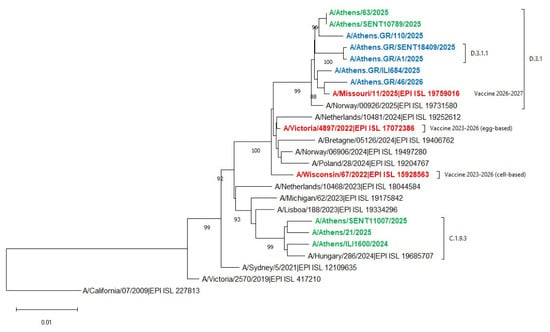
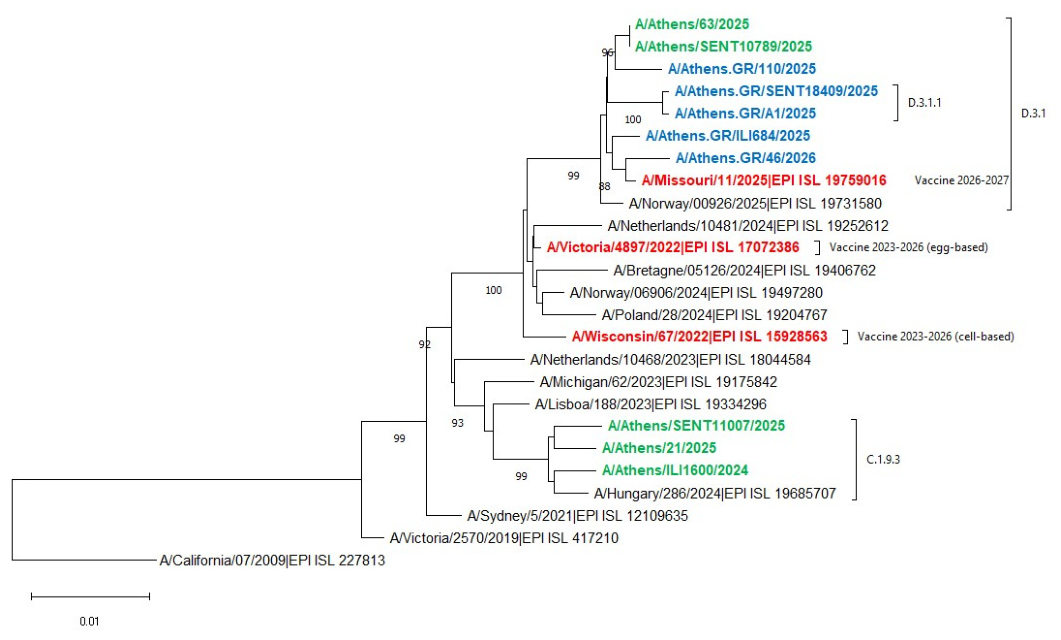
The phylogenetic tree for Influenza A(H1N1)pdm09 (Figure 1) was rooted using A/California/07/2009 as the outgroup, representing the founding strain of the pdm09 pandemic lineage from which all subsequent H1N1 clades descend [13,25]. As the most phylogenetically divergent sequence within the dataset, it provides a stable and biologically meaningful root that anchors the tree at the earliest point of the pandemic lineage, allowing the directionality of evolutionary change to be traced from the 2009 pandemic origin towards the most recently circulating clades.
Figure 1.
Maximum-likelihood phylogenetic tree of the hemagglutinin (HA) gene segment of influenza A(H1N1) pdm09 viruses circulating in S. Greece during the 2024–2025 and 2025–2026 seasons. Greek samples from the 2024 to 2025 season depicted in green, Greek samples from the 2025 to 2026 season are depicted in blue and vaccine strains are depicted in red.
The tree resolved two main subclade groups—C.1.9.3 and D.3.1/D.3.1.1—reflecting a clear inter-seasonal lineage transition. The three 2024–2025 C.1.9.3 strains formed a well-supported cluster alongside the European reference strains, confirming their placement within the globally circulating C.1.9.3 lineage of that period. A/Athens/63/2025 branched at the base of the D.3.1 node, consistent with its transitional phylogenetic position between C.1.9.3 and the emerging D.3.1 lineage. The 2025–2026 strains clustered separately within two adjacent nodes: two of them formed a D.3.1.1 sub-cluster alongside A/Athens.GR/110/2025, while two clustered within D.3.1 near A/Norway/00926/2025. The 2025–2026 vaccine strains A/Victoria/4897/2022 (egg-based) and A/Wisconsin/67/2022 (cell-based) were placed at basal positions outside all circulating subclades, reflecting their evolutionary distance from the D.3.1/D.3.1.1 viruses circulating in Greece. Critically, the 2026–2027 Northern Hemisphere vaccine strain A/Missouri/11/2025 clustered within the D.3.1 node alongside the Greek 2025–2026 isolates, confirming that the updated vaccine component directly addresses the evolutionary gap observed in the previous season and represents a strong match to the H1N1 viruses currently circulating in Greece [26].
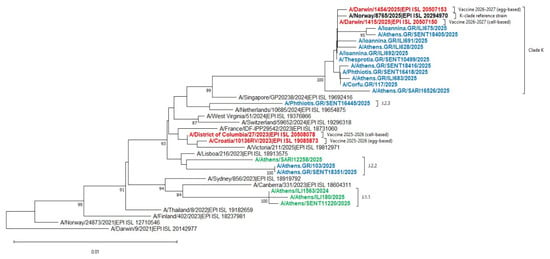
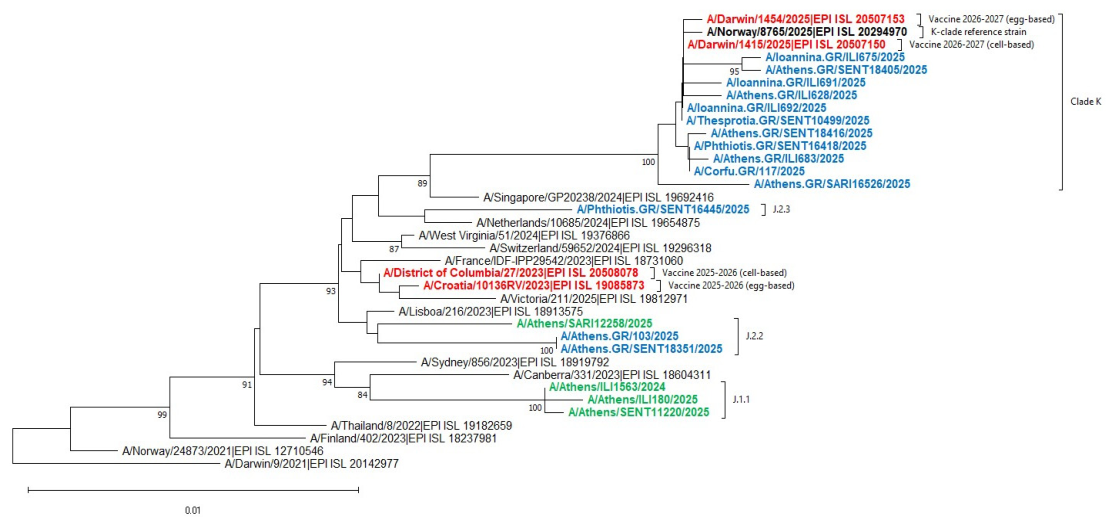
The H3N2 phylogenetic tree (Figure 2) was rooted using A/Darwin/9/2021 as the outgroup, representing an earlier 3C.2a1b lineage phylogenetically distinct from all currently circulating subclades, providing a temporal anchor that allows the directionality of H3N2 evolution towards the recently emerged J and K subclades to be clearly resolved.
Figure 2.
Maximum-likelihood phylogenetic tree of the hemagglutinin (HA) gene segment of influenza A(H3N2) viruses circulating in S. Greece during the 2024–2025 and 2025–2026 seasons. Greek samples from the 2024 to 2025 season depicted in green, Greek samples from the 2025 to 2026 season are depicted in blue and vaccine strains are depicted in red.
The tree resolved four subclades—J.1.1, J.2.2, J.2.3, and K—with a clear temporal separation between seasons. The 2024–2025 strains clustered within J.1.1 (n = 3) and J.2.2 (n = 1), phylogenetically distant from the 2025–2026 viruses. Two 2025–2026 strains clustered within J.2.2 in close proximity to the 2024–2025 J.2.2 strain, suggesting residual circulation persisting into the early 2025–2026 season. A/Phthiotis.GR/SENT16445/2025 was placed on a separate branch together with the J.2.3 reference strain, consistent with its J.2.3 assignment.
The eleven 2025–2026 subclade K strains formed a highly supported cluster together with the K reference strain A/Norway/8765/2025 and both 2026–2027 Northern Hemisphere vaccine strains—A/Darwin/1415/2025 (cell-based) and A/Darwin/1454/2025 (egg-based)—indicating strong concordance between the circulating Greek H3N2 viruses and the updated vaccine components recommended for the 2026–2027 season [27]. By contrast, both 2025–2026 Northern Hemisphere vaccine strains—A/Croatia/10136RV/2023 (egg-based) and A/District of Columbia/27/2023 (cell-based)—belong to subclade J.2 and are placed outside subclade K, reflecting that subclade K emerged from the J.2 background through the acquisition of multiple HA substitutions after the 2025–2026 vaccine composition had been set. The geographic spread of subclade K viruses across Athens, Ioannina, Corfu, Thesprotia, and Phthiotis confirms wide dissemination throughout Southern Greece.
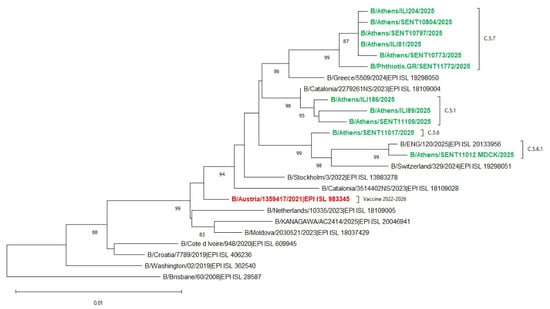
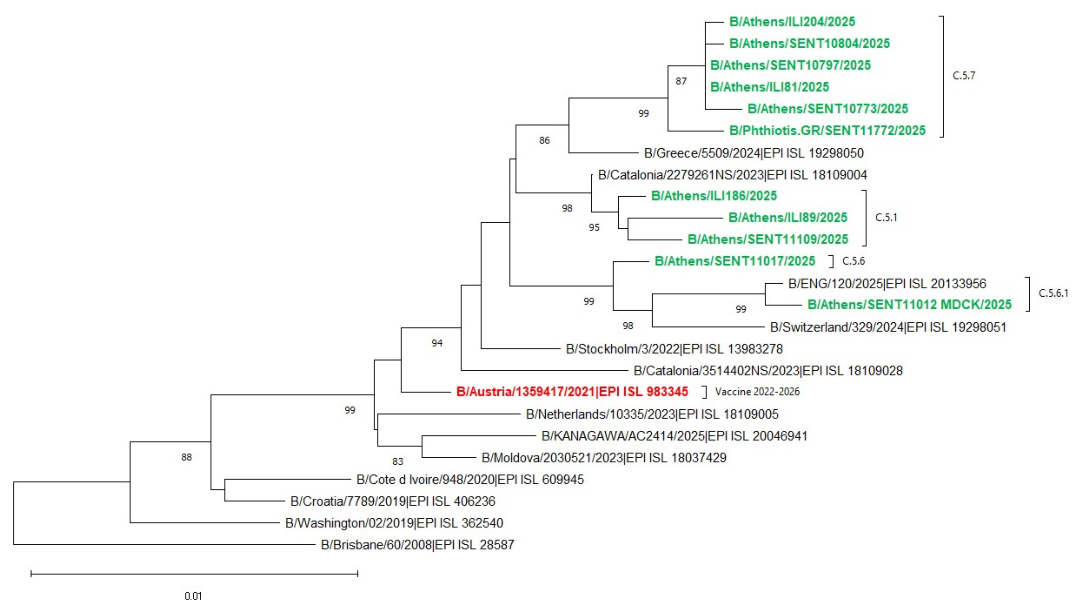
The B/Victoria phylogenetic tree (Figure 3) was rooted using B/Brisbane/60/2008 as the outgroup, a historical B/Victoria reference strain representing an ancestral lineage phylogenetically distinct from all currently circulating C.5 subclades, providing a stable temporal anchor for resolving the evolutionary relationships among contemporary B/Victoria viruses.
Figure 3.
Maximum-likelihood phylogenetic tree of the hemagglutinin (HA) gene segment of influenza B/Victoria lineage viruses circulating in S. Greece during the 2024–2025 season. Greek samples from the 2024 to 2025 season depicted in green and vaccine strains are depicted in red.
All eleven 2024–2025 Greek B/Victoria strains fell within the V1A lineage, resolving into four subclades: C.5.7 (n = 6), C.5.1 (n = 3), C.5.6 (n = 1), and C.5.6.1 (n = 1). The six C.5.7 strains formed a well-supported cluster (bootstrap 87) together with the domestic reference strain B/Greece/5509/2024, confirming phylogenetic continuity with previously circulating Greek B/Victoria strains. Three C.5.1 strains formed a separate sub-cluster adjacent to B/Catalonia/2279261NS/2023, consistent with their distinct HA profile carrying E143K rather than E143G. B/Athens/SENT11017/2025 (C.5.6) and B/Athens/SENT11012_MDCK/2025 (C.5.6.1) clustered together alongside B/ENG/120/2025 and B/Switzerland/329/2024. The vaccine strain B/Austria/1359417/2021 was placed at a deeply basal position outside all C.5 clusters, reflecting the genetic (HA sequence) divergence between the vaccine component and the circulating Greek C.5 subclade viruses. No B/Yamagata-lineage sequences were detected, consistent with the near-global elimination of this lineage.
Across all three virus types, the S. Greek strains cluster within the internationally defined subclades alongside the European and global reference strains, and the inter-seasonal subclade transitions observed—the A(H1N1)pdm09 shift from C.1.9.3 to D.3.1/D.3.1.1 and the A(H3N2) replacement of J-lineage viruses by subclade K—are consistent with those reported for the EU/EAA over the same period by ECDC [28,29,30].
This study reports the first published systematic whole-genome surveillance of influenza viruses circulating in S. Greece across two consecutive seasons, 2024–2025 and 2025–2026, using whole-genome sequencing, and the findings demonstrate the value of whole-genome surveillance as a tool for real-time monitoring of viral evolution, resistance emergence, and vaccine match at a national level.
4. Discussion
Influenza genomic surveillance has become an essential component of national and international public health preparedness, enabling timely detection of antigenic drift, antiviral resistance, and vaccine mismatch [1,3]. While these targets can also be partially addressed through Sanger sequencing of the HA and NA segments, whole-genome sequencing (WGS) additionally enables detection of reassortment events among internal gene segments, identification of resistance-associated mutations outside the NA gene and genome-wide characterization of substitutions across all eight segments. In Greece, prior molecular characterization has been limited to partial gene sequencing of selected strains and contributions to multi-country European networks, without a systematic consecutive-season whole-genome approach [13,14]. This study addresses that gap and represents the first published, systematic, protocol-driven whole-genome sequencing of all eight segments applied prospectively across consecutive seasons within a national reference-laboratory framework, as distinct from earlier Greek influenza reports based on partial (HA/NA) gene sequencing of selected or single-time-point isolates [14]. Our findings demonstrate that influenza viruses circulating in S. Greece during 2024–2026 evolved in concordance with continental surveillance trends, while providing national-level genomic resolution previously unavailable.
Sequencing quality was consistently high across all runs, with pass rates and segment depths comparable to those reported in published nanopore influenza surveillance workflows [31,32]. Partial assemblies, observed in four samples per season and uniformly limited to the longer polymerase segments (PB2, PB1, PA), are a recognized feature of amplicon-based nanopore approaches at lower viral loads [19,28]; critically, HA and NA segments were fully recovered in all retained samples. At this point it needs to be noted that consensus sequencing does not resolve minority variants or within-host diversity, which would require deep sequencing approaches [7,11]. The dual-platform workflow—wf-flu for rapid classification and INSaFLU for final consensus assembly—provided cross-validation of subtype and clade calls with full concordance, while integration of Nextclade v2.16.1 ensured alignment with WHO/ECDC harmonized nomenclature [18,19,20]. Phylogenetic interpretation was performed on well-supported branches (bootstrap > 80), which define the subclade-level groupings on which our conclusions are based. Together, this workflow enabled a complete pipeline from clinical sample to phylogenetically classified, resistance-screened consensus genome, screened genome-wide for resistance-associated markers across the NA (oseltamivir/zanamivir), M2 (adamantane), and PA (baloxavir) genes, within a national reference laboratory setting, consistent with the experience of comparable single-laboratory genomic surveillance programs in Europe [32,33]. The value of genomic characterization beyond routine seasonal surveillance has been previously demonstrated by our group, with the identification and sequencing of off-season influenza strains detected in Greece in August 2022 enabling phylogenetic placement of imported A(H3N2) and A(H1N1)pdm09 viruses into clusters closely related to the 2022/23 vaccine strains [14].
The detection of H275Y in A/Athens/21/2025, an A(H1N1)pdm09 sample from surveillance week 3 of the 2024–2025 season, is a clinically significant finding. H275Y confers high-level oseltamivir resistance—the NA inhibitor most widely prescribed for influenza treatment and post-exposure prophylaxis—while preserving susceptibility to zanamivir and baloxavir [34]. This variant was detected in a patient receiving oseltamivir therapy, as documented in the clinical record—a presentation consistent with treatment-emergent resistance, the pattern by which most H275Y detections arise, rather than with community transmission of a resistant virus. Since the displacement of the 2008–2009 resistant A(H1N1) wave by the pandemic pdm09 strain, community transmission of H275Y-bearing viruses has remained rare, with most European detections similarly arising as treatment-emergent events [34,35]. Its detection illustrates the value of integrating resistance screening into routine whole-genome surveillance, complementary to targeted phenotypic testing only in treatment failure cases [34,35].
Analysis of the six internal gene segments provided additional genomic context beyond HA and NA characterization. The highly conserved NP substitution background shared across all H1N1 strains in both seasons (E14D, T22A, I33V, I136L, V217I, Q453P) is consistent with the stable polymerase complex maintenance reported in contemporary pdm09 lineages [27], while the additional PB2 substitutions I66M and I559M distinguishing 2025–2026 D.3.1/D.3.1.1 strains from year 2024 C.1.9.3 background reflect the accumulation of lineage-defining polymerase features alongside HA evolution. The near-universal detection of PA G397E across all H3N2 strains in both seasons—in 16 of 18 samples—is a recurrent feature of the 3C.2a1b.2a lineage reported in recent international surveillance datasets [28,29], though its functional impact on polymerase activity remains to be fully characterized. In four of the influenza strains analyzed, partial polymerase segment assemblies precluded reassortment analysis and limited polymerase-level resistance or virulence profiling. In B/Victoria, NS Y104H was present in all eleven clinical samples regardless of C.5 subclade, confirming its status as a lineage-wide feature of currently circulating B/Victoria viruses [30,36], while the internal segment markers PB2 T110N/A301T and PA S208N co-segregating with the C.5.7 HA subclade may represent candidate markers warranting confirmation in larger datasets. Crucially, no substitutions at established virulence-associated positions—including PB2 E627K and D701N, known to enhance polymerase activity and mammalian replication of avian-origin viruses [37]—or at the baloxavir resistance-determining PA I38 position [36,38] were detected in any sample with complete polymerase-segment assembly, confirming the absence of emerging polymerase-associated risk markers in circulating Greek influenza strains during this surveillance period.
The inter-seasonal shift in A(H1N1)pdm09 from subclade C.1.9.3 to D.3.1/D.3.1.1 is consistent with the global replacement of 5a.2a lineages documented by WHO and ECDC from late 2024 onwards [28,29], and mirrors the antigenic drift reducing serum neutralization relative to the vaccine strain reported by Villafuerte et al. for the same period [25]. For A(H3N2), the dominance of subclade K (79% of samples) mirrors the rapid EU/EEA replacement of J-lineage viruses documented by ECDC from late 2025 [29,39]. Both 2025–2026 Northern Hemisphere vaccine components—the egg-based A/Croatia/10136RV/2023 and the cell-based A/District of Columbia/27/2023—belong to subclade J.2 and are placed outside subclade K in our analysis, consistent with the antigenic distance between the 2025–2026 vaccine and the emerging K viruses flagged by ECDC [39,40]. The updated 2026–2027 vaccine strains A/Darwin/1415/2025 and A/Darwin/1454/2025 fall within subclade K, and the close clustering of the Greek K viruses with these strains indicates that the 2026–2027 vaccine composition is well matched to the A/H3N2 viruses now circulating in Southern Greece; early European vaccine-effectiveness estimates for the 2025–2026 season nonetheless reported better-than-anticipated protection against A(H3N2) [41]. The residual J.2.2 circulation detected at the onset of the 2025–2026 season, branching near the 2024 J.2.2 strains, reflects the inter-seasonal subclade continuity described by Fall et al. [42] and is consistent with the progressive rather than abrupt nature of lineage replacement in A(H3N2) evolution. All B/Victoria clinical samples from the 2024 to 2025 season fell within the C.5 lineage, with C.5.7 predominating, consistent with European surveillance for the corresponding period [29,30]. The intra-C.5 diversity observed—including a distinct C.5.1 sub-cluster characterized by E143K rather than E143G—mirrors the subclade co-circulation reported in French 2024–2025 [30]. Co-grouping of our C.5.7 strains with the domestic reference strain B/Greece/5509/2024 confirms phylogenetic continuity with previously circulating Greek strains. The near-complete absence of influenza B during 2025–2026 reflects the epidemiological pattern in Southern Greece and is consistent with the low influenza B circulation reported across Europe in that season. For the 2025–2026 season, no influenza B samples were available, preventing longitudinal B/Victoria tracking. The deep basal placement of the vaccine strain B/Austria/1359417/2021 outside all C.5 clusters reflects HA genetic divergence of the circulating C.5 subclades from the vaccine component. Despite HA genetic divergence, antigenic characterization by ECDC indicates that the majority of circulating B/Victoria viruses remained antigenically similar to the B/Austria/1359417/2021 vaccine virus [28,29], consistent with preserved antigenic match.
Although the present analysis is framed within the European surveillance context to which our national reference laboratory contributes, influenza is a globally circulating pathogen, and Asia in particular is recognized as a major source region for its evolution and for the emergence of novel variants. Contemporary surveillance from China and Hong Kong provides an informative comparator: the post-pandemic period has been marked by altered influenza seasonality and an increased disease burden across China [43,44], echoing the resurgence dynamics that followed the relaxation of COVID-19 measures in Europe. At the genetic level, H3N2 evolution in Asia has proceeded within the same 3C.2a1b.2a framework observed here, including the displacement of a geographically restricted, China-specific subclade by the internationally prevalent 2a.3a.1 lineage in early 2023 [45] and the genetic and antigenic characterization of H3N2 during and after the pandemic [46,47]. The concordance between these Asian datasets and the subclade dynamics we document in Southern Greece—including the continued diversification of the 2a.3a.1 (J/K) lineages—reinforces that the variants circulating in Greece are part of a single, globally connected evolutionary process rather than a regionally isolated one, and underscores the value of integrating national genomic surveillance data into the global monitoring network.
Several limitations of the present study should be considered when interpreting the whole-genome sequencing and phylogenetic findings. First, the sequenced subset was not a proportional random sample of RT-PCR-confirmed positives. Because amplicon-based whole-genome sequencing requires a minimum viral load, only specimens above a viral-load threshold (Ct ≤28, extended to ≤34 in selected cases) were sequenced, so the genomic characterization pertains to infections with sufficient viral load for whole-genome recovery. An approximate 5% sampling rate is operationally sound and cost-effective for routine surveillance during normal-to-high activity periods. Within these constraints, sampling was aim-driven: in 2024–2025, influenza A and B were sequenced in comparable numbers to characterize both co-circulating types, and in 2025–2026 sequencing was enriched for A(H3N2) to capture the emerging subclade K. The sequenced composition therefore reflects these objectives rather than the relative prevalence of subtypes in the positive pool, and the genomic findings should be interpreted as characterizing circulating viral diversity rather than as estimates of relative subtype prevalence in Southern Greece. The conserved internal-segment substitutions described in this study co-segregate with particular subclades within our dataset on the basis of sequence association alone. No functional data were generated to test their phenotypic effects; they should therefore be regarded as subclade-associated mutations rather than as substitutions with demonstrated adaptive, replicative or virulence significance. Moreover, in the absence of comparison with internal-gene sequences from a broader set of reference viruses, these associations may partly reflect characteristics of the present sample subset rather than generalizable subclade-associated markers, and their potential utility for subclade identification requires confirmation in larger datasets and dedicated functional studies. Phylogenetic inference in this study was based on the HA segment. Although HA is the antigenically decisive segment and the standard one used for subclade assignment and vaccine-match assessment, HA-only phylogeny does not capture the independent evolutionary routes potentially involving the rest of the gene segments and cannot, by itself, formally detect or date reassortment events. To bridge this gap, genome-wide evolution was instead fully addressed through extensive genetic analysis and per-segment amino acid substitution profiling across all eight segments. The present analysis focused on consensus-level (majority) variants, which represent the dominant viral population within each specimen. Low-frequency intra-host minority variants were not systematically characterized in the scope of this study.
5. Conclusions
In conclusion, this study establishes a baseline for systematic influenza genomic surveillance in S. Greece and demonstrates that Nanopore whole-genome sequencing is operationally feasible and scientifically productive at a national reference laboratory level. The identification of an oseltamivir-resistant H1N1 variant (NA H275Y) in a patient receiving oseltamivir therapy, the documentation of rapid A(H3N2) subclade K emergence and its dissemination across multiple regions of S. Greece, and the confirmation of concordance between circulating subclade K viruses and the updated 2026–2027 vaccine strains, each represent findings with direct public health relevance. Unlike the HA/NA-only Sanger sequencing traditionally used in influenza surveillance, the whole-genome approach applied here additionally screened all eight gene segments for resistance-associated markers across the NA, M2, and PA genes and provides the capacity to detect reassortment events—a level of resolution not achievable through conventional partial-gene methods. Integration of this workflow into prospective, real-time national surveillance—contributing data continuously to GISAID and the WHO GISRS network—would maximize its value for both national public health decision-making and international vaccine strain selection.
Supplementary Materials
The following supporting information can be downloaded at: https://www.mdpi.com/article/10.3390/v18111213/s1. Table S1. Demographic, clinical, and virological characteristics of influenza-positive samples sequenced during the 2024–2025 surveillance period (n = 21). Table S2. Demographic, clinical, and virological characteristics of influenza-positive samples sequenced during the 2025–2026 surveillance period (n = 19). Table S3. Amino acid substitutions in the HA and NA segments of influenza A and B samples (2024–2025 season). Table S4. Amino acid substitutions in the HA and NA segments of influenza A samples (2025–2026 season). Table S5. Internal Segment Substitutions (2024–2025 Season). Table S6. Internal Segment Substitutions (2025–2026 Season). Missense amino acid substitutions in the internal gene segments (PB2, PB1, PA, NP, M, NS) of influenza A samples (2025–2026 season). Table S7. Origin of the haemagglutinin (HA) sequences of Influenza A(H1N1)pdm09 strains used for phylogenetic analysis of Figure 1. Table S8. Origin of the haemagglutinin (HA) sequences of Influenza A(H3N2) strains used for phylogenetic analysis in Figure 2. Sequences are listed in ascending order of collection year. EPI ISL = GISAID EpiFlu database accession number. Table S9. Origin of the haemagglutinin (HA) sequences of Influenza B/Victoria strains used for phylogenetic analysis (Figure 3).
Author Contributions
Conceptualization, M.E. (Mary Emmanouil) and M.E. (Maria Evangelidou); methodology, M.E. (Mary Emmanouil), M.K.S., M.T.; software, K.D. and G.T.; validation, M.E. (Mary Emmanouil), M.E. (Maria Evangelidou) and E.A.; formal analysis, K.D. and G.T.; investigation, K.D.; resources, M.E. (Mary Emmanouil), M.K.S., M.T. and E.A.; data curation, K.D. and M.E. (Maria Evangelidou); writing—original draft preparation. K.D. and M.E.; writing—review and editing, K.D., G.T. and M.E.; visualization, K.D. and M.E. (Mary Emmanouil); supervision, M.E. (Mary Emmanouil) and E.A.; project administration, M.E. (Mary Emmanouil) All authors have read and agreed to the published version of the manuscript.
Funding
This research received no external funding.
Institutional Review Board Statement
This study was approved by the Institutional Ethics Committee of the National Public Health Organization of Greece with protocol number 14258/30.06.2026. Patient records were coded and de-identified prior to analysis, and no identifying details are included in this article. The surveillance of influenza cases is conducted in accordance with the mandates and guidelines of the World Health Organization (WHO) through the Global Influenza Surveillance and Response System (GISRS), contributing to the monitoring of circulating influenza viruses and informing vaccine strain selection and public health interventions. The collection of clinical specimens and the epidemiological surveillance process are coordinated by the National Public Health Organization (NPHO) in collaboration with the National Influenza Centre for Southern Greece, within the framework of the national influenza surveillance program and the Mandatory Notification of Diseases, as stipulated by Ministerial Decision No. Δ1α/Γ.Π. οικ.16711 on the “Revision of the List of Mandatory Notifiable Diseases” (Government Gazette B’ 1665/07-04-2022).
Informed Consent Statement
No written consent from patients is required, given that the data are collected in accordance with Article 6(1)(e) (Processing is necessary for the performance of a task carried out in the public interest) and Article 9(2)(j) (Processing is necessary for scientific research purposes) of the GDPR (cf. 5 & 6), within the framework of the surveillance conducted by the Hellenic National Public Health Organization (NPHO) and the National Influenza Reference Laboratory for Southern Greece.
Data Availability Statement
The original contributions presented in the study are included in the article/Supplementary Materials, and further inquiries can be directed to the corresponding author.
Acknowledgments
CDC Influenza Virus Real-Time RT-PCR Influenza A/B Typing Panel (VER 2) (RUO) (Catalog No. FluRUO-14), FR-1711, CDC Influenza Virus Real-Time RT-PCR Influenza A (H3/H1pdm09) Subtyping Panel (VER 4) (RUO) (Catalog No. FluRUO-16), FR-1890, and “CDC Influenza Virus Real-Time RT-PCR Influenza B Lineage Genotyping Panel (VER 1.1) (RUO) (Catalog No. FluRUO-11), FR-1918, were obtained through the International Reagent Resource, Influenza Division, WHO Collaborating Center for Surveillance, Epidemiology and Control of Influenza, Centers for Disease Control and Prevention, Atlanta, GA, USA. During the preparation of this manuscript, the authors used Claude Sonnet 4.6 (Anthropic, San Francisco, CA, USA) for the purposes of translation assistance and English language editing and adaptation. The authors have reviewed and edited the output and take full responsibility for the content of this publication.
Conflicts of Interest
The authors declare no conflicts of interest.
Abbreviations
The following abbreviations are used in this manuscript:
| BC | Barcode |
| CDC | Centers for Disease Control and Prevention |
| ECDC | European Centre for Disease Prevention and Control |
| GISAID | Global Initiative on Sharing All Influenza Data |
| GISRS | Global Influenza Surveillance and Response System |
| HA | Hemagglutinin |
| HAC | High-Accuracy (basecalling model) |
| ICU | Intensive Care Unit |
| ILI | Influenza-Like Illness |
| INSaFLU | Influenza Surveillance platform |
| IUPAC | International Union of Pure and Applied Chemistry |
| MDCK | Madin-Darby Canine Kidney |
| N50 | Sequence length at which 50% of the total assembly bases are contained in reads of that length or longer |
| NA | Neuraminidase |
| NGS | Next-Generation Sequencing |
| ONT | Oxford Nanopore Technologies |
| P1 | Passage 1 (first cell culture passage) |
| PCR | Polymerase Chain Reaction |
| RT-PCR | Reverse Transcription Polymerase Chain Reaction |
| SARI | Severe Acute Respiratory Infection |
| SENT | Sentinel |
| WGS | Whole-Genome Sequencing |
References
- World Health Organization. Considerations for Surveillance During an Influenza Pandemic: Meeting Report, 12–13 November 2024; WHO: Geneva, Switzerland, 2025; Available online: https://iris.who.int/handle/10665/381435 (accessed on 5 June 2025).
- Iuliano, A.D.; Roguski, K.M.; Chang, H.H.; Muscatello, D.J.; Palekar, R.; Tempia, S.; Cohen, C.; Gran, J.M.; Schanzer, D.; Cowling, B.J.; et al. Estimates of global seasonal influenza-associated respiratory mortality: A modelling study. Lancet 2018, 391, 1285–1300. [Google Scholar] [CrossRef] [Scilit] [PubMed]
- Hay, A.J.; McCauley, J.W. The WHO global influenza surveillance and response system (GISRS)—A future perspective. Influenza Other Respir. Viruses 2018, 12, 513–520. [Google Scholar] [CrossRef] [Scilit] [PubMed]
- European Centre for Disease Prevention and Control. Seasonal Influenza, 2023–2024: Annual Epidemiological Report; ECDC: Stockholm, Sweden, 2024; Available online: https://www.ecdc.europa.eu/sites/default/files/documents/seasonal-influenza-annual-epidemiological-report-2023-2024.pdf (accessed on 5 June 2025).
- European Centre for Disease Prevention and Control. The European Respiratory Virus Surveillance Summary (ERVISS); ECDC: Stockholm, Sweden, 2025; Available online: https://www.ecdc.europa.eu/en/publications-data/european-respiratory-virus-surveillance-summary-erviss (accessed on 5 June 2025).
- Goraichuk, I.V.; Risalvato, J.; Pantin-Jackwood, M.; Suarez, D.L. Improved influenza A whole-genome sequencing protocol. Front. Cell. Infect. Microbiol. 2024, 14, 1497278. [Google Scholar] [CrossRef] [Scilit] [PubMed]
- Goldstein, E.J.; Harvey, W.T.; Wilkie, G.S.; Shepherd, S.J.; MacLean, A.R.; Murcia, P.R.; Gunson, R.N. Integrating patient and whole-genome sequencing data to provide insights into the epidemiology of seasonal influenza A(H3N2) viruses. Microb. Genom. 2018, 4, e000137. [Google Scholar] [CrossRef] [Scilit] [PubMed]
- Gwinn, M.; MacCannell, D.; Armstrong, G.L. Next-generation sequencing of infectious pathogens. JAMA 2019, 321, 893–894. [Google Scholar] [CrossRef] [Scilit] [PubMed]
- Barzon, L.; Lavezzo, E.; Militello, V.; Toppo, S.; Palù, G. Applications of next-generation sequencing technologies to diagnostic virology. Int. J. Mol. Sci. 2011, 12, 7861–7884. [Google Scholar] [CrossRef] [Scilit] [PubMed]
- Zhou, B.; Wentworth, D.E. Influenza A virus molecular virology techniques. Methods Mol. Biol. 2012, 865, 175–192. [Google Scholar] [CrossRef] [Scilit] [PubMed]
- Lewandowski, K.; Xu, Y.; Pullan, S.T.; Lumley, S.F.; Foster, D.; Sanderson, N.; Vaughan, A.; Morgan, M.; Bright, N.; Kavanagh, J.; et al. Metagenomic nanopore sequencing of influenza virus direct from clinical respiratory samples. J. Clin. Microbiol. 2019, 58, e00963-19. [Google Scholar] [CrossRef] [Scilit] [PubMed]
- Ip, H.S.; Uhm, S.; Killian, M.L.; Torchetti, M.K. An evaluation of avian influenza virus whole-genome sequencing approaches using nanopore technology. Microorganisms 2023, 11, 529. [Google Scholar] [CrossRef] [Scilit] [PubMed]
- Broberg, E.K.; Vukovikj, M.; Svartström, O.; Hasibra, I.; Riess, M.; Melidou, A.; Members of the ERLI-Net Network. Antigenic changes in influenza A(H3N2) driven by genetic evolution: Insights from virological surveillance, EU/EEA, week 40/2023 to week 9/2024. Eurosurveillance 2024, 29, 2400395. [Google Scholar] [CrossRef] [Scilit] [PubMed]
- Mellou, K.; Tryfinopoulou, K.; Emmanouil, M.; Gkolfinopoulou, K.; Sapounas, S.; Evangelidou, M.; Moulopoulou, P.; Miaoulis, E.; Angelakis, E.; Sourvinos, G.; et al. Influenza transmission during COVID-19 measures downscaling in Greece, August 2022: Evidence for the need of continuous integrated surveillance of respiratory viruses. Eurosurveillance 2023, 28, 2200754. [Google Scholar] [CrossRef] [Scilit] [PubMed]
- Oxford Nanopore Technologies. Ligation Sequencing Kit: Influenza Whole Genome Sequencing V14 Protocol; Oxford Nanopore Technologies: Oxford, UK, 2024; Available online: https://nanoporetech.com (accessed on 5 June 2025).
- Santos, J.D.; Pinheiro, M.; Borges, V.; Gomes, J.P.; Duarte, S. INSaFLU-TELEVIR: An open web-based bioinformatics suite for influenza whole-genome sequencing-based surveillance. Genome Med. 2024, 16, 61. [Google Scholar] [CrossRef] [Scilit] [PubMed]
- Borges, V.; Pinheiro, M.; Pechirra, P.; Guiomar, R.; Gomes, J.P. INSaFLU: An automated open web-based bioinformatics suite from-reads for influenza whole-genome-sequencing-based surveillance. Genome Med. 2018, 10, 46. [Google Scholar] [CrossRef] [Scilit] [PubMed]
- Aksamentov, I.; Roemer, C.; Hodcroft, E.B.; Neher, R.A. Nextclade: Clade assignment, mutation calling and quality control for viral genomes. J. Open Source Softw. 2021, 6, 3773. [Google Scholar] [CrossRef] [Scilit]
- Hadfield, J.; Megill, C.; Bell, S.M.; Huddleston, J.; Potter, B.; Callender, C.; Sagulenko, P.; Bedford, T.; Neher, R.A. Nextstrain: Real-time tracking of pathogen evolution. Bioinformatics 2018, 34, 4121–4123. [Google Scholar] [CrossRef] [Scilit] [PubMed]
- Sagulenko, P.; Puller, V.; Neher, R.A. TreeTime: Maximum-likelihood phylodynamic analysis. Virus Evol. 2018, 4, vex042. [Google Scholar] [CrossRef] [Scilit] [PubMed]
- Neher, R.A.; Huddleston, J.; Bedford, T.; Lewis, N.S.; Harvey, R.; Galiano, M.; Byrne, A.M.P.; James, S.; Smith, D.; Łuksza, M.; et al. Nomenclature for Tracking of Genetic Variation of Seasonal Influenza Viruses. Influenza Other Respir. Viruses 2026, 20, e70230. [Google Scholar] [CrossRef] [Scilit] [PubMed]
- Kumar, S.; Stecher, G.; Suleski, M.; Sanderford, M.; Sharma, S.; Tamura, K. MEGA12: Molecular Evolutionary Genetic Analysis Version 12 for Adaptive and Green Computing. Mol. Biol. Evol. 2024, 41, msae263. [Google Scholar] [CrossRef] [Scilit]
- Centers for Disease Control and Prevention. Influenza Antiviral Drug Resistance; CDC: Atlanta, GA, USA, 2025. Available online: https://www.cdc.gov/flu/treatment/antiviralresistance.html (accessed on 5 June 2025).
- World Health Organization. Summary of Neuraminidase (NA) Amino Acid Substitutions Assessed for Their Effects on Inhibition by Neuraminidase Inhibitors (NAIs); WHO: Geneva, Switzerland, 7 March 2023; Available online: https://cdn.who.int/media/docs/default-source/global-influenza-programme/1.-nai_human_reduced-susceptibility-marker-table-(who)_07.03.23_update.pdf (accessed on 5 June 2025).
- Villafuerte, D.; Fall, A.; Akin, E.; Werner, A.P.; Pinsley, M.; Vue, Y.; Bhatti, M.M.; Forman, M.; Tamma, P.D.; Milstone, A.M.; et al. Genomic evolution of influenza A virus during the 2024–2025 season, the Johns Hopkins Health System: Antigenic drift reduces serum neutralization. J. Infect. Dis. 2026, 233, e1386–e1395. [Google Scholar] [CrossRef] [Scilit] [PubMed]
- World Health Organization. Recommended Composition of Influenza Virus Vaccines for Use in the 2025–2026 Northern Hemisphere Influenza Season; WHO: Geneva, Switzerland, 28 February 2025; Available online: https://www.who.int/publications/m/item/recommended-composition-of-influenza-virus-vaccines-for-use-in-the-2025-2026-nh-influenza-season (accessed on 5 June 2025).
- Tramuto, F.; Maida, C.M.; Randazzo, G.; Previti, A.; Sferlazza, G.; Graziano, G.; Costantino, C.; Mazzucco, W.; Vitale, F. Insights into Genetic and Antigenic Characteristics of Influenza A(H1N1)pdm09 Viruses Circulating in Sicily During the Surveillance Season 2023–2024: The Potential Effect on the Seasonal Vaccine Effectiveness. Viruses 2024, 16, 1644. [Google Scholar] [CrossRef] [Scilit] [PubMed]
- European Centre for Disease Prevention and Control; World Health Organization Regional Office for Europe. Influenza Virus Characterization: Summary Report, Europe, November 2024; Licence: CC BY 3.0 IGO; WHO Regional Office for Europe and Stockholm: European Centre for Disease Prevention and Control: Copenhagen, Denmark, 2024; Available online: https://www.ecdc.europa.eu/en/publications-data/influenza-virus-characterization-summary-europe-november-2024 (accessed on 5 June 2025).
- European Centre for Disease Prevention and Control. Influenza Virus Characteristics, Week 40 2024 to Week 33 2025, EU/EEA; ECDC: Stockholm, Sweden, 2025; Available online: https://www.ecdc.europa.eu/en/publications-data/influenza-virus-characteristics-week-40-2024-week-33-2025 (accessed on 5 June 2025).
- Coudeville, L.; Turbelin, C.; Blanchon, T.; Hanslik, T.; Souty, C.; Falchi, A.; Falchi, L.; Savitch, Y.; Mosnier, A.; Vilcu, A.M. Influenza vaccine effectiveness and genetic diversity: Insights from end-of-season community surveillance, France, 2024–2025. Emerg. Microbes Infect. 2025, 14, 2562045. [Google Scholar] [CrossRef] [Scilit] [PubMed]
- King, J.; Harder, T.; Beer, M.; Pohlmann, A. Rapid multiplex MinION nanopore sequencing workflow for Influenza A viruses. BMC Infect. Dis. 2020, 20, 648. [Google Scholar] [CrossRef] [Scilit] [PubMed]
- Cane, J.; Sanderson, N.; Barnett, S.; Vaughan, A.; Pott, M.; Kapel, N.; Jeffery, K.; Oakley, S.; Crook, D.; Walker, A.S.; et al. Nanopore sequencing of influenza A and B in Oxfordshire and the United Kingdom, 2022–2023. J. Infect. 2024, 88, 106164. [Google Scholar] [CrossRef] [Scilit] [PubMed]
- Galluzzi, L.; Biagi, M.; Brunelli, A.; Rizzi, M.; Cordioli, P.; Moreno, A.; Sartori, E.; De Rosa, S.; Gobbi, F.; Castilletti, C.; et al. Tracking seasonal influenza trends in South Tyrol during 2022/2023 using genomic surveillance data. Influenza Other Respir. 2025, 19, e70046. [Google Scholar] [CrossRef] [Scilit]
- Gould, V.R.; Correia, V.R.C.; Sheu, T.G.; Gubareva, L.V.; Fry, A.M.; Vandemaele, K.A.H. WHO Global Influenza Surveillance and Response System. Multicountry spread of influenza A(H1N1)pdm09 viruses with reduced oseltamivir inhibition, May 2023–February 2024. Emerg. Infect. Dis. 2024, 30, 1410–1415. [Google Scholar] [CrossRef] [Scilit] [PubMed]
- Mele, S.; Casas, I.; Torres, G.; Solano, A.; Torner, N.; Marcos, M.A.; Antón, A.; Pumarola, T.; Domínguez, A. Expansion of influenza A(H1N1)pdm09 NA:S247N viruses with reduced susceptibility to oseltamivir, Catalonia, Spain, and in Europe, July to October 2025. Eurosurveillance 2025, 30, 2500834. [Google Scholar] [CrossRef] [Scilit] [PubMed]
- Lee, N.; Tang, J.W.; Chon, I.; Kakuya, F.; Terao, R.; Kawashima, T.; Sato, I.; Kodo, N.; Suzuki, E.; Masaki, H.; et al. Influenza PA substitutions and genetic diversity of A(H1N1)pdm09, A(H3N2), and B/Victoria viruses in Japan during the 2023–2024 season. Viruses 2026, 18, 13. [Google Scholar] [CrossRef] [Scilit] [PubMed]
- Zhu, W.; Li, L.; Yan, Z.; Gan, T.; Li, L.; Chen, R.; Chen, R.; Zheng, Z.; Hong, W.; Wang, J.; et al. Dual E627K and D701N mutations in the PB2 protein of A(H7N9) influenza virus increased its virulence in mammalian models. Sci. Rep. 2015, 5, 14170. [Google Scholar] [CrossRef] [Scilit] [PubMed]
- Hussain, S.; Meijer, A.; Govorkova, E.A.; Dapat, C.; Gubareva, L.V.; Barr, I.G.; Brown, S.K.; Daniels, R.S.; Fujisaki, S.; Galiano, M.; et al. Global update on the susceptibilities of influenza viruses to neuraminidase inhibitors and the cap-dependent endonuclease inhibitor baloxavir, 2020–2023. Antivir. Res. 2025, 241, 106217. [Google Scholar] [CrossRef] [Scilit] [PubMed]
- European Centre for Disease Prevention and Control. Threat Assessment Brief: Assessing the Risk of Influenza for the EU/EEA in the Context of Increasing Circulation of A(H3N2) Subclade K; TQ-01-25-075-EN-N; ECDC: Stockholm, Sweden, 2025. [Google Scholar] [CrossRef]
- World Health Organization. Recommended Composition of Influenza Virus Vaccines for Use in the 2026–2027 Northern Hemisphere Influenza Season; WHO: Geneva, Switzerland, February 2026; Available online: https://www.who.int/publications/m/item/recommended-composition-of-influenza-virus-vaccines-for-use-in-the-2026-2027-northern-hemisphere-influenza-season (accessed on 5 June 2025).
- European Centre for Disease Prevention and Control. Early Estimates of Seasonal Influenza Vaccine Effectiveness against Influenza Requiring Medical Attention at Primary Care Level in Europe, Week 41–49, 2025; ECDC: Stockholm, Sweden, January 2026; Available online: https://www.ecdc.europa.eu/en/news-events/early-estimates-seasonal-influenza-vaccine-effectiveness-against-influenza-requiring (accessed on 5 June 2025).
- Fall, A.; Han, L.; Yunker, M.; Gong, Y.N.; Li, T.J.; Norton, J.M.; Robinson, M.L.; Mostafa, H.H. Evolution of influenza A(H3N2) viruses in 2 consecutive seasons of genomic surveillance, 2021–2023. Open Forum Infect. Dis. 2023, 10, ofad577. [Google Scholar] [CrossRef] [Scilit] [PubMed]
- Du, H.; Li, J.; Wen, H.; Gu, Z.; Chang, Y.; Rong, W.; Yang, Z.; Khan, R.U.; Feng, Z.; Wang, Q.; et al. Respiratory Pathogen Profiles of Patients—Beijing Municipality, China, November 2023–April 2024. China CDC Wkly. 2025, 7, 113–120. [Google Scholar] [CrossRef] [Scilit] [PubMed]
- Yu, H.; Wang, Q.; Qi, B.; Qian, J.; Yang, W.; Feng, L. Changing Epidemiological Pattern and Higher Disease Burden of Influenza in China, 2022 to 2025. Influenza Other Respir. Viruses 2025, 19, e70151. [Google Scholar] [CrossRef] [Scilit] [PubMed]
- Zhao, X.; Gu, Y.; Tang, X.; Jiang, C.; Fang, F.; Chu, W.; Tao, L.; Zhang, X.; Chen, M.; Wu, H.; et al. Whole-genome analysis of circulating influenza A virus (H3N2) strains in Shanghai, China from 2005 to 2023. Emerg. Microbes Infect. 2024, 13, 2396867. [Google Scholar] [CrossRef] [Scilit] [PubMed]
- Li, J.; Huan, Y.; Xia, Q.; Li, Y.; Khan, R.U.; Liu, Q.; Dou, C.; Gulyaeva, M.; Shestopalov, A.; Zhang, N.; et al. H3N2 influenza virus characteristics in China (2019–2022): Genetic, antigenic, and infection dynamics during the COVID-19 pandemic. hLife 2025, 3, 146–158. [Google Scholar] [CrossRef] [Scilit] [PubMed]
- Bian, J.; Fung, J.; Lee, L.-K.; Tam, W.-Y.; Wong, L.C.-H.; Wong, C.K.-W.; Lau, M.Y.-X.; Jiang, B.; Tang, N.H.-L.; Ho, A.Y.-M.; et al. Genetic characterization of influenza A viruses circulating in Hong Kong, China, 2023: The first influenza epidemic after the lifting of 2.5 years of COVID-19 non-pharmaceutical interventions. Emerg. Microbes Infect. 2025, 14, 2521850. [Google Scholar] [CrossRef] [Scilit] [PubMed]

Disclaimer/Publisher’s Note: The statements, opinions and data contained in all publications are solely those of the individual author(s) and contributor(s) and not of MDPI and/or the editor(s). MDPI and/or the editor(s) disclaim responsibility for any injury to people or property resulting from any ideas, methods, instructions or products referred to in the content. |
© 2026 by the authors. Licensee MDPI, Basel, Switzerland. This article is an open access article distributed under the terms and conditions of the Creative Commons Attribution (CC BY) license.