


Abstract
Static pulling tests are essential for evaluating tree mechanical stability, hence the ability to sustain wind loading. In the tests, the trees are usually pulled in one direction, which can raise concerns about the bias of the estimates due to thigmomorphogenetic adaptations to wind, hence the effect of pulling direction. In this study, the effect of pulling direction on tree mechanical stability estimates (basal bending moment at primary and secondary failures) was assessed based on data collected from trees growing in stands regenerated naturally and by mounding. Scots pine (Pinus sylvestris L.) stands in three sites with slightly differing wind climates in hemiboreal forests in Latvia were studied. Pulling direction (difference between wind and pulling direction) had a significant effect on basal bending moment at fatal failure, indicating pulling direction-related bias that was not affected by stand regeneration. Stand regeneration had a significant effect on susceptibility to primary failure, which is intrinsic permanent wood damage, implying altered strength of storm legacy effects. Primary failure, however, was not affected by pulling direction.
1. Introduction
In Northern Europe and the Eastern Baltic region in particular, the forest sector is a fundamental part of national economies and a primary source of timber for European markets, contributing to regional resource security [1]. To meet the growing demand for timber, driven by the increasing need for renewable sources of materials and energy, rotation forestry is practiced [2,3]. The implications of rotation forestry include soil preparation (e.g., trenching or mounding) as a means for efficient regeneration of the stand, increasing initial survival and vitality of saplings [4,5]. Mechanical soil preparation using the mounding technique involves creating localized elevated planting beds of inverted topsoil and mineral capping to improve soil aeration, increase root zone temperatures, and suppress competing ground vegetation [5]. Soil preparation and planting, in turn, can have legacy effects on the susceptibility of older stands to natural disturbances, among which wind is the most common [6], accounting for the majority of damages to the growing stock in Europe [7,8], thus affecting the sustainability of forests.
To sustain the anticipated intensifying effects (severity and frequency) of storms [9], forest management systems should be made agile, allowing for timely response to environmental changes. Such systems are dependent on reliable estimates (quantitative assessment) of tree susceptibility to wind for evaluation and adjustment of adaptive measures, highlighting the relevance of field measurements even in the era of remote sensing and large-scale modelling [10,11,12]. In this regard, tree–pulling tests, including static/destructive tests, can provide highly detailed information on the biomechanics and physical strength of trees across diverse growing conditions [13]. Hence, static tree–pulling tests, which have been proven reliable, are crucial tools for evaluation of tree mechanical stability and, hence, wind resistance across various site conditions [13], providing detailed information on physical limitations of trees and, hence, sustainability of forest stands [14].
Trees adapt to dominant winds by deploying resources to anchor against the prevailing mechanical stress thigmomorphogenetically, mostly increasing the strength of the root system and/or stem, depending on local conditions [15]. Furthermore, such adjustments are the result of chronic as well as acute movement, which are commonly caused by dominant winds [16]. During the pulling tests, the pulling direction, therefore, can cause bias in the estimates of mechanical stability [17], although local wind climates and stand structures can add complexity to such relationships [7]. In the case of rotation forestry, management activities at younger ages can contribute to the complexity of thigmomorphogenetic adjustments via alteration of stand structure. Moreover, soil preparation methods, which can vary locally depending on the site to maximize the growth potential of saplings, affect root architecture and subsequently stability and anchorage of trees, potentially moderating thigmomorphogenetic adjustments [18]. This can further add to increased complexity and bias in the interpretation of pulling test results, affecting their interpretability [17], hence undermining the sustainability of management. In Northern Europe, disc trenching and mounding, as well as no soil preparation (natural regeneration), are common in conventionally managed forests [19]. Compared to the more commonly used disc trenching, as determined by the abundance of dry forests on freely draining mineral soils, the mounding technique, which is implemented in moist sites, appears to be a more climate-smart solution for regeneration of wind-resilient forests, as the root architecture is symmetric, allowing high plasticity of thigmomorphogenetic adjustments [6,18,20].
The aim of the study was to evaluate the effect of pulling direction on the mechanical stability of trees in conventionally managed stands where soil has been prepared by the mounding technique. We hypothesize that thigmomorphogenetic adjustments to dominant winds have left footprints in tree mechanical stability, leading to a weak, yet significant bias related to pulling direction during static pulling tests. We also assume that the improvement of early growing conditions provided by mounding would result in high mechanical stability compared to naturally regenerated stands.
2. Materials and Methods
2.1. Study Area
The study areas were located in Latvia, which is in the hemiboreal zone [21]. In Latvia, forests cover 54.1% of the territory, with 45.3% and 54.7% of stands being dominated by deciduous and coniferous trees, respectively. The forest landscape is heterogeneous, and forest cover is higher in the northern part of Latvia; most forests occur in forest massifs, which are heterogeneous [22].
The climate is humid and dominated by westerlies from the North Atlantic, with continentality increasing eastwards with distance from the Baltic Sea [23], which determines local differences in mean air temperatures, precipitation, and wind climate [24] During the period 1991–2020, in the coastal areas, mean air temperatures in February and July were −1.1 °C and 17.8 °C, respectively; in the inland areas, they were −4.7 °C and 17 °C, respectively. The frost-free period extends from March to November [25]. The precipitation and wind speed also vary according to the distance from the sea, with the coastal and inland areas receiving mean annual precipitation of 693 mm and 729 mm, and mean annual wind speeds of 4.3 m/s and 2.5 m/s, respectively.
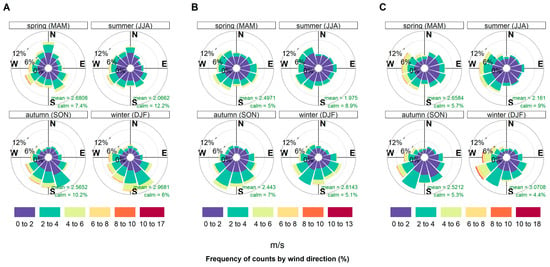
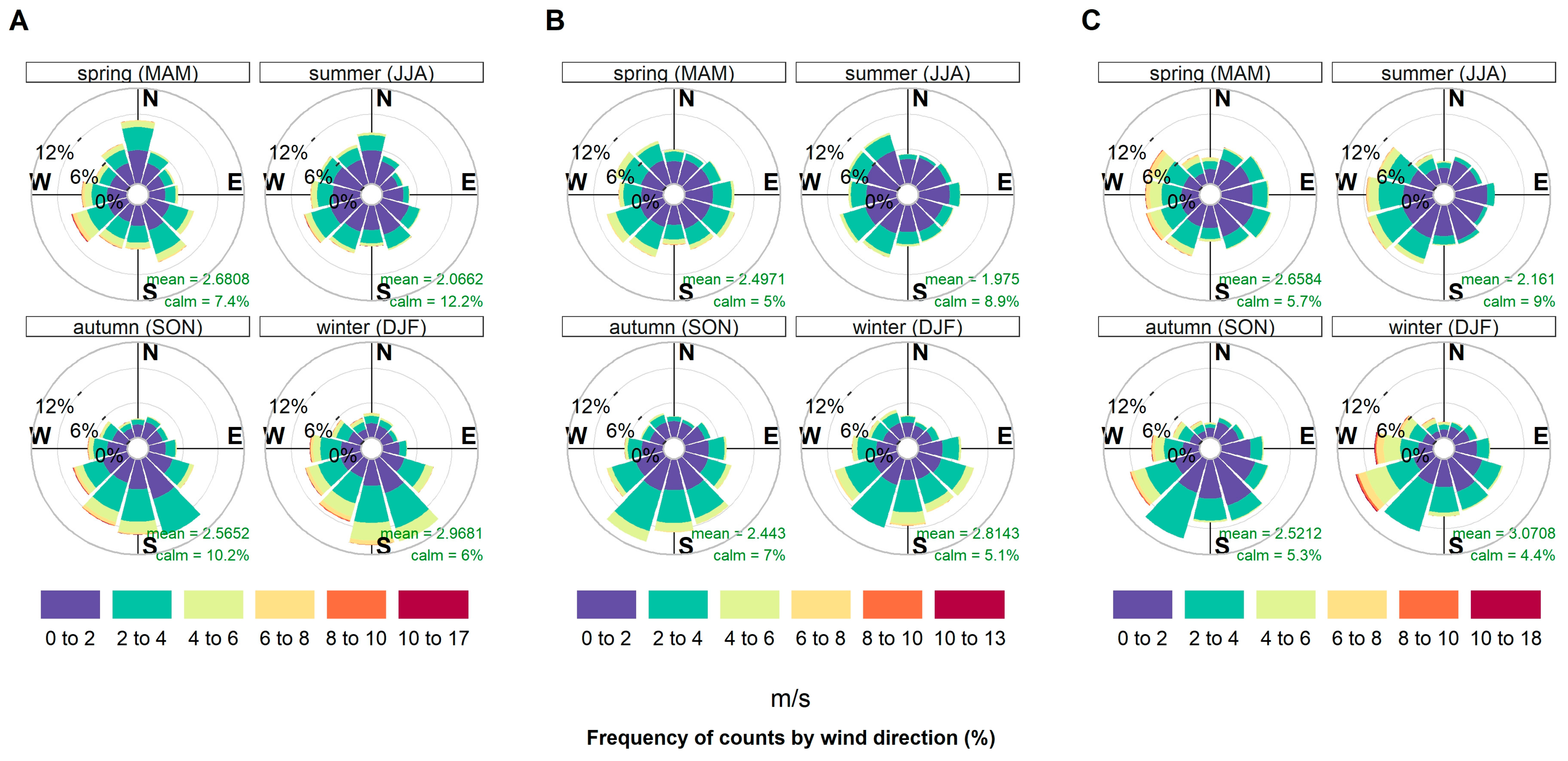
The frequency and wind speed during the period 1991–2020 were determined from the Latvian Environment, Geology and Meteorology Centre from the closest meteorological stations to the study areas in Latvia to minimize wind climate bias (Figure 1). The prevailing winds in Latvia show seasonal and spatial variation. In autumn and winter, the winds were stronger (Figure 1A,B) and were generally blowing from the south and south-west, with the frequency of low (2–4 m/s) and strong winds being 10% and 3%, respectively. In summer and spring, western winds were more frequent, yet their magnitude was lower, with strong winds occurring up to 2% of the time. The regional differences in the central part of Latvia were reflected in the dominance of southern winds. In the east-facing slope of uplands, south-west to west winds were dominant in autumn and winter, but in spring and summer western winds were more common (Figure 1C).
Figure 1.
Seasonal wind frequency and wind speed (m/s) for the time period 1991–2020 in central lowland—Jelgava (A), central upland—Skrīveri (B) and eastern upland—Zīlāni (C) part of Latvia.
2.2. Sampling
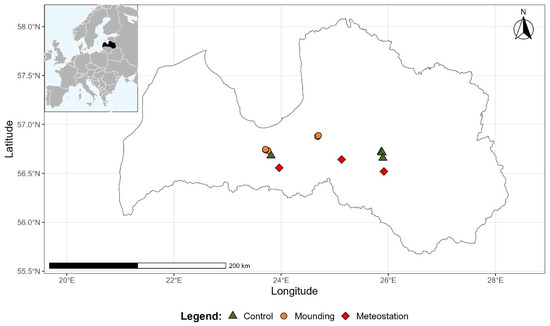
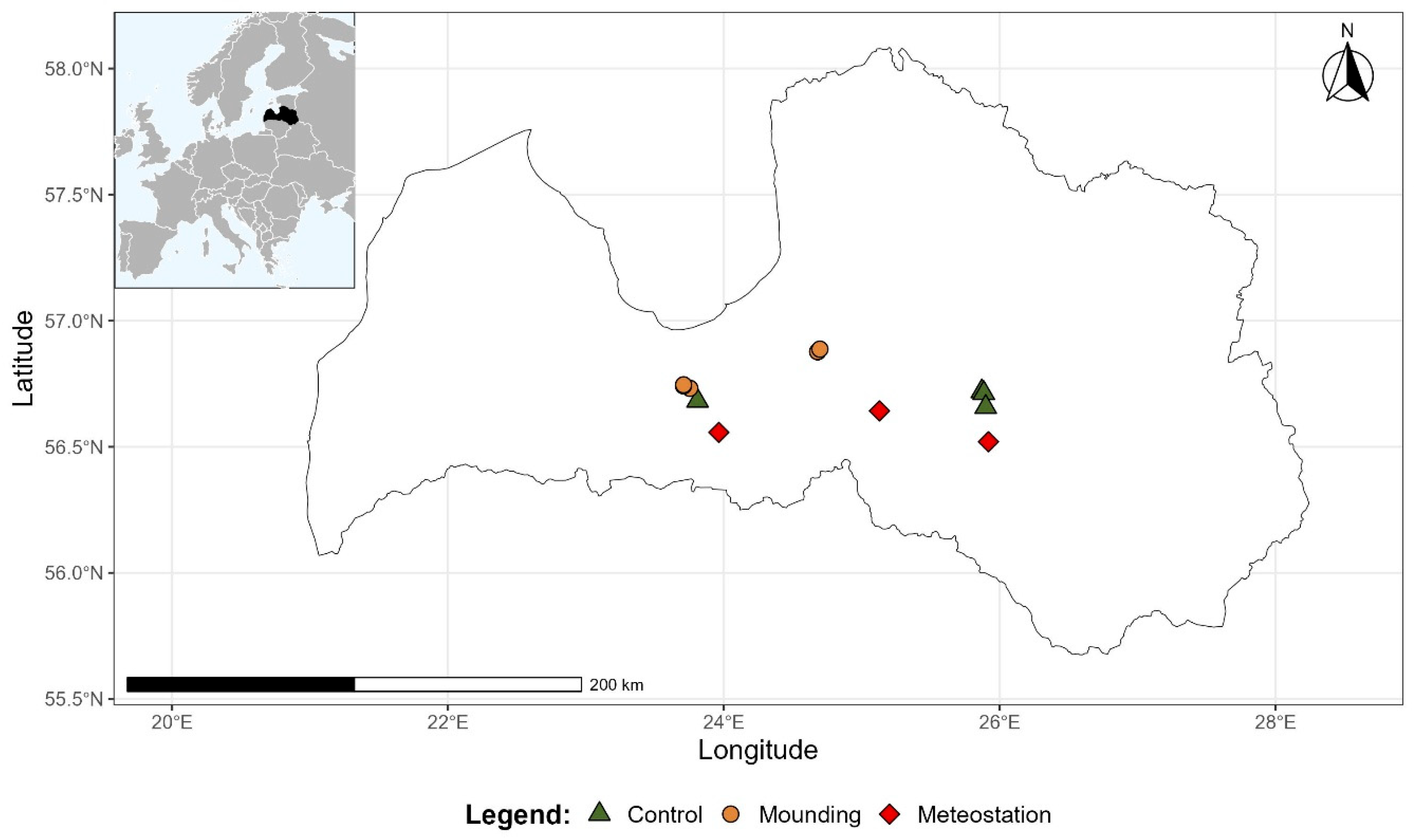
Ten Scots pine (Pinus sylvestris L.) dominated stands, which were located in three vicinities in the central part of Latvia, were studied (Figure 2). The stands were selected in experimental forests according to the State Forest Service database. The experimental forest districts are more flexible in terms of felling and management legislation. Among the sampled stands, six were selected to be regenerated by soil mounding, and in the remaining four stands (considered as control), trees regenerated naturally without any soil preparation (Table 1). Additional criteria for the stratified stand selection were conventional management, single canopy cohort, flat topography, without clearcuts at the stand edges, occurrence on freely draining mineral mesotrophic podzol soils, dominance of Scots pine (>80% of basal area), and the stands had to be at commercial age (young to mature). Hence, mean stand age ranged from 29 to 124 years. Such a range of stand age was selected to characterize the gradient of tree dimensions that are subjected to wind damage [26].
Figure 2.
Map of study objects in the territory of Latvia.
Table 1.
Characteristics of Scots pine sample trees growing in stands regenerated by mounding as well as naturally in conventionally managed forests in the hemiboreal zone. (Mean values ± 95% confidence intervals).
In each stand regenerated by mounding, six non-leaning, visually healthy, non-edge (>10 m from stand edge) sample trees representing height and diameter at breast height (DBH) distribution of a stand were selected for sampling. In the naturally regenerated (control) stands, 20 trees in total were selected, according to the same stratified selection criteria; however, the number of sample trees per stand ranged from two to 11, due to differences in stand size as well as harvesting restrictions. The inventory of the stand was conducted 1–4 years prior to sampling. As a result, trees selected for sampling were similar in size, with DBH ranging from 19.5 to 27.9 cm and tree height from 16.2 to 26.7 m. The trees in the oldest stand, which was nearly two times older, showed only slightly higher dimensions, thus extending the analysable gradient of tree dimensions.
To assess the mechanical stability of sample trees, the destructive tree-pulling test according to Krišāns et al. (2022) [13] was performed. In brief, sampled trees were measured and topped 1 m above their mid-height, and the top anchorage point was set at the mid-height of the sample tree. Tree topping was done to omit effects of crown mass, and any rotations introduced by crown asymmetry, as well as wind. Tree–pulling was conducted with a motorized winch positioned 30–40 m from the sample tree at 0.5–1.0 m height. For assessment of mechanical stability, the pulling force and line angle were recorded using a dynamometer positioned between the pulley system and the line extension. Stem inclination was monitored at two heights, 0.3 and 5 m, using inclinometers, while wood fiber strain on the compression side was measured at a 1 m height with a strain gauge. The instruments used in pulling tests were the TreeQinetic system (IML Electronic GmbH, Rostock, Germany). Sample trees were pulled until fatal failure by breakage or uprooting. The direction of pulling was recorded.
For sample trees, pulling direction was determined by the convenience of anchorage (optimal distance to a sufficient anchor tree). Considering that the studied stands were managed and had not been subjected to structure-altering natural disturbances, they were spatially homogeneous. Furthermore, the pulling direction was not associated with stand density, distribution of neighbouring trees, roads, forest clearings, stand edges, or topographic orientation. As a result, pulling direction represented all cardinal directions, although in stands where soil was prepared by mounding, eastern pulling direction tended to be slightly more frequent (Figure S1A). The same was observed for control stands, yet the pulling directions for sample trees tended to align with north and south directions (Figure S1B), while western direction was less represented.
2.3. Data Analysis
The basal bending moment at primary and secondary failure was estimated based on the recorded pulling force, rope angle, and the inclination of the stem according to Krišāns et al. (2022) [13]. The primary failure was considered as the initial structural wood damage signified by the loss of proportionality between stem inclination and pulling force (deviation of the confidence interval of second-order regression spline from the proportionality line; Figure S2) [13,27]. The secondary failure was considered to occur when the maximum BBM was reached. Basal bending moment (both at primary and secondary failures) was then expressed per stem wood volume, thus estimating tree mechanical stability proxies (BBMPF and BBMSF in kNm/m3, respectively). Such an approach was used to account for the heterogeneity of stem wood of trees of different sizes [28], as it has been empirically proven previously [29]. The linear proportional relationships between BBMs and stem volume were graphically and statistically confirmed, with the simple zero-intercept models showing tight fits (R2 ≥ 0.96) with the data (Figure S3). As within the age range of the studied trees (28–124 years), Scots pine is not considered biologically old, which could alter crown architecture and susceptibility to wind loading [30], stem wood volume was calculated as an integral proxy of tree size according to the national equation by Liepa, 1996.
To estimate potential bias associated with pulling direction, the absolute difference between annual dominant wind direction (according to direction and mean wind speed) and pulling direction was calculated and expressed in radians. Its effect on tree stability proxies (BBMPF and BBMSF) was assessed by linear mixed-effects models. The models were supplemented with the fixed effects of soil preparation method, failure type, and their interactions with the difference in pulling direction. Stand was included as a random intercept, and coefficients of the difference between pulling direction and annual dominant wind direction were allowed to vary among stands (random slopes of BBMsf).
The models were as follows:
where yis—BBMPF and BBMSF failure basal bending moment per stem volume for primary and secondary failure, respectively; Alpha_diff_radi—Absolute difference between annual dominant wind direction and pulling direction in radians; Soil_preps—soil preparation method (mounding, control); Failurei—failure type (uprooted or broken); μstand(s)—random intercept of stand; εis—residual error; …—model parameters. The mode of secondary failure (uprooting vs. stem breakage) was included as a fixed effect to assess whether the mechanisms and loading thresholds of primary failure differed between trees that were more prone to uprooting and those that snapped.
For primary failure, however, the structure of random effects showed signs of overparameterization; hence, random slope was not included. Random slope and intercept of study stands were used to minimize pseudo-replication in the hierarchical dataset [31]. Model overparameterization was evaluated with the variance–covariance correlation matrix. The significance of the fixed effects was estimated using Wald’s χ2. The compliance of the fitted model with the statistical assumptions was verified using the diagnostic plots. Data analysis was performed with statistical software R 4.6.0. [32], using the package “lme4” [33].
3. Results and Discussion
3.1. Mechanical Stability of Trees
Destructive static tree–pulling tests are more prone to result in uprooting than stem breakage, due to tree biomechanics, namely the involvement of dynamic loading in failure under natural conditions [14,34]. Accordingly, uprooting as a type of secondary failure occurred in 59 ± 10% (mean ± st. err.) of cases, with the mean occurrences of 66 ± 13% and 56 ± 14% in naturally regenerated and mounded stands, respectively. The observed proportion of broken trees was higher than observed in Scots pine-dominated stands in Latvia on mineral (23%) and peat (29%) soils, while being comparable to that observed in Germany (36%) [29]. Such a higher share of stem breakage highlighted that the studied trees have allocated resources to stabilization of the root system [14,35]. Alternatively, the increased share of stem breakages, which effectively comprised half of all trees in this study, might be explained by a denser rooting network and/or balanced stem-root growth [13] in stands that have been regenerated naturally and by mounding, respectively [18]. Denser undergrowth, as in the case of naturally regenerated stands, can provide additional stability against uprooting by formation of interconnected root systems with trees of different canopy status complementing each other [14,34]. Though it must be admitted that these conditions were neither quantified nor included in the model due to the limited scope of the study, rendering these explanations speculative. In the case of improved growing conditions and homogeneous stand structure following mounding, trees had likely relied on collective stability [14], while forming a stronger root system to gain an advantage from ameliorated soil conditions [19], which had likely resulted in a shift in the weak point to the stem. Though it must be admitted that the differences in mechanical stability of trees prone to uprooting or stem breakage are mostly negligible, as trees thigmomorphogenetically reach an equilibrium state under local conditions [15].
In wood, which is an elastic composite material, failure under mechanical stress occurs in two steps, with the actual breakage being the secondary failure [13]. Accordingly, intrinsic damage, which is invisible from the outside yet manifests as rupture of wood fibres on the compression side, occurs prior to failure, yet manifests as loss of proportionality between applied force and bending of the stem [13]. For living trees, this implies disruption of wood functionality, hence loss of water conductivity [36], which in turn causes water stress (including physiological water deficit), potentially impairing growth, competitiveness and survival [37]. Although being independent of pulling direction, the estimated susceptibility of trees to primary failure, which can facilitate legacy effects of wind damage [7,38], tended to be higher in mounded stands compared to naturally regenerated stands, as the share of BBMPF from BBMSF was 65 ± 2% and 73 ± 2%, respectively. Still, such ratios were comparable to other studies within the region [29,34], indicating that the same general set is being studied; hence, results are relevant for the study region.
Stand regeneration showed some imprint on tree mechanical stability. The mean BBMPF and BBMSF appeared lower in mounded than in naturally regenerated stands (63.2 ± 1.8 vs. 74.8 ± 3.8, and 97.8 ± 5.2 vs. 101.8 ± 10.4 kNm/m3, respectively), pointing to differences in overall tree mechanical strength. The observed values of BBM were representative and fell within the range of values observed for Scots pine stands in Northern Europe [29] and were comparable to other economically important tree species within the region [34]. Still, the proposed hypothesis was rejected as trees showed lower mechanical stability under mounded than under naturally regenerated conditions. It could be speculated that such differences might arise from the regularity of artificially regenerated stands where trees are more reliant on collective stability, and where root systems might have been less interconnected.
3.2. Effects of Pulling Direction
Even though the morphology of trees in a stand is less affected by thigmomorphogenesis compared to solitary trees [15], dominant winds apparently had a significant effect on the development of trees, as pulling direction was estimated to have a significant effect on tree stability at the fatal failure (secondary, visible failure; Table 2). While local wind climates at the forest canopy height may not be represented by the recorded 30-year average wind directions at the closest meteorological stations, the stand selection was based on similar local topography, growing conditions, and surrounding landscape, without any clearcuts or gaps at the stand edges in the study area. Though, it must be admitted that the directions of wind experienced by individual trees might still deviate from those recorded at the meteorological stations due to landscape specifics. Nevertheless, the estimation appeared reliable as the fitted statistical models were able to explain 17% of the data variation for primary and secondary failure, as indicated by the marginal R2 value, respectively. Such R2 values can be considered moderately high for biological/ecological systems [39], particularly due to complex ecological and mechanical interactions among the trees within a forest stand. However, the F-values of the fixed effects were relatively low, indicating overall weak influence, likely due to considerable local site-specific variation. Site-specific variation was shown by considerably higher conditional R2 values, as well as reasonable ICC (Table 2), pointing to explicit variability among stands which might be partially related to landscape effects on the direction of wind affecting individual trees. The site effects have been considered a major source of uncertainty, preventing wide generalizations of tree-level predictions of mechanical stability [40]. Nevertheless, the weak but significant effect confirmed the presence of pulling direction-related bias, fully agreeing with the stated hypothesis, while indicating the presence of systematic environmental effects which could be accounted for to improve the accuracy of predictions [16].
Table 2.
Fixed effect (Type II Wald Chi-sq values, degrees of freedom (df) and significance), variance for random effects and general performance statistics for the models describing the relationships between the difference in wind and pulling directions, soil preparation method, failure type, and their interactions on basal bending moment at stem base expressed per stem wood volume. Significant effects are shown in bold.
Pulling direction (difference between wind and pulling direction) had a significant effect on BBMSF (Table 2 and Table 3), indicating that pulling direction is likely to cause bias in the estimates of mechanical tree stability, which have to be accounted for (Figure S4). The effect of pulling direction, however, did not interact with soil preparation method, indicating that mounding did not affect tree adjustments to dominant wind. This complies with the symmetric root geometry of trees planted with the mounding technique [18]. The effect of pulling direction was significant, even though slope coefficient estimates showed high variability among the stands, likely in response to locally differing wind climates (wind directions; Figure 1), as well as unique stand properties (as the sample was limited), indicating overall systematic influences. The slight discrepancy observed between the ANOVA results (Table 2) and the parameter estimates (Table 3) likely reflects the differing mathematical assumptions and sensitivities of the statistical tests employed [41]. The parameter estimates for the effect of the difference in wind and pulling direction, which indicate the direction of effect of adaptations of trees likely via thigmomorphogenesis under windy climates [15], suggest potential bias which might be partially related to the systematic tilting of wood fibers [42].
Table 3.
Parameter estimates (±standard error, SE) for the models describing the relationships between the difference in wind and pulling directions, soil preparation method, failure type, and their interactions on basal bending moment at stem base expressed per stem wood volume.
As hinted by the overall statistics and fitted models, it can be cautiously stated that mounding had a significant effect on BBMPF (Table 2), which was not involved in interactions, confirming systematic influence across stands in the Eastern Baltic region. The parameter estimate showed that the effect was significantly lower in mounded stands compared to naturally regenerated stands, suggesting higher susceptibility to legacy effects of storms [5], which are likely to intensify due to the anticipated environmental changes [7,9]. This can be considered as yet another alarm bell regarding the necessity for proactive climate-smart adaptive forestry measures aimed at reducing the negative effects of storms and wind loading, particularly during periods of unfrozen soil, when trees are susceptible to fatal damage [43]. Lower resistance of trees to primary failure in stands regenerated by mounding might be related to stand characteristics [5,44], as indicated by considerable variability among stands (ICC; Table 2). In stands regenerated by mounding, trees were planted in a regular manner, which might have increased the collective stability [44], as mechanical strength characteristics were lower. Hence, this might have reduced the toughness of the stem, resulting in lower resistance to intrinsic wood damage under mechanical loading [45,46]. On the other hand, allocation of resources to competition and growth rather than stability can be considered an advantage, particularly if the rotation period, and hence risks of catastrophic stand-replacing disturbances, are decreased [47]. In contrast, in naturally regenerated stands, the pattern of trees is less regular [48], which might have contributed to stronger wind loads and adaptation of the stem thereafter [45].
Still, some potential limitations of the study should be stated. Some, though likely negligible, biases might be related to the stratified stand selection, which was not randomly distributed across the country, as well as not completely random pulling direction due to the convenience of setup. While destructive pulling tests within observational field settings cannot fully isolate physiological acclimation from site-specific covariates, the stratified sampling protocol ensures that the identified directional patterns provide robust empirical insight into mechanical stability under varying conditions. Stem form and its relation to tree dimensions might have introduced some, though likely negligible, bias in the estimates of BBM [49]. The fact that the effect of deviation of the mass point during the loading was not accounted for in the calculations might have also caused some underestimation of BBM, though it was identical for the studied trees. Additionally, post-failure root morphology and dimensions were not measured, limiting the ability to directly evaluate how specific belowground structural traits influence fatal failure modes.
4. Conclusions
Even though trees growing in stands were studied, the thigmomorphogenetic adaptations to dominant winds were significant in terms of resistance to fatal failure, thus introducing pulling direction-related bias in static pulling tests. Hence, for more reliable estimates needed for agile evaluation of tree stability and stand susceptibility to wind effects, thus aiming to aid sustainability of forests, the difference between pulling direction and dominant winds should be taken into consideration. The non-interactive effect of pulling direction suggested the presence of a general yet simple underlying mechanism. Artificial soil preparation, which in this case was represented by mounding, however, affected the susceptibility of trees to intrinsic wood damage from wind loading, implying that storm legacy effects might be increased.
Supplementary Materials
The following supporting information can be downloaded at: https://www.mdpi.com/article/10.3390/f17091111/s1, Figure S1. Pulling direction frequency of sample trees in mounded (A) and naturally regenerated (control; B) stands. Figure S2. Schematic depiction of estimation of primary and secondary failure based on the relationships between basal bending moment and stem base inclination for trees in situ. Figure S3. Linear relationship between basal bending moment and stem volume at primary (PF) and secondary (SF) failures. Figure S4. The relationship of basal bending moment per stem volume at primary (PF) and secondary (SF) failures with the difference in wind and pulling directions. Coloured area denotes 95% confidence intervals.
Author Contributions
Conceptualization, V.S., R.M. and O.K.; methodology, A.S., R.M., D.E. and O.K.; data curation, A.S., V.S., R.M., D.E. and O.K.; formal analysis, R.M., D.E. and O.K.; writing—original draft preparation, A.S. and O.K.; writing—review and editing, V.S. and R.M.; supervision, O.K. All authors have read and agreed to the published version of the manuscript.
Funding
This study was funded by the JSC Latvia’s State Forests research programme “Effect of climate change on forestry and associated risks” (agreement No. 5-5.9.1_007p_101_21_78). Oskars Krišāns was supported specifically by Activity 1.1.1.9 “Post-doctoral Research” of the Specific Objective 1.1.1 “Strengthening research and innovative capacities and introduction of advanced technologies in the common R&D system” of the European Union’s Cohesion Policy Programme for 2021–2027 research application No 1.1.1.9/LZP/1/24/035 “A solution for reducing wind damage risk in uneven-aged management of Scots pine stands in the Eastern Baltic region”.
Data Availability Statement
Data is contained within the article or Supplementary Material.
Conflicts of Interest
The authors declare no conflicts of interest.
References
- Jansson, G.; Hansen, J.K.; Haapanen, M.; Kvaalen, H.; Steffenrem, A. The genetic and economic gains from forest tree breeding programmes in Scandinavia and Finland. Scand. J. For. Res. 2017, 32, 273–286. [Google Scholar] [CrossRef] [Scilit]
- Pukkala, T.; Laiho, O.; Lähde, E. Continuous cover management reduces wind damage. For. Ecol. Manag. 2016, 372, 120–127. [Google Scholar] [CrossRef] [Scilit]
- Ara, M.; Berglund, M.; Fahlvik, N.; Johansson, U.; Nilsson, U. Pre-Commercial Thinning Increases the Profitability of Norway Spruce Monoculture and Supports Norway Spruce–Birch Mixture over Full Rotations. Forests 2022, 13, 1156. [Google Scholar] [CrossRef] [Scilit]
- Luoranen, J.; Rikala, R. Field performance of Scots pine (Pinus sylvestris L.) seedlings planted in disc trenched or mounded sites over an extended planting season. New For. 2013, 44, 147–162. [Google Scholar] [CrossRef] [Scilit]
- Sikström, U.; Hjelm, K.; Holt Hanssen, K.; Saksa, T.; Wallertz, K. Influence of mechanical site preparation on regeneration success of planted conifers in clearcuts in Fennoscandia – a review. Silva Fenn. 2020, 54, 10172. [Google Scholar] [CrossRef] [Scilit]
- Dupuy, L.; Fourcaud, T.; Stokes, A.A. Numerical Investigation into the Influence of Soil Type and Root Architecture on Tree Anchorage. Plant Soil 2005, 278, 119–134. [Google Scholar] [CrossRef] [Scilit]
- Gardiner, B.; Schuck, A.R.T.; Schelhaas, M.J.; Orazio, C.; Blennow, K.; Nicoll, B. (Eds.) Living with storm damage to forests; European Forest Institute: Joensuu, Finland, 2013; Volume 3, pp. 129–134. [Google Scholar]
- Patacca, M.; Lindner, M.; Lucas-Borja, M.E.; Cordonnier, T.; Fidej, G.; Gardiner, B.; Hauf, Y.; Jasinevičius, G.; Labonne, S.; Linkevičius, E.; et al. Significant increase in natural disturbance impacts on European forests since 1950. Glob. Change Biol. 2022, 29, 1359–1376. [Google Scholar] [CrossRef] [Scilit]
- IPCC. Climate Change 2023: Synthesis Report; Contribution of Working Groups I, II and III to the Sixth Assessment Report of the Intergovernmental Panel on Climate Change; Core Writing Team, Lee, H., Romero, J., Eds.; IPCC: Geneva, Switzerland, 2023; pp. 35–115. [Google Scholar] [CrossRef] [Scilit]
- Valinger, E.; Fridman, J. Factors affecting the probability of windthrow at stand level as a result of Gudrun winter storm in southern Sweden. For. Ecol. Manag. 2011, 262, 398–403. [Google Scholar] [CrossRef] [Scilit]
- Baggio, T.; Costa, M.; Marchi, N.; Locatelli, T.; Lingua, E. Improve the estimation of forest wind vulnerability through remote sensed data: A new methodology. Environ. Model. Softw. 2025, 106825. [Google Scholar] [CrossRef] [Scilit]
- Merlin, M.; Locatelli, T.; Gardiner, B.; Astrup, R. Large-scale modelling wind damage vulnerability through combination of high-resolution forest resources maps and ForestGALES. For. Ecosyt. 2025, 14, 100361. [Google Scholar] [CrossRef] [Scilit]
- Krišāns, O.; Čakša, L.; Matisons, R.; Rust, S.; Elferts, D.; Seipulis, A.; Jansons, Ā. A Static Pulling Test Is a Suitable Method for Comparison of the Loading Resistance of Silver Birch (Betula pendula Roth.) between Urban and Peri-Urban Forests. Forests 2022, 13, 127. [Google Scholar] [CrossRef] [Scilit]
- Peltola, H.; Kellomäki, S.; Hassinen, A.; Granander, M. Mechanical stability of Scots pine, Norway spruce and birch: An analysis of tree-pulling experiments in Finland. For. Ecol. Manag. 2000, 135, 143–153. [Google Scholar] [CrossRef] [Scilit]
- Moulia, B.; Coutand, C.; Julien, J.-L. Mechanosensitive control of plant growth: Bearing the load, sensing, transducing, and responding. Front. Plant Sci. 2015, 6, 52. [Google Scholar] [CrossRef] [Scilit] [PubMed]
- Nicoll, B.C.; Gardiner, B.A.; Peace, A.J. Improvements in anchorage provided by the acclimation of forest trees to wind stress. Forestry 2008, 81, 389–398. [Google Scholar] [CrossRef] [Scilit]
- Andreozzi, M.; Marrazzo, G.; Marsiglia, A.; Boldrin, D.; Castellanza, R.P.; Knappett, J.; Ciantia, M.O. On the Uprooting Stability of Trees: Combined Loading Effect on Tree Stability Assessment. Forests 2025, 16, 1780. [Google Scholar] [CrossRef] [Scilit]
- Dūmiņš, K.; Žīgure, S.; Celma, S.; Štāls, T.A.; Vendiņa, V.; Zuševica, A.; Lazdiņa, D. Impact of Soil Preparation Method and Stock Type on Root Architecture of Scots Pine, Norway Spruce, Silver Birch and Black Alder. Forests 2025, 16, 830. [Google Scholar] [CrossRef] [Scilit]
- Zuševica, A.; Lazdiņa, D.; Štāls, T.A.; Dūmiņš, K. The effect of site preparation on vegetation restoration in young hemiboreal mixed stands. Balt. For. 2023, 29, id705. [Google Scholar] [CrossRef] [Scilit]
- Gardiner, B. Wind Damage to Forests and Trees: A Review with an Emphasis on Planted and Managed Forests. J. For. Res. 2021, 26, 248–266. [Google Scholar] [CrossRef] [Scilit]
- Ahti, T.; Hämet-Ahti, L.; Jalas, J. Vegetation zones and their sections in northwestern Europe. Ann. Bot. Fenn. 1968, 5, 169–211. [Google Scholar]
- Rendenieks, Z.; Liepa, L.; Nikodemus, O. Spatial patterns and species composition of new forest areas present challenges for forest management in Latvia. For. Ecol. Manag. 2022, 509, 120097. [Google Scholar] [CrossRef] [Scilit]
- Jaagus, J.; Briede, A.; Rimkus, E.; Remm, K. Precipitation pattern in the Baltic countries under the influence of large-scale atmospheric circulation and local landscape factors. Int. J. Climatol. 2010, 30, 705–720. [Google Scholar] [CrossRef] [Scilit]
- Kalvāns, A.; Kalvāne, G.; Zandersons, V.; Gaile, D.; Briede, A. Recent seasonally contrasting and persistent warming trends in Latvia. Theor. Appl. Climatol. 2023, 154, 125–139. [Google Scholar] [CrossRef] [Scilit]
- LEGMC Climate of Latvia. Available online: https://klimats.meteo.lv/klimats_latvija/latvijas_klimatiskais_raksturojums/ (accessed on 15 July 2026).
- Donis, J.; Kitenberga, M.; Snepsts, G.; Elferts, D.; Jansons, Ā. Factors affecting windstorm damage at the stand level in hemiboreal forests in Latvia: Case study of 2005 winter storm. Silva Fenn. 2018, 52, 10009. [Google Scholar] [CrossRef] [Scilit]
- Detter, A.; Rust, S.; Rust, C.; Maybaum, G. Determining strength limits for standing tree stems from bending tests. Proceedings of 18th International Nondestructive Testing and Evaluation of Wood Symposium, Madison, WI, USA, 24–27 September 2013; pp. 24–27. [Google Scholar]
- Anfodillo, T.; Petit, G.; Crivellaro, A. Axial conduit widening in woody species: A still neglected anatomical pattern. Iawa J. 2013, 34, 352–364. [Google Scholar] [CrossRef] [Scilit]
- Seipulis, A.; Gardiner, B.; Peltola, H.; Nicoll, B.; Rust, S.; Matisons, R.; Elferts, D.; Krišāns, O.; Jansons, Ā. Geographic variation in resistance of Scots pine (Pinus sylvestris L.) to wind loading across different wind environments in Europe. For. Ecol. Manag. 2024, 571, 122237. [Google Scholar] [CrossRef] [Scilit]
- Mäkelä, A.; Vanninen, P. Vertical structure of Scots pine crowns in different age and size classes. Trees 2001, 15, 385–392. [Google Scholar] [CrossRef] [Scilit]
- Arnqvist, G. Mixed models offer no freedom from degrees of freedom. Trends Ecol. Evol. 2020, 35, 329–335. [Google Scholar] [CrossRef] [Scilit] [PubMed]
- R Core Team. R: A Language and Environment for Statistical Computing; R Foundation for Statistical Computing: Vienna, Austria; 2026. [CrossRef] [Scilit]
- Bates, D.; Mächler, M.; Bolker, B.; Walker, S. Fitting linear mixed-effects models using lme4. J. Stat. Soft. 2015, 67, 1–48. [Google Scholar] [CrossRef] [Scilit]
- Krišāns, O.; Matisons, R.; Vuguls, J.; Bāders, E.; Rust, S.; Elferts, D.; Saleniece, R.; Jansons, Ā. Regularly Planted Rather Than Natural Understory of Norway Spruce (Picea abies H. Karst.) Contributes to the Individual Stability of Canopy Silver Birch (Betula pendula Roth.). Forests 2022, 13, 942. [Google Scholar] [CrossRef] [Scilit]
- Nicoll, B.C.; Ray, D. Adaptive growth of tree root systems in response to wind action and site conditions. Tree Physiol. 1996, 16, 891–898. [Google Scholar] [CrossRef] [Scilit] [PubMed]
- Mayr, S.; Bertel, C.; Dämon, B.; Beikircher, B. Static and dynamic bending has minor effects on xylem hydraulics of conifer branches (Picea abies, Pinus sylvestris). Plant Cell Environ. 2014, 37, 2151–2157. [Google Scholar] [CrossRef] [Scilit] [PubMed]
- Brodribb, T.J.; Cochard, H. Hydraulic failure defines the recovery and point of death in water-stressed conifers. Plant physiol. 2009, 149, 575–584. [Google Scholar] [CrossRef] [Scilit] [PubMed]
- Seidl, R.; Thom, D.; Kautz, M.; Martin-Benito, D.; Peltoniemi, M.; Vacchiano, G.; Reyer, C.P. Forest disturbances under climate change. Nat. Clim. Change 2017, 7, 395–402. [Google Scholar] [CrossRef] [Scilit] [PubMed]
- Low-Décarie, E.; Chivers, C.; Granados, M. Rising complexity and falling explanatory power in ecology. Front. Ecol. Environ. 2014, 12, 412–418. [Google Scholar] [CrossRef] [Scilit]
- Gardiner, B.; Byrne, K.; Hale, S.; Kamimura, K.; Mitchell, S.J.; Peltola, H.; Ruel, J.C. A review of mechanistic modelling of wind damage risk to forests. Forestry 2008, 81, 447–463. [Google Scholar] [CrossRef] [Scilit]
- Fox, J. Applied Regression Analysis and Generalized Linear Models, 3rd ed.; SAGE Publications, Inc.: Thousand Oaks, CA, USA, 2016; ISBN 978-1-4522-0566-3. [Google Scholar]
- Eklund, L.; Säll, H. The influence of wind on spiral grain formation in conifer trees. Trees 2000, 14, 324–328. [Google Scholar] [CrossRef] [Scilit]
- Gregow, H.; Peltola, H.; Laapas, M.; Saku, S.; Venäläinen, A. Combined occurrence of wind, snow loading and soil frost with implications for risks to forestry in Finland under the current and changing climatic conditions. Silva Fenn. 2011, 45, 35–54. [Google Scholar] [CrossRef] [Scilit]
- Hanewinkel, M.; Albrecht, A.; Schmidt, M. Influence of stand characteristics and landscape structure on wind damage. In Living with Storm Damage to Forests; Gardiner, B., Schuck, A., Schelhaas, M.-J., Orazio, C., Blennow, K., Nicoll, B., Eds.; European Forest Institute: Joensuu, Finland, 2013; Volume 3, pp. 39–45. [Google Scholar]
- Brüchert, F.; Gardiner, B. The effect of wind exposure on the tree aerial architecture and biomechanics of Sitka spruce (Picea sitchensis, Pinaceae). Am. J. Bot. 2006, 93, 1512–1521. [Google Scholar] [CrossRef] [Scilit] [PubMed]
- Sellier, D.; Fourcaud, T. Crown structure and wood properties: Influence on tree sway and response to high winds. Am. J. Bot. 2009, 96, 885–896. [Google Scholar] [CrossRef] [Scilit] [PubMed]
- Peltola, H.; Ikonen, V.P.; Gregow, H.; Strandman, H.; Kilpeläinen, A.; Venäläinen, A.; Kellomäki, S. Impacts of climate change on timber production and regional risks of wind-induced damage to forests in Finland. For. Ecol. Manag. 2010, 260, 833–845. [Google Scholar] [CrossRef] [Scilit]
- Szmyt, J.; Korzeniewicz, R. Spatial diversity of planted and untended silver birch (Betula pendula L.) stands. For. Res. Pap. 2012, 73, 323–330. [Google Scholar] [CrossRef] [Scilit]
- Mäkelä, A.; Vanninen, P. Impacts of size and competition on tree form and distribution of aboveground biomass in Scots pine. Can. J. For. Res. 1998, 28, 216–227. [Google Scholar] [CrossRef]

Disclaimer/Publisher’s Note: The statements, opinions and data contained in all publications are solely those of the individual author(s) and contributor(s) and not of MDPI and/or the editor(s). MDPI and/or the editor(s) disclaim responsibility for any injury to people or property resulting from any ideas, methods, instructions or products referred to in the content. |
© 2026 by the authors. Licensee MDPI, Basel, Switzerland. This article is an open access article distributed under the terms and conditions of the Creative Commons Attribution (CC BY) license.