


Abstract
Floodplain forests in central Amazonia are structured along a marked flooding gradient that influences species distribution, performance, and survival. This study evaluated the demographic structure, survival, and growth responses of two co-occurring tree species across contrasting várzea environments differing in inundation regimes. Field surveys quantified seedlings, juveniles, and adults in low- and high-floodplain forests, while a field experiment assessed survival and growth under conditions with and without interspecific interaction. Repeated-measures ANOVA revealed that temporal variation and forest type significantly affected growth parameters, with species-specific responses to flooding intensity. In the field experiment, mortality of Crateva tapia L. differed significantly among treatments (χ2 = 24.96, p < 0.001), with the highest mortality observed in high-várzea (up to 75% under interspecific interaction), while Hura crepitans L. showed 100% survival across all treatments. Non-parametric analyses detected no significant treatment effects on selected morphological traits. The results support the stress-gradient hypothesis, suggesting that plant–plant interactions may shift along the flooding gradient, with facilitative processes becoming more relevant under higher stress conditions. Overall, differential flood tolerance appears to be a key driver of habitat preference and population structure in these Amazonian wetlands.
1. Introduction
Amazonian várzea forests are highly dynamic ecosystems structured by the annual flood pulse, which acts as the primary environmental filter shaping species distribution, composition, and performance [1,2,3]. Based on flood height and duration, two main forest types are distinguished: low-várzea, subjected to mean flood heights between 3 and 7.5 m and inundation periods of 50–230 days per year, and high-várzea, where flooding rarely exceeds 3 m and lasts less than 50 days annually [4]. These hydrotopographic differences result in pronounced floristic turnover along the flood gradient.
Flooding imposes multiple constraints on soil physicochemical conditions, including hypoxia or anoxia, accumulation of CO2, reduction in redox potential, mobilization of reduced elements such as iron and manganese, and the formation of phytotoxic compounds [5,6,7]. In addition, the periodic deposition of fine sediments alters soil structure, porosity, and nutrient availability, directly influencing root functioning and plant establishment [8]. As a result, successful seedling establishment depends on a suite of morphological, anatomical, and physiological adaptations, including aerenchyma formation, hypertrophied lenticels, adventitious roots, and tight phenological synchronization with flood dynamics [9].
Hydrotopographic position plays a central role in shaping plant strategies along the flood gradient. Species occupying lower elevations are typically characterized by submergence tolerance, exhibiting traits such as reduced elongation growth and enhanced resistance to prolonged anoxia [6]. In contrast, species from higher elevations often display escape strategies, relying on rapid shoot elongation and higher growth rates to avoid submergence [10,11]. These contrasting strategies are reflected early in ontogeny, particularly during germination and seedling establishment, where functional differences such as cotyledon type, germination speed, and reserve allocation contribute to species sorting along the gradient [12,13,14].
Studies in fertile white-water floodplains demonstrate that flood duration strongly affects seedling density, biomass, and diversity, often overriding other abiotic and biotic factors [4]. Functional differences are also evident at the germination stage: low-várzea species tend to show faster and more synchronized germination, frequently with foliaceous cotyledons, whereas high-várzea species exhibit slower germination and reserve-type cotyledons [13,15]. These functional contrasts contribute to species zonation along the flood gradient.
Although the flood pulse is widely recognized as the dominant abiotic driver in várzea forests, increasing evidence highlights the importance of biotic interactions in structuring plant communities [16,17,18,19,20]. Negative density dependence, driven by conspecific competition and natural enemies, has been shown to regulate seedling survival and promote species coexistence in tropical forests [21,22]. Beyond flood height, multiple components of the hydrological regime, including flood duration and frequency, strongly influence plant establishment [23]. In Amazonian floodplains, large-scale analyses indicate that variation in flooding regime and edaphic conditions explains a substantial portion of seedling mortality and habitat specialization, often exceeding the influence of herbivory alone [21,22]. Moreover, neighborhood effects may interact with topography and hydrological conditions, influencing growth patterns and spatial distribution of tree species [24].
Floodplain soils in Amazonian várzea forests are composed of nutrient-rich fine sediments (clay and silt) and are highly dynamic and shaped by the annual flood pulse, which regulates sediment deposition, nutrient availability, and soil structure [1,25]. In addition, soil physical properties such as porosity, compaction, and water retention vary along the flood gradient and directly affect root aeration and seedling performance [13,26]. Lower topographic positions, characterized by longer inundation periods, tend to favor species with adaptations to hypoxic conditions, whereas higher areas experience greater soil aeration and support species with higher growth rates but lower flood tolerance [26]. Together, hydrological and edaphic factors act as key environmental filters shaping species distribution and regeneration dynamics in Amazonian várzea forests.
The integration of abiotic filters and biotic interactions is conceptually framed by the stress gradient hypothesis (SGH), which predicts that the relative importance of competition and facilitation shifts along environmental gradients [27,28]. Under high abiotic stress, facilitative interactions are expected to become more prevalent, whereas competition predominates under more benign conditions. Empirical evidence further suggests that neighborhood effects can interact with topography, influencing tree growth and spatial distribution [21,29]. Despite its theoretical relevance, empirical tests of SGH in tropical floodplain forests, particularly during early life stages, remain limited.
Based on the distribution of 186 common tree species in Central Amazonia, ref. [30] proposed that species originally associated with less-flooded environments gradually colonized floodplain forests, progressively developing adaptations to periodic inundation. In this process, some species may have reached a “point of no return”, investing heavily in submergence tolerance while losing competitive ability in non-flooded environments. This mechanism could explain the higher proportion of endemic species in low-várzea compared to high-várzea forests. This framework suggests that specialization along the flood gradient results from the interaction between abiotic selection and competitive trade-offs [30]. However, experimental tests directly evaluating interspecific interactions across contrasting hydrotopographic positions remain scarce.
In this study, we investigate how the flood gradient interacts with interspecific competition to influence growth and biomass allocation in seedlings of two common Central Amazonian várzea tree species: Crateva tapia (typically associated with low-várzea) and Hura crepitans (primarily associated with high-várzea) [31]. We formulate the following a priori hypotheses. (1) Flood-filtering hypothesis: Increasing flood intensity will reduce growth and total biomass accumulation of Hura crepitans (high-várzea species) more strongly than of Crateva tapia, reflecting lower flood tolerance. (2) Competitive trade-off hypothesis: Under low-flood (less stressful) conditions, Hura crepitans will outperform C. tapia in growth and biomass accumulation, indicating greater competitive ability in environments where abiotic stress is reduced. (3) Stress-dependent interaction hypothesis: Under high-flood (high-stress) conditions, the presence of the flood-tolerant species (C. tapia) will mitigate stress effects on H. crepitans, leading to neutral or positive interaction outcomes consistent with the stress gradient hypothesis.
By explicitly testing how abiotic filtering and interspecific interactions shift along the flood gradient, this study provides a mechanistic framework to explain species zonation and habitat specialization in Amazonian várzea floodplain forests.
2. Materials and Methods
2.1. Species Selection Criteria
The study species were selected based on (i) preferential occurrence in one of the two várzea forest types (low- or high-várzea), (ii) high local frequency, and (iii) ecological importance within Central Amazonian floodplain forests.
2.2. Biological Characteristics of the Study Species
Crateva tapia L. (Capparaceae) predominantly occurs in lower topographic positions of Amazonian várzea forests, experiencing a mean flood height of approximately 5.1 m [19]. It is a tree species reaching an average height of 23 m and a mean diameter at breast height (DBH) of 48.3 cm. It is classified as a secondary to late-successional species in low-várzea forests [2]. Fruits are globose berries, green to brown, with a lenticellate epicarp. Flowering and fruiting occur during the flood season [31,32]. Germination is epigeal [9].
Hura crepitans L. (Euphorbiaceae) occurs primarily in higher topographic positions of floodplain forests, with a mean flood height of approximately 2 m [32]. It is a canopy tree reaching up to 35 m in height and 52.3 cm DBH. It is considered a climax species of high-várzea forests [11] and ranks among the 30 most important and frequent species in high-várzea forests of the Amazon basin [32]. The fruit is a schizocarpic capsule (3–5 cm diameter) that splits explosively at maturity into 10–20 mericarps, each containing one seed. Germination is epigeal [16].
2.3. Demographic Survey Design
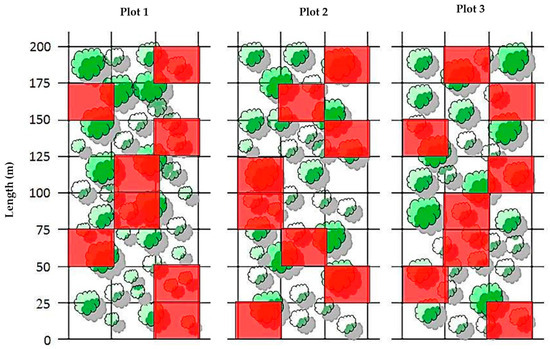
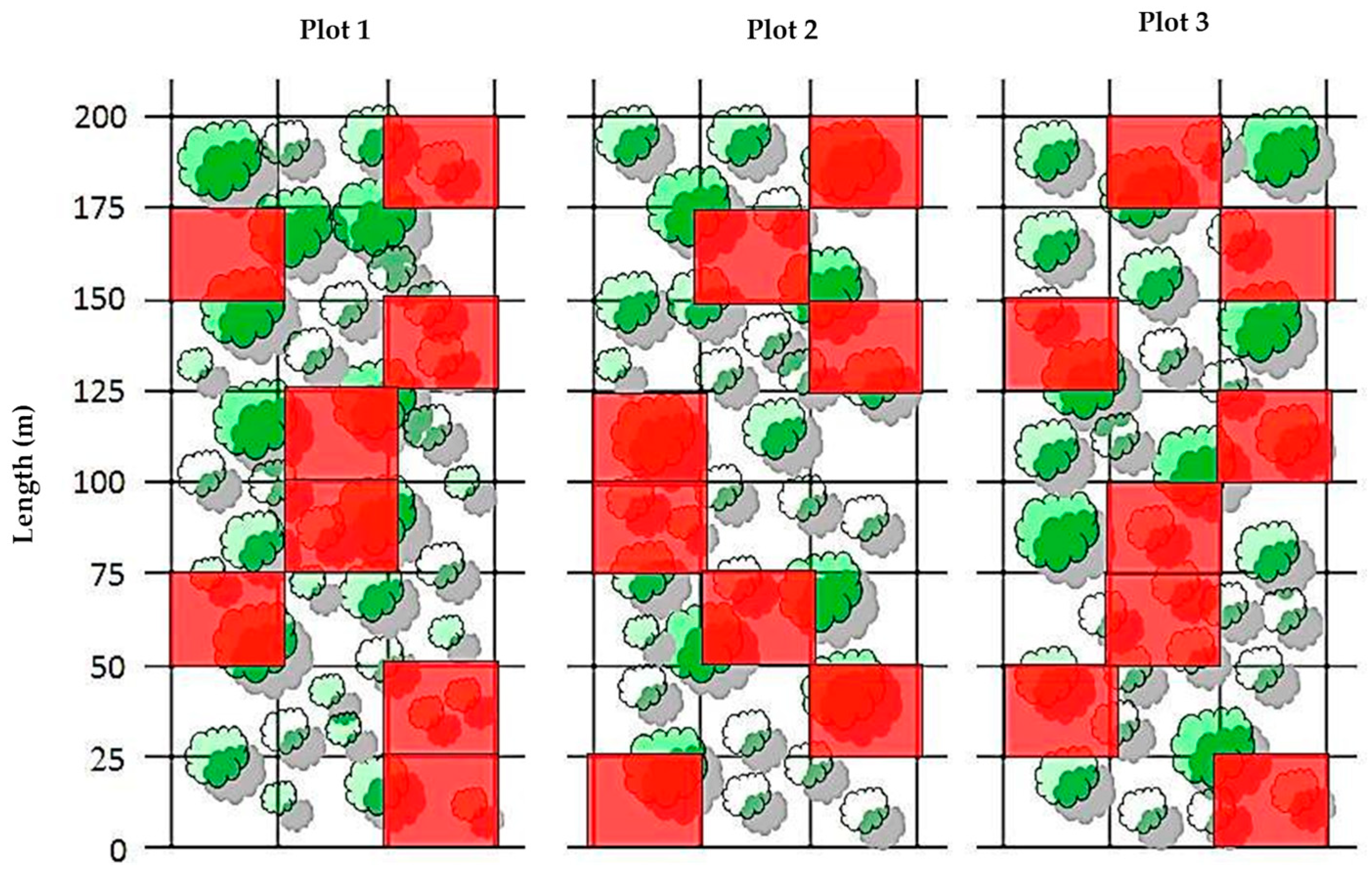
The demographic survey was conducted in March 2011 in a seasonally flooded forest located between the Negro and Solimões rivers, in the Janauari Lake region (03°13′05.7″ S; 60°01′12.9″ W), approximately 10 km southwest of Manaus, Amazonas, Brazil. Six 1.5 ha plots (75 × 200 m) were established, at least 500 m apart: three in low-várzea and three in high-várzea forest. Forest type classification was based on flood height estimated from water marks on tree trunks. Each 1.5 ha plot was subdivided into 24 subplots (25 × 25 m). One subplot per transect line (every 25 m perpendicular to the river margin) was randomly selected, totaling 48 sampled subplots (24 per forest type) and 3 ha of total sampled area (Figure 1).
Figure 1.
Schematic representation of the sampling design used for the demographic survey of Crateva tapia and Hura crepitans in the field. The red squares represent the 25 × 25 m (625 m2) plots that were randomly selected.
The study region is characterized by a humid tropical climate (Af, Köppen classification), with mean annual temperatures ranging from 26 to 28 °C and annual precipitation exceeding 2500 mm. Rainfall seasonality drives the annual flood pulse, which is the main ecological driver structuring várzea ecosystems [33].
All individuals of C. tapia and H. crepitans were tagged and classified as follows:
- Seedlings: ≤1 cm stem collar diameter (SCD);
- Juveniles: >1 cm SCD and ≤10 cm DBH;
- Adults: >10 cm DBH.
Juveniles and adults had diameter measured at 30 cm and 1.30 m above ground, respectively, using a diameter tape. Seedling stem collar diameter was measured using digital calipers. Flood depth for each individual was estimated using water marks on surrounding tree trunks.
For each species, we calculated absolute density (AD), relative density (RD), absolute frequency (AF), relative frequency (RF), absolute dominance (DoA), relative dominance (DoR), and importance value (IV) following [34].
2.4. Seedling Production in Greenhouse
Mature fruits of both species were collected between April and May 2011 from Janauari Lake and Camaleão Lake (Marchantaria Island, Solimões River). Fruits were collected from at least 10 mother trees per species.
Seeds were manually extracted, homogenized, and sown within 48 h after collection in plastic trays containing várzea soil. Seedlings were maintained under natural light conditions and irrigated daily to maintain substrate moisture close to field capacity. No fertilization was applied. Germination was monitored regularly, and after 30 days, seedlings were transplanted into individual plastic bags (10 × 20 cm). At approximately three months (C. tapia) and two months (H. crepitans), seedlings were transferred to plastic pots (18 cm base diameter × 21 cm top diameter × 20 cm height) prior to field transplantation.
2.5. Field Experimental Design
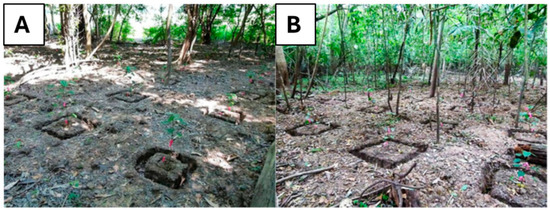
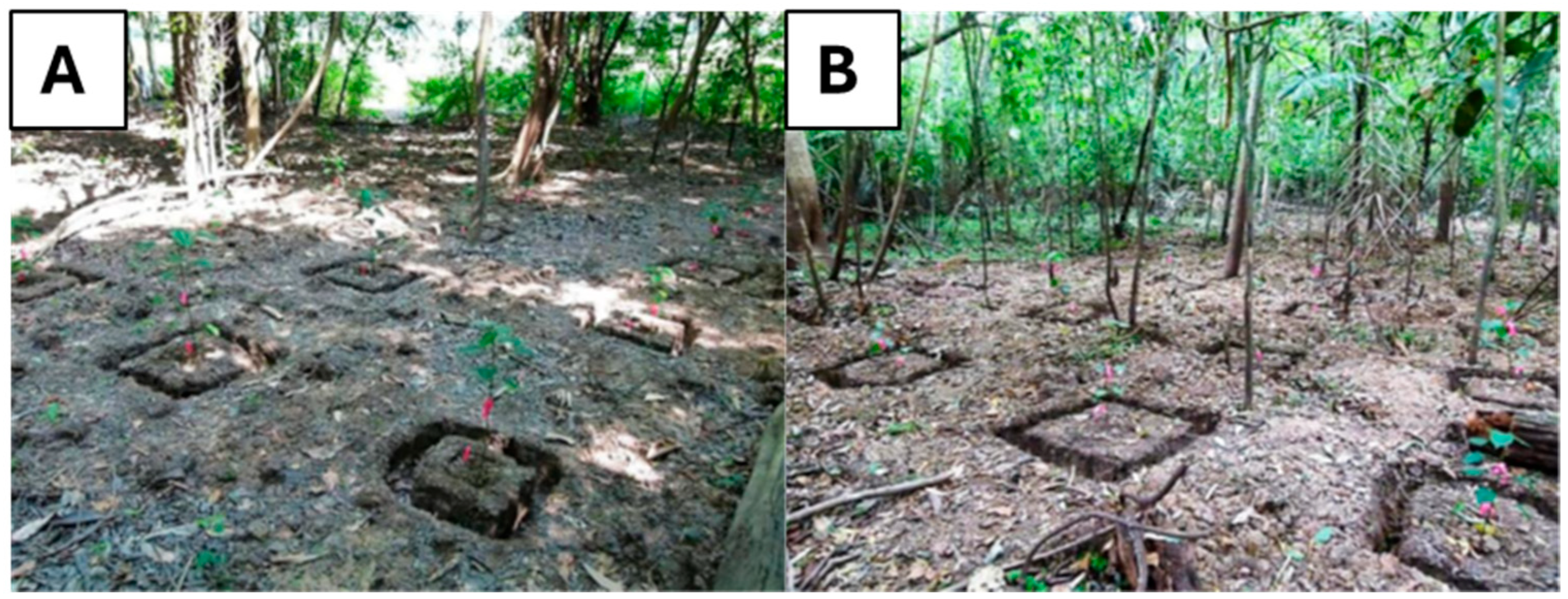
During the falling-water period (August 2011), 80 seedlings of each species were transplanted into the field (Figure 2). A total of 120 experimental plots (~900 cm2 each; 30 × 30 cm plots) were established: 60 in low-várzea and 60 in high-várzea in the Janauari Lake region. To prevent root competition from surrounding vegetation, trenches (5 cm width × 30 cm depth) were dug around each plot and re-opened biweekly.
Figure 2.
Field experiment. Experimental setup in the low-floodplain forest (A). Experimental setup in the high-floodplain forest (B).
The experiment followed a fully factorial design:
- Forest type (2 levels): low-várzea, high-várzea;
- Interspecific interaction (2 levels): alone; with heterospecific neighbor.
Each species was analyzed separately, with 20 replicates per treatment combination (2 × 2 × 20 = 80 experimental units per species).
In interaction treatments, one individual of each species was planted equidistant from plot center and edges. Control treatments corresponded to seedlings planted alone in their preferential forest type.
2.6. Monitoring and Performance Measurements
Seedlings were monitored biweekly for 105 days. The following variables were measured:
- Height (cm);
- Stem collar diameter (mm);
- Number of leaves;
- Total leaf area.
Leaf area estimation was based on species-specific regressions between leaf length and leaf area (n = 30 leaves per species). Regressions were significant for both species (C. tapia: R2 = 0.72; H. crepitans: R2 = 0.85; p < 0.001). Leaves with herbivory damage were measured directly using a portable leaf area meter (AM300, ADC BioScientific Ltd., Hoddesdon, Hertfordshire, UK).
At the end of the experiment, seedlings were harvested and separated into leaves, stems, and roots. Leaf area was determined using scanned images analyzed in ImageJ 1.46. Biomass fractions were dried at 95 °C to constant mass and weighed.
Total biomass was calculated as the sum of all fractions. We also calculated
- Specific leaf area (SLA) = leaf area/leaf dry mass;
- Root-to-shoot ratio (R:S) = root dry mass/(leaf + stem dry mass).
2.7. Statistical Analyses
Repeated-measures ANOVA was used to test the effects of flood condition (2 levels), interspecific interaction (2 levels), and time (treated as a repeated factor). Mortality of C. tapia across treatments was analyzed using contingency tables with Pearson’s chi-square test. Data were checked for normality and homoscedasticity. When assumptions were violated, Kruskal–Wallis tests were used. All analyses were conducted using SYSTAT 11.1 [35].
3. Results
3.1. Demographic Survey
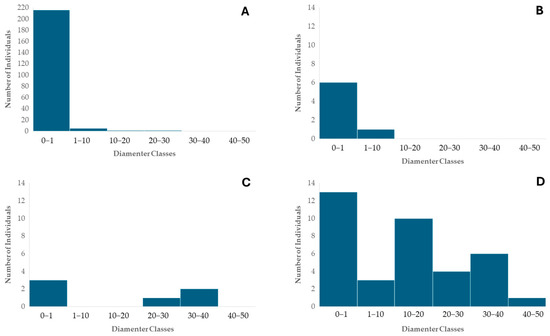
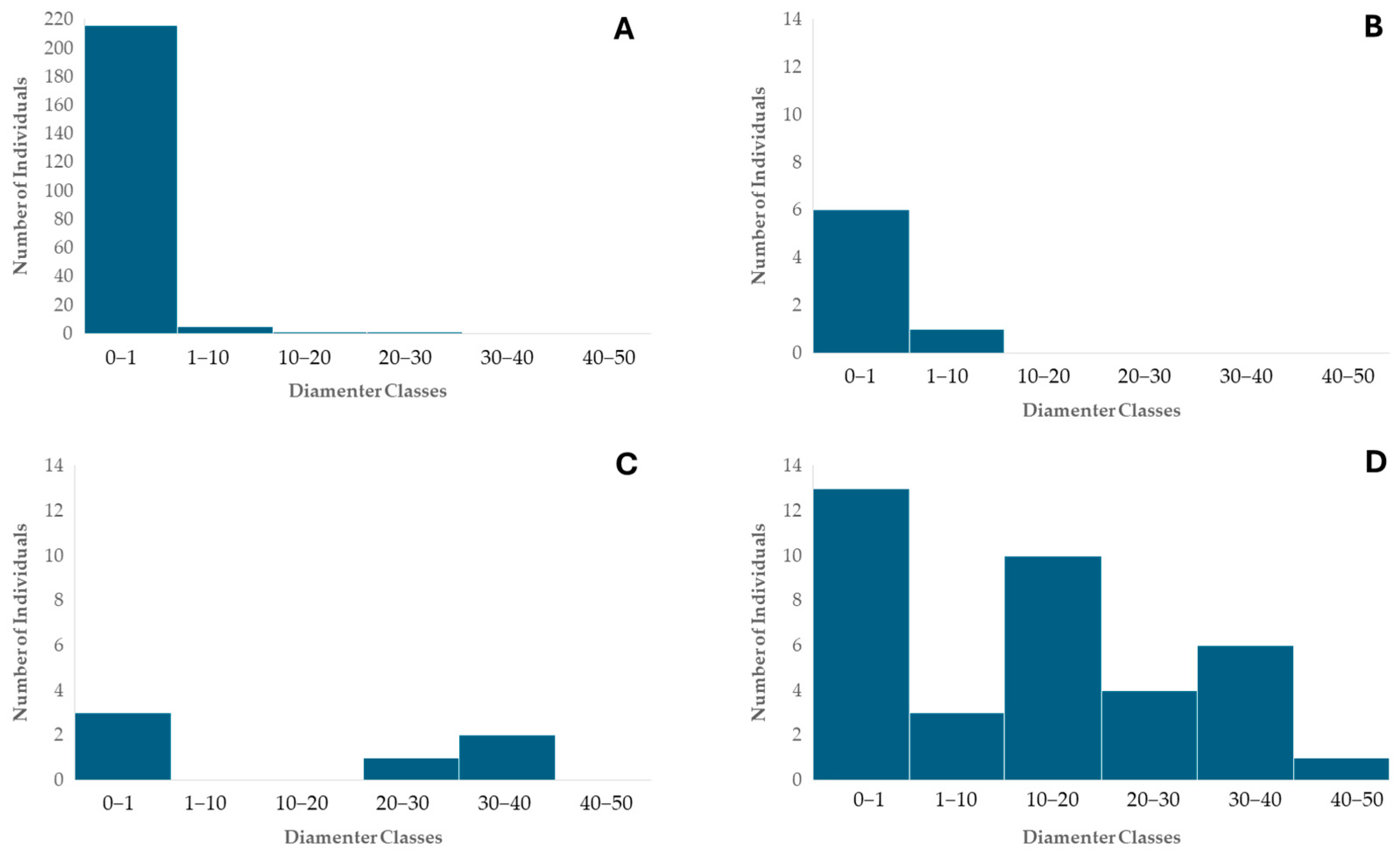
Mean flood height in the low-várzea was 4.79 ± 0.98 m (n = 229), whereas in the high-várzea it was 2.66 ± 0.26 m (n = 44). In the low-várzea, we recorded 216 seedlings (≤1 cm collar diameter), 5 juveniles (>1 cm collar diameter and ≤10 cm DBH), and 2 adults (>10 cm DBH) of Crateva tapia (Figure 3A). In the high-várzea, only six seedlings, one juvenile, and no adults were found (Figure 3B).
Figure 3.
Distribution of the number of individuals by diameter class of Crateva tapia (A,B) and Hura crepitans (C,D) in the low-várzea forest (A,C) and in the high-várzea floodplain forest (B,D).
For Hura crepitans, three seedlings and no juveniles or adults were recorded in the low-várzea (Figure 3C), whereas in the high-várzea we found 13 seedlings, 3 juveniles, and 21 adults (Figure 3D). For Crateva tapia, the highest values of absolute density (AD), relative density (RD), absolute frequency (AF), and relative frequency (RF), across all ontogenetic stages, were observed in the low-várzea. In contrast, for Hura crepitans, these values were higher in the high-várzea. Additionally, for adult individuals of C. tapia, absolute dominance (ADo), relative dominance (RDo), and importance value (IV) were highest in the low-várzea, whereas for H. crepitans these metrics were highest in the high-várzea (Table 1).
Table 1.
Demographic parameters of seedlings (≤1 cm collar diameter), juveniles (>1 cm collar diameter and ≤10 cm DBH), and adults (>10 cm DBH) of Crateva tapia and Hura crepitans in low-várzea (LV) and high-várzea (HV) forests at Lago do Janauari floodplain.
3.2. Field Experiment
The number of dead and surviving Crateva tapia seedlings at the end of the experiment differed among treatment combinations (Pearson’s χ2 = 24.960; df = 3; p < 0.001). The highest mortality occurred in the high-várzea treatments (Supplementary Material), both without interspecific interaction (10 out of 20 individuals) and with interspecific interaction (15 out of 20 individuals) (Table 2). In contrast, all individuals of Hura crepitans survived across all treatment combinations.
Table 2.
Contingency table—Crateva tapia (field experiment). Observed number of dead and surviving individuals (expected values in parentheses).
Repeated-measures ANOVA for Crateva tapia seedling revealed a significant effect of time on seedling height (F7 = 17.66, p < 0.001), indicating consistent growth throughout the experimental period. A significant time × forest-type interaction was also detected for height (F7 = 3.13, p < 0.05), demonstrating that growth trajectories differed between low- and high-floodplain forests. However, no significant main effects of forest type or interspecific interaction were observed for height (Table 3). For stem collar diameter (SCD), no significant effects were detected for time, forest type, interspecific interaction, or their interactions (p > 0.05 in all cases), indicating relative stability of this trait across treatments. Kruskal–Wallis tests showed no significant differences among treatments for number of leaves (H = 2.14, df = 3, p > 0.05) or leaf area (H = 2.14, df = 3, p > 0.05).
Table 3.
Results of repeated-measures ANOVA and Kruskal–Wallis tests to Crateva tapia. Significance levels: * p < 0.05; *** p < 0.001.
In contrast, growth responses of Hura crepitans were strongly influenced by the experimental factors. Repeated-measures ANOVA showed a highly significant effect of time on stem diameter (F7 = 250.18, p < 0.001), number of leaves (F7 = 140.65, p < 0.001), and leaf area (F7 = 132.90, p < 0.001), reflecting marked temporal growth variation (Table 4). Forest type significantly affected stem diameter (F1 = 8.24, p < 0.01) and leaf area (F1 = 6.04, p < 0.05), indicating differential performance between low- and high-floodplain environments. Significant time × forest-type interactions were detected for all three variables (diameter: F7 = 60.66, p < 0.001; leaves: F7 = 14.38, p < 0.001; leaf area: F7 = 16.91, p < 0.001), demonstrating that growth dynamics over time varied according to flood regime. A significant time × interaction effect was observed for leaf area (F7 = 2.16, p < 0.05), suggesting that interspecific interaction influenced leaf area dynamics across the experimental period. No other interaction terms were significant. Kruskal–Wallis analysis indicated no significant differences among treatments for height (H = 3.50, df = 3, p > 0.05).
Table 4.
Results of repeated-measures ANOVA and Kruskal–Wallis tests to Hura crepitans. Significance levels: * p < 0.05; ** p < 0.01; *** p < 0.001.
4. Discussion
4.1. Flood Filtering and Demographic Patterns Along the Gradient
The demographic survey revealed a clear spatial segregation between species consistent with their known flood associations. Crateva tapia showed higher density, frequency, dominance, and importance values in the low-várzea, whereas Hura crepitans exhibited these patterns in the high-várzea. The absence of adult C. tapia in the high-várzea and of adult H. crepitans in the low-várzea strongly supports for the role of flood regime as a primary environmental filter structuring species zonation, in agreement with broader evidence that hydrological gradients determine regeneration niches and functional specialization in Amazonian floodplain trees [31,35].
The low number of adult C. tapia recorded in the low-várzea may partially reflect sampling design, as this species preferentially occupies river margins [30], which were not included in our plots. In contrast, the low abundance of adult H. crepitans in the high-várzea likely reflects selective logging pressure, as this species is frequently harvested for plywood production due to its low wood density (<0.60 g cm−3) [36] and regional abundance [37].
Interestingly, seedlings of both species were recorded in both forest types, although in contrasting densities. This indicates that initial establishment after flood recession may occur outside their typical adult distribution zones. However, the absence or rarity of later ontogenetic stages suggests strong post-establishment filtering mechanisms limiting recruitment across the flood gradient. This is consistent with trade-offs between flood tolerance and competitive ability described for várzea species and is conceptualized as a potential point of no return in habitat specialization [31,38].
The particularly low number of H. crepitans seedlings may also reflect elevated mortality following extreme flood events (e.g., the 2009 flood), reinforcing the idea that flooding intensity constrains its regeneration niche [39].
Together, these findings support our flood-filtering hypothesis, indicating that abiotic stress imposed by flooding plays a dominant role in shaping species distribution limits while interacting with functional traits and demographic trade-offs [40].
4.2. Experimental Evidence of Flood-Induced Stress
The experimental results further corroborate the flood-filtering mechanism. Flooding caused complete leaf abscission and growth stagnation in both species during a 60-day inundation period, suggesting induction of dormancy under hypoxic conditions [31], as previously described for várzea species [1,7,41,42]. However, species responses diverged markedly after flood removal.
Crateva tapia showed rapid leaf resprouting and compensatory growth, surpassing non-flooded individuals within four weeks. This response is consistent with adaptive strategies of low-várzea species that maximize growth during the short terrestrial phase and often rely on reserve-supported recovery after inundation [43]. The post-flood allocation shift toward leaves and stems suggests rapid restoration of photosynthetic capacity, reflecting high flood tolerance and conservative resource-use strategies linked to seed reserve investment.
In contrast, Hura crepitans exhibited negative growth after inundation, associated with apical meristem decay and likely root damage. This pattern aligns with known physiological limitations of flood-intolerant species under prolonged hypoxia, including reduced ATP production, accumulation of ethanol, impaired nutrient uptake, and increased susceptibility to oxidative damage upon reoxygenation [5,6]. Reduced investment in leaf, stem, and root biomass indicates that flooding imposed severe physiological stress on this species.
These contrasting responses provide strong experimental support for our prediction that increasing flood stress disproportionately reduces growth of the less flood-tolerant species. This reinforces the role of hydrological filtering as a primary driver of regeneration dynamics in floodplain forests [40]. Furthermore, it has been shown that seasonal and predictable soil flooding filters tree lineages along the hydrographic gradient [41]. A critical factor in this selection and diversification is likely related to distinct adaptations of the species’ roots to waterlogging.
4.3. Competition–Stress Trade-Offs Along the Flood Gradient
Our results also demonstrate that biotic interactions shift along the flood gradient. Under non-flooded conditions, Crateva tapia experienced reduced leaf production, leaf biomass, and specific leaf area when grown in interaction with Hura crepitans, despite the absence of shading. This suggests that belowground competition for nutrients or space, rather than light limitation, is the primary driver of interaction outcomes in well-aerated soils [2,16]. These findings support our competitive trade-off hypothesis, indicating that the more flood-tolerant species is competitively inferior under low-stress conditions, consistent with theoretical expectations of tolerance–competition trade-offs in stressful environments [18,44]. Similarly, the presence of C. tapia reduced growth and biomass accumulation of Hura crepitans in non-flooded treatments, confirming that interspecific competition operates bidirectionally when abiotic stress is low.
However, under flooded conditions, interaction outcomes shifted. In inundated treatments, H. crepitans seedlings exhibited greater height, collar diameter, leaf number, total biomass, and specific leaf area when growing with C. tapia than when growing alone. This pattern is consistent with the stress gradient hypothesis, which predicts that facilitative interactions become more important as environmental stress increases and has been experimentally demonstrated for Amazonian floodplain seedlings [21,45].
The presence of the flood-tolerant species may have mitigated soil hypoxia through radial oxygen loss (ROL) from its roots, potentially improving the rhizosphere microenvironment for the less tolerant H. crepitans [27]. Although not directly measured, recent studies suggest that mycorrhizal associations in várzea forests may further modulate these interactions, enhancing nutrient uptake and stress tolerance even during periods of partial submergence [46,47]. This transition from competition under low stress to facilitation under high stress provides a mechanistic insight into how biotic interactions, often overlooked in favor of purely abiotic filters, contribute to species zonation and coexistence in Amazonian floodplain forests [18,27].
5. Conclusions
The spatial segregation of Crateva tapia and Hura crepitans along the flood gradient of Lago do Janauari reflects a dynamic balance between early establishment potential and subsequent demographic filtering. Although seedlings of both species can emerge across low- and high-várzea forests, long-term persistence appears constrained by environmental conditions that differentially affect survival and growth throughout ontogeny.
Our combined field and experimental evidence indicates that the seasonal flood pulse acts as a central structuring force, modulating growth trajectories, biomass allocation patterns, and recovery capacity. The contrasting post-inundation responses observed between species highlight divergent life-history strategies, with performance tightly linked to flood tolerance thresholds.
Importantly, species interactions were context-dependent along the flood gradient. Competitive effects prevailed under benign conditions, whereas stressful flooding environments altered interaction outcomes, favoring positive or stress-buffering effects. This context dependency underscores that species distribution limits in floodplain forests cannot be attributed solely to physiological tolerance, but, rather, emerge from the interplay between abiotic constraints and shifting biotic relationships.
Overall, our findings emphasize that habitat specialization in Amazonian várzea forests results from multi-level ecological processes operating from seedling establishment to adult persistence. Recognizing how hydrological stress and interaction dynamics jointly shape demographic outcomes is essential for predicting vegetation responses to intensifying flood regimes under ongoing environmental change.
Supplementary Materials
The following supporting information can be downloaded at: https://www.mdpi.com/article/10.3390/f17040496/s1, Figure S1. Individuals of Crataeva benthamii in the field showing herbivory damage to leaves, apical meristems, and stems. (A) Young individual with initial leaf damage. (B) Leaves exhibiting perforations and chewing marks caused by herbivores. (C) Seedling with damage to the apical meristem. (D) Severe apical meristem consumption leading to tissue deformation. (E) Detail of stem apex after meristem removal. (F) Stem damage associated with herbivory. (G) Advanced tissue degradation affecting stem integrity.
Author Contributions
Conceptualization, N.F.d.S., P.P. and M.T.F.P.; methodology, N.F.d.S., L.O.D. and A.L.; software, A.L.; validation, N.F.d.S., P.P. and M.T.F.P.; formal analysis, N.F.d.S. and A.L.; investigation, N.F.d.S., L.O.D. and L.C.C.; resources, P.P. and M.T.F.P.; data curation, N.F.d.S.; writing—original draft preparation, N.F.d.S.; writing—review and editing, P.P., L.O.D., L.C.C., A.L. and M.T.F.P.; visualization, N.F.d.S. and A.L.; supervision, P.P. and M.T.F.P.; project administration, M.T.F.P.; funding acquisition, M.T.F.P. All authors have read and agreed to the published version of the manuscript.
Funding
We acknowledge financial support from the Amazonas State Research Foundation (FAPEAM) and the National Council for Scientific and Technological Development (CNPq) through the Long-Term Ecological Research Program (PELD MAUA Phases III and IV) grant number 01.02.016301.02630/2022-76, 441811/2020-5 and 446044/2024-5; the National Institute of Science and Technology for the Adaptation of Amazonian Aquatic Biota—ADAPTA II and III (CNPq/FAPEAM) grant number 465540/2014-7; and INPA/PPI of the MAUA Research Group grant number 1090-5. M.T.F.P. acknowledges support from a CNPq Productivity Fellowship grant number 308827/2021-0. A.L. acknowledges support from the Instituto Cesumar de Ciência, Tecnologia e Inovação (ICETI) grant number CP 01/2024 and the Araucária Foundation for the Support of Scientific and Technological Development of the State of Paraná through a Productivity Fellowship grant number CP 23/2023.
Data Availability Statement
The data supporting the findings of this study are available from the corresponding author upon reasonable request.
Acknowledgments
We are grateful to the Instituto Nacional de Pesquisas da Amazônia (INPA), the MAUA Research Group (“Ecology, Monitoring and Sustainable Use of Wetlands”), and the INPA/Max Planck Project for logistical support. We also thank Jéssica Ferreira Barroncas for assistance with greenhouse and fieldwork activities. M.T.F.P. acknowledges support from a CNPq Research Productivity Fellowship. This study was also supported by the Technical and Scientific Cooperation Agreement between INPA and the Max Planck Society.
Conflicts of Interest
The authors declare no conflicts of interest. The funders had no role in the design of the study; in the collection, analyses, or interpretation of data; in the writing of the manuscript; or in the decision to publish the results.
Abbreviations
The following abbreviations are used in this manuscript:
| AD | Absolute density |
| RD | Relative density |
| AF | Absolute frequency |
| RF | Relative frequency |
| ADo | Absolute dominance |
| RDo | Relative dominance |
| IV | Importance value |
| DBH | Diameter at breast height |
| SCD | Stem collar diameter |
| CD | Collar diameter |
| LA | Leaf area |
| SLA | Specific leaf area |
| R:S | Root-to-shoot ratio |
| LV | Low-várzea |
| HV | High-várzea |
| T | Time (repeated-measures factor) |
| Int | Interspecific interaction |
| df | Degrees of freedom |
References
- Junk, W.J.; Bayley, P.B.; Sparks, R.E. The flood pulse concept in river-floodplain systems. In Proceedings of the International Large River Symposium; Dodge, D.P., Ed.; Canadian Special Publication of Fisheries and Aquatic Sciences; Department of Fisheries and Oceans: Ottawa, ON, Canada, 1989; Volume 106, pp. 110–127. [Google Scholar]
- Wittmann, F.; Junk, W.J. Sapling communities in Amazonian white-water forests. J. Biogeogr. 2003, 30, 1533–1544. [Google Scholar] [CrossRef] [Scilit]
- Junk, W.J.; An, S.; Finlayson, C.M.; Gopal, B.; Květ, J.; Mitchell, S.A.; Mitsch, W.J.; Robarts, R.D. Current state of knowledge regarding the world’s wetlands and their future under global climate change: A synthesis. Aquat. Sci. 2013, 75, 151–167. [Google Scholar] [CrossRef] [Scilit]
- Wittmann, F.; Anhuf, D.; Junk, W.J. Tree species distribution and community structure of central Amazonian várzea forests by remote-sensing techniques. J. Trop. Ecol. 2002, 18, 805–820. [Google Scholar] [CrossRef] [Scilit]
- Jackson, M.B.; Colmer, T.D. Response and adaptation by plants to flooding stress. Ann. Bot. 2005, 96, 501–505. [Google Scholar] [CrossRef] [Scilit]
- Colmer, T.D.; Voesenek, L.A.C.J. Flooding tolerance: Suites of plant traits in variable environments. Funct. Plant Biol. 2009, 36, 665–681. [Google Scholar] [CrossRef] [Scilit]
- Voesenek, L.A.C.J.; Bailey-Serres, J. Flood adaptive traits and processes: An overview. New Phytol. 2015, 206, 57–73. [Google Scholar] [CrossRef] [Scilit]
- Lane, C.R.; Leibowitz, S.G.; Autrey, B.C.; LeDuc, S.D.; Alexander, L.C. Hydrological, physical, and chemical functions and connectivity of non-floodplain wetlands to downstream waters: A review. J. Am. Water Resour. Assoc. 2018, 54, 346–371. [Google Scholar] [CrossRef] [Scilit] [PubMed]
- Jia, W.; Ma, M.; Chen, J.; Wu, S. Plant morphological, physiological and anatomical adaption to flooding stress and the underlying molecular mechanisms. Int. J. Mol. Sci. 2021, 22, 1088. [Google Scholar] [CrossRef] [Scilit] [PubMed]
- Worbes, M. The forest ecosystem of the floodplains. In The Central Amazon Floodplain: Ecology of a Pulsing System; Springer: Berlin/Heidelberg, Germany, 1997; pp. 223–265. [Google Scholar]
- Fonseca, L.D.; Dalagnol, R.; Malhi, Y.; Rifai, S.W.; Costa, G.B.; Silva, T.S.; Da Rocha, H.R.; Tavares, I.B.; Borma, L.S. Phenology and seasonal ecosystem productivity in an Amazonian floodplain forest. Remote Sens. 2019, 11, 1530. [Google Scholar] [CrossRef] [Scilit]
- Violle, C.; Bonis, A.; Plantegenest, M.; Cudennec, C.; Damgaard, C.; Marion, B.; Le Cœur, D.; Bouzillé, J.B. Plant functional traits capture species richness variations along a flooding gradient. Oikos 2011, 120, 389–398. [Google Scholar] [CrossRef] [Scilit]
- Dalling, J.W.; Muller-Landau, H.C.; Wright, S.J.; Hubbell, S.P. Role of dispersal in the recruitment limitation of neotropical pioneer species. J. Ecol. 2002, 90, 714–727. [Google Scholar] [CrossRef] [Scilit]
- Swenson, N.G. The assembly of tropical tree communities–the advances and shortcomings of phylogenetic and functional trait analyses. Ecography 2013, 36, 264–276. [Google Scholar] [CrossRef] [Scilit]
- Westoby, M.; Leishman, M.; Lord, J. Comparative ecology of seed size and dispersal. Philos. Trans. R. Soc. Lond. B Biol. Sci. 1996, 351, 1309–1318. [Google Scholar] [CrossRef] [Scilit]
- Lopes, A.; Silva, N.F.D.; Demarchi, L.O.; Albuquerque, B.W.D.; Wittmann, F.; Schöngart, J.; Paccola, E.A.d.S.; Piedade, M.T.F.; Reboucas, E.R. Germination and organic reserves of seeds from common Amazonian floodplain tree species. Acta Amaz. 2025, 55, e55bc24363. [Google Scholar] [CrossRef] [Scilit]
- Mitsch, W.J.; Bernal, B.; Nahlik, A.M.; Mander, Ü.; Zhang, L.; Anderson, C.J.; Jørgensen, S.E.; Brix, H. Wetlands, Carbon, and Climate Change. Landsc. Ecol. 2013, 28, 583–597. [Google Scholar] [CrossRef] [Scilit]
- Wittmann, F.; Householder, J.E.; Piedade, M.T.F.; Schöngart, J.; Demarchi, L.O.; Quaresma, A.C.; Junk, W.J. A review of the ecological and biogeographic differences of Amazonian floodplain forests. Water 2020, 14, 3360. [Google Scholar] [CrossRef] [Scilit]
- Silva, R.D.S.; Cruz, F.R.D.S.; Silva, M.L.M.D.; Nascimento, M.D.G.R.D.; Sousa, E.M.D.; Cordeiro, J.M.P.; Silva, J.H.C.S.; Alves, E.U. From Seed to Young Plant: A Study on Germination and Morphological Characteristics of Crateva tapia L. (Capparaceae). Biology 2025, 14, 1729. [Google Scholar] [CrossRef] [Scilit] [PubMed]
- Bruno, J.F.; Stachowicz, J.J.; Bertness, M.D. Inclusion of facilitation into ecological theory. Trends Ecol. Evol. 2003, 18, 119–125. [Google Scholar] [CrossRef] [Scilit]
- Metz, M.R.; Sousa, W.P.; Valencia, R. Widespread density-dependent seedling mortality promotes species coexistence in a highly diverse Amazonian rainforest. Ecology 2010, 91, 3675–3685. [Google Scholar] [CrossRef] [PubMed]
- Johnson, D.J.; Beaulieu, W.T.; Bever, J.D.; Clay, K. Conspecific negative density dependence and Amazonian tree diversity. Science 2017, 356, 1389–1392. [Google Scholar]
- Fetcher, N.; Strain, B.R.; Oberbauer, S.F. Effects of light regime on the growth, leaf morphology, and water relations of seedlings of two species of tropical trees. Oecologia 1983, 58, 314–319. [Google Scholar] [CrossRef] [Scilit]
- Scarano, F.R. Plant communities at the periphery of the Atlantic rain forest: Rare-species bias and its risks for conservation. Biodivers. Conserv. 2002, 11, 229–241. [Google Scholar] [CrossRef] [Scilit]
- Fortunel, C.; Lasky, J.R.; Uriarte, M.; Valencia, R.; Wright, S.J.; Garwood, N.C.; Kraft, N.J. Topography and neighborhood crowding can interact to shape species growth and distribution in a diverse Amazonian forest. Ecology 2018, 99, 2272–2283. [Google Scholar] [CrossRef] [Scilit]
- de Souza Ferreira Neto, G.; Baccaro, F.B.; Quesada, C.A.N.; Figueiredo, A.S.; Oliveira, R.; Gomes, E.; Spironello, W.R.; Barnett, A.A. Sedimental journey: Soil fertility of fluvial islands increases with proximity to an Amazonian white-water river. Wetlands 2021, 41, 104. [Google Scholar] [CrossRef] [Scilit]
- Bredin, Y.K.; Hess, L.L.; Scabin, A.B.; Dunthorn, M.; Haugaasen, T.; Peres, C.A.; Nilsson, H.R.; Antonelli, A.; Ritter, C.D. Above-and below-ground biodiversity responses to the prolonged flood pulse in central-western Amazonia, Brazil. Environ. DNA 2022, 4, 533–548. [Google Scholar] [CrossRef] [Scilit]
- Casanova, M.T.; Brock, M.A. How do depth, duration and frequency of flooding influence the establishment of wetland plant communities? Plant Ecol. 2000, 147, 237–250. [Google Scholar] [CrossRef] [Scilit]
- Fortunel, C.; Paine, C.T.; Fine, P.V.; Kraft, N.J.; Baraloto, C. Environmental factors predict community functional composition in A mazonian forests. J. Ecol. 2014, 102, 145–155. [Google Scholar] [CrossRef] [Scilit]
- Wittmann, F.; Schöngart, J.; Junk, W.J. Phytogeography, species diversity, community structure and dynamics of Central Amazonian floodplain forests. In Amazonian Floodplain Forests: Ecophysiology, Biodiversity and Sustainable Management; Junk, W.J., Piedade, M.T.F., Wittmann, F., Schöngart, J., Parolin, P., Eds.; Springer: Dordrecht, The Netherlands, 2010; pp. 61–102. [Google Scholar]
- Silva, N.F.; Parolin, P.; Piedade, M.T.F.; Lopes, A. Flooding affects plant–plant interactions in tree seedlings from fertile Amazonian floodplains, Brazil. Hydrobiologia 2023, 850, 1303–1317. [Google Scholar] [CrossRef] [Scilit]
- Wittmann, F.; Schongart, J.; Brito, J.M.; Wittmann, A.O.; Piedade, M.T.F.; Parolin, P.; Piedade, M.T.F.; Junk, W.J.; Guillaumet, J. Manual of Trees from Central Amazonian Várzea Floodplains; Inpa: Manaus, Brazil, 2010. [Google Scholar]
- Alvares, C.A.; Stape, J.L.; Sentelhas, P.C.; Gonçalves, J.D.M.; Sparovek, G. Köppen’s climate classification map for Brazil. Meteorol. Z. 2013, 22, 711–728. [Google Scholar] [CrossRef] [Scilit] [PubMed]
- Curtis, J.T.; McIntosh, R.P. The interrelations of certain analytic and synthetic phytosociological characters. Ecology 1950, 31, 434–455. [Google Scholar] [CrossRef] [Scilit]
- Systat Software, Inc. SYSTAT 11.1 for Windows; Systat Software, Inc.: Richmond, CA, USA, 2004. [Google Scholar]
- Schöngart, J. Dendrochronologische Untersuchungen in Überschwemmungswäldern der várzea Zentralamazoniens. In Göttinger Beiträge zur Land- und Forstwirtschaft in den Tropen und Subtropen; Cuvillier Verlag: Göttingen, Germany, 2003; Volume 149, pp. 1–257. [Google Scholar]
- Schöngart, J.; Queiroz, H. Traditional timber harvesting in the Central Amazonian floodplain forests. In Amazonian Floodplain Forests: Ecophysiology, Biodiversity and Sustainable Management; Junk, W.J., Piedade, M.T.F., Wittmann, F., Schöngart, J., Parolin, P., Eds.; Springer: Berlin/Heidelberg, Germany, 2010; pp. 419–436. [Google Scholar]
- Wittmann, F.; Schöngart, J.; Junk, W.J. Wood specific gravity of trees in Amazonian white-water forests in relation to flooding. Lawa J. 2006, 27, 255–268. [Google Scholar] [CrossRef] [Scilit]
- Ackerly, D.D. Community assembly, niche conservatism, and adaptive evolution in changing environments. Int. J. Mol. Sci. 2003, 164, S165–S184. [Google Scholar] [CrossRef] [Scilit]
- Lusk, C.H.; Laughlin, D.C. Regeneration patterns, environmental filtering and tree species coexistence in a temperate forest. New Phytol. 2017, 213, 657–668. [Google Scholar] [CrossRef] [Scilit]
- Kozlowski, T.T. Plant responses to flooding of soil. BioScience 1984, 34, 162–167. [Google Scholar] [CrossRef] [Scilit]
- Joly, C.A.; Crawford, R.M.M. Variation in tolerance and metabolic responses to flooding in some tropical trees. J. Exp. Bot. 1982, 33, 799–809. [Google Scholar] [CrossRef] [Scilit]
- Waldhoff, D.; Furch, B. Leaf morphology and anatomy in eleven tree species from Central Amazonian floodplains (Brazil). Amazoniana 2002, 17, 79–94. [Google Scholar]
- He, Q.; Bertness, M.D. Extreme stresses, niches, and positive species interactions along stress gradients. Ecology 2014, 95, 1437–1443. [Google Scholar] [CrossRef] [Scilit]
- Bertness, M.D.; Callaway, R. Positive interactions in communities. Trends Ecol. Evol. 1994, 9, 191–193. [Google Scholar] [CrossRef] [Scilit] [PubMed]
- dos Santos, L.C.; de Almeida, J.D.; de Sousa, N.S.; Fernandes, F.D.S.; Ennes, J.F.; Frickmann, H.; de Souza, J.V.B.; de Souza, É.S. Amazonian Fungal Diversity and the Potential of Basidiomycetes as Sources of Novel Antimicrobials. Biology 2026, 15, 261. [Google Scholar] [CrossRef] [Scilit] [PubMed]
- Ritter, C.D.; Zizka, A.; Barnes, C.; Nilsson, R.H.; Roger, F.; Antonelli, A. Locality or habitat? Exploring predictors of biodiversity in Amazonia. Ecography 2019, 42, 321–333. [Google Scholar] [CrossRef] [Scilit]

Disclaimer/Publisher’s Note: The statements, opinions and data contained in all publications are solely those of the individual author(s) and contributor(s) and not of MDPI and/or the editor(s). MDPI and/or the editor(s) disclaim responsibility for any injury to people or property resulting from any ideas, methods, instructions or products referred to in the content. |
© 2026 by the authors. Licensee MDPI, Basel, Switzerland. This article is an open access article distributed under the terms and conditions of the Creative Commons Attribution (CC BY) license.