


Abstract
This study examined four forest stands (Pseudotsuga gaussenii Flous, Quercus glauca Thunb., Pinus taiwanensis Hayata and Rhododendron simiarum Hance forests) in the Huaiyu Mountain Range at the Jiangxi–Zhejiang border in China and systematically compared their litter stocks, water-holding characteristics, soil hydro-physical properties, and infiltration characteristics through field investigation, the cutting-ring method, and the indoor soaking method. The results were as follows: (1) The total litter stock ranged from 4.64 to 8.35 t·ha−1, being highest in the R. simiarum forest and lowest in the Q. glauca forest. (2) The litter maximum water-holding capacity (2.92–5.92 t·ha−1) and effective water-retention capacity (1.56–3.30 t·ha−1) differed significantly among stands (p < 0.05), with the P. gaussenii forest performing well and the P. taiwanensis forest performing the worst. (3) In the 0–30 cm soil layer, bulk density increased with depth, while total porosity and water-holding capacity decreased significantly (p < 0.05), and the infiltration rate showed a power-function relationship with time (R2 > 0.95); among the four forest types, the R. simiarum forest exhibited the highest maximum and capillary soil water-holding capacities, the Q. glauca forest had the strongest infiltration and runoff-interception capacity, and the P. taiwanensis forest had the weakest overall soil hydrological performance. (4) Semi-decomposed litter had a significantly higher maximum water-holding capacity than undecomposed litter, and litter water-holding capacity and water absorption rate showed logarithmic and power-function relationships with soaking time, respectively (both R2 > 0.90). A comprehensive evaluation using the entropy weight method identified the P. gaussenii and Q. glauca forests as the superior stand types. These results provide scientific guidance for tree species selection in forest transformation and for sustainable forest management in this region.
1. Introduction
The role of forest ecosystems in regional hydrological cycles has received increasing attention, with soil and water conservation being of particular importance. As a key component of forest hydrological functions, the litter layer plays an irreplaceable regulatory role by facilitating rainfall interception, regulating soil moisture, and reducing surface runoff [1,2]. Litter influences hydrological processes not only through its structure and accumulation but also by actively regulating soil water infiltration, reducing runoff, and conserving water. Previous studies have shown that the hydrological effects of the litter layer are shaped by the combined influences of forest types, litter decomposition characteristics, and environmental factors [3,4]. However, the differences in hydrological effects of the litter layer among different forest types remain unclear. In particular, the regulatory mechanisms underlying the interactions between the litter layer and the soil layer in hydrological processes still lack systematic synthesis and analysis.
The soil layer, as a key zone for water storage and water source regulation, is closely related to the hydrological function of forest ecosystems [5]. Soil porosity, bulk density, and organic matter content directly determine its water-holding capacity and water infiltration performance, thereby affecting its contribution to water conservation [6,7]. Meanwhile, the soil hydrological properties of different forest stands show significant differences in physical properties, soil water retention capacity, and infiltration rate [8]. At present, driven by climate change and the practical needs of forest management, the influence of stand type on soil hydrological effects has become a research hotspot. Although a large number of studies have separately examined the hydrological effects of the litter layer and the soil layer, systematic comparisons of the interactions between these two layers and the hydrological effects under different forest types remain insufficient. Most current studies still focus on multi-factor analyses of key indicators of soil hydrological regulation, including measurements of soil bulk density [9], total porosity [10], saturated water-holding capacity, non-capillary porosity [11], and maximum water-holding capacity [12], as well as their correlations or multi-factor influence analyses. However, fewer studies have thoroughly investigated the coupling and interactive mechanisms between the hydrological processes of the litter layer and the soil layer. In particular, there is an urgent need for systematic research to comprehensively evaluate the overall water conservation capacity of forest ecosystems under different forest types.
The Huaiyu Mountains run northeast–southwest across the border between Zhejiang and Jiangxi provinces, serving as the core watershed between the Poyang Lake water system and the Qiantang River water system, as well as the source area of the Xinjiang River, Le’an River and other basins. They are also among the main rainstorm centers in northeastern Jiangxi. The soil and water conservation functions of their forest ecosystems are directly related to the water ecological security, flood control safety, and sustainable utilization of water resources in the transboundary basins of Zhejiang and Jiangxi provinces. However, current studies on this important trans-provincial watershed, the Huaiyu Mountains, mostly focus on the investigation and statistics of forest resource data and macro-control of soil erosion. There is a lack of systematic comparative studies on the hydrological effects of litter layers and soil layers in different typical forest stands in this region, especially an insufficient understanding of the connectivity and synergistic regulation mechanisms of hydrological effects between the two layers. It is difficult to accurately support the optimization of stand structure, the upgrading of forestland management, and scientific decision-making for forest hydrological functions in this region. Therefore, this study aimed to comprehensively evaluate the hydrological effects of the litter and soil layers in four typical forest stands in the Huaiyu Mountains—Pseudotsuga gaussenii Flous (hereafter P. gaussenii), Quercus glauca Thunb. (hereafter Q. glauca), Pinus taiwanensis Hayata (hereafter P. taiwanensis), and Rhododendron simiarum Hance (hereafter R. simiarum) forests—and to compare their hydrological properties. To this end, the present study focused on addressing the following two scientific questions: (1) How do litter water-retention properties, soil water-holding properties, and infiltration characteristics differ among the four forest types? (2) How do the four forest types compare when these measured litter and soil properties are considered together in an integrated evaluation? The results are expected to provide a scientific basis for enhancing soil and water conservation functions, optimizing stand improvement, and promoting sustainable management of forest ecosystems in the Huaiyu Mountains region.
2. Materials and Methods
2.1. Overview of the Study Area
The study area is located in the Huaiyu Mountains on the border between Jiangxi and Zhejiang provinces. Situated in the northeastern part of Jiangxi Province, this mountain system (28°30′–29°19′ N, 117°30′–118°20′ E) stretches in a northeast–southwest direction. Its elevation ranges from 300 m to 1817 m, with highly undulating terrain. The region has a subtropical humid climate, with an annual mean temperature of approximately 16.7–18.5 °C and abundant annual precipitation of 1400–1900 mm. Rainfall is concentrated in summer, while winter is relatively dry. The annual mean evaporation is 1100–1500 mm, the relative humidity is 80%–90%, and the four seasons are distinct. According to the World Reference Base for Soil Resources (WRB), the soils at the study sites are classified into two Reference Soil Groups: Histosols under the Pseudotsuga gaussenii and Rhododendron simiarum stands, and Arenosols under the Quercus glauca and Pinus taiwanensis stands, based on field surveys. The vegetation exhibits an obvious vertical zonal distribution, consisting mainly of forests and meadows. The representative tree species include Q. glauca, R. simiarum, P. taiwanensis, P. gaussenii, Pinus massoniana, etc.
2.2. Plot Establishment and Sample Collection
In December 2023, after collecting and sorting forest resource survey data in the Huaiyu Mountains and combining them with field investigations, four forest stands were selected: P. gaussenii, Q. glauca, P. taiwanensis and R. simiarum forests (Table 1). Three 20 × 20 m sample plots were randomly established in each stand. The sampled sites have relatively shallow soils underlain by granite and are located at broadly comparable elevations, slope gradients, and slope aspects.
Table 1.
Basic characteristics of different stand standard plots.
Within each plot, five 0.5 × 0.5 m litter quadrats were set at the center and four corners. Within each quadrat, litter was separated into undecomposed and semi-decomposed layers based on its morphological characteristics and degree of decomposition. The undecomposed layer consisted of relatively intact plant residues with clearly recognizable original structures. The semi-decomposed layer consisted of partially decomposed and fragmented residues whose original plant structures remained identifiable. The thickness of the undecomposed and semi-decomposed litter layers in each quadrat was measured and sampled separately, then placed in nylon bags and transported to the laboratory.
Meanwhile, one typical soil profile site was selected in each of the three replicated standard plots for each forest type. The site was chosen to ensure that site factors such as aspect, slope position, slope gradient, and elevation were consistent with the average conditions of the plot. The soil profiles were excavated to a length of 1.5 m, a width of 0.8 m, and a depth of 30 cm, as shallow granite bedrock limited deeper excavation in some areas. After profile investigation and stratification marking, soil samples were collected using cutting rings at depths of 0–10 cm, 10–20 cm, and 20–30 cm, with five replicates per layer. In total, 180 soil samples were collected from 12 plots (four forest stands × three plots × three soil depths × five samples per depth). The five samples collected at each depth within a plot were subsamples, whereas the plots constituted the independent sampling units.
2.3. Determination of Litter Accumulation, Water-Holding Capacity and Water Retention Capacity
In the laboratory, for each forest type and decomposition layer, litter subsamples of approximately 20 g were placed in mesh bags for the immersion experiment. The litter was tested as a mixed sample without separating it into individual components. Litter samples were oven-dried at 80 °C to constant weight, and litter accumulation (t·ha−1) was calculated [13]. The water retention capacity of litter was determined using the laboratory immersion method [14], with five replicates established for each time point. Samples were allowed to stand until water droplets no longer dripped continuously and were then quickly weighed. The natural moisture content, maximum water-holding rate, maximum water-holding capacity, effective water-retention rate, and effective water-retention capacity of litter from each forest type were calculated [15,16,17]. Natural moisture content represents the initial water content of field-collected litter relative to its oven-dry mass. Maximum water-holding rate represents the water retained after 24 h of immersion and subsequent drainage relative to oven-dry litter mass. Effective water-retention rate was calculated as 0.85 times the maximum water-holding rate minus the natural moisture content.
In this study, water-holding and effective water-retention rates are expressed as percentages of dry litter mass, whereas the corresponding capacities were calculated by multiplying these rates, converted to decimal fractions, by the dry litter accumulation of the corresponding decomposition layer and are expressed per unit ground area (t·ha−1).
2.4. Determination and Comprehensive Evaluation of Soil Physical Properties and Soil Moisture
Soil moisture content in the sample plots was determined using the oven-drying method and expressed on a gravimetric basis, calculated as the mass of water lost during drying divided by the oven-dry soil mass and multiplied by 100%. Soil bulk density, porosity, and water-holding capacity were determined using the cutting-ring method.
Soil capillary porosity (Pc) and non-capillary porosity (Pn) were estimated using intact soil cores collected with cutting rings. The cores were immersed in distilled water for 12 h and weighed (m1). They were subsequently placed on dry sand for 2 h to allow drainage and weighed again (m2). Finally, the cores were oven-dried at 105 °C for 24 h and weighed (m3). Capillary porosity was calculated from the water retained after drainage, whereas non-capillary porosity was estimated from the water released during the drainage step:
where Pc and Pn are expressed as percentages; m1, m2, and m3 are the combined masses of the cutting ring and soil after soaking, drainage, and oven-drying, respectively (g); V is the internal volume of the cutting ring (cm3); and ρw is the density of water, taken as 1.0 g cm−3. These estimates operationally distinguish the water retained and released under the specified laboratory drainage conditions.
Wn = 10,000 × Pn × H
Wc = 10,000 × Pc × H
Wmax = Wc + Wn
In these equations, Wn, Wc, and Wmax represent the soil effective water-holding capacity, soil capillary water-holding capacity, and soil maximum water-holding capacity (t·ha−1), respectively; Pn and Pc denote the soil non-capillary porosity and soil capillary porosity (%), respectively; and H is the soil layer depth (m).
Additionally, the entropy weight method was employed to comprehensively evaluate the hydrological effects of the soil layer across different forest types. The selected indicators included soil bulk density, natural moisture content, total porosity, capillary porosity, non-capillary porosity, maximum water-holding capacity, capillary water-holding capacity, field capacity, and steady infiltration rate.
2.5. Data Processing
Statistical analyses and analysis of variance were conducted using SPSS 26 and DPS 10.0 software. Significant differences were determined by Duncan’s multiple range test. Tables and figures were prepared using Microsoft Excel 2019 and Origin 2022 software.
3. Results
3.1. Litter Accumulation in Different Forest Types
As shown in Table 2, the total litter accumulation across the different forest types followed the order: R. simiarum forest > P. gaussenii forest > P. taiwanensis forest > Q. glauca forest. The total accumulation ranged from 4.64 to 8.35 t·ha−1. Analysis of variance indicated that the semi-decomposed layer litter accumulation differed significantly among the four forest types (p < 0.05), suggesting that forest type exerted a substantial influence on litter storage. The total litter accumulation in the R. simiarum forest was significantly higher than that in the other three forest types (p < 0.05), with the semi-decomposed layer accounting for as much as 62.40%. In terms of litter accumulation, the R. simiarum forest was the superior stand type.
Table 2.
Four types of forest litter accumulation and proportion.
3.2. Hydrological Effects of Litter in Different Forest Stands
3.2.1. Water Retention Capacity of Litter
The litter layer in the four forest types generally showed higher natural moisture content in the semi-decomposed layer than in the undecomposed layer (Table 3). In the undecomposed layer, natural moisture content differed significantly among the four forest types (p < 0.05). In the semi-decomposed layer, the natural moisture content of the P. gaussenii forest was normally higher than that of the other forest types (except some parts of Q. glauca). The maximum water-holding rate of litter across all forest types ranged from 96.25% to 203.01%. The maximum water-holding capacity of the undecomposed layer in the Q. glauca forest differed significantly from that in the other three forest types (p < 0.05). The mean effective water-retention rate ranged from 51.46% to 134.30%. In the undecomposed layer, the Q. glauca and P. gaussenii forests differed significantly from the other forest types in effective water-retention rate (p < 0.05); in the semi-decomposed layer, the effective water-retention rate in the Q. glauca forest differed significantly from that in the other three forest types (p < 0.05). The P. gaussenii forest generally exhibited favorable litter water-retention properties, although it did not have the highest value for every indicator. These results indicated that the water retention capacity of the semi-decomposed litter layer was superior to that of the undecomposed layer, allowing greater water interception and retention. Overall, the P. gaussenii and Q. glauca forests exhibited relatively superior water retention capacities.
Table 3.
Water-holding capacity of litter in four forest stands.
3.2.2. Water-Holding Process of Litter
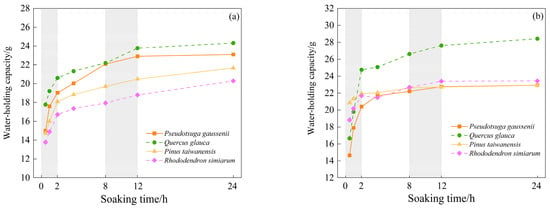
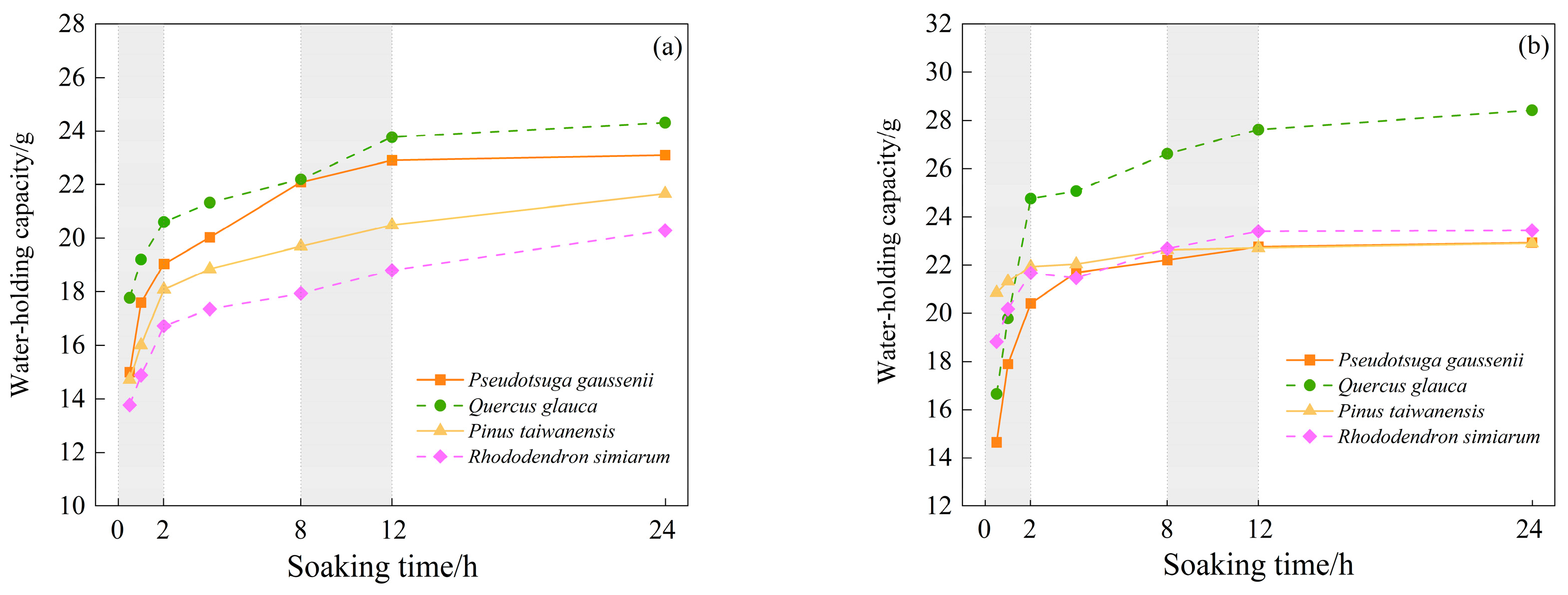
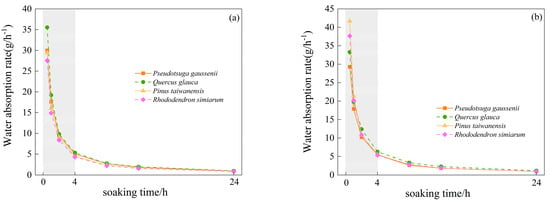
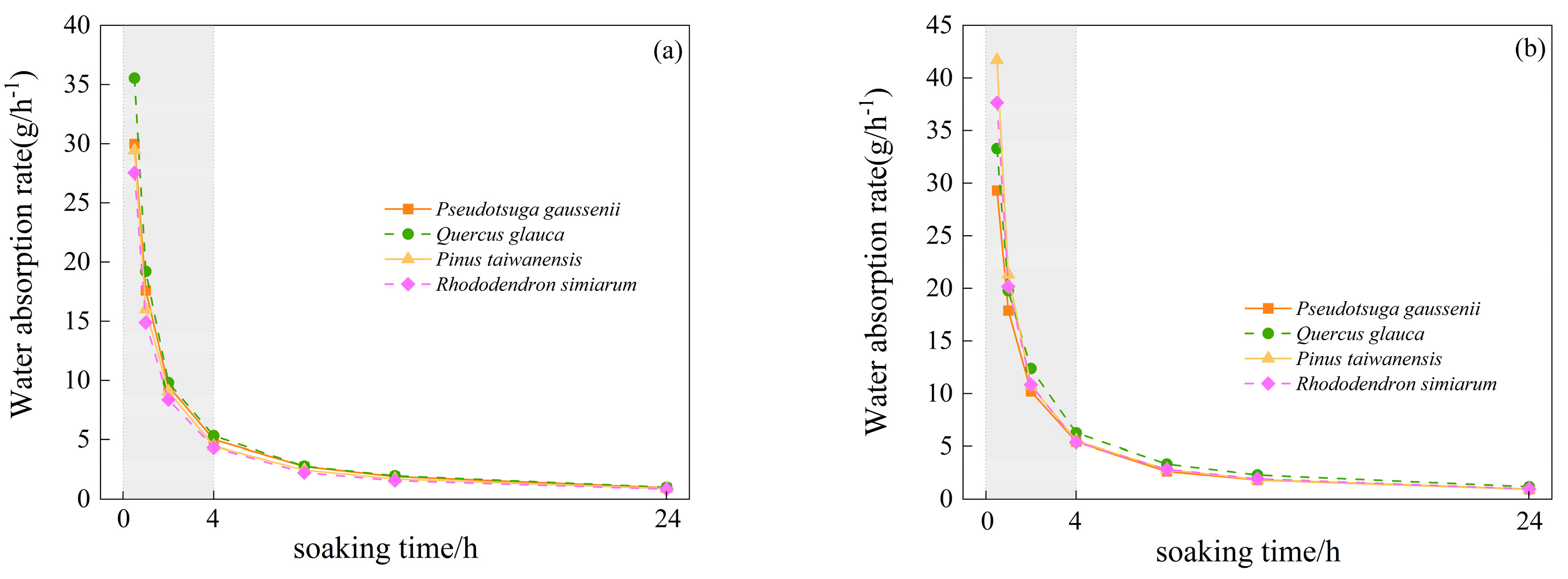
As shown in Figure 1a,b, during the entire immersion process, the water-holding capacity of litter from the four forest types increased rapidly within 0–2 h. With prolonged immersion time, the increment in water-holding capacity gradually decreased. After 8–12 h, the change in litter water-holding capacity tended to stabilize, reaching its maximum at 24 h. The undecomposed litter layer of the P. gaussenii forest exhibited the largest change in water-holding capacity, reaching 8.11 g per 24 h. In the semi-decomposed layer, the change in water-holding capacity was greatest in the Q. glauca forest and smallest in the P. taiwanensis forest. Meanwhile, the water absorption rate of litter from all forest types was high and showed obvious variation during the first 4 h, after which it gradually decreased and approached zero after 24 h of immersion (Figure 2a,b).
Figure 1.
Relationship between water-holding capacity and soaking time of litter in different forest stands: (a) undecomposed layer; (b) semi-decomposed layer. The gray shaded areas highlight the soaking periods of 0–2 h and 8–12 h.
Figure 2.
Relationship between water absorption rate and water immersion time of litter in different forest stands: (a) undecomposed layer; (b) semi-decomposed layer. The gray shaded area highlights the soaking period of 0–4 h.
The water-holding capacity of the undecomposed and semi-decomposed layers of litter from the four forest types and their relationships with immersion time, as well as the relationships between water absorption rate and immersion time, were fitted (Table 4). The relationship between litter water-holding capacity and immersion time was described by the equation Q = aln(t) + b. The coefficients of determination (R2) of all regression equations in the table were greater than 0.92, indicating good fitting performance.
Table 4.
Regression equations for litter water-holding capacity, water absorption rate, and soaking time at different forest stand levels.
3.3. Hydrological Effects of Different Forest Stand Soils
3.3.1. Soil Physical Properties
The mean soil bulk density values for the four forest types, in descending order, were P. taiwanensis forest, Q. glauca forest, P. gaussenii forest, and R. simiarum forest (Table 5). Soil total porosity exhibited a decreasing trend with increasing soil depth, opposite to the pattern observed for soil bulk density. The range of variation in soil total porosity among the different forest types was 43.58–70.48%. The mean soil total porosity followed the order R. simiarum forest > P. gaussenii forest > Q. glauca forest > P. taiwanensis forest. Neither capillary porosity nor non-capillary porosity in the four forest types showed a consistent pattern with changes in soil depth. The capillary porosity across all forest types ranged from 37.42% to 64.35%, with the highest value recorded under the R. simiarum forest, indicating its superior water retention capacity.
Table 5.
Physical Properties of Four Forest Stand Types.
3.3.2. Soil Water-Holding Capacity
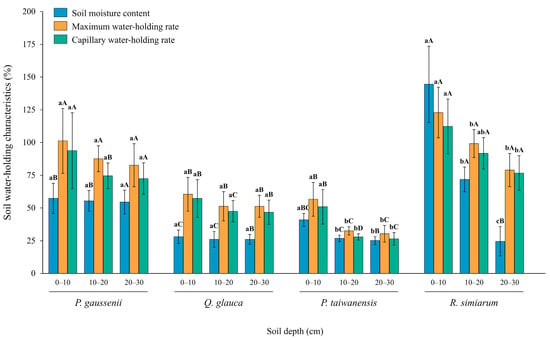
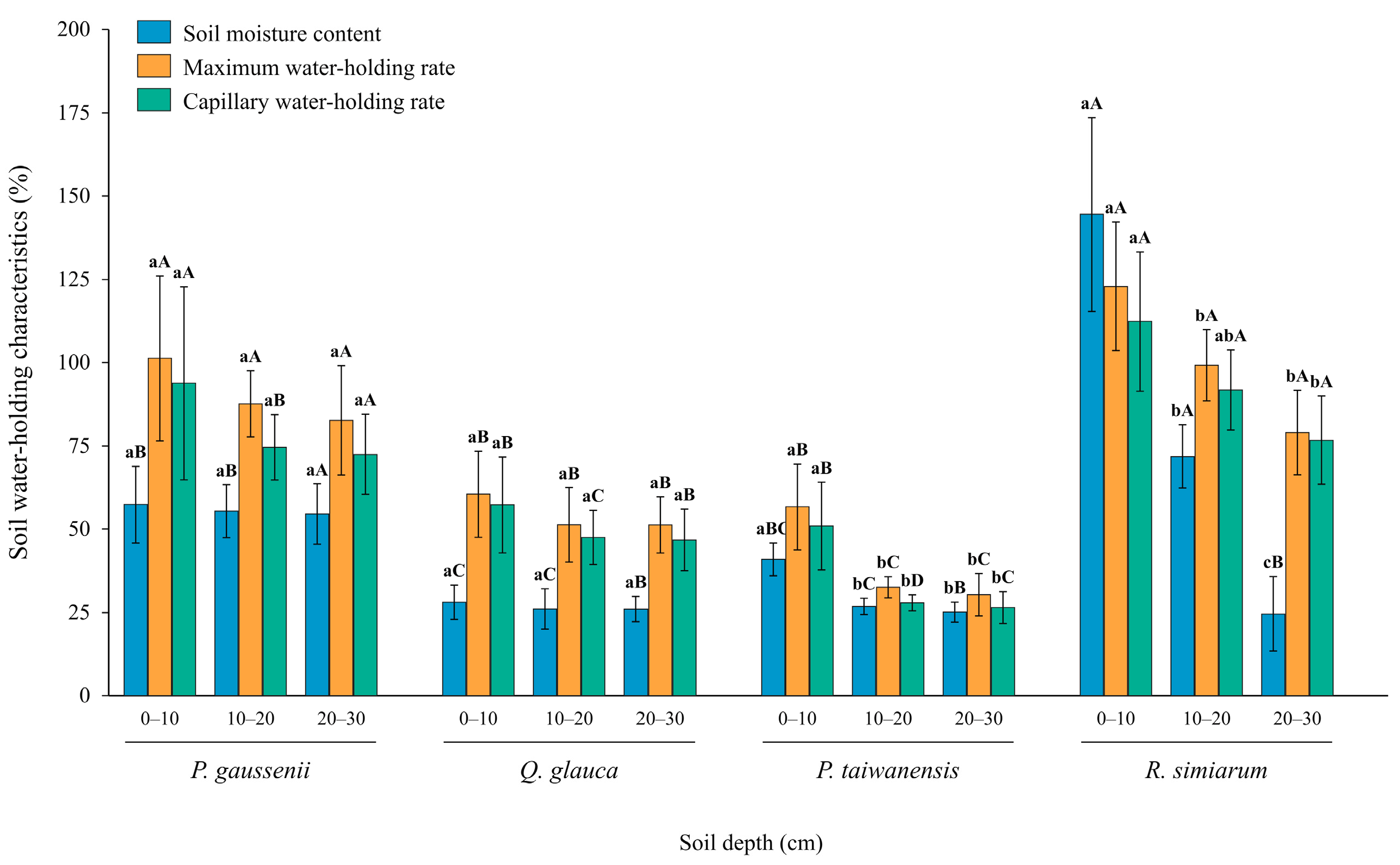
As shown in Figure 3, the key soil water-holding indices under each forest type decreased significantly with increasing soil depth (p < 0.05). Taking the 0–10 cm layer as an example, the maximum water-holding rate and capillary water-holding rate were significantly higher than those in the 10–20 cm and 20–30 cm layers. Meanwhile, significant differences in soil water retention capacity existed among the different forest types (p < 0.05). The R. simiarum forest exhibited the strongest soil water retention capacity, with soil moisture content, maximum water-holding rate, and capillary water-holding rate in each soil layer significantly higher than those in the other forest types. In particular, the maximum water-holding rate in the 0–10 cm layer was significantly higher than that in the P. gaussenii, Q. glauca, and P. taiwanensis forests. The P. gaussenii forest ranked second, with relatively high water-holding indices in the 0–10 cm and 10–20 cm layers. The Q. glauca forest showed moderate water retention characteristics, with relatively small variations in indices across soil layers. The P. taiwanensis forest had the weakest soil water retention capacity, with the lowest water-holding indices in all soil layers; in particular, the soil moisture content and capillary water-holding rate in the 20–30 cm layer were significantly lower than those in the other forest types.
Figure 3.
Water-holding characteristics of soils in four forest stands. Soil moisture content, maximum water-holding rate, and capillary water-holding rate are expressed as percentages of oven-dry soil mass. For each indicator, lowercase letters indicate comparisons among soil depths within the same forest stand, whereas uppercase letters indicate comparisons among forest stands at the same soil depth. Values sharing no letters of the relevant case differ significantly according to Duncan’s multiple range test (p < 0.05).
3.4. Comprehensive Analysis of Dynamic Water Regulation and Storage Capacity and Hydrological Effects of Soil in Different Forest Types
Infiltration characteristics serve as an important indicator reflecting the water conservation capacity of forestland and directly influence the movement of water within the soil [18,19]. Among the four forest types, the soil initial infiltration rate was highest in the Q. glauca forest (29.4 mm/min) and lowest in the R. simiarum forest (9.6 mm/min) (Table 6). The mean steady infiltration rates of the four forest types, in descending order, were Q. glauca forest > P. gaussenii forest > P. taiwanensis forest > R. simiarum forest. With increasing infiltration time, the soil infiltration rate gradually decreased and ultimately reached a relatively stable value. A power-function relationship existed between soil water infiltration rate and infiltration time for each forest type, with the R2 values of the regression equations ranging between 0.953 and 0.986, indicating good fitting performance.
Table 6.
Soil Permeability Rates and Regression Equations of Four Forest Types.
Table 7 presents the entropy values and weights of the soil water-holding-related indicators and litter water-holding indicators for the different forest types, as determined by the entropy weight method. In the comprehensive evaluation of soil water retention characteristics across the forest types, the steady infiltration rate and soil moisture content of the soil layer, together with the effective water-retention rate of the litter layer, emerged as the core indicators with the highest contribution. The results indicated that differences in these indicators among forest types were the key factors driving the differentiation of soil water retention characteristics across the different forest types.
Table 7.
Entropy values and weights of different indicators.
4. Discussion
4.1. Influence Mechanism of Forest Stand Type on Hydrological Effects of Litter Layer
The litter layer plays an important role in forest hydrological regulation. Its accumulation, water-holding capacity, and interception capacity are critical for reducing surface runoff and preventing soil and water loss within forest ecosystems. Forest type can influence the hydrological regulatory function of the litter layer by altering total litter accumulation, composition, and decomposition degree. In this study, the R. simiarum forest exhibited the highest litter accumulation, whereas the Q. glauca forest had the lowest. According to relevant studies, litter accumulation is regulated by multiple factors, including forest type, soil properties, and local habitat conditions [20,21]. This is probably because R. simiarum is typically distributed in high-altitude regions, where low temperatures inhibit litter decomposition, resulting in long-term accumulation of the semi-decomposed layer. In contrast, the Q. glauca forest had the lowest litter accumulation among the sampled forest stands, the mechanisms underlying this difference require further investigation. This pattern shares some similarities with the conclusions of Zhao et al. [22] in forests of the rocky mountainous areas in North China.
From the perspective of litter water retention capacity, the effective water-retention capacity and maximum water-holding capacity of litter in the P. gaussenii forest were the highest in this study, whereas those in the P. taiwanensis forest were the lowest. Notably, the water retention capacity of the semi-decomposed litter layer in all four forest types was higher than that of the undecomposed layer. This can be explained from two aspects. First, the inherent physical properties of different forest types and the morphological characteristics of tree organs largely determine their water retention capacity. The natural porous structure of P. gaussenii needles enables effective water absorption through surface tension, whereas the waxy layer on the surface of P. taiwanensis needles exhibits strong hydrophobicity, resulting in significantly lower water retention than that of P. gaussenii. These findings are consistent with those of Castagnolli et al. (2023) [3], who reported that the hydrophobicity of branch lignin significantly restricts water absorption and that leaf water-holding capacity is markedly higher than that of lignified components.
The fitting results of the water-holding process showed that the water-holding capacity of litter in the four forest types exhibited a significant logarithmic relationship with immersion time (R2 > 0.90), while the water absorption rate exhibited a power-function relationship with immersion time (R2 > 0.90). This pattern—characterized by rapid initial water absorption followed by a gradual slowdown—aligns with the results of Zhou et al. [15] and represents a universal feature of the water-holding process in forest litter. The P. gaussenii and Q. glauca forests have higher canopy closure, which reduces understory evaporation and helps maintain litter moisture; this is the primary reason for the superior effective water-retention capacity of litter in these two forest types in the present study. It should be noted, however, that the maximum water-holding capacity measured by the laboratory immersion method in this study reflects only the water retention capacity of litter under ideal conditions and cannot fully represent the actual interception capacity under field conditions.
4.2. Synergistic Regulation Effect of Soil Layer on Hydrological Processes
The soil layer serves as the core carrier of water conservation in forest ecosystems, and its hydrological effects are regulated by the dual influences of litter layer inputs and forest type. The increase in soil bulk density and the decreases in total porosity and water-holding capacity with depth observed in this study are consistent with commonly reported soil profile patterns [23,24]. These expected trends provide context for interpreting the differences among the sampled forest stands.
In terms of comparisons among forest types, significant differences in soil hydrological performance were observed among the four forest types. The Rhododendron simiarum forest exhibited the lowest soil bulk density and the highest total porosity and capillary porosity, resulting in the strongest soil water retention capacity. The Q. glauca forest showed the highest initial and steady infiltration rates, indicating the strongest capacity for surface runoff regulation and soil and water conservation. In contrast, the P. taiwanensis forest had the highest soil bulk density, poorest pore development, and overall weakest soil hydrological performance. Soil texture is an important control on soil water retention and infiltration and may have contributed to the differences observed among the sampled stands. However, sand, silt, and clay fractions were not measured in this study, so the contribution of soil texture could not be evaluated. The observed differences therefore cannot be attributed solely to forest stand type.
It is noteworthy that although the Q. glauca forest had low litter accumulation, it exhibited the highest steady infiltration rate and the strongest capacity for runoff regulation and soil and water conservation. This result reflects a clear synergistic effect between the hydrological functions of the litter layer and the soil layer. Overall, the measurements characterize litter water retention and soil water-holding and infiltration properties in the sampled stands. However, soil organic matter content was not measured at any depth, so its contribution to the observed differences could not be evaluated.
4.3. Evaluation System for Integrated Hydrological Effects of Different Forest Stand Types
In this study, the entropy weight method was used to integrate the measured litter and soil indicators. This method determines indicator weights from variation in the input data, reducing reliance on subjective judgments in weight assignment [25]. The resulting ranking was P. gaussenii > Q. glauca > R. simiarum > P. taiwanensis. Soil steady infiltration rate, soil moisture content, and litter effective water-retention rate received the highest weights in this evaluation. These weights reflect the information provided by the indicators within the analyzed dataset rather than their causal importance in forest hydrological processes.
Liu et al. (2023) [1] highlighted the importance of climatic factors and soil physical properties in determining forest water storage capacity. Their findings provide broader context for the present comparison, although climatic factors were not included in our evaluation. In the sampled stands, P. gaussenii exhibited relatively high litter water-retention capacity, whereas Q. glauca exhibited a high steady infiltration rate and litter effective water-retention rate. These measured characteristics contributed to their higher composite scores. However, the ranking is specific to the sampled stands and selected indicators and does not independently establish synergistic interactions between the litter and soil layers or the superiority of these forest types under other site conditions.
Overall, the differences in hydrological effects among the four forest types reflected the combined contributions of litter accumulation, litter water retention capacity, soil water-holding capacity, and soil infiltration characteristics. The R. simiarum forest had the highest litter accumulation, but its relatively low maximum water-holding rates limited its litter water retention capacity. Its low soil bulk density and high capillary porosity were consistent with its strong soil water-holding capacity, whereas its steady infiltration rate was the lowest. This contrast indicates that greater soil water-holding capacity does not necessarily correspond to faster infiltration. The Q. glauca forest, despite having the lowest litter accumulation, exhibited the highest effective water-retention rate in the semi-decomposed layer and the highest steady infiltration rate. The P. gaussenii forest combined high litter water retention capacity with relatively favorable soil water-holding capacity and steady infiltration rate, whereas the P. taiwanensis forest exhibited relatively low litter maximum water-holding rates, high soil bulk density, and weak soil water-holding capacity. These contrasting patterns help explain the comprehensive evaluation results and indicate that differences among forest types cannot be explained by litter accumulation or soil total porosity alone.
4.4. Implications for Regional Management and Research Limitations
From a regional ecological management perspective, the Huaiyu Mountains serve as a critical watershed divide between the Qiantang River and Poyang Lake water systems. The soil and water conservation capacities of their forest ecosystems directly influence the sustainable utilization of trans-basin water resources and water security across Zhejiang and Jiangxi Provinces. Based on the hydrological properties measured in the sampled stands, Pseudotsuga gaussenii and Q. glauca may be considered candidate species for further evaluation in regional forest improvement projects, taking local site suitability into account. However, their suitability for wider regional application requires further assessment through long-term hydrological monitoring and evaluation of ecosystem resilience. At the stand level, maintaining litter cover and reducing disturbances such as litter removal and understory soil cultivation may help preserve the water retention functions of the litter and soil layers.
This study characterized the hydrological properties of the litter and soil layers in four typical forest types in the Huaiyu Mountains. However, several limitations should be acknowledged. First, litter water retention was measured using the laboratory immersion method, which reflects potential water-holding capacity under controlled conditions rather than actual interception during natural rainfall events. This method does not fully account for variations in rainfall amount, intensity, and duration. Second, this study focused on the litter layer and the upper 0–30 cm of soil, without evaluating canopy interception or the contribution of deeper soil layers to forest hydrological functioning. Third, although 180 soil samples were collected, the sampling design included only three independent plots per forest type. The five samples collected at each depth within a plot were subsamples intended to capture local soil variability and did not increase the number of independent plot-level replicates. The limited number of independent plots constrains statistical power and the generalizability of the findings. Fourth, the assumptions of residual normality and homogeneity of variances underlying the ANOVA were not formally assessed in the original analysis. The reported significance tests should therefore be interpreted cautiously, and further statistical assessment is needed to evaluate the robustness of the inferred differences among forest types. Future studies should include more independent plots, long-term field monitoring of rainfall interception and soil water dynamics, assessments of ecosystem resilience, and statistical analyses that explicitly account for the hierarchical sampling design.
5. Conclusions
The total litter accumulation across the four forest types ranged from 4.64 to 8.35 t·ha−1, with the highest value observed in the Rhododendron simiarum forest and the lowest in the Q. glauca forest. The water retention capacity of the semi-decomposed litter layer was greater than that of the undecomposed layer in all forest types. The relationship between litter water-holding capacity and immersion time followed a logarithmic function, while the relationship between water absorption rate and immersion time followed a power function.
The natural moisture content of litter in the different forest types was consistently higher in the semi-decomposed layer than in the undecomposed layer, following the order P. gaussenii > P. taiwanensis > R. simiarum > Q. glauca. The mean maximum water-holding rate ranged from 96.25% to 203.01%, in the order P. gaussenii > Q. glauca > P. taiwanensis > R. simiarum. The effective water-retention rate ranged from 51.46% to 134.30%, in the order Q. glauca > P. gaussenii > P. taiwanensis > R. simiarum.
During the water-holding process, the water-holding capacity of litter in the four forest types exhibited a logarithmic relationship with immersion time, described by the equation Q = aln(t) + b, with R2 values close to 1. The water absorption rate showed a power-function relationship with immersion time, given by V = kt−n, with R2 > 0.92.
In the 0–30 cm soil layers, the mean gravimetric soil moisture content across the four forest types ranged from 26.75% to 80.31% on an oven-dry mass basis, following the order R. simiarum > P. gaussenii > P. taiwanensis > Q. glauca. Both the maximum water-holding rate and capillary water-holding rate followed the same order: R. simiarum > P. gaussenii > Q. glauca > P. taiwanensis.
The evaluation results based on the entropy weight method indicated that the primary factors influencing soil hydrological effects were steady infiltration rate, field capacity, and bulk density. According to the comprehensive evaluation of hydrological and ecological effects, the P. gaussenii forest and Q. glauca forest exhibited the strongest overall hydrological effects, while the P. taiwanensis forest was the weakest.
Author Contributions
J.Y. (Jia Ye), J.Y. (Jilin Yan), L.C., Y.B., H.Z. and N.Z. contributed to the components of the field survey and data collection. Data analysis was performed by J.Y. (Jilin Yan), L.C. and J.Y. (Jia Ye). The overall design framework and field survey of the research were carried out by Y.L. and Y.Z. The first draft of the manuscript was written by J.Y. (Jia Ye) and J.Y. (Jilin Yan), and all authors commented on previous versions of the manuscript. All authors have read and agreed to the published version of the manuscript.
Funding
This work was funded by the National Natural Science Foundation of China (32360265), Science and Technology Research Project Supported by the Education Department of Jiangxi Province (GJJ211718).
Data Availability Statement
Data will be made available on request.
Acknowledgments
We acknowledge Shangrao Normal University, Administrative Committee of Mount Sanqing Scenic Area, Jiangxi Province, China, for providing the experimental conditions and lab analysis.
Conflicts of Interest
The authors declare no conflicts of interest.
References
- Liu, Y.; Shi, W.; Tao, F.; Shi, X.; Fu, B. A global synthesis of multi-factors affecting water storage capacity in forest canopy, litter and soil layers. Geophys. Res. Lett. 2023, 50, e2022GL099888. [Google Scholar] [CrossRef] [Scilit]
- Chen, S.; Cao, T.; Tanaka, N.; Gao, T.; Zhu, L.; Zou, C. Hydrological properties of litter layers in mixed forests in Mt. Qinling, China. iForest 2018, 11, 243–250. [Google Scholar] [CrossRef] [Scilit]
- Castagnolli, L.; Boggiani, F.S.; de Lima, J.A.; Lima, M.T.; Tonello, K.C. Hydrological properties of litter in different vegetation types: Implications for ecosystem functioning. Hydrology 2023, 10, 165. [Google Scholar] [CrossRef] [Scilit]
- Pereira, L.C.; Balbinot, L.; Lima, M.T.; Bramorski, J.; Tonello, K.C. Aspects of forest restoration and hydrology: The hydrological function of litter. J. For. Res. 2022, 33, 543–552. [Google Scholar] [CrossRef] [Scilit]
- Liu, X.; Feng, T.; Zhang, Y.; Liu, Y.; Wang, P. Vegetation restoration affects soil hydrological processes in typical natural and planted forests on the Loess Plateau. J. Hydrol. 2025, 650, 132465. [Google Scholar] [CrossRef] [Scilit]
- Li, Z.; Wu, P.; Feng, H.; Zhao, X.; Huang, J.; Zhuang, W. Simulated experiment on effects of soil bulk density on soil water holding capacity. Acta Pedol. Sin. 2010, 47, 611–620. [Google Scholar]
- Wang, N.; Bi, H.; Peng, R.; Zhao, D.; Liu, Z. Disparities in soil and water conservation functions among different forest types and implications for afforestation on the Loess Plateau. Ecol. Indic. 2023, 155, 110935. [Google Scholar] [CrossRef] [Scilit]
- Xiao, W.; Yuan, X.; Hu, W.; Pan, L.; Wang, X.; Lei, J.; Cui, H. Effect of Pinus massoniana stand structure on hydrological effects of litter layer and soil layer. For. Res. 2020, 33, 26–34. [Google Scholar]
- Robinson, D.A.; Friedman, S.P.; Thomas, A.; Hirmas, D.; Sullivan, P.L.; Nemes, A. Soil bulk density and porosity connecting macro- and micro-scales through geometry. Earth-Sci. Rev. 2025, 268, 105173. [Google Scholar] [CrossRef] [Scilit]
- Han, Q.; Wang, H.; Sun, K.; Pei, Z.; Wang, H.; Su, X.; Yang, J.; Chen, H. Water conservation capacity of plantations in the Kubuqi Desert. Bull. Soil Water Conserv. 2023, 43, 133–141. [Google Scholar]
- Jia, Z.; Weng, B.; Yan, D.; Peng, H.; Dong, Z. The effects of different factors on soil water infiltration properties in High Mountain Asia: A meta-analysis. Catena 2024, 234, 107583. [Google Scholar] [CrossRef] [Scilit]
- Liu, Y.; Wang, G.; Hu, Z.; Guo, L. Litter storage and water-holding capacity of typical forests in mountainous area of Southwest China. Chin. J. Appl. Ecol. 2022, 33, 2113–2120. [Google Scholar] [CrossRef] [Scilit] [PubMed]
- Yang, H.; Zhang, G.; Zhang, B. Litter and its water-holding properties of typical plant communities distributed on gully steep slopes in the loess hilly-gully region. Sci. Soil Water Conserv. 2019, 17, 83–90. [Google Scholar]
- He, W.; Chen, L.; Pang, D.; Cao, M.; Zhang, Y.; Li, X. Hydrological effects of soil layers in different vegetation types on the eastern slopes of the Helan Mountains. J. Cent. South Univ. For. Technol. 2023, 43, 102–113. [Google Scholar]
- Zhou, L.; Chen, S.; Dai, J.; Liu, J.; Xu, L.; Tian, Z.; Zhan, Z.; Zhao, W.; Chen, J.; Tu, Z. Hydrological effects of litter layers and soil layers in seven ornamental Magnoliaceae plants. Sci. Soil Water Conserv. 2022, 20, 126–136. [Google Scholar]
- Zhang, J.; Zhang, T.; Pu, L.; Yan, L.; Cai, G.; Chen, P.; Yang, T.; Zhang, C. Litter eco-hydrological function characteristics of three typical plant communities in the area of Karst peak-cluster depressions from Guizhou, China. PLoS ONE 2022, 17, e0278565. [Google Scholar] [CrossRef] [Scilit] [PubMed]
- Shi, Z.; Wang, Y.; Xu, L.; Xiong, W.; Yu, P.; Guo, H.; Zhang, L. Hydrological functions of litter layer of typical forest types in the Liupan Mountains. J. Beijing For. Univ. 2009, 31, 91–99. [Google Scholar]
- Zhang, H.; Cheng, J.; Shi, Y.; Cheng, Y. The distribution of preferential paths and its relation to the soil characteristics in the Three Gorges Area, China. Int. J. Sediment Res. 2007, 22, 39–48. [Google Scholar]
- Lv, G.; Wu, X. Review on influential factors of soil infiltration characteristics. China Agric. Sci. Bull. 2008, 24, 494–499. [Google Scholar]
- Li, W.; Li, Y.; Long, M.; Li, X. Study on water-holding properties of litters in different types of forests of Yuntaishan mountain area in Shibing County, Guizhou Province. IOP Conf. Ser. Mater. Sci. Eng. 2018, 394, 022057. [Google Scholar] [CrossRef] [Scilit]
- Ning, Y.; Liang, X.; Ding, C.; Zhang, Z.; Hu, Y.; Yang, G.; Lü, X. Litter accumulation retards the positive effects of nitrogen inputs on plant carbon sequestration in grassland. Plant Soil 2022, 483, 301–312. [Google Scholar] [CrossRef] [Scilit]
- Zhao, Y.; Yu, X.; Wu, H.; Song, S.; Huang, Z. Hydrological effects of forest litters and soil in rocky mountain area of northern China. J. Soil Water Conserv. 2011, 25, 148–152. [Google Scholar]
- Xie, J.; Jia, H.; Lin, X. Relationship between tree species diversity and water holding capacity of litter layer in subtropical region. Chin. J. Appl. Ecol. 2024, 35, 1771–1778. [Google Scholar] [CrossRef] [Scilit] [PubMed]
- Ji, W.; Mu, C.; Cui, Y.; Hao, X. Effects of release cutting intensity on dynamics of litter interception and soil water storage in “planting conifer and preserving broadleaved tree” stand in Changbai Mountain, northeast China. J. Beijing For. Univ. 2025, 47, 61–72. [Google Scholar]
- Xin, G.; Yang, C.; Yang, Q.; Li, C.; Wei, C. Post-evaluation of well-facilitied capital farmland construction based on entropy weight method and improved TOPSIS model. Trans. Chin. Soc. Agric. Eng. 2017, 33, 238–249. [Google Scholar]

Disclaimer/Publisher’s Note: The statements, opinions and data contained in all publications are solely those of the individual author(s) and contributor(s) and not of MDPI and/or the editor(s). MDPI and/or the editor(s) disclaim responsibility for any injury to people or property resulting from any ideas, methods, instructions or products referred to in the content. |
© 2026 by the authors. Licensee MDPI, Basel, Switzerland. This article is an open access article distributed under the terms and conditions of the Creative Commons Attribution (CC BY) license.