


Abstract
The value realization of forest ecological products in mountain areas represents a critical pathway for China to reconcile ecological protection with rural prosperity. This study develops a conceptual framework integrating new economic geography, information economics, transaction cost theory, and Schumpeterian innovation theory to examine the potential complementarities between the Four Good Rural Roads initiative and digital village construction, their underlying mechanisms, and relevant boundary conditions. The analysis proposes that: (1) transportation accessibility and digital connectivity may facilitate forest ecological product value realization through distinct but complementary mechanisms by reducing spatial barriers, information asymmetries, and transaction costs; (2) their interactions may promote resource reallocation and business model innovation through the progressive analytical framework of “physical connectivity–digital value enhancement–ecological efficiency restructuring”, potentially improving value realization efficiency; and (3) potential transportation–digital policy synergies face institutional, spatial, governance, and market constraints, which may limit their effectiveness in improving value realization efficiency. Based on these theoretical insights, the study identifies four interrelated policy directions: improving physical and digital accessibility, supporting value discovery, strengthening institutional coordination, and promoting sustainable market formation and business model innovation. This study advances the theoretical understanding of transportation–digital policy complementarities in forest ecological product value realization and provides a basis for context-dependent policy implications in mountainous regions.
1. Introduction
Globally, the value realization of ecological products has become a core issue in sustainable development [1] and the construction of ecological civilization [2]. As the largest terrestrial ecosystem, forests play a pivotal role, and the efficient transformation of their ecological products directly affects regional ecological security and human well-being in China [3]. However, nearly 90% of China’s forests are concentrated in underdeveloped mountainous rural areas that are geographically remote, with poor infrastructure, low transportation accessibility, and inadequate information connectivity [4], making it difficult to introduce modern production factors effectively. Converting ecological resources into economic value has long faced dual constraints of spatial barriers and information blockages. For China, mountainous regions are not only important ecological security barriers and areas rich in natural resources but also critical zones for the value realization of ecological products. Promoting the value realization of forest ecological products in underdeveloped mountainous areas is a crucial pathway for China to increase asset-based income for mountain populations, achieve a win-win outcome of livelihood improvement and ecological protection, advance the construction of beautiful rural areas, and realize common prosperity [5]. In this study, the term forest ecological products refers to forest-derived goods and ecosystem services within China’s ecological product value realization policy framework. It is closely related to the internationally recognized concept of forest ecosystem services, but places greater emphasis on mechanisms through which these benefits may generate economic value.
To address the practical constraints hindering the value realization of forest ecological products, China issued the Opinions on Establishing and Improving the Mechanism for Value Realization of Ecological Products in 2021, which explicitly calls for increased support for necessary transportation infrastructure and other facilities to enhance the value addition of ecological products, and for the appropriate development of environmentally sensitive industries such as the digital economy to transform ecological advantages into industrial strengths. Under these policy guidelines, practical experience has shown that the Four Good Rural Roads—as a fundamental infrastructure project connecting urban and rural areas and facilitating the conversion of resources into assets [6]—has effectively reduced factor mobility costs [7] and improved spatial accessibility and market responsiveness of mountainous forest resources. Meanwhile, the digital village construction policy, as a key measure for unleashing digital dividends and promoting the eco-industrialization of rural areas [8], has demonstrated potential to reshape pathways for value realization by alleviating information asymmetries [9], innovating transaction mechanisms for ecological products, and cultivating new business forms [4]. Notably, the integration of transportation infrastructure and digital technologies is advancing in both policy and practice, creating opportunities for potential synergies. However, how and under what conditions transportation–digital policy synergies may facilitate the value realization of forest ecological products in mountainous areas, particularly through improvements in value realization efficiency, remains insufficiently understood. Therefore, exploring the underlying mechanisms and boundary conditions of these potential synergies is of significant theoretical and practical relevance to China’s goal of establishing a comprehensive mechanism for ecological product value realization by 2035, as well as to advancing ecological civilization and rural revitalization in mountainous areas.
Current scholarly research has conducted both theoretical explorations and empirical examinations on the value realization of forest ecological products. At the theoretical level, scholars have primarily focused on the conceptual connotations and diverse pathways for promoting the value realization of forest ecological products. In terms of conceptual connotation, forest ecological products are defined as the totality of various products and services provided by natural ecosystems to human beings, with forest resources as the carrier. Their value realization is essentially a process of transforming use value into exchange value [10]. With respect to realization pathways, the academic community has correspondingly designed diverse pathways such as government-led mechanisms for forest resource capitalization, market-led mechanisms for forest asset capitalization, and value feedback mechanisms with cross-embeddedness between government and market [11]. At the empirical level, the existing literature mainly focuses on measuring value realization efficiency and its influencing factors. Methodologically, scholars have mostly employed frontier efficiency measurement tools such as the super-efficiency SBM-Malmquist index decomposition method [12] and the two-stage network Data Envelopment Analysis (DEA) model [1,13] for quantitative assessment. Regarding influencing factors, studies have shown that forest new quality productive forces [1], resource endowment [14], digital economy development [15,16], and green finance [3,17] all significantly affect value realization efficiency.
Existing studies have examined how digital village construction [4] and high-quality rural roads [18] may facilitate forest ecological product value realization through their respective mechanisms, providing important foundations for understanding the roles of digital and transportation infrastructure. However, three research gaps remain. First, the potential synergies between transportation and digital policies have not been sufficiently explored, particularly how their interactions may facilitate resource reallocation, business model innovation, and improvements in value realization efficiency. Second, insufficient attention has been paid to how the distinctive spatial and institutional constraints of mountainous areas, characterized by abundant forest resources, geographical isolation, and inadequate infrastructure, shape these policy interactions. Third, the conditions under which such synergies may generate sustained efficiency improvements or potential structural transformations remain insufficiently understood. To address these gaps, this study aims to explain how and under what conditions transportation–digital policy synergies may facilitate forest ecological product value realization in mountainous China. Specifically, it examines how physical accessibility and information connectivity may jointly influence value creation, delivery, and capture, how their interactions may improve value realization efficiency through resource reallocation and business model innovation, and how spatial, institutional, and ecological constraints may shape these relationships.
This study adopts a conceptual theoretical approach based on a focused synthesis of relevant academic literature and Chinese policy documents, without conducting original empirical estimation. The literature is selected for its relevance to forest ecological product value realization, rural transportation accessibility, digital village construction, and their underlying mechanisms, while policy documents provide the institutional context. The framework is developed by identifying the principal spatial, informational, and institutional constraints on value realization and selecting relevant theories to explain how to alleviate them. Specifically, new economic geography explains how transportation accessibility may reduce spatial barriers; information economics and transaction cost theory clarify how digital connectivity may alleviate information asymmetries and transaction costs; and Schumpeterian innovation theory explains how these changes may facilitate resource reallocation and business model innovation. Integrating these perspectives, the study develops a progressive analytical framework of “physical connectivity–digital value enhancement–ecological efficiency restructuring” and derives theoretical propositions and their boundary conditions. The proposed relationships remain theoretical and require future empirical validation.
The theoretical contributions of this study are threefold. First, from a research perspective, it moves beyond single-policy analyses by examining the potential synergies between transportation and digital village construction policies, offering an integrated perspective on how their interactions may facilitate forest ecological product value realization. Second, from a spatial perspective, it focuses on China’s mountainous rural areas, where abundant forest resources coexist with geographical isolation and infrastructure deficiencies, highlighting how these distinctive spatial and institutional constraints may shape the mechanisms and boundary conditions of transportation–digital policy synergies. Third, from a theoretical perspective, it integrates new economic geography, information economics, transaction cost theory, and Schumpeterian innovation theory into a progressive analytical framework of “physical connectivity–digital value enhancement–ecological efficiency restructuring”, explaining how potential policy synergies may facilitate resource reallocation and business model innovation, thereby creating conditions for improvements in value realization efficiency. Together, these contributions advance the theoretical understanding of forest ecological product value realization and provide a basis for context-dependent policy implications in mountainous regions.
2. Definition of Key Concepts
2.1. Policy Background of Rural Transportation and Digital Village Construction in China
2.1.1. Rural Transportation Policy: From Connectivity to Empowerment via the Four Good Rural Roads
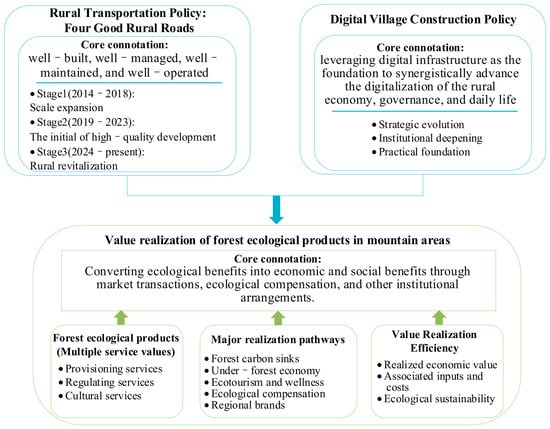
The Four Good Rural Roads initiative is a major rural transportation policy in China, built around four core principles: well-built, well-managed, well-maintained, and well-operated rural roads [19]. This study focuses on this initiative because of its importance in improving rural transportation accessibility, particularly in remote mountainous areas where geographical isolation and high transportation costs [18] constrain the value realization of forest ecological products. Beyond enhancing physical connectivity, the initiative may improve logistics efficiency, facilitate factor mobility, and expand market access, thereby creating favorable conditions for converting forest ecological resources into economic value [20]. Accordingly, this study focuses on China’s mountainous rural areas to theoretically examine how the overlay of the Four Good Rural Roads initiative and digital village construction policies may generate synergistic effects and create conditions for efficiency leaps in the value realization of forest ecological products.
The development of the Four Good Rural Roads has roughly undergone a three-stage evolution: from “focusing mainly on Scale expansion” to “the initial phase of high-quality development”, and then to “systematic empowerment and rural revitalization”. Its role in value realization of ecological products has also evolved from providing basic guarantees for getting products out of the mountains, to supporting the regular operation of ecological business forms, and ultimately to promoting the value discovery, market access, and industrial reshaping of ecological resources. The detailed contents of the three stages are shown in Table 1. By the end of 2023, the total mileage of rural roads nationwide reached 4.6 million kilometers, with a cumulative total of 545 national demonstration counties established under the Four Good Rural Roads [20].
Table 1.
The development phrase of the Four Good Rural Roads.
2.1.2. Digital Village Construction Policy: Rural Digital Transformation from Informatization to Intelligentization
A digital village refers to a rural development model characterized by the integration of digital infrastructure, technologies, and services into economic and social activities. Digital village construction, in turn, refers to the process of developing this model by systematically applying digital technologies to promote agricultural and rural modernization. It encompasses four key dimensions: digital infrastructure, rural economic digitalization, digital governance, and digital rural life [21]. This process involves a transition from informatization, which emphasizes network connectivity and information accessibility, toward intelligentization, which focuses on the application of data analytics, automated monitoring, and intelligent decision-support systems in rural production, management, and market coordination. By facilitating the integration of digital technologies into rural economic activities and governance [22], digital village construction may alleviate information asymmetries, reduce transaction costs, and support the value realization of forest ecological products. As an important component of China’s Digital China initiative and rural revitalization strategy, it provides technological support for rural ecological industrialization [21].
From a policy perspective, the digital village strategy has been elevated to a national strategy since 2018, and subsequent No. 1 Central Documents have continued to make deployments with ever-increasing policy intensity, pushing digital village construction into a stage of comprehensive acceleration. At the level of institutional deepening, since 2023, relevant implementation plans and central decisions have further strengthened the institutional articulation between digital village construction and value realization of ecological products. At the practical level, according to data from the Ministry of Industry and Information Technology and the Ministry of Agriculture and Rural Affairs, as of 2024, the number of rural broadband users nationwide surpassed 200 million, rural online retail sales exceeded 2 trillion yuan, and new business forms such as livestream e-commerce have continued to emerge. The progressive maturation of digital infrastructure has laid a solid technological foundation for the informatized and networked circulation of ecological products.
2.2. Value Realization and Efficiency of Forest Ecological Products in Mountain Areas
2.2.1. Value Realization of Forest Ecological Products
Forest ecosystem services refer to the benefits that people obtain from forest ecosystems, including provisioning, regulating, and cultural services. In China’s policy context, forest ecological products is a related but policy-specific concept encompassing forest-derived goods and ecosystem services whose benefits may be realized through market transactions, ecological compensation, and other institutional arrangements [23]. The two concepts overlap, but they are not fully interchangeable: forest ecosystem services emphasize ecosystem contributions to human well-being, whereas forest ecological products emphasize the policy-oriented identification and realization of their economic value.
The value realization of forest ecological products refers to the process through which these ecological benefits are translated into economic and social benefits through market transactions, ecological compensation, and other institutional arrangements [1]. In essence, it restructures the energy flow and value-circulation relationships within the nature-economy-society system through ecological industrialization pathways, liberating the productive capacity of ecological capital and transforming ecological assets into economic value [24]. At the practical level, typical pathways for value realization of forest ecological products include forest carbon sinks, the under-forest economy, ecotourism and forest-based health and wellness, forest ecological compensation, and the development of regional public brands for ecological products [25,26]. These pathways depend heavily on market access costs determined by transportation accessibility and transaction efficiency determined by information symmetry, making them particularly sensitive to changes in infrastructure and digitalization conditions.
2.2.2. Value Realization Efficiency and Potential Efficiency Leap of Forest Ecological Products in Mountain Areas
The value realization efficiency of forest ecological products refers to the efficiency with which forest ecological resources and associated production factors are converted into realized economic value under ecological sustainability constraints [24]. Its theoretical core lies in the input–output relationship between realized value and the resources and costs required for its realization [27]. Relevant inputs include forest resources, labor, capital, infrastructure investment, and transaction and management costs, while desirable outputs include economic returns from forest product transactions, ecosystem service markets, ecological compensation, and forest-based cultural services. Importantly, higher revenues, price premiums, or greater market access do not necessarily indicate improved efficiency if they entail disproportionate costs or ecological degradation. Thus, value realization efficiency emphasizes greater realized economic value relative to associated inputs and costs while maintaining ecological integrity.
Building on the concept of value realization efficiency, an efficiency leap is defined as a substantial and persistent upward shift in the level of efficiency relative to its previous development trajectory, rather than gradual improvements along an established trend. Unlike normal sustained progress, which reflects incremental efficiency gains without fundamentally altering the existing trajectory, an efficiency leap implies a structural change that establishes a higher efficiency level over time. In mountainous areas constrained by geographical isolation and information asymmetries [4], such a transformation may arise from improved market accessibility, resource reallocation, and business model innovation. Empirically, a potential efficiency leap could be identified through longitudinal efficiency measurements and structural break tests to determine whether a significant upward level shift persists beyond normal fluctuations and pre-existing trends. Such assessments would require comparable measures of realized economic value and associated resource inputs, infrastructure investment, and transaction and management costs, while accounting for ecological sustainability constraints. As this study is conceptual, the occurrence of an efficiency leap remains a theoretical possibility requiring future empirical validation.
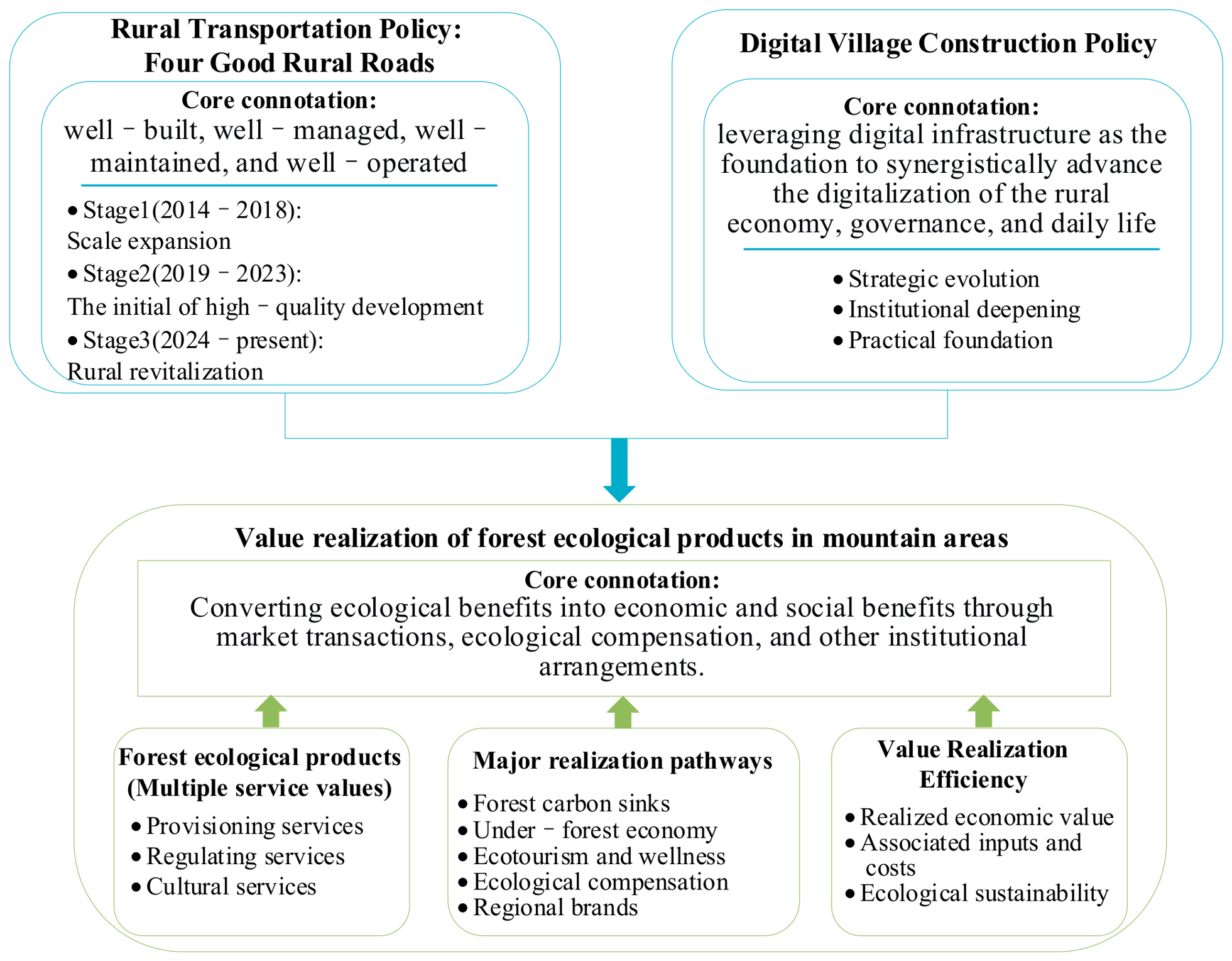
Accordingly, the key connotation of this study is illustrated in Figure 1.
Figure 1.
Key connotation definition.
3. Theoretical Logic of Transportation–Digital Policy Synergies
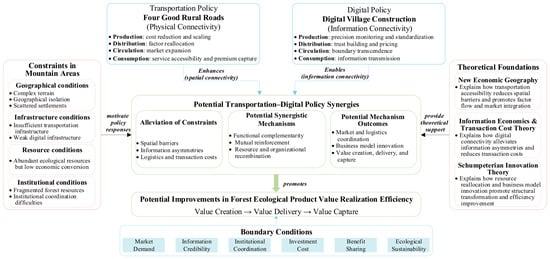
The theoretical framework is developed through a problem-driven synthesis of relevant theories. First, the principal constraints on forest ecological product value realization in mountainous areas are identified as spatial barriers, information asymmetries, and coordination difficulties. Second, relevant theories are selected to explain how transportation–digital policy synergies may alleviate these constraints through distinct yet complementary mechanisms. Third, Schumpeterian innovation theory is incorporated to explain how interactions between improved physical accessibility and digital connectivity may facilitate resource reallocation and business model innovation. Integrating these perspectives enables the development of a theoretical framework that explains the potential synergistic mechanisms and their boundary conditions.
The proposed framework centers on the value realization of forest ecological products, with transportation and digital policies serving as potentially complementary interventions. Specifically, new economic geography explains how improved transportation accessibility may reduce spatial barriers and expand market access, while information economics and transaction cost theory clarify how digital connectivity may alleviate information asymmetries and reduce transaction costs. Schumpeterian innovation theory further explains how interactions between these mechanisms may support new combinations of resources, business models, and organizational arrangements. By integrating these theoretical perspectives, the study establishes a progressive analytical framework of “physical connectivity–digital value enhancement–ecological efficiency restructuring”, illustrating how potential transportation–digital policy synergies may facilitate forest ecological product value realization and create conditions for improvements in value realization efficiency.
The proposed theoretical framework rests on three key assumptions. First, geographical isolation and information asymmetries jointly constrain the efficiency of forest ecological product value realization in China’s mountainous areas. Second, the overlay of the Four Good Rural Roads initiative and digital village construction policies may create opportunities for synergistic interactions by improving physical accessibility and information connectivity, thereby facilitating market access, reducing transaction costs, and enabling resource reallocation. Third, the potential efficiency gains arising from transportation–digital policy synergies depend on favorable economic, institutional, and ecological conditions, as excessive implementation costs, unequal benefit distribution, and ecological degradation may offset or undermine the expected benefits. These conditions define the boundaries within which potential policy synergies may facilitate ecological efficiency restructuring and sustained improvements in value realization efficiency. Accordingly, the proposed relationships remain theoretical and require future empirical validation.
Based on these assumptions, three theoretical propositions are advanced.
Proposition 1.
Distinct policy mechanisms. Transportation accessibility and digital connectivity may facilitate forest ecological product value realization through distinct but complementary mechanisms, primarily by reducing spatial barriers, information asymmetries, and transaction costs.
Proposition 2.
Potential transportation–digital policy synergies. Improvements in transportation accessibility may enhance the effectiveness of digital connectivity, while digital connectivity may improve the utilization of transportation infrastructure through better information sharing and market coordination. These complementary interactions may facilitate resource reallocation and business model innovation, potentially generating additional efficiency gains beyond those associated with either policy independently.
Proposition 3.
Boundary conditions of policy synergies. The potential benefits of transportation–digital policy synergies depend on sufficient market demand, credible ecological information, institutional coordination, economically justified investment, equitable benefit sharing, and ecological sustainability. Where these conditions are absent, policy overlay may produce limited benefits or fail to improve overall value realization efficiency.
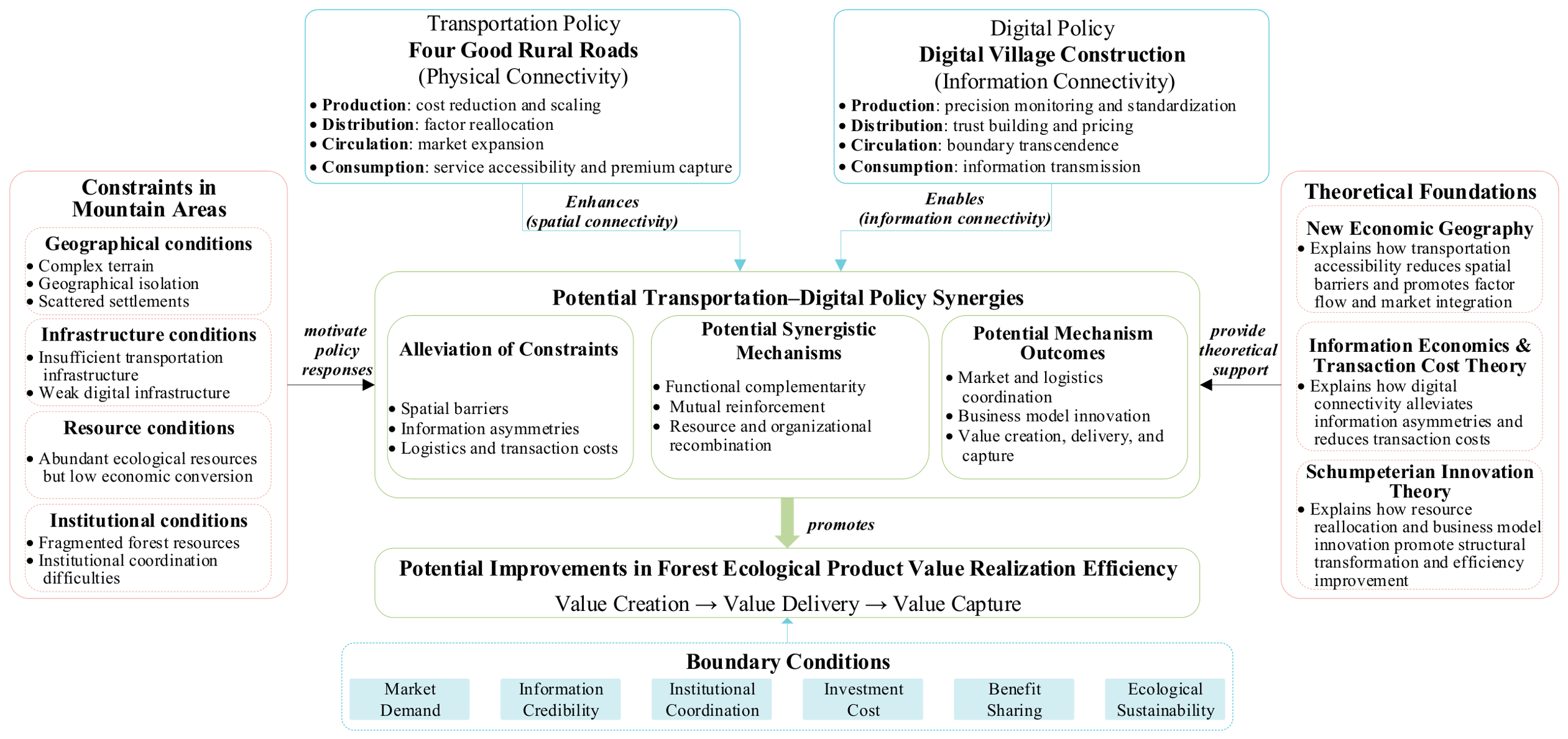
The specific theoretical logic is illustrated in Figure 2.
Figure 2.
Theoretical framework.
3.1. Distinct Mechanisms of Transportation and Digital Policies
Rural transportation policy and digital village construction policy may facilitate the value realization of forest ecological products through two distinct but related dimensions: physical accessibility and information connectivity. Both may contribute to reducing associated costs and enhancing realized economic value, although they operate through different mechanisms.
Transportation policy primarily addresses spatial constraints by reducing transportation costs. New economic geography identifies these costs as an important factor shaping economic spatial distribution [20,28]. In mountainous areas, high transportation costs act as iceberg costs that erode the value of ecological products during circulation. Improving rural road networks through better construction, management, maintenance, and operation [19] may reduce these costs across the production, distribution, circulation, and consumption of ecological products [25]. In production, improved roads reduce input transportation costs and enable machinery and specialized services to reach remote mountainous areas, supporting more efficient resource allocation and moderately scaled operations [20,29]. In distribution, reliable roads facilitate the aggregation of forest products at regional nodes, potentially reducing collection costs and post-harvest losses [30]. In circulation, improved logistics infrastructure supports cold-chain transportation and warehousing, expanding market access from local to regional and national markets [20,31]. In consumption, improved accessibility connects forest landscape resources with urban consumers, creating opportunities for ecotourism and forest-based wellness services [6,32]. Overall, transportation improvements may alleviate spatial barriers, reduce logistics costs, and establish a physical foundation for forest ecological product value realization.
Digital policy primarily addresses information asymmetries and transaction costs, as emphasized by information economics and transaction cost theory [33]. Forest ecological products in mountainous areas face substantial information barriers: consumers may find it difficult to verify ecological attributes, while producers often lack access to distant market information. Digital village construction may alleviate these constraints through data resources, digital technologies, platforms, and governance mechanisms. In production, remote sensing and digital monitoring support the measurement and assessment of forest carbon sinks, water conservation, and other ecological indicators, providing information for ecological value accounting and potential market transactions [27,33]. Digital platforms may also reduce the costs of accessing technical training, policy information, and financial services [21]. In distribution, digital traceability and blockchain-based systems can improve the verifiability of product origins and quality attributes, reducing information asymmetries among supply chain participants [9,33]. In circulation, e-commerce platforms connect mountainous producers with wider markets, potentially reducing search costs, intermediary costs, and circulation losses [27]. In consumption, digital branding and marketing improve the communication of ecological attributes, strengthen consumer trust, and create opportunities for differentiated pricing [34]. Overall, digital village construction may support value discovery and more effective market transactions by improving information connectivity and reducing transaction costs.
Transportation and digital policies thus address distinct but interrelated constraints: transportation may expand physical market accessibility, while digital technologies may enhance information connectivity and market coordination. By alleviating spatial and informational barriers, respectively, these policies provide a basis for potential synergies. However, whether their interactions generate additional benefits depends on the complementary mechanisms and boundary conditions discussed in the following section.
3.2. Potential Transportation–Digital Policy Synergies and Efficiency Improvement
The preceding analysis indicates that transportation and digital village construction policies may facilitate forest ecological product value realization through physical accessibility and information connectivity, respectively. However, their effects need not operate independently. Research on organizational and technological complementarities suggests that improvements in one component may enhance the effectiveness of another when they are jointly utilized [35]. In mountainous areas, transportation infrastructure enables the physical movement of forest products, production factors, and consumers [21], while digital technologies facilitate information exchange, market matching, and transaction coordination [36]. Accordingly, the overlay of the Four Good Rural Roads initiative and digital village construction policies may create opportunities for synergistic interactions, although policy coexistence alone does not guarantee additional benefits.
Transportation–digital policy synergies may emerge through three interrelated mechanisms. First, functional complementarity arises from the interaction between physical delivery and information connectivity. Improved roads reduce the costs of transporting forest products and accessing forest-based services, while digital platforms reduce information asymmetries and facilitate connections between dispersed suppliers and market demand [37]. Their combination may improve the matching of information flows with physical flows, reducing transaction delays, distribution losses, and coordination costs. Second, mutual reinforcement occurs when improvements in one dimension enhance the utilization of the other. Better transportation accessibility may facilitate the deployment and use of digital services, whereas digital technologies may improve logistics efficiency through demand forecasting, route optimization, and load matching. These reciprocal interactions may strengthen the effectiveness of both infrastructure systems under suitable market and institutional conditions [21]. Third, resource and organizational recombination, as explained by Schumpeterian innovation theory, may arise when improved physical and informational connectivity enables new combinations of forest resources, labor, capital, technologies, and market demand [9]. Such recombination may create opportunities for business model innovation and more effective value realization.
These synergistic mechanisms may be reflected in three interrelated business models. First, integrated product–service models may enhance value creation by combining forest products with ecotourism, forest wellness, and other ecological services through improved accessibility and digital transactions. Second, platform-driven models may improve value delivery by connecting mountainous producers with distant consumers through digital marketing supported by reliable transportation and logistics, potentially reducing search and distribution costs. Third, cooperative models may strengthen value coordination and capture by enabling dispersed forest farmers to participate in shared quality standards, pooled production, collective marketing, and coordinated distribution.
Together, these business models illustrate how transportation–digital policy synergies may reshape value creation, delivery, and capture through resource reallocation and organizational innovation. Such changes may provide an organizational and market foundation for ecological efficiency restructuring, creating conditions for potential improvements in forest ecological product value realization efficiency. This process can be understood through three analytically interconnected mechanisms.
First, physical connectivity may help overcome low-efficiency constraints. Mountainous forest ecological products have long faced geographical isolation and high transportation costs, limiting market access and investment in scale and specialization. Systematic road improvements may alleviate these constraints by reducing iceberg costs, improving road connectivity and service quality, and lowering unit transportation costs. Consequently, forest ecological products may gain access to regional and national markets. This stage establishes the physical foundation for market participation and potential efficiency improvement.
Second, digital value enhancement may alleviate information constraints. As forest ecological products enter wider markets, information asymmetries may continue to restrict value realization. Consumers often struggle to verify ecological attributes, while producers lack access to distant market information. Digital village construction may address these challenges through digital platforms that make product origins, production processes, and quality attributes more accessible and verifiable. By reducing information asymmetries and transaction costs, digital technologies may facilitate value discovery and market matching, supporting a shift from quantity expansion toward value deepening [38].
Third, ecological efficiency restructuring may emerge from sustained transportation–digital policy interactions. Improved physical accessibility and information connectivity may jointly facilitate resource reallocation, logistics coordination, and business model innovation. By reorganizing forest resources, capital, technologies, and market relationships, these interactions may improve value creation, delivery, and capture while reducing relevant transaction and coordination costs. Under favorable economic, institutional, and ecological conditions, such changes may contribute to substantial and sustained structural improvements in value realization efficiency, including potential efficiency leaps.
In summary, transportation–digital policy synergies may facilitate forest ecological product value realization through the progressive analytical framework of “physical connectivity–digital value enhancement–ecological efficiency restructuring”. These stages represent interrelated theoretical mechanisms rather than a fixed temporal sequence. Transportation improvements may alleviate spatial constraints, while digital technologies may reduce information asymmetries. Their interactions may further support resource reallocation and business model innovation, creating conditions for improved value realization efficiency. However, these potential benefits depend on market, institutional, and ecological conditions and require future empirical validation.
4. Realistic Challenges to Transportation–Digital Policy Synergies in Forest Ecological Product Value Realization
4.1. Implementation Challenges of the Four Good Rural Roads Initiative and Digital Village Construction
Regarding the Four Good Rural Roads initiative, three challenges deserve attention. First, high construction and maintenance costs constrain infrastructure sustainability in mountainous areas. Complex terrain, dispersed settlements, and geological conditions increase the costs of road development and maintenance, while limited local financial capacity may restrict long-term upkeep [18,19]. Evidence from rural China indicates that infrastructure quality and cost-effectiveness are influenced by governance and project management arrangements [39]. Second, difficulties in factor allocation persist. Limited access to capital, professional services, and skilled labor may constrain the development of forest-based industries, particularly where investment returns are uncertain and production cycles are long [18]. Third, road networks are not always effectively integrated with local industries. Inadequate connections between transport infrastructure, forest production areas, processing facilities, and tourism destinations may limit the economic benefits of improved accessibility [6,18]. These challenges suggest that road construction alone does not guarantee more efficient forest ecological product value realization.
Regarding digital village construction, three challenges also remain. First, digital infrastructure and application capabilities vary across rural areas. Remote mountainous communities may face weaker network services, limited technical support, and insufficient digital skills, potentially restricting effective technology adoption [27,40]. Second, forest ecological monitoring and accounting systems remain constrained by fragmented data, inconsistent standards, and limited information sharing [23]. These limitations may undermine the credibility and comparability of ecological product information. Third, digital platform utilization may lag behind infrastructure deployment. A field survey covering 121 Chinese villages reported that only 58 surveyed villages had introduced digital village-affairs services, and 28 of these still relied primarily on offline procedures [41]. Although this evidence concerns rural digital governance rather than forest ecological product platforms specifically, it illustrates the broader challenge of translating digital infrastructure into sustained practical use. Platform effectiveness therefore depends not only on technological investment but also on user capabilities, service relevance, and operational maintenance. At the same time, forestry digital platforms remain oriented toward administration rather than commercial development and market transactions, so data elements are not embedded in the value-realization chain [21].
4.2. Systemic Constraints on Potential Policy Synergies
The potential synergies between transportation and digital policies in mountainous areas may be constrained by four interrelated factors: institutional, spatial, governance, and market constraints. These systemic constraints may prevent the boundary conditions identified in Proposition 3 from being satisfied, thereby limiting the potential benefits of transportation–digital policy synergies.
At the institutional level, differences in the development stages of transportation and digital infrastructure may constrain policy coordination. China’s rural road network has developed over several decades and is increasingly shifting from network expansion toward quality improvement and integrated operation. In contrast, although rural digital infrastructure has expanded rapidly, advanced digital applications and service integration remain uneven, particularly in remote mountainous areas where network quality, operational capacity, and technological adoption still face constraints [42]. Such disparities may weaken the coordination between physical accessibility and digital connectivity. For example, the integration of intelligent transportation systems with forest ecological product traceability and quality supervision systems may remain insufficient, limiting information sharing and coordinated logistics operations [18]. To address these challenges, China’s Digital Village Development Action Plan (2022–2025) and New Round of Rural Road Improvement Action Plan (2025) emphasize improvements in digital applications and coordinated development of rural roads and communication infrastructure, providing policy support for potential transportation–digital synergies.
At the spatial level, the dispersed geography of mountain areas undermines the effectiveness of generic policy tools. Road investment in plains exhibits economies of scale, but in mountainous regions it faces diminishing marginal returns: each additional kilometer serves fewer households, yet costs rise sharply [18]. Similarly, digital investment encounters high per-capita costs, unstable returns, and limited user density in hollowed-out villages, reducing incentives for private and even public investment [4]. Uniform policy templates designed for average rural conditions ignore this spatial heterogeneity, resulting in spatial mismatch where roads and networks are built but fail to generate sufficient economic density for self-sustaining operation. Consequently, uniform infrastructure investment may fail to accommodate heterogeneous local demand, resulting in mismatches between accessibility improvements and industrial development and weakening the potential integration of logistics and information flows [42].
At the governance level, departmental fragmentation constitutes a structural barrier to policy synergy. Transportation construction involves departments of transport, finance, agriculture, and rural affairs, while digital village initiatives span cyberspace administration, industry and information technology, and agricultural agencies. In the absence of a cross-departmental coordination mechanism at the grassroots level, these agencies operate with different standards, data systems, and performance targets, generating high coordination costs and interlocking problems such as inconsistent construction standards and absent maintenance responsibilities [21]. Such departmental fragmentation may result in duplicated investment and hinder the integration of intelligent transportation systems with forest ecological product traceability and quality supervision platforms, weakening the institutional foundation for policy coordination.
At the market level, underdeveloped factor markets may obstruct the conversion of policy inputs into efficiency gains. Fragmented forestland tenure and unclear property rights constrain scale-based operations, while empirical studies of China’s collective forest sector indicate that forest tenure arrangements and property rights influence forestland investment incentives [43]. Moreover, long investment cycles, uncertain returns, and financing difficulties may discourage social capital participation in forest ecological industries. Official information from the National Forestry and Grassland Administration identifies substantial initial investments, long project cycles, and financing constraints as major challenges to private investment in ecological restoration [44]. Consequently, investment in forest ecological industries may remain heavily dependent on public funding [18]. Even where rural roads and digital platforms provide physical and informational support, underdeveloped factor markets—including land, capital, labor, and data—may hinder the conversion of improved accessibility and connectivity into realized economic value. These market constraints may therefore weaken potential transportation–digital policy synergies and limit improvements in forest ecological product value realization efficiency.
5. Conditional Policy Implications for Improving Forest Ecological Product Value Realization Efficiency
Based on the theoretical mechanisms identified in Section 3 and the structural constraints discussed in Section 4, four interrelated policy directions are proposed to improve the efficiency of forest ecological product value realization rather than prescribe universally optimal interventions. Their applicability depends on local market demand, implementation costs, institutional capacity, benefit distribution, and ecological conditions.
5.1. Improving Physical and Digital Accessibility
Limited transportation accessibility and digital connectivity constitute fundamental barriers to forest ecological product value realization in mountainous areas. High transportation costs restrict market access, while inadequate digital connectivity limits information exchange and logistics coordination. From the perspective of new economic geography, coordinated improvements in rural transportation and digital infrastructure may alleviate spatial constraints, facilitate factor mobility, and expand market participation. In areas with sufficient market demand, integrating road improvement with communication network and logistics development could also reduce duplicated investment and improve infrastructure utilization.
However, infrastructure expansion is not necessarily economically justified in all mountainous areas. Complex terrain, dispersed settlements, and high construction and maintenance costs may result in limited returns, particularly where market demand is weak. Therefore, investment priorities should be differentiated according to expected transaction volumes, existing infrastructure conditions, lifecycle costs, and local ecological sensitivity. Rather than imposing mandatory digital connectivity requirements on all road projects, policymakers could assess whether coordinated investment offers advantages over upgrading existing roads, improving mobile network coverage, or developing shared logistics services. Such alternatives may be more appropriate in sparsely populated areas.
Infrastructure planning should also consider potential ecological costs, including habitat fragmentation, vegetation disturbance, and increased human access to sensitive forests. Route selection, environmental impact assessment, and long-term maintenance arrangements are therefore important safeguards. The objective should be to improve accessibility and market connectivity without undermining the ecological assets on which value realization ultimately depends.
5.2. Reducing Information Asymmetries and Supporting Value Discovery
Information asymmetries constrain the recognition, pricing, and market transactions of forest ecological products, particularly when ecological attributes are difficult for consumers to observe or verify. Drawing on information economics and transaction cost theory, digital monitoring, traceability, certification, and transaction platforms may improve information credibility, reduce search and verification costs, and support differentiated pricing. For forest products, reliable information on origin, quality, and ecological characteristics may strengthen consumer trust and market recognition. For regulating ecosystem services, standardized monitoring and accounting may provide a foundation for compensation and other value realization arrangements.
Nevertheless, digital technologies do not automatically generate price premiums or efficiency improvements. Their effectiveness depends on the reliability of ecological data, the credibility of certification institutions, and sufficient market willingness to pay. Monitoring equipment, verification procedures, and platform operation also involve continuing costs that may be particularly burdensome for small-scale forest operators. Consequently, improving existing digital systems, sharing certification services, and developing interoperable information standards may be more feasible than establishing additional independent platforms.
Furthermore, not all forest ecosystem services can be effectively commercialized. Where ecological benefits have substantial public-good characteristics or market demand remains insufficient, ecological compensation and public payment mechanisms may provide more appropriate alternatives. Digitalization should therefore be evaluated according to its capacity to improve the credibility and efficiency of value realization, rather than the scale of technological investment alone.
5.3. Strengthening Institutional Coordination and Equitable Benefit Sharing
Institutional fragmentation and uneven bargaining power may prevent improvements in accessibility and information connectivity from translating into higher value realization efficiency. Transportation, digital development, forestry management, and ecological conservation involve different administrative responsibilities, potentially resulting in fragmented planning and inconsistent implementation. From an institutional and transaction cost perspective, improved coordination may reduce organizational barriers, facilitate resource allocation, and strengthen the connection between ecological resource providers and market participants.
Policy coordination could focus on aligning infrastructure planning, forest resource management, ecological information standards, and market services. Existing village collectives, forestry cooperatives, and local service organizations may provide practical channels for coordinating dispersed forest operators without creating additional administrative structures. However, these arrangements involve management costs and depend on local governance capacity. Their implementation should therefore reflect the relative benefits of coordination and the resources required to maintain it.
Equally important is the distribution of benefits generated through policy complementarities. Improved market access may increase the revenues of platform operators, logistics providers, and larger enterprises without proportionately increasing returns to forest owners and smallholders. Public institutions may also benefit through improved service provision and economic activity, while bearing infrastructure and regulatory costs. Transparent contractual arrangements, cooperative marketing, and appropriate benefit-sharing mechanisms may help strengthen the bargaining position of local resource providers. Policy effectiveness should therefore be assessed not only by aggregate transaction growth but also by whether forest owners, small-scale operators, and village collectives can capture sustainable economic benefits and maintain incentives for forest conservation.
5.4. Supporting Sustainable Market Formation and Business Model Innovation
Improved accessibility and information connectivity may facilitate market formation by connecting forest ecological resources with differentiated consumer demand. Building on Schumpeterian innovation theory, their complementarities may support new combinations of products, services, technologies, and organizational arrangements. Integrated forest product–service offerings, platform-based marketing, and cooperative operations may diversify value creation, improve value delivery, and strengthen local value capture. Such changes may create conditions for ecological efficiency restructuring and potential nonlinear improvements in value realization efficiency.
However, market expansion requires sufficient demand and viable organizational arrangements. Where consumer demand is limited, additional infrastructure or commercial platforms may increase costs without generating corresponding returns. In these circumstances, ecological compensation, public service provision, or smaller-scale cooperative arrangements may be preferable to further commercialization. Moreover, dependence on dominant digital platforms may increase transaction fees and weaken the bargaining position of small operators, making transparent market rules and accessible alternative marketing channels important.
Market expansion must also remain compatible with forest ecological sustainability. Increased tourism, product extraction, and transportation activities may intensify soil disturbance, biodiversity loss, habitat fragmentation, and pressure on ecosystem services. Differentiated land-use management, sustainable harvesting standards, ecological monitoring, and limits on activities in sensitive areas are therefore necessary safeguards. Importantly, higher commercial revenues should not automatically be interpreted as greater value realization efficiency if they are accompanied by substantial implementation costs or losses of ecological functions. The evaluation of potential efficiency gains should account for net economic and social benefits, benefit distribution, and changes in forest ecosystem services.
Overall, these policy directions represent context-dependent implications of the proposed theoretical framework rather than empirically validated policy solutions. Transportation–digital policy complementarities may contribute to efficiency leaps in forest ecological product value realization when improvements in accessibility, information credibility, institutional coordination, and market formation are economically feasible, socially inclusive, and ecologically sustainable.
6. Discussion
6.1. Theoretical Contributions and Relationship to Existing Studies
This study extends existing research on forest ecosystem services and their economic value realization by examining potential complementarities between rural transportation and digital policies in mountainous China. Previous studies have explored the roles of digital village construction [4] and high-quality rural roads [18] separately. By contrast, the proposed framework considers how physical accessibility and information connectivity may interact through functional complementarity, mutual reinforcement, and resource and organizational recombination. Its theoretical contribution lies in linking these interactions to value creation, delivery, and capture, while distinguishing potential improvements in value realization efficiency from increases in economic returns alone. The framework therefore provides a policy-specific interpretation of the economic value realization of forest ecosystem services without assuming that their total ecological value is fully reflected in market transactions.
6.2. Boundary Conditions and Alternative Explanations
The potential benefits of transportation–digital policy synergies are neither automatic nor universally applicable. Their effectiveness depends on market demand, credible ecological information, institutional coordination, economically justified investment, equitable benefit sharing, and ecological sustainability. Moreover, improvements in value realization may also reflect pre-existing forest resource endowments, local economic development, institutional capacity, or market conditions rather than policy interactions alone. Increased accessibility and commercialization may generate additional economic returns while imposing infrastructure costs or ecological pressures. Consequently, potential efficiency improvements must be evaluated against economic costs, distributional consequences, and changes in forest ecosystem services. These considerations limit the generalizability of the framework and highlight the importance of context-dependent policy analysis.
6.3. Limitations and Future Research
This study is conceptual and does not empirically estimate the individual or joint effects of transportation and digital policies. The proposed mechanisms, additional efficiency gains, and potential structural improvements therefore remain theoretical. Moreover, the framework draws primarily on China’s policy context, and its applicability to other countries depends on differences in forest governance, ecosystem service markets, infrastructure development, and institutional arrangements. Future research could employ panel data, quasi-natural experiments, and comparative case studies to examine policy interactions, transmission mechanisms, and spatial heterogeneity. In particular, longitudinal efficiency measurements and structural break tests could help determine whether potential policy synergies are associated with persistent upward shifts in value realization efficiency rather than gradual improvements, while accounting for relevant inputs, costs, and ecological constraints.
7. Conclusions
This study develops a theoretical framework to explain how potential synergies between the Four Good Rural Roads initiative and digital village construction policies may facilitate the value realization of forest ecological products in mountainous China. The theoretical analysis yields four main insights. First, geographical isolation, information asymmetries, and coordination difficulties jointly constrain forest ecological product value realization, while improvements in transportation accessibility and digital connectivity may alleviate these constraints through distinct mechanisms. Second, transportation–digital policy synergies may emerge through functional complementarity, mutual reinforcement, and resource and organizational recombination, facilitating value creation, delivery, and capture. These interactions may contribute to improvements in value realization efficiency through the progressive analytical framework of “physical connectivity–digital value enhancement–ecological efficiency restructuring”. Third, potential transportation–digital policy synergies face institutional, spatial, governance, and market constraints which may hinder their translation into improvements in value realization efficiency. Fourth, improving forest ecological product value realization may require context-dependent policy coordination that strengthens physical and digital accessibility, supports value discovery, and promotes sustainable market formation and business model innovation.
Author Contributions
Conceptualization, J.W., J.Z. and C.X.; methodology, J.W. and C.T.; software, J.W. and C.T.; validation, J.W., C.X. and F.K.; formal analysis, J.W. and J.Z.; data curation, J.W.; writing—original draft preparation, J.W.; writing—review and editing, J.W. and C.X.; supervision, J.W. and F.K.; project administration, J.W. and J.Z.; funding acquisition, F.K. and C.X. All authors have read and agreed to the published version of the manuscript.
Funding
This research was funded by the Annual Project of Zhejiang Provincial Philosophy and Social Sciences Planning (Grant No. 26NDJC107YB).
Data Availability Statement
Data are contained within the article.
Conflicts of Interest
The authors declare no conflicts of interest.
References
- Yang, T.; Lu, H.; Raza, A. The Binary Moderating Effect of Forest New Quality Productive Forces on the Efficiency of Forest Ecosystem Services Value Realization. Forests 2025, 16, 1109. [Google Scholar] [CrossRef] [Scilit]
- Wu, M.; Liu, Y.; Xu, Z.; Yan, G.; Ma, M.; Zhou, S.; Qian, Y. Spatio-Temporal Dynamics of China’s Ecological Civilization Progress after Implementing National Conservation Strategy. J. Clean. Prod. 2021, 285, 124886. [Google Scholar] [CrossRef] [Scilit]
- Huang, H.; Xiong, K.; Li, Y.; Wang, Q.; Yan, J. Green Finance and Value Realization of Forest Ecological Products in Karst Areas: A Mediating-Effect Perspective Based on the Level of Karst Desertification. Forests 2024, 15, 2189. [Google Scholar] [CrossRef] [Scilit]
- Xu, C.Y.; Kong, F.B. Theoretical Logic and Practical Paths of Digital Rural Construction Enpowering the Value Realization of Forest Ecological Products. China Popul. Resour. Environ. 2024, 34, 163–177. (In Chinese) [Google Scholar]
- Xie, X.; Chen, S.; Zhao, R. An Index System for the Evaluation of the Effectiveness of Forest Ecological Product Value Realization in China. Forests 2024, 15, 1236. [Google Scholar] [CrossRef] [Scilit]
- Tang, Y. Landscape Design of “Four Good Rural Road” in Shuangshi Town, Yongchuan District. J. Archit. Res. Dev. 2025, 9, 118–124. [Google Scholar] [CrossRef] [Scilit]
- Xu, Y. Post Evaluation of Rural Road Renovation and Upgrading Plans in Low Mountain and Hilly Areas Based on IF-VE Method. J. Innov. Dev. 2023, 4, 89–92. [Google Scholar] [CrossRef] [Scilit]
- Acemoglu, D.; Restrepo, P. The Race between Man and Machine: Implications of Technology for Growth, Factor Shares, and Employment. Am. Econ. Rev. 2018, 108, 1488–1542. [Google Scholar] [CrossRef] [Scilit]
- Zhao, L.; Chen, H.; Ding, X.; Chen, Y. Does Digital Village Construction Empower the Green Allocation of Agricultural Water Resources? Systems 2024, 12, 12060214. [Google Scholar] [CrossRef] [Scilit]
- Sun, Y.; Zhao, J.; Qiao, Q.; Lin, Z.; Zhang, W. Unlocking the Value of Nature: A Deep Dive into China’s Ecological Product Realization and Its Driving Mechanisms. Forests 2025, 16, 37. [Google Scholar] [CrossRef] [Scilit]
- Wang, K.; Liu, P.; Sun, F.; Wang, S.; Zhang, G.; Zhang, T.; Chen, G.; Liu, J.; Wang, G.; Cao, S. Progress in Realizing the Value of Ecological Products in China and Its Practice in Shandong Province. Sustainability 2023, 15, 9480. [Google Scholar] [CrossRef] [Scilit]
- Zhang, H. Research on the Efficiency and Influencing Factors of Realizing the Value of Ecological Products in China’s Forestry and Grassland Industry. Environ. Prog. Sustain. Energy 2025, 44, e70024. [Google Scholar] [CrossRef] [Scilit]
- Wu, Y.; Chen, P.; Ma, L. Research on the Suitability Evaluation and Enhancement Path of Grassland Ecological Product Value Transformation in China Based on the Three-Dimensional Evaluation Matrix of Ecology, Economy, and Importance. Land 2025, 14, 404. [Google Scholar] [CrossRef] [Scilit]
- Peng, Y.; Liu, W.; Xiong, C.; Bai, X. Value Transformation and Ecological Practice: The Path to Realizing the Value of Ecotourism Products in Heritage Sites-A Case Study of the Qitai Dry Farming System in Xinjiang. Sustainability 2024, 16, 5013. [Google Scholar] [CrossRef] [Scilit]
- Shao, J. Influence Mechanism of Digital Economy Development on the Supply Efficiency of Ecological Products. Front. Environ. Sci. 2024, 12, 1435156. [Google Scholar] [CrossRef] [Scilit]
- Ali, Z.; Juan, Y.; Qianna, L.; Tianqi, L. An Empirical Study on How the Development of Digital Economy Affects the Value Realization of Ecological Products. J. Resour. Ecol. 2025, 16, 81–92. [Google Scholar] [CrossRef] [Scilit]
- Song, M.; Du, J. Mechanisms for Realizing the Ecological Products Value: Green Finance Intervention and Support. Int. J. Prod. Econ. 2024, 271, 109210. [Google Scholar] [CrossRef] [Scilit]
- Tang, C.; Xu, C.Y.; Zhai, J.; Kong, F.B. The Construction of High-Quality Rural Roads Empowers the Realization of the Value of Forest Ecological Products: Theoretical Elucidation and Implementation Pathway. Acta Ecol. Sin. 2026, 46, 3653–3667. (In Chinese) [Google Scholar] [CrossRef]
- Zheng, C. Thoughts on the Construction of “Village to Village Roads” in Rural Areas. In Proceedings of the 2018 International Conference of Green Buildings and Environmental Management (GBEM 2018); IoP Publishing Ltd.: Qingdao, China, 2018; Volume 186, p. 012052. [Google Scholar]
- Ou, L.; Wang, Z.; Lyu, Q.; Zheng, X. Rural Roads in Narrowing Regional Income Inequality: A Quasi-Natural Experiment from China. Transp. Policy 2026, 182, 104109. [Google Scholar] [CrossRef] [Scilit]
- Deng, J.; Li, X.; Zhang, N. The Impact of Digital Rural Construction on Rural Revitalization-Empirical Evidence from Chinese County Panel Data. Agriculture 2024, 14, 1903. [Google Scholar] [CrossRef] [Scilit]
- Pauschinger, D.; Klauser, F.R. The Introduction of Digital Technologies into Agriculture: Space, Materiality and the Public-Private Interacting Forms of Authority and Expertise. J. Rural Stud. 2022, 91, 217–227. [Google Scholar] [CrossRef] [Scilit]
- Lai, H.; Liang, Q.; Sun, Y. Realizing Forest Ecosystem Service Value Through Natural Resource Asset Portfolio Supply: A Multi-Case Study from China. Forests 2026, 17, 678. [Google Scholar] [CrossRef] [Scilit]
- Huang, X.; Li, J.; Ren, Y.; Cao, Y.; Cao, B. The Temporal and Spatial Evolution Characteristics of the Ecosystem Service Value and Conversion Rate in China’s Key State-Owned Forest Regions. Forests 2024, 15, 781. [Google Scholar] [CrossRef] [Scilit]
- Xiao, H.; Zhong, H.; Bao, Q.; Dong, Y.; Zhu, Q. Analysis of Influencing Factors for the Realization of the Ecological Product Value in National Forest Parks Based on Intuitionistic Fuzzy DEMATEL-ISM. Front. Environ. Sci. 2025, 13, 1582118. [Google Scholar] [CrossRef] [Scilit]
- Liu, H.; Yu, Q.Y. Realization of the Value of Forest Ecological Products in China: Path Thinking. World For. Res. 2022, 35, 130–135. [Google Scholar] [CrossRef]
- Jiang, X.M.; Guan, Z.J.; Zhang, W. The Impact of Digital Technology on the Efficiency of Realizing the Value of Forest Ecological Products in China. Appl. Ecol. Environ. Res. 2026, 24, 409–429. [Google Scholar] [CrossRef] [Scilit]
- Duka, A.; Papa, I.; Proto, A.R.; Latterini, F.; Mederski, P.S.; Borz, S.A.; Iordache, E.; Sokolovic, D.; Karisik, A.; Stojnic, D.; et al. Forest Accessibility and Road Network Density: A Global Overview with a Special Focus on Europe. Curr. For. Rep. 2025, 11, 26. [Google Scholar] [CrossRef] [Scilit]
- Liu, R.; Yuan, J.; Liu, H.J.; Su, S.; Sun, A.; Liu, B. Digital Transport Infrastructure and Environmental Sustainability: STIRPAT Perspective Based on China’s Evidence. Res. Transp. Bus. Manag. 2025, 59, 101314. [Google Scholar] [CrossRef] [Scilit]
- Vega-Escobar, A.; Girard, F.; Valeria, O. An Optimization Framework for Planning Forest Road Restoration under Carbon, Fragmentation, and Operational Trade-Offs. Ecol. Model. 2026, 517, 111595. [Google Scholar] [CrossRef] [Scilit]
- Essoussi, I. Road Infrastructure and Forest Landscape Fragmentation: Evidence from the Tangier–Tanger Med Motorway, Northern Morocco. Int. J. Sci. Res. Innov. Stud. 2023, 2, 30–36. [Google Scholar] [CrossRef] [Scilit]
- Zhou, Y.; Tong, C.; Wang, Y. Road Construction, Economic Growth, and Poverty Alleviation in China. Growth Change 2022, 53, 1306–1332. [Google Scholar] [CrossRef] [Scilit]
- Sun, Y.; Chen, C. Digital Rural Construction, Financial Development and Regional Economic Resilience: Mechanism Analysis and Empirical Test. Int. Rev. Econ. Financ. 2025, 101, 104146. [Google Scholar] [CrossRef] [Scilit]
- Shen, K.R.; Lin, J.W.; Fu, Y.H. Network Infrastructure Construction, Information Accessibility and the Innovation Boundaries of Enterprises. China Ind. Econ. 2023, 1, 57–75. (In Chinese) [Google Scholar] [CrossRef]
- Milgrom, P.; Roberts, J. The Economics of Modern Manufacturing: Technology, Strategy, and Organization. Am. Econ. Rev. 1990, 80, 511–528. [Google Scholar]
- Wang, J.; Tang, C.; Kong, F.B. The Effect of the Quality Upgrading of Rural Transportation Infrastructure on Common Prosperity in Counties: A Quasi Natural Experiment Based on the High-Quality Rural Roads Policy. J. South China Agric. Univ. (Soc. Sci. Ed.) 2026, 25, 114–128. (In Chinese) [Google Scholar]
- Su, M.Y. From Regional Integration to State Embedding: Fei Xiaotong’s “Mountain–Plain” Thought and the Dual-Track Practice of Modernization in Jinxiu. J. Qinghai Minzu Univ. (Soc. Sci.) 2026, 52, 141–150. (In Chinese) [Google Scholar]
- Liu, B.Q.; Liu, W.J.; Lv, W.Q. From Scale Accumulation to Efficiency Leap: Growth-Driving Mechanism and Value Release Path of Data Factors. Financ. Econ. 2026, 1–16. (In Chinese) [Google Scholar] [CrossRef]
- Wong, H.L.; Luo, R.; Zhang, L.; Rozelle, S. Providing Quality Infrastructure in Rural Villages: The Case of Rural Roads in China. J. Dev. Econ. 2013, 103, 262–274. [Google Scholar] [CrossRef] [Scilit]
- Liu, H.; Qiao, J.; Li, J.; Zhao, Y. “De-Tagging the Digital Village”: How Shuizhuyuan Village Transforms Rural Governance in China’s Mountainous Areas via the Synergy of Digital Technology and Cultural Development. J. Rural Stud. 2026, 126, 104319. [Google Scholar] [CrossRef] [Scilit]
- Daily, F. Progress, Challenges, and Countermeasures of Digital Village Construction. 2023. Available online: https://nyncw.cq.gov.cn/zwxx_161/ywxx/202307/t20230717_12156116.html (accessed on 17 October 2026). (In Chinese)
- Yan, Q.; Zhao, Z.T.; Wang, M. Digital Empowerment of Rural Ecological Revitalization: Current Situation, Challenges, and Pathways. J. Southwest Minzu Univ. (Humanit. Soc. Sci.) 2025, 46, 181–190. (In Chinese) [Google Scholar]
- Yi, Y. Devolution of Tenure Rights in Forestland in China: Impact on Investment and Forest Growth. For. Policy Econ. 2023, 154, 103025. [Google Scholar] [CrossRef] [Scilit]
- Huang, S. Social Capital Can Participate in Ecological Conservation and Restoration in Four Steps. China Green Times, 24 November 2021. Available online: https://www.forestry.gov.cn/c/www/lhgzdt/33247.jhtml (accessed on 17 October 2026). (In Chinese)

Disclaimer/Publisher’s Note: The statements, opinions and data contained in all publications are solely those of the individual author(s) and contributor(s) and not of MDPI and/or the editor(s). MDPI and/or the editor(s) disclaim responsibility for any injury to people or property resulting from any ideas, methods, instructions or products referred to in the content. |
© 2026 by the authors. Licensee MDPI, Basel, Switzerland. This article is an open access article distributed under the terms and conditions of the Creative Commons Attribution (CC BY) license.