


Abstract
Erosion control dams (ECDs) in forested mountain streams are key pieces of infrastructure for disaster risk reduction, but they have also been reported to disturb the hydro-geomorphic balance of stream ecosystems. Open-type ECDs have increasingly been used to mitigate the loss of longitudinal connectivity caused by closed-type ECDs; however, quantitative comparisons between the two types remain scarce. We evaluated the presence of fish (Rhynchocypris oxycephalus) and amphibian (Glandirana emeljanovi) using logistic regression analysis in a forested mountain stream on Mt. Oseo, Republic of Korea, where closed- and open-type ECDs were installed in sequence. The best-fit models indicated different habitat preferences: R. oxycephalus responded to hydro-geomorphic parameters, whereas G. emeljanovi responded to riparian forest vegetation and soil parameters as well. Although six parameters varied significantly between the sections divided by the two types of ECDs, all observed values fell within the ranges previously reported for mountain streams in natural conditions. Bayesian Network Analysis further identified crown density, stream-bed slope, and number of step pools as high-level parameters that can be regulated through erosion control works, including engineering and forestry techniques. These findings link the presence of both species to stream conditions and are translated into an ecosystem management framework, filling a knowledge gap where comparable studies are scarce.
1. Introduction
Natural disasters worldwide have been increasing rapidly in frequency under the influence of climate change driven by global warming. According to a report published by the World Meteorological Organization, the global number of reported natural disasters surged from 711 in the 1970s to 3165 in 2010, with typhoons, floods, and sediment-related disasters among the most prominent types [1]. Asia accounts for approximately 31% of natural disasters worldwide, making it the continent most vulnerable to disasters [1]. Particularly in East Asia, the summer stationary front forms when the northern Okhotsk High and the southern North Pacific High meet. Combined with the influence of typhoons moving northward from the western Pacific, a substantial portion of the annual precipitation is concentrated between June and September, leading to frequent sediment-related disasters [2,3].
The Republic of Korea, located in East Asia, has forests covering approximately 63.7% of its national land area, and a population density of approximately 515 persons per km2 [4,5]. As a result, much social infrastructure is densely distributed adjacent to forests, and when sediment-related disasters occur, the resulting casualties and property damage per unit area are substantial.
The most common way to mitigate damage from sediment-related disasters is to install artificial structures. Erosion control dams (ECDs), a representative form of gray infrastructure within forested watersheds, are installed across streams, capturing sediment and woody debris flowing from upstream and reducing the velocity of the runoff [6]; they suppress severe stream-bed scour and sediment outflow downstream and contribute to the conservation of green infrastructure, i.e., forest and stream ecosystems [7]. In recognition of the positive functions of ECDs, the Republic of Korea has actively installed them. Starting with the installation of 31 dams in 1986, a total of 17,932 dams have been installed nationwide as of the end of 2025 [8].
However, conflicting perceptions of ECDs persist in the Republic of Korea. Positive media coverage is dominated by reports highlighting how ECDs mitigate sediment-related disasters during the rainy seasons of summer and autumn (e.g., [9,10,11,12]). By contrast, negative media coverage is dominated by reports emphasizing ecosystem fragmentation and landscape degradation caused by the disruption of longitudinal stream connectivity during the spring dry season (e.g., [13,14,15]). This duality is likely to manifest differently depending on the formal type of ECD. Closed-type ECDs, which block most of the sediment moving downstream, are effective for mitigating sediment-related disasters but inevitably disrupt the longitudinal connectivity of streams. In contrast, open-type ECDs, which allow sediments to pass through, can substantially alleviate such disruption. Although open-type ECDs have been installed for an extended period in the Republic of Korea, this has gradually expanded into a measure to mitigate the recently highlighted negative aspects of closed-type ECDs [8]. Nevertheless, a scientific evaluation of the functional changes associated with the formal type (i.e., closed- and open-type) of ECDs remains insufficient.
Only a few studies have been conducted in the Republic of Korea to determine the effects of ECDs on stream ecosystems. Park et al. [16] analyzed changes in water quality before and after the installation of an open-type ECD using tetrapods, which are mainly used in coastal breakwater construction, at a mountain stream in Sancheong-gun, Gyeongsangnam-do. They reported that the tetrapod ECD had a negligible effect on stream water pollution. Seo and Lee [17] evaluated the effects of a closed-type concrete ECD on the benthic macroinvertebrate community in a mountain stream in Gimcheon-si, Gyeongsangbuk-do. They found that the diversity, richness, and evenness indices recovered to their original levels approximately 18 months after installation. Subsequently, Lee et al. [18] examined the effects of a closed-type concrete ECD on fish and amphibian habitats in a mountain stream in Gongju-si, Chungcheongnam-do. They reported that, although the ECD negatively affected both fishes and amphibians during installation, they recovered to their original levels four months after installation.
Numerous studies abroad have examined the effects of ECDs on the longitudinal connectivity of streams and the habitats of aquatic organisms. Notably, Itsukushima et al. [19] reported that after the ECD was removed from the Kamo stream in Japan, turbidity increased due to sediment release but recovered the following year. This reduced the negative effects on the habitats of the benthic macroinvertebrate community. Nagayama et al. [20] reported that, after ECD removal in the Ikeshomanai stream in Japan, the richness and structural diversity of fish habitats recovered and increased. Furthermore, Haworth and Bestgen [21], through a 29-year study of a stream in Colorado, USA, reported that the disruption of longitudinal connectivity caused by a low-head spillway ECD negatively affected the distribution, diversity, and richness of the fish community. However, these studies focused on ECD removal or on a single ECD type; they did not consider the formal differences between the main types of ECDs being installed in the Republic of Korea, namely closed-type and open-type ECDs.
This study aimed to determine the effects of closed-type and open-type ECDs on the habitats of fishes and amphibians, focusing on a stream at Mt. Oseo in Hongseong-gun, Chungcheongnam-do, Republic of Korea. To this end, we examined eleven parameters identified in previous studies as potentially affecting the habitats of fishes and amphibians. Also, we monitored the presence or absence of Rhynchocypris oxycephalus and Glandirana emeljanovi, as the dominant species at the study site. Logistic regression analysis was then performed to derive the parameters significantly influencing the presence of each species, and difference tests were used to examine, on a section-by-section basis, the differences in stream condition parameters and presence frequency according to formal ECD types. Finally, Bayesian Network Analysis of the eleven parameters was employed to identify interrelationships among the parameters influencing the presence of R. oxycephalus and G. emeljanovi, thereby determining the high-level parameters that can be artificially managed through forest engineering techniques for the habitats of the two species.
2. Study Site
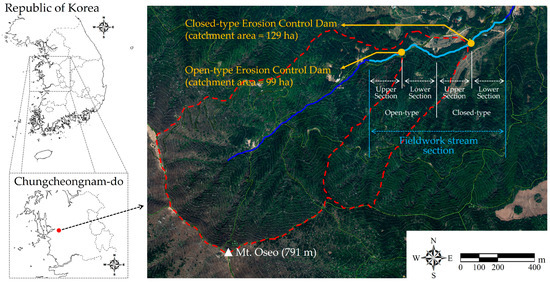
To examine the presence of fish and amphibians as well as the characteristics of parameters affecting them depending on the type of ECD, it was necessary to select a study site where two different types of ECD were installed in sequence in the same mountain stream. The study site was therefore selected using ECD information from the Landslide Information System of the Korea Forest Service [8]. The site selected was a mountain stream originating from Mt. Oseo (791 m a.s.l., 126°40′02.9″ E, 36°28′12.3″ N), which lies at the boundary of Janggok-myeon in Hongseong-gun and Cheongna-myeon and Cheongso-myeon in Boryeong-si, Chungcheongnam-do (Figure 1). Tributaries are well developed in this stream, and the movement of channel bed materials such as sediment, boulders, and large wood was originally active; three closed-type stone-masonry concrete ECDs and one open-type steel buttress ECD have been installed to regulate this movement.
Figure 1.
Location and fieldwork sections of the study stream originating from Mt. Oseo. (The blue lines indicate the streams, and the red dashed line indicates the catchment boundary.).
The actual survey reach of the study stream extends 640 m in total, with altitudes ranging from 137 to 232 m. The channel bed gradient ranges from 2 to 33% (mean 14%), and the longitudinal profile of the channel bed shows a well-developed step pool morphology.
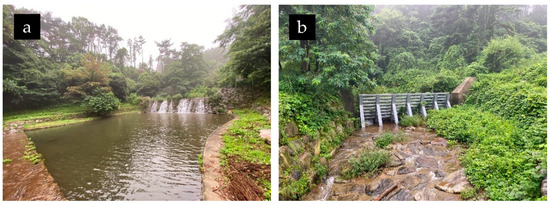
Of the four ECDs installed in sequence, two are included in the survey reach—the second and third from downstream. They differ in appearance (Figure 2). The first ECD, located 160 m upstream from the lowermost point of the survey reach, is a closed-type stone-masonry concrete ECD installed in 2001, with a drainage area of 129 ha, upper and lower widths of 29 m and 22 m, respectively, and a total and effective height of 4.0 m and 3.0 m, respectively, forming a drop structure. The second ECD, located a further 320 m upstream (480 m upstream from the lowermost point of the survey reach), is an open-type steel buttress ECD installed in 2007, with a drainage area of 99 ha, upper and lower widths of 27 m and 22 m, respectively, and a total height of 2.0 m, forming a no drop structure.
Figure 2.
(a) Closed-type and (b) open-type erosion control dams in a stream originating from Mt. Oseo.
In this study, the 160 m reach downstream of the closed-type ECD was designated as (i) the lower section of the closed-type ECD, and the 160 m reach upstream was designated as (ii) the upper section of the closed-type ECD. In the same manner, the 160 m reach downstream of the open-type ECD was designated as (iii) the lower section of the open-type ECD, and the 160 m reach upstream was designated as (iv) the upper section of the open-type ECD. Each section was subdivided at 20 m intervals, resulting in a total of 32 survey segments (Table 1).
Table 1.
Characteristics of the study site at Mt. Oseo stream.
The mean annual temperature at the study site over the past ten years was 13.4 °C, and the mean annual precipitation over the same period was 1157 mm, most of which resulted from heavy rainfall and typhoons between June and September [22]. The geology of the hillslopes on both banks and of the channel bed is Precambrian mica schist [23], and the forest is a mixed stand of oak and pine species, mainly of age classes III–IV.
3. Methods
3.1. Survey of Fish and Amphibian Presence
Surveys on the presence of fish and amphibians were conducted from May 2018 to October 2020, excluding the period from late autumn to early spring of the following year, which is the hibernation period for fish and amphibians.
The surveys were conducted at least once a month (i.e., approximately 30-day intervals) to avoid duplicate observations of individuals, and were divided into morning and evening sessions: morning survey was conducted between 8:00 and 9:00 a.m. after sunrise, and evening survey was conducted between 8:00 and 9:00 p.m. after sunset [24].
The presence of fish and amphibians was recorded using the line-transect sampling method of Urbina-Cardona et al. [25], proceeding from downstream to upstream along the thalweg, with visual surveys covering a 10 m area beyond both banks of the stream. To minimize disturbance to fish and amphibian habitats and changes in water quality, no physical manipulation such as installing nets or turning over stones and fallen leaves was performed [26,27]. The locations of individuals observed were recorded using a GPS device (Garmin GPSMAP 64s; Garmin, Olathe, KS, USA).
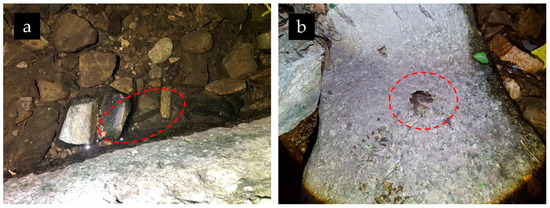
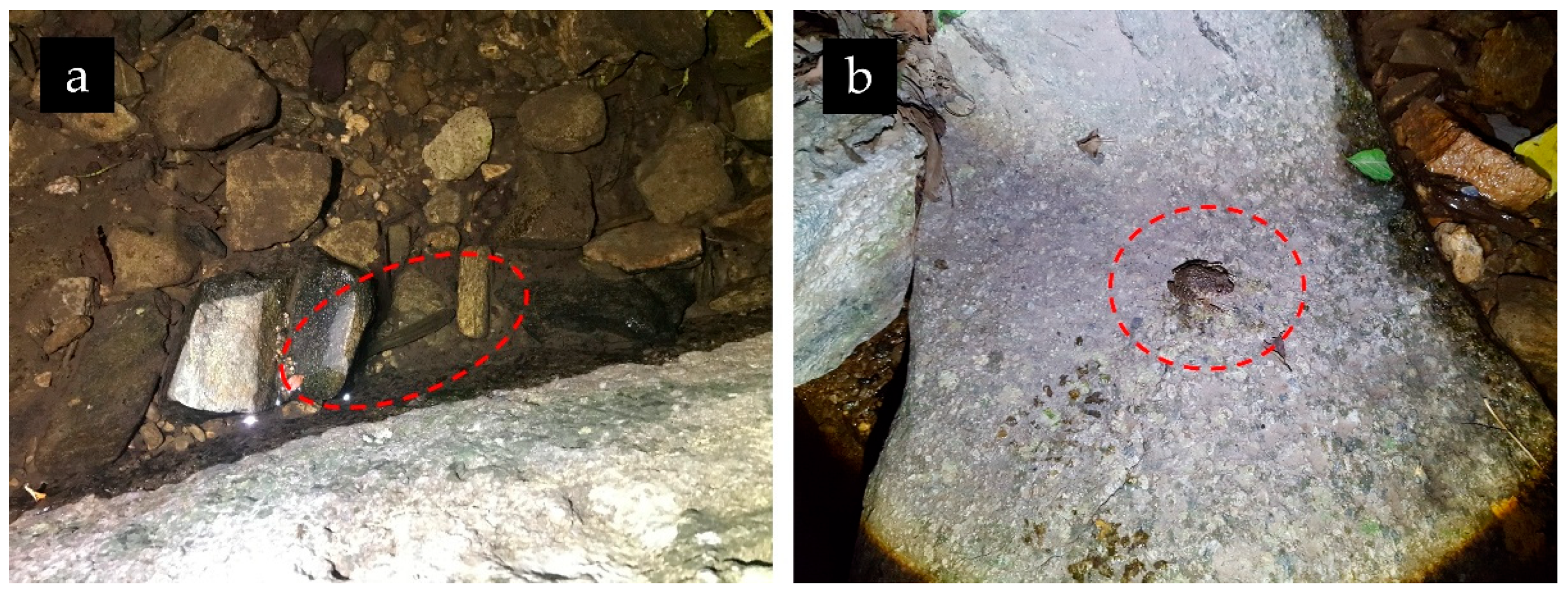
The surveys on the presence of fish and amphibians in the Mt. Oseo stream showed that Rhynchocypris oxycephalus and Glandirana emeljanovi were the overwhelmingly dominant fish and amphibian species, respectively (Figure 3); these two species were therefore selected as the target species of this study.
Figure 3.
(a) Rhynchocypris oxycephalus and (b) Glandirana emeljanovi as representative fish and amphibian species, respectively, in the study stream. (The red dashed circles indicate the individuals.).
R. oxycephalus is a Korean endemic species belonging to the family Cyprinidae of the order Cypriniformes. It is widely distributed in the upper reaches of rivers and in mountain streams throughout the Korean Peninsula [28]. As a representative cold-water fish, it prefers first-class water bodies with low temperature and abundant dissolved oxygen throughout the year; therefore, it has been used as an indicator species reflecting the hydraulic and water quality conditions of streams in the Republic of Korea [29].
G. emeljanovi, on the other hand, is an amphibian belonging to the family Ranidae of the order Anura. It mainly inhabits ecotones and valley margins where forests and streams adjoin; the wrinkles and tubercles developed on its skin favor moisture retention, enabling it to make wide use of moist soils and riparian zones within forests [29].
3.2. Selection of Potential Parameters Affecting the Presence of R. oxycephalus and G. emeljanovi
We selected parameters reported in numerous previous studies as strongly affecting the presence of fish and amphibians. For hydrological parameters of mountain streams, six parameters were selected: (i) monthly rainfall, (ii) water temperature, (iii) water pH, (iv) water electric conductivity, (v) water dissolved oxygen, and (vi) water flow velocity [30,31,32,33,34,35,36,37]. Then, two geomorphological and soil parameters were selected: (vii) stream-bed slope and (viii) number of step pools [38,39,40], as well as (ix) soil pH and (x) soil humidity, respectively [41,42]. Finally, for the riparian forest vegetation parameter, only (xi) crown density was selected [24,43].
3.3. Field Survey of Potential Parameters Affecting the Presence of R. oxycephalus and G. emeljanovi
Monthly rainfall, as a hydrological parameter, was obtained from the ‘Boryeong Mt. Oseo’ station of the Mountain Meteorology Information System operated by the Korea Forest Service and compiled on a monthly basis. The other five hydrological parameters were measured with portable devices: water pH and electric conductivity with a HANNA HI991300 (Hanna Instruments, Seoul, Republic of Korea), dissolved oxygen and water temperature with a TOADKK DO-31P (DKK-TOA Corporation, Tokyo, Japan), and flow velocity with a JDC Electronic FLOWATCH (JDC Electronic, Yverdon-les-Bains, Switzerland). Each parameter was measured three times in the field, and the most stable value was recorded in the field note; the mean of these values was taken as the final measurement.
Stream-bed slope, one of the geomorphological parameters, was measured with a SUUNTO Clinometer (Suunto, Vantaa, Finland) for each 20 m survey segment. The number of step pools was recorded for each 20 m survey segment by visually counting points that correspond to the geometric structure of a step pool.
Crown density, the riparian forest vegetation parameter, was determined by photographing the canopy directly above the thalweg with a Nikon D750 camera (Nikon, Tokyo, Japan) fitted with a Nikon AF Fisheye-Nikkor 16 mm lens and then calculating the canopy cover using Gap Light Analyzer (ver. 2.0; Simon Fraser University, Burnaby, BC, Canada). To reduce variation in solar radiation depending on the time of day, the shooting time and aperture were fixed at 10:00 a.m. and F4, respectively.
Finally, soil pH and soil humidity, the soil parameters, were measured in the field with a TAKEMURA DM-5 (Takemura Electric Works, Tokyo, Japan) and a Mirae Sensor WT1000N (Mirae Sensor, Seoul, Republic of Korea), respectively. Both parameters were measured three times at random points within approximately 10 m of both banks of the stream and recorded in the field note; the mean of these values was taken as the final measurement. All parameters were surveyed at the same time frame over the same period as fish and amphibians, with the exception of crown density, which was photographed at a fixed time of 10:00 a.m. as noted above. Fixing the measurement times in this way minimized the influence of diurnal fluctuations, particularly in water temperature and dissolved oxygen, on the comparison of parameters between months.
3.4. Derivation of the Best-Fit Models Predicting Presence of R. oxycephalus and G. emeljanovi
Logistic regression analysis was conducted to develop the best-fit models explaining the presence of R. oxycephalus and G. emeljanovi depending on the type of ECD [44].
In this study, the eleven parameters identified in previous studies were used as explanatory variables, and presence–absence data rather than abundance data for the two species were used as the corresponding dependent variable. This is because, under conditions of extreme hydrological variability such as mountain streams, where abundance fluctuates considerably in the short-term depending on survey location and timing, abundance data may reflect short-term environmental disturbances or survey conditions more strongly than habitat suitability.
Prior to logistic regression analysis, the parameters affecting the presence of the two species must be independent of one another; when this is not satisfied, multicollinearity exists. To eliminate multicollinearity, variance inflation factors (VIFs) were calculated for the parameters [45]. Parameters with a VIF of 10 or greater were excluded; therefore, only independently meaningful parameters were used as explanatory variables.
In building the models, a backward stepwise procedure was used to sequentially remove variables that did not have a statistically significant effect on the presence of the two species. Through this procedure, the best-fit models composed of the finally retained parameters were derived [46]. However, as the regression coefficients (or estimates) from logistic regression analysis are expressed in log-odds units, their interpretation is limited. Accordingly, odds ratios (Exp(b)) were examined to intuitively compare the effect size of each parameter in the best-fit models, and statistical significance was tested using z-values and p-values.
The best-fit model was assessed using the Hosmer–Lemeshow goodness-of-fit test [47]. This test evaluates the agreement between predicted and observed values; a p-value ≥ 0.05 indicates that the values predicted by the best-fit models did not differ significantly from the observed data.
To evaluate the discriminatory power of the best-fit models, the area under the curve (AUC) of the receiver operating characteristic (ROC) curve was used [48]. An AUC of 0.7 or greater is generally regarded as good discriminatory power, and this criterion was applied in this study. The 95% confidence interval of each AUC was estimated using the DeLong method with the ‘pROC’ package in R statistical software (ver. 4.3.1; R Foundation for Statistical Computing, Vienna, Austria).
3.5. Differences in Parameters Depending on Erosion Control Dam Type
As described above, one of the ultimate objectives of this study was to identify the characteristics of parameters affecting the presence of R. oxycephalus and G. emeljanovi depending on the type of ECD. To this end, the Shapiro–Wilk test was first conducted to examine whether the distributions of all parameters satisfied normality [49].
An independent-group design is possible using the parameters of the four sections divided by the two structures of ECDs (the upper and lower sections of the closed- and open-type ECDs). Accordingly, one-way analysis of variance (ANOVA) was initially considered to quantitatively compare the differences between the four groups [50]. However, this method also requires assumptions of normality and homogeneity of variance, which are likely to be violated in mountain streams where environmental conditions are highly heterogeneous between survey segments. In such cases, the Kruskal–Wallis test, a non-parametric test, was applied [51].
Where the Kruskal–Wallis test indicated significant differences between groups, Dunn’s post hoc test was conducted [52]. Since multiple comparisons may lead to a Type I error, the Benjamini–Hochberg correction was applied [53].
3.6. Analysis of Differences in R. oxycephalus and G. emeljanovi Presence Frequencies Depending on Erosion Control Dam Type
To examine differences in the presence frequencies of R. oxycephalus and G. emeljanovi in relation to the type of ECD, statistical analysis using binary data, simply as present ‘1’ or absent ‘0’, was conducted. Because the same 20-m segments were surveyed repeatedly over the study period, the observations are not mutually independent; segment-level and survey-level dependence was therefore accounted for by fitting a generalized linear mixed model (GLMM) with binomial error distribution and a logit link [54]. Here, stream section was specified as a fixed effect, and segment and occasion were specified as random intercepts. The models were fitted by Laplace approximation using the ‘lme4’ package in R statistical software (ver. 4.3.1) [55], and the overall effect of section was tested with a Type II Wald chi-square test. The intraclass correlation coefficient (ICC) was calculated from the variance of the random intercepts to quantify the degree of within-segment dependence.
Pairwise contrasts between the four sections were then obtained from the fitted models using the ‘emmeans’ package, and the Benjamini–Hochberg procedure was applied to control the false discovery rate arising from multiple comparisons [53].
The monthly presence frequencies for the four sections divided into upper and lower sections for each ECD were then examined by year.
3.7. Analysis of the Causal Structure Between Parameters Affecting Presence of R. oxycephalus and G. emeljanovi
The best-fit models were derived from logistic regression analysis and selected based on whether individual parameters had statistical explanatory power for the binary dependent variable of presence. However, this does not necessarily mean that parameters differ between survey sections based on the type of ECD. Therefore, Bayesian Network Analysis was conducted for all eleven parameters that had the potential to affect the habitats of the two species, not only those included in the best-fit models, to examine the causal structure between the parameters [56].
The causal structure between the eleven parameters was explored using the ‘bnlearn’ package in R statistical software (ver. 4.3.1) [57]. Structure learning was performed with the Hill-Climbing (hc) algorithm, a greedy search-based method, using the Gaussian Bayesian Information Criterion (BIC-g) as the network score. It was repeated 1000 times through bootstrap resampling to ensure reliability [58].
Using the structure learning procedure, the strength and direction of each parameter pair were calculated, and the importance of the causal relationship was quantitatively evaluated using the score obtained by multiplying the two values (strength × direction) [59]. Here, strength refers to the relative proportion (0–1) of bootstrap iterations in which a connection between two parameters was observed, and direction refers to the proportion (0–1) in which the direction of the connection was consistently maintained. Therefore, the product of the strength and direction reflects not only whether a connection between two given parameters was consistently recovered, but also whether its direction was consistently maintained. Here, when the score is 0.7 or greater, it was interpreted as indicating a substantive causal relationship between the two parameters [60]. This criterion is more conservative than the product (0.425) of reference strength (0.85) and direction (0.5) that is commonly applied in bootstrap-based Bayesian network studies [57,59].
After learning the structure, the averaged network structure was derived using the ‘averaged.network()’ function, and the graph was visualized using the ‘graphviz.plot()’ function. The score of each causal path was labeled on the corresponding edge in the network.
4. Results
4.1. Derivation of the Best-Fit Models Predicting the Presence of R. oxycephalus and G. emeljanovi
Prior to the logistic regression analysis that derived the best-fit models for predicting the presence of R. oxycephalus and G. emeljanovi, multicollinearity between the independent variables (parameters) was examined using VIF. All eleven parameters—including monthly rainfall (MR), water temperature (WT), water pH (WpH), water electric conductivity (WEC), water dissolved oxygen (WDO), water flow velocity (WFV), crown density (CD), stream-bed slope (SBS), number of step pools (NSP), soil pH (SpH), and soil humidity (SH)—showed VIF values below 10 (1.047–2.183 for R. oxycephalus and 1.033–2.573 for G. emeljanovi), confirming that no multicollinearity existed between the parameters.
With these eleven parameters as independent variables and the presence of each species as the dependent variable, logistic regression analysis with backward stepwise selection yielded a best-fit model for R. oxycephalus comprising seven parameters: water temperature, water pH, water electric conductivity, water dissolved oxygen, water flow velocity, stream-bed slope, and number of step pools (Table 2). The best-fit model for G. emeljanovi comprised nine parameters: water temperature, water pH, water electric conductivity, water dissolved oxygen, crown density, stream-bed slope, number of step pools, soil pH, and soil humidity (Table 3).
Table 2.
The best-fit model predicting the presence of Rhynchocypris oxycephalus after backward stepwise selection in Mt. Oseo stream.
Table 3.
The best-fit model predicting the presence of Glandirana emeljanovi after backward stepwise selection in Mt. Oseo stream.
Odds ratios (Exp(b)) were examined to compare the effect size of each parameter. In the best-fit model for R. oxycephalus, water temperature, water dissolved oxygen, and number of step pools were observed in a positive (+) direction, whereas water pH, water electric conductivity, water flow velocity, and stream-bed slope had a negative (−) direction; six of these parameters were statistically significant, with the exception of stream-bed slope (Table 2). In the best-fit model for G. emeljanovi, water temperature, water dissolved oxygen, stream-bed slope, number of step pools and soil humidity were observed in a positive (+) direction, whereas water pH, water electric conductivity, crown density and soil pH had a negative (−) direction; eight of these parameters were statistically significant, with the exception of water electric conductivity (Table 3).
The Hosmer–Lemeshow goodness-of-fit test was then conducted to assess the best-fit models for the two species. The results were χ2 = 3.87 (df = 6, p = 0.792) for R. oxycephalus and χ2 = 0.86 (df = 6, p = 0.990) for G. emeljanovi, indicating that the values predicted by both models did not differ significantly from the observed values.
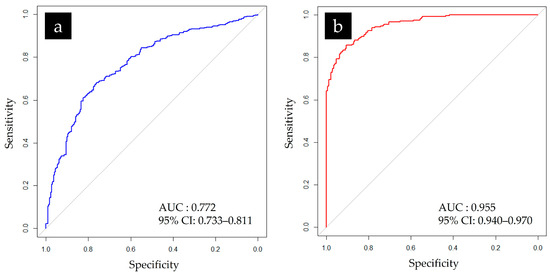
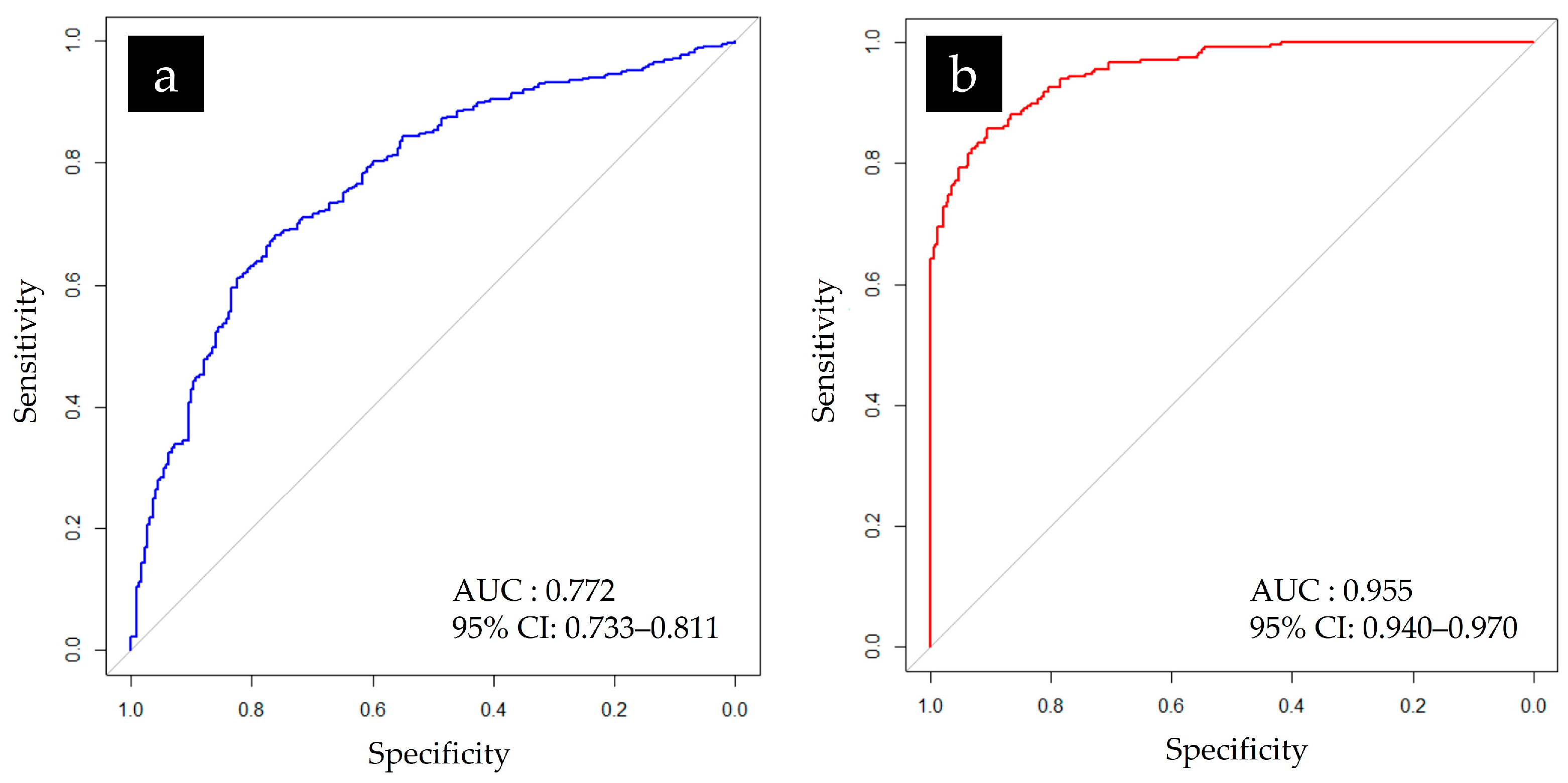
ROC curve analysis was also conducted to evaluate the discriminatory power of the best-fit models for calculations of presence and absence (Figure 4). The AUC values were 0.772 (95% CI: 0.733–0.811) for R. oxycephalus and 0.955 (95% CI: 0.940–0.970) for G. emeljanovi, indicating that both models had good discriminatory power. The lower bounds of both confidence intervals exceeded 0.7, confirming that the discriminatory power of the models was not attributable to sampling variability.
Figure 4.
ROC curves for the best-fit models predicting presence of (a) Rhynchocypris oxycephalus and (b) Glandirana emeljanovi in Mt. Oseo stream.
4.2. Differences in Parameters Depending on Erosion Control Dam Type
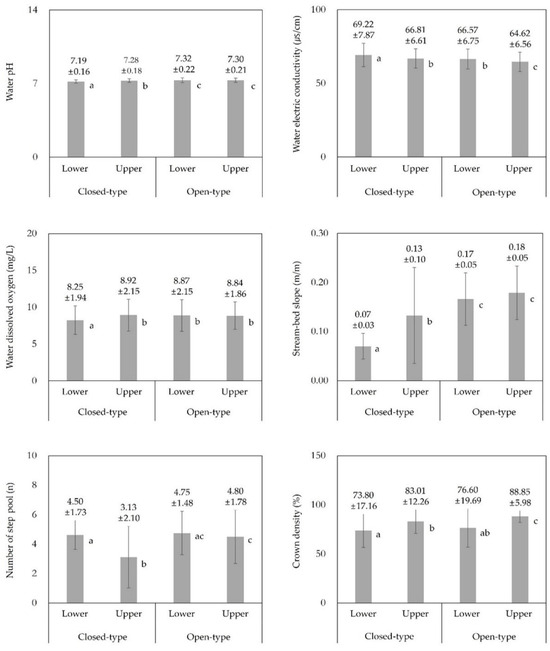
Before examining differences in the parameters affecting the presence of R. oxycephalus and G. emeljanovi between the upper and lower sections of each ECD type, the Shapiro–Wilk test was conducted on all eleven potential parameters to examine whether they satisfied normality. None of the parameters satisfied normality. The non-parametric Kruskal–Wallis test was therefore used to examine differences depending on the type of ECD, divided into upper and lower sections (Figure 5). Water electric conductivity and crown density varied significantly between the upper and lower sections of both ECD types, and water pH, water dissolved oxygen, stream-bed slope, and number of step pools varied significantly between the upper and lower sections of the closed-type ECD. In contrast, monthly rainfall, water temperature, water flow velocity, soil pH, and soil humidity showed no significant difference regardless of the type of ECD.
Figure 5.
Differences in the six parameters that varied significantly between the upper and lower sections based on two types (closed- and open-type) of erosion control dams located in Mt. Oseo stream (Dunn’s post hoc test with Benjamini–Hochberg correction, p < 0.05).
4.3. Differences in Frequencies of R. oxycephalus and G. emeljanovi Depending on Erosion Control Dam Type
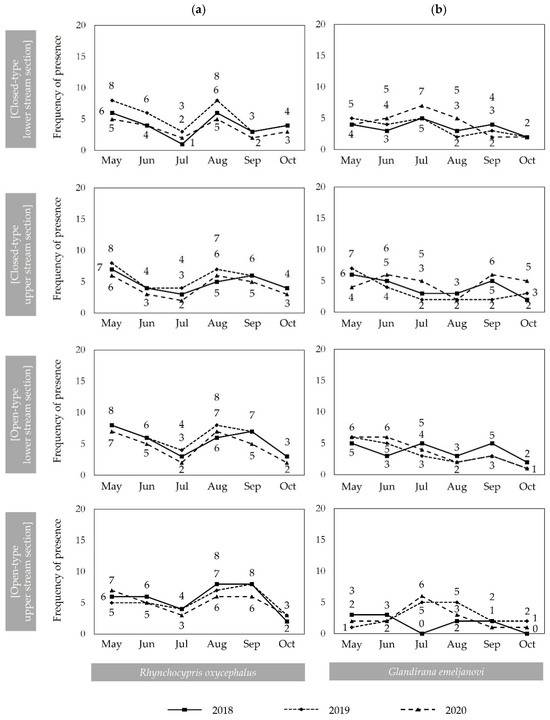
Throughout the survey period, R. oxycephalus was present relatively more often in the upper section than in the lower section of the closed-type ECD; by contrast, presence frequencies differed little between the upper and lower sections of the open-type ECD (Figure 6a). For G. emeljanovi, presence frequencies differed little between the upper and lower sections of the closed-type ECD throughout the survey period; by contrast, the upper section of the open-type ECD consistently showed lower presence frequencies than the lower section (Figure 6b).
Figure 6.
Monthly variations in presence of (a) Rhynchocypris oxycephalus and (b) Glandirana emeljanovi in the upper and lower sections divided by closed- and open-type erosion control dams in Mt. Oseo stream (8 survey segments per section, 18 survey occasions).
Monthly presence patterns of R. oxycephalus, examined for the upper and lower sections of each ECD type, showed relatively high frequencies every May for all sections, followed by a decrease in July, an increase in August, and a subsequent decrease. G. emeljanovi, in contrast, showed highly irregular patterns in all sections.
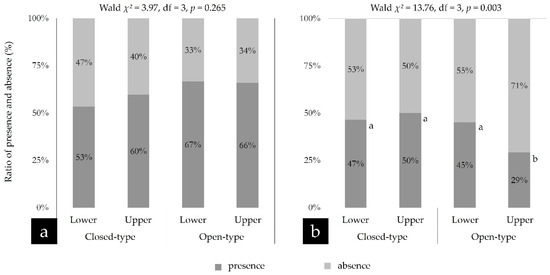
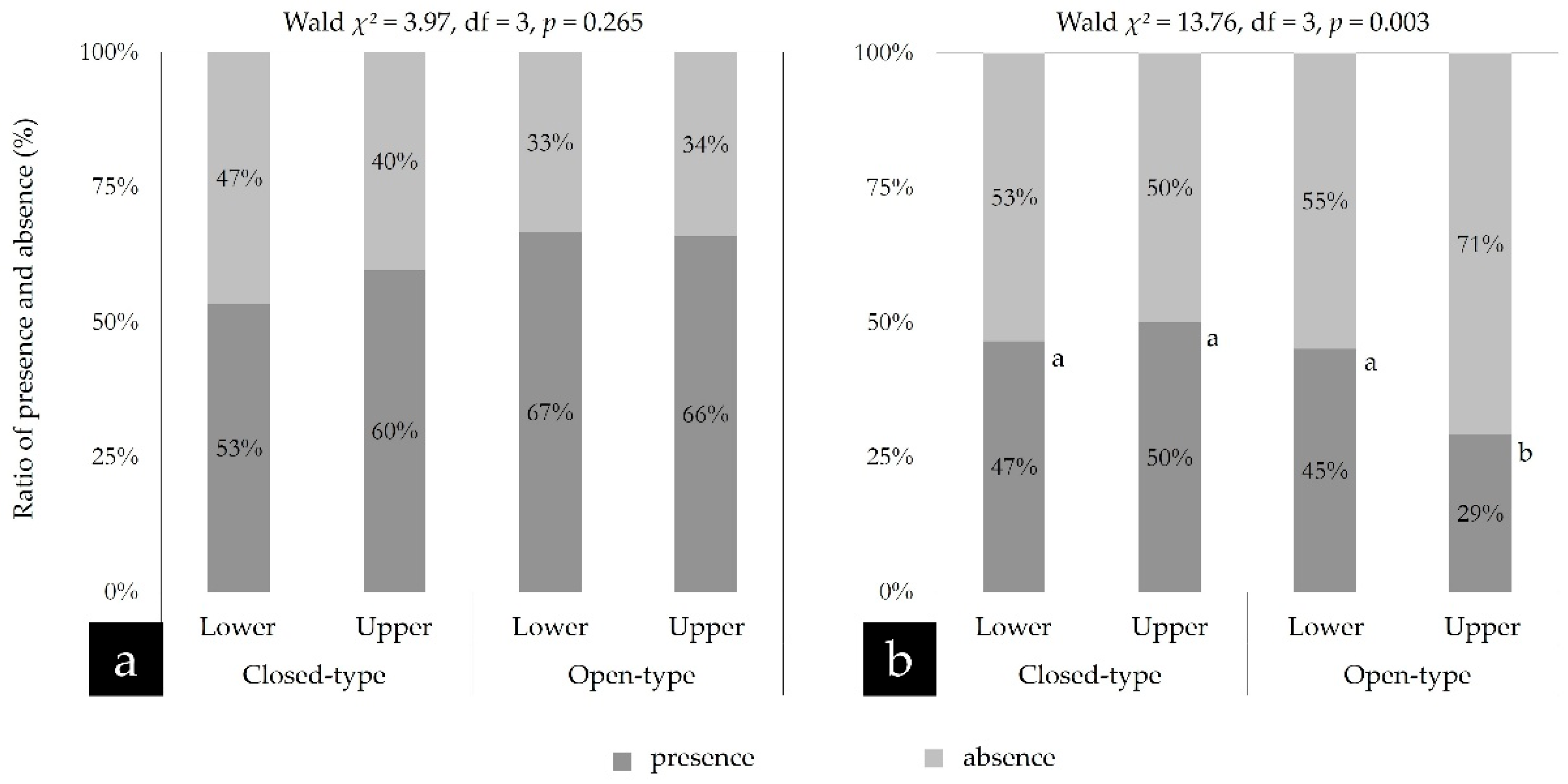
The GLMM showed that the presence ratios of R. oxycephalus were 53% and 60% in the lower and upper sections of the closed-type ECD, and 67% and 66% in the lower and upper sections of the open-type ECD, respectively. However, the overall effect of section was not statistically significant (Wald χ2 = 3.97, df = 3, p = 0.265, Figure 7a). In contrast, the presence ratios of G. emeljanovi were 47% and 50% in the lower and upper sections of the closed-type ECD, and 45% and 29% in the lower and upper sections of the open-type ECD, with a statistically significant difference observed in the latter case (Wald χ2 = 13.76, df = 3, p = 0.003, Figure 7b). Pairwise contrasts with Benjamini–Hochberg correction indicated that the upper section of the open-type ECD differed significantly from all three other sections (adjusted p = 0.011, 0.003, and 0.014), whereas no other pair differed significantly (adjusted p = 0.641–0.820).
Figure 7.
Ratio of the presence and absence of (a) Rhynchocypris oxycephalus and (b) Glandirana emeljanovi in the upper and lower sections divided by closed- and open-type erosion control dams in the Mt. Oseo stream (n = 144 per section). Different letters indicate significant differences in pairwise contrasts with Benjamini–Hochberg correction (adjusted p < 0.05).
The intraclass correlation coefficients derived from the random intercepts were 0.054 for R. oxycephalus and 0.006 for G. emeljanovi, indicating that the dependence arising from repeated surveys of the same segments was small.
4.4. Causal Structure Between the Parameters Affecting Presence of R. oxycephalus and G. emeljanovi
Some of the parameters comprising the best-fit models derived above were included despite showing no statistically significant differences based on the type of ECD.
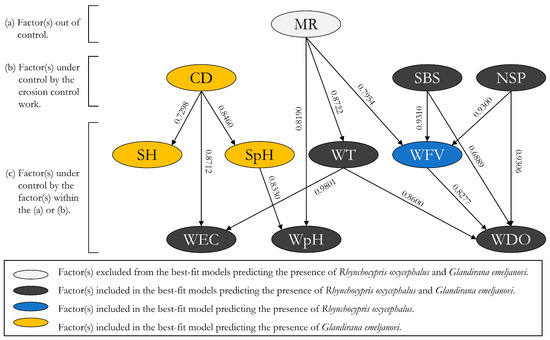
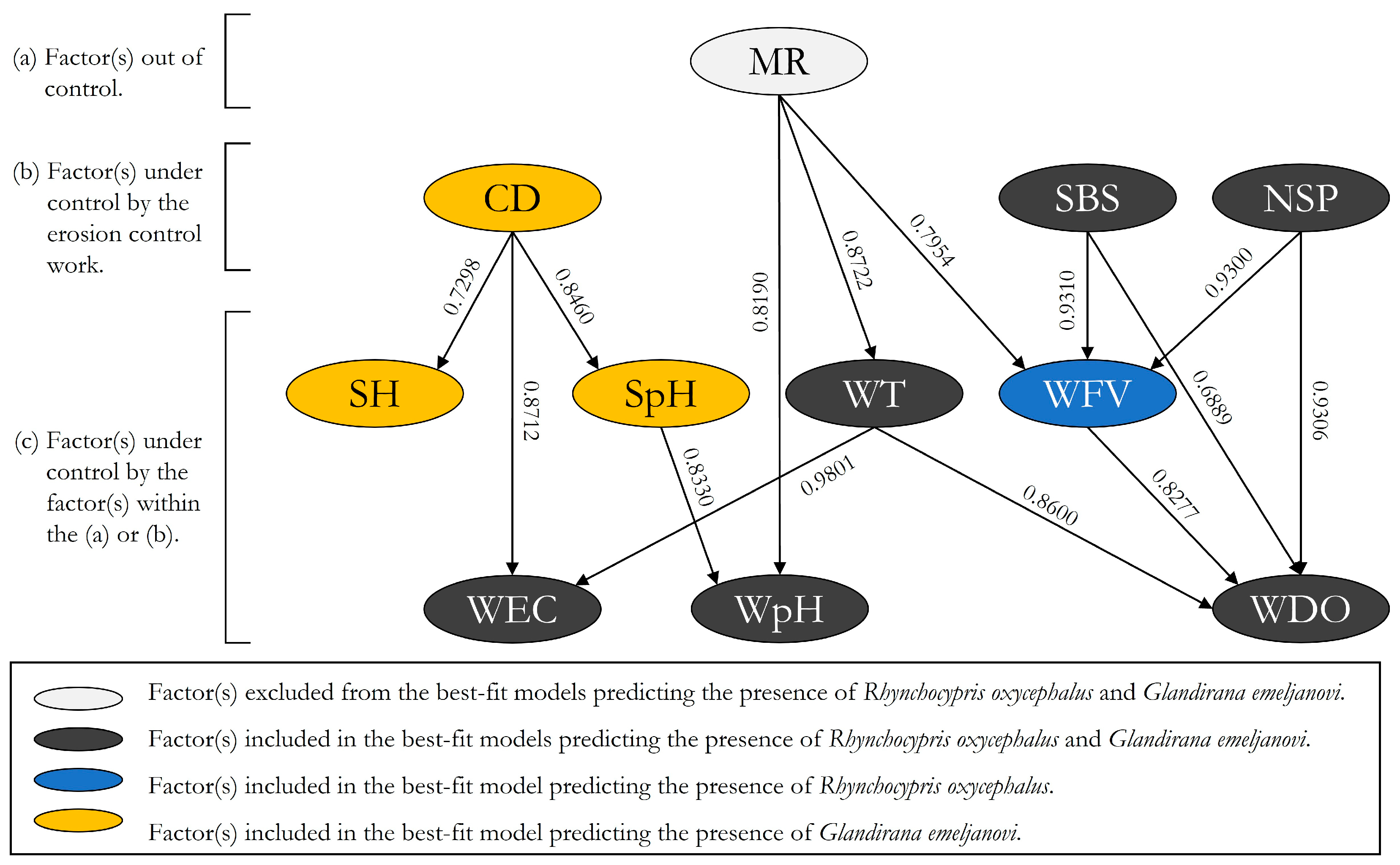
Bayesian Network Analysis was therefore applied to examine the causal structure between the eleven parameters potentially involved in the presence of R. oxycephalus and G. emeljanovi (Table 4, Figure 8). Monthly rainfall, crown density, stream-bed slope, and number of step pools were identified as the main high-level parameters, forming a causal structure leading from these parameters to a number of lower-level parameters.
Table 4.
Bayesian Network Analysis results for the parameters predicting the presence of Rhynchocypris oxycephalus and Glandirana emeljanovi in Mt. Oseo stream.
Figure 8.
Network structure of parameters controlling the presence of Rhynchocypris oxycephalus and Glandirana emeljanovi in the Mt. Oseo stream.
Of the four high-level parameters identified, monthly rainfall exerted a primary influence on water pH, water temperature, and water flow velocity; water temperature in turn exerted a secondary influence on water electric conductivity and water dissolved oxygen, and water flow velocity on water dissolved oxygen. Crown density exerted a primary influence on soil humidity, water electric conductivity, and soil pH. Soil pH in turn exerted a secondary influence on water pH. Stream-bed slope and number of step pools both exerted a primary influence on water flow velocity and dissolved oxygen, with water flow velocity in turn exerting a secondary influence on water dissolved oxygen.
5. Discussion
5.1. Changes in Stream Conditions Depending on Erosion Control Dam Type
The best-fit models derived in this study indicate that R. oxycephalus was relatively more responsive to hydrological and geomorphological parameters in mountain streams, whereas G. emeljanovi was affected by riparian forest vegetation and soil as well as hydrological and geomorphological parameters (Table 2 and Table 3). In both species, however, water temperature, dissolved oxygen and number of step pools were observed in a positive (+) direction, whereas water pH and water electric conductivity had a negative (−) direction. This is consistent with the general habitat characteristics of the two species, which have a high oxygen requirement and dependence on microhabitats [61,62,63,64].
Water flow velocity, selected only for R. oxycephalus, was observed in a negative (−) direction, apparently reflecting the tendency of this species to use sections where flow velocity is reduced around boulders and large wood as refuges [65,66]. Soil humidity (+), soil pH (−) and crown density (−), selected only for G. emeljanovi, indicate that amphibians relying on cutaneous respiration respond sensitively to soil moisture conditions, soil acidity and canopy cover [43,67,68].
Stream-bed slope, however, was observed in a negative (−) direction for R. oxycephalus and a positive (+) direction for G. emeljanovi, showing opposite patterns. Stream-bed slope is a parameter mediating flow velocity, sedimentation, and dissolved oxygen [69,70]: steep slopes provide habitats with abundant oxygen supply, whereas gentle slopes provide environments suitable for the spawning and larval habitats of lentic species [43,71]. The opposite directions in the two species are considered to reflect differences in the habitat conditions each species prefers.
Examination of whether these parameters actually changed depending on ECD type showed significant differences between sections in water pH, water electric conductivity, water dissolved oxygen, crown density, stream-bed slope, and number of step pools (Figure 5). Water pH was lowest in the lower section of the closed-type ECD and increased upstream. In mountain streams, water pH generally tends to decrease downstream as the influence of forest-derived organic acids and acid rain accumulates [72,73,74], and the same tendency was observed in this study. The particularly low pH in the lower section of the closed-type ECD is considered to result from acidification driven by the long-term decomposition of organic matter in the sediment deposited in the storage space of the ECD [67,75]. In contrast, no difference between the upper and lower sections was observed for the open-type ECD, apparently reflecting the structural characteristic that no storage space is formed.
Water electric conductivity was lowest in the upper section of the open-type ECD and increased downstream. This is because the expansion of the drainage area increases discharge and the ions derived from suspended solids. In addition, dissolved ions are introduced downstream from groundwater outflow and non-point pollution sources [76,77]. The magnitude of the change differed depending on the type of ECD; however, this had the largest difference between the upper and lower sections of the closed-type ECD. This shows that the closed-type ECD exerts a greater influence on water electric conductivity than the open-type ECD.
Water dissolved oxygen remained high for the open-type ECD to the upper section of the closed-type ECD and then decreased in the lower section of the closed-type ECD. Since water dissolved oxygen generally decreases downstream owing to rising water temperatures and declining flow velocity [78,79], the overall tendency is consistent with this. The upper section of the closed-type ECD, however, showed the highest amount of water dissolved oxygen despite its relatively low number of step pools and stream-bed slopes. This is considered to be related to the report that dissolved oxygen is higher in sections where the channel bed consists of bedrock, as the impact generated by drops is greater [80].
Stream-bed slope and crown density, meanwhile, tended to increase upstream. This is consistent with the longitudinal characteristics of mountain streams, in which the stream-bed slope becomes gentler downstream [81,82], and the channel width increases with the inflow of tributaries, resulting in greater openness in the canopy [83]. The sharp decrease in stream-bed slope in the lower section of the closed-type ECD is attributed to the deposition of coarse sediments on the channel bed downstream of the ECD [84,85]. By contrast, the number of step pools showed no such longitudinal tendency, as step pool structures are formed locally by large floods or debris flows [86,87].
5.2. Stream Condition Parameters Affecting the Habitats of R. oxycephalus and G. emeljanovi
As described above, although six parameters varied significantly between the upper and lower sections depending on the type of ECD, R. oxycephalus showed no significant differences between sections, and G. emeljanovi had a lower presence frequency only in the upper section of the open-type ECD (Figure 7). This is because the differences in stream condition parameters between sections, although statistically significant, did not exert an influence sufficient to constrain the presence of the two species. Indeed, the water pH observed in this study fell within the range of pH 6.4–7.4 reported for mountain streams with natural stream conditions and no particular pollution sources—those on the northwestern slope of Odaesan National Park, on Mt. Gyebang and on Mt. Bangtae [88]. Water dissolved oxygen likewise fell within the range (4.0–12.5 mg/L) observed at eleven stations in the Chilseon, Baekmudong and Baemsagol valleys of Mt. Jiri [89], and satisfied the first-class criterion (5.0 mg/L or above) presented in the Enforcement Decree of the Framework Act on Environmental Policy of the Ministry of Environment in all sections. The range of stream-bed slope (0.02–0.33 m/m, Table 1) corresponds to the general range for mountain streams in the Republic of Korea, and the number of step pools did not greatly deviate from the level of 15–30 per 100 m (i.e., 3–6 per 20 m) reported for a stream with natural stream conditions shown in Chuncheon, Gangwon-do [40]. For crown density, no quantitative range or threshold directly linked to the presence of a particular species has been clearly presented [90]; since relatively high levels were maintained in all sections, it is unlikely that the differences between sections constrained the presence of the two species.
Water electric conductivity at the study site (64.62–69.22 μS/cm), however, was approximately 1.6–2.2 times higher than the general levels reported for the Republic of Korea, with a mean of 39.90 μS/cm at eleven stations in the Chilseon, Baekmudong and Baemsagol valleys of Mt. Jiri [89], a mean of 33.65 μS/cm in a mountain stream on the northern slope of Mt. Bangtae [91], and a value of 31.00 μS/cm measured before the installation of an ECD in Honggye valley, Sancheong-gun, Gyeongsangnam-do [92]. This is attributed to the geomorphological characteristics of the study stream, in which the inflow of channel bed materials and dissolved accumulated ions increases as the drainage area expands downstream [93,94]; given that both species were present in all sections throughout the survey period, this level is considered not to have constrained their presence.
If the differences in stream condition parameters between sections were insufficient to determine the presence of the two species, the habitat characteristics of each species were considered instead. R. oxycephalus prefers habitats where step pool structures are well developed and dissolved oxygen and flow velocity are relatively stable [95]. It is frequently observed in stream environments with little human interference, well-developed vegetation and limited abrupt changes in water temperature [29,96]. Such stream conditions are generally better developed in upper sections, where the channel width is relatively narrow, than in wider lower sections [81,83]. However, given that no statistically significant differences were confirmed between these sections, the closed- and open-type ECDs installed in sequence can be interpreted as not having contributed to changes in stream conditions to the level constraining the presence of R. oxycephalus.
G. emeljanovi, in contrast, has been reported to be mainly observed in environments where forests and farmland adjoin, including relatively gentle and stagnant stream environments such as streams, farmland, waterways and puddles during the breeding season [29]. Thus, this species can be regarded as using lower sections, where riparian and terrestrial environments are continuously connected, as its main range of activity; the significantly lower presence frequency confirmed only in the upper section of the open-type ECD, which corresponds to the uppermost part of the survey reach, can likewise be understood as reflecting these habitat characteristics. This section also exhibited the highest crown density and a relatively steep stream-bed slope between the four sections, conditions under which the gentle and stagnant stream environments used by this species during the breeding season are unlikely to develop.
The differences in the monthly presence patterns of the two species also appear to be related to the habitat characteristics of each species. R. oxycephalus showed similar seasonal variations in all sections (Figure 6a), which is presumed to result from its main spawning season (April–June) and rainfall [97,98,99]. In summer in particular, repeated increases in flow velocity and fluctuations in water level caused by increased rainfall temporarily reduce the stability of microhabitats [29]. This lowers the likelihood of species being observed during surveys as they take shelter. G. emeljanovi, in contrast, showed irregular presence patterns (Figure 6b), which is considered to be attributable to its relatively wide range of habitat space as an amphibian using both aquatic and terrestrial environments, unlike fish confined to aquatic life, its characteristically short breeding period, and its spatial dispersal depending on rainfall conditions.
5.3. Proposal of Stream Management Measures Considering the Habitats of R. oxycephalus and G. emeljanovi
The fact that differences in individual parameters between sections did not sufficiently explain the presence characteristics of the two species suggests that these parameters are involved within an interconnected structure rather than acting in isolation. Of the four high-level parameters derived through Bayesian Network Analysis in this study, monthly rainfall is a climatic factor that cannot be artificially regulated (Table 4, Figure 8). Crown density, stream-bed slope and number of step pools, in contrast, are parameters that can be directly or indirectly regulated through engineering and forestry techniques (i.e., erosion control works); with appropriate management, they may exert a positive influence on the presence of R. oxycephalus and G. emeljanovi together with the stability of stream conditions.
Considering the habitat characteristics of the two species described above, it is important in stream management to create stream-bed slopes and step pool structures capable of providing stable flow velocity and dissolved oxygen in upper sections, and to maintain crown density for the retention of soil humidity in lower sections. Such management approaches not only accord with the basic purpose of erosion control works—reducing human and material damage from sediment-related disasters in mountainous areas—but can also be extended in a direction that takes account of the public benefits derived from forests, such as land conservation, water resource cultivation, forest recreation, air purification and wildlife protection [7,100].
First, in terms of stream management through the regulation of crown density, selective management such as the removal of obstructive trees, thinning, and pruning can be considered for sections already showing high crown density. Such management can contribute to moderating fluctuations in water temperature and maintaining stable soil humidity by regulating the degree of shading over the stream and its surroundings. Since the soil humidity of the riparian zone in lower sections may be directly linked to the presence of G. emeljanovi in particular, management is required to ensure that abrupt reductions in canopy do not induce surface desiccation.
Next, grade stabilization structures, small check dams, and ECDs can be considered management techniques for regulating the stream-bed slope. These transverse structures function to disperse the energy of flowing water by ensuring the longitudinal gradient of the channel bed remains stable or by moderating sections experiencing abrupt local changes in slope. In water source areas or sections of high ecological value in particular, the possibility of fragmentation caused by structures can be minimized by installing fish passages alongside them, considering the movement of aquatic organisms such as fish. Since the presence of R. oxycephalus is favored in step pool structures where flow velocity and dissolved oxygen are maintained in a stable manner, caution is required in applying management approaches that excessively moderate the slope or unduly stagnate the flow in upper sections. It is also necessary to identify existing step pool structures in advance and ways of conserving or partly utilizing the boulders and bedrock contributing to their formation. In lower sections, conversely, G. emeljanovi is likely to use gentle stream environments continuous with the riparian zone; it is therefore important to determine the arrangement and scale of structures in a manner that minimizes disturbance to stream conditions while reducing sediment discharge. Where sediment discharge occurs owing to increased earthwork volume during the installation of structures, water electric conductivity may rise temporarily in lower sections, and sediment discharge countermeasures should therefore be considered at the construction stage.
6. Conclusions
This study aimed to identify the presence characteristics of fish and amphibians depending on the type of ECD and the characteristics of the parameters affecting them. It proposes appropriate stream management measures on this basis. To this end, we surveyed the presence of fish and amphibians together with eleven potential parameters in a mountain stream on Mt. Oseo, Chungcheongnam-do, Republic of Korea. We then performed logistic regression analysis, difference tests, and Bayesian Network Analysis.
The surveys showed that Rhynchocypris oxycephalus and Glandirana emeljanovi were overwhelmingly dominant; this was related to ten parameters, with monthly rainfall being the only exception. While only hydrological and geomorphological parameters were selected in the best-fit model explaining the presence of R. oxycephalus, the best-fit model for G. emeljanovi included riparian forest vegetation and soil parameters as well as the stream environment, indicating differences in habitat characteristics between the two species. Some of the parameters comprising the best-fit models varied significantly depending on the type of ECD; however, all of them fell within the ranges observed in streams in natural conditions, and it was therefore difficult to regard these variations as a direct effect of the ECDs. We accordingly conclude that the differences in the presence of R. oxycephalus and G. emeljanovi are regulated by the conditions each species prefers within the observed ranges of the parameters, and by the structural characteristics inherent in mountain streams, rather than the type of ECD itself. In addition, Bayesian Network Analysis identified crown density, stream-bed slope, and number of step pools as high-level parameters affecting the presence of the two species. These can be artificially regulated through erosion control works.
As shown above, we quantitatively analyzed the relationships between the presence characteristics of fish and amphibians and condition parameters in a mountain stream where different types of ECDs are located, and organized these relationships into a management concept for stream conditions. Given that comparable studies are scarce, this may be significant in presenting a methodology that can fill a research gap in the field of erosion control in the Republic of Korea. Although this study was spatially and specifically limited to a single mountain stream on Mt. Oseo and two species, the findings provide important information regarding the establishment of stream management strategies in watersheds where ECDs of different types are installed in sequence. Further studies are nevertheless required to improve the generalizability of these findings. Specifically, the spatial coverage should be expanded to include a larger number of ECD installation sites distributed across diverse watersheds, and multiple fish and amphibian species occupying different ecological niches should be added for cross-validation.
Author Contributions
Conceptualization, S.I.L. and J.I.S.; methodology, S.I.L., J.I.S. and S.K.; investigation, S.I.L. and J.L.; data curation, S.I.L.; formal analysis, S.I.L. and J.I.S.; writing—original draft preparation, S.I.L.; writing—review and editing, J.I.S. and S.K.; supervision, J.I.S.; funding acquisition, J.I.S. All authors have read and agreed to the published version of the manuscript.
Funding
This study was carried out with the support of ‘R&D Program for Forest Science Technology (Project No. RS-2025-02223388)’ provided by the Korea Forest Service (Korea Forestry Promotion Institute). This study was also supported by the Forest Pioneer Scholarship Program of the CHUNGINWOOK Scholarship Foundation.
Data Availability Statement
The original contributions presented in this study are included in the article. Further inquiries can be directed to the corresponding author.
Conflicts of Interest
The authors declare no conflicts of interest.
References
- WMO. WMO Atlas of Mortality and Economic Losses from Weather, Climate and Water Extremes (1970–2019); World Meteorological Organization: Geneva, Switzerland, 2023. [Google Scholar]
- Ding, Y.; Chan, J.C.L. The East Asian Summer Monsoon: An Overview. Meteorol. Atmos. Phys. 2005, 89, 117–142. [Google Scholar] [CrossRef] [Scilit]
- Katzenberger, A.; Levermann, A. Consistent Increase of East Asian Summer Monsoon Rainfall and Its Variability under Climate Change over China in CMIP6. Earth Syst. Dynam. 2024, 15, 1137–1151. [Google Scholar] [CrossRef] [Scilit]
- Statistics Korea. Available online: https://kostat.go.kr/ (accessed on 7 August 2026).
- Korea Forest Service. Korea Forest and Forestry Statistics Platform. Available online: https://kfss.forest.go.kr/stat/ptl/newStat/newStatDtl.do (accessed on 7 August 2026).
- Piton, G.; Recking, A. Effects of Check Dams on Bed-Load Transport and Steep-Slope Stream Morphodynamics. Geomorphology 2017, 291, 94–105. [Google Scholar] [CrossRef] [Scilit]
- Chun, K. New Erosion Control Structures for Forest; Hyangmunsa: Seoul, Republic of Korea, 2011. [Google Scholar]
- Korea Forest Service. Landslide Statistics. Landslide Information System. Available online: https://sansatai.forest.go.kr/mhms_pub/mhms/notice/lndslStatsPage.do (accessed on 7 August 2026).
- Jungbu Daily News. Erosion Control Dams Prove Highly Effective Against This Year’s Flood Damage. Jungbu Daily News, 18 September 2002. Available online: https://www.jbnews.com/news/articleView.html?idxno=69353 (accessed on 7 August 2026). (In Korean)
- Gangwon Provincial Residents’ Daily. 22 Erosion Control Dams Installed. Gangwon Provincial Residents’ Daily, 16 October 2003. Available online: https://www.kado.net/news/articleView.html?idxno=110589 (accessed on 7 August 2026). (In Korean)
- Environment Daily. Erosion Control Projects Prove Highly Effective in Preventing Floods and Storms. Environment Daily, 1 November 2006. Available online: https://www.hkbs.co.kr/news/articleView.html?idxno=94163 (accessed on 7 August 2026). (In Korean)
- Gyeongnam Daily News. Erosion Control Dams in Hadong-gun Prove Effective in Preventing Landslides. Gyeongnam Daily News, 17 August 2011. Available online: https://www.knnews.co.kr/news/articleView.php?idxno=995686 (accessed on 7 August 2026). (In Korean)
- Busan Daily News. The “Four Major Rivers Project in the Forest” Controversy: Erosion Control Dams Cannot Continue as They Are (Part 2)—Environmental Destruction and Effectiveness in Question. Busan Daily News, 21 August 2014. Available online: https://www.busan.com/view/busan/view.php?code=20140820000136 (accessed on 7 August 2026). (In Korean)
- Gangwon Provincial Residents’ Daily. Waste of Budget on Erosion Control Dams in Dry Valleys. Gangwon Provincial Residents’ Daily, 13 August 2015. (In Korean)
- KBS News. Far from Preventing Flood Damage: Poorly Built and Neglected “Defective” Erosion Control Dams. KBS News, 21 July 2017. Available online: https://news.kbs.co.kr/news/pc/view/view.do?ncd=3519596&ref=DA (accessed on 7 August 2026). (In Korean)
- Park, J.; Ma, H.; Kim, K.; Youn, H. Influences of the Construction of the Torrent Control Structure Using Customized Tetrapods on the Stream Water Quality at Valley. J. Korean Soc. For. Sci. 2011, 100, 105–111. (In Korean) [Google Scholar]
- Seo, J.; Lee, H. Effects of Debris Barrier on Community Structure and Functional Feeding Groups of the Benthic Macroinvertebrate. J. Korean Soc. For. Sci. 2012, 101, 480–487. (In Korean) [Google Scholar]
- Lee, S.I.; Seo, J.I.; Kim, S.W.; Woo, C.K. Changes in Habitats of Fish and Amphibian Due to Erosion Control Dam Constructed in a Mountain Stream, Gongju, Chungcheongnamdo. J. Korean Soc. For. Sci. 2019, 108, 241–258. (In Korean) [Google Scholar]
- Itsukushima, R.; Ohtsuki, K.; Sato, T.; Kano, Y.; Takata, H.; Yoshikawa, H. Effects of Sediment Released from a Check Dam on Sediment Deposits and Fish and Macroinvertebrate Communities in a Small Stream. Water 2019, 11, 716. [Google Scholar] [CrossRef] [Scilit]
- Nagayama, S.; Ishiyama, N.; Seno, T.; Kawai, H.; Kawaguchi, Y.; Nakano, D.; Nakamura, F. Time Series Changes in Fish Assemblages and Habitat Structures Caused by Partial Check Dam Removal. Water 2020, 12, 3357. [Google Scholar] [CrossRef] [Scilit]
- Haworth, M.R.; Bestgen, K.R. Low-Head Dam Fragmentation, Habitat Alteration, and Invasive Predators Degrade a Western United States Stream Fish Assemblage. Ecol. Freshw. Fish 2024, 33, e12773. [Google Scholar] [CrossRef] [Scilit]
- Korea Meteorological Administration. Past Observations. Available online: https://www.weather.go.kr/w/observation/land/past-obs/obs-by-day.do (accessed on 7 August 2026).
- Korea Institute of Geoscience and Mineral Resources. Geological Thematic Map. Available online: https://data.kigam.re.kr/map/ (accessed on 7 August 2026).
- Hong, N.R. Habitat Characteristics of the Korean Clawed Salamander (Onychodactylus koreanus) in Mt. Baegun, Gwangyang, Jeollanam-do. Master’s Thesis, Seoul National University, Seoul, Republic of Korea, 2017. (In Korean) [Google Scholar]
- Urbina-Cardona, J.N.; Olivares-Pérez, M.; Reynoso, V.H. Herpetofauna Diversity and Microenvironment Correlates across a Pasture-Edge-Interior Ecotone in Tropical Rainforest Fragments in the Los Tuxtlas Biosphere Reserve of Veracruz, Mexico. Biol. Conserv. 2006, 132, 61–75. [Google Scholar] [CrossRef] [Scilit]
- Flint, W.D.; Harris, R.N. The Efficacy of Visual Encounter Surveys for Population Monitoring of Plethodon punctatus (Caudata: Plethodontidae). J. Herpetol. 2005, 39, 578–584. [Google Scholar] [CrossRef] [Scilit]
- Grover, M.C. Comparative Effectiveness of Nighttime Visual Encounter Surveys and Cover Object Searches in Detecting Salamanders. Herpetol. Conserv. Biol. 2006, 1, 93–99. [Google Scholar]
- Chae, B.S.; Song, H.B.; Park, J.Y. Freshwater Fishes of Korea; LG Evergreen Foundation: Seoul, Republic of Korea, 2019. (In Korean) [Google Scholar]
- National Institute of Biological Resources. Species Detail Information. Available online: https://species.nibr.go.kr/ (accessed on 7 August 2026).
- Noland, R.; Ultsch, G.R. The Roles of Temperature and Dissolved Oxygen in Microhabitat Selection by the Tadpoles of a Frog (Rana pipiens) and a Toad (Bufo terrestris). Copeia 1981, 1981, 645–652. [Google Scholar] [CrossRef] [Scilit]
- Poff, N.L.; Ward, J.V. Implications of Streamflow Variability and Predictability for Lotic Community Structure: A Regional Analysis of Streamflow Patterns. Can. J. Fish. Aquat. Sci. 1989, 46, 1805–1818. [Google Scholar] [CrossRef] [Scilit]
- Semlitsch, R.D.; Scott, D.E.; Pechmann, J.H.K.; Gibbons, J.W. Effects of Hydroperiod on Growth and Survival of Larval Amphibians. Ecol. Monogr. 1996, 66, 139–158. [Google Scholar]
- Resh, V.H.; Brown, A.V.; Covich, A.P.; Gurtz, M.E.; Li, H.W.; Minshall, G.W.; Reice, S.R.; Sheldon, A.L.; Wallace, J.B.; Wissmar, R.C. The Role of Disturbance in Stream Ecology. J. N. Am. Benthol. Soc. 1988, 7, 433–455. [Google Scholar] [CrossRef] [Scilit]
- Bunn, S.E.; Arthington, A.H. Basic Principles and Ecological Consequences of Altered Flow Regimes for Aquatic Biodiversity. Environ. Manag. 2002, 30, 492–507. [Google Scholar] [CrossRef] [Scilit]
- Allan, J.D.; Castillo, M.M. Stream Ecology: Structure and Function of Running Waters, 2nd ed.; Springer: Dordrecht, The Netherlands, 2007. [Google Scholar]
- Blaustein, A.R.; Walls, S.C.; Bancroft, B.A.; Lawler, J.J.; Searle, C.L.; Gervasi, S.S. Direct and Indirect Effects of Climate Change on Amphibian Populations. Diversity 2010, 2, 281–313. [Google Scholar] [CrossRef] [Scilit]
- Park, J.H.; Kim, C.S. Analysis of the Effects of Erosion Control Structures on Stream Water Quality. J. Korean For. Soc. 2013, 102, 517–577. (In Korean) [Google Scholar] [CrossRef] [Scilit]
- Park, B.S. Amphibian Fauna of Deogyusan National Park: Effects of Large-Scale Construction on Amphibian Habitats. Korean J. Environ. Ecol. 1994, 7, 207–212. (In Korean) [Google Scholar]
- Kye, M.C. Amphibians of the Myeongjisan Area. Korean J. Environ. Biol. 2003, 21, 203–207. (In Korean) [Google Scholar]
- Kim, S.W.; Chun, K.W.; Park, J.M.; Nam, S.Y.; Lim, Y.H.; Kim, Y.S. Characteristics of Step-Pool Structures in a Mountain Stream near Chuncheon, Gangwon-do. J. Korean For. Soc. 2011, 100, 202–211. (In Korean) [Google Scholar]
- Wyman, R.L. Soil Acidity and Moisture and the Distribution of Amphibians in Five Forests of Southcentral New York. Copeia 1988, 1988, 394–399. [Google Scholar] [CrossRef] [Scilit]
- Sadinski, W.J.; Dunson, W.A. A Multilevel Study of Effects of Low pH on Amphibians of Temporary Ponds. J. Herpetol. 1992, 26, 413–422. [Google Scholar] [CrossRef] [Scilit]
- DeMaynadier, P.G.; Hunter, M.L., Jr. The Relationship between Forest Management and Amphibian Ecology: A Review of the North American Literature. Environ. Rev. 1995, 3, 230–261. [Google Scholar] [CrossRef] [Scilit]
- Cox, D.R. The Regression Analysis of Binary Sequences. J. R. Stat. Soc. Ser. B 1958, 20, 215–242. [Google Scholar] [CrossRef] [Scilit]
- Belsley, D.A.; Kuh, E.; Welsch, R.E. Regression Diagnostics: Identifying Influential Data and Sources of Collinearity; Wiley: New York, NY, USA, 1980. [Google Scholar]
- Mallows, C.L. Some Comments on Cp. Technometrics 1973, 15, 661–675. [Google Scholar]
- Hosmer, D.W.; Lemeshow, S. Applied Logistic Regression, 2nd ed.; Wiley: New York, NY, USA, 2000. [Google Scholar]
- Hanley, J.A.; McNeil, B.J. A Method of Comparing the Areas under Receiver Operating Characteristic Curves Derived from the Same Cases. Radiology 1983, 148, 839–843. [Google Scholar] [CrossRef] [Scilit]
- Shapiro, S.S.; Wilk, M.B. An Analysis of Variance Test for Normality (Complete Samples). Biometrika 1965, 52, 591–611. [Google Scholar] [CrossRef] [Scilit]
- Fisher, R.A. Statistical Methods for Research Workers; Oliver & Boyd: Edinburgh, UK, 1925. [Google Scholar]
- Kruskal, W.H.; Wallis, W.A. Use of Ranks in One-Criterion Variance Analysis. J. Am. Stat. Assoc. 1952, 47, 583–621. [Google Scholar] [CrossRef] [Scilit]
- Dunn, O.J. Multiple Comparisons Using Rank Sums. Technometrics 1964, 6, 241–252. [Google Scholar] [CrossRef] [Scilit]
- Benjamini, Y.; Hochberg, Y. Controlling the False Discovery Rate: A Practical and Powerful Approach to Multiple Testing. J. R. Stat. Soc. Ser. B 1995, 57, 289–300. [Google Scholar] [CrossRef] [Scilit]
- Bolker, B.M.; Brooks, M.E.; Clark, C.J.; Geange, S.W.; Poulsen, J.R.; Stevens, M.H.H.; White, J.-S.S. Generalized Linear Mixed Models: A Practical Guide for Ecology and Evolution. Trends Ecol. Evol. 2009, 24, 127–135. [Google Scholar] [CrossRef] [Scilit]
- Bates, D.; Mächler, M.; Bolker, B.; Walker, S. Fitting Linear Mixed-Effects Models Using lme4. J. Stat. Softw. 2015, 67, 1–48. [Google Scholar]
- Pearl, J. Causality: Models, Reasoning, and Inference, 2nd ed.; Cambridge University Press: Cambridge, UK, 2009. [Google Scholar]
- Scutari, M. Learning Bayesian Networks with the bnlearn R Package. J. Stat. Softw. 2010, 35, 1–22. [Google Scholar]
- Cooper, G.F.; Herskovits, E. A Bayesian Method for the Induction of Probabilistic Networks from Data. Mach. Learn. 1992, 9, 309–347. [Google Scholar] [CrossRef] [Scilit]
- Friedman, N.; Goldszmidt, M.; Wyner, A. Data Analysis with Bayesian Networks: A Bootstrap Approach. In Proceedings of the 15th Conference on Uncertainty in Artificial Intelligence, Stockholm, Sweden, 30 July–1 August 1999; pp. 196–205. [Google Scholar]
- Scutari, M.; Nagarajan, R. Identifying Significant Edges in Graphical Models of Molecular Networks. Artif. Intell. Med. 2013, 57, 207–217. [Google Scholar] [CrossRef] [Scilit]
- Erez, J.; Krom, M.D.; Neuwirth, T. Daily Oxygen Variations in Marine Fish Ponds, Elat, Israel. Aquaculture 1990, 84, 289–305. [Google Scholar] [CrossRef] [Scilit]
- Barton, B.A.; Iwama, G.K. Physiological Changes in Fish from Stress in Aquaculture with Emphasis on the Response and Effects of Corticosteroids. Annu. Rev. Fish Dis. 1991, 1, 3–26. [Google Scholar] [CrossRef] [Scilit]
- Reeves, G.H.; Benda, L.E.; Burnett, K.M.; Bisson, P.A.; Sedell, J.R. A Disturbance-Based Ecosystem Approach to Maintaining and Restoring Freshwater Habitats of Evolutionarily Significant Units of Anadromous Salmonids in the Pacific Northwest. In Evolution and the Aquatic Ecosystem; Nielsen, J.L., Ed.; American Fisheries Society: Bethesda, MD, USA, 1995; pp. 334–349. [Google Scholar]
- Mossop, B.; Bradford, M.J. Importance of Large Woody Debris for Juvenile Chinook Salmon Habitat in Small Boreal Forest Streams in the Upper Yukon River Basin, Canada. Can. J. For. Res. 2004, 34, 1955–1966. [Google Scholar] [CrossRef] [Scilit]
- Edo, K.; Suzuki, K. Preferable Summering Habitat of Returning Adult Masu Salmon in the Natal Stream. Ecol. Res. 2003, 18, 783–791. [Google Scholar] [CrossRef] [Scilit]
- Nagayama, S.; Kawaguchi, Y.; Nakano, D.; Nakamura, F. Summer Microhabitat Partitioning by Different Size Classes of Masu Salmon (Oncorhynchus masou) in Habitats Formed by Installed Large Wood in a Large Lowland River. Can. J. Fish. Aquat. Sci. 2009, 66, 42–51. [Google Scholar] [CrossRef] [Scilit]
- Reuss, J.O.; Johnson, D.W. Effect of Soil Processes on the Acidification of Water by Acid Deposition. J. Environ. Qual. 1985, 14, 26–31. [Google Scholar] [CrossRef] [Scilit]
- Wyman, R.L. Experimental Assessment of Salamanders as Predators of Detrital Food Webs: Effects on Invertebrates, Decomposition, and the Carbon Cycle. Biodivers. Conserv. 1998, 7, 641–650. [Google Scholar] [CrossRef] [Scilit]
- Maddock, I. The Importance of Physical Habitat Assessment for Evaluating River Health. Freshw. Biol. 1999, 41, 373–391. [Google Scholar] [CrossRef] [Scilit]
- Walrath, J.D.; Dauwalter, D.C.; Reinke, D. Influence of Stream Condition on Habitat Diversity and Fish Assemblages in an Impaired Upper Snake River Basin Watershed. Trans. Am. Fish. Soc. 2016, 145, 821–834. [Google Scholar] [CrossRef] [Scilit]
- Kondolf, G.M.; Piégay, H.; Sear, D.A. Integrating Geomorphological Tools in Ecological and Management Studies. In Tools in Fluvial Geomorphology; Kondolf, G.M., Piégay, H., Eds.; John Wiley & Sons: Chichester, UK, 2003; pp. 633–660. [Google Scholar]
- Davies, T.D.; Tranter, M.; Wigington, P.J.; Eshleman, K.N. ‘Acidic Episodes’ in Surface Waters in Europe. J. Hydrol. 1992, 132, 25–69. [Google Scholar] [CrossRef] [Scilit]
- Kim, S.J.; Krieter, M.; Jung, C.J.; Jung, H.G. Acid Precipitation and the Water Cycle. J. Korean Soc. Atmos. Environ. 1994, 10, 159–169. (In Korean) [Google Scholar]
- Hill, T.; Neal, C. Spatial and Temporal Variation in pH, Alkalinity and Conductivity in an Acidic Upland Stream in Mid-Wales. Hydrol. Earth Syst. Sci. 1997, 1, 697–706. [Google Scholar]
- Powell, B.; Martens, M. A Review of Acid Sulfate Soil Impacts, Actions and Policies That Impact on Water Quality in Great Barrier Reef Catchments, Including a Case Study on Remediation at East Trinity. Mar. Pollut. Bull. 2005, 51, 149–164. [Google Scholar] [CrossRef] [Scilit]
- Gali, R.K.; Soupir, M.L.; Helmers, M.J. Electrical Conductivity as a Tool to Estimate Chemical Properties of Drainage Water Quality in the Des Moines Lobe, Iowa. In Proceedings of the ASABE Annual International Meeting, Dallas, TX, USA, 29 July–1 August 2012. Paper No. 121338083. [Google Scholar]
- Schäfer, B.; Beck, C.; Rhys, H.; Soteriou, H.; Jennings, P.; Beechey, A.; Heppell, C.M. Machine Learning Approach towards Explaining Water Quality Dynamics in an Urbanised River. Sci. Rep. 2022, 12, 12346. [Google Scholar] [CrossRef] [Scilit]
- Nakamoto, R.J. Characteristics of Pools Used by Adult Summer Steelhead Oversummering in the New River, California. Trans. Am. Fish. Soc. 1994, 123, 757–765. [Google Scholar] [CrossRef] [Scilit]
- Baigún, C. Characteristics of Deep Pools Used by Adult Summer Steelhead in Steamboat Creek, Oregon. N. Am. J. Fish. Manag. 2003, 23, 1167–1174. [Google Scholar] [CrossRef] [Scilit]
- Gomi, T.; Sidle, R.C.; Woodsmith, R.D.; Bryant, M.D. Characteristics of Channel Steps and Reach Morphology in Headwater Streams, Southeast Alaska. Geomorphology 2003, 51, 225–242. [Google Scholar] [CrossRef] [Scilit]
- Seo, J.I.; Nakamura, F. Scale-Dependent Controls upon the Fluvial Export of Large Wood from River Catchments. Earth Surf. Processes Landf. 2009, 34, 786–800. [Google Scholar] [CrossRef] [Scilit]
- Seo, J.I.; Nakamura, F.; Chun, K.W.; Kim, S.W.; Grant, G.E. Precipitation Patterns Control the Distribution and Export of Large Wood at the Catchment Scale. Hydrol. Processes 2015, 29, 5044–5057. [Google Scholar] [CrossRef] [Scilit]
- Seo, J.I.; Chun, K.W.; Kim, S.W.; Lim, S.J.; Enkhjargal, D. Spatiotemporal Diversity of Large Wood Dynamics and Its Effects on Discharge Characteristics in Korean Mountain Streams. J. Korean For. Soc. 2012, 101, 333–343. (In Korean) [Google Scholar]
- Zema, D.A.; Bombino, G.; Muto, F.; Denisi, P.; Zimbone, S.M. Evaluating the Effects of Check Dams on Channel Geometry, Bed Sediment Size and Riparian Vegetation in Mediterranean Mountain Torrents. Sci. Total Environ. 2018, 642, 327–339. [Google Scholar] [CrossRef] [Scilit]
- De Haas, T.; de Jong, S.M.; Ventra, D.; Turner, S.; Hauber, E. How Memory Effects, Check Dams, and Channel Geometry Control Erosion and Deposition by Debris Flows. Sci. Rep. 2020, 10, 14061. [Google Scholar] [CrossRef] [Scilit]
- Grant, G.E.; Swanson, F.J.; Wolman, M.G. Pattern and Origin of Stepped-Bed Morphology in High-Gradient Streams, Western Cascades, Oregon. Geol. Soc. Am. Bull. 1990, 102, 340–352. [Google Scholar] [CrossRef] [Scilit]
- Chin, A. On the Stability of Step-Pool Mountain Streams. J. Geol. 1998, 106, 59–69. [Google Scholar] [CrossRef] [Scilit]
- Hwang, J.S.; Jung, J.H. Water Environment on the Northwestern Slope of Odaesan National Park. Res. Rep. Korean Assoc. Nat. Conserv. 1998, 38, 135–141. (In Korean) [Google Scholar]
- Jeon, S.R.; Hwang, J.S. Freshwater Fish Fauna and Water Environment in Chilseon, Baekmudong and Baemsagol Valleys, Mt. Jiri. Res. Rep. Korean Assoc. Nat. Conserv. 1993, 31, 141–151. (In Korean) [Google Scholar]
- Michel, F.L.; Hartwell, H.W. Canopy Cover Effects on Stream Microclimate and Riparian Soil Moisture Regimes across Forested Headwater Catchments. J. Hydrol. 2014, 517, 324–335. [Google Scholar]
- Jeon, S.R.; Hwang, J.S. Water Environment and Freshwater Fish Fauna on the Northern Slope of Mt. Bangtae. Res. Rep. Korean Assoc. Nat. Conserv. 1995, 35, 121–134. (In Korean) [Google Scholar]
- Park, J.H.; Ma, H.S.; Kim, K.H. Influences of Torrential Erosion Control Structures Using Customized Tetra-Blocks on Stream Ecosystems. J. Korean For. Soc. 2012, 101, 113–120. (In Korean) [Google Scholar]
- Forbes, A.M.; Magnuson, J.J.; Harrell, D.M. Effects of Habitat Modifications from Coal Ash Effluent on Stream Macrobenthos: A Synthesis. In The Warmwater Streams Symposium; Krumholz, L.A., Ed.; American Fisheries Society: Knoxville, TN, USA, 1981; pp. 241–249. [Google Scholar]
- Kerr, S.J. Silt, Turbidity and Suspended Sediments in the Aquatic Environment: An Annotated Bibliography and Literature Review; Technical Report TR-008; Ontario Ministry of Natural Resources: North Bay, ON, Canada, 1995. [Google Scholar]
- Moon, W.K.; An, K.G. Environmental Characteristics and Fish Community in Small Streams of First Order. Korean J. Ecol. Environ. 2007, 40, 163–172. (In Korean) [Google Scholar]
- Park, I. The Studies of Chinese Minnow (Rhynchocypris oxycephalus) and Amur Minnow (Rhynchocypris lagowskii): A Review. Biomed. J. Sci. Tech. Res. 2021, 34, 27045–27058. [Google Scholar] [CrossRef] [Scilit]
- Uchida, K. The Fishes of Korea; Bulletin of the Fisheries Experiment Station of the Government General of Korea: Busan, Korea, 1939. [Google Scholar]
- Han, K.H.; Noh, B.Y.; Oh, S.H.; Park, J.T.; Jo, J.K.; Seong, K.B. Spawning Behavior and Early Life History of the Chinese Minnow, Rhynchocypris oxycephalus, Reared in the Laboratory. Korean J. Ichthyol. 1999, 11, 117–183. (In Korean) [Google Scholar]
- Kim, D.H.; Jang, B.S.; Kim, W.J.; Lee, M.S.; Deung, Y.G.; Kim, S.; Lee, G.J. Spermatogenesis of the Chinese Minnow (Rhynchocypris oxycephalus), a Teleost Fish of Subfamily Leuciscinae. Korean J. Microsc. 2010, 40, 1–8. (In Korean) [Google Scholar]
- Korea Forest Service. Revised Erosion Control Technical Manual; Landslide Prevention Division, Korea Forest Service: Daejeon, Republic of Korea, 2022. (In Korean)

Disclaimer/Publisher’s Note: The statements, opinions and data contained in all publications are solely those of the individual author(s) and contributor(s) and not of MDPI and/or the editor(s). MDPI and/or the editor(s) disclaim responsibility for any injury to people or property resulting from any ideas, methods, instructions or products referred to in the content. |
© 2026 by the authors. Licensee MDPI, Basel, Switzerland. This article is an open access article distributed under the terms and conditions of the Creative Commons Attribution (CC BY) license.