Review

On Some Significant Phytoplasma Diseases of Forest Trees: An Update

by
Carmine Marcone
1,*,
Deividas Valiunas
2,
Soma Mondal
3 and
Ramachandran Sundararaj
3
1
Department of Pharmacy, University of Salerno, I-84084 Fisciano, Italy
2
Nature Research Centre, Laboratory of Plant Pathology, Akademijos g. 2, LT-08412 Vilnius, Lithuania
3
Forest Protection Division, ICFRE—Institute of Wood Science and Technology, Malleshwaram, Bengaluru 560003, India
*
Author to whom correspondence should be addressed.
Forests 2021, 12(4), 408; https://doi.org/10.3390/f12040408
Submission received: 26 February 2021 / Revised: 25 March 2021 / Accepted: 25 March 2021 / Published: 29 March 2021
(This article belongs to the Special Issue Forest Pathology and Entomology)

Abstract

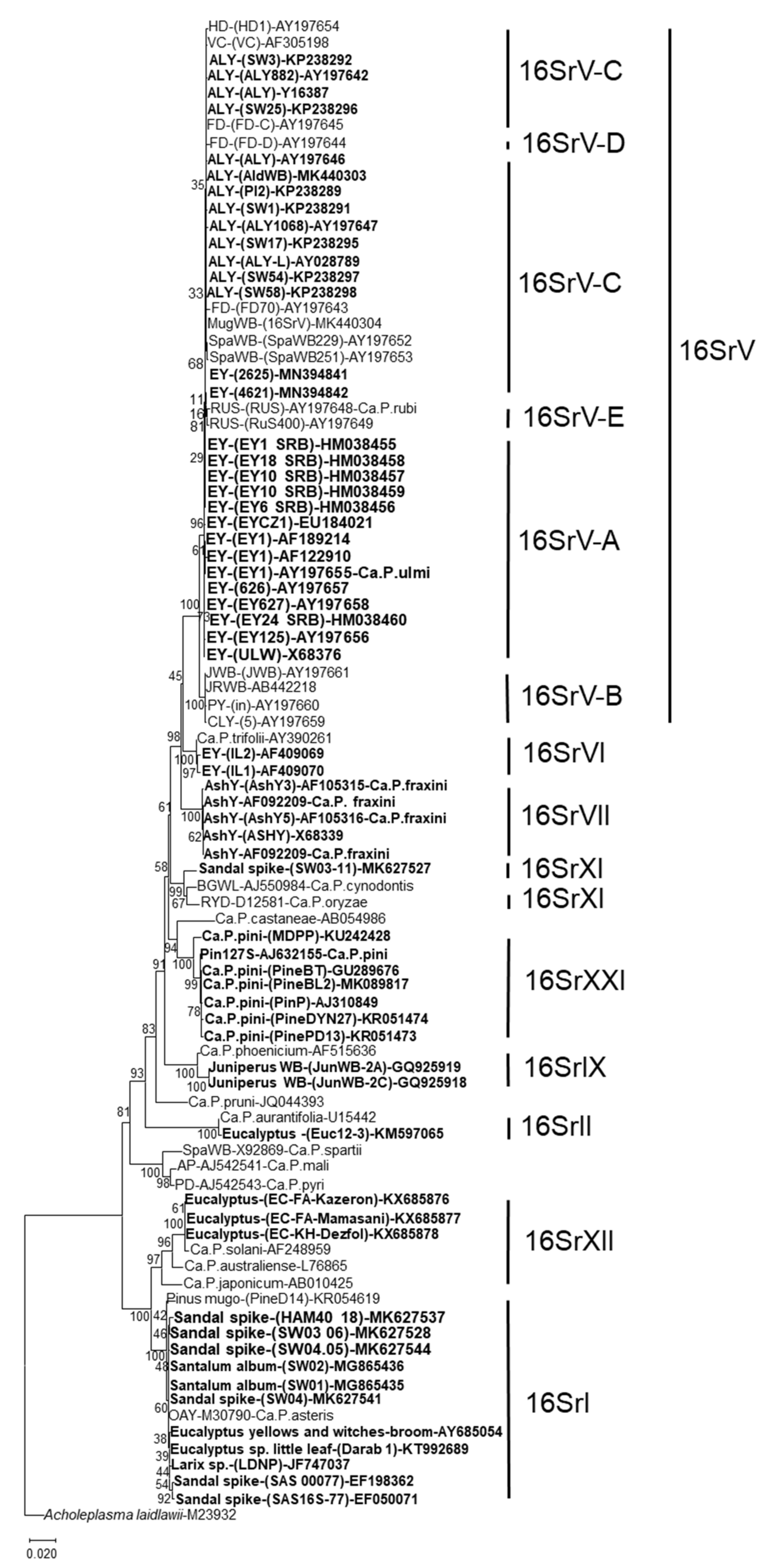
This paper provides an updating of information of a selected number of major phytoplasma diseases of forest trees, with a focus on the associated phytoplasma taxa. Phytoplasma diseases of forest trees have been less extensively studied than those affecting fruit trees. Research on the role of phytoplasmas as the cause of diseases of forest trees has only in the last few years been intensified, after sensitive and specific detection methods greatly based on PCR technology became available. Various phytoplasma taxa have been identified in naturally infected elm, ash, conifer, sandal, and eucalyptus trees, whereas only one phytoplasma taxon has been recorded in naturally infected alder trees. However, for almost all of the reviewed diseases, there is still sparse information about insect vectors, plant host range, strain virulence, pathogenicity, and host tolerance and resistance. Knowledge of these aspects is the basis for appropriate disease management. In particular, further research is required to clarify the role of phytoplasmas in asymptomatic trees. In addition, the etiological role of various “non-specific” phytoplasma taxa, which have been recorded in forest trees, while no data from pathological studies are available, needs to be further investigated.
Keywords: Candidatus Phytoplasma’ species; 16Sr group/subgroups; PCR; yellows diseases; witches’ broom; phloem discoloration; die-back; phytoplasma strains; etiology; eucalyptus little-leaf; disease incidence Candidatus Phytoplasma’ species; 16Sr group/subgroups; PCR; yellows diseases; witches’ broom; phloem discoloration; die-back; phytoplasma strains; etiology; eucalyptus little-leaf; disease incidence