


Abstract
This study presents a clear and reliable framework for classifying the intent behind scientific citations. It combines multi-model reasoning with concepts from social choice theory. Instead of using a single model, this framework employs three open Large Language Models Gemma, LLaMA, and Mistral. Additionally, we combine their ranked outputs using an exponentially weighted Borda method. By doing so, this approach increases agreement among high-confidence predictions, maintains ranking information, and produces stable, high-quality supervision signals. Consequently, it boosts reliability while remaining transparent. To create a strong experimental basis, we built a large, balanced dataset from the UnarXive corpus, which contains structured full-text scientific articles and citation networks. First, we automatically pulled citation contexts and organized them within a DuckDB-based analytical setup. Then, we rebalanced the dataset across rhetorical categories to enhance representativeness and minimize bias. Finally, we categorized each citation context into one of five roles: background, methodology, comparison, extension, or critique. As a result, the resulting dataset provides a robust foundation for training and evaluation. We trained a SciBERT classifier using these ensemble-generated annotations and tested it on a five-category citation intent classification task. The model achieved a macro F1-score of 0.83, an outstanding result for this type of classification. Indeed, this level of performance shows strong reliability given how challenging it is to differentiate closely related citation functions. Moreover, it demonstrates that combining multiple models produces valuable and distinct supervision signals, capturing subtle rhetorical and semantic patterns that single models often overlook. Furthermore, the framework enhances interpretability. Specifically, the explicit weighting system clarifies how each model contributes to the final outcome. In addition, the deterministic tie-breaking method ensures the outputs are consistent and reproducible. Taken together, these design choices maintain explainability without sacrificing effectiveness.
1. Introduction
In recent decades, scientometric evaluation has mainly relied on global indicators like the Impact Factor and the h-index. These metrics measure the visibility and productivity of researchers and journals. Even though these metrics are well-established in research assessment systems, they have significant limitations. In particular, they aggregate impact at the author or venue level instead of focusing on individual contributions or specific research. This means they miss the more subtle intellectual influence of a particular article or dataset within scientific discussions [1]. Indeed, this limitation aligns with our previous study [2], where we suggested a hybrid framework that combines citation-based and content-oriented metrics to assess the semantic depth and contextual quality of scientific publications. Consequently, with the increasing variety of research communication through journals, evaluation systems need to move from a basic citation-counting approach to a more context-sensitive understanding of scholarly impact [3]. Citations represent the most detailed and understandable unit of scholarly influence because they clearly show how one work interacts with another. However, not all citations have the same epistemic weight or intent. Some may indicate endorsement, methodological reuse, theoretical opposition, or simply contextual mention [1,4,5]. Therefore, the traditional belief that every citation signals a positive impact is no longer true. Accordingly, understanding the function of citations, whether they are background, methodological, comparative, or critical, has become crucial for creating more accurate and semantically rich measures of impact [3,6]. The classification of citation intent addresses this challenge by analyzing the textual and rhetorical context around each citation to determine its functional role [7,8]. To achieve this, it requires a fine understanding of the immediate linguistic environment of the citing sentence, using methods similar to those in local citation recommendation systems [9]. Despite significant progress made possible by pretrained Language Models like BERT [10,11] and SciBERT [12], automatic systems still face challenges due to semantic ambiguity and context dependence. In particular, citation texts often rephrase or distort the meaning of the cited work. As a result, contextualization becomes vital to maintain semantic and argumentative accuracy [13]. At the same time, the rise of Large Language Models (LLMs) has greatly changed how we produce and evaluate scientific knowledge. Their generative capabilities provide new ways to understand textual intent, but they also raise significant concerns about reliability, transparency, and intellectual property. In this regard, it has been argue that citation serves as a foundation of scientific accountability and that the same standard should apply to AI-driven knowledge systems [14]. However, LLMs are still prone to semantic hallucinations and interpretive inconsistencies [15,16], problems that are similar to the challenges in citation classification. Furthermore, relying on a single model or data source can introduce disciplinary bias, similar to distortions that occur when bibliometric analyses depend only on one citation database like Scopus or Web of Science [17]. These challenges emphasize the need for a methodological shift toward multi-model reasoning and ensemble interpretability. Indeed, single-source systems cannot guarantee semantic reliability or epistemic fairness [15,17]. Accordingly, in this study, we present a new framework for citation intent classification that combines multiple open LLMs using a weighted Borda voting mechanism [18,19,20]. Each model ranks potential citation intents based on contextual understanding. Subsequently, an exponential weighting function boosts the top-ranked predictions, reflecting the consensus in Borda theory that nonlinear rank weighting improves decisiveness [7,8,18]. As a result, this ensemble approach balances diversity and stability by leveraging different reasoning from multiple models while reducing individual biases and hallucinations [15,17,21,22,23,24]. In addition to improving accuracy, our method also enhances explainability and traceability by providing transparency in each aggregated decision based on ranked evidence. Ultimately, this work contributes to creating responsible and interpretable scientometric AI, in line with current calls for fair, accountable, and ethically aware Language Models [14,25,26,27].
2. From Citation Retrieval to Contextual Interpretation
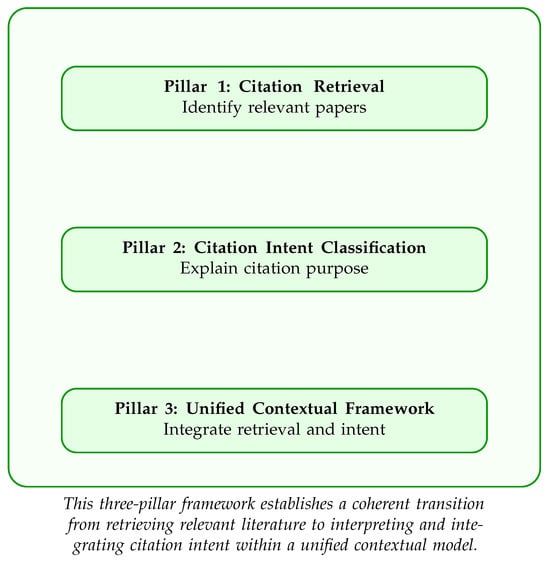
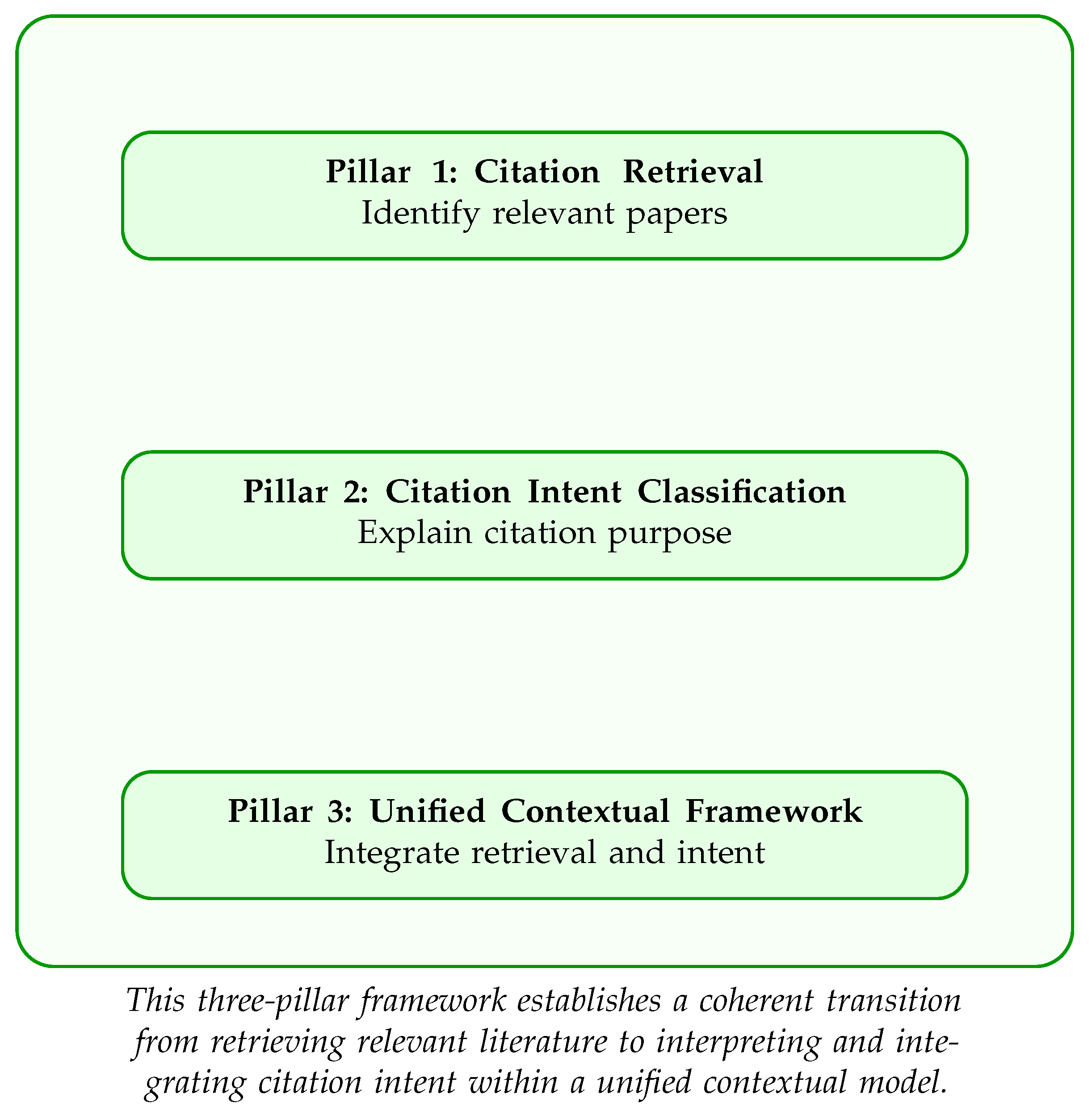
Citation recommendation systems constitute a foundational component of computational citation analysis, as they aim to identify the most relevant references for a specific textual passage rather than for an entire document [8]. In this sense, these systems view citation as a reasoning process that uses linguistic and structural cues to identify which prior work best supports a statement [28,29]. Consequently, this localized modeling of intertextual relations provides the foundation for interpretive methods that go beyond simple retrieval to achieve a deeper understanding. Building on this idea, citation intent classification shifts from determining what to cite to explaining why a citation is included. It categorizes each reference based on its rhetorical and cognitive function, whether to provide background, describe a methodological contribution, or support a comparative discussion [4,30]. Accordingly, by viewing citations as discourse functions, this task adds a qualitative aspect to understanding scientific influence. As highlighted in [2,31], analyzing citations in context is a vital step toward evaluating the interpretive aspects of scientific communication. In other words, seeing citations as discourse actions rather than just numbers offers a richer view of scientific reasoning. As a consequence, this approach leads to intent-aware measures of impact that consider both context and argumentation. Recent developments in contextual language modeling have been key to this shift. Models like BERT and SciBERT can capture bidirectional semantic relationships in citation contexts, allowing for better classification of rhetorical intentions [10,12,32,33]. Moreover, semi-supervised architectures like cGAN-SciBERT show that using unlabeled data can greatly improve model generalization and reduce reliance on expensive manual annotation [22]. Taken together, these advancements suggest a growing ability to infer citation intent with more accuracy and depth. However, the rise of Large Language Models (LLMs) brings new challenges that need to be addressed. While their generative abilities enhance reasoning across long text spans, their absence of clear citation mechanisms raises significant questions about transparency, reproducibility, and intellectual accountability [22,34]. In addition, the variation in their internal reasoning complicates how we interpret their decisions in scientific contexts. Therefore, it is essential that these models can explain and justify their citation-related predictions, which requires methods that draw on multiple sources of evidence and ensure reliable knowledge. From this perspective, the overlap between citation recommendation and citation intent classification shapes the rationale for this work. Both areas aim to model the relationships between scientific texts: one finds relevant references, while the other explains their roles in discourse [35]. Figure 1 illustrates the conceptual three-pillar framework that motivates the proposed approach. Building upon this shared objective, our research builds on this connection by proposing an interpretable framework that brings together several open LLMs using a weighted Borda aggregation strategy. More specifically, this integration enhances contextual precision, balances diversity among models, and improves the traceability of automated citation understanding. Ultimately, it leads to a more transparent, explainable, and accountable approach to scientometric artificial intelligence.
Figure 1.
Three-pillar contextual citation framework.
3. The Proposed Methodological Approach Based on Exponential Borda Fusion
3.1. Ensemble-Driven Citation Intent Modeling and Interpretability-Aware Aggregation
The proposed system builds citation intent labeling on a weighted ensemble that integrates three open Large Language Models: Gemma, LLaMA, and Mistral. This design relies on social choice theory, where diversity among voters reduces systematic bias and limits correlated errors. Architectural heterogeneity arises from differences in training corpora, filtering pipelines, tokenization schemes, and fine-tuning strategies developed by Google [36], Meta [37], and Mistral AI [38]. Such independence strengthens complementary semantic coverage and improves robustness across instruction-following tasks, including multimodal settings such as vision-language applications [39].
Each model assigns one label among five citation intent categories: background, methodology, comparison, extension, and critique, aligned with established citation analysis taxonomies in scientific discourse [30]. Building on this categorical decision, each model also produces a confidence-ranked list of labels. The aggregation layer merges these rankings through an exponential Borda scheme derived from nonlinear weighting principles [18], which concentrates influence on top-ranked predictions and reinforces inter-model agreement. This design maintains explicit score attribution and supports interpretability through alignment with explainable AI methods such as SHAP and LIME [30]. It also preserves the classical two-stage Borda structure formalized by García-Lapresta, Martínez-Panero, and Meneses [40], while extending the interpretability-oriented fusion framework introduced in [2], which integrates quantitative signals with contextual evidence in scientometric analysis.
3.2. Model Selection Criteria and Reproducible Deployment
Model selection prioritizes diversity, stability, and reproducibility. Gemma, LLaMA, and Mistral represent leading open-weight models under 10 billion parameters, with strong performance in zero-shot classification and reliable long-context handling. Their independent development reduces shared biases and improves methodological stability compared to proprietary systems, where undocumented updates and behavioral drift can compromise experimental consistency [41].
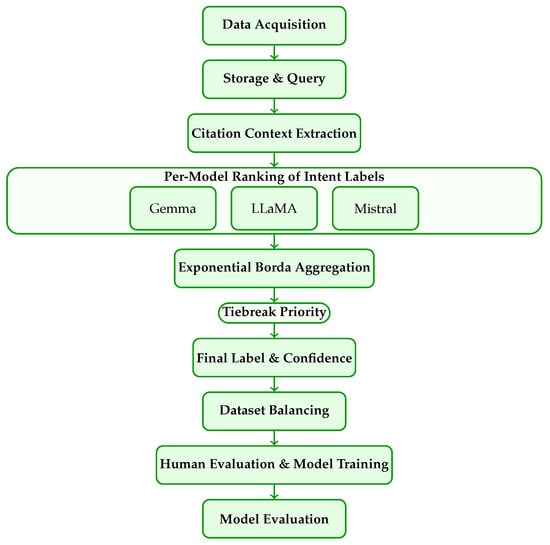
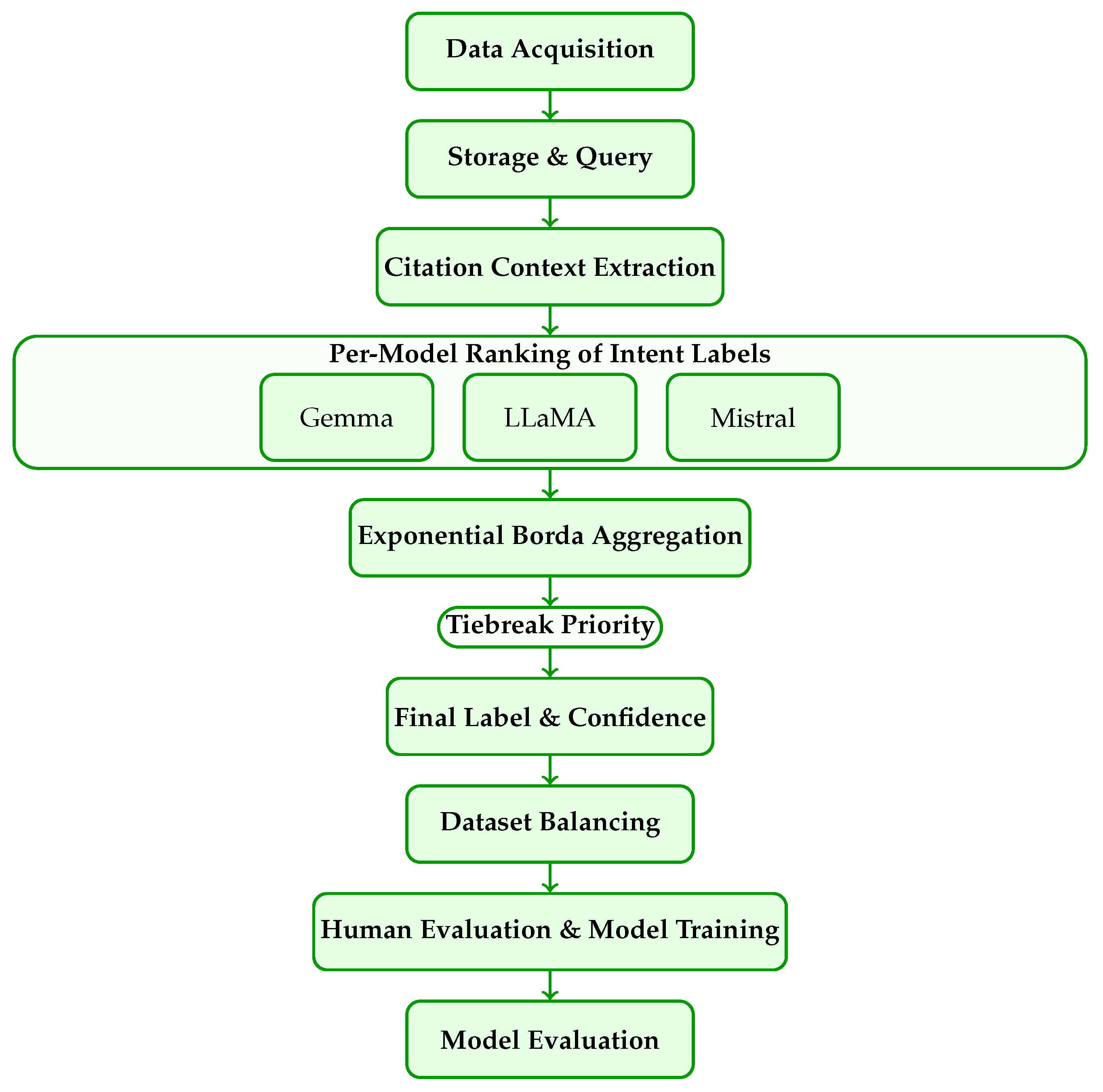
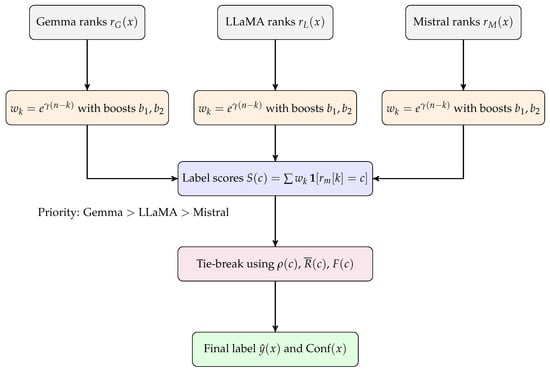
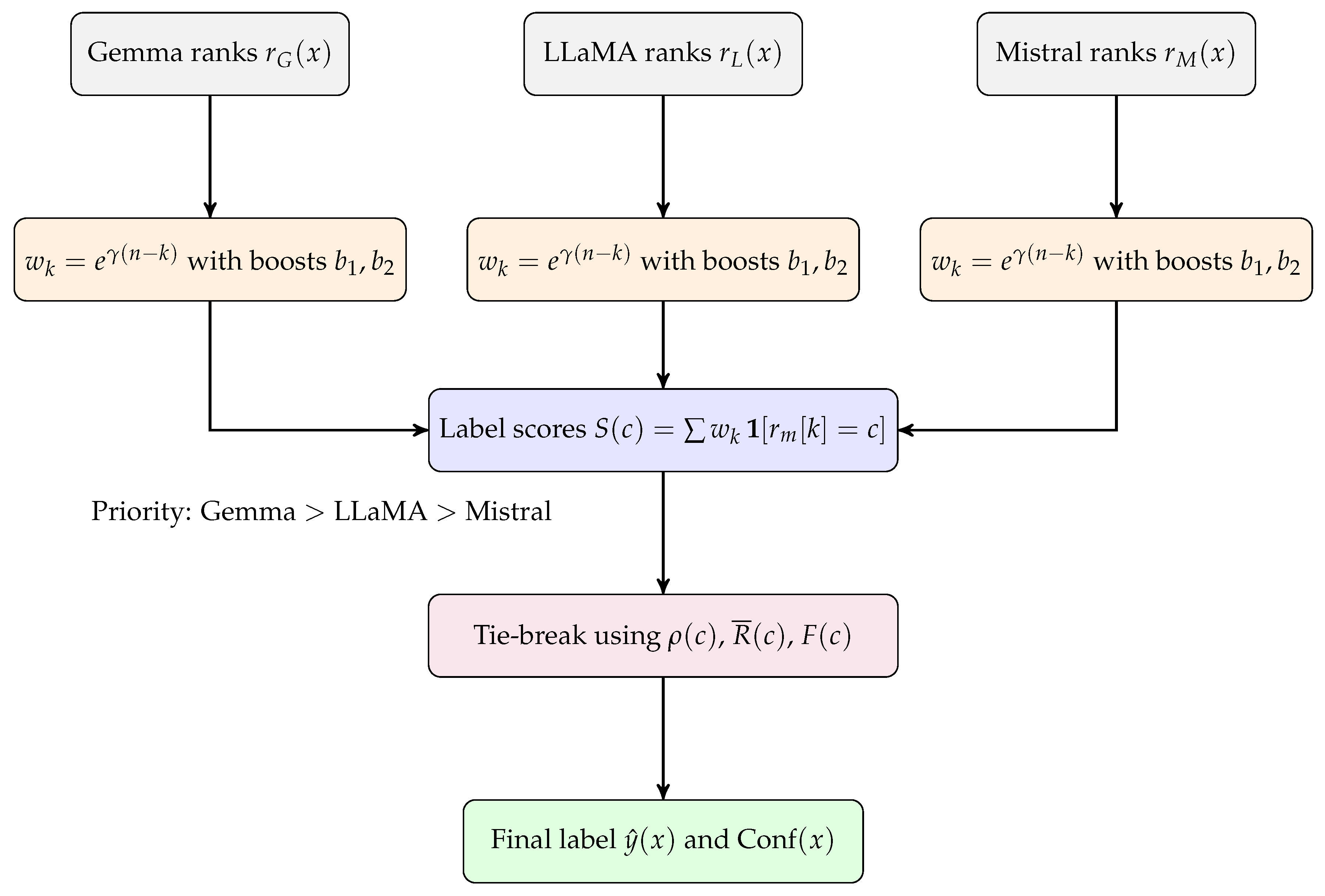
Open-weight accessibility enables full local deployment on standard academic infrastructure, including consumer and mid-range GPUs. This constraint eliminates dependence on external APIs and stabilizes the annotation pipeline across experiments. It also strengthens reproducibility by ensuring consistent model behavior over time and across computational environments [42]. The priority order is backed by independent benchmark evaluations that show a clear capability hierarchy for scientific reasoning tasks. Nadeau et al. [43] tested Llama2, Mistral, and Gemma on factuality, toxicity, bias, and hallucination. Their results show distinct capability profiles for these architectures. In terms of classification performance, Gemma-3-12B-it has been found to outperform Llama-3.1-8B-Instruct in in-context learning settings [44]. Additionally, Mistral 7B performs better than LLaMA 2 13B across all evaluated benchmarks [38]. The Open LLM Leaderboard also shows that Gemma consistently outperforms both LLaMA and Mistral on reasoning and comprehension benchmarks. Together, these evaluations establish a clear capability hierarchy: (Gemma > LLaMA > Mistral), which supports our tie-breaking priority order. Figure 2 provides an overview of the proposed end-to-end methodological pipeline. The framework integrates citation context processing, inference using three complementary open-weight LLMs, exponential Borda rank aggregation, confidence estimation, and final citation intent prediction. The following subsections describe each component of the pipeline in detail.
Figure 2.
End-to-End Methodological Pipeline for Citation Intent Classification Using Our Proposed Approach.
4. Data Collection and Preparation
4.1. Corpus Selection and Rationale
The empirical foundation of this study relies on a large-scale, high-quality corpus that enables both linguistic and scientometric analyses of citation behavior [45]. Existing datasets such as CiteSeerX and ACL Anthology remain limited by their restricted disciplinary coverage and incomplete linkage between textual and bibliographic information [8,46]. Similarly, the absence of unified metadata structures has long constrained the reproducibility and comparability of contextual citation models [7,28]. Overcoming these limitations requires a dataset that integrates the full semantic and structural richness of scholarly texts with explicit citation networks. This design is consistent with the methodological principles established in [2], where the integration of textual content and bibliometric data was identified as a prerequisite for reliable scientometric modeling.
To address this requirement, we adopted the unarXive 2022 dataset, introduced by [27], as the principal source for corpus construction. unarXive compiles 1.9 million arXiv publications spanning physics, mathematics, and computer science, all derived from original LaTeX sources rather than PDF files. This choice preserves document hierarchy, mathematical notation, tables, figure captions, and in-text citation markers with exceptional fidelity. As a result, the dataset provides a structured full-text representation together with a citation network containing over 63 million references and 133 million in-text markers, nearly half of which are directly linked to OpenAlex, thereby ensuring traceability and persistent identifiers. In addition, its JSON-based schema captures paragraph segmentation, section types, and cross-referencing between citations and metadata fields. Such an architecture aligns with the objectives of corpora such as S2ORC [47] and SciLens [25], while offering stronger disciplinary breadth and greater citation-network completeness.
4.2. Data Integration and Preprocessing
After acquiring the structured JSON files, we ingested the data into a DuckDB database in order to support scalable query execution and efficient joins between textual and bibliometric components. The extraction pipeline parsed each JSON element and inserted it as a structured record in DuckDB, while retaining only the fields required for this study, namely: paper ID, title, discipline, citation context, cited paper ID, and section metadata. In this way, the resulting architecture combines the flexibility of semi-structured data with the efficiency of analytical storage, thereby facilitating multi-model processing and reproducible experimentation.
4.3. Automatic Citation Context Extraction
Although the unarXive corpus provides complete section-level textual content, it does not explicitly isolate the exact in-text citation context. To address this limitation, we developed an adaptive citation context extraction algorithm that automatically reconstructs the textual environment surrounding each citation. The algorithm first identifies the sentence containing the citation marker and normalizes LaTeX-specific constructs by removing formatting commands and replacing mathematical expressions and citation markers with the placeholder tokens <MATH> and <CIT>, respectively. The normalized sentence is then evaluated for syntactic completeness using lightweight structural heuristics, including lexical token count, delimiter matching, sentence termination patterns, and clause completeness. When the sentence is determined to be incomplete, the context window is adaptively expanded by incorporating the preceding sentence, the following sentence, or both, depending on the position of the citation marker. Otherwise, the current sentence alone is retained. This adaptive strategy produces coherent citation contexts while remaining robust to the fragmented sentence structures frequently encountered in scientific documents containing LaTeX equations and formatting artifacts, thereby providing informative inputs for downstream citation intent classification [48]. The complete implementation of the proposed method is presented in Algorithm 1.
| Algorithm 1: Adaptive Citation Context Extraction |
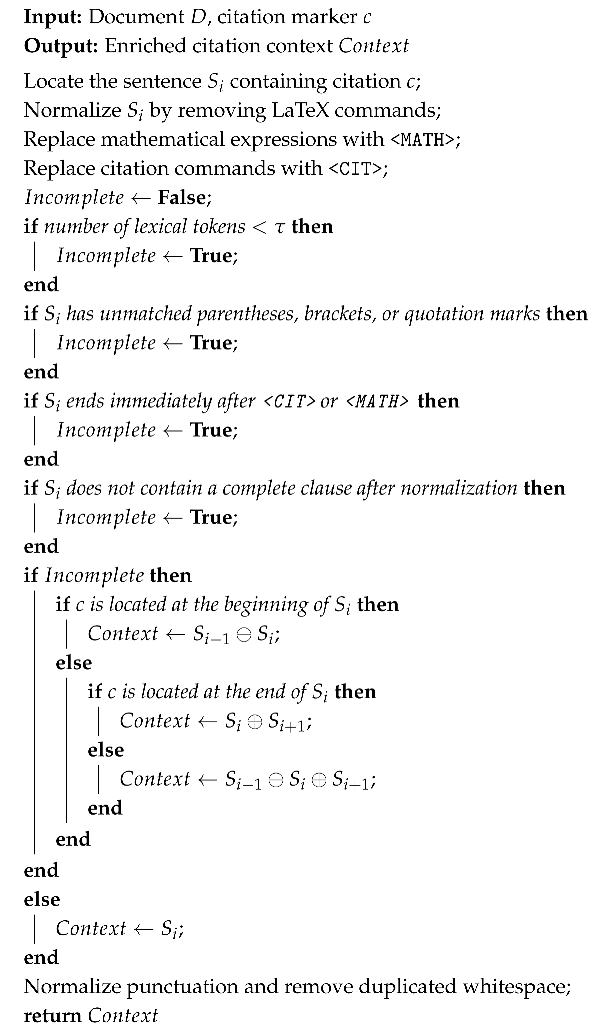 |
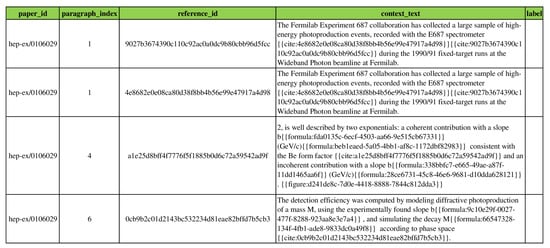
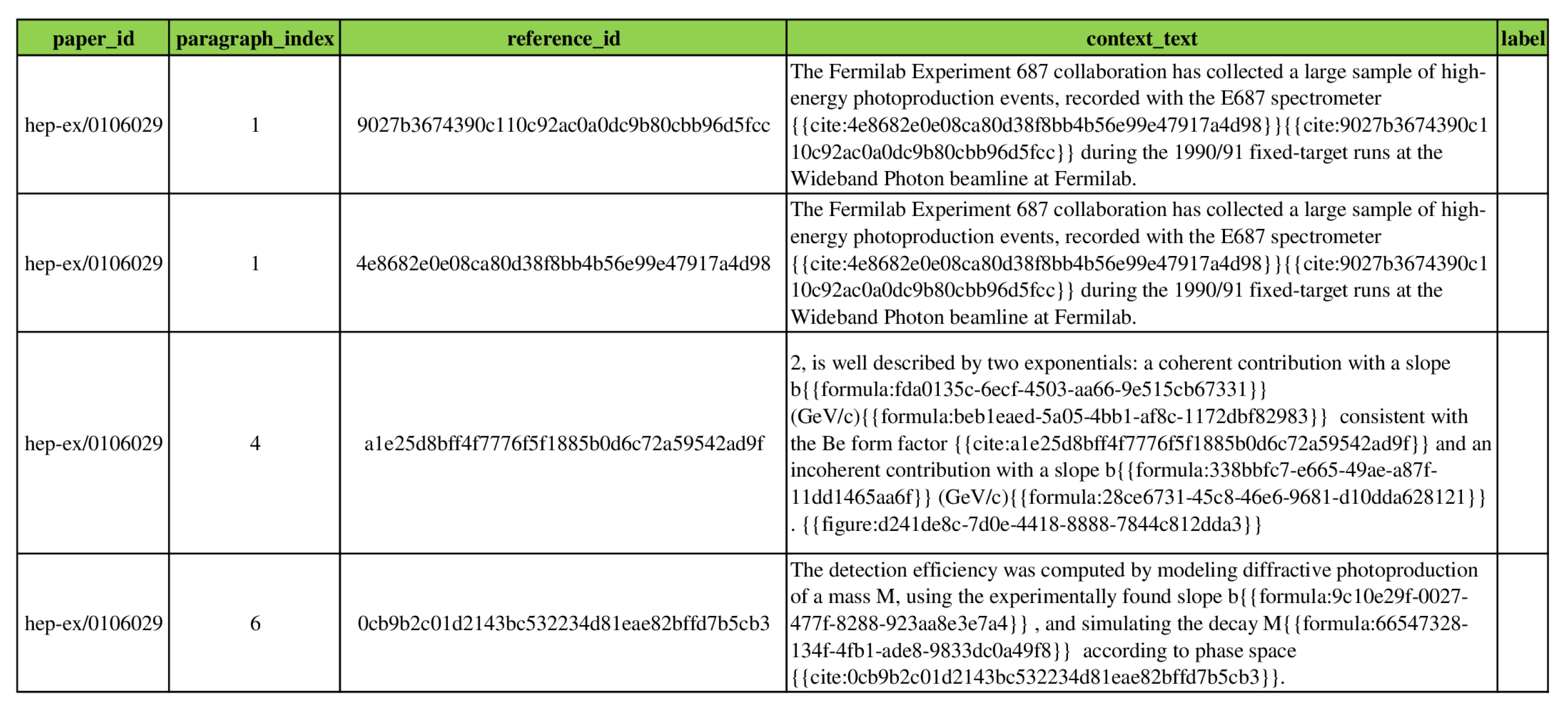
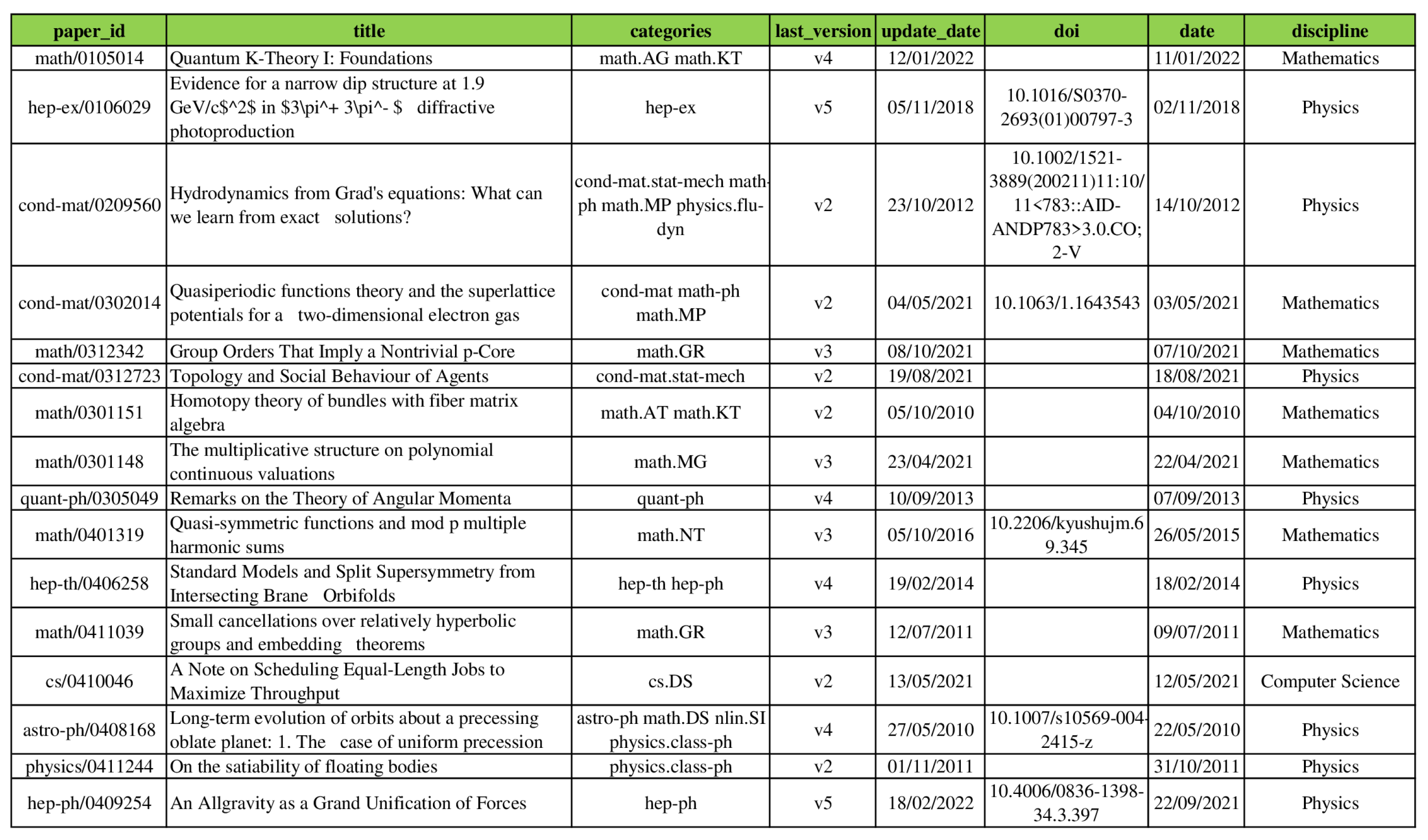
The resulting citation contexts provide a coherent representation of the local context surrounding each citation. This preprocessing step generates informative inputs for the subsequent citation intent classification model and approximates the citation contexts used in benchmark datasets such as SciCite [4]. An overview of the prepared citation instances and their associated information is provided in Figure 3 and Figure 4.
Figure 3.
Excerpt from the citation table.
Figure 4.
Excerpt from the papers table.
4.4. Prompt Design and LLM Inference Setup
Initial ranking preferences from Language Models require minimization of systematic bias; therefore, a strict zero-shot prompt template is designed. This prompt enforces the generation of both a single discrete label and a complete ordered ranking over all candidate roles. As a result, this dual-output constraint enables programmatic extraction of full ranking sequences, which in turn supports the computation of exponential Borda scores. The exact prompt structure used during the inference phase is detailed in Listing 1.
| Listing 1. Citation intent classification prompt. |
|
{ "role": "user", "content": "Classify the following scientific citation context into one of five roles: background, methodology, comparison, extension, or critique. Citation context: \"{normalized_text}\" Please provide the output in the following format: 1. Label: one of the five roles 2. Ranked roles: 1. most likely role 2. second most likely role 3. third most likely role 4. fourth most likely role 5. fifth most likely role Respond in plain text only." } |
5. Analytical Formulation of the Exponentially Weighted Borda Ensemble
The proposed ensemble method extends the classical Borda Count mechanism by incorporating an exponential weighting strategy together with a deterministic tie-breaking rule based on model priority. This section formalizes the mathematical structure underlying the proposed approach and provides an analytical description of how ranked predictions from multiple Language Models are aggregated into a single interpretable decision.
5.1. Problem Setting
The ensemble operates over multiple models that contribute ranked predictions for each citation instance. Formally, let denote the set of participating Language Models, and let represent the label set corresponding to the rhetorical roles of scientific citations:
For each citation instance x, each model produces a ranked list of candidate labels without repetition:
where denotes the number of labels returned by model m. Let be the subset of models that provide a non-empty ranking for instance x, and define
as the maximum ranking length across non-abstaining models. These rankings reflect the internal confidence ordering of each model across the possible citation roles. Models that return “unknown” or fail to produce a ranked list are treated as abstaining, thereby ensuring that the aggregation process remains robust and unbiased in the presence of incomplete outputs.
5.2. Exponential Weighting
To emphasize the most confident predictions, an exponentially decaying weight is assigned to each ranked position. The underlying intuition is that higher-ranked predictions should contribute disproportionately more to the final decision, while lower-ranked alternatives should retain only a limited influence. The exponential weighting function is defined as:
where controls the steepness of the exponential decay, and and are top-rank boosting coefficients satisfying . This formulation yields a smoothly decaying contribution profile in which the top-ranked prediction exerts the strongest influence while preserving interpretability through explicit and transparent score attribution.
5.3. Label Scoring
Each candidate label receives an aggregated score obtained by summing the contributions of all active models weighted according to their rank positions:
where denotes the subset of non-abstaining models for instance x. This scoring function captures not only how frequently a label appears across model rankings, but also the relative strength of model agreement regarding its position. To further refine the decision process, two auxiliary quantities are also computed:
The first term, , represents the mean rank of label c, whereas counts the number of times it appears in the top position across models. Together, these quantities provide complementary discriminative signals for the final decision rule.
5.4. Tie-Breaking and Decision Rule
Because multiple labels may achieve comparable aggregated scores, a deterministic tie-breaking mechanism is required to ensure stability and reproducibility. To this end, each label c is associated with a priority tuple derived from the fixed model hierarchy , defined as:
Missing ranks default to , thereby penalizing absent predictions. The final label is then determined through lexicographic ordering of the following composite decision vector:
This formulation ensures that the total aggregated score remains the primary criterion. However, when two or more labels receive equivalent scores, the system favors the label ranked higher by the more reliable models according to the predefined priority order. In this way, the decision process remains fully deterministic and reproducible across runs while preserving interpretability at each comparison stage.
5.5. Confidence Estimation
To quantify the degree of ensemble agreement, a normalized confidence score is computed as follows:
This metric measures the concentration of the ensemble vote distribution and provides an interpretable estimate of classification certainty. A value close to 1 indicates strong inter-model consensus, whereas lower values reflect disagreement or ambiguity across the participating models. In cases where all models abstain for a given citation instance, the algorithm defaults to assigning and , thereby representing deliberate abstention rather than uncertainty.
Taken together, these equations define an interpretable and mathematically consistent ensemble mechanism capable of merging multiple LLM-based predictions into a unified and traceable scientometric decision. More broadly, this formulation is consistent with recent advances in semantic representation and structured knowledge extraction, where contextual embedding methods have been shown to improve semantic coherence and interoperability in complex data environments [49].
5.6. Algorithmic Description
This ensemble ensures interpretability and robustness by combining exponential ranking sensitivity with a deterministic tie-breaking strategy based on empirically informed model priorities [2,18,44]. Algorithm 2 summarizes the exponentially weighted Borda ensemble used to aggregate the ranked predictions produced by multiple LLMs.
| Algorithm 2: Exponentially Weighted Borda Ensemble. |
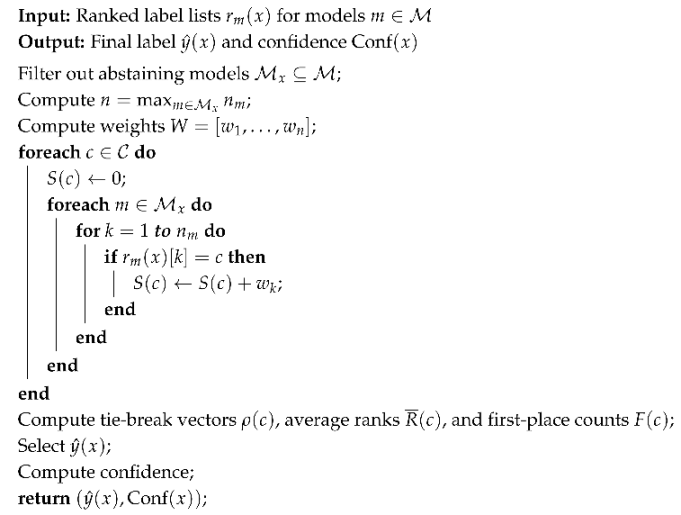 |
Each model generates a ranked list of candidate labels for each citation instance. The system applies an exponential weighting function, , to amplify the influence of top-ranked predictions while gradually reducing the contribution of lower-ranked ones [7,8]. Aggregated scores across models produce a global relevance value for each label [15,21].
To resolve score equivalence, the ensemble uses a fixed model-priority hierarchy (Gemma > LLaMA > Mistral), complemented by the average rank and the first-rank frequency [14,44]. This multi-layered mechanism ensures that the final label reflects both the quantitative evidence and the qualitative reliability of the contributing models [20,25]. The ensemble also outputs a normalized confidence score , providing a clear measure of certainty [3,50,51].
5.7. Hyperparameter Optimization
The exponential weighting function derived in Equation (3) depends on three hyperparameters. First, controls how steeply the exponential weighting falls off with the rank, and then and boost the weighted contributions of the top two ranks. In order to automate manual tuning and to find the most effective ensemble setup, we exhaustively evaluated a grid of candidate values on a held-out validation set comprising 10% of the training data, stratified by citation intent category.
Importantly, this validation set is kept completely disjoint from the training and test splits of SciBERT, which are described in Section 7, and is used solely for hyperparameter optimization.
We evaluated a grid of candidate values for the hyperparameters , and . For each possible combination, we ran the exponential Borda ensemble to obtain pseudo-labels on the validation set and computed the macro score (over the five classes) between the predicted labels and the ground truth expert annotations on the validation data. Table 1 presents the three best performing configurations. The exponential Borda configuration achieved a macro of on the validation set, and performs better than all the other examined hyperparameter configurations.
Table 1.
Grid search results for the exponential Borda hyperparameters (top three configurations). The optimal configuration is highlighted in bold.
Compared to the simple linear Borda ensemble (, ), our chosen exponential configuration improves upon its macro score by approximately 5 percentage points.
Our chosen configuration achieves a natural trade-off: a moderate decay is selected, which keeps lower ranks relevant while maintaining a clear weighting decay. The boosting coefficients and amplify the two most salient predictions, known to be semantically most informative in zero-shot settings, without allowing them to entirely dominate the prediction, thus avoiding over-sensitivity to noisy single predictions. This combination is therefore less likely to be trapped by a high consensus on an incorrect prediction, while it still promotes high agreement between the models’ most confident predictions.
All subsequent experiments are performed with these hyperparameter values.
It is worth noting that the validation macro of the Borda ensemble on the validation set serves as a natural upper bound for any classifier trained on its output pseudo-labels. The fact that our SciBERT fine-tuning reaches a test macro of (see Section 7) on a completely unseen test set, which is close to this validation upper bound, indicates that our model does not simply memorise pseudo-labels but generalizes well to new data. This suggests a stable and reliable supervisory signal derived from the Borda ensemble.
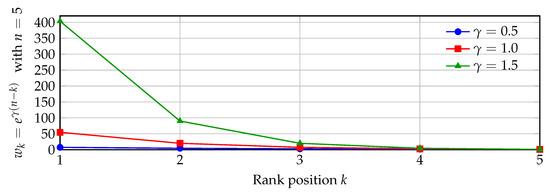
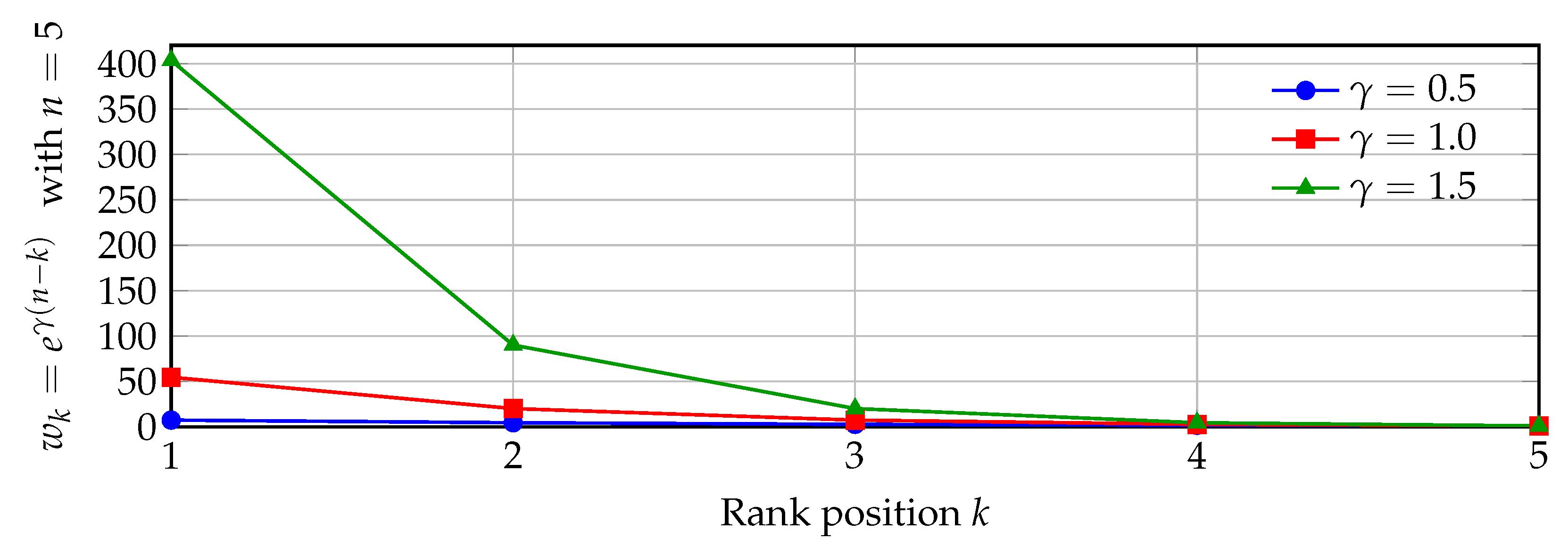
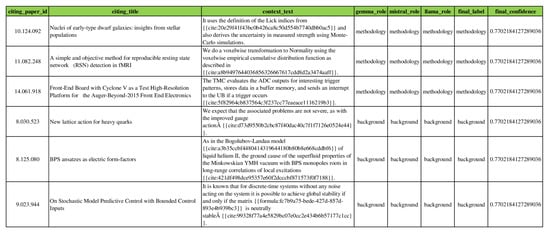
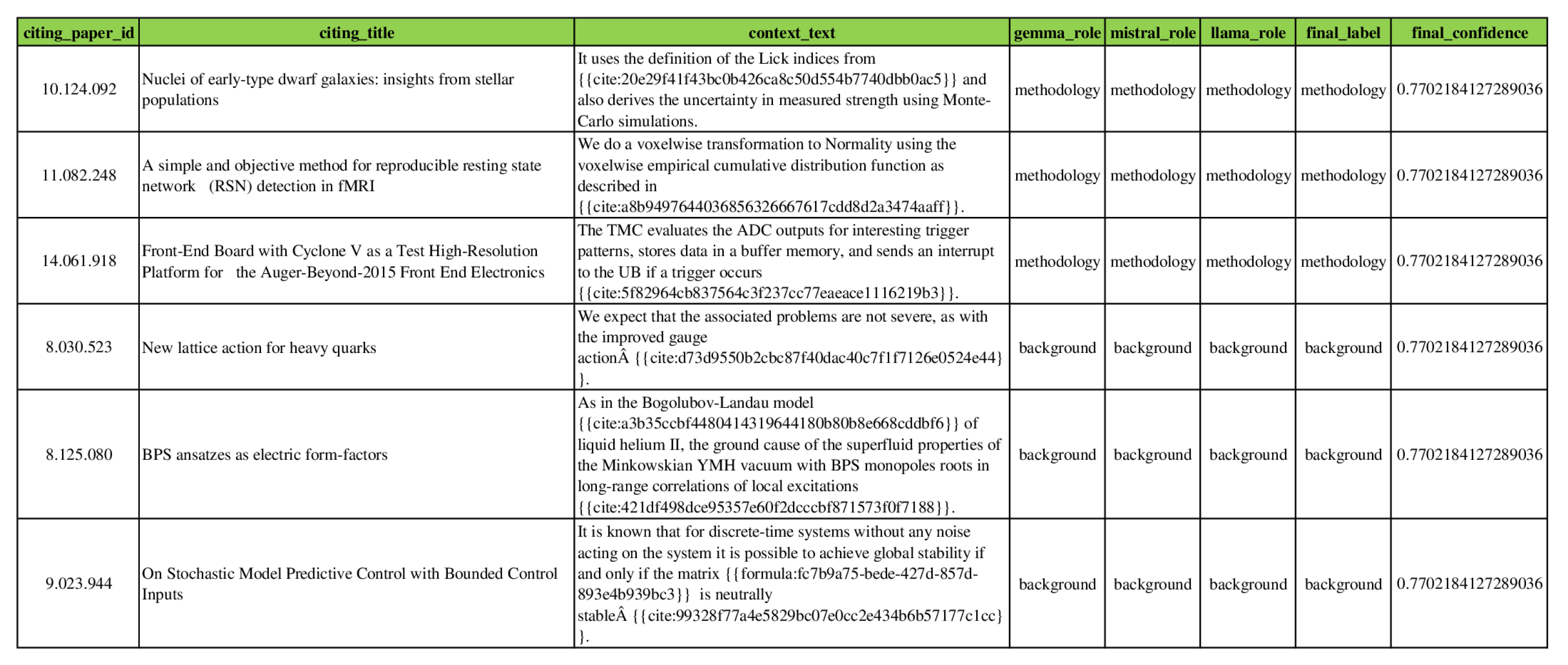
Figure 5 presents the overall workflow of the exponentially weighted Borda ensemble [7,18], while Figure 6 illustrates the exponential weighting curve [2,11]. Adjusting increases the separation between consecutive ranks, emphasizing high-confidence predictions from the most reliable models. This design mirrors human decision-making, stabilizes inter-model voting, and makes each ranked position’s contribution explicit and traceable [10,22]. Figure 7 presents an excerpt from the labeled citation dataset, illustrating the citation role predictions generated by the Gemma, Mistral, and LLaMA models.
Figure 5.
The exponentially weighted Borda ensemble.
Figure 6.
Exponential weighting curves for and different values. Larger increases the dominance of top ranks.
Figure 7.
Excerpt from the labeled citation dataset showing predicted citation roles from Gemma, Mistral, and LLaMA models.
5.8. Individual Model Performance and Ensemble Gain
To assess the contribution of the ensemble aggregation, we evaluated each LLM individually on the validation set (10% of the data). For each model, we compared its zero-shot predictions against the consensus labels derived from human experts. Table 2 reports accuracy and macro F1 for each model, alongside the performance of the full exponential Borda ensemble.
Table 2.
Individual LLM performance versus the exponential Borda ensemble on the validation set.
The results show that while Gemma achieves the highest individual accuracy (86.2%), followed by LLaMA (70.4%) and Mistral (45.8%), the individual macro F1 scores are considerably lower, indicating that each model exhibits significant class-specific biases. In contrast, the exponential Borda ensemble achieves a macro F1 of 0.831, outperforming the best individual model (Gemma, 0.628) by more than 20 percentage points.
This substantial improvement confirms that the weighted Borda aggregation effectively combines the complementary reasoning patterns of the three architectures, correcting individual model errors through consensus-based voting and producing more balanced and reliable predictions across all five citation intent categories. The ensemble is therefore not merely selecting the best model but actively combining diverse reasoning patterns to produce a more robust supervisory signal for SciBERT training.
6. Reconciling the Data Skew
Once label fusion has completed, the produced dataset becomes significantly skewed towards background and methodology labels which now amount to over 60% of the dataset samples. This imbalance, consistent with previously collected data statistics on large-scale corpora [27,52], is problematic for standard classifiers, which are inherently biased towards majority classes, and often yield poor results on minority classes like critique.
In a previous version of this work, we handled this imbalance by removing low-confidence citation context to obtain an even dataset. However, we found this process to be too aggressive and harmful: it filtered away the most complex and challenging citations, introducing a strong selection bias which artificially inflated evaluation scores but was not representative of the distribution of challenging examples. To counter this, we implemented a rigorous class-weighted loss approach instead of removing samples, training SciBERT on all samples while increasing loss for under-represented minority classes. The class weights are computed using the following formulation:
where N represents the total number of samples, K represents the number of unique classes (in this case 5), and represents the number of samples per class c. This ensures all samples were used, while offsetting for the class imbalances in optimization. Table 3 shows the resulting class distribution; at this step no samples were discarded.
Table 3.
Final distribution of citation intent categories in the dataset.
7. Empirical Evaluation: Human Validation of the Borda Ensemble and SciBERT Performance
7.1. Human Agreement on the Ensemble Predictions
While we have established that the exponentially weighted Borda ensemble is reproducible and objective, the results should be corroborated by expert human evaluation. A subset of 600 citation samples was selected at random for independent annotation by 3 scientometrics and scientific literature analysis domain experts. The subset was selected in a stratified manner from the overall pool after the label aggregation step (Section 6) to cover all five categories according to the real-world distribution. Annotation was performed blindly, meaning annotators had no knowledge of the model’s predictions.
The 3 experts each individually classified the selected citation samples into one of five citation categories: background, methodology, comparison, extension, and critique. These labels were used to create a consensus label via majority voting as the ground truth for evaluation.
We compare the predictions made by the exponentially weighted Borda ensemble with these human-labeled data: overall agreement was 93.4%, which is a good indication that our method’s outcome matches human judgment quite closely. Class-wise agreement percentages were 94% (background), 95% (comparison), 96% (critique), 89% (extension) and 93% (methodology), showing a consistent agreement level across all classes.
We then measure agreement by the widely adopted metric Cohen’s , to factor out accidental agreement:
where is the overall observed agreement (0.934) and is the expected chance agreement. The latter can be computed using the margins of the confusion matrix (of ensemble predictions and consensus annotations):
Using the actual confusion matrix, we found the expected agreement . This results in:
According to Landis and Koch’s interpretation of values [53], values greater than 0.80 indicate almost perfect agreement. Thus, we have demonstrated very high consistency between our proposed method and the annotated data.
For a more fine-grained view, we analyzed class-wise Kappa values to identify potential overlaps among categories, see Table 4. Extension yielded the lowest value (0.80), which we attribute to its semantic similarities with methodology, an observation that is also reflected in its F1 scores from Section 7.2. Background and critique, on the other hand, showed the highest agreement between our method and the human experts.
Table 4.
Cohen’s per category.
7.2. Performance Assessment of the Fine-Tuned SciBERT Model
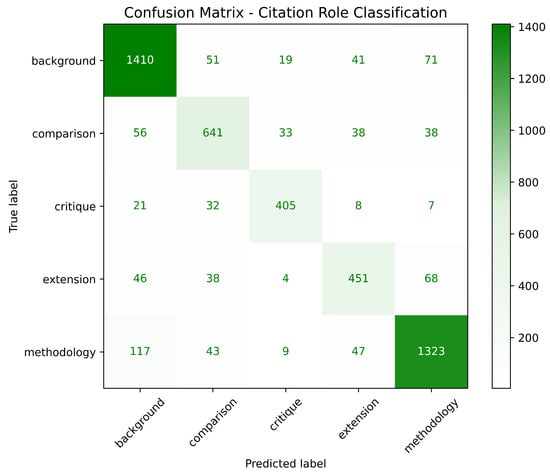
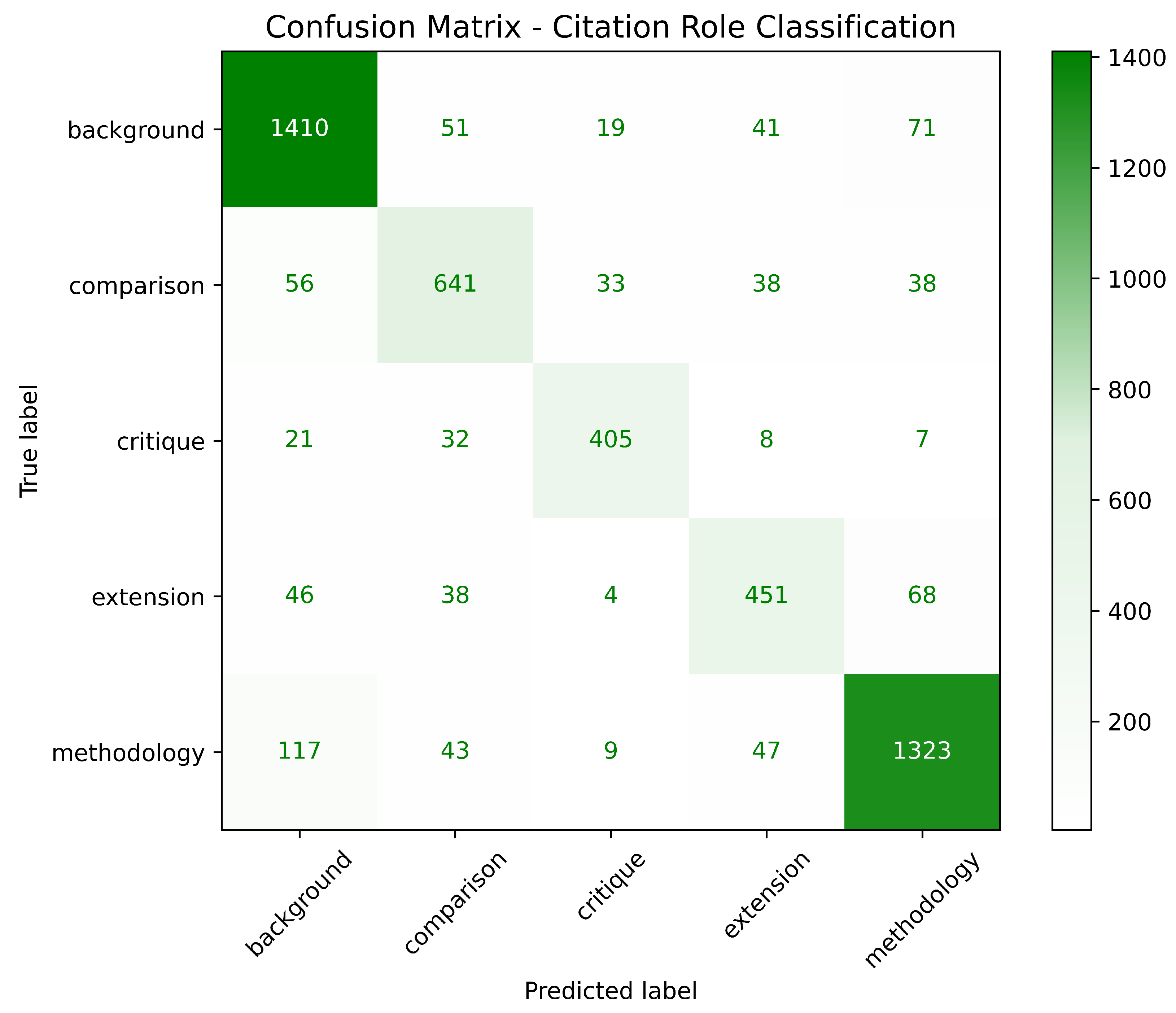
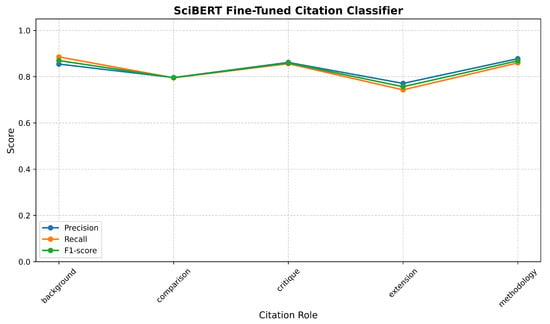
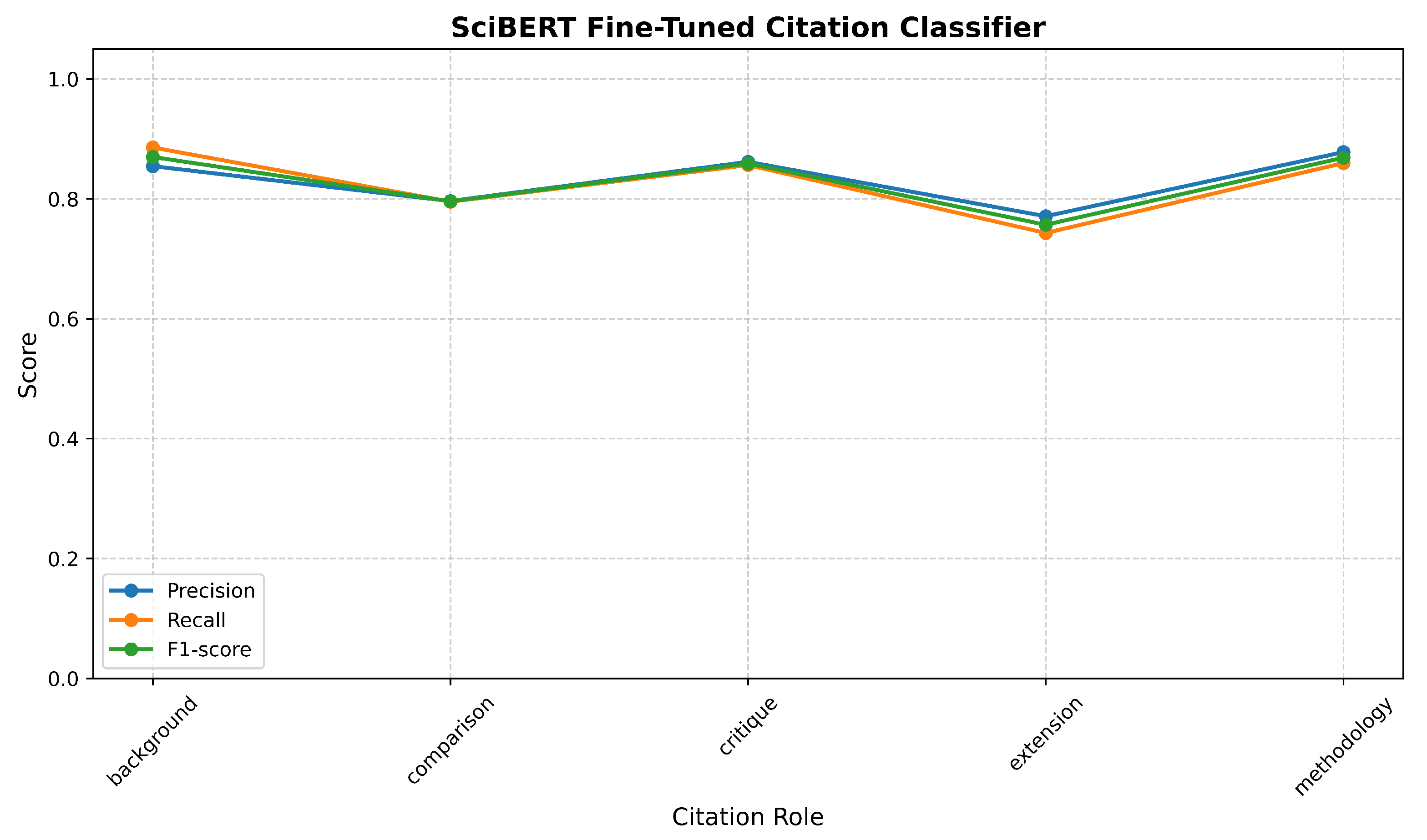
These results provide strong empirical evidence that the exponential Borda fusion strategy reliably captures the semantic intent of citations, making it suitable for downstream supervised learning tasks. We subsequently fine-tuned the SciBERT model to evaluate its ability to classify citation intents accurately. This step aimed to determine whether the ensemble-based labeling procedure produces coherent and discriminative representations across the five discourse-functional categories: background, methodology, comparison, extension, and critique. The fine-tuned model achieved an overall accuracy of 84%, with a macro F1-score of 0.83 and a weighted F1-score of 0.84. Specifically, the model performed strongly on the background and methodology classes, both reaching an F1-score of 0.87. In contrast, slightly lower scores were observed for comparison (0.80) and critique (0.86), while extension attained an F1 of 0.76, likely due to its semantic overlap with methodological contexts. Figure 8 presents the confusion matrix, and Table 5 summarizes precision, recall, and F1-scores for each category.
Figure 8.
Confusion matrix of SciBERT fine-tuned on the Borda-labeled dataset.
Table 5.
Performance metrics for each citation intent class.
These results suggest that the Borda-based labeling provides stable decision boundaries and supports consistent classification. Moreover, this observation aligns with prior work demonstrating that domain-specific pretraining improves contextual understanding and lexical discrimination in scientific texts [1]. In addition, variance analysis across five random seeds showed minimal fluctuations, confirming that ensemble-generated labels enhance both robustness and reproducibility [6]. The performance of the SciBERT classifier is summarized in Figure 9, which presents the classification report obtained on the Borda-fused dataset.
Figure 9.
Classification report of SciBERT trained on the Borda-fused dataset.
Finally, the experimental outcomes extend the conceptual framework proposed in [2] by shifting citation evaluation from purely metric-based approaches toward a discourse-aware classification paradigm. Overall, the combination of ensemble labeling and fine-tuned SciBERT offers reliable and context-sensitive predictions, bridging quantitative performance with nuanced semantic understanding.
8. Discussion
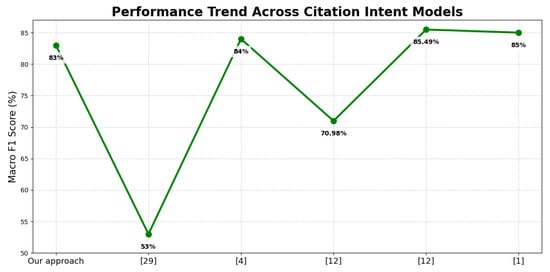
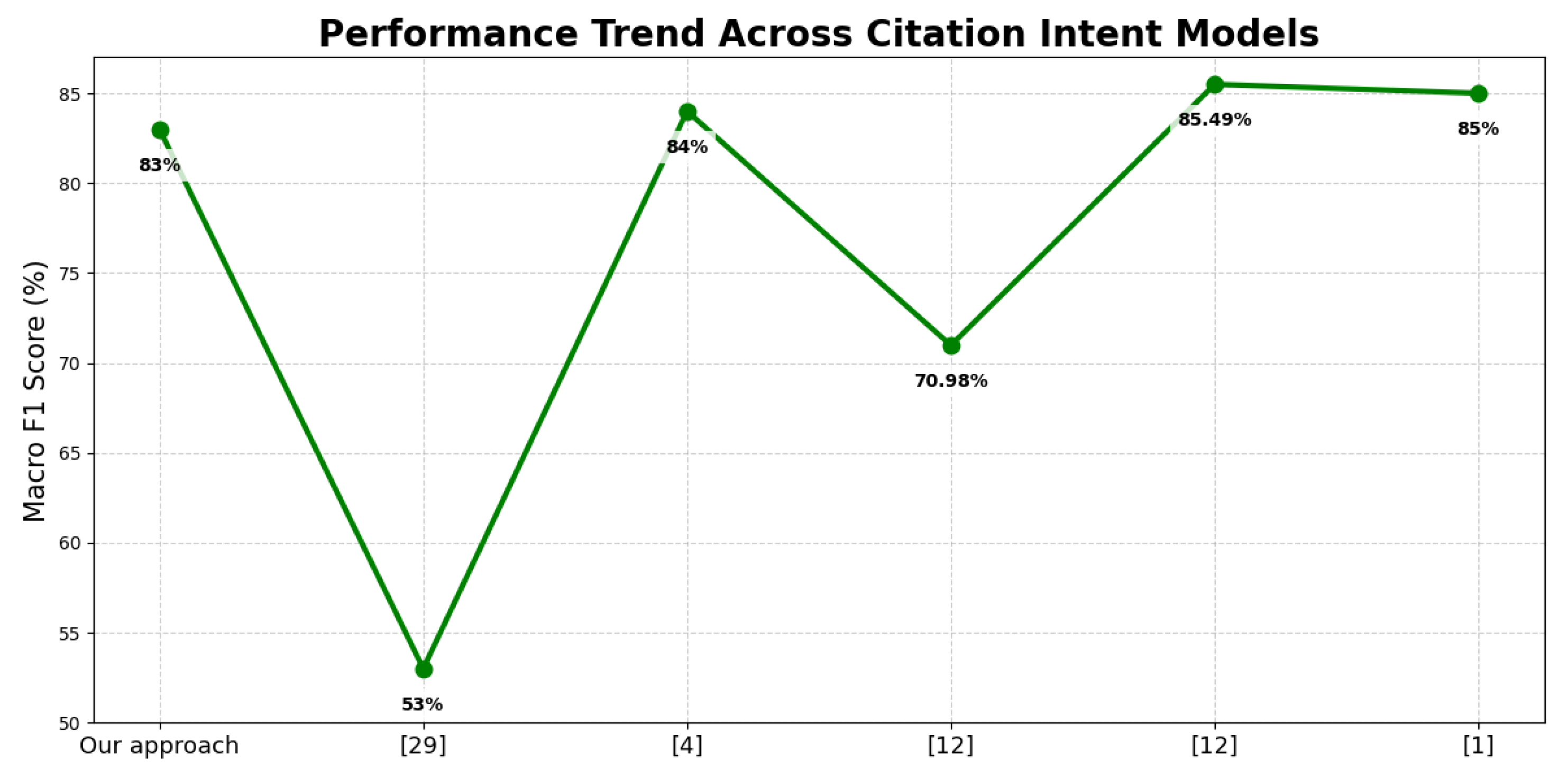
The results show that combining Borda-based labeling with domain-specific fine-tuning improves both accuracy and reliability in citation intent classification. Specifically, the exponential Borda fusion mitigates inter-model noise, balances class distributions, and stabilizes the rhetorical signal across seeds, which enhances the quality of the annotations. The observed stability of precision and recall across categories confirms that the fusion pipeline produces linguistically meaningful labels while preserving clear weight attribution in line with explainable AI principles [3,30,54]. However, residual confusion between comparison and critique reflects mixed rhetorical cues documented in prior studies, highlighting the need for future work on multi-label or hierarchical intent taxonomies [1]. In addition, multi-seed validation strengthens the assessment, ensuring methodological robustness and reproducibility [6]. Table 6 situates our SciBERT classifier within the evolution from early feature-driven baselines to domain-specialized and semi-supervised Transformer architectures [1,4,12,29]. As a result, our approach attains a macro-F1 of 83%, surpassing classical systems such as Jurgens et al. (53% on ACL-ARC) and fine-tuned SciBERT on the same benchmark (70.98%), despite operating on a more fine-grained five-class taxonomy. Although SciCite models reach 84–85% F1 on a simpler three-class setup, our results demonstrate that comparable performance is achievable on a substantially more complex intent distinction [1,4,12,29].
Table 6.
Comparison of citation intent classification models.
The deterministic exponential Borda weighting aggregates heterogeneous LLM preferences into a balanced training corpus, thereby prioritizing the most reliable cross-model signals [18]. In this context, stable performance on background and critique underscores the benefits of domain-specific pretraining for scholarly discourse [1,12]. At the same time, the ensemble design supports reproducibility and enables downstream scientometric applications. Taken together, by integrating structured ensemble logic, contextualized representations, and rigorous evaluation, our approach advances auditable citation intent understanding. In summary, training SciBERT on the Borda–Fusion dataset achieves a macro-F1 of 83%, reaching strong semi-supervised benchmarks without relying on adversarial or generative strategies [6], as illustrated in Figure 10.
Figure 10.
F1 Score Distribution Across Baseline and Transformer Citation-Intent Classifiers.
9. Conclusions
This work establishes a conceptual bridge between citation theory, natural language processing, and social choice formalism. By providing a mathematically grounded mechanism for aggregating heterogeneous model preferences, the exponential Borda weighting extends traditional decision-making principles to multi-model reasoning [18,55]. This formulation enables the proposed framework to produce intent-aware citation classifications that move beyond citation counts toward a richer interpretation of scientific influence [22]. Furthermore, the framework aligns with the principles of transparency, reproducibility, and interoperability advocated by open science initiatives, ensuring that each classification remains traceable to verifiable textual evidence [17,56]. Despite these contributions, some limitations remain. The framework has been evaluated on a single large-scale scientific corpus, and its generalization across disciplines with different citation practices requires further investigation. In addition, the quality of the final prediction remains dependent on the underlying language models, while structural information such as citation networks or document-level relationships is not yet explicitly incorporated. The proposed framework is applicable to several research scenarios, including intent-aware bibliometric analysis, scientific recommendation systems, digital libraries, and systematic literature reviews, where distinguishing citation functions can provide a more informative assessment of scientific influence than citation counts alone [22,25]. Several future research directions naturally emerge from this work. Integrating explicit citation insertion strategies, including pre hoc and post hoc contextual citation generation, could transform the framework into an explainable citation recommendation system [14,57,58,59]. Likewise, incorporating a human-in-the-loop component would improve reliability for ambiguous citation contexts [8]. Finally, extending the hybrid architecture with graph-based influence models and adaptive ensemble weighting strategies could further enhance both classification performance and interpretability [60,61,62]. Overall, this work positions citation intent classification as an important building block for transparent, explainable, and ethically aligned AI systems supporting scientific knowledge discovery and scholarly communication [14,52].
Author Contributions
Conceptualization, M.B., S.B., and E.H.B.L.; methodology, M.B. and S.B.; software, M.B.; validation, M.B., S.B., E.H.B.L., O.Z., and A.Z.; formal analysis, M.B. and S.B.; investigation, M.B.; data curation, M.B.; writing—original draft preparation, M.B.; writing—review and editing, S.B., E.H.B.L., O.Z., and A.Z.; visualization, M.B.; supervision, E.H.B.L. and S.B. All authors have read and agreed to the published version of the manuscript.
Funding
This research received no external funding, and the APC was not externally funded.
Data Availability Statement
The dataset generated and analyzed during this study is available from the corresponding author upon reasonable request. Further inquiries can be directed to the corresponding author.
Conflicts of Interest
The authors declare no conflicts of interest.
References
- Visser, R.; Dunaiski, M. Sentiment and intent classification of in-text citations using BERT. EPiC Ser. Comput. 2022, 85, 129–145. [Google Scholar] [CrossRef] [Scilit]
- Barchane, M.; Zahour, O. Assessing the Quality of Scientific Publications: A Thorough Analysis of Citation-Based and Content-Oriented Metrics for Evaluating Research Impact and Scholarly Contribution. Math. Model. Comput. 2025, 12, 1109–1120. [Google Scholar] [CrossRef] [Scilit]
- Paolini, L.; Vahdati, S.; Di Iorio, A.; Wardenga, R.; Heibi, I.; Peroni, S. “Why do you cite?” An investigation on Citation Intents and Decision-Making Classification Processes. arXiv 2024, arXiv:2407.13329. [Google Scholar] [CrossRef]
- Cohan, A.; Ammar, W.; van Zuylen, M.; Cady, F. Structural Scaffolds for Citation Intent Classification in Scientific Publications. In Proceedings of the 2019 Conference of the North American Chapter of the Association for Computational Linguistics: Human Language Technologies, Volume 1 (Long and Short Papers); Burstein, J., Doran, C., Solorio, T., Eds.; Association for Computational Linguistics: Minneapolis, MN, USA, 2019; pp. 3586–3596. [Google Scholar] [CrossRef] [Scilit]
- Mifrah, S.; Hourrane, O.; Benlahmar, E.H.; Bouhriz, N.; Rachdi, M. Citation Sentiment Analysis: A Brief Comprehensive Study. J. Islam. Ctries. Soc. Stat. Sci. 2018, 3, 145–156. [Google Scholar]
- Zheng, M.; Shen, D.; Shen, Y.; Chen, W.; Xiao, L. Improving Self-supervised Pre-training via a Fully-Explored Masked Language Model. arXiv 2020, arXiv:2010.06040. [Google Scholar] [CrossRef] [Scilit]
- Shui, Z.; Karypis, P.; Karls, D.S.; Wen, M.; Manchanda, S.; Tadmor, E.B.; Karypis, G. Fine-Tuning Language Models on Multiple Datasets for Citation Intention Classification. arXiv 2024, arXiv:2410.13332. [Google Scholar] [CrossRef] [Scilit]
- Färber, M.; Jatowt, A. Citation recommendation: Approaches and datasets. Int. J. Digit. Libr. 2020, 21, 375–405. [Google Scholar] [CrossRef] [Scilit]
- Gu, N.; Gao, Y.; Hahnloser, R.H.R. Local Citation Recommendation with Hierarchical-Attention Text Encoder and SciBERT-based Reranking. arXiv 2022, arXiv:2112.01206. [Google Scholar] [CrossRef] [Scilit]
- Devlin, J.; Chang, M.W.; Lee, K.; Toutanova, K. BERT: Pre-training of Deep Bidirectional Transformers for Language Understanding. arXiv 2019, arXiv:1810.04805. [Google Scholar] [CrossRef] [Scilit]
- Rogers, A.; Kovaleva, O.; Rumshisky, A. A Primer in BERTology: What we know about how BERT works. arXiv 2020, arXiv:2002.12327. [Google Scholar] [CrossRef] [Scilit]
- Beltagy, I.; Lo, K.; Cohan, A. SciBERT: A Pretrained Language Model for Scientific Text. In Proceedings of the 2019 Conference on Empirical Methods in Natural Language Processing and the 9th International Joint Conference on Natural Language Processing (EMNLP-IJCNLP); Inui, K., Jiang, J., Ng, V., Wan, X., Eds.; Association for Computational Linguistics: Hong Kong, China, 2019; pp. 3615–3620. [Google Scholar] [CrossRef] [Scilit]
- Cohan, A.; Goharian, N. Contextualizing Citations for Scientific Summarization using Word Embeddings and Domain Knowledge. In Proceedings of the 40th International ACM SIGIR Conference on Research and Development in Information Retrieval; ACM: New York, NY, USA, 2017; pp. 1133–1136. [Google Scholar] [CrossRef] [Scilit]
- Huang, J.; Chang, K.C.C. Citation: A Key to Building Responsible and Accountable Large Language Models. arXiv 2024, arXiv:2307.02185. [Google Scholar] [CrossRef] [Scilit]
- Li, W.; Li, J.; Ma, W.; Liu, Y. Citation-Enhanced Generation for LLM-based Chatbots. In Proceedings of the 62nd Annual Meeting of the Association for Computational Linguistics (Volume 1: Long Papers); Association for Computational Linguistics: Stroudsburg, PA, USA, 2024; pp. 1451–1466. [Google Scholar] [CrossRef] [Scilit]
- Fontana, N.; Corso, F.; Zuccolotto, E.; Pierri, F. Evaluating open-source Large Language Models for automated fact-checking. arXiv 2025, arXiv:2503.05565. [Google Scholar] [CrossRef] [Scilit]
- Kumpulainen, M.; Seppänen, M. Combining Web of Science and Scopus datasets in citation-based literature study. Scientometrics 2022, 127, 5613–5631. [Google Scholar] [CrossRef] [Scilit]
- Fox, N.B.; Bruyns, B. An Evaluation of Borda Count Variations Using Ranked Choice Voting Data. arXiv 2025, arXiv:2501.00618. [Google Scholar] [CrossRef] [Scilit]
- Wang, W.; Wang, Y.; Huang, H. Ranked Voting based Self-Consistency of Large Language Models. arXiv 2025, arXiv:2505.10772. [Google Scholar] [CrossRef] [Scilit]
- Sana, S.; Brous, D.; Wells, M.T.; Duchin, M. Quantitative Relaxations of Arrow’s Axioms. arXiv 2025, arXiv:2506.12961. [Google Scholar] [CrossRef] [Scilit]
- Koloveas, P.; Chatzopoulos, S.; Vergoulis, T.; Tryfonopoulos, C. Can LLMs Predict Citation Intent? An Experimental Analysis of In-Context Learning and Fine-Tuning on Open LLMs. In Linking Theory and Practice of Digital Libraries; Springer Nature: Cham, Switzerland, 2025; pp. 207–224. [Google Scholar] [CrossRef] [Scilit]
- Bezerra, D.A.; Silva, F.N.; Amancio, D.R. Leveraging GANs for citation intent classification and its impact on citation network analysis. arXiv 2025, arXiv:2505.21162. [Google Scholar] [CrossRef] [Scilit]
- Shen, J.; Zhou, T.; Chen, Y.; Qiu, D.; Liu, S.; Liu, K.; Zhao, J. Transparentize the Internal and External Knowledge Utilization in LLMs with Trustworthy Citation. In Proceedings of the Findings of the Association for Computational Linguistics: ACL 2025; Che, W., Nabende, J., Shutova, E., Pilehvar, M.T., Eds.; Association for Computational Linguistics: Vienna, Austria, 2025; pp. 17858–17877. [Google Scholar] [CrossRef] [Scilit]
- Lahiri, A.; Sanyal, D.K.; Mukherjee, I. CitePrompt: Using Prompts to Identify Citation Intent in Scientific Papers. arXiv 2023, arXiv:2304.12730. [Google Scholar] [CrossRef] [Scilit]
- Smeros, P.; Castillo, C.; Aberer, K. SciLens: Evaluating the Quality of Scientific News Articles Using Social Media and Scientific Literature Indicators. In Proceedings of the World Wide Web Conference, New York, NY, USA, 13–17 May 2019; WWW ’19. pp. 1747–1758. [Google Scholar] [CrossRef] [Scilit]
- Cousijn, H.; Kenall, A.; Ganley, E.; Harrison, M.; Kernohan, D.; Murphy, F.; Polischuk, P.; Martone, M.; Clark, T. A Data Citation Roadmap for Scientific Publishers. bioRXiv 2018, 5, 180259. [Google Scholar] [CrossRef] [Scilit] [PubMed]
- Saier, T.; Krause, J.; Färber, M. unarXive 2022: All arXiv Publications Pre-Processed for NLP, Including Structured Full-Text and Citation Network. arXiv 2023, arXiv:2303.14957. [Google Scholar] [CrossRef]
- Jeong, C.; Jang, S.; Shin, H.; Park, E.; Choi, S. A Context-Aware Citation Recommendation Model with BERT and Graph Convolutional Networks. arXiv 2019, arXiv:1903.06464. [Google Scholar] [CrossRef] [Scilit]
- Jurgens, D.; Kumar, S.; Hoover, R.; McFarland, D.; Jurafsky, D. Measuring the Evolution of a Scientific Field through Citation Frames. Trans. Assoc. Comput. Linguist. 2018, 6, 391–406. [Google Scholar] [CrossRef] [Scilit]
- Tsai, H.J.; Yen, A.Z.; Huang, H.H.; Chen, H.H. Citation Intent Classification and Its Supporting Evidence Extraction for Citation Graph Construction. In Proceedings of the 32nd ACM International Conference on Information and Knowledge Management, New York, NY, USA, 21–25 October 2023; CIKM ’23. pp. 2472–2481. [Google Scholar] [CrossRef] [Scilit]
- Hu, Z.; Cui, J.; Lin, A. Identifying potentially excellent publications using a citation-based machine learning approach. Inf. Process. Manag. 2023, 60, 103323. [Google Scholar] [CrossRef] [Scilit]
- Medić, Z.; Snajder, J. Improved Local Citation Recommendation Based on Context Enhanced with Global Information. In Proceedings of the First Workshop on Scholarly Document Processing; Chandrasekaran, M.K., de Waard, A., Feigenblat, G., Freitag, D., Ghosal, T., Hovy, E., Knoth, P., Konopnicki, D., Mayr, P., Patton, R.M., et al., Eds.; Association for Computational Linguistics: Stroudsburg, PA, USA, 2020; pp. 97–103. [Google Scholar] [CrossRef] [Scilit]
- Mifrah, S.; Benlahmar, E.H. Sentence-Level Sentiment Classification A Comparative Study Between Deep Learning Models. J. ICT Stand. 2022, 10, 339–352. [Google Scholar] [CrossRef] [Scilit]
- Kalai, A.T.; Nachum, O.; Vempala, S.S.; Zhang, E. Why Language Models Hallucinate. arXiv 2025, arXiv:2509.04664. [Google Scholar] [CrossRef] [Scilit]
- Mifrah, S.; El Habib, B.L. Semantic Relationship Study between Citing and Cited Scientific Articles Using Topic Modeling. In Proceedings of the 4th International Conference on Big Data and Internet of Things, New York, NY, USA, 22–24 August 2020. BDIoT ’19. [Google Scholar] [CrossRef] [Scilit]
- Team, G.; Mesnard, T.; Hardin, C.; Dadashi, R.; Bhupatiraju, S.; Pathak, S.; Sifre, L.; Rivière, M.; Kale, M.S.; Love, J.; et al. Gemma: Open Models Based on Gemini Research and Technology. arXiv 2024, arXiv:2403.08295. [Google Scholar] [CrossRef] [Scilit]
- Grattafiori, A.; Dubey, A.; Jauhri, A.; Pandey, A.; Kadian, A.; Al-Dahle, A.; Letman, A.; Mathur, A.; Schelten, A.; Vaughan, A.; et al. The Llama 3 Herd of Models. arXiv 2024, arXiv:2407.21783. [Google Scholar] [CrossRef] [Scilit]
- Jiang, A.Q.; Sablayrolles, A.; Mensch, A.; Bamford, C.; Chaplot, D.S.; Casas, D.; Bressand, F.; Lengyel, G.; Lample, G.; Saulnier, L.; et al. Mistral 7B. arXiv 2023, arXiv:2310.06825. [Google Scholar] [CrossRef] [Scilit]
- Guendoul, O.; Bahaj, A.; Tabii, Y.; Rachid, O.H.T. Preliminary Evaluation of Vision-Language Models for Fall Detection; Springer Nature: Cham, Switzerland, 2025; pp. 220–234. [Google Scholar] [CrossRef] [Scilit]
- Kilgour, D.M.; Grégoire, J.C.; Foley, A.M. Condorcet efficiency: Weighted Bucklin vs. weighted scoring and Borda. Math. Soc. Sci. 2025, 135, 102420. [Google Scholar] [CrossRef] [Scilit]
- Chen, L.; Zaharia, M.; Zou, J. How is ChatGPT’s behavior changing over time? arXiv 2023, arXiv:2307.09009. [Google Scholar] [CrossRef] [Scilit]
- Lu, B.; Sun, Y.; Fan, L.; Ma, X.; Duan, H. Evolutionary characteristics of global offshore carbon emissions network and responsibility allocation of emissions reduction. Patterns 2023, 4, 100801. [Google Scholar] [CrossRef] [Scilit] [PubMed]
- Nadeau, D.; Kroutikov, M.; McNeil, K.; Baribeau, S. Benchmarking Llama2, Mistral, Gemma and GPT for Factuality, Toxicity, Bias and Propensity for Hallucinations. arXiv 2024, arXiv:2404.09785. [Google Scholar] [CrossRef] [Scilit]
- Aydın, Ö.; Karaarslan, E.; Erenay, F.S.; Bacanin, N. Generative AI in Academic Writing: A Comparison of DeepSeek, Qwen, ChatGPT, Gemini, Llama, Mistral, and Gemma. Turk. J. Eng. 2025, 10, 592–607. [Google Scholar] [CrossRef] [Scilit]
- Mifrah, S. Toward a Semantic Graph of Scientific Publications: A Bibliometric Study. Int. J. Adv. Trends Comput. Sci. Eng. 2020, 9, 3323–3330. [Google Scholar] [CrossRef] [Scilit]
- Mifrah, S.; Ben Lahmar, E.H. Semantico-automatic Evaluation of Scientific Papers: State of the Art. In Proceedings of the 2nd International Conference on Big Data, Cloud and Applications, New York, NY, USA, 29–30 March 2017. BDCA’17. [Google Scholar] [CrossRef] [Scilit]
- Lo, K.; Wang, L.L.; Neumann, M.; Kinney, R.; Weld, D. S2ORC: The Semantic Scholar Open Research Corpus. In Proceedings of the 58th Annual Meeting of the Association for Computational Linguistics; Jurafsky, D., Chai, J., Schluter, N., Tetreault, J., Eds.; Association for Computational Linguistics: Stroudsburg, PA, USA, 2020; pp. 4969–4983. [Google Scholar] [CrossRef] [Scilit]
- Hourrane, O.; Mifrah, S.; Benlahmar, E.H.; Bouhriz, N.; Rachdi, M. Using Deep Learning Word Embeddings for Citations Similarity in Academic Papers. In Proceedings of the Big Data, Cloud and Applications; Tabii, Y., Lazaar, M., Al Achhab, M., Enneya, N., Eds.; Springer: Cham, Switzerland, 2018; pp. 185–196. [Google Scholar] [CrossRef] [Scilit]
- Belefqih, S.; Barchane, M.; Zellou, A.; Benlahmar, E.H. A Novel Framework for RDF Schema Extraction in NoSQL Databases Using Sentence-BERT. IEEE Access 2025, 13, 88243–88252. [Google Scholar] [CrossRef] [Scilit]
- Belefqih, S.; Barchane, M.; Zellou, A.; Doumi, K.; Benlahmar, E. Reinforcement Learning for Dynamic RDF Schema Evolution in NoSQL Databases. In Proceedings of the 2025 International Conference on Intelligent Systems: Theories and Applications (SITA), Rabat, Morocco, 20–21 October 2025; pp. 1–6. [Google Scholar] [CrossRef] [Scilit]
- Belefqih, S.; Barchane, M.; Zellou, A.; Benlahmar, E.H. Schema validation and evaluation framework for extracted schemas in JSON databases. Sci. Rep. 2026, 16, 10873. [Google Scholar] [CrossRef] [Scilit] [PubMed]
- Saier, T.; Färber, M. unarXive: A large scholarly data set with publications’ full-text, annotated in-text citations, and links to metadata. Scientometrics 2020, 125, 3085–3108. [Google Scholar] [CrossRef] [Scilit]
- Landis, J.R.; Koch, G.G. The Measurement of Observer Agreement for Categorical Data. Biometrics 1977, 33, 159–174. [Google Scholar] [CrossRef] [Scilit]
- Paolini, L.; Vahdati, S.; Di Iorio, A.; Wardenga, R.; Heibi, I.; Peroni, S. CiteFusion: An ensemble framework for citation intent classification harnessing dual-model binary couples and SHAP analyses. Scientometrics 2025, 130, 5911–5981. [Google Scholar] [CrossRef] [Scilit]
- Wang, H. The Fallacy of Borda Count Method—Why it is Useless with Group Intelligence and Shouldn’t be Used with Big Data including Banking Customer Services. SHS Web Conf. 2023, 179, 04008. [Google Scholar] [CrossRef] [Scilit]
- Cousijn, H.; Feeney, P.; Lowenberg, D.; Presani, E.; Simons, N. Bringing Citations and Usage Metrics Together to Make Data Count. Data Sci. J. 2019, 18, 9. [Google Scholar] [CrossRef] [Scilit]
- Shen, J.; Zhou, T.; Chen, Y.; Liu, K.; Zhao, J. CiteLab: Developing and Diagnosing LLM Citation Generation Workflows via the Human-LLM Interaction. In Proceedings of the 63rd Annual Meeting of the Association for Computational Linguistics (Volume 3: System Demonstrations); Mishra, P., Muresan, S., Yu, T., Eds.; Association for Computational Linguistics: Vienna, Austria, 2025; pp. 490–501. [Google Scholar] [CrossRef] [Scilit]
- Zhang, J.; Chen, J.; Maatouk, A.; Bui, N.; Xie, Q.; Tassiulas, L.; Shao, J.; Xu, H.; Ying, R. LitFM: A Retrieval Augmented Structure-aware Foundation Model For Citation Graphs. arXiv 2024, arXiv:2409.12177. [Google Scholar] [CrossRef] [Scilit]
- Zhu, Y.; Zhou, X.; Qiang, J.; Li, Y.; Yuan, Y.; Wu, X. Prompt-Learning for Short Text Classification. arXiv 2022, arXiv:2202.11345. [Google Scholar] [CrossRef] [Scilit]
- Radulescu, C.Z.; Radulescu, M.; Boncea, R. A Hybrid Group Weighting Method based on the Borda and the Group Best Worst Method with application for digital development indicators. Procedia Comput. Sci. 2022, 214, 10–17. [Google Scholar] [CrossRef] [Scilit]
- Cohan, A.; Goharian, N. Scientific document summarization via citation contextualization and scientific discourse. Int. J. Digit. Libr. 2017, 19, 287–303. [Google Scholar] [CrossRef] [Scilit]
- Chen, X.; Li, M.; Gao, S.; Yan, R.; Gao, X.; Zhang, X. Scientific Paper Extractive Summarization Enhanced by Citation Graphs. In Proceedings of the The 2022 Conference on Empirical Methods in Natural Language Processing; Goldberg, Y., Kozareva, Z., Zhang, Y., Eds.; Association for Computational Linguistics: Abu Dhabi, United Arab Emirates, 2022; pp. 4053–4062. [Google Scholar] [CrossRef] [Scilit]

Disclaimer/Publisher’s Note: The statements, opinions and data contained in all publications are solely those of the individual author(s) and contributor(s) and not of MDPI and/or the editor(s). MDPI and/or the editor(s) disclaim responsibility for any injury to people or property resulting from any ideas, methods, instructions or products referred to in the content. |
© 2026 by the authors. Licensee MDPI, Basel, Switzerland. This article is an open access article distributed under the terms and conditions of the Creative Commons Attribution (CC BY) license.