


Abstract
Background: Monitoring external load in team sports is essential for performance optimization, injury prevention, and individualized training prescription. Although Local Positioning Systems (LPS) are widely used for indoor athlete tracking, they require wearable devices and specialized infrastructure. Recent advances in artificial intelligence and computer vision allow markerless athlete tracking; however, their validity for basketball remains insufficiently explored. Objective: To evaluate the validity of a deep-learning multi-camera computer-vision system for quantifying external-load variables in basketball compared with a commercial LPS. Methods: The framework integrated fisheye video acquisition, player detection, and pose estimation using YOLOv11x-Pose and player re-identification through ResNet-50 and FAISS similarity search. Positional data were transformed into real-world court coordinates to derive distance, acceleration, deceleration, player load, and average speed metrics. Outputs were compared with measurements obtained from Kinexon LPS. Results: Strong correlations were observed for total distance (r = 0.92), acceleration counts (r = 0.90), deceleration counts (r = 0.92), and player load (r = 0.81), while average speed showed a moderate-to-strong correlation (r = 0.66). ICC and Bland–Altman analyses indicated agreement between systems. Conclusions: The proposed computer-vision system demonstrated high agreement with LPS, supporting its use as a valid, non-invasive, and scalable solution for external load monitoring in basketball.
1. Introduction
The systematic recording and monitoring of training load in team sports is essential for maximizing performance, reducing injury risk, and supporting safe return to play [1,2,3,4,5]. Effective load monitoring enables the individualization of training stimuli and the characterization of competition demands according to sport, playing position, and level of play [5,6,7,8,9]. Traditionally, internal load has been assessed using heart-rate-based indices, ratings of perceived exertion, and biochemical markers [10,11,12,13,14]. In parallel, external load was first quantified through time–motion analysis and computer-vision systems, which provided detailed movement profiles but were limited by the need for video capture, laborious post hoc coding, and subjective categorization of movement types [15,16]. The development of wearable technologies introduced systems based on the global positioning system (GPS) [13,17,18,19] and inertial sensors [14,20], and more recently, local positioning systems (LPSs) [17,21,22], which allows continuous, automated quantification of players’ external load.
Time–motion analysis, inertial measurement units (IMU), and LPS now represent the principal technologies for monitoring the physical demands of intermittent, court-based sports such as basketball and handball [21,22,23,24]. LPS, particularly ultra-wideband configurations operating at high sampling frequencies, have demonstrated generally good to excellent reliability and moderate to excellent validity for estimating player position, total distance covered, and average speed in team-sport settings [23,25]. These systems provide high-frequency positional data suitable for time–series analyses of speed and for deriving spatiotemporal and running-based metrics [26,27]. However, important limitations persist. Accuracy is reduced for high-intensity movement variables, such as peak acceleration and deceleration, especially during rapid linear sprints or explosive changes in speed, which consistently show lower validity [26,27]. Furthermore, indoor measurements tend to be less valid than outdoor measurements, largely due to signal interference and reflections from hall construction materials, and the results can be further influenced by the specific filtering and data-processing techniques applied [25].
Recent evidence has highlighted the growing importance of LPS in monitoring athlete movement patterns in indoor team sports. Hoppe et al. reported that ultra-wideband (UWB) LPS technologies demonstrate superior validity and reliability compared with conventional GPSs for assessing team-sport movement demands, particularly for total distance covered and sprint-related variables [27]. Their findings showed that LPS technologies operating at higher sampling frequencies can provide highly accurate spatiotemporal information, making them suitable for quantifying locomotor demands in dynamic sports environments. Similarly, Alt et al. [25] emphasized that LPS technologies enable continuous monitoring in both indoor and outdoor environments. However, indoor environments may reduce measurement validity due to signal reflections and interference from construction materials. Importantly, these authors demonstrated that filtering techniques and signal-processing methods substantially influence the accuracy of speed and acceleration measurements, highlighting the need for robust data-processing pipelines when evaluating high-intensity sport actions.
In parallel with advances in positioning technologies, computer vision and deep-learning approaches have emerged as promising alternatives for ecological athlete monitoring in indoor sports. Luteberget et al. [28] demonstrated that modern LPS technologies provide acceptable validity for position, distance traveled, and average speed during indoor team-sport activities, but also noted that instantaneous speed and rapid movement transitions remain challenging to estimate accurately. More recently, Fuchs et al. reported that radio-frequency-based positioning systems, combined with inertial measurements, can achieve excellent reliability for positional tracking and good validity for time-series analyses of speed and acceleration in sports [26]. At the same time, comprehensive reviews by Ferraz et al. underlined that tracking technologies are increasingly integrated into performance analysis, workload monitoring, fatigue management, and injury prevention in elite team sports [29]. Nevertheless, despite the rapid expansion of tracking technologies, the literature still lacks sufficient validation studies comparing modern deep-learning computer-vision systems against established indoor, widely validated reference systems such as UWB-based LPS technologies. This gap is particularly evident in basketball, where complex movement patterns, frequent changes in direction, and high player density create substantial challenges for markerless tracking systems.
In recent years, computer-vision player-tracking systems have gained prominence in indoor team sports. These systems enable continuous tracking of players and the ball while simultaneously supporting technical, tactical, and physical performance analysis. By integrating these dimensions within a common spatiotemporal framework, computer-vision systems offer a more holistic and ecologically valid representation of game performance than traditional box-score statistics or purely physical or technical analyses considered in isolation. Despite their growing use in elite competitions, there is a notable lack of studies examining the validity of computer-vision-based tracking against established reference technologies.
The individual components used in the present framework, including deep-learning-based pose estimation, multi-object tracking, re-identification, and homography-based coordinate transformation, have been previously described in the computer-vision literature. However, their integrated application for ecological external-load quantification and validation against a commercial LPS in indoor basketball settings remains insufficiently explored. The novelty of the present study lies not in the development of a new standalone deep-learning architecture, but in the integration and validation of a complete multi-camera computer-vision pipeline capable of estimating basketball-specific external-load metrics under realistic game conditions without wearable sensors. To that end, the present study aims to investigate the validity of a computer-vision system incorporating deep learning and artificial intelligence-based algorithms, compared with an LPS, for assessing key external load variables in basketball, including distance, speed, acceleration, deceleration, and overall player load. We hypothesize that the computer-vision system will exhibit strong correlations and high agreement with LPS-derived measures, supporting its use as a valid tool for integrated performance analysis in indoor basketball settings.
2. Materials and Methods
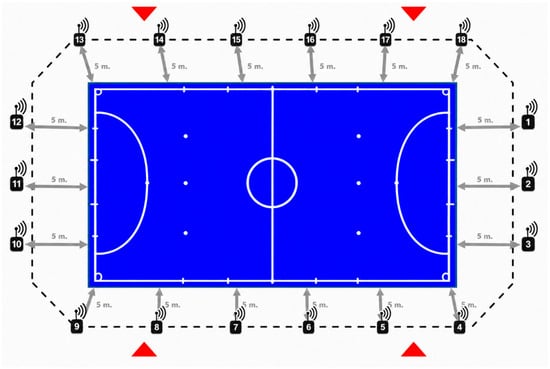
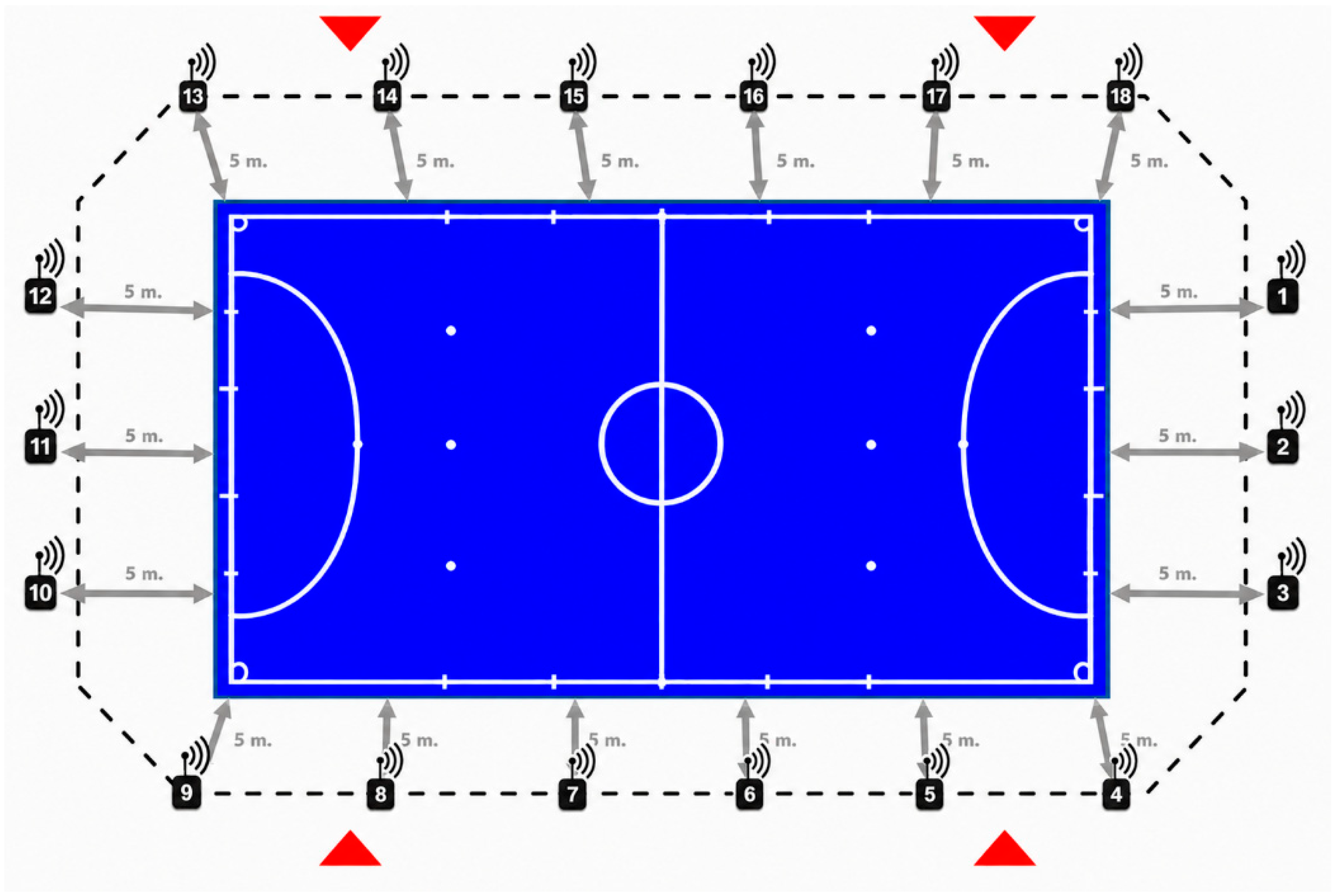
The present study followed a proof-of-concept design to evaluate the validity of a deep-learning computer-vision system for quantifying external load in basketball. System outputs were compared against a Kinexon Local Positioning System (LPS), which served as the reference technology for indoor athlete tracking. The primary variables examined included total distance covered, average speed, acceleration, deceleration, and player load. The placement of the four cameras and the LPS antennas is illustrated in Figure 1.
Figure 1.
Overhead view of the indoor basketball court illustrating the spatial configuration of the four video cameras (red arrows) and the 18 ceiling-mounted Kinexon UWB LPS antennas used for simultaneous data acquisition during the basketball games. The setup ensured full-court coverage for both the computer-vision system and the reference LPS measurements.
The dataset consisted of measurements collected during seven official basketball games played in a regional veterans’ basketball tournament involving athletes aged 35 years and older. Each game comprised four 10 min quarters conducted under standard basketball regulations. Across all recorded sessions, 14 teams participated, with approximately eight active players per team, resulting in 136 athlete participants. The total recording duration was approximately 1120 min (18.7 h) of basketball activity. Only athletes with complete synchronized recordings from both the Kinexon LPS and the computer-vision system were included in the final analysis. All data were collected under standardized indoor conditions at the University Indoor Sports Facility.
2.1. Computer-Vision System Architecture
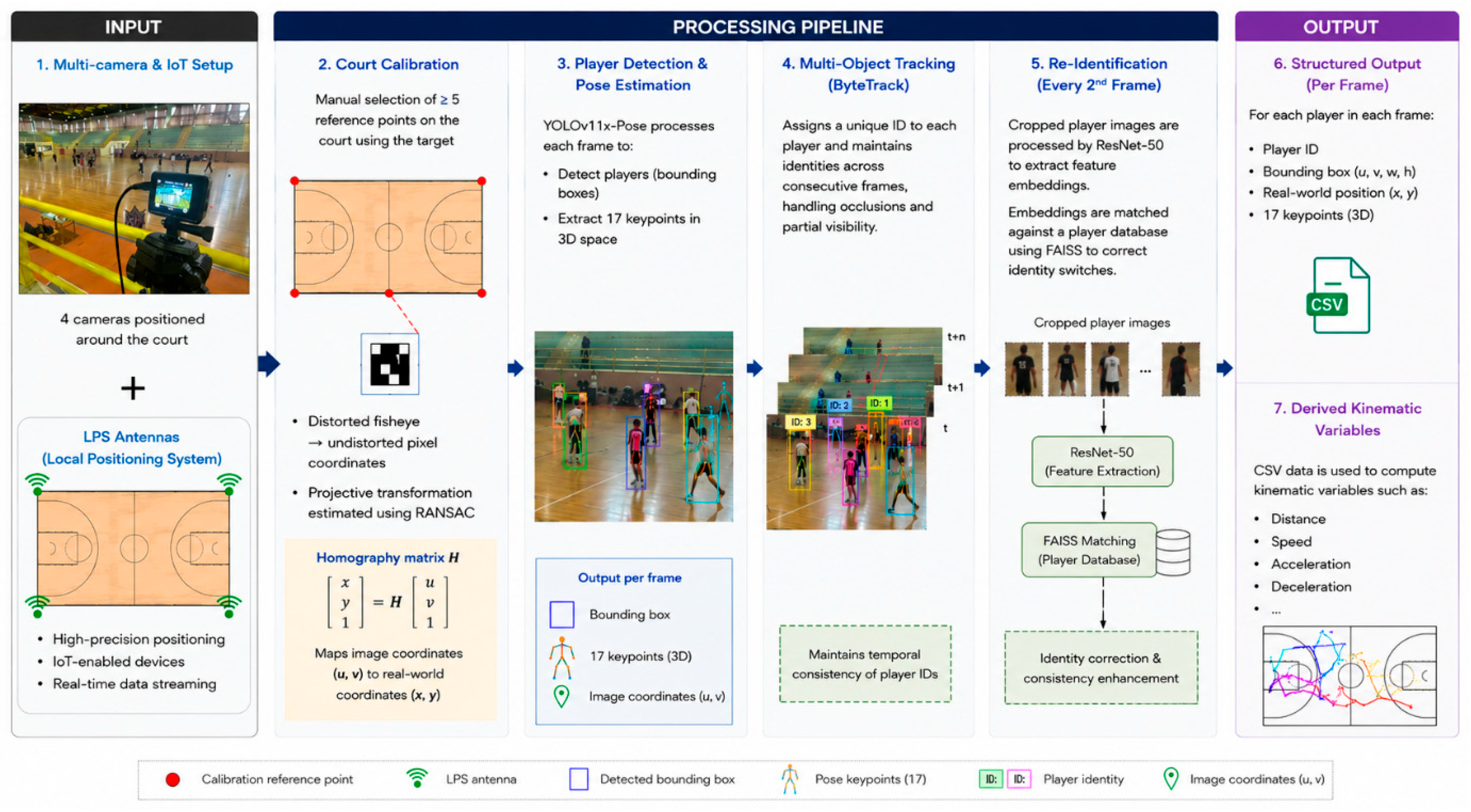
The proposed computer-vision system consisted of a multi-stage processing pipeline integrating player detection, pose estimation, tracking, and re-identification modules. The system operated on fisheye video recordings and transformed image-based observations into real-world court coordinates expressed in meters. Video data were acquired using action cameras operating at 30 frames per second (fps) and a resolution of 1920 × 1080 pixels (1080p). All inference and data-processing procedures were performed on a workstation equipped with an Intel® Core™ i7 processor (Intel Corporation, Santa Clara, CA, USA) and an NVIDIA GeForce RTX 4080 graphics processing unit (NVIDIA Corporation, Santa Clara, CA, USA). Image distortion was corrected using intrinsic calibration parameters, including radial distortion coefficients (k1, k2), focal scaling (zoom), and optical-center coordinates, enabling accurate geometric reconstruction of the scene.
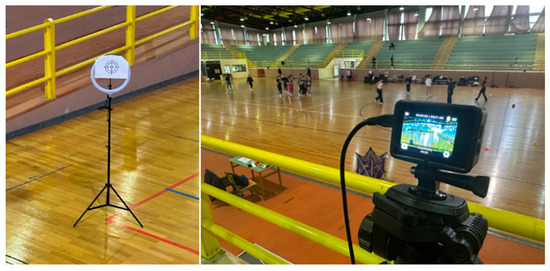
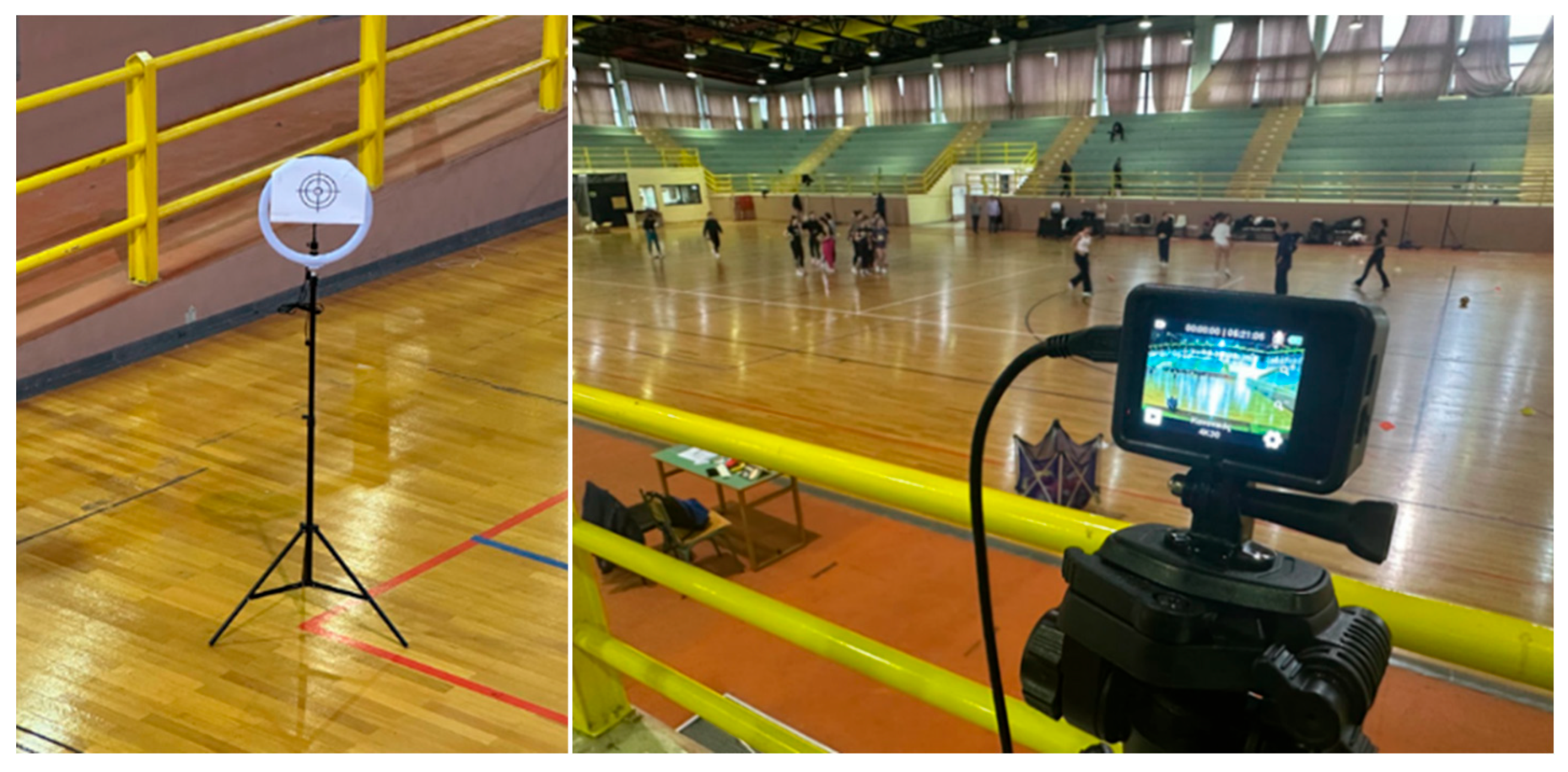
Court calibration is subsequently performed to establish the mapping between image coordinates and real-world positions, implemented using OpenCV (version 4.10.0; OpenCV Foundation, Palo Alto, CA, USA). A minimum of five reference points on the basketball court are manually selected, corresponding to known spatial locations (e.g., court corners and line intersections), using the target depicted in Figure 2. These points are transformed from distorted fisheye coordinates into undistorted pixel coordinates, after which a projective transformation is estimated using the RANSAC algorithm to ensure robustness against outliers [30]. The resulting homography matrix H maps image coordinates to real-world coordinates according to:
Figure 2.
Court-calibration procedure used for homography estimation and mapping between image-space coordinates and real-world court positions. The left image illustrates the calibration target used for selecting at least five known reference points on the basketball court for each camera, while the right image presents an example frame acquired from the game recordings.
The applied homography transformation maps 2D image-space detections onto 2D real-world court coordinates (x–y plane only) and does not involve volumetric 3D pose reconstruction or depth estimation. The calibration parameters are stored and reused in subsequent sessions to ensure reproducibility and efficiency.
Player detection and pose estimation are performed on a frame-by-frame basis using YOLOv11x-Pose implemented through the Ultralytics framework (version 8.2.0; Ultralytics Inc., Austin, TX, USA), which simultaneously identifies player bounding boxes and extracts 17 anatomical keypoints in 2D image space corresponding to major body joints. [31]. Temporal consistency in player tracking is achieved through the ByteTrack algorithm, which assigns unique identifiers to each detected individual and maintains these identities across consecutive frames, even in the presence of occlusions or partial visibility [32].
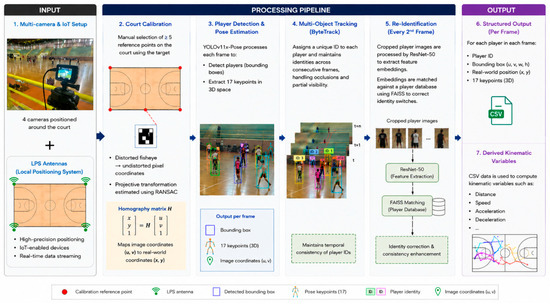
Meanwhile, to further enhance identity consistency, a re-identification (Re-ID) module was applied at regular intervals, using a ResNet-50 convolutional neural network implemented in PyTorch (version 2.3.1; Linux Foundation AI & Data Foundation, San Francisco, CA, USA). Specifically, every second frame, cropped player images were processed by the ResNet-50 model trained to generate discriminative feature embeddings. The embedding dimensionality corresponded to the output dimensionality of the final hidden layer of ResNet-50, i.e., 2048-dimensional feature vectors. Similarity matching between embeddings was performed using FAISS (version 1.8.0; Meta Platforms, Inc., Menlo Park, CA, USA) with a cosine-similarity threshold of 0.5. The ResNet-50 model was trained using a leave-one-subject-group-out validation strategy based on the available athlete dataset, including approximately 136 athlete participations overall, with 32 reserved for validation/testing during each fold. An overview of the above pipeline is depicted in Figure 3.
Figure 3.
Overview of the proposed computer-vision framework for basketball external-load monitoring. The system acquires synchronized video streams from multiple cameras and applies fisheye correction and court calibration through homography transformation. Players are then detected and tracked using YOLOv11x-Pose and ByteTrack, while identity consistency is maintained through ResNet-50-based re-identification and FAISS similarity matching. Finally, locomotor metrics, including distance, speed, accelerations, decelerations, and player load, are extracted from the reconstructed trajectories.
Then, the system outputs structured data for each frame, including player identity, bounding box coordinates, real-world position , and skeletal keypoints. These outputs are exported in comma-separated values (CSV) format and used to derive kinematic variables. The instantaneous velocity v of each player is computed as:
where and represent consecutive positional coordinates and is the time interval between frames. Acceleration is subsequently calculated as the temporal derivative of velocity:
Total distance covered is obtained by summing the Euclidean displacement across all frames:
Average speed () was calculated as the ratio between total distance covered and total movement duration:
where represents the total distance covered and the total recording duration.
External load was quantified using the Accumulated Acceleration Load (AAL), also referred to as Player Load, obtained directly from the Kinexon Local Positioning System (LPS). AAL is based on the cumulative resultant acceleration measured across the three spatial axes and can be conceptually represented as:
where , , and denote the acceleration components along the three orthogonal axes. Therefore, the present study used the AAL values provided directly by the Kinexon platform and focused on comparing the resulting external-load estimates between the LPS and the proposed computer-vision framework.
2.2. Reference Local Positioning System
The reference measurements were obtained using a Local Positioning System (LPS). More specifically, external load was assessed using an LPS (Kinexon GmbH, Munich, Germany) designed for indoor team-sport applications. The system was installed in the University Indoor Sports Facility. It comprised 18 ceiling-mounted antennas distributed around the playing area to ensure full spatial coverage and signal stability throughout the court. In addition, the setup included a central processing unit that served as the communication hub between the antennas and the wearable transmitters and handled data acquisition, synchronization, storage, and real-time processing.
The Kinexon LPS operates using Ultra-Wideband (UWB) radio-frequency technology, providing high-precision positional tracking with an accuracy of less than 10 cm. Positional data were sampled at 20 Hz, enabling continuous monitoring of athletes’ movement patterns during gameplay and training activities. Throughout all recording sessions, researchers monitored incoming data in real time to identify and minimize potential signal interruptions or data loss due to technical issues. Athletes wore dedicated wearable sensors during the measurements. The sensors were attached at the hip level using a dedicated clip positioned close to the athlete’s center of mass. These placements were selected to maximize signal quality, improve movement-tracking accuracy, and minimize interference with sport-specific actions.
Beyond positional tracking, each Kinexon sensor integrates inertial measurement components, including a triaxial accelerometer operating at 100 Hz, a magnetometer, and a gyroscope operating at 200 Hz. The integration of LPS and inertial sensor technologies enables the detailed quantification of external load variables in sports characterized by multidirectional, intermittent, and highly dynamic movement patterns. Such systems are particularly suitable for indoor court sports where frequent accelerations, decelerations, changes in direction, jumps, and high-intensity transitions occur.
For the present study, the variables extracted and analyzed from both the Kinexon LPS and the proposed computer-vision system included total distance covered, number of accelerations (nACC), number of decelerations (nDEC), player load, and average speed. Average speed was calculated as the ratio of total distance covered to the duration of movement. At the same time, player load was derived from acceleration- and deceleration-based workload estimates provided by each system. These variables were selected because they represent key indicators of external load commonly used in basketball performance monitoring, athlete workload quantification, and return-to-play assessment.
The resulting dataset included approximately 200 performance-related variables derived from positional and inertial measurements. For the present study, 75 variables in total were selected for further analysis. These variables included metrics associated with locomotor activity, velocity profiles, acceleration and deceleration patterns, distance covered across intensity zones, and mechanical load indicators.
2.3. Data Processing and Synchronization
To ensure comparability between the two systems, temporal synchronization was performed manually by aligning the initial timestamps of the video recordings and the Kinexon LPS recordings using predefined visual stimuli presented at the beginning of each acquisition session. Synchronization accuracy was further refined by considering the frame rates and sampling frequencies of both systems, i.e., 30 fps for the computer-vision system and 20 Hz for the Kinexon LPS. Subsequently, both datasets were resampled to a common temporal resolution to eliminate discrepancies in sampling frequency. Noise reduction techniques, including low-pass filtering, were applied to positional data prior to derivative calculations to minimize amplification of measurement noise in velocity and acceleration estimates. All kinematic variables were computed using identical mathematical formulations for both systems to ensure methodological consistency.
2.4. Statistical Analysis
Statistical analyses were conducted to examine the validity and agreement between the proposed deep-learning computer-vision tracking system and the reference Kinexon Ultra-Wideband (UWB) Local Positioning System (LPS). The analyses focused on the principal external-load variables that were available across both systems, including Distance, nACC, nDEC, player load, and average speed.
Before statistical processing, positional data obtained from both systems were temporally synchronized and resampled to a common temporal resolution to ensure direct comparability between measurements. Subsequently, locomotor and event-based variables were calculated using identical mathematical formulations and thresholding procedures across both datasets to minimize methodological discrepancies in signal processing.
The linear relationship between the measurements obtained from the two systems was assessed using Pearson’s correlation coefficient (r). Correlation strength was interpreted according to conventional thresholds for sport-science applications. Agreement between systems was interpreted collectively based on Pearson correlations, ICC values, Bland–Altman limits of agreement, effect sizes, and the practical relevance of the observed differences within the context of basketball external-load monitoring. Ninety-five percent confidence intervals (95% CI) were additionally calculated for Pearson correlations and Bland–Altman mean bias estimates. Moreover, to further quantify absolute measurement error between systems, mean absolute error (MAE), root mean square error (RMSE), and mean absolute percentage error (MAPE) were additionally calculated for all examined variables. In addition, paired-samples t-tests were performed to identify potential systematic differences between systems for each variable examined. Given the proof-of-concept design of the study, an a priori power analysis was not performed. Nevertheless, the final sample consisted of 136 paired observations, which provided sufficient statistical power for detecting moderate-to-strong correlations and agreement effects between systems.
To further assess inter-system reliability, intraclass correlation coefficients (ICCs) were calculated for all variables examined across quartiles. ICC values were interpreted using established reliability thresholds: values below 0.50 indicate poor reliability; values between 0.50 and 0.75 indicate moderate reliability; values between 0.75 and 0.90 indicate good reliability; and values above 0.90 indicate excellent reliability. Statistical significance was established at p < 0.05 for all analyses. All statistical procedures, data processing, and visualization tasks were performed using Python 3.11.9 (Python Software Foundation, Wilmington, DE, USA).
3. Results
3.1. Agreement Between the Computer-Vision System and Kinexon UWB LPS
The validity of the proposed computer-vision system was evaluated against the Kinexon Ultra-Wideband (UWB) Local Positioning System (LPS) across basketball games. The analyses focused on the common external-load variables available across all measurements, including total distance covered (Total Distance), number of accelerations (nACC), number of decelerations (nDEC), player load, and average speed. Average speed was calculated as the total distance divided by the duration for each system.
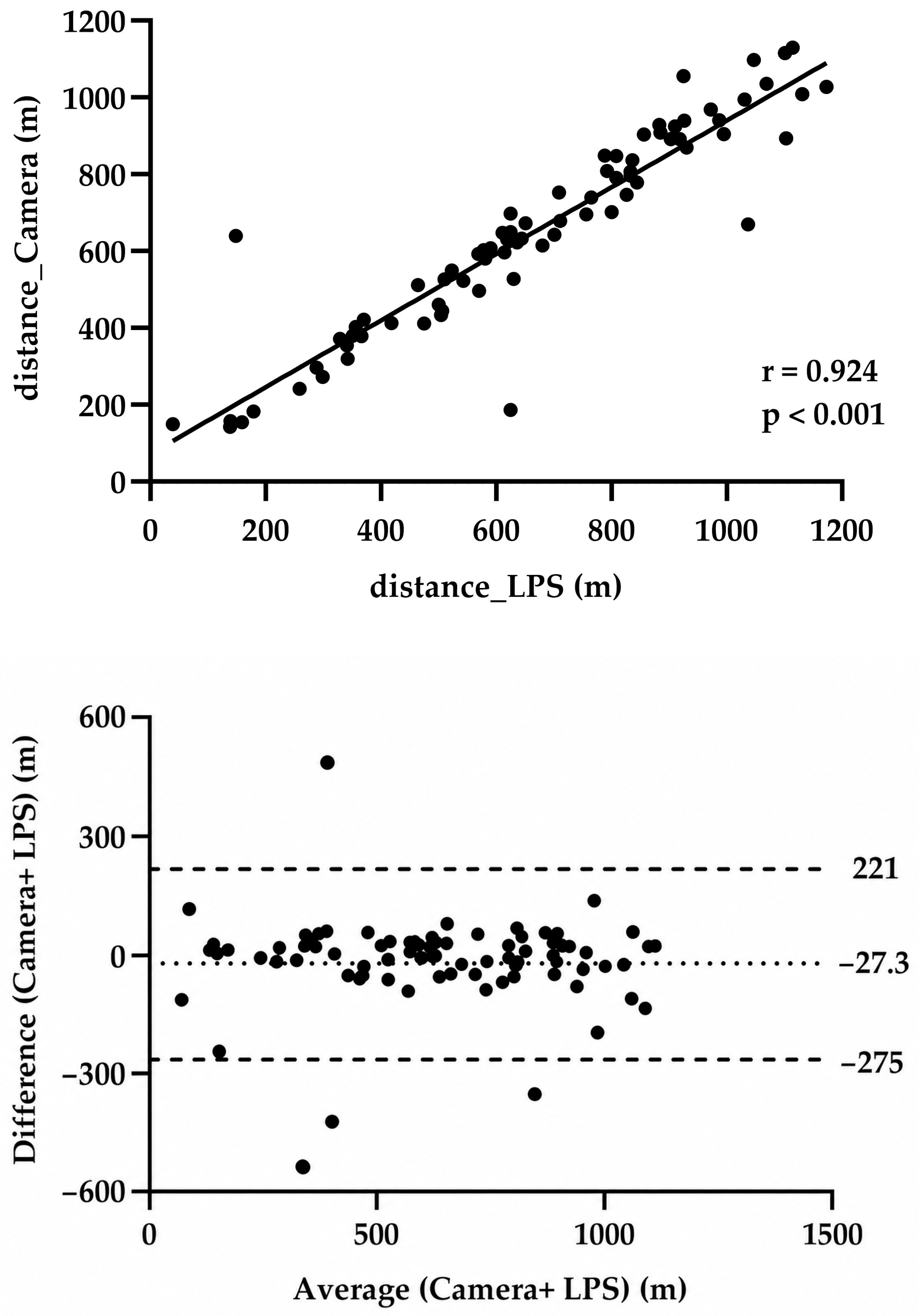
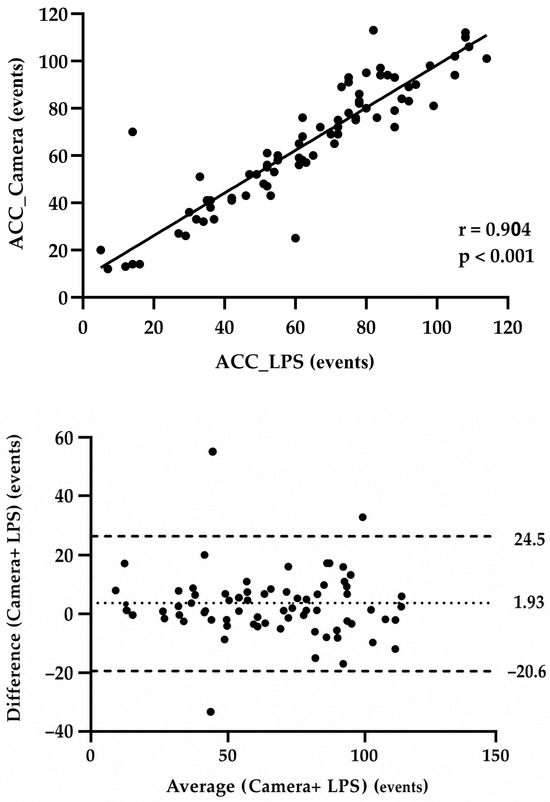
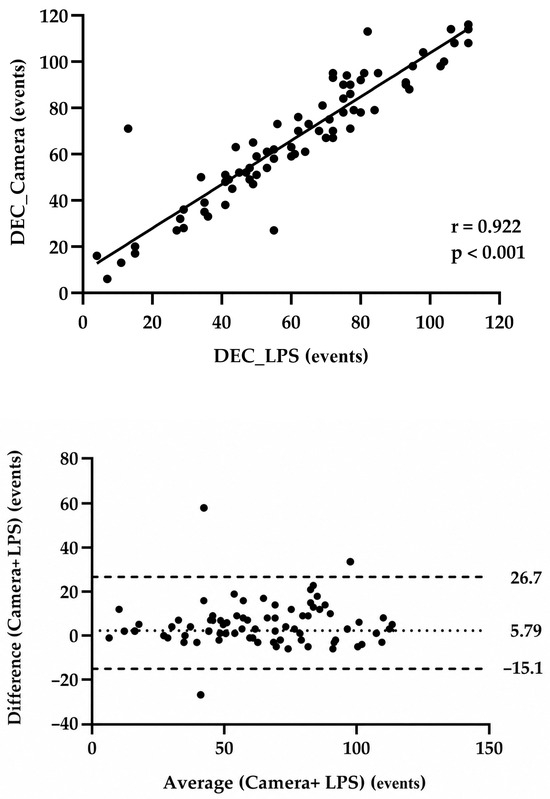
Pearson correlation analyses demonstrated strong-to-excellent associations between the proposed computer-vision system and the reference Kinexon UWB system for all examined variables. Specifically, strong positive correlations were observed between the LPS and camera-based measurements for total distance (r = 0.924, p < 0.001), nACC (r = 0.904, p < 0.001), nDEC (r = 0.922, p < 0.001), and player load (r = 0.806, p < 0.001). A moderate-to-strong correlation was observed for average speed (r = 0.655, p < 0.001). These findings indicate that the proposed computer-vision system exhibited the same measurement trend as the reference LPS throughout the entire game period.
Paired-samples t-tests showed no statistically significant differences between systems for total distance (p = 0.086), nACC (p = 0.053), or player load (p = 0.867). In contrast, statistically significant differences were observed for nDEC (p < 0.001) and average speed (p < 0.001). The effect sizes were small for total distance, nACC, player load, and average speed, while nDEC showed a moderate effect size.
Collectively, these findings indicate that the proposed vision-based approach can reliably reproduce the measurements obtained from the Kinexon UWB system for locomotor-demand variables commonly used in indoor basketball settings. All the above results are summarized in Table 1.
Table 1.
Correlations, Paired t-Tests, and Effect Sizes for the examined parameters.
Additional absolute-error analyses demonstrated moderate-to-low measurement error for most variables, with total distance and maximum speed showing the lowest relative percentage errors between systems. The results are presented in Table 2.
Table 2.
Absolute Error Metrics between Systems.
3.2. Bland–Altman Agreement Analysis
Bland–Altman analyses were performed to assess systematic bias and the limits of agreement between the computer-vision system and the LPS throughout the entire game. The mean difference was calculated as Camera − LPS, where negative values indicate underestimation by the computer-vision system and positive values indicate overestimation.
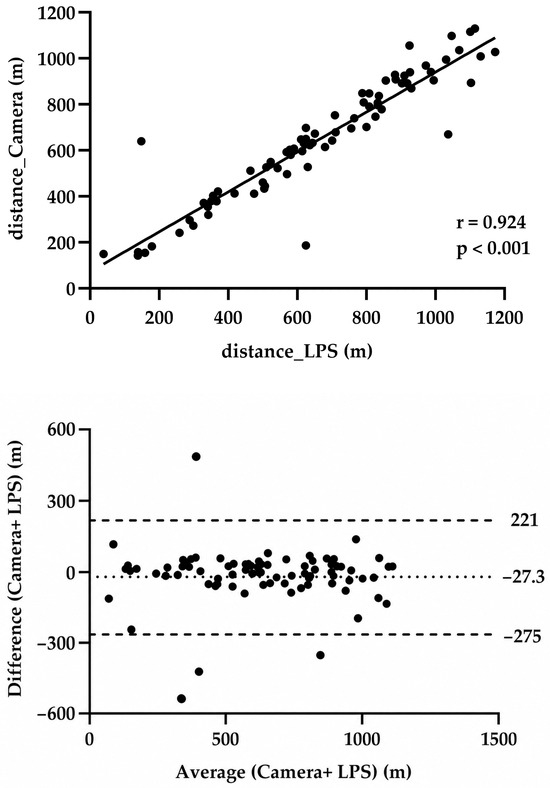
For total distance, the computer-vision system showed a small mean underestimation of −27.30 m, with limits of agreement ranging from −275.02 m to 221.03 m. For nACC, the computer-vision system slightly overestimated the number of accelerations by 1.93 events. For nDEC, the system showed a higher positive bias of 5.79 events, indicating that the computer-vision approach tended to detect more deceleration events than the LPS. Player load showed negligible mean bias (−0.47 a.u.), whereas average speed was slightly underestimated by the computer-vision system (−0.96 m·min−1). The above results are summarized in Table 3.
Table 3.
Bland–Altman for the examined parameters.
The Bland–Altman analyses indicated that total distance exhibited wider limits of agreement compared with the remaining variables, suggesting greater variability between systems during prolonged or highly dynamic movement sequences. In contrast, acceleration counts, deceleration counts, and player load demonstrated narrower agreement ranges and smaller systematic bias. Visual inspection of the Bland–Altman plots did not reveal a pronounced heteroscedastic pattern, although variability appeared to increase slightly at higher movement volumes for total distance and deceleration-related variables. Similarly, no substantial proportional bias trend was visually observed across the measurement range; however, these effects were not formally quantified using regression-based approaches.
The corresponding Pearson correlations and Bland–Altman plots illustrating the agreement between the proposed computer-vision system and the Kinexon UWB system for Total Distance, nACC, and nDEC are presented in Figure 4, Figure 5 and Figure 6.
Figure 4.
Pearson correlation and Bland–Altman agreement analyses between the computer-vision system and the Kinexon UWB LPS for total distance covered during basketball gameplay. The upper panel illustrates the linear relationship between systems, while the lower panel presents mean bias and 95% limits of agreement.
Figure 5.
Pearson correlation and Bland–Altman agreement analyses between the computer-vision system and the Kinexon UWB LPS for the number of acceleration events (nACC). The upper panel illustrates the correlation between systems, while the lower panel presents mean bias and 95% limits of agreement.
Figure 6.
Pearson correlation and Bland–Altman agreement analyses between the computer-vision system and the Kinexon UWB LPS for the number of deceleration events (nDEC). The upper panel illustrates the correlation between systems, while the lower panel presents mean bias and 95% limits of agreement.
3.3. Intra-Class Correlation Coefficient (ICC) Analysis
The intra-class correlation coefficient (ICC) analysis confirmed good-to-excellent agreement between the computer-vision system and the LPS for most variables. Excellent reliability was observed for total distance (ICC = 0.921), nACC (ICC = 0.902), and nDEC (ICC = 0.901). Player load demonstrated good reliability (ICC = 0.807), whereas average speed showed moderate reliability (ICC = 0.632). All the above results are presented in Table 4.
Table 4.
ICC Reliability Metrics between the Computer-Vision System and Kinexon UWB LPS.
Overall, these findings indicate that the proposed computer-vision system provides highly consistent measurements for total distance and acceleration/deceleration counts across the entire game. Player load also showed acceptable agreement, while average speed exhibited lower reliability, suggesting that speed-related estimates may be more sensitive to differences in temporal synchronization, positional smoothing, or duration-based calculations between systems.
4. Discussion
4.1. Overview of the Findings and Purpose of the Study
The LPS represents one of the most widely adopted and validated technological solutions for assessing external load in indoor basketball settings [24,27,28]. Its validity has already been evaluated against the VICON system for parameters such as acceleration and deceleration, and therefore indirectly for player load, which is calculated from these parameters [24]. The results of that study showed that LPS demonstrated high reliability and validity for speed, acceleration, and deceleration parameters [24]. To the best of our knowledge, the VICON system is undoubtedly the gold standard for movement assessment, not only with respect to the center of mass but also for joint-level motion analysis [24]. However, its use is not feasible under real game conditions, making LPS an established reference method for assessing player load under ecological indoor sport conditions, despite its known limitations related to positional accuracy, acceleration estimation, and signal interference [24,28]. From this perspective, comparing the video-based system with LPS is the only way to evaluate its validity under competitive conditions. In our results, particularly regarding accelerations, decelerations, and player load, very high levels of agreement were observed, as quantified by correlation analyses, Bland–Altman plots, and ICC values (value ranges).
4.2. Results and Comparison
Regarding total distance and average speed parameters, the present findings demonstrated strong agreement between the computer-vision system and the LPS technology. Correlation analyses revealed strong associations for total distance and moderate-to-strong associations for average speed, while Bland–Altman analyses demonstrated relatively small systematic biases between systems. Specifically, the computer-vision system slightly underestimated total distance and average speed relative to the LPSs; however, the magnitude of these differences remained practically acceptable for applied sport-performance monitoring.
The observed underestimation of total distance and average speed may be attributed to several methodological and technological factors. Computer-vision systems are inherently sensitive to temporary occlusions, player overlaps, and rapid changes in body orientation that occur frequently during indoor basketball settings [27]. Such conditions may produce short-term tracking discontinuities or smoothing effects that slightly reduce the estimated movement trajectory and consequently affect distance- and speed-related calculations. In addition, differences in filtering procedures and interpolation algorithms between the computer-vision system and the Kinexon UWB system may contribute to discrepancies in cumulative locomotor metrics [25,28].
The LPS, due to its underlying UWB technology, can determine player position with an accuracy of a few centimeters [24,28]. Previous studies comparing LPS performance indoors and outdoors, as well as against 10 Hz GPSs in outdoor environments, have shown that although positioning accuracy is generally higher outdoors, LPS still represents an acceptable and valid solution for indoor basketball settings [25,27,28]. Interestingly, the absence of environmental disturbances such as weather conditions, metallic structures, and construction materials within sports facilities may adversely affect indoor signal propagation [25,27,28]. It should also be noted that earlier studies often employed fewer antennas. In contrast, the present setup used 18 antennas mounted on the facility roof, supported by a dedicated structure designed to minimize signal interference and improve positional accuracy. Overall, the existing evidence indicates that the LPS provides valid estimates of distance- and speed-related parameters in indoor environments [24,25,28], and the high level of agreement observed in the present study suggests that the proposed computer-vision system can provide comparable estimates of these variables. These findings should nevertheless be interpreted while considering that the reference UWB LPS itself may demonstrate reduced precision during rapid changes in direction, explosive accelerations/decelerations, and highly dynamic basketball-specific actions. In addition, the relatively wider limits of agreement observed for total distance suggest that cumulative locomotor variables may be more sensitive to small positional discrepancies accumulated during prolonged tracking periods.
The present findings demonstrated very high levels of agreement between the computer-vision system and the LPS for accelerations, decelerations, and player load, as quantified by correlation analyses, Bland–Altman plots, and ICC values. Strong correlations and excellent ICC values were observed for nACC and nDEC, while player load demonstrated good reliability and negligible systematic bias.
Although the computer-vision system slightly overestimated deceleration counts relative to the LPS, the observed differences remained practically acceptable. Deceleration actions are often characterized by abrupt braking maneuvers, rapid directional changes, and short-duration movement transitions, all of which can be more challenging for video-based motion extraction algorithms to accurately identify [24,26]. Consequently, slightly lower agreement for deceleration metrics is expected and has been previously reported in studies involving optical and markerless tracking technologies [24,26]. Similarly, the proposed system demonstrated relatively small differences in acceleration counts compared with the LPS reference system. From the analysis of data on accelerations, decelerations, and player load, the observed mean values were comparable to those reported with other load-monitoring technologies in indoor sport settings, including inertial sensor systems and time–motion analysis approaches [5,6]. Player load represents an especially important variable in applied sport science because it reflects the cumulative mechanical and physiological demands imposed on athletes during training and competition [1,4]. Since player load is derived from accelerations and decelerations, the strong agreement observed for these variables directly supports the validity of the training-load estimations produced by the computer-vision system. The negligible mean bias and good ICC values observed for player load suggest that the proposed approach can provide practically useful workload information for athlete monitoring and coaching applications.
Overall, the results indicate that the computer-vision system can accurately estimate external-load metrics such as accelerations, decelerations, and player load when evaluated against the LPSs, which currently represents a widely validated reference technology for recording external load in indoor athlete tracking [24,27,28].
From the analysis of data on accelerations, decelerations, and player load, the observed mean values (means ± standard deviations) were comparable to those reported by other load-monitoring systems in indoor settings, such as inertial sensor systems and time–motion analysis [5,6]. Based on the above, it can be concluded that the computer-vision system can accurately estimate external load metrics such as accelerations, decelerations, and player load when evaluated against the LPSs, which, to date, represents a commonly used reference solution for recording external load in indoor basketball settings under competitive conditions [24,27,28]. Nevertheless, previous studies have also demonstrated that UWB-based LPSs may exhibit reduced accuracy for acceleration- and deceleration-related variables and may be affected by signal reflections, multipath interference, and filtering procedures, particularly in indoor environments [24,25,28].
4.3. Practical Application
From an applied perspective, the present findings support the use of computer-vision systems as cost-effective and scalable alternatives to commercial UWB positioning technologies [27,29]. UWB systems require specialized hardware infrastructure, wearable sensors, and extensive installation procedures, which may limit their accessibility in certain sports environments. In essence, they constitute a system installed in a sports facility as permanent equipment for monitoring external loads, since their relocation is only possible with specialized staff and requires several days for disassembly and reinstallation [24,28]. In contrast, vision-based approaches may offer more flexible deployment options while still maintaining acceptable validity and reliability for locomotor monitoring [29]. The practical implications of these findings are particularly important for indoor sports environments, where accurate athlete monitoring remains challenging due to restricted GPS availability and complex movement dynamics [5,6,28]. The proposed system appears capable of supporting performance analysis, workload monitoring, and athlete management applications in ecological sports settings. Among the advantages of the image-based method are its ease of use, the automation of output, and the ability to transfer it from one facility to another—or even to install it simultaneously in multiple sports venues—due to its relatively low cost. In addition, using video for load analysis can provide additional solutions for technical and tactical evaluation [29]. Enriching the system with distance-based analyses, ball detection and tracking, and estimation of LPS-type parameters via extrapolation techniques could maximize its effectiveness. At present, it appears that the use of computer-vision systems, together with validity studies against LPS technology, provides a satisfactory foundation for further research and the development of a product useful for the coaching process.
From a computational perspective, the proposed framework was implemented using commercially available hardware, including cameras operating at 30 fps and a workstation equipped with an Intel Core i7 CPU and an NVIDIA RTX 4080 GPU. The architecture was designed to support near-real-time processing through efficient deep-learning inference pipelines combining YOLOv11x-Pose detection, ByteTrack tracking, and periodic ResNet-50-based re-identification using FAISS similarity matching. Although the present study primarily focused on system validity rather than latency benchmarking, the observed computational performance supports the practical feasibility of real-time or near-real-time deployment in indoor basketball environments. Nevertheless, overall scalability and processing latency may depend on factors such as the number of cameras, video resolution, synchronization requirements, and available GPU resources.
4.4. Limitations
At this point, several limitations should be acknowledged. The present study examined only a limited set of locomotor variables and was conducted within a single indoor basketball environment. Additional biomechanical and metabolic indicators were not evaluated [25,26,28]. Therefore, caution is required when generalizing the findings to different populations and competitive settings. Consequently, future research should extend the validation of camera-based systems to additional performance variables (e.g., instantaneous speed profiles, directional change metrics, joint-level kinematics), diverse competitive levels and tactical contexts, and different indoor environments, while also exploring advanced multi-camera fusion and ball-tracking algorithms to improve further positional accuracy, event detection, and the integrated analysis of technical, tactical, and physical performance [24,26].
Meanwhile, the present study focused only on a subset of common locomotor variables, namely distance, acceleration counts, and deceleration counts. Additional performance indicators, such as instantaneous speed profiles, metabolic power estimates, or biomechanical metrics, were not examined [26]. Second, although the proposed system demonstrated strong agreement with the UWB reference system, the wider limits of agreement observed for distance measurements suggest that caution may still be required when interpreting individual observations during highly dynamic movement sequences [25,26,28]. For this purpose, future work should additionally evaluate the robustness of the proposed framework under conditions involving severe player occlusions, dense player clustering, and prolonged visual overlap, which remain important challenges for markerless computer-vision systems in basketball. Finally, the dataset was collected exclusively from veteran basketball athletes aged over 35 years, which may limit generalizability to younger or elite professional populations.
Additionally, the use of video-based athlete-monitoring systems raises important ethical and privacy considerations related to data collection, storage, and processing. In the present study, all procedures were conducted following approval from the corresponding Ethics Committee. Video recordings were used exclusively for scientific and performance-analysis purposes, and access to the data was restricted to authorized research personnel. Furthermore, the proposed framework focused on movement tracking and external-load quantification rather than facial recognition or biometric identification. Future implementations of similar systems should continue to ensure appropriate informed consent procedures, secure data management, and compliance with applicable privacy regulations.
4.5. Future Studies
Future studies should further investigate the performance of computer-vision systems under different competitive levels, tactical contexts, and environmental conditions [25,28]. Additionally, future research could explore integrating deep-learning-based motion estimation algorithms with multi-camera fusion techniques to further improve positional accuracy and event detection performance [29].
Overall, the present study demonstrates that the proposed computer-vision system provides valid and reliable measurements of locomotor demands during indoor basketball settings. The strong agreement observed with the Kinexon UWB Local Positioning System supports the applicability of the proposed approach as an effective alternative for monitoring and performance analysis of ecological athletes in indoor sports environments [24].
5. Conclusions
To sum up, the present proof-of-concept study provides preliminary validation that the proposed computer-vision system can estimate key basketball external-load variables with generally strong agreement relative to a commercial UWB-LPS reference system. The findings support the feasibility of computer-vision systems as practical tools for athlete monitoring, measuring total distance covered, acceleration counts, deceleration counts, player load, and average speed across basketball games.
Although slightly wider limits of agreement were observed for total distance covered during certain quartiles, the magnitude of the observed errors remained within practically acceptable ranges for applied sport-performance monitoring. Similarly, acceleration and deceleration event detection demonstrated satisfactory agreement, supporting the proposed system’s ability to capture dynamic locomotor actions during indoor gameplay.
From an applied perspective, the proposed vision-based approach offers a promising alternative to commercial UWB positioning technologies, potentially reducing infrastructure complexity and deployment cost while maintaining acceptable measurement validity and reliability. Consequently, the system may support applications for athlete monitoring, workload quantification, and performance analysis in ecological indoor sports environments.
Future research should investigate the performance of the proposed approach across different competitive contexts, movement intensities, and tactical scenarios, and explore advanced deep learning architectures and multi-camera fusion techniques to improve positional accuracy, robustness under conditions involving severe player occlusions, dense player clustering, and prolonged visual overlap, as well as enhanced event detection capabilities.
In conclusion, the present findings support the applicability of deep-learning-based computer-vision systems as reliable and practical tools for external load monitoring and performance analysis in indoor basketball settings.
Author Contributions
Conceptualization, A.C., I.K., A.G., D.P. and C.K. (Christos Kokkotis); methodology, A.C., I.K., A.G., G.P. (Georgios Pistikos), I.P., P.K., D.P. and C.K. (Christos Kokkotis); software, I.K., G.P. (Georgios Pistikos), I.P., P.K., S.M., S.A. and C.K. (Christos Kokkotis); validation, A.C., I.K., A.G., D.P., P.F. and C.K. (Christos Kokkotis); formal analysis, I.K., D.P., P.F. and C.K. (Christos Kokkotis); investigation, D.P., P.A., D.B., A.D., P.F., K.M. and N.Z.; resources, A.C., A.A., A.G., G.P. (Georgios Pistikos), I.P., P.K., A.K., C.K. (Christos Kazantzis), G.P. (Georgios Pavlidis) and C.K. (Christos Kokkotis); data curation, I.K., D.P., P.A., D.B., A.D., P.F., K.M. and C.K. (Christos Kokkotis); writing—original draft preparation, A.C., I.K., D.P., D.B., P.F. and C.K. (Christos Kokkotis); writing—review and editing, A.C., A.A., A.G., D.P., N.Z., A.K., C.K. (Christos Kazantzis), G.P. (Georgios Pavlidis) and C.K. (Christos Kokkotis); visualization, I.K., G.P. (Georgios Pistikos), I.P., P.K., S.M., S.A. and C.K. (Christos Kokkotis); supervision, A.C., A.A., A.G., G.P. (Georgios Pavlidis) and C.K. (Christos Kokkotis); project administration, A.C., A.A., A.K., C.K. (Christos Kazantzis), G.P. (Georgios Pavlidis) and C.K. (Christos Kokkotis); funding acquisition, A.C. and A.A. All authors have read and agreed to the published version of the manuscript.
Funding
This research received funding from the project, which is co-funded by the European Union—NextGenerationEU through the Recovery and Resilience Facility (RRF) for the period 2022–2025, with the contribution of the National Public Investment Programme (PIP) and national resources covering VAT (DLS-ΥΠ3ΤA-0559995). In the abstract, all the DLS consortium members participated.
Institutional Review Board Statement
Ethical approval was granted by the Ethics Committee of the Department of Physical Education and Sport Science, Democritus University of Thrace (Protocol No: DUTH/EHDE/38826/966/31 January 2025).
Informed Consent Statement
Informed consent was obtained from all subjects involved in the study.
Data Availability Statement
The data presented in this study are available on request from the corresponding author due to privacy and ethical reasons.
Acknowledgments
The authors have reviewed and edited the output and take full responsibility for the content of this publication.
Conflicts of Interest
Georgios Pistikos, loannis Papavasilopoulos, and Panagiotis Kaddas are employees of In Digital, a member of the DLS project consortium that funded and co-financed this research. The remaining authors declare no conflicts of interest. The funders had no role in the design of the study; in the collection, analysis, or interpretation of data; in the writing of the manuscript; or in the decision to publish the results.
References
- Bourdon, P.C.; Cardinale, M.; Murray, A.; Gastin, P.; Kellmann, M.; Varley, M.C.; Gabbett, T.J.; Coutts, A.J.; Burgess, D.J.; Gregson, W.; et al. Monitoring Athlete Training Loads: Consensus Statement. Int. J. Sports Physiol. Perform. 2017, 12, S2-161–S2-170. [Google Scholar] [CrossRef] [Scilit]
- Gabbett, T.J. The Training—Injury Prevention Paradox: Should Athletes Be Training Smarter and Harder? Br. J. Sports Med. 2016, 50, 273–280. [Google Scholar] [CrossRef] [Scilit]
- Soligard, T.; Schwellnus, M.; Alonso, J.-M.; Bahr, R.; Clarsen, B.; Dijkstra, H.P.; Gabbett, T.; Gleeson, M.; Hägglund, M.; Hutchinson, M.R.; et al. How Much Is Too Much? (Part 1) International Olympic Committee Consensus Statement on Load in Sport and Risk of Injury. Br. J. Sports Med. 2016, 50, 1030–1041. [Google Scholar] [CrossRef] [Scilit]
- Impellizzeri, F.M.; Marcora, S.M.; Coutts, A.J. Internal and External Training Load: 15 Years On. Int. J. Sports Physiol. Perform. 2019, 14, 270–273. [Google Scholar] [CrossRef] [Scilit]
- Fox, J.L.; Scanlan, A.T.; Stanton, R. A Review of Player Monitoring Approaches in Basketball: Current Trends and Future Directions. J. Strength Cond. Res. 2017, 31, 2021–2029. [Google Scholar] [CrossRef] [Scilit]
- Petway, A.J.; Freitas, T.T.; Calleja-González, J.; Medina Leal, D.; Alcaraz, P.E. Training Load and Match-Play Demands in Basketball Based on Competition Level: A Systematic Review. PLoS ONE 2020, 15, e0229212-. [Google Scholar] [CrossRef] [Scilit] [PubMed]
- Sosa Marín, C.; Alonso-Pérez-Chao, E.; Schelling, X.; Lorenzo, A. How to Optimize Training Design? A Narrative Review of Load Modulators in Basketball Drills. Appl. Sci. 2025, 15, 3816. [Google Scholar] [CrossRef] [Scilit]
- Rebelo, A.; Pereira, J.R.; Nakamura, F.Y.; Valente-dos-Santos, J. Beyond the Jump: A Scoping Review of External Training Load Metrics in Volleyball. Sports Health Multidiscip. Approach 2025, 17, 111–125. [Google Scholar] [CrossRef] [Scilit]
- Rampinini, E.; Coutts, A.; Castagna, C.; Sassi, R.; Impellizzeri, F. Variation in Top Level Soccer Match Performance. Int. J. Sports Med. 2007, 28, 1018–1024. [Google Scholar] [CrossRef] [Scilit] [PubMed]
- Chatzinikolaou, A.; Draganidis, D.; Avloniti, A.; Karipidis, A.; Jamurtas, A.Z.; Skevaki, C.L.; Tsoukas, D.; Sovatzidis, A.; Theodorou, A.; Kambas, A.; et al. The Microcycle of Inflammation and Performance Changes after a Basketball Match. J. Sports Sci. 2014, 32, 870–882. [Google Scholar] [CrossRef] [Scilit] [PubMed]
- Pantazis, D.; Avloniti, A.; Dimitrios, D.; Stampoulis, T.; Protopapa, M.; Kokkotis, C.; Balampanos, D.; Arsenis, S.; Poulios, A.; Papanikolaou, K.; et al. The Effect of Protein Supplementation and Playing Time on Recovery Kinetics During a Congested Basketball Schedule. Nutrients 2024, 17, 128. [Google Scholar] [CrossRef] [Scilit] [PubMed]
- Fatouros, I.G.; Chatzinikolaou, A.; Douroudos, I.I.; Nikolaidis, M.G.; Kyparos, A.; Margonis, K.; Michailidis, Y.; Vantarakis, A.; Taxildaris, K.; Katrabasas, I.; et al. Time-Course of Changes in Oxidative Stress and Antioxidant Status Responses Following a Soccer Game. J. Strength Cond. Res. 2010, 24, 3278–3286. [Google Scholar] [CrossRef] [Scilit]
- Ispirlidis, I.; Pantazis, D.; Poulios, A.; Avloniti, A.; Stampoulis, T.; Michailidis, Y.; Troupkos, K.; Evangelou, E.; Draganidis, D.; Balampanos, D.; et al. The Effect of Intraset Rest Periods on External and Internal Load During Small-Sided Games in Soccer. Sports 2024, 12, 331. [Google Scholar] [CrossRef] [Scilit]
- Pantazis, D.; Stampoulis, T.; Balampanos, D.; Avloniti, A.; Kokkotis, C.; Aggelakis, P.; Protopapa, M.; Draganidis, D.; Emmanouilidou, M.; Retzepis, N.-O.; et al. Comparing Workloads Among Different Age Groups in Official Masters’ Basketball Matches: Implications for Physical Activity. Appl. Sci. 2025, 15, 4547. [Google Scholar] [CrossRef] [Scilit]
- Ben Abdelkrim, N.; El Fazaa, S.; El Ati, J. Time-Motion Analysis and Physiological Data of Elite under-19-Year-Old Basketball Players during Competition. Br. J. Sports Med. 2007, 41, 69–75; discussion 75. [Google Scholar] [CrossRef] [Scilit]
- Conte, D.; Tessitore, A.; Smiley, K.; Thomas, C.; Favero, T.G. Performance Profile of NCAA Division I Men’s Basketball Games and Training Sessions. Biol. Sport 2016, 33, 189–194. [Google Scholar] [CrossRef] [Scilit]
- Buchheit, M.; Allen, A.; Poon, T.K.; Modonutti, M.; Gregson, W.; Di Salvo, V. Integrating Different Tracking Systems in Football: Multiple Camera Semi-Automatic System, Local Position Measurement and GPS Technologies. J. Sports Sci. 2014, 32, 1844–1857. [Google Scholar] [CrossRef] [Scilit] [PubMed]
- Mohr, M.; Ermidis, G.; Jamurtas, A.Z.; Vigh-Larsen, J.F.; Poulios, A.; Draganidis, D.; Papanikolaou, K.; Tsimeas, P.; Batsilas, D.; Loules, G.; et al. Extended Match Time Exacerbates Fatigue and Impacts Physiological Responses in Male Soccer Players. Med. Sci. Sports Exerc. 2023, 55, 80–92. [Google Scholar] [CrossRef] [Scilit] [PubMed]
- Coutts, A.J.; Duffield, R. Validity and Reliability of GPS Devices for Measuring Movement Demands of Team Sports. J. Sci. Med. Sport 2010, 13, 133–135. [Google Scholar] [CrossRef] [Scilit]
- Pantazis, D.; Kokkotis, C.; Zaras, N.; Balampanos, D.; Avloniti, A.; Stampoulis, T.; Foteinakis, P.F.; Frazis Christou, P.; Papoulias, G.; Aggelakis, P.; et al. Individualized Physical Performance Metrics in 3 × 3 Basketball Games Using Match-Play Data. Appl. Sci. 2026, 16, 2037. [Google Scholar] [CrossRef] [Scilit]
- Irid, Y.; Hutin, J.; Toussaint, J.-F.; Sedeaud, A. Exploring the Most Demanding Scenarios in Elite Youth Basketball: A Comprehensive Analysis across Playing Positions and Time Windows. Biol. Sport 2025, 42, 37–47. [Google Scholar] [CrossRef] [Scilit]
- Bastida-Castillo, A.; Gómez-Carmona, C.D.; De La Cruz Sánchez, E.; Pino-Ortega, J. Comparing Accuracy between Global Positioning Systems and Ultra-wideband-based Position Tracking Systems Used for Tactical Analyses in Soccer. Eur. J. Sport Sci. 2019, 19, 1157–1165. [Google Scholar] [CrossRef] [Scilit]
- Sosa, C.; Lorenzo, A.; Trapero, J.; Ribas, C.; Alonso, E.; Jimenez, S.L. Specific Absolute Velocity Thresholds during Male Basketball Games Using Local Positional System; Differences between Age Categories. Appl. Sci. 2021, 11, 4390. [Google Scholar] [CrossRef] [Scilit]
- Fleureau, A.; Lacome, M.; Buchheit, M.; Couturier, A.; Rabita, G. Validity of an Ultra-Wideband Local Positioning System to Assess Specific Movements in Handball. Biol. Sport 2020, 37, 351–357. [Google Scholar] [CrossRef] [Scilit]
- Alt, P.S.; Baumgart, C.; Ueberschär, O.; Freiwald, J.; Hoppe, M.W. Validity of a Local Positioning System during Outdoor and Indoor Conditions for Team Sports. Sensors 2020, 20, 5733. [Google Scholar] [CrossRef] [Scilit] [PubMed]
- Fuchs, P.X.; Chou, Y.-C.; Chen, W.-H.; Fiolo, N.J.; Shiang, T.-Y. Accuracy of a Local Positioning System for Time-Series Speed and Acceleration and Performance Indicators in Game Sports. Sports Biomech. 2025, 24, 291–305. [Google Scholar] [CrossRef] [Scilit] [PubMed]
- Hoppe, M.W.; Baumgart, C.; Polglaze, T.; Freiwald, J. Validity and Reliability of GPS and LPS for Measuring Distances Covered and Sprint Mechanical Properties in Team Sports. PLoS ONE 2018, 13, e0192708. [Google Scholar] [CrossRef] [Scilit] [PubMed]
- Luteberget, L.S.; Spencer, M.; Gilgien, M. Validity of the Catapult ClearSky T6 Local Positioning System for Team Sports Specific Drills, in Indoor Conditions. Front. Physiol. 2018, 9, 115. [Google Scholar] [CrossRef] [Scilit]
- Ferraz, A.; Duarte-Mendes, P.; Sarmento, H.; Valente-Dos-Santos, J.; Travassos, B. Tracking Devices and Physical Performance Analysis in Team Sports: A Comprehensive Framework for Research—Trends and Future Directions. Front. Sports Act. Living 2023, 5, 1284086. [Google Scholar] [CrossRef] [Scilit]
- Fischler, M.A.; Bolles, R.C. Random Sample Consensus: A Paradigm for Model Fitting with Applications to Image Analysis and Automated Cartography. Commun. ACM 1981, 24, 381–395. [Google Scholar] [CrossRef] [Scilit]
- BenAbdennour, A.; Sameh, M.; Khawaja, B.A.; Vallappil, A.K.; Alenezi, A.M.; Abbasi, Q.H.; Qazi, S. Real-Time Human Fall Detection From Video Using YOLOv11 With Pose Estimation: A Paradigm Shift Toward Efficient Transformer-Based Architectures. IEEE Access 2026, 14, 45658–45675. [Google Scholar] [CrossRef] [Scilit]
- Zhang, Y.; Sun, P.; Jiang, Y.; Yu, D.; Weng, F.; Yuan, Z.; Luo, P.; Liu, W.; Wang, X. ByteTrack: Multi-Object Tracking by Associating Every Detection Box. In Computer Vision—ECCV 2022; Avidan, S., Brostow, G., Cissé, M., Farinella, G.M., Hassner, T., Eds.; Lecture Notes in Computer Science; Springer Nature: Cham, Switzerland, 2022; Volume 13682, pp. 1–21. ISBN 978-3-031-20046-5. [Google Scholar]

Disclaimer/Publisher’s Note: The statements, opinions and data contained in all publications are solely those of the individual author(s) and contributor(s) and not of MDPI and/or the editor(s). MDPI and/or the editor(s) disclaim responsibility for any injury to people or property resulting from any ideas, methods, instructions or products referred to in the content. |
© 2026 by the authors. Licensee MDPI, Basel, Switzerland. This article is an open access article distributed under the terms and conditions of the Creative Commons Attribution (CC BY) license.