


Abstract
In indoor crowd navigation, quickly and accurately acquiring the kinematic data of pedestrians within a robot’s field of view is a crucial factor determining success. Existing indoor pedestrian tracking methods have limitations in accuracy and real-time performance. To address these issues, a lightweight pedestrian tracking method based on an improved YOLOv10s and DeepSORT is proposed. In the detection stage, a CPNGhostNetV2 module incorporating Ghost Convolution and attention mechanisms is first designed to replace the original C2f module in YOLOv10s. This achieves lightweight while effectively preserving global feature information. Secondly, the GSConv module is introduced to further reduce computational load and model parameters. Finally, the Focal Loss function is introduced to enhance the detection capability of the YOLOv10s model in dense scenes. In the tracking stage, a novel trajectory management mechanism is proposed to reduce the ID-switching problem under occlusion conditions. The experimental results show that the improved YOLOv10s reduces computational complexity by 33.9% and parameters by 17.4% compared to the original model. It also improves mAP@50 by 0.6%. The improved DeepSORT algorithm achieves a 7.0% increase in MOTA, a 1.4% increase in MOTP, and a 24.8% reduction in ID-switch counts compared to the original YOLOv10-DeepSORT. It outperforms traditional algorithms in terms of accuracy, real-time performance, and computational efficiency, demonstrating promising application prospects.
1. Introduction
In recent years, with the continuous increase in labor costs, the use of robots to replace human labor has become a primary approach to reducing operational costs in public spaces. For instance, mobile robots are often required to autonomously perceive pedestrians with varying motion states and static obstacles. They must navigate quickly and safely to specific locations to accomplish designated tasks. Therefore, the ability to quickly and accurately detect the number and kinematic states of unknown pedestrians has become critical to the success of navigation. However, tracking pedestrians in indoor public environments poses numerous challenges. These include complex environmental conditions, random noise, and diverse and rapidly changing pedestrian kinematic states. Consequently, occlusions often occur between the environment and pedestrians or among pedestrians themselves. This makes it more difficult to accurately extract the kinematic states of different individuals.
Furthermore, constrained by hardware performance and intricate detection-tracking mechanisms, several advanced detection-based tracking methods cannot fully leverage their strengths. As a result, they fail to rapidly and accurately extract the kinematic states of different pedestrians in such scenarios. To address these challenges, this paper proposes an indoor pedestrian tracking method combining an improved YOLOv10s and DeepSORT. First, the object detection model YOLOv10s is made lightweight through the incorporation of the GSConv module and CPNGhostNetV2. Subsequently, the Focal Loss function is introduced to enhance the detection performance of YOLOv10s in dense scenes. Finally, building upon the original DeepSORT framework, a novel trajectory management mechanism is proposed. It integrates historical trajectory information into the matching process. This enhancement improves the tracking performance of DeepSORT under occlusion conditions and reduces identity-switching issues during occlusion events.
2. Related Work
2.1. Pedestrian Detection
As a critical component of indoor crowd navigation, pedestrian detection must not only estimate the number and distance of individuals ahead but also determine their precise positions, thereby supplying reliable information to the robot’s navigation module to support safe and robust decision-making. As a subfield of object detection, pedestrian detection technology offers considerable practical value. It can be integrated with techniques such as pedestrian tracking and re-identification, playing a key role in applications including autonomous driving, intelligent transportation, smart robotics, video surveillance, and human behavior analysis. Nevertheless, pedestrian detection faces significant challenges due to the diversity of human postures and substantial variations in appearance caused by changes in viewing angle, lighting conditions, and occlusion. For example, occlusions among pedestrians can hinder effective feature extraction, making it difficult for models to accurately determine pedestrian locations and counts. Moreover, constraints related to large-scale deployment often necessitate the use of low-cost sensors on robots, balancing performance and cost. As a result, achieving efficient inference on edge devices remains a key challenge for object detection technology.
Object detection methods can be broadly categorized into two-stage and one-stage paradigms. Two-stage detectors, such as Faster R-CNN [1], first generate region proposals and then perform classification and regression, achieving high accuracy at the cost of inference speed. One-stage detectors, including the YOLO (You Only Look Once) series [2,3] and SSD [4], directly predict bounding boxes and class probabilities in a single pass, offering a better trade-off between speed and accuracy. Given the complex and highly dynamic motion states of indoor pedestrians, detection models must identify pedestrians both rapidly and accurately in real-world environments. In this context, one-stage methods are generally better suited to meet the demands of fast inference and real-time performance.
The YOLO family has evolved through multiple generations to refine this balance. Early versions established the anchor-based one-stage detection paradigm, while subsequent versions introduced architectural improvements. Notably, YOLOv8 [5] adopted an anchor-free design and decoupled heads, improving both precision and efficiency. More recently, YOLOv10 [6] eliminated the dependency on non-maximum suppression (NMS) through consistent dual-label assignment, enabling faster end-to-end inference. Following YOLOv10, newer versions such as YOLOv11 [7] and YOLOv12 [8] have further improved efficiency through reparameterization and dynamic convolution techniques. Beyond the YOLO family, Transformer-based detectors have achieved state-of-the-art results by leveraging attention mechanisms for effective feature refinement. DINO [9] introduced an enhanced denoising training strategy, while RT-DETR [10] demonstrated that real-time Transformer-based detectors can rival YOLO in speed while maintaining high accuracy. These advances provide strong baselines for pedestrian detection in resource-constrained environments.
Despite substantial progress in general object detection, research on dense pedestrian detection—particularly under heavy occlusion conditions—remains limited. Dense crowd environments pose unique challenges: high visual complexity and severe inter-pedestrian occlusions make robust feature extraction particularly difficult. To address these challenges, several specialized datasets have been developed, including the Crowd Human Dataset, the broader Human Dataset, and multi-scenario image collections with varying pedestrian densities. Among these, the WiderPerson dataset [11] designed explicitly for pedestrian detection in crowded scenes has been widely adopted as a benchmark for training and evaluating detection models.
Numerous studies have reported results on the WiderPerson dataset. Gao et al. [12] achieved a 5.04% improvement in average precision by adjusting the IoU threshold for non-maximum suppression and enhancing the IoU regression loss when training YOLOX on WiderPerson. Sun et al. [13] integrated the EMA attention mechanism and MPDIoU loss function into the original YOLOv8n architecture, increasing mAP50 to 77.4% and mAP50-95 to 49.7%. Ye et al. [14] enhanced feature extraction by incorporating residual Transformers into the YOLOv7 framework [15] and embedding a normalization-based attention module into both the backbone and neck, achieving a 3.4% improvement in mAP50. Li et al. [16] optimized the backbone by introducing the Repc3 module into YOLOv8 and adopted the GIoU loss function, yielding a 3.1% accuracy gain on the same dataset.
Although the aforementioned methods have improved detection accuracy, the substantial increase in model size in some approaches has compromised operational efficiency and raised hardware requirements. Consequently, these approaches may not be optimally suited for indoor dense-crowd navigation robots with limited computational resources. Therefore, this work focuses on enhancing pedestrian detection accuracy while simultaneously reducing model complexity, enabling fast and precise detection suitable for deployment in resource-constrained robotic platforms.
2.2. Multi-Object Tracking
With the advancement of object detection technology, tracking-by-detection has become the dominant paradigm in multi-object tracking. In this paradigm, target trajectories typically emerge within global optimization problems, where complete video batches are processed at once. For instance, flow network formulations [17,18,19] and probabilistic graphical models [20,21,22] are two typical frameworks of this type. However, these frameworks require batch processing of video data. As a result, they are not suitable for detecting pedestrians with constantly changing kinematic states since target annotations must be generated at each timestep.
More traditional methods include Multiple Hypothesis Tracking (MHT) [23] and the Joint Probabilistic Data Association Filter (JPDAF) [24]. These methods perform data association frame by frame. In JPDAF, single-state hypotheses are generated by weighting individual measurements, with the weights derived from association likelihoods. In MHT, all possible hypotheses are tracked, but pruning schemes must be applied to maintain computational tractability. Both methods have recently been revisited in tracking-by-detection scenarios and have demonstrated promising results. However, the performance of these methods comes with increased computational and implementation complexity.
To address the aforementioned issues, Alex et al. proposed Simple Online and Real-Time Tracking (SORT) [25]. This method performs Kalman filtering in image space and uses the Hungarian algorithm with an association metric that measures bounding box overlap for frame-by-frame data association. Despite its simplicity, this approach achieves good performance at high frame rates. On the MOT Challenge dataset, SORT combined with a state-of-the-art pedestrian detector significantly outperforms MHT. However, the number of identity switches returned by SORT is relatively high. This is because the adopted association metric is only accurate when state estimation uncertainty is low. Consequently, when targets frequently appear in front-view camera scenarios, SORT struggles with occlusion tracking.
To address this limitation, the authors built upon SORT and introduced DeepSORT [26], which incorporates a ReID network to combine motion and appearance information as association metrics. It also introduces a cascade matching strategy. This approach resolves the frequent ID-switching issues of the SORT algorithm in scenarios involving target occlusion or similar appearances, demonstrating superior performance on the MOT Challenge dataset. Zhang et al. [27] proposed ByteTrack, which associates each detection bounding box to address the false-negative issue common in existing trackers. Du et al. [28] introduced StrongSORT, improving tracking accuracy via enhanced appearance feature extraction, camera motion compensation, and appearance-trajectory matching.
3. Methodology
3.1. Whole Process
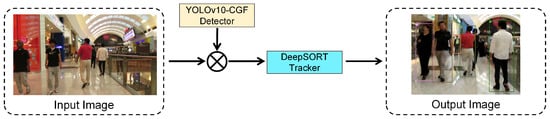
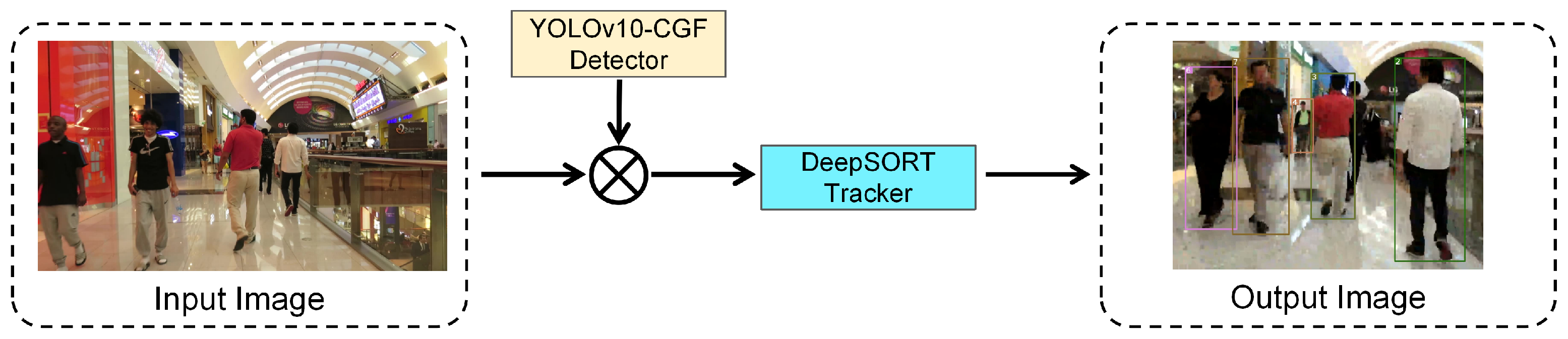
By integrating the improved YOLOv10s detector with the enhanced DeepSORT algorithm, the proposed system achieves robust pedestrian detection and tracking. Specifically, the modified YOLOv10s object detection algorithm processes each input video frame to generate bounding boxes, object categories, and confidence scores. This detection information is subsequently passed to the DeepSORT module. Within the DeepSORT framework, a Kalman filter is first applied to predict the object’s position in the current frame based on its location in the previous frame, producing corresponding prediction boxes. The detection boxes and prediction boxes then undergo cascaded matching and IoU-based association to ensure that the overlap between detected and predicted boxes satisfies a predefined threshold. The Hungarian algorithm is employed to correlate detection results between consecutive frames. This procedure is repeated iteratively until all video frames have been processed. The overall workflow of the target tracking system is illustrated in Figure 1.
Figure 1.
Whole process of pedestrian tracking.
3.2. YOLOv10s
YOLOv10 [6] was developed by the research team at Tsinghua University. It integrates the advantages of previous YOLO versions and introduces significant improvements in real-time detection. YOLOv10 incorporates spatial-channel decoupled downsampling. It also enhances feature extraction in the backbone network through large-kernel convolutions and partial self-attention mechanisms. Additionally, it adopts a dual-label assignment strategy in the detection head, eliminating the need for Non-Maximum Suppression (NMS) and substantially reducing inference latency. These advancements make it well-suited for real-time pedestrian detection and tracking. The YOLOv10 series offers six variants ranging from lightweight to high-performance models: YOLOv10n, s, m, b, l, and x. To meet the requirements of real-time performance and ease of deployment, the lightweight YOLOv10s was selected as the baseline model in this study.
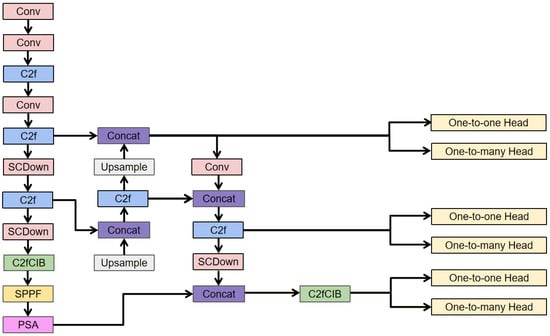
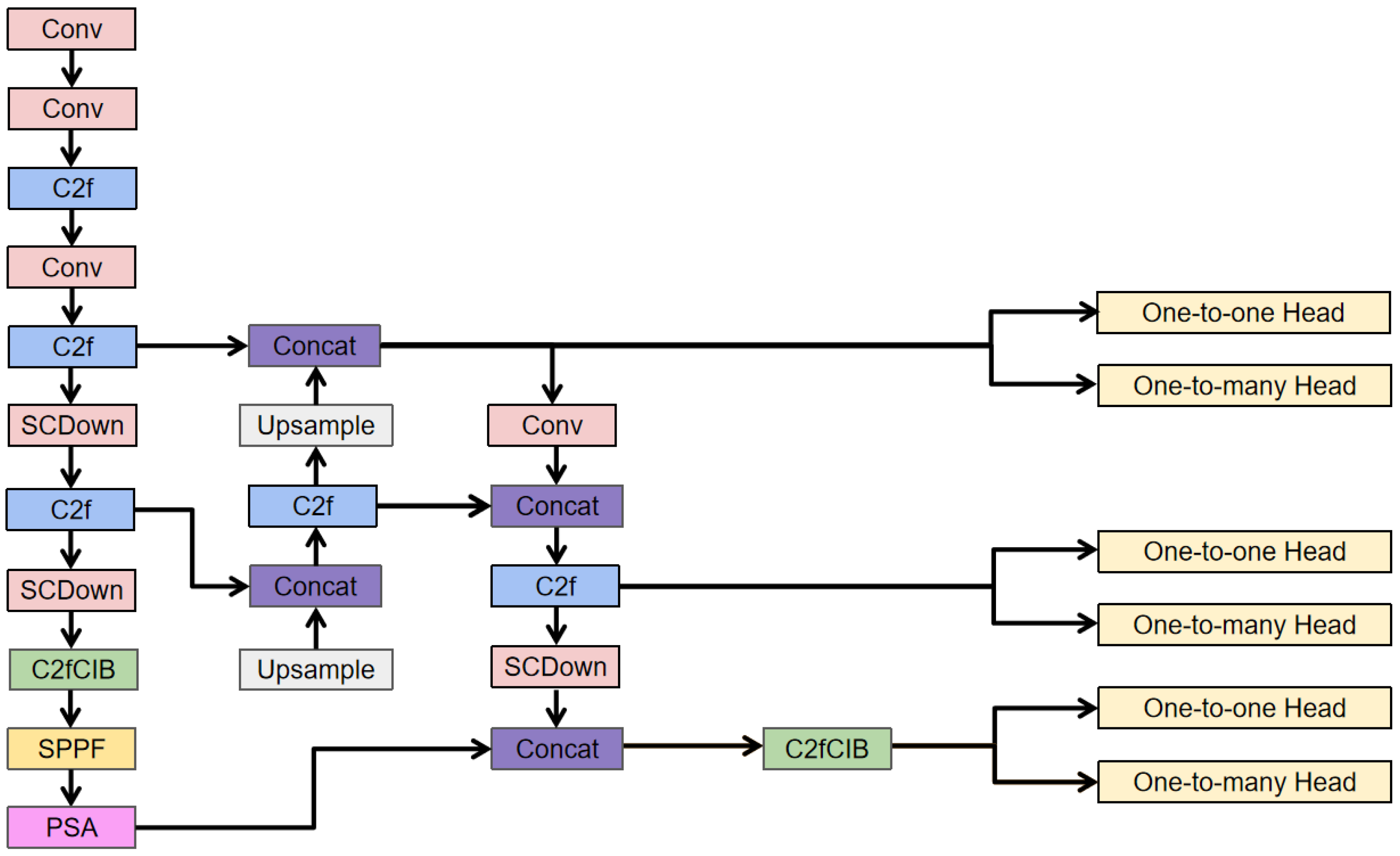
The network architecture of YOLOv10s, as illustrated in the Figure 2, consists of three main components: the backbone, the neck, and the detection head. The backbone is responsible for extracting multi-level feature information from input images. The neck focuses on feature fusion and enhancement. It aggregates features of different scales extracted by the backbone and forwards them to the head for object detection. The head performs target classification and location regression. It utilizes the fused features from the neck to output the final detection results, including object categories and positional information.
Figure 2.
The original YOLOv10s.
However, the complexity of detecting pedestrians poses challenges for the YOLOv10s model. This complexity stems from the unknown numbers and highly variable kinematic states of pedestrians. These factors lead to issues such as false positives and false negatives, which limit further improvements in pedestrian tracking performance. The primary challenges are as follows:
Post-NMS Processing: To ensure that the main detection head produces only one high-quality bounding box, the training strategy may prioritize more certain positive samples. In dense scenes, this can cause the model to overlook difficult samples, increasing the likelihood of missed detections.
Parameter Redundancy: The original feature extraction module relies on repeated convolution operations for feature fusion, resulting in significant parameter redundancy. This slows down inference speed. As a result, it becomes difficult to deploy on real-time detection devices. It also hinders the model’s ability to capture the diverse kinematic states of pedestrians.
Environmental Noise: Indoor environments often contain static obstacles with varying materials and colors. Additionally, pedestrians exhibit diverse appearance characteristics. This leads to significant environmental noise. And it reduces feature discriminability and contributes to both missed and false detections.
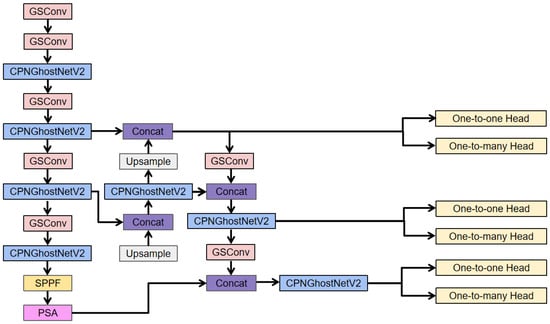
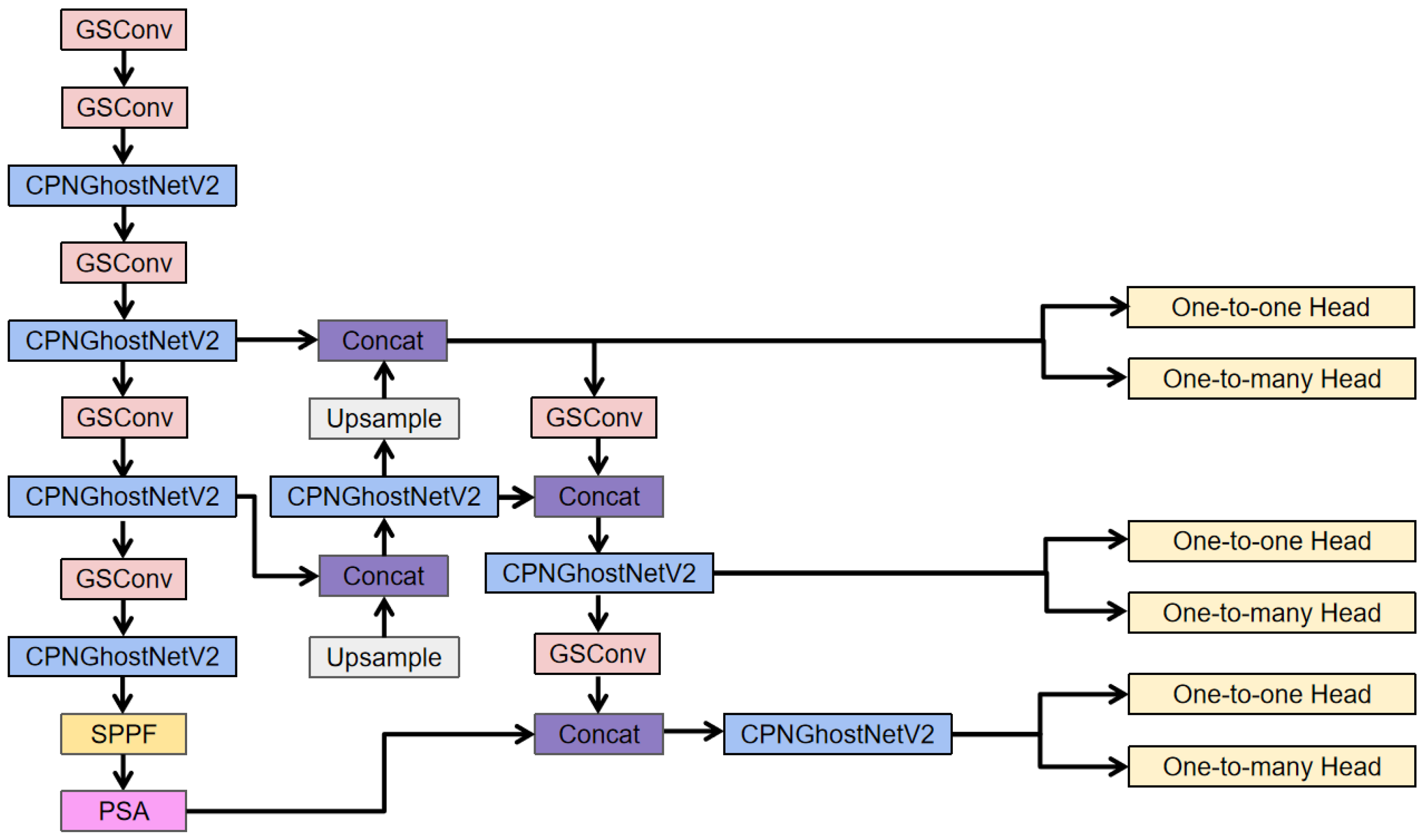
To address these challenges, this paper proposes improvements to the YOLOv10s network architecture shown in Figure 3. It results in the modified structure shown in the diagram. The key enhancements include:
Figure 3.
The improved YOLOv10s for pedestrian detection.
- 1.
- Integration of GSConv: The Conv modules in both the Backbone and Neck sections are replaced with GSConv modules to optimize computational efficiency.
- 2.
- Restructuring of C2f Modules: The residual structure of the C2f modules is retained. Meanwhile, the original Bottleneck modules within C2f are replaced with GhostNetV2 modules, forming CPNGhostNetV2 modules to enhance feature representation with reduced redundancy.
- 3.
- Adoption of Focal Loss: The original loss function is replaced with Focal Loss to improve detection robustness for small targets and in occlusion scenarios.
3.3. GSConv
For robots navigating in indoor public environments, quickly detecting pedestrian features is as crucial as accurately detecting them. However, when traditional convolutional neural networks extract features from images, issues such as feature information redundancy, high computational complexity, and excessive parameter counts arise. This makes it difficult to deploy target detection algorithms on edge devices. It also hinders the rapid generation of feature information. To address the aforementioned issues and inspired by [29], this paper introduces the GSConv module [30], as shown in Figure 4, on the basis of the YOLOv10s target detection model. This module replaces the Conv modules in both the backbone and neck networks of YOLOv10s. It aims to reduce model complexity and the number of parameters.
Figure 4.
GSConv module.
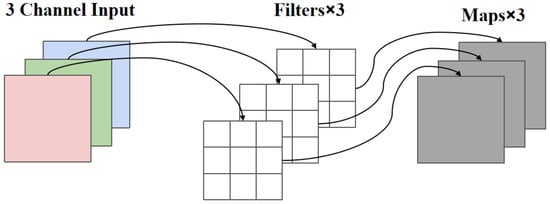
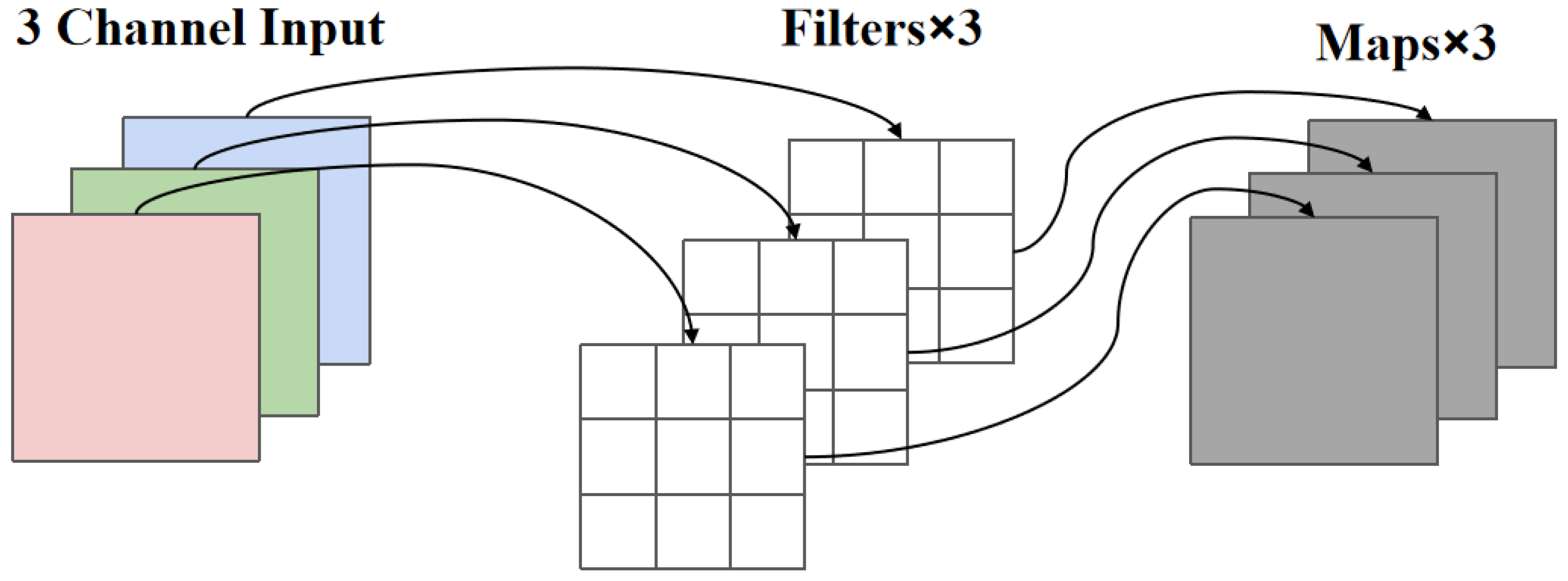
The core concept of the GSConv module is to reduce computational load by combining group convolution shown in Figure 5 and spatial convolution, dividing the conventional convolution process into two steps:
Figure 5.
DWConv module.
First, group convolution is performed. Before group convolution, the input image passes through a convolution layer for feature extraction, generating preliminary feature information. After extraction, the initially extracted features are divided into two groups. They then undergo convolution operations. This reduces the computational load per group while preserving feature extraction capability.
Finally, spatial convolution is performed. After the grouped feature information undergoes convolution operations, the two sets of feature information are merged and shuffled to produce the final output information.
3.4. CPNGhostNetV2
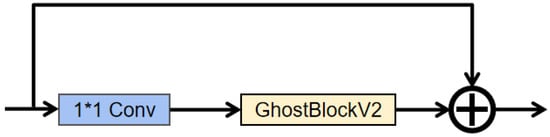
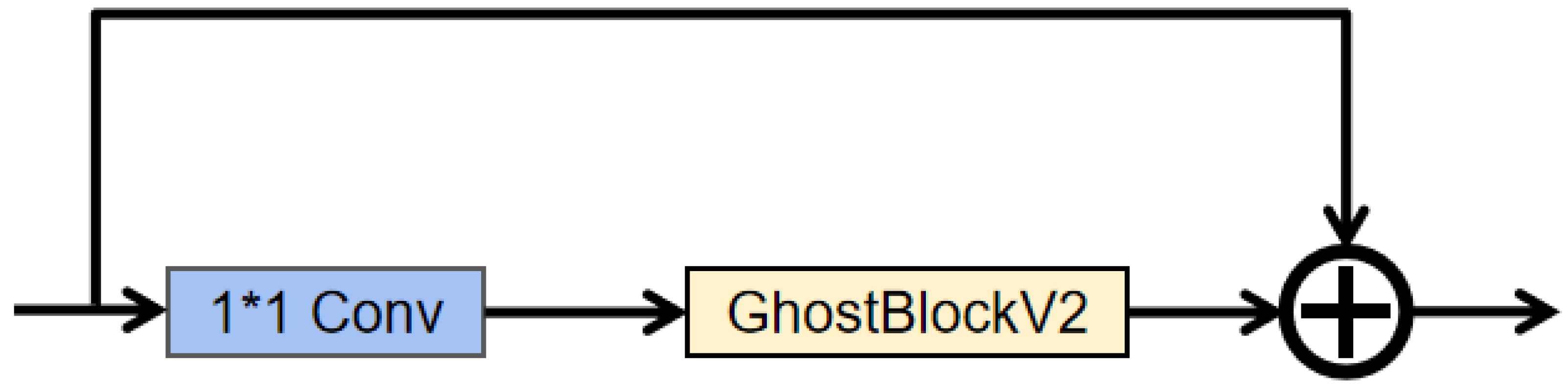
In indoor pedestrian detection tasks, pedestrian detection relies more on shape features and is susceptible to background interference. The C2f module in YOLOv10s can balance local and global feature information through Conv blocks and Bottleneck blocks. However, its structure suffers from high computational redundancy. This makes it difficult to simultaneously capture global and local feature information under lightweight constraints. Moreover, traditional lightweight networks achieve compactness by using fewer parameters to generate feature information. This limits their ability to capture global features. It also restricts further improvements in the accuracy of lightweight models. Therefore, building upon GhostNetV2 and inspired by [31,32], this paper proposes the CPNGhostNetV2 module as shown in Figure 6. This module enables the extraction of both global and local feature information while maintaining a lightweight design.
Figure 6.
CPNGhostNetV2 module.
As shown in Figure 6, the CPNGhostNetV2 module consists of GhostNetV2 [33] and a Conv module connected via residual links. It achieves better extraction of both global and local feature information while maintaining a lightweight network structure.
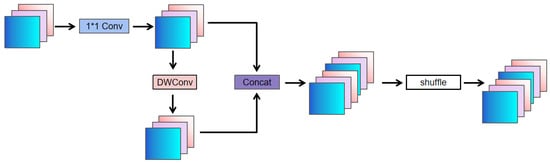
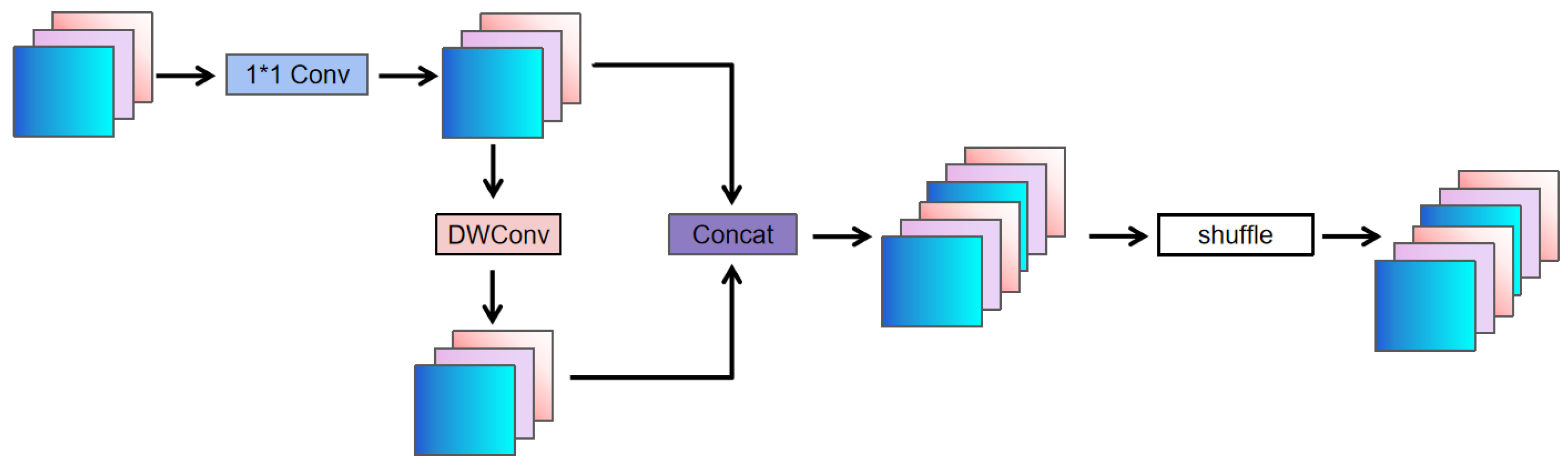
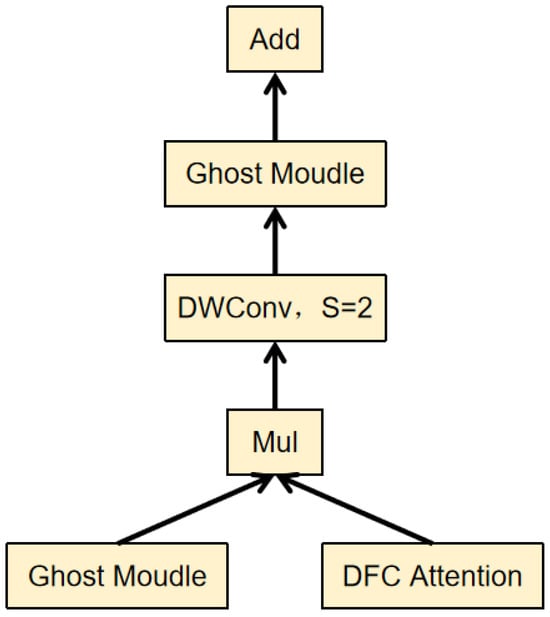
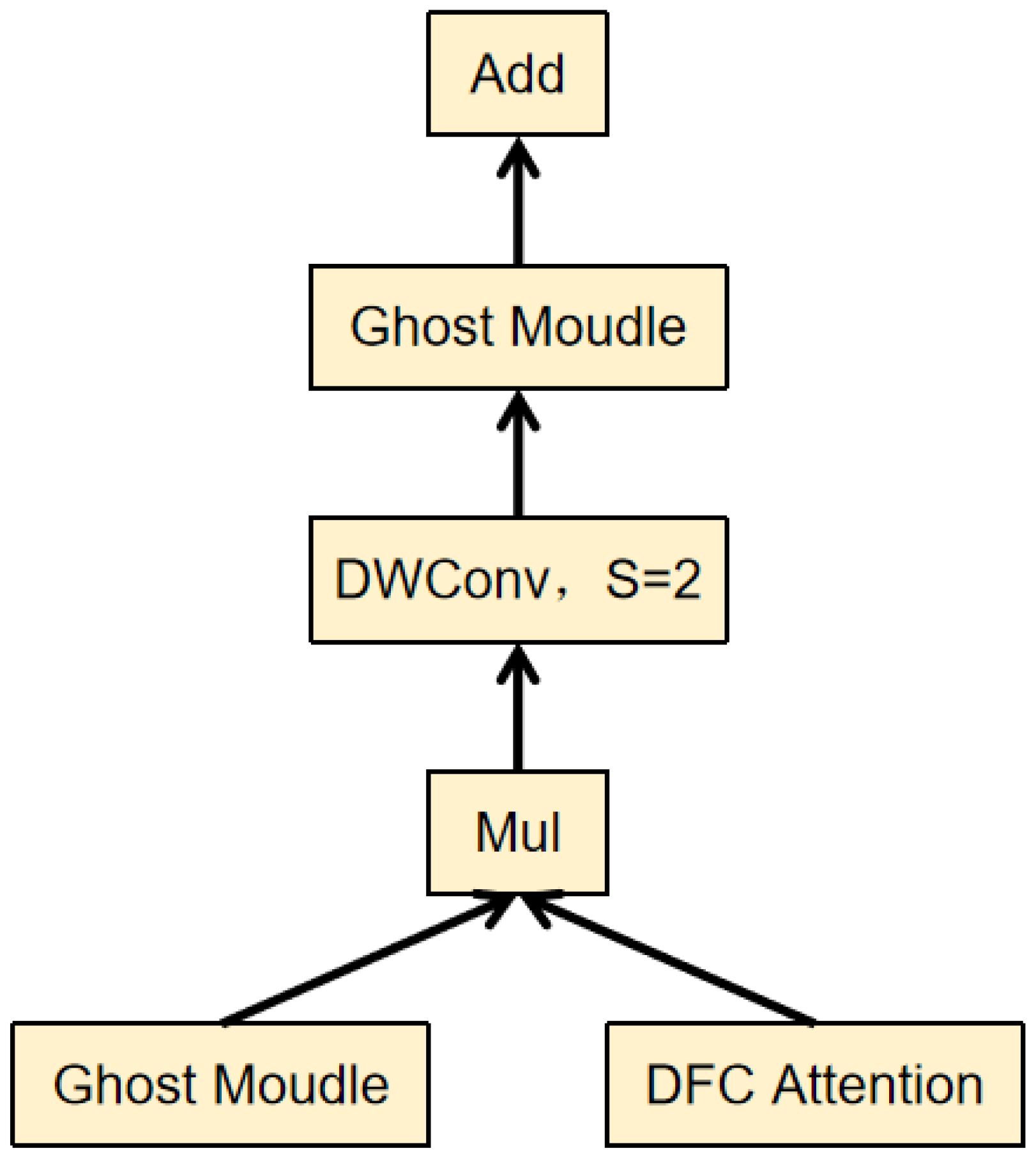
The GhostNetV2 module consists of a ghost module and a DFC attention mechanism module, as illustrated in Figure 7. It obtains local and global feature information by separately applying convolution and attention mechanism operations to the input feature map, followed by a concatenation operation. After initially generating feature information, the feature information is fed into two parallel paths. The first path passes through the ghost module shown in Figure 8. First, after obtaining the preliminary feature information, a small number of convolution kernels are used to generate part of the primary features. Then, the remaining features are concatenated with the primary features generated in the previous step to obtain local feature information, which can be expressed by the following formula:
where X represents the input features, denotes the 1*1 convolution, and represents depthwise separable convolution.
Figure 7.
GhostNetV2 module.
Figure 8.
Ghost module.
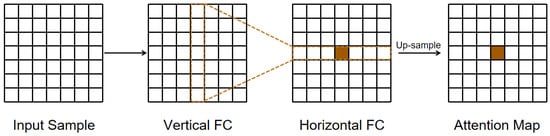
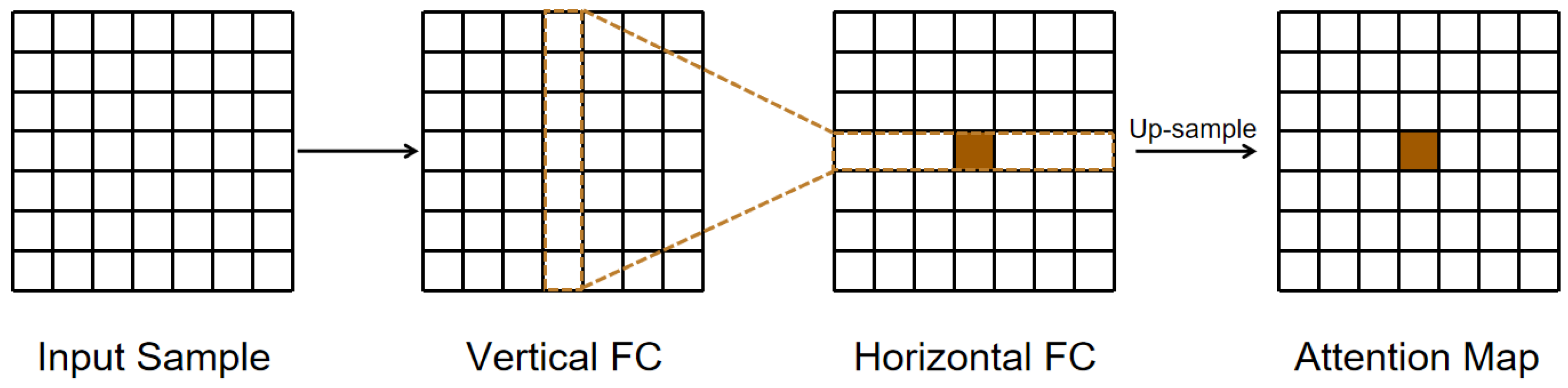
The second path passes through the DFC attention mechanism module shown in Figure 9. First, the input features are subjected to global average pooling along the height (H) and width (W) directions separately to obtain two direction-aware feature vectors. These two vectors are then processed through a 1*1 convolutional block and a Sigmoid activation function to derive horizontal attention information and vertical attention information. Finally, these two attention features are fused to obtain the final spatial attention information, as expressed by the following formula:
where ⊙ represents element-wise multiplication; and denote learnable weights; and and represent the input feature information. Combining and yields the attention feature information, denoted as A. Then, the feature information generated from the two channels is multiplied to obtain the final feature extraction information, expressed by the following formula:
where the purpose of is to normalize the output of the attention matrix to the range (0, 1), and represents the aforementioned Ghost convolution.
Figure 9.
DFC attention module.
3.5. Focal IoU
The loss function is a critical tool in object detection models, guiding the optimization direction of model parameters by quantifying the difference between predicted results and ground truth labels. IoU (intersection over union) is a key metric for measuring the overlap between ground truth boxes and predicted boxes, expressed as
The loss function of YOLOv10s is CIoU, which builds upon IoU by incorporating constraints on the aspect ratio of bounding boxes. It comprehensively considers the overlap area, center point distance, and aspect ratio, with its mathematical expression as follows:
where represents the squared Euclidean distance between the centers of the ground truth box and the predicted box; is a weighting coefficient that balances the contributions of the center point distance and the aspect ratio; and is a parameter that constrains the consistency of the aspect ratios between the predicted box and the ground truth box. The CIoU loss function can effectively measure the overlap between predicted and ground truth bounding boxes. However, in indoor public scenes with various static obstacles and diverse kinematic states of pedestrians, indoor pedestrian detection tasks demand higher detection accuracy for small and occluded targets. Additionally, due to the unknown number of pedestrians, the target detection area may be significantly smaller than the background area, which can exacerbate the imbalance between positive and negative samples. And it leads to false positives and missed detections. Therefore, to address the above issues, Focal IoU is adopted as a replacement for CIoU. The Focal IoU loss function is an improved object detection loss that combines the concept of Focal Loss with IoU loss. Building upon IoU, it introduces a balancing factor to mitigate the influence of negative samples. It prevents excessive impact from an abundance of negative samples on the loss. Additionally, a focusing factor is incorporated to adjust the model’s emphasis on easy-to-classify versus hard-to-classify samples. Its mathematical expression is as follows:
where is the predicted probability of the target class by the model, is a balancing factor used to adjust the influence between positive and negative samples, and is a focusing factor used to adjust the weights of easy and hard samples.
3.6. DeepSORT
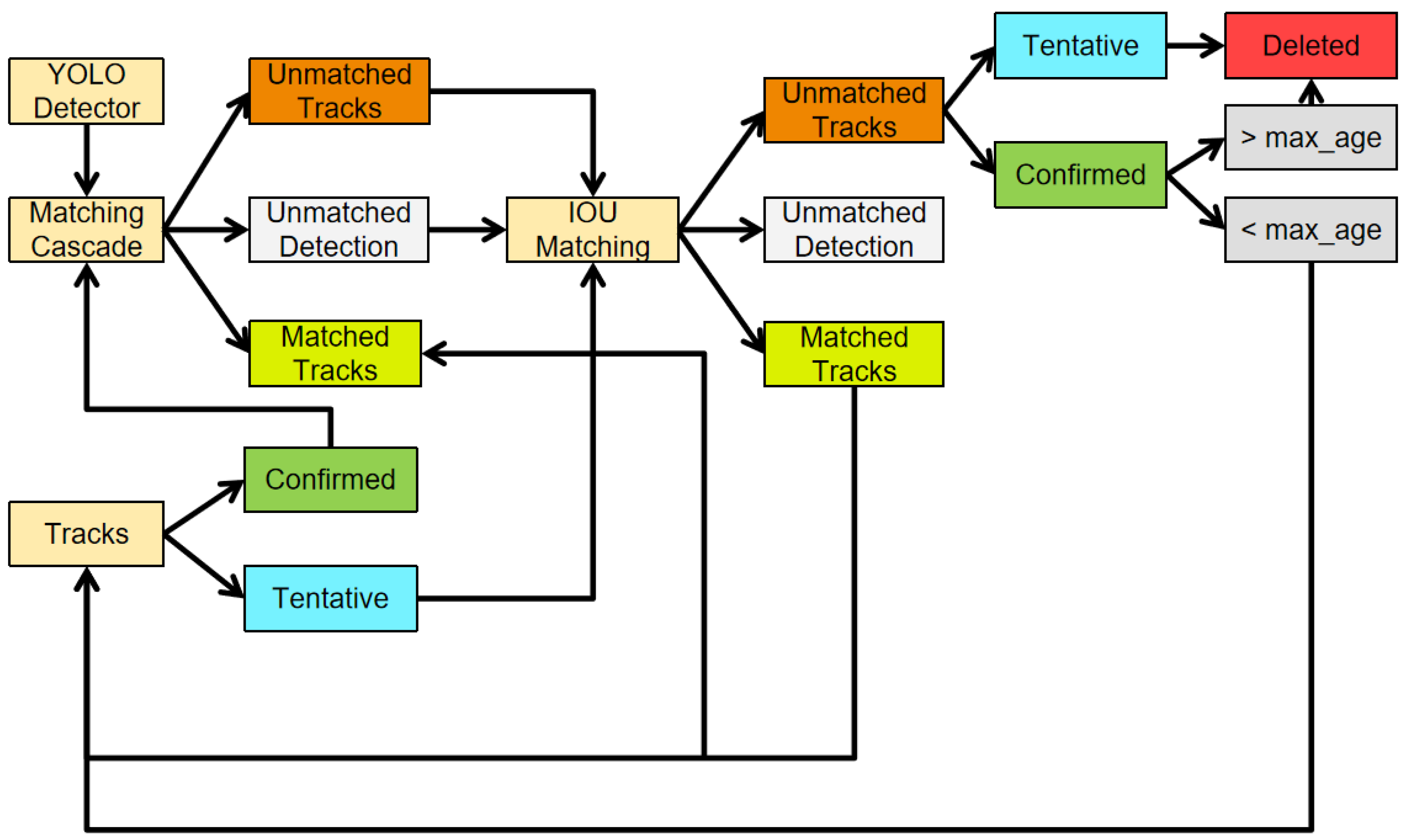
The SORT algorithm utilizes a simple Kalman filter to manage frame-to-frame data association and employs the Hungarian algorithm for correlation evaluation. And it demonstrates good performance at high frame rates. However, SORT relies solely on motion information, maintaining high accuracy only when the uncertainty of pedestrian states is low. Moreover, to improve tracking efficiency, SORT removes unmatched targets across consecutive frames, leading to frequent ID-switching issues. As a result, its tracking performance is poor in occluded environments. Building upon the SORT algorithm, DeepSORT integrates target motion information and appearance information by using a ReID network as association metrics and introduces cascade matching. This effectively addresses the frequent ID-switching problems encountered by SORT in scenarios such as target occlusion and similar appearances. Figure 10 presents the processing flow of DeepSORT, which can be broken down into the following steps:
Figure 10.
The original DeepSORT.
The first step involves initialization. In the first frame of the video, a new track is created for each detected target based on the output of the target detector.
In step two, the Kalman filter algorithm is used to predict the positions and velocities of all tracks in the next frame, while in each frame, the YOLO detector identifies the bounding boxes of all targets.
Step three is IoU matching. The predicted tracks from the previous frame are compared with the detection results of the current frame, and an IOU matrix (as shown in the equation) is computed. The Hungarian algorithm is then applied to optimize the matching based on the cost matrix. In this process, three scenarios may arise: First, when a detection box successfully matches a track, the Kalman filter algorithm is used to update the state of the track. Second, if the number of consecutive unmatched frames exceeds a predefined threshold, these unmatched tracks are directly deleted when it comes to unmatched tracks. Third, when a detection box fails to match any predicted box (Unmatched Detections), the Hungarian algorithm is employed to address the mapping problem between new detection and the predicted Kalman states. Taking both motion and appearance information into account, the Mahalanobis distance between them is defined based on the specified Equation (8).
where represents the projection of the i-th track distribution in the measurement space, and denotes the j-th bounding box detection. In step four, cascade matching is performed using appearance features. If the tracks are successfully matched at this stage, the corresponding track variables are directly updated via the Kalman filter algorithm; otherwise, the system returns to step three to repeat the IOU matching process. The above steps are then iteratively executed until the video concludes.
However, during pedestrian tracking in indoor public scenes, detected pedestrians inevitably disappear briefly from the field of view due to the diversity of pedestrian kinematic states. Enhancing detector performance in densely occluded environments is widely recognized as essential for improving tracking performance. However, the existing DeepSORT tracking algorithm determines whether a trajectory matches a detection by setting a fixed frame threshold. In other words, from the perspective of pedestrian tracking, pedestrians seem to appear out of nowhere or suddenly vanish from the field of view. This contradicts the actual kinematic behavior of pedestrians in real-world scenarios.
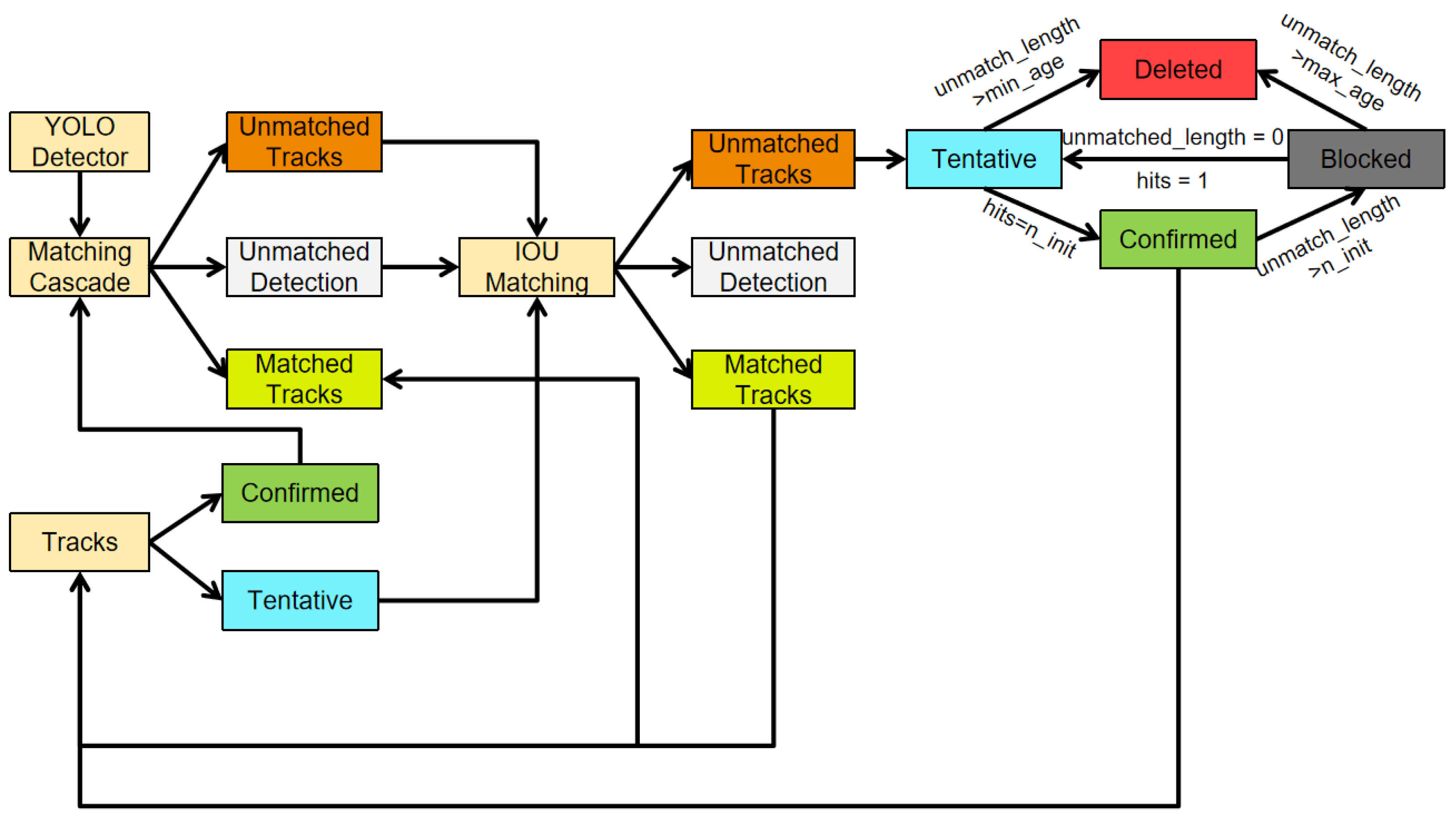
To address the above issues and inspired by [34], this paper proposes a novel trajectory management mechanism based on the original DeepSORT framework, incorporating historical trajectory information into the matching process. The improved DeepSORT algorithm workflow is illustrated in Figure 11.
Figure 11.
The improved DeepSORT.
First, trajectories are defined into four states: tentative, confirmed, occluded, and deleted. All unmatched tracks are initially set to the tentative state, with the hits marked as 1. When the consecutive matching count reaches the threshold, the trajectory state transitions from tentative to confirmed. If the unmatched length exceeds the threshold, the trajectory is set to the occluded state. This temporarily retains the trajectory to avoid missed tracking. When an occluded trajectory’s consecutive mismatch count exceeds the max age, or a tentative trajectory’s consecutive mismatch count exceeds the deletion threshold, the target is considered permanently lost. It then transitions to the deleted state.
3.7. Experimental Method
3.7.1. Dataset
This study employed the open-source WiderPerson dataset [11] to train the YOLO-based object detection algorithm. The WiderPerson dataset consists of 8975 RGB images with a resolution of 640 × 640 pixels. The dataset was split into training, testing, and validation sets in an 8:1:1 ratio. This resulted in 6461 images for training, 1616 for testing, and 898 for validation. However, the images in the WiderPerson dataset do not constitute continuous motion sequences. Therefore, they are unsuitable for validating pedestrian tracking algorithms. To address this, the MOT16 dataset [35] was adopted in this study to evaluate the performance of the improved object tracking algorithm.
Introduced in 2016, MOT16 serves as a benchmark for multi-object tracking. It provides a standardized platform for evaluating both detection and tracking methods, with a specific focus on pedestrian tracking. The dataset comprises 14 video sequences. Seven of these were annotated and used as the training set, while the remaining seven formed the test set. The sequences MOT-05, MOT-10, and MOT-11 contain indoor video data. Their resolutions are 640 × 480, 1920 × 1080, and 1920 × 1080, respectively.
3.7.2. Experimental Setup
The entire training process was conducted within the PyTorch deep learning framework. The hardware experimental setup included an Intel Core i7 13th generation processor and an NVIDIA GeForce RTX 4090 GPU (48 GB). The software environment comprised Ubuntu 20.04 as the operating system, PyTorch version 1.13.0, CUDA 11.7, and Python 3.8.10 as the programming language. And the learning rate and batch size were set to 0.01 and 64, respectively, with 200 training epochs.
3.7.3. Evaluation Metrics
To evaluate the practical effectiveness of the aforementioned improvements, this study divided the experiments into two parts. The first part was the YOLOv10s validation experiment. Precision, mean average precision (mAP), recall, model parameters, and floating-point operations (FLOPs) were used as evaluation metrics. The formulas and meanings of these metrics are as follows:
- (1)
- Precision (P): This metric indicates the proportion of correctly predicted boxes among all boxes predicted by the model. Here, TP (True Positives) represents the number of correctly predicted positive instances, while FP (False Positives) denotes the number of negative instances incorrectly predicted as positive. The formula is defined as
- (2)
- Recall (R): This metric represents the proportion of actual targets that are successfully detected. Here, FN (False Negatives) refers to positive instances incorrectly classified as negative. The formula is defined as
- (3)
- Mean Average Precision (mAP): mAP is the average of the AP (average precision) values across all categories, reflecting the model’s overall performance in both localization and classification. Here, N represents the total number of categories, and denotes the AP value for the i-th category. Specifically, mAP@0.5 refers to the average precision calculated at an IoU (intersection over union) threshold of 0.5. Its formula is defined as
- (4)
- Parameter Count: This metric refers to the total number of trainable parameters in the model. The parameter count directly reflects the model’s complexity—generally, a higher parameter count indicates greater model capacity. However, models with a large number of parameters require more storage space and may face limitations when deployed on edge devices.
- (5)
- Giga Floating-Point Operations Per Second (GFLOPS): This metric represents the number of billions of floating-point operations executed by the model per second, serving as a measure of computational complexity. Here, 1 GFLOPS equals FLOPS. A higher GFLOPS value indicates that the model requires more computational resources during inference.
- (6)
- FPS: The number of independent image frames the system can process per second when selected (frames per second).
The second part involves the validation experiment for the tracking algorithm. The evaluation is conducted using Multi-Object Tracking Accuracy (MOTA), Multi-Object Tracking Precision (MOTP), Identity F1 Score (IDF1), and identity switches (IDS). The formulas and meanings of these metrics are as follows:
- (1)
- Multi-Object Tracking Accuracy (MOTA): This metric comprehensively considers factors such as missed detections, false positives, and identity errors, making it one of the primary indicators for evaluating MOT performance. Its expression iswhere indicates instances where the tracking algorithm fails to detect a real target that actually exists. indicates instances where the tracking algorithm mistakenly marks the background or a non-existent object as a target. indicates the number of identity switches in the tracking sequence, where a target’s identity changes from one to another during the tracking process. indicates the total number of real targets that actually exist in the tracking sequence.
- (2)
- Multi-Object Tracking Precision (MOTP): This metric measures the average distance between predicted trajectories and their corresponding ground truth trajectories, reflecting the accuracy of tracking results. Its expression iswhere represents the total number of matches at frame t, and represents the distance value between the i-th hypothesized bounding box and the ground truth bounding box at frame t.
- (3)
- Identity F1 Score (IDF1): This metric takes into account the number of correctly matched targets and the number of unmatched targets, serving as an evaluation of target-level tracking performance. It is the harmonic mean of identification precision and identification recall, used to assess the stability of tracking algorithms. Its expression iswhere IDTP refers to correctly matched target identities, where ground truth targets are accurately matched with tracking results. IDFP refers to incorrectly matched target identities, where ground truth targets are erroneously matched with tracking results. IDFN refers to ground truth target identities that are not matched, meaning the ground truth targets are not matched with any tracking results.
- (4)
- Identity Switches (IDS): This metric refers to the number of times the identity of a tracked target changes. A lower value indicates better tracking stability.
4. Experimental Results
4.1. Comprehensive Comparative Experiments on Object Detection
To validate the detection performance of the improved YOLOv10s model for pedestrians detection, comparative experiments were conducted with identical configurations and using the same dataset. The improved model was compared with YOLOv3-tiny, YOLOv3, YOLOv5s, YOLOv7-tiny, YOLOv8s, and YOLOv10s. The detection results of each model are summarized in Table 1.
Table 1.
Comprehensive comparative experiments of each object detection method.
As shown in Table 1, the proposed YOLOv10s-CGF algorithm demonstrates improvements across various performance metrics compared to YOLOv3-tiny, YOLOv5s, YOLOv7-tiny, and YOLOv10s. Specifically, precision increased by 6.8%, 1.9%, 3.2%, and 0.9%, respectively, relative to these models. When compared to YOLOv3, although precision decreased by 6.9%, the number of parameters and GFLOPs were reduced by 89.2% and 89.4%, respectively. Similarly, compared to YOLOv8s, precision decreased by 1.5%, but both parameter count and computational complexity were reduced by 40.2% and 42.7%, respectively. Therefore, the proposed YOLOv10s-CGF algorithm achieves superior performance in indoor pedestrian target detection compared to other mainstream algorithms, further validating the effectiveness of the proposed improvements.
4.2. Ablation Study of YOLOv10
To fairly evaluate the performance improvements contributed by each module introduced in this study, ablation experiments were conducted. Specifically, the Focal Loss function, CPNGhostNetV2 module, and GSConv module were individually and jointly integrated into the original YOLOv10s for comparative testing. The ablation results of YOLOv10-CGF, measured by metrics including mAP, model size, GFLOPs, and parameter count, are presented in Table 2.
Table 2.
Ablation study results of YOLOv10s.
As shown in Table 2, after introducing the Focal Loss function, the mean average precision (mAP) of the improved model increased by 1.4% compared to YOLOv10s. This indicates an overall enhancement in detection performance. The parameter count of the modified model decreased by approximately 29.2%, significantly reducing computational costs. Following the replacement of the loss function, the mAP improved by 1.7% without additional computational overhead, demonstrating enhanced model generalization, increased attention to small and occluded targets, and effective mitigation of sample imbalance issues. Subsequently, replacing all C2f modules with CPNGhostNetV2 modules led to a significant reduction in parameters compared to the original YOLOv10s model, albeit with a minor trade-off in precision. Finally, the introduction of the GSConv module further reduced the parameter count, achieving 16.1 GFLOPs and effectively improving the inference speed of the model.
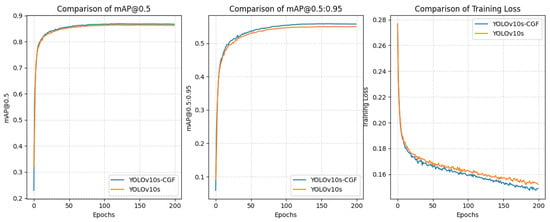
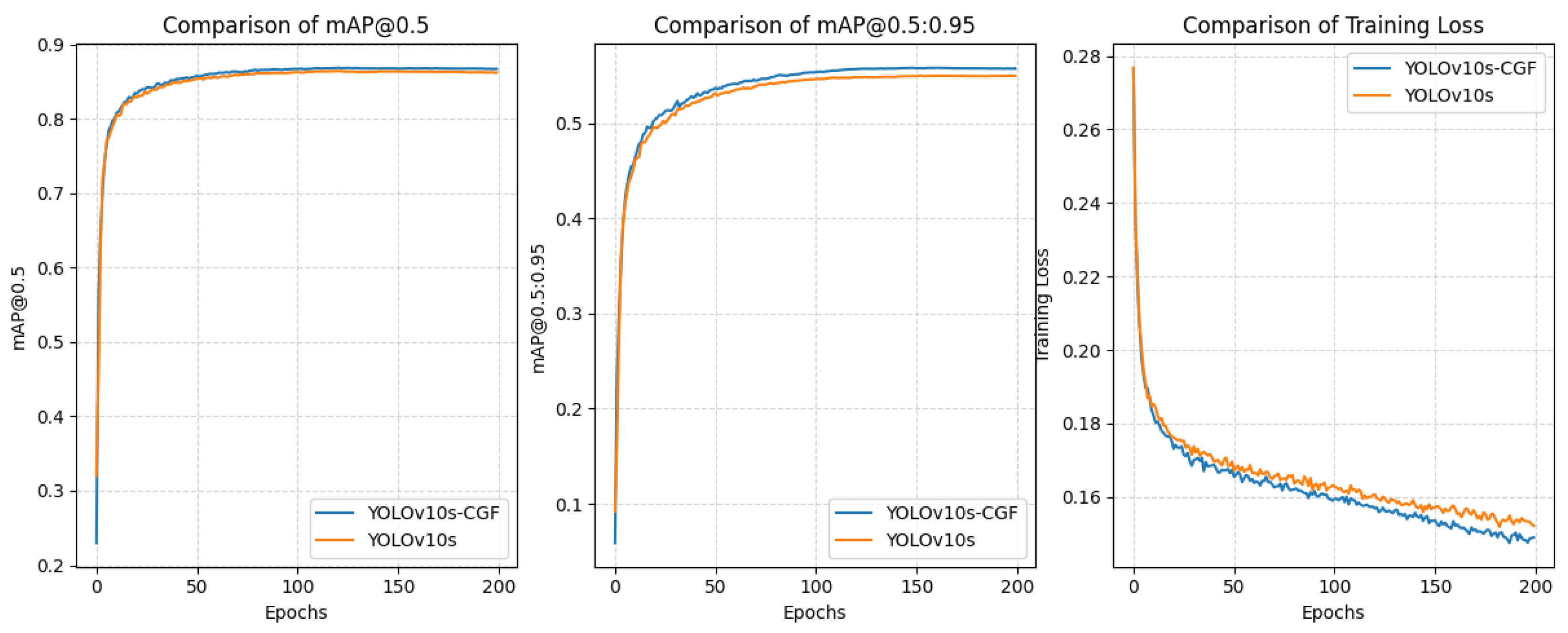
Figure 12 shows the comprehensive performance metric curves before and after model refinement. The YOLOv10s-CGF model exhibits a higher final convergence value for mAP. This indicates that the refined model effectively learns pedestrian features, resulting in a relatively stable improvement in pedestrian recognition accuracy.
Figure 12.
Training curve of YOLOv10s detection.
4.3. Comparative Experiments on Object Tracking
This study adopted SORT, YOLOv3 + DeepSORT, and YOLOv5s + StrongSORT as baselines. Three video sequences-MOT16-05, MOT16-10, and MOT16-11-from the MOT16 [33] training dataset were selected for comprehensive experiments with the proposed detection and tracking algorithm. Additionally, ablation studies were conducted to validate the effectiveness of the improved algorithm. The experimental results are presented in Table 3.
Table 3.
Performance comparison of each tracking module.
As shown in Table 3, compared to the SORT algorithm, the improved YOLOv10 + DeepSORT algorithm achieves enhancements of 11.1%, 10.5%, and 1.1% in MOTA, MOTP, and IDF1, respectively, while reducing IDS by 229 instances. Similarly, the improved YOLOv10s+enhanced DeepSORT algorithm outperforms SORT with improvements of 12.9%, 11.8%, and 7.8% in MOTA, MOTP, and IDF1, respectively, and reduces IDS by 316 instances.
Compared to YOLOv5 + StrongSORT, the improved YOLOv10s + DeepSORT algorithm demonstrates increases of 4.7% and 10.5% in MOTA and MOTP, respectively, while reducing IDS by 25 instances. Although IDF1 shows a slight decline, the improvements in other metrics are notable. The improved YOLOv10s + enhanced DeepSORT algorithm further improves MOTA and MOTP by 6.5% and 11.8%, respectively, and reduces IDS by 112 instances.
The proposed improved YOLOv10 object detection model maintains detection accuracy while reducing computational complexity and improving detection speed. This leads to enhanced MOTA when combined with DeepSORT. Furthermore, integrating the improved DeepSORT with the YOLOv10 detection model yields additional improvements in MOTA, MOTP, and IDF1, along with a reduction in IDS.
Table 3 indicates that the improved YOLOv10 + enhanced DeepSORT algorithm achieves the best performance in MOTA, MOTP, and IDS. Therefore, it can be concluded that the synergistic combination of the improved YOLOv10 and enhanced DeepSORT algorithms collectively contributes to the advancement of indoor pedestrian detection and tracking performance.
4.4. Visual Analysis of Improved YOLOv10s and DeepSORT
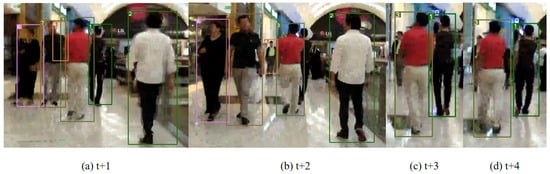
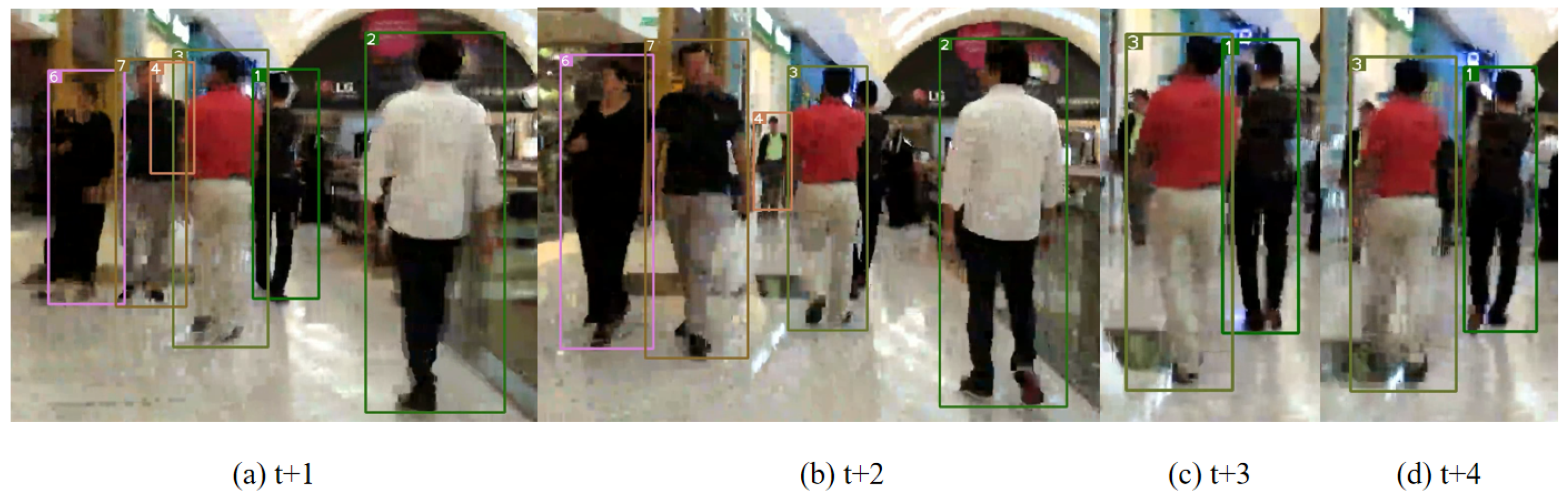
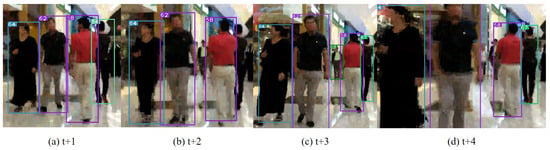
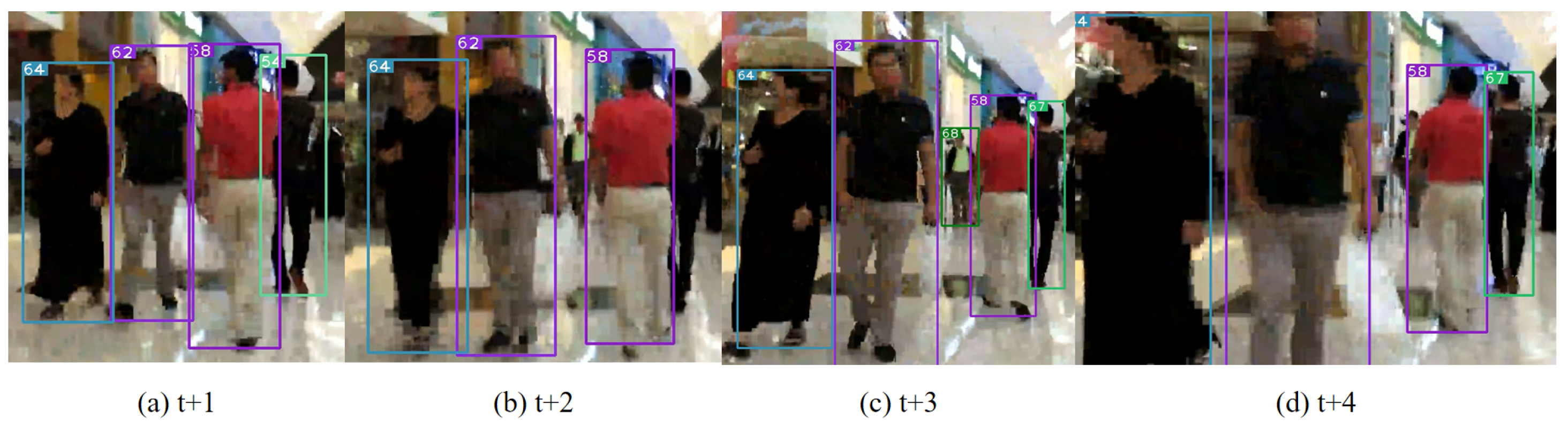
Also, to provide a more intuitive demonstration of the tracking performance of the improved algorithm, visualizations of selected video sequences from the MOT16 dataset are presented as illustrated in Figure 13 and Figure 14.
Figure 13.
The improved YOLOv10 and DeepSORT in the MOT16 dataset.
Figure 14.
The original YOLOv10 and DeepSORT in the MOT16 dataset.
As shown in Figure 13 and Figure 14, in the improved DeepSORT algorithm, the target with ID 1 maintains the same ID after being occluded. This avoids the issue of ID reassignment that typically occurs after occlusion. The results demonstrate that the improved algorithm not only enhances detection accuracy and efficiency but also handles occlusion more effectively. This leads to more stable tracking outcomes, which contributes positively to subsequent robot navigation tasks in indoor pedestrian tracking.
5. Discussion
5.1. Contribution
This paper presents an enhanced pedestrian detection and tracking framework based on the tracking-by-detection (TBD) paradigm. The framework incorporates an improved YOLOv10s detector and an enhanced DeepSORT tracker. To address the practical requirements of dense pedestrian navigation in indoor environments, both components are optimized to achieve more efficient hardware execution while improving overall tracking accuracy.
Specifically, for YOLOv10s, the standard Conv and C2f modules are replaced with GSConv and CPNGhostNetV2 modules, respectively. This reduces model complexity while maintaining detection precision. Additionally, the Focal Loss function is introduced to further enhance detection accuracy following model lightweighting. Concurrently, a novel trajectory management mechanism is integrated into the original DeepSORT architecture to better handle occlusions and intermittent observations.
The experimental results demonstrate that the improved YOLOv10s achieves substantial reductions in both computational complexity and parameter count. Compared to the baseline model, the enhanced version reduces computational complexity by 33.9% and the number of parameters by 17.4%. It also improves mAP@50 by 0.6 percentage points. When integrated with the improved DeepSORT, the proposed tracking system exhibits notable gains in tracking accuracy and robustness, with a significant reduction in identity switches.
Evaluation on the MOT16 benchmark dataset shows that the enhanced YOLOv10s-DeepSORT algorithm outperforms the original YOLOv5-DeepSORT baseline. It achieves a 7.0% increase in MOTA (Multi-Object Tracking Accuracy) and a 1.4% improvement in MOTP (Multi-Object Tracking Precision) while reducing the frequency of identity switches by 24.8%.
5.2. Limitations and Future Work
However, since the YOLOv10s object detector was trained on the Widerperson dataset, it can only detect individual pedestrians in the environment or test videos. It fails to recognize pedestrians with different social statuses or characteristics in diverse scenarios—for example, distinguishing shoppers carrying baskets from those pushing carts in supermarkets, elderly people from children, or pedestrians moving in groups. This limitation constrains the robot’s navigation performance in various indoor crowded environments. In future work, we will investigate approaches to improving detection accuracy and constructing a dedicated dataset for indoor pedestrian detection so as to identify pedestrians in diverse social states and with distinct social characteristics.
6. Conclusions
This paper proposes a track-before-detect (TBD)-based pedestrian tracking algorithm for indoor pedestrian tracking research. The algorithm combines an improved YOLOv10s detector with an enhanced DeepSORT algorithm, and its objective is to develop lightweight models that meet practical application requirements. Based on YOLOv10s, we introduce GSConv and CPNGhostNetV2 modules. These modules are designed to reduce model parameters while maintaining the detection accuracy of the original YOLOv10s. Finally, the Focal Loss function is incorporated to further improve the detection accuracy after lightweighting. Simultaneously, a novel trajectory management mechanism is introduced into the original DeepSORT framework. The experimental results show that the improved YOLOv10s achieves optimization in both computational complexity and detection performance. Compared with the original model, the modified YOLOv10s exhibits a 33.9% reduction in computational complexity and a 17.4% decrease in parameter count. Its mean average precision at 50 intersection over union (mAP@50) is increased by 0.6%. When combined with the improved DeepSORT, the tracking accuracy is improved and the number of ID-switching events is significantly reduced. Compared with the original YOLOv5-DeepSORT, the enhanced DeepSORT algorithm achieves a 7.0% increase in the multiple object tracking accuracy (MOTA) and a 1.4% increase in the multiple object tracking precision (MOTP). It also reduces ID-switching events by 24.8%, which meets the requirements of practical applications.
Author Contributions
S.H. responsible for programming and article writing; C.L. completed the correction and proofreading of the article. All authors have read and agreed to the published version of the manuscript.
Funding
This study was funded by the Xinjiang Uygur Autonomous Region Central Guided Local Science and Technology Development Funds Project, Project No. ZYYD2025QY17.
Data Availability Statement
The data presented in this study are available on request from the corresponding author, within reasonable limits.
Conflicts of Interest
The authors declare no conflicts of interest. The funders had no role in the design of the study; in the collection, analyses, or interpretation of data; in the writing of the manuscript; or in the decision to publish the results.
References
- Ren, S.; He, K.; Girshick, R.; Sun, J. Faster R-CNN: Towards real-time object detection with region proposal networks. IEEE Trans. Pattern Anal. Mach. Intell. 2016, 39, 1137–1149. [Google Scholar] [CrossRef] [Scilit] [PubMed]
- Redmon, J.; Divvala, S.; Girshick, R.; Farhadi, A. You only look once: Unified, real-time object detection. In Proceedings of the IEEE Conference on Computer Vision and Pattern Recognition; IEEE: Piscataway, NJ, USA, 2016. [Google Scholar]
- Redmon, J.; Farhadi, A. Yolov3: An incremental improvement. arXiv 2018, arXiv:1804.02767. [Google Scholar] [CrossRef] [Scilit]
- Liu, W.; Anguelov, D.; Erhan, D.; Szegedy, C.; Reed, S.; Fu, C.Y.; Berg, A.C. Ssd: Single shot multibox detector. In Proceedings of the European Conference on Computer Vision; Springer International Publishing: Cham, Switzerland, 2016. [Google Scholar]
- Sohan, M.; Sai Ram, T.; Rami Reddy, C.V. A review on yolov8 and its advancements. In Proceedings of the International Conference on Data Intelligence and Cognitive Informatics; Springer: Singapore, 2024. [Google Scholar]
- Wang, A.; Chen, H.; Liu, L.; Chen, K.; Lin, Z.; Han, J.; Ding, G. Yolov10: Real-time end-to-end object detection. Adv. Neural Inf. Process. Syst. 2024, 37, 107984–108011. [Google Scholar]
- Khanam, R.; Hussain, M. Yolov11: An overview of the key architectural enhancements. arXiv 2024, arXiv:2410.17725. [Google Scholar] [CrossRef] [Scilit]
- Tian, Y.; Ye, Q.; Doermann, D. Yolov12: Attention-centric real-time object detectors. arXiv 2025, arXiv:2502.12524. [Google Scholar]
- Zhang, H.; Li, F.; Liu, S.; Zhang, L.; Su, H.; Zhu, J.; Ni, L.M.; Shum, H.Y. Dino: Detr with improved denoising anchor boxes for end-to-end object detection. arXiv 2022, arXiv:2203.03605. [Google Scholar]
- Zhao, Y.; Lv, W.; Xu, S.; Wei, J.; Wang, G.; Dang, Q.; Liu, Y.; Chen, J. Detrs beat yolos on real-time object detection. In Proceedings of the IEEE/CVF Conference on Computer Vision and Pattern Recognition; IEEE: Piscataway, NJ, USA, 2024. [Google Scholar]
- Zhang, S.; Xie, Y.; Wan, J.; Xia, H.; Li, S.Z.; Guo, G. Widerperson: A diverse dataset for dense pedestrian detection in the wild. IEEE Trans. Multimed. 2019, 22, 380–393. [Google Scholar]
- Gao, F.; Cai, C.; Jia, R.; Hu, X. Improved YOLOX for pedestrian detection in crowded scenes. J. Real-Time Image Process. 2023, 20, 24. [Google Scholar] [CrossRef] [Scilit]
- Sun, C.; Wang, X.; Yang, K.; Liu, C.; Sun, C. Enhanced-YOLOv8n: Depth for small-scale pedestrian detection research on learning algorithms. In Proceedings of the IET Conference Proceedings CP989; The Institution of Engineering and Technology: Stevenage, UK, 2024; Volume 2024. [Google Scholar]
- Ye, H..; Wang, Y. Residual transformer YOLO for detecting multi-scale crowded pedestrian. Appl. Sci. 2023, 13, 12032. [Google Scholar] [CrossRef] [Scilit]
- Wang, C.-Y.; Bochkovskiy, A.; Liao, H.-Y.M. YOLOv7: Trainable bag-of-freebies sets new state-of-the-art for real-time object detectors. In Proceedings of the IEEE/CVF Conference on Computer Vision and Pattern Recognition; IEEE: Piscataway, NJ, USA, 2023. [Google Scholar]
- Li, N.; Bai, X.; Shen, X.; Xin, P.; Tian, J.; Chai, T.; Wang, Z. Dense pedestrian detection based on GR-YOLO. Sensors 2024, 24, 4747. [Google Scholar] [CrossRef] [Scilit] [PubMed]
- Zhang, L.; Li, Y.; Nevatia, R. Global data association for multi-object tracking using network flows. In Proceedings of the 2008 IEEE Conference on Computer Vision and Pattern Recognition; IEEE: Piscataway, NJ, USA, 2008. [Google Scholar]
- Pirsiavash, H.; Ramanan, D.; Fowlkes, C.C. Globally-optimal greedy algorithms for tracking a variable number of objects. In Proceedings of the CVPR 2011; IEEE: Piscataway, NJ, USA, 2011. [Google Scholar]
- Berclaz, J.; Fleuret, F.; Turetken, E.; Fua, P. Multiple object tracking using k-shortest paths optimization. IEEE Trans. Pattern Anal. Mach. Intell. 2011, 33, 1806–1819. [Google Scholar] [CrossRef] [Scilit] [PubMed]
- Yang, B.; Nevatia, R. An online learned CRF model for multi-target tracking. In Proceedings of the 2012 IEEE Conference on Computer Vision and Pattern Recognition; IEEE: Piscataway, NJ, USA, 2012. [Google Scholar]
- Andriyenko, A.; Schindler, K.; Roth, S. Discrete-continuous optimization for multi-target tracking. In Proceedings of the 2012 IEEE Conference on Computer Vision and Pattern Recognition; IEEE: Piscataway, NJ, USA, 2012. [Google Scholar]
- Milan, A.; Schindler, K.; Roth, S. Detection-and trajectory-level exclusion in multiple object tracking. In Proceedings of the IEEE Conference on Computer Vision and Pattern Recognition; IEEE: Piscataway, NJ, USA, 2013. [Google Scholar]
- Kim, C.; Li, F.; Ciptadi, A.; Rehg, J.M. Multiple hypothesis tracking revisited. In Proceedings of the IEEE International Conference on Computer Vision; IEEE: Piscataway, NJ, USA, 2015. [Google Scholar]
- Rezatofighi, S.H.; Milan, A.; Zhang, Z.; Shi, Q.; Dick, A.; Reid, I. Joint probabilistic data association revisited. In Proceedings of the IEEE International Conference on Computer Vision; IEEE: Piscataway, NJ, USA, 2015. [Google Scholar]
- Bewley, A.; Ge, Z.; Ott, L.; Ramos, F.; Upcroft, B. Simple online and realtime tracking. In Proceedings of the 2016 IEEE International Conference on Image Processing (ICIP); IEEE: Piscataway, NJ, USA, 2016. [Google Scholar]
- Wojke, N.; Bewley, A.; Paulus, D. Simple online and realtime tracking with a deep association metric. In Proceedings of the 2017 IEEE International Conference on Image Processing (ICIP); IEEE: Piscataway, NJ, USA, 2017. [Google Scholar]
- Zhang, Y.; Sun, P.; Jiang, Y.; Yu, D.; Weng, F.; Yuan, Z.; Luo, P.; Liu, W.; Wang, X. Bytetrack: Multi-object tracking by associating every detection box. In Proceedings of the European Conference on Computer Vision; Springer Nature: Cham, Switzerland, 2022. [Google Scholar]
- Du, Y.; Zhao, Z.; Song, Y.; Zhao, Y.; Su, F.; Gong, T.; Meng, H. Strongsort: Make deepsort great again. IEEE Trans. Multimed. 2023, 25, 8725–8737. [Google Scholar] [CrossRef] [Scilit]
- Wang, Y.; Song, J.; Wang, Y.; Wang, R.; Chen, H. Object Detection Method of Inland Vessel Based on Improved YOLO. J. Mar. Sci. Eng. 2025, 13, 697. [Google Scholar] [CrossRef] [Scilit]
- Li, H.; Li, J.; Wei, H.; Liu, Z.; Zhan, Z.; Ren, Q. Slim-neck by GSConv: A better design paradigm of detector architectures for autonomous vehicles. arXiv 2022, arXiv:2206.02424. [Google Scholar] [CrossRef] [Scilit]
- Wang, H.; Zong, Q.; Liao, Y.; Luo, X.; Gong, M.; Liang, Z.; Gu, B.; Liao, Y. Lightweight Helmet-Wearing Detection Algorithm Based on StarNet-YOLOv10. Processes 2025, 13, 946. [Google Scholar] [CrossRef] [Scilit]
- Targ, S.; Almeida, D.; Lyman, K. Resnet in resnet: Generalizing residual architectures. arXiv 2016, arXiv:1603.08029. [Google Scholar] [CrossRef] [Scilit]
- Tang, Y.; Han, K.; Guo, J.; Xu, C.; Xu, C.; Wang, Y. GhostNetv2: Enhance cheap operation with long-range attention. Adv. Neural Inf. Process. Syst. 2022, 35, 9969–9982. [Google Scholar]
- Wang, X.; Fu, C.; He, J.; Huang, M.; Meng, T.; Zhang, S.; Zhou, H.; Xu, Z.; Zhang, C. A multi-modal fusion-based 3d multi-object tracking framework with joint detection. IEEE Robot. Autom. Lett. 2024, 10, 532–539. [Google Scholar] [CrossRef] [Scilit]
- Milan, A.; Leal-Taixé, L.; Reid, I.; Roth, S.; Schindler, K. MOT16: A benchmark for multi-object tracking. arXiv 2016, arXiv:1603.00831. [Google Scholar] [CrossRef] [Scilit]



Disclaimer/Publisher’s Note: The statements, opinions and data contained in all publications are solely those of the individual author(s) and contributor(s) and not of MDPI and/or the editor(s). MDPI and/or the editor(s) disclaim responsibility for any injury to people or property resulting from any ideas, methods, instructions or products referred to in the content. |
© 2026 by the authors. Licensee MDPI, Basel, Switzerland. This article is an open access article distributed under the terms and conditions of the Creative Commons Attribution (CC BY) license.