


Abstract
Heterogeneous multi-robot task allocation (MRTA) requires the efficient coordination of robots with different capabilities while balancing task benefits, travel costs, and completion time. To address the challenges of complex constraints and premature convergence in conventional optimization methods, this paper proposes a heterogeneous MRTA algorithm based on chaotic adaptive dung beetle optimization algorithm, termed t-SDBO. First, a task allocation model is established by incorporating time-dependent task benefits, robot resource requirements, and task execution constraints into a weighted combinatorial optimization formulation. A real-valued encoding–decoding mechanism and constraint-repair strategy are then employed to transform continuous search positions into feasible discrete task assignments and execution sequences. To improve the optimization performance of the dung beetle optimizer, Sine chaotic mapping is introduced to enhance initial population diversity, while adaptive t-distribution mutation is used to strengthen exploration and alleviate premature convergence. Furthermore, a dynamic selection strategy adjusts the application of mutation to balance solution quality and computational overhead. Comparative experiments show that t-SDBO achieves an average fitness value of 4.3556 and a best fitness value of 4.3213 in the four-robot, twelve-task scenario, outperforming PSO, SSA, standard DBO, and SDBO in solution quality. In the ROS/Gazebo multi-robot navigation benchmark, t-SDBO reduces the total navigation time by 3.50% and 14.17%, and the total travel distance by 4.72% and 8.36%, compared with DBO and PSO, respectively, while maintaining a 100% task completion success rate. These results demonstrate that the proposed method can improve both optimization quality and multi-robot execution efficiency, providing a practical solution for constrained heterogeneous multi-robot task allocation.
1. Introduction
Multi-robot systems (MRSs) have attracted increasing attention because of their ability to improve operational efficiency, flexibility, and robustness through cooperation among multiple autonomous agents [1,2,3,4,5]. As a fundamental component of multi-robot cooperation, multi-robot task allocation (MRTA) determines how a set of tasks should be assigned to available robots and, when necessary, how the corresponding execution sequences should be organized. Compared with homogeneous robot teams, heterogeneous multi-robot systems involve robots with different capabilities, resource configurations, and operational characteristics, making task allocation more difficult but also more representative of practical applications.
In heterogeneous MRTA, task assignment and execution sequencing are usually strongly coupled. A feasible allocation scheme must consider not only whether a robot is capable of performing a task, but also resource compatibility, task deadlines, robot load limitations, travel costs, and the time-dependent value of task execution. As the numbers of robots and tasks increase, the resulting solution space expands rapidly and the allocation problem becomes computationally challenging [6,7]. Recent reviews have further indicated that scalability, dynamic environments, task heterogeneity, uncertainty, and real-time decision-making remain important challenges in MRTA research.
Existing approaches to MRTA mainly include mathematical optimization, market- or rule-based methods, learning-based approaches, and population-based intelligent optimization methods [8,9]. Mathematical programming methods can provide rigorous formulations but may become computationally expensive for large-scale and strongly constrained problems. Learning-based methods have demonstrated promising decision-making capability, particularly for dynamic and uncertain environments, but usually require substantial training and may depend on reward design and policy generalization. Recent studies have also investigated distributed allocation and scheduling under tightly coupled temporal constraints, as well as reinforcement-learning-based allocation and scheduling for heterogeneous robot teams [10,11].
Population-based metaheuristic algorithms provide an alternative because they require relatively limited prior knowledge of the problem and can flexibly handle nonlinear and combinatorial search spaces. However, their performance is strongly affected by population diversity and the balance between global exploration and local exploitation. In heterogeneous MRTA, these issues become more pronounced because a candidate solution must simultaneously determine robot–task assignments and task execution sequences while satisfying multiple constraints. Premature convergence may therefore lead the population to a locally competitive but globally inferior allocation scheme.
The dung beetle optimizer (DBO) [12] is a population-based metaheuristic that models several behavioral mechanisms, including rolling, breeding, foraging, and stealing. Its diversified search mechanisms and relatively simple computational structure make it a suitable candidate for combinatorial optimization. Nevertheless, standard DBO operates in a continuous search space and may suffer from insufficient initial population diversity and premature convergence. Recent DBO studies have similarly focused on chaotic initialization, adaptive perturbation, and mutation mechanisms to improve population diversity and the ability to escape local optima [13,14].
These observations reveal three research gaps relevant to the heterogeneous MRTA problem considered in this study. First, the joint optimization of time-dependent task benefits, travel costs, completion time, heterogeneous resource requirements, task deadlines, and robot load limitations requires an integrated problem representation rather than an isolated assignment model. Second, standard population-based optimizers, including DBO, require further improvement in population diversity and escape-from-local-optimum capability when dealing with the highly coupled assignment–sequencing search space. Third, because DBO generates continuous search positions, an appropriate discrete representation and constraint-handling mechanism is required to transform its search behavior into feasible heterogeneous MRTA solutions.
Motivated by these gaps, this study develops a chaotic adaptive dung beetle optimization algorithm, termed t-SDBO, for heterogeneous multi-robot task allocation. The research idea is to establish a unified optimization framework in which the heterogeneous MRTA model defines the constrained solution space, a real-valued encoding–decoding mechanism bridges continuous DBO search and discrete task allocation, and dedicated search-enhancement strategies improve optimization performance. Specifically, Sine chaotic mapping is employed to improve the distribution of the initial population, adaptive t-distribution mutation is introduced to strengthen exploration and alleviate premature convergence, and a dynamic selection mechanism is used to regulate mutation operations and control additional computational overhead.
The main contributions of this study are summarized as follows:
- (1)
- A time-decay-aware heterogeneous MRTA model is established to jointly consider task benefits, travel costs, and completion time. Robot capabilities, task resource requirements, task deadlines, and robot load limitations are incorporated into the formulation, thereby representing the coupled task assignment and execution-sequencing problem.
- (2)
- A continuous-to-discrete task allocation framework is developed for applying DBO to heterogeneous MRTA. A real-valued encoding–decoding mechanism determines both robot–task assignments and execution priorities, while a constraint-repair strategy converts infeasible candidate solutions into feasible allocation schemes.
- (3)
- A search-enhanced t-SDBO algorithm is proposed by integrating Sine-chaotic population initialization, adaptive t-distribution mutation, and dynamic mutation selection. These mechanisms are designed to improve initial population diversity, enhance the ability to escape local optima, and balance optimization performance against additional computational cost.
- (4)
- Comparative experiments with PSO, SSA, standard DBO, and the corresponding intermediate improved algorithm, together with experiments at different problem scales and indoor/outdoor ROS/Gazebo simulations, are conducted to evaluate the solution quality, convergence behavior, computational performance, scalability, and practical feasibility of the proposed method.
The remainder of this paper is organized as follows. Section 2 reviews related studies on heterogeneous MRTA and population-based optimization methods. Section 3 introduces the technical background of heterogeneous MRTA and the basic DBO algorithm. Section 4 formulates the heterogeneous task allocation problem and its constraints. Section 5 presents the proposed t-SDBO algorithm. Section 6 provides comparative experiments and ROS/Gazebo simulations. Finally, Section 7 concludes the paper and discusses future research directions.
2. Related Work
2.1. Heterogeneous Multi-Robot Task Allocation
MRTA has been extensively investigated using optimization-based, heuristic, market-based, and learning-based approaches. Dai et al. [9] investigated dynamic multi-robot task allocation under changing operational conditions. Song et al. [15] combined near-field subset partitioning with intelligent optimization to organize task allocation and sequencing, while Alitappeh and Jeddisaravi [16] employed a clonal-selection-based strategy to improve multi-robot allocation performance. Martin et al. [17] formulated MRTA with multiple nonlinear criteria and investigated branch-and-bound and genetic-algorithm-based solutions. Ghassemi and Chowdhury [18] further considered dynamic tasks with deadlines and robot range and payload constraints.
More recently, attention has increasingly shifted toward heterogeneous, constrained, and dynamically scheduled MRTA. Ferreira et al. [10] studied distributed allocation and scheduling for heterogeneous robot teams with tightly coupled temporal and precedence dependencies, highlighting the importance of jointly considering allocation and scheduling. Dai et al. [11] investigated heterogeneous multi-robot task allocation and scheduling through reinforcement learning. Khelifa et al. [19] explored fuzzy task assignment in heterogeneous distributed multi-robot systems.
Nevertheless, heterogeneous MRTA involving simultaneous consideration of task-value decay, resource compatibility, deadlines, robot load, travel cost, and execution sequencing continues to produce a highly coupled combinatorial search space. This motivates the development of optimization frameworks capable of representing these constraints while maintaining efficient search capability.
2.2. Swarm Intelligence Methods for MRTA
Swarm intelligence and evolutionary optimization methods have been widely employed in MRTA because of their flexibility in dealing with nonlinear and discrete optimization problems. Lv et al. [20] applied swarm intelligence to adaptive task assignment for multiple mobile robots. Kong et al. [21] combined improved PSO with a greedy strategy, where PSO determines robot–task combinations and the greedy procedure organizes execution sequences. Zhao et al. [22] applied an evolutionary prediction strategy to multimodal optimization for MRTA, aiming to explore multiple promising regions of the solution space.
Although these approaches have demonstrated the feasibility of population-based optimization for MRTA, their performance may deteriorate as the dimensionality and constraint complexity of the allocation problem increase. Population diversity can decrease during iteration, causing candidate solutions to concentrate around local optima. Moreover, heterogeneous MRTA requires both allocation and sequencing decisions, further enlarging the combinatorial solution space. Therefore, improving exploration capability without introducing excessive computational overhead remains an important requirement.
2.3. DBO and Its Improvement Strategies
DBO was introduced by Xue and Shen [12] as a population-based metaheuristic inspired by the behavioral characteristics of dung beetles. Its multiple behavioral mechanisms provide different search patterns for balancing global exploration and local exploitation. However, subsequent studies have shown that standard DBO can still encounter low population diversity, premature convergence, and insufficient local or global search capability when solving complex optimization problems.
Recent studies have therefore introduced various improvement strategies. Liu et al. [13] combined improved chaotic population initialization with adaptive t-distribution perturbation to enhance DBO search performance. Hu et al. [14] incorporated chaotic mapping and t-distribution-based variation into an enhanced DBO framework for robot path planning, demonstrating the potential of these mechanisms for improving diversity and escaping local optima.
However, these studies primarily improve DBO as a continuous optimization algorithm or apply it to path-planning problems. The direct application of these mechanisms to heterogeneous MRTA remains nontrivial because the continuous positions generated by DBO must be mapped into discrete robot assignments and task execution sequences while satisfying resource, temporal, and load constraints. Therefore, the present study focuses not merely on improving the optimizer itself, but on constructing a complete continuous-search–discrete-allocation–constraint-repair framework and integrating it with chaotic initialization and adaptive mutation for heterogeneous MRTA.
2.4. Critical Comparison with Existing Studies
Existing MRTA methods exhibit different strengths and limitations. Mathematical programming and branch-and-bound methods provide rigorous problem formulations and can obtain high-quality solutions for relatively small and well-defined problems; however, their computational burden increases rapidly with the number of robots, tasks, and coupled constraints. Learning-based methods offer fast decision-making after training and are potentially suitable for dynamic environments, but their performance depends strongly on training data, reward design, and policy generalization. Swarm-intelligence-based approaches provide greater modeling flexibility and require less prior training, but they may suffer from premature convergence, insufficient population diversity, and unstable performance in high-dimensional combinatorial search spaces.
Existing DBO-based studies have introduced chaotic initialization, adaptive perturbation, or mutation strategies to improve global exploration and escape from local optima. Their advantage lies in improving the search capability of the original continuous optimizer with relatively limited structural complexity. However, most of these studies focus on continuous benchmark optimization or path-planning problems and do not explicitly address the coupled representation of task assignment and execution sequencing, heterogeneous resource compatibility, temporal feasibility, and robot load constraints required by MRTA.
In contrast, the novelty of the present study does not rely solely on modifying the DBO search mechanism. First, a heterogeneous MRTA model jointly considering time-dependent task benefits, travel costs, completion time, resource requirements, task deadlines, and robot load constraints is established. Second, a continuous-to-discrete encoding–decoding and constraint-repair framework is introduced to connect DBO with feasible task assignment and execution sequencing. Third, Sine-chaotic initialization, adaptive t-distribution mutation, and dynamic selection are integrated into this discrete MRTA framework to improve population diversity and alleviate premature convergence while limiting unnecessary computational overhead. Therefore, the proposed t-SDBO framework differs from prior DBO improvement studies by combining problem-specific discrete representation, constraint handling, and search enhancement within a unified heterogeneous MRTA solution framework.
3. Technical Background
3.1. Heterogeneous MRTA
Multi-robot task allocation (MRTA) aims to determine appropriate assignments between a set of robots and a set of tasks while satisfying operational requirements and optimizing predefined performance objectives. As the numbers of robots and tasks increase, the allocation problem generally becomes a combinatorial optimization problem with rapidly expanding solution spaces and is commonly regarded as computationally challenging [6,7].
Consider a heterogeneous multi-robot system consisting of a finite robot set and a finite task set . Unlike homogeneous robot teams, heterogeneous robots may differ in their capabilities, available resources, task loads, and operational characteristics. Similarly, different tasks may have different resource requirements, execution time windows, spatial locations, and task values. Therefore, whether a robot can execute a particular task depends not only on the assignment decision itself but also on the compatibility between robot capabilities and task requirements.
A complete heterogeneous MRTA solution generally involves two coupled decisions: task assignment and task execution sequencing. Task assignment determines which robot is responsible for each task, whereas execution sequencing determines the order in which the tasks assigned to the same robot are performed. These two decisions jointly affect robot travel distance, task execution time, and the resulting task benefits. Consequently, the heterogeneous MRTA considered in this study is formulated as a constrained combinatorial optimization problem involving resource compatibility, temporal feasibility, robot load limitations, and execution-sequence optimization.
3.2. Dung Beetle Optimizer
The dung beetle optimizer (DBO), originally proposed by Xue and Shen [12], is a population-based metaheuristic inspired by the biological behaviors of dung beetles. The algorithm divides the population into several behavioral groups, including rolling, breeding, foraging, and stealing dung beetles. Different position-update mechanisms are assigned to these groups to provide complementary global exploration and local exploitation capabilities.
For a D-dimensional optimization problem, the position of the i-th dung beetle at iteration t can be represented as . Each position corresponds to a candidate solution to the optimization problem. During the iterative search process, different subpopulations update their positions according to their respective behavioral mechanisms and the current local or global best solutions. Through repeated position updating and fitness evaluation, the population gradually explores promising regions of the solution space.
Rolling dung beetles primarily perform exploratory movements, whereas breeding and foraging behaviors provide search mechanisms around promising regions. Stealing dung beetles further exploit information associated with high-quality solutions. The cooperation among these behavioral mechanisms enables DBO to balance global and local search within a relatively simple population-based optimization framework.
Nevertheless, the standard DBO is originally designed for continuous optimization. When it is directly applied to heterogeneous MRTA, two additional issues arise. First, continuous dung beetle positions cannot directly represent discrete robot–task assignments and execution sequences. Second, random population initialization and the original search mechanism may lead to insufficient population diversity and premature convergence in a highly coupled combinatorial search space. These characteristics provide the methodological basis for introducing the discrete encoding–decoding mechanism, Sine-chaotic initialization, adaptive t-distribution mutation, and dynamic selection strategy presented in Section 5.
4. Problem Description
This section describes the heterogeneous multi-robot task allocation (MRTA) problem considered in this study. The objective is to assign a set of tasks to robots with different capabilities and resources while determining appropriate execution sequences. Task benefits, travel costs, and time costs are considered jointly, subject to task assignment, resource, temporal, and load constraints. The resulting combinatorial optimization model provides the basis for the proposed t-SDBO algorithm.
4.1. Formal Description of the Task Allocation Problem
Consider a heterogeneous multi-robot system in which robots of different types are required to execute multiple tasks. Each robot may perform several tasks, and each task must be executed within a specified time limit. Moreover, the costs incurred by different robots when performing the same task may vary, as may the benefits obtained from task completion. These characteristics introduce coupling between robot selection and task execution sequencing.
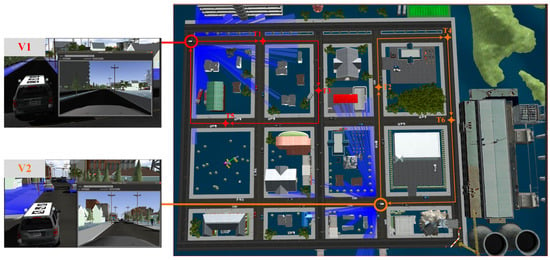
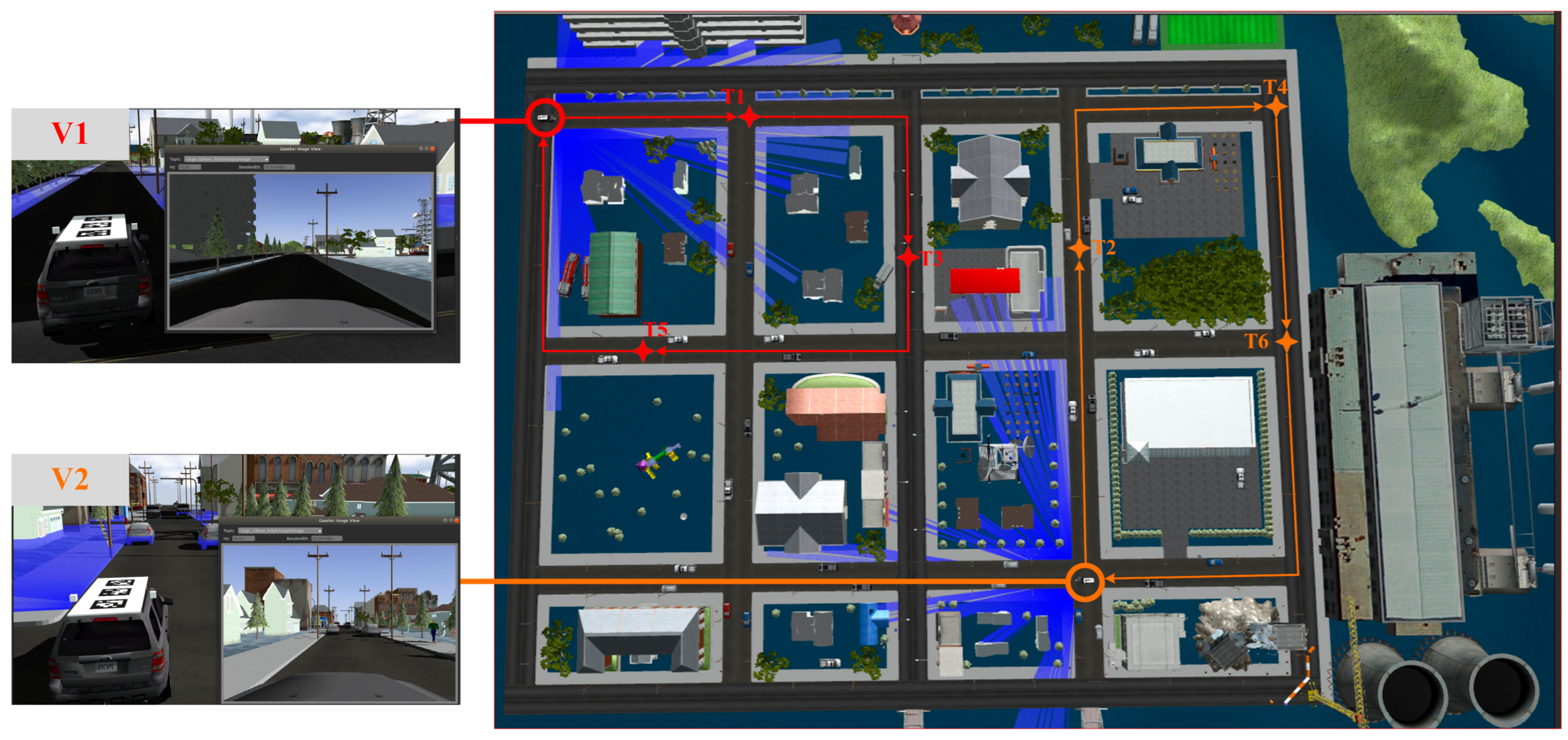
Inspired by the multiple traveling salesman problem (MTSP) [23,24], this study establishes a multi-objective task allocation model that accounts for the heterogeneous characteristics of robots and tasks. As illustrated in Figure 1, two robots, V1 and V2, are assigned a set of tasks distributed in an outdoor environment. For example, tasks T1, T3, and T5 are assigned to robot V1, whereas tasks T2, T4, and T6 are assigned to robot V2. The corresponding execution sequences are denoted by Seq1 = {T1,T3,T5} and Seq2 = {T2,T4,T6}, respectively. In Figure 1, the red and orange arrows respectively indicate the driving directions of the V1 and V2 robots, while the red and orange circles represent the initial positions of the V1 and V2 robots. The two sub-figures on the left of the figure show the front-view states of each of the two robots. The assignment and ordering of tasks determine the travel routes, execution times, and overall performance of the multi-robot system.
Figure 1.
Illustration of task allocation for two heterogeneous robots.
The main elements of the MRTA problem are defined as follows:
- denotes the finite, nonempty set of robots, where Nv is the number of robots.
- (xi(t),yi(t)) represents the position of robot Vi at time t.
- SVi = (svi1,svi2,⋯,svik) denotes the resource vector of robot Vi, where k is the number of resource types. The binary variable svij indicates whether robot Vi carries the j-th resource type.
- denotes the finite, nonempty set of tasks, where Nt is the number of tasks.
- (xj,yj) represents the position of task Tj.
- Value (Tj) denotes the initial value of task Tj.
- STj = (stj1,stj2,⋯,stjk) denotes the resource requirements of task Tj.
- Ti ⊆ T denotes the set of tasks that robot Vi can execute while satisfying the corresponding task requirements.
- Seqi = {Ti1,Ti2,⋯,Tim} denotes the ordered task execution sequence assigned to robot Vi, where m is the number of tasks in the sequence.
4.2. Evaluation Function
The purpose of task allocation is to determine an appropriate execution sequence for each robot and evaluate the overall quality of the resulting assignment scheme. In this study, task benefits, travel costs, and time costs are selected as the evaluation criteria. These criteria reflect the value obtained from task execution, the spatial cost of robot movement, and the temporal efficiency of the multi-robot system, respectively.
4.2.1. Maximize Task Benefits
The value of a task may decrease as its execution is delayed. For example, in a multi-robot rescue scenario, completing a rescue task earlier may provide greater benefit than completing the same task after a prolonged delay. If the specified deadline is exceeded, the task is considered invalid and its execution is regarded as unsuccessful. Therefore, the temporal decay of task value is incorporated into the allocation model to better reflect practical task execution requirements.
When robot Vi executes task Tj, the corresponding task benefit is defined as,
where Pij ∈ (0,1) is the capability coefficient of robot Vi, xij is the task assignment variable, Value(Tj) is the initial value of task Tj, and μj ∈ (0,1) is the time-decay coefficient. Furthermore, t0 j denotes the release time of task Tj, and tj denotes the time at which the task begins execution.
The exponential term describes the reduction in task benefit as the execution delay increases. Consequently, the allocation algorithm is encouraged to assign tasks to suitable robots and determine execution sequences that preserve the value of time-sensitive tasks.
4.2.2. Minimize Travel Costs
The task assignment assigns a task sequence, denoted as to each robot, where mi represents the number of tasks in sequence . During task execution, the robot departs from location Xi and sequentially performs the tasks in sequence finally returning to location Xi. The travel cost for the robot is defined as the Euclidean distance between the departure point Xi and each target, as well as between consecutive targets in the sequence. The travel cost function, denoted as Cost(Vi,Tj) is expressed as follows.
The distance between two positions Ai and Bj is calculated using the Euclidean distance function:
where and are the coordinates of positions A and B, respectively.
The experiments in this study are conducted in a two-dimensional environment; therefore, the travel cost is calculated using planar coordinates. Nevertheless, the distance function can be extended to three-dimensional or other spatial environments when required. Minimizing travel costs helps reduce unnecessary robot movement and improves the spatial efficiency of the allocation scheme.
4.2.3. Minimize Time Costs
In addition to maximizing task benefits and minimizing travel costs, it is also necessary to consider minimizing the total time for all robots to complete their tasks. This refers to the time difference between the completion time of the last task and the starting time of the first task. The time costs function, denoted as Timef is expressed as follows.
where the variables k and l range from 1 to Nv, represents the completion time of task Tk, and represents the start execution time of task Tj.
4.2.4. Total Evaluation Function
The total evaluation function of task assignment is expressed as follows.
where w1,w2,w3 ∈ [0,1] are weight coefficients, indicating the importance of each evaluation function.
4.3. Complex Constraints
4.3.1. Task Assignment Constrains
The considered MRTA problem can be regarded as a variant of the MTSP in which the number of robots is smaller than the number of tasks. Consequently, each robot is required to execute multiple tasks. To avoid duplicate assignments, each task is assigned to exactly one robot.
The task assignment constraint is expressed as
where xij is a binary variable indicating whether task Tj is assigned to robot Vi. Specifically, xij = 1 indicates that robot Vi is assigned task Tj, whereas xij = 0 indicates otherwise.
This constraint ensures that each task is included in only one robot’s execution sequence and prevents repeated assignment of the same task.
4.3.2. Resource Type Constraints
Heterogeneous robots carry different types of resources, while different tasks have different resource requirements. A robot can execute a task only when its available resources satisfy the corresponding task requirements. Therefore, resource compatibility must be considered when determining the feasible task set for each robot.
The resource type constraint is expressed as
where SVi denotes the resource set carried by robot Vi, and STj denotes the resource requirement set of task Tj.
SVi ∩ STj ≠ ∅.
4.3.3. Time Limit Constraints
Each task must be executed within its specified time interval. A task cannot begin before its release time and must be executed before its deadline. The temporal constraint is expressed as
where is the release time of task Tj, tj is the time at which the task begins execution, and aim_ddlj is the deadline of task Tj.
In this study, task execution duration is not considered. Therefore, the temporal constraint is evaluated using the task execution start time. A task that cannot be executed within its specified time limit is regarded as infeasible.
4.3.4. Load Constraints
Each robot has a limited task load and can execute only a finite number of tasks in a single allocation cycle. The number of tasks assigned to a robot must not exceed its maximum load capacity. In addition, to improve robot utilization and avoid idle robots during task execution, each robot is required to execute at least one task.
The load constraint is expressed as
where denotes the maximum number of tasks that robot Vi can execute.
The lower bound ensures that every robot participates in task execution, while the upper bound prevents excessive task assignment. Together with the assignment, resource, and temporal constraints, this condition defines the feasible solution space of the heterogeneous MRTA problem.
5. Task Assignment Algorithm
This section presents the proposed t-SDBO algorithm for heterogeneous multi-robot task allocation. The method combines the basic search mechanism of the dung beetle optimizer (DBO) with a real-valued encoding–decoding scheme, Sine-chaotic population initialization, and adaptive t-distribution mutation with dynamic selection. These components are designed to transform continuous search positions into discrete task allocation solutions, improve the diversity of the initial population, and alleviate premature convergence while controlling additional computational overhead.
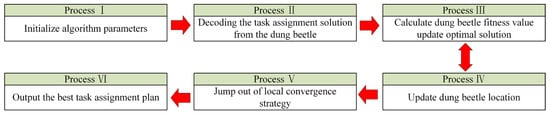
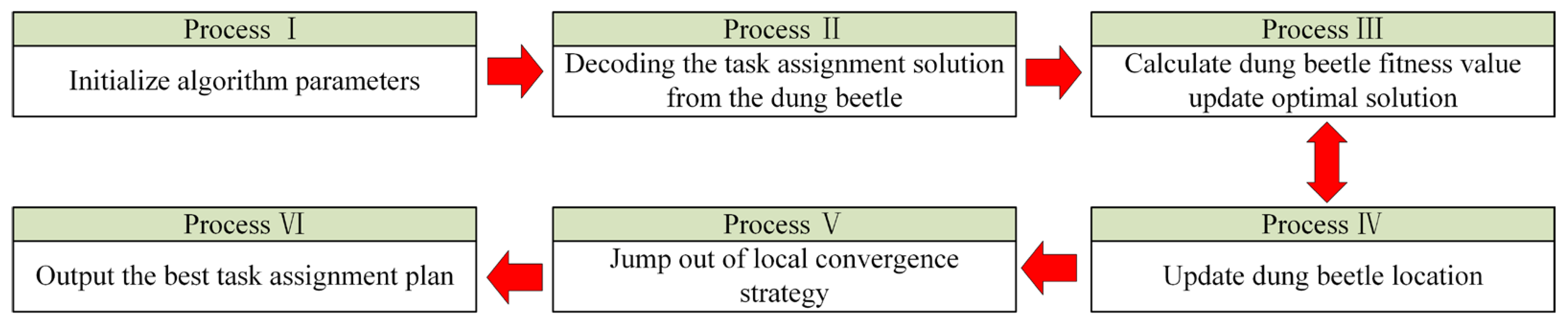
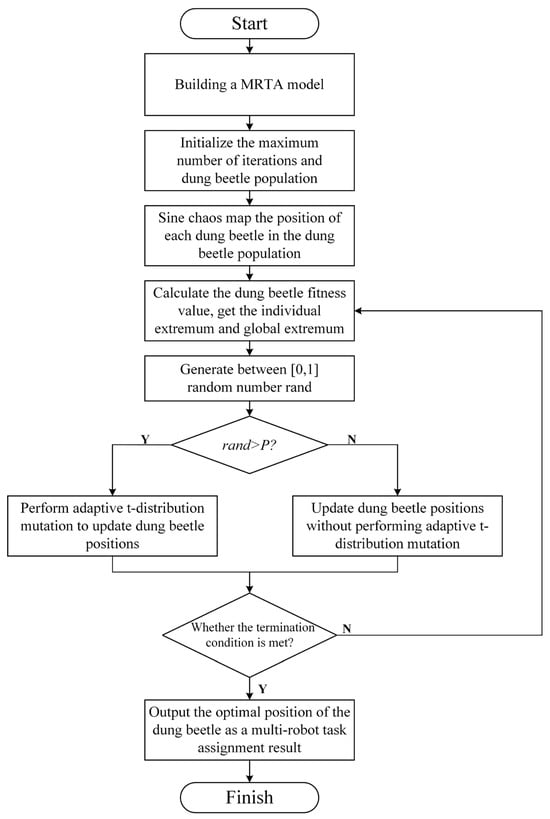
The overall procedure is illustrated in Figure 2 and consists of five main processes. Process I initializes the algorithm parameters and the dung beetle population, as described in Section 5.3. Process II decodes the continuous positions into task allocation solutions according to Section 5.2. Process III evaluates the fitness of each candidate solution using the objective function established in Section 2. Process IV updates the dung beetle positions according to the basic DBO mechanism described in Section 5.1. Finally, Process V applies the adaptive mutation and dynamic selection strategy presented in Section 5.4 to improve the search performance. The algorithm iterates through these processes until the termination criterion is satisfied, after which the best task allocation scheme is returned.
Figure 2.
Schematic diagram of the main process of the algorithm.
5.1. Overview of the Proposed Framework
The proposed t-SDBO framework is designed to solve the heterogeneous multi-robot task allocation problem by integrating problem modeling, continuous-to-discrete solution representation, population initialization, iterative optimization, constraint handling, and solution output into a unified procedure. Figure 3 presents the overall architecture and workflow of the proposed method.
Figure 3.
Overall architecture and workflow of the proposed t-SDBO-based heterogeneous MRTA framework.
The framework consists of five functional stages. First, robot information, task information, resource configurations, temporal constraints, and algorithm parameters are provided as inputs. Based on these data, the heterogeneous MRTA model evaluates candidate solutions in terms of task benefits, travel costs, and completion time under assignment, resource, temporal, and load constraints. Second, each dung beetle position is represented by a real-valued vector, and the proposed encoding–decoding mechanism transforms the continuous position into a discrete robot–task assignment and execution sequence. A constraint-repair procedure is subsequently applied to ensure the feasibility of the decoded solution.
Third, the initial population is generated using Sine chaotic mapping to improve population diversity. Fourth, candidate solutions are iteratively optimized through the standard DBO position-update mechanisms together with the proposed adaptive t-distribution mutation and dynamic selection strategy. After each update, the candidate solution is decoded, repaired, and evaluated, and the individual and global best solutions are updated accordingly. Finally, when the termination criterion is satisfied, the best position is decoded to obtain the final task allocation scheme, execution sequences, and corresponding objective value.
Therefore, the overall information flow of t-SDBO can be summarized as problem input → chaotic population initialization → encoding/decoding and constraint repair → fitness evaluation → DBO position update → adaptive mutation and dynamic selection → best-solution update → termination judgment → task allocation output. This architecture establishes an explicit connection between the continuous optimization process of DBO and the discrete constrained MRTA problem, as shown in Figure 3.
The computational idea of the DBO algorithm is as follows: by considering different behaviors of dung beetles, they are divided into small subpopulations, with each subpopulation corresponding to a potential solution. During the iterative updating process of the dung beetle population, the positions of dung beetles represent the optimal solutions to the optimization problem. Therefore, it is necessary to pay attention to the local extremal value X* and the global extremal value Xb of the dung beetles. Dung beetles update their positions based on these extremal values, aiming to approach the optimal solution of the optimization problem. If the optimal solution of the optimization problem is in D-dimensions, the position of the corresponding dung beetle can also be seen as a D-dimensional vector. In other words, the position of the k-th dung beetle at the t-th iteration t is . According to the behavior characteristics of dung beetles, the dung beetle population is divided into four subgroups: rolling dung beetles, breeding dung beetles, foraging dung beetles, and thief dung beetles, in a ratio of 6:6:7:11. The positions of dung beetles are updated using Equations (11)–(15).
The position update equation for rolling dung beetles is as follows.
where represents the position information of the i-th dung beetle at the t-th iteration, t represents the current iteration count, and α represents the natural coefficient, which can take the values of 1 or −1. k represents the defect coefficient, and its range is (0,0.2]. b represents the light intensity coefficient, and its range is (0,1). Xw represents the global worst position, and ΔX is used to simulate the variation in light intensity.
The position update equation for dancing dung beetles is as follows.
where θ is the angle used to simulate the change in movement direction. This mechanism enables the dung beetle to adjust its search direction when its original movement is obstructed.
The position update equation for breeding dung beetles is as follows.
where X* represents the current local best position, Lb* and Ub* represent the lower and upper bounds of the spawning region, Tmax represents the maximum number of iterations, Lb and Ub represent the lower and upper bounds of the optimization problem, and b1 and b2 represent two independent random vectors of size 1 × D.
The position update equation for foraging dung beetles is as follows.
where Xb represents the current global best position, Lbb and Ubb represent the lower and upper bounds of the foraging region, c1 represents a random number subject to a normal distribution, c2 represents a random vector, and the value range of c2 is (0,1).
The position update equation for thief dung beetles is as follows.
where g is a random vector whose dimension 1 × D obeys normal distribution, and S represents a constant.
5.2. Encoding and Decoding
To apply DBO to the MRTA problem, two decisions must be represented simultaneously: the assignment of tasks to robots and the execution order of tasks assigned to each robot [25]. These decisions are discrete, whereas the standard DBO algorithm operates in a continuous search space. Consequently, an encoding–decoding mechanism is introduced to transform continuous dung beetle positions into candidate task allocation solutions.
5.2.1. Encoding
In MRTA, the number of robots is denoted as Nv, and the number of tasks is denoted as Nt. Therefore, in the DBO algorithm, the dimensionality of dung beetle should be Nt. Each dung beetle corresponds to a potential task assignment solution. By employing real-valued encoding, let the position Xn of the n-th ant be an Nt-dimensional real-valued vector. The upper and lower limits [1,Nv + 1) are set to ensure that the position Xn of the n-th dung beetle is updated within its range.
5.2.2. Decoding
During the encoding process, Xn is a Nt-dimensional real-valued vector, which consists of an integer part and a fractional part. Let Xn(IN) represent the integer part of Xn and Xn(DE) represent the fractional part of Xn. For example: 8.75(IN) = 8 and 8.75(DE) = 0.75. Xn(INj) = i can represent a potential solution for task assignment, where it assigns task Tj to robot Vi. In task assignment, it is possible for multiple dung beetles’ positions to have the same integer part . Therefore, the following rules are defined: First, we use the integer part X(IN) of the position vector X to determine which tasks will be assigned to the same robot. Then, we sort the fractional part X(DE) of the position vector X in descending order. The larger the fractional part, the higher priority the corresponding task has for execution by the same robot.
Scene 1: Consider a multi-robot task assignment problem with Nv equal to 3 and Nt equal to 8, meaning that eight tasks (denoted as T1∼T8) are to be assigned to three heterogeneous robots (denoted as V1∼V3). Through the encoding–decoding process, we know that the dimensionality of the solution space is equal to eight, and the positions of the ants are updated within the range of [1,4). The decoding of ant positions is illustrated in Table 1.
Table 1.
Dung beetle positions and their corresponding assignment results.
In theory, by decoding the ant positions from Table 1, we can obtain the task assignment results, denoted as Seq1 = {T14,T12,T11,T17,T18}, Seq2 = {T26,T25,T23}, Seq2= ∅. Let’s assume scenario , where robot V1 has been assigned five tasks, exceeding its maximum load capacity, while robot V3 has not been assigned any tasks. Both V1 and V3 fail to satisfy the load constraint defined in Equation (5). To address this problem, Algorithm 1 is proposed in this paper to decode a feasible assignment vector Seqi that satisfies the constraints.
Algorithm 1 can be divided into the following three steps, where TN[i] represents the total number of tasks assigned to the robot at the current time, and set ψ represents the collection of tasks that exceed the load constraint and remain unassigned.
- (a)
- (Lines 1–11) Pre-assignment: Based on the decoding results, a pre-assigned set of task collections ψ(i) is assigned for each robot Vi in the firefly algorithm. The set ψ(i) is then sorted according to the requirements, i.e., the task execution order, and the resulting order is outputted as TN[i].
- (b)
- (Lines 12–20) Initial assignment: Based on the pre-assignment of TN[i] a judgment is made. If it does not exceed the load constraint, the tasks are assigned. If it exceeds the load constraint, the exceeding portion is stored in set ψ.
- (c)
- (Lines 21–29) Reassignment: According to the initial assignment, if ψ is not an empty set, the tasks in the set are redistributed. If TN[i] equals zero, meaning it does not meet the requirement of each robot executing at least one task, priority is given to assigning tasks from set ψ to fulfill this requirement. If all robots have already been assigned tasks, the tasks from set ψ are assigned to the robot with the fewest number of tasks already assigned.
| Algorithm 1. Constraint Modification Algorithm. |
| Input: Dung beetle position decoding result, including Xn,Xn(IN) and Xn(DE). |
| Output: Task assignment sequence Seqi,i ∈ {1,2,⋯,Nv}. |
| 1. For (i in Nv){ |
| 2. Initialization TN[i] = 0, ψ(i) = 0 |
| 3. For (j in Nt){ |
| 4. If (Xn(INj) = i) |
| 5. ψ(i) = ψ(i) ∪ {Tj} |
| 6. TN[i] = TN[i] + 1 |
| 7. End |
| 8. } |
| 9. Sort ψ(i) according to the encoding and decoding requirements. |
| 10. Output TN[i]. |
| 11. } |
| 12. Initialization ψ = ∅. |
| 13. For (i in Nv){ |
| 14. If (ψ(i) ≠ ∅) |
| 15. If ) |
| 16. Seqi = ψ(i) |
| 17. Else |
| 18. Put the excess part in ψ |
| 19. End |
| 20. } |
| 21. While (ψ ≠ ∅){ |
| 22. For (i in Nv){ |
| 23. If (ψ(i) ≠ ∅) |
| 24. Assign the tasks in ψ to it first. |
| 25. Else |
| 26. Assign tasks in ψ to the robot with the least number of assigned tasks. |
| 27. End |
| 28. } |
| 29. } |
The task assignment results for each robot through Algorithm 1 are shown in Table 2. In conclusion, through Algorithm 1, it is possible to generate an output that satisfies the load constraint for task assignment.
Table 2.
Task assignment scheme.
5.3. Initialization of Population Strategy Based on Sine Chaotic Mapping
The DBO algorithm initializes the population in a random manner, resulting in a high diversity and poor variability in the generated population. When solving the MRTA problem, there are many local optimal solutions in the search space. In order to reduce the probability of getting stuck in local optima and improve the diversity of solutions, this study adopts the Sine chaotic mapping to initialize the population [26]. The Sine chaotic mapping is defined as follows.
where Xk denotes the chaotic variable at iteration k, and ∂ is the control parameter of the Sine map. In this study, ∂ is fixed at 4 throughout the population initialization process rather than being randomly generated. This setting removes unnecessary parameter randomness and ensures that the same Sine-map mechanism is consistently applied in all experiments. The initial chaotic states are generated from the initial population, after which Equation (16) is iteratively applied to obtain the chaotically mapped population.
By introducing the Sine chaotic mapping for population initialization in the DBO algorithm, Algorithm 2 is proposed to enhance the uniform distribution of the population in the search space, thereby improving the optimization efficiency.
| Algorithm 2. Sine-Chaotic Population Initialization. |
| Input: The population size Population, the problem dimension Nt and the initial position of each dung beetle Xk. |
| Output: The position of each dung beetle after chaos mapping Xk+1. |
| 1. For (i in Population){ |
| 2. For (j in Nt){ |
| 3. Set the Sine-map control parameter ∂ = 4. |
| 4. Perform chaotic mapping using Equation (16).} |
| 5. Output Xk+1; |
| 6. } |
5.4. Adaptive t-Distribution Mutation and Dynamic Selection Strategy
When solving complex MRTA problems, the standard DBO algorithm may converge prematurely to a local optimum. To alleviate this limitation, an adaptive t-distribution mutation operator is introduced to perturb dung beetle positions and improve the exploration capability of the algorithm [27].
The mutation operator adjusts its distribution according to the iteration count. The perturbed position is calculated as
where represents the perturbed dung beetle position, represents the position of the i-th dung beetle at the n-th iteration, and t(iter) represents the t-distribution with degrees of freedom determined by the algorithm’s iteration count. Because the iteration counter starts from zero, this definition guarantees that the degrees of freedom are always positive. At the beginning of the optimization process, v(0) = 1, and the heavy-tailed t-distribution produces relatively large perturbations, thereby enhancing global exploration. As iter increases, v(iter) gradually increases and the t-distribution approaches the Gaussian distribution, resulting in smaller perturbations and stronger local exploitation.
As the number of iterations increases, the t-distribution gradually approaches the Gaussian distribution. In the early stages of optimization, the heavier tails of the t-distribution provide a greater probability of generating relatively large perturbations, which can enhance global exploration. In later stages, the distribution becomes more concentrated, supporting local refinement around promising solutions. This adaptive mechanism is intended to improve the balance between exploration and exploitation and reduce the likelihood of premature convergence.
However, applying the mutation operator to every dung beetle at every iteration may increase computational overhead. To address this issue, a dynamic selection strategy is introduced to regulate the application of adaptive t-distribution mutation. The selection parameter is defined as
where A1 determines the upper limit of the dynamic selection parameter, A2 controls its variation during the iterative process, iter is the current iteration count, and Tmax is the maximum number of iterations. In this study, the parameters of the dynamic selection strategy are set to A1 = 0.5 and A2 = 1. Accordingly, the selection threshold P gradually increases from approximately 0.4 to 0.5 during the iterative process. Since adaptive t-distribution mutation is activated when rand > P, the corresponding mutation probability gradually decreases from approximately 0.6 in the early stage to 0.5 in the later stage. This setting maintains relatively frequent perturbations during early exploration while moderately reducing mutation operations during later exploitation, thereby balancing the ability to escape local optima and convergence efficiency.
The dynamic selection mechanism determines whether the mutation operator is applied to a dung beetle. When mutation is selected, a new candidate position is generated according to Equation (17) and evaluated using the fitness function. The perturbed position is accepted if it improves the current fitness; otherwise, the original position is retained. This strategy allows the algorithm to introduce additional search variation while limiting unnecessary mutation operations.
The detailed procedure is presented in Algorithm 3.
| Algorithm 3. Strategy for Escaping Premature Convergence. |
| Input: of the dung beetle, and the corresponding local extremum F(X*) and global extremum F(Xb), A1 = 0.5,A2 = 1. |
| Output: |
| 1. Generate a random number rand between [0, 1]. |
| 2. If (rand > P) |
| 3. |
| 4. and global extremum F(Xb). |
| 5. If ) |
| 6. |
| 7. Else |
| 8. does not change. |
| 9. End |
| 10. Else |
| 11. Does not perform adaptive t-distribution mutation. |
| 12. End |
5.5. Heterogeneous Multi-Robot Task Allocation Method Based on t-SDBO
The proposed t-SDBO algorithm integrates Sine-chaotic population initialization, the basic DBO position-update mechanism, real-valued encoding–decoding, and adaptive t-distribution mutation with dynamic selection. The overall task allocation procedure is illustrated in Figure 3.
Step 1. Population initialization and decoding. Initialize the parameters of the t-SDBO algorithm, including the population size, maximum number of iterations, and search-space bounds. Set the iteration counter to iter = 0, and initialize the dung beetle population using the Sine chaotic mapping strategy described in Equation (16). The continuous positions are then decoded into task allocation solutions according to Section 3.2. After sorting the task execution sequences, the fitness values of the candidate solutions are calculated, and the initial individual and global best positions are determined.
Step 2. Fitness evaluation. For each dung beetle, calculate the objective function value of the corresponding task allocation solution using Equations (1)–(5). The fitness evaluation considers task benefits, travel costs, and time costs under the constraints established in Section 2. The individual best and global best positions are updated according to the resulting fitness values.
Step 3. Dung beetle position update. Update the positions of the dung beetles according to their behavioral subgroups using Equations (11)–(15). The rolling, breeding, foraging, and stealing mechanisms provide different search behaviors, enabling the population to explore the solution space and refine promising candidate solutions.
Step 4. Adaptive mutation and dynamic selection. Apply the adaptive t-distribution mutation and dynamic selection strategy according to Equations (17) and (18). When the mutation condition is satisfied, a perturbed position is generated and evaluated. If the perturbed position produces a better fitness value, it replaces the original position; otherwise, the original position is retained. The iteration counter is then updated as iter = iter + 1.
Step 5. Termination criterion. Check whether the maximum number of iterations has been reached. If iter < Tmax, return to Step 2 and continue the optimization process. Otherwise, terminate the iteration.
Step 6. Output the task allocation scheme. Decode the best dung beetle position obtained during the optimization process and output the corresponding task allocation scheme, execution sequences, and fitness value.
Through the above procedure, the proposed t-SDBO algorithm combines the continuous search capability of DBO with a discrete task allocation representation. Sine-chaotic initialization is used to improve the initial population distribution, while adaptive t-distribution mutation and dynamic selection are employed to enhance the search process and alleviate premature convergence.
6. Simulation
The proposed t-SDBO algorithm was implemented in Python3.8, and MATLAB R2021b was used for experimental data analysis and visualization. The experimental datasets were randomly generated and included task locations, resource requirements, task execution intervals, task values, robot resource configurations, and capability coefficients. To simplify the analysis, both time and distance were treated as dimensionless quantities. All optimization experiments were conducted on a Lenovo Legion laptop (Lenovo Group Limited, Beijing, China), equipped with an Intel Core i7 processor (Intel Corporation, Santa Clara, CA, USA) and 16 GB of memory.
The proposed t-SDBO algorithm was implemented in Python, while MATLAB R2021b was used for experimental data analysis and visualization. All numerical optimization experiments were conducted on a computer equipped with an Intel Core i7 processor and 16 GB of memory. The experimental datasets contained robot positions and resource configurations, task locations, resource requirements, execution time windows, task values, and robot–task capability coefficients. Unless otherwise specified, time and distance were treated as dimensionless quantities in the numerical optimization experiments.
To ensure a fair comparison, PSO, SSA, standard DBO, SDBO, and t-SDBO were evaluated using the same population size, maximum number of iterations, objective function, constraints, and initial problem instances. The population size was set to 60, the maximum number of iterations was set to 500, and the objective-function weights were set to w1 = w2 = w3 = 1. Each algorithm was independently executed 10 times for each numerical test scenario, and the average fitness, best fitness, and solution time were recorded. The same robot and task datasets were used for all algorithms in each comparison.
The evaluation consists of three complementary levels. First, a four-robot/twelve-task benchmark is used to compare optimization quality, convergence behavior, and computational cost. Second, five MRTA scales—MRTA0310, MRTA0315, MRTA0412, MRTA0515, and MRTA0520—are used to examine scalability, where for example, MRTA0310 denotes three robots and ten tasks. Third, system-level validation is conducted using a ROS/Gazebo multi-robot navigation platform to examine whether the optimized task assignments can be successfully transferred to multi-robot execution.
6.1. Experiment 1: Comparative Evaluation of Task Allocation Performance
A rescue scenario involving four heterogeneous robots and twelve target tasks was constructed to evaluate the performance of the proposed algorithm. The initial information of the robots and tasks is presented in Table 3 and Table 4, respectively. To simplify the experimental setting, each robot was assumed to move at a constant speed.
Table 3.
Robot initial information.
Table 4.
Task initial information.
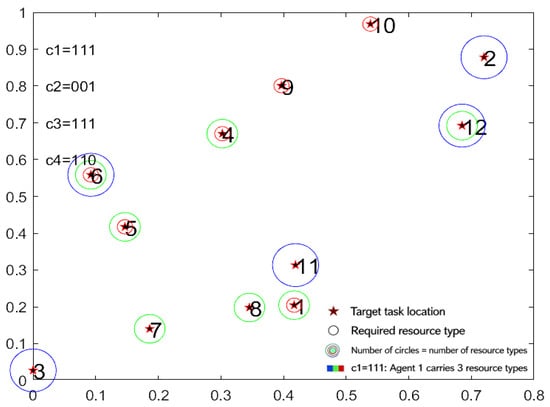
Figure 4 illustrates the distribution of tasks and their resource requirements. The numbers 1–12 denote the identification codes of target tasks, and star-shaped markers indicate task locations. Circles of different sizes represent distinct resource types required by each task; for instance, three overlaying circles for Task 6 signify that it demands three types of resources. Binary encoding describes the resource configuration of intelligent agents (robots): c1 = 111 corresponds to the first agent, where each binary digit denotes whether the agent carries the respective resource: “1” means possession of the resource and “0” means absence. Accordingly, the vector (1,1,1) represents an agent equipped with all three resource types. Please refer to Table 3 for further details.
Figure 4.
Schematic diagram of the experimental scene.
In this section, experiments are conducted to compare and analyze the Particle Swarm Optimization (PSO) [28], Sparrow Search Algorithm (SSA) [29], Dung Beetle Optimization Algorithm (DBO), and the proposed Chaotic Adaptive Dung Beetle Optimization Algorithm (t-SDBO). Additionally, to validate the effectiveness of the strategy to escape from local convergence, the improved Dung Beetle Optimization Algorithm (SDBO) without considering the strategy is introduced for comparison. Given the initial conditions and the maximum number of iterations Tmax = 500 for the five algorithms, the impact of task benefits, travel costs, and time costs is balanced by setting w1 = w2 = w3 = 1. Furthermore, a population size of 60 is given.
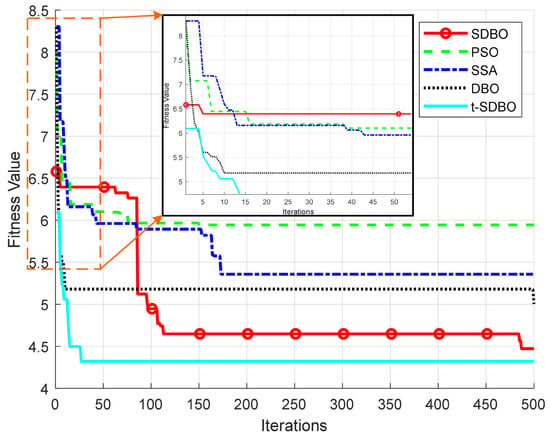
Figure 5 presents the fitness curves of the five algorithms. PSO achieves a relatively high final fitness value compared with the other methods, indicating weaker optimization performance in this experimental scenario. SSA converges rapidly during the early stages but subsequently shows limited improvement, suggesting that it may become trapped in a local optimum. Standard DBO achieves better performance than PSO and SSA, although its convergence also tends to stagnate during the later stages.
Figure 5.
The graph of fitness value changing with the number of iterations.
Compared with standard DBO, SDBO obtains a lower fitness value, indicating that Sine-chaotic initialization improves the search performance in this experiment. The proposed t-SDBO achieves the lowest final fitness among the five algorithms and exhibits faster early-stage convergence. These results suggest that the combination of Sine-chaotic initialization and adaptive t-distribution mutation improves solution quality and helps alleviate premature convergence in the considered MRTA scenario.
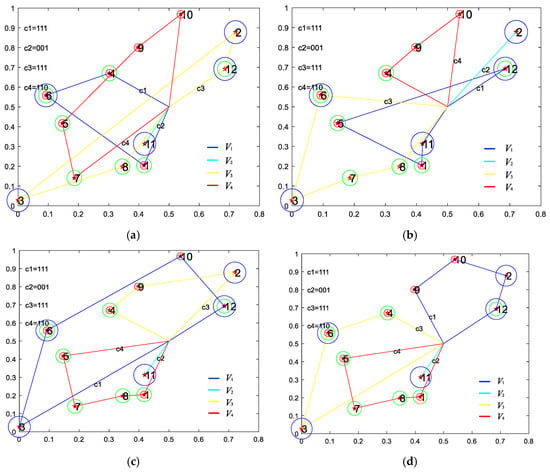
Table 5 and Figure 6 show the task assignment results. The numbers in the table represent the task sequence numbers. For example, ⟨12,2,10⟩ indicates that robot V1 is assigned to tasks T12, T2 and T10, and the sorting in the table indicates the order in which the tasks are executed. The programs of the five algorithms were run 10 times each, and the average fitness value, best fitness value, and solution time are shown in Table 6. From the results in Table 6, it can be observed that the t-SDBO algorithm performs better than the other four algorithms, with an average fitness value of 4.3556 and a best fitness value of 4.3213. The results indicate that the proposed algorithm provides better solution quality than the four comparison methods in this scenario. In particular, the improvement over SDBO supports the effectiveness of introducing adaptive t-distribution mutation in addition to Sine-chaotic initialization.
Table 5.
Task assignment results of different algorithms.
Figure 6.
Visualization of allocation schemes for the four algorithms: (a) PSO. (b) SSA. (c) DBO. (d) t-SDBO.
Table 6.
Comparison results of different algorithms.
In terms of computational cost, t-SDBO requires an average solution time of 3.3069 s, which is higher than that of standard DBO and SDBO but remains comparable to those of PSO and SSA. This result indicates that the improved solution quality is accompanied by additional computational overhead. Therefore, the principal advantage demonstrated by this experiment is the improvement in optimization quality and convergence behavior, rather than a reduction in the absolute solution time.
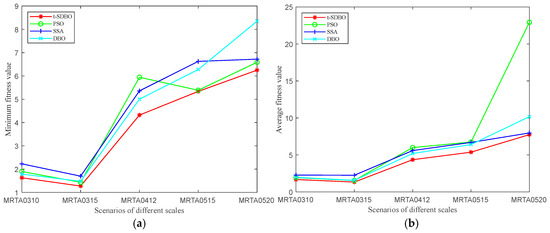
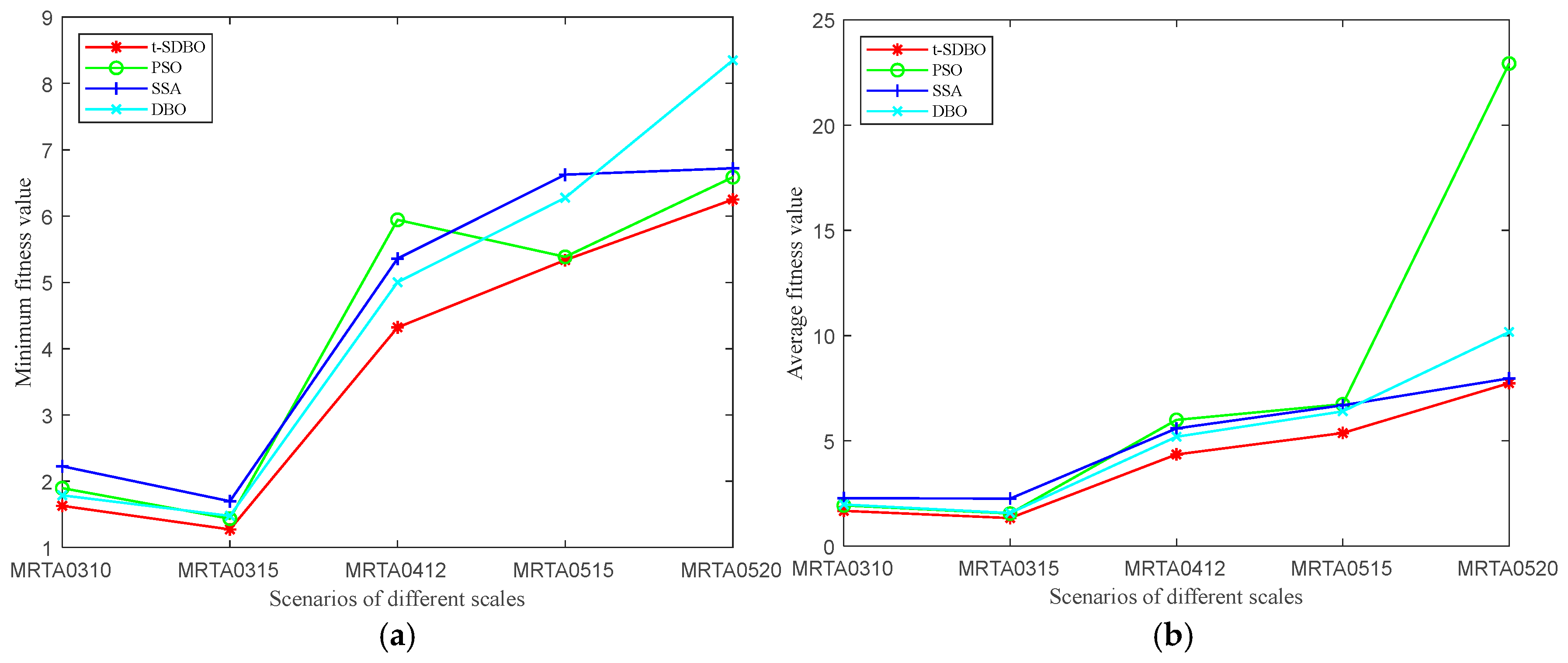
To investigate the performance of the proposed algorithm under different MRTA problem scales, t-SDBO, PSO, SSA, and standard DBO were applied to five scenarios with different numbers of robots and tasks. The experimental scenarios were denoted as MRTA0310, MRTA0315, MRTA0412, MRTA0515, and MRTA0520. For example, MRTA0310 represents a scenario involving three robots and ten tasks.
Each algorithm was independently executed ten times for each scenario, and the minimum and average fitness values were recorded. The comparative results are presented in Figure 7, where Figure 7a shows the minimum fitness values and Figure 7b shows the average fitness values.
Figure 7.
Comparison of different scales of MRTA experiments: (a) Optimal fitness value. (b) Average fitness value.
The results in Table 6 provide both comparative and ablation-based validation of the proposed method. In terms of average fitness, t-SDBO achieves a value of 4.3556, corresponding to reductions of approximately 12.09%, 27.34%, 22.10%, and 16.19% relative to SDBO, PSO, SSA, and standard DBO, respectively. For the best fitness value, t-SDBO achieves 4.3213, representing improvements of approximately 3.36%, 27.30%, 19.34%, and 13.64%, respectively. The progressive performance improvement from standard DBO to SDBO and then to t-SDBO also serves as an ablation validation: the improvement from DBO to SDBO demonstrates the contribution of Sine-chaotic initialization, while the further improvement from SDBO to t-SDBO supports the effectiveness of adaptive t-distribution mutation and dynamic selection.
It should be noted that the improved optimization quality introduces additional computational cost. The average solution time of t-SDBO is 3.3069 s, compared with 2.8184 s for DBO and 3.0968 s for SDBO, but remains comparable to PSO (3.3295 s) and SSA (3.4064 s). Therefore, the main advantage of t-SDBO lies in improved solution quality and convergence robustness rather than minimum computation time.
6.2. Experiment 2: ROS/Gazebo Multi-Robot Simulation
To further evaluate the feasibility of the proposed t-SDBO algorithm in a multi-robot system, simulation experiments were conducted using ROS, Gazebo, and RViz. The experimental framework integrates the proposed task allocation module with robot navigation, motion control, mapping, and localization components. In addition to the indoor and outdoor simulation scenarios presented in the original manuscript, a quantitative known-environment benchmark involving five mobile robots and nine navigation tasks was conducted to compare t-SDBO with standard DBO and PSO.
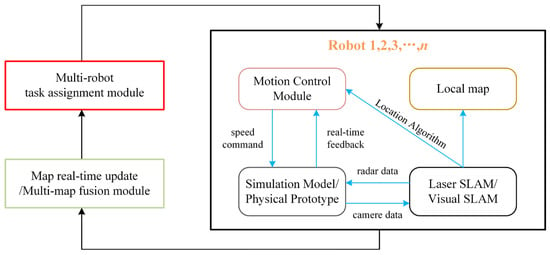
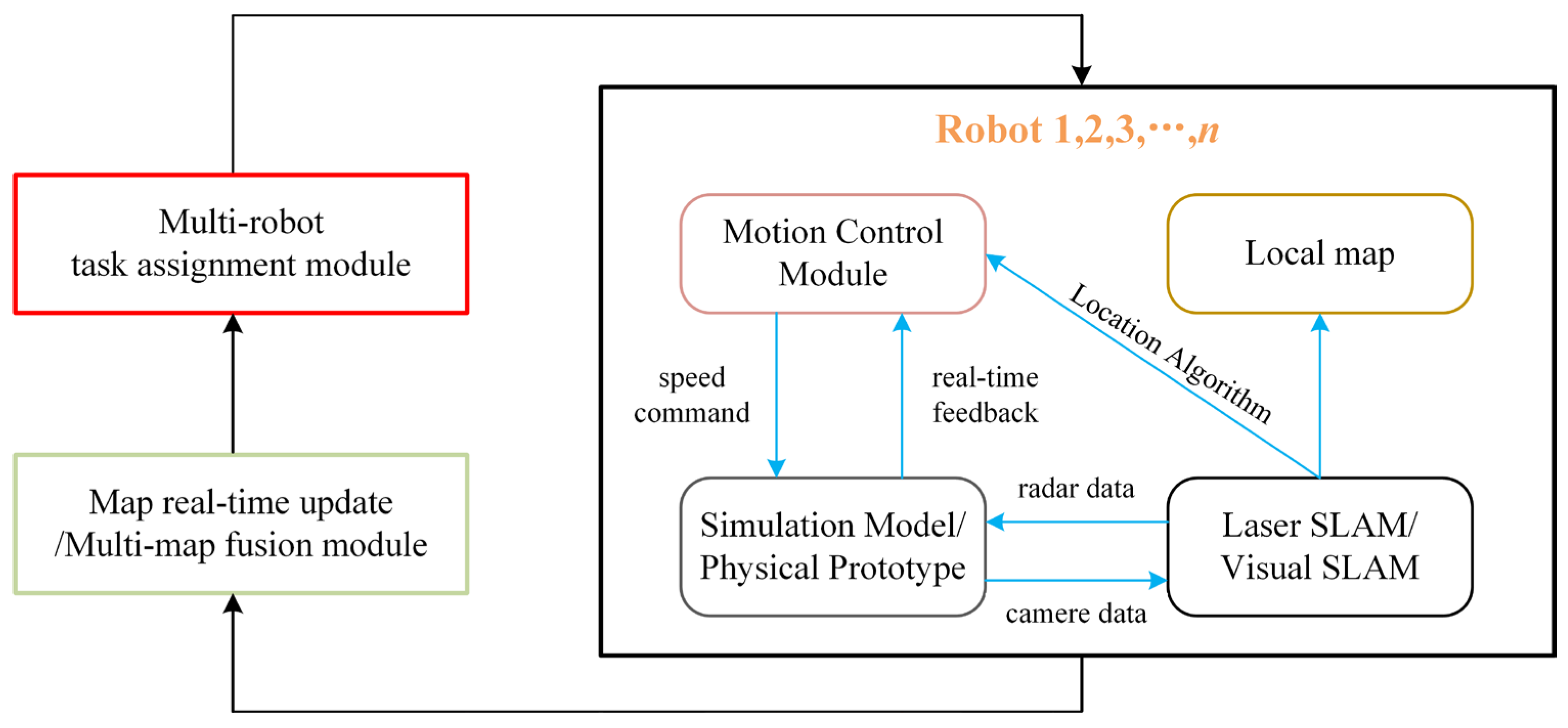
The multi-robot simulation platform was developed under Ubuntu 18.04, ROS Melodic, and Gazebo 9. TurtleBot3 Burger models were used as the mobile robot platforms. For experiments requiring map construction and localization, laser-based Gmapping was employed in the SLAM module, while the ROS multirobot-map-merge package was used for multi-robot map fusion. The task allocation module generated task sequences, and the robots executed the assigned navigation goals through the ROS navigation framework. The overall system architecture is illustrated in Figure 8 [30].
Figure 8.
Frame diagram of multi-robot system.
The experiments were designed to examine the integration of task allocation with multi-robot navigation and to provide quantitative evidence of the proposed method’s performance. Since the simulation platform does not fully reproduce differences in physical resources and task execution capabilities, these characteristics were simplified in the known-environment benchmark. Therefore, the quantitative results primarily evaluate allocation and navigation performance under the specified conditions, rather than the complete range of heterogeneous resource constraints considered in the mathematical model.
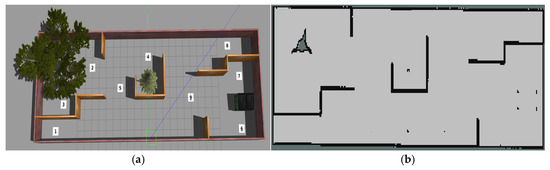
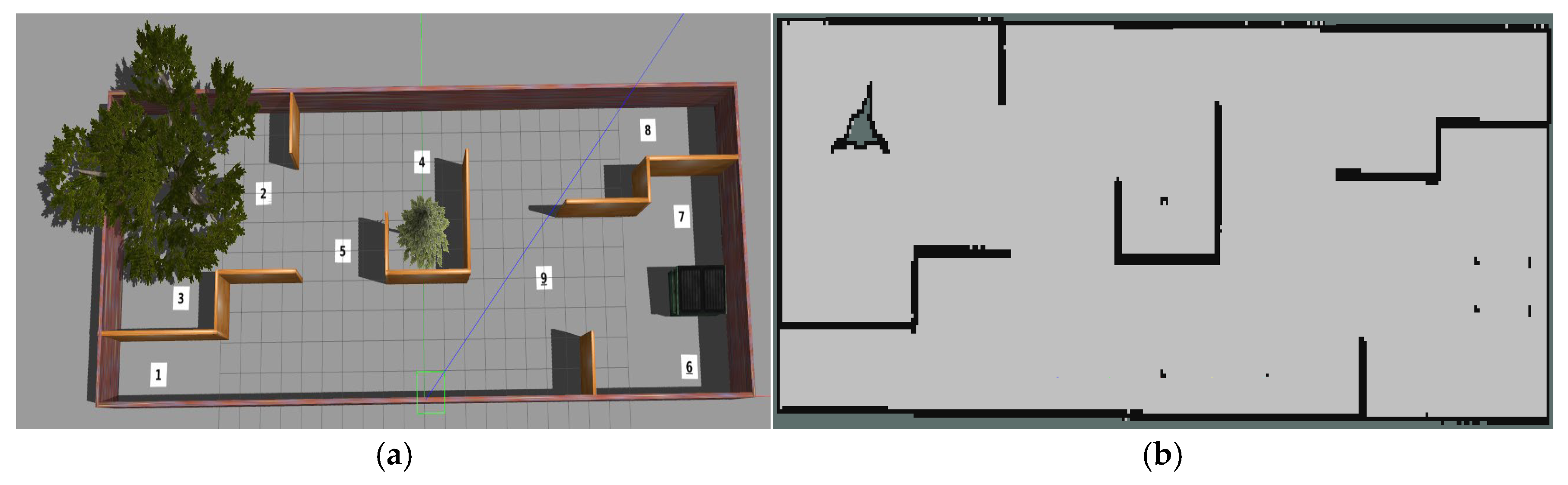
A multi-robot experimental platform for task allocation in a known environment was constructed based on ROS, Gazebo, and RViz. The experimental environment map was generated using the Gmapping algorithm. The size of the experimental environment was 20 m × 10 m, and the experimental scenario is shown in Figure 9, where the numbers 1–9 represent nine target tasks.
Figure 9.
Experimental simulation environment: (a) Simulation environment in Gazebo. (b) Simulation environment map in RViz.
The experimental tests were conducted based on the move_base framework. Five mobile robots were assigned tasks using the task allocation algorithm proposed in this chapter. Each robot then navigated to its assigned navigation points (target tasks) using the navigation system provided by the move_base framework. Because the experimental conditions could not represent the resource requirements of robots and target tasks, the nine navigation points were assigned identical resource requirements and value coefficients. Similarly, the five mobile robots were assigned identical resource configurations and capability value coefficients. The initial information of the five mobile robots and nine navigation points is presented in Table 7 and Table 8, respectively.
Table 7.
Initial Information on the Mobile Robots.
Table 8.
Initial Information on the Navigation Points.
To evaluate the practical performance of the proposed t-SDBO algorithm in the above experiment, the DBO and PSO algorithms were used for comparison. The navigation point allocation results obtained by the different algorithms are presented in Table 9. The numbers in the table represent navigation point identifiers, and their order indicates the sequence in which the navigation points are visited. For example, <2,3> indicates that mobile robot V2 is assigned navigation points T2 and T3, and that robot V2 first moves to T2 and then to T3.
Table 9.
Navigation Point Allocation Results.
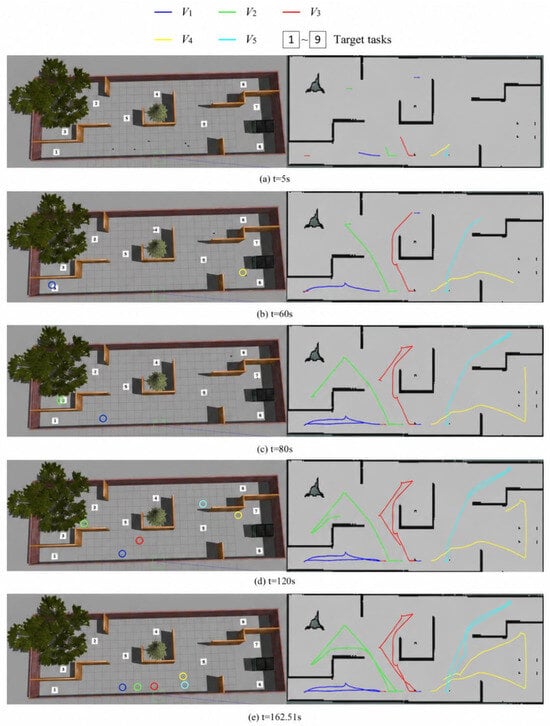
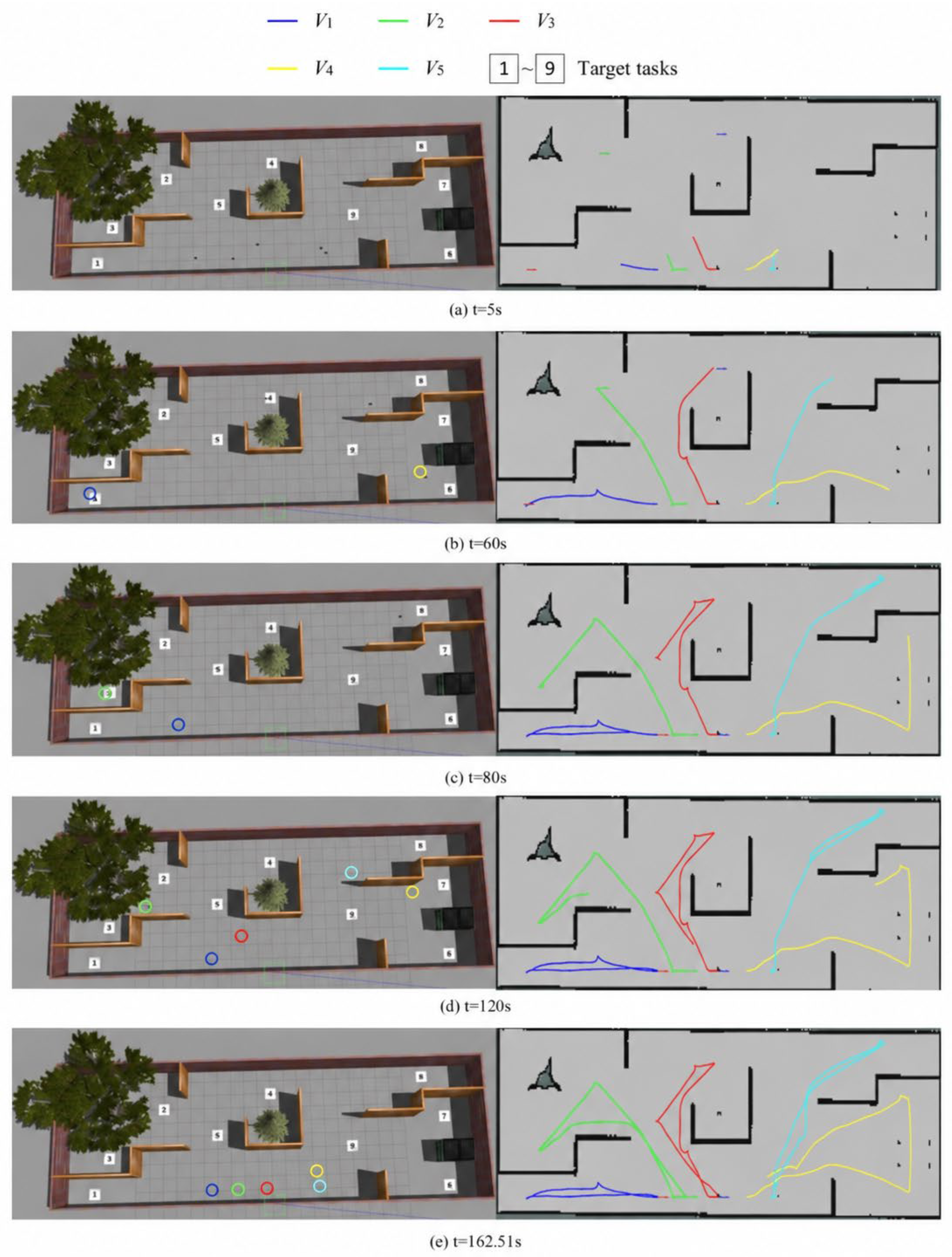
The experimental process of the t-SDBO algorithm is shown in Figure 10, which presents five representative time instants. The images in the left column show the positions of the robots in Gazebo as they reach the navigation points at different times. The dark blue, green, red, yellow, and light blue circles represent the positions of robots V1, V2, V3, V4, and V5, respectively. The images in the right column show the corresponding robot operating states in RViz. The dark blue, green, red, light blue, and yellow trajectories represent the trajectories of robots V1, V2, V3, V4, and V5, respectively.
Figure 10.
Experimental Process of the t-SDBO Algorithm: (a) t = 5 s. (b) t = 60 s. (c) t = 80 s. (d) t = 120 s. (e) t = 162.51 s.
To quantitatively evaluate navigation performance, five experimental trials were conducted for each of the three algorithms: t-SDBO, standard DBO, and PSO. The reported results include total navigation time, total travel distance, average travel distance per robot, and task completion success rate. The original numerical results are presented in Table 10 without modification.
Table 10.
Quantitative comparison of navigation performance.
As shown in Table 10, t-SDBO achieves the lowest reported navigation time and travel distance among the three algorithms. Compared with standard DBO, t-SDBO reduces the total navigation time by 5.89 s (3.50%) and the total travel distance by 6.04 m (4.72%). The average travel distance per robot decreases from 25.604 m to 24.396 m, corresponding to the same relative reduction of 4.72%. Both algorithms achieve a reported task completion success rate of 100%, indicating that the improvement in navigation efficiency is obtained without a reduction in the reported completion performance.
Five independent navigation trials were conducted for each of the t-SDBO, DBO, and PSO algorithms. Four system-level performance metrics were evaluated: total navigation time, total travel distance, average travel distance per robot, and task completion success rate. As shown in Table 10, t-SDBO achieves a total navigation time of 162.51 s and a total travel distance of 121.98 m, with a 100% task completion success rate. Compared with DBO, navigation time and travel distance are reduced by 3.50% and 4.72%, respectively. Compared with PSO, the reductions are 14.17% and 8.36%, respectively, while the task completion success rate increases from 98% to 100%.
These results provide system-level simulation validation complementary to the fitness-based numerical experiments. The first two experiments evaluate optimization quality and scalability at the algorithmic level, whereas the ROS/Gazebo experiment verifies that the resulting allocation schemes can be executed through an integrated multi-robot navigation system. Nevertheless, this validation remains simulation-based and should not be interpreted as physical-robot experimental validation.
7. Conclusions
This study proposed t-SDBO for heterogeneous multi-robot task allocation by integrating Sine-chaotic initialization, adaptive t-distribution mutation, and dynamic selection into the DBO framework. A constrained MRTA model considering time-dependent task benefits, travel costs, completion time, resource requirements, task deadlines, and robot load limitations was established, together with a real-valued encoding–decoding and constraint-repair mechanism. Comparative experiments showed that t-SDBO achieved an average fitness value of 4.3556 and a best fitness value of 4.3213 in the four-robot, twelve-task scenario and exhibited improved solution quality and convergence performance compared with the benchmark algorithms. The different-scale experiments and ROS/Gazebo simulations further demonstrated the effectiveness and simulation-level feasibility of the proposed method.
Several limitations remain in the present study. First, the experimental datasets were randomly generated, and the optimization experiments treated time and distance as dimensionless quantities. Second, the current task model does not consider task execution duration, and the simulated robots are assumed to move at constant speeds, which simplifies practical multi-robot operations. Third, the experimental validation is mainly conducted in two-dimensional simulated environments and on ROS/Gazebo platforms; therefore, uncertainties associated with physical robot motion, sensing, communication, and real-world environmental disturbances have not yet been fully evaluated. These limitations indicate that the current results primarily demonstrate the algorithmic effectiveness and simulation-level applicability of t-SDBO rather than complete real-world deployment capability.
Future work will extend the proposed framework in several directions. First, dynamic and online MRTA will be investigated by considering newly arriving tasks, changing task priorities, and real-time task reassignment. Second, more realistic system factors, including task execution duration, variable robot velocities, sensing and communication uncertainties, and dynamic environmental conditions, will be incorporated into the task allocation model. Third, the scalability and computational efficiency of t-SDBO will be further investigated for larger heterogeneous robot teams and more complex task sets. Finally, hardware experiments on physical heterogeneous multi-robot platforms will be conducted to evaluate the robustness, real-time performance, and practical applicability of the proposed method under real-world operating conditions.
Author Contributions
Conceptualization, Y.N. and L.W.; methodology, Y.N., W.Y. and J.Z.; software, Y.N. and W.Y.; validation, Y.N., X.W. and R.A.; formal analysis, Y.N. and J.Z.; investigation, X.W. and K.L.; resources, L.W. and K.L.; data curation, W.Y. and R.A.; writing—original draft preparation, Y.N.; writing—review and editing, Y.N., L.W. and J.Z.; visualization, W.Y. and X.W.; supervision, L.W. and J.Z.; project administration, L.W.; funding acquisition, L.W. All authors have read and agreed to the published version of the manuscript.
Funding
This research received no external funding.
Data Availability Statement
The original contributions presented in this study are included in the article.
Conflicts of Interest
The authors declare no conflicts of interest.
Abbreviations
The following abbreviations are used in this manuscript:
| MRS | Multi-Robot System |
| MRTA | Multi-Robot Task Allocation |
| MTSP | Multiple Traveling Salesman Problem |
| DBO | Dung Beetle Optimizer |
| SDBO | Sine-Chaotic Dung Beetle Optimizer |
| t-SDBO | Sine-Chaotic Dung Beetle Optimizer with Adaptive t-Distribution Mutation |
| PSO | Particle Swarm Optimization |
| SSA | Sparrow Search Algorithm |
| ROS | Robot Operating System |
| RViz | ROS Visualization |
| SLAM | Simultaneous Localization and Mapping |
References
- Ning, Y.; Li, T.; Yao, C.; Du, W.; Zhang, Y. HMS-RRT: A novel hybrid multi-strategy rapidly-exploring random tree algorithm for multi-robot collaborative exploration in unknown environments. Expert Syst. Appl. 2024, 247, 123238. [Google Scholar] [CrossRef] [Scilit]
- Yang, H.; Xu, W.; Pham, D.T.; Qi, L.; Ba, M. Decentralised task planning and motion coordination for scalable multi-robot collaborative manufacturing. Robot. Comput.-Integr. Manuf. 2026, 100, 103255. [Google Scholar] [CrossRef] [Scilit]
- Djenadi, A.; Khanouche, M.E.; Mendil, B. A lexicographic optimization-based approach for efficient task allocation in industrial transportation multi-robot systems. Expert Syst. Appl. 2024, 257, 124998. [Google Scholar] [CrossRef] [Scilit]
- Morim, A.; Campuzano, G.; Amorim, P.; Mes, M.; Lalla-Ruiz, E. The drone-assisted vehicle routing problem with robot stations. Expert Syst. Appl. 2024, 238, 121741. [Google Scholar] [CrossRef] [Scilit]
- Li, J.; Li, J.; Zhang, J.; Meng, W. A comprehensive review of path-planning algorithms for multi-UAV swarms. Drones 2025, 10, 11. [Google Scholar] [CrossRef] [Scilit]
- He, Y.; Xing, Z. HGAT-MAPPO: Heterogeneous Graph Attention Multi-Agent PPO for decentralized cooperative navigation of mobile robots in pedestrian-rich dynamic environments. J. King Saud Univ. Comput. Inf. Sci. 2026, 38, 619. [Google Scholar] [CrossRef] [Scilit]
- Chen, X.; Wan, Y.; Qi, J.; Zhao, Z.; Ruan, Y.; Tang, J. A bi-subpopulation coevolutionary immune algorithm for multi-objective combinatorial optimization in multi-UAV task allocation. Complex Intell. Syst. 2025, 11, 149. [Google Scholar] [CrossRef] [Scilit]
- Quinton, F.; Grand, C.; Lesire, C. Market approaches to the multi-robot task allocation problem: A survey. J. Intell. Robot. Syst. 2023, 107, 29. [Google Scholar] [CrossRef] [Scilit]
- Dai, W.; Lu, H.; Xiao, J.; Zeng, Z.; Zheng, Z. Multi-robot dynamic task allocation for exploration and destruction. J. Intell. Robot. Syst. 2020, 98, 455–479. [Google Scholar] [CrossRef] [Scilit]
- Ferreira, B.A.; Petrović, T.; Orsag, M.; Martínez-de Dios, J.R.; Bogdan, S. Distributed allocation and scheduling of tasks with cross-schedule dependencies for heterogeneous multi-robot teams. IEEE Access 2024, 12, 74327–74342. [Google Scholar] [CrossRef] [Scilit]
- Dai, W.; Rai, U.; Chiun, J.; Cao, Y.; Sartoretti, G. Heterogeneous multi-robot task allocation and scheduling via reinforcement learning. IEEE Robot. Autom. Lett. 2025, 10, 2654–2661. [Google Scholar] [CrossRef] [Scilit]
- Xue, J.; Shen, B. Dung beetle optimizer: A new meta-heuristic algorithm for global optimization. J. Supercomput. 2023, 79, 7305–7336. [Google Scholar] [CrossRef] [Scilit]
- Liu, K.; Dai, Y.; Liu, H. Improvement of dung beetle optimization algorithm application to robot path planning. Appl. Sci. 2025, 15, 396. [Google Scholar] [CrossRef] [Scilit]
- Hu, W.; Zhang, Q.; Ye, S. An enhanced dung beetle optimizer with multiple strategies for robot path planning. Sci. Rep. 2025, 15, 4655. [Google Scholar] [CrossRef] [Scilit] [PubMed]
- Song, W.; Gao, Y.; Shen, L.; Zhang, Y. A multi-robot task allocation algorithm based on near-field subset partition. Robot 2021, 43, 629–640. [Google Scholar]
- Alitappeh, R.J.; Jeddisaravi, K. Multi-robot exploration in task allocation problem. Appl. Intell. 2022, 52, 2189–2211. [Google Scholar] [CrossRef] [Scilit]
- Martin, J.G.; Frejo, J.R.D.; García, R.A.; Camacho, E.F. Multi-robot task allocation problem with multiple nonlinear criteria using branch and bound and genetic algorithms. Intell. Serv. Robot. 2021, 14, 707–727. [Google Scholar] [CrossRef] [Scilit]
- Ghassemi, P.; Chowdhury, S. Multi-robot task allocation in disaster response: Addressing dynamic tasks with deadlines and robots with range and payload constraints. Robot. Auton. Syst. 2022, 147, 103905. [Google Scholar] [CrossRef] [Scilit]
- Khelifa, R.; Hamza, T.; Fatma, B. Fuzzy task assignment in heterogeneous distributed multi-robot system. Artif. Intell. Rev. 2025, 58, 14. [Google Scholar] [CrossRef] [Scilit]
- Lv, Y.; Lei, J.; Yi, P. A local information aggregation-based multiagent reinforcement learning for robot swarm dynamic task allocation. IEEE Trans. Neural Netw. Learn. Syst. 2025, 36, 10437–10449. [Google Scholar] [CrossRef] [Scilit] [PubMed]
- Kong, X.; Gao, Y.; Wang, T.; Liu, J.; Xu, W. Multi-robot task allocation strategy based on particle swarm optimization and greedy algorithm. In Proceedings of the 2019 IEEE 8th Joint International Information Technology and Artificial Intelligence Conference, Chongqing, China, 24–26 May 2019; pp. 1643–1646. [Google Scholar]
- Zhao, H.; Tang, L.; Li, J.R.; Liu, J. Strengthening evolution-based differential evolution with prediction strategy for multimodal optimization and its application in multi-robot task allocation. Appl. Soft Comput. 2023, 139, 110218. [Google Scholar] [CrossRef] [Scilit]
- Chen, S.T.; Ermiş, G.; Sharpanskykh, A. Multi-agent planning and coordination for automated aircraft ground handling. Robot. Auton. Syst. 2023, 167, 104480. [Google Scholar] [CrossRef] [Scilit]
- Zheng, J.; Hong, Y.; Xu, W.; Li, W.; Chen, Y. An effective iterated two-stage heuristic algorithm for the multiple Traveling Salesmen Problem. Comput. Oper. Res. 2022, 143, 105772. [Google Scholar] [CrossRef] [Scilit]
- Han, D.; Jiang, H.; Wang, L.; Zhu, X.; Chen, Y.; Yu, Q. Collaborative Task Allocation and Optimization Solution for Unmanned Aerial Vehicles in Search and Rescue. Drones 2024, 8, 138. [Google Scholar] [CrossRef] [Scilit]
- Zhang, C.; Ding, S. A stochastic configuration network based on chaotic sparrow search algorithm. Knowl.-Based Syst. 2021, 220, 106924. [Google Scholar] [CrossRef] [Scilit]
- Zhang, W.; Liu, S. Improved sparrow search algorithm based on adaptive t-distribution and golden sine and its application. Microelectron. Comput. 2022, 39, 17–24. [Google Scholar]
- Abualigah, L. Particle swarm optimization: Advances, applications, and experimental insights. Comput. Mater. Contin. 2025, 82, 1539–1592. [Google Scholar] [CrossRef] [Scilit]
- Wang, X.; Liu, J.; Hou, T.; Pan, C. The SSA-BP-based potential threat prediction for aerial target considering commander emotion. Def. Technol. 2022, 18, 2097–2106. [Google Scholar] [CrossRef] [Scilit]
- Ning, Y.; Li, T.; Yao, C.; Shao, J. Multi-robot Cooperative Space Exploration Method Based on Rapidly-exploring Random Trees and Greedy Frontier-based Exploration. Robot 2022, 44, 708–719. [Google Scholar]

Disclaimer/Publisher’s Note: The statements, opinions and data contained in all publications are solely those of the individual author(s) and contributor(s) and not of MDPI and/or the editor(s). MDPI and/or the editor(s) disclaim responsibility for any injury to people or property resulting from any ideas, methods, instructions or products referred to in the content. |
© 2026 by the authors. Licensee MDPI, Basel, Switzerland. This article is an open access article distributed under the terms and conditions of the Creative Commons Attribution (CC BY) license.