


Abstract
First-principles calculations based on density functional theory (DFT) are a powerful tool in data-oriented materials research. The choice of approximation for the exchange-correlation functional is crucial, as it strongly affects the accuracy of DFT calculations. This study compares the performance capabilities of three approximations on the energetics, mechanical and electronic properties, and crystal structure of NaAlP2O7, which is an insulator with a wide band gap that suppresses its electronic conductivity. Two of these approximations are based on Perdew–Burke–Ernzerhof (PBE) generalized gradient approximation (GGA) and the other on the strongly constrained and appropriately normed (SCAN) meta-GGA. We explore these materials as a contribution to the development of new solid electrolytes (SEs) for sodium-ion batteries (NIBs), which have the potential to mitigate challenges related to lifecycle, safety, and low ionic conductivity. The performance of these batteries largely emanates from the extraordinary demand for high-performing energy storage technologies. This study revealed that PBEsol accurately predicted lattice parameters that closely aligned with experimental values. However, r2SCAN provided the most reliable predictions of the structural and electronic properties of the NaAlP2O7 solid electrolyte compared to PBE and PBEsol. Findings demonstrated that the material is structurally, mechanically, electronically, and thermodynamically stable, but exhibits vibrational instability, which may scatter ions and reduce ionic conductivity due to the presence of imaginary frequencies. Our results highlight the importance of selecting appropriate functionals for solid electrolyte DFT computations. The r2SCAN functional appears to be a promising choice for calculating NaAlP2O7 properties.
1. Introduction
The demand for new and advanced energy storage technologies has increased recently, driven by the rapid growth in the development of electronic devices, electric vehicles (EVs), and stationary power storage [1,2,3]. Sodium-ion batteries (NIBs), compared to lithium-ion batteries (LIBs), have attracted interest in the energy storage sector owing to their advantages, such as their low cost, safety, sodium abundance, and better electrochemical performance than LIBs [4,5,6,7]. However, NIBs face formidable challenges with low energy density [8], slow diffusion rate at the solid electrode during cycling, and large volume expansion compared with lithium-ion batteries [9], which play a role as setbacks that hinder the overall performance of NIBs. Currently, NIBs use liquid electrolytes, which benefit from high ionic conductivity (in the order of 10−1 S/m) [10]. However, these liquid electrolytes face challenges such as flammability due to thermal runaway [11], leakage due to the liquid boiling, leading to pressure buildup [12], a limited electrochemical stability window, and a short lifespan [13]. These issues raise safety concerns, particularly for large-scale applications, such as EVs and stationary power stations. Researchers have developed solid electrolytes (SEs) as promising alternatives to commercial liquid electrolytes to address these challenges in next-generation batteries [14].
Sodium superionic conductors (NASICONs) are promising solid electrolyte materials with a three-dimensional framework that allows the movement of ions through defects/vacancies within the crystal structure, leading to a higher ionic conductivity and exhibiting superior chemical and thermal stability properties [15,16]. The universally explored NASICON-type SE Na3Zr2Si2PO12 (NZSP) detailed by Goodenough et al. exhibits an excellent ionic conductivity of 6.7 × 10⁻⁴ S cm−1 at room temperature, which depends on the open three-dimensional channel for quick Na+ migration [17,18]. NZSP also demonstrates high chemical and thermal stability, which are essential for stable battery operation [14]. However, the assembled Na cells of NZSP demonstrate limited cycling stability (≤75% capacity retention after 100 cycles) [19]. The poor solid–solid contact and the insulating phases that form in the material lead to poor cyclic performance [20]. Additionally, the synthesis of NZSP is challenging because of the formation of second phases attributed to the volatilization of sodium and phosphorus, causing a change in composition during high-temperature processing. Extensive investigation has been dedicated to other NASICON-type Ses, such as Li1.5Al0.5Ge1.5(PO4)3, which exhibited a poor ionic conductivity of 5.4 × 10⁻⁵ S cm−1 at room temperature [21]. The NASICON-type SE material sodium aluminum pyrophosphate (NaAlP2O7) is a three-dimensional crystal framework structure, having the potential to exhibit high ionic conductivity due to its unique structural architecture which allows the transport of Na ions [22,23]. NaAlP2O7 material contains monovalent sodium, and due to its smaller ionic radii (in the range of 1.18–1.32 Å) than Li, it diffuses swiftly, resulting in high-rate capabilities. However, the NaAlP2O7 structure has few vacant sites for Na ions, which leads to moderate ionic conductivity. Therefore, incorporating NaAlP2O7 material with heterovalent dopants will create more vacant sites/defects, which will act as wider Na-ion pathways, leading to elevated ionic conductivity, which will improve the battery’s overall performance. The Al atoms are coordinated with six O atoms forming an AlO6 building block and the P atoms are coordinated by four O atoms forming the tetrahedral PO4. The structure contains a P2O group formed of two PO4’s which share corners to form a P-O-P bridge. The bond length and angle of this bridge play a key role in the material’s flexibility and vibrational properties. The Na atoms occupy the interstitial sites and are coordinated by eight O atoms to form a polyhedral group. The high number of Na ions and their irregular coordination are essential for its capabilities, as ion migration is one of the applications of SEs. The bond distance between the Na and O atoms and the energy barrier in this site are determined by the geometry of the Na-ion movement.
In this study, density functional theory (DFT) is employed to predict the different properties of SE materials. The exchange-correlation functionals, such as the Perdew–Burke–Ernzerhof (PBE) generalized gradient approximation (GGA) [24], the PBEsol (revised for solids) [25], and the r2SCAN meta-generalized gradient approximation (meta-GGA) functionals [26], have been employed to investigate the structural, electronic, mechanical, and thermodynamic properties of different SE materials due to their ability to predict accurate results. GGA functionals are renowned for striking a balance between computational efficiency and accuracy. However, GGAs often underestimate band gap energies for some materials, limiting their accuracy in predicting electronic properties [27]. The LDA functional underestimates the lattice parameters and bond length of the atoms in the crystal structure, while PBE overestimates them. Shang et al. reported that PBEsol predicted the structural properties of Li2CO3 in better agreement with experimental data than the PBE and LDA [28] functionals. Meta-GGAs, while more computationally expensive than GGAs, often offer greater accuracy by incorporating the kinetic energy density, leading to better predictions for solid and molecular properties [29,30]. Liu et al. demonstrated that the r2SCAN functional predicted the cell volumes, cohesive energy, and mechanical properties accurately compared to the LDA, PBEsol, and PBE functionals, while the PBEsol functional was superior in predicting the thermal expansion coefficients [31].
In this study, the capabilities of PBE, PBEsol, and r2SCAN to cater for accurate validation of NaAlP2O7 properties are investigated. This study employs DFT methods to calculate the mechanical and electronic properties of NaAlP2O7 materials due to their influence on the safety, performance, and lifespan of SEs. The exchange-correlation functional that offers the most accurate results will be used to unearth the electronic, mechanical, electrochemical, thermal, and vibrational properties of pyrophosphate-based NaAlP2O7 SEs in NIBs. These findings will lay a foundation for exploring the impact of various dopants on NaAlP2O7 SEs to mitigate the conductivity challenge while ensuring that the above-mentioned properties are not compromised, as they contribute to the overall performance of the battery.
2. Materials and Methods
In this section, the computational techniques employed to investigate the properties of NaAlP2O7 are explained in detail. All density functional theory (DFT) [32] calculations were performed using the Vienna Ab initio Simulation Package (VASP) [33].
2.1. Exchange Correlation Functionals
The exchange-correlation functional is an important approximation in DFT, which has a direct impact on the accuracy of the calculated properties. The currently proposed methods vary in terms of computational cost and accuracy. The local density approximation (LDA) is derived from the isotropic electronic density of a gaseous system [34]. The applicability of the LDA functional falls short in systems with varying charge densities [35]. The description of such systems is significantly improved with the introduction of the gradient of the local energy density. This is the generalized-gradient approximation (GGA) successfully parameterized by Perdew, Burke, and Ernzerhof (PBE). More accurate total energies and structural property predictions are expected with the inclusion of the charge density gradient [36]. This exchange-correlation functional yields relatively acceptable results from molecular systems with notable variation in electron densities to bulk materials with slowly changing electron densities. Nevertheless, it was shown that the performance of GGA-PBE can be improved for materials with densely populated atoms through the readjustment of the correlation term. The GGA functional revised for solids (GGA-PBEsol) can yield considerable improvements for equilibrium properties such as lattice parameters, mechanical, surface, phonon, and vibrational properties [37]. Despite the success of this modification of the GGA exchange functionals in a variety of material properties, for electronic properties, particularly for systems with strongly correlated electrons, sophisticated functionals are necessary. Perdew, Kurth, Zupan, and Blaha formulated a relatively robust functional by adding a kinetic energy density term to the local electron density and its gradient exchange-correlation functional called meta-GGA. This allows the incorporation of the density curvature to yield a more accurate exchange-correlation energy. The widely utilized meta-GGA exchange-correlation functional was parameterized by Tao, Perdew, Staroverov, and Scuseria (TPSS). The localization of d orbitals is notably achieved with meta-GGA functionals, particularly the strongly constrained and appropriately normed (SCAN) functional, which offers a more improved description of electronic and magnetic properties. However, a well-converged electronic density requires a high description of the reciprocal space, which is computationally demanding. The restored regularized SCAN (r2SCAN) functional was developed to achieve comparable accuracy at a relatively realistic computational cost [38,39,40].
2.2. Computational Details
The NaAlP2O7 structure used in this work is constructed from structural information (lattice parameters, space groups, etc.) obtained from experiments. All the calculations were performed with the Vienna ab initio simulation package (VASP) within the materials exploration and design analysis (MedeA) environment. Projector-augmented wave (PAW) [30] pseudopotentials were used for all exchange-correlation functionals to efficiently handle the core electrons. The damped molecular dynamics electronic minimization algorithm was able to find the ground-state electronic density of the NaAlP2O7 structure for all of the r2SCAN calculations. Moreover, a damping parameter of 0.4 fs was sufficient for achieving the ground-state electronic density. The electronic minimization was carried out by utilizing the Blocked-Davidson algorithm for the PBE and PBEsol calculations. The NaAlP2O7 structures were fully optimized using a plane wave basis set with a cut-off energy of 510.00 eV and k-mesh parameters of 4 × 4 × 3. The ground-state energy was reached when the change in total energy of the system was less than 10−6 eV. A denser sampling was chosen for density of states (DOS), band structures, and phonon dispersion calculations. For accurate calculation of these properties, the cut-off energy and k-points were set to 700 eV and 5 × 5 × 4, respectively. The NaAlP2O7 structure was fully optimized when the forces between the atoms were less than 1 × 10⁻² eV/Å. The conjugate-gradient (CG) optimization scheme was utilized to determine atomic positions that minimize the total energy of the NaAlP2O7 system. A strain of 0.005 was applied on the NaAlP2O7 structure for the calculation of mechanical properties. The calculations utilized 168 and 36 bands for occupied and unoccupied orbitals, respectively. The phonon dispersion curve was predicted using the phonon code [41] as implemented in the MedeA [42] software.
3. Results and Discussions
3.1. Structural Analysis
3.1.1. Structural Properties
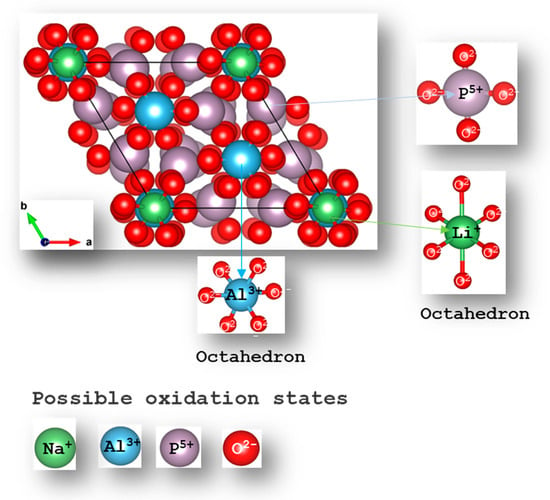
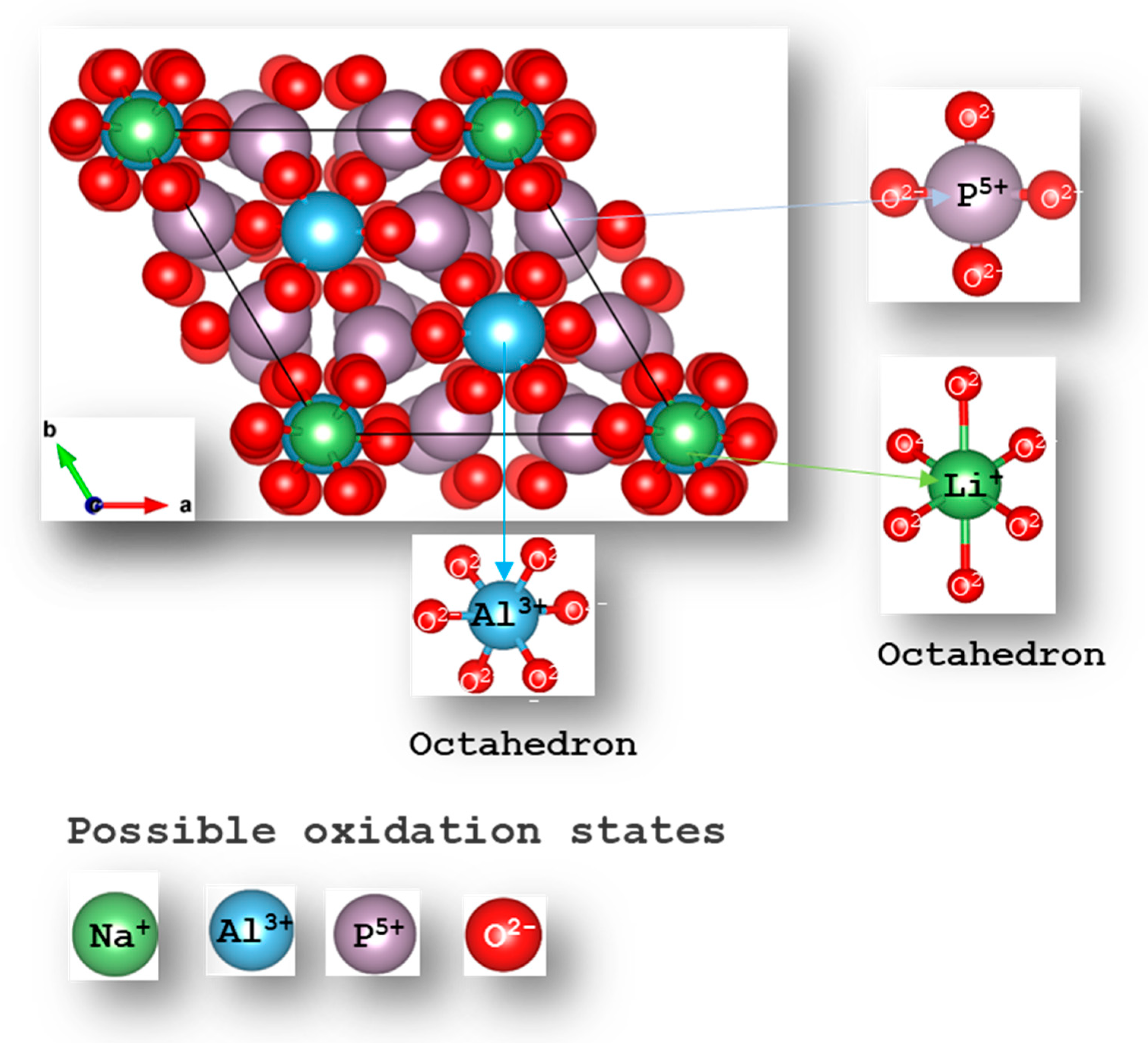
The NaAlP2O7 crystal structure was optimized by allowing the cell volumes, shape, and atomic positions to relax using PBE, PBEsol, and r2SCAN exchange-correlation functionals. The lattice parameters and formation energies of the ground-state structure displayed in Figure 1 were obtained and examined. NaAlP2O7 is made up of 44 atoms and was found to crystallize in the monoclinic space group P21/c. The structure consists of corner-sharing P2O7 diphosphate groups and AlO6 octahedra, forming a three-dimensional framework composed of NaO7 polyhedra and AlO6 octahedra and P2O7 diphosphate units. Figure 1 illustrates the atomic arrangement of the NaAlP2O7 structure using the ball-and-stick and polyhedral views.
Figure 1.
The crystal structure of a sodium aluminum pyrophosphate compound contains 44 atoms. The phosphate atoms form a tetrahedral coordination with the oxygen atoms; the aluminum and sodium ions form an octahedral coordination with oxygen.
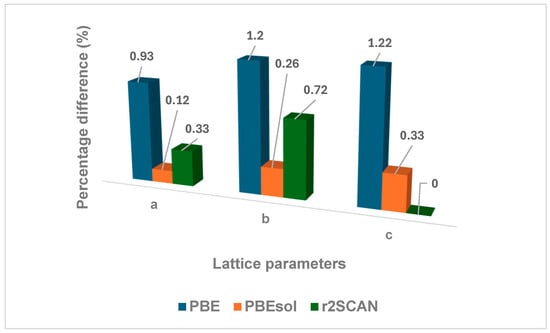
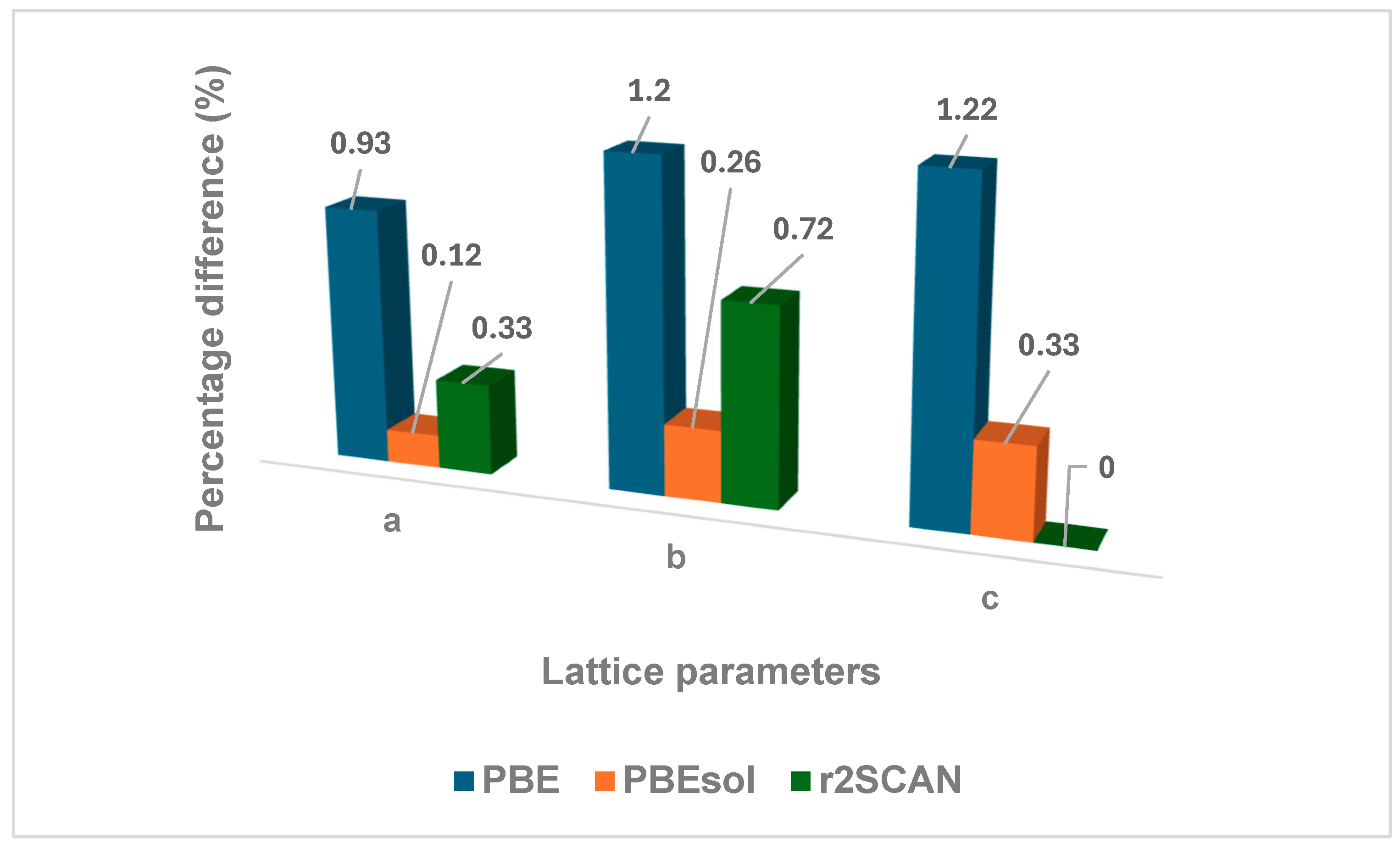
The lattice parameters describe the smallest repeating units of a crystal structure, which is essential for understanding how materials behave under different conditions, such as variations in applied pressure, operating temperature, and stress, as well as for identifying the crystal structure [43]. Table 1 presents the lattice parameters, volumes, and densities of the NaAlP2O7 crystal structure calculated using PBE, PBEsol, and r2SCAN exchange-correlation functionals, compared with the experimental data reported by Taher et al. [44]. Figure 2 illustrates the percentage differences between the calculated lattice parameters of the NaAlP2O7 structure using the PBE, PBEsol, and r2SCAN exchange-correlation functionals compared to the experimental data. The lattice parameters calculated with the PBE functional show a large percentage difference, which illustrates that the PBE functional overestimates the lattice parameters of NaAlP2O7. This could lead to incorrect predictions of essential structure properties, such as the thermal expansion and the stability of various phases of the material under conditions such as differing pressure. The r2SCAN functional yielded percentage differences of 0.33% and 0.72% to experimental data for the and lattice parameters, respectively. The parameter compared extremely well, with a percentage difference of 0% to experimental values. Notably, the PBEsol functional shows the best agreement with the experimental data, compared to the PBE and the r2SCAN functionals. Therefore, the PBEsol is the most suitable exchange-correlation functional for determining the lattice parameters of NaAlP2O7 solid electrolytes (SEs), which can contribute to reliable insights essential for developing sodium-ion batteries (NIBs) with enhanced performance.
Table 1.
The lattice parameters (, , ), angles (α, β), volume, and density of the NaAlP2O7 structure calculated using the PBE, PBEsol, and r2SCAN exchange-correlation functionals, compared with experimental results.
Figure 2.
The percentage difference between the a, b, and c lattice parameters obtained in this work and the experimental values (Table 1) of the NaAlP2O7 structure.
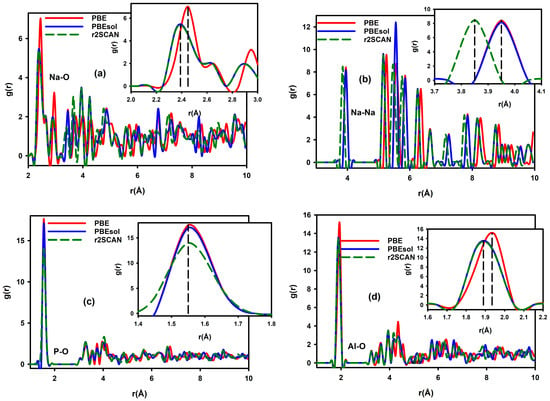
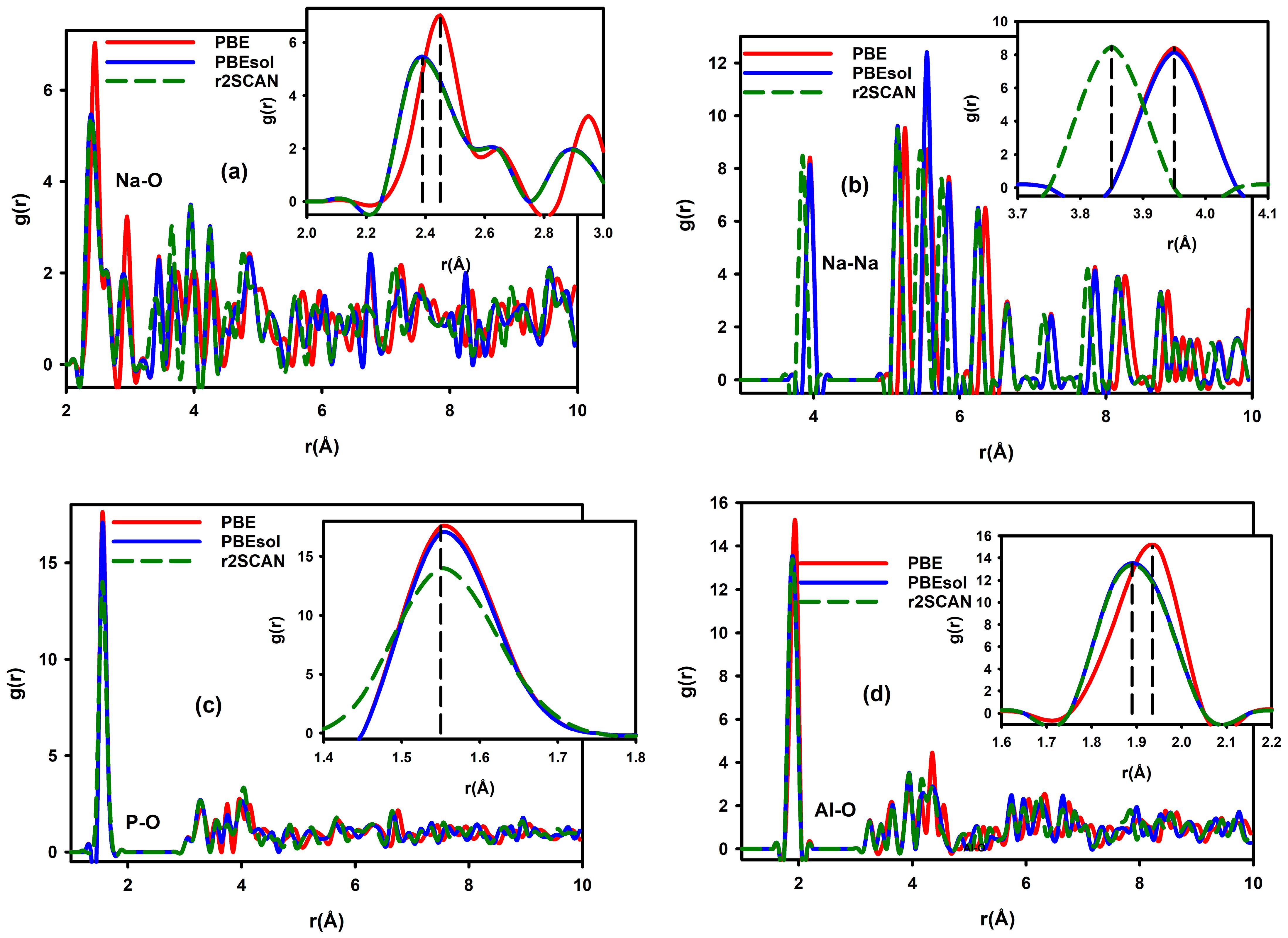
The RDF graphs in Figure 3a–d show the highest likelihood of finding an atom at a certain distance from a reference atom within a given separation range. The first peak in the RDF plot corresponds to the average distance to the nearest neighbouring atoms, which depicts the bonding distance of the interaction. The PBE first-nearest-neighbour RDF peak differs from the PBEsol and r2SCAN first-nearest-neighbour RDF peaks illustrated in Figure 3 for all interactions. This illustrates the differences in the magnitudes of the bonding distances between PBE, r2SCAN, and PBEsol for the NaAlP2O7 material. Table 2 shows the bonding distances obtained from the RDF plots of the NaAlP2O7 structure illustrated in Figure 3. The bond distance of the Na–Na interaction was found to be 3.962 Å, 3.912 Å, and 3.899 Å, obtained with the PBE, PBEsol, and r2SCAN exchange-correlation functionals, respectively. The bond length affects the shape and size of the channels through which ions migrate within the material. Narrow channels may slow down ion movement, resulting in low ionic conductivity. The Na–Na bonding distance represents the maximum migration path for Na+ conductivity in the material. As such, a shorter bond length reduces the energy barriers for ion migration, resulting in higher ionic conductivity. The PBE functional shows the highest bonding distance for all the interactions (Na–Na, Na–O, P–O, and Al–O). The bond lengths determined by the r2SCAN and PBEsol functionals are in good accord with a percentage difference of less than 1.3% for all the interactions (Na–Na, Na–O, P–O, and Al–O). Therefore, in line with the lattice parameters in Table 1, the PBEsol and r2SCAN functionals should yield bonding distances that are closer to experimental results.
Figure 3.
The bond lengths of (a) Na–O, (b) Na–Na (c) P–O, and (d) Al–O interactions in NaAlP2O7 are illustrated using radial distribution functions (RDFs) calculated from ground-state structures obtained with the PBE, PBEsol, and r2SCAN exchange-correlation functionals.
Table 2.
Bond lengths of the structural building blocks in NaAlP2O7 calculated using the PBE, PBEsol, and r2SCAN exchange-correlation functionals.
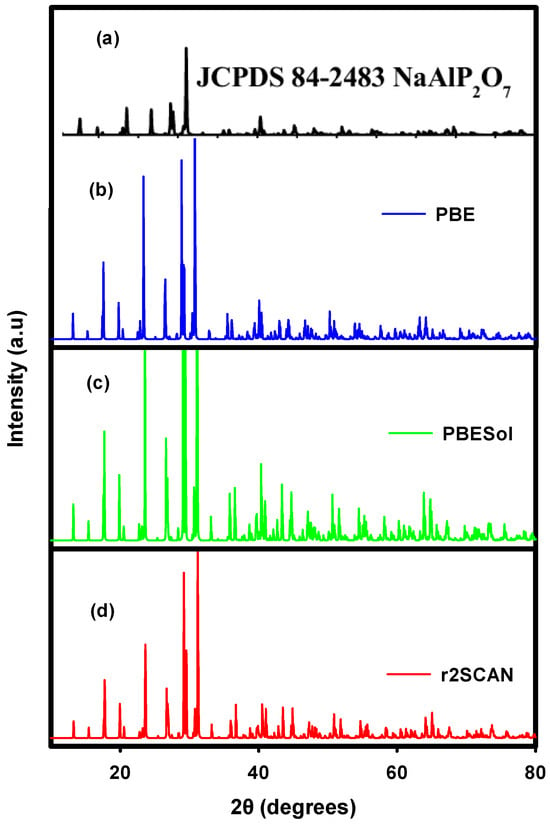
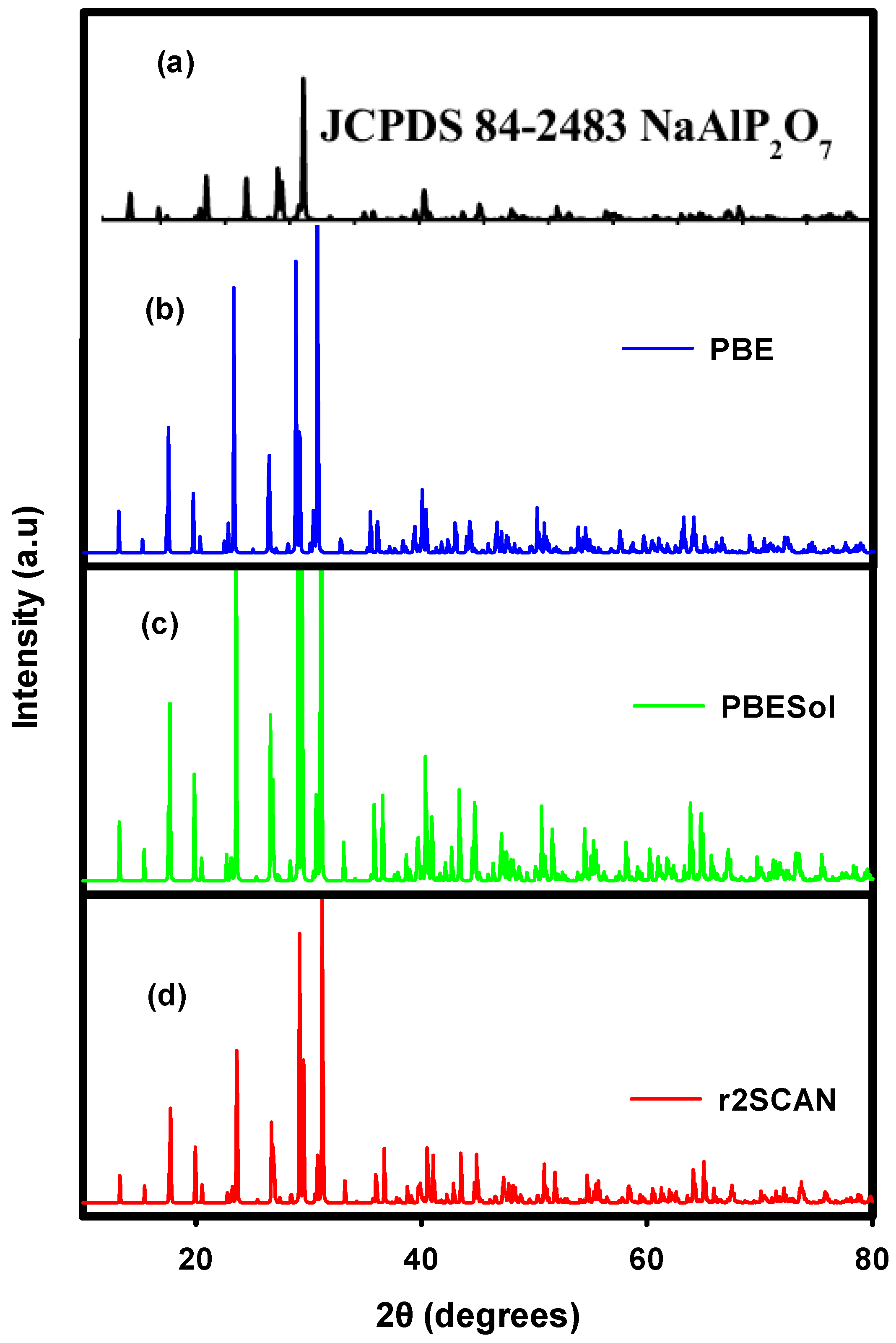
The X-ray diffraction (XRD) patterns of NaAlP2O7 determined from its ground-state structures obtained with PBE, PBEsol, and r2SCAN exchange-correlation functionals, compared with that of experiments, are illustrated in Figure 4. Figure 4a compares well with the XRD patterns shown in Figure 4b–d, which are indexed to a monoclinic crystal structure with a space group of P2_1/c. The XRD patterns were calculated using a copper wavelength of 1.540 Å and indexed at various diffracting angles. The peaks diffracted along the 212 planes are observed at different diffraction angles for all of the structures, optimized with PBE (29.45°), PBEsol (29.37°), and r2SCAN (29.07°). This can be attributed to the different bond distances between the elements in these compounds obtained by different functionals. As such, the choice of the exchange-correlation functional greatly influences the quality and reliability of the results for this SE material. Additionally, the variations in the peak intensities demonstrated in Figure 4 further evidence the difference in the description of lattice properties with the three exchange-correlation functionals. The different peak intensities suggest a varying degree of crystallinity of the ground-state structures obtained with the three functionals. Furthermore, the calculated XRD patterns possess comparable width since they were generated from bulk structures of the same size, which is in line with the Debye–Scherrer equation [45,46]:
where is the crystallite size, is a shape factor, is the X-ray wavelength, is the full width half maxima (FWHM), and θ is the diffracting angle.
Figure 4.
The XRD patterns of the NaAlP2O7 crystal structure: (a) the experimental structure [47] compared with the theoretical structure optimized using the (b) PBE, (c) PBEsol, and (d) r2SCAN exchange-correlation functionals.
3.1.2. Mechanical Properties
The investigation of the impact of the exchange-correlation functional on the mechanical properties of NaAlP2O7 was also evaluated, as illustrated in Table 3 and Figure 5. Table 3 depicts the elastic constants (Cijs) of NaAlP2O7 calculated with the PBE, PBEsol, and r2SCAN exchange-correlation functionals. There is currently no experimental data reported on the Cijs of the NaAlP2O7 material. The elastic constants were calculated under a strain of 0.005 applied isotopically to obtain a better mechanical response. For monoclinic crystals to be considered mechanically stable, they must satisfy the stability criteria defined by the Equations (A1)–(A7), illustrated in Appendix A.
Table 3.
The elastic constants of the NaAlP2O7 structure were calculated using different exchange-correlation functionals.
Figure 5.
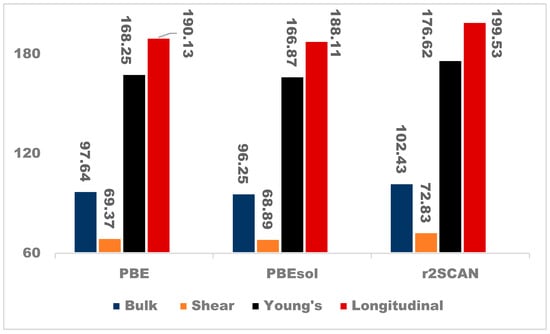
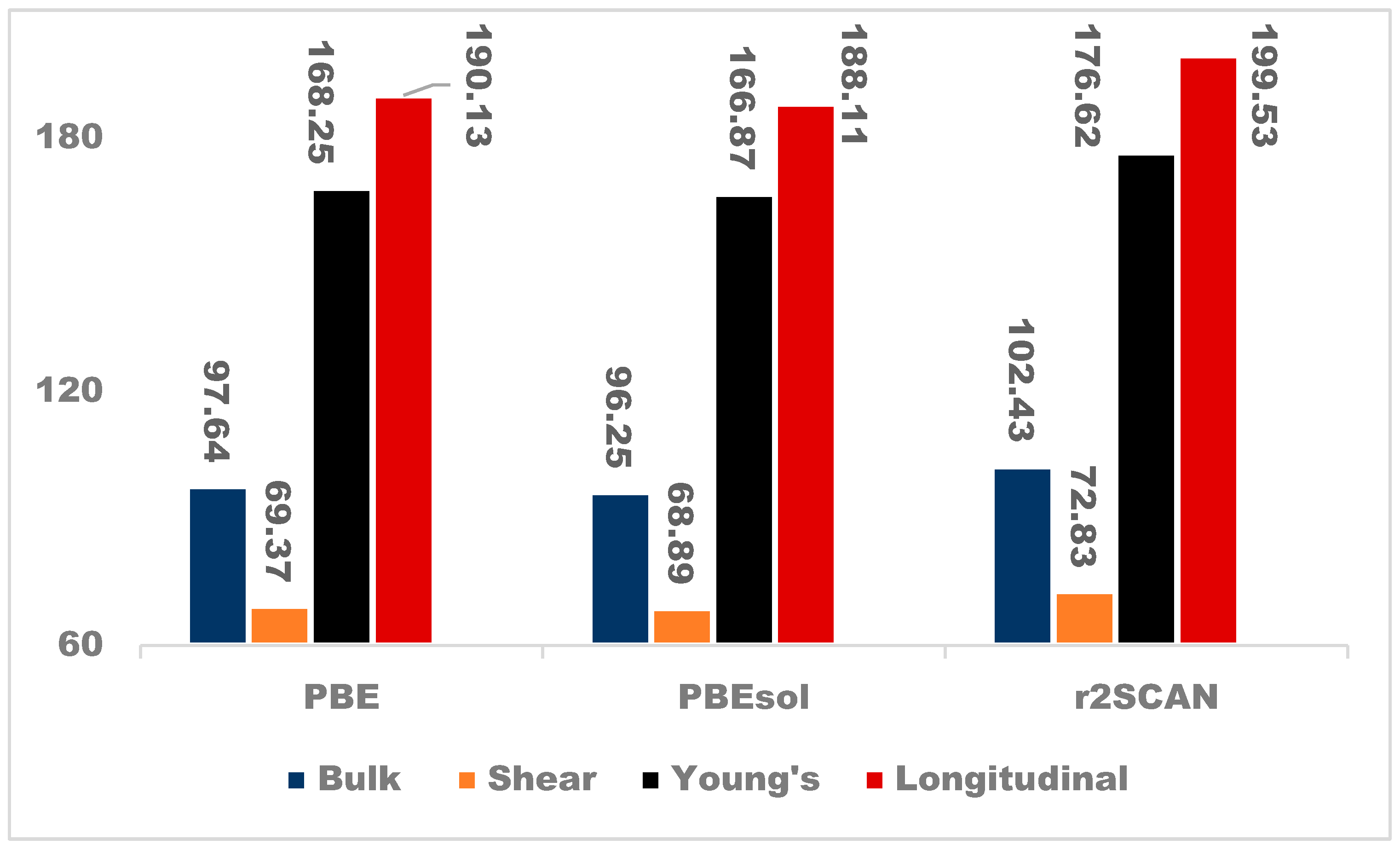
Elastic moduli (GPa) for NaAlP2O7 structures calculated using various functionals.
Substitutions of the from Table 3 into Equations (A1)–(A7) satisfy all the stability criteria. Therefore, the three exchange-correlation functionals predict that the NaAlP2O7 material is mechanically stable. The mechanical stability is essential for maintaining structural integrity during charging and discharging of the secondary battery. The majority of the constants are comparable, with slight differences. Particularly, the , , , , and constants of the three exchange-correlation functionals show notable differences. For example, the constant determined with the PBE, PBEsol, and r2SCAN functionals was found to be 4.52, 2.24, and −2.16, respectively. The PBEsol functional is designed to improve the accuracy of equilibrium properties, such as bulk moduli and lattice constants, by satisfying the second-order expansion of the gradient for local spin density and exchanged energy density.
The elastic modulus is also a very important mechanical property for assessing performance, and hence its proper description is of paramount importance. The elastic modulus describes the elastic deformation of a material under applied force [48], which plays a crucial role in the durability and performance of solid electrolyte (SE) batteries. Elastic properties are categorized into bulk modulus, shear modulus, Young’s modulus, and longitudinal modulus. The bulk modulus describes the uniform compression of a material in all directions when pressure is applied [49,50]. A material with a higher bulk modulus (100–150 GPa) indicates resistance to changes in volume.
The shear and bulk modulus are crucial in solid electrolyte batteries (SEBs) as they indicate a measure of a material’s resistance to cracking and deformation [51] under operating pressure (while maintaining constant volume), which affects the safety and lifecycle of the battery [50,52,53]. The bulk modulus of NaAlP2O7 was determined by PBE, PBEsol, and r2SCAN, illustrated in Figure 5, as 97.64 GPa, 96.25 GPa, and 102.43 GPa, respectively. The same trend is observed in the shear modulus, in which the PBESol has the lowest modulus (68.89 GPa) and the r2SCAN shows the highest modulus (72.83 GPa). The values of the Young’s and longitudinal moduli calculated with the PBE functional are between the values calculated with the PBESol and r2SCAN functionals. This trend is consistent for all of the elastic moduli. In general, oxide-containing solid electrolyte materials are brittle. Similarly, the Pugh’s ratio calculated with the PBE, PBESol, and r2SCAN functionals predicts that the NaAlP2O7 structure is brittle [54,55]. The values of the Pugh’s ratio determined with the three functionals are 1.41, 1.40, and 1.42 for the PBE, PBESol, and r2SCAN functionals, respectively. Their percentage difference is less than 2%, indicating that the three functionals yield comparable results for the elastic moduli. The elastic modulus is critical in studies of a material’s response to external stresses. A higher bulk modulus ensures structural integrity under applied loads, indicating greater resistance to volume changes under operating pressure [56]. Similarly, a higher shear modulus means the material resists bending and twisting, which can lead to fractures or cracks, and it can prevent the formation of Na dendrites because of the higher shear during battery operation. Batteries operate under varying temperatures and pressures, requiring rigid materials design and fabrication to avoid compression and stretching. The higher Young’s and longitudinal moduli obtained with r2SCAN, as displayed in Figure 5, reveal that the NaAlP2O7 solid electrolyte (SE) material is stiff and resists deformation under applied pressure [57]. However, factors such as the crystal’s structure and the temperature, pressure [58], defects, and chemical composition can affect the elastic properties of SE materials. A higher bulk modulus is one of the criteria used to determine whether the material is brittle [56].
3.1.3. Electronic Properties
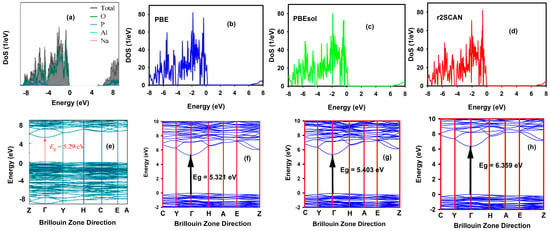
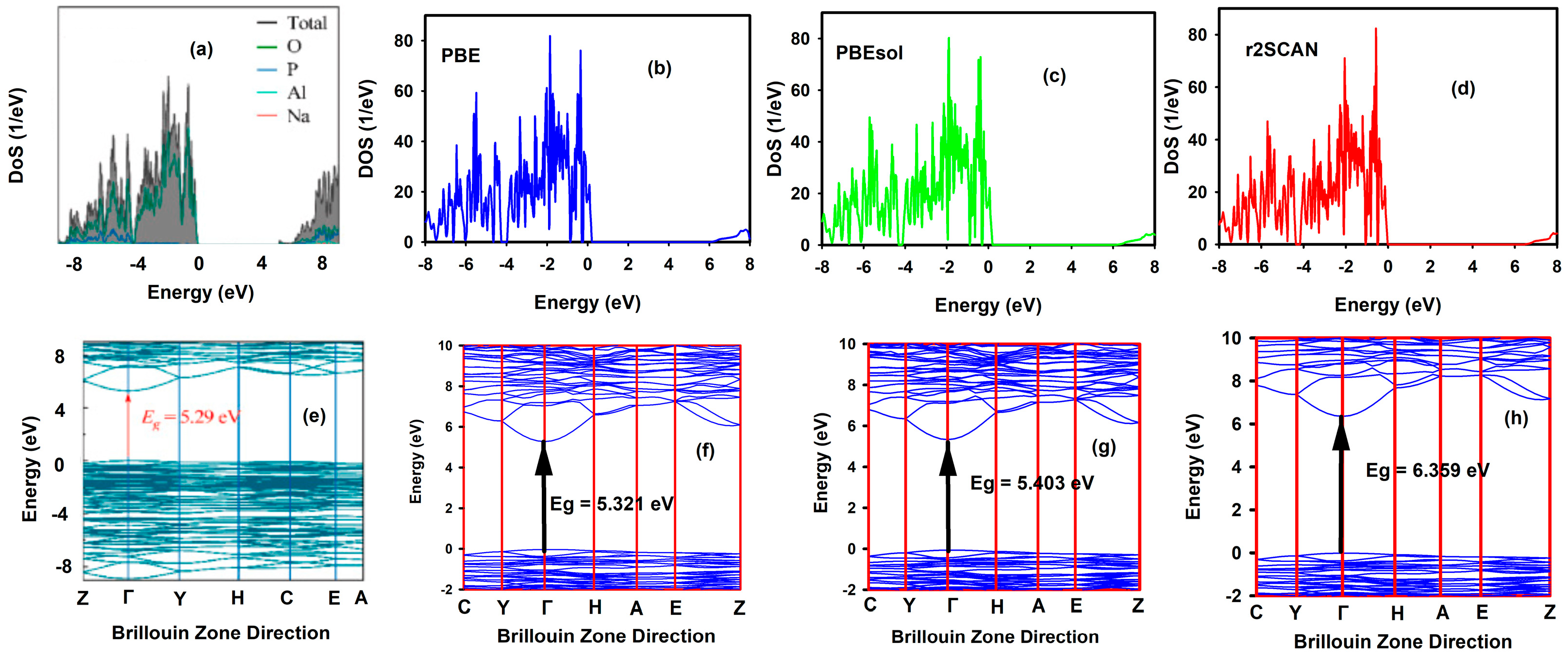
The electronic properties of a material describe the behaviour and interactions of electrons within the material, which influence ionic conductivity, electronic conductivity, safety, and the electrochemical stability window. These properties play a pivotal role in determining how materials respond to electric fields, heat, and light. A wider band gap is desirable in solid electrolyte (SE) batteries, as it can improve their stability and safety by suppressing electronic conductivities and reducing the likelihood of unwanted chemical reactions and short circuits [59]. Figure 6 shows the total density of states (TDOS) of the NaAlP2O7 crystal structure calculated using the PBE (band gap of 5.321 eV), PBEsol (5.403 eV), and r2SCAN (band gap of 6.359 eV) exchange-correlation functionals implemented in VASP. The obtained band gap energies from all three functionals indicate insulating behaviour. The TDOS calculated by r2SCAN exhibits a wider band gap, meaning that electrons in the valence band (VB) require more energy to transition to the conduction band (CB). The PBE functional shows the smallest energy gap, with a significant energy difference of 1.038 eV compared to that of the r2SCAN functional. Therefore, the choice of functional is very sensitive to the electronic properties of materials such as NaAlP2O7.
Figure 6.
The total density of states (TDOS) of NaAlP2O7: (a) experimental [60] compared with calculations using the (b) PBE, (c) r2SCAN, and (d) PBEsol exchange-correlation functionals and the band structure of NaAlP2O7: (e) experimental findings [44] versus that of the (f) PBE, (g) PBEsol, and (h) r2SCAN exchange-correlation functionals.
Additionally, the electronic property analysis of NaAlP2O7 was also evaluated with band structure diagrams, illustrated in Figure 6e–h, which describe the behaviour of electrons occupying different energy levels within a material. It gives a pictorial description of the valence band, the highest occupied energy level at zero temperature, and the conduction band, the unoccupied energy level above the valence band at absolute zero. The band gap energy of 5.321 eV for NaAlP2O7, calculated using the PBE functional, agrees with the band gap energy of 5.29 eV reported by Zhang et al. [60]. Zhang et al. also employed the PBE functional in their DFT prediction of the band gap of NaAlP2O7, which aligns with our predictions. The PBESol functional demonstrates a band gap of 5.403 eV for NaAlP2O7, which is 0.08 eV higher than the band gap computed with the PBE functional. Hence, the PBE and PBESol functionals yield similar predictions of the electronic properties of NaAlP2O7. In comparison with the PBE and PBESol functionals, the r2SCAN functional overestimates band gap energies, which is a consequence of its enhanced treatment of electron interactions. The smaller band gaps obtained with the PBE and PBEsol functionals can be attributed to the inherent poor description of localized electrons by the two functionals. The r2SCAN meta-GGA functional includes crucial information about the orbitals in the materials through the kinetic energy density, which provides a better description of the localized electronic environments in the material than the PBE and PBEsol functionals. As such, the most accurate description of electronic interaction is expected from the r2SCAN functional rather than the PBE and PBESol functionals. However, the band gap determined by the r2SCAN functional can be overestimated in comparison with the true band of the material, in line with the observations of Kothakonda et al. It was reported that r2SCAN overestimated the band gap energy of the material, which was found to be higher than the experimental value [29]. This overestimation can be traced to inaccuracies in how r2SCAN handles an electron’s interaction with its charge within the material. These errors cause an overestimation of the energy levels associated with the valence and conduction bands, leading to an increased estimated band gap for NaAlP2O7.
3.1.4. Thermodynamic Properties
For a material to be considered thermodynamically stable, it should exhibit negative formation energy. The formation energies of the NaAlP2O7 structure were calculated using the PBE, PBEsol, and r2SCAN exchange-correlation functionals using the formula in Equation (2). The energy of formation of NaAlP2O7 was found to be −2641.60 kJ/mol, −2747.15 kJ/mol, and −3003.22 kJ/mol with the PBE, PBEsol, and r2SCAN exchange-correlation functionals, respectively. All the functionals suggest that NaAlP2O7 is thermodynamically stable, evidenced by the negative energy of formation. This indicates that the NaAlP2O7 structure has a strong tendency to avoid decomposition and phase transition, making it a stable material. The higher energy of formation values calculated with the PBE functional can be linked to the overestimation of the lattice parameters, which leads to weaker atomic bonds and consequently to slightly higher energies. The PBEsol functional systematically yields high energy of formation values due to its capabilities of properly describing properties such as lattice parameters and bulk moduli. The r2SCAN functional produced the most thermodynamically stable structure with the lowest energy of formation. The r2SCAN functional is expected to yield an energy of formation that is closer to the experimental values due to its efficiency in characterizing local environments such as the double bond in O2 molecules. This is poorly defined in the PBE and PBEsol functionals, resulting in a large difference in the energy of formation calculation, in line with Equation (2). Therefore, the r2SCAN functional can be the most effective approach in predicting the ground-state interaction energy, quantified by formation energy, with relatively low computational demands.
where is the energy of formation for the compound [61], is the total energy of the compound, and is the reference energy of each constituent of NaAlP2O7.
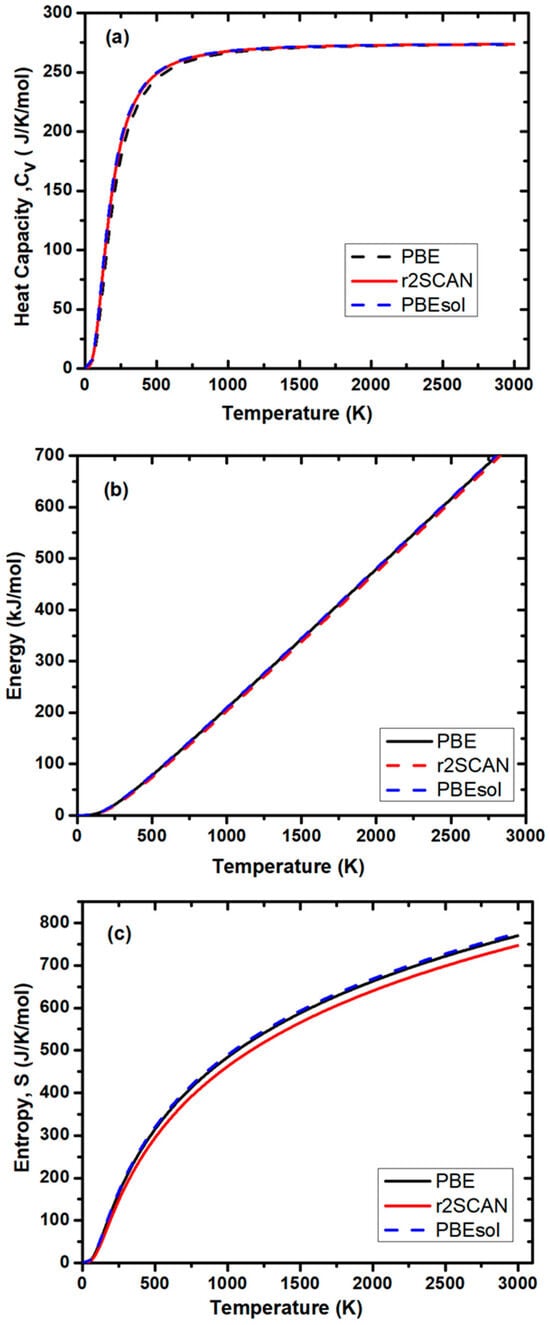
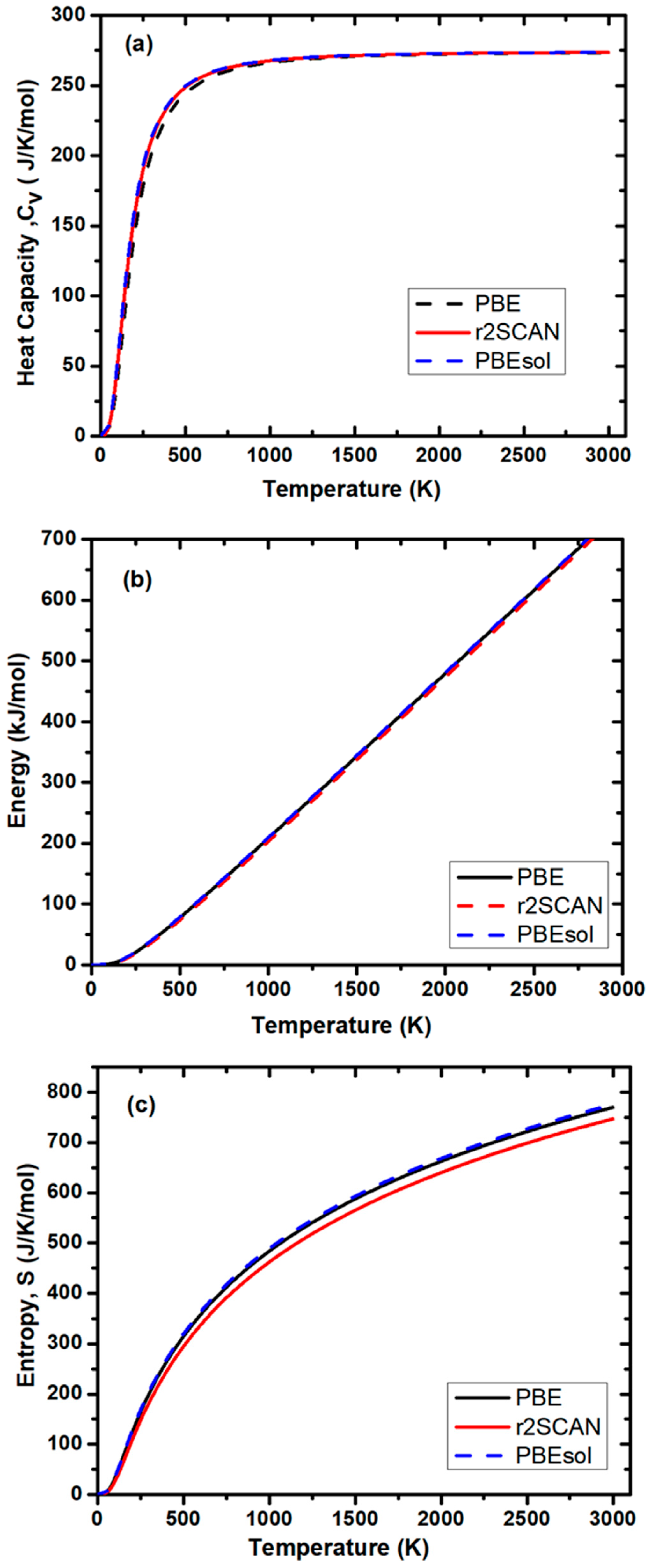
An increase in temperature significantly influences ion diffusion and mobility within solid electrolytes (SEs), as vibrating ions gain more kinetic energy, leading to higher battery capacity. Elevated temperatures can also accelerate electrochemical reactions at the electrode–electrolyte interface, improving reaction kinetics and enabling higher current densities and capacity. However, at very high temperatures, capacity may decrease due to increased side reactions, such as electrode corrosion and electrolyte decomposition, which can degrade battery performance. At low temperatures (near absolute zero), the heat capacity of NaAlP2O7 increases slowly because only low-energy vibrational modes of the atoms are excited. As the temperature rises, more vibrational modes become accessible, resulting in a gradual increase in heat capacity. This low-rate increase in heat capacity is attributed to the growing number of excited vibrational modes with temperature. At elevated temperatures, the heat capacity approaches a constant value, as shown in Figure 7a. Table 4 shows the heat capacity values at room temperature and 333 K, indicating that the battery can operate at low temperatures. This value corresponds to the energy required to excite all vibrational degrees of freedom of the atom in the material. The three functionals demonstrate a similar trend of heat capacity, with a slight difference noted between 250 and 750 K. The PBE functional yields results that deviate slightly from the PBEsol and r2SCAN functionals. This is attributed to the overinflated lattice parameters resulting from the softening of the low-frequency acoustic modes. Since soft modes are easily affected by temperature, this is more visible at lower temperatures (250–500 K). The PBEsol and r2SCAN functionals show good correlation to the heat capacities since they both yield acceptable lattice parameters. Lattice parameters possess significant influence on low frequency modes, which dominate heat capacities.
Figure 7.
(a) Vibrational heat capacity at constant volume, (b) internal energy, and (c) entropy as a function of temperature for NaAlP2O7 structures.
Table 4.
The heat capacity and temperature values calculated using the PBE, PBEsol, and r2SCAN exchange-correlation functionals.
The internal energy of the system, calculated with three functionals, PBE, PBEsol, and r2SCAN, increases linearly with temperature, as shown in Figure 7b. This trend can be attributed to the increase in vibrational energy of the atoms in the NaAlP2O7 structure. As the temperature rises, the kinetic energy of the atoms increases due to their dynamic vibrations. At higher temperatures, the atoms in NaAlP2O7 gain sufficient energy to move freely within the material, leading to higher ionic conductivity. Among the functionals, PBEsol predicts higher energy, followed by r2SCAN and then PBE. The parallel lines in the figure indicate that the energy difference between the functionals remains consistent across the temperature range. However, the PBE and PBEsol functionals demonstrate a subtle increase in the internal energy of the system in comparison with the r2SCAN functional. In PBE, the softer phonon is generally inaccurate, which leads to inaccurate zero-point energies. This is expected to improve with the PBEsol and r2SCAN functionals. The r2SCAN functional generally yields accurate phonons due to the inclusion of the kinetic term in its description.
Entropy in a system measures the level of disorder or randomness among atoms within a material, reflecting their arrangement. Higher entropy promotes the formation of more ionic pathways for ionic migration, as increased vacant sites and defects improve ionic conductivity by allowing atoms to move more easily. This makes entropy a key factor in designing batteries for various applications, such as electric vehicles (EVs) and electronic devices. Figure 7c shows the relationship between entropy and temperature predicted with three different exchange-correlation functionals, PBE, PBEsol, and r2SCAN. At higher temperatures, thermal energy helps ions overcome energy barriers, enabling them to move more freely within the electrolyte. This increased mobility raises entropy, indicating a greater level of disorder. However, very high temperatures can generate heat during battery operation, potentially reducing the battery’s lifespan and raising safety concerns. The insert in Figure 7c demonstrates how low temperatures affect the entropy of SEs. At temperatures between 0 and 30 K, entropy is much lower, but it sharply increases at 20 K, showing that ions gain enough energy to migrate within the NaAlP2O7 SE material. The PBE and PBEsol functionals predicted comparable entropy with increasing temperature, which varies from those predicted with the r2SCAN functional. This can be linked to the lack of the dispersion in PBE and PBEsol compared to the r2SCAN functional, which captures the intermediate range of the dispersion.
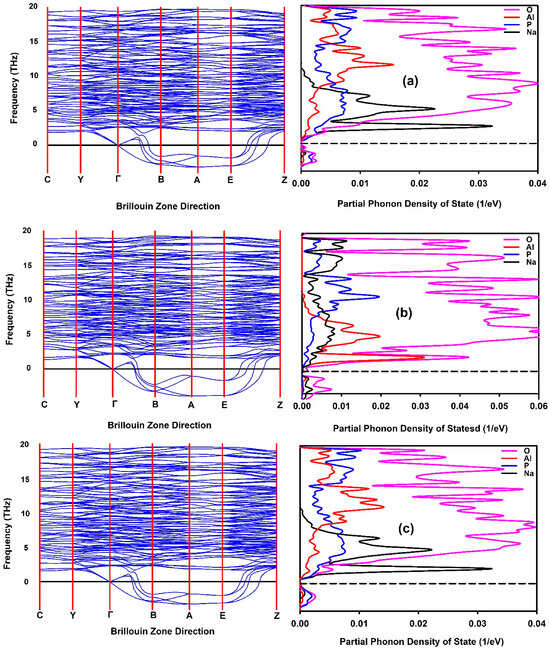
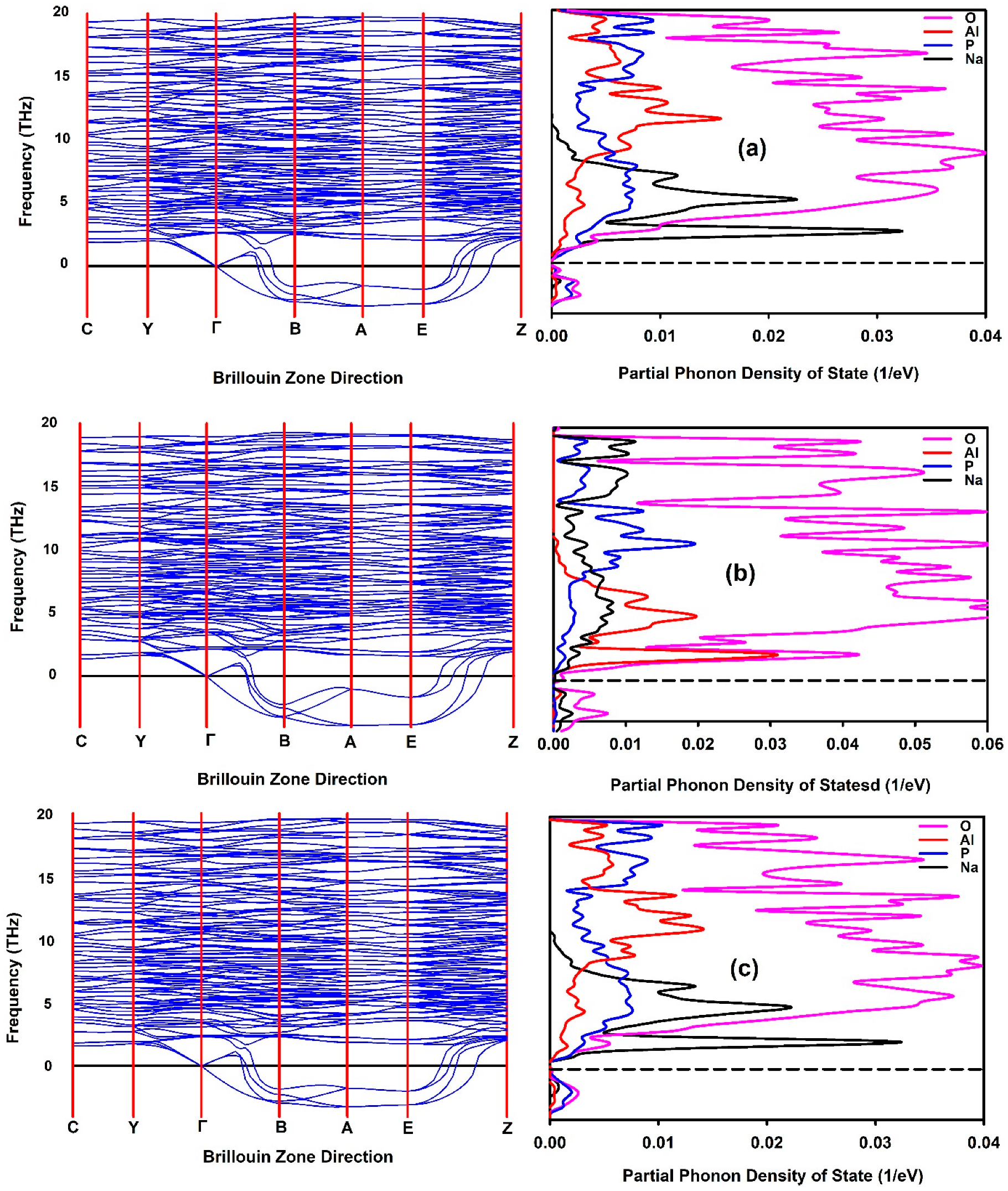
The quantum mechanical concept of “phonons” describes a specific type of vibrational motion in which lattice oscillations occur uniformly at the same frequency. Phonon dispersions in SEs are crucial for understanding material behaviour, including ionic transport, which influences ionic conductivity, thermal properties, and material design approaches. Phonons are categorized into two types: optical and acoustic modes. Optical modes, characterized by positive frequencies, are indicative of vibrational stability, while acoustic modes, with negative frequencies, indicate vibrational instability. Figure 8 shows the phonon dispersion curves of the NaAlP2O7 structure, calculated using the PBE, PBEsol, and r2SCAN exchange-correlation functionals implemented in VASP. Soft modes are observed in all phonon dispersion curves, indicating structural instability [62] in the NaAlP2O7 structure calculated with these functionals. As such, phonon calculations in NaAlP2O7 are not particularly affected by the choice of the functionals, between PBE, PBEsol, and r2SCAN. The instability in the NaAlP2O7 structure is attributed to the atomic vibrations of the Na, Al, P, and O atoms in the A, B, and E directions. The O and P atoms exhibit higher vibrational velocities in the A and E directions, as shown in the partial phonon density of states (DOS). Additionally, the O and P atoms are located closer to the Fermi level compared to the Na and Al atoms. Based on the obtained phonon dispersion curves, it is not possible to determine which functional is the most suitable for evaluating the vibrational stability of the NaAlP2O7 structure.
Figure 8.
Phonon dispersion curves and partial phonon density of states of O (pink), Al (red), P (blue), and Na (black) for NaAlP2O7 calculated using (a) PBE, (b) PBEsol, and (c) r2SCAN exchange-correlation functionals.
4. Conclusions
This study successfully investigated the properties of NaAlP2O7 using different density functional theory exchange-correlation functionals, such as PBE, PBEsol, and r2SCAN. The PBEsol functional was found to yield lattice parameters that are in close agreement with experimental data. Consequently, the PBEsol functional can also be a viable option for calculating mechanical properties within acceptable computational demands. The NaAlP2O7 structure was found to be mechanically stable, satisfying all stability criteria for a monoclinic crystal. Wider band gap energies were observed, showing the insulating behaviour of NaAlP2O7. The PBE and PBEsol functionals were also found to underestimate the band gap of the NaAlP2O7 solid electrolyte material. As a result, the r2SCAN functional could be a better approach for electronic structure analysis at a considerable computational cost. The three functionals demonstrate that the NaAlP2O7 structure is thermodynamically stable, which is essential for the lifecycle of sodium-ion batteries. However, the r2SCAN functional also predicted a more negative energy of formation than the PBE and PBEsol functionals. As such, the calculation of formation energies of the NaAlP2O7 solid material benefits significantly from the inclusion of the kinetic energy density in the r2SCAN-meta-GGA functional. The choice of the exchange-correlation functional was also found to be very important in the calculation of the internal energy and entropy of the NaAlP2O7 solid electrolyte material. The r2SCAN was found to be a suitable option for calculation of these properties due to its proper description of soft modes and inclusion of intermediate-range dispersion. The three functionals (PBE, PBEsol, and r2SCAN) predict that the NaAlP2O7 structure is vibrationally unstable, demonstrated by the negative frequencies in the phonon dispersion curves, likely due to atomic oscillation speeds. As such, structural modification through doping can be sought for improving its vibrational stability. Overall, the r2SCAN exchange-correlation functional demonstrated superior accuracy in predicting most of NaAlP2O7’s properties, making it a reliable choice for modelling solid electrolyte materials. However, the PBEsol functional can also play a pivotal role in accelerating analysis of NaAlP2O7’s equilibrium properties, especially in situations where a bigger simulation structure is required. These findings provide valuable insights into developing NIBs with solid electrolytes, enhancing battery safety and performance across numerous applications.
Author Contributions
Writing—original draft, M.S.M., K.T.M., D.H., and R.S.L.; methodology, M.S.M., K.T.M., D.H., P.E.N., and R.S.L.; software, P.E.N.; validation, M.S.M., K.T.M., D.H., and R.S.L.; formal analysis, M.S.M.; investigation, M.S.M.; resources, M.S.M.; data curation, M.S.M.; writing—original draft preparation, M.S.M.; writing—review and editing, K.T.M., D.H., and R.S.L.; visualization, R.S.L.; supervision, K.T.M., D.H., P.E.N., and R.S.L.; project administration, R.S.L.; funding acquisition, M.S.M. and P.E.N. All authors have read and agreed to the published version of the manuscript.
Funding
This study was funded by the DSI-CSIR inter-bursary and the University of Limpopo, Material Modeling Centre.
Institutional Review Board Statement
Not applicable.
Informed Consent Statement
Not applicable.
Data Availability Statement
The original contributions presented in this study are included in the article. Further inquiries can be directed to the corresponding authors.
Acknowledgments
We thank the University of Limpopo Materials Modeling Centre and the Center for High Performance Computing (CHPC) for their computing resources.
Conflicts of Interest
The authors declare no conflicts of interest.
Abbreviations
The following abbreviations are used in this manuscript:
| DFT | Density Functional Theory |
| GGA-PBE | Generalize Gradient Approximation Perdew–Burke–Ernzerhof |
| GGA-PBESOL | Generalize Gradient Approximation Perdew–Burke–Ernzerhof Revised for Solids |
| Meta-GGA r2SCAN | Generalize Gradient Approximation Range-separated Hybrid functional |
| LDA | Local Density Approximation |
| VASP | Vienna Ab initio Simulation Package |
| PAW | Projector-Augmented Wave |
| LIB | Lithium-Ion Batter |
| NIB | Sodium-Ion Battery |
| SE | Solid Electrolyte |
| SEB | Solid Electrolyte Battery |
| EV | Electric Vehicle |
| Na | Sodium |
| Al | Aluminum |
| P | Phosphorus |
| O | Oxygen |
| NZSP | Sodium Zirconium Silicon Phosphate |
| NASICON | Sodium Superionic Conductor |
| DOS | Density Of States |
| TDOS | Total Density of States |
| PDOS | Phonon Density of States |
| D | Crystallite Size |
| XRD | X-ray Diffraction |
| FWHM | Full Width Half Maxima |
| RDF | Radial Distribution Functional |
| VB | Valence Band |
| CB | Conduction Band |
| Cij | Elastic Constant |
| GPa | Gigapascal |
| eV | Electron Volts |
Appendix A
The mechanical stability conditions for a monoclinic system, as outlined by the Born criteria, are expressed as [54,63]:
References
- Kong, L.; Tang, C.; Peng, H.J.; Huang, J.Q.; Zhang, Q. Advanced Energy Materials for Flexible Batteries in Energy Storage: A Review. SmartMat 2020, 1, SMM21007. [Google Scholar] [CrossRef] [Scilit]
- Brown, S.; Pyke, D.; Steenhof, P. Electric Vehicles: The Role and Importance of Standards in an Emerging Market. Energy Policy 2010, 38, 3797–3806. [Google Scholar] [CrossRef] [Scilit]
- Ahmad, F.; Khalid, M.; Panigrahi, B.K. Development in Energy Storage System for Electric Transportation: A Comprehensive Review. J. Energy Storage 2021, 43, 103153. [Google Scholar] [CrossRef] [Scilit]
- Junfeng, H.; Tabish, M.; Ajmal, S.; Kumar, A.; Guo, J.; Alam, M.M.; Yasin, G. Nanoengineering of Boron-Based Materials for Lithium Batteries: Advances, Challenges, and Prospects. Small Methods 2025, 9, 2500208. [Google Scholar] [CrossRef] [Scilit]
- Zhao, L.; Zhang, T.; Li, W.; Li, T.; Zhang, L.; Zhang, X.; Wang, Z. Engineering of Sodium-Ion Batteries: Opportunities and Challenges. Engineering 2023, 24, 172–183. [Google Scholar] [CrossRef] [Scilit]
- Chen, S.; Wu, C.; Shen, L.; Zhu, C.; Huang, Y.; Xi, K.; Maier, J.; Yu, Y. Challenges and Perspectives for NASICON-Type Electrode Materials for Advanced Sodium-Ion Batteries. Adv. Mater. 2017, 29, 1700431. [Google Scholar] [CrossRef] [Scilit] [PubMed]
- You, Y.; Sang, Z.; Liu, J. Recent Developments on Aqueous Sodium-Ion Batteries. Mater. Technol. 2016, 31, 501–509. [Google Scholar] [CrossRef] [Scilit]
- Yabuuchi, N.; Kubota, K.; Dahbi, M.; Komaba, S. Research Development on Sodium-Ion Batteries. Chem. Rev. 2014, 114, 11636–11682. [Google Scholar] [CrossRef] [Scilit] [PubMed]
- Sawicki, M.; Shaw, L.L. Advances and Challenges of Sodium Ion Batteries as Post Lithium-Ion Batteries. RSC Adv. 2015, 5, 53129–53154. [Google Scholar] [CrossRef] [Scilit]
- Yu, Z.; Shang, S.-L.; Seo, J.-H.; Wang, D.; Luo, X.; Huang, Q.; Chen, S.; Lu, J.; Li, X.; Liu, Z.-K.; et al. Exceptionally High Ionic Conductivity in Na3P0.62As0.38S4 with Improved Moisture Stability for Solid-State Sodium-Ion Batteries. Adv. Mater. 2017, 29, 1605561. [Google Scholar] [CrossRef] [Scilit]
- Tang, X.; Lv, S.; Jiang, K.; Zhou, G.; Liu, X. Recent Development of Ionic Liquid-Based Electrolytes in Lithium-Ion Batteries. J. Power Sources 2022, 542, 231792. [Google Scholar] [CrossRef] [Scilit]
- Niu, H.; Wang, L.; Guan, P.; Zhang, N.; Yan, C.; Ding, M.; Guo, X.; Huang, T.; Hu, X. Recent Advances in Application of Ionic Liquids in Electrolyte of Lithium-Ion Batteries. J. Energy Storage 2021, 40, 102659. [Google Scholar] [CrossRef] [Scilit]
- Hou, W.; Guo, X.; Shen, X.; Amine, K.; Yu, H.; Lu, J. Solid Electrolytes and Interfaces in All-Solid-State Sodium Batteries: Progress and Perspective. Nano Energy 2018, 52, 279–291. [Google Scholar] [CrossRef] [Scilit]
- Kim, J.J.; Yoon, K.; Park, I.; Kang, K. Progress in the Development of Sodium-Ion Solid Electrolytes. Small Methods 2017, 1, 1700219. [Google Scholar] [CrossRef] [Scilit]
- Li, C.; Li, R.; Liu, K.; Si, R.; Zhang, Z.; Hu, Y.S. NaSICON: A Promising Solid Electrolyte for Solid-State Sodium Batteries. Interdiscip. Mater. 2022, 1, 396–416. [Google Scholar] [CrossRef] [Scilit]
- Pandit, B.; Johansen, M.; Andersen, B.P.; Martínez-Cisneros, C.S.; Levenfeld, B.; Ravnsbæk, D.B.; Varez, A. All-Solid-State Sodium-Ion Batteries Operating at Room Temperature Based on NASICON-Type NaTi2(PO4)3 Cathode and Ceramic NASICON Solid Electrolyte: A Complete in Situ Synchrotron X-Ray Study. Chem. Eng. J. 2023, 472, 144509. [Google Scholar] [CrossRef] [Scilit]
- Zuo, D.; Yang, L.; Zou, Z.; Li, S.; Feng, Y.; Harris, S.J.; Shi, S.; Wan, J.; Zuo, D.; Yang, L.; et al. Ultrafast Synthesis of NASICON Solid Electrolytes for Sodium-Metal Batteries. Adv. Energy Mater. 2023, 13, 2301540. [Google Scholar] [CrossRef] [Scilit]
- Zhang, Q.; Lu, Y.; Guo, W.; Shao, Y.; Liu, L.; Lu, J.; Rong, X.; Han, X.; Li, H.; Chen, L.; et al. Hunting Sodium Dendrites in NASICON-Based Solid-State Electrolytes. Energy Mater. Adv. 2021, 2021, 1–10. [Google Scholar] [CrossRef] [Scilit]
- Huang, H.; Wang, L.; Zhi, B.; Fan, J.; Mi, Y.; Ma, H.; Tang, Y.; Liang, J.; Hu, Z.; Yang, T. High Electrochemical Performance of Tb Doping Na3Zr2Si2PO12 Solid Electrolyte by Manipulating Phase Structures. Ceram. Int. 2025, 51, 26853–26860. [Google Scholar] [CrossRef] [Scilit]
- Xiang, L.; Gao, Y.; Ding, Y.; Li, X.; Jiang, D.; Wu, C.; Zhan, X.; Zhu, L. Self-Forming Na3P/Na2O Interphase on a Novel Biphasic Na3Zr2Si2PO12/Na3PO4 Solid Electrolyte for Long-Cycling Solid-State Na-Metal Batteries. Energy Storage Mater. 2024, 73, 103831. [Google Scholar] [CrossRef] [Scilit]
- Pereira da Silva, J.G.; Bram, M.; Laptev, A.M.; Gonzalez-Julian, J.; Ma, Q.; Tietz, F.; Guillon, O. Sintering of a Sodium-Based NASICON Electrolyte: A Comparative Study between Cold, Field Assisted and Conventional Sintering Methods. J. Eur. Ceram. Soc. 2019, 39, 2697–2702. [Google Scholar] [CrossRef] [Scilit]
- Zhu, J.; Xiang, J.; Hu, L.; Mao, Y.; Xiong, K.; Zhao, H. Synthesis and Red Emitting Properties of NaAlP2O7:Pr3+ Polycrystal for Blue Chip-Excited WLEDS. Results Phys. 2019, 12, 771–775. [Google Scholar] [CrossRef] [Scilit]
- Ben Taher, Y.; Oueslati, A.; Maaloul, N.K.; Khirouni, K.; Gargouri, M. Conductivity Study and Correlated Barrier Hopping (CBH) Conduction Mechanism in Diphosphate Compound. Appl. Phys. A Mater. Sci. Process 2015, 120, 1537–1543. [Google Scholar] [CrossRef] [Scilit]
- Kim, K.; Siegel, D.J. Predicting Wettability and the Electrochemical Window of Lithium-Metal/Solid Electrolyte Interfaces. ACS Appl. Mater. Interfaces 2019, 11, 39940–39950. [Google Scholar] [CrossRef] [Scilit]
- Terentjev, A.V.; Constantin, L.A.; Pitarke, J.M. Dispersion-Corrected PBEsol Exchange-Correlation Functional. Phys. Rev. B 2018, 98, 214108. [Google Scholar] [CrossRef] [Scilit]
- Kim, J.; Mok, D.H.; Kim, H.; Back, S. Accelerating the Search for New Solid Electrolytes: Exploring Vast Chemical Space with Machine Learning-Enabled Computational Calculations. ACS Appl. Mater. Interfaces 2023, 15, 42. [Google Scholar] [CrossRef] [Scilit] [PubMed]
- Gigli, L.; Tisi, D.; Grasselli, F.; Ceriotti, M. Mechanism of Charge Transport in Lithium Thiophosphate. Chem. Mater. 2024, 36, 1482–1496. [Google Scholar] [CrossRef] [Scilit] [PubMed]
- Shang, S.L.; Hector, L.G.; Shi, S.; Qi, Y.; Wang, Y.; Liu, Z.K. Lattice Dynamics, Thermodynamics and Elastic Properties of Monoclinic Li2CO3 from Density Functional Theory. Acta Mater. 2012, 60, 5204–5216. [Google Scholar] [CrossRef] [Scilit]
- Kothakonda, M.; Kaplan, A.D.; Isaacs, E.B.; Bartel, C.J.; Furness, J.W.; Ning, J.; Wolverton, C.; Perdew, J.P.; Sun, J. Testing the R2SCAN Density Functional for the Thermodynamic Stability of Solids with and without a van Der Waals Correction. ACS Mater. Au 2023, 3, 102–111. [Google Scholar] [CrossRef] [Scilit] [PubMed]
- Ning, J.; Furness, J.W.; Sun, J. Reliable Lattice Dynamics from an Efficient Density Functional Approximation. Chem. Mater. 2022, 34, 2562–2568. [Google Scholar] [CrossRef] [Scilit]
- Liu, H.; Bai, X.; Ning, J.; Hou, Y.; Song, Z.; Ramasamy, A.; Zhang, R.; Li, Y.; Sun, J.; Xiao, B. Assessing R2SCAN Meta-GGA Functional for Structural Parameters, Cohesive Energy, Mechanical Modulus, and Thermophysical Properties of 3d, 4d, and 5d Transition Metals. J. Chem. Phys. 2024, 160, 024102. [Google Scholar] [CrossRef] [Scilit]
- Moradabadi, A.; Kaghazchi, P. Defect Chemistry in Cubic Li6.25Al0.25La3Zr2O12 Solid Electrolyte: A Density Functional Theory Study. Solid. State Ion. 2019, 338, 74–79. [Google Scholar] [CrossRef] [Scilit]
- Liu, Z.; Qi, Y.; Lin, Y.X.; Chen, L.; Lu, P.; Chen, L.Q. Interfacial Study on Solid Electrolyte Interphase at Li Metal Anode: Implication for Li Dendrite Growth. J. Electrochem. Soc. 2016, 163, 592–598. [Google Scholar] [CrossRef] [Scilit]
- Loos, P.F. Generalized Local-Density Approximation and One-Dimensional Finite Uniform Electron Gases. Phys. Rev. A 2014, 89, 052523. [Google Scholar] [CrossRef] [Scilit]
- Sahni, V.; Bohnen, K.-P.; Harbola, M.K. Analysis of the Local-Density Approximation of Density-Functional Theory. Phys. Rev. 1988, 37, 1895–1907. [Google Scholar] [CrossRef] [Scilit]
- Hua, X.; Chen, X.; Iii, W.A.G. Generalized Generalized Gradient Approximation: An Improved Density-Functional Theory for Accurate Orbital Eigenvalues. Phys. Rev. 1997, 55, 16103–16109. [Google Scholar] [CrossRef] [Scilit]
- Babu, M.M.H.; Saha, T.; Podder, J.; Roy, P.; Barik, A.; Haque, E. Electronic Structure Transition of Cubic CsSnCl3 under Pressure: Effect of RPBE and PBEsol Functionals and GW Method. Heliyon 2021, 7, e07796. [Google Scholar] [CrossRef] [Scilit]
- Mejía-Rodríguez, D.; Trickey, S.B. Meta-GGA Performance in Solids at Almost GGA Cost. Phys. Rev. B 2020, 102, 121109. [Google Scholar] [CrossRef] [Scilit]
- Swathilakshmi, S.; Devi, R.; Gautam, G.S. Performance of the R2SCAN Functional in Transition Metal Oxides. J. Chem. Theory Comput. 2023, 19, 4202–4215. [Google Scholar] [CrossRef] [Scilit]
- Furness, J.W.; Kaplan, A.D.; Ning, J.; Perdew, J.P.; Sun, J. Accurate and Numerically Efficient R2SCAN Meta-Generalized Gradient Approximation. J. Phys. Chem. Lett. 2020, 11, 8208–8215. [Google Scholar] [CrossRef] [Scilit] [PubMed]
- Parlinski, K.; Li, Z.Q.; Kawazoe, Y. First-Principles Determination of the Soft Mode in Cubic ZrO2. Phys. Rev. Lett. 1997, 78, 4063–4066. [Google Scholar] [CrossRef] [Scilit]
- Wimmer, E.; Christensen, M.; Eyert, V.; Wolf, W.; Reith, D.; Rozanska, X.; Freeman, C.; Saxe, P.; Wimmer, E.; Christensen, M.; et al. Computational Materials Engineering: Recent Applications of VASP in the MedeA® Software Environment. J. Korean Ceram. Soc. 2016, 53, 263–272. [Google Scholar] [CrossRef] [Scilit]
- Arunkumar, T.A.; Manthiram, A. Influence of Lattice Parameter Differences on the Electrochemical Performance of the 5 v Spinel LiMn1.5-YNi0.5-ZM Y+zO4 (M = Li, Mg, Fe, Co, and Zn). Electrochem. Solid-State Lett. 2005, 8, A403. [Google Scholar] [CrossRef] [Scilit]
- Ben Taher, Y.; Hajji, R.; Oueslati, A.; Gargouri, M. Infra-Red, NMR Spectroscopy and Transport Properties of Diphosphate NaAlP2O7. J. Clust. Sci. 2015, 26, 1279–1294. [Google Scholar] [CrossRef] [Scilit]
- Mustapha, S.; Ndamitso, M.M.; Abdulkareem, A.S.; Tijani, J.O.; Shuaib, D.T.; Mohammed, A.K.; Sumaila, A. Comparative Study of Crystallite Size Using Williamson-Hall and Debye-Scherrer Plots for ZnO Nanoparticles. Adv. Nat. Sci. Nanosci. Nanotechnol. 2019, 10, 045013. [Google Scholar] [CrossRef] [Scilit]
- Bokuniaeva, A.O.; Vorokh, A.S. Estimation of Particle Size Using the Debye Equation and the Scherrer Formula for Polyphasic TiO2 Powder. J. Phys. Conf. Ser. 2019, 1410, 012057. [Google Scholar] [CrossRef] [Scilit]
- Chen, X.; Lv, F.; Ma, Y.; Zhang, Y. Preparation and Spectroscopic Investigation of Novel NaAlP2O7:Eu2+ Phosphors for White LEDs. J. Alloys Compd. 2016, 680, 20–25. [Google Scholar] [CrossRef] [Scilit]
- Shatov, A.V.; Ponomarev, S.S.; Firstov, S.A. Hardness and Deformation of Hardmetals at Room Temperature. Compr. Hard Mater. 2014, 1, 267–299. [Google Scholar] [CrossRef] [Scilit]
- Roy, A.; Kanungo, B.; Patra, P.K.; Bhattacharya, B. Benchmarking DFT Approximations for Studying Apatites. Phys. Chem. Chem. Phys. 2024, 26, 29617–29627. [Google Scholar] [CrossRef] [Scilit] [PubMed]
- Yang, Y.; Wu, Q.; Cui, Y.; Chen, Y.; Shi, S.; Wang, R.Z.; Yan, H. Elastic Properties, Defect Thermodynamics, Electrochemical Window, Phase Stability, and Li+ Mobility of Li3PS4: Insights from First-Principles Calculations. ACS Appl. Mater. Interfaces 2016, 8, 25229–25242. [Google Scholar] [CrossRef] [Scilit]
- Gross, T.M.; Wu, J.; Baker, D.E.; Price, J.J.; Yongsunthon, R. Crack-Resistant Glass with High Shear Band Density. J. Non-Cryst. Solids 2018, 494, 13–20. [Google Scholar] [CrossRef] [Scilit]
- Boaretto, N.; Garbayo, I.; Valiyaveettil-SobhanRaj, S.; Quintela, A.; Li, C.; Casas-Cabanas, M.; Aguesse, F. Lithium Solid-State Batteries: State-of-the-Art and Challenges for Materials, Interfaces and Processing. J. Power Sources 2021, 502, 229919. [Google Scholar] [CrossRef] [Scilit]
- Liu, X.; Feng, Q.; Tang, B.; Zheng, J.; Zheng, Z.; Zhou, W.; Tian, J.; Wang, J. First-Principles Calculations of Mechanical and Thermodynamic Properties of Tetragonal Be12Ti. RSC Adv. 2019, 9, 5302–5312. [Google Scholar] [CrossRef] [Scilit] [PubMed]
- Xiao, W.; Yang, Y.; Pi, Z.; Zhang, F. Phase Stability and Mechanical Properties of the Monoclinic, Monoclinic-Prime and Tetragonal REMO4 (M = Ta, Nb) from First-Principles Calculations. Coatings 2022, 12, 73. [Google Scholar] [CrossRef] [Scilit]
- Yu, S.; Schmidt, R.D.; Garcia-Mendez, R.; Herbert, E.; Dudney, N.J.; Wolfenstine, J.B.; Sakamoto, J.; Siegel, D.J. Elastic Properties of the Solid Electrolyte Li7La3Zr2O12 (LLZO). Chem. Mater. 2016, 28, 197–206. [Google Scholar] [CrossRef] [Scilit]
- Bae Song, Y.; Kwak, H.; Cho, W.; Kim, K.S.; Seok Jung, Y.; Park, K.H. Electrochemo-Mechanical Effects as a Critical Design Factor for All-Solid-State Batteries. Curr. Opin. Solid. State Mater. Sci. 2022, 26, 100977. [Google Scholar] [CrossRef] [Scilit]
- Wolfenstine, J.; Allen, J.L.; Sakamoto, J.; Siegel, D.J.; Choe, H. Mechanical Behavior of Li-Ion-Conducting Crystalline Oxide-Based Solid Electrolytes: A Brief Review. Ionics 2018, 24, 1271–1276. [Google Scholar] [CrossRef] [Scilit]
- Manghnani, M.H.; Williams, Q.; Matsui, T.; Schultz, P.C.; Kurkjian, C.R. Effects of Composition, Pressure, and Temperature on the Elastic Properties of SiO2-TiO2 Glasses: An Integrated Ultrasonic and Brillouin Study. Minerals 2020, 10, 481. [Google Scholar] [CrossRef] [Scilit]
- Dai, H.; Xu, W.; Hu, Z.; Chen, Y.; Gu, J.; Xie, F.; Wei, W.; Guo, R.; Zhang, G. Novel Solid-State Sodium-Ion Battery with Wide Band Gap NaTi2(PO4)3 Nanocrystal Electrolyte. ACS Omega 2021, 6, 11537–11544. [Google Scholar] [CrossRef] [Scilit]
- Zhang, H.; Zhong, J.; Li, C.; Wang, L.; Zhao, W. Broadband Near-Infrared Luminescence in the NaAlP2O7:Cr3+ Phosphor for Spectroscopy Applications. J. Lumin. 2022, 251, 119211. [Google Scholar] [CrossRef] [Scilit]
- Colinet, C. Ab-Initio Calculation of Enthalpies of Formation of Intermetallic Compounds and Enthalpies of Mixing of Solid Solutions. Intermetallics 2003, 11, 1095–1102. [Google Scholar] [CrossRef] [Scilit]
- Moriwake, H.; Gao, X.; Kuwabara, A.; Fisher, C.A.J.; Kimura, T.; Ikuhara, Y.H.; Kohama, K.; Tojigamori, T.; Ikuhara, Y. Domain Boundaries and Their Influence on Li Migration in Solid-State Electrolyte (La,Li)TiO3. J. Power Sources 2015, 276, 203–207. [Google Scholar] [CrossRef] [Scilit]
- Song, X.; Ding, Y.; Zhang, J.; Jiang, C.; Liu, Z.; Lin, C.; Zheng, W.; Zeng, Y. Thermophysical and Mechanical Properties of Cubic, Tetragonal and Monoclinic ZrO2. J. Mater. Res. Technol. 2023, 23, 648–655. [Google Scholar] [CrossRef] [Scilit]

Disclaimer/Publisher’s Note: The statements, opinions and data contained in all publications are solely those of the individual author(s) and contributor(s) and not of MDPI and/or the editor(s). MDPI and/or the editor(s) disclaim responsibility for any injury to people or property resulting from any ideas, methods, instructions or products referred to in the content. |
© 2026 by the authors. Licensee MDPI, Basel, Switzerland. This article is an open access article distributed under the terms and conditions of the Creative Commons Attribution (CC BY) license.