Review

Recycling Technologies for Cathode Materials from Spent Lithium Iron Phosphate Batteries: An Overview


1
College of Vehicle and Traffic Engineering, Henan University of Science and Technology, Luoyang 471003, China
2
Lomon Billions Group Co., Ltd., Jiaozuo 454191, China
*
Authors to whom correspondence should be addressed.
Materials 2026, 19(4), 674; https://doi.org/10.3390/ma19040674
Submission received: 5 December 2025 / Revised: 8 January 2026 / Accepted: 31 January 2026 / Published: 10 February 2026
(This article belongs to the Section Materials Chemistry)

Abstract

With the accelerated deployment of new energy vehicles and the global pursuit of carbon neutrality and carbon peaking goals, lithium iron phosphate (LFP) batteries have become a dominant technology in the energy storage market. The rapid expansion in their production and application has led to a surge in the number of spent LFP batteries, raising urgent concerns regarding resource recovery and environmental sustainability. This review provides a comprehensive overview of recycling technologies for spent LFP batteries, which are categorized into three major routes: (i) conventional metallurgical recycling, including pyrometallurgical and hydrometallurgical processes; (ii) direct regeneration strategies, such as electrochemical and solid-state approaches; and (iii) emerging green technologies, which leverage external fields or novel eco-friendly solvents to enhance recovery efficiency. The fundamental mechanisms, advantages, and limitations of each approach are systematically analyzed and compared. Finally, we also discuss current challenges and future directions for developing high-efficiency, low-cost, and environmentally benign recycling systems. These technological advances are expected to not only promote resource circularity and reduce ecological burdens but also provide a solid foundation for the sustainable evolution of the lithium-ion battery industry.

1. Introduction

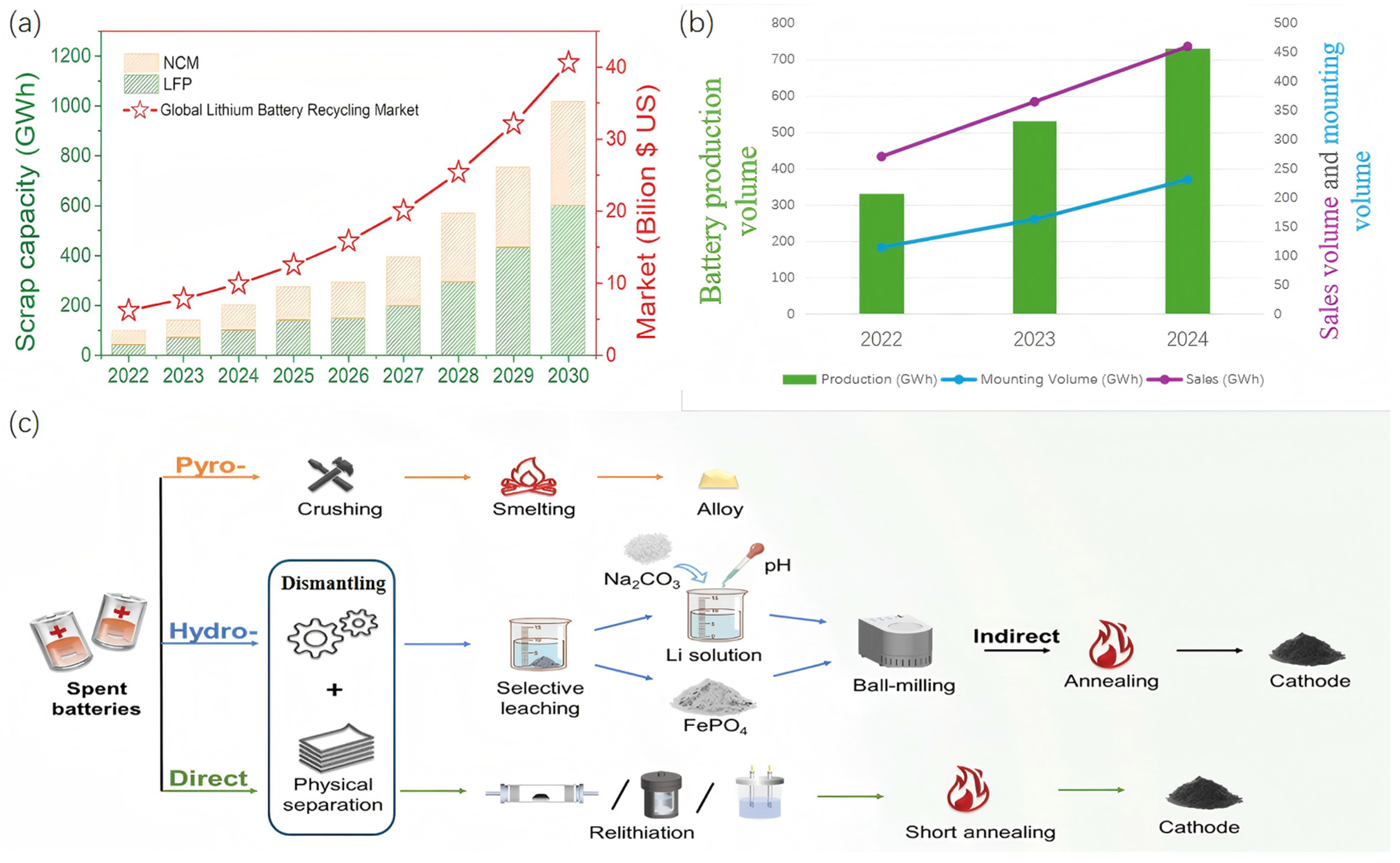
Electric vehicles (EVs) and renewable energy systems are accelerating the global transition toward carbon neutrality, driving an unprecedented demand for high-performance energy storage devices. Among various lithium-ion battery chemistries, lithium iron phosphate (LiFePO4, LFP) batteries have emerged as a dominant technology, owing to their intrinsic safety, long cycle life, thermal stability, and cost-effectiveness. With their wide deployment in EVs, stationary energy storage, and grid-balancing applications, the global installed capacity of LFP batteries has reached several hundred gigawatt-hours annually and continues to grow at a double-digit rate. A comparison of data over the past three years is shown in Figure 1b. Such large-scale adoption reflects their indispensable role in supporting the decarbonization of transportation and power sectors worldwide [1,2,3].
However, the rapid expansion of LFP battery production and use has been accompanied by an equally rapid accumulation of end-of-life (EoL) batteries. As the first generation of large-scale LFP-based systems approaches retirement, a massive wave of spent batteries is expected in the coming years. This presents two major challenges: the efficient recovery of valuable materials such as lithium, phosphorus, and transition metals, and the mitigation of environmental hazards associated with improper disposal. In response, many regions—including the European Union (EU), the United States, Japan, and other major economies—have established comprehensive policies to promote battery recycling and resource circularity. The EU Battery Regulation (2022), for example, stipulates minimum recovery rates of 85% for lithium and 97% for critical metals, and requires manufacturers to adopt closed-loop recycling systems. Similarly, global initiatives such as the U.S. National Blueprint for Lithium Batteries (2021–2030) and Japan’s circular economy roadmap emphasize the creation of sustainable battery supply chains through efficient material recovery. Despite these policies, it is estimated that less than 5% of spent lithium-ion batteries are currently recycled worldwide, due to high transportation and collection costs, the technical complexity of disassembly, and limited industrial-scale recycling infrastructure [4]. From a technological standpoint, the recycling of LFP batteries presents unique challenges compared to nickel-rich or cobalt-based cathodes. The relatively low economic value of iron and phosphorus, the chemical stability of the olivine structure, and the complex composition of electrode binders and additives hinder efficient recovery. Nevertheless, rapid advances in materials science and green chemistry have catalyzed the development of a diverse set of recycling technologies, ranging from conventional metallurgical routes to innovative, environmentally friendly approaches.
Currently, three primary recycling routes dominate the industrial and academic landscape: hydrometallurgical, pyrometallurgical, and direct regeneration processes [5,6,7]. In particular, hydrometallurgical recycling offers high recovery efficiency, high product purity, and low operating temperature, but it requires intensive pre-treatment steps, consumes large volumes of acid and alkali reagents, and generates saline wastewater that demands secondary treatment. Pyrometallurgical recycling provides a simple and robust process with high throughput and tolerance to feedstock variability, yet it involves high energy consumption, emits harmful gases, and typically results in poor lithium recovery. In contrast, direct regeneration aims to restore the structure and electrochemical performance of cathode materials through targeted repair, re-lithiation, or surface modification. However, its scalability and compatibility with diverse waste streams remain key challenges [8]. Developing efficient, low-cost, and environmentally benign recycling systems for LFP batteries is thus of strategic importance for achieving a sustainable and circular battery economy. Beyond material recovery, advanced recycling can also reduce carbon emissions, alleviate resource dependence, and enhance the overall resilience of the global energy supply chain. In this context, this review provides a comprehensive and systematic overview of the state-of-the-art recycling technologies for spent LiFePO4 batteries. It classifies existing approaches into conventional metallurgical methods, direct regeneration strategies, and emerging green technologies that integrate external fields or novel eco-friendly solvents. Furthermore, it elucidates their underlying mechanisms, compares their advantages and limitations, and discusses future directions for realizing green, efficient, and industrial-scale recycling of LFP batteries. These technological advancements are expected to play a pivotal role in enabling sustainable energy storage systems and advancing the global low-carbon transition.
Figure 1. (a) The following report presents an estimate of the market size of global power batteries and energy storage batteries from 2022 to 2030 [9]. (b) Market Data of Lithium Iron Phosphate (LFP) Batteries in China Over the Past Three Years. (c) Lithium-ion Battery Production, Application, and Recycling Process [9].
Materials 19 00674 g001

2. Summary of LFP Battery Failure Types and Mechanisms

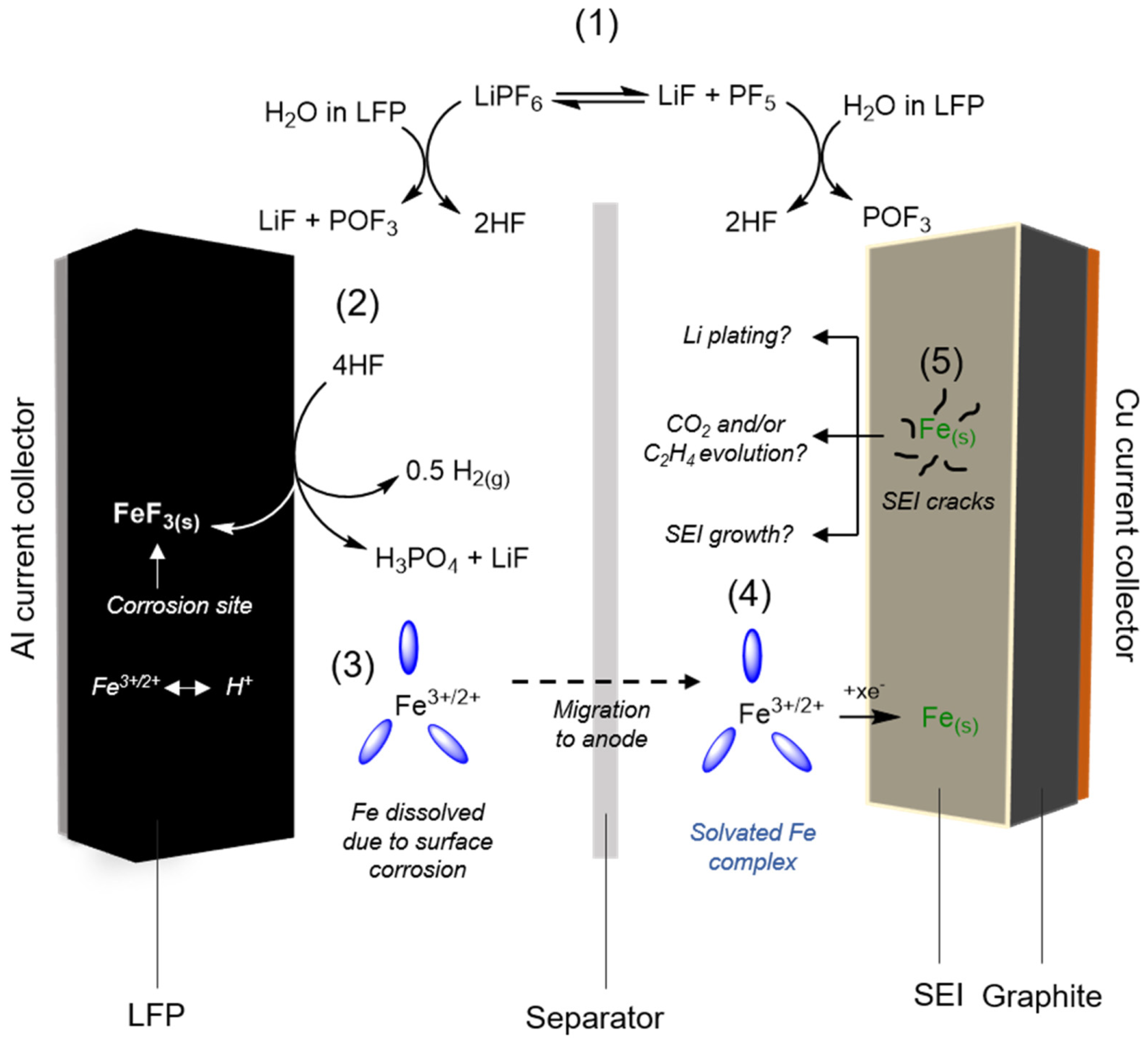
Lithium-ion batteries face battery failure or degradation issues during long-term cycling. Lithium loss, active material mass loss, and corrosion of the current collector and interface are the primary causes of failure [10]. The presence of impurities can also lead to battery failure [11,12,13]. Figure 2 illustrates the mechanism of battery deactivation.
The solid electrolyte interphase (SEI) forms on the anode, the cathode electrolyte interphase (CEI) forms on the cathode, and the growth of lithium dendrites all consume lithium within the battery [14]. During the initial charge cycle, the electrolyte encounters Li+ at the graphite surface and forms the SEI; at the cathode, the CEI forms. Each cycle disrupts these films, prompting their reformation. Each reformation consumes active lithium; the interface layers gradually thicken, increasing impedance and potentially triggering dendrite growth [15]. These dendrites not only extract more lithium from the cathode but may also bridge the electrodes, causing battery short circuits [16]. This process directly corresponds to the mechanism described in Step 5 of Figure 2 (the effect of metallic iron on the negative electrode SEI), where deposited metallic iron exacerbates SEI instability and the risk of dendrite growth.
The degradation of active materials stems from lattice expansion and contraction during each charge–discharge cycle. After hundreds of cycles, cracks begin to form at the edges of particles, exposing new surfaces that come into contact with the electrolyte. Subsequently, new SEI and CEI layers form on these exposed surfaces, consuming additional lithium. As cycling continues, these cracks gradually propagate. Simultaneously, localized lithium depletion oxidizes nearby Fe2+ to Fe3+, forming a thin FePO4 shell layer on the LiFePO4 particle surface [17,18]. Notably, FePO4 enables reversible lithium ion insertion/extraction in both non-aqueous and aqueous systems [19]; however, within the FePO4 shell formed under these degradation conditions, Fe3+ occupies the original lithium sites, disrupting the regular Li/Fe arrangement and blocking lithium ion diffusion pathways.
Capacity decay in lithium-ion batteries is often associated with reduced reversibility of lithium ion deintercalation/intercalation within the cathode material [20]. Once this occurs, residual lithium within the particles struggles to deintercalate or intercalate smoothly, weakening the particle’s structural framework and leading to diminished usable capacity [17,18]. This structural degradation of the cathode material and the formation of the FePO4 shell primarily correspond to Step 2 in Figure 2, where HF in the electrolyte reacts with the LFP surface, causing etching and iron dissolution.
When trace HF and free Fe3+ interact within the aggressive electrolyte, corrosion creates pinholes in the aluminum foil. Localized hotspots then accelerate electrolyte decomposition, causing nearby CEI swelling and self-amplifying damage. As pits deepen, aluminum ions leach out and deposit on the cathode particle surface, blocking electron pathways. Additional polarization intensifies, causing interfacial impedance to surge and exacerbating two further degradation mechanisms [21,22]. This chain reaction of aluminum foil corrosion can be traced back to Step 1 in Figure 2 (LiPF6 hydrolysis producing HF) and its subsequent effects, where HF serves as the key initiating factor for current collector corrosion.
Whatever the chemistry, LiFePO4 or ternary layered, graphite or silicon carbon anode, the cell dies for the same reason: the cell keeps losing lithium. The SEI and CEI thicken, lithium dendrites deposit, and every cycle adds fresh layers. Swelling and shrinking crack the grains; fresh cracks open new surfaces that instantly grow more films and devour more lithium. Fe3+ creeps into vacant lithium sites and blocks the paths [23]. Residual Fe2O3 and stray iron in the mix, plus high State of Charge (SOC) and heat, gnaw pits in the aluminum foil and force the electrolyte to break down. Lithium, active mass, and the conductive network all drain away together. To revive the cell, one must return the lithium, rebuild the interfaces, seal the cracks, and flush out the Fe3+ occupying the lithium sites. For degradation primarily driven by crystal structure defects, direct repair strategies such as electron beam irradiation demonstrate unique advantages. This technique enables precise control of irradiation dose to selectively degrade binders at low temperatures, facilitating efficient electrode delamination. Concurrently, it regulates the concentration of Li/Fe anti-site defects, inducing a transition in lithium ion diffusion pathways from one-dimensional to two-dimensional. This significantly enhances the efficiency of subsequent relithiation processes, achieving both structural repair and performance restoration of the material [24]. When the internal composition and valence states of a battery undergo changes, the restoration process must concurrently achieve both lithium replenishment and reduction. Two effective strategies are low-temperature direct regeneration using green deep eutectic solvents and synergistic repair with natural electron donors. Deep eutectic solvents (the Licl-ethylene glycol system) enable direct migration of lithium ions to material lithium vacancies at low temperatures (80 °C), while their reducing components simultaneously convert surface Fe3+ to Fe2+, achieving targeted lithium replenishment and defect repair [25]. Similarly, employing natural substances such as tea polyphenols as electron donors can simultaneously replenish lithium salts while efficiently converting the FePO4 phase into LiFePO4 and reducing Li–Fe anti-site defects [26]. For end-of-life lithium iron phosphate batteries where repair is economically unviable, a value-added upgrading strategy may be pursued. For instance, leveraging the stable structure and lattice of spent LFP materials, mild oxidation coupled with heterojunction engineering can transform them into high-performance electrocatalysts for oxygen evolution reactions. This direct conversion of retired batteries into high-value functional materials significantly enhances the economic viability of the recycling process [27].
Figure 2. Battery deactivation mechanism (the purple oval represents dissolved iron ions) [28].
Materials 19 00674 g002

3. Recycling Technology of Cathode Materials

Current lithium-ion battery cathode material recycling technologies can be summarized into three main approaches: traditional processes represented by pyrometallurgical and hydrometallurgical methods are mature but highly energy-intensive and polluting; direct regeneration strategies achieve low-energy closed-loop regeneration through lithium supplementation and structural repair, and are transitioning from laboratory research to commercial application; and novel recycling methods beyond traditional approaches utilize external field-assisted enhancement, novel green solvents, and plasma technology to strive for a future recycling landscape characterized by zero carbon emissions, high efficiency, and intelligence. Driven by policy initiatives and carbon neutrality constraints, direct regeneration and green enhancement technologies are poised to replace traditional high-energy-consuming processes, becoming the core technologies of the global lithium-ion battery recycling industry by around 2030 [29].

3.1. Traditional Recycling Technology

Traditional recycling technologies are primarily categorized into two main types: wet recycling and pyrometallurgical recycling. Among traditional recycling technologies, wet recycling of batteries requires pretreatment to reduce the difficulty and cost of subsequent metal leaching and material regeneration processes [30].
Pre-treatment technologies are primarily categorized into two main groups: physical methods and chemical methods. Chemical recycling technology refers to the addition of discharge electrolyte to consume the remaining battery power during the discharge process. However, the chemical method frequently causes metals to lose electrons, leading to oxidation and corrosion, which can easily result in electrolyte leakage and pollution of battery materials. Physical recycling techniques rely on the physical properties of different materials within spent LFP batteries to achieve separation. These methods are cost-effective and operationally simple. Physical treatment alone risks polluting the environment, so it serves only as the first step and must be paired with chemical methods to lift overall recovery [31,32,33]. Table 1 provides a detailed comparison of the advantages of various pre-treatment methods, with the most commonly employed techniques being crushing and magnetic separation. Crushing typically utilizes two mechanical force methods: shear crushing and impact crushing. The core process involves: first, safely discharging the battery and manually dismantling it to obtain the cathode plates, followed by applying either shear or impact crushing for varying durations. Research indicates that shear crushing significantly outperforms impact crushing in efficiency, achieving a dissociation rate of 42.08% within 5 s and reaching 69.29% after 40 s. In contrast, impact crushing exhibits a slower initiation of dissociation, with effective action concentrated between 5 and 20 s, ultimately yielding a dissociation rate of 62.68%. Both methods resulted in over-pulverization of the aluminum foil current collector, which becomes mixed with the fine powder, though its content could be controlled at a relatively low level [34]. Hu et al. [35] proposed employing high-intensity magnetic separation (HIMS) technology to recover LiFePO4 cathodes and graphite anodes from spent lithium iron phosphate (SLFP) batteries. Through a dry-process workflow of “discharging–crushing–magnetic separation–screening”, they found induction roller magnetic separation (IRMS) to yield optimal results for treating electrode fragments, achieving a LiFePO4 grade of 93.3% and a recovery rate of 98.7%. This method requires no chemical reagents, is environmentally sustainable, and offers low operational costs, presenting an efficient and readily industrializable new approach to physical separation.
During the pre-treatment process of lithium iron phosphate batteries, safety issues must be systematically managed. Although LFP batteries exhibit higher thermal stability compared to other lithium-ion chemistries, thermal runaway may still occur under overcharging conditions (110% SOC) or external high temperatures (>200 °C). Experiments indicate that when SOC exceeds 28%, thermal runaway may occur above approximately 200 °C due to anode reactions, with overcharging significantly reducing thermal stability [36]. Consequently, batteries must be fully discharged prior to dismantling to minimize residual energy and thermal runaway susceptibility [37,38]. The aqueous solution discharge method is recommended, particularly using NaCl solution, owing to its low cost, weak corrosivity, and ability to effectively absorb residual charge, thereby reducing short-circuit and overheating risks [39]. Lithium-ion battery electrolytes typically contain LiPF6 and organic carbonate solvents; LiPF6 readily decomposes upon contact with water or high temperatures, releasing toxic and corrosive gases such as HF and PF5. During wet crushing, LiPF3 primarily dissolves into water rather than being released through decomposition. The cooling and dissolving properties of the aqueous medium significantly suppress LiPF6 decomposition, reducing emissions of gaseous fluorine and phosphorus pollutants. Wet processes should be prioritized for dismantling and crushing operations, with circulation and monitoring ensured to promote LiPF6 dissolution and inhibit acid gas generation. Conversely, dry crushing or high-temperature processing may release toxic gases. Controling processing temperatures (maintaining water temperatures < 50 °C) and avoiding localized overheating can effectively suppress LiPF6 decomposition. Operators should routinely wear corrosion-resistant gloves, safety goggles, and respiratory protective equipment, whilst batteries require temperature and gas monitoring [40].
Pre-treatment technologies find extensive industrial application. Finland’s AkkuSer Oy employs a “dry process” comprising two-stage crushing followed by magnetic separation or cyclone degassing, achieving reagent-free, explosion-proof operations with high precious metal recovery rates; General Electric pursues a “mechanical separation and hydrometallurgy” approach, yielding copper, aluminum, iron, nickel, and lithium salts after acid leaching, followed by co-precipitation of ternary precursors with by-products including cobalt carbonate and lithium hyd roxide, graphite, aluminum foil, and black powder in a single step. The entire process requires no reagents and boasts an annual processing capacity exceeding 30,000 tons, making it both environmentally friendly and highly efficient [41].
Table 1. Physical treatment method of retired lithium iron phosphate battery.
Empirical MethodDistinguishingRefs.
CrushingShear crushing method has large crushing ratio, large particle size, and good crushing effect on tough materials. Impact crushing method has high efficiency and low running cost.[34,42]
Air SeparationEffective in material separation, but requires high uniformity of crushed products.[43]
Eddy Current SeparationEffective in separation with strong adaptability.[44,45]
Magnetic separationMagnetic separation in batteries features high efficiency, cost-effectiveness, broad applicability, and customizability, enhancing material purity and safety.[35,46]
FlotationAdjustable settings; compatibility with various materials; high separation precision.[47,48]

3.1.1. Hydrometallurgical Recycling

Hydrometallurgical recycling is an effective method for recovering metals from the cathode materials of spent lithium–iron– phosphate (LFP) batteries. Hydrometallurgy dissolves metals in water-based reagents, then filters, purifies, extracts, and treats the wastewater [49]. It extracts metals from spent LFP cathodes with high yield and flexible chemistry, so leaching and separation are at its core. During the leaching process, the cathode materials are dissolved using acids or bases to extract metal components. Subsequently, the separation process involves techniques such as extraction and precipitation to obtain the desired metals and metal compounds [15,50,51]. Hydrometallurgical recycling is not only suitable for small and medium-scale recycling operations of spent lithium-ion batteries but is also particularly well-suited for treating LFP batteries.
(1) 
Acid leaching
Acid dissolves valuable metals from spent LFP cathodes. Sulfuric, hydrochloric, and nitric acids are the usual choices [52,53]. In the acid, LFP breaks down into soluble iron and phosphate salts, while lithium enters the liquor. Sulfuric acid, combined with hydrogen peroxide, already yields high Li levels, and hydrochloric acid with the same oxidant achieves 96.31% under optimized conditions [54]. Table 2 lists the performance of each acid.
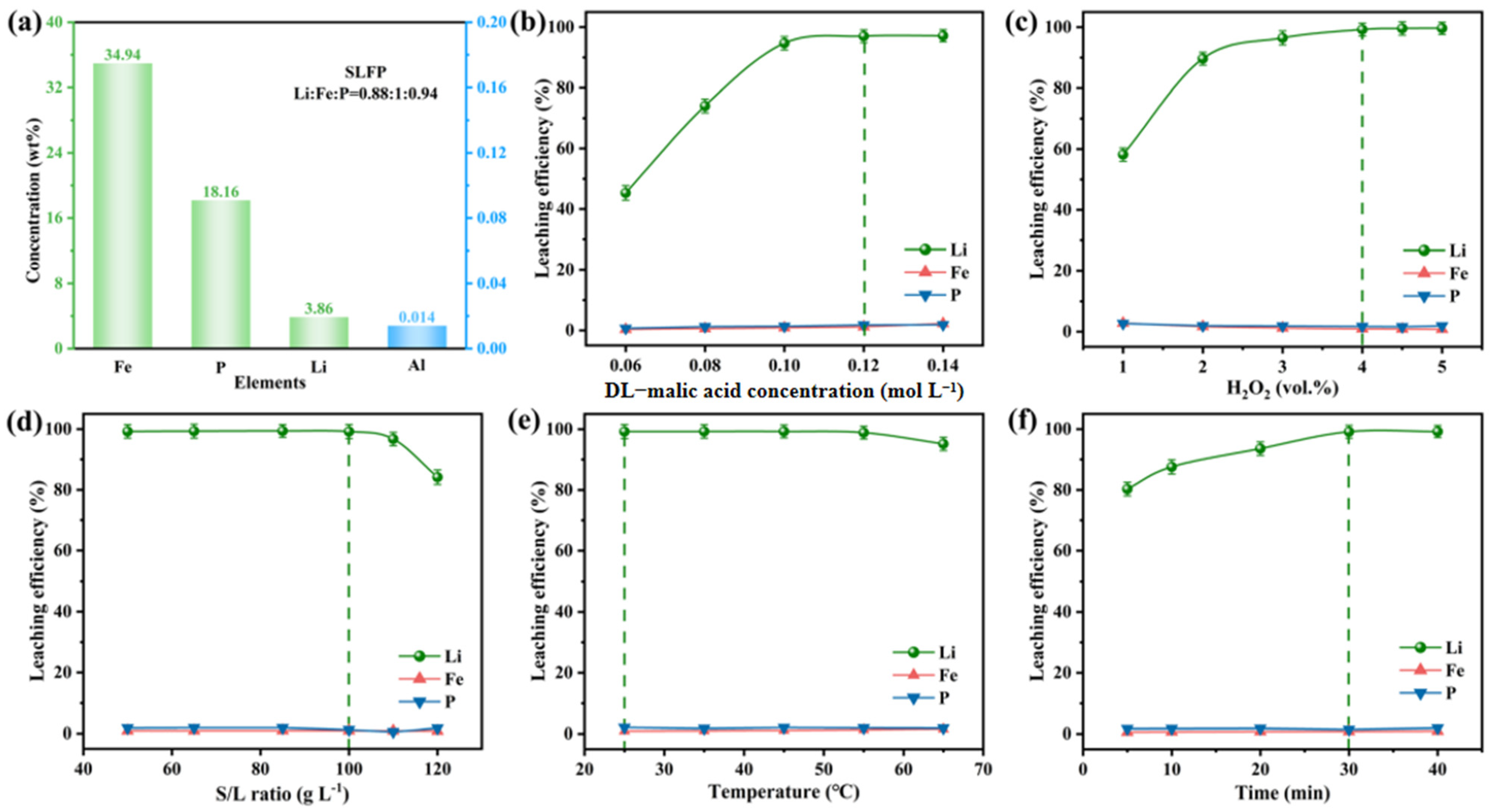
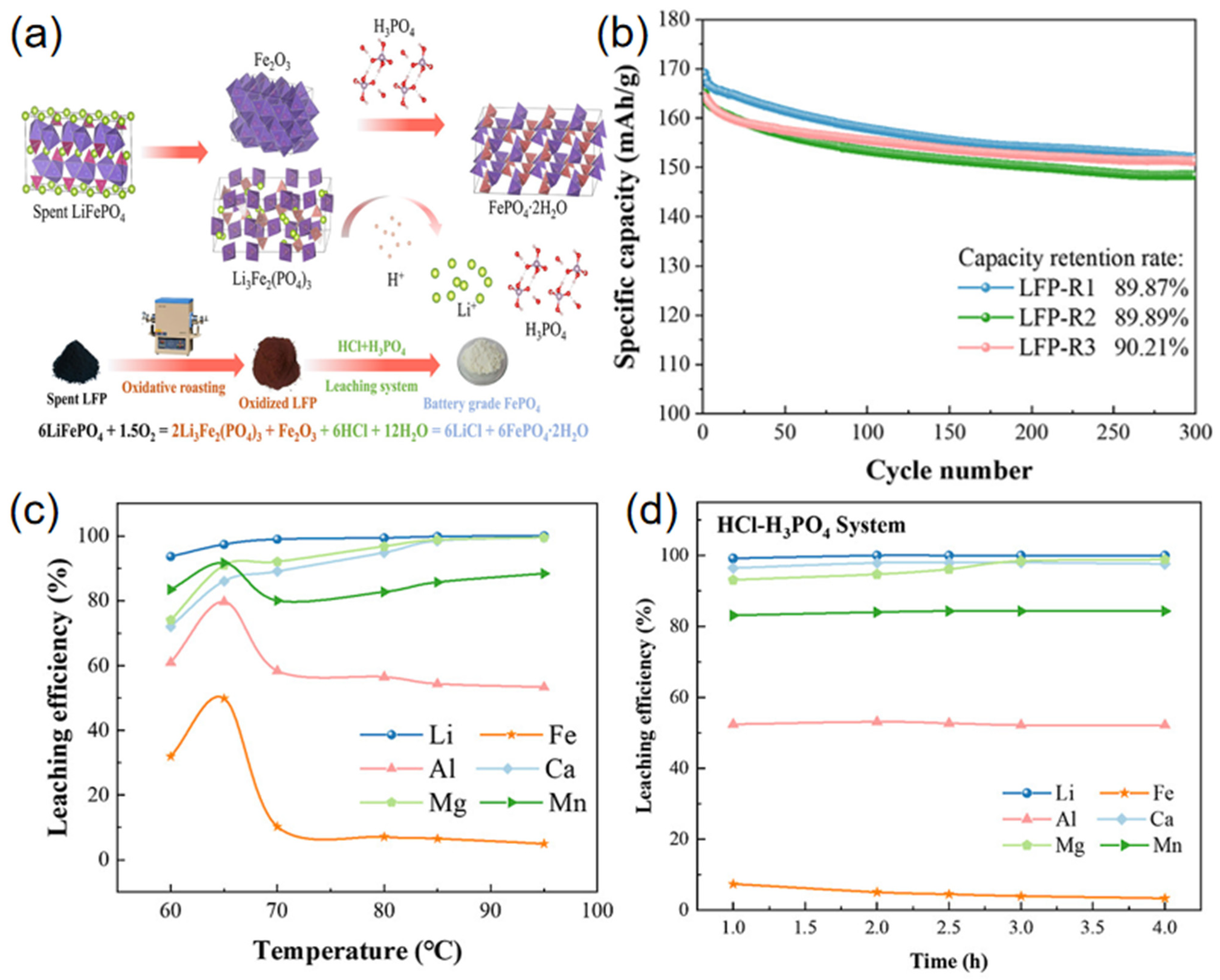
Luo et al. [61] proposed an innovative mixed acid leaching strategy employing hydrochloric acid and phosphoric acid to achieve selective lithium extraction and direct recovery of iron phosphate from spent lithium iron phosphate (LiFePO4) batteries. The process flow, as illustrated in Figure 3a, first employs oxidative roasting to separate materials, yielding feedstock with low impurity content. Subsequently, under optimized conditions (90 °C, liquid-to-solid ratio 5:1), mixed acid leaching with HCl–H3PO4 achieves both efficient lithium extraction (100% leaching rate, as shown in Figure 3c,d) and simultaneous synthesis of battery-grade FePO4·2H2O (iron loss rate merely 4.42%). The recovered iron phosphate successfully regenerates LiFePO4 cathode material with excellent electrochemical performance as a precursor, exhibiting a discharge capacity of 169.2 mAh/g at 0.5C and a capacity retention rate of 90.21% after 300 cycles, as shown in Figure 3b. This process avoids the use of oxidants, strong alkalis, and precipitants common in traditional hydrometallurgy, whilst enabling the recycling of phosphoric acid. It substantially reduces reagent consumption, energy expenditure, and secondary pollution, providing a sustainable solution for short-process, high-value closed-loop recycling of waste LFP batteries. Zhou et al. [62] developed an process for recycling waste LiFePO4 batteries based on malic acid. The method employs naturally degradable organic acids instead of traditional inorganic acid leaching, reducing the negative impact on the environment. Under optimized conditions, 99.12% Li is extracted, while less than 1% Fe is leached. Figure 4a shows the concentrations of different elements (Fe, P, Li, Al) in the regenerated battery. Figure 3b,c demonstrates the effects of different concentrations of hydrogen peroxide (H2O2) on leaching efficiency. Figure 4d–f illustrates the effects of solid–liquid ratio, temperature, and time on leaching efficiency. Compared with the traditional method, this process merits efficient lithium–iron separation, environmental friendliness, and economic efficiency. Biodegradable organic acid (DL-malic acid) instead of an inorganic acid is used together with an oxidant (H2O2) to selectively leach lithium, and innovatively recover P in the form of Li3PO4 by evaporation crystallization. It splits lithium from iron almost completely, cuts waste, and costs less than the former acid routes. The recycled products can be directly used to prepare high-performance recycled materials, making them the optimal choice for establishing a sustainable closed-loop recycling system. Li et al. [63] proposed a novel process for recycling metals from spent Lithium-Ion Battery (LIB) using a sulfuric acid–malonic acid leaching system that balances environmental sustainability and cost-effectiveness. Response surface methodology was employed to optimize process parameters. Under conditions of 70 °C for 81 min, with synergistic effects from 0.93 mol L−1 sulfuric acid, 0.85 mol L−1 malonic acid, a liquid-to-solid ratio of 61 mL g−1, and 30% H2O2, the lithium leaching rate reached 99.79%. The method works quickly and pulls out most metals, but it also floods the plant with acidic wastewater, burns through acid, and demands extra neutralizers. Cutting that waste and cost is now the main hurdle.
(2) 
Alkaline leaching
Standard alkaline leaching solutions include NaOH, NaCO3, and NH4OH. In traditional processes, alkaline leaching is typically used to recover aluminum from cathode materials or to neutralize and precipitate acids in acid leaching solutions, and it is widely used in ternary batteries. Alkaline solutions have not yet been used as leaching agents for recovering waste LFP because iron cannot be leached into the solution under alkaline conditions. However, after material leaching, they can be used as iron precipitants [64]. The core of alkaline leaching technology lies in utilizing the selective dissolution and precipitation capabilities of OH. In a strong alkaline environment, target metals (such as Li and Al) are preferentially leached out. At the same time, iron and phosphorus are induced to undergo in situ hydrolysis [64,65].
Yang et al. [66] proposed an innovative oxidative leaching process using sodium hydroxide for recycling spent LiFePO4. This method utilizes NaOH’s dual function as both a leaching agent and oxidant. Under optimal conditions of 2 mol/L NaOH, a liquid-to-solid ratio of 50:1, 50 °C, and 2 h, it achieved efficient and selective leaching of lithium (98.2%) and phosphorus (99.9%), while converting all iron into Fe3O4 residue. Kinetic studies indicated the process is controlled by chemical reaction. Mechanistic analysis revealed that OH oxidizes Fe(II) to Fe3O4 while being reduced to H2, and Na+ may intercalate into and disrupt the LiFePO4 structure. This process requires no additional oxidants or precipitants, directly yielding Li3PO4 from the concentrated leachate, offering advantages of low cost, simplicity, and environmental friendliness. Han et al. [67] proposed an alkali-enhanced Polyvinylidene fluoride (PVDF) cracking technology. Under conditions of NaOH concentration of 2.7 mol/L, solid–liquid ratio of 20 g/L, leaching time of 32 min, and leaching temperature of 34 °C, the aluminum leaching rate reached 92.6%. Subsequently, the alkali leaching residue was calcined at a lower temperature to catalyze PVDF cracking and convert it into harmless LiF. Treatment stripped 98.6% of the aluminum and left 97.5% of the lithium in hand. The rebuilt LFP delivered higher reversible capacity than the untreated powder; topping up lithium alone brought it back to battery grade. Zhang et al. [68] employed a sodium bisulfate-assisted roasting process under optimized conditions of 600 °C for one hour with a NaHSO4·H2O to LiFePO4 mass ratio of 1.5:1, achieving a high lithium leaching efficiency of 98.12% via water leaching of the resulting LiNaSO4. During roasting, the FeO6 and LiO6 octahedral units in LiFePO4 dissociate, enabling selective conversion of lithium into water-soluble LiNaSO4, while iron transforms into pure FePO4. The FePO4 recovered from the residue matched commercial-grade purity. Systematic experiments varying the mass ratio, roasting temperature, roasting time, and water leaching duration established the optimal parameters for maximal lithium recovery. The regenerated LFP material exhibited low polarization, comparable Li+ diffusion coefficients to commercial LFP, and excellent rate capability along with stable capacity retention over 200 cycles.
The process runs at room temperature and pressure, needs no extra heat, and keeps steps short and cheap. However, alkali leaching still hinges on concentration, solid-to-liquid ratio, temperature, and particle size, so that yields can swing widely. Laboratories combine alkali leaching with other recovery systems to improve recovery efficiency [66,67,69]. Optimizing leaching parameters and exploring new alkali leaching systems will be necessary to improve alkali leaching recovery rates while simultaneously reducing recovery costs.
(3) 
Bioleaching
Microbes strip metals from spent LFP cathodes by gluing to the surface, then oxidizing or reducing the ions. Subsequently, these metals are released into the solution through oxidation and reduction reactions. Microorganisms produce biological leaching agents such as sulfuric acid or organic acids through metabolic activities. These substances can effectively dissolve metals in secondary resources like ores, end-of-life LIB, and Printed Circuit Board (PCB), as well as valuable metallic components in other electronic waste [70]. Commonly used bacteria are sulfur-oxidizing bacteria, iron-oxidizing bacteria, and Aspergillus niger strains [71,72].
Gu et al. [73] recovered Li from spent LiFePO4 batteries efficiently by bioleaching using an acidophilic bacterial consortium (ABC) enriched from acid mine drainage, dominated by Acidithiobacillus and Acidiphilium. They achieved a high recovery rate of 98% and confirmed that this method is more environmentally sustainable and cost-effective than traditional techniques through a carbon footprint assessment. Ghahreman et al. [74] conducted selective lithium leaching using the neutrophilic bacterium Thiobacillus under near-neutral pH conditions. At 30 °C and near-neutral pH conditions, lithium recovery reached approximately 65% (slurry density 15 g/L, leaching for 47 days). Under optimized conditions featuring lower slurry density (≤10 g/L), extended leaching duration (approximately 60 days), and continuous replenishment of bacterial cultures, lithium recovery increased to approximately 98%. Iron leaching remained consistently below 1%, demonstrating high leaching selectivity. Then, the recovered lithium is converted into Li3PO4, and the leachate is recycled as a culture medium. This process introduces an innovative LFP positive electrode material recycling method with good environmental prospects. The core of LIB bioleaching technology’s industrialization lies in its microbial strains simultaneously meeting the requirements of multi-metal toxicity tolerance, low-cost cultivation, and high-solids tolerance, while maintaining a metal leaching rate of 80–90% even under conditions of 100 g dry residue per liter of pulp [75].
The advantages of this technology lie in its environmental friendliness and low energy consumption. However, the efficiency of biological leaching is restricted by many factors, including the species of microorganisms, the growth environment, and the duration of response, which leads to their usually low recovery efficiency. At the same time, the cultivation and domestication process of microorganisms also increases the complexity and economic cost of the recovery process. Therefore, improving the recovery efficiency of bio-leaching and reducing the related costs are important problems that need to be solved in developing this technology.

3.1.2. Pyrometallurgy

Pyrometallurgical recycling is a technology that uses high-temperature roasting, smelting, distillation, and molten salt to convert scrap metal, electronic waste, and other materials into reusable raw materials. Heat melts the oxides back to metal and drives off impurities in one step [76,77]. It handles large volumes, recovers most metals, and copes with mixed waste better than wet or mechanical routes [78].
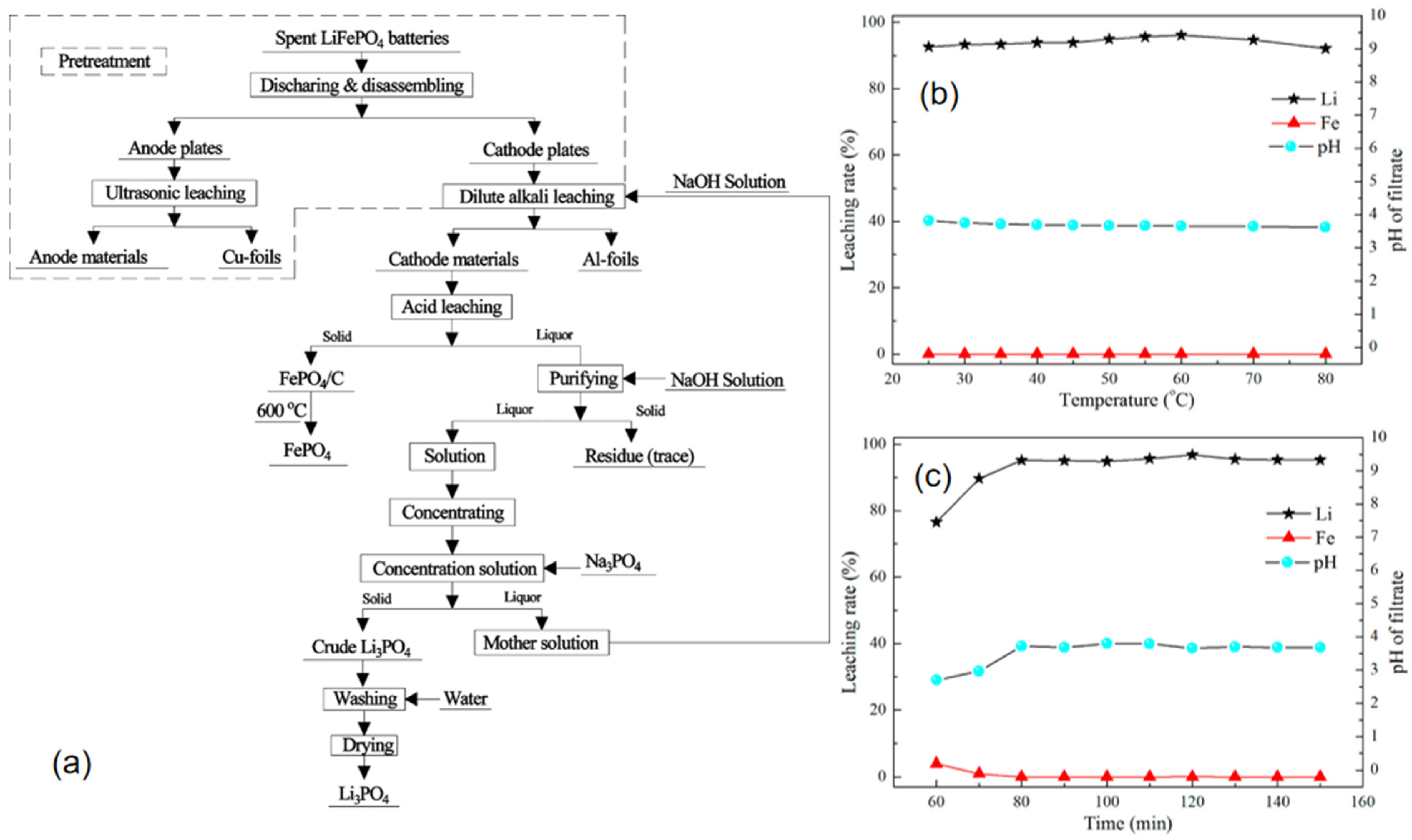
Zhang et al. [79] discovered that under the influence of Na2CO3, LiFePO4 can be effectively decomposed via carbon thermal reduction below 600 °C, thereby achieving highly efficient lithium recovery with a recovery rate as high as 99.2%. The core principle lies in Na2CO3 acting as an activator, capable of breaking the thermodynamically stable olivine structure chemical bonds in LiFePO4. This overcomes the challenge that carbon cannot directly reduce LiFePO4, thereby enabling the reduction reaction to proceed. Following Na2CO3 activation, LiFePO4 is converted into products including Fe, NaLi2PO4, and LiNa5(PO4)2. Subsequent magnetic separation yields Li3PO4 or Li2CO3. Substituting the activator with NaOH still maintains a lithium recovery rate of 92.7%, wherein LiFePO4 primarily converts to Fe3O4 and identical lithium–sodium phosphates under oxidative conditions. This salt-assisted carbon thermal reduction–magnetic separation process combines high recovery rates, low energy consumption, and excellent scalability. Zhang et al. [68] mixed spent LFP cathode with NaHSO4 and fired the blend at 600 °C for one hour. After cooling, they poured the cake into water at 30 °C for an hour. The water pulled out 98% of the lithium while leaving Fe, Al, and P below 1% in solution. The solids—Li3PO4 and FePO4—went straight back into fresh LiFePO4. The rebuilt cathode delivered 162 mAh g−1 at 0.1 C, 120 mAh g−1 at 5 C, and still held 141 mAh g−1—97% of its initial capacity—after 200 cycles at 1 C. Qu et al. [80] roasted spent LFP with (NH4) 2SO4 at 300 °C for ten minutes. Within five minutes, sulfur escaped as SO2, 98% of the lithium leached out as Li2SO4, and only 1.8% of the iron followed; clean FePO4 stayed behind. These short, acid-free salt roasts pull lithium back and rebuild high-rate LFP cheaply, yet the exact times and ratios still need fine-tuning. Li et al. [55] proposed a dual-system recovery process combining leaching and calcination for the efficient recovery of lithium, iron, and phosphorus from spent lithium iron phosphate battery cathode materials. Figure 5a illustrates the process flow diagram. Spent batteries undergo pretreatment with 0.3 M sulphuric acid and hydrogen peroxide, followed by selective leaching under optimized conditions (H2O2/Li molar ratio 2.07, H2SO4/Li molar ratio 0.57, 60 °C for 120 min), enabling lithium to be leached into solution at a high rate of 96.85%, while iron and phosphorus remain in the leaching residue as iron phosphate (iron leaching rate only 0.027%). Figure 5b,c illustrates the effects of time and temperature on different metals. The leachate underwent alkaline purification and concentration before sodium phosphate precipitation to recover lithium, yielding a lithium phosphate product with a lithium recovery rate of 95.56%. The leaching residue was calcined at 600 °C for 4 h to remove carbon residues, after which it was directly recovered as iron phosphate.
Pyrometallurgy demands furnace temperatures above 800 °C, so lithium evaporates and the LFP grains crack. Yields drop while the power bill climbs, eroding any green advantage. LFP waste contains few valuable metals at low prices, and the market price of finished LFP is generally lower than that of ternary materials, making pyrometallurgical lithium extraction even more challenging. The rigid olivine lattice needs extra heat to fall apart, pushing costs higher. High energy, high emissions, and thin returns leave pyrometallurgy with an uncertain future for LFP recycling.

3.2. Direct Regeneration Strategy Recycling Technology

3.2.1. Solid Phase Regeneration Method

Solid-phase regeneration technology is a method for repairing and regenerating spent lithium-ion battery cathode materials through direct high-temperature heat treatment. This technology essentially involves a simple “supplementation-calcination” process: first, the recovered spent cathode active material is mixed with an appropriate amount of lithium source (such as Li2CO3, LiOH) to compensate for lithium loss during cycling at a stoichiometric ratio [81]. Subsequently, the mixture is calcined under an inert or controlled atmosphere to induce crystal structure rearrangement and regeneration, thereby restoring the material’s original crystalline structure and electrochemical performance [82].
Sun et al. [83] subjected cathode materials to thermal decomposition and separation, followed by sintering at 800 °C for 2 h in air to remove carbon coatings and conductive agents, yielding Fe2O3 and Li3Fe2(PO4)3. These were subsequently ball-milled with sucrose (20 wt%) and varying proportions of Li2CO3, pressed into discs, and regenerated via two-step sintering in an H2/Ar atmosphere. The sample containing 1.4 wt% Li2CO3 exhibited optimal performance, with the full cell maintaining over 80% capacity retention after 2000 cycles at 10 C. Guan et al. [84] proposed a method for regenerating LiFePO4 based on the Polyvinyl acetate (PVAc) alcoholysis reaction. Following pre-treatment of end-of-life batteries and NaOH washing to remove aluminum impurities, Li2CO3, FeC2O4, NH4H2PO4 and PVAc were added in a Li:Fe:P ratio of 1.05:1:1. The mixture was dispersed in a methanol-ammonia solution and regenerated via 6 h of pre-calcination at 350 °C followed by 12 h of main calcination at 650 °C under a nitrogen atmosphere. Samples incorporating 2.5 wt% PVAc exhibited optimal performance: initial discharge capacity reached 163.2 mA h g−1 (0.1 C), with a capacity retention rate of 97.08% after 100 cycles. Song et al. [85] studied the performance of high-temperature solid phase reaction after mixing newly synthesized LiFePO4 directly with waste material. When the mass ratio of the new and old materials was 3:7, and heated at 700 °C for 8 h, the resulting repair materials showed excellent electrochemical properties.
Solid-phase regeneration technology effectively restores the crystal structure and electrochemical properties of spent cathode materials, enabling their reuse. This regeneration process not only preserves the molecular structure of the cathode but also enhances material crystallinity and consistency, thereby directly improving its electrochemical performance. However, this method faces significant challenges: on one hand, the complex and inconsistent composition of waste materials makes precise elemental stoichiometric compensation extremely difficult; on the other hand, the process itself relies on prolonged high-temperature heat treatment, resulting in high energy consumption and the potential generation of dust and exhaust gases during processing, posing risks of secondary pollution. Therefore, to achieve high-capacity, long-cycle-life recycled materials, strict control over key process parameters—including raw material composition, processing temperature, duration, and atmosphere—is essential.

3.2.2. Electrochemical Process

The electrochemical method extracts valuable metals from the cathode material of waste lithium iron phosphate batteries through electrochemical action. Currently, in electrochemical lithium extraction technology, ion exchange methods and membrane separation processes (such as electrodialysis) are commonly employed to recover lithium from liquid resources [86]. The electrochemical method crushes and screens the spent cathode, then electrochemically dissolves its metals; finally, pure metal is plated from the liquor in one electrolytic step. The electrochemical method has the advantages of simple operation and high recovery efficiency, and it is also a potential recovery method.
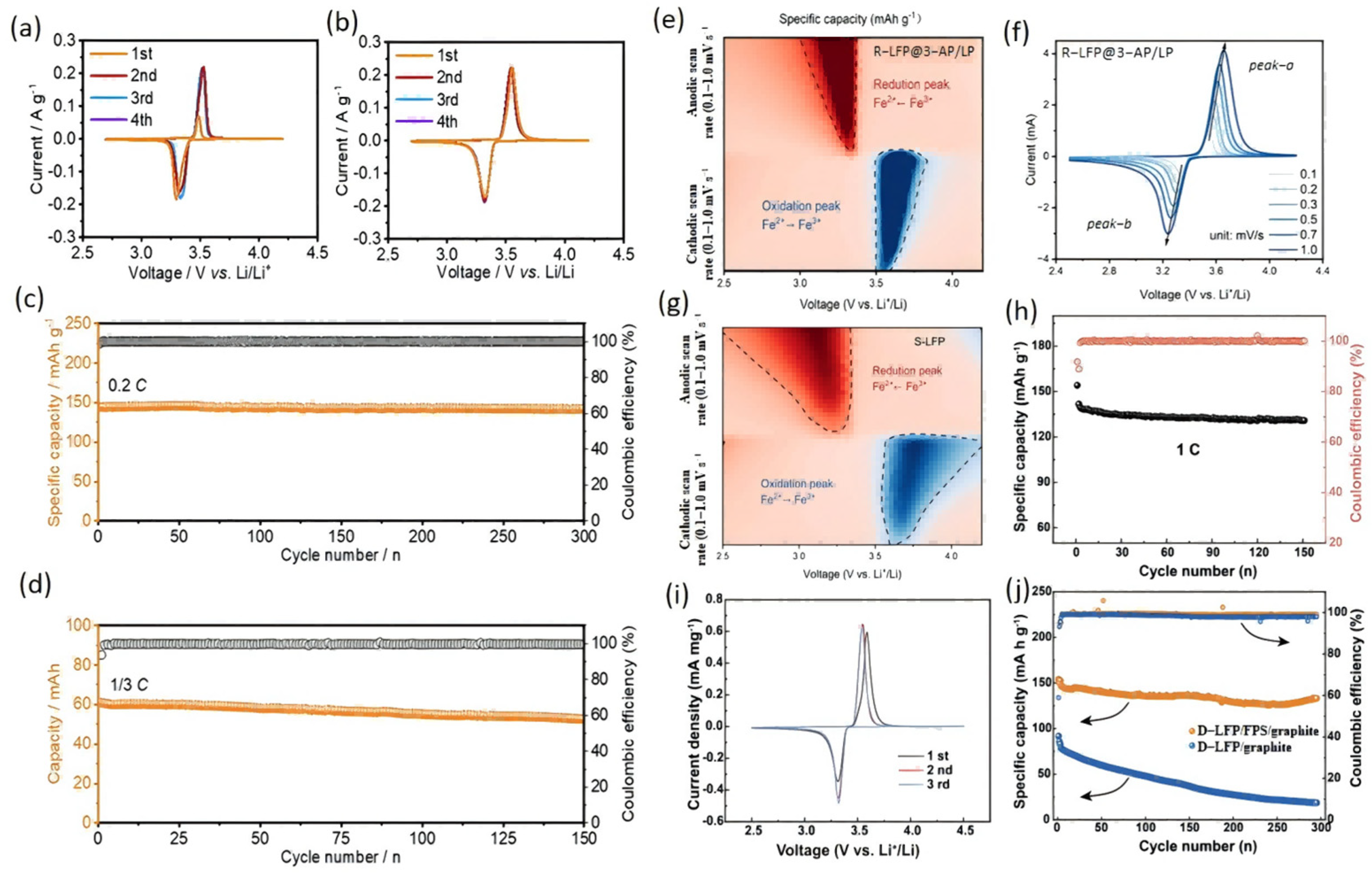
Zhou et al. [87] proposed an environmentally friendly and economical electrochemical regeneration technique. The technology is used in water-based media, using an H-type electrolytic cell to build a low-cost battery system, where the cathode uses cheap zinc metal, and the positive electrode is the waste LiFePO4 material that needs to be recycled. During the discharge process, the lithium ion (Li+) is re-embedded into the old LiFePO4 to realize the regeneration of the material. Under the optimal conditions, the lithium content in the regenerated LiFePO4 can reach 3.81%, showing a good crystal structure and excellent electrochemical properties. Moreover, the regeneration process can be monitored in real time by Raman spectroscopy. Li et al. [88] leached lithium from spent LFP with 0.20 mol/L [Fe(CN) 6]3−. The oxidant splits LiFePO4 into FePO4 and Li+, then the spent [Fe(CN) 6]4− is re-oxidized at the anode for reuse. At 99.8% Li recovery, the products are 99.9% LiOH and 99.97% FePO4. Wang et al. [89] proposed an efficient direct regeneration method for spent LiFePO4 cathode materials. Characterization revealed that after long-cycle battery operation, LiFePO4 transforms into Li1-xFePO4 due to lithium loss, forming FePO4 nanodomains within particles while preserving the olivine framework. Researchers employed a mild chemical lithium replenishment treatment using a lithium-aromatic solvent, successfully restoring the FePO4 phase to pure LiFePO4 while eliminating phase boundaries and preserving structural integrity. Voltammetric cycling tests demonstrated that the regenerated LiFePO4 exhibited fully restored oxidation peak intensity and symmetry compared to degraded material, with redox potentials matching those of fresh material, confirming complete electrochemical performance recovery (Figure 6a,b). The regenerated material exhibits electrochemical performance comparable to new material in both half-cell and full-cell tests, achieving a capacity of 152.5 mAh/g with excellent cycling stability, as shown in Figure 6c,d. This method offers advantages including low energy consumption, a simple process, and recyclable reagents, providing a new strategy for the green and efficient recovery of poly-anionic electrode materials. Liu et al. [26] employed a process where waste materials were oxidatively leached to obtain lithium-containing solutions, which were then used as the medium for electrochemical lithium replenishment, achieving recycling of the leachate. Their cyclic voltammetry curves exhibited two distinct pairs of Li+ insertion/extraction peaks at −0.13 V and −0.58 V in the initial electrolyte. Dilution of the electrolyte caused the reaction potential to increase, and the peaks disappeared under high-fold dilution (as shown in Figure 6f). Compared to Figure 6g, the CV curve of the recycled LiFePO4 exhibits greater symmetry with a narrower potential difference between redox peaks, indicating significantly enhanced electrochemical reversibility. This recycled cathode delivers a discharge capacity of 154.2 mAh g−1 at 0.5 C, maintaining 91.0% capacity retention after 300 cycles at 1 C. Fan et al. [90] proposed an in-situ electrochemical regeneration of spent LiFePO4 electrodes by employing a functionalized pre-lithiated separator coated with Li2C2O4/CMK-3 composite material, which decomposes during the initial charge cycle to supply additional Li+ ions. Cyclic voltammetry revealed that LFP maintains structural stability at the high voltage of 4.5 V without significant side reactions, as shown in Figure 6i. This decomposes during the initial charge to supply additional Li+ ions, enabling the regenerated full cell to recover a discharge specific capacity of 152.0 mAh g−1 at 0.05 C. After 292 cycles at 1 C, the capacity retention rate remains as high as 90.7%, as shown in Figure 6h,j, indicating excellent rate performance.
The electrochemical method’s advantage is that it can efficiently recover valuable metals in the cathode material of a waste lithium iron phosphate battery and has little impact on the environment. However, the electrochemical method needs to consume a large amount of electric energy and electrolytes, and the electrolysis process will produce a large amount of waste gas and waste liquid, which needs to be properly treated. Moreover, the process parameters of the electrochemical methods need to be strictly controlled to ensure the recovery efficiency and product quality.

3.3. New Recycling Technology That Surpasses Traditional Recycling Methods

3.3.1. Mechanical Activation Method

The mechanical activation method refines the valuable metal particles in the cathode material of waste lithium iron phosphate batteries by mechanical action. It improves their reactivity to facilitate subsequent recovery and treatment. Mechanochemical processes, which utilize ball mills to drive chemical reactions, have been effectively applied in metal recovery from various waste streams. Examples include extracting indium from discarded liquid crystal displays, recovering lead from cathode ray tube funnel glass, and separating rare earth elements from phosphors [91]. The method is simple and energy-efficient.
The key steps in the mechanical activation method are mechanical activation and subsequent processing. The mechanical activation process involves placing the pretreated cathode material in the mechanical activation equipment for ball grinding or stirring treatment and refining the valuable metal particles through mechanical action. The subsequent treatment process involves chemical or physical treatment of the mechanically activated cathode material to separate the valuable metal from its compounds [92,93].
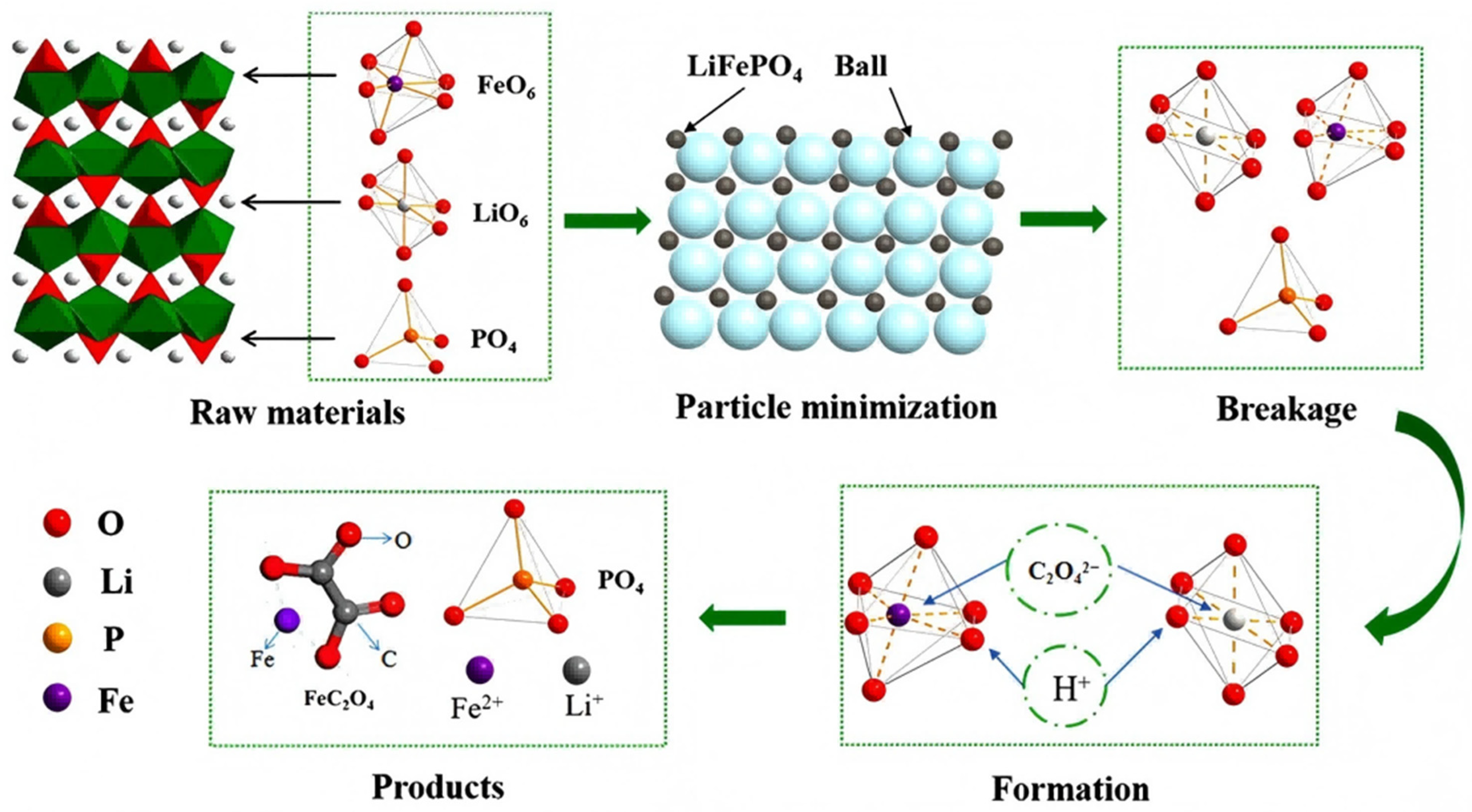
Fan et al. [94], used oxalic acid as grinding agent (oxalic acid and lithium iron phosphate cathode waste mass ratio of 1:1), and the ball after two h for water immersion. Test results showed that more than 99% of lithium and 6% iron was leaching. The main component of leaching residue was FeC2O4·2H2O, compared with the use of oxalic acid as leaching agent direct wet leaching, mechanical activation process significantly reduce the use of acid. Figure 7 illustrates the leaching reaction mechanism. Liu et al. [95] use Na and Li with similar outer electronic arrangement and coordination environment, using low-cost NaCl as abrasive agent and mechanical force to induce solid phase reaction, making Na isomorphism to replace Li in lithium iron phosphate. After mechanical activation, Na2CO3 solution was added to leach to obtain Li2CO3 precipitation, which also recycled NaCl. Li et al. [96] ball-milled the cathode powder with citric acid and H2O2 and leached 99.35% of the lithium; when citric acid and water were used instead, 97.82% Li and 95.62% Fe dissolved. The process is low-energy and uses no harsh reagents.
The advantage of the mechanical activation method is that it can improve the reactivity of valuable metals in the cathode material of waste lithium iron phosphate batteries and facilitate the subsequent recovery and treatment. However, mechanical activation requires a large amount of mechanical energy and produces a lot of dust and noise pollution. In addition, the recovery efficiency of the mechanical activation method is affected by various factors such as raw material composition and mechanical activation conditions.

3.3.2. Ultrasonic Assisted Method

Ultrasound triggers cavitation: microbubbles form, oscillate, and collapse, producing high local temperature, pressure, shockwaves, and microjets. These accelerate mass transfer and fragment solids, enhancing reaction kinetics [97,98].
Paired with pretreatment, ultrasound cleaves organic binders and cleanly separates metal foils from active powders. The application of ultrasound during acid leaching reduces the leaching temperature and time required, accelerating and improving the metal leaching rate, lowering the activation energy of the reaction, and increasing the leaching efficiency. It can also be combined with hydrothermal methods to remove residual organics that affect remediation, which is beneficial for repairing channels blocked by cathode materials [99,100,101]. Zhou et al. [102] conducted experimental studies on the application of ultrasonic cavitation effects in recycling lithium iron phosphate (LiFePO4) batteries. They found that when the ultrasonic power was 80 W, the frequency was 40 kHz, the water temperature was 300 K, and the treatment time was 15 min, the removal efficiency of LiFePO4 could reach 77.7%. The recovered LiFePO4 powder also exhibited excellent electrochemical performance, indicating that the ultrasonic-assisted method is an efficient and green approach for recycling spent LiFePO4 batteries. Yang et al. [103] proposed a physical separation process combining ultrasonic-assisted alkali leaching with gas separation. Following discharge, positive and negative electrode sheets were separated. For positive electrode materials, treatment with dilute alkali (0.4 mol/L NaOH) combined with ultrasonication (70 kHz, 20 min, liquid-solid ratio 10 mL/g) was employed. Ultrasonic cavitation enhanced binder dissolution and interfacial delamination, achieving highly efficient separation of aluminum foil from LiFePO4 with a separation efficiency of 99.85%. For the negative electrode material, hammer crushing and general crushing are first performed, followed by classification based on particle size: copper foil with particle size > 0.25 mm can be directly recovered (copper grade 91.6%); the fraction with particle size < 0.106 mm yields high-purity graphite (grade 96.6%); while the intermediate size fraction (0.106–0.25 mm) undergoes gas separation. At an air velocity of 0.9 m/s, copper recovery reaches 87.2% with a grade of 84.6%. This entirely physical separation process significantly reduces chemical consumption and energy expenditure, offering an efficient and viable technical pathway for the large-scale, environmentally sound recycling of waste lithium-ion batteries.
Ultrasound is now ready for LFP recycling. Cavitation cracks the cathode lattice and speeds metal leaching with low energy and little waste. Tuning the transducer layout, pulsing the field, and scaling the reactor can ease the hurdles—modest throughput, uneven results, equipment drift and cost [104].

3.3.3. Deep Eutectic Solvent Method

Deep Eutectic Solvent (DES) is a novel green solvent characterized by its low melting point, high dissolving capacity, and low toxicity. It is typically composed of a binary or ternary system formed by a hydrogen bond donor (such as polyols, urea, or carboxylic acids) and a hydrogen bond acceptor (such as quaternary ammonium salts, choline chloride). Currently, DES has been widely applied in battery recycling [105,106,107].
In the experiment, pretreated cathode material is mixed with DESs in a sealed glass bottle and subjected to an oil bath at different temperatures to facilitate complexation reactions, dissolving valuable metals efficiently. By adjusting the composition of DESs, reaction conditions can be optimized to enhance the selectivity of metal recovery. Finally, lithium and other metals are recovered through chemical precipitation [108,109,110].
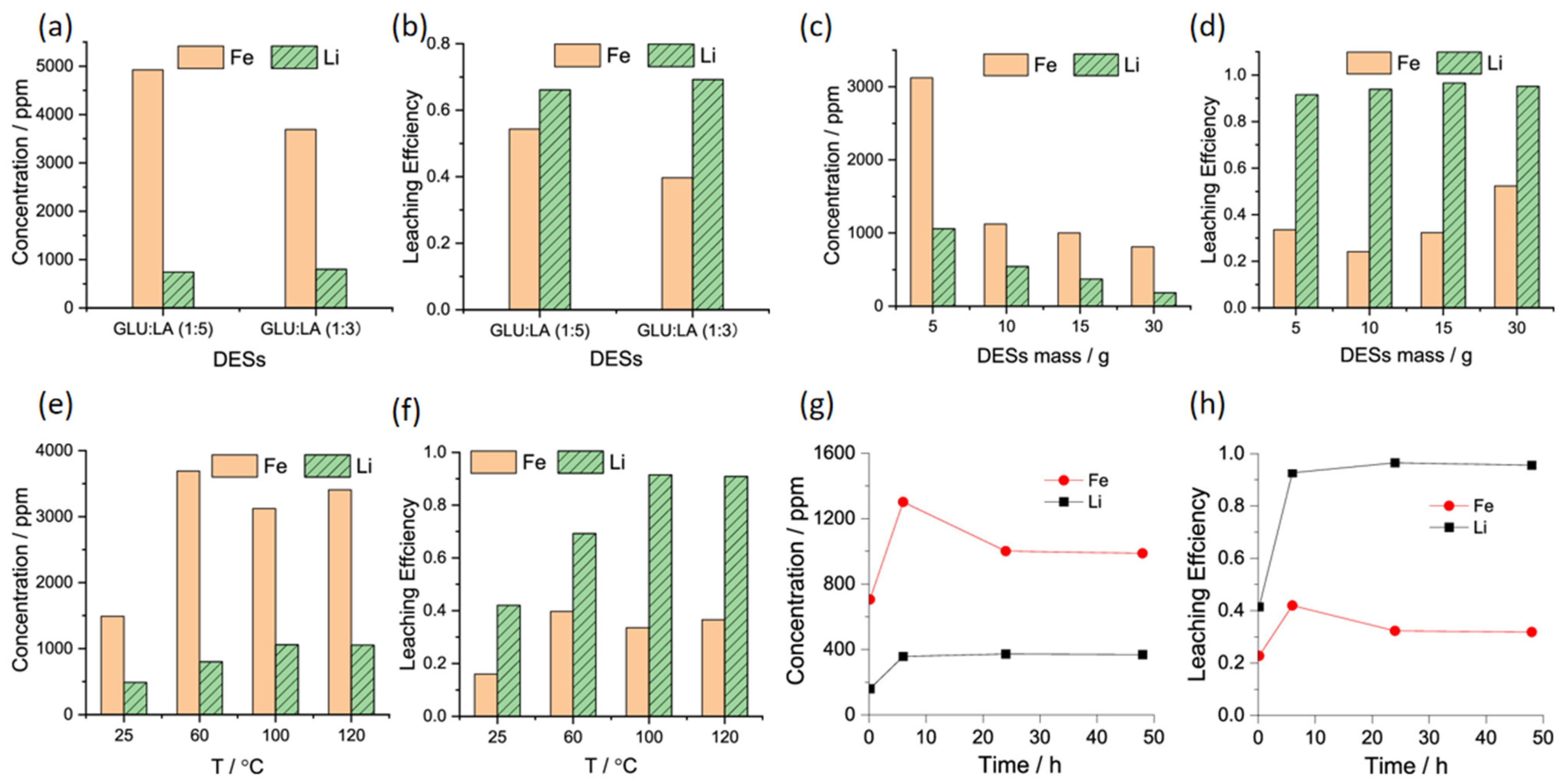
A.V. Kozhevnikova et al. [111] experimentally investigated the extraction and separation of valuable metals from spent lithium iron phosphate batteries using hydrophobic deep eutectic solvents (HDES) based on tributyl phosphate (TBP) and di(2-ethylhexyl) phosphoric acid (D2EHPA). Between 1 and 10 mol L−1 HCl, the extractant captured >99% Fe3+ at every tested acidity and >99% Al3+ at pH 1.4. Cu2+ stayed below 5% at low pH but rose to 50% at pH ≥ 1.9. Guided by these data, we devised a sequential route that lowers acidity stepwise to isolate Al3+, Cu2+, Fe3+, and Li+, and we set the conditions for strip solutions that regenerate the extractant and yield pure metal streams. Chen et al. [112] dissolved lithium selectively from spent LFP cathodes with a glucose–lactic acid deep eutectic solvent at mild temperature, achieving 96.5% Li recovery. Yield depends on solvent mass, time, temperature, and molar ratio. Figure 8a,b shows the lithium and iron concentrations and leaching efficiency at two different depths of discharge. It can be observed that the lithium concentration and leaching efficiency are significantly higher than those of iron. Figure 8c,d demonstrates the lithium and iron concentrations and leaching efficiency as the mass at depth of discharge increases. As the mass of DESs increases, lithium concentration and leaching efficiency increase, while iron concentration remains relatively stable. Figure 8e,f show that raising the temperature boosts lithium concentration and leaching efficiency, whereas iron concentration remains nearly constant. Figure 8g,h demonstrates the effect of time on lithium and iron concentrations and leaching efficiency (Figure 8h). Lithium concentration increased and stabilized with increasing time, while iron concentration showed little change. Regarding leaching efficiency, both lithium and iron improved with increasing time.
Although DESs are considered potential battery recycling lixiviants, their poor chemical stability, complex properties, high cost, and scalability challenges hinder practical application. The industrial sector is reluctant to adopt new DES-based recycling methods [113]. Additionally, research on the recycling of lithium iron phosphate batteries is limited. Mapping how DES components interact will clarify the extraction mechanism and guide the design of new systems.

3.4. Functionalised Recycling

Data from the International Energy Agency indicates that the current global lithium-ion battery recycling capacity stands at approximately 2 million tons annually. Meanwhile, the Organization for Economic Co-operation and Development notes that by 2030, over half of the world’s end-of-life lithium-ion batteries are projected to originate from electric vehicles, totaling around 1.6 million tons [114]. Confronted by this imminent scale of recycling, existing technologies reveal fundamental limitations. Currently, industrial pyrometallurgical and hydrometallurgical techniques, while capable of recovering high-value metals such as lithium and iron, suffer from high energy consumption, severe pollution (generating acidic waste liquids), and neglect of non-metallic component recovery. This results in resource wastage and environmental hazards [115,116]. This heavy-metal-priority recovery model essentially involves only selective extraction of certain metals from batteries, falling far short of achieving the goal of closed-loop utilization for all battery components. In existing processes, materials like carbon black and PVDF binders are often treated as worthless impurities and incinerated or discarded, failing to unlock their inherent value. “Functional recycling,” however, transcends simple disposal or removal. It focuses on leveraging the intrinsic properties of these components to transform them into functional materials with specific applications, thereby achieving value regeneration and enhancement [117].
Functional recycling follows two primary approaches: one involves direct reuse of components through physical disassembly, such as dismantling aluminum foil/copper foil current collectors or battery casings for use as structural parts in other products, or utilizing carbon black separated from spent electrodes as fillers in conductive coatings, conductive adhesives, and antistatic materials. This method offers advantages of operational simplicity and low energy consumption, but requires high purity and integrity of the waste materials [117,118]. The other approach involves upgrading waste materials into high-value-added materials through functional conversion. Zhou et al. [119] developed an iodine-mediated electrochemical extraction pathway that concurrently achieves lithium recovery and conversion of waste LFP into catalysts within the same liquid system. Leveraging iodine ion redox reactions, lithium is selectively leached with 93% recovery and precipitated as Li2CO3, while metallic zinc is cathodically deposited. The delithinated Fe3O4 retained carbon black and graphite conductive agents within its framework, serving directly as a 3D conductive network for OER catalysis. Mild alkaline leaching of PVDF generated fluorine-carbon defects, further enhancing oxygen evolution activity. This catalyst exhibited an overpotential of merely 250 mV at 10 mA cm−2, outperforming commercial RuO2. The entire process chain substantially reduces battery separation steps, enabling high-value utilization of waste batteries. Li et al. [120] achieved one-step electrode stripping at room temperature using methanol–citric acid as a dual-functional solvent, yielding intact aluminum foil without acid mist corrosion. The collected powder directly utilized the original 5 wt% PVDF from waste batteries as a fluorocarbon precursor. Following low-temperature solid-state sintering, the PVDF undergoes in-situ decomposition into fluorine-doped three-dimensional porous carbon networks. These networks tightly encapsulate the regenerated LiFePO4, while residual carbon black particles are welded into the carbon framework, forming continuous conductive pathways. The resulting cathode material exhibits a reversible capacity of 141.5 mAh g−1 at 1C, with only 0.4% capacity decay after 100 cycles. The aluminum foil, current collector, and conductive carbon are all retained, achieving one-step conversion of waste material into functional material. The aforementioned experiments demonstrate that the functionalization pathway eliminates strong acids and heavy metal-laden leachate, thereby reducing wastewater generation. Consequently, functionalized recycling significantly outperforms the conventional “acid leaching-resynthesis” route in terms of carbon footprint, resource consumption, and toxicity metrics.
In summary, the functionalized recycling of lithium iron phosphate not only breaks through the traditional linear model of “metal extraction–material resynthesis” but also unlocks its potential for reuse through structural repair and the imparting of new properties. While enhancing resource circulation efficiency, this approach significantly reduces environmental impact, providing both theoretical foundations and technical pathways for the sustainable management of waste lithium iron phosphate batteries. Future research should focus on the scale effects and interfacial evolution mechanisms of functional restoration. This will drive the transformation of LFP from “resource recovery” to “performance regeneration.”

3.5. Technical-Economic-Environmental Integrated Assessment

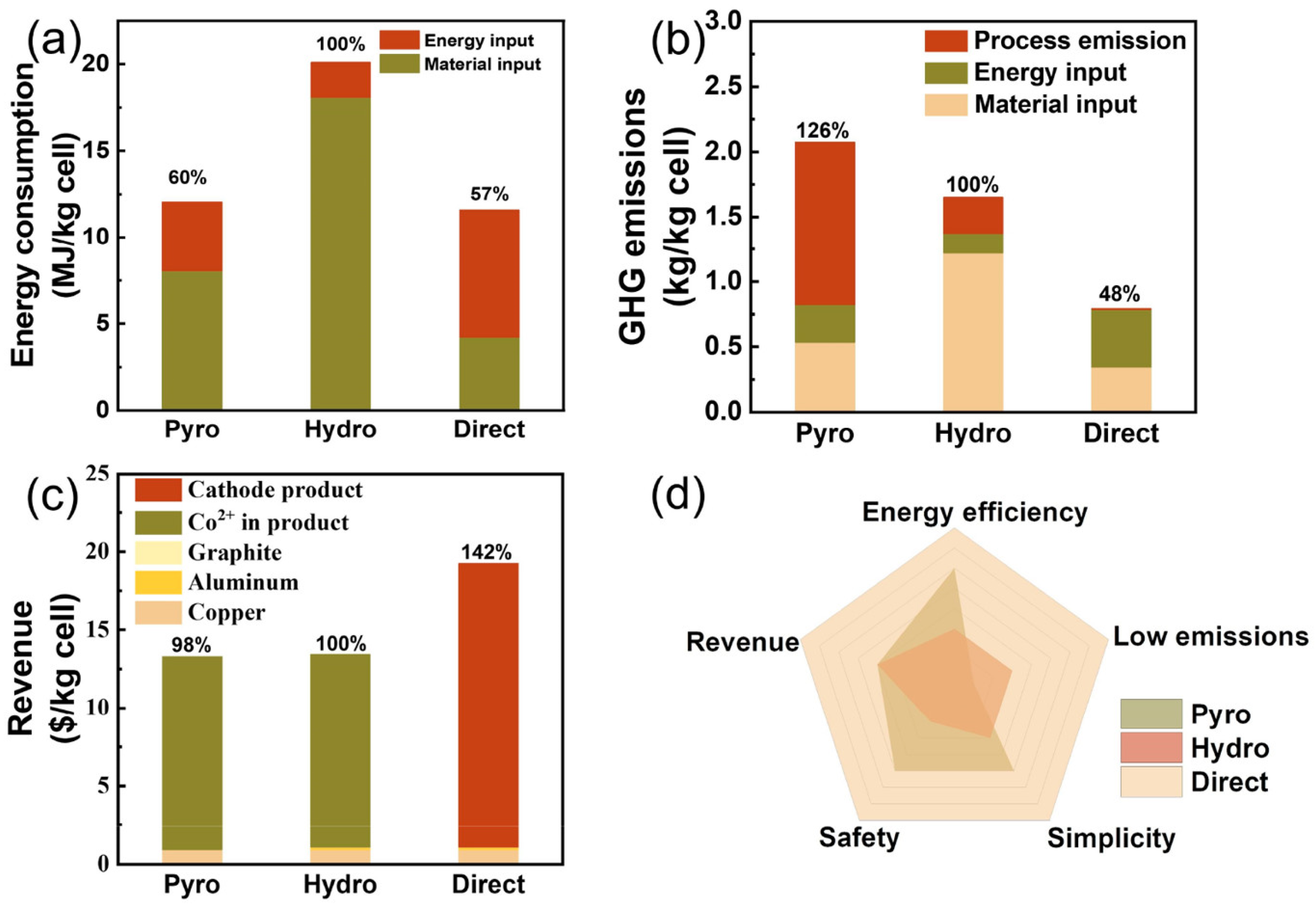
Regarding energy consumption, as shown in Figure 9a, hydrometallurgical recycling exhibits the highest overall energy demand due to the EverBatt model accounting for chemical reagent production. Recycling 1 kg of spent lithium-ion batteries requires approximately 21 megajoules (MJ) of energy, with roughly 18 MJ allocated to material inputs for chemical reagents (such as sulfuric acid, hydrochloric acid, hydrogen peroxide, etc.). Pyrometallurgical recycling exhibits significantly lower energy consumption than hydrometallurgical methods, primarily expended during high-temperature smelting. Recycling 1 kg of waste batteries requires approximately 13 MJ of energy. While its operational costs are relatively manageable due to reduced reliance on high-cost chemical reagents, it exhibits substantial carbon emission intensity. For LFP batteries, pyrometallurgical methods struggle to achieve efficient lithium recovery, with resource utilization rates below 40%. This further undermines their environmental and economic sustainability, making it difficult to meet future demands for high-value, low-carbon recycling. Direct recycling processes consume approximately 12 MJ of energy per kilogram of waste batteries, representing 57% of the energy required for hydrometallurgical recycling. While equipment energy consumption accounts for about 7.5 MJ in direct recycling—a relatively high proportion—the use of key chemical reagents as industrial byproducts eliminates additional energy consumption during their production, significantly reducing material energy consumption [121]. Wang et al. [122] further highlighted that in traditional hydrometallurgical recycling, reagents like NaOH and H2SO4 not only consume substantial energy but also generate significant wastewater treatment burdens. Their proposed approach involves “cross-system upgrading” the FePO4 component from low-value LFP batteries into sodium-ion battery systems while preserving high-value Li recovery pathways, achieving dual-track recycling through Li-Fe separation. This “dual-cycle” pathway significantly reduces energy consumption and chemical usage by eliminating Li replenishment and adopting sodium-based substitutes.
Regarding greenhouse gas emissions, as shown in Figure 9b, pyrometallurgical recycling processes emit approximately 2.1 kg of CO2 equivalent per kilogram of recycled waste batteries, representing the highest gas emissions. The hydrometallurgical recycling process emits approximately 1.6 kg CO2 equivalent per kg of recycled waste batteries, while the direct recycling process emits only 0.8 kg CO2 equivalent—just 48% of the hydrometallurgical method. Notably, the majority of greenhouse gas emissions across all three pathways stem from energy and material inputs, with minimal emissions generated during the recycling process itself [121]. Vinci et al. [123] indicate that within a life cycle assessment framework, the cascading utilization pathway (involving testing, sorting, disassembly, and reconfiguration of retired power batteries for downgraded applications in sectors with lower battery performance requirements) yields lower greenhouse gas emissions than traditional recycling processes. It is approximately 15 kg CO2 eq/kWh lower than pyrometallurgical recycling and about 11.9 kg CO2 eq/kWh lower than hydrometallurgical recycling. Wang et al. [122] found through LCA that their “dual-cycle” pathway reduces global warming potential by 30.2% compared to traditional linear recycling pathways and by 9.7% compared to closed-loop LFP regeneration pathways.
Regarding economic benefits, as shown in Figure 9c, the primary revenue sources for hydrometallurgical and pyrometallurgical processes stem from recovering high-value metals like cobalt and copper, with cobalt products accounting for over 90% of total revenue [121]. However, as battery chemistries evolve toward cobalt-free systems (LFP), the economic appeal of these traditional processes will gradually diminish. Wang et al. [124] also noted that LFP batteries, lacking high-value metals, yield significantly lower recycling economics than Nickel Cobalt Manganese Lithium-ion Batteries (NCM). Particularly in metal consumption reduction, LFP recycling achieves only about 30% resource savings, whereas NCM recycling exceeds 80%. In contrast, direct recycling processes yield a total profit of $3.9 per kilogram of recycled LFP waste, significantly higher than pyrometallurgical ($2.07) and hydrometallurgical ($2.44) methods, demonstrating substantial economic advantages for direct recycling in LFP battery recovery [125]. Moreover, the recycled LiFePO4 cathode material (approximately $19/kg) contributes the bulk of the value, with copper foil and other materials accounting for only a minor portion [121]. The high profitability of direct recycling stems from its near-100% lithium recovery rate and the direct usability of the recycled material, minimizing material loss and additional costs associated with re-synthesis [125].
Moreover, the radar chart (Figure 9d) demonstrates that the direct recycling process outperforms conventional methods across multiple dimensions. Beyond its low energy consumption, minimal emissions (11.9 kg CO2eq/kWh), and high economic returns, it features simpler operation and enhanced safety [121]. Utilizing fewer chemical reagents with lower toxicity, the direct recycling process offers greater operational feasibility and environmental friendliness for industrial applications [125].
Wang et al. [122] noted that their “dual-cycle” pathway outperforms traditional approaches across key environmental impact categories including resource scarcity, human health, and ecosystem quality. Notably, it reduces fossil resource scarcity by 29.1% compared to linear pathways and by 12.6% compared to closed-loop pathways. Wang et al. [124] also highlighted that cascading utilization of LFP batteries in energy storage systems significantly reduces net lifecycle impacts, particularly in fossil fuel consumption. Extending the cascading lifespan from 1 to 10 years enhances environmental benefits by 0.24–4.62 times. The literature also indicates that the direct recycling process currently has a Technology Readiness Level of 4. Although not yet industrialized at scale, some companies are conducting small-scale pilot projects, suggesting broad future development prospects [125].
The state of health (SOH) of a battery is the primary factor determining its post-retirement value and the appropriate recycling pathway. It is typically measured by the ratio of the battery’s current capacity to its initial capacity. The degradation of SOH signifies not only capacity loss but also indicates the evolution of the internal physicochemical structure [126]. Consequently, batteries in different states of health require distinct recycling methods: For batteries with higher SOH and relatively intact active material structures, direct recycling methods—sensitive to process conditions but requiring single-component feedstocks—are more suitable. Conversely, batteries with lower SOH and severe structural damage benefit from extraction processes such as hydrometallurgy or pyrometallurgy. In terms of industrial maturity, hydrometallurgy currently represents the most established and widely applied industrial method, particularly suited to feedstocks with a certain range of compositional variability, though leaching purity remains susceptible to impurities. Pyrometallurgy holds industrial application value under specific conditions, yet exhibits low adaptability to mixed feedstocks and may readily cause elemental alloying or slag entrapment. From an environmental perspective, direct recycling technologies align most closely with green development requirements due to their minimal chemical reagent consumption and lowest secondary pollution. Although currently experimental, technological advancements and cost reductions are anticipated to achieve industrial breakthroughs within the coming years.
It is worth noting that beyond the scaled-up pyrometallurgical, hydrometallurgical, and direct recycling routes mentioned above, a number of emerging recycling strategies have emerged in recent years. These include mechanochemical coupled selective leaching, deep eutectic solvent recovery, ultrasonic-assisted recovery, and functional recycling. Given that these processes remain in laboratory or early experimental stages, publicly available data exhibits significant gaps in mass balance, energy consumption benchmarks, and life cycle boundary definitions. This makes it challenging to conduct comparable technical-economic-environmental assessments against mature routes. Therefore, this paper intentionally excludes them from the comprehensive assessment phase, not to dismiss their potential advantages. This section is deliberately reserved as a future research direction, aiming to incorporate them into the reassessment framework once the data system is refined, thereby enabling dynamic updates to the integrated technical-economic-environmental evaluation of recycling technologies.

4. Conclusions and Future Prospects

This review has systematically examined the representative recycling approaches for spent lithium iron phosphate (LFP) batteries, highlighting their respective strengths and limitations. Each recycling route, including hydrometallurgical, pyrometallurgical, direct regeneration, electrochemical, mechanical activation, and ultrasonic-assisted recovery, offers unique advantages under specific conditions, yet all face persistent technical, environmental, and economic challenges. Building on these insights, future work should focus on targeted improvements across multiple levels.
  • Hydrometallurgical methods should leverage selective, non-corrosive solvents and novel catalysts to enhance leaching efficiency while reducing reagent consumption and wastewater generation. High-temperature solid-state and direct regeneration technologies can be optimized through lower-temperature calcination, shorter dwell times, or hybrid thermal–chemical strategies to decrease energy requirements and emissions. Electrochemical recovery could benefit from miniaturized, modular cells and reduced electrolyte volumes, enhancing scalability and energy efficiency. Mechanical activation techniques should prioritize energy-efficient milling, dust suppression, and noise reduction, while maintaining enhanced metal reactivity. Ultrasonic-assisted recycling methods, though promising in efficiency and material purity, require cost-effective reactor design and automation for industrial-scale application.
  • At the industrial level, comprehensive end-of-pipe treatments, including advanced wastewater neutralization, off-gas scrubbing, and solid residue management, will be essential to meet environmental regulations and achieve zero-waste targets. Standardization of process parameters, battery sorting, and cathode characterization will further enhance recovery yields and product consistency.
  • From a policy and supply-chain perspective, governments should implement mandatory life-cycle tracking, provide tiered subsidies for challenging chemistries, and foster public-private partnerships to share recycling infrastructure. International collaboration and data-sharing platforms could harmonize standards, enable cross-border material circulation, and accelerate the establishment of closed-loop supply chains.
Against the backdrop of the dual carbon goals, the continuous innovation of battery recycling methods holds significant strategic importance. Looking ahead to the future of battery recycling technology, future recovery processes will evolve towards multi-technology coupling and process optimization. For instance, hydrometallurgy can be combined with mechanical activation pretreatment to enhance the selective leaching rate of lithium; direct recycling processes may incorporate ultrasonic-assisted technology to improve the uniformity and efficiency of material recovery. Through the integration of artificial intelligence and big data technologies, a digital system spanning the entire battery lifecycle—from production and use to recycling—will be established. Real-time monitoring of battery health will predict optimal decommissioning timings and recycling value, enabling precise recycling and management. During processing, machine learning will optimize parameters to enhance product consistency, propelling battery recycling towards intelligent development. Consequently, advancements in battery recycling technology not only constitute a vital safeguard for resource security but also represent an indispensable key component in achieving carbon neutrality.

Author Contributions

Investigation, X.C. and W.Z.; resources, S.P.; data curation, Z.W. and C.Z.; validation, H.L.; writing—original draft preparation, Z.W.; writing—review and editing, S.P. and X.W.; supervision, L.X., S.P. and M.L.; project administration, Y.Z.; conceptualization, X.W.; visualization, Y.Z. All authors have read and agreed to the published version of the manuscript.

Funding

This work was financially supported by Major Science and Technology Projects of Henan Province (No. 241100240400), Key R&D and Promotion Special Project (Scientific and Technological Research) of Henan Province (No. 252102241036, 252102321084) and Natural Science Foundation of Henan Province (No. 252300421189, 252300423691, 252300423394), and China Postdoctoral Science Foundation (2025M770590).

Data Availability Statement

No new data were created or analyzed in this study. Data sharing is not applicable to this article.

Acknowledgments

We gratefully acknowledge the financially supported by Major Science and Technology Projects of Henan Province, Key R&D and Promotion Special Project (Scientific and Technological Research) of Henan Province and Natural Science Foundation of China, and China Postdoctoral Science Foundation.

Conflicts of Interest

Author Yurong Zhang was employed by the 2 Lomon Billions Group Co., Ltd. The remaining authors declare that the research was conducted in the absence of any commercial or financial relationships that could be construed as a potential conflict of interest.

Abbreviations

The following abbreviations are used in this manuscript:
EVs Electric vehicles
LFPLiFePO4
EoLend-of-life
EUEuropean Union
U.S.United States
SEISolid Electrolyte Interphase
CEICathode Electrolyte Interphase
SOC State of Charge
HIMS high-intensity magnetic separation
IRMS induction roller magnetic separation
LIB Lithium-Ion Batteries
PVDF Polyvinylidene fluoride
PCB Printed Circuit Board
ABC acidophilic bacterial consortium
PVAc Polyvinyl acetate
XRD X-ray Diffraction
SEM Scanning Electron Microscopy
DES Deep Eutectic Solvent
HDES hydrophobic deep eutectic solvents
TBP tributyl phosphate
D2EHPA di(2-ethylhexyl) phosphoric acid
GLU glucose
LA lactic acid
MJmegajoules
NCMNickel Cobalt Manganese Lithium-ion Batteries
SOHstate of health
SLFPspent lithium iron phosphate

References

  1. 2024 Annual Power Battery Data Information, with Lithium Iron Phosphate Batteries Accounting for 74.6%. Available online: https://news.bjx.com.cn/html/20250114/1422593.shtml (accessed on 14 January 2025).
  2. In 2023, China’s Cumulative Power Battery Installation Volume Reached 387.7 GWh, Representing a Year-on-Year Increase of 31.6%. Available online: https://news.bjx.com.cn/html/20240111/1355490.shtml (accessed on 11 January 2024).
  3. Analysis of China’s Top 10 Power Battery Installations (Insurance-Registered Volume) in 2022. Available online: https://news.bjx.com.cn/html/20230209/1287372.shtml (accessed on 9 February 2023).
  4. Makwarimba, C.P.; Tang, M.; Peng, Y.; Lu, S.; Zheng, L.; Zhao, Z.; Zhen, A. Assessment of recycling methods and processes for lithium-ion batteries. iScience 2022, 25, 104321. [Google Scholar] [CrossRef]
  5. Naseri, T.; Mousavi, S.M. Treatment of spent lithium iron phosphate (LFP) batteries. Curr. Opin. Green Sustain. Chem. 2024, 47, 100906. [Google Scholar] [CrossRef]
  6. Sederholm, J.G.; Li, L.; Liu, Z.; Lan, K.; Cho, E.J.; Gurumukhi, Y.; Dipto, M.J.; Ahmari, A.; Yu, J.; Haynes, M. Emerging trends and future opportunities for battery recycling. ACS Energy Lett. 2024, 10, 107–119. [Google Scholar] [CrossRef]
  7. Wu, X.; Ma, J.; Wang, J.; Zhang, X.; Zhou, G.; Liang, Z. Progress, key issues, and future prospects for Li-ion battery recycling. Glob. Chall. 2022, 6, 2200067. [Google Scholar] [CrossRef]
  8. Yao, H.; Zhang, Y.; Yang, G.; Fu, L.; Li, Y.; Zhou, L.; Geng, S.; Xiang, Y.; Seh, Z.W. Recycling of spent lithium iron phosphate cathodes: Challenges and progress. ACS Appl. Mater. Interfaces 2024, 16, 67087–67105. [Google Scholar] [CrossRef]
  9. Yan, J.; Qian, J.; Li, Y.; Li, L.; Wu, F.; Chen, R. Toward sustainable lithium iron phosphate in lithium-ion batteries: Regeneration strategies and their challenges. Adv. Funct. Mater. 2024, 34, 2405055. [Google Scholar] [CrossRef]
  10. Azzouz, I.; Yahmadi, R.; Brik, K.; Ben Ammar, F. Analysis of the critical failure modes and developing an aging assessment methodology for lithium iron phosphate batteries. Electr. Eng. 2022, 104, 27–43. [Google Scholar] [CrossRef]
  11. Sun, Y.; Yuan, Y.; Lu, Y.; Pu, M.; Kong, X.; Lu, L.; Wang, H.; Han, X.; Ouyang, M. Life-cycle evolution and failure mechanisms of metal-contaminant defects in lithium-ion batteries. J. Power Sources 2023, 557, 232591. [Google Scholar] [CrossRef]
  12. Chen, W.; Han, X.; Pan, Y.; Yuan, Y.; Kong, X.; Liu, L.; Sun, Y.; Shen, W.; Xiong, R. Defects in lithium-ion batteries: From origins to safety risks. Green Energy Intell. Transp. 2025, 4, 100235. [Google Scholar] [CrossRef]
  13. Zhang, Z.; Said, S.; Lovett, A.J.; Jervis, R.; Shearing, P.R.; Brett, D.J.L.; Miller, T.S. The influence of cathode degradation products on the anode interface in lithium-ion batteries. ACS Nano 2024, 18, 9389–9402. [Google Scholar] [CrossRef] [PubMed]
  14. Yang, M.; Ye, Y.; Yang, A.; Jiang, Z.; Wang, X.; Yuan, H.; Rong, M. Comparative study on aging and thermal runaway of commercial LiFePO4/graphite battery undergoing slight overcharge cycling. J. Energy Storage 2022, 50, 104691. [Google Scholar] [CrossRef]
  15. Shan, M.; Dang, C.; Meng, K.; Cao, Y.; Zhu, X.; Zhang, J.; Xu, G.; Zhu, M. Recycling of LiFePO4 cathode materials: From laboratory scale to industrial production. Mater. Today 2024, 73, 130–150. [Google Scholar] [CrossRef]
  16. Wei, Z.; Wang, X.; Zhou, M.; Papović, S.; Zheng, K.; Świerczek, K.; Wu, J.; Xin, X. Revitalizing lithium metal batteries: Strategies for tackling dead lithium formation and reactivation. Small 2024, 20, 2407395. [Google Scholar] [CrossRef]
  17. Ji, G.; Wang, J.; Liang, Z.; Jia, K.; Ma, J.; Zhuang, Z.; Zhou, G.; Cheng, H.-M. Direct regeneration of degraded lithium-ion battery cathodes with a multifunctional organic lithium salt. Nat. Commun. 2023, 14, 584. [Google Scholar] [CrossRef]
  18. Xu, P.; Dai, Q.; Gao, H.; Liu, H.; Zhang, M.; Li, M.; Chen, Y.; An, K.; Meng, Y.S.; Liu, P. Efficient direct recycling of lithium-ion battery cathodes by targeted healing. Joule 2020, 4, 2609–2626. [Google Scholar] [CrossRef]
  19. Minakshi, M. Lithium intercalation into amorphous FePO4 cathode in aqueous solutions. Electrochim. Acta 2010, 55, 9174–9178. [Google Scholar] [CrossRef]
  20. Minakshi, M.; Sharma, N.; Ralph, D.; Appadoo, D.; Nallathamby, K. Synthesis and characterization of Li (Co0.5Ni0.5) PO4 cathode for Li-ion aqueous battery applications. Electrochem. Solid-State Lett. 2011, 14, A86. [Google Scholar] [CrossRef]
  21. Tomaszewska, A.; Chu, Z.; Feng, X.; O’kane, S.; Liu, X.; Chen, J.; Ji, C.; Endler, E.; Li, R.; Liu, L. Lithium-ion battery fast charging: A review. eTransportation 2019, 1, 100011. [Google Scholar] [CrossRef]
  22. Camacho-Forero, L.E.; Balbuena, P.B. Effects of charged interfaces on electrolyte decomposition at the lithium metal anode. J. Power Sources 2020, 472, 228449. [Google Scholar] [CrossRef]
  23. Zhao, Y.; Du, H.; Kang, Y.; Zhang, J.; Lan, B.; Guo, Z.; Titirici, M.; Zhao, Y.; Tavajohi, N.; Kang, F. Spent battery regeneration for better recycling. Nat. Rev. Mater. 2025, 10, 722–724. [Google Scholar] [CrossRef]
  24. Li, T.; Chen, X.; Huang, K.; Sun, Z.; Li, H.; Sun, Q.; Chen, Z.; Guo, Z.; Huang, J.; Yuan, L.; et al. Electron beam irradiation for spent LiFePO4 recycling. eScience 2025, 100501, in press. [Google Scholar] [CrossRef]
  25. Lin, Y.; Wang, T.; Gao, C.; Zhang, X.; Yu, W.; Wang, M.; Yang, C.; Zhang, J. Direct and Low-Temperature Regeneration of Degraded LiFePO4 Cathodes at Ambient Conditions Using Green and Sustainable Deep Eutectic Solvent. Adv. Adv. Sci. 2025, 12, 2504683. [Google Scholar] [CrossRef]
  26. Liu, Y.; Bai, J.; Shi, R.; Wang, P.; Xiao, K.; Wang, S.; Qiu, S.; Wang, X.; Zhu, X.; Yang, K.; et al. Direct recycling of degraded LiFePO4 cathode material via natural electron donors healing and targeted surface reconstruction. Adv. Mater. 2025, 38, e11246. [Google Scholar] [CrossRef] [PubMed]
  27. Wang, C.; Kong, X.; Wang, L.; Yin, F.; Zheng, F.; Liu, S.; Liu, Q.; Zhuang, Q.; Ju, Z.; Zhang, J. Mechanistically engineered heterojunction from spent LFP for efficient oxygen evolution electrocatalysis. Angew. Chem. 2025, 137, e202516122. [Google Scholar] [CrossRef]
  28. Eldesoky, A.; Logan, E.R.; Johnson, M.B.; McFarlane, C.R.M.; Dahn, J.R. Scanning micro X-ray fluorescence (μXRF) as an effective tool in quantifying Fe dissolution in LiFePO4 cells: Towards a mechanistic understanding of Fe dissolution. J. Electrochem. Soc. 2020, 167, 130539. [Google Scholar] [CrossRef]
  29. Men, L.; Feng, S.; Zhang, J.; Luo, X.; Zhou, Y. A systematic review of efficient recycling for the cathode materials of spent lithium-ion batteries: Process intensification technologies beyond traditional methods. Green Chem. 2024, 26, 1170–1193. [Google Scholar] [CrossRef]
  30. Li, Y.; Han, D.; Qi, L. Recent research on pretreatment of waste lithium-ion batteries and electrolyte recovery technology. Inorg. Chem. Ind. 2024, 56, 1–10. [Google Scholar] [CrossRef]
  31. Shaw-Stewart, J.; Alvarez-Reguera, A.; Greszta, A.; Marco, J.; Masood, M.; Sommerville, R.; Kendrick, E. Aqueous solution discharge of cylindrical lithium-ion cells. Sustain. Mater. Technol. 2019, 22, e00110. [Google Scholar] [CrossRef]
  32. Yadav, P.; Jie, C.J.; Tan, S.; Srinivasan, M. Recycling of cathode from spent lithium iron phosphate batteries. J. Hazard. Mater. 2020, 399, 123068. [Google Scholar] [CrossRef]
  33. Yu, D.; Huang, Z.; Makuza, B.; Guo, X.; Tian, Q. Pretreatment options for the recycling of spent lithium-ion batteries: A comprehensive review. Miner. Eng. 2021, 173, 107218. [Google Scholar] [CrossRef]
  34. Ni, Y.; Nie, C.-C.; Shi, S.-X.; Zhu, X.-N. Effect of mechanical force on dissociation characteristics of cathode materials in spent lithium-ion batteries. Process Saf. Environ. Prot. 2022, 161, 374–383. [Google Scholar] [CrossRef]
  35. Hu, Z.; Liu, J.; Gan, T.; Lu, D.; Wang, Y.; Zheng, X. High-intensity magnetic separation for recovery of LiFePO4 and graphite from spent lithium-ion batteries. Sep. Purif. Technol. 2022, 297, 121486. [Google Scholar] [CrossRef]
  36. Bugryniec, P.J.; Davidson, J.N.; Cumming, D.J.; Brown, S.F. Pursuing safer batteries: Thermal abuse of LiFePO4 cells. J. Power Sources 2019, 414, 557–568. [Google Scholar] [CrossRef]
  37. Zhang, G.; Yuan, X.; He, Y.; Wang, H.; Zhang, T.; Xie, W. Recent advances in pretreating technology for recycling valuable metals from spent lithium-ion batteries. J. Hazard. Mater. 2021, 406, 124332. [Google Scholar] [CrossRef] [PubMed]
  38. Kim, S.; Bang, J.; Yoo, J.; Shin, Y.; Bae, J.; Jeong, J.; Kim, K.; Dong, P.; Kwon, K. A comprehensive review on the pretreatment process in lithium-ion battery recycling. J. Clean. Prod. 2021, 294, 126329. [Google Scholar] [CrossRef]
  39. Li, J.; Wang, G.; Xu, Z. Generation and detection of metal ions and volatile organic compounds (VOCs) emissions from the pretreatment processes for recycling spent lithium-ion batteries. Waste Manag. 2016, 52, 221–227. [Google Scholar] [CrossRef]
  40. Li, B.; Zhou, T.; Sun, H.; Song, Q.; Liu, Y.; Li, J.; Xu, Z. Hazardous electrolyte releasement and transformation mechanism during water protected spent lithium-ion batteries crushing. J. Hazard. Mater. 2025, 486, 137036. [Google Scholar] [CrossRef] [PubMed]
  41. Yan, S.; Jiang, Y.; Chen, X.; Yuan, L.; Min, T.; Cao, Y.; Peng, W.; Zhou, T. Engineering classification recycling of spent lithium-ion batteries through pretreatment: A comprehensive review from laboratory to scale-up application. Rare Met. 2024, 43, 915–941. [Google Scholar] [CrossRef]
  42. Zhu, X.; Zhang, L.; Dong, S.; Kou, W.; Nie, C.; Lyu, X.; Qiu, J.; Li, L.; Liu, Z.; Wu, P. Mechanical activation to enhance the natural floatability of waste printed circuit boards. Waste Manag. 2020, 109, 222–230. [Google Scholar] [CrossRef]
  43. Zhong, X.; Liu, W.; Han, J.; Jiao, F.; Zhu, H.; Qin, W. Pneumatic separation for crushed spent lithium-ion batteries. Waste Manag. 2020, 118, 331–340. [Google Scholar] [CrossRef]
  44. Bai, Y.; Zhu, H.; Zu, L.; Bi, H. Eddy current separation of broken lithium battery products in consideration of the shape factor. J. Mater. Cycles Waste Manag. 2023, 25, 2262–2275. [Google Scholar] [CrossRef]
  45. Bi, H.; Zhu, H.; Zu, L.; Gao, Y.; Gao, S.; Wu, Z. Eddy current separation for recovering aluminium and lithium-iron phosphate components of spent lithium-iron phosphate batteries. Waste Manag. Res. 2019, 37, 1217–1228. [Google Scholar] [CrossRef]
  46. Huang, Z.; Lin, M.; Qiu, R.; Zhu, J.; Ruan, J.; Qiu, R. A novel technology of recovering magnetic micro particles from spent lithium-ion batteries by ultrasonic dispersion and waterflow-magnetic separation. Resour. Conserv. Recycl. 2021, 164, 105172. [Google Scholar] [CrossRef]
  47. Zhu, X.; Nie, C.; Zhang, H.; Lyu, X.; Qiu, J.; Li, L. Recovery of metals in waste printed circuit boards by flotation technology with soap collector prepared by waste oil through saponification. Waste Manag. 2019, 89, 21–26. [Google Scholar] [CrossRef]
  48. Zhang, G.; Du, Z.; He, Y.; Wang, H.; Xie, W.; Zhang, T. A sustainable process for the recovery of anode and cathode materials derived from spent lithium-ion batteries. Sustainability 2019, 11, 2363. [Google Scholar] [CrossRef]
  49. Wang, M.; Liu, K.; Dutta, S.; Alessi, D.S.; Rinklebe, J.; Ok, Y.S.; Tsang, D.C.W. Recycling of lithium iron phosphate batteries: Status, technologies, challenges, and prospects. Renew. Sustain. Energy Rev. 2022, 163, 112515. [Google Scholar] [CrossRef]
  50. Cui, K.; Zhao, M.-C.; Li, Y.; Atrens, A.; Zhang, F. Recycling of spent lithium iron phosphate batteries: Research progress based on environmental protection and sustainable development technology. Sep. Purif. Technol. 2024, 354, 128982. [Google Scholar] [CrossRef]
  51. Yan, T.T.; Zhong, S.W.; Zhou, M.M.; Guo, X.M.; Hu, J.W.; Wang, F.F.; Zeng, F.T.; Zuo, S.C. High-efficiency method for recycling lithium from spent LiFePO4 cathode. Nanotechnol. Rev. 2020, 9, 1586–1593. [Google Scholar] [CrossRef]
  52. Jin, H.; Zhang, J.; Yang, C.; Ma, L.; Chen, Y.; Wang, C. Selective recovery of lithium from spent LiFePO4 battery via a self-catalytic air oxidation method. Chem. Eng. J. 2023, 460, 141805. [Google Scholar] [CrossRef]
  53. Huang, Y.F.; Han, G.H.; Liu, J.T.; Chai, W.C.; Wang, W.J.; Yang, S.Z.; Su, S.P. A stepwise recovery of metals from hybrid cathodes of spent Li-ion batteries with leaching-flotation-precipitation process. J. Power Sources 2016, 325, 555–564. [Google Scholar] [CrossRef]
  54. Sheng, L.; Zhou, Z.; Chen, A.; Liu, Z.; Li, N.; Guo, H. Experimental study on leaching of lithium from the cathode materials of spent lithium iron phosphate batteries with hydrochloric acid and hydrogen peroxide. J. Salt Lake Res. 2025, 33, 87–92. [Google Scholar] [CrossRef]
  55. Li, H.; Xing, S.; Liu, Y.; Li, F.; Guo, H.; Kuang, G. Recovery of lithium, iron, and phosphorus from spent LiFePO4 batteries using stoichiometric sulfuric acid leaching system. ACS Sustain. Chem. Eng. 2017, 5, 8017–8024. [Google Scholar] [CrossRef]
  56. Zhang, Z.; Tang, J.; Su, M.; Xu, J.; Shih, K. Design and optimization of an economically viable and highly efficient strategy for Li recycling from spent LiFePO4 batteries. ACS Sustain. Chem. Eng. 2023, 11, 16124–16132. [Google Scholar] [CrossRef]
  57. Zheng, R.; Zhao, L.; Wang, W.; Liu, Y.; Ma, Q.; Mu, D.; Li, R.; Dai, C. Optimized Li and Fe recovery from spent lithium-ion batteries via a solution-precipitation method. RSC Adv. 2016, 6, 43613–43625. [Google Scholar] [CrossRef]
  58. Wang, T.; Wang, X.; Lyv, W.; Sun, X.; Chen, J.; Xu, E.; Wu, K.; Zhang, Y. Regeneration behavior of FePO4·2H2O from spent LiFePO4 under extremely acidic condition (pH < 0.8): Mechanism study and the properties of regenerated LiFePO4. Sep. Purif. Technol. 2024, 330, 125508. [Google Scholar]
  59. Chen, Y.Z.; Wang, L.H.; He, H.; Li, J.; Li, Y.M.; Liu, R.T.; Li, D.Y.; He, Z.Y. Preparation of FePO4 and LiH2PO4 from cathode mixture materials of scrapped LiFePO4 batteries. J. Mater. Sci.-Mater. Electron. 2020, 31, 4083–4091. [Google Scholar] [CrossRef]
  60. Xu, C.L.; Hu, X.; Yang, Y.; Jian, Z.L.; Chen, W.; Yang, L.R.; Yang, C.; Liu, H.Z.; Zhao, J.M.; Cao, H.B.; et al. Integrated process of CO2 sequestration and recycling spent LiFePO4 batteries. Energy Storage Mater. 2023, 60, 10. [Google Scholar] [CrossRef]
  61. Luo, B.; Xu, B.; Tan, Q.; Yan, Q.; Zhou, Y.; Dong, Z.; Wu, C.; Nie, R. Sustainable hydrochloric–phosphate acid leaching strategy for selective sithium extraction and direct recovery of FePO4· 2H2O from Spent LiFePO4 materials. ACS Sustain. Chem. Eng. 2025, 13, 17359–17369. [Google Scholar] [CrossRef]
  62. Zhou, H.; Zhang, Y.; Li, L.; Cao, Z. Integrated recycling of valuable elements from spent LiFePO4 batteries: A green closed-loop process. Green Chem. 2023, 25, 7696–7706. [Google Scholar] [CrossRef]
  63. Li, P.W.; Luo, S.H.; Su, F.X.; Zhang, L.; Yan, S.X.; Lei, X.F.; Mu, W.N.; Wang, Q.; Zhang, Y.H.; Liu, X.; et al. Optimization of synergistic leaching of valuable metals from spent lithium-ion batteries by the sulfuric acid-malonic acid system using response surface methodology. ACS Appl. Mater. Interfaces 2022, 14, 11359–11374. [Google Scholar] [CrossRef]
  64. Jiang, Y.; Chen, X.; Yan, S.; Li, S.; Zhou, T. Pursuing green and efficient process towards recycling of different metals from spent lithium-ion batteries through ferro-chemistry. Chem. Eng. J. 2021, 426, 131637. [Google Scholar] [CrossRef]
  65. Zheng, X.; Gao, W.; Zhang, X.; He, M.; Lin, X.; Cao, H.; Zhang, Y.; Sun, Z. Spent lithium-ion battery recycling–reductive ammonia leaching of metals from cathode scrap by sodium sulphite. Waste Manag. 2017, 60, 680–688. [Google Scholar] [CrossRef]
  66. Yang, W.; Liu, X.; Zhou, X.; Tang, J.; Su, F.; Li, Z.; Yang, J.; Ma, Y. Mechanism of selective lithium extraction from spent LiFePO4 cathodes in oxidizing alkaline leaching system. Sep. Purif. Technol. 2024, 329, 125237. [Google Scholar] [CrossRef]
  67. Han, F.; Zhou, L.; Fang, D.F.; Yang, G.; Yang, L.M.; Huang, M.T.; Feng, Y.F.; Shao, P.H.; Shi, H.; Luo, X.B. Alkali-enhanced polyvinylidene fluoride cracking to deeply remove aluminum impurities for regeneration of battery-grade lithium iron phosphate. Chem. Eng. J. 2024, 483, 8. [Google Scholar] [CrossRef]
  68. Zhang, L.; Teng, T.; Xiao, L.; Shen, L.; Ran, J.; Zheng, J.; Zhu, Y.; Chen, H. Recovery of LiFePO4 from used lithium-ion batteries by sodium-bisulphate-assisted roasting. J. Clean. Prod. 2022, 379, 134748. [Google Scholar] [CrossRef]
  69. Song, S.; Liu, R.; Sun, M.; Zhen, A.; Kong, F.; Yang, Y. Hydrometallurgical recovery of lithium carbonate and iron phosphate from blended cathode materials of spent lithium-ion battery. Rare Met. 2024, 43, 1275–1287. [Google Scholar] [CrossRef]
  70. Yu, Z.S.; Han, H.W.; Feng, P.Y.; Zhao, S.; Zhou, T.Y.; Kakade, A.; Kulshrestha, S.; Majeed, S.; Li, X.K. Recent advances in the recovery of metals from waste through biological processes. Bioresour. Technol. 2020, 297, 13. [Google Scholar] [CrossRef]
  71. Huang, T.; Liu, L.; Zhang, S. Recovery of cobalt, lithium, and manganese from the cathode active materials of spent lithium-ion batteries in a bio-electro-hydrometallurgical process. Hydrometallurgy 2019, 188, 101–111. [Google Scholar] [CrossRef]
  72. Zeng, G.; Deng, X.; Luo, S.; Luo, X.; Zou, J. A copper-catalyzed bioleaching process for enhancement of cobalt dissolution from spent lithium-ion batteries. J. Hazard. Mater. 2012, 199, 164–169. [Google Scholar] [CrossRef] [PubMed]
  73. Gu, J.; Nie, Y.; Li, Z.; Yang, K.; An, L.; Jiang, H.; Han, X.; Fu, Z.; Zhao, X. Efficient bioleaching of Li from waste lithium–iron phosphate batteries by acidophilic bacterial consortium: Enrichment condition, Li recovery, and brief carbon footprint analysis. Chem. Eng. J. 2025, 509, 161450. [Google Scholar] [CrossRef]
  74. Mahandra, H.; Hein, G.; Faraji, F.; Ghahreman, A. A novel neutrophilic bacteria based process for selective LiFePO4 cathode recycling. Resour. Conserv. Recycl. 2023, 195, 107015. [Google Scholar] [CrossRef]
  75. Roy, J.J.; Rarotra, S.; Krikstolaityte, V.; Zhuoran, K.W.; Cindy, Y.D.I.; Tan, X.Y.; Carboni, M.; Meyer, D.; Yan, Q.Y.; Srinivasan, M. Green recycling methods to treat lithium-ion batteries e-waste: A circular approach to sustainability. Adv. Mater. 2022, 34, 27. [Google Scholar] [CrossRef]
  76. Zhou, M.; Li, B.; Li, J.; Xu, Z. Pyrometallurgical technology in the recycling of a spent lithium ion battery: Evolution and the challenge. ACS ES T Eng. 2021, 1, 1369–1382. [Google Scholar] [CrossRef]
  77. Makuza, B.; Tian, Q.; Guo, X.; Chattopadhyay, K.; Yu, D. Pyrometallurgical options for recycling spent lithium-ion batteries: A comprehensive review. J. Power Sources 2021, 491, 229622. [Google Scholar] [CrossRef]
  78. Cornelio, A.; Zanoletti, A.; Bontempi, E. Recent progress in pyrometallurgy for the recovery of spent lithium-ion batteries: A review of state-of-the-art developments. Curr. Opin. Green Sustain. Chem. 2024, 46, 100881. [Google Scholar] [CrossRef]
  79. Zhang, B.; Qu, X.; Chen, X.; Liu, D.; Zhao, Z.; Xie, H.; Wang, D.; Yin, H. A sodium salt-assisted roasting approach followed by leaching for recovering spent LiFePO4 batteries. J. Hazard. Mater. 2022, 424, 127586. [Google Scholar] [CrossRef] [PubMed]
  80. Qu, X.; Ma, J.; Zhang, B.; Zhao, J.; Qiu, B.; Chen, X.; Zhou, F.; Li, X.; Gao, S.; Wang, D. Fast ammonium sulfate salt assisted roasting for selectively recycling degraded LiFePO4 cathode. J. Clean. Prod. 2024, 435, 140428. [Google Scholar] [CrossRef]
  81. Zhao, Y.; Yuan, X.; Jiang, L.; Wen, J.; Wang, H.; Guan, R.; Zhang, J.; Zeng, G. Regeneration and reutilization of cathode materials from spent lithium-ion batteries. Chem. Eng. J. 2020, 383, 123089. [Google Scholar] [CrossRef]
  82. Wang, Z.; Huang, Y.; Wang, X.; Wu, D.; Wu, X. Advanced solid-state electrolysis for green and efficient spent LiFePO4 cathode material recycling: Prototype reactor tests. Ind. Eng. Chem. Res. 2022, 61, 12318–12328. [Google Scholar] [CrossRef]
  83. Sun, Q.F.; Li, X.L.; Zhang, H.Z.; Song, D.W.; Shi, X.X.; Song, J.S.; Li, C.L.; Zhang, L.Q. Resynthesizing LiFePO4/C materials from the recycled cathode via a green full-solid route. J. Alloys Compd. 2020, 818, 8. [Google Scholar] [CrossRef]
  84. Guan, L.Y.; Liu, M.H.; Yu, F.; Qiu, T.; Zhou, T.B.G.; Lin, X. A LiFePO4 regeneration method based on PVAc alcoholysis reaction. Renew. Energy 2021, 175, 559–567. [Google Scholar] [CrossRef]
  85. Song, X.; Hu, T.; Liang, C.; Long, H.; Zhou, L.; Song, W.; You, L.; Wu, Z.; Liu, J. Direct regeneration of cathode materials from spent lithium iron phosphate batteries using a solid phase sintering method. RSC Adv. 2017, 7, 4783–4790. [Google Scholar] [CrossRef]
  86. Wang, J.J.; Yue, X.Y.; Wang, P.F.; Yu, T.; Du, X.; Hao, X.G.; Abudula, A.; Guan, G.Q. Electrochemical technologies for lithium recovery from liquid resources: A review. Renew. Sustain. Energy Rev. 2022, 154, 15. [Google Scholar] [CrossRef]
  87. Zhou, S.; Du, J.; Xiong, X.; Liu, L.; Wang, J.; Fu, L.; Ye, J.; Chen, Y.; Wu, Y. Direct recovery of scrapped LiFePO4 by a green and low-cost electrochemical re-lithiation method. Green Chem. 2022, 24, 6278–6286. [Google Scholar] [CrossRef]
  88. Yu, J.Z.; Wang, X.; Zhou, M.Y.; Wang, Q. A redox targeting-based material recycling strategy for spent lithium ion batteries. Energy Environ. Sci. 2019, 12, 2672–2677. [Google Scholar] [CrossRef]
  89. Wang, W.; Wang, R.; Zhan, R.; Du, J.; Chen, Z.; Feng, R.; Tan, Y.; Hu, Y.; Ou, Y.; Yuan, Y.; et al. Probing hybrid LiFePO4/FePO4 phases in a single olive LiFePO4 particle and their recovering from degraded electric vehicle batteries. Nano Lett. 2023, 23, 7485–7492. [Google Scholar] [CrossRef]
  90. Fan, M.; Meng, Q.; Chang, X.; Gu, C.; Meng, X.; Yin, Y.; Li, H.; Wan, L.; Guo, Y. In situ electrochemical regeneration of degraded LiFePO4 electrode with functionalized prelithiation separator. Adv. Energy Mater. 2022, 12, 2103630. [Google Scholar] [CrossRef]
  91. Wang, Y.Q.; An, N.; Wen, L.; Wang, L.; Jiang, X.T.; Hou, F.; Yin, Y.X.; Liang, J. Recent progress on the recycling technology of Li-ion batteries. J. Energy Chem. 2021, 55, 391–419. [Google Scholar] [CrossRef]
  92. Zhou, F.; Zhang, B.; Wang, H.; Wang, D.; Qu, X.; Wang, S.; Tang, M.; Peng, L.; Chen, X.; Wang, D. Mechanical force inducing oxygen vacancies and pyrolysis gas reduction activity for the efficient valorization of waste biomass and Li-ion batteries. Green Chem. 2025, 27, 7918–7927. [Google Scholar] [CrossRef]
  93. Liu, K.; Liu, L.L.; Tan, Q.Y.; Li, J.H. Selective extraction of lithium from a spent lithium iron phosphate battery by mechanochemical solid-phase oxidation. Green Chem. 2021, 23, 1344–1352. [Google Scholar] [CrossRef]
  94. Fan, E.; Li, L.; Zhang, X.; Bian, Y.; Xue, Q.; Wu, J.; Wu, F.; Chen, R. Selective recovery of Li and Fe from spent lithium-ion batteries by an environmentally friendly mechanochemical approach. ACS Sustain. Chem. Eng. 2018, 6, 11029–11035. [Google Scholar] [CrossRef]
  95. Sun, R.; Liu, L.; Liu, Y.; Ye, J.; Wang, T.; Wu, Y. Recycling spent LiFePO4 from Li-ion battery. Battery Bimon. 2022, 52, 479–483. [Google Scholar] [CrossRef]
  96. Li, L.; Bian, Y.F.; Zhang, X.X.; Yao, Y.; Xue, Q.; Fan, E.S.; Wu, F.; Chen, R.J. A green and effective room-temperature recycling process of LiFePO4 cathode materials for lithium-ion batteries. Waste Manag. 2019, 85, 437–444. [Google Scholar] [CrossRef] [PubMed]
  97. Chen, Y.; Truong, V.N.; Bu, X.; Xie, G. A review of effects and applications of ultrasound in mineral flotation. Ultrason. Sonochem. 2020, 60, 104739. [Google Scholar] [CrossRef] [PubMed]
  98. Ren, X.; Tong, Z.; Dai, Y.; Ma, G.; Lv, Z.; Bu, X.; Bilal, M.; Vakylabad, A.B.; Hassanzadeh, A. Effects of mechanical stirring and ultrasound treatment on the separation of graphite electrode materials from copper foils of spent LIBs: A comparative study. Separations 2023, 10, 246. [Google Scholar] [CrossRef]
  99. Chen, X.; Li, S.; Wu, X.; Zhou, T.; Ma, H. In-situ recycling of coating materials and Al foils from spent lithium ion batteries by ultrasonic-assisted acid scrubbing. J. Clean. Prod. 2020, 258, 120943. [Google Scholar] [CrossRef]
  100. Zhao, S.; Zhang, W.; Li, G.; Zhu, H.; Huang, J.; He, W. Ultrasonic renovation mechanism of spent LCO batteries: A mild condition for cathode materials recycling. Resour. Conserv. Recycl. 2020, 162, 105019. [Google Scholar] [CrossRef]
  101. Zhou, S.; Zhang, Y.; Meng, Q.; Dong, P.; Fei, Z.; Li, Q. Recycling of LiCoO2 cathode material from spent lithium ion batteries by ultrasonic enhanced leaching and one-step regeneration. J. Environ. Manag. 2021, 277, 111426. [Google Scholar] [CrossRef]
  102. Zhou, M.; Liu, K.; Wei, M.; Zhang, J.; Chen, S.; Cheng, W. Recovery of lithium iron phosphate by specific ultrasonic cavitation parameters. Sustainability 2022, 14, 3390. [Google Scholar] [CrossRef]
  103. Yang, Y.; Zhang, H.; Kuang, G.; Li, H.; Guo, H.; Jin, X.; Gan, M.; Long, H. Ultrasonic-assisted alkali leaching coupled gas sorting process to separate cathode and anode materials from spent LiFePO4 batteries. Chem. Eng. Process.-Process Intensif. 2025, 209, 110207. [Google Scholar] [CrossRef]
  104. Tong, Z.; Ren, X.; Ni, M.; Bu, X.; Dong, L. Review of ultrasound-assisted recycling and utilization of cathode materials from spent lithium-ion batteries: State-of-the-art and outlook. Energy Fuels 2023, 37, 14574–14588. [Google Scholar] [CrossRef]
  105. Tran, M.K.; Rodrigues, M.-T.F.; Kato, K.; Babu, G.; Ajayan, P.M. Deep eutectic solvents for cathode recycling of Li-ion batteries. Nat. Energy 2019, 4, 339–345. [Google Scholar] [CrossRef]
  106. Jaglan, P.; Kumar, M.; Kaushik, D.; Kumar, A.; Argyropoulos, D.; Oz, F.; Proestos, C. Optimization of the extraction process of moringa oleifera flower by using deep eutectic solvents (DES). Results Chem. 2024, 7, 101445. [Google Scholar] [CrossRef]
  107. Ruesgas-Ramón, M.; Figueroa-Espinoza, M.C.; Durand, E. Application of deep eutectic solvents (DES) for phenolic compounds extraction: Overview, challenges, and opportunities. J. Agric. Food Chem. 2017, 65, 3591–3601. [Google Scholar] [CrossRef]
  108. Lu, Q.; Chen, L.; Li, X.; Chao, Y.; Sun, J.; Ji, H.; Zhu, W. Sustainable and convenient recovery of valuable metals from spent Li-ion batteries by a one-pot extraction process. ACS Sustain. Chem. Eng. 2021, 9, 13851–13861. [Google Scholar] [CrossRef]
  109. Schiavi, P.G.; Altimari, P.; Sturabotti, E.; Giacomo Marrani, A.; Simonetti, G.; Pagnanelli, F. Decomposition of deep eutectic solvent aids metals extraction in lithium-ion batteries recycling. ChemSusChem 2022, 15, e202200966. [Google Scholar] [CrossRef]
  110. Tang, S.; Feng, J.; Su, R.; Zhang, M.; Guo, M. New bifunctional deep-eutectic solvent for in situ selective extraction of valuable metals from spent lithium batteries. ACS Sustain. Chem. Eng. 2022, 10, 8423–8432. [Google Scholar] [CrossRef]
  111. Kozhevnikova, A.V.; Lobovich, D.V.; Milevskii, N.A.; Zinov’eva, I.V.; Zakhodyaeva, Y.A.; Voshkin, A.A. The use of organophosphorus extractants as a component of hydrophobic deep eutectic solvents (HDES) for the processing of spent lithium-iron phosphate batteries. Hydrometallurgy 2024, 228, 106369. [Google Scholar] [CrossRef]
  112. Chen, Y.; Zhang, F.; Yang, C.; Ju, X.; Zhang, Z.; Liu, Z.; Yang, M. Efficient and selective dissolution of Li from lithium-ion battery LiFePO4 cathode by natural deep eutectic solvents. Energy Fuels 2024, 38, 5391–5396. [Google Scholar] [CrossRef]
  113. Meles Neguse, S.; Yoon, S.; Lim, H.; Jang, J.; Baek, S.; Jöckel, D.M.; Widenmeyer, M.; Balke-Grünewald, B.; Weidenkaff, A. The pitfalls of deep eutectic solvents in the recycling of lithium-ion batteries. Energy Technol. 2024, 12, 2301213. [Google Scholar] [CrossRef]
  114. Chacana-Olivares, J.; Peceño, B.; Grageda, M.; Cruz, C.; Rojas, L. Lithium-ion battery recycling: A perspective on key challenges and opportunities. npj Mater. Sustain. 2025, 3, 38. [Google Scholar] [CrossRef]
  115. Baum, Z.J.; Bird, R.E.; Yu, X.; Ma, J. Lithium-Ion Battery Recycling–Overview of Techniques and Trends. ACS Energy Lett. 2022, 7, 712–719. [Google Scholar] [CrossRef]
  116. Wu, J.; Xiao, L.; Shen, L.; Ran, J.-J.; Zhong, H.; Zhu, Y.-R.; Chen, H. Recent advancements in hydrometallurgical recycling technologies of spent lithium-ion battery cathode materials. Rare Met. 2024, 43, 879–899. [Google Scholar] [CrossRef]
  117. Wiechers, P.; Hermann, A.; Koob, S.; Glaum, F.; Gleiß, M. Development of a Process for Direct Recycling of Negative Electrode Scrap from Lithium-Ion Battery Production on a Technical Scale and Its Influence on the Material Quality. Batteries 2024, 10, 218. [Google Scholar] [CrossRef]
  118. Zhu, P.; Driscoll, E.H.; Dong, B.; Sommerville, R.; Zorin, A.; Slater, P.R.; Kendrick, E. Direct reuse of aluminium and copper current collectors from spent lithium-ion batteries. Green Chem. 2023, 25, 3503–3514. [Google Scholar] [CrossRef]
  119. Liu, J.; Liu, Z.; Xiao, Z.; Zhu, Y.; Wang, J.; Ji, G.; Liu, Y.; Sun, B.; Zhou, G. Iodine-mediated redox strategy for sustainable lithium extraction from spent LiFePO4 cathodes. Adv. Mater. 2025, 37, 2503450. [Google Scholar] [CrossRef]
  120. Li, A.; Sun, Z.; Lv, C.; Fu, Z. Recent progress in removal and recovery of PVDF from spent lithium-ion batteries. Sep. Purif. Technol. 2026, 380, 135193. [Google Scholar] [CrossRef]
  121. Li, M.; Zhang, B.; Qu, X.; Cai, M.; Liu, D.; Zhou, F.; Xie, H.; Gao, S.; Yin, H. A SiCl4-Assisted Roasting Approach for Recovering Spent LiCoO2 Cathode. ACS Sustain. Chem. Eng. 2022, 10, 8305–8313. [Google Scholar] [CrossRef]
  122. Wang, X.; Gu, Z.; Cao, J.; Zhao, X.; Liu, H.; Zheng, S.; Heng, Y.; Zhang, K.; Ang, E.H.; Wang, Z.; et al. Dual-loop upcycling of spent LiFePO4: Defect inheritance enables durable and fast-charging sodium-ion batteries. Natl. Sci. Rev. 2025, 12, nwaf321. [Google Scholar] [CrossRef]
  123. Vinci, G.; Arangia, V.C.; Ruggieri, R.; Savastano, M.; Ruggeri, M. Reuse of Lithium Iron Phosphate (LiFePO4) Batteries from a Life Cycle Assessment Perspective: The Second-Life Case Study. Energies 2024, 17, 2544. [Google Scholar] [CrossRef]
  124. Wang, Y.; Tang, B.; Shen, M.; Wu, Y.; Qu, S.; Hu, Y.; Feng, Y. Environmental impact assessment of second life and recycling for LiFePO4 power batteries in China. J. Environ. Manag. 2022, 314, 115083. [Google Scholar] [CrossRef] [PubMed]
  125. Li, H.; Wang, X.; Zhang, W.; Li, P.; Wang, X.; Zhang, X.; Wu, B.; Gao, W.; Wen, J.; Huang, G.; et al. Multi-perspective evaluation on spent lithium iron phosphate recycling process: For next-generation technology option. J. Environ. Manag. 2024, 367, 121983. [Google Scholar] [CrossRef] [PubMed]
  126. Su, L.; Xu, Y.; Dong, Z. State-of-health estimation of lithium-ion batteries: A comprehensive literature review from cell to pack levels. Energy Convers. Econ. 2024, 5, 224–242. [Google Scholar] [CrossRef]
Figure 3. (a) Process flow (b) Battery cycle performance (c) Effect of different temperatures on elemental leaching rates (d) Effect of reaction time on elemental leaching rates (deep purple crystals: Fe2O3, deep red crystals: PO4, yellow spheres: Li) [61].
Materials 19 00674 g003
Figure 4. (a) Elemental content within the battery; (b) DL-malic acid dosage; (c) H2O2 concentration; (d) S/L ratio; (e) Temperature; (f) Effect of time on leaching rates of different elements (these green dotted lines indicate the optimum process conditions determined by the experiment) [62].
Materials 19 00674 g004
Figure 5. (a): Process flow diagram; (b,c): Effects of temperature and time on different metals (Dotted box: encompasses the entire ‘pretreatment’ process from waste batteries to electrode plate separation; solid arrow: indicates the sequential relationship of process steps and the flow direction of materials/solutions) [55].
Materials 19 00674 g005
Figure 6. (a), Cyclic voltammetry curves of (b) spent lithium iron phosphate at 0.1 mV s−1. (c), Capacity versus cycle number and charge–discharge efficiency versus cycle number curves of recycled lithium iron phosphate at 0.2 C. (d), long-term cycling performance of recycled LiFePO4 at 1/3 C [89]. (e), Contour plots of specific capacity for recycled LiFePO4 illustrating the evolution of redox peaks across various cycle numbers and voltage ranges. (f), CV curves of recycled LiFePO4 at scan rates from 0.1 to 1.0 mV s−1. (g), Comparative contour plots tracking redox peak evolution in commercial LFP versus recycled during cycling [26]. (i) First three CV cycles of recycled LiFePO4 at 0.1 mV s−1. (h), Cycling performance of LFP batteries at 1 C rate after initial activation at 0.1 C. (j), Comparison of cycling stability between recycled and virgin batteries (arrows indicate which vertical axis corresponds to each line) [90].
Materials 19 00674 g006
Figure 7. Products and mechanism of the mechanochemical process (the dark green crystals are FeO6, dark red crystals are PO4, white spheres are LiO6, red corresponds to O, grey corresponds to Li, orange corresponds to P, purple corresponds to Fe) [95].
Materials 19 00674 g007
Figure 8. (a) Effect of glucose: lactic acid (GLU:LA) Molar Ratio on Fe and Li Concentration, (b) Effect of GLU:LA Molar Ratio on Fe and Li Leaching Efficiency, (c) Effect of DES Mass on Fe and Li Concentration, (d) Effect of DES Mass on Fe and Li Leaching Efficiency, (e) Effect of Temperature on Fe and Li Concentration, (f) Effect of Temperature on Leaching Efficiency, (g) Response time to changes in metal ion concentration, (h) Effect of reaction time on the dissolution rates of iron and lithium [112].
Materials 19 00674 g008
Figure 9. Illustrates the life cycle analysis results for pyrometallurgical, hydrometallurgical, and direct recycling methods. The comparison includes: (a) energy consumption, (b) greenhouse gas emissions, (c) potential revenue from recovered materials, and (d) a radar chart comparing various characteristics of the three recycling processes [121].
Materials 19 00674 g009
Table 2. Effect of Different Acid Leaching Methods on Metal Leaching Rates from Cathodes of Spent Lithium–Iron–Phosphate Batteries.
SolventExperimental ConditionsLeaching EfficiencyProductRef.
H2SO4 + H2O20.3 M/L H2SO4, H2O2/Li = 2.07, H2SO4/Li = 0.57, T = 60 °C, t = 2 hLi 96.85%, Fe 0.027%Li2PO4, FePO4[55]
H2SO4 + H2O20.3 M/L H2SO4, H2O2/Li = 1.03, H2SO4/Li = 0.52, T = 25 °C, t = 1.5 hLi 99.97%, Fe 0.021%Li2CO3, FePO4[56]
H2SO42.5 mol/L H2SO4, L/S = 10 mL/g, T = 60 °C, t = 4 hLi 97%, Fe 98%Li2CO3, FePO4[57]
H2SO4H2SO4/Fe = 1.1:1, L/S = 4:1, T = 25 °C, t = 1.5 hLi 97.5%, Fe 96.5%FePO4·2H2O[58]
H2SO4 + airP(air) = 0.4 Mpa H2SO4/Li = 0.5, L/S = 20 mL/g, T = 90 °C, t = 5 hLi 98.9%, Fe 0.41%Li2CO3, FePO4[52]
HCl + H2O26.5 mol/L HCl, L/S = 5 mL/g, T = 60 °C, t = 2 hLi 92.15%, Fe 91.73%Li3PO4[53]
HCl + NaClOHCl/Li = 0.8, NaClO/Li = 1, t = 1 hLi 99%, Fe 91.73%Li2CO3, FePO4[51]
H3PO40.5 mol/L H3PO4, T = 95 °C, t = 12 hLi 99.2%, Fe 97.68%LiH2PO4, FePO4·x H2O[59]
CO2 + H2O P(CO2) = 2 MPa, S/L = 100 g/L, t = 3 hLi 96.8%, Fe 0.22%Li2CO3, FePO4[60]
Disclaimer/Publisher’s Note: The statements, opinions and data contained in all publications are solely those of the individual author(s) and contributor(s) and not of MDPI and/or the editor(s). MDPI and/or the editor(s) disclaim responsibility for any injury to people or property resulting from any ideas, methods, instructions or products referred to in the content.