


Abstract
Conventional glass ionomer cement (GIC) is a reaction product formulated from glass powders and polycarboxylic acid aqueous solution. This material has garnered significant attention in restorative dentistry due to its favorable properties, including chemical adhesion to tooth structure, biocompatibility, and sustained fluoride release, coupled with its minimal pulp irritation. However, its low mechanical strength, high brittleness, and susceptibility to cracking limit its use in stress-bearing areas of teeth. To expand the clinical application scope of GIC and develop an “ideal” dental restorative material, enhancing traditional GIC is necessary. This narrative review summarizes the main strategies for enhancing GIC, covering modifications to both the powder and liquid components. The key findings indicate that incorporating reinforcing fillers into the powder or modifying the polyacid chemistry can significantly improve mechanical properties such as compressive, tensile, and flexural strength. Additionally, some modifications help maintain or enhance fluoride release. However, the translation of many laboratory-based improvements to clinical practice requires further validation. In conclusion, while numerous promising enhancement routes exist, future development should focus on synergistic approaches and rigorous clinical evaluation to advance towards high-performance, durable restorative materials.
1. Introduction
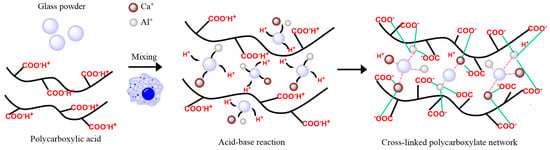
Glass Ionomer Cement (GIC) is fundamentally composed of powders and a liquid component. The powders consist mainly of SiO2, Al2O3, CaF2, AlF3, NaF, and AlPO4, while the liquid is primarily an aqueous solution of polycarboxylic acid, typically including acrylic acid homopolymers, acrylic acid (AA)-itaconic acid (IA) copolymers, or copolymers of AA with other unsaturated carboxylic acids [1,2,3]. Upon mixing the powders and the liquid, the carboxylate groups of the polycarboxylic acid chelate with metal ions released from the glass powders, forming a cross-linked polycarboxylate network (as shown in Figure 1) that leads to the hardening of the cement [4,5]. Once set, GIC exhibits several favorable properties [6,7,8,9], including effective adhesion to tooth structure, excellent biocompatibility, and the ability to release fluoride ions over time. These characteristics contribute significantly to its clinical utility in dentistry [9,10]. However, the application of conventional GICs, particularly in high-stress-bearing areas such as posterior restorations, is substantially constrained by several inherent limitations, most notably low mechanical strength, poor wear resistance, and high brittleness [11,12].
Figure 1.
Reaction mechanism of GIC.
In response to these drawbacks, considerable research efforts have been directed toward modifying and enhancing conventional GICs to improve their mechanical performance and expand their clinical scope. These enhancement strategies can be broadly classified into two main categories: modifications to the powder’s components and modifications to the liquid components [13,14,15].
2. Methodology
This narrative review systematically synthesizes existing knowledge regarding enhancement strategies for glass ionomer cements, evaluates the findings and discrepancies across different studies, and identifies directions for future academic exploration. The literature search was conducted utilizing databases including Web of Science, Elsevier, SciELO, Wiley, and PubMed. Search terms comprised “glass ionomer cement,” “enhance,” “modification,” “powder,” “filler,” “liquid,” “polycarboxylic acid,” and “mechanical properties,” among others. Keywords were combined using Boolean operators (AND/OR). The search proceeded retrospectively from recent to earlier publications. Additionally, a manual backward search was performed by reviewing the reference lists of articles identified through the electronic databases.
The inclusion criteria focused on English-language original research articles and reviews concerning the enhancement and modification of conventional glass ionomer cements. Laboratory studies, review articles, and selected clinical studies were considered. The search and screening process aimed to encompass the principal enhancement strategies, including commercially successful types such as glass hybrids. However, given the narrative nature of this review and the substantial volume of research on glass ionomer cement modifications, this work does not constitute an exhaustive systematic review, and some less prominent modification approaches may not be covered.
3. Modification of the Powders Components
A primary strategy for enhancing GICs is the incorporation of reinforcing fillers into the powder component. Metallic particles, fibers, and inorganic fillers are among the most commonly employed [13,16]. Researchers have endeavored to improve the mechanical properties and expand the clinical applicability of GICs in dental restorations by systematically optimizing the filler characteristics, such as their type, particle size, morphology, and incorporation ratio.
3.1. Metallic Materials
Numerous studies [17,18,19] have investigated metal-reinforced glass ionomer cements, utilizing metals such as Au, Ag, Sn, and Ti, as well as certain metal alloys. The primary mechanism of metal-reinforced GIC involves the physical interlocking of metal particles within the polycarboxylate cross-linked network, which enhances mechanical properties by dispersing stress [18,20]. As early as the 1980s, researchers introduced metallic silver into GICs to improve their mechanical strength [21]. Research by Walls et al. [22] has demonstrated that the addition of sintered silver particles to glass ionomer cement can significantly enhance its compressive strength and fatigue resistance. Kerby et al. [23] reported that the GIC prepared by mixing acid-treated stainless-steel powder with glass-ionomer powders exhibited a significant increase in compressive and tensile strength compared to commercially available silver-reinforced GIC. Subsequently, Chung [20] compared the reinforcing effects of silver and high-copper amalgam powders on GICs. The results demonstrated that both additives enhanced the tensile strength and hardness of conventional GICs, with a 40% proportion of high-copper amalgam showing a more significant reinforcing effect. However, the study also indicated that the fluoride release of these metal-reinforced GICs was lower than that of their conventional counterparts [20,24]. This reduction in fluoride release has become a recognized drawback of nearly all metal-reinforcement approaches, coupled with their generally inferior adhesion to tooth structure. Nevertheless, recent studies have also indicated that silver nanoparticles (AgNPs) at specific concentrations (e.g., 1–2.5%) can enhance fluoride ion release, while metal additives such as zinc, strontium, titanium, and zirconium in the form of oxides demonstrate even greater effectiveness in promoting fluoride ion release at certain concentrations [25].
3.2. Metal Oxides
Building on the metal reinforcement research, subsequent efforts have shifted towards the incorporation of metal oxides. After oxidation treatment, the AgSnZnAl alloy used by Sarkar [26] was found to provide better reinforcement than commercially available metal-reinforced GIC. Tests revealed that the metal oxides on the alloy surface chemically reacted with polycarboxylic acid, indicating that the reinforcement mechanism involves chemical bonding [27,28]. Extensive studies have utilized nano-sized metal oxides, such as ceria (CeO2), zirconia (ZrO2), magnesia (MgO), and zinc oxide (ZnO), which enhance the GIC by filling the interstitial spaces between the glass particles [29]. The reinforcement mechanism of nano-metal oxides primarily involves filling the gaps between glass particles, reducing pores and microcracks, and thereby enhancing the material’s density and bonding strength [29,30,31]. Gu et al. [32] replaced the silver amalgam in metal-reinforced GICs with yttria-stabilized zirconia (YSZ). Their findings demonstrated a significant improvement in the tensile strength of the modified cement. In another study, Jairam et al. [33] incorporated CeO2 nanoparticles into the glass powder. The results indicated that at an optimal concentration of 8%, the microhardness, compressive strength, and tensile strength increased by 26.6%, 35.5%, and 50%, respectively.
Beyond single-component modifications, the synergistic effect of incorporating two or more metal oxides has also been explored. For example, Monmaturapoj et al. [34] investigated the reinforcement of GICs using a combination of MgO and BaO. While metal oxides can improve certain mechanical properties of GICs, they also introduce drawbacks such as prolonged setting time, reduced adhesive strength, and poor color matching [29]. However, compared to metallic fillers, metal oxides are more conducive to maintaining or even enhancing the sustained fluoride release capability of GICs, thereby addressing a key limitation associated with traditional metal reinforcement.
3.3. Fiber
Early GICs were initially adopted as luting agents in dentistry, but their limited mechanical properties prevented widespread use in restorative applications. Consequently, researchers have begun to explore the reinforcement of GIC with fibers. The reinforcement mechanism of fibers lies primarily in their anisotropic properties, which effectively inhibit crack propagation. Additionally, the composition and surface characteristics of different fibers contribute to interfacial bonding [35,36,37]. A significant advancement was made by Kobayashi et al. [38], who pioneered the use of glass fibers (CPSA) as reinforcing agents. They found that a glass fiber mass ratio of 60% yielded the maximum tensile and flexural strengths, which were 1.8 and 4.5 times higher than those of conventional GICs, demonstrating the high efficacy of glass fiber reinforcement. It should be noted, however, that incorporating CPSA glass fibers can significantly prolong the setting time of GIC. Moreover, not all glass fibers are suitable for this purpose; they must possess a specific chemical composition that is compatible with the GIC system and capable of participating in the setting reaction. Based on the work with glass fibers, Bao et al. [39] investigated silane-treated basalt fibers for GIC reinforcement. Their research confirmed that basalt fibers significantly enhance the mechanical properties of GICs, with an optimal performance achieved using 7 wt.% of 2 mm long fibers.
In addition to inorganic fibers, researchers have also explored natural fibers. Numerous studies have investigated the reinforcing effect of cellulose fibers on GIC. Findings demonstrate that incorporating these fibers at specific proportions improves its compressive strength [40,41] and fracture toughness [42]. In particular, nano-scale cellulose fibers [43] have been shown to provide a comprehensive improvement in the mechanical properties of GIC. Abou Neel et al. [36] and Kuscu et al. [37] utilized flax and hemp fibers to reinforce GICs. These natural fibers not only improve the mechanical properties to a certain extent but also offer the potential for more environmentally sustainable and sustainable development. However, the incorporation of natural fibers typically increases the viscosity of GIC and shortens its working time, which can make clinical mixing and shaping more difficult. Concurrently, whiskers [44,45,46] have emerged as another form of reinforcement for modifying and enhancing glass ionomer cements.
3.4. Hydroxyapatite
Hydroxyapatite (HA), the primary inorganic constituent of human bones and teeth, has been incorporated into GICs in an attempt to combine biocompatibility with mechanical enhancement [47,48]. In addition to physical reinforcement, its enhancement mechanism also involves HA participating in acid-base reactions. During this process, phosphate and calcium ions react with the inorganic/organic components within the GIC network. When H+ ions are released and attack the HA, more Ca2+ ions become available for cement formation, polymeric salt bridge formation, and cross-linking, thereby strengthening the GIC [49,50]. Lucas et al. [51] added 8 wt.% HA to the powder of a conventional GIC. The mixture was manually blended with the liquid component, an aqueous solution of polyacrylic and itaconic acids, at a powder-to-liquid ratio of 3:6. Their results indicated that the fracture strength of this modified cement reached a substantially high level within the first 15 min, whereas the conventional GIC required 24 h of curing to achieve its maximum fracture strength. Subsequent studies have also reported that the incorporation of HA can enhance the flexural strength, diametral tensile strength and toughness of GICs [52,53,54]. In recent years, researchers have begun to utilize hydroxyapatite nanoparticles for reinforcement [55,56,57].
However, the advantage of HA lies less in its mechanical reinforcement and more in its superior biocompatibility and ion-releasing properties. This has established HA modification as a mainstream research direction. Consequently, current research often focuses on combining HA with one or more additional materials [58,59,60,61] to achieve synergistic enhancement of GICs.
3.5. Glass Hybrids
The modification and enhancement of GIC by using glass hybrid systems no longer relies on the chemically less reactive fluoroaluminosilicate glass powder found in traditional GICs. Instead, a specially designed, highly reactive glass filler is employed. The key feature of this approach is the use of strontium and lanthanum-containing aluminosilicate glass to partially replace calcium aluminosilicate glass. These elements not only enhance the stability of the glass but also release beneficial ions during the reaction. Through special processing, the glass particles are finer with a larger specific surface area, allowing for more thorough and rapid reactions with polycarboxylic acid [62,63]. Meanwhile, the glass hybrid system enables extremely high filler content.
An important and commercially successful improvement is the development of glass hybrid or glass hybrid restorative materials. Such materials represent an advanced evolution of traditional GICs. Products such as ChemFil Rock and EQUIA Forte Fil fall into this category. Many researchers have investigated the mechanical properties of these glass ionomer dental restorative materials. The enhancement of ChemFil Rock is achieved through the combined use of highly reactive glass fillers and optimized polymers [62]. It exhibits higher compressive strength and diametral tensile strength compared to traditional GICs [64]. Although it performs well, it has notable shortcomings, such as insufficient hardness [63], and is marketed for restorations in non-load-bearing areas [65]. EQUIA Forte Fil’s glass hybrid innovation is achieved through the introduction of ultrafine, highly reactive glass particles, dispersed within the conventional glass ionomer structure. With the addition of a higher molecular weight polyacrylic acid, the new glass hybrid formulation builds a high strength restorative [62,64,65]. EQUIA Forte Fil outperforms traditional GICs in terms of flexural strength and surface hardness, while its compressive strength and diametral tensile strength are slightly higher than those of Fuji IX [65,66]. Its successful application in load-bearing restorations [61] is precisely attributed to this optimization strategy for the powder formulation, which simultaneously addresses several limitations of traditional GICs. Although EQUIA Forte Fil is superior to conventional GICs, its fracture resistance may be insufficient when subjected to occlusal forces [65].
3.6. Other Materials
In addition to the aforementioned material reinforcement, studies have also utilized chitosan and its derivatives. For instance, Kashyap et al. [67] incorporated carboxymethyl chitosan (CMC) with glass powder. CMC, which possesses multiple functional groups such as carboxyl, hydroxyl, and amino groups, can form stronger ionic and hydrogen bonds with ions in the GIC. This enhances the interfacial bonding and improves the mechanical properties.
Furthermore, nanocarbon materials like graphene [68,69,70,71] and carbon nanotubes [72,73,74,75,76] have shown emerging potential in GIC reinforcement, owing to their exceptionally high specific strength and unique properties. Benevides et al. [70] reinforced GIC using reduced graphene oxide and its composite materials. Their results indicated that while the improvements in compressive and tensile strength were moderate, the enhancement in hardness was significant. While Sun et al. [71] employed fluorinated graphene, which effectively improved the compressive strength and hardness, the flexural strength across all experimental groups showed no statistically significant differences compared to the control. Additionally, Goyal et al. [76] found that the addition of 1% multi-walled carbon nanotubes yielded the optimal mechanical strength for GIC. However, the dark color of the resulting composite precludes its use in anterior teeth or visible restorations, significantly limiting its clinical applicability and effective dosage range.
The ongoing advancement of science and technology is continually introducing a growing variety of materials, particularly at the nanoscale [5,77,78], for the enhancement of glass ionomer cement. Overall, the enhancement effects of different materials are summarized in Table 1.
Table 1.
Summary of the enhancement effects of different materials with the powder’s components.
4. Modification of the Liquid Component
As the concentration of hydrogen ions increases in the polyacrylic acid solution of conventional glass ionomer cement, the ionization of the remaining carboxyl groups is progressively suppressed. This, in turn, prevents these carboxyl groups from fully participating in cross-linking reactions with the metal ions leached from the glass powder. As a result, the cross-linking density is compromised, which adversely affects the mechanical properties of the cement. To address this, the polycarboxylic acid is commonly modified by copolymerizing it with a third monomer featuring longer side-chain carboxyl groups. These introduce steric hindrances that disrupt intermolecular hydrogen bonds, thereby enhancing carboxyl group reactivity during setting [14,79]. Simultaneously, some studies have enhanced GIC by directly incorporating materials into the liquid component. These materials primarily form a reinforcing network within the GIC matrix through hydrogen bonding, ionic bonding, or physical cross-linking, thereby improving stress distribution and interfacial bonding [79].
4.1. Liquid-Phase Additives
In recent years, researchers have introduced natural or modified biomaterials into the liquid component of GIC to enhance its overall performance. Chang et al. [80] reported that adding 0.01 wt.% collagen to the liquid significantly increased the compressive strength (from 172.0 MPa to 204.2 MPa). Menezes-Silva et al. [81] incorporated cellulose nanocrystals (0.2 wt.% of the total mass) into the polyacrylic acid liquid component of GIC, followed by ultrasonic dispersion before mixing with the powder; the results showed a notable improvement in both compressive strength and diametral tensile strength. Rini et al. [82] and Al-Mofty et al. [83] enhanced GIC using cellulose derived from rice husks, processed via acid hydrolysis and one-step sodium hypochlorite treatment to obtain nanocrystalline cellulose and micro-scale cellulose, respectively. Both studies demonstrated that rice husk cellulose effectively improved the mechanical properties of GIC, particularly in terms of hardness and bond strength. Furthermore, Petri et al. [84] and Bao et al. [85] found that very low concentrations of chitosan (0.0044 wt.%) or carboxymethyl chitosan (0.0125 wt.%), respectively, could significantly enhance flexural strength and fluoride ion release. Chitosan forms a network structure with GIC components through hydrogen bonding and electrostatic interactions, reducing interfacial tension and improving mechanical properties. While the addition of trace amounts of biomaterials to the liquid component of GIC can effectively enhance its mechanical strength, biocompatibility, and functional properties, it should be noted that the improvement in mechanical performance is selective rather than comprehensive. Furthermore, this approach may introduce new structural defects or instability.
4.2. Synthesis of Novel Copolymers
4.2.1. Amino Acid Derivatives
Kao et al. [86] synthesized two amino acid-derived monomers, N-acryloyl glutamic acid (AGA) and N-acryloyl-6-aminohexanoic acid (AACA), which were subsequently copolymerized with AA and IA to form polyacids with varying compositions. The GICs prepared from these modified polyacids exhibited improved mechanical properties. Expanding on this approach, Wu et al. [87] prepared methacrylate or acrylate derivatives from six natural amino acids and fabricated the corresponding terpolymers. Their research indicated that all amino acid-modified GICs exhibited significantly enhanced compressive and flexural strengths. In a notable study, Moshaverinia et al. [88] synthesized a proline derivative and its corresponding terpolymer with AA and IA to modify a commercial Fuji II GIC. The results confirmed substantial property enhancements, with increases of 27% in compressive strength, 170% in biaxial flexural strength, and 94% in diametral tensile strength compared to the unmodified cement.
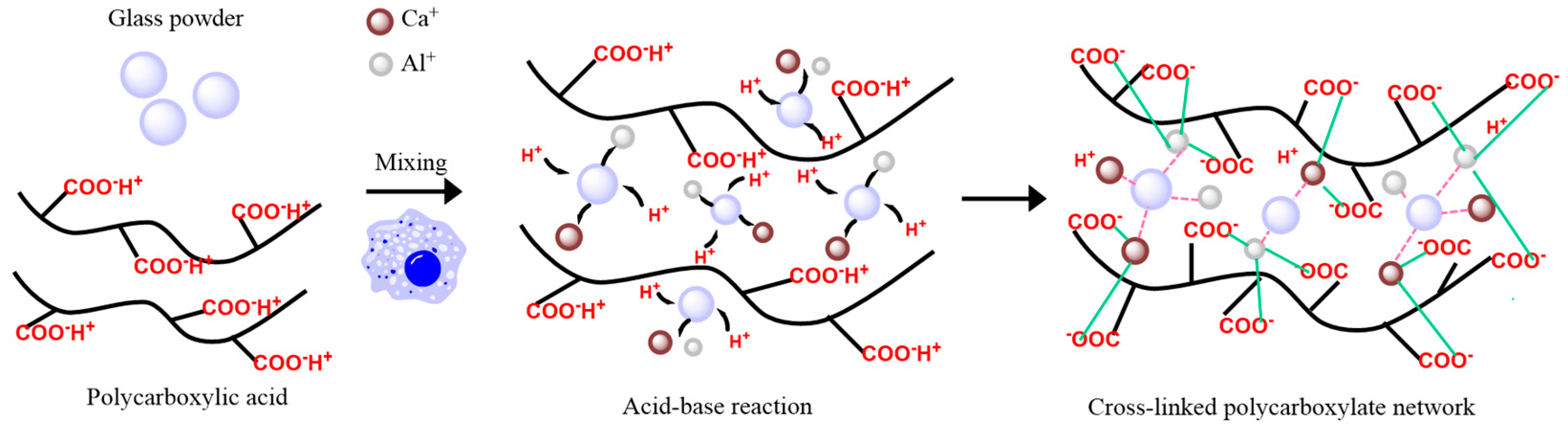
In summary, amino acid modification of GICs introduces flexible spacer groups (as shown in Figure 2) that effectively reduce the steric hindrance between the carboxyl groups and the polymer backbone. This enhances their chelation ability with Ca2+ and Al3+ ions from the glass powder, leading to the observed significant enhancement in the mechanical performance of the material. However, as the molecular weight of the polyacid increases, the viscosity of the cement rises, making mixing and placement more challenging. Concurrently, the working time is significantly reduced, potentially compromising the clinically manageable working window.
Figure 2.
Structures of Poly (AA-co-IA-co-Amino acid derivatives).
4.2.2. N-Vinyl Lactam
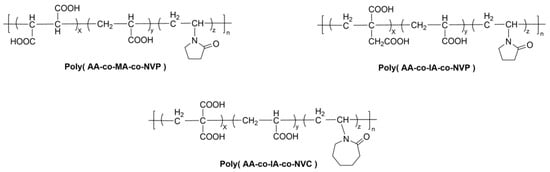
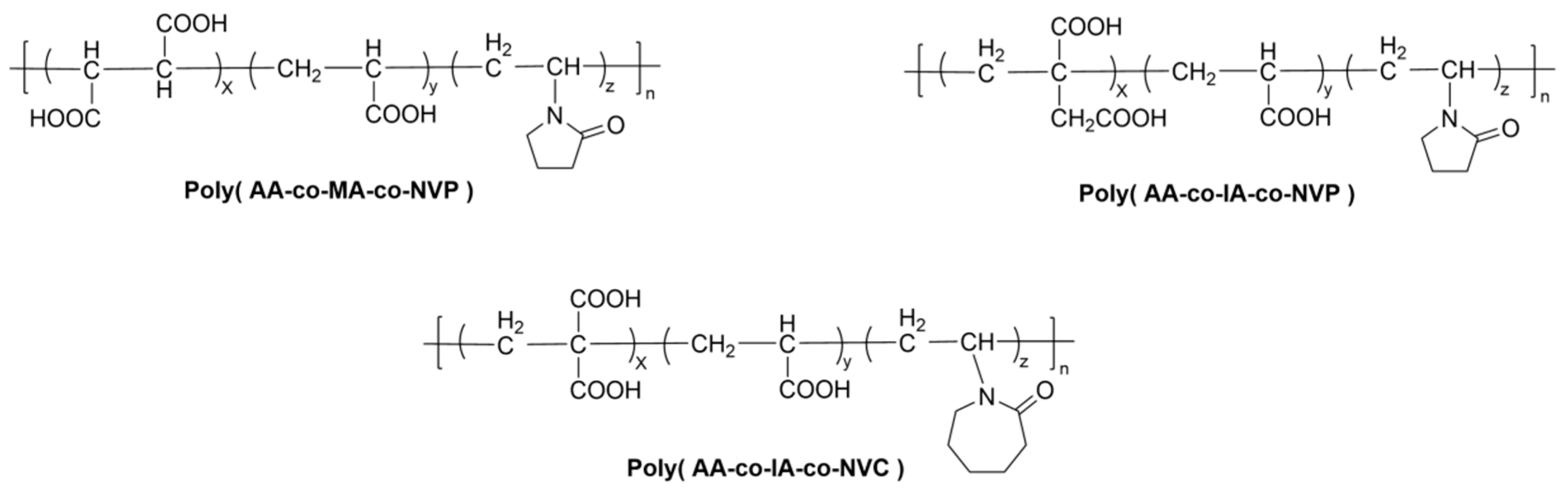
Yamazaki et al. [89] copolymerized varying contents of N-vinylpyrrolidone (NVP) with AA and maleic acid (MA). They determined that the terpolymer with an AA-MA-NVP ratio of 8:1:1 yielded GICs with optimal mechanical properties, which were superior or comparable to those of the commercial Fuji IX.
Xie et al. [90] found that a terpolymer with an AA-IA-NVP ratio of 7:1:3 resulted in a GIC with significantly higher flexural strength. Their study also established a positive correlation between the molecular weight of the terpolymer and the flexural strength of the resulting cement. Furthermore, the microhardness of this modified GIC was superior or comparable to that of most commercial products [91]. It was also noted that the compatibility between the NVP-modified copolymer and commercial glass powders was suboptimal. The development of dedicated glass powders is therefore necessary to achieve optimal performance.
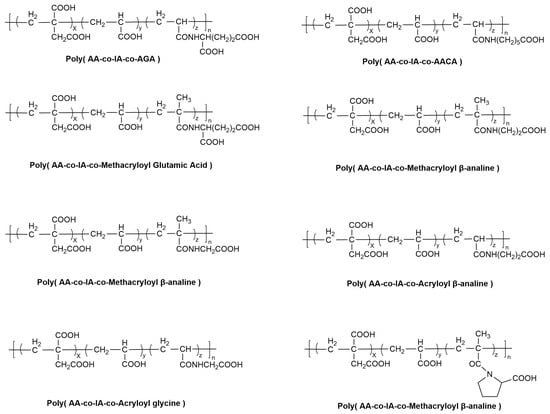
Building on this foundation, Moshaverinia et al. [92,93] synthesized an AA-IA-NVC (8:1:1) terpolymer. Testing revealed improvements in the flexural strength, compressive strength, tensile strength and fracture toughness of the modified cement. Both NVP and NVC function as spacer groups (as shown in Figure 3) that reduce steric hindrance, thereby promoting the formation of a greater number of salt bridges within the set matrix and ultimately enhancing the material’s properties.
Figure 3.
Structures of Poly (AA-co-IA/MA-co-N-vinyl lactam).
4.2.3. Alkyl-Enoic Acids
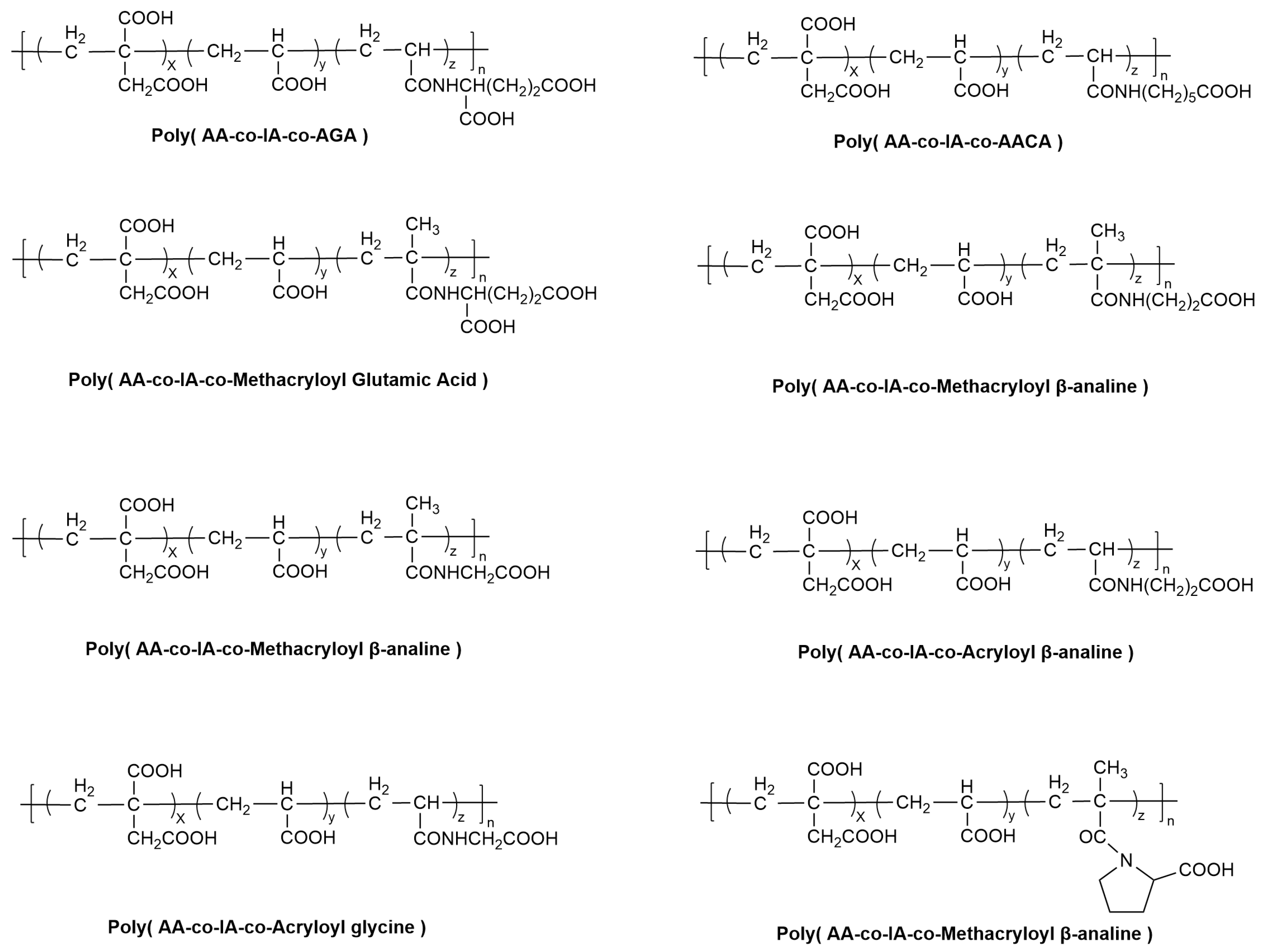
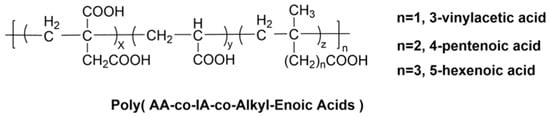
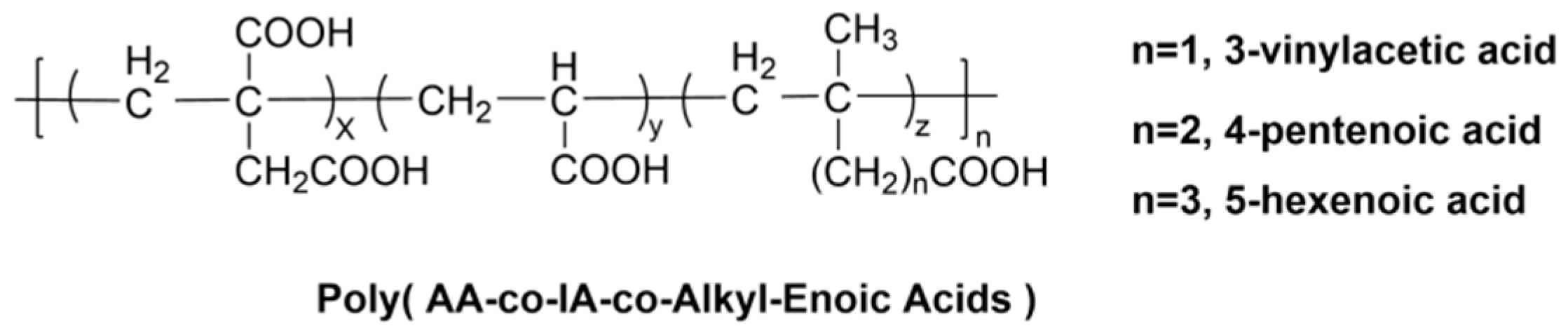
The insufficient mechanical strength of conventional GICs restricts their use in load-bearing applications. Studies show that incorporating flexible alkenoic acid spacers into the polycarboxylic acid backbone (as shown in Figure 4) effectively addresses this limitation. Liang et al. [94,95,96] systematically demonstrated that introducing spacers such as 3-butenoic acid, 4-pentenoic acid, and 5-hexenoic acid into the polyacid structure significantly enhances GIC mechanical properties. Their research optimized key parameters including spacer content, polyacid molecular weight, and concentration. A critical finding was the identification of 12 mol% as the optimal addition level. Modification with 3-butenoic acid proved particularly effective, yielding a flexural strength of 52.29 MPa (a 23.1% increase) and a flexural modulus of 16.30 GPa, indicating superior rigidity and load-bearing capacity while preserving structural integrity.
Figure 4.
Structures of Poly (AA-co-IA-co-Alkyl-Enoic acids).
Despite significant improvements in mechanical properties, its suitability for high-stress-bearing areas, such as posterior restorations, requires further validation through comprehensive comparative studies with established materials like ceramics and resin composites. Simultaneously, the alkyl-enoic acid modified GICs maintained low water sorption and sustained fluoride release capability, demonstrating promising clinical potential as high-strength, long-term anticariogenic restorative materials. As summarized in Table 2, the different liquid agents varied in their enhancement effects.
Table 2.
Summary of the enhancement effects of different liquid components.
5. Conclusions and Future Perspectives
While conventional GICs exhibit relatively poor mechanical strength, numerous studies have been conducted to enhance their properties. However, different reinforcement methods each have their own advantages and limitations, as summarized in Table 3. In addition to direct modifications of the powder and liquid components, the mechanical performance of GICs is also influenced by various factors, such as the particle size [97], shape [98], and surface condition of the powder, the molecular weight [99] and concentration [100] of the liquid, and the powder-to-liquid ratio [101]. Consequently, a more systematic investigation into these influencing factors is warranted.
Table 3.
Summary of advantages and disadvantages of different strategies of enhancement.
As shown in Table 3, most enhancement strategies require balancing the strength, performance, and handling properties of glass ionomer cement. Improving mechanical properties often comes at the cost of sacrificing other clinically essential characteristics, such as reduced working time, increased viscosity affecting clinical handling, compromised esthetics, altered fluoride release properties, or inconsistent adhesion to tooth structures. While the reviewed studies demonstrate promising laboratory outcomes for enhanced GICs, several challenges and limitations must be acknowledged when considering clinical translation. First, there is significant heterogeneity among studies in terms of materials, modification methods, filler concentrations, and testing protocols, making direct comparisons difficult. Second, most evidence comes from in vitro studies, which may not fully replicate the complex oral environment, including fatigue loading, thermal cycling, and biofilm challenge. The long-term clinical performance, biocompatibility, and wear characteristics of many novel modifications remain to be validated through rigorous clinical trials.
Future research must move beyond the single metric of “strength” and focus on a comprehensive multi-dimensional performance evaluation. Current research is trending towards diversified and composite strategies. The future lies in ‘synergistic enhancement’—a hybrid approach combining powder and liquid modifications or employing multi-functional fillers to develop GICs that simultaneously offer superior mechanical strength, biocompatibility, and antibacterial efficacy.
Additionally, future research should also focus on the perspectives to bridge the gap between laboratory innovation and clinical application. Primarily, to facilitate the clinical translation of these advanced materials, it is imperative to establish comprehensive performance standards and conduct long-term, large-scale clinical studies to validate their long-term performance in demanding applications, such as stress-bearing restorations. Subsequently, well-designed, long-term clinical studies are imperative to confirm the durability, safety, and efficacy of these advanced materials in vivo.
Author Contributions
All authors conceived the research idea and the framework of this study. Y.Z. collected and sorted out papers related to the theme of the article and prepared the draft. J.H. analyzed the structure of and modified the article, writing—review and editing, and supervision. All authors have read and agreed to the published version of the manuscript.
Funding
This research received no external funding.
Institutional Review Board Statement
Not applicable.
Informed Consent Statement
Not applicable.
Data Availability Statement
No new data were created or analyzed in this study. Data sharing is not applicable to this article.
Conflicts of Interest
The authors declare no conflicts of interest.
References
- McLean, J.W.; Nicholson, J.W.; Wilson, A.D. Proposed nomenclature for glass-ionomer dental cements and related materials. Quintessence Int. 1994, 25, 587–589. [Google Scholar] [PubMed]
- Wilson, A.D.; Kent, B.E. A new translucent cement for dentistry. The glass ionomer cement. Br. Dent. J. 1972, 132, 133–135. [Google Scholar] [CrossRef] [Scilit]
- Alhalawani, A.M.F.; Curran, D.J.; Boyd, D.; Towler, M.R. The role of poly (acrylic acid) in conventional glass polyalkenoate cements. J. Polym. Eng. 2016, 36, 221–237. [Google Scholar] [CrossRef] [Scilit]
- Barry, T.I.; Clinton, D.J.; Wilson, A.D. The structure of a glass-ionomer cement and its relationship to the setting process. J. Dent. Res. 1979, 58, 1072–1079. [Google Scholar] [CrossRef] [Scilit]
- Vasiliu, S.; Racovita, S.; Gugoasa, I.A.; Lungan, M.A.; Popa, M.; Desbrieres, J. The benefits of smart nanoparticles in dental applications. Int. J. Mol. Sci. 2021, 22, 2585. [Google Scholar] [CrossRef] [Scilit]
- Powis, D.R.; Folleras, T.; Merson, S.A.; Wilson, A.D. Improved adhesion of a glass ionomer cement to dentin and enamel. J. Dent. Res. 1982, 61, 1416–1422. [Google Scholar] [CrossRef] [Scilit]
- Kawahara, H.; Imanishi, Y.; Oshima, H. Biological evaluation on glass ionomer cement. J. Dent. Res. 1979, 58, 1080–1086. [Google Scholar] [CrossRef] [Scilit] [PubMed]
- McLean, J.W.; Wilson, A.D. The clinical development of the glass-ionomer cements. I. Formulations and properties. Aust. Dent. J. 1977, 22, 31–36. [Google Scholar] [CrossRef] [Scilit]
- Sidhu, S.K.; Nicholson, J.W. A review of glass-ionomer cements for clinical dentistry. J. Funct. Biomater. 2016, 7, 16. [Google Scholar] [CrossRef] [Scilit]
- McLean, J.W.; Wilson, A.D. The clinical development of the glass-ionomer cement. II. Some clinical applications. Aust. Dent. J. 1977, 22, 120–127. [Google Scholar] [CrossRef] [Scilit] [PubMed]
- Xie, D.; Brantley, W.A.; Culbertson, B.M.; Wang, G. Mechanical properties and microstructures of glass-ionomer cements. Dent. Mater. 2000, 16, 129–138. [Google Scholar] [CrossRef] [Scilit]
- Cattani-Lorente, M.A.; Godin, C.; Meyer, J.M. Early strength of glass ionomer cements. Dent. Mater. 1993, 9, 57–62. [Google Scholar] [CrossRef] [Scilit] [PubMed]
- Moshaverinia, A.; Roohpour, N.; Chee, W.W.L.; Schricker, S.R. A review of powder modifications in conventional glass-ionomer dental cements. J. Mater. Chem. 2011, 21, 1319–1328. [Google Scholar] [CrossRef] [Scilit]
- Moshaverinia, A.; Roohpour, N.; Chee, W.W.L.; Schricker, S.R. A review of polyelectrolyte modifications in conventional glass-ionomer dental cements. J. Mater. Chem. 2012, 22, 2824–2833. [Google Scholar] [CrossRef] [Scilit]
- Prosser, H.J.; Powis, D.R.; Wilson, A.D. Glass-ionomer cements of improved flexural strength. J. Dent. Res. 1986, 65, 146–148. [Google Scholar] [CrossRef] [Scilit]
- Oilo, G. Characterization of glass ionomer filling materials. Dent. Mater. 1988, 4, 129–133. [Google Scholar] [CrossRef] [Scilit]
- Williams, J.A.; Billington, R.W.; Pearson, G.J. The comparative strengths of commercial glass-ionomer cements with and without metal additions. Br. Dent. J. 1992, 172, 279–282. [Google Scholar] [CrossRef] [Scilit]
- Nakajima, H.; Watkins, J.H.; Arita, K.; Hanaoka, K.; Okabe, T. Mechanical properties of glass ionomers under static and dynamic loading. Dent. Mater. 1996, 12, 30–37. [Google Scholar] [CrossRef] [Scilit] [PubMed]
- ElMallakh, B.; Sarkar, N.K.; Kamar, A. Does Metal Incorporation Improve Glass-Ionomer Properties. In Proceedings of the 65th General Session & Exhibition of the International Association for Dental Research, Washington, DC, USA, 11–15 March 1987. [Google Scholar]
- Chung, K.H. The properties of metal-reinforced glass ionomer materials. J. Oral Rehabil. 1993, 20, 79–87. [Google Scholar] [CrossRef] [Scilit] [PubMed]
- McLean, J.W. The clinical use of glass-ionomer cements—Future and current developments. Clin. Mater. 1991, 7, 283–288. [Google Scholar] [CrossRef] [Scilit]
- Walls, A.W.G.; Adamson, J.; McCabe, J.F.; Murray, J.J. The properties of a glass polyalkenoate (ionomer) cement incorporating sintered metallic particles. Dent. Mater. 1987, 3, 113–116. [Google Scholar] [CrossRef] [Scilit]
- Kerby, R.E.; Bleiholder, R.F. Physical properties of stainless-steel and silver-reinforced glass-ionomer cements. J. Dent. Res. 1991, 70, 1358–1361. [Google Scholar] [CrossRef] [Scilit]
- Nicholson, J.W. Adhesive dental materials and their durability. Int. J. Adhes. Adhes. 2000, 20, 11–16. [Google Scholar] [CrossRef] [Scilit]
- Klimas, S.; Kiryk, S.; Kiryk, J.; Kotela, A.; Kensy, J.; Michalak, M.; Rybak, Z.; Matys, J.; Dobrzynski, M. The impact of environmental and material factors on fluoride release from metal-modified glass ionomer cements: A systematic review of in vitro studies. Materials 2025, 18, 3187. [Google Scholar] [CrossRef] [Scilit]
- Sarkar, N.K. Metal–matrix interface in reinforced glass ionomers. Dent. Mater. 1999, 15, 421–425. [Google Scholar] [CrossRef] [Scilit]
- Bertolini, M.J.; Zaghete, M.A.; Gimenes, R.; de Souza, R.F.; Vaz, L.G. Preparation of new glass systems by the polymeric precursor method for dental applications. J. Non-Cryst. Solids 2004, 344, 170–175. [Google Scholar] [CrossRef] [Scilit]
- Bertolini, M.J.; Zaghete, M.A.; Gimenes, R. Development of an experimental glass ionomer cement containing niobium and fluoride. J. Non-Cryst. Solids 2005, 351, 3884–3887. [Google Scholar] [CrossRef] [Scilit]
- Almira, H.; Herda, E.; Sunarso. Metal oxide nanoparticles modified glass ionomer cement: A short review. AIP Conf. Proc. 2024, 3080, 060005. [Google Scholar] [CrossRef] [Scilit]
- Gjorgievska, E.; Van Tendeloo, G.; Nicholson, J.W.; Coleman, N.J.; Slipper, I.J.; Booth, S. The incorporation of nanoparticles into conventional glass-ionomer dental restorative cements. Microsc. Microanal. 2015, 21, 392–406. [Google Scholar] [CrossRef] [Scilit] [PubMed]
- Assery, M.K.A.; Alshubat, A.; Abushanan, A.W.; Labban, N.; Hashem, M. Nanoparticles as void fillers in glass ionomer cement for enhanced physicomechanical properties. Mater. Express 2020, 10, 1960–1964. [Google Scholar] [CrossRef] [Scilit]
- Gu, Y.W.; Yap, A.U.J.; Cheang, P.; Khor, K.A. Zirconia-glass ionomer cement—A potential substitute for Miracle Mix. Scr. Mater. 2005, 52, 113–116. [Google Scholar] [CrossRef] [Scilit]
- Jairam, L.S.; Shri, M.D.; Chandrashekar, A.; Arjun, A.; Premkumar, H.B. Antibacterial and mechanical properties of cerium oxide nanoparticles modified glass ionomer cement. Mater. Chem. Phys. 2024, 315, 129040. [Google Scholar] [CrossRef] [Scilit]
- Monmaturapoj, N.; Kinmonta, S.; Thepsuwan, W.; Channasanon, S.; Tanodekaew, S. Preparation and characterisation of glass ionomer cements incorporating barium and magnesium ions. Adv. Appl. Ceram. 2012, 111, 159–164. [Google Scholar] [CrossRef] [Scilit]
- Hammouda, I.M. Reinforcement of conventional glass-ionomer restorative material with short glass fibers. J. Mech. Behav. Biomed. Mater. 2009, 2, 73–81. [Google Scholar] [CrossRef] [Scilit]
- Abou Neel, E.A.; Young, A.M. Setting kinetics and mechanical properties of flax fibre reinforced glass ionomer restorative materials. J. Biomed. Res. 2017, 31, 264. [Google Scholar] [CrossRef] [Scilit]
- Kuscu, S.; Baysan, F.D.; Korkmaz, N.; Kuscu, A.I.; Karadag, A. Enhancing mechanical properties of glass-ionomer cement with hemp fiber: A sustainable approach for dental restorations. BMC Oral Health 2025, 25, 369. [Google Scholar] [CrossRef] [Scilit]
- Kobayashi, M.; Kon, M.; Miyai, K.; Asaoka, K. Strengthening of glass-ionomer cement by compounding short fibres with CaO-P2O5-SiO2-Al2O3 glass. Biomaterials 2000, 21, 2051–2058. [Google Scholar] [CrossRef] [Scilit] [PubMed]
- Bao, X.; Garoushi, S.K.; Liu, F.; Lassila, L.L.; Vallittu, P.K.; He, J. Enhancing mechanical properties of glass ionomer cements with basalt fibers. Silicon 2020, 12, 1975–1983. [Google Scholar] [CrossRef] [Scilit]
- Silva, R.M.; Santos, P.H.N.; Souza, L.B.; Dumont, V.C.; Soares, J.A.; Santos, M.H. Effects of cellulose fibers on the physical and chemical properties of glass ionomer dental restorative materials. Mater. Res. Bull. 2013, 48, 118–126. [Google Scholar] [CrossRef] [Scilit]
- Silva, R.M.; Carvalho, V.X.M.; Dumont, V.C.; Santos, M.H.; Carvalho, A.M.M.L. Addition of mechanically processed cellulosic fibers to ionomer cement: Mechanical properties. Braz. Oral Res. 2015, 29, 1–8. [Google Scholar] [CrossRef] [Scilit]
- Garoushi, S.; He, J.; Obradovic, J.; Fardim, P.; Vallittu, P.K.; Lassila, L. Incorporation of cellulose fiber in glass ionomer cement. Eur. J. Oral Sci. 2020, 128, 81–88. [Google Scholar] [CrossRef] [Scilit]
- Nishimura, T.; Shinonaga, Y.; Nagaishi, C.; Imataki, R.; Takemura, M.; Kagami, K.; Abe, Y.; Harada, K.; Arita, K. Effects of powdery cellulose nanofiber addition on the properties of glass ionomer cement. Materials 2019, 12, 3077. [Google Scholar] [CrossRef] [Scilit]
- Kurata, S.; Umemoto, K. Effect of aluminoborate whiskers on mechanical properties of polycarboxylate cements. Dent. Mater. J. 2008, 27, 561–564. [Google Scholar] [CrossRef] [Scilit]
- Xu, H.H.K.; Eichmiller, F.C.; Antonucci, J.M.; Schumacher, G.E.; Ives, L.K. Dental resin composites containing ceramic whiskers and precured glass ionomer particles. Dent. Mater. 2000, 16, 356–363. [Google Scholar] [CrossRef] [Scilit]
- Xu, H.H.; Eichmiller, F.C.; Antonucci, J.M.; Flaim, G.M. Single-crystalline ceramic whisker-reinforced carboxylic acid-resin composites with fluoride release. Oper. Dent. 2000, 25, 90–97. [Google Scholar]
- Orlovskii, V.P.; Komlev, V.S.; Barinov, S.M. Hydroxyapatite and Hydroxyapatite-Based Ceramics. Inorg. Mater. 2002, 38, 973–984. [Google Scholar] [CrossRef] [Scilit]
- Nayak, A.K. Hydroxyapatite synthesis methodologies: An overview. Int. J. ChemTech Res. 2010, 2, 903–907. [Google Scholar]
- Moshaverinia, A.; Ansari, S.; Moshaverinia, M.; Roohpour, N.; Darr, J.A.; Rehman, I. Effects of incorporation of hydroxyapatite and fluoroapatite nanobioceramics into conventional glass ionomer cements (GIC). Acta Biomater. 2008, 4, 432–440. [Google Scholar] [CrossRef] [Scilit]
- Suresh, G.; Sindhya, A.; Dhanaraj, K. A comprehensive review of recent work on hydroxyapatite and glass ionomer cement: Properties, limitations and synergistic dental applications. Phys. Scr. 2025, 100, 062002. [Google Scholar] [CrossRef] [Scilit]
- Lucas, M.E.; Arita, K.; Nishino, M. Strengthening a conventional glass ionomer cement using hydroxyapatite. J. Dent. Res. 2001, 80, 711. [Google Scholar]
- Arita, K.; Lucas, M.E.; Nishino, M. The effect of adding hydroxyapatite on the flexural strength of glass ionomer cement. Dent. Mater. J. 2003, 22, 126–136. [Google Scholar] [CrossRef] [Scilit]
- Mederos, M.; Cuevas-Suarez, C.E.; Sanchez, W.; Miranda, P.; Francia, A.; Pardo, H.; Villanueva-Stark, J.P.; Kreiner, M.; Grazioli, G. Effect of the incorporation of hydroxyapatite on the diametral tensile strength of conventional and hybrid glass ionomer cements. Odontology 2021, 109, 904–911. [Google Scholar] [CrossRef] [Scilit]
- Lucas, M.E.; Arita, K.; Nishino, M. Toughness, bonding and fluoride-release properties of hydroxyapatite-added glass ionomer cement. Biomaterials 2003, 24, 3787–3794. [Google Scholar] [CrossRef] [Scilit]
- Alatawi, R.A.S.; Elsayed, N.H.; Mohamed, W.S. Influence of hydroxyapatite nanoparticles on the properties of glass ionomer cement. J. Mater. Res. Technol. 2019, 8, 344–349. [Google Scholar] [CrossRef] [Scilit]
- Kheur, M.; Kantharia, N.; Iakha, T.; Kheur, S.; Husain, N.A.H.; Özcan, M. Evaluation of mechanical and adhesion properties of glass ionomer cement incorporating nano-sized hydroxyapatite particles. Odontology 2020, 108, 152. [Google Scholar] [CrossRef] [Scilit]
- Balhuc, S.; Campian, R.; Labunet, A.; Negucioiu, M.; Buduru, S.; Kui, A. Dental applications of systems based on hydroxyapatite nanoparticles—An evidence-based update. Crystals 2021, 11, 674. [Google Scholar] [CrossRef] [Scilit]
- Rahman, I.A.; Masudi, S.M.; Luddin, N.; Shiekh, R.A. One-pot synthesis of hydroxyapatite–silica nanopowder composite for hardness enhancement of glass ionomer cement (GIC). Bull. Mater. Sci. 2014, 37, 213–219. [Google Scholar] [CrossRef] [Scilit]
- Moheet, I.A.; Luddin, N.; Ab Rahman, I.; Masudi, S.A.M.; Kannan, T.P.; Abd Ghani, N.R.N. Evaluation of mechanical properties and bond strength of nano-hydroxyapatite-silica added glass ionomer cement. Ceram. Int. 2018, 44, 9899–9906. [Google Scholar] [CrossRef] [Scilit]
- Kermanian, M.; Mohandessi, M.; Selahvarzi, N.; Nourian, A.; Sadighian, S. Enhancement of the mechanical properties of a dental glass ionomer cement by silica/hydroxyapatite/silver nanocomposite. Iran. J. Chem. Chem. Eng. 2024, 43, 1937–1945. [Google Scholar]
- Ramić, B.; Cvjetićanin, M.; Bajkin, B.; Drobac, M.; Milanović, M.; Rajnović, D.; Krstonošić, V.; Veljović, Đ. Physical and mechanical properties assessment of glass ionomer cements modified with TiO2 and Mg-doped hydroxyapatite nanoparticles. J. Appl. Biomater. Funct. Mater. 2024, 22, 1–12. [Google Scholar] [CrossRef] [Scilit] [PubMed]
- Fuhrmann, D.; Murchison, D.; Whipple, S.; Vandewalle, K. Properties of new glass-ionomer restorative systems marketed for stress-bearing areas. Oper. Dent. 2020, 45, 104–110. [Google Scholar] [CrossRef] [Scilit]
- Bahammam, S.; Nathanson, D.; Fan, Y. Evaluating the mechanical properties of restorative glass ionomers cements. Int. Dent. J. 2022, 72, 859–865. [Google Scholar] [CrossRef] [Scilit]
- Moshaverinia, M.; Navas, A.; Jahedmanesh, N.; Shah, K.C.; Moshaverinia, A.; Ansari, S. Comparative evaluation of the physical properties of a reinforced glass ionomer dental restorative material. J. Prosthet. Dent. 2019, 122, 154–159. [Google Scholar] [CrossRef] [Scilit] [PubMed]
- Menezes-Silva, R.; Oliveira, B.M.B.; Magalhães, A.P.R.; Bueno, L.S.; Borges, A.F.S.; Baesso, M.L.; Navarro, M.F.L.; Nicholson, J.W.; Sidhu, S.K.; Pascotto, R.C. Correlation between mechanical properties and stabilization time of chemical bonds in glass-ionomer cements. Braz. Oral Res. 2020, 34, e053. [Google Scholar] [CrossRef] [Scilit] [PubMed]
- Kunte, S.; Shah, S.B.; Patil, S.; Patel, A.; Patil, S.; Shah, S.B. Comparative evaluation of compressive strength and diametral tensile strength of conventional glass ionomer cement and a glass hybrid glass ionomer cement. Int. J. Clin. Pediatr. Dent. 2022, 15, 398–402. [Google Scholar] [CrossRef] [Scilit]
- Kashyap, P.K.; Chauhan, S.; Negi, Y.S.; Goel, N.K.; Rattan, S. Biocompatible carboxymethyl chitosan-modified glass ionomer cement with enhanced mechanical and anti-bacterial properties. Int. J. Biol. Macromol. 2022, 223, 1506–1520. [Google Scholar] [CrossRef] [Scilit] [PubMed]
- Chen, J.; Zhao, Q.; Peng, J.; Yang, X.; Yu, D.; Zhao, W. Antibacterial and mechanical properties of reduced graphene-silver nanoparticle nanocomposite modified glass ionomer cements. J. Dent. 2020, 96, 103332. [Google Scholar] [CrossRef] [Scilit]
- Liu, R.; Wang, E.; Guo, Y.; Zhou, Q.; Zheng, Y.; Zhai, J.; Zhang, B. Enhanced antibacterial properties and promoted cell proliferation in glass ionomer cement by modified with fluorinated graphene-doped. J. Appl. Biomater. Funct. Mater. 2021, 19, 1–9. [Google Scholar] [CrossRef] [Scilit]
- Castro-Rojas, M.A.; Vega-Cantu, Y.I.; Cordell, G.A.; Rodriguez-Garcia, A. Dental Applications of Carbon Nanotubes. Molecules 2021, 26, 4423. [Google Scholar] [CrossRef] [Scilit]
- Benevides, A.P.; Campos, A.R.; Vieira, L.C.; Perez, C.D.R.; Cesar, D.V. Reduced graphene oxide-zinc oxide flower-like composite for glass-ionomer materials reinforcement. Mater. Res. 2020, 23, e20190580. [Google Scholar] [CrossRef] [Scilit]
- Sun, L.; Yan, Z.; Duan, Y.; Zhang, J.; Liu, B. Improvement of the mechanical, tribological and antibacterial properties of glass ionomer cements by fluorinated graphene. Dent. Mater. 2018, 34, e115–e127. [Google Scholar] [CrossRef] [Scilit] [PubMed]
- Hamdy, T.M. Evaluation of compressive strength, surface microhardness, solubility and antimicrobial effect of glass ionomer dental cement reinforced with silver doped carbon nanotube fillers. BMC Oral Health 2023, 23, 777. [Google Scholar] [CrossRef] [Scilit]
- Mohamed, Y.S.; Abdelbary, A. Effect of carbon nanotube incorporation on the mechanical and physical properties of hydroxyapatite/glass ionomer nanocomposite. J. Reinf. Plast. Compos. 2024, 45, 873–883. [Google Scholar] [CrossRef] [Scilit]
- Foroughi, M.R.; Khoroushi, M.; Nazem, R.; Akbarian Tefaghi, E. The effect of carbon nanotubes/bioglass nanocomposite on mechanical and bioactivity properties of glass ionomer cement. Sci. Iran. 2016, 23, 3123–3134. [Google Scholar] [CrossRef] [Scilit]
- Goyal, M.; Sharma, K. Novel multi-walled carbon nanotube reinforced glass-ionomer cements for dental restorations. Mater. Today Proc. 2021, 37, 3035–3037. [Google Scholar] [CrossRef] [Scilit]
- Amin, F.; Rahman, S.; Khurshid, Z.; Zafar, M.S.; Sefat, F.; Kumar, N. Effect of nanostructures on the properties of glass ionomer dental restoratives/cements: A comprehensive narrative review. Materials 2021, 14, 6260. [Google Scholar] [CrossRef] [Scilit]
- Naguib, G.; Maghrabi, A.A.; Mira, A.I.; Mously, H.A.; Hajjaj, M.; Hamed, M.T. Influence of inorganic nanoparticles on dental materials’ mechanical properties. A narrative review. BMC Oral Health 2023, 23, 897. [Google Scholar] [CrossRef] [Scilit]
- Lathikumari, S.S.; Saraswathy, M. Modifications of polyalkenoic acid and its effect on glass ionomer cement. Mater. Adv. 2024, 5, 2719–2735. [Google Scholar] [CrossRef] [Scilit]
- Chang, H.J.; Wu, C.M.; Chang, Y.C.; Fanchiang, J.C.; Shieh, D.B.; Wong, T.Y. Collagen enhances compatibility and strength of glass ionomers. J. Dent. Res. 2009, 88, 449–454. [Google Scholar] [CrossRef] [Scilit]
- Menezes-Silva, R.; de Oliveira, B.M.B.; Fernandes, P.H.M.; Shimohara, L.Y.; Pereira, F.V.; Borges, A.F.S.; Buzalaf, M.A.R.; Pascotto, R.C.; Sidhu, S.K.; Navarro, M.F.L. Effects of the reinforced cellulose nanocrystals on glass-ionomer cements. Dent. Mater. 2019, 35, 564–573. [Google Scholar] [CrossRef] [Scilit]
- Rini, A.D.K.; Juwita, F.T.; Bagjana, R.W.; Octivany, S.; Purnama, R.B.; Rijal, M.S.; Anwar, A.M.; Purwasasmita, B.S.; Asri, L.A.T.W. Improving the Mechanical Properties of Glass Ionomer Cement With Nanocrystalline Cellulose From Rice Husk. J. Biomed. Mater. Res. B Appl. Biomater. 2024, 112, e35472. [Google Scholar] [CrossRef] [Scilit] [PubMed]
- Al-Mofty, S.E.D.; Elghazawy, N.H.; Azzazy, H.M.E. A one-step facile process for extraction of cellulose from rice husk and its use for mechanical reinforcement of dental glass ionomer cement. RSC Sustain. 2023, 1, 1743–1750. [Google Scholar] [CrossRef] [Scilit]
- Petri, D.F.S.; Donegá, J.; Benassi, A.M.; Bocangel, J.A. Preliminary study on chitosan modified glass ionomer restoratives. Dent. Mater. 2007, 23, 1004–1010. [Google Scholar] [CrossRef] [Scilit]
- Bao, X.; Liu, F.; He, J. Preparation and characterization of glass ionomer cements with added carboxymethyl chitosan. J. Macromol. Sci. B 2020, 59, 345–356. [Google Scholar] [CrossRef] [Scilit]
- Kao, E.C.; Culbertson, B.M.; Xie, D. Preparation of glass ionomer cement using N-acryloyl-substituted amino acid monomers—Evaluation of physical properties. Dent. Mater. 1996, 12, 44–51. [Google Scholar] [CrossRef] [Scilit]
- Wu, W.; Xie, D.; Puckett, A.; Mays, J.W. Synthesis of amino acid-containing polyacids and their application in self-cured glass-ionomer cement. Eur. Polym. J. 2003, 39, 959–968. [Google Scholar] [CrossRef] [Scilit]
- Moshaverinia, A.; Roohpour, N.; Rehman, I.U. Synthesis and characterization of a novel fast-set proline-derivative-containing glass ionomer cement with enhanced mechanical properties. Acta Biomater. 2009, 5, 498–507. [Google Scholar] [CrossRef] [Scilit]
- Yamazaki, T.; Brantley, W.; Culbertson, B.; Seghi, R.; Schricker, S. The measure of wear in N-vinyl pyrrolidinone (NVP) modified glass-ionomer cements. Polym. Adv. Technol. 2005, 16, 113–116. [Google Scholar] [CrossRef] [Scilit]
- Xie, D.; Culbertson, B.M.; Johnston, W.M. Improved flexural strength of N-vinyl-pyrrolidone modified acrylic acid copolymers for glass-ionomers. J. Macromol. Sci. A 1998, 35, 1615–1629. [Google Scholar] [CrossRef] [Scilit]
- Xie, D.; Culbertson, B.M.; Wang, G. Microhardness of N-vinylpyrrolidone modified glass-ionomer cements. J. Macromol. Sci. A 1998, 35, 547–561. [Google Scholar] [CrossRef] [Scilit]
- Moshaverinia, A.; Roohpour, N.; Darr, J.A.; Rehman, I.U. Synthesis and characterization of a novel N-vinylcaprolactam-containing acrylic acid terpolymer for applications in glass-ionomer dental cements. Acta Biomater. 2009, 5, 2101–2108. [Google Scholar] [CrossRef] [Scilit]
- Moshaverinia, A.; Brantley, W.A.; Chee, W.W.L.; Rohpour, N.; Ansari, S.; Zheng, F.; Heshmati, R.H.; Darr, J.A.; Schricker, S.R.; Rehman, I.U. Measure of microhardness, fracture toughness and flexural strength of N-vinylcaprolactam (NVC)-containing glass-ionomer dental cements. Dent. Mater. 2010, 26, 1137–1143. [Google Scholar] [CrossRef] [Scilit]
- Liang, X.; Zhou, D.; Yu, B.; Zhong, H.; He, J. Optimization of 3-butenoic acid-modified polyalkenoic acid for enhanced glass ionomer cement performance. J. Mech. Behav. Biomed. Mater. 2025, 172, 107177. [Google Scholar] [CrossRef] [Scilit]
- Zhou, D.; Liu, F.; He, J. Improving the Mechanical Properties of Conventional Glass Ionomer Cement Through Using 4-Pentenoic Acid Modified Polycarboxylic Acid (PCA). J. Macromol. Sci. B 2022, 61, 584–594. [Google Scholar] [CrossRef] [Scilit]
- Liang, X.; Zhou, D.; Yu, B.; Zhong, H.; He, J. Enhancement of Glass Ionomer Cements Through Polycarboxylic Acid Modification with Alkylenoic Acid Spacers. ChemistrySelect 2025, 10, e00474. [Google Scholar] [CrossRef] [Scilit]
- Prentice, L.H.; Tyas, M.J.; Burrow, M.F. The effect of particle size distribution on an experimental glass-ionomer cement. Dent. Mater. 2005, 21, 505–510. [Google Scholar] [CrossRef] [Scilit] [PubMed]
- Gu, Y.W.; Yap, A.U.J.; Cheang, P.; Kumar, R. Spheroidization of glass powders for glass ionomer cements. Biomaterials 2004, 25, 4029–4035. [Google Scholar] [CrossRef] [Scilit] [PubMed]
- Crisp, S.; Lewis, B.G.; Wilson, A.D. Characterization of glass-ionomer cements: 3. Effect of polyacid concentration on the physical properties. J. Dent. 1977, 5, 51–56. [Google Scholar] [CrossRef] [Scilit]
- Wilson, A.D.; Crisp, S.; Abel, G. Characterization of glass-ionomer cements 4. Effect of molecular weight on physical properties. J. Dent. 1977, 5, 117–120. [Google Scholar] [CrossRef] [Scilit]
- Crisp, S.; Lewis, B.G.; Wilson, A.D. Characterization of glass-ionomer cements: 2. Effect of the powder: Liquid ratio on the physical properties. J. Dent. 1976, 4, 287–290. [Google Scholar] [CrossRef] [Scilit] [PubMed]

Disclaimer/Publisher’s Note: The statements, opinions and data contained in all publications are solely those of the individual author(s) and contributor(s) and not of MDPI and/or the editor(s). MDPI and/or the editor(s) disclaim responsibility for any injury to people or property resulting from any ideas, methods, instructions or products referred to in the content. |
© 2026 by the authors. Licensee MDPI, Basel, Switzerland. This article is an open access article distributed under the terms and conditions of the Creative Commons Attribution (CC BY) license.