


Abstract
Optimizing ceramic/metal multilayer coatings requires understanding how repeated interfaces influence microstructural evolution and mechanical failure. In this study, TiN/Rh multilayer coatings with different bilayer repetition numbers (n = 1, 3, 6, 10, and 15) were deposited on commercially pure titanium substrates by magnetron sputtering while maintaining constant cumulative nominal deposition times of 60 min for TiN and 15 min for Rh. Their crystalline structure, surface morphology, coating thickness, and scratch failure behavior were systematically investigated. Increasing the repetition number resulted in broader Rh (111) and TiN (200) diffraction reflections and a reduction in coating thickness from approximately 475 to 356 nm. The lateral Rh surface feature size decreased from 61.6 nm at n = 1 to a minimum of 43.8 nm at n = 10. The highest mean values of Lc1 and Lc2 were obtained at n = 3, reaching 47.7 ± 2.7 and 63.4 ± 2.1 N, respectively, before decreasing substantially to 9.5 ± 1.2 and 15.2 ± 1.2 N at n = 15. These findings demonstrate that increasing the number of ceramic/metal interfaces does not necessarily improve scratch failure resistance. Instead, multilayer architecture and its accompanying structural and thickness variations must be considered together when optimizing TiN/Rh coatings.
1. Introduction
The reliability of metallic contact interfaces is critical for precision mechanical systems operating under vacuum, mechanical loading, and variable thermal conditions. This issue is particularly important for space-based gravitational-wave detection missions, where test masses must be securely constrained during launch and subsequently released with minimal mechanical disturbance [1,2,3]. Previous investigations have established that adhesion between metallic surfaces is strongly influenced by material combinations, surface conditions, and contact environments [4,5,6,7]. Surface coatings offer a potential approach to controlling undesirable metallic adhesion; however, their practical application also requires sufficient mechanical integrity to withstand contact loading without cracking or delamination. Consequently, the development of protective coatings for precision contact applications must consider both surface functionality and resistance to mechanical failure.
Rhodium (Rh) is a promising functional coating material owing to its chemical stability and favorable characteristics for metallic contact applications. Nevertheless, the mechanical reliability of Rh coatings depends strongly on their microstructure, substrate characteristics, and deposition conditions [8,9]. Titanium nitride (TiN), characterized by high hardness, wear resistance, and chemical stability, can serve as a load-bearing constituent to improve the mechanical response of Rh-based coatings. Magnetron sputtering enables the controlled deposition of alternating metallic and ceramic layers, providing opportunities to tailor coating microstructures and interfaces [10,11,12]. However, the structural characteristics and chemical stability of TiN/Rh interfaces must also be considered when designing multilayer architectures [13]. Combining TiN and Rh within periodically repeated structures therefore offers a potential strategy for improving coating reliability beyond conventional bilayer configurations.
Multilayer coatings have attracted considerable attention because their internal interfaces can modify deformation behavior, stress distribution, and crack propagation. The concept of interface-mediated strengthening was established through theoretical studies of layered materials and subsequently demonstrated experimentally in hard ceramic superlattices [14,15]. More recent investigations have shown that the mechanical performance of protective multilayer coatings depends on constituent properties, individual layer thickness, interface characteristics, and structural continuity [16]. Importantly, enhanced hardness does not necessarily correspond to improved resistance to cracking or delamination [17,18]. Studies of various metallic/ceramic and nitride-based multilayer systems have further demonstrated that mechanical and tribological properties are sensitive to layer arrangement and repetition number [19,20,21,22,23,24,25,26]. These findings suggest that introducing additional interfaces may improve mechanical performance under suitable conditions, but excessive refinement of individual layers does not necessarily provide further benefits.
A fundamental challenge in multilayer coating design is understanding how increasing the number of bilayer repetitions simultaneously affects interface density, crystalline structure, and mechanical failure behavior. When the cumulative deposition time is maintained constant, increasing the repetition number reduces the deposition duration of each constituent layer, potentially modifying nucleation, crystallite development, and microstructural characteristics. Such changes may influence the load-bearing capability of individual layers and the evolution of scratch-induced damage. Furthermore, the measured critical loads in progressive-load scratch testing depend on the combined response of the coating and substrate, rather than representing intrinsic interfacial adhesion strength alone [27,28,29,30,31,32]. Therefore, evaluating the mechanical reliability of multilayer coatings requires correlating their structural evolution with both damage initiation and extensive failure, rather than relying solely on interface number or individual structural parameters.
Previous studies of TiN/Rh bilayer coatings have demonstrated that TiN sputtering power and Rh deposition temperature significantly influence crystalline structure, surface morphology, residual stress, and scratch failure behavior [33,34]. However, the effects of periodically repeated TiN/Rh architectures on microstructural evolution and progressive scratch failure remain insufficiently understood. In this study, TiN/Rh multilayer coatings with bilayer repetition numbers of n = 1, 3, 6, 10, and 15 were deposited on commercially pure titanium substrates by magnetron sputtering under constant cumulative nominal deposition times. Their crystalline characteristics, surface morphology, coating thickness, and scratch failure behavior were systematically investigated. Particular attention was paid to the nonmonotonic variation in critical scratch loads, with both initial and extensive failure resistance reaching their highest values at n = 3. By correlating structural evolution with scratch failure, this work aims to clarify the competing influences of multilayer interfaces, crystalline characteristics, and thickness-dependent mechanical response, providing guidance for the structural optimization of TiN/Rh multilayer coatings.
2. Materials and Methods
2.1. Substrate Preparation and Coating Deposition
Commercially pure titanium (TA1 grade, Dongguan Guanyue Metal Materials Co., Ltd., Dongguan, China) was selected as the substrate material. TA1 is an engineering-grade unalloyed titanium material consisting predominantly of Ti, with controlled amounts of residual impurity elements, including Fe, C, N, H, and O. Unlike high-purity elemental titanium, commercially pure titanium allows specified amounts of residual impurities associated with industrial production. The nominal chemical composition limits of TA1 are summarized in Table 1. The TA1 substrates were cut into specimens measuring 10 mm × 10 mm × 2 mm. The specimens were sequentially ground using SiC abrasive papers (400–5000 grit, SHARPNESS, Hubei Yuli Abrasive Belts Group Co., Ltd., Xianning, China) to remove surface oxides and contaminants. Subsequently, the ground substrates were electropolished in an electrolyte consisting of perchloric acid (≥60%, Aladdin Biochemical Technology Co., Ltd., Shanghai, China) and anhydrous methanol (analytical grade, Tianjin Fuyu Fine Chemical Co., Ltd., Tianjin, China) at a volume ratio of 1:9, with the addition of 2.91 g/L citric acid (≥99.5%, Aladdin Biochemical Technology Co., Ltd., Shanghai, China) and 83.33 mL/L glycerol (Aladdin Biochemical Technology Co., Ltd., Shanghai, China). Electropolishing was performed at 25 V and 20 °C for 20 s. After electropolishing, the substrates were successively ultrasonically cleaned in acetone (≥99%, Aladdin Biochemical Technology Co., Ltd., Shanghai, China), anhydrous ethanol (analytical grade, Tianjin Fuyu Fine Chemical Co., Ltd., Tianjin, China), and deionized water (Beijing Chemical Works, Beijing, China) for 15 min each, followed by drying with warm air.
Table 1.
Nominal chemical composition limits of TA1 commercially pure titanium (wt.%).
TiN/Rh multilayer coatings were deposited using a JZCK-440S high-vacuum magnetron sputtering system (Shenyang Qihui Vacuum Technology Co., Ltd., Shenyang, China). High-purity Ti and Rh targets (99.99%, Shenyang Dongchuang Precious Metal Materials Co., Ltd., Shenyang, China) were employed for the deposition of TiN and Rh layers, respectively. Before deposition, the sputtering chamber was evacuated to a base pressure of approximately 7 × 10⁻⁵ Pa. The targets were pre-sputtered for 15 min to remove surface contaminants, and the substrates were heated to 400 °C. The TiN layers were deposited by reactive magnetron sputtering using a Ti target under an Ar/N2 atmosphere. The Ti target power was maintained at 150 W, with Ar and N2 flow rates of 40 and 5 sccm, respectively, corresponding to a nominal inlet flow ratio of 8:1, and a working pressure of 0.2 Pa. Under these reactive sputtering conditions, TiN formation involves the interaction of sputtered Ti species with nitrogen-containing reactive species. The formation of crystalline FCC-TiN under comparable deposition conditions had previously been confirmed by XRD and TEM analyses [33]. The Rh layers were deposited by magnetron sputtering using a Rh target at 30 W, with an Ar flow rate of 15 sccm and a working pressure of 0.3 Pa. The substrate temperature was maintained at 400 °C during the deposition of both constituent layers.
To investigate the effect of bilayer repetition number, TiN/Rh multilayer coatings with n = 1, 3, 6, 10, and 15 were prepared by alternately depositing TiN and Rh layers without breaking vacuum. Each bilayer consisted of a TiN layer followed by a Rh layer. This deposition sequence was adopted based on the functional design established in our previous studies, in which TiN served as the transition and load-bearing layer adjacent to the titanium substrate, while Rh acted as the outermost functional layer [33,34]. The substrate temperature of 400 °C was selected based on our previous investigation of Rh deposition temperature, which demonstrated that TiN/Rh coatings deposited under the investigated 400 °C conditions exhibited favorable crystalline characteristics, a dense microstructure, a continuous TiN/Rh interface, and high resistance to scratch-induced failure [34]. Accordingly, the substrate temperature was fixed at 400 °C in the present study to focus on the influence of bilayer repetition number rather than introducing deposition temperature as an additional variable. The cumulative nominal deposition times were maintained at 60 min for TiN and 15 min for Rh, consistent with the deposition-time settings used in our previous TiN/Rh bilayer studies [33,34]. These fixed durations were divided among different numbers of bilayers, resulting in shorter individual deposition periods as the repetition number increased. The deposition parameters are summarized in Table 2. After deposition, the coated samples were allowed to cool naturally before removal from the chamber.
Table 2.
Deposition parameters of TiN/Rh multilayer coatings with different bilayer repetition numbers.
2.2. Microstructural and Surface Characterization
The crystalline structures and phase compositions of the TiN/Rh multilayer coatings were characterized by X-ray diffraction (XRD) using a SmartLab diffractometer (Rigaku Corporation, Tokyo, Japan) with Cu Kα radiation. Diffraction patterns were collected over a 2θ range of 20–90° at a scanning rate of 3°/min. The diffraction data were analyzed using MDI Jade 6.5 software for background subtraction and phase identification.
The surface and cross-sectional morphologies of the coatings were examined using a JSM-IT800 scanning electron microscope (SEM; JEOL Ltd., Tokyo, Japan). Surface SEM images were used to evaluate the morphology and lateral dimensions of the Rh surface features. For each coating configuration, SEM measurements were repeated three times to quantitatively evaluate the lateral dimensions of Rh surface features. The measured values were statistically analyzed and expressed as mean ± standard deviation (SD) to characterize the dispersion of the surface feature sizes. Cross-sectional SEM observations were performed to examine the multilayer architecture and measure the total coating thickness.
Surface topography and roughness were characterized using a Cypher ES atomic force microscope (AFM; Oxford Instruments Asylum Research, Santa Barbara, CA, USA). For each coating configuration, AFM measurements were repeated three times in tapping mode over a scanning area of 5 μm × 5 μm to evaluate the variability of surface roughness. The RMS roughness was calculated independently from the surface height data of each measurement, and the results were expressed as mean ± standard deviation (SD).
2.3. Scratch Testing and Failure Characterization
The scratch failure behavior of the TiN/Rh multilayer coatings was evaluated by progressive-load scratch testing using a TI 950 TriboIndenter (Hysitron, Inc., Minneapolis, MN, USA) equipped with a diamond indenter. The applied normal load was progressively increased to a maximum of 80 N at a loading rate of 80 N/min over a scratch length of 4 mm. The frictional response was recorded during scratching, and the resulting scratch tracks were subsequently examined by SEM to identify the onset and progression of coating damage. Two critical loads, Lc1 and Lc2, were determined by correlating changes in the frictional response with the corresponding scratch-track morphologies. Lc1 was defined as the critical load associated with the onset of observable coating damage, such as initial cracking or localized spallation. Lc2 corresponded to extensive coating failure, characterized by pronounced spallation or delamination. The critical loads were identified following the general principles of progressive-load scratch testing [30]. For each coating configuration, scratch tests were repeated three times under identical testing conditions. The critical loads Lc1 and Lc2 were determined independently from each test, and the results were expressed as mean ± standard deviation (SD) to evaluate the repeatability and dispersion of the scratch failure measurements. In this study, Lc1 and Lc2 were used to characterize resistance to initial damage and extensive scratch-induced failure, respectively. Because these critical loads are influenced by coating thickness, microstructure, substrate deformation, and testing conditions, they were considered comparative indicators of scratch failure resistance rather than direct measurements of intrinsic interfacial adhesion strength.
3. Results and Discussion
3.1. Influence of Bilayer Repetition Number on Crystalline Structure
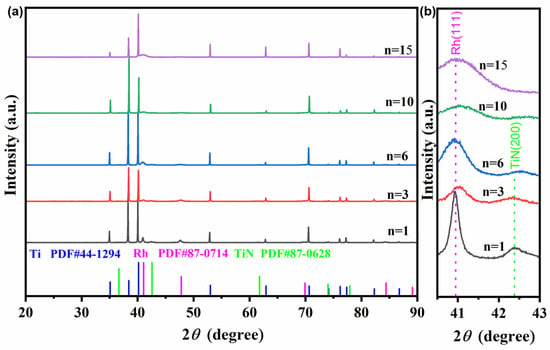
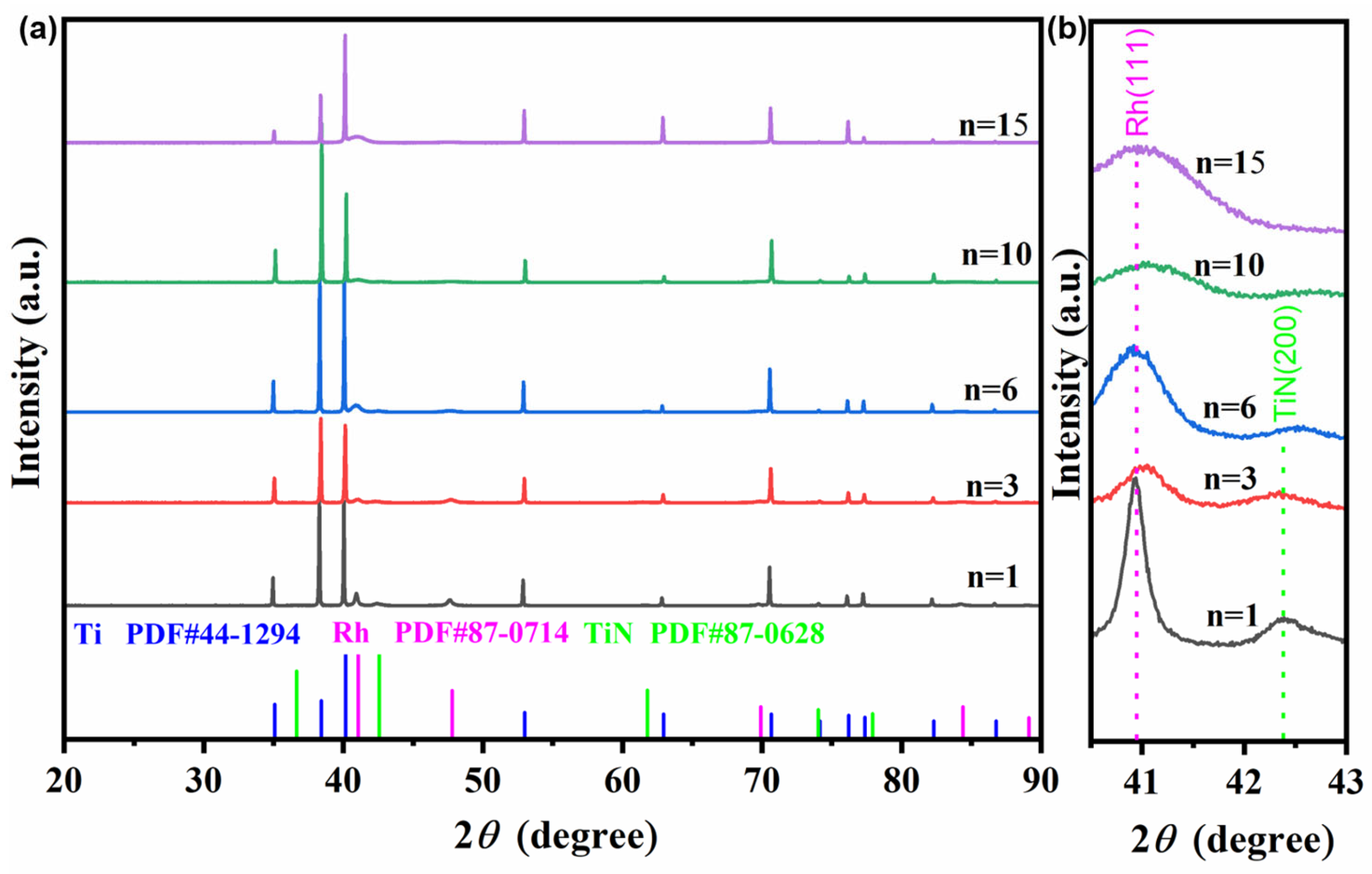
Figure 1a presents the XRD patterns of TiN/Rh multilayer coatings with different bilayer repetition numbers (n = 1, 3, 6, 10, and 15). The diffraction peaks can be indexed to hexagonal close-packed α-Ti from the TA1 substrate (PDF No. 44-1294), face-centered cubic (FCC) Rh (PDF No. 87-0714), and FCC TiN (PDF No. 87-0628). The characteristic reflections of the titanium substrate remain detectable in all samples because of X-ray penetration through the relatively thin coatings. No additional crystalline phases are identified within the detection limits of XRD.
Figure 1.
XRD patterns of TiN/Rh multilayer coatings with different bilayer repetition numbers (n = 1, 3, 6, 10, and 15): (a) full-range patterns; (b) enlarged region containing the Rh (111) and TiN (200) reflections.
The assignment of the TiN and Rh diffraction features is further supported by independent characterization conducted in our previous studies. In particular, TiN single-layer coatings prepared at a Ti sputtering power of 150 W and a substrate temperature of 400 °C were characterized by XRD, HRTEM, FFT, and SAED, confirming the formation of crystalline FCC-TiN under comparable reactive sputtering conditions [33]. Furthermore, cross-sectional TEM and elemental mapping of previously prepared TiN/Rh bilayer coatings revealed spatially distinguishable TiN and Rh layers, while high-resolution structural observations supported the presence of crystalline FCC Rh [33,34]. These findings provide complementary experimental support for the formation of the constituent coatings under the adopted deposition conditions. Nevertheless, the earlier control specimens are not identical to the multilayer samples investigated here, particularly those with high repetition numbers, and therefore do not independently establish their detailed phase compositions.
The diffraction characteristics of the TiN/Rh multilayer coatings change progressively with increasing bilayer repetition number. At n = 1, relatively pronounced Rh (111) and Rh (200) reflections are observed. As n increases, these reflections generally become weaker and broader, although the Rh (111) reflection remains detectable at n = 15. As shown in the enlarged diffraction patterns in Figure 1b, the TiN (200) reflection also weakens progressively and becomes poorly resolved at higher repetition numbers.
It should be emphasized that increasing the bilayer repetition number does not correspond to an increase in the cumulative nominal deposition time of either constituent. The total programmed deposition durations were maintained at 60 min for TiN and 15 min for Rh for all coating configurations. Moreover, the cross-sectional SEM results presented in Section 3.3 show that the actual coating thickness decreases from approximately 475 nm at n = 1 to 356 nm at n = 15. This thickness reduction may decrease the effective diffracting volume of the coating constituents and increase the relative contribution of the underlying titanium substrate. Diffraction intensity may also be influenced by crystallographic texture and other microstructural characteristics. Consequently, the weakening of the TiN (200) reflection cannot be directly interpreted as a decrease in the overall TiN content or as evidence of TiN decomposition.
The broadening of the Rh (111) and TiN (200) reflections should be distinguished from the reduction in peak intensity. As the repetition number increases, the deposition duration of each TiN layer decreases from 60 to 4 min, while that of each Rh layer decreases from 15 to 1 min. These shorter individual growth periods, together with repeated deposition on alternating TiN and Rh surfaces, may influence nucleation, coherent crystallite development, and lattice microstrain. Both reduced coherent domain dimensions and increased microstrain can contribute to diffraction peak broadening, but their individual contributions cannot be quantitatively distinguished from the present data. Therefore, the XRD results indicate repetition-dependent changes in the crystalline diffraction characteristics of the multilayer coatings, rather than establishing a specific chemical transformation mechanism.
Quantitative phase refinement was not performed because the diffraction patterns are dominated by strong α-Ti reflections from the substrate, whereas several TiN- and Rh-related reflections are relatively weak, broadened, or partially overlapped. Under these conditions, refinement-derived phase fractions and coherent crystallite sizes would be highly sensitive to the assumed structural models, preferred orientation, peak-profile parameters, and substrate contribution. Furthermore, metallic Ti potentially formed within the coating would be difficult to distinguish from the much stronger diffraction contribution of the titanium substrate. Therefore, the present XRD data are primarily used for qualitative phase identification and comparison of crystalline diffraction characteristics rather than quantitative phase-fraction determination. Additional chemical-state and depth-resolved structural analyses would be required to determine whether TiN decomposition or metallic Ti formation occurred during deposition.
3.2. Effect of Bilayer Repetition Number on Surface Morphology and Grain Size
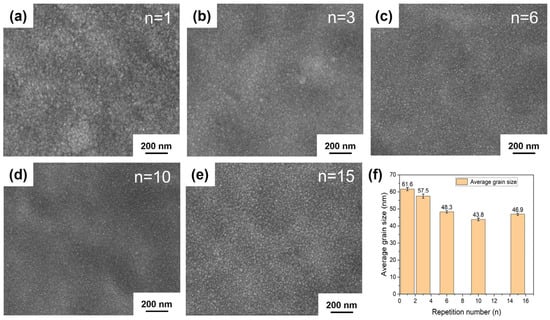
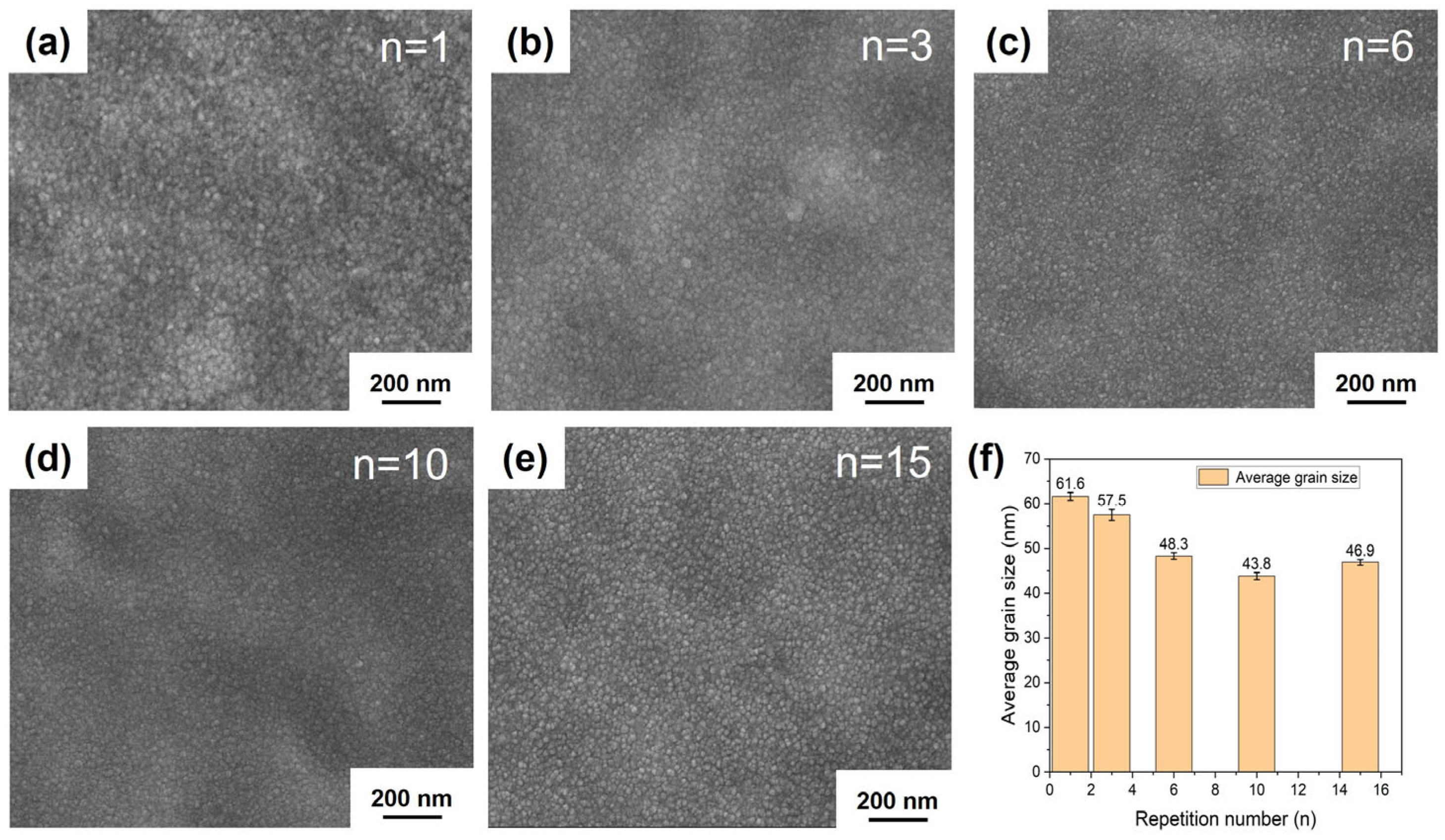
Figure 2a–e present the SEM surface morphologies of TiN/Rh multilayer coatings with different bilayer repetition numbers (n = 1, 3, 6, 10, and 15). All coatings exhibit relatively compact and continuous surfaces without obvious macroscopic cracks or large-scale delamination. However, the surface morphology and characteristic dimensions of the Rh surface features vary noticeably with increasing bilayer repetition number. At n = 1 (Figure 2a), the surface consists of relatively coarse granular features with distinguishable boundaries and a somewhat nonuniform distribution. Increasing n to 3 (Figure 2b) results in finer and more uniformly distributed surface features. Further increasing n to 6 and 10 (Figure 2c,d) produces progressively refined granular morphologies. At n = 15 (Figure 2e), the surface remains relatively compact, although some granular features become slightly more pronounced than those observed at n = 10.
Figure 2.
SEM surface morphologies of TiN/Rh multilayer coatings: (a) n = 1; (b) n = 3; (c) n = 6; (d) n = 10; (e) n = 15; and (f) mean lateral Rh surface feature size versus bilayer repetition number. Error bars in (f) represent the standard deviation (SD) of repeated SEM measurements.
The quantitative variation in the average lateral Rh surface feature size is shown in Figure 2f. As the bilayer repetition number increases from n = 1 to 3, 6, and 10, the average feature size decreases from 61.6 ± 0.9 to 57.5 ± 1.2, 48.3 ± 0.7, and 43.8 ± 0.8 nm, respectively, corresponding to a reduction of approximately 28.9% between n = 1 and n = 10. However, a further increase in n to 15 results in a slight increase to 46.9 ± 0.6 nm. The values are presented as mean ± standard deviation (SD), reflecting the dispersion of the measured surface feature sizes. Thus, the characteristic surface feature size exhibits a nonmonotonic dependence on bilayer repetition number, reaching its minimum at n = 10 rather than at the highest repetition number.
The observed morphological evolution may be associated with changes in the nucleation and growth behavior of the outermost Rh layer. Although the cumulative Rh deposition time was maintained at 15 min, the deposition duration of each individual Rh layer decreased from 15 min at n = 1 to 1 min at n = 15. Shorter deposition durations may restrict lateral grain growth, while repeated alternation between TiN and Rh may modify the nucleation conditions for subsequent Rh deposition. These effects could contribute to the progressive refinement of surface features from n = 1 to n = 10. Nevertheless, the slight increase in feature size at n = 15 indicates that further increasing the repetition number does not necessarily produce continued refinement. This deviation may reflect differences in surface nucleation, growth, or coalescence during the final Rh deposition stage, although the available SEM observations do not allow these contributions to be distinguished.
The SEM results also provide complementary information to the XRD observations in Section 3.1. The reduction in lateral Rh surface feature size from n = 1 to n = 10 accompanies the progressive broadening of the Rh (111) diffraction peak, consistent with changes in crystalline growth characteristics. However, the slight increase in SEM-derived feature size at n = 15 occurs despite continued broadening of the Rh (111) reflection. This difference highlights that lateral surface feature dimensions measured by SEM are not necessarily equivalent to the coherent crystallite dimensions contributing to XRD peak broadening. Lattice microstrain and other structural factors may also affect the diffraction peak width. Therefore, the SEM and XRD observations collectively indicate that increasing the bilayer repetition number modifies Rh growth and crystalline characteristics, while their individual contributions to scratch failure are considered in Section 3.6.
3.3. Effect of Bilayer Repetition Number on Cross-Sectional Microstructure and Coating Thickness
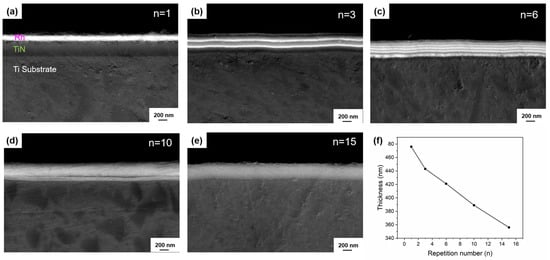
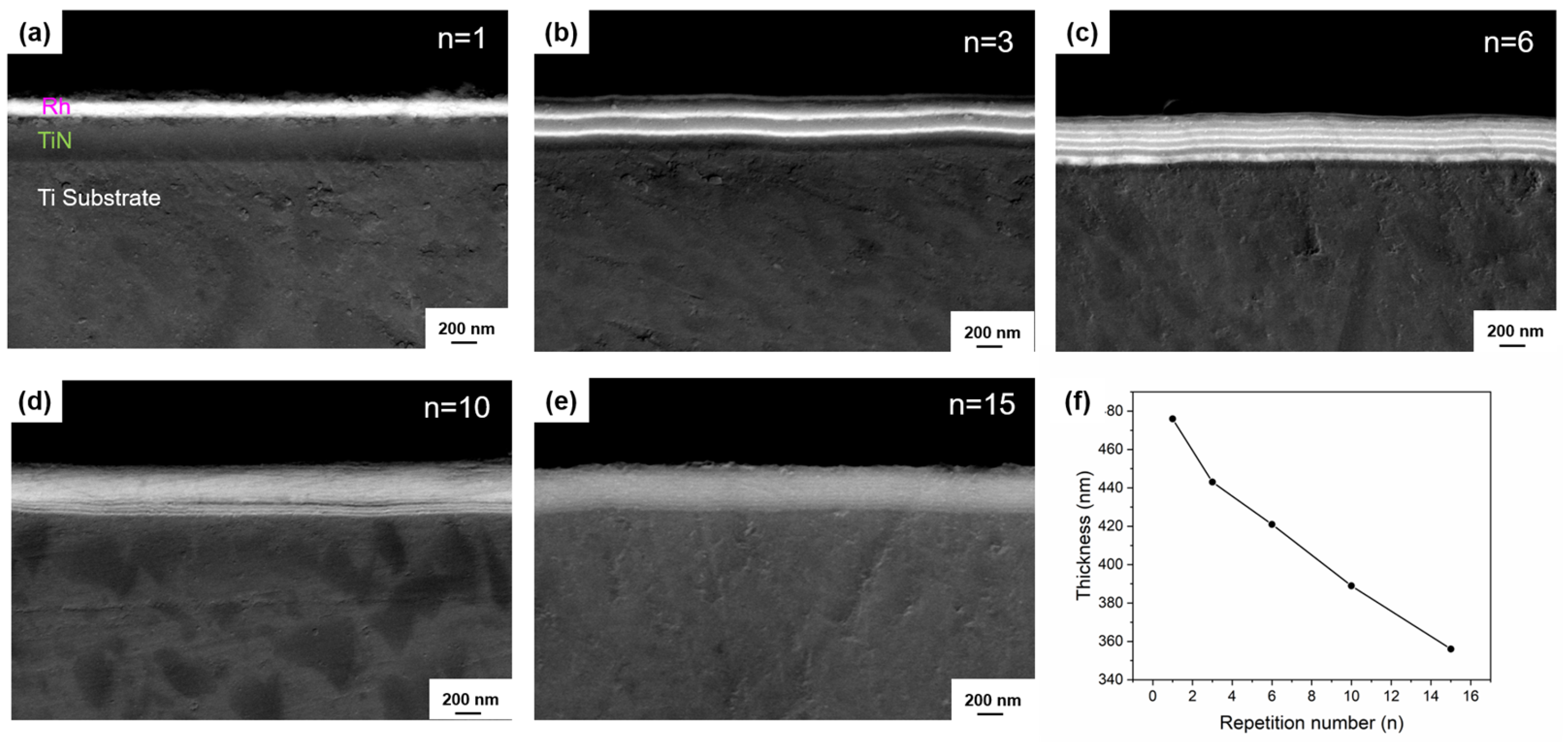
Figure 3a–e present the cross-sectional SEM images of TiN/Rh multilayer coatings with different bilayer repetition numbers (n = 1, 3, 6, 10, and 15). All coatings exhibit relatively continuous cross-sectional structures on the TA1 titanium substrates, without obvious large-scale interfacial separation in the examined regions. At n = 1 (Figure 3a), a conventional bilayer structure is observed, consisting of a TiN layer adjacent to the substrate and an outer Rh layer. The Rh layer exhibits relatively bright contrast, whereas the underlying TiN layer appears darker. As n increases to 3 and 6 (Figure 3b,c), periodically alternating TiN and Rh layers become distinguishable, confirming the formation of multilayer architectures. Further increasing n to 10 (Figure 3d) results in more closely spaced layers with reduced contrast between adjacent constituents. At n = 15 (Figure 3e), the individual layers can no longer be clearly distinguished by cross-sectional SEM. This reduced visibility is consistent with the decreasing thickness of individual layers and the limited spatial resolution and contrast of the SEM observations. However, the absence of clearly resolved interfaces does not necessarily indicate the disappearance of the multilayer structure or loss of layer continuity. Figure 3f summarizes the variation in total coating thickness with bilayer repetition number. The measured thickness decreases progressively from approximately 475 nm at n = 1 to 443, 423, 390, and 356 nm at n = 3, 6, 10, and 15, respectively, corresponding to an overall reduction of approximately 25.1%. Notably, the cumulative nominal deposition times were maintained at 60 min for TiN and 15 min for Rh across all samples. Therefore, increasing the bilayer repetition number results in a systematic reduction in total coating thickness despite identical cumulative nominal sputtering durations.
Figure 3.
Cross-sectional SEM images of TiN/Rh multilayer coatings: (a) n = 1; (b) n = 3; (c) n = 6; (d) n = 10; (e) n = 15; and (f) total coating thickness versus bilayer repetition number.
Under ideal steady-state deposition conditions, dividing a fixed cumulative sputtering duration into multiple shorter deposition steps would not necessarily alter the final coating thickness. However, the present deposition process involves repeated alternation between reactive TiN sputtering in an Ar/N2 atmosphere and metallic Rh sputtering in Ar. As the bilayer repetition number increases, the number of transitions between these deposition conditions increases, while the duration of each individual deposition step becomes progressively shorter. Such repeated transitions may involve transient changes in the gas atmosphere, plasma conditions, target-surface reaction states, and effective deposition rates.
In addition, the initial nucleation and growth processes of individual layers may be affected by deposition on alternating TiN and Rh surfaces. These transient and interfacial growth effects could become increasingly important at higher repetition numbers, where each constituent layer is deposited for a relatively short duration. Consequently, the effective average growth rate may decrease despite the unchanged cumulative nominal deposition times. This interpretation provides a plausible explanation for the reduction in total coating thickness from approximately 475 nm at n = 1 to 356 nm at n = 15. Nevertheless, because time-resolved deposition-rate measurements and in situ plasma diagnostics were not performed, the relative contributions of these factors cannot be quantitatively determined. Therefore, the observed thickness reduction is associated with the repeated deposition sequence rather than attributed to a uniquely established mechanism.
The thickness variation also provides useful context for interpreting the XRD results discussed in Section 3.1. A decrease in total coating thickness may reduce the diffracting volume of the coating constituents, resulting in weaker coating-related diffraction signals and a relatively greater contribution from the titanium substrate. However, the reduced coating thickness alone does not necessarily explain the progressive broadening of the Rh (111) and TiN (200) reflections. Such broadening may be associated with changes in coherent crystallite dimensions, lattice microstrain, or both, arising from the altered growth conditions of individual layers. Therefore, the reduction in diffraction intensity should be distinguished from changes in peak width when evaluating the crystalline structural evolution of TiN/Rh multilayer coatings.
The simultaneous changes in multilayer architecture and total coating thickness may also influence the scratch failure behavior. Although additional TiN/Rh interfaces could modify local stress transfer and damage propagation, a reduction in coating thickness may alter the stress distribution beneath the indenter and the relative contribution of substrate deformation. Meanwhile, the increasingly short deposition duration of individual layers may influence their crystalline characteristics and mechanical response. Consequently, the effect of bilayer repetition number on scratch failure cannot be attributed solely to interface density or total coating thickness.
3.4. Effect of Bilayer Repetition Number on Surface Topography and Roughness
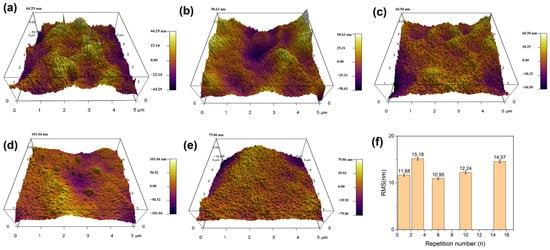
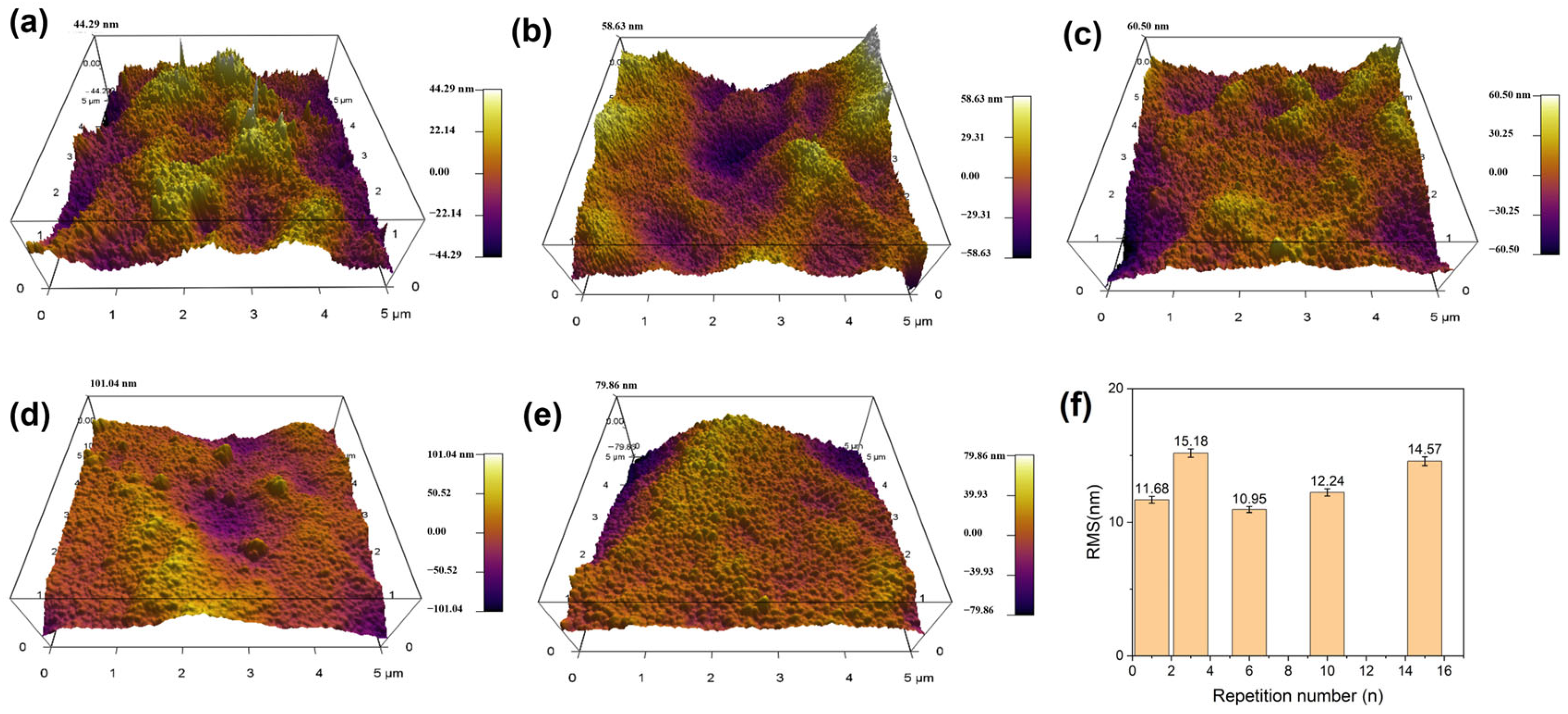
Figure 4a–e present the three-dimensional AFM surface topographies of TiN/Rh multilayer coatings with different bilayer repetition numbers (n = 1, 3, 6, 10, and 15). All coatings exhibit relatively continuous surfaces characterized by nanoscale protrusions and depressions, without obvious large-scale cracks or discontinuities within the examined regions. Although the distribution and height of surface features vary among the samples, no systematic increase or decrease in surface roughness is observed with increasing bilayer repetition number. These observations are consistent with the relatively compact surface morphologies revealed by SEM in Figure 2. The root-mean-square (RMS) surface roughness values are summarized in Figure 4f. As the bilayer repetition number increases from n = 1 to 3, the RMS roughness increases from 11.68 ± 0.26 to 15.18 ± 0.32 nm. A further increase to n = 6 reduces the roughness to its minimum value of 10.95 ± 0.22 nm, followed by increases to 12.24 ± 0.27 and 14.57 ± 0.33 nm at n = 10 and 15, respectively. The values are expressed as mean ± standard deviation (SD), indicating the dispersion of the measured RMS roughness. These results demonstrate that the RMS roughness exhibits a nonmonotonic dependence on bilayer repetition number. Unlike the progressive refinement of the lateral Rh surface features observed from n = 1 to n = 10 (Figure 2f), the surface roughness does not follow a corresponding decreasing trend. This difference indicates that the lateral dimensions of surface features and their vertical height variations respond differently to changes in the multilayer architecture.
Figure 4.
Three-dimensional AFM surface topographies of TiN/Rh multilayer coatings with different bilayer repetition numbers: (a) n = 1; (b) n = 3; (c) n = 6; (d) n = 10; (e) n = 15; and (f) root-mean-square (RMS) surface roughness as a function of bilayer repetition number. Error bars in (f) represent the standard deviation (SD) of repeated AFM measurements.
The lack of a direct relationship between surface feature size and roughness may be associated with differences in the nucleation, growth, and coalescence of the outermost Rh layer. Although shorter deposition durations generally produce finer lateral surface features, the resulting surface height distribution may also depend on local grain arrangement and growth morphology. Consequently, a reduction in lateral feature size does not necessarily lead to a smoother coating surface. Nevertheless, the relative contributions of these processes cannot be determined from the present AFM measurements alone.
The roughness results also provide useful information for interpreting the scratch failure behavior. Notably, the coating with n = 3 exhibits the highest RMS roughness of 15.18 nm while achieving the highest critical scratch loads of 47.7 N (Lc1) and 63.4 N (Lc2). In contrast, the coating with n = 6 possesses the lowest roughness of 10.95 nm but lower critical loads of 46.5 and 54.3 N, respectively. These observations indicate that the resistance to scratch-induced failure does not follow a simple correlation with RMS surface roughness. Instead, the mechanical response is likely influenced by the combined effects of multilayer architecture, crystalline structural characteristics, and coating thickness, as discussed in Section 3.6.
3.5. Effect of Bilayer Repetition Number on Scratch Failure Behavior
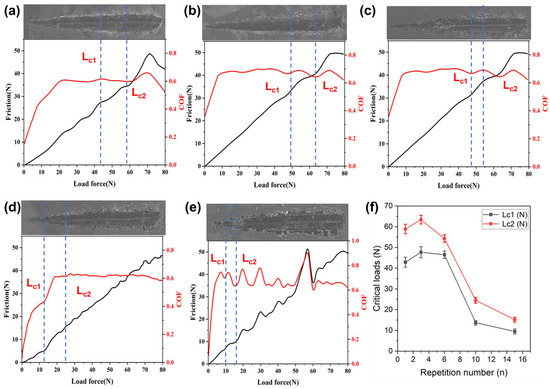
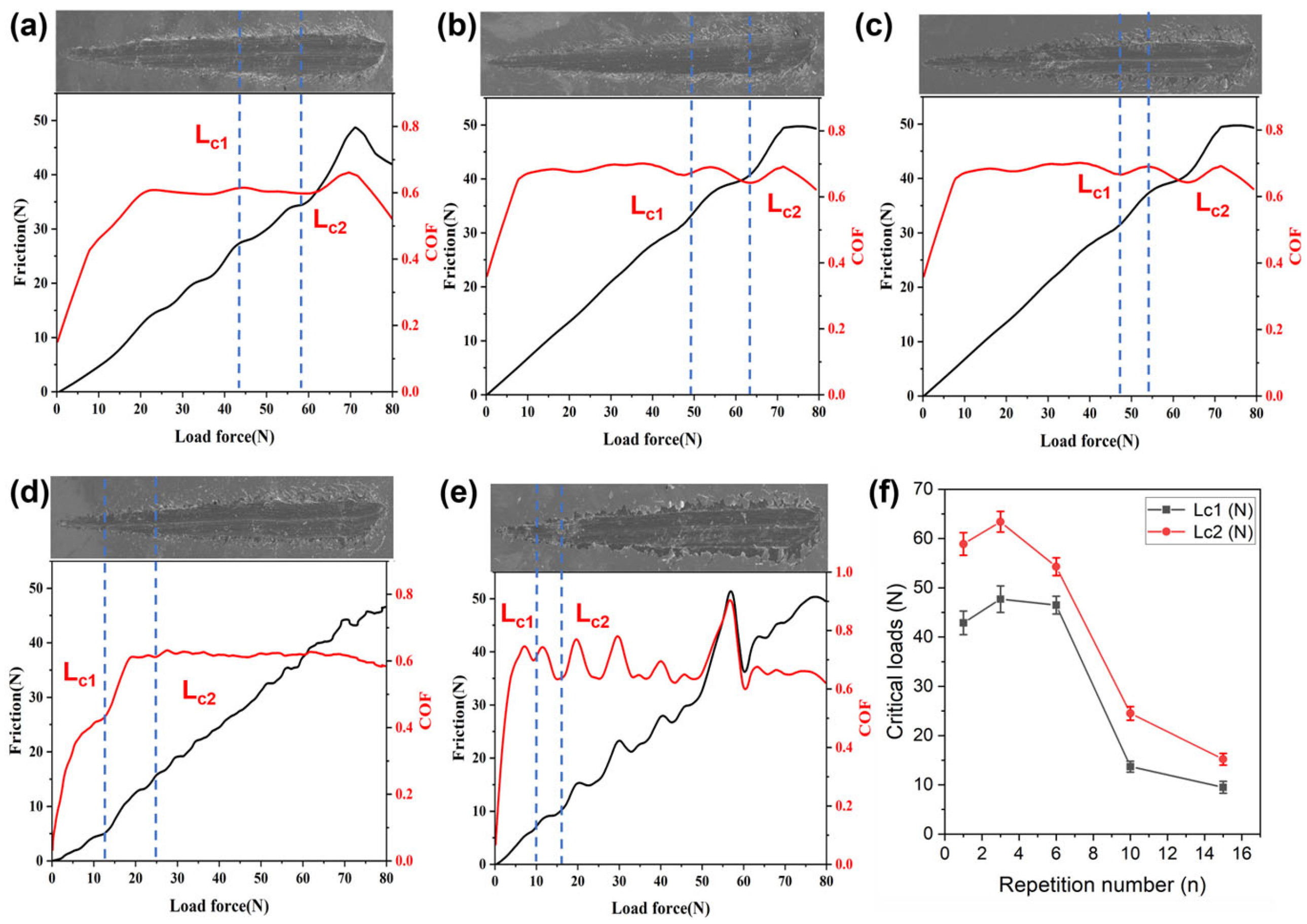
The scratch failure behavior of TiN/Rh multilayer coatings with different bilayer repetition numbers was evaluated using progressive-load scratch testing. Figure 5a–e present the representative scratch-track SEM images and corresponding friction force and coefficient of friction (COF) curves, while the critical scratch loads are summarized in Figure 5f and Table 3. Two critical loads, Lc1 and Lc2, were identified by correlating the frictional responses with the observed scratch-track morphologies. Lc1 represents the onset of observable coating damage, whereas Lc2 corresponds to extensive coating failure characterized by pronounced spallation or delamination. These critical loads provide comparative measures of resistance to scratch-induced failure under the present testing conditions rather than direct measurements of intrinsic interfacial adhesion strength.
Figure 5.
Scratch-track SEM images and corresponding frictional responses of TiN/Rh multilayer coatings: (a) n = 1; (b) n = 3; (c) n = 6; (d) n = 10; (e) n = 15; and (f) critical scratch loads (Lc1 and Lc2) versus bilayer repetition number. The blue dashed lines in (a–e) indicate the critical loads Lc1 and Lc2. Error bars in (f) represent the standard deviation (SD) of three repeated scratch tests.
Table 3.
Critical scratch loads of TiN/Rh multilayer coatings with different bilayer repetition numbers.
Both Lc1 and Lc2 exhibit nonmonotonic variations with increasing bilayer repetition number. For the coating with n = 1, Lc1 and Lc2 are 42.9 ± 2.4 and 58.9 ± 2.3 N, respectively. Increasing n to 3 raises these values to 47.7 ± 2.7 and 63.4 ± 2.1 N, corresponding to increases in the mean critical loads of approximately 11.2% and 7.6%, respectively. The three-repetition coating therefore exhibits the highest mean critical loads associated with both initial damage and extensive failure among the investigated samples. When n increases to 6, Lc1 decreases slightly to 46.5 ± 1.8 N, whereas Lc2 decreases more noticeably to 54.3 ± 1.8 N. Further increasing n to 10 results in substantial reductions in Lc1 and Lc2 to 13.7 ± 1.1 and 24.5 ± 1.4 N, respectively. At n = 15, the critical loads decrease to their minimum mean values of 9.5 ± 1.2 and 15.2 ± 1.2 N. Compared with the n = 3 coating, the mean Lc1 and Lc2 values at n = 15 are reduced by approximately 80.1% and 76.0%, respectively. These results indicate that a moderate bilayer repetition number yields higher measured scratch failure resistance under the present experimental conditions, whereas excessive repetition is accompanied by pronounced deterioration.
The differences between Lc1 and Lc2 provide additional information about the progression of coating damage. The load interval between initial damage and extensive failure, ΔLc = Lc2 − Lc1, is 16.0, 15.7, 7.8, 10.8, and 5.7 N for n = 1, 3, 6, 10, and 15, respectively. Although the n = 3 coating exhibits the highest absolute critical loads, its ΔLc is comparable to that of the conventional bilayer coating (n = 1). Interestingly, the coating with n = 6 retains a relatively high Lc1 of 46.5 N, close to the maximum value at n = 3, but exhibits a lower Lc2 and a narrower load interval of 7.8 N. This indicates that resistance to initial damage is largely maintained at n = 6, whereas extensive failure occurs after a smaller additional increase in applied load. At higher repetition numbers, particularly n = 10 and 15, the pronounced decreases in both critical loads indicate substantially reduced resistance to scratch-induced damage. However, ΔLc should be interpreted as a test-dependent measure of the separation between two failure events rather than a direct measure of coating fracture toughness.
The scratch results reveal that the mechanical response of TiN/Rh multilayer coatings is strongly influenced by bilayer repetition number, with the most favorable critical loads obtained at n = 3. The different variations in Lc1, Lc2, and ΔLc indicate that resistance to damage initiation and the subsequent development of extensive failure cannot be characterized by a single parameter. The nonmonotonic dependence of the critical loads suggests that increasing the number of TiN/Rh interfaces provides a beneficial effect only within a limited range of multilayer architectures. The possible contributions of crystalline structural evolution, individual-layer characteristics, and total coating thickness to these trends are discussed in Section 3.6.
3.6. Discussion
The nonmonotonic variation in scratch critical loads suggests that the mechanical response of TiN/Rh multilayer coatings is governed by the combined effects of multilayer architecture, crystalline structural characteristics, and coating thickness. The different responses of Lc1 and Lc2 further indicate that the factors controlling damage initiation may differ from those governing extensive coating failures. Therefore, understanding the scratch failure behavior requires consideration of both structural evolution and damage progression rather than relying on a single critical load.
At relatively low repetition numbers, introducing additional TiN/Rh interfaces may improve the mechanical response of the coating system. The alternating arrangement of hard TiN and metallic Rh layers introduces differences in deformation behavior that may facilitate local stress redistribution during scratching. Furthermore, the presence of additional internal interfaces could modify crack propagation paths or the development of localized damage under combined normal and tangential loading [16,19,20,21,22,23]. Compared with the conventional bilayer coating (n = 1), the coating with n = 3 exhibits increases of approximately 11.2% and 7.6% in Lc1 and Lc2, respectively, despite a modest reduction in total coating thickness. These results are consistent with a beneficial effect of multilayer architecture on resistance to both initial damage and extensive failure. However, the load interval between these events remains nearly unchanged, decreasing slightly from 16.0 to 15.7 N. Thus, the improvement at n = 3 is primarily reflected in higher absolute critical loads rather than a substantially wider interval between damage initiation and extensive failure. Although interface-mediated stress redistribution and crack-path modification provide plausible explanations, direct evidence of crack deflection or arrest at individual TiN/Rh interfaces is not available.
Further increasing the bilayer repetition number changes the balance between these potentially beneficial effects and the structural characteristics of the constituent layers. At n = 6, Lc1 decreases only slightly from 47.7 to 46.5 N, whereas Lc2 decreases from 63.4 to 54.3 N. Consequently, the interval between initial and extensive failure narrows from 15.7 to 7.8 N. This observation suggests that the coating retains considerable resistance to the onset of observable damage but provides a smaller additional load margin before extensive failure develops. When n increases to 10 and 15, both critical loads decrease sharply, indicating a pronounced deterioration in resistance to scratch-induced damage. The transition from relatively high critical loads at n = 6 to substantially lower values at n = 10 suggests that excessive repetition is accompanied by structural changes that may adversely affect the mechanical response of the coating/substrate system.
The XRD results provide important evidence of crystalline structural evolution during repeated multilayer deposition. With increasing n, both the Rh (111) and TiN (200) reflections exhibit progressive broadening, while the TiN (200) reflection eventually becomes poorly resolved (Figure 1). These observations are consistent with changes in coherent crystallite dimensions, lattice microstrain, or the detectable crystalline contribution of the constituent layers. Increasing the repetition number considerably reduces the deposition duration of each TiN and Rh layer, potentially restricting crystallite development and modifying the nucleation and growth processes at successive interfaces. Such changes may influence local deformation behavior, stress transfer, and susceptibility to scratch-induced cracking. In particular, the evolution of the TiN crystalline characteristics may be relevant to the load-bearing response of the alternating ceramic/metal structure. Nevertheless, diffraction peak broadening cannot be attributed exclusively to reduced crystallinity, and the weakening of a diffraction reflection does not necessarily indicate structural discontinuity or amorphization. Therefore, the XRD observations support a relationship between crystalline structural evolution and scratch failure behavior, but do not independently establish a direct causal mechanism.
The structural changes observed by XRD should not be interpreted as direct evidence of specific chemical transformations. In particular, the weakening of the TiN (200) reflection does not independently establish a reduction in TiN content or decomposition of the TiN phase, while the broadening of Rh reflections does not necessarily indicate amorphization. The surface and cross-sectional SEM images in Figure 2 and Figure 3 provide information on morphology, layer architecture, and coating thickness, but they cannot quantitatively determine crystalline phase fractions or chemical states. The observed scratch failure behavior should therefore be discussed in relation to the experimentally characterized structural features rather than assumed phase transformations. At moderate repetition numbers, the multilayer architecture may facilitate stress redistribution and modify the development of localized damage, contributing to the relatively high critical scratch loads observed at n = 3. At higher repetition numbers, shorter individual deposition periods, changes in crystalline diffraction characteristics, and reduced coating thickness may collectively influence the mechanical response of the coating/substrate system. However, the relative contributions of these factors cannot be separated using the present measurements. Consequently, the observed deterioration in scratch failure resistance at n = 10 and 15 cannot be uniquely attributed to TiN decomposition or Rh amorphization.
The reduction in coating thickness may also contribute to the deterioration in scratch resistance, although it cannot independently account for the observed critical-load trends. As shown in Figure 3f, the total thickness decreases progressively from approximately 475 nm at n = 1 to 356 nm at n = 15. A thinner coating may alter the stress distribution beneath the moving indenter and increase the relative influence of deformation of the underlying titanium substrate. However, the relative changes in critical loads are considerably larger than the corresponding changes in coating thickness over certain repetition intervals. For example, increasing n from 3 to 6 reduces the total thickness from approximately 443 to 423 nm, corresponding to a decrease of 4.5%, whereas Lc2 decreases by approximately 14.4%. More strikingly, increasing n from 6 to 10 reduces the thickness by approximately 7.8%, while Lc1 and Lc2 decrease by approximately 70.5% and 54.9%, respectively. These differences suggest that changes in crystalline characteristics, individual-layer dimensions, and multilayer architecture may contribute substantially to the observed deterioration. Nevertheless, thickness-dependent scratch failure may be nonlinear, and the separate contributions of coating thickness and microstructural evolution cannot be quantitatively determined from the present results.
The surface morphology and roughness measurements provide additional insight into the factors controlling scratch failure. Although the lateral Rh surface features generally become finer with increasing repetition number up to n = 10, the critical scratch loads do not exhibit a corresponding improvement. Similarly, the RMS roughness varies within 10.95–15.18 nm without following the critical-load trends. Notably, the n = 3 coating exhibits the highest RMS roughness while maintaining the highest Lc1 and Lc2, indicating that surface roughness alone cannot explain the observed differences in scratch resistance. Previous studies of TiN/Rh bilayer coatings demonstrated that TiN sputtering power and Rh deposition temperature influence crystalline structure, interfacial characteristics, residual stress, and mechanical failure behavior [33,34]. These findings highlight the sensitivity of TiN/Rh coatings to structural development and stress-related conditions. In the present study, the sputtering powers and substrate temperature were maintained constant, whereas the bilayer repetition number was varied. The resulting changes in diffraction characteristics and scratch response therefore demonstrate the importance of multilayer architecture as an additional structural-design parameter. However, residual stress and the mechanical properties of individual constituent layers were not directly determined for the present multilayer series, and their possible contributions should not be overlooked.
Taken together, the nonmonotonic scratch failure behavior of TiN/Rh multilayer coatings can be interpreted as the result of competing effects associated with interfacial architecture, crystalline structural evolution, and thickness-dependent mechanical response. At a moderate repetition number (n = 3), additional TiN/Rh interfaces may improve stress accommodation and resistance to scratch-induced damage, producing the highest critical loads among the investigated coatings. With further increases in repetition number, the increasingly short growth duration of individual layers is accompanied by pronounced changes in diffraction characteristics and a reduction in total coating thickness. These combined structural changes may progressively outweigh the potential benefits of additional interfaces, resulting in a substantial decrease in scratch failure resistance at n = 10 and 15. This interpretation provides a plausible structure–failure relationship for TiN/Rh multilayer coatings, while recognizing that the individual contributions of crystallite size, microstrain, residual stress, interfacial characteristics, and coating thickness cannot be quantitatively distinguished from the present results.
Although the present results establish a clear nonmonotonic relationship between bilayer repetition number and scratch failure resistance, developing a quantitative predictive model requires further consideration. In principle, an empirical mathematical relationship between the critical scratch loads and bilayer repetition number could be established for the investigated experimental conditions. However, the present dataset contains only five repetition numbers, and changes in multilayer architecture are accompanied by variations in total coating thickness and crystalline characteristics. Consequently, a simple fitting function based solely on repetition number would not distinguish the individual contributions of these factors and could have limited predictive capability beyond the investigated range. Therefore, rather than proposing an empirical equation without a sufficiently established physical basis, the present study focuses on the experimentally observed trends and their structure–failure correlations. Further systematic investigations involving independently controlled coating thickness, repetition number, residual stress, and interfacial characteristics would be required to develop a more general quantitative model.
The potential influence of chemical and thermal processes on multilayer development also warrants consideration. TiN formation during reactive sputtering involves interactions between sputtered Ti species and nitrogen-containing reactive species, whereas Rh is deposited under an Ar atmosphere. Repeated deposition and subsequent thermal exposure may influence crystallite development, structural relaxation, and interfacial evolution. However, because all coating configurations were prepared at the same nominal substrate temperature of 400 °C, the present experimental design does not allow temperature-dependent effects to be independently distinguished from changes associated with bilayer repetition number.
Furthermore, the available XRD and SEM observations do not directly establish TiN decomposition, metallic Ti formation, or a crystalline-to-amorphous transformation of Rh. Verification of such processes would require additional chemical-state and depth-resolved characterization. Although these possible structural and chemical changes may be relevant to long-term coating durability, their influence on oxidation resistance cannot be determined from the present results because oxidation-exposure testing was not conducted. Therefore, the conclusions of this study are restricted to the experimentally observed microstructural evolution, thickness variation, and scratch failure behavior. Future investigations combining chemical-state analysis, controlled thermal studies, and oxidation testing would be valuable for clarifying the corresponding transformation mechanisms and environmental durability.
4. Conclusions
In summary, TiN/Rh multilayer coatings with different bilayer repetition numbers (n = 1, 3, 6, 10, and 15) were deposited on commercially pure titanium substrates by magnetron sputtering to investigate the relationships among multilayer architecture, microstructural evolution, and scratch failure behavior in the present work. Increasing the repetition number resulted in progressive broadening of the Rh (111) and TiN (200) diffraction reflections, accompanied by a reduction in total coating thickness from approximately 475 to 356 nm. The lateral Rh surface feature size decreased from 61.6 nm at n = 1 to a minimum of 43.8 nm at n = 10, whereas the RMS surface roughness varied within 10.95–15.18 nm without a clear monotonic trend. Both critical scratch loads exhibited nonmonotonic variations with increasing bilayer repetition number. The highest mean values of Lc1 and Lc2 were obtained at n = 3, reaching 47.7 ± 2.7 and 63.4 ± 2.1 N, respectively, compared with 42.9 ± 2.4 and 58.9 ± 2.3 N at n = 1. At n = 6, Lc1 remained relatively high at 46.5 ± 1.8 N, whereas Lc2 decreased to 54.3 ± 1.8 N. Further increasing n to 15 substantially reduced Lc1 and Lc2 to 9.5 ± 1.2 and 15.2 ± 1.2 N, respectively. These findings demonstrate that increasing the number of TiN/Rh interfaces does not necessarily improve scratch failure resistance. The observed nonmonotonic behavior suggests that multilayer architecture, crystalline structural characteristics, and coating thickness collectively influence the mechanical response. However, because these parameters varied simultaneously, their individual contributions cannot be independently determined from the present experimental results. Among the investigated configurations, the coating with n = 3 exhibited the highest mean critical scratch loads, highlighting the importance of optimizing bilayer repetition number rather than simply maximizing interface density.
Author Contributions
H.Z.: Writing—original draft, Methodology, Investigation, Formal analysis, Data curation. C.Q.: Investigation, Data curation. X.Q.: Investigation, Data curation. H.H.: Investigation, Data curation. Z.L.: Validation, Formal analysis. B.Y.: Writing—review & editing, Validation, Supervision, Project administration, Funding acquisition, Conceptualization. All authors have read and agreed to the published version of the manuscript.
Funding
This work was supported by the National Key Research and Development Program of China (No. 2022YFC2204202).
Institutional Review Board Statement
Not applicable.
Informed Consent Statement
Not applicable.
Data Availability Statement
The original contributions presented in this study are included in the article. Further inquiries can be directed to the corresponding author.
Conflicts of Interest
The authors declare no conflicts of interest.
References
- Luo, J.; Chen, L.-S.; Duan, H.-Z.; Gong, Y.-G.; Hu, S.; Ji, J.; Liu, Q.; Mei, J.; Milyukov, V.; Sazhin, M.; et al. TianQin: A space-borne gravitational wave detector. Class. Quantum Grav. 2016, 33, 035010. [Google Scholar] [CrossRef] [Scilit]
- Zanoni, C.; Bortoluzzi, D.; Conklin, J.; Köker, I.; Seutchat, B.; Vitale, S. Summary of the results of the LISA-Pathfinder Test Mass release. J. Phys. Conf. Ser. 2015, 610, 012022. [Google Scholar] [CrossRef] [Scilit]
- Benedetti, M.; Bortoluzzi, D.; Da Lio, M.; Fontanari, V. The influence of adhesion and sub-Newton pull-off forces on the release of objects in outer space. J. Tribol. 2006, 128, 828–840. [Google Scholar] [CrossRef] [Scilit]
- Takahashi, Y.; Matsusaka, S. Adhesional bonding of fine gold wires to metal substrates. J. Adhes. Sci. Technol. 2003, 17, 435–451. [Google Scholar] [CrossRef] [Scilit]
- Winslow, P.M.; McIntyre, D.V. Adhesion of metals in the space environment. J. Vac. Sci. Technol. 1966, 3, 54–61. [Google Scholar] [CrossRef] [Scilit]
- Gane, N.; Pfaelzer, P.; Tabor, D. Adhesion between clean surfaces at light loads. Proc. R. Soc. Lond. A 1974, 340, 495–517. [Google Scholar] [CrossRef] [Scilit]
- Sikorski, M. The adhesion of metals and factors that influence it. Wear 1964, 7, 144–162. [Google Scholar] [CrossRef] [Scilit]
- Marot, L.; Covarel, G.; Tuilier, M.-H.; Steiner, R.; Oelhafen, P. Adhesion of rhodium films on metallic substrates. Thin Solid Films 2008, 516, 7604–7608. [Google Scholar] [CrossRef] [Scilit]
- Marot, L.; De Temmerman, G.; Thommen, V.; Mathys, D.; Oelhafen, P. Characterization of magnetron sputtered rhodium films for reflective coatings. Surf. Coat. Technol. 2008, 202, 2837–2843. [Google Scholar] [CrossRef] [Scilit]
- Safi, I. Recent aspects concerning DC reactive magnetron sputtering of thin films: A review. Surf. Coat. Technol. 2000, 127, 203–218. [Google Scholar] [CrossRef] [Scilit]
- Sarakinos, K.; Alami, J.; Konstantinidis, S. High power pulsed magnetron sputtering: A review on scientific and engineering state of the art. Surf. Coat. Technol. 2010, 204, 1661–1684. [Google Scholar] [CrossRef] [Scilit]
- Baptista, A.; Silva, F.; Porteiro, J.; Míguez, J.; Pinto, G. Sputtering Physical Vapour Deposition (PVD) Coatings: A Critical Review on Process Improvement and Market Trend Demands. Coatings 2018, 8, 402. [Google Scholar] [CrossRef] [Scilit]
- Demkowicz, P.; Wright, K.; Gan, J.; Petti, D. High temperature interface reactions of TiC, TiN, and SiC with palladium and rhodium. Solid State Ion. 2008, 179, 2313–2321. [Google Scholar] [CrossRef] [Scilit]
- Koehler, J.S. Attempt to Design a Strong Solid. Phys. Rev. B 1970, 2, 547–551. [Google Scholar] [CrossRef] [Scilit]
- Helmersson, U.; Todorova, S.; Barnett, S.A.; Sundgren, J.-E.; Markert, L.C.; Greene, J.E. Growth of single-crystal TiN/VN strained-layer superlattices with extremely high mechanical hardness. J. Appl. Phys. 1987, 62, 481–484. [Google Scholar] [CrossRef] [Scilit]
- Cheng, W.; Wang, J.; Ma, X.; Zhang, P.; Wang, X.; Wang, Y.; Zhang, G.; Li, X.; Liu, Y.; Sun, J.; et al. A review on microstructures and mechanical properties of protective nano-multilayered films or coatings. J. Mater. Res. Technol. 2023, 27, 2413–2442. [Google Scholar] [CrossRef] [Scilit]
- Zhang, S.; Sun, D.; Fu, Y.; Du, H. Toughness measurement of thin films: A critical review. Surf. Coat. Technol. 2005, 198, 74–84. [Google Scholar] [CrossRef] [Scilit]
- Musil, J.; Jirout, M. Toughness of hard nanostructured ceramic thin films. Surf. Coat. Technol. 2007, 201, 5148–5152. [Google Scholar] [CrossRef] [Scilit]
- Cai, F.; Zhang, J.; Wang, J.; Zheng, J.; Wang, Q.; Zhang, S. Improved adhesion and erosion wear performance of CrSiN/Cr multi-layer coatings on Ti alloy by inserting ductile Cr layers. Tribol. Int. 2021, 153, 106657. [Google Scholar] [CrossRef] [Scilit]
- Ou, Y.X.; Lin, J.; Che, H.L.; Yang, P. Mechanical and tribological properties of CrN/TiN multilayer coatings deposited by pulsed DC magnetron sputtering. Surf. Coat. Technol. 2015, 276, 152–159. [Google Scholar] [CrossRef] [Scilit]
- Arudi, I.S.; Hamzah, E.; Yajid, M.A.M.; Bushroa, A.R.; Munshi, S.M.; Al-Ashhab, M.S.; Ibrahim, M.Z. Taguchi optimization of hardness and scratch adhesion strength of multilayer Ti/TiN coatings on Ti-51 at% Ni alloy deposited via magnetron sputtering technique. J. Mater. Res. Technol. 2023, 27, 7664–7672. [Google Scholar] [CrossRef] [Scilit]
- Aringozhina, Z.; Magazov, N.; Rakhadilov, B.; Batanov, Y.; Serikbaikyzy, A.; Kussainov, A. Influence of Layer Configuration on the Mechanical, Tribological and Corrosion Performance of Ti/TiN Multilayer Coatings. Coatings 2025, 15, 1313. [Google Scholar] [CrossRef] [Scilit]
- Kang, W.-B.; Liu, Y.; Hwang, Y.-H.; Lee, J.-M.; Kim, D.-E. In Situ Scanning Electron Microscopy Investigation of Failure Mechanisms in Multilayer Coatings. ACS Appl. Mater. Interfaces 2025, 17, 63922–63936. [Google Scholar] [CrossRef] [Scilit]
- Yesilyurt, M.; Gülten, G.; Yaylali, B.; Totik, Y.; Gunay, R.; Kara, G.; Altintas, B.B.; Akhan, A.; Efeoglu, I. The effect of various cycle numbers of TiAl:TiN multilayer coatings on the mechanical, tribological, and corrosion properties. Tribol. Int. 2026, 213, 111083. [Google Scholar] [CrossRef] [Scilit]
- Xu, J.M.; Zhang, P.; Yu, J.J.; Ma, N.; Ying, P.; Yang, T.; Wu, J.; Wang, T.; Wang, T.; Levchenko, V. Tribological Properties of MoN/TiN Multilayer Coatings Prepared via High-Power Impulse Magnetron Sputtering. Lubricants 2025, 13, 319. [Google Scholar] [CrossRef] [Scilit]
- Wei, Q.; Wang, X.; Wang, Y.; Yuan, H.; Dai, X.; Xu, J.; Luo, G.; Shen, Q. Hierarchical TiAlN/CrN coatings deposited on WC-Co with interfacial nesting structure for enhanced adhesion and wear resistance. Surf. Coat. Technol. 2026, 529, 133509. [Google Scholar] [CrossRef] [Scilit]
- Othman, M.; Bushroa, A.R.; Abdullah, W.N.R. Evaluation techniques and improvements of adhesion strength for TiN coating in tool applications: A review. J. Adhes. Sci. Technol. 2015, 29, 569–591. [Google Scholar] [CrossRef] [Scilit]
- Liu, H.Y.; Li, J.L.; Ma, D.L.; Jiang, X.; Xie, D.; Leng, Y.X. Influence of Interlayers on Adhesion Strength of TiN Film on Mg Alloy. Coatings 2024, 14, 121. [Google Scholar] [CrossRef] [Scilit]
- Akhter, R.; Bendavid, A.; Munroe, P. Improving the wear resistance and scratch adhesion of TiAlN coatings via Al incorporation. Thin Solid Films 2025, 816, 140650. [Google Scholar] [CrossRef] [Scilit]
- ASTM C1624-05; Standard Test Method for Adhesion Strength and Mechanical Failure Modes of Ceramic Coatings by Quantitative Single Point Scratch Testing. ASTM International: West Conshohocken, PA, USA, 2005. [Google Scholar] [CrossRef] [Scilit]
- Yang, J.; Roa, J.J.; Odén, M.; Johansson-Jõesaar, M.P.; Esteve, J.; Llanes, L. Substrate surface finish effects on scratch resistance and failure mechanisms of TiN-coated hardmetals. Surf. Coat. Technol. 2015, 265, 174–184. [Google Scholar] [CrossRef] [Scilit]
- Bull, S.J. Failure modes in scratch adhesion testing. Surf. Coat. Technol. 1991, 50, 25–32. [Google Scholar] [CrossRef] [Scilit]
- Zhang, H.; Tang, J.; Li, S.; Yan, H.; Li, H.; Li, Z.; Zuo, L.; Yang, B. Effect of TiN Sputtering Power on Microstructure and Adhesion Properties of TiN/Rh Bilayer Coatings. Coatings 2026, 16, 1170. [Google Scholar] [CrossRef] [Scilit]
- Zhang, H.; Tang, J.; Yan, H.; Li, H.; Li, Z.; Li, S.; Zuo, L.; Yang, B. Effect of Rh deposition temperature on residual stress evolution and adhesion behavior of TiN/Rh coatings on titanium substrates. Vacuum 2027, 255, 115820. [Google Scholar] [CrossRef] [Scilit]

Disclaimer/Publisher’s Note: The statements, opinions and data contained in all publications are solely those of the individual author(s) and contributor(s) and not of MDPI and/or the editor(s). MDPI and/or the editor(s) disclaim responsibility for any injury to people or property resulting from any ideas, methods, instructions or products referred to in the content. |
© 2026 by the authors. Licensee MDPI, Basel, Switzerland. This article is an open access article distributed under the terms and conditions of the Creative Commons Attribution (CC BY) license.