


Highlights
- UN decomposition starts near 1900 K at a rate of about 1.5% per nanosecond, preferentially releasing nitrogen, with a mean activation energy of 6.33 eV.
- External pressure suppresses decomposition at intermediate temperatures but weakens above 2273 K; at 10 GPa, the total decomposition fraction remains below 5%.
- O2 molecules almost fully dissociate on UN surfaces, forming amorphous oxygen-deficient UOx layers; N vacancies lower the O diffusion activation energy from 1.234 to 0.999 eV.
Abstract
Uranium mononitride (UN) is a promising accident-tolerant fuel, but high-temperature decomposition and oxidative attack are encountered during sintering, which significantly affect the chemical and phase purity. A U–N–O ternary deep potential trained on DFT data is used to perform large-scale molecular dynamics simulations, by which the coupled decomposition–oxidation behavior is unraveled. A decomposition threshold is identified near 1900 K, with an average activation energy of ~6.33 eV and preferential nitrogen release; decomposition is significantly suppressed by high pressure at intermediate temperatures, but this effect is weakened above 2273 K. At the UN(001)–O2 interface, O2 is nearly completely dissociated, and amorphous oxygen-deficient UOx is formed rather than crystalline UO2. Oxygen diffusion is governed by a vacancy-assisted, thermally activated mechanism; its activation energy is reduced from 1.234 to 0.999 eV as the N-vacancy concentration is increased to 1%, demonstrating that oxidative penetration is accelerated by decomposition-generated vacancies. The atomic-scale sintering window is thereby defined, and guidance is provided for the design of oxidation-resistant UN fuel.
1. Introduction
Nuclear energy is a low-carbon and efficient baseload power source, which plays an irreplaceable role in the global energy transition. Following the Fukushima accident, the materials challenges facing nuclear fuel systems prompted deep reflection within the international community [1], and the development of accident-tolerant fuel (ATF) became a priority for the nuclear energy field, aiming to substantially extend the reactor accident-response time, reduce the risk of hydrogen release, and enhance radioactive containment [2,3]. Uranium mononitride (UN) has attracted wide attention for its excellent overall properties, including high uranium density, high thermal conductivity, and high melting point. However, the application of UN has long been restricted by its poor oxidation resistance and weak phase stability. Hayes et al. [4] systematically summarized the thermal-physical properties of UN, reporting a uranium density of 13.5 g·cm−3, far exceeding the 9.7 g·cm−3 of UO2, and a melting point of about 3078 K; Ross et al. [5] established a thermal-conductivity correlation for UN over 10–1923 K, showing about 21 W·m−1·K−1 at 1000 K, significantly higher than that of UO2 (about 4 W·m−1·K−1); and Muta et al. [6] further confirmed experimentally, through spark plasma sintering (SPS) preparation, that UN combines excellent thermal conductivity and mechanical properties. These advantages give UN the potential to improve both economic performance and safety margins.
The sintering of UN pellets from powder to dense body faces two central scientific challenges that severely constrain its engineering application. The first is high-temperature decomposition instability. Mikhalchik et al. [7] performed thermogravimetric analysis on sintered UN samples in high-purity helium at 1900–2300 °C and found that the mass loss proceeds in two stages: the first stage is the decomposition of UN with the release of N2, and the second is the vigorous evaporation of metallic uranium. Lunev et al. [8] further carried out kinetic and microstructural studies of the thermal decomposition of UN compacts in high-purity helium, revealing the temperature dependence of the decomposition process and the microstructural evolution. Baranov et al. [9] developed a technique for evaluating the thermal stability of UN, providing an experimental basis for the quantitative description of the decomposition behavior. Conventional pressureless sintering usually requires 2300–2600 K to achieve the desired theoretical density (>95% TD), a temperature range that lies exactly within the active decomposition regime of UN, creating a conflict between densification and phase stability. Spark plasma sintering (SPS) can partially alleviate this problem through rapid heating and short holding times: Malkki et al. [10] obtained fully dense UN pellets by SPS from hydride-derived powders, and Yang et al. [11] achieved UN pellets with controllable microstructure and phase composition by SPS. Nevertheless, the microscopic mechanism of decomposition kinetics remains insufficiently understood, and the selection of the sintering temperature–pressure–time window still lacks systematic theoretical guidance.
The second challenge is the attack of residual oxygen impurities. UN powder is extremely sensitive to oxygen, which leads to high concentrations of phase impurities during the industrial fabrication of UN pellets. Lu et al. [12] studied the initial oxidation behavior of UNx films with different nitrogen contents and found that the oxidation products follow different reaction pathways depending on the N/U ratio. Lu et al. [13] further showed that the thermal stability of UN and uranium oxynitride films in ultra-high vacuum is also strongly affected by the oxygen content. Joyce and Xie [14] pointed out that UN powder oxidizes readily at high temperature even under very low oxygen concentrations, whose anti-oxidation capacity can be enhanced via surface coating with CeN. Gonzalez Fonseca et al. [15] studied the oxidation and hydrolysis behavior of thorium-doped UN fuel, showing that oxygen content control during the sintering is a key factor determining UN fuel quality. The above-mentioned results mainly rely on experimental observations and lack information on the meta-stable transition stages of UN decomposition. Therefore, the microscopic migration pathways of oxygen atoms in the UN lattice, the diffusion mechanism, and the modulating role of defects remain unclear.
More importantly, the above-mentioned two technical issues are not independent but intrinsically coupled. Point defects such as nitrogen vacancies generated during high-temperature decomposition might provide fast channels for oxygen migration and thus aggravate oxidative attack; conversely, the incorporation of oxygen can alter the bonding character and thermodynamic stability of UN and affect the decomposition behavior. Owing to the difficulty of experimentally probing atomic-scale processes under extreme high-temperature conditions, the coupling mechanism between the two has long lacked a systematic microscopic interpretation.
From the computational side, Zhukovskii et al. [16] calculated the adsorption configurations and energetics of oxygen atoms on the UN(001) surface by first-principles methods; Zergoug et al. [17] further systematically studied the diffusion pathways and migration energy barriers of oxygen atoms on perfect and defective UN(001) surfaces, suggesting that oxygen diffusion can be accelerated by crystalline vacancies. These works provide important electronic structure-level information for understanding the oxidation mechanism. However, density functional theory (DFT) calculations are limited by system size (typically a few hundred atoms) and time scale (picoseconds) and cannot describe the long-time dynamical evolution at elevated sintering temperatures. It is almost impossible to reveal the underlying chemical bonding behavior solely through DFT calculations when performing reactive simulations. Classical molecular dynamics (MD) can simulate large-scale systems; Galashev et al. used empirical potentials to simulate the oxidation of UN in an Ar–O atmosphere and found that the oxidation efficiency of amorphous UN nanoparticles is higher than that of crystalline particles, but traditional potentials describe the U–N–O ternary interactions with insufficient accuracy, especially lacking reliability for high-temperature phase behavior [18]. It is acknowledged that the meta-stable chemical bonding behavior among U–N–O cannot be captured by empirical potentials since no REAXFF potential is currently available. Moreover, establishing an empirical REAXFF potential is generally highly time-consuming, which cannot keep pace with the rapid development of UN fuel research.
In recent years, the rapid development of machine learning interatomic potentials (MLIPs) based on deep learning has provided a new route to resolving this accuracy–efficiency bottleneck. The Gaussian approximation potential (GAP) framework developed by Bartók and Csányi [19] and the deep potential (DP) method proposed by Zhang et al. [20] can both accelerate computational efficiency by several orders of magnitude while retaining near-DFT accuracy. Lu et al. [21] have demonstrated that DP-MD can achieve simulations of one hundred million atoms with ab initio accuracy, significantly larger than DFT calculations. In actinide systems, Chai et al. [22] trained deep potential models for U, Zr, and U–Zr alloys and successfully predicted their high-temperature thermophysical properties; Alzate-Vargas et al. [23] built the first machine learning potential for UN and validated its ability to describe structural, elastic, and thermal properties. More recently, Liu et al. [24] developed a unified neuroevolution potential (NEP) covering the UN, U2N3, and UN2 stoichiometries, and Chen et al. [25] achieved accurate prediction of the transport properties, including thermal conductivity, of UN within a moment tensor potential (MTP) framework. Nevertheless, a unified interatomic potential model that fully covers the U–N–O ternary composition and simultaneously describes the coupled evolution of high-temperature decomposition and oxygen diffusion is still lacking.
The present work adopts a multiscale computational strategy combining molecular dynamics simulation with machine learning potentials to systematically study the decomposition and oxidation behaviors of UN pellets during high-temperature sintering and their coupling mechanism. A reliable and accurate deep potential was established based on the machine learning strategy, providing an alternative route to rapidly investigate the underlying mechanism governing UN oxidation. Specifically, (1) for the decomposition behavior, a UN/Ar mixed-system model is constructed to systematically examine the influence of temperature and pressure on the decomposition kinetics based on the conventional EAM potential function, reveal the mechanism by which high pressure suppresses UN decomposition, and establish a kinetic model describing the evolution of the decomposition fraction with temperature, pressure, and time; (2) a U–N–O ternary deep-potential model is trained on first-principles data and validated for its reliability in describing the high-temperature lattice structure and oxygen diffusion for the oxidation behavior, and large-scale MD simulations are used to reveal the diffusion pathways and migration mechanisms of O atoms in the UN lattice and to clarify the promoting effect of lattice vacancies on oxygen diffusion; and (3) in the coupling analysis, the synergistic effect between pressure-suppressed decomposition and densification is discussed, together with the physical picture in which lattice vacancies serve as the microscopic link between the decomposition and oxidation behaviors. This work aims to provide an atomic-scale theoretical framework and mechanistic understanding for optimizing the temperature–pressure window and controlling impurity content in UN pellet sintering.
2. Materials and Methods
This work adopts a multiscale computational strategy combining machine learning potentials with molecular dynamics simulations to establish an atomic-scale model of the high-temperature decomposition and oxidation behavior of UN. The core of the model is a U–N–O ternary machine learning potential within the deep potential (DP) framework [26]. This potential is trained on density functional theory (DFT) data and fits the potential energy surface with a deep neural network, improving the computational efficiency by several orders of magnitude while retaining near-DFT accuracy, thereby enabling molecular dynamics simulations of tens to hundreds of thousands of atoms over nanosecond time scales. On this basis, a UN(001)–O2 interface model and a UN/Ar SPS sintering model are constructed to study the adsorption, diffusion, and oxidation behavior of oxygen in UN, as well as the decomposition behavior of UN under high-temperature sintering and its temperature–pressure dependence. The oxidation of UN generally proceeds rapidly on the UN(001) crystalline plane since this plane possesses the lowest activation energy; previous experimental results clearly indicate that the (001) plane is the favorable oxygen adsorption site and exhibits the highest oxidation ratio, as revealed by the previous XRD profile [27].
2.1. Model Construction of UN
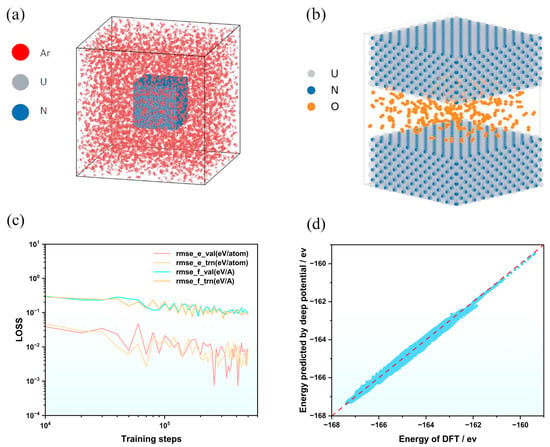
A large-scale atomic model of the UN/Ar mixed system was constructed to study the high-temperature decomposition behavior of UN during the SPS sintering process, as shown in Figure 1a. The UN crystal adopts the NaCl-type structure, containing 62,500 U atoms and 62,500 N atoms, with periodic boundary conditions and an equilateral simulation box. Ar atoms, with numbers varying between 25,000 and 35,000, were introduced into the model to simulate the gas density at different sintering pressures. Specifically, the simulations cover a parameter matrix of 24 (T, P) combinations composed of four pressure levels (50, 100, 200, and 400 MPa) and six temperature levels (1773–2273 K), covering the ranges typical of the UN sintering process and allowing further investigation of the high-temperature, high-pressure decomposition behavior of UN [11]. A two-stage protocol was adopted: first, a 750 ps relaxation in the NPT ensemble brings the system to thermodynamic equilibrium at the target temperature and pressure, with temperature controlled by a Nosé–Hoover thermostat [28] and pressure by a Parrinello–Rahman barostat [29]; then, a 1000 ps production run in the NVT ensemble is performed to sample the decomposition kinetics. The time step is 1 fs, and frames are output every 10 ps, giving 101 frames for analysis.
Figure 1.
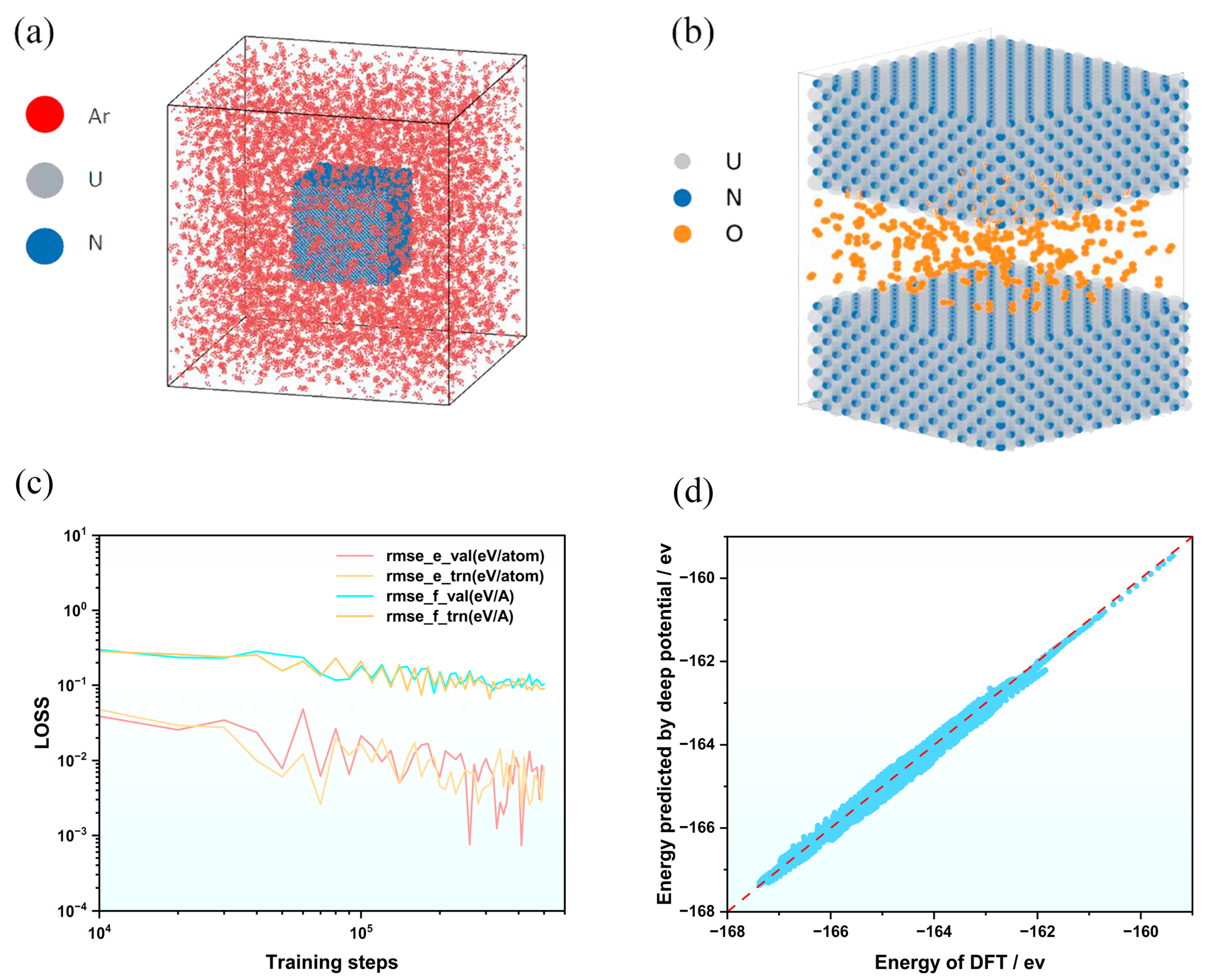
Construction of the U–N–O ternary deep potential model: (a) schematic of the UN/Ar simulation box (Ar red, U gray, N yellow); (b) atomic structure of the UN oxidation interface model (U gray, N blue, O red); (c) evolution of the root mean square error (RMSE) of energy and force during training (training/validation sets); (d) scatter plot comparing the energies predicted by the deep potential (DP) with DFT values (red dashed line: y = x).
A UN(001)–O2 interface model was constructed to study the adsorption of oxygen on the UN surface and its diffusion into the crystal, as shown in Figure 1b. The model adopts a “sandwich” configuration: two UN crystal layers at the top and bottom with 300 oxygen atoms in between, in a simulation box of 48.9 Å × 48.9 Å × 73.9 Å. This configuration provides two UN surfaces, thereby increasing the effective contact area between oxygen and UN; periodic boundary conditions preserve the long-range order of the UN crystal; an appropriate cutoff radius is chosen so that there is no interaction between the two UN surfaces; and the oxygen molecules are placed in the central region between the two UN layers to simulate diffusion and surface adsorption. The choice of 300 oxygen atoms is a compromise that balances a sufficient oxygen supply against statistical reliability, providing enough oxygen to observe the adsorption and diffusion behavior while avoiding excessive thermal motion that would interfere with the diffusion statistics. Nitrogen vacancies at three concentrations of 0%, 0.5%, and 1% were introduced into the UN lattice to examine the effect of lattice vacancies on oxygen diffusion, and molecular dynamics simulations were carried out at four temperatures of 1773, 1873, 1973, and 2073 K.
2.2. Construction and Validation of the U–N–O Ternary Machine Learning Potential
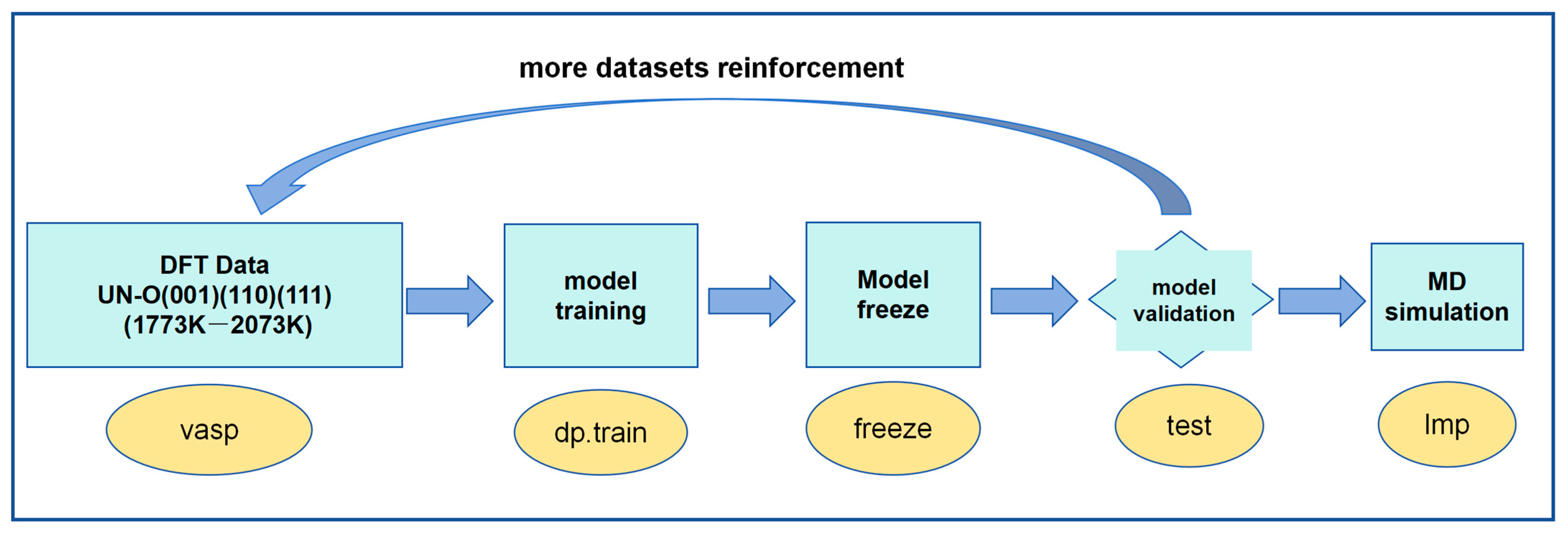
A U–N–O ternary deep potential was constructed within the DeePMD-kit framework to simultaneously describe the U–N bonding in the UN lattice (Figure 2), the dissociative adsorption of O2, and the U–O bonding. The training data were generated by VASP ab initio molecular dynamics (AIMD) and cover representative structures, including O2 adsorption configurations on UN surfaces and UO2 crystals, to ensure that the potential accurately describes the chemisorption of O2, the U–O bonding, and the interaction between the UN lattice and oxygen. The DFT calculations employed the PBE + U functional (U_eff = 3 eV) [30] with projector augmented-wave (PAW) pseudopotentials [31], a plane-wave cutoff of 500 eV, a 2 × 2 × 1 k-point mesh, and spin polarization; the AIMD simulations were performed in the NVT ensemble at 1773–2073 K with a time step of 1 fs. The model uses the se_e2_a descriptor to encode the local atomic environment and fits the potential-energy surface with a deep neural network; an adaptive learning rate strategy was adopted during training, and the energy and force losses of the training and validation sets were monitored simultaneously to judge convergence. The energy root mean square error is below 0.05 eV/atom, and the force root mean square error is below 0.05 eV/Å; during training, the energy loss decreased from about 0.05 eV/atom to the 10−3–10−2 eV/atom level and the force loss from about 0.5 eV/Å to about 0.1 eV/Å, with the training and validation curves remaining consistent and showing no obvious overfitting (Figure 1c). Figure 1d shows that the predicted energies are highly linearly correlated with the DFT values, with the data points tightly distributed around the ideal fitting line, suggesting the high accuracy of the machine learning potential.
Figure 2.
Construction workflow of the U–N–O machine learning potential.
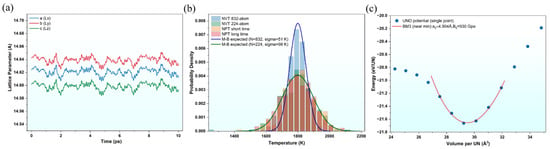
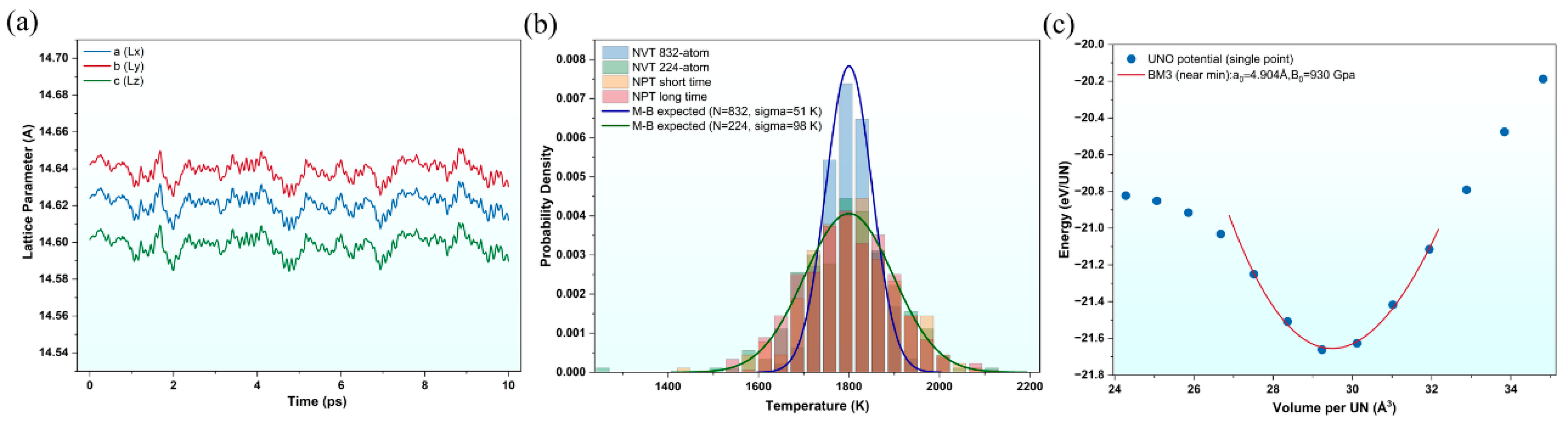
To ensure the reliability of the U–N–O potential for its intended application, we validated it from three perspectives: structural stability, statistical sampling, and equilibrium geometry. First, by monitoring the lattice parameters during NPT simulations at 1800 K (Figure 3a), we found that the lattice constants remain stable at about 4.87 Å without drift and preserve the cubic symmetry of the rock salt lattice, confirming the structural stability at high temperature. Second, by comparing the temperature distribution of UN under different simulation conditions with the Maxwell–Boltzmann distribution (Figure 3b), we found that the observed temperature fluctuations follow the Maxwell–Boltzmann distribution, with an observed-to-theoretical width ratio of about 1.06, indicating that the potential provides physically consistent thermodynamic sampling. Third, from the equation-of-state fit of bulk UN (Figure 3c), the fitted equilibrium lattice constant a0 = 4.904 Å deviates from the experimental value of 4.889 Å by only 0.3%, confirming that the potential accurately reproduces the equilibrium structure of UN. On the basis of the above evidence, we conclude that the potential reproduces the equilibrium geometry of UN and provides physically reasonable thermodynamic and structural behavior at high temperature and is, therefore, suitable for the structural and dynamical simulations reported in this work.
Figure 3.
Validation of the U–N–O machine learning potential. (a) Supercell edge lengths Lx, Ly, and Lz of UN at 1800 K versus time; with three unit cells per axis, the lattice parameter is a = L/3 ≈ 4.87 Å; (b) energy comparison between the temperature distribution obtained from the simulation and the Maxwell–Boltzmann distribution; (c) equation-of-state fit of bulk UN.
3. Results and Discussion
3.1. The High-Temperature Decomposition Behavior of UN
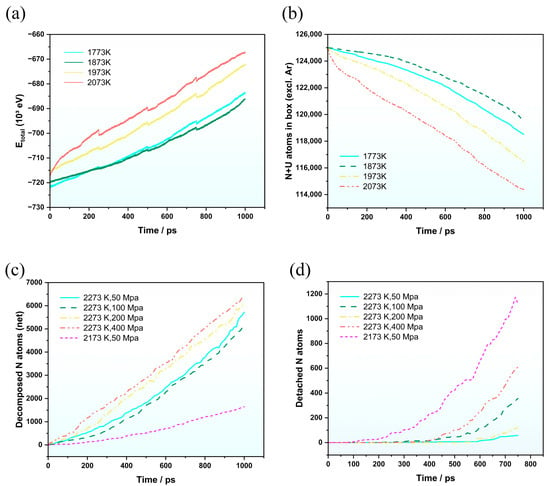
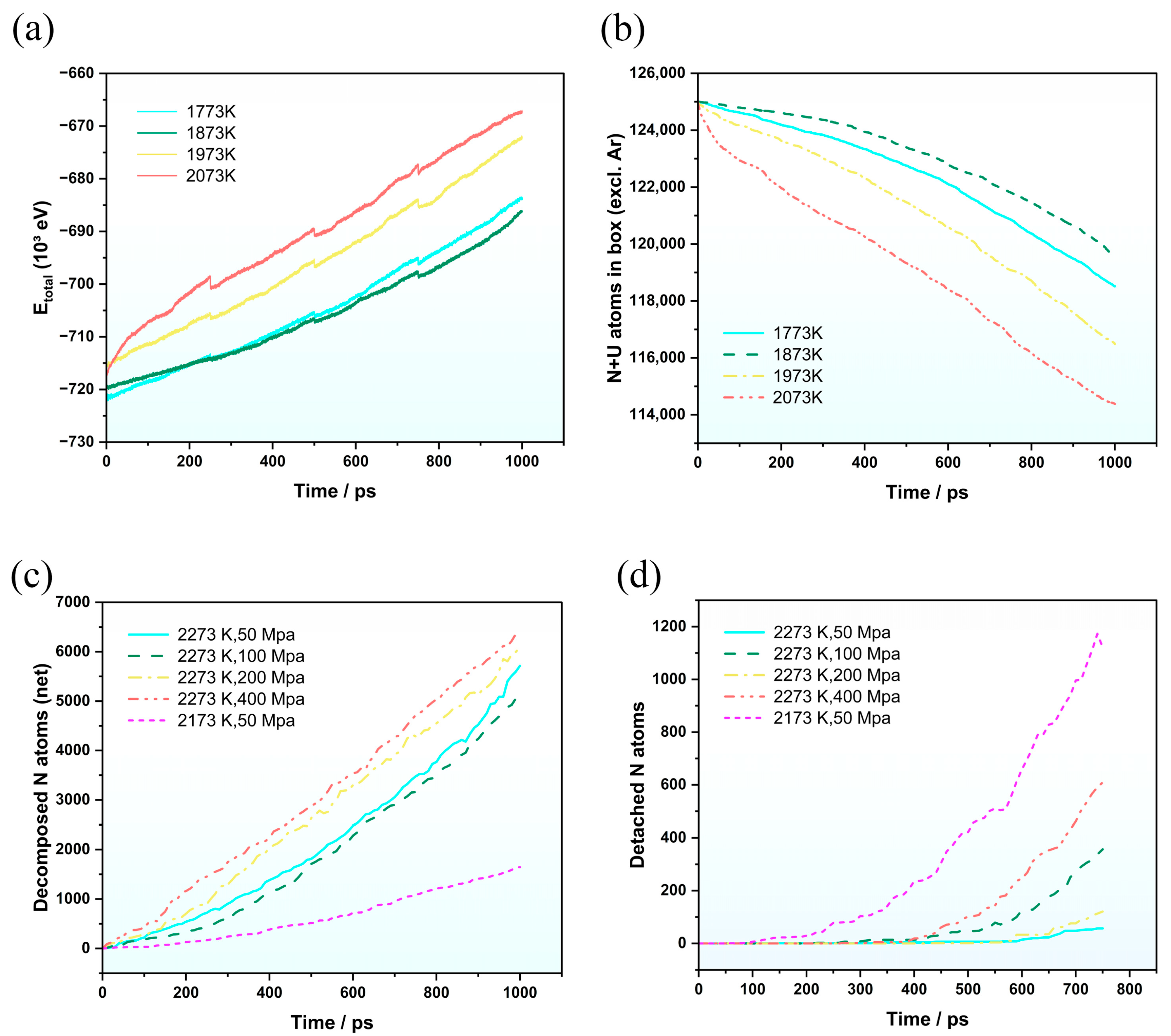
The high-temperature decomposition of UN was examined under 24 (T, P) combinations composed of four pressures (50, 100, 200, and 400 MPa) and temperatures from 1773 to 2273 K, with the decomposition ratio quantified by the total decomposition fraction f_tot. The evolution of UN thermal decomposition during the NVT and NPT simulations of the UN/Ar system and the corresponding decomposition ratios are shown in Figure 4. The results show that the thermal decomposition of UN is clearly temperature-dominated, with a decomposition threshold of about 1900 K, and that the effect of pressure on decomposition shows opposite trends in the low-to-intermediate and high temperature regimes. As shown in Figure 4a–c, during the NVT production stage, the system temperature fluctuates within ±5 K around the target value, the total energy rises by about 46 × 103 eV over 1 ns, corresponding to the endothermic nature of decomposition, and the number of atoms in the box decreases continuously by 6500–10,700, reflecting the continuous loss of N2 molecules and a small number of U atoms from the system. Significant decomposition already occurs at high temperature during the NPT relaxation stage (Figure 4d), with the number of detached N atoms reaching about 1150 at 400 MPa, and the relaxation-stage decomposition accounting for 30–40% of the total high-temperature decomposition, indicating that UN begins to decompose during heating and relaxation.
Figure 4.
Evolution of decomposition during the NVT and NPT simulations of the UN/Ar system. (a) Total energy versus time; (b) number of N + U atoms in the box versus time; (c) net number of decomposed N atoms during the NVT production stage versus time; (d) number of detached N atoms during the NPT relaxation stage versus time.
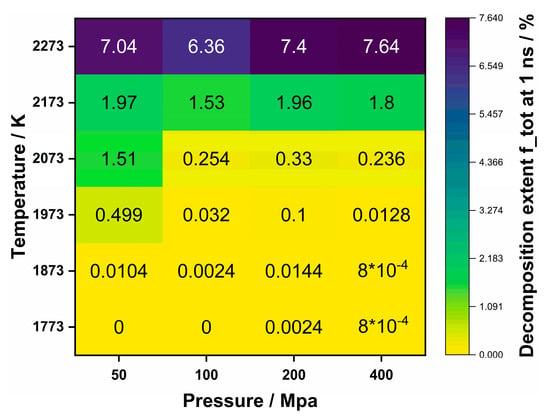
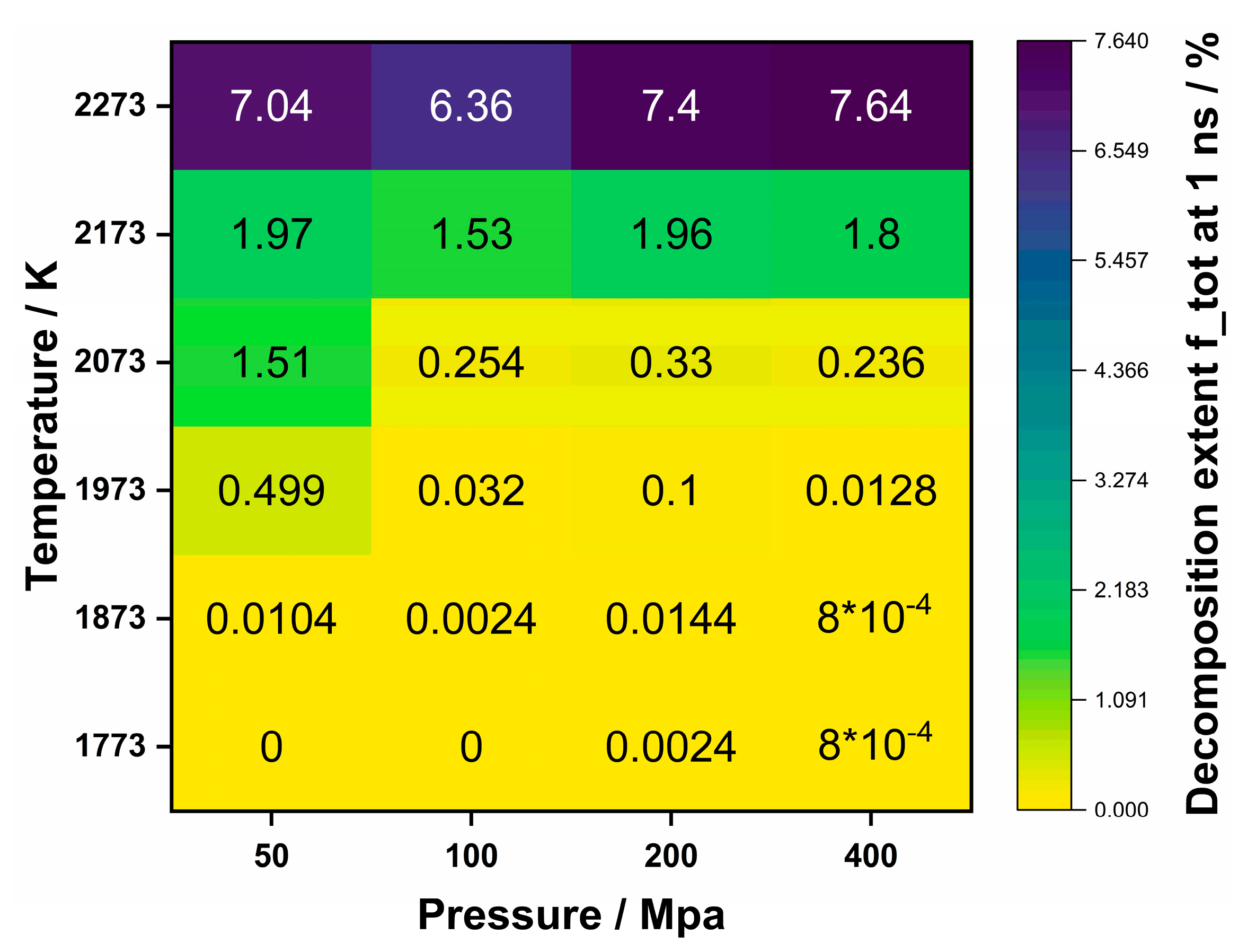
Figure 5 summarizes the total decomposition fraction f_tot at 1 ns for the 24 (T, P) combinations. The decomposition of f_tot is below 0.02% and the UN crystal is highly stable at all pressures up to 1873 K, while decomposition becomes visible from 1973 K, increasing to 0.24–1.51% at 2073 K, 1.53–1.97% at 2173 K, and jumping to 6.36–7.64% at 2273 K, from which the decomposition threshold of UN is determined to be about 1900 K. The results are consistent with previous experimental reports: Yang et al. (2021) studied the UN sintering behavior and found that slight UN decomposition occurred at temperatures above 1650 °C [11]. Therefore, the present simulation agrees well with the published literature. Specifically, the decomposition fraction increases sharply with temperature, with a 3–4-fold jump between 2173 and 2273 K, indicating that temperature is the dominant factor controlling UN decomposition. On the other hand, the suppressing effect of pressure on decomposition shows a clear temperature dependence. In the 1973–2073 K range, high pressure significantly suppresses decomposition, and at 2073 K, the decomposition fraction at 400 MPa is only 16% of that at 50 MPa, corresponding to a suppression ratio of about 84%. However, the decomposition fractions at all pressures reach 6.4–7.6% at 2273 K with 400 MPa, slightly higher than that of 50 MPa, suggesting that the pressure-suppressing effect weakens as the temperature further increases. These trends follow from the sequence of steps that UN decomposition requires. Specifically, a nitrogen atom must first leave its lattice site, migrate to the UN surface, and combine with a second nitrogen atom to desorb as N2. Each step is thermally activated, so the decomposition rate increases exponentially with temperature. The energy balance is consistent with this sequence: the system absorbs about 46 × 103 eV during the 1 ns production stage (Figure 4a), which is the cost of transferring nitrogen and uranium from the lattice to the gas phase. The equilibrium concentration of nitrogen vacancies is too low for the sequence to be completed within the simulation time below the temperature of 1900 K, which leads to the low f_tot of 0.02% up to 1873 K, after which it rises steeply. Decomposition converts a condensed phase into gas and, therefore, expands the system. An external pressure raises the chemical potential of the gas phase and shifts the equilibrium towards the condensed state. At 2073 K, f_tot falls from 1.51% at 50 MPa to 0.24% at 400 MPa, with a suppression of about 84%. Therefore, the uranium is more likely to be suppressed by increasing pressure compared to nitrogen, which leads to higher nitrogen atoms in the released species at 100 MPa instead of at 400 MPa (Figure 6b). At 2273 K, the four isobars converge to 6.4–7.6%, because the volume term is only one part of the driving force and the rate becomes limited by the interfacial step that converts lattice nitrogen into N2, on which pressure does not act directly.
Figure 5.
Heatmap of the total decomposition fraction ftot at 1 ns for the 24 (T, P) combinations. The horizontal axis is pressure, and the vertical axis is temperature; the color and cell values indicate the decomposition extent.
Figure 6.
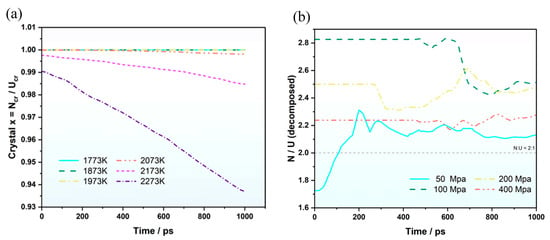
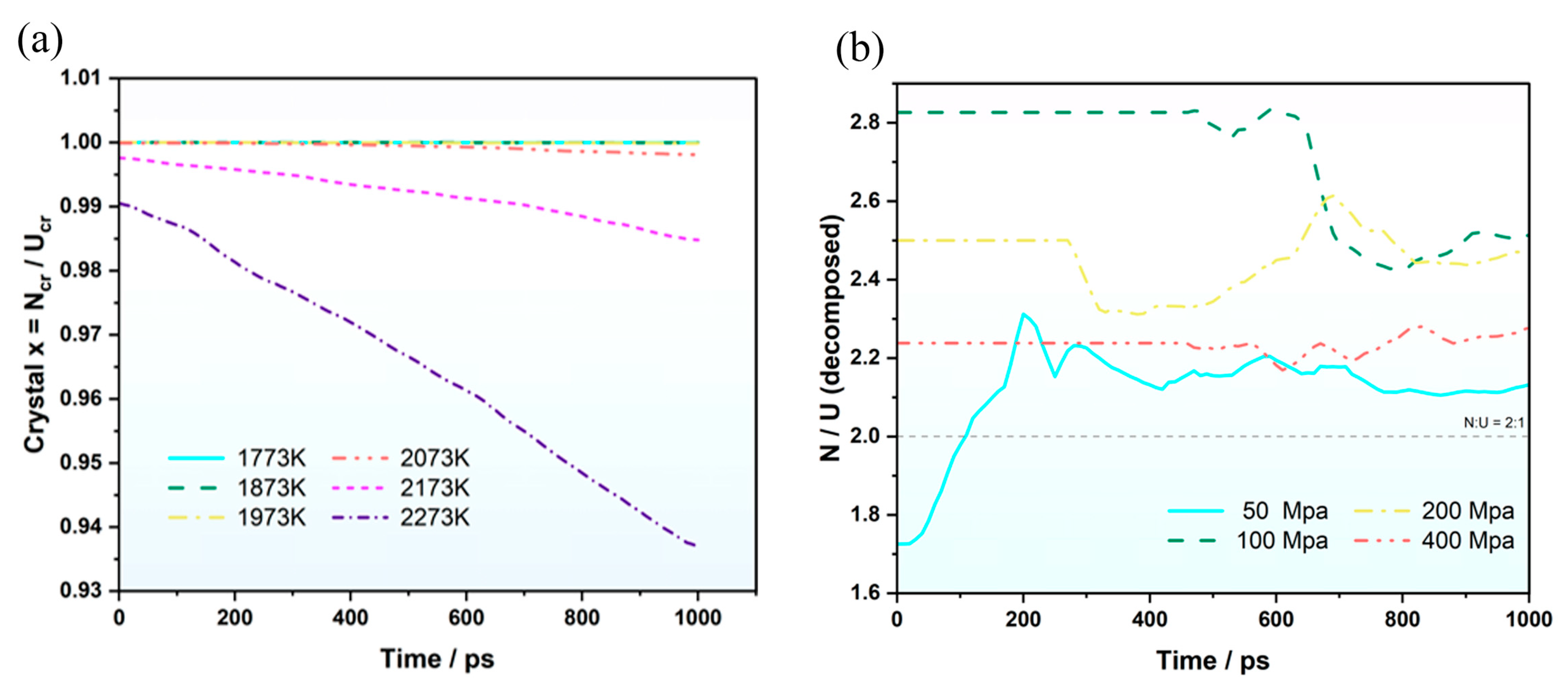
Evolution of the N/U ratio of the residual crystal and the decomposition products. (a) N/U ratio of the residual crystal versus time at different temperatures; (b) N/U ratio of the decomposition products versus time at different pressures.
We further examined the composition of the residual crystal and of the species released during decomposition; the corresponding N/U ratios and possible decomposition products are shown in Figure 6. As shown in Figure 6a, the N/U ratio of the residual crystal remains essentially constant at about 1.00 at 1773–1973 K, confirming that the UN lattice is stable below the decomposition threshold. With increasing temperature, the crystal N/U ratio decreases progressively with time: the decrease is negligible at 2073 K, becomes appreciable at 2173 K, and is most pronounced at 2273 K, showing that a higher temperature causes more nitrogen to be lost from the lattice. Figure 6b shows the N/U ratio of the released species at different pressures. At all pressures, this ratio remains above 1.6 throughout the simulation and settles at about 2.1–2.5 at 1 ns, well above the value of 1.0 expected for stoichiometric UN decomposition; this indicates that nitrogen is released preferentially as N2 while most uranium is retained in the lattice. Notably, the ratio depends non-monotonically on pressure: it is lowest at 50 MPa, highest at 100 MPa, and decreases again at 400 MPa. This behavior shows that pressure does not monotonically suppress the preferential release of nitrogen. Instead, two competing effects govern the composition of the released species: at low pressure, uranium co-evaporates relatively easily, which dilutes the released nitrogen and lowers the N/U ratio; as the pressure rises to about 100 MPa, uranium evaporation is suppressed more than N2 release, so the released species become more nitrogen-rich; at still higher pressure, the release of N2 itself is increasingly suppressed, and the N/U ratio falls back.
3.2. The High-Temperature Thermal Decomposition Kinetics of UN
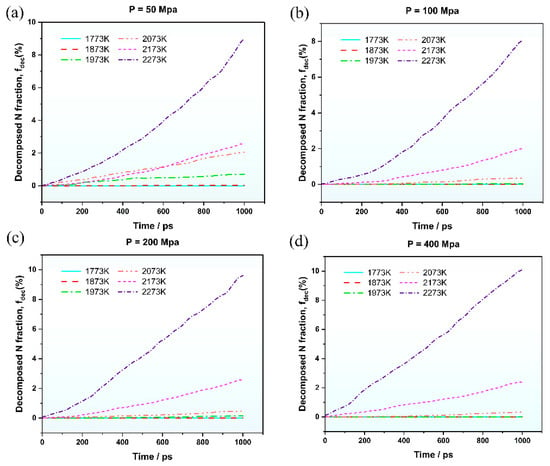
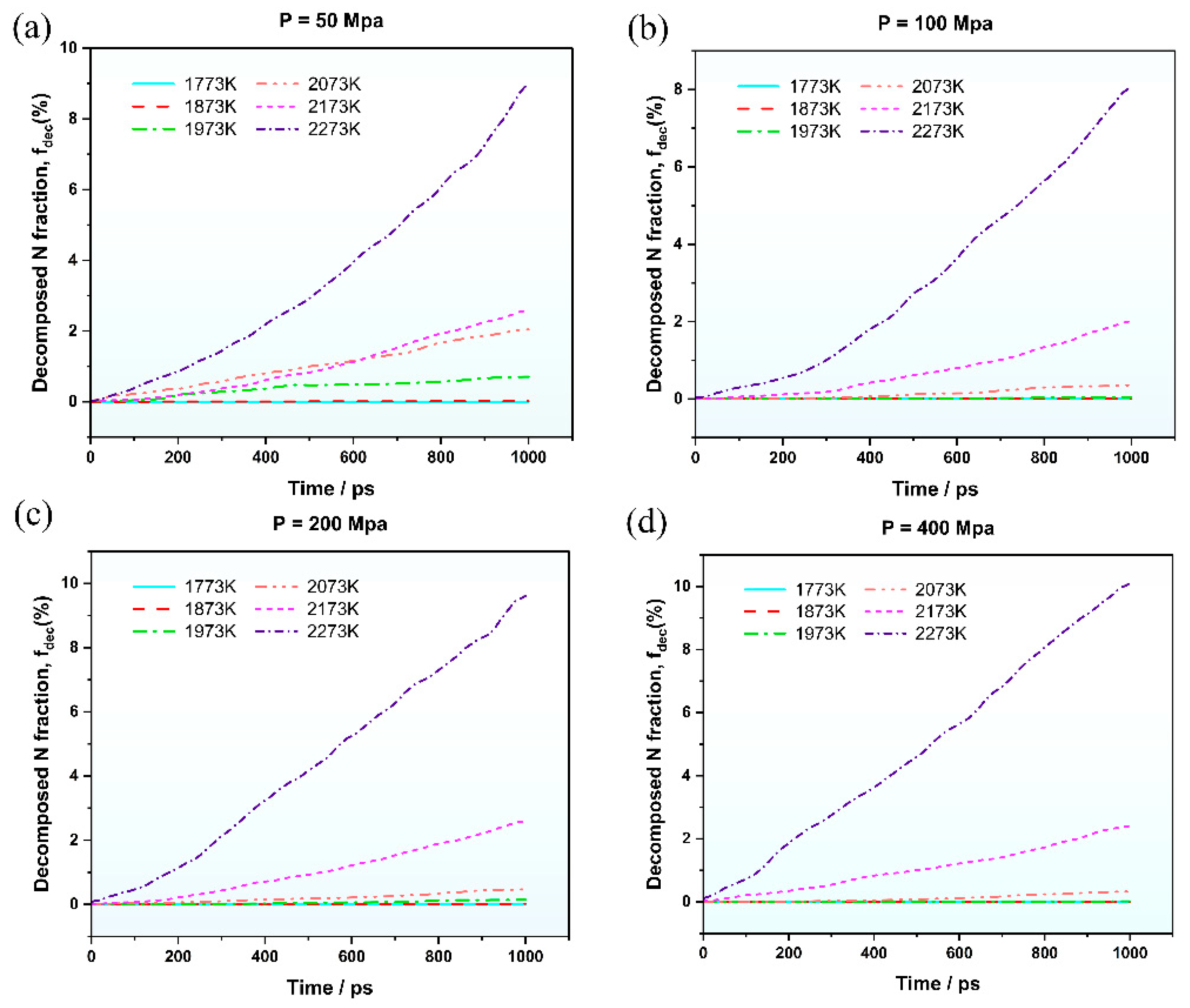
The evolution of the decomposition fraction of UN with temperature and pressure was further analyzed to characterize the kinetic features of UN decomposition (Figure 7a–d). At temperatures ≤ 1973 K, the curves are nearly flat at all pressures, with the decomposition fraction below 0.5% within 1 ns, indicating relatively weak thermal decomposition. The thermal decomposition starts slowly at 2073 K, with nearly linear growth reaching 0.2–1.5% at 1 ns. The thermal decomposition is accelerated when the temperature is further increased to 2173 K and 2273 K, with the decomposition ratio reaching 1.5–2.0% and 6.4–8.9% and higher at 1 ns, respectively.
Figure 7.
Evolution of the UN decomposition fraction with time at different pressures: (a) 50 MPa; (b) 100 MPa; (c) 200 MPa; (d) 400 MPa. The curves in each panel correspond to different temperatures.
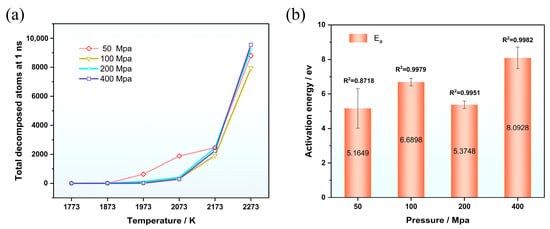
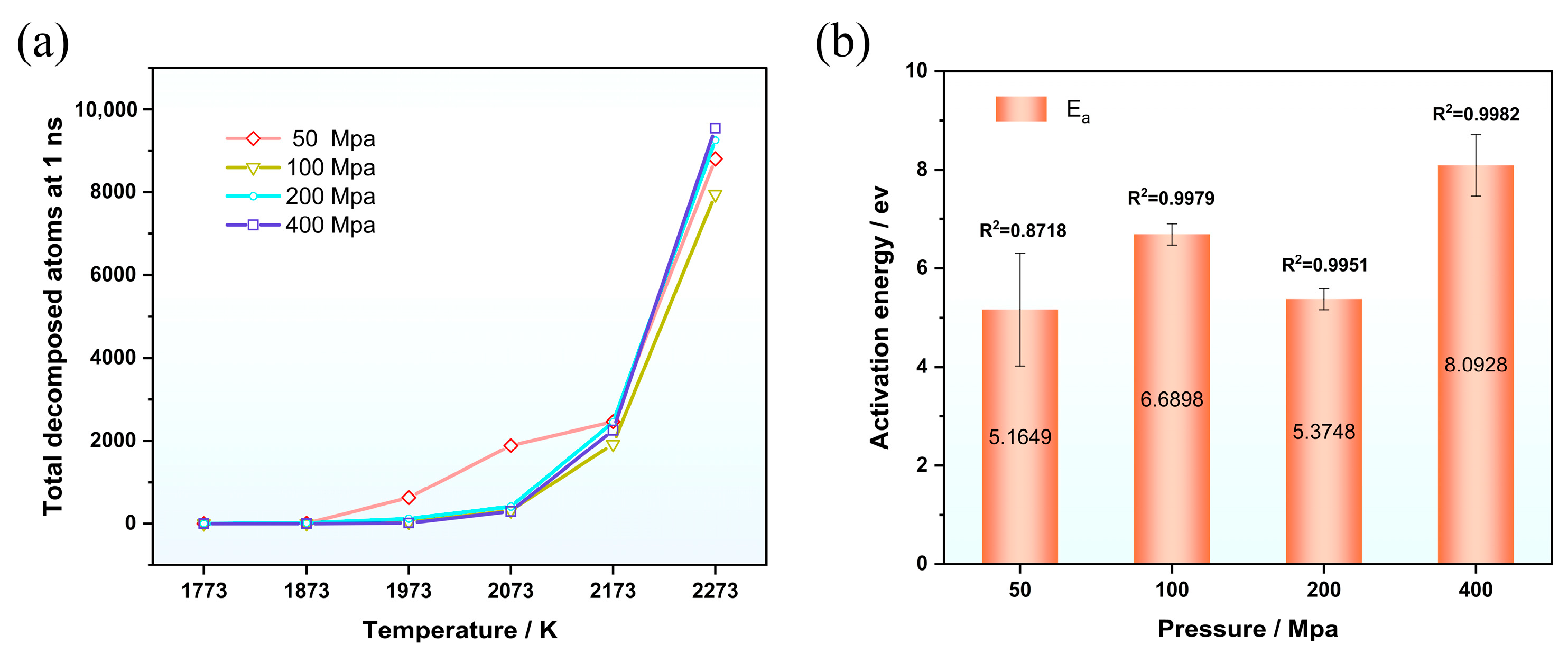
Moreover, the decomposition is most pronounced at 50 MPa, reaching 8.9% at 2273 K. The thermal decomposition is strongly suppressed when the pressure is further increased to 100 MPa at low-to-intermediate temperatures. Therefore, the decomposition onset temperature rises with increasing pressure, while the decomposition is more sensitive to temperature at low pressure. Figure 8a shows the decomposition rate and the total number of decomposed atoms as functions of temperature; both increase exponentially with temperature, with the total number of decomposed atoms reaching 8000–9600 at 2273 K. The decomposition fraction follows an Arrhenius relationship with temperature, with linear fitting between ln f and 1000/T at all pressures, indicating that decomposition follows a thermally activated mechanism [8]. The decomposition activation energies obtained from these fits at each pressure are shown in Figure 8b: 5.16 eV at 50 MPa, 6.69 eV at 100 MPa, 5.37 eV at 200 MPa, and 8.09 eV at 400 MPa, averaging 6.33 eV. The values span about 3 eV rather than clustering around one number, which is consistent with the sequence predicted in Section 3.1. The values span about 3 eV rather than clustering around one number. That spread is what the sequence in Section 3.1 predicts. The Arrhenius slope measures the combined cost of forming a nitrogen vacancy, migrating nitrogen to the surface, and desorbing it as N2.
Figure 8.
The decomposition behavior and kinetic parameters of UN decomposition. (a) Total number of decomposed atoms (and decomposition rate) versus temperature at 1 ns; (b) decomposition activation energy Ea at each pressure obtained from the Arrhenius fits.
The released U and N species at 50 MPa have the lowest N/U ratio among the four pressures, suggesting that uranium leaves the lattice together with nitrogen. The highest energy barrier of 8.09 eV is observed for UN at 400 MPa; at this high pressure, the released nitrogen atoms readily form N2 gas, and the extra energy is added to the energy barrier.
The phase decomposition ratios are 0.100% and 0.330% at 200 MPa, compared with 0.032% and 0.254% at 100 MPa within the temperature range of 1973–2073 K. By contrast, the thermal decomposition ratios are 7.40% and 6.36% at 200 MPa and 100 MPa, respectively. Therefore, the temperature-driven decomposition of UN can be divided into two distinguishable processes and mechanisms, with energy barriers of 6.69 eV at 100 MPa and 5.37 eV at 200 MPa.
3.3. The High-Temperature Oxygen Diffusion Behavior in UN
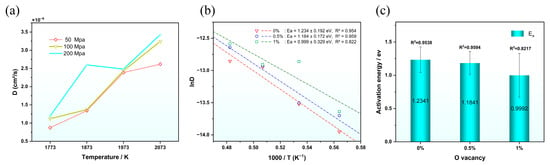
The diffusion coefficients of O were obtained by mean square displacement (MSD) analysis to study the diffusion behavior of O atoms in UN [32] at 1773–2073 K with nitrogen-vacancy concentrations of 0%, 0.5%, and 1%, and the diffusion activation energies were fitted from the Arrhenius equation. The diffusion coefficient increases from 8.73 × 10⁻⁷ cm2/s at 1773 K to 2.62 × 10⁻⁶ cm2/s under 0% vacancy from 1773 K to 2073 K (Figure 9a), reflecting the high thermal sensitivity of O diffusion. For comparison, the diffusion coefficient of O increases with vacancy concentration for the UN with N vacancies, indicating that N vacancies provide additional diffusion channels for O atoms.
Figure 9.
Effect of N vacancies on the diffusion of O in UN. (a) Diffusion coefficient D versus temperature at different N-vacancy concentrations; (b) Arrhenius fit of the diffusion coefficient (ln D–1000/T); (c) diffusion activation energy Ea versus N-vacancy concentration.
Figure 9b shows that the temperature dependence of the diffusion coefficient obeys the Arrhenius equation, with the ln D versus 1000/T plots fitting well linearly at all vacancy concentrations, confirming that O diffusion strictly follows a thermally activated mechanism. Figure 9c shows that the fitted diffusion activation energy decreases monotonically with increasing N-vacancy concentration, from 1.234 eV at 0% to 1.184 eV at 0.5% and 0.999 eV at 1%, a reduction of about 19% as compared to 0%. This indicates that N vacancies do not act as “traps” that capture O atoms and suppress diffusion; instead, they provide lower-energy diffusion pathways for O, promoting its diffusion in the UN lattice through vacancy hopping or vacancy–solute complex migration mechanisms.
3.4. The High-Temperature Oxidation Behavior of UN
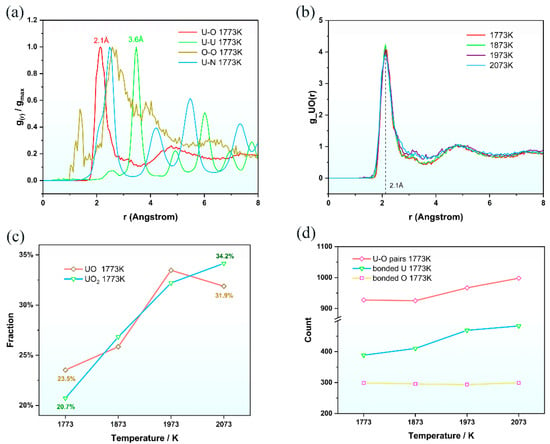
The radial distribution function (RDF), U–O bond statistics, and coordination environment of the oxidation interface products were analyzed to explore the atomic-scale mechanism of the high-temperature oxidation of UN. The first broad peak of the U–O RDF is located at about 2.1 Å at 1773 K (Figure 10a,b), clearly shorter than the U–O bond length in crystalline UO2. The U–U and U–N RDFs retain clear crystalline peaks, suggesting that the UN matrix lattice remains intact during oxidation. The O–O RDF is severely broadened and disordered, indicating that almost all O2 molecules are dissociated. The position of the first U–O peak remains stable at about 2.1 Å with only slight broadening over 1773–2073 K, indicating that the short-range structure of the interfacial amorphous product is insensitive to temperature. According to the definition of the radial distribution function, the value at the first minimum is used as the criterion for judging bonding. Specifically, taking the first minimum of the RDF as the bonding criterion, the cutoff distance for U–O bonding is defined as 2.85 Å. Figure 10c,d show that at all temperatures, nearly all O atoms participate in bonding, confirming that the dissociative adsorption of O2 is efficient and nearly complete. The number of U–O bonds increases from 927 pairs at 1773 K to 996 pairs at 2073 K, and the number of bonded U atoms increases from 391 to 483, while the O/U stoichiometric ratio decreases from 0.76 to 0.62, indicating that at high temperature oxidation shifts from a “concentrated” mode around a few U atoms to a “dispersed” mode over more U atoms. The distribution of U oxidation states shows that the fraction of low-valence UO increases from 23.5% to about 31.9% with increasing temperature, while the fraction of high-valence UO2 increases from 20.7% to 34.2%, further demonstrating that high temperature is the key factor promoting deep oxidation of U.
Figure 10.
Radial distribution function, oxidation states, and bond statistics of the high-temperature oxidation interface of UN. (a) Normalized radial distribution functions g(r)/gmax of the atomic pairs (U–O, U–U, O–O, U–N) at 1773 K; (b) U–O radial distribution function g_UO(r) at different temperatures; (c) fractions of the U oxidation states (UO, UO2) versus temperature; (d) number of U–O bond pairs, bonded U atoms, and bonded O atoms versus temperature.
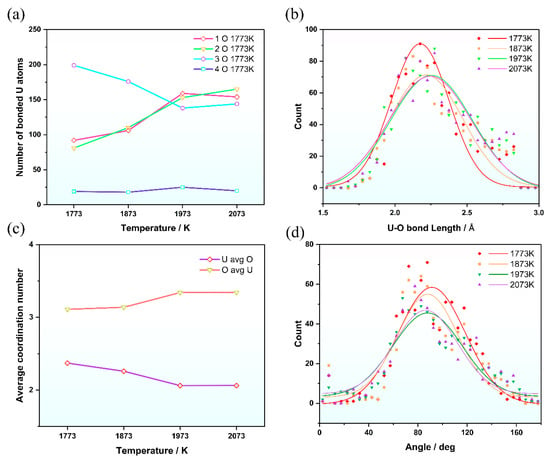
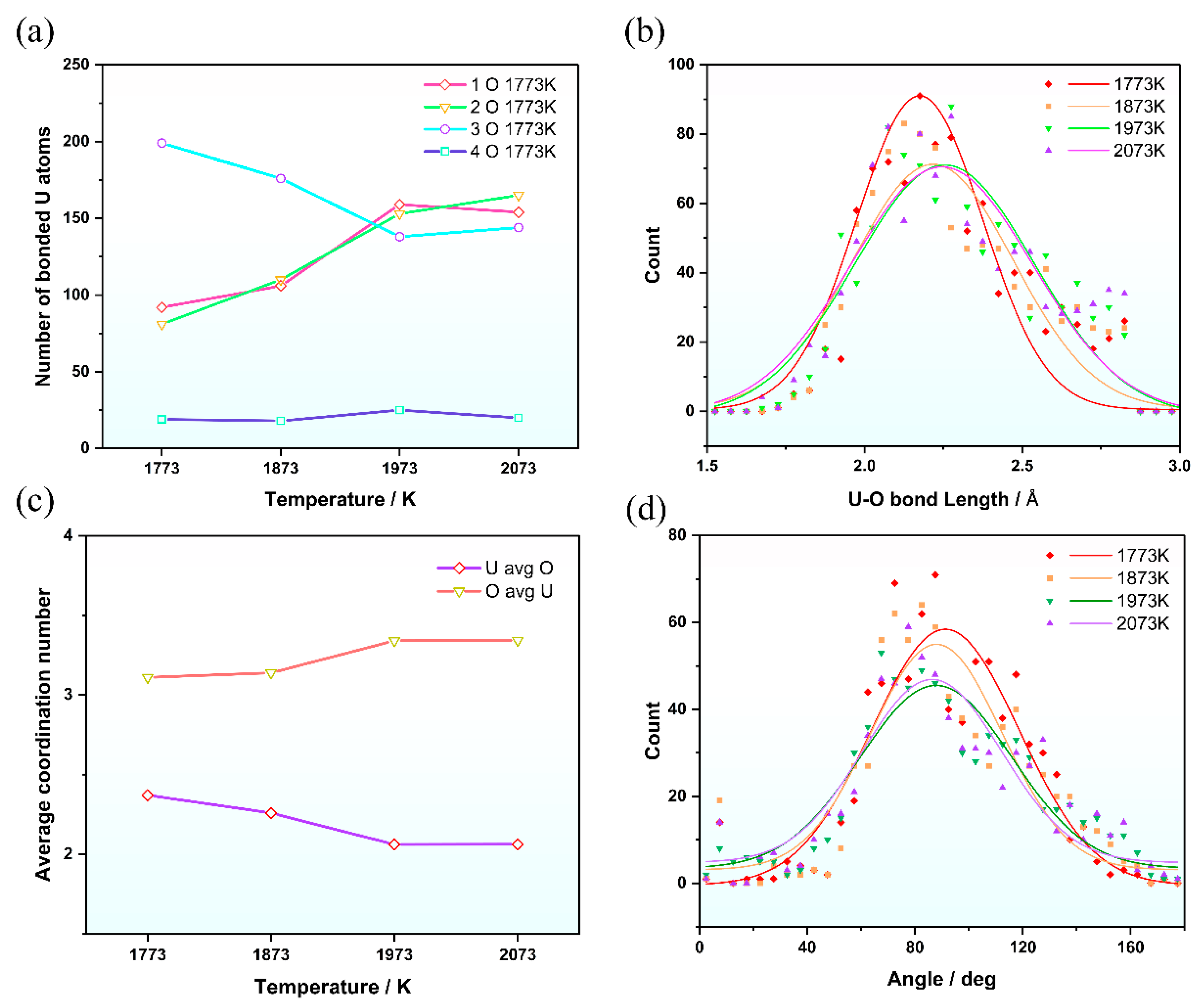
The nearest neighbor coordination environments of U and O were further analyzed to confirm the amorphous nature of the interface products. The average O coordination number of U is only 2.1–2.4, far lower than the 8-fold coordination of U in crystalline UO2 (Figure 11). The average U coordination number of O is about 3.2–3.4, close to but more broadly distributed than the 4-fold coordination in crystalline UO2. The bond-length and bond-angle distributions of U–O bonds at different temperatures show that the U–O bond-length distribution peaks at about 2.1–2.2 Å and spans 1.5–3.0 Å, while the U–O bond-angle distribution peaks at about 92° with a full width at half maximum of about 30°, all lacking the sharp features of crystalline UO2. The average U coordination number decreases from about 2.4 to about 2.1 with increasing temperature, fully consistent with the transition from the “concentrated” to the “dispersed” oxidation mode. Therefore, the comprehensive comparison of bond length, coordination number, bond angle, and long-range order constitutes a complete chain of evidence for the amorphous identification.
Figure 11.
Coordination environment analysis of the U–O oxidation products of UN. (a) Number of bonded U atoms versus temperature at different O coordination numbers; (b) U–O bond-length distribution; (c) average coordination number versus temperature; (d) O–U–O bond-angle distribution versus temperature.
4. Conclusions
This study avoids the conventional, time-consuming procedure of developing an empirical potential by employing a highly accurate reaction potential based on deep learning molecular dynamics, using a U–N–O ternary machine learning potential to quantitatively reveal the thermal decomposition and oxidation behavior of UN under high-temperature sintering at the atomic scale, thereby providing a theoretical basis for optimizing the sintering process.
- (1)
- The current work systematically studied the high-temperature and high-pressure decomposition of the UN fuel via MD simulation. The results suggest that the thermal decomposition threshold of UN is about 1900 K, which is consistent with the experimental observation: the crystal is highly stable below 1873 K, and the total decomposition fraction rises to 6–9% at 2273 K. Decomposition follows a thermally activated mechanism with an average decomposition activation energy of about 6.33 eV and manifests as the selective release of nitrogen. Kinetically, decomposition follows first-order kinetics at 50–100 MPa and linear growth at 200–400 MPa, with the rate constant increasing significantly with temperature. High pressure can significantly suppress high-temperature phase decomposition, which implies that the high-temperature sintering of large-grain-size UN simultaneously requires a higher uniaxial pressure.
Therefore, the safe UN sintering temperature is well below 1773 K, while the temperature can increase to 1873 K if the pressure increases to 400 MPa.
- (2)
- A deep learning U–N–O potential was successfully established based on the DFT and DeePMD. The results suggest that O2 undergoes nearly complete dissociative adsorption on the UN surface, and the interface forms amorphous oxygen-deficient UOx rather than crystalline UO2, with an average U coordination number of only 2.1–2.4 and a U–O bond length of about 2.1 Å, both markedly deviating from crystalline UO2. The thermally activated diffusion of O in UN is accelerated by crystalline vacancies, which are generated during the high-temperature sintering process. The corresponding O diffusion activation energy, about 1.0–1.23 eV, decreases monotonically with increasing N-vacancy concentration, indicating that N vacancies accelerate oxidative penetration by providing lower-energy-barrier diffusion pathways.
- (3)
- The above results define, at the atomic scale, the safe temperature–pressure window for UN sintering and reveal the key mechanisms by which N vacancies generated during sintering and irradiation accelerate oxidation and oxygen contamination induce the amorphous UOx phase, providing a quantitative basis for optimizing the sintering process and designing oxidation-resistant strategies for UN fuel.
The main limitations of this study are the restricted simulation temperature (1773–2273 K), the limited N-vacancy concentration (0–1%), the short time scale (1 ns), and the fact that only N vacancies were considered. Future work can further investigate the effects of U vacancies, antisite defects, and other defects on decomposition and diffusion, and extend to longer time scales and larger systems, to comprehensively evaluate the role of defect chemistry in the sintering and in-service performance of UN.
Author Contributions
Conceptualization, project administration Y.L. and K.Y.; methodology, Y.L.; software, writing and editing Z.L.; validation, formal analysis L.Y.; formal analysis, investigation S.Y.; investigation, resource L.S., S.W., and J.W.; resources, K.Y.; data curation, methodology Z.P. and T.S.; writing—original draft preparation, investigation Z.L. and J.X.; writing—review and editing, K.Y. and C.C. All authors have read and agreed to the published version of the manuscript.
Funding
This research received no external funding.
Institutional Review Board Statement
Not applicable.
Informed Consent Statement
Not applicable.
Data Availability Statement
The raw data supporting the conclusions of this article will be made available by the authors on request.
Conflicts of Interest
Authors Zongshu Li, Lu Yu, Yongheng Lu, Shuxin Yao, Liqing Shi, Tingyu Sun, Jingjing Xia and Chen Chen were employed by the company China north nuclear fuel co., Ltd. The remaining authors declare no conflicts of interest.
References
- Zinkle, S.J.; Was, G.S. Materials challenges in nuclear energy. Acta Mater. 2013, 61, 735–758. [Google Scholar] [CrossRef] [Scilit]
- Terrani, K.A. Accident tolerant fuel cladding development: Promise, status, and challenges. J. Nucl. Mater. 2018, 501, 13–30. [Google Scholar] [CrossRef] [Scilit]
- Bragg-Sitton, S.M.; Todosow, M.; Montgomery, R.; Stanek, C.R.; Carmack, W.J. Metrics for the technical performance evaluation of light water reactor accident-tolerant fuel. Nucl. Technol. 2016, 195, 111–123. [Google Scholar] [CrossRef] [Scilit]
- Hayes, S.L.; Thomas, J.K.; Peddicord, K.L. Material property correlations for uranium mononitride: I. Physical properties. J. Nucl. Mater. 1990, 171, 262–270. [Google Scholar] [CrossRef] [Scilit]
- Ross, S.B.; El-Genk, M.S.; Matthews, R.B. Thermal conductivity correlation for uranium nitride fuel between 10 and 1923 K. J. Nucl. Mater. 1988, 151, 318–326. [Google Scholar] [CrossRef] [Scilit]
- Muta, H.; Kurosaki, K.; Uno, M.; Yamanaka, S. Thermal and mechanical properties of uranium nitride prepared by SPS technique. J. Mater. Sci. 2008, 43, 6429–6434. [Google Scholar] [CrossRef] [Scilit]
- Mikhalchik, V.V.; Tenishev, A.V.; Baranov, V.G.; Kuzmin, R.S. High temperature uranium nitride decomposition. Adv. Mater. Res. 2014, 1040, 47–52. [Google Scholar] [CrossRef] [Scilit]
- Lunev, A.; Mikhalchik, V.; Tenishev, A.; Baranov, V. Kinetic and microstructural studies of thermal decomposition in uranium mononitride compacts subjected to heating in high-purity helium. J. Nucl. Mater. 2016, 475, 266–273. [Google Scholar] [CrossRef] [Scilit]
- Baranov, V.; Tenishev, A.; Kuzmin, R.; Pokrovskiy, S.; Mikhalchik, V.; Astafyev, V.; Taubin, M.; Solntseva, E. Thermal stability investigation technique for uranium nitride. Ann. Nucl. Energy 2016, 87, 784–792. [Google Scholar] [CrossRef] [Scilit]
- Malkki, P.; Jolkkonen, M.; Hollmer, T.; Wallenius, J. Manufacture of fully dense uranium nitride pellets using hydride derived powders with spark plasma sintering. J. Nucl. Mater. 2014, 452, 548–551. [Google Scholar] [CrossRef] [Scilit]
- Yang, K.; Kardoulaki, E.; Zhao, D.; Broussard, A.; Metzger, K.; White, J.T.; Sivack, M.R.; McClellan, K.J.; Lahoda, E.J.; Lian, J. Uranium nitride (UN) pellets with controllable microstructure and phase—Fabrication by spark plasma sintering and their thermal-mechanical and oxidation properties. J. Nucl. Mater. 2021, 557, 153272. [Google Scholar] [CrossRef] [Scilit]
- Lu, L.; Li, F.; Hu, Y.; Xiao, H.; Bai, B.; Zhang, Y.; Luo, L.; Liu, J.; Liu, K. The initial oxidation behaviors of uranium nitride UNx (x = 0, 0.23, 0.68, 1.66) films. J. Nucl. Mater. 2016, 480, 189–194. [Google Scholar] [CrossRef] [Scilit]
- Lu, L.; Li, F.; Xiao, H.; Hu, Y.; Luo, L.; Bai, B.; Liu, J.; Liu, K. Thermal stability of uranium nitride and oxynitride films in an ultra-high vacuum environment. J. Nucl. Mater. 2018, 509, 408–416. [Google Scholar] [CrossRef] [Scilit]
- Joyce, L.; Xie, Y. A rapid sintering method for cerium nitride pellet: A uranium mononitride surrogate. Ceramics 2022, 5, 1009–1018. [Google Scholar] [CrossRef] [Scilit]
- Fonseca, L.G.; Hedberg, M.; Vollmer, T.R. Oxidation and hydrolysis of thorium doped uranium nitride fuel for use in LWR. J. Nucl. Mater. 2021, 555, 153150. [Google Scholar] [CrossRef] [Scilit]
- Zhukovskii, Y.; Bocharov, D.; Kotomin, E.; Evarestov, R.; Bandura, A. First principles calculations of oxygen adsorption on the UN(001) surface. Surf. Sci. 2009, 603, 50–53. [Google Scholar] [CrossRef] [Scilit]
- Zergoug, T.; Abaidia, S.E.H.; Nedjar, A. Oxygen diffusion and migration in clean and defective uranium nitride UN (0 0 1) surfaces. Comput. Mater. Sci. 2018, 144, 56–63. [Google Scholar] [CrossRef] [Scilit]
- Galashev, A.Y.; Vorob’ev, A.S.; Zaikov, Y.P. Structure of the interior and electronic properties of the surface of uranium nitride nanoparticles in the presence of oxygen. Mol. Phys. 2026, 124, e2497090. [Google Scholar] [CrossRef] [Scilit]
- Bartók, A.P.; Csányi, G. Gaussian approximation potentials: A brief tutorial introduction. Int. J. Quantum Chem. 2015, 115, 1051–1057. [Google Scholar] [CrossRef] [Scilit]
- Zhang, L.; Han, J.; Wang, H.; Car, R.; E, W. Deep potential molecular dynamics: A scalable model with the accuracy of quantum mechanics. Phys. Rev. Lett. 2018, 120, 143001. [Google Scholar] [CrossRef] [Scilit]
- Lu, D.; Wang, H.; Chen, M.; Lin, L.; Car, R.; E, W.; Jia, W.; Zhang, L. 86 PFLOPS deep potential molecular dynamics simulation of 100 million atoms with ab initio accuracy. Comput. Phys. Commun. 2021, 259, 107624. [Google Scholar] [CrossRef] [Scilit]
- Yin, W.Q.; Bo, T.; Zhao, Y.B.; Zhang, L.; Chai, Z.F.; Shi, W.Q. Deep Learning of Accurate Interatomic Potentials for Uranium, Zirconium and Uranium-Zirconium Alloy. J. Nucl. Radiochem. 2024, 46, 450–461. [Google Scholar] [CrossRef]
- Alzate-Vargas, L.; Subedi, K.N.; Tutchton, R.M.; Gibson, T.; Lubbers, N.; Cooper, M.; Messerly, R. Toward machine learning interatomic potentials for modeling uranium mononitride. Mach. Learn. Sci. Technol. 2025, 6, 35064. [Google Scholar] [CrossRef] [Scilit]
- Liu, F.; Song, R.; Qiu, R.; Ding, X.; Sun, J. Transferable machine learning potential for modeling uranium nitrides across stoichiometries. Phys. Rev. Mater. 2026, 10, 73801. [Google Scholar] [CrossRef] [Scilit]
- Chen, B.; Hua, Z.; Watkins, J.K.; Malakkal, L.; Khafizov, M.; Hurley, D.H.; Jin, M. Machine learning interatomic potential for predicting the thermal properties of uranium nitride. J. Appl. Phys. 2025, 138, 205102. [Google Scholar] [CrossRef] [Scilit]
- Wang, H.; Zhang, L.; Han, J.; E, W. DeePMD-kit: A deep learning package for many-body potential energy representation and molecular dynamics. Comput. Phys. Commun. 2018, 228, 178–184. [Google Scholar] [CrossRef] [Scilit]
- Lawrence Bright, E.; Darnbrough, J.E.; Goddard, D.T.; Griffiths, I.; Cattelan, M.; Springell, R. Oxidation and passivation of the uranium nitride (001) surface. Corros. Sci. 2022, 209, 110705. [Google Scholar] [CrossRef] [Scilit]
- Nosé, S. A unified formulation of the constant temperature molecular dynamics methods. J. Chem. Phys. 1984, 81, 511–519. [Google Scholar] [CrossRef] [Scilit]
- Parrinello, M.; Rahman, A. Polymorphic transitions in single crystals: A new molecular dynamics method. J. Appl. Phys. 1981, 52, 7182–7190. [Google Scholar] [CrossRef] [Scilit]
- Dudarev, S.L.; Botton, G.A.; Savrasov, S.Y.; Humphreys, C.J.; Sutton, A.P. Electron-energy-loss spectra and the structural stability of nickel oxide: An LSDA+U study. Phys. Rev. B 1998, 57, 1505–1509. [Google Scholar] [CrossRef] [Scilit]
- Blöchl, P.E. Projector augmented-wave method. Phys. Rev. B 1994, 50, 17953–17979. [Google Scholar] [CrossRef] [Scilit]
- Zamzamian, S.M.; Zolfaghari, A.; Kowsar, Z. Molecular dynamics investigation of xenon, uranium, and oxygen diffusion in UO2 nuclear fuel. Comput. Mater. Sci. 2022, 211, 111553. [Google Scholar] [CrossRef] [Scilit]
Disclaimer/Publisher’s Note: The statements, opinions and data contained in all publications are solely those of the individual author(s) and contributor(s) and not of MDPI and/or the editor(s). MDPI and/or the editor(s) disclaim responsibility for any injury to people or property resulting from any ideas, methods, instructions or products referred to in the content. |
© 2026 by the authors. Licensee MDPI, Basel, Switzerland. This article is an open access article distributed under the terms and conditions of the Creative Commons Attribution (CC BY) license.