


Highlights
- The straightforward synthesis of a DOPO-based phosphonamidate with a morpholinopropanamino moiety is reported.
- The nitrogen-containing fragments interact with 3-hydroxy-2-naphthoic acid at the solid state.
- A salt was isolated from the mechanochemical reaction between the phosphonamidate and 3-hydroxy-2-naphthoic acid.
- The salt is a suitable luminescent flame retardant for PLA.
Abstract
The development of multifunctional additives that simultaneously improve fire resistance and provide optical functionality is an attractive strategy for producing advanced polymeric materials. In this context, 9,10-dihydro-9-oxa-10-phosphaphenanthrene-10-oxide (DOPO) is a well-established platform for chlorine- and bromine-free phosphorus-based flame retardants, while its chemical versatility offers opportunities to introduce complementary properties such as photoluminescence. In this work, a new nitrogen-containing DOPO derivative, 6-(3-morpholinopropanamino)dibenzo[c,e][1,2]oxaphosphinine 6-oxide (DOPO–NH^morph), was synthesized in 76% yield through a one-pot reaction between DOPO and 3-morpholinopropylamine mediated by a mild oxidant. DOPO–NH^morph was then reacted with fluorescent 3-hydroxy-2-naphthoic acid (HO2C-NaphOH). Quantitative mass recovery of the organic salt [DOPO–NH^morphH][O2C–NaphOH] was achieved at room temperature by mechanochemical grinding without further purification. Spectroscopic characterization and density functional theory calculations supported proton transfer and hydrogen-bonding interactions between the components. The resulting salt exhibited yellow emission centred at 574 nm, a photoluminescence quantum yield of 7%, and a nanosecond excited-state lifetime. TGA measurements were carried out to compare the thermal behavior of DOPO-NH^morph and [DOPO-NH^morphH][O2C-NaphOH] under N2 and air. Its incorporation into PLA affords photoluminescent materials with improved flame-retardant performance. These findings establish a straightforward strategy for producing a multifunctional DOPO-based additive that combines flame retardancy and photoluminescence in polymeric materials.
1. Introduction
Polymeric materials increasingly require additives capable of providing more than one function while limiting formulation complexity and the total additive content. In this context, combining flame retardancy with photoluminescence may be relevant for the development of visually detectable, traceable or optically responsive polymeric materials. These properties are conventionally introduced using separate additives, which may differ in compatibility, dispersion and migration behavior, and may negatively affect the processing or final properties of the polymer. Integrating phosphorus-based flame-retardant functionality and a luminophore within a single molecular represents an attractive design strategy. Among the recent publications in this field, Liu and Wang reported the preparation of a novel flame-retardant fluorescent supramolecular polymer via solvent-free modification of lipoic acid. The final product can behave either as flame-retardant additive and as fluorescent encryption material [1]. Jian et al. designed a fluorescent flame-retardant hybrid based on the assembly of luminescent Zn(8-hydroxyquinolinate)2 on the surface of ammonium polyphosphate, subsequently fed into epoxy-curing system for the construction of multifunctional epoxy-based composites. The resulting materials exhibited noticeable flame retardancy and a significant thermochromic behavior in their luminescence [2]. Further recent outcomes concern the functionalization of N,N′-4,4′-diphenylmethane-bismaleimide or 2-aminofluorene with organophosphorus groups. The compounds exhibited noticeable luminescence and excellent flame retardant properties for epoxy resins [3,4]. Anyway, modular approaches in which a luminophore is associated with a flame retardant with straightforward protocols based on non-covalent interactions have received limited attention, in particular for what concerns additives dedicated to bio-based polymers.
DOPO (9,10-dihydro-9-oxa-10-phosphaphenanthrene-10-oxide) is an organophosphorus compound widely investigated as a non-halogenated flame retardants for plastic materials [5,6,7]. Formal replacement of the P-H with a P-N bond leads to the formation of DOPO-based phosphonamidates (DOPO-am), which may exhibit advantageous flame-retardant properties arising from phosphorus–nitrogen synergism [8,9,10]. For example, the compound commonly known as EDA-DOPO, N,N′-bis(6-oxido-6H-dibenz[c,e][1,2]oxaphosphorin-6-yl)-1,2-ethanediamine, was reported to be an efficient, non-toxic flame retardant and was successfully produced at industrial scale [11,12]. The combined presence of phosphorus and nitrogen atoms favors polymer-chain crosslinking during thermal decomposition and promotes phosphorus retention in the condensed phase, facilitating the formation of a thermally stable char that protects the underlying matrix.
Conventional synthetic routes for the synthesis of DOPO-am (am = amines) derivatives generally require the synthesis of the intermediate species 9,10-dihydro-9-oxa-10-phosphaphenanthrene-10-chloride (DOPO-Cl), prepared by reacting DOPO with carbon tetrachloride or with other suitable chlorinating agents [12,13,14,15,16,17,18]. Subsequently, DOPO-Cl easily reacts with an amine to give the corresponding DOPO-am. Recently, more sustainable synthetic approaches using chlorine-free reactants have been reported for the preparation of these phosphonamidates. In particular, our research group has studied and patented a green protocol for the functionalization of H-phosphinates based on the oxidation of DOPO with a mild oxidant in the presence of an amine such as butylamine, morpholine, 4-acetylpiperazine, p-toluidine, N-methylaniline and N,N′-dimethylurea [19,20,21,22]. Differently from other organophosphorus compounds containing the phosphoryl fragment, these DOPO-am show scarce emissions, usually centred at relatively short wavelengths, and are therefore not suitable for technological applications concerning luminescence [23,24,25,26,27,28,29,30,31,32,33,34,35,36,37]. Building on our previous experience in the development of resource-efficient chemical processes based on improved atom economy, milder reaction conditions and reduced use of auxiliary substances [38,39], we considered mechanochemical assembly as a suitable strategy for introducing an additional functionality on DOPO-am without requiring further covalent derivatization.
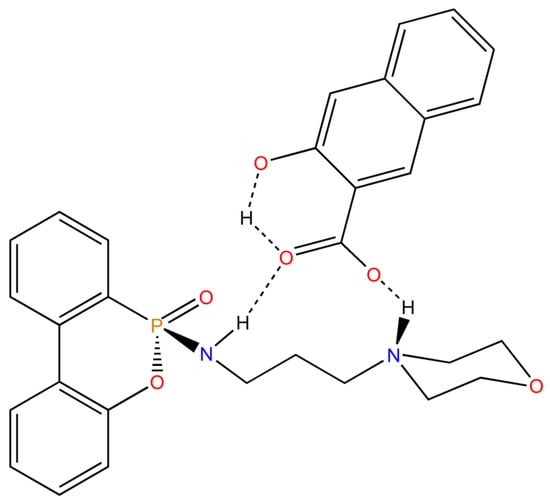
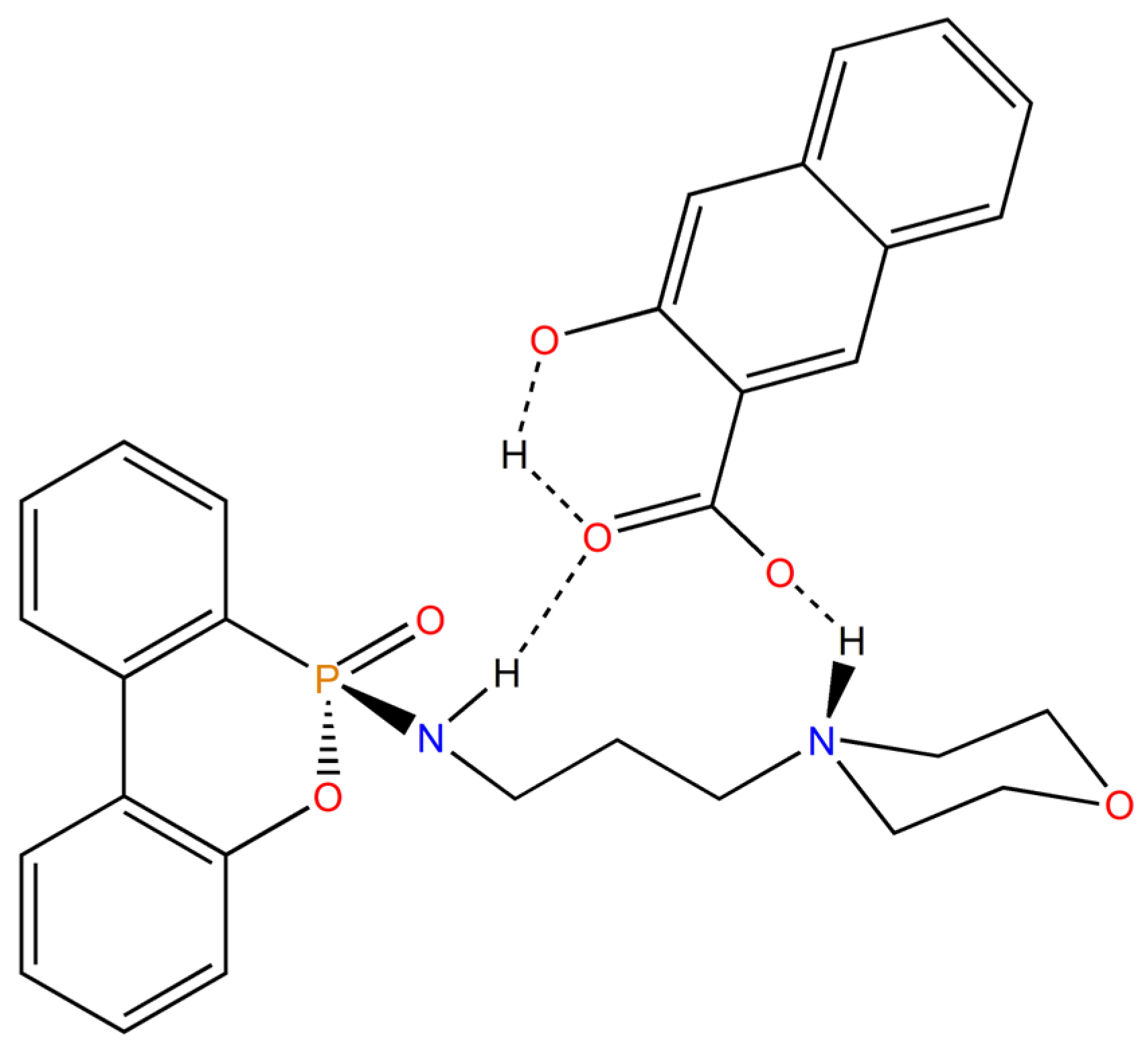
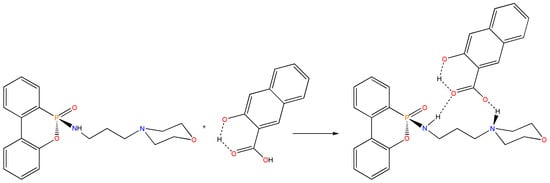
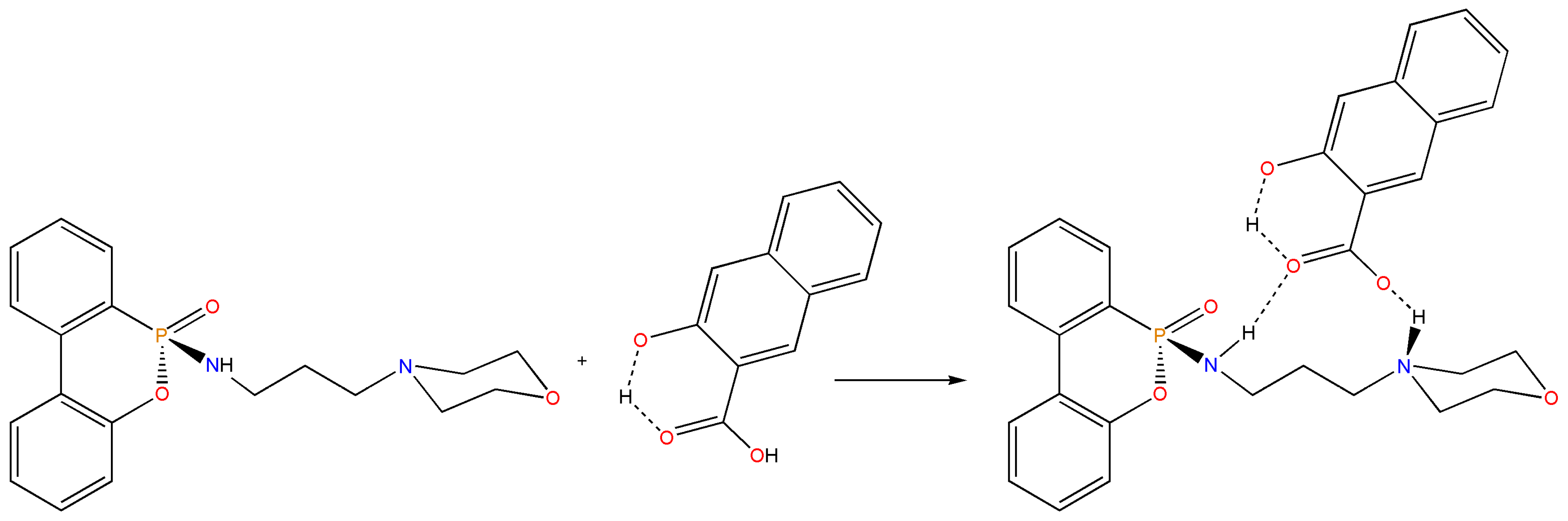
On this basis, the present study investigates a modular strategy in which a basic DOPO-derived phosphonamidate is combined with a photoluminescent carboxylic acid through proton transfer and hydrogen-bonding interactions. Unlike conventional covalent functionalization, the luminescent component is introduced by solvent-free grinding at room temperature, without additional reagents, solvents or purification steps during the assembly stage. The resulting salt, [DOPO-NH^morphH][O2C-NaphOH] (Figure 1), was structurally, thermally and photophysically characterized, and its preliminary behavior as a dual-function additive in PLA was assessed. Particular attention was paid to determining whether the combination preserves the luminescence of the organic acid while modifying the thermal decomposition and combustion behavior of the polymer.
Figure 1.
Proposed chemical structure of [DOPO-NH^morphH][O2C-NaphOH].
2. Materials and Methods
2.1. Materials
9,10-dihydro-9-oxa-10-phosphaphenanthrene-10-oxide (DOPO) was purchased from Fluorochem (Glossop, UK) and handled without further purification. The other reactants were purchased from Merck (Darmstadt, Germany) and used as received, with the exception of triethylamine, distilled over NaOH before use. Polylactic acid (PLA) was a TotalEnergies Corbion (Gorinchem, The Netherlands) product. The organic solvents were purified following literature methods [40]. The deuterated solvents used were Euriso-Top (Saarbrücken, Germany) products. Links to the safety data sheet of 3-hydroxy-2-naphthoic acid (HO2C-NaphOH) [41], DOPO [42] and 3-morpholinopropylamine [43] provided by the distributors are reported in the References section.
2.2. Characterizations
Elemental analyses (CHN) were carried out using an Elementar (Langenselbold, Germany) Unicube microanalyzer. Conductivity measurements in nitromethane and acetone were carried out at 25 °C with a Radiometer (Copenhagen, Denmark) CDM83 instrument. ATR-IR spectra were collected in the 4000–400 cm−1 range using a Perkin–Elmer (Shelton, CT, USA) Spectrum Two spectrophotometer equipped with a diamond ATR. Mono- and bi-dimensional nuclear magnetic resonance (NMR) spectra were collected employing Bruker (Billerica, MA, USA) Avance 600 and Avance 400 instruments operating, respectively, at 600.1 MHz and 400.1 MHz (1H resonance). 1H and 13C NMR spectra are referred to tetramethylsilane. 31P{1H} NMR spectra are referred to 85% H3PO4 in water.
Melting points were registered using a FALC (Treviglio, Italy) 360 D instrument equipped with a camera. Thermogravimetric analyses (TGA) were carried out under N2 (20 mL/min) or ultrapure air flow (20 mL/min) with a Perkin-Elmer (Shelton, CT, USA) TGA 4000 instrument. The common temperature range was 30–600 °C (10 °C/min), extended to 800 °C for selected measurements under ultrapure air. The first derivative of the TGA curves is indicated as DTG in the text. A Hikmicro (Hangzhou, China) Eco-V thermal camera was used during the flammability tests. Differential scanning calorimetry measurements were carried out under N2 flow (40 ml/min) with a Mettler Toledo (Columbus, OH, USA) DSC 3 instrument. The temperature range was 25–150 °C (10 °C/min).
Photoluminescence emission (PL) and excitation (PLE) spectra, as well as lifetime decay curves, were registered using an Edinburgh Instruments (Livingston, Scotland) FS5 spectrofluorometer with Peltier-based temperature controller. Suitable long-pass filters were placed in front of the acquisition systems. The excitation and emission spectra were corrected for the instrumental functions. Time-resolved analyses were performed in time-correlated single-photon counting (TCSPC) with an Edinburgh Instruments EPLED pulsed source centred at 365 nm. The room temperature photoluminescence quantum yields (Φ) were measured with an Edinburgh Instruments integrating sphere connected to the spectrofluorometer. The values reported are the average of three measurements.
2.3. Synthesis of DOPO-NH^morph
The preparation was carried out under N2 atmosphere. DOPO (1.00 g, 4.63 mmol) was dissolved in 30 mL of dichloromethane containing 1.3 mL (9.32 mmol) of triethylamine. 3-morpholinopropylamine (0.7 mL, 4.79 mmol) was added to the solution. Solid iodine (1.175 g, 4.63 mmol) was then added in small portions to the stirred solution, which was left under stirring for 8 h at room temperature. The reaction mixture was washed three times with 30 mL of water and the organic fraction was dried over Na2SO4. After filtration, the solvent was removed under reduced pressure. The addition of 10 mL of diethyl ether caused the separation of a white solid, which was collected by filtration, washed two times with 5 mL of diethyl ether and dried under vacuum. Yield 1.26 g (76%).
Characterization data for DOPO-NH^morph. M.p. 65 °C. Anal. calcd for C19H23N2O3P (358.37 g mol−1, %): C, 63.68; H, 6.47; N, 7.82. Found (%): C, 63.45; H, 6.50; N, 7.85. 1H NMR (C6D6, 400.1 MHz, 300 K) δ 8.00 (dd, 1H, JPH = 14.2 Hz, JHH = 7.5 Hz, arom), 7.51 (d, 1H, JHH = 8.0 Hz, arom), 7.48 (dd, 1H, JHH = 8.2 Hz, JPH = 5.6 Hz, arom), 7.18–7.11 (m, 2H, arom), 7.07 (td, 1H, JHH = 7.4 Hz, JPH = 3.1 Hz, arom), 6.94 (t, 1H, JHH = 7.6 Hz, arom), 6.84 (t, 1H, JHH = 7.6 Hz, arom), 5.60 (m, br, 1H, NH), 3.40 (t, 4H, JHH = 4.7 Hz, CH2Omorph), 2.83 (m, 2H, P-NH-CH2-CH2-CH2-morph), 2.10–1.90 (m, 6H, CH2Nmorph + P-NH-CH2-CH2-CH2-morph), 1.42 (quint, 2H, 6.7 Hz, P-NH-CH2-CH2-CH2-morph). The NH multiplet of another sample at 600.1 MHz resonated at 5.90 ppm (dt, 1H, JPH = 10.1 Hz, JHH = 6.6 Hz). 31P{1H} NMR (C6D6, 161.9 MHz, 300 K) δ 14.26 (s) 31P{1H} NMR (DMSO-d6, 161.9 MHz, 300 K) δ 14.88 (s). 13C{1H} NMR (C6D6, 151.1 MHz, 300 K) δ 150.5 (d, JPC = 7.2 Hz, arom-Cipso), 136.9 (d, JPC = 6.8 Hz, arom-Cipso), 132.0 (d, JPC = 2.3 Hz, arom-CH), 130.3 (s, arom-CH), 129.9 (s, arom-CH), 127.9 (HSQC projection, arom-CH), 126.1 (d, JPC = 162.7 Hz, arom-Cipso), 124.9 (s, arom-CH), 123.7 (s, arom-CH), 123.5 (d, JPC = 11.0 Hz, arom-CH), 122.5 (d, JPC = 11.6 Hz, arom-Cipso), 120.5 (d, JPC = 6.2 Hz, arom-CH), 66.6 (s, CH2Omorph), 56.2 (s, P-NH-CH2-CH2-CH2-morph), 53.5 (s, CH2Nmorph), 39.8 (s, P-NH-CH2-CH2-CH2-morph), 27.3 (d, JPC = 6.2 Hz, P-NH-CH2-CH2-CH2-morph). ATR-IR (cm−1): 3232 sh, 3188 (νNH), 1205 (νP=O).
2.4. Synthesis of [DOPO-NH^morphH][O2C-NaphOH]
In a typical preparation, DOPO-NH^morph (0.502 g, 1.40 mmol) was mixed in an agate mortar with a equimolar amount HO2C-NaphOH (0.263 g). The powders were finely ground for 20 min at room temperature. No further treatment was carried out and the recovered solid, which weighed 0.765 g, corresponds to 100% recovery of the combined reactant mass.
Characterization data for [DOPO-NH^morphH][O2C-NaphOH]. M.p. 66 °C. Anal. calcd for C30H31N2O6P (546.55 g mol−1, %): C, 65.93; H, 5.72; N, 5.13. Found (%): C, 65.68; H, 5.74; N, 5.11. 1H NMR (CD2Cl2, 600.1 MHz, 300 K) δ 8.34 (s, 1H, aromNaph), 7.87 (dd, 1H, JHH = 8.0 Hz, JPH = 5.9 Hz, aromDOPO), 7.84 (dd, 1H, JHH = 8.0 Hz, JHH = 1.5 Hz, aromDOPO), 7.77 (dd, 1H, JPH = 14.1 Hz, JHH = 7.4 Hz, aromDOPO), 7.68 (d, 1H, JHH = 8.3 Hz, aromNaph), 7.58–7.54 (m, 2H, aromDOPO + aromNaph), 7.38–7.32 (m, 2H, aromDOPO + aromNaph), 7.25 (t, 1H, JHH = 7.7 Hz, aromNaph), 7.17 (t, 1H, JHH = 7.5 Hz, aromDOPO), 7.15 (t, 1H, JHH = 7.6 Hz, aromDOPO), 7.11 (d, 1H, JHH = 8.1 Hz, aromDOPO), 7.07 (d, 1H, aromNaph), 3.81 (t, 4H, JHH = 4.8 Hz, CH2Omorph), 3.05–2.90 (m, 6H, N-bonded CH2), 1.89 (m, 2H, P-NH-CH2-CH2-CH2-morph). Very broad resonances are centred around 9.0, 4.6 and 2.9 ppm. The NH multiplet resonates at 5.82 ppm in DMSO-d6 solution (dt, 1H, JPH = 11.9 Hz, JHH = 6.9 Hz). 31P{1H} NMR (DMSO-d6, 161.9 MHz, 300 K) δ 14.77 (s). 13C{1H} NMR (CD2Cl2, 151.1 MHz, 300 K) δ 174.0 (s, COO), 157.7 (s, aromNaph-Cipso), 149.7 (d, JPC = 7.2 Hz, aromDOPO-Cipso), 137.3 (s, aromNaph-Cipso), 136.8 (d, JPC = 7.0 Hz, aromDOPO-Cipso), 133.0 (d, JPC = 2.5 Hz, aromDOPO-CH), 132.1 (s, aromNaph-CH), 130.3 (s, aromNaph-CH), 129.8 (d, JPC = 9.6 Hz, aromDOPO-CH), 129.0 (s, aromNaph-CH), 128.4 (d, JPC = 14.4 Hz, aromDOPO-CH), 127.8 (s, aromNaph-CH), 127.0 (s, aromNaph-Cipso), 125.8 (s, aromNaph-CH), 125.1 (s, aromDOPO-CH), 124.4 (s, aromDOPO-CH), 124.3 (d, JPC = 163.8 Hz, aromDOPO-Cipso), 123.9 (d, JPC = 11.4 Hz, aromDOPO-CH), 122.9 (s, aromDOPO-CH), 122.3 (d, JPC = 11.7, aromDOPO-Cipso), 120.3 (d, JPC = 6.2 Hz, aromDOPO-CH), 119.1 (s, aromNaph-Cipso), 110.1 (s, aromNaph-CH), 64.2 (s, CH2Omorph), 55.0, 52.0, 38.2 (s, CH2-N), 25.6 (d, JPC = 4.8 Hz, P-NH-CH2-CH2-CH2-morph). ATR-IR (cm−1): 3281 (νOH), 1662 (νCOO), 1205 (νP=O).
2.5. Preparation of Doped PLA Films
Films of polylactic acid (PLA) were obtained through solvent casting method according to common procedures [44,45] and doped with [DOPO-NH^morphH][O2C-NaphOH]. In typical preparation, pristine PLA (2.10 g) was dissolved in 15 mL of CH2Cl2, and the solution was stirred for 24 h at 35 °C. A CH2Cl2 solution (10 mL) containing 0.21 g or 0.42 g of [DOPO-NH^morphH][O2C-NaphOH] was subsequently added. The final solution was then cast onto a glass support, and the solvent evaporated at room temperature for 10 min, and then at 40 °C and 0.5 atm pressure overnight. The mass percentage of the additive in the final doped polymers was 9.1% or 16.7%. The materials are hereafter referred to as PLA9.1 and PLA16.7.
2.6. Computational Details
Non-periodic geometry optimizations were carried out with the density functional theory (DFT) r2SCAN-3c method [46], based on the meta-GGA r2SCAN functional [47] combined with a tailor-made triple-ζ Gaussian atomic orbital basis set [48,49]. The method also includes refitted D4 and geometrical counter-poise corrections for London dispersion and basis set superposition error [50,51]. IR simulations were carried out using the harmonic approximation, from which zero-point vibrational energies and thermal corrections (T = 298.15 K) were obtained. The software used was ORCA version 5.0.3 [52,53]. The output of the calculations was elaborated with Multiwfn version 3.8 [54,55]. The Cartesian coordinates of the optimized structures are collected in the Supplementary Materials, Table S1.
Periodic DFT calculations were carried out at the plane-wave DFT level, using the PBEsol GGA functional [56] in combination with on-the-fly generated ultrasoft pseudopotentials [57]. The number of resulting explicit electrons was 202. The dispersion corrections from Tkatchenko and Scheffler were added [58]. The plane-wave basis cut-off was set at 600 eV. The number of irreducible k-points in the Brillouin zone considered during SCF calculations was four. Relativistic effects were accounted for through the scalar Koelling–Harmon approximation [59]. The cell used belongs to the P1 space group and the lattice parameters were optimized together with the atomic coordinates, setting the compressibility at 500 GPa [60]. The initial coordinates were obtained from the previous r2SCAN-3c optimization of a single molecule. The initial parameters of the primitive cell were set considering the Van der Waals radii of the atoms composing the molecule. The software used was CASTEP version 23.1 [61]. Data concerning the optimized structure are reported in Table S2.
3. Results and Discussion
3.1. Synthesis and Characterization of DOPO-NH^morph
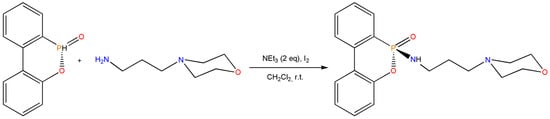
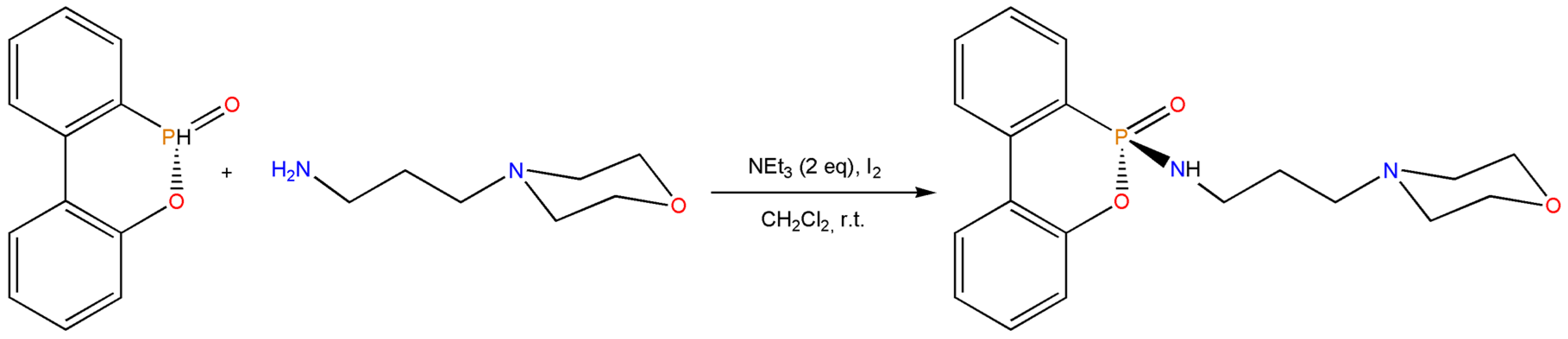
The phosphoramidate 6-(3-morpholinopropanamino)dibenzo[c,e][1,2]oxaphosphinine 6-oxide (DOPO-NH^morph) was synthesized by reacting DOPO with 3-morpholinopropylamine (NH2^morph) and I2 in the presence of triethylamine as proton scavenger, according to Scheme 1. The product was isolated as a white solid in 76% yield.
Scheme 1.
Synthesis of DOPO-NH^morph.
The spectroscopic data support the proposed molecular structure. The aromatic region of the 1H NMR spectrum (C6D6, 300 K) shows the resonances expected for the biphenyl moiety of the DOPO skeleton, several of which exhibit scalar coupling with the 31P nucleus. The formation of the P-N bond is supported by the NH resonance in the 5.5–5.9 ppm range, which shows a JPH coupling constant of 10.1 Hz together with the scalar coupling with the hydrogen atoms of the directly bonded methylene fragment (JHH = 6.6 Hz). The propylene chain corresponds to three multiplets centred between 2.9 and 1.4 ppm, in part superimposed with the two multiplets associated to the morpholine ring. The phosphorus atom in DOPO-NH^morph is a stereogenic centre and the hydrogen atoms of the methylene fragments are therefore diasterotopic; thus, all the coupling constants cannot be easily determined. Nevertheless, the multiplet at 2.83 ppm assigned to the P-NH-CH2-CH2-CH2-morph resonance is affected by 31P decoupling, further confirming the formation of the P-N bond. The aromatic region of the 13C{1H} NMR spectrum shows twelve resonances, eight correlated to the proton spectrum through HSQC experiments. Five resonances in the 67.0–27.0 ppm range are attributable to the morpholinopropylamino structure. Selected aromatic and aliphatic 13C{1H} NMR resonances are doublets because of the coupling with 31P. The 31P{1H} NMR spectra are composed by one sharp singlet, with chemical shift between 14.2 and 14.9 ppm depending upon the choice of the solvent. Representative NMR spectra are shown in Figures S1 and S2.
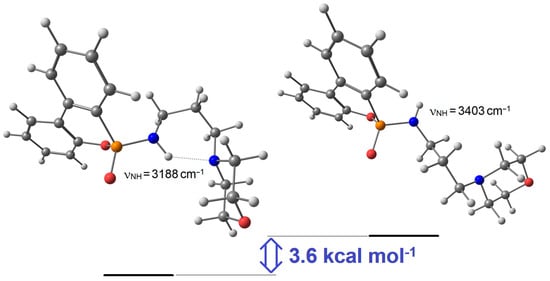
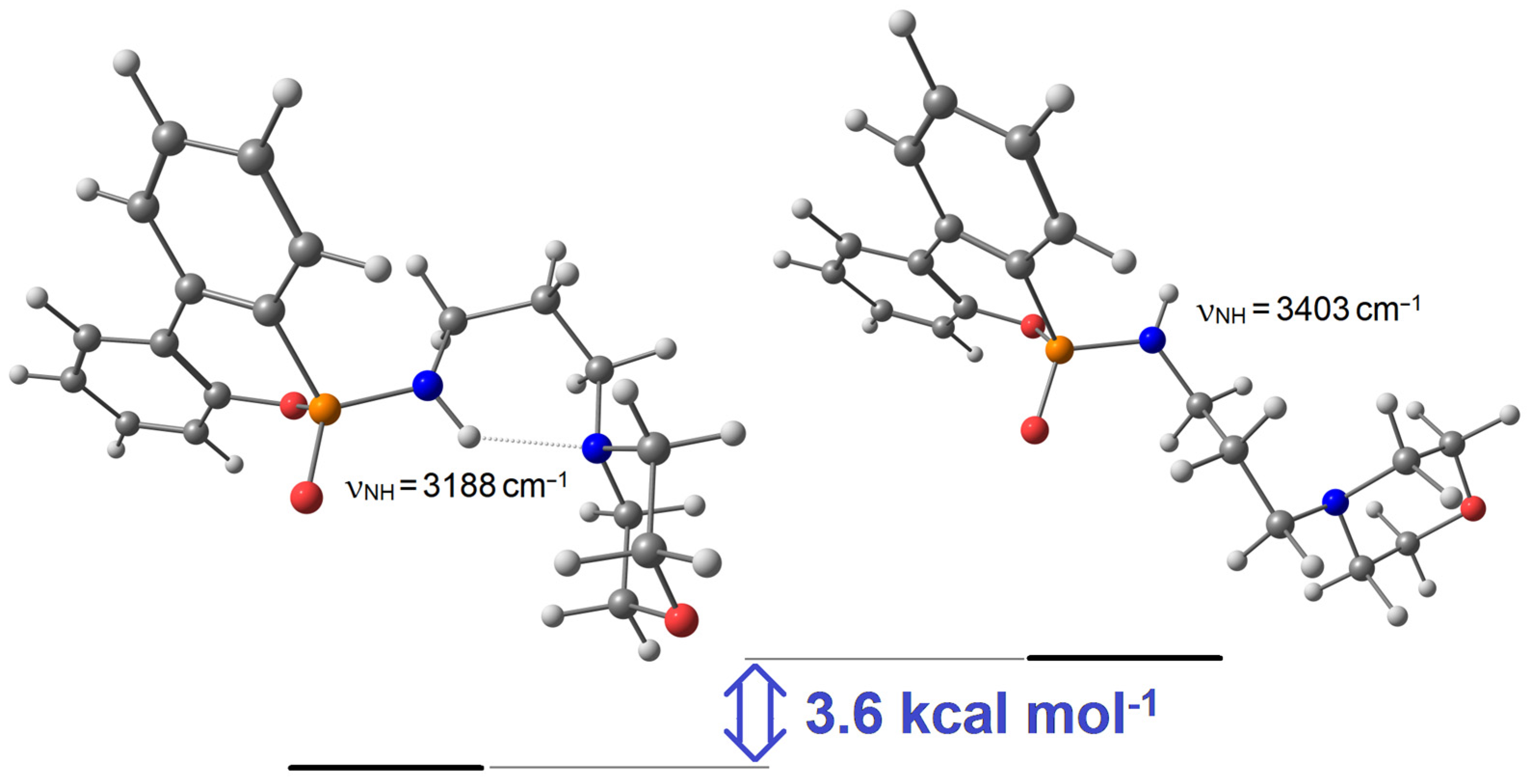
Diagnostic bands in the ATR-IR spectrum fall at 3188 cm−1 (with a shoulder around 3232 cm−1) and 1205 cm−1, respectively attributed to νNH and νP=O stretching [62]. The spectrum is shown in Figure S3. The νNH range is low-frequency shifted with respect to common NH stretching vibrations. A possible explanation is the formation of an intramolecular hydrogen bond between the NH moiety and the morpholine nitrogen atom [63]. DFT optimizations of the DOPO-NH^morph structure were carried out to support this hypothesis, revealing that the intramolecular hydrogen bond is associated with a thermodynamic stabilization around 3.6 kcal mol−1 (Gibbs free energy). Moreover, the intramolecular interaction (computed N-H and H---N bond lengths respectively equal to 1.023 and 2.060 Å) causes a red-shift greater than 200 cm−1 of the predicted νNH wavenumber. The DFT-optimized structures are shown in Figure 2.
Figure 2.
DFT-optimized structures of DOPO-NH^morph with Gibbs energy difference and computed νNH wavenumbers (scale factor equal to 0.94). Phosphorus, orange; oxygen, red; nitrogen, blue; carbon, grey; hydrogen, white.
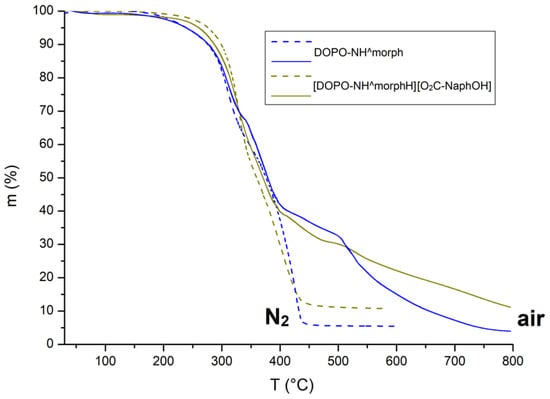
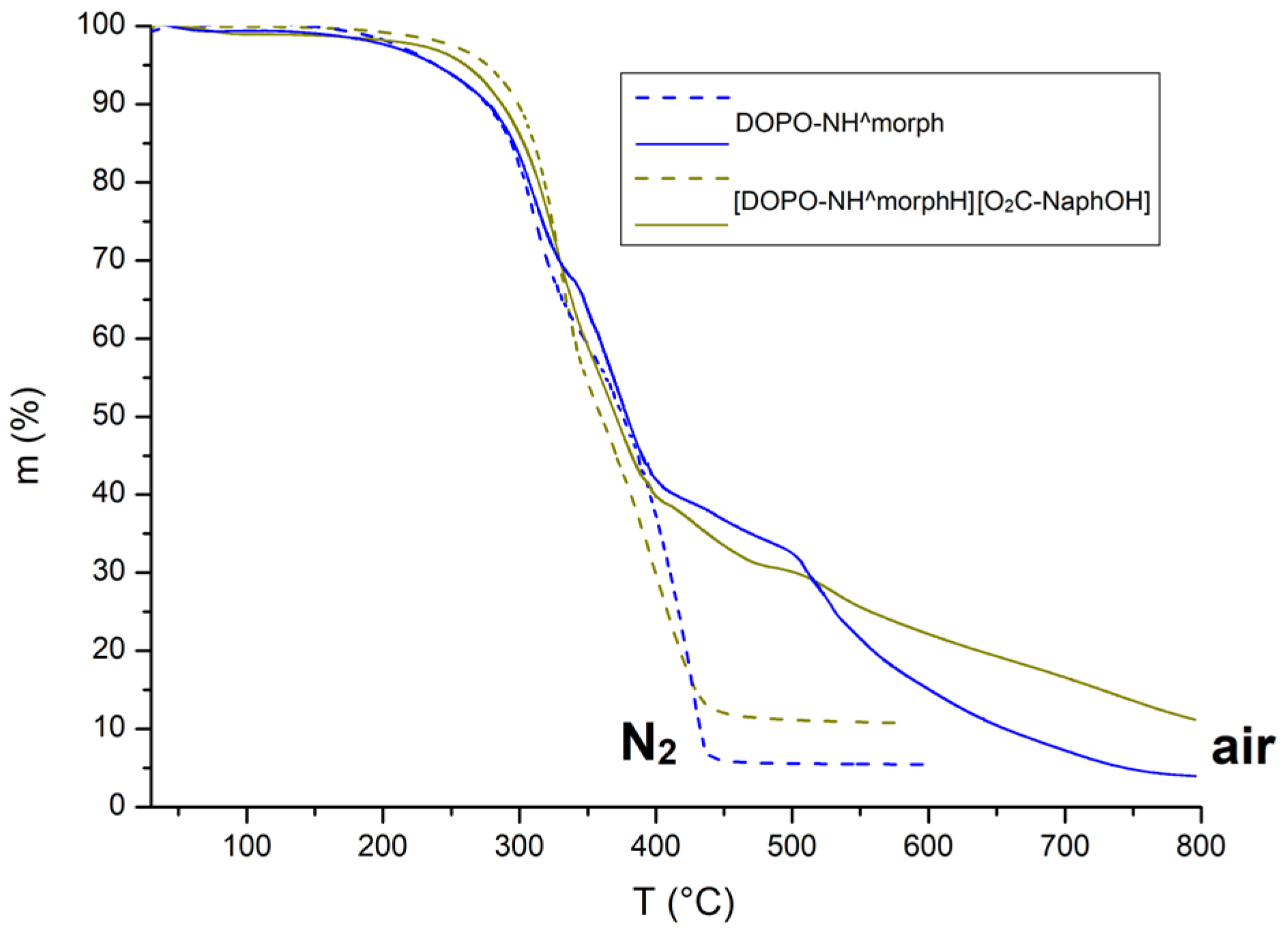
DOPO-NH^morph starts to melt without decomposition at about 65 °C. The mass loss under N2 begins above 200 °C and occurs in two stages, with DTG minima around 310 and 425 °C (Figure S4). The residual mass reaches a plateau around 5% above 445 °C.
Solid samples of DOPO-NH^morph exhibit a very weak bluish luminescence upon irradiation with UV light. The emission (PL) spectrum shows a band centred at 442 nm with full-width-half-maximum (FWHM) of 4850 cm−1. The excitation (PLE) spectrum revealed that the excitation range falls at wavelengths shorter than 330 nm. The lifetime of the excited state is in the nanoseconds range, in line with a fluorescent decay (Figure S5). The resulting photoluminescence was too low to allow quantum yield measurements.
3.2. Synthesis and Characterization of [DOPO-NH^morphH][O2C-NaphOH]
The presence of the morpholino fragment in DOPO-NH^morph makes the compound suitable to interact with acids or to form hydrogen bonds. One of the features of DOPO and of related phosphonamidates at the basis of their widespread application as dopants for plastics is their scarce toxicity [11,64]. The luminescent compound to be reacted with DOPO-NH^morph was thus chosen considering both spectroscopic features and toxicity issues. Despite the presence of an extended aromatic structure, HO2C-NaphOH is not a substance of concern [41]. Moreover, hydroxynaphtoic acids are well-known for their appreciable fluorescence [65,66], and the presence of the hydroxyl moiety could favor the electrostatic interaction with polar groups of selected polymer chains.
The reactions between DOPO-NH^morph and the carboxylic acid did not require solvents, but prolonged grinding at room temperature of stoichiometric mixtures of the two reagents as powders was sufficient to obtain the target salt [DOPO-NH^morphH][O2C-NaphOH] (Scheme 2). Notably, such a synthetic approach respects many principles of green chemistry, such as atom economy, reduction of derivatives, prevention of waste, less hazardous syntheses and lack of solvents [67], and it is therefore appealing compared to the covalent functionalization of DOPO with luminescent organic fragments [3,4].
Scheme 2.
Synthesis [DOPO-NH^morphH][O2C-NaphOH].
[DOPO-NH^morphH][O2C-NaphOH] is not soluble in C6D6; therefore, the NMR spectra were recorded for CD2Cl2 and DMSO-d6 solutions. The aromatic region of the 1H NMR spectrum (CD2Cl2, 300 K) shows the superposition of the eight resonances of the DOPO skeleton with the six signals of the 2,3-disubstituted naphthyl moiety. Accordingly, in the aromatic region of the 13C{1H} NMR spectrum between 158 and 110 ppm, twenty-two resonances can be recognized, eight of which related to ipso carbon atoms. The carboxylate carbon atom corresponds to a singlet at 174.0 ppm. Regarding the morpholinopropylamino pendant, the multiplet associated to the O-bonded methylene fragments falls at 3.81 ppm in the 1H NMR spectrum and the corresponding 13C{1H} NMR resonance is observable at 64.2 ppm. Another multiplet around 3.0 ppm accounts for three N-bonded methylene units, while the P-NH-CH2-CH2-CH2-morph resonance is centred at 1.89 ppm. As already observed for DOPO-NH^morph, the P-NH-CH2-CH2-CH2-morph 13C{1H} NMR signal is a doublet because of the coupling with the phosphorus centre (δ 25.6, JPC = 4.8 Hz). The OH, NH and one of the N-CH2 resonances cannot be unambiguously assigned in the 1H NMR spectrum in CD2Cl2, even if very broad resonances are centred around 9.0, 4.6 and 2.9 ppm. Nevertheless, the 13C{1H} NMR spectrum in CD2Cl2 shows three distinct resonances for N-bonded CH2, at 55.0, 52.0 and 38.2 ppm. The NH multiplet was detected in the 1H NMR spectrum recorded for a DMSO-d6 solution at 5.82 ppm (dt, 1H, JPH = 11.9 Hz, JHH = 6.9 Hz). The 31P{1H} NMR spectrum is a singlet with chemical shift closely comparable with that of DOPO-NH^morph. Selected NMR spectra are shown in Figures S6 and S7.
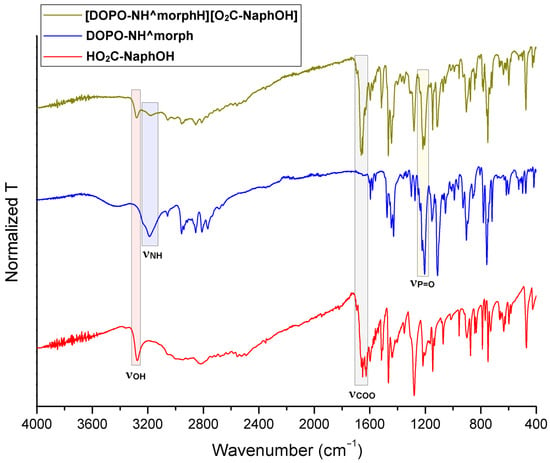
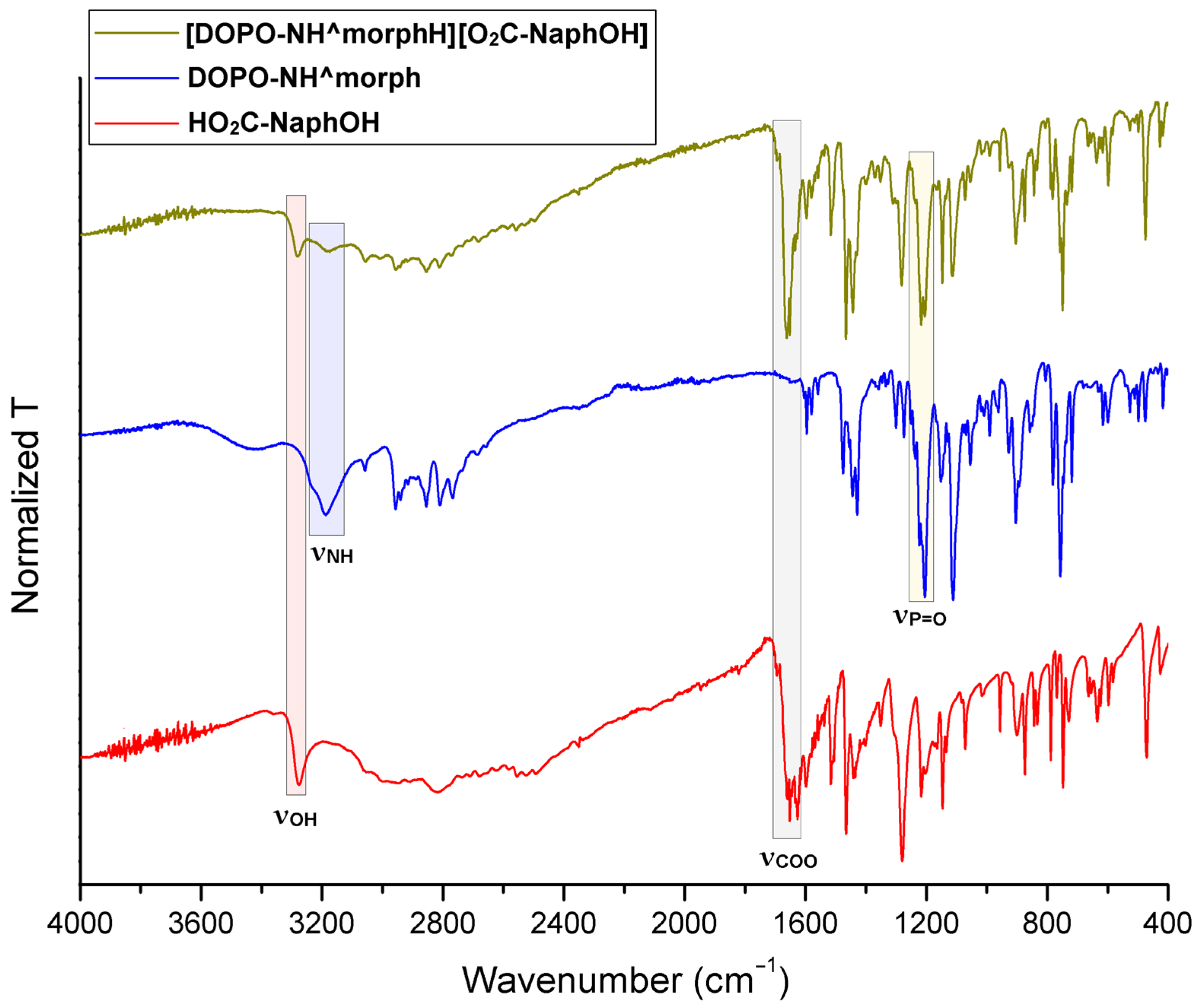
The interaction between DOPO-NH^morph and HO2C-NaphOH is evidenced by the comparison of the ATR-IR spectra of reactants and the product, as shown in Figure 3. In particular, the νNH stretching band observed in DOPO-NH^morph is not present in the product and the carbonyl stretching band around 1662 cm−1 appears altered. On the other hand, the νOH and νP=O stretchings in [DOPO-NH^morphH][O2C-NaphOH] are almost unchanged compared to those of the reactants. Conductivity measurements indirectly confirm the formation of a salt. DOPO-NH^morph and HO2C-NaphOH do not behave as electrolytes in nitromethane solution, while the molar conductivity of [DOPO-NH^morphH][O2C-NaphOH] in the same solvent at 25 °C is 22 ohm−1mol−1cm2. Such a result is in line with the formation of a salt that forms ion pairs in solution [68]. Accordingly, the molar conductivity drops to 5 ohm−1mol−1cm2 using acetone as solvent.
Figure 3.
Comparison of the ATR-IR spectra of DOPO-NH^morph, HO2C-NaphOH and [DOPO-NH^morphH][O2C-NaphOH].
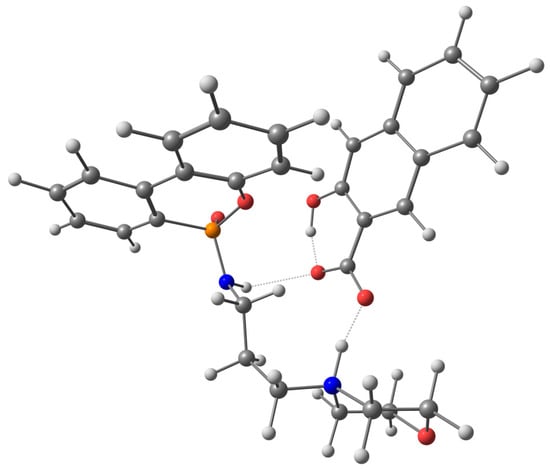
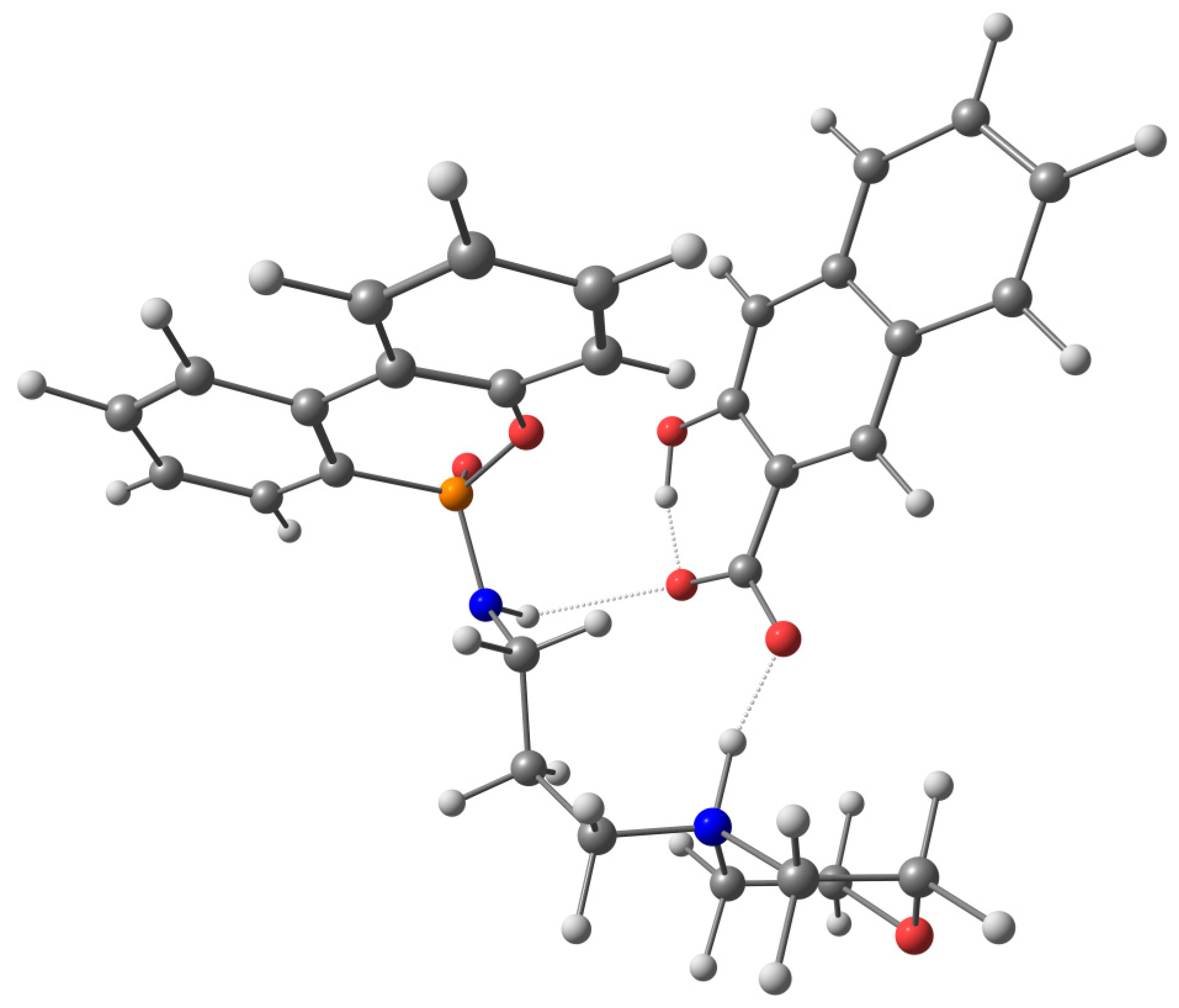
No crystals suitable for X-ray diffraction were obtained. The nature of the interactions between the two components of [DOPO-NH^morphH][O2C-NaphOH] was further investigated by means of periodic DFT calculations. The optimized geometry is shown in Figure 4. Further views are collected in Figure S8. The hydrogen atom of the acid transferred to the morpholine nitrogen atom (computed N-H bond length equal to 1.104 Å), forming a hydrogen bond with the carboxylate (computed O---H distance equal to 1.541 Å). Another hydrogen bond is present between the P-bonded NH fragment and the other oxygen atom of the carboxylic group (computed N-H and O---H bond lengths, respectively, equal to 1.028 and 2.374 Å). The same oxygen atom is also involved in a hydrogen bond with the hydroxyl fragment in the ortho position. The oxygen atom of the phosphoryl fragment points towards the hydroxyl moiety, but the computed O---H distance, 3.166 Å, appears too high to consider such an interaction relevant for the stabilization of the product.
Figure 4.
DFT-optimized structure of [DOPO-NH^morphH][O2C-NaphOH]. Phosphorus, orange; oxygen, red; nitrogen, blue; carbon, grey; hydrogen, white.
Accordingly, the Atoms-in-Molecules (AIM) analysis localized (3,-1) bond critical points (BCPs) only between the N-bonded hydrogen atoms and the oxygen atoms of the carboxylate moiety [69,70]. The NH---O BCPs are shown in Figure S9. Selected data at BCPs are collected in the caption of Figure S9. The resulting morphH---O interaction was much stronger than the P(O)NH---O one, with its electron density about 4.5 times higher. The meaningfully more negative potential energy density value at BCP confirms this conclusion.
Melting point experiments showed changes around 50 °C, followed by melting above 65 °C. Further characterization was carried out by TGA under N2 (Figure S10). The mass losses under N2 occur at about the same temperatures of DOPO-NH^morph. An interesting feature of the TGA curve of [DOPO-NH^morphH][O2C-NaphOH] is that about 11 wt% of the initial mass is still present above 445 °C. This outcome suggests that the thermal decomposition of [DOPO-NH^morphH][O2C-NaphOH] under N2 leaves a greater quantity of pyrolytic carbonaceous residue because of the presence of the naphthyl moiety.
To better give insight into the thermal decomposition of the species, the TGA curves of DOPO-NH^morph and [DOPO-NH^morphH][O2C-NaphOH] were collected under air between 30 and 800 °C (Figure 5). The plots do not meaningfully change compared to those recorded under N2 atmosphere up to about 390 °C, while the mass loss results noticeably reduced at higher temperatures (Figure 5). The comparison of the TGA curves allows the formation of scarcely volatile oxidation products from the DOPO-NH^morph skeleton to be proposed [71]. The residual mass is about 4 wt% for DOPO-NH^morph at 800 °C, while it is about 11 wt% for [DOPO-NH^morphH][O2C-NaphOH]. The comparison of the TGA curves therefore indicates that the coupling of the phosphonamidate with HO2C-NaphOH increases the formation of scarcely volatile products either under N2 or under air.
Figure 5.
TGA curves of DOPO-NH^morph (blue lines) and [DOPO-NH^morphH][O2C-NaphOH] (dark-yellow lines) under N2 (dashed lines) and air (solid lines).
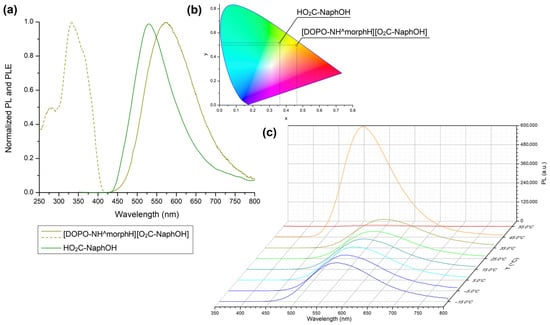
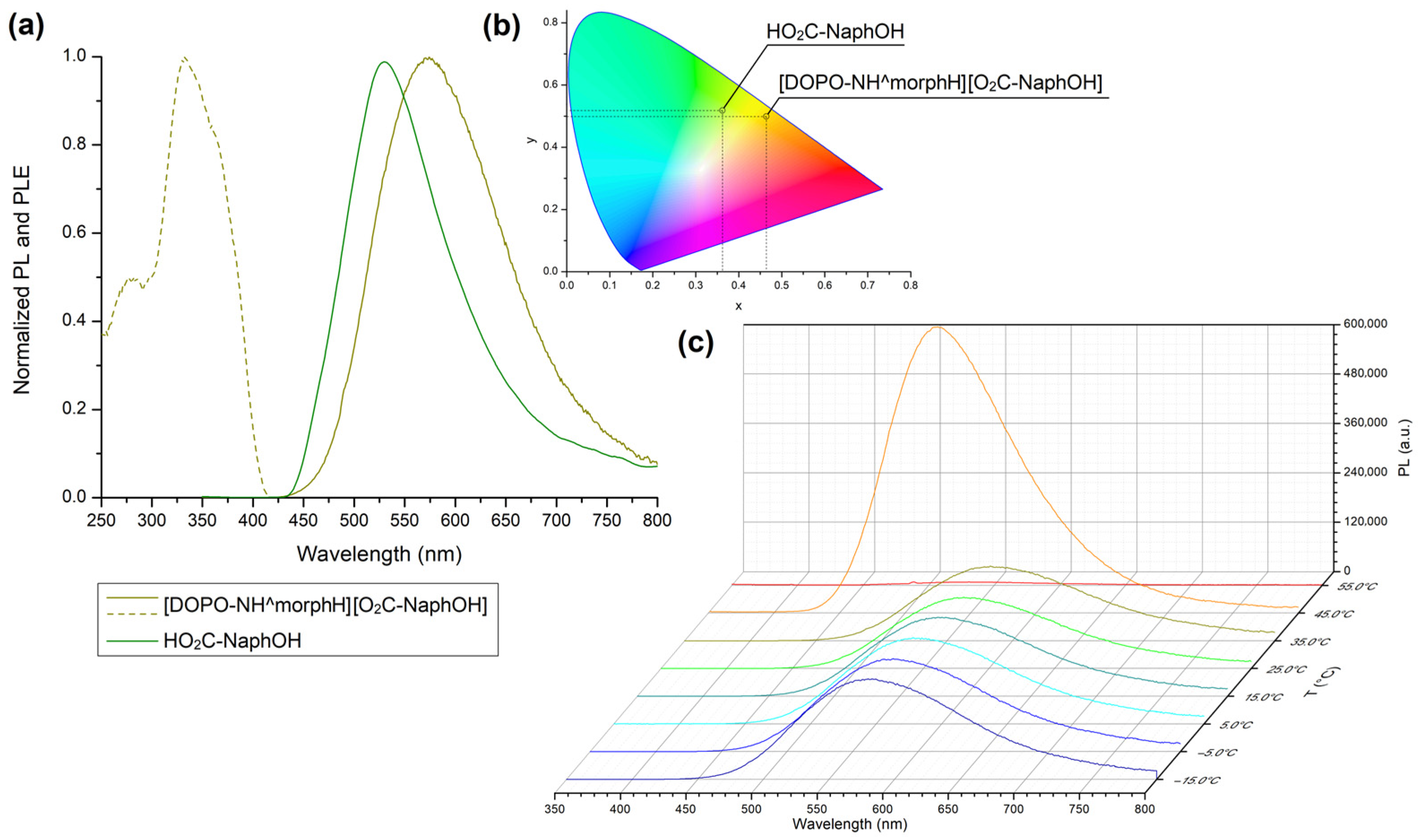
The emission spectrum of [DOPO-NH^morphH][O2C-NaphOH] is markedly different compared to those of the precursors. The weak emission of DOPO-NH^morph (Figure S5) is not observable, replaced by an intense band centred at 574 nm (FWHM = 4400 cm−1). As shown in Figure 6, the PL maximum is noticeably red-shifted, about 1450 cm−1, compared to that of HO2C-NaphOH under the same experimental conditions (maximum at 530 nm). The observed emitted colour shifts from the yellowish green of HO2C-NaphOH (CIE 1931 coordinates [72]: x = 0.362, y = 0.518) to yellow (CIE 1931 coordinates: x = 0.464, y = 0.499). The emission does not vary on changing the excitation wavelength in the PLE range. The PLE spectrum falls at wavelengths shorter than 410 nm, with a maximum at 332 nm (Figure 6). The photoluminescence quantum yield at room temperature is 7% and the lifetime of the excited state falls in the nanoseconds range (Figure S11).
Figure 6.
(a) Normalized PL (solid lines, λexcitation = 305 nm) and PLE (dashed line, λemission = 570 nm) of [DOPO-NH^morphH][O2C-NaphOH] (dark-yellow lines) and HO2C-NaphOH (green line) at 20 °C. (b) CIE 1931 chromaticity diagram with chromaticity coordinates of [DOPO-NH^morphH][O2C-NaphOH] and HO2C-NaphOH at 20 °C. (c) PL spectra (λexcitation = 305 nm) of [DOPO-NH^morphH][O2C-NaphOH] collected at different temperatures.
The emission does not show meaningful alterations on changing the temperature from −15 °C to 35 °C, while the PL maximum blue-shifts at about the same wavelength observed for HO2C-NaphOH at 45 °C. It is likely that the dissociation of the two components of [DOPO-NH^morphH][O2C-NaphOH] should happen around this temperature; therefore, the PL spectrum at 45 °C reasonably shows a band related to free HO2C-NaphOH (Figure 6). The luminescence drops at higher temperature because of the progressive melting of the sample. The possible dissociation of [DOPO-NH^morphH][O2C-NaphOH] before melting is also suggested by the DSC profile (Figure S12), which shows a broad endothermic peak centred at 52 °C before the melting process (minimum of DSC peak at 77 °C).
3.3. PLA Films Doped with [DOPO-NH^morphH][O2C-NaphOH]
PLA films containing 9.1 wt% and 16.7 wt% of [DOPO-NH^morphH][O2C-NaphOH] (PLA9.1 and PLA16.7) were prepared from dichloromethane solutions by the solvent casting method and compared to pristine PLA films. The chosen mass concentrations are in line with comparable studies in this field [3]. PLA9.1 and PLA16.7 showed noticeable photoluminescence (PL) in the yellowish green region, as shown in Figure S13 (CIE coordinates: x = 0.328, y = 0.514), similar to that of naphthoic acid. The emission is in fact centred at 525 nm, close to the PL maximum of pure solid HO2C-NaphOH (529 nm), and does not seem to depend on the concentration of dopant. Selected emission spectra are compared in Figure S13. A possible explanation is that weak interactions, hydrogen bonds in particular, between the PLA chains and the polar fragments of the product, could be competitive compared to the formation of a salt from DOPO-NH^morph and HO2C-NaphOH. The homogeneity of the films was verified through optical microscopy with a UV source (Figure S14). The luminescence of the films was also homogeneous at the maximum load of dopant.
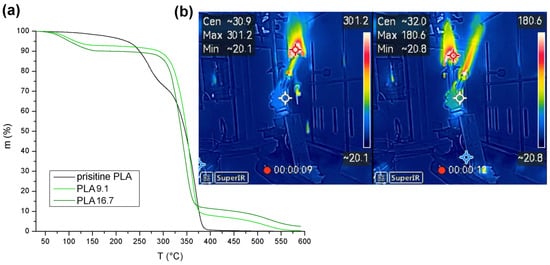
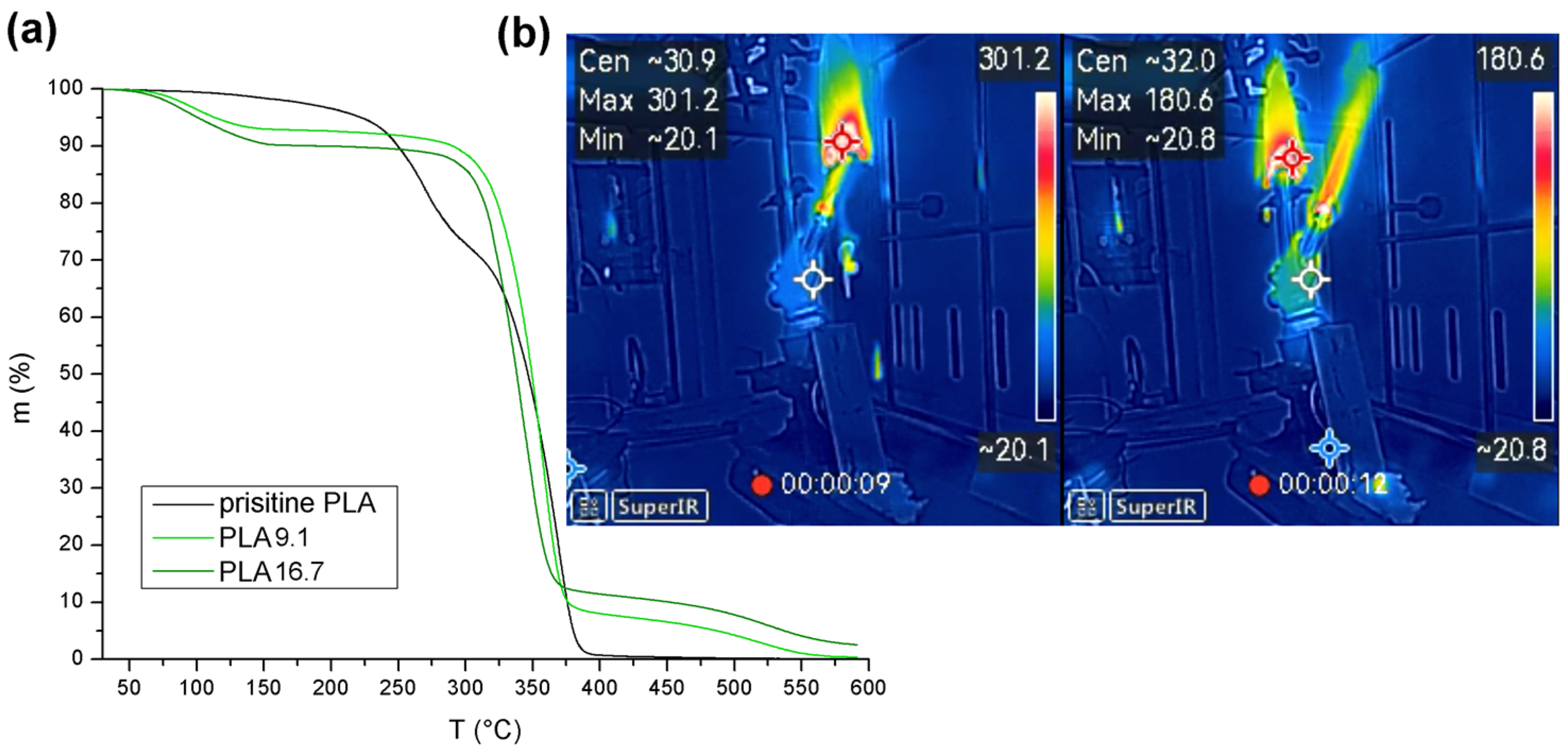
TGA plots of PLA, PLA9.1 and PLA16.7, performed under air, are reported in Figure 7. The pristine PLA is characterized by two mass losses occurring around 270 and 370 °C, and mass loss reaches about 100 wt% within 400 °C. In the cases of PLA9.1 and PLA16.7, after an initial mass loss, possibly due to the evaporation of traces of solvent entrapped in the samples, a single dominant decomposition process is observable between 280 and 390 °C. At 400 °C, between 8 wt% and 12 wt% of the initial mass is still present, depending on the concentration of dopant used. To reach total mass loss, higher temperatures (up to 600 °C) are necessary (Figure 7). It is worth noting that the TGA profile of [DOPO-NH^morphH][O2C-NaphOH] under air (Figure 5) showed that the residual mass around 400 °C is 40 wt% of the initial. On the basis of the mass compositions of PLA9.1 and PLA16.7, the residual masses observed for the two doped PLA samples after the first decomposition process are only in part derived from the oxidative decomposition of [DOPO-NH^morphH][O2C-NaphOH]. Around 4% of the residue at 400 °C appears reasonably attributable to carbonaceous products derived from the PLA chains, whose formation is induced by the presence of the phosphonamidate.
Figure 7.
(a) TGA curves of pristine and doped PLA samples under air. (b) Pictures taken with a thermal camera of a PLA16.7 sample during the exposition to the flame and immediately after the exposition.
Preliminary screening tests concerning the flammability of PLA9.1 and PLA16.7 were carried out on samples prepared according to ISO 9773 (200 × 50 × 0.25 mm sheets) [73]. Five films for each concentration were used, each exposed to the flame two times for three seconds. The experiments revealed that the combustion does not spread on the surface of the film that is not directly exposed to the flame, as shown for instance in Figure 7. The combustion process is not prosecuted after the removal of the samples from the flame. The figure reported as an example shows the almost immediate drop of the temperature on the polymer surface when the flame is removed, from around 300 to 180 °C in about three seconds. Moreover, for PLA16.7, the droplets do not ignite the cotton placed under the sample. The droplets falling from PLA16.7 can be observed in Figure 7b (left), and their temperature is below 200 °C. According to the literature [74,75], the self-extinguishing behavior can be ascribed either to gas-phase action and formation of a carbonaceous barrier. Further measurements are required to ascertain the flame retardancy mechanisms.
4. Conclusions
A basic DOPO-derived phosphonamidate, DOPO-NH^morph, was synthesized in one pot and subsequently mechanochemically combined with 3-hydroxy-2-naphthoic acid by solvent-free grinding at room temperature. The assembly step incorporated both components with quantitative mass recovery without further purification. Spectroscopic measurements revealed interactions between the phosphonamidate and the carboxylic acid, while periodic DFT calculations supported a structural model involving proton transfer to the morpholine nitrogen atom and a network of N–H···O interactions. The resulting product, formulated as [DOPO-NH^morphH][O2C-NaphOH], exhibited yellow photoluminescence centred at 574 nm, an absolute quantum yield of 7% at room temperature, and a greater amount of thermally persistent residue than DOPO-NH^morph under both nitrogen and air.
Preliminary incorporation into PLA showed that the photoluminescence of the organic acid was retained, although the shift of the emission maximum towards that of HO2C-NaphOH indicated substantial modification of the interactions between the two components during dissolution and film formation. The additive also altered the thermal-decomposition profile of PLA and increased the residual mass observed above 400 °C. In preliminary open-flame experiments, combustion ceased after removal of the ignition source, and droplets from the formulation containing 16.7 wt% additive did not ignite the underlying cotton under the adopted conditions. These results identify the mechanochemical association of independently prepared flame-retardant and luminescent components as a potentially versatile strategy for preparing dual-function polymer additives. Nevertheless, standardized flammability measurements, analysis of the decomposition residues, evaluation of additive dispersion and migration, and assessment of the mechanical properties and long-term stability of the resulting materials will be required to establish their practical performance and clarify their mode of action.
Supplementary Materials
The following supporting information can be downloaded at https://www.mdpi.com/article/10.3390/ma19234989/s1, Figure S1: 1H, 1H{31P} and 31P{1H} NMR spectra of DOPO-NH^morph; Figure S2: HSQC NMR spectrum of DOPO-NH^morph; Figure S3: ATR-IR spectrum of DOPO-NH^morph; Figure S4: TGA and DTG curves of DOPO-NH^morph under N2; Figure S5: PL and PLE spectra and luminescence decay curve of DOPO-NH^morph; Figure S6: 1H and 31P{1H} NMR spectra of [DOPO-NH^morphH][O2C-NaphOH]; Figure S7: HSQC NMR spectrum of [DOPO-NH^morphH][O2C-NaphOH]; Figure S8: Views of the periodic structure of [DOPO-NH^morphH][O2C-NaphOH]; Figure S9: DFT-optimized structure of [DOPO-NH^morphH][O2C-NaphOH] with NH---O BCPs; Figure S10: TGA and DTG curves of [DOPO-NH^morphH][O2C-NaphOH] under N2; Figure S11: Luminescence decay curve of [DOPO-NH^morphH][O2C-NaphOH]; Figure S12: DSC curve of [DOPO-NH^morphH][O2C-NaphOH]; Figure S13: Comparison of the emission bands of [DOPO-NH^morphH][O2C-NaphOH], HO2C-NaphOH and doped PLA and picture of 10% doped PLA under 365 nm irradiation; Figure S14: Pictures of the microscope coupled with UV source during the homogeneity check of a doped PLA film; Table S1: Cartesian coordinates of the computed isomers of DOPO-NH^morph; Table S2: DFT-optimized structure of [DOPO-NH^morphH][O2C-NaphOH].
Author Contributions
Conceptualization, V.B. and M.B.; methodology, V.G. and M.B.; software, M.B., V.G. and D.P.; validation, V.B., V.G., M.B. and D.P.; formal analysis, V.G. and M.B.; investigation, V.G., D.P. and M.B.; resources, V.B. and M.B.; data curation, V.G., D.P. and M.B.; writing—original draft preparation, V.B., V.G., M.B. and D.P.; writing—review and editing, V.B., V.G., M.B. and D.P.; visualization, M.B., V.G. and D.P.; supervision, V.B. and M.B.; project administration, V.B.; funding acquisition, V.B. All authors have read and agreed to the published version of the manuscript.
Funding
This research was funded by Università Ca’ Foscari Venezia, ADIR grant 2025.
Institutional Review Board Statement
Not applicable.
Informed Consent Statement
Not applicable.
Data Availability Statement
Data are contained within the article and Supplementary Materials. Further inquiries can be directed to the corresponding authors.
Acknowledgments
Fabio Marchetti, Università di Pisa, is gratefully acknowledged for having made available the academic version of CASTEP.
Conflicts of Interest
The authors declare no conflicts of interest. The funders had no role in the design of the study; in the collection, analyses, or interpretation of data; in the writing of the manuscript; or in the decision to publish the results.
References
- Liu, J.; Wang, X. Synthesis of flame-retardant fluorescent supramolecular polymers for post-combustion fluorescent tracking, cryptographic applications, and eco-friendly invisible fluorescent inks. Mater. Horiz. 2026, 13, 7765–7775. [Google Scholar] [CrossRef] [Scilit] [PubMed]
- Ma, T.-L.; Huang, S.-Z.; Zhang, W.; Wang, L.-T.; Hong, J.-Q.; Li, X.-M.; Lin, Y.-C.; Bai, W.-B.; Jian, R.-K. A fluorescent polyphosphate hybrid for multifunctional epoxy resins: Thermochromic early warning, fire safety and mechanical robustness. Prog. Org. Coat. 2026, 217, 110247. [Google Scholar] [CrossRef] [Scilit]
- He, L.; Chen, T.; Zhang, Y.; Hu, L.; Wang, T.; Han, R.; He, J.-L.; Luo, W.; Liu, Z.-G.; Deng, J.-N.; et al. Imide-DOPO derivative endows epoxy resin with excellent flame retardancy and fluorescence without losing glass transition temperature. Compos. Part B Eng. 2022, 230, 109553. [Google Scholar] [CrossRef] [Scilit]
- Zhang, S.; Song, X.; Liu, W.; Zhai, X.; Gao, H.; Chong, Q.; Luo, Z.; Wang, B. Fabrication of flame-retardant epoxy resin-based room-temperature phosphorescent materials with robust tolerance to harsh environments. Prog. Org. Coat. 2026, 212, 109908. [Google Scholar] [CrossRef] [Scilit]
- Pack, S. A Review of Non-halogen Flame Retardants in Epoxy-Based Composites and Nanocomposites: Flame Retardancy and Rheological Properties. In Flame Retardants; Visakh, P.M., Arao, Y., Eds.; Springer: Berlin/Heidelberg, Germany, 2015; pp. 115–130. [Google Scholar]
- Marosi, G.; Szolnoki, B.; Bocz, K.; Toldy, A. Reactive and Additive Phosphorus-based Flame Retardants of Reduced Environmental Impact. In Polymer Green Flame Retardants; Papaspyrides, C.D., Kiliaris, P., Eds.; Elsevier: Amsterdam, The Netherlands, 2014; pp. 181–220. [Google Scholar] [CrossRef] [Scilit]
- Saito, T. Cyclic Organophosphorus Compounds and Process for Making Same. US3702878A, 14 November 1972. [Google Scholar]
- Olcay, H.; Gul, C.; Kocak, D.E. Synergism in Nitrogen- and Phosphorus-Based Flame Retardants. In Materials and Chemistry of Flame-Retardant Polyurethanes—Volume 2: Green Flame Retardants; Gupta, R.K., Ed.; ACS Symposium Series: Washington, DC, USA, 2021; pp. 213–247. [Google Scholar]
- Nazir, R.; Gaan, S. Recent developments in P(O/S)–N containing flame retardants. J. Appl. Polym. Sci. 2020, 137, 47910. [Google Scholar] [CrossRef] [Scilit]
- Gaan, S.; Neisius, M.; Mercoli, P.; Liang, S.; Mispreuve, H.; Näscher, R. Novel Phosphonamidates-Synthesis and Flame Retardant Application. Patent WO2013020696A2, 14 February 2013. [Google Scholar]
- Hirsch, C.; Striegl, B.; Mathes, S.; Adlhart, C.; Edelmann, M.; Bono, E.; Gaan, S.; Salmeia, K.A.; Hoelting, L.; Krebs, A.; et al. Multiparameter toxicity assessment of novel DOPO-derived organophosphorus flame retardants. Arch. Toxicol. 2017, 91, 407–425. [Google Scholar] [CrossRef] [Scilit] [PubMed]
- Salmeia, K.A.; Baumgartner, G.; Jovic, M.; Gössi, A.; Riedl, W.; Zich, T.; Gaan, S. Industrial Upscaling of DOPO-Based Phosphonamidates and Phosphonates Derivatives Using Cl2 Gas as a Chlorinating Agent. Org. Process Res. Dev. 2018, 22, 1570–1577. [Google Scholar] [CrossRef] [Scilit]
- Wagner, S.; Rakotomalala, M.; Bykov, Y.; Walter, O.; Döring, M. Synthesis of new organophosphorus compounds using the Atherton–Todd reaction as a versatile tool. Heteroatom. Chem. 2012, 23, 216–222. [Google Scholar] [CrossRef] [Scilit]
- Jian, R.; Wang, P.; Duan, W.; Wang, J.; Zheng, X.; Weng, J. Synthesis of a Novel P/N/S-Containing Flame Retardant and Its Application in Epoxy Resin: Thermal Property, Flame Retardance, and Pyrolysis Behavior. Ind. Eng. Chem. Res. 2016, 55, 11520–11527. [Google Scholar] [CrossRef] [Scilit]
- Neisius, N.M.; Lutz, M.; Rentsch, D.; Hemberger, P.; Gaan, S. Synthesis of DOPO-Based Phosphonamidates and their Thermal Properties. Ind. Eng. Chem. Res. 2014, 53, 2889–2896. [Google Scholar] [CrossRef] [Scilit]
- Salmeia, K.A.; Flaig, F.; Rentsch, D.; Gaan, S. One-Pot Synthesis of P(O)-N Containing Compounds Using N-Chlorosuccinimide and Their Influence in Thermal Decomposition of PU Foams. Polymers 2018, 10, 740. [Google Scholar] [CrossRef] [Scilit] [PubMed]
- Tada, Y.; Sunada, A.; Watanabe, R.; Kanazawa, M.; Utsumi, K. Synthesis of Trispirocyclotriphosphazenes with Oxaphosphorine Rings and Their Crystal and Molecular Structures. Inorg. Chem. 2021, 60, 5014–5020. [Google Scholar] [CrossRef] [Scilit] [PubMed]
- Kukla, P.; Greiner, L.; Eibl, S.; Döring, M.; Schönberger, F. Novel phosphorus-containing silazanes as flame retardants in epoxy resins. React. Funct. Polym. 2022, 170, 105120. [Google Scholar] [CrossRef] [Scilit]
- Agostinis, L.; Ghincolov, S.; Bortoluzzi, M. Preparation Process of P(=O)-Heteroatom Derivatives of Dibenzooxaphosphacycles. Patent WO2023094526, 1 June 2023. [Google Scholar]
- Bortoluzzi, M.; Agostinis, L.; Ghincolov, S.; Ferraro, V.; Marra, G.; Castro, J. Straightforward synthesis of 9,10-dihydro-9-oxa-10-phosphaphenanthrene-10-oxide derivatives containing P–N bonds. Chem. Pap. 2023, 77, 7999–8006. [Google Scholar] [CrossRef] [Scilit]
- Marra, G.; Bortoluzzi, M.; Agostinis, L. One-Pot Synthesis of Phosphoramidates from dibenzo[1,3,2]dioxaphosphepine-6-oxide. Chem. Proc. 2023, 14, 18. [Google Scholar] [CrossRef] [Scilit]
- Bortoluzzi, M.; Beghetto, V.; Gagliardi, V. Synthesis and Characterization of 6-(1,3-dimethylureido) dibenzo[c,e][1,2]oxaphosphinine 6-oxide. Chem. Proc. 2025, 18, 45. [Google Scholar] [CrossRef] [Scilit]
- Ferraro, V.; Castro, J.; Agostinis, L.; Bortoluzzi, M. Dual-emitting Mn(II) and Zn(II) halide complexes with 9,10-dihydro-9-oxa-10-phosphaphenanthrene-10-oxide as ligand. Inorg. Chim. Acta 2023, 545, 121285. [Google Scholar] [CrossRef] [Scilit]
- Gagliardi, V.; Castro, J.; Beghetto, V.; Expósito, M.; Bortoluzzi, M. Luminescence of the Conjugate Bases of [2-(2-Hydroxyphenyl)phenyl]phosphinic Acid and Single-Crystal X-Ray Structure Determination of Sodium [2-(2-Hydroxyphenyl)phenyl]phosphinate. Organics 2025, 6, 10. [Google Scholar] [CrossRef] [Scilit]
- Song, X.; Xu, H. Pure-organic phosphine oxide luminescent materials. J. Inf. Disp. 2020, 21, 149–172. [Google Scholar] [CrossRef] [Scilit]
- She, P.; Duan, J.; Lu, J.; Qin, Y.; Li, F.; Liu, C.; Liu, S.; Ma, Y.; Zhao, Q. Single-component molecular dual persistent room temperature phosphorescence from low- and high-lying triplet states. Adv. Opt. Mater. 2022, 10, 2102706. [Google Scholar] [CrossRef] [Scilit]
- Liu, C.; Gu, Y.; Fu, Q.; Sun, N.; Zhong, C.; Ma, D.; Qin, J.; Yang, C. Nondoped deep-blue organic light-emitting diodes with color stability and very low efficiency roll-off: Solution-processable small-molecule fluorophores by phosphine oxide linkage. Chem. Eur. J. 2012, 18, 13828–13835. [Google Scholar] [CrossRef] [Scilit] [PubMed]
- Wada, A.; Yasuda, T.; Zhang, Q.; Seok Yang, Y.; Takasu, I.; Enomoto, S.; Adachi, C. A host material consisting of a phosphinic amide directly linked donor–acceptor structure for efficient blue phosphorescent organic light-emitting diodes. J. Mater. Chem. C 2013, 1, 2404–2407. [Google Scholar] [CrossRef] [Scilit]
- Tao, Y.; Xiao, J.; Zheng, C.; Zhang, Z.; Yan, M.; Chen, R.; Zhou, X.; Li, H.; An, Z.; Wang, Z.; et al. Dynamically adaptive characteristics of resonance variation for selectively enhancing electrical performance of organic semiconductors. Angew. Chem. 2013, 125, 10685–10689. [Google Scholar] [CrossRef] [Scilit]
- Liu, C.; Li, Y.; Li, Y.; Yang, C.; Wu, H.; Qin, J.; Cao, Y. Efficient solution-processed deep-blue organic light-emitting diodes based on multibranched oligofluorenes with a phosphine oxide center. Chem. Mater. 2013, 25, 3320–3327. [Google Scholar] [CrossRef] [Scilit]
- Han, C.; Zhao, F.; Zhang, Z.; Zhu, L.; Xu, H.; Li, J.; Ma, D.; Yan, P. Constructing low-triplet-energy hosts for highly efficient blue PHOLEDs: Controlling charge and exciton capture in doping systems. Chem. Mater. 2013, 25, 4966–4976. [Google Scholar] [CrossRef] [Scilit]
- Wang, J.; Liu, C.; Jiang, C.; Yao, C.; Gu, M.; Wang, W. Solution-processed aggregation-induced delayed fluorescence (AIDF) emitters based on strong π-accepting triazine cores for highly efficient nondoped OLEDs with low efficiency roll-off. Org. Electron. 2019, 65, 170–178. [Google Scholar] [CrossRef] [Scilit]
- Jia, J.; Zhu, L.; Wei, Y.; Wu, Z.; Xu, H.; Ding, D.; Chen, R.; Ma, D.; Huang, W. Triazine-phosphine oxide electron transporter for ultralow-voltage-driven sky blue PHOLEDs. J. Mater. Chem. C 2015, 3, 4890–4902. [Google Scholar] [CrossRef] [Scilit]
- Bui, T.-T.; Goubard, F.; Ibrahim-Ouali, M.; Gigmes, D.; Dumur, F. Recent advances on organic blue thermally activated delayed fluorescence (TADF) emitters for organic light-emitting diodes (OLEDs). Beilstein J. Org. Chem. 2018, 14, 282–308. [Google Scholar] [CrossRef] [Scilit] [PubMed]
- Li, Y.; Liu, J.-Y.; Zhao, Y.-D.; Cao, Y.-C. Recent advancements of high efficient donor-acceptor type blue small molecule applied for OLEDs. Mater. Today 2017, 20, 258–266. [Google Scholar] [CrossRef] [Scilit]
- Zhu, M.; Yang, C. Blue fluorescent emitters: Design tactics and applications in organic light-emitting diodes. Chem. Soc. Rev. 2013, 42, 4963–4976. [Google Scholar] [CrossRef] [Scilit] [PubMed]
- Alfani, G.A.; Cui, Z.; Zhao, Z.; Qiu, Z.; Alam, P.; Tang, B.Z. Recent advances in room-temperature phosphorescence in organophosphorus aggregates. Chem. Commun. 2025, 61, 17770–17786. [Google Scholar] [CrossRef] [Scilit] [PubMed]
- Santandrea, D.; Caldato, J.; Beghetto, V. Amidated carboxymethylcellulose: Synthesis, characterization and evaluation of their performance in paper coating application. Cellulose 2026, 33, 481–503, Correction in Cellulose 2026, 33, 505–507. [Google Scholar] [CrossRef] [Scilit]
- Santandrea, D.; Sillard, C.; Rey, C.; Beghetto, V.; Bras, J. Influence of aliphatic amine grafting on the barrier properties of TEMPO-CNF films. Polym. Chem. 2026, 17, 3189–3204. [Google Scholar] [CrossRef] [Scilit]
- Armarego, W.L.F.; Perrin, D.D. Purification of Laboratory Chemicals, 4th ed.; Butterworth-Heinemann: Oxford, UK, 1996; pp. 176, 215–216. [Google Scholar]
- Safety Data Sheet for HO2C-NaphOH. Available online: https://www.sigmaaldrich.com/IT/en/sds/aldrich/h46007 (accessed on 18 November 2026).
- Safety Data Sheet for DOPO. Available online: https://fluorochem.co.uk/product/F223729/ (accessed on 18 November 2026).
- Safety Data Sheet for 3-Morpholinopropylamine. Available online: https://www.sigmaaldrich.com/IT/en/sds/aldrich/a9028 (accessed on 18 November 2026).
- Zhou, X.; Cheng, R.; Wang, B.; Zeng, J.; Xu, J.; Li, J.; Kang, L.; Cheng, Z.; Gao, W.; Chen, K. Biodegradable sandwich-architectured films derived from pea starch and polylactic acid with enhanced shelf-life for fruit preservation. Carbohydr. Polym. 2021, 251, 117117. [Google Scholar] [CrossRef] [Scilit] [PubMed]
- Li, M.-X.; Ren, Y.; Lee, D.; Choi, S.-W. Crystallization Behavior and Electrical Properties of Nanoparticle-Reinforced Poly(lactic Acid)-Based Films. Polymers 2022, 14, 177. [Google Scholar] [CrossRef] [Scilit] [PubMed]
- Grimme, S.; Hansen, A.; Ehlert, S.; Mewes, J.-M. r2SCAN-3c: A “Swiss army knife” composite electronic-structure method. J. Chem. Phys. 2021, 154, 064103. [Google Scholar] [CrossRef] [Scilit] [PubMed]
- Furness, J.W.; Kaplan, A.D.; Ning, J.; Perdew, J.P.; Sun, J. Accurate and Numerically Efficient r2SCAN Meta-Generalized Gradient Approximation. J. Phys. Chem. Lett. 2020, 11, 8208–8215, Correction in J. Phys. Chem. Lett. 2020, 11, 9248. [Google Scholar] [CrossRef] [Scilit] [PubMed]
- Weigend, F.; Ahlrichs, R. Balanced basis sets of split valence, triple zeta valence and quadruple zeta valence quality for H to Rn: Design and assessment of accuracy. Phys. Chem. Chem. Phys. 2005, 7, 3297–3305. [Google Scholar] [CrossRef] [Scilit] [PubMed]
- Weigend, F. Accurate Coulomb-fitting basis sets for H to Rn. Phys. Chem. Chem. Phys. 2006, 8, 1057–1065. [Google Scholar] [CrossRef] [Scilit] [PubMed]
- Kruse, H.; Grimme, S. A geometrical correction for the inter- and intra-molecular basis set superposition error in Hartree-Fock and density functional theory calculations for large systems. J. Chem. Phys. 2012, 136, 154101. [Google Scholar] [CrossRef] [Scilit] [PubMed]
- Caldeweyher, E.; Ehlert, S.; Hansen, A.; Neugebauer, H.; Spicher, S.; Bannwarth, C.; Grimme, S.A. Generally applicable atomic-charge dependent London dispersion correction. J. Chem. Phys. 2019, 150, 154122. [Google Scholar] [CrossRef] [Scilit] [PubMed]
- Neese, F. The ORCA program system. WIREs Comput. Mol. Sci. 2012, 2, 73–78. [Google Scholar] [CrossRef] [Scilit]
- Neese, F. Software update: The ORCA program system—Version 5.0. WIREs Comput. Mol. Sci. 2022, 12, e1606. [Google Scholar] [CrossRef] [Scilit]
- Lu, T.; Chen, F. Multiwfn: A multifunctional wavefunction analyzer. J. Comput. Chem. 2012, 33, 580–592. [Google Scholar] [CrossRef] [Scilit] [PubMed]
- Lu, T. A comprehensive electron wavefunction analysis toolbox for chemists, Multiwfn. J. Chem. Phys. 2024, 161, 082503. [Google Scholar] [CrossRef] [Scilit] [PubMed]
- Perdew, J.P.; Ruzsinszky, A.; Csonka, G.I.; Vydrov, O.A.; Scuseria, G.E.; Constantin, L.A.; Zhou, X.; Burke, K. Restoring the Density-Gradient Expansion for Exchange in Solids and Surfaces. Phys. Rev. Lett. 2008, 100, 136406, Erratum in Phys. Rev. Lett. 2009, 102, 039902. https://doi.org/10.1103/PhysRevLett.102.039902. [Google Scholar] [CrossRef] [Scilit] [PubMed]
- Lin, J.S.; Qteish, A.; Payne, M.C.; Heine, V. Optimized and transferable nonlocal separable ab initio pseudopotentials. Phys. Rev. B 1993, 47, 4174–4180. [Google Scholar] [CrossRef] [Scilit] [PubMed]
- Tkatchenko, A.; Scheffler, M. Accurate Molecular Van Der Waals Interactions from Ground-State Electron Density and Free-Atom Reference Data. Phys. Rev. Lett. 2009, 102, 073005. [Google Scholar] [CrossRef] [Scilit] [PubMed]
- Koelling, D.D.; Harmon, B.N. A technique for relativistic spin-polarised calculations. J. Phys. C Solid State Phys. 1977, 10, 3107–3114. [Google Scholar] [CrossRef] [Scilit]
- Pfrommer, B.G.; Côté, M.; Louie, S.G.; Cohen, M.L. Relaxation of Crystals with the Quasi-Newton Method. J. Comput. Phys. 1997, 131, 233–240. [Google Scholar] [CrossRef] [Scilit]
- Clark, S.J.; Segall, M.D.; Pickard, C.J.; Hasnip, P.J.; Probert, M.I.J.; Refson, K.; Payne, M.C. First principles methods using CASTEP. Z. Krist. 2005, 220, 567–570. [Google Scholar] [CrossRef] [Scilit]
- Bellamy, L.J.; Beecher, L. The infra-red spectra of organo-phosphorus compounds. Part II. Esters, acids, and amines. J. Chem. Soc. 1952, 155, 1701–1706. [Google Scholar] [CrossRef] [Scilit]
- Hansen, P.E.; Vakili, M.; Kamounah, F.S.; Spanget-Larsen, J. NH Stretching Frequencies of Intramolecularly Hydrogen-Bonded Systems: An Experimental and Theoretical Study. Molecules 2021, 26, 7651. [Google Scholar] [CrossRef] [Scilit] [PubMed]
- Waaijers, S.L.; Hartmaan, J.; Soeter, A.M.; Helmus, R.; Kools, S.A.; de Voogt, P.; Admiraal, W.; Parsons, J.R.; Kraak, M.H. Toxicity of new generation flame retardants to Daphnia magna. Sci. Total Environ. 2013, 463–464, 1042–1048. [Google Scholar] [CrossRef] [Scilit] [PubMed]
- Schulman, S.G.; Kovi, P.J. Electronic absorption and fluorescence study of ionization and intramolecular hydrogen-bonding in the α, β-o-hydroxynaphthoic acids. Anal. Chim. Acta 1973, 67, 259–267. [Google Scholar] [CrossRef] [Scilit]
- Mishra, H.; Maheshwary, S.; Tripathi, H.B.; Sathyamurthy, N. An Experimental and Theoretical Investigation of the Photophysics of 1-Hydroxy-2-naphthoic Acid. J. Phys. Chem. A 2005, 109, 2746–2754. [Google Scholar] [CrossRef] [Scilit] [PubMed]
- Anastas, P.T.; Warner, J.C. Green Chemistry: Theory and Practice; Oxford University Press: Oxford, UK, 1998; pp. 29–55. [Google Scholar]
- Banik, I.; Roy, M.N. Role of Anions (Tetrafluoroborate, Perchlorate) of Tetrabutylammonium Salts in Determining Solvation Effects Prevailing in Industrially Essential Solvents Probed by Conductance and FT-IR Spectra. J. Chem. Eng. Data 2013, 58, 3378–3386. [Google Scholar] [CrossRef] [Scilit]
- Kumar, P.S.V.; Raghavendra, V.; Subramanian, V. Bader’s Theory of Atoms in Molecules (AIM) and its Applications to Chemical Bonding. J. Chem. Sci. 2016, 128, 1527–1536. [Google Scholar] [CrossRef] [Scilit]
- Espinosa, E.; Souhassou, M.; Lachekar, H.; Lecomte, C. Topological analysis of the electron density in hydrogen bonds. Acta Cryst. 1999, B55, 563–572. [Google Scholar] [CrossRef] [Scilit] [PubMed]
- Camino, G.; Costa, L.; Luda di Cortemiglia, M.P. Overview of Fire Retardant Mechanisms. Polym. Degrad. Stab. 1991, 33, 131–154. [Google Scholar] [CrossRef] [Scilit]
- Schubert, E.F. Light-Emitting Diodes, 2nd ed.; Cambridge University Press: Cambridge, UK, 2006; pp. 292–303. [Google Scholar]
- ISO 9773:2024; Plastics—Determination of Burning Behaviour of Thin Flexible Vertical Specimens in Contact with a Small Flame Ignition Source. International Organization for Standardization: Geneva, Switzerland. Available online: https://www.iso.org/standard/85513.html (accessed on 14 October 2026).
- Niu, M.; Yang, S.; Li, F.; Lu, Y.; Chang, X.; Xue, B.; Wang, S. Circular valorization of waste polyester fabric/hemp stalk into fire-safe structural composites. J. Clean. Prod. 2026, 575, 149195. [Google Scholar] [CrossRef] [Scilit]
- Zheng, Y.; Xu, K.; Zhang, B.; Guan, S.; Xia, L.; Huang, Z. Synergistic effect of piperazine pyrophosphate (PAPP)/melamine polyphosphate (MPP)/ZnO halogen-free flame retardant system in PCC-P/PBAT blends. J. Polym. Mater. 2025, 42, 237–253. [Google Scholar] [CrossRef] [Scilit]
Disclaimer/Publisher’s Note: The statements, opinions and data contained in all publications are solely those of the individual author(s) and contributor(s) and not of MDPI and/or the editor(s). MDPI and/or the editor(s) disclaim responsibility for any injury to people or property resulting from any ideas, methods, instructions or products referred to in the content. |
© 2026 by the authors. Licensee MDPI, Basel, Switzerland. This article is an open access article distributed under the terms and conditions of the Creative Commons Attribution (CC BY) license.