


Abstract
Cement-based batteries (CBBs) offer a new technical approach for constructing multifunctional structural energy storage systems that combine load-bearing and energy storage capabilities; however, the low intrinsic electronic conductivity of traditional cement-based composite cathodes severely limits their electrochemical performance. In this study, rGO was incorporated into the MnO2 cathode to construct a highly conductive MnO2@rGO composite cathode for Zn-MnO2 cement-based batteries. The interconnected rGO network forms continuous electron transport pathways between MnO2 particles while improving electrical contact between the active material and the current collector. Furthermore, the flake-like rGO framework promotes the uniform dispersion of MnO2 and mitigates particle agglomeration and structural degradation during repeated charge–discharge cycles. Thanks to these synergistic effects, the MnO2@rGO cathode achieved an electronic conductivity of 14.59 mS cm−1, representing a 6243.5% increase over pure MnO2. The assembled cement-based battery exhibited a discharge specific capacity of approximately 125 mAh g−1 at 0.01 mA and retained 80.7% of its initial capacity after 100 cycles. Electrochemical Impedance Spectroscopy (EIS) results showed that the charge transfer resistance was reduced from 148 Ω for pure MnO2 to 56 Ω, confirming accelerated interfacial charge transport and effective suppression of electrode polarization. This study reveals the crucial role of conductive carbon networks in overcoming the electronic transport bottleneck in cement-based electrodes and provides a scalable design strategy for developing highly conductive and multifunctional structured batteries.
1. Introduction
With the rapid development of renewable energy systems and distributed electronic devices, energy storage technologies that can be deeply integrated into the built environment have attracted widespread attention [1,2,3,4,5,6]. Traditional batteries are typically used as standalone functional units, and their integration into buildings and civil infrastructure often results in additional weight, bulk, and installation costs [7,8,9]. Cement-based batteries offer a new solution by transforming concrete or cement-based components from traditional passive load-bearing materials into multifunctional structural systems that combine mechanical support with electrochemical energy storage capabilities [10,11]. Given that cement-based materials offer advantages such as widely available raw materials, low cost, high mechanical stability, and compatibility with existing building fabrication processes, cement-based batteries show great application potential in areas such as smart buildings, self-powered sensors, emergency power supply, and large-scale structural energy storage [12,13,14]. However, the electrochemical performance of current cement-based batteries remains significantly inferior to that of traditional energy storage devices. This is primarily due to the complex structure of the cement matrix and its high overall resistance, which not only limits ion diffusion but also hinders electron transport and exacerbates interfacial polarization between the active electrode material and the surrounding electrolyte phase [15,16]. Therefore, improving charge transport kinetics while maintaining the mechanical integrity of the cement matrix is key to advancing cement-based batteries from proof-of-concept to practical structural energy storage applications [17,18,19].
Among the various cathode materials used in cement-based batteries, MnO2 has attracted widespread attention due to its high theoretical specific capacity, low cost, abundant availability, good environmental compatibility, and multiple variable oxidation states [20]. When paired with a zinc anode, MnO2 enables charge storage through reversible electrochemical reactions involving protons and Zn2+, making it suitable for aqueous cement-based energy storage systems [21,22]. However, MnO2’s low intrinsic electronic conductivity and slow reaction kinetics severely limit its actual active material utilization. These issues are further exacerbated when MnO2 is embedded in a cement matrix. Discontinuous electron transport pathways within cement-based composite electrodes and poor electrical contact between active particles lead to higher electrode polarization and charge transfer resistance [23]. Furthermore, MnO2 particles are prone to agglomeration during electrode preparation, which reduces their electrochemical active surface area and creates localized electrochemically inert regions. During repeated ion insertion and extraction cycles, MnO2 may also undergo structural distortion, particle cracking, and loss of electrical contact, ultimately leading to rapid capacity decay during cycling [24]. Therefore, establishing a continuous and stable conductive network for MnO2 while ensuring efficient ion transport is key to improving the utilization of active materials, accelerating interfacial charge transfer kinetics, and enhancing the cycling stability of MnO2-based cement batteries [25,26,27].
To address the charge-transport bottleneck of MnO2 cathodes, rGO is introduced as an effective conductive component [28,29,30]. Its two-dimensional flake structure, high electronic conductivity, large specific surface area, and good mechanical flexibility facilitate the formation of an interconnected electronic transport network within the electrode. When combined with MnO2, rGO can bridge isolated active particles, shorten the distance of electronic transport, and improve the electrical contact between MnO2 and the current collector. At the same time, the oxygen-containing functional groups remaining on the rGO surface serve as nucleation and anchoring sites for MnO2, thereby promoting the uniform dispersion of active particles and enhancing interfacial coupling within the composite [31,32,33]. Furthermore, the flexible rGO scaffold can cushion local structural deformations caused by repeated redox cycles and suppress the agglomeration, cracking, and electrical contact failure of MnO2 particles. These properties are particularly important for cement-based batteries, as the highly heterogeneous and high-impedance cement-based environment makes it more difficult to establish continuous conductive pathways compared to traditional coated electrodes [34,35]. Therefore, the composite of MnO2 and rGO is expected to simultaneously enhance electron transport capacity, accessibility of active sites, interfacial charge transfer kinetics, and structural stability, thereby providing an effective approach to overcoming the intrinsic electrochemical limitations of MnO2 cathodes in cement-based energy storage systems [36,37].
In this study, a MnO2@rGO composite cathode was developed for highly conductive Zn-MnO2 cement-based batteries. By introducing rGO, an interconnected conductive network was constructed within the cathode, while maintaining sufficient exposure of MnO2 active sites. Structural and chemical characterizations confirmed the successful integration of MnO2 with rGO, which facilitated efficient electron transport and improved interfacial stability. Compared with pristine MnO2, the optimized MnO2 @rGO electrode exhibited significantly enhanced electrical conductivity (14.59 mS cm−1) and reduced charge-transfer resistance. Benefiting from the improved electron transport and accelerated reaction kinetics, the MnO2@rGO cement-based battery delivered a higher discharge capacity of approximately 125 mAh g−1 and maintained 80.7% capacity retention after 100 cycles. Furthermore, the rGO network effectively suppressed MnO2 aggregation and preserved continuous conductive pathways during cycling, contributing to improved structural stability. These results demonstrate that rGO modification is an effective strategy to overcome the intrinsic conductivity limitation of MnO2 cathodes and provides a feasible approach for developing high-performance and durable cement-based energy storage systems.
2. Experimental Section
Materials
Nickel foam (thickness: 1 mm, Guangjiayuan New Materials Co., Ltd., Kunshan City, China), zinc foil (thickness: 0.3 mm, Dingyuan Metal Products Co., Ltd., Shanghai, China), polyvinyl alcohol (1750 ± 50, Sinopharm Chemical Reagents Co., Ltd., Shanghai, China), manganese sulfate monohydrate (MnSO4·H2O, Sinopharm Chemical Reagents Co., Ltd., Shanghai, China), reduced graphene oxide (rGO, Suzhou Tanfeng Technology Co., Ltd., Suzhou, China), zinc oxide (ZnO, Sinopharm Chemical Reagents Co., Ltd., Shanghai, China), hydrochloric acid (HCl, Sinopharm Chemical Reagents Co., Ltd., Shanghai, China), ammonium persulfate ((NH4)2S2O8, Sinopharm Chemical Reagents Co., Ltd., Shanghai, China), carboxymethyl cellulose (CMC, Sinopharm Chemical Reagents Co., Ltd., Shanghai, China), styrene-butadiene rubber (SBR, Sinopharm Chemical Reagents Co., Ltd., Shanghai, China), Super P conductive carbon black (Sinopharm Chemical Reagents Co., Ltd., Shanghai, China), potassium hydroxide (KOH, 95%, General Reagents), lithium hydroxide (LiOH, Aladdin Reagents Co., Ltd., Shanghai, China), and P·II 52.5 cement (Jiangsu Xinning New Building Materials Co., Ltd., Nanjing, China).
3. Preparation
- (a)
- Preparation of MnO2
First, 0.02 mol of manganese sulfate monohydrate (MnSO4·H2O) and 0.02 mol of ammonium persulfate ((NH4)2S2O8) were added to 100 mL of deionized water and stirred for 40 min. Subsequently, the resulting mixture was placed in an oil bath at 85 °C and allowed to react for 6 h. After the reaction, the product was filtered and washed several times with deionized water and anhydrous ethanol, respectively. Finally, the resulting product was dried in an oven at 80 °C for 12 h to obtain MnO2 powder.
- (b)
- Preparation of the MnO2@rGO Cathode
MnO2, the binder, and Super P were mixed in a mass ratio of 8:1:1, where the binder consisted of CMC and SBR in a mass ratio of 6:4; an additional 5 wt% (by mass of MnO2) of rGO was added, and the mixture was formulated into a uniform slurry. Nickel foam was immersed in the slurry to obtain the target cathode with surface-loaded active material, which was then dried in an oven at 60 °C for 12 h.
- (c)
- Preparation of the cement-based electrolyte
An excess of ZnO powder was added to a mixed solution containing 12 wt% KOH and 0.6 wt% LiOH. The mixture was magnetically stirred at 500 rpm at room temperature for 10 h, followed by standing for 1 day. The supernatant was collected to obtain a 12 wt% KOH-LiOH solution saturated with ZnO.
A 5 wt% polyvinyl alcohol (PVA) powder was added to deionized water and stirred magnetically at 500 rpm and 95 °C for 1 h until the PVA was completely dissolved. Stirring continued while cooling to room temperature. The previously prepared ZnO-saturated KOH-LiOH solution was slowly added to the PVA solution to obtain the PVA-KOH-LiOH(ZnO) composite solution.
During the preparation of the composite electrolyte, the water-to-cement ratio was fixed at 0.35, excluding the moisture introduced by the PVA–KOH–LiOH(ZnO) solution. The PVA–KOH–LiOH(ZnO) solution was thoroughly mixed with fresh cement, then poured into a mold and allowed to set for 1 day. After demolding, the specimens were placed in a standard constant-temperature and constant-humidity curing chamber and cured for 28 days.
- (d)
- Battery Assembly
The prepared cement-based electrolyte slurry was poured into a cubic mold with a side length of 2 cm. A MnO2 cathode and a zinc anode were then inserted, with the distance between the two electrodes maintained at 2.0 ± 0.5 mm.
4. Characterization
X-ray diffraction (XRD, Bruker D8, Karlsruhe, Germany) was employed to analyze the crystallographic information of electrode materials. The diffraction patterns were collected over a 2θ range of 5–90° with a scanning rate of 2° min−1. Raman spectra were collected using a Raman spectrometer (Renishaw inVia, Wotton-under-Edge, UK) to investigate the structural characteristics, defect states, and carbon-related information of the electrode materials. The measurements were performed using a 532 nm laser excitation source within the wavenumber range of 100–2000 cm−1. Scanning electron microscopy (SEM, JSM 7800 F, Akishima, Japan) and high-resolution transmission electron microscopy (TEM, JEM-2100, Akishima, Japan) were utilized for morphological structure analysis. Elemental valence states were determined by X-ray photoelectron spectroscopy (XPS, Thermo Scientific K-Alpha, Waltham, MA, USA).
Electrochemical Measurements
To ensure experimental consistency and accurate interpretation, electrochemical measurements were conducted at room temperature (25 °C). Cyclic voltammetry (CV) and electrochemical impedance spectroscopy (EIS) tests were performed using a CHI650D electrochemical workstation (CH Instruments, Inc., Austin, TX, USA). EIS measurements were conducted over a frequency range of 100 kHz–0.01 Hz with an AC amplitude of 5 mV. Charge–discharge testing was conducted using a Wuhan LAND CT2001A testing system (Wuhan LAND Electronic Co., Ltd., Wuhan, China).
For the ionic conductivity test, two identical perforated stainless-steel sheets were inserted into both sides of CSEs, and the EIS test was performed after molding and maintenance. The ionic conductivity was calculated according to Equation (1).
where σ is the ionic conductivity of the cement-based electrolyte, H and S** are the thickness and the sectional area of the sample, respectively. The internal resistance of the electrolyte, Rb, was calculated based on the intersection of the curves with the real part of the Nyquist plot with the real axis.
5. Result and Discussion
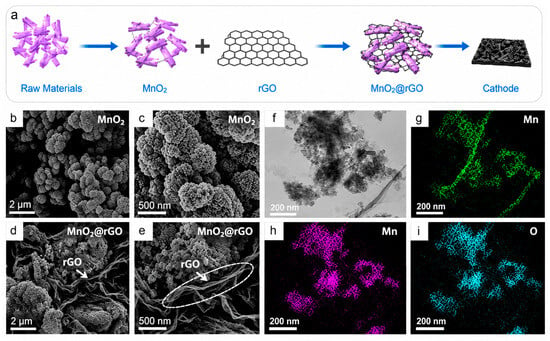
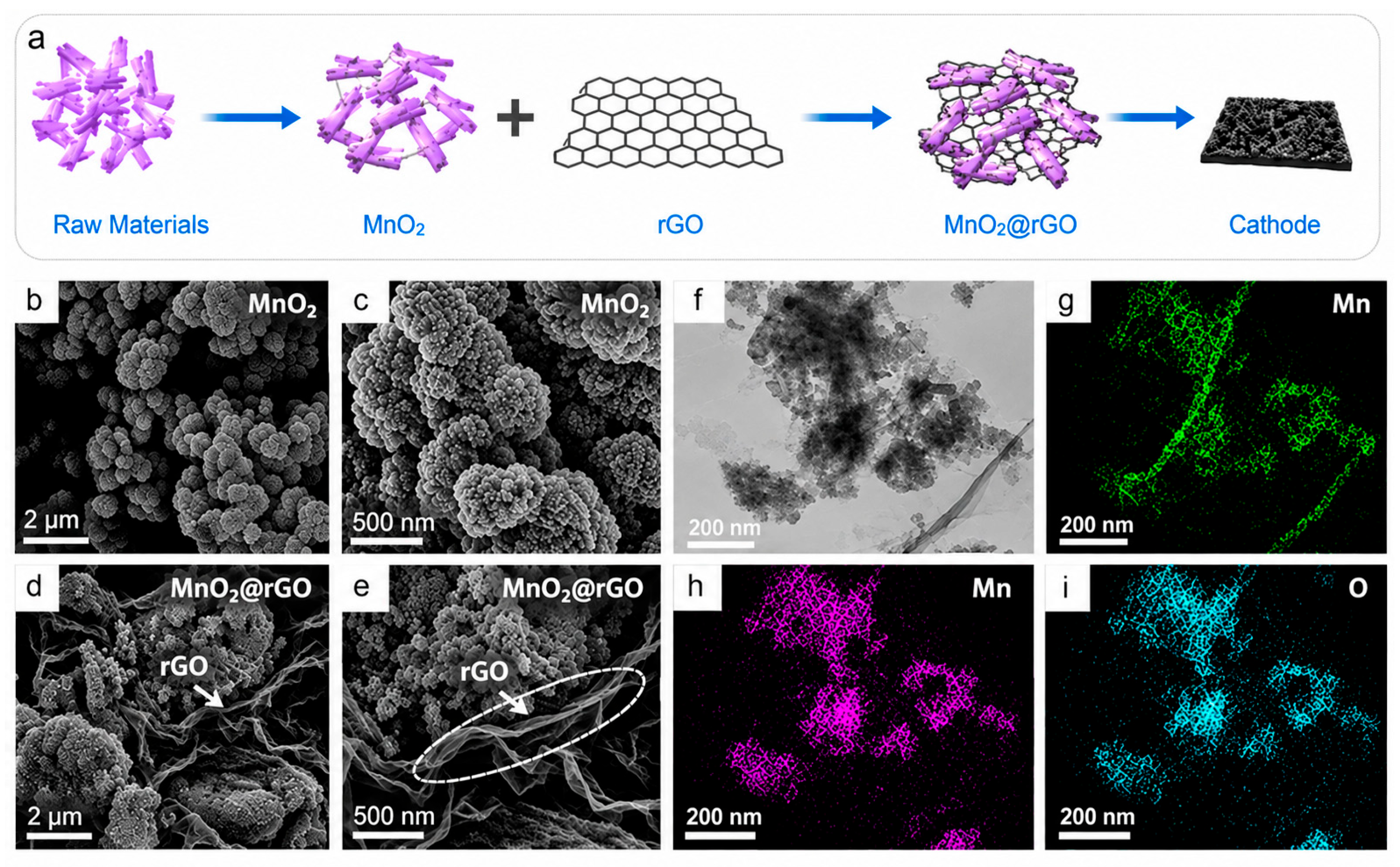
Figure 1 illustrates the preparation process and microstructural characteristics of the MnO2@rGO composite cathode. As shown in Figure 1a, MnO2 was first prepared from raw materials, then combined with rGO to obtain the MnO2@rGO composite, which was further processed into a cathode. The SEM images in Figure 1b,c show that pure MnO2 consists primarily of a large number of nanoscale particles aggregated into irregular micron-scale agglomerates; the particle surfaces are relatively rough, and the overall structure exhibits a distinct cluster-like arrangement. After the introduction of rGO, thin, wrinkled, flake-like structures can be clearly observed between the MnO2 particles (Figure 1d,e). These rGO layers are intercalated and distributed among the MnO2 agglomerates, forming relatively close contact with the surrounding particles, indicating that rGO has been successfully incorporated into the composite. Compared to pure MnO2, MnO2@rGO retains the basic morphology of MnO2 particles while incorporating a distinct two-dimensional layered structure. The TEM image in Figure 1f further shows that MnO2 particles are distributed on and around the surfaces of the translucent rGO layers, with close contact between MnO2 particles and rGO layers observable in localized areas. The corresponding elemental mapping results indicate that C, Mn, and O are all present in the selected regions. Among these, the distribution patterns of Mn and O are largely consistent, primarily concentrated in the MnO2 particle regions; C, on the other hand, is mainly distributed along the layered structure. The synergistic distribution of these three elements in the composite region further confirms the successful composite formation between MnO2 and rGO.
Figure 1.
(a) Schematic illustration of the preparation process for the MnO2@rGO composite and its cathode; (b,c) SEM images of MnO2; (d,e) SEM images of MnO2@rGO; (f–i) mapping images of MnO2@rGO.
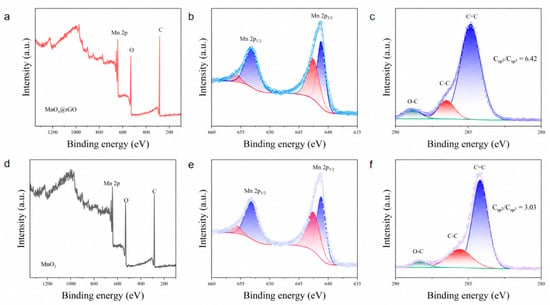
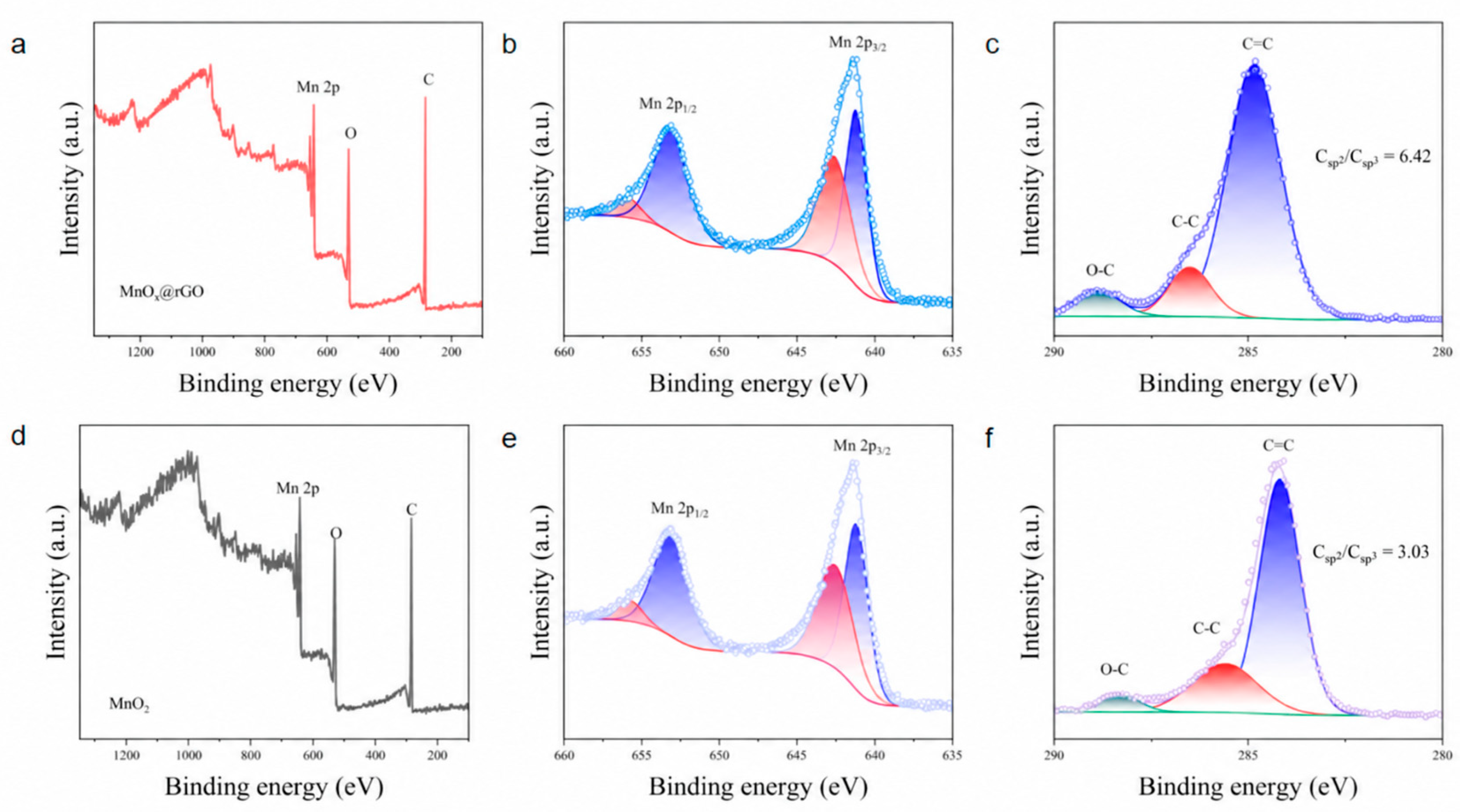
Figure 2 shows the XPS analysis results for MnO2@rGO and pure MnO2, which were used to characterize the surface elemental composition and chemical state of the two materials. Distinct Mn 2p, O 1s, and C 1s characteristic signals can be observed in the full XPS spectrum of MnO2@rGO (Figure 2a) [38]. Compared with pure MnO2 (Figure 2d), MnO2@rGO exhibits a stronger C 1s signal, confirming that rGO has been successfully incorporated into the composite material. At the same time, distinct Mn and O signals are retained in both samples, indicating that MnO2 remains the primary active component after composite formation. Figure 2b,e show the high-resolution Mn 2p spectra of MnO2@rGO and MnO2, respectively. Both samples exhibit two characteristic peaks at approximately 642 and 654 eV, corresponding to Mn 2p3/2 and Mn 2p1/2, respectively. The peak positions and overall spectral profiles of the two materials are quite similar, indicating that the introduction of rGO did not significantly alter the primary chemical environment of the Mn element in MnO2. No new Mn-related characteristic peaks were observed after the composite formation, suggesting that MnO2 maintained good chemical stability during the preparation of MnO2@rGO. The high-resolution C 1s spectra shown in Figure 2c,f can be resolved into three components: C=C, C-C, and O-C. Among these, the C=C peak at approximately 284.8 eV corresponds to sp2-hybridized carbon, the C-C peak primarily corresponds to sp3-hybridized carbon, and the high-binding-energy O-C peak originates from residual oxygen-containing functional groups [39]. Compared to pure MnO2, the C=C peak in MnO2@rGO is significantly enhanced, and the Csp2/Csp3 ratio increases from 3.03 to 6.42, indicating a significant increase in the proportion of conjugated sp2 carbon structures in the composite. A higher proportion of sp2-hybridized carbon facilitates the formation of continuous electron transport pathways between MnO2 particles, while the residual oxygen-containing functional groups help enhance the interfacial contact between MnO2 and rGO. Overall, the XPS results confirm the successful incorporation of rGO, the basic preservation of the MnO2 chemical environment, and the significant increase in the proportion of conductive sp2 carbon in MnO2@rGO.
Figure 2.
(a,d) Full XPS spectra of MnO2@rGO and MnO2; (b,e) high-resolution Mn 2p spectra; (c,f) high-resolution C 1s spectra.
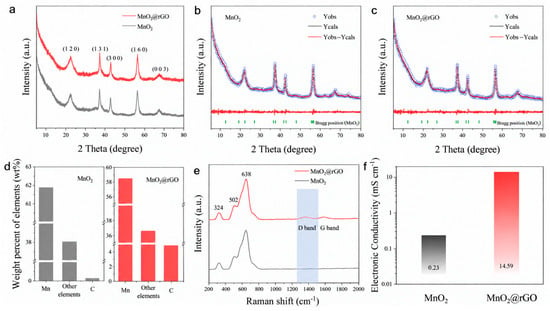
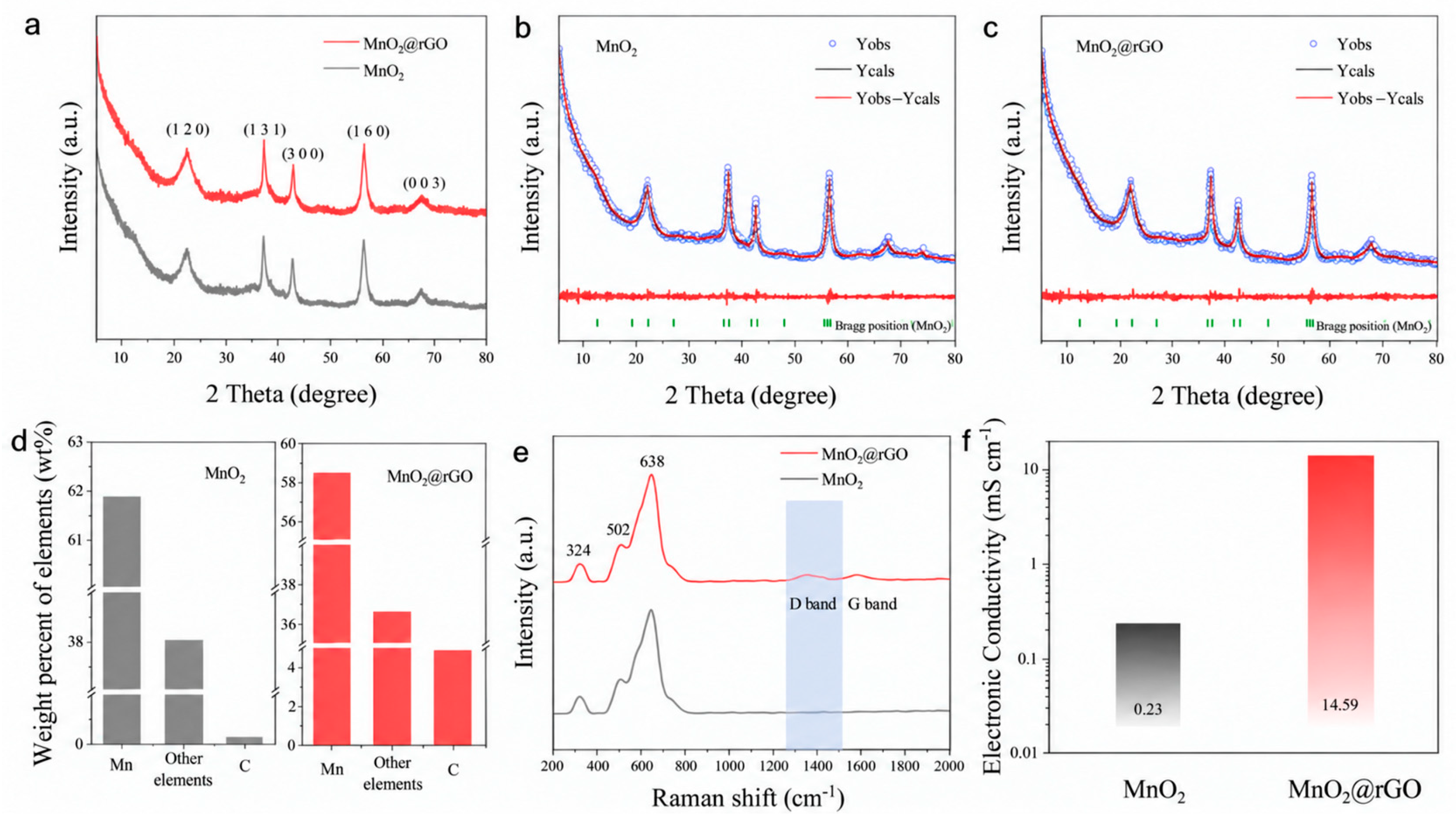
As shown in Figure 3a, both samples exhibit distinct diffraction peaks at approximately 22°, 37°, 42°, 56°, and 68°, corresponding to the (1 2 0), (1 3 1), (3 0 0), (1 6 0), and (0 0 3) crystal planes of MnO2, respectively. The diffraction peak positions of MnO2@rGO are essentially consistent with those of pure MnO2, and no obvious diffraction peaks from impurity phases were observed, indicating that the introduction of rGO did not significantly alter the main crystal structure of MnO2. The absence of distinct rGO-characteristic diffraction peaks in MnO2@rGO may be attributed to its low content and high degree of structural disorder. Figure 3b,c show the Rietveld refinement results for the two samples. The experimental diffraction patterns exhibit high consistency with the calculated curves, and the residual curves are generally smooth, further validating the phase composition of the samples. The elemental composition results are shown in Figure 3d. Pure MnO2 consists primarily of Mn and O, with small amounts of other elements; its carbon content is only about 0.2 wt%. Upon the introduction of rGO, the carbon content in MnO2@rGO increased to approximately 4.8 wt%, while the mass fraction of Mn correspondingly decreased, confirming the successful incorporation of rGO into the composite material. Figure 3e shows the Raman spectra; both samples exhibit characteristic vibrational peaks of MnO2 at approximately 324, 502, and 638 cm−1. Compared with pure MnO2, MnO2@rGO further exhibits distinct D and G bands at approximately 1350 and 1590 cm−1, which are associated with defect structures and the sp2-hybridized carbon framework in the carbon material, respectively, further confirming the successful composite formation of MnO2 and rGO [40]. Electrical conductivity measurements showed that the electrical conductivity of pure MnO2 was only 0.23 mS cm−1, whereas that of MnO2@rGO increased to 14.59 mS cm−1, approximately 63.4 times that of pure MnO2 (Figure 3f). These results indicate that the introduction of rGO significantly improved the electronic transport properties of the MnO2 composite [41].
Figure 3.
(a) XRD patterns of MnO2 and MnO2@rGO; (b,c) Rietveld refinement results; (d) elemental mass fractions; (e) Raman spectra; (f) electronic conductivity.
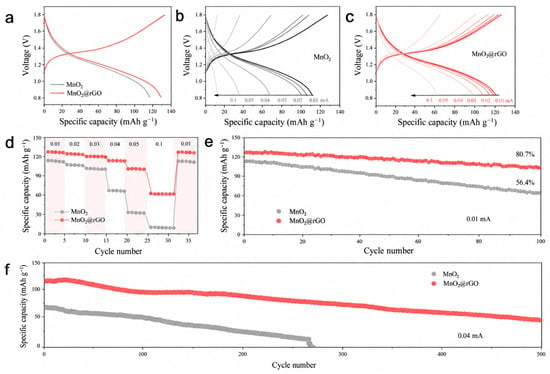
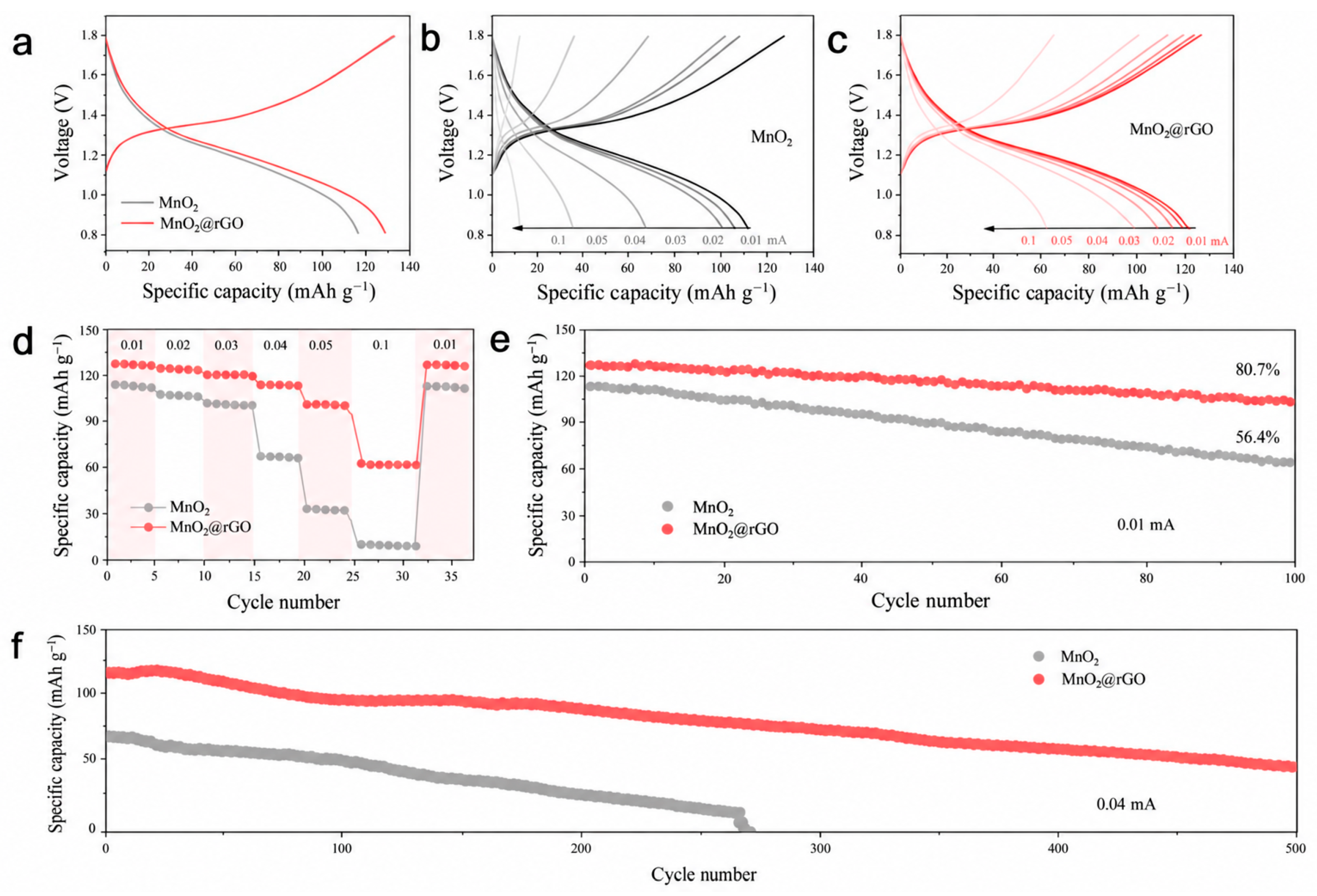
As shown in Figure 4a, at 0.01 mA, the first-cycle specific capacity of the MnO2@rGO battery was approximately 125 mAh g−1, which was higher than the approximately 115 mAh g−1 of the MnO2 battery, and it also exhibited a longer charge–discharge curve. Figure 4b,c show the charge–discharge curves of the two batteries at currents of 0.01, 0.02, 0.03, 0.04, 0.05, and 0.1 mA, respectively. As the current increases, the discharge specific capacity of both batteries gradually decreases, and the voltage difference between the charge and discharge curves correspondingly increases; however, the MnO2@rGO battery maintains a higher capacity and a more stable voltage response at all tested currents. Figure 4d further compares the rate performance of the two batteries. At currents of 0.01, 0.02, 0.03, 0.04, 0.05, and 0.1 mA, the specific discharge capacity of MnO2@rGO was approximately 125, 120, 115, 105, 95, and 63 mAh g−1, respectively, all of which were significantly higher than those of the pure MnO2 battery. When the current was restored to 0.01 mA, the capacity of MnO2@rGO recovered to approximately 123 mAh g−1, close to its initial level, indicating good rate reversibility. Figure 4e shows that after 100 cycles at 0.01 mA, MnO2@rGO still retained a specific discharge capacity of approximately 104 mAh g−1, corresponding to a capacity retention rate of 80.7%; in contrast, MnO2 retained only about 65 mAh g−1, with a capacity retention rate of 56.4%. At a higher current of 0.04 mA, MnO2@rGO still exhibited a discharge specific capacity of approximately 46 mAh g−1 after 500 cycles, whereas the capacity of MnO2 continued to decline rapidly, approaching zero after approximately 270 cycles (Figure 4f). These results demonstrate that the incorporation of rGO significantly enhances the capacity output, rate performance, and long-term cycling stability of the MnO2 cathode.
Figure 4.
(a) Initial constant-current charge–discharge curve at 0.01 mA; (b,c) charge–discharge curves of MnO2 and MnO2@rGO cement-based batteries at different currents; (d) rate performance at 0.01–0.1 mA; (e) cycling performance after 100 cycles at 0.01 mA; (f) long-term cycling performance after 500 cycles at 0.04 mA.
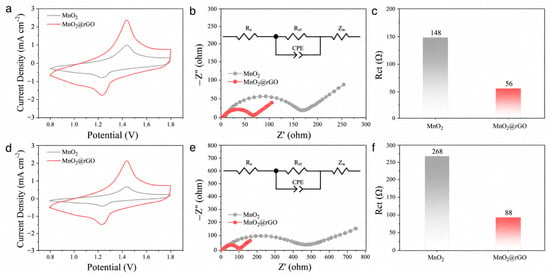
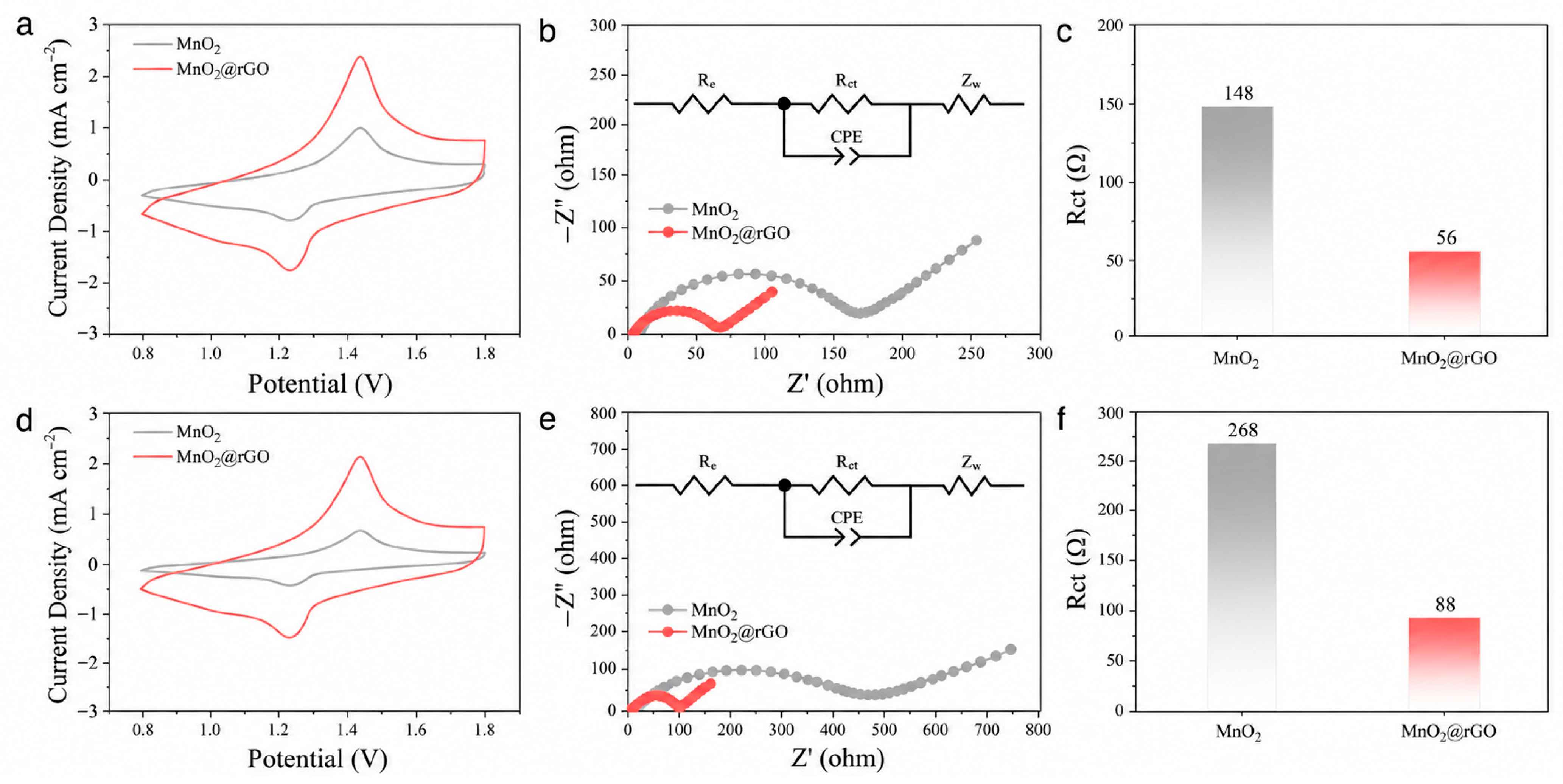
As shown in Figure 5a, both cement-based batteries exhibited distinct redox responses, indicating that reversible electrochemical reactions can occur at the MnO2 cathode. Compared with the pure MnO2 battery, the MnO2@rGO battery exhibited higher redox peak currents and a larger area under the CV curve, suggesting higher electrochemical activity and more efficient utilization of the active material. At the same time, the oxidation and reduction peaks of the MnO2@rGO battery are more distinct, suggesting that the introduction of rGO improves the reversibility of electrode reactions and reduces polarization during charging and discharging. Figure 5b shows the Nyquist plots of both batteries before cycling; the spectra consist primarily of a semicircle in the high-frequency region and a sloping line in the low-frequency region, corresponding to interfacial charge transfer and ion diffusion processes, respectively. The MnO2@rGO battery exhibits a significantly smaller semicircle diameter in the high-frequency region, indicating lower interfacial charge transfer resistance. Based on fitting using the equivalent circuit shown in the inset, the charge transfer resistance (Rct) for MnO2 and MnO2@rGO is 148 and 56 Ω, respectively (Figure 5c). Compared to pure MnO2, the Rct of MnO2@rGO was reduced by approximately 62.2%, indicating that the conductive network formed by rGO effectively improves electronic contact between particles and accelerates interfacial charge transfer. After 200 cycles, both the peak current and the integrated area of the CV curves for both cells decreased, indicating a certain degree of decline in electrode reactivity during long-term cycling (Figure 5d). However, the MnO2@rGO cell still retained a distinct redox peak, with its peak current and CV area remaining significantly higher than those of the pure MnO2 cell, indicating that the composite cathode still exhibits good electrochemical reversibility after long-term cycling. The post-cycling Nyquist plots showed that the semicircles in the high-frequency region of both cells had increased (Figure 5e), indicating that the electrode/electrolyte interface impedance gradually increased with cycling. Fitting results show that after 200 cycles, the Rct values for MnO2 and MnO2@rGO increased to 268 and 88 Ω, respectively (Figure 5f). Notably, the Rct of MnO2@rGO remained approximately 67.2% lower than that of pure MnO2. Furthermore, the Rct of pure MnO2 increased by approximately 81.1% compared to its initial value, whereas that of MnO2@rGO increased by only about 57.1%, suggesting that rGO not only reduces the initial interfacial impedance but also slows the increase in charge transfer resistance during cycling. These results indicate that the MnO2@rGO electrode exhibits faster interfacial charge transfer, lower reaction polarization, and more stable long-term electrochemical kinetics.
Figure 5.
(a,d) CV curves of MnO2 and MnO2@rGO before cycling and after 200 cycles; (b,e) Nyquist plots and corresponding equivalent circuits, where Rs represents the series resistance, Rct represents the charge-transfer resistance, CPE represents the constant phase element, and Zw represents the Warburg impedance; (c,f) fitted charge-transfer resistance (Rct) values.
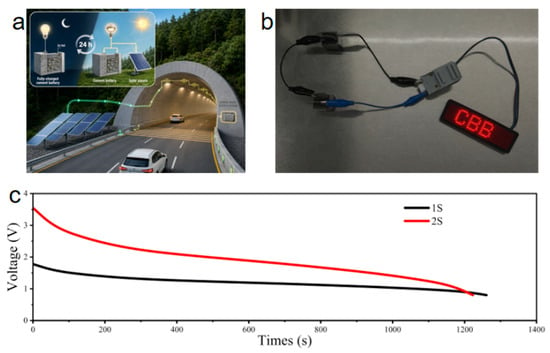
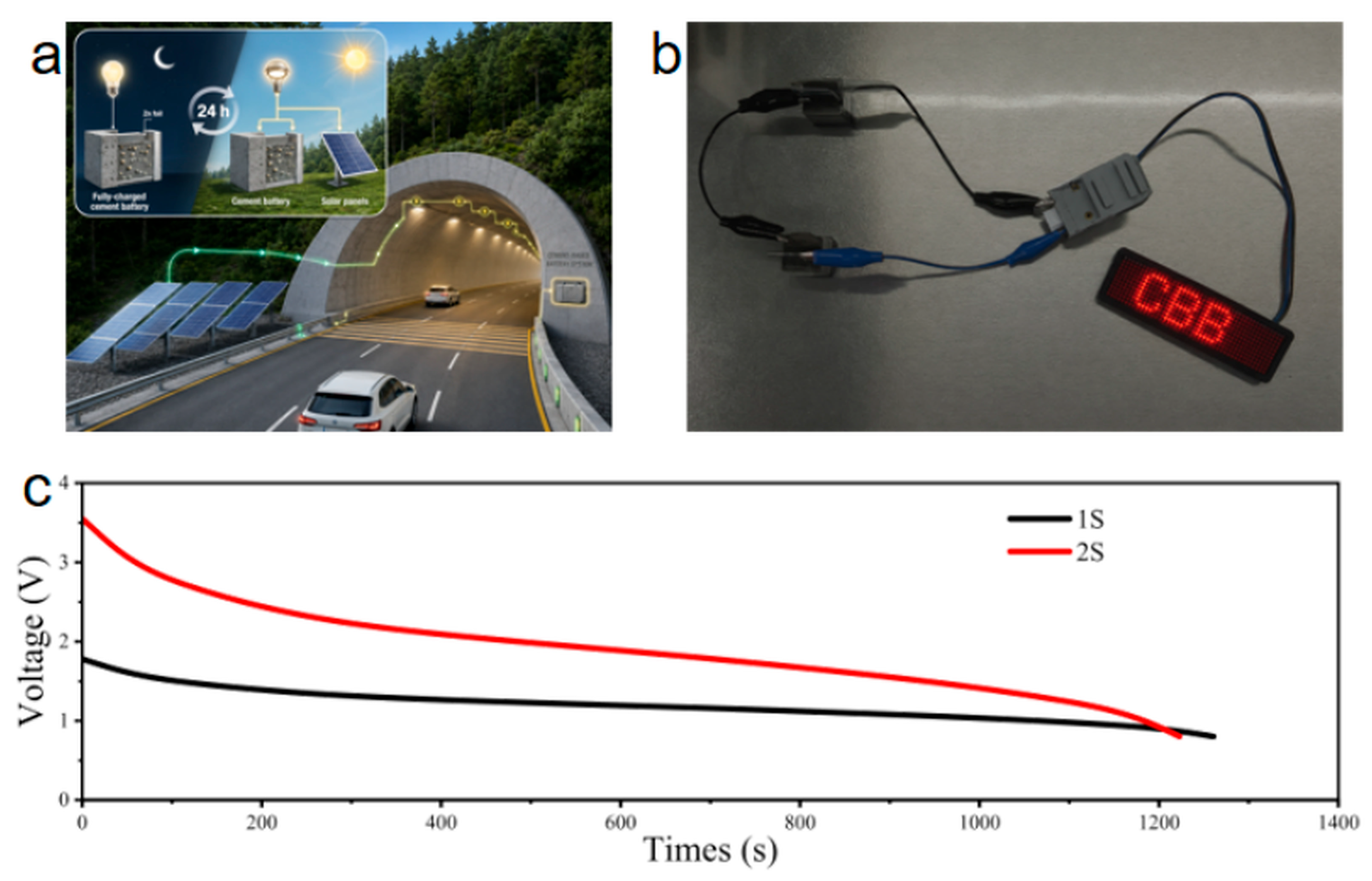
As shown in Figure 6a, this battery can be integrated with a photovoltaic system to store solar energy during the day and power tunnel lighting at night, which effectively addresses the intermittency defect of photovoltaic power generation and endows this structural energy storage device prominent engineering and economic feasibility for large-scale photovoltaic-tunnel lighting integrated projects. Figure 6b shows that the assembled battery successfully powers an Light Emitting Diode (LED) display, demonstrating its practical power supply capability. The discharge curves in Figure 6c show that the initial voltage of a single cell is approximately 1.8 V, while the initial voltage increases to about 3.6 V when two cells are connected in series. The series-connected cells maintain a higher output voltage during discharge, indicating that the operating voltage can be effectively adjusted by connecting cells in series.
Figure 6.
(a) Schematic diagram illustrating the application of a cement-based battery integrated with a solar power system for continuous tunnel lighting; (b) photograph of an LED display powered by a cement-based battery; (c) discharge curves for a single-cell battery (1S) and two cells connected in series (2S).
The enhanced electrochemical performance of MnO2@rGO can be attributed to the synergistic effect between MnO2 active materials and the rGO conductive framework. The structural and chemical characterizations confirm the successful integration of rGO with MnO2, while the increased electronic conductivity demonstrates the formation of efficient electron transport pathways. During battery operation, the rGO network facilitates rapid electron transfer and reduces electrode polarization, thereby improving MnO2 utilization and stabilizing the electrochemical reaction process. As a result, the MnO2@rGO cathode delivers enhanced capacity retention and cycling stability compared with pristine MnO2, demonstrating the effectiveness of conductive network engineering for high-performance cement-based batteries.
6. Conclusions
In this study, a highly conductive MnO2@rGO cathode for cement-based batteries was fabricated by compositing MnO2 with an interconnecting rGO network. Structural and compositional characterization confirmed that rGO was successfully incorporated into the composite without significantly altering the primary crystal structure or chemical state of MnO2. The incorporation of rGO increased the electrode’s electronic conductivity from 0.23 mS cm−1 to 14.59 mS cm−1 and reduced the initial charge transfer resistance from 148 Ω to 56 Ω. Consequently, the MnO2@rGO cement-based battery exhibited higher discharge specific capacity, better rate performance, and more stable cycling performance. After 100 cycles at 0.01 mA, the capacity retention rate reached 80.7%, which is higher than the 56.4% observed for the pure MnO2 battery. Furthermore, after 500 cycles at 0.04 mA, the MnO2@rGO battery still maintained a discharge specific capacity of approximately 46 mAh g−1 and retained a relatively low charge transfer resistance after cycling. The assembled batteries can also have their output voltage increased by connecting them in series, successfully powering an LED display. These results indicate that constructing a continuous rGO conductive network effectively alleviates the electron transport limitations of the MnO2 cathode and enhances the practical electrochemical performance of cement-based batteries.
Author Contributions
H.Z. and S.G.; methodology, S.G., Y.X. (Yongchun Xu) and Y.X. (Yifeng Xia); software, S.G.; validation, S.G., Y.X. (Yongchun Xu) and Y.X. (Yifeng Xia); formal analysis, S.G. and H.Z.; investigation, S.G., Y.X. (Yongchun Xu) and Y.X. (Yifeng Xia); resources, H.Z.; data curation, S.G. and Y.X. (Yongchun Xu); writing—original draft preparation, S.G.; writing—review and editing, H.Z., Y.X. (Yongchun Xu) and Y.X. (Yifeng Xia); visualization, S.G. and Y.X. (Yifeng Xia); supervision, H.Z.; project administration, H.Z.; funding acquisition, H.Z. All authors have read and agreed to the published version of the manuscript.
Funding
Yunnan Provincial Department of Transportation Major Science and Technology Project (No. 202302AD080007). The authors also appreciate the support from the Shiyanjia Lab (www.shiyanjia.com).
Data Availability Statement
The original contributions presented in this study are included in the article. Further inquiries can be directed to the corresponding author.
Conflicts of Interest
The authors Song Gu, Yongchun Xu and Yifeng Xia are employed by the company Zhaotong Expressway Investment and Development Co., Ltd. The remaining authors declare that the research was conducted in the absence of any commercial or financial relationships that could be construed as potential conflicts of interest.
References
- Oh, M.H.; Yu, T.; Yu, S.-H.; Lim, B.; Ko, K.-T.; Willinger, M.-G.; Seo, D.-H.; Kim, B.H.; Cho, M.G.; Park, J.-H.; et al. Galvanic Replacement Reactions in Metal Oxide Nanocrystals. Science 2013, 340, 964–968. [Google Scholar] [CrossRef] [Scilit] [PubMed]
- Bi, Z.; Hao, Y.; Wang, Y.; Liu, W.; Zhang, H.; Gao, F.; Zhu, Y.; Xu, J.; Chen, Q.; Zhu, H. A novel biomimetic in situ mineralization strategy for protective spores in self-healing mortar. Cem. Concr. Compos. 2026, 171, 106617. [Google Scholar] [CrossRef] [Scilit]
- Bi, Z.; Wang, Y.; Gao, F.; Zhu, Y.; Chen, H.; Xu, J.; Chen, Q.; Zhu, H. Spore surface cationization enables cathode-directed microbial electromigration for self-healing of existing reinforced concrete. Cem. Concr. Compos. 2026, 172, 106687. [Google Scholar] [CrossRef] [Scilit]
- Ge, X.; Gu, X.; Han, J.; Liu, S.; Hu, Z.; Ding, X.; Wang, L.; Liu, J.; Wang, H.; Ngo, T. Explore the effect of sodium-based desulfurization ash on the regulation of calcium carbide residue activated coal gasification slag-based low-carbon cementitious materials: Mechanical properties, hydration mechanism and ecological compatibility. Constr. Build. Mater. 2026, 534, 146909. [Google Scholar] [CrossRef] [Scilit]
- Luo, W.; Chen, H.; Zhu, H.; Zhang, L. Analytical investigation of steady-state seepage flow around shallow tunnels with arbitrary cross-sections. Tunn. Undergr. Space Technol. 2026, 176, 107814. [Google Scholar] [CrossRef] [Scilit]
- Zhang, H.; She, A.; Zhang, J.; Bi, Z.; Chen, Q.; Zhu, H. Zeolite Suppresses Mn Dissolution to Construct MnO2/Zn Cement-Based Batteries. ACS Appl. Eng. Mater. 2026, 4, 4357–4366. [Google Scholar] [CrossRef] [Scilit]
- Ning, S.; Jian, Y.; Yu, G.; Xu, J.; Lee, M.; Wang, D.; Chen, H.; Barboiu, M.; Liu, X.; Zhao, D.; et al. Dynamic Electron Spring Effect in Hollow Fe2O3/CoSe2 Heterostructure Enhance Ethanol Electro-Oxidation Activity and Stability. Adv. Funct. Mater. 2025, 35, 2509007. [Google Scholar] [CrossRef] [Scilit]
- Han, S.; Hu, X.; Wang, J.; Fang, X.; Zhu, Y. Novel Route to Fe-Based Cathode as an Efficient Bifunctional Catalysts for Rechargeable Zn-Air Battery. Adv. Energy Mater. 2018, 8, 1800955. [Google Scholar] [CrossRef] [Scilit]
- Gao, S.; Li, B.; Lu, K.; Alabidun, S.; Xia, F.; Nickel, C.; Xu, T.; Cheng, Y. Modulating MnO2 Interface with Flexible and Self-Adhering Alkylphosphonic Layers for High-Performance Zn-MnO2 Batteries. Acs Appl. Mater. Interfaces 2021, 13, 23724–23731. [Google Scholar] [CrossRef] [Scilit] [PubMed]
- Ge, X.; Gu, X.; Liu, J.; Song, G.; Liu, S.; Wang, X.; Wang, S.; Hu, Z.; Wang, H.; Nehdi, M.L. Reutilization of steel slag (SS) in super sulfate cement (SSC): A comparative study of SS dosage and carbonation treatment on strength development, hydration behavior and sustainable development. Environ. Res. 2025, 277, 121580. [Google Scholar] [CrossRef] [Scilit] [PubMed]
- Ge, X.; Gu, X.; Wang, S.; Wang, X.; Hu, Z.; Wang, H.; Liu, J.; Ngo, T. Preparation of low-carbon cementitious materials based on fly ash from biomass power plant by alkali-salt solid waste synergistic effect: Activator ratio optimization, hydration process and sustainability assessment. Process Saf. Environ. Prot. 2025, 203, 107970. [Google Scholar] [CrossRef] [Scilit]
- Bi, Z.; Xu, J.; Sun, H.; Chen, Q.; Zhu, H. A novel electromigration-based microbial self-healing strategy for existing concrete structures. Cem. Concr. Compos. 2025, 158, 105965. [Google Scholar] [CrossRef] [Scilit]
- Bi, Z.; Xu, J.; Zhang, H.; Zhu, Y.; Chen, Q.; Zhu, H. Microbial self-healing enabled by electromigration: A comparative study on carbonated and uncarbonated concrete. Cem. Concr. Compos. 2026, 168, 106509. [Google Scholar] [CrossRef] [Scilit]
- Zhang, N.; Han, X.; Liu, Y.; Hu, X.; Zhao, Q.; Chen, J. 3D Porous γ-Fe2O3@C Nanocomposite as High-Performance Anode Material of Na-Ion Batteries. Adv. Energy Mater. 2015, 5, 1401123. [Google Scholar] [CrossRef] [Scilit]
- Lin, W.; Xing, J.; Zhou, Y.; Pan, L.; Yang, L.; Zhang, Y.; Liu, X.X.; Xiong, C.; Li, W.; Sun, Z. A Biomimetic Cement-Based Solid-State Electrolyte with Both High Strength and Ionic Conductivity for Self-Energy-Storage Buildings. Research 2024, 7, 0379. [Google Scholar] [CrossRef] [Scilit] [PubMed]
- Liu, Z.; Feng, P.; Yuan, L.; Liu, R.; Meng, X.; Tao, G.; Chen, J.; Guo, Z.; Miao, C. High Performance Zn-Mn Cement Batteries for the Next Generation of Buildings. Nano-Micro Lett. 2026, 18, 284. [Google Scholar] [CrossRef] [Scilit] [PubMed]
- Liu, Z.; Feng, P.; Liu, R.; Yuan, L.; Meng, X.; Tao, G.; Chen, J.; Ran, Q.; Hong, J.; Liu, J.; et al. Integration of zinc anode and cement: Unlocking scalable energy storage. Natl. Sci. Rev. 2024, 11, nwae309. [Google Scholar] [CrossRef] [Scilit] [PubMed]
- Yan, K.; Zhang, Z.; Yang, X.; Liu, L.; Wang, W.; Lu, Z.; Wang, D. Biomimetic Neurostimulation Framework for Probing Bacterial Metabolism with Anisotropic Au@PDA Nanoassemblies. Anal. Chem. 2026. [Google Scholar] [CrossRef] [Scilit] [PubMed]
- Wang, Z.; Chen, D.; Peng, J.; Ren, H.; Wu, Y.; Wang, W.; Jia, K.; Wang, D.; Yan, K. Room-Temperature Fabrication of Bioinspired Nano-Reinforced Flexible Hollow Aerogel Fibers with Radially Oriented Channels and Anisotropic Thermal Conductivity. Sci. China Mater. 2026. [Google Scholar] [CrossRef] [Scilit]
- Meng, Q.; Chung, D. Battery in the form of a cement-matrix composite. Cem. Concr. Compos. 2010, 32, 829–839. [Google Scholar] [CrossRef] [Scilit]
- Sun, W.; Wang, F.; Hou, S.; Yang, C.; Fan, X.; Ma, Z.; Gao, T.; Han, F.; Hu, R.; Zhu, M.; et al. Zn/MnO2 Battery Chemistry With H+ and Zn2+ Coinsertion. J. Am. Chem. Soc. 2017, 139, 9775–9778. [Google Scholar] [CrossRef] [Scilit] [PubMed]
- Pan, H.; Shao, Y.; Yan, P.; Cheng, Y.; Han, K.S.; Nie, Z.; Wang, C.; Yang, J.; Li, X.; Bhattacharya, P.; et al. Reversible aqueous zinc/manganese oxide energy storage from conversion reactions. Nat. Energy 2016, 1, 16039. [Google Scholar] [CrossRef] [Scilit]
- Guo, X.; Zhou, J.; Bai, C.; Li, X.; Fang, G.; Liang, S. Zn/MnO2 battery chemistry with dissolution-deposition mechanism. Mater. Today Energy 2020, 16, 100396. [Google Scholar] [CrossRef] [Scilit]
- Wang, C.; Wang, M.; He, Z.; Liu, L.; Huang, Y. Rechargeable Aqueous Zinc-Manganese Dioxide/Graphene Batteries with High Rate Capability and Large Capacity. Acs Appl. Energy Mater. 2020, 3, 1742–1748. [Google Scholar] [CrossRef] [Scilit]
- Huang, J.; Wang, Z.; Hou, M.; Dong, X.; Liu, Y.; Wang, Y.; Xia, Y. Polyaniline-intercalated manganese dioxide nanolayers as a high-performance cathode material for an aqueous zinc-ion battery. Nat. Commun. 2018, 9, 2906. [Google Scholar] [CrossRef] [Scilit] [PubMed]
- Tong, H.; Li, T.; Liu, J.; Gong, D.; Xiao, J.; Shen, L.; Ding, B.; Zhang, X. Fabrication of the Oxygen Vacancy Amorphous MnO2/Carbon Nanotube as Cathode for Advanced Aqueous Zinc-Ion Batteries. Energy Technol. 2021, 9, 2000769. [Google Scholar] [CrossRef] [Scilit]
- Deng, Z.; Huang, J.; Liu, J.; Ren, L.; Zhu, L.; Xiao, X.; Tan, M. β-MnO2 nanolayer coated on carbon cloth as a high-activity aqueous zinc-ion battery cathode with high-capacity and long-cycle-life. Mater. Lett. 2019, 248, 207–210. [Google Scholar] [CrossRef] [Scilit]
- Liu, Y.; Wang, Y.; Ma, Y.; Zhang, X.; Xu, G.; Song, Y. Uniform Electric Fields-assisted MnO2/rGO Electrode for High-Performance Zinc-Ion Batteries. Small 2025, 21, e04484. [Google Scholar] [CrossRef] [Scilit] [PubMed]
- Wei, T.; Li, S.; Xu, T.; Zhou, L.; Yin, S.; Wen, Z.; Sun, J. Yttrium-doped MnO2/rGO composites as cathode material for ultra-long cycle life aqueous zinc-ion battery. Carbon Lett. 2025, 35, 1327–1336. [Google Scholar] [CrossRef] [Scilit]
- Wang, C.; Liu, H.; Han, L.; Zhang, J.; Liu, R.; Kong, F. Reduced graphene oxide modified c-MnO2 nanoflowers cathode with oxygen vacancy for advanced rechargeable aqueous zinc-ion batteries. Mater. Res. Bull. 2025, 191, 113543. [Google Scholar] [CrossRef] [Scilit]
- Baek, J.; Kim, S.; Ahn, Y.; Seo, Y.; Yoo, J.; Lee, D.; Byun, S. Impact of carbon additives on alpha-MnO2 cathode performance in aqueous zinc ion batteries: Towards high energy density and stability. J. Energy Storage 2025, 107, 114922. [Google Scholar] [CrossRef] [Scilit]
- Chen, X.; Sun, B.; Li, Q.; Yu, N.; Li, Y.; Zhao, D.; Meng, Q.; Wei, F.; Qi, J.; Sui, Y.; et al. Synergistic effect of Sn doped manganese oxide and conductive reduced graphene oxide for zinc ion battery. J. Power Sources 2024, 622, 235318. [Google Scholar] [CrossRef] [Scilit]
- Pradhan, S.; Ahirrao, D.J.; Jha, N. Sustainable Hydrothermal Synthesis of Reduced Graphene Oxide Wrapped on α-MnO2 Nanorod Cathode for Zinc-Ion Batteries. Adv. Sustain. Syst. 2024, 8, 2400362. [Google Scholar] [CrossRef] [Scilit]
- Antony, M.; Navaneeth, P.; Vinod, M.; Krishnendu, S.; Babu, T.; Suneesh, P. MnO2 nanowires modified reduced graphene oxide thick film cathode for aqueous zinc-ion prismatic battery. J. Energy Storage 2024, 103, 114283. [Google Scholar] [CrossRef] [Scilit]
- Sun, Y.; Ba, Y.; Sun, J. S-MnO2/Graphene composites with high electrochemical properties as cathode of aqueous zinc-ion battery. Mater. Lett. 2024, 359, 135917. [Google Scholar] [CrossRef] [Scilit]
- Saadi-Motaallegh, S.; Javanbakht, M.; Omidvar, H.; Habibzadeh, S.; Gao, B. Nanostructure Design of MnO2/Partially Oxidized Graphene Nanocomposite Cathode via One-Step Pulse Potential Strategy: Toward Ultralong-Life Zinc-Ion Batteries. Acs Appl. Eng. Mater. 2023, 1, 2941–2953. [Google Scholar] [CrossRef] [Scilit]
- Tang, H.; Liu, C.; Zhou, R.; Cai, T.; Guo, C.; Liu, X.; Zhu, Y. Synergistic effect of small-size MnO2 nanodots and conductive reduced graphene oxide boosting cathode materials for high-performance aqueous zinc-based energy storage. J. Power Sources 2023, 566, 232915. [Google Scholar] [CrossRef] [Scilit]
- Wang, J.; Wang, J.; Liu, H.; You, Z.; Li, Z.; Kang, F.; Wei, B. A Highly Flexible and Lightweight MnO2/Graphene Membrane for Superior Zinc-Ion Batteries. Adv. Funct. Mater. 2021, 31, 2007397. [Google Scholar] [CrossRef] [Scilit]
- Ren, Y.; Meng, F.; Zhang, S.; Ping, B.; Li, H.; Yin, B.; Ma, T. CNT@MnO2 composite ink toward a flexible 3D printed micro-zinc-ion battery. Carbon Energy 2022, 4, 446–457. [Google Scholar] [CrossRef] [Scilit]
- Zhang, J.; Jiang, J.; Zhao, X.S. Synthesis and Capacitive Properties of Manganese Oxide Nanosheets Dispersed on Functionalized Graphene Sheets. J. Phys. Chem. C 2011, 115, 6448–6454. [Google Scholar] [CrossRef] [Scilit]
- Purwaningsih, H.; Suari, N.M.I.P.; Widiyastuti, W.; Setyawan, H. Preparation of rGO/MnO2 Composites through Simultaneous Graphene Oxide Reduction by Electrophoretic Deposition. ACS Omega 2022, 7, 6760–6767. [Google Scholar] [CrossRef] [Scilit] [PubMed]
Disclaimer/Publisher’s Note: The statements, opinions and data contained in all publications are solely those of the individual author(s) and contributor(s) and not of MDPI and/or the editor(s). MDPI and/or the editor(s) disclaim responsibility for any injury to people or property resulting from any ideas, methods, instructions or products referred to in the content. |
© 2026 by the authors. Licensee MDPI, Basel, Switzerland. This article is an open access article distributed under the terms and conditions of the Creative Commons Attribution (CC BY) license.