


Abstract
With the rapid development of wearable body-centric wireless systems, there is a growing demand for textile antennas with stable on-body performance, low profile, flexibility, and garment compatibility. Textile metamaterials provide an effective approach to address the limitations of conventional textile antennas by regulating antenna–body coupling, backward radiation, surface-wave propagation, frequency selectivity, local resonance, and polarization. Although existing reviews have discussed the mechanisms and structures of metamaterials, systematic discussions that connect metamaterial structures with textile materials, fabrication, and performance remain limited. This review summarizes representative metamaterials used in textile antennas and analyzes their roles in gain enhancement, SAR reduction, miniaturization, multiband operation, and polarization improvement. Common substrates, spacers, and conductive materials are further reviewed, together with fabrication methods such as lamination, embroidery, sewing, weaving, knitting, printing, coating, and laser patterning. Current studies indicate that material variability, conductor loss, fabrication tolerance, layer alignment, deformation stability, and garment integration still restrict practical application. This review is expected to provide a reference for the design and realization of reliable metamaterials for textile antennas.
1. Introduction
Wearable textile antennas are key radio-frequency components for body-centric wireless systems, where conformability, low weight, flexibility, and user comfort must be achieved together with stable electromagnetic performance [1,2,3,4,5,6]. A central difficulty in such antennas is their operation in the lossy near-body environment. Human tissues can perturb the input impedance, shift the resonant frequency, reduce gain and radiation efficiency, enhance backward radiation, and raise specific absorption rate (SAR) concerns [1,5]. This problem becomes more complex on textile platforms, since textile substrates generally exhibit low permittivity, porous morphology, and moisture-sensitive dielectric properties due to their hygroscopic nature, while conductive yarns and fabrics introduce finite conductivity, sheet resistance, and process-dependent current paths [3,7,8]. Metamaterials are artificially engineered structures designed to manipulate electromagnetic waves beyond the capability of natural materials. They offer an effective route to regulate antenna–body coupling and preserve radiation performance by tailoring reflection phase, surface impedance, wave propagation, frequency selectivity, polarization response, and electromagnetic absorption [9,10].
Different metamaterial structures have been introduced as functional layers or resonant elements in textile antenna systems. High-impedance surfaces (HIS) and artificial magnetic conductors (AMC) provide in-phase reflection and are commonly used as low-profile backing layers for suppressing body-side radiation; textile AMC-backed antennas have demonstrated improvements in gain, efficiency, and SAR performance [9,10,11,12]. Electromagnetic band-gap (EBG) structures mainly act through surface-wave and coupling suppression, leading to enhanced front-to-back ratio, radiation efficiency, and on-body stability; representative textile EBG antennas have been reported to exhibit reduced body-directed radiation, gain enhancement, and SAR reduction [13,14,15,16]. Frequency-selective surfaces (FSS) function as selective reflectors, shielding layers, filters, or superstrates, and have been used for gain enhancement, SAR reduction, beam control, and frequency-selective shielding in textile platforms [17,18,19,20,21]. In addition, metamaterial-inspired resonators, including split-ring resonators (SRR), complementary split-ring resonators (CSRR), composite right/left-handed (CRLH) cells, and zeroth-order resonators (ZOR), provide local resonance mechanisms for miniaturization, multiband operation, and bandwidth tuning [22,23,24,25,26,27]. Polarization-control metamaterials further support polarization conversion and circular-polarization (CP) improvement [28,29,30,31,32,33], whereas absorptive metamaterial structures introduce controlled loss for leakage-field attenuation, electromagnetic shielding, and exposure reduction [34,35,36,37]. These studies show that metamaterials are not simply auxiliary loading elements, but electromagnetic design tools for coordinating the antenna, textile platform, human body, and wireless channel.
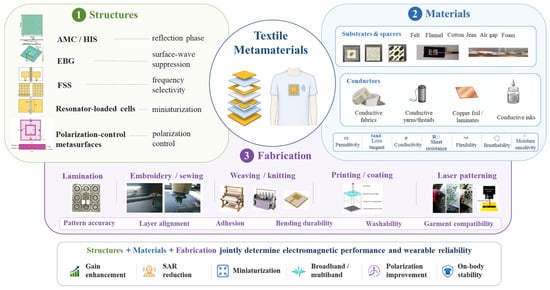
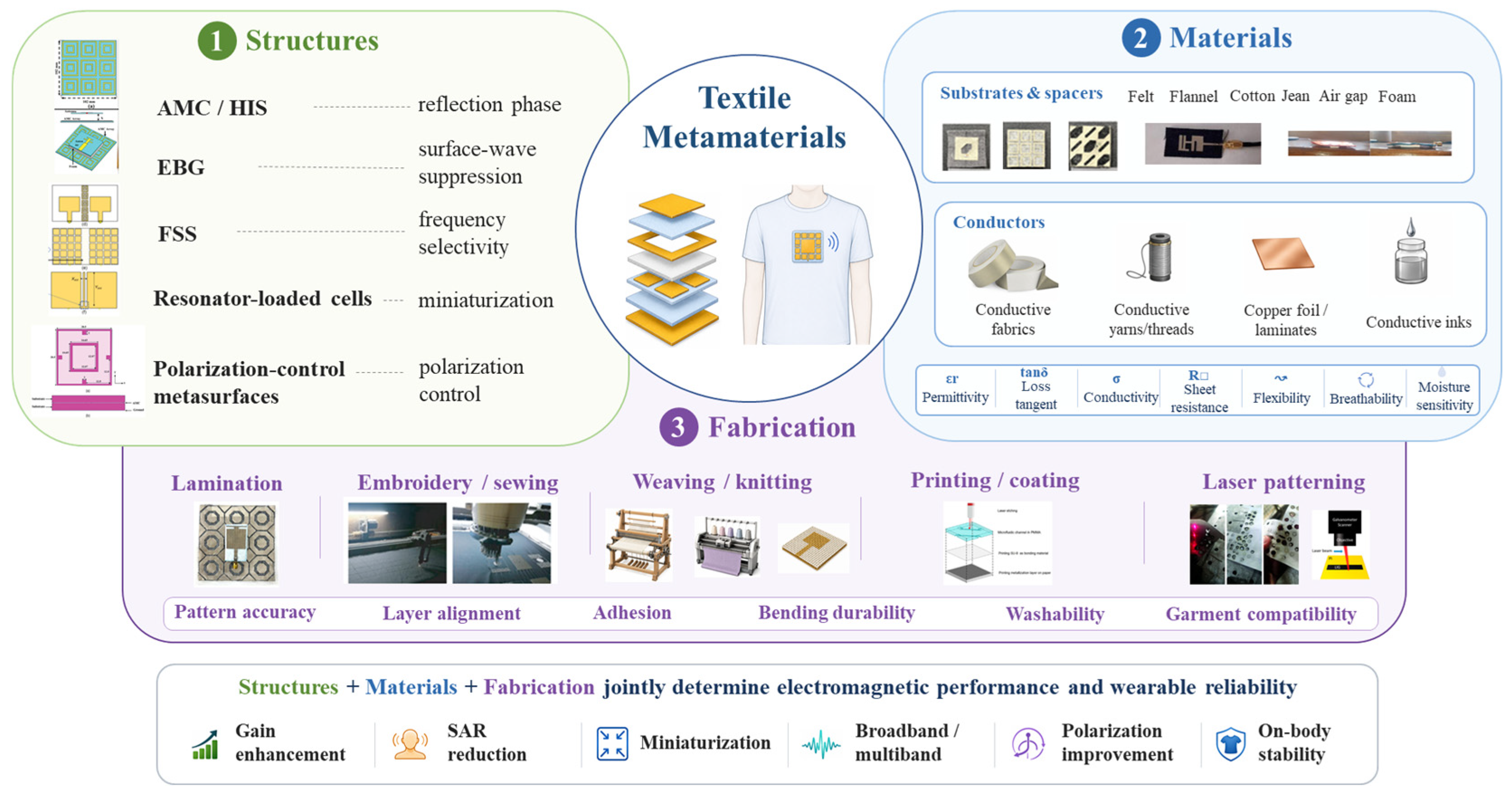
Previous reviews have separately addressed wearable and textile antennas in terms of antenna configurations, textile materials, fabrication, and human-body effects [3,4,5,6,38,39,40,41], and have also summarized the electromagnetic mechanisms and functions of metamaterials [10,16,42]. However, these discussions often emphasize metamaterial structures, while the textile realization of metamaterials remains less connected to materials and fabrication. This review therefore connects metamaterial structures, textile materials, textile-compatible fabrication, and performance. As summarized in Figure 1, the review of metamaterials for wearable textile antennas can be discussed from three closely related aspects: structures, materials, and fabrication, with emphasis on antenna–body coupling control, radiation improvement, SAR reduction, polarization regulation, and garment integration.
Figure 1.
Schematic overview of the structures, materials, fabrication, and performance of metamaterial-integrated wearable textile antennas. (AI-assisted tools were used to provide preliminary suggestions for the layout and color scheme and to generate several small schematic icons. The final figure was manually reconstructed, reviewed, and edited by the authors using Microsoft PowerPoint, version 16.0 (Microsoft Corporation, Redmond, WA, USA)).
Relevant studies were retrieved from Web of Science, Scopus, IEEE Xplore, ScienceDirect, and Google Scholar, covering publications from [1990] to [2026]. Search terms included combinations of “textile antenna”, “wearable antenna”, “textile metamaterial”, “AMC”, “HIS”, “EBG”, “FSS”, and “metasurface”. Studies on textile, flexible, or wearable metamaterial structures for antenna integration were included, particularly those reporting simulation, measurement, material, or fabrication information. Studies limited to rigid, optical, or terahertz structures without clear relevance to wearable textile antennas were excluded. Titles and abstracts were screened first, followed by full-text assessment.
2. Metamaterial Structures and Mechanisms in Textile Antennas
2.1. AMC and HIS
AMC and HIS are reflective metamaterial structures mainly defined by high surface impedance and a near-zero reflection phase around resonance. This feature distinguishes it from EBG and FSS structures. EBG mainly emphasizes the suppression or control of surface-wave propagation, while FSS regulates frequency-selective transmission or reflection. AMC/HIS is therefore more closely related to the replacement or modification of a metallic reflector, allowing the radiator to operate with a smaller spacing from the backing layer [9,10].
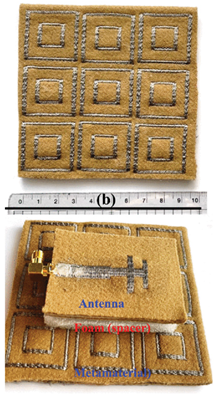
Structurally, textile AMC/HIS designs are usually composed of periodic conductive units on soft dielectric substrates. Common cells include square patches, rings, loops, grids, octagonal units, and C-shaped resonators. The gaps between adjacent units mainly provide equivalent capacitance, while the conductive paths and substrate thickness contribute to inductance. Conductive fabrics, plated textiles, embroidered conductors, and copper-based fabrics are often combined with felt, foam, denim, cotton, or other textile-compatible substrates to form flexible impedance surfaces [11,12,43,44,45,46,47].
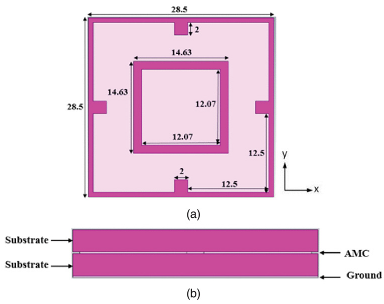
The placement of the AMC/HIS layer determines how strongly it interacts with the radiator. In many wearable antennas, the AMC/HIS is used as a body-side backing layer and is separated from the radiator by foam, felt, or an air gap. This configuration mainly redirects backward radiation, improves the front-to-back ratio and gain, and reduces SAR. For example, Yan et al. used a low-profile dual-band AMC to stabilize the textile antenna response, while Ali et al. adopted a 3 × 3 dual-band AMC array for gain, efficiency, bandwidth, and SAR improvement [11,12]. El Atrash et al. further demonstrated that AMC-backed wearable antennas can combine gain enhancement with low-SAR operation in WBAN-oriented designs [48,49].
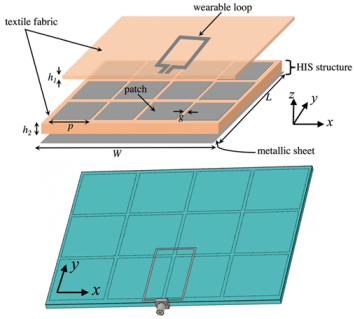
In another configuration, the AMC/HIS is placed close to the radiator or integrated into the antenna stack. In this case, it is no longer only a reflector; it also participates in impedance tuning, cavity formation, polarization control, or resonant loading. Bait-Suwailam et al. used a textile HIS to improve the impedance of a grounded loop antenna, showing that HIS layers are not limited to patch-type antennas [50]. Joshi et al. used a 3 × 3 square-patch AMC backing for a dual-band, dual-sense textile antenna, linking the AMC layer with GPS localization and WBAN/WLAN operation [51]. Yang et al. further showed that a polarization-rotation AMC can support dual-band dual-circularly polarized off-body communication [52].
For textile patch antennas with a continuous ground, placing an AMC/HIS below the ground should be considered carefully. If the ground is electrically continuous, most body-side fields are already shielded, and the AMC/HIS may couple weakly with the radiator. This layout becomes more meaningful when the ground is partial, slotted, windowed, or grid-like, where leakage toward the body still exists. In such cases, an additional AMC/HIS reflector or a breathable grid-type AMC can provide extra isolation while partly preserving flexibility and air permeability, as illustrated by the breathable ground-grid AMC reported by Hussain et al. [53].
Table 1 summarizes representative AMC/HIS structures reported in wearable textile antennas, with emphasis on unit-cell form, integration position, and the corresponding antenna-level functions. Overall, AMC/HIS design in textile antennas is not only a matter of selecting a unit-cell shape. It requires coordinated control of cell geometry, array size, layer spacing, substrate thickness, conductor continuity, bending stability, and garment comfort. These structural factors determine whether the AMC/HIS behaves as an effective body-side reflector, an embedded impedance surface, or a weakly coupled auxiliary layer.
Table 1.
Representative AMC/HIS configurations and performance comparison of wearable textile antennas with and without AMC/HIS integration.
2.2. EBG
EBG structures are periodic surfaces that create a stopband for electromagnetic-wave propagation. In wearable textile antennas, they are mainly used to suppress or control surface waves near the antenna–textile–body interface. Unlike AMC/HIS, which is usually associated with high surface impedance and in-phase reflection, and FSS, which focuses on frequency-selective transmission or reflection, EBG structures are more directly related to band-gap behavior, surface-current suppression, and coupling control [9,10,16].
Textile EBGs are commonly formed by periodic conductive cells on flexible substrates. Patch-type, coplanar, dual-band, and via-less layouts are frequently adopted. Since metallic vias are difficult to fabricate and maintain in soft fabrics, via-less EBGs are especially suitable for textile antennas, although their stopband response is sensitive to unit-cell size, gap spacing, substrate thickness, conductor continuity, and bending deformation [13,14,16].
Representative studies show the main functions of EBG in textile antennas. Zhu and Langley used a dual-band EBG to reduce body-side radiation and improve gain [13]. Ashyap et al. demonstrated that a via-less textile EBG can enhance gain, efficiency, front-to-back ratio, and SAR performance without using vertical vias [14]. Wissem et al. extended textile EBG design to a 26 GHz 5G-IoT antenna, while Agus et al. and Kumkhet et al. applied EBG-based surfaces to wearable MIMO systems for isolation, radiation improvement, and SAR reduction [15,58,59]. In addition, Tak et al. showed that EBGs can also guide useful body-surface waves rather than only suppress unwanted propagation [60].
Table 2 summarizes representative EBG structures in wearable textile antennas, including dual-band EBGs, via-less EBGs, millimeter-wave EBG-backed antennas, and EBG-assisted MIMO designs. These examples indicate that textile EBGs are mainly used for surface-wave control, body-side isolation, gain and efficiency enhancement, SAR reduction, and mutual-coupling suppression. Overall, textile EBG design requires a compromise between electromagnetic performance and textile compatibility. A stable band gap depends on periodicity and layer accuracy, while bending, compression, cutting tolerance, and misalignment may shift the operating frequency or weaken the stopband. Therefore, EBG-based textile antennas should be evaluated together with gain, efficiency, SAR, front-to-back ratio, bending stability, and on-body performance.
Table 2.
Representative EBG configurations and performance comparison of wearable textile antennas with and without EBG integration.
2.3. FSS
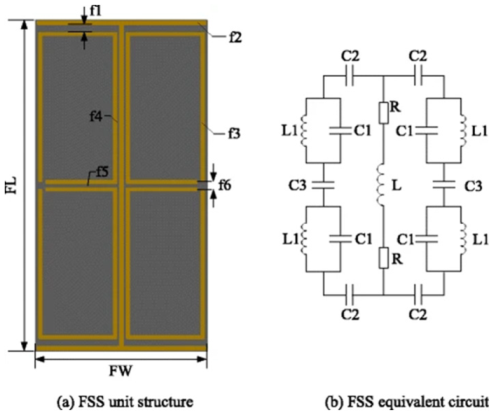
FSS are periodic conductive or aperture-type surfaces that provide frequency-dependent transmission and reflection responses. In wearable textile antennas, FSS are mainly used as selective reflectors, shielding layers, or superstrates. Compared with continuous metallic grounds, textile FSSs can offer electromagnetic isolation while retaining better flexibility, lower weight, and partial breathability. This makes them suitable for gain enhancement, SAR reduction, radiation-pattern control, and body-side shielding in garment-integrated antennas [17,18,19,20].
Textile FSS are usually formed by repeated unit cells such as square loops, rings, grids, cross-shaped elements, Y-shaped fractal cells, or other patterned conductive fabrics. Their response is determined by unit-cell geometry, periodicity, substrate permittivity, conductor sheet resistance, and the spacing between the FSS and radiator. In textile implementations, fabrication tolerance is particularly important because cutting error, lamination direction, embroidery roughness, bending, and fabric deformation can shift the resonant frequency or weaken the frequency-selective response [18,19,20,21].
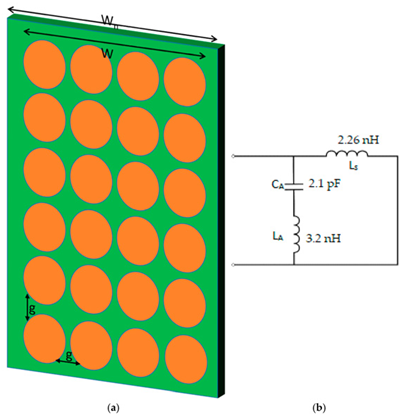
Representative antenna studies show the main role of FSSs in wearable textile platforms. Amit et al. used an FSS reflector beneath a textile antenna to improve gain and reduce SAR at 2.4 and 5.8 GHz [17,61]. Sugumaran et al. reported a compact flexible monopole backed by a modified square-loop FSS for SAR reduction and gain enhancement [62]. Vaezi et al. further combined an FSS with a miniaturized circularly polarized wearable antenna, where the FSS contributed to beam shaping and SAR control [63]. In addition, frequency-selective fabric studies by Rac-Rumijowska et al., Guan et al., Li et al., and Zheng et al. show that textile substrate, unit-cell shape, lamination direction, and fabrication method strongly affect FSS transmission and shielding performance [18,21,64,65,66,67,68].
Table 3 summarizes representative FSS and frequency-selective textile structures used in wearable textile antennas. The listed studies include textile FSS reflectors, square-ring FSSs, ring-shaped and Y-shaped frequency-selective fabrics, and FSS-based coupling-control structures. These examples indicate that FSSs are mainly used for gain enhancement, SAR reduction, beam shaping, electromagnetic shielding, transmission control, and coupling suppression. Overall, FSS design in textile antennas requires a balance between frequency selectivity and wearable compatibility. A denser or larger FSS array can improve shielding and radiation control, but it may also increase stiffness and reduce comfort. Meanwhile, bending, compression, and textile anisotropy can alter the unit-cell spacing and effective permittivity. Therefore, FSS-based textile antennas should be evaluated not only by free-space transmission or reflection response, but also by antenna gain, SAR, radiation pattern, bending stability, and on-body performance.
Table 3.
Representative FSS configurations and performance comparison of wearable textile antennas with and without FSS integration.
Table 4 provides a concise category-level comparison of the three main metamaterial structures used in wearable textile antennas, clearly highlighting their differences in structural features, primary functions, and application focuses.
Table 4.
Comparison of AMC/HIS, EBG, and FSS structures in wearable textile antennas.
2.4. Representative Performance Visualizations
Previous sections summarized the quantitative performance variations in textile metamaterial antennas. This section further illustrates the effects of metamaterial integration on radiation, impedance matching, and human safety through visual comparisons.
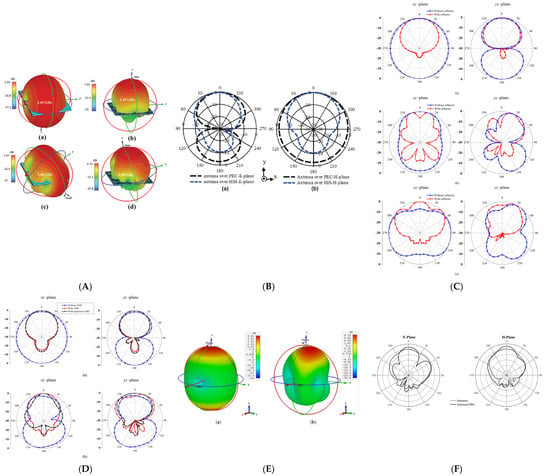
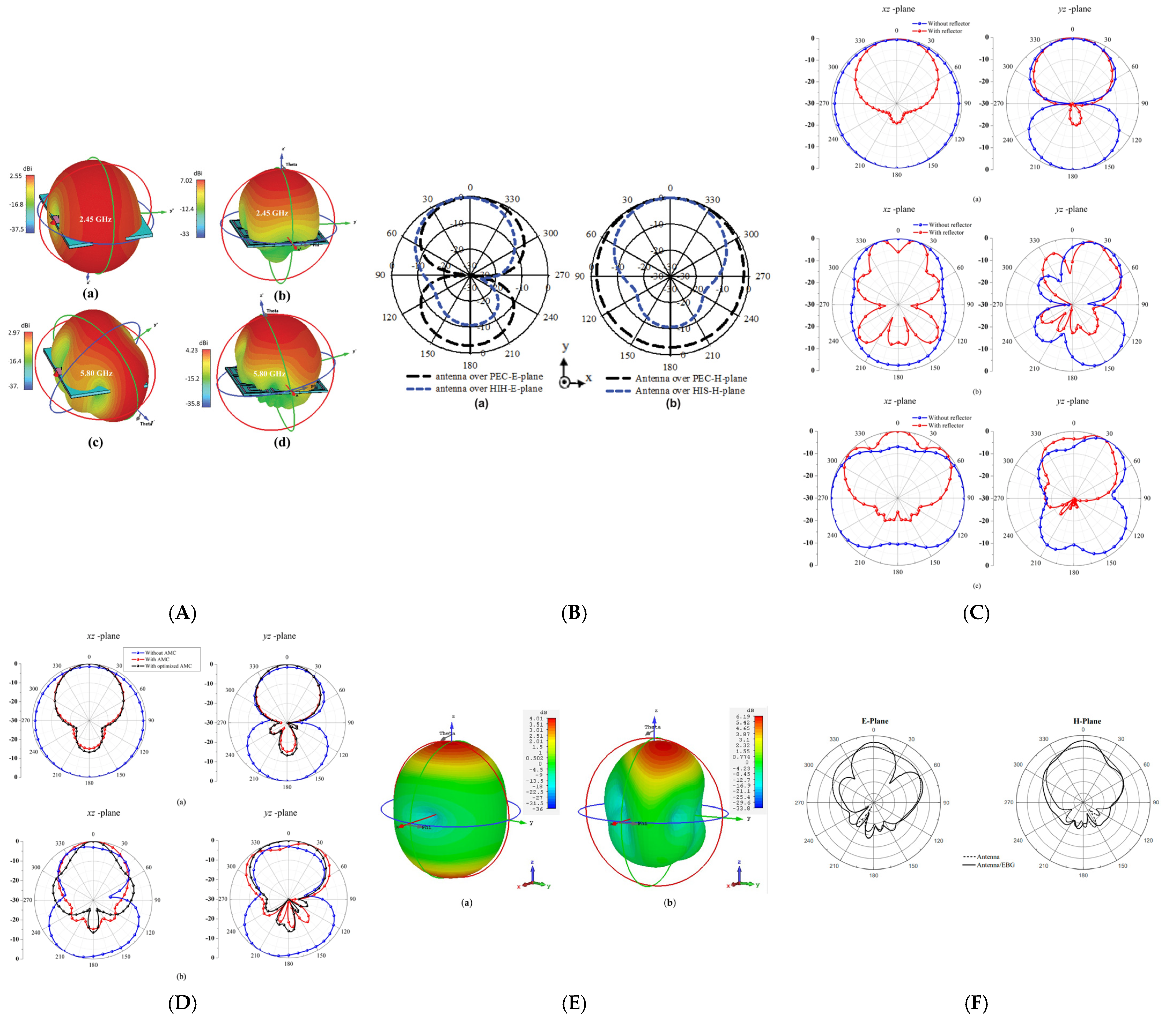
As shown in Figure 2, most textile antennas exhibit reduced backward radiation and enhanced forward gain upon integration of metamaterial structures [12,15,43,45,46,50]. AMC/HIS structures primarily redistribute electromagnetic energy through reflection-phase control, reducing body-directed radiation, while EBG structures suppress surface-wave propagation and reduce unwanted energy losses.
Figure 2.
Representative radiation-pattern variations in wearable textile antennas before and after metamaterial integration: (A) [12] Ali; (B) [43] Ashyap; (C) [45] Thaiwirot; (D) [46] Hengroemyat; (E) [50] Bait-Suwailam; (F) [15] Wissem.
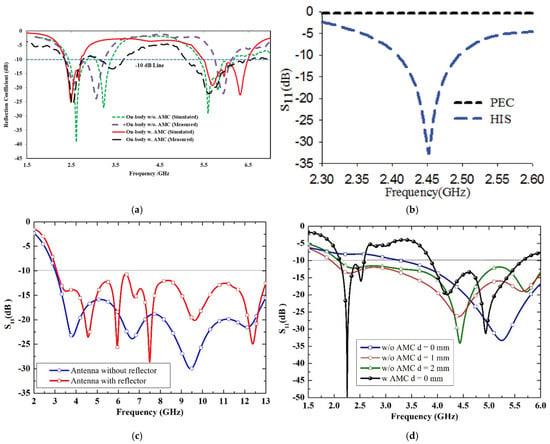
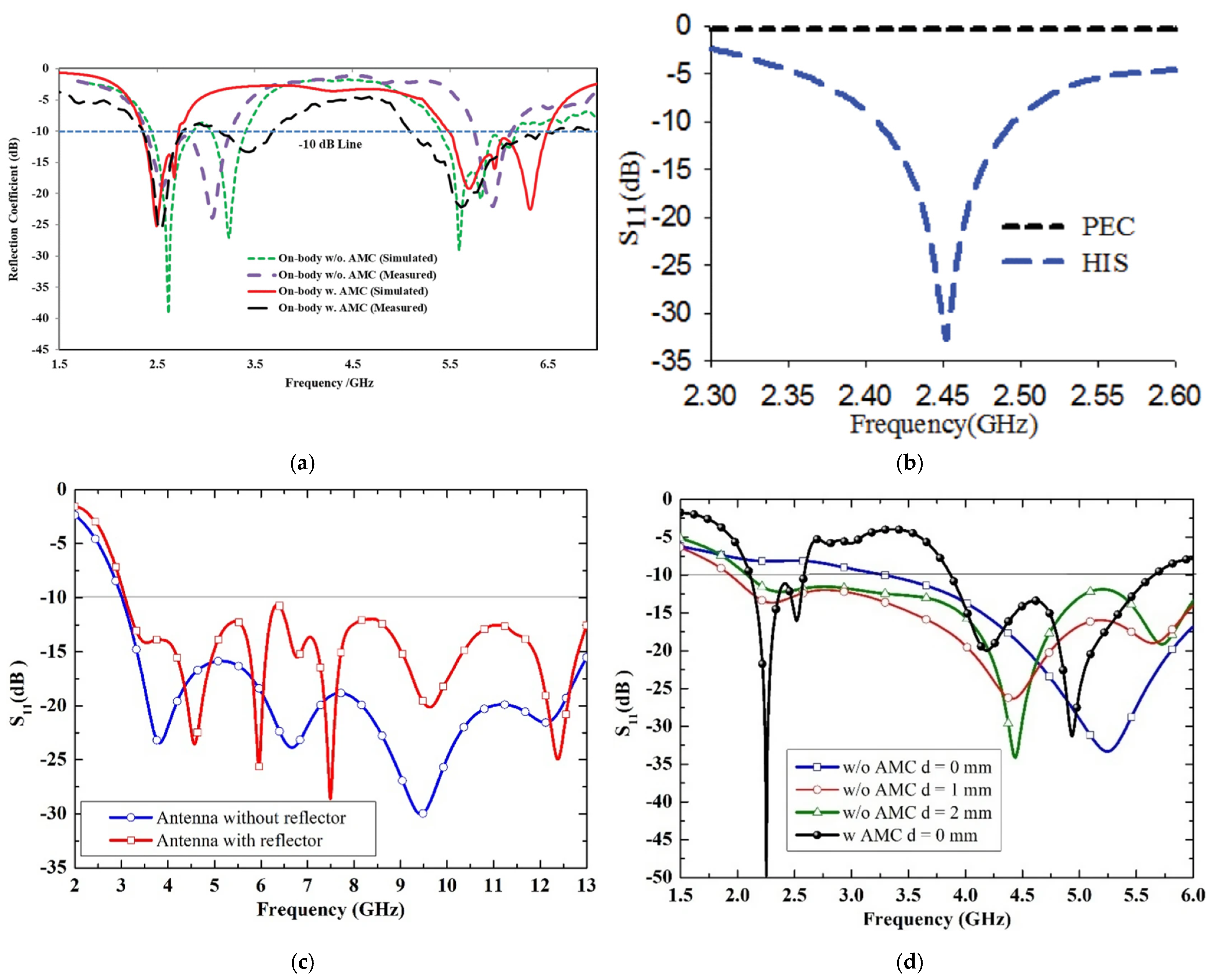
Figure 3 shows that metamaterial loading can improve the impedance matching performance of textile antennas. The results reported by Ashyap [43] and Hengroemyat [46] demonstrate bandwidth enhancement and reduced reflection loss after AMC integration. However, Ali [12] and Thaiwirot [45] indicate that metamaterial loading may also modify the equivalent inductance, capacitance, and resonant modes of the antenna, resulting in operating-frequency shifts that require further frequency tuning.
Figure 3.
Representative S11 variations in wearable textile antennas before and after metamaterial integration: (a) [12] Ali; (b) [43] Ashyap; (c) [45] Thaiwirot; (d) [46] Hengroemyat.
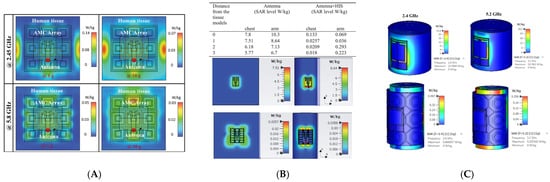
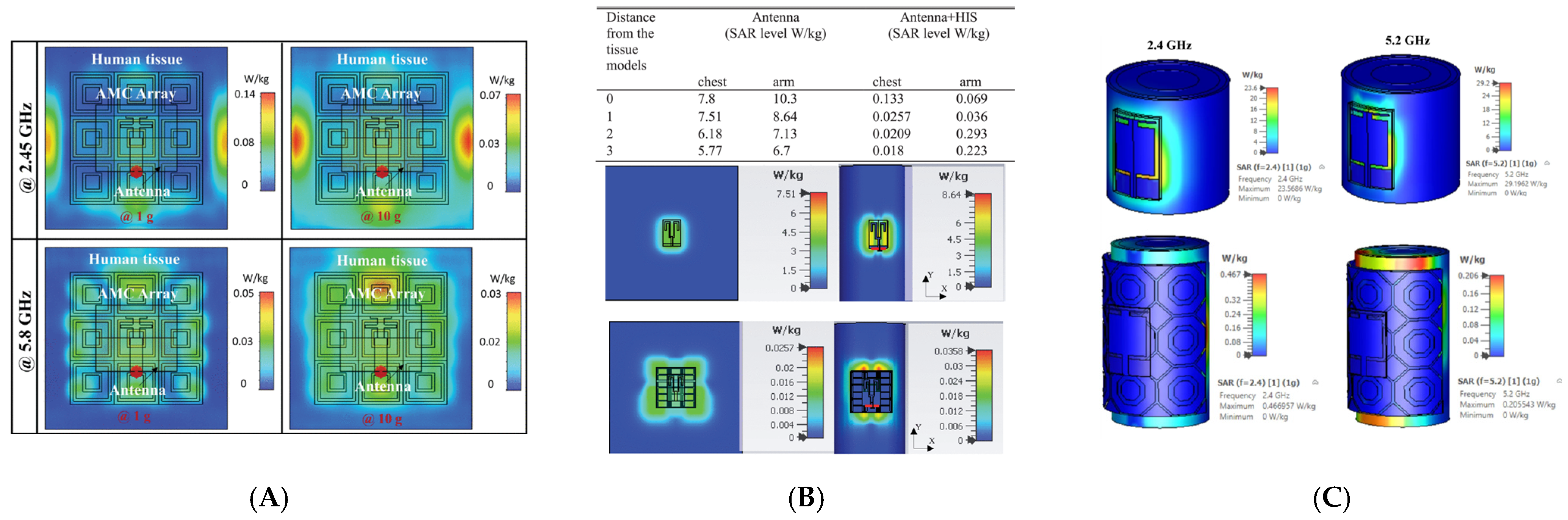
As shown in Figure 4, SAR reduction is one of the major motivations for integrating metamaterials into wearable antennas. AMC/HIS and EBG structures effectively reduce electromagnetic leakage toward the human body. However, additional reflective layers and spacer structures may increase antenna profile and compromise flexibility and garment integration.
Figure 4.
Representative SAR variations in wearable textile antennas before and after metamaterial integration: (A) [12] Ali; (B) [43] Ashyap; (C) [46] Hengroemyat.
Overall, textile metamaterials provide effective approaches for improving radiation performance and human safety, but their advantages involve trade-offs with wearable compatibility. Furthermore, many existing designs still rely on concepts developed for rigid substrates, highlighting the need for textile-oriented metamaterial designs that consider the unique characteristics of textile materials, including flexibility, deformation, and anisotropy.
In addition to AMC, HIS, EBG, and FSS structures, metamaterial-inspired resonators and polarization-control metasurfaces provide localized electromagnetic control in wearable textile antennas. Resonator-loaded elements, such as SRRs, CSRRs, CRLH cells, ZORs, and anisotropic metasurface cells, can be embedded into the radiator, feed line, ground, slot region, or nearby textile layer to introduce additional resonances, adjust current paths, and tune impedance, bandwidth, miniaturization, or multiband performance [22,23,24,25,26,27,70,71]. Polarization-control metasurfaces are especially useful for wearable communication, GNSS, and positioning systems because they can improve circular polarization, axial-ratio bandwidth, gain stability, and off-body communication under changing antenna orientations [28,29,30,31,32,33,72,73,74]. Therefore, metamaterial structures in textile antennas should be evaluated not only by their structural type, but also by their placement, coupling strength, and antenna-level functions, including matching, radiation pattern, gain, efficiency, SAR, polarization response, deformation stability, and fabrication repeatability [9,10,16,17,18,19,20,21].
3. Materials for Metamaterial Structures in Textile Antennas
3.1. Substrates and Spacer Materials
Substrates and spacer layers strongly affect the electromagnetic response of textile metamaterial antennas. The substrate determines the effective permittivity, loss, unit-cell capacitance, and electrical size, while the spacer controls the coupling strength between the radiator, the metamaterial layer, and the human body. A higher permittivity can reduce the unit-cell size, but excessive dielectric loss may lower radiation efficiency. A thicker spacer can improve isolation and broaden the effective reflection response, but it also increases antenna profile and reduces wearing comfort [9,10,16].
Felt is the most widely used substrate in textile AMC and EBG antennas because it is soft, low-cost, low-permittivity, and easy to obtain in millimeter-scale thickness. It has been used in dual-band EBG/HIS antennas, AMC-backed textile antennas, and recent all-textile AMC designs [11,12,13,45,46]. These studies show that substrate thickness, intercell gap, and conductive-cell geometry jointly determine the reflection phase, band-gap position, and antenna–body isolation. Foam, Rohacell, air gaps, and spacer fabrics are often added to adjust the separation between the radiator and the metamaterial layer, thereby improving gain, front-to-back ratio, and SAR performance [13,17,46,48].
FSS and polarization-control metasurfaces introduce broader substrate choices, including flannel, polyester textile, PET fabric, and multilayer felt. For example, Amit et al. used flannel with an air gap in an FSS-backed textile antenna, while Rac-Rumijowska et al. showed that substrate permittivity, thickness, conductive layer properties, and interelement spacing all influence FSS frequency selectivity [17,18]. These results indicate that textile substrates should be treated as electromagnetic design variables rather than only as garment materials.
Table 5 summarizes representative substrate and spacer materials used in textile metamaterial antennas, including felt, flannel, foam, Rohacell, air gaps, PET textile, cotton, jean, jute, PDMS, and Ecoflex. The listed parameters show that material thickness, relative permittivity, and loss tangent vary significantly across reported designs, which partly explains the differences in resonance shift, reflection bandwidth, SAR reduction, and bending stability.
Table 5.
Materials and properties of substrates and spacer layers used in textile metamaterial structures.
Overall, substrate and spacer selection requires a compromise among miniaturization, bandwidth, isolation, comfort, and mechanical stability. Future studies should report not only nominal dielectric parameters but also the effects of compression, humidity, bending, and washing effects, since these factors can change the effective permittivity, layer spacing, and final antenna performance.
3.2. Conductive Materials
Conductive materials define the current path of textile metamaterial unit cells. In AMC/HIS, EBG, FSS, metasurfaces, and resonator-loaded antennas, conductor properties affect surface resistance, current continuity, ohmic loss, intercell coupling, and fabrication accuracy. Therefore, the conductor is not only a metallization layer, but also a key factor controlling reflection phase, stopband response, frequency selectivity, absorption strength, and radiation efficiency.
Table 6 summarizes representative conductive materials used in textile metamaterial antennas and related structures. The reported choices include copper- or nickel-plated conductive fabrics, ShieldIt-type textiles, copper foil or polyimide copper laminates, conductive threads, printed silver inks, PU resistive films, conductive fibers, liquid metal, MXene-coated fabrics, and conductive 3D-printing filaments. Their electrical properties vary widely, from highly conductive copper layers to resistive films and fibrous networks designed for controlled loss.
Table 6.
Conductive materials and properties used in textile metamaterial structures.
Conductive fabrics are still the most common option because they are flexible, easy to cut or laminate, and sufficiently conductive for many wearable antenna bands [11,12,13,14,45,46]. However, their performance depends strongly on sheet resistance, edge quality, adhesive bonding, and bending stability. Fraying, anisotropic conductivity, and local air gaps may shift resonance or reduce radiation efficiency. At higher frequencies or for finer metasurface patterns, conductor precision becomes more critical. Copper laminates and foils provide better edge definition and lower loss, which is useful for millimeter-wave EBGs and compact metasurfaces [15,28]. Embroidered conductive threads offer better textile integration and washability, but stitch density, thread tension, and surface roughness can change the effective line width and resistance [24,25,35,78]. For absorbers and tunable structures, the target is not always maximum conductivity; resistive films, conductive fibers, carbon-based coatings, and liquid metals are selected to provide controlled loss or deformation-dependent tuning [34,35,36,37,75,76].
Overall, conductive-material selection should match the electromagnetic function of the structure. Reflective layers usually require low-loss and continuous conductors. Future studies should report not only conductivity, but also sheet resistance, pattern resolution, bending durability, adhesion, washing stability, and their influence on antenna performance.
Material selection and fabrication accuracy are critical for metamaterial-integrated textile antennas because the electromagnetic response is strongly coupled with the textile platform. They directly affect equivalent capacitance, inductance, surface impedance, band-gap behavior, frequency selectivity, absorption loss, and polarization response. Compared with rigid microwave substrates, textile materials introduce additional design uncertainty. Their porosity, compressibility, anisotropy, moisture sensitivity, and deformation under bending or washing can shift the resonant frequency, change the reflection or transmission response, and reduce repeatability. Similarly, conductive fabrics, threads, printed inks, liquid metals, and lossy coatings differ in conductivity, sheet resistance, pattern resolution, adhesion, and durability, which further influence radiation efficiency, SAR reduction, shielding performance, and long-term wearable reliability.
4. Metamaterials Fabrication and Integration Technologies
4.1. Fabric Lamination
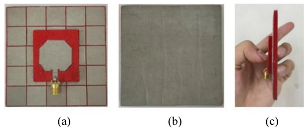
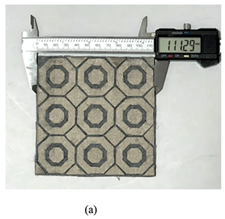
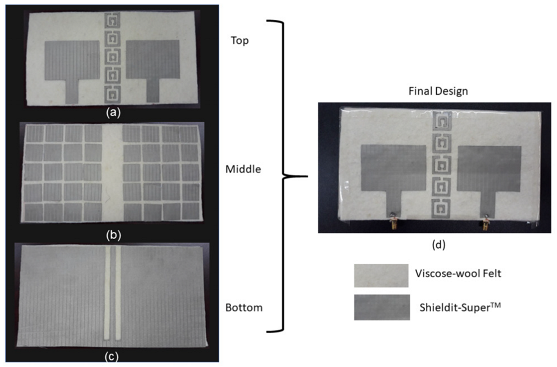
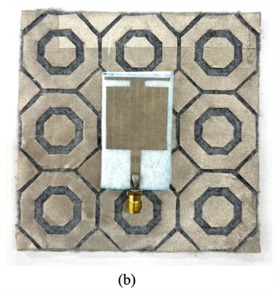
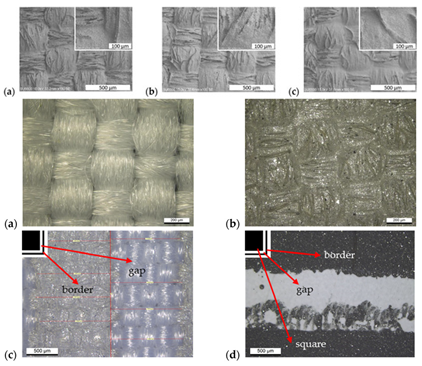
Fabric lamination is one of the most common fabrication routes for textile metamaterial antennas. Conductive fabrics, copper foils, or copper tapes are cut into periodic unit cells and then bonded onto felt, foam, denim, polyester, or other flexible substrates. This method is especially suitable for AMC/HIS, EBG, and FSS structures, where the electromagnetic response depends strongly on unit-cell size, gap spacing, and layer alignment [13,14,43,44,45,46,48,50].
Table 7 summarizes representative laminated textile metamaterial antennas, including patterned conductive-fabric HIS, low-profile AMC layers, octagonal AMC cells, textile HIS-backed antennas, and metamaterial-inspired laminated patterns.
Table 7.
Representative textile metamaterial antennas fabricated by lamination.
Lamination is a simple and low-cost method for rapid prototyping of textile metamaterial antennas. Conductive fabrics or copper foils can be cut into periodic patterns and bonded onto flexible substrates, making it convenient to verify designs, compare unit-cell geometries, adjust spacer layers, and assemble multilayer antenna–metamaterial stacks [45,46,53,55]. However, lamination is not a high-precision textile manufacturing method. Cutting errors, adhesive thickness, bonding nonuniformity, and layer misalignment may alter the effective substrate height, intercell capacitance, reflection phase, stopband position, and impedance matching. Adhesive bonding may also increase local stiffness, reduce breathability, or cause delamination during repeated deformation. Therefore, laminated textile metamaterial antennas are suitable for laboratory-stage validation, but practical garment integration still requires evaluation of dimensional repeatability, bonding stability, flexibility, and long-term reliability.
4.2. Embroidery and Sewing
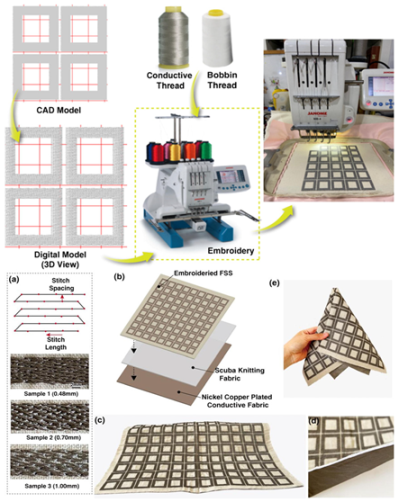
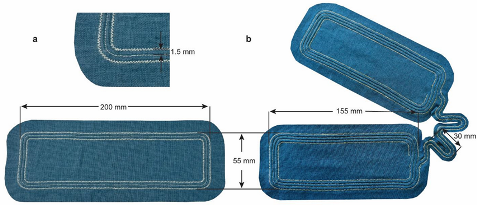
Embroidery and sewing are widely used for textile antennas because conductive threads can be patterned into radiators, resonators, and cells. They are especially useful for SRR-based antennas, RFID reader antennas, and textile resonant structures [24,25,35,66,67,78,83].
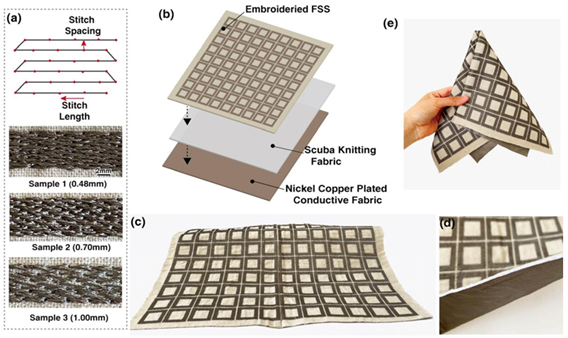
Table 8 summarizes representative embroidered or sewn textile metamaterial structures. These studies show that embroidery is not only a manufacturing method but also a way to tune electromagnetic response through stitch density, thread path, and conductive-thread continuity. The electromagnetic mechanism is strongly linked to stitch geometry. Stitch density, stitch direction, yarn position, yarn tension, and stabilizer choice control the effective line width, surface roughness, inter-yarn contact resistance, and continuity of each unit cell. These parameters alter the equivalent inductance and capacitance of the design [35,84,85].
Table 8.
Representative textile metamaterial antennas fabricated by embroidery and sewing.
The advantage of embroidery is its compatibility with large-area textile production and washable garment integration. At the same time, the process introduces RF uncertainty. Stitch spacing, yarn tension, thread roughness, and inter-yarn contact resistance can change the effective line width, surface resistance, and resonant frequency. Therefore, embroidered metamaterial antennas should be evaluated together with fabrication tolerance, bending response, washing durability, and repeatability [84,85,87,88,89,90].
4.3. Printing and Coating
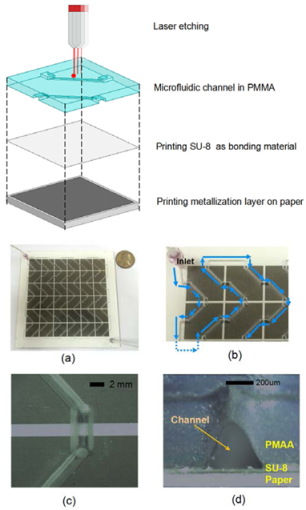
Screen-printed silver ink, conductive paste, resistive films, carbon-based coatings, and MXene coatings have been used to form resonant or lossy textile patterns [18,34,36,79,91]. Table 9 summarizes representative printed and coated metamaterial structures, including silver-ink textile absorbers, printed FSS patterns, inkjet-printed absorbers, MXene-based metasurfaces, and coated nonwoven fabrics. These studies show that printing and coating are not only patterning methods, but also material-tuning routes for controlling conductivity, sheet resistance, and absorption loss.
Table 9.
Representative textile metamaterial antennas fabricated by printing and coating.
The key challenge is the interaction between ink and fabric. Ink spreading, penetration into yarn gaps, uneven drying, and cracking under bending can change line width, thickness, and surface resistance. These variations directly affect the resonant frequency, absorption strength, and frequency-selective response. Therefore, printed textile metamaterials should be evaluated together with sheet resistance stability, bending durability, washing resistance, and pattern repeatability.
4.4. Laser Patterning and Etching
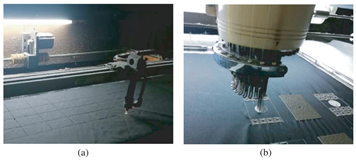
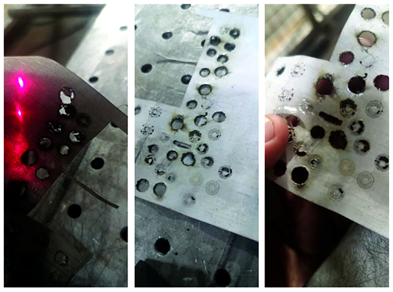
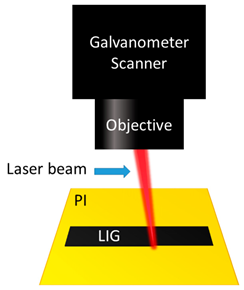
Laser patterning and etching provide better geometric precision than manual cutting or coarse coating. They are suitable for fine patterns, especially when the operating frequency is high, and the unit-cell size is small [15,18,28]. Table 10 summarizes representative laser-patterned or etched structures, including etched copper-laminate EBGs, laser-cut conductive textile metasurfaces, laser-induced graphene absorbers, textile CSRR cells, and laser-written antenna patterns. These examples indicate that laser processing can improve edge definition and pattern repeatability, but its use depends on substrate thermal stability.
Table 10.
Representative textile metamaterial antennas fabricated by laser patterning and etching.
Overall, laser patterning and etching offer relatively high geometric resolution for textile metamaterials, especially for fine patterns. Compared with manual cutting or coarse coating, these methods improve edge definition and pattern repeatability, which is important for unit cells sensitive to dimensional errors. However, their textile application is limited by substrate thermal stability, processing cost, material compatibility, and possible fabric damage. Therefore, laser-based techniques are suitable for precise patterning and mechanism verification, but practical integration still requires control of thermal effects, sheet resistance, adhesion, and mechanical durability [94,95].
5. Reliability of Textile Metamaterial
5.1. Bending and Deformation Stability
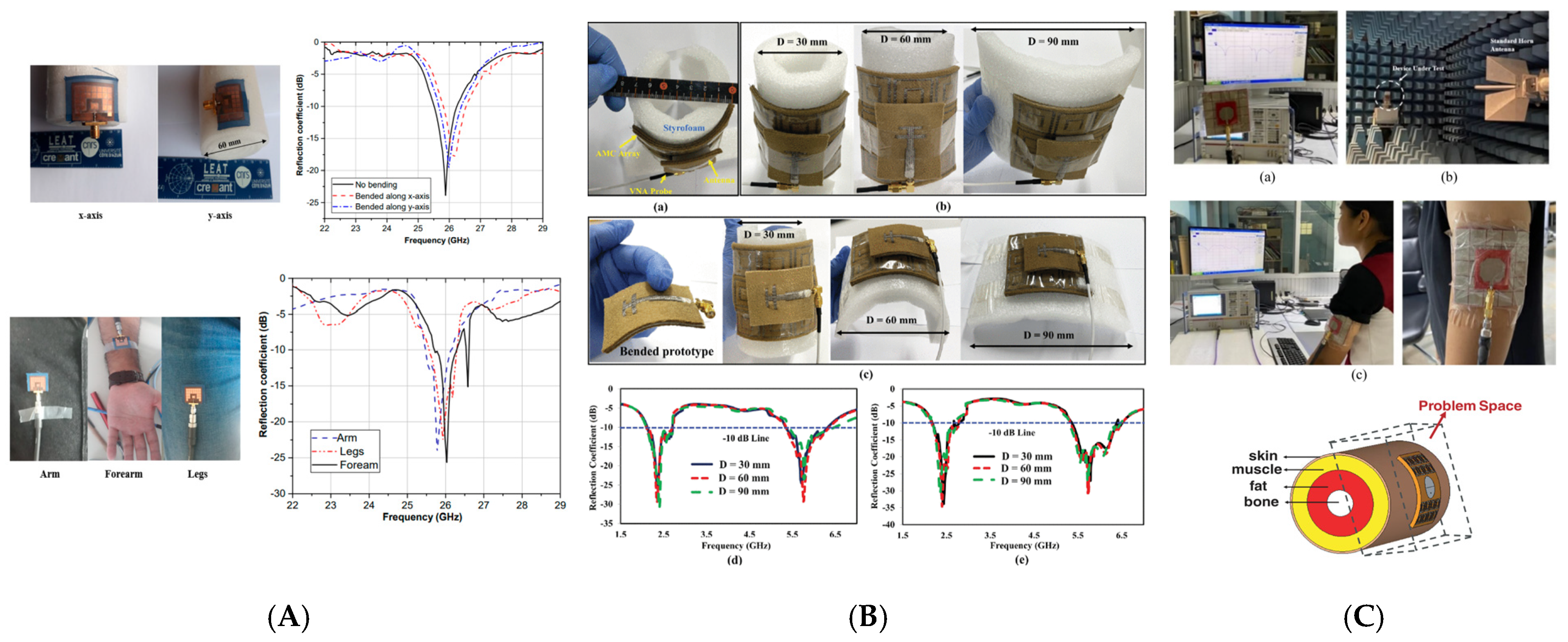
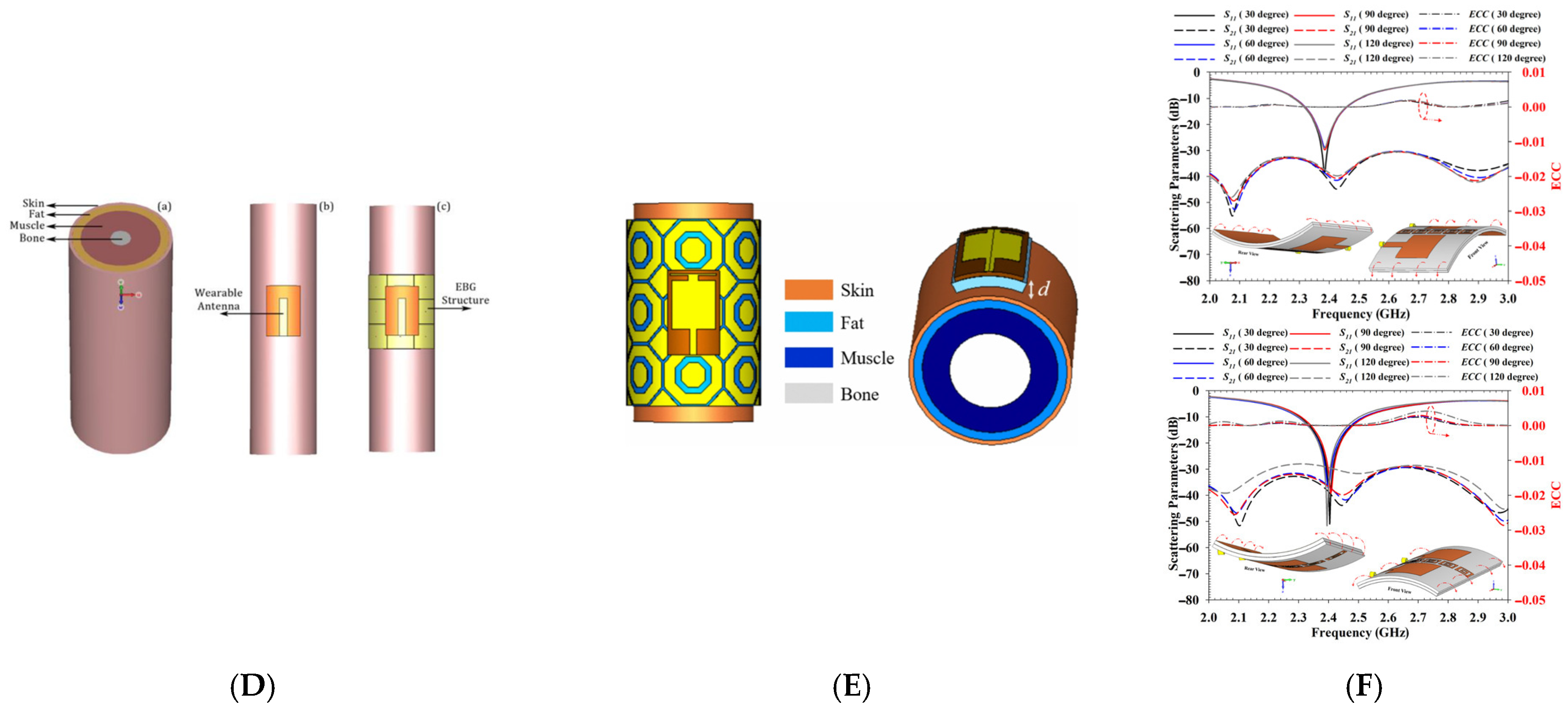
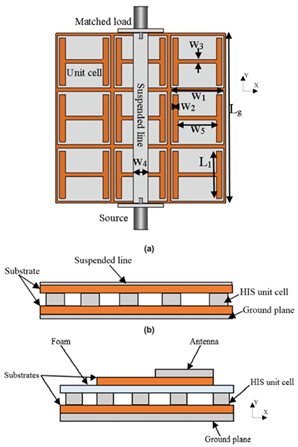
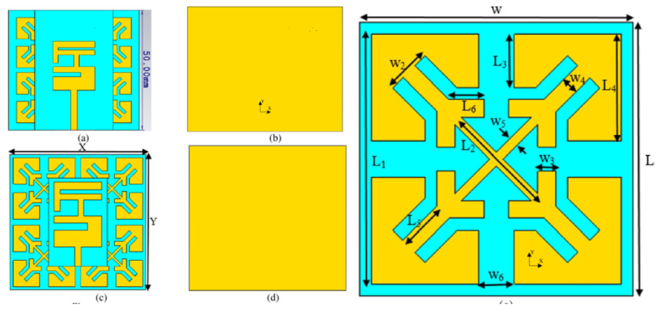
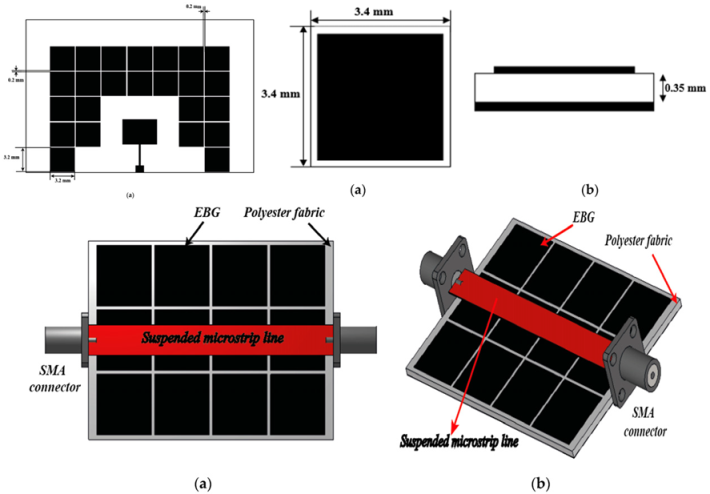
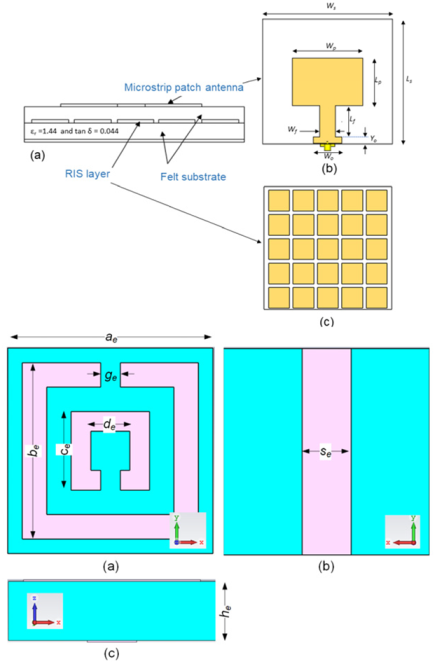
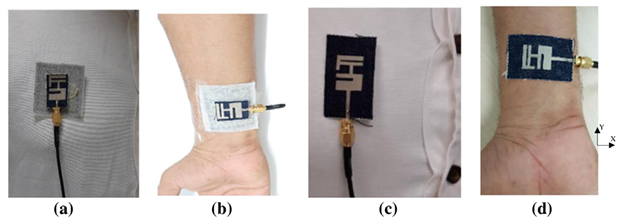
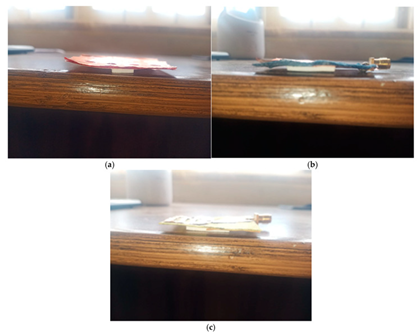
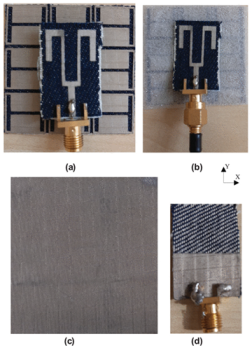
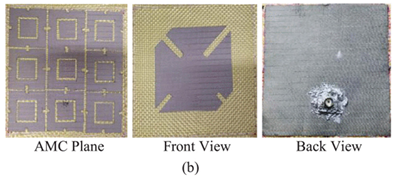
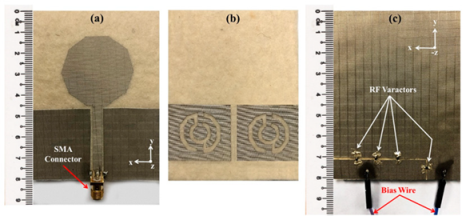
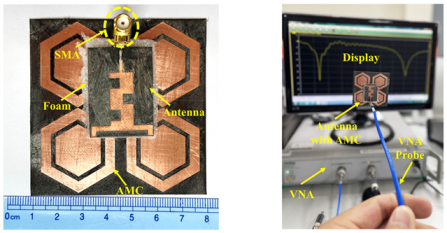
The wearability of textile metamaterial-integrated antennas is commonly evaluated through static bending and on-body tests. As shown in Figure 5, the antenna is usually mounted on cylindrical supports with different diameters or placed on-body locations such as the arm, forearm, and leg, and its performance is compared before and after deformation. Wissem et al. [15] found that a millimeter-wave EBG antenna retained its target operating band under different bending directions and body positions, although some resonance shift occurred. Ali et al. [12] tested a dual-band AMC antenna on cylinders with diameters of 30, 60, and 90 mm. The operating bands were generally maintained, while smaller bending diameters caused more evident detuning. The UWB AMC antenna reported by Thaiwirot et al. [45] preserved its wideband response under arm-wrapping and on-body conditions, with only a slight shift in the lower-frequency region. Hengroemyat et al. [46] further evaluated antenna stability near the body using a multilayer arm model.
Figure 5.
Representative bending, on-body, and directional deformation evaluations of textile metamaterial-integrated antennas: (A) [15] Wissem; (B) [12] Ali; (C) [45] Thaiwirot; (D) [96] Tetik; (E) [46] Hengroemyat; (F) [58] Agus.
Bending direction also affects antenna performance. Shamsuri Agus et al. [58] examined an RIS–EBG MIMO antenna under different bending angles and orientations. The scattering parameters and mutual coupling varied differently along the two axes, indicating clear directional sensitivity. This behavior was associated with changes in unit-cell spacing, current paths, and relative array positions.
Overall, existing studies confirm that these antennas can maintain acceptable performance under regular bending and static on-body conditions. However, the reported tests remain relatively simple. Wrinkling, twisting, nonuniform compression, interlayer sliding, localized severe deformation, and dynamic body motion have rarely been evaluated systematically. Future work should therefore include irregular deformation and dynamic wearing tests.
5.2. Moisture, Washing, Abrasion, and Long-Term Durability
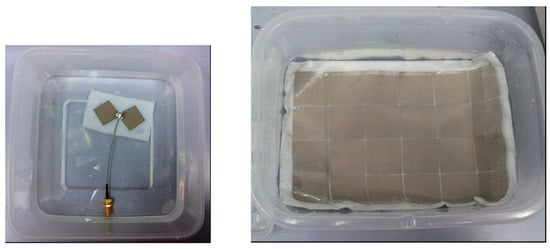
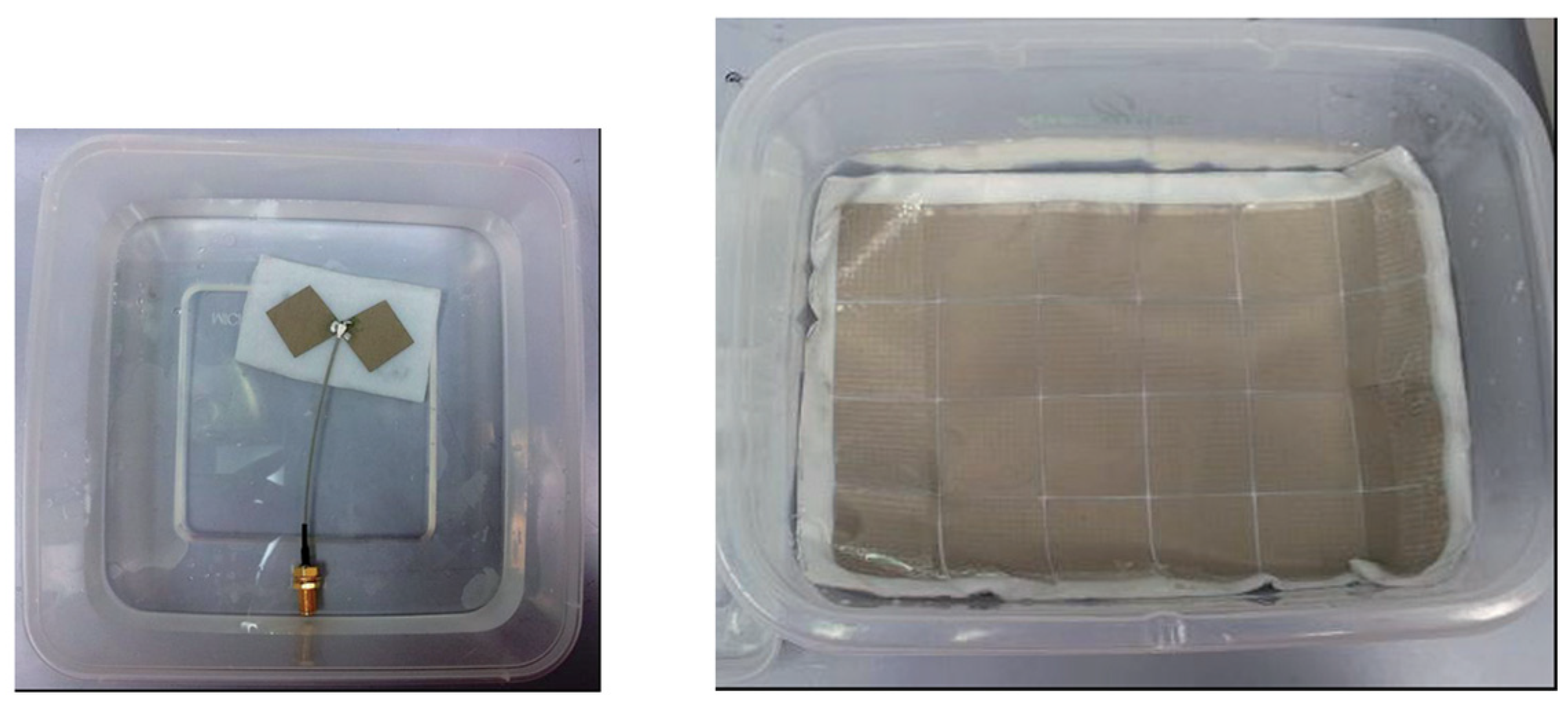
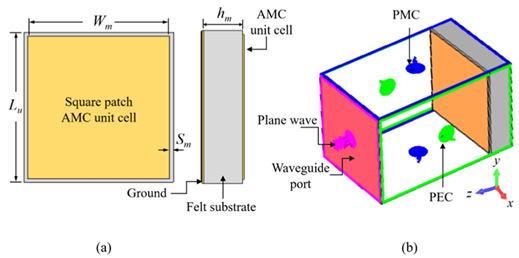
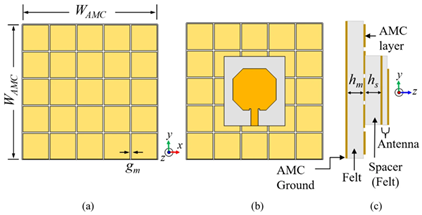
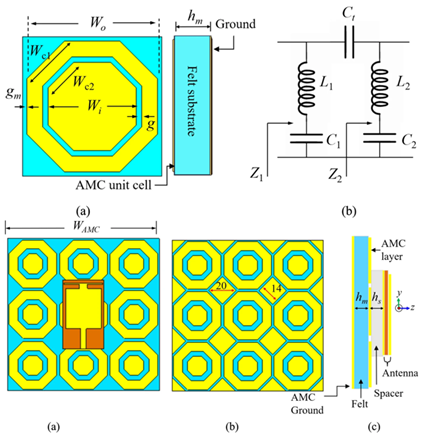
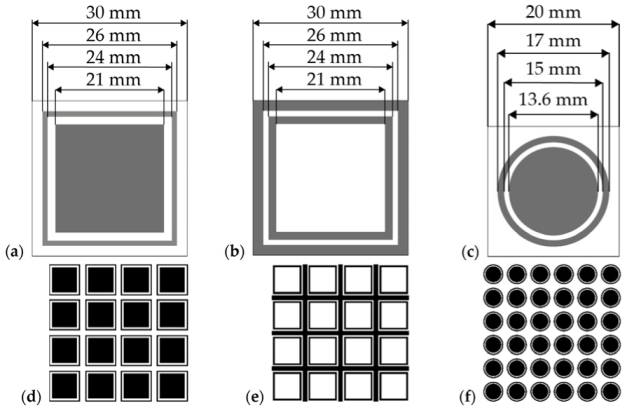
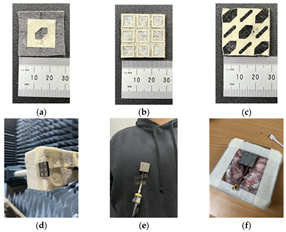
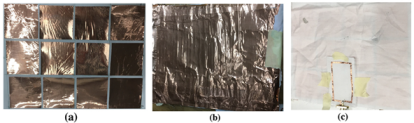
Textile substrates are porous and moisture-sensitive. Water absorbed into the fibers and interlayer voids can increase the effective permittivity and dielectric loss, while also altering the coupling between metamaterial cells and between the antenna and the AMC layer. Kamardin et al. evaluated textile diamond-dipole, CPW-monopole, and textile-AMC configurations under wet conditions [97,98,99,100]. After prolonged immersion, the fully wet structures exhibited clear downward frequency shifts and distorted responses. Their performance gradually recovered during drying, although small residual deviations remained, possibly due to fabric shrinkage, interlayer displacement, or residual moisture. These studies mainly examined single-immersion and drying-recovery processes and should not be regarded as standardized laundering tests.
Existing evaluations also focused largely on S11, with limited systematic comparisons of the AMC reflection phase, gain, efficiency, radiation pattern, and SAR before and after wetting. Standardized abrasion tests, artificial-sweat exposure, repeated wet–dry cycling, and post-washing performance assessment remain insufficiently investigated for textile metamaterial-integrated antennas (Figure 6).
Figure 6.
Wetness-test configurations for textile AMC [98].
6. Conclusions and Future Perspectives
6.1. Conclusions
Metamaterials provide an effective route for improving the on-body performance of wearable antennas by introducing additional electromagnetic interfaces to regulate antenna–body coupling, suppress backward radiation, enhance radiation efficiency, reduce SAR, and improve polarization response. Among the reported structures, AMC/HIS and EBG are most frequently used for reducing backward radiation, improving gain, increasing front-to-back ratio, and lowering SAR. FSS provide more selective transmission, reflection, shielding, beam shaping, and polarization control. Resonator-loaded structures are useful for compact and multiband textile antennas. These functions are often coupled in practical textile antenna stacks, so the role of a metamaterial layer should be evaluated according to its position, spacing, coupling strength, and interaction with the radiator and human body.
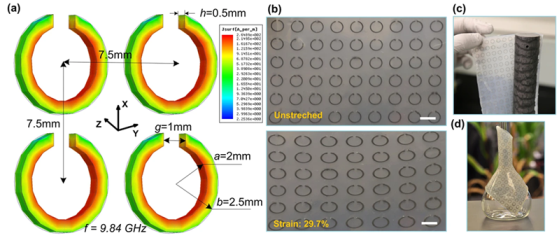
The reviewed studies also show that textile is a decisive part of metamaterial antenna design. Substrate permittivity, loss tangent, thickness, spacer configuration, conductor sheet resistance, pattern accuracy, and layer alignment directly affect the final reflection phase, band-gap response, frequency selectivity, resonant mode, radiation efficiency, and SAR performance. Therefore, textile substrates, spacer layers, and conductive materials should not be treated only as mechanical supports. They are active design variables that determine whether the intended metamaterial response can be transferred from simulation to a wearable textile platform.
As for fabrication, lamination is suitable for low-cost and rapid laboratory validation of designs, but its accuracy and long-term reliability are limited by cutting tolerance, adhesive thickness, bonding uniformity, and layer misalignment. Embroidery, sewing, weaving, and knitting offer better textile integration, but their electromagnetic response is affected by yarn resistance, stitch geometry, loop deformation, and structural repeatability. Printing and coating allow conductivity or surface resistance to be adjusted, whereas ink spreading, cracking, adhesion, and bending stability remain important concerns. Laser patterning and etching can improve edge definition and pattern resolution, but textile application is still restricted by thermal stability, material compatibility, and processing cost.
Future research could place greater emphasis on the design of metamaterial structures tailored to textile material characteristics. Metamaterials should be evaluated together with antenna matching, gain, efficiency, radiation pattern, AR, SAR, on-body detuning, and fabrication repeatability. For practical garment integration, greater attention must be paid to layer spacing, conductor continuity, bonding stability, connector transition, flexibility, breathability, and long-term wearing reliability. A practical textile metamaterial antenna should balance electromagnetic performance, textile compatibility, manufacturability, and human-body safety. With the advances in artificial intelligence, more intelligent and efficient design frameworks could also be established to support material selection, structural optimization, performance prediction, and parameter screening for textile metamaterial antennas.
6.2. Future Perspectives
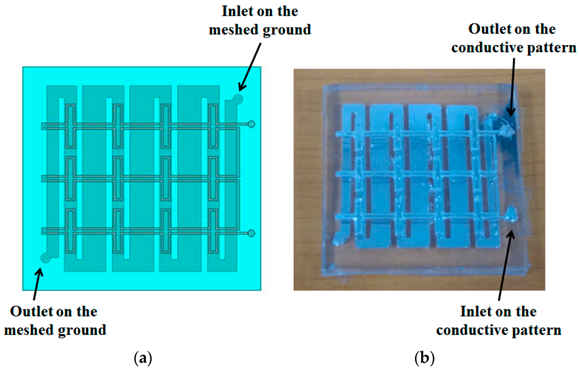
Further development should move beyond transferring conventional resonators onto fabric and instead integrate electromagnetic functions into the textile structure. Conductive-polymer fabric antennas and stretchable textile antennas have shown that radiation and sensing functions can be incorporated into soft and deformable platforms [101,102,103,104]. Similar approaches could be extended to textile metamaterials by combining weaving, knitting, embroidery, printing, or additive manufacturing to form the radiator, periodic cells, conductive paths, and protective layers within a unified textile system. The main challenge is to retain unit-cell geometry, sheet resistance, and layer spacing during bending, stretching, washing, and repeated wear. Conductive-polymer fabric antennas have already demonstrated the feasibility of fully organic RF structures, while stretchable textile antennas indicate how mechanical deformation and electromagnetic response may be jointly designed.
Material and structural concepts developed outside textile antennas also provide useful references. Graphene and carbon films offer a basis for thin and lightweight passive components across the microwave–THz range [105]. Graphene split-ring structures further show that material tunability and geometric asymmetry can be combined to obtain multiband and polarization-dependent responses [106]. These principles may support future textile metasurfaces based on coated fibers, conductive films, or hybrid carbon-textile layers, although their conductivity, biasing method, adhesion, and durability still require experimental verification on fabrics. Textile rectenna arrays and metamaterial-assisted rectennas further demonstrate the potential to combine communication with RF energy harvesting [107,108]. Reflective textile metasurfaces can also support indoor signal-coverage enhancement [109]. The cited graphene absorber achieved tunable multiband and strongly anisotropic responses through a single patterned resonator layer, but its THz-scale rigid multilayer configuration cannot be transferred directly to clothing systems.
Compact rigid antennas may also provide structural guidance. Ground-integrated CSRR loading has been used to lower the resonant frequency and reduce antenna size in a 5G design [110]. However, the reported negative gain also illustrates that miniaturization can be accompanied by reduced radiation performance. Textile adaptation should therefore evaluate size reduction together with gain, efficiency, bandwidth, conductor loss, and deformation stability rather than reproducing the rigid geometry directly. The cited design reduced the operating frequency from 5.88 to 3.5 GHz through CSRR loading and reported substantial miniaturization, but its simulated gain was −3.7 dBi.
Programmable surfaces and data-driven design provide longer-term opportunities. Field-programmable RF surfaces have demonstrated real-time regulation of current paths, impedance matching, and radiation characteristics on conventional substrates [111,112]. Their textile implementation would require flexible low-loss switches, reliable bias networks, compact power supplies, and washable encapsulation. Fully textile programmable metasurfaces and reconfigurable intelligent surfaces therefore remain exploratory rather than established solutions. Machine learning has also been applied to wearable-antenna optimization [113]. Future models should include textile-specific variables, such as sheet resistance, anisotropy, moisture, compression, bending radius, layer misalignment, and fabrication tolerance, and jointly consider gain, bandwidth, efficiency, SAR, size, flexibility, and reliability.
Author Contributions
Conceptualization, R.W. and J.H.; methodology, R.W. and Q.T.; investigation, R.W. and Q.T.; resources, Y.Z. and J.H.; data curation, R.W., Q.T. and Y.Z.; writing—original draft preparation, R.W.; writing—review and editing, R.W., Q.T., Y.Z. and J.H.; visualization, R.W. and Q.T.; supervision, J.H.; project administration, J.H.; funding acquisition, Y.Z. All authors have read and agreed to the published version of the manuscript.
Funding
This research was funded by the Fund of Jiangsu College of Engineering and Technology, grant number JSGYZRJJZD-01.
Data Availability Statement
No new data were created or analyzed in this study. Data sharing is not applicable to this article.
Acknowledgments
During the preparation and revision of this manuscript, the authors used OpenAI Codex (GPT-5.6; OpenAI, San Francisco, CA, USA; accessed on 3 August 2026; https://chatgpt.com/) for language polishing, readability improvement, preliminary layout and color-scheme suggestions for Figure 1, and the generation of several small schematic icons. The tool was not used to generate research data, conduct data analysis, draw scientific conclusions, or replace the authors’ academic judgment. The authors have reviewed and edited all AI-assisted outputs and take full responsibility for the content of this publication.
Conflicts of Interest
The authors declare no conflict of interest.
Abbreviations
| 3D | Three-Dimensional |
| 5G | Fifth-Generation Mobile Communication |
| AI | Artificial Intelligence |
| AMC | Artificial Magnetic Conductor |
| AR | Axial Ratio |
| CP | Circular Polarization |
| CPW | Coplanar Waveguide |
| CRLH | Composite Right/Left-Handed |
| CSRR | Complementary Split-Ring Resonator |
| EBG | Electromagnetic Band Gap |
| EGaIn | Eutectic Gallium–Indium |
| EMI | Electromagnetic Interference |
| F/B | Front-to-Back Ratio |
| FSS | Frequency-Selective Surface |
| GNSS | Global Navigation Satellite System |
| GPS | Global Positioning System |
| HIS | High-Impedance Surface |
| IoT | Internet of Things |
| MIMO | Multiple-Input Multiple-Output |
| MXene | Transition Metal Carbide, Nitride, or Carbonitride |
| PDMS | Polydimethylsiloxane |
| PEC | Perfect Electric Conductor |
| PET | Polyethylene Terephthalate |
| PIN | Positive–Intrinsic–Negative |
| PLA | Polylactic Acid |
| PU | Polyurethane |
| RF | Radio Frequency |
| RFID | Radio-Frequency Identification |
| RIS | Reconfigurable Intelligent Surface |
| SAR | Specific Absorption Rate |
| SIW | Substrate-Integrated Waveguide |
| SRR | Split-Ring Resonator |
| UHF | Ultra-High Frequency |
| UWB | Ultra-Wideband |
| WBAN | Wireless Body Area Network |
| WLAN | Wireless Local Area Network |
| ZOR | Zeroth-Order Resonator |
References
- Wang, R.H.; Zheng, C.; Hu, J.Y. Structure design and performance evaluation of wearable circularly polarized fabric antenna adapted for Beidou satellite communication. In Proceedings of the 18th Textile Bioengineering and Informatics Symposium Proceedings (TBIS 2025), Hangzhou, China, 17–20 August 2025; pp. 1116–1124. [Google Scholar] [CrossRef] [Scilit]
- Movassaghi, S.; Abolhasan, M.; Lipman, J.; Smith, D.; Jamalipour, A. Wireless body area networks: A survey. IEEE Commun. Surv. Tutor. 2014, 16, 1658–1686. [Google Scholar] [CrossRef] [Scilit]
- Salvado, R.; Loss, C.; Gonçalves, R.; Pinho, P. Textile materials for the design of wearable antennas: A survey. Sensors 2012, 12, 15841–15857. [Google Scholar] [CrossRef] [Scilit] [PubMed]
- Almohammed, B.; Ismail, A.; Sali, A. Electro-textile wearable antennas in wireless body area networks: Materials, antenna design, manufacturing techniques, and human body consideration: A review. Text. Res. J. 2021, 91, 646–663. [Google Scholar] [CrossRef] [Scilit]
- Del-Rio-Ruiz, R.; Lopez-Garde, J.M.; Legarda, J. Planar textile off-body communication antennas: A survey. Electronics 2019, 8, 714. [Google Scholar] [CrossRef] [Scilit]
- Marterer, V.; Radouchová, M.; Soukup, R.; Hipp, S.; Blecha, T. Wearable textile antennas: Investigation on material variants, fabrication methods, design and application. Fash. Text. 2024, 11, 9. [Google Scholar] [CrossRef] [Scilit]
- Shaw, R.K.; Long, B.R.; Werner, D.H.; Gavrin, A. The characterization of conductive textile materials intended for radio frequency applications. IEEE Antennas Propag. Mag. 2007, 49, 28–40. [Google Scholar] [CrossRef] [Scilit]
- Ouyang, Y.; Chappell, W.J. High frequency properties of electro-textiles for wearable antenna applications. IEEE Trans. Antennas Propag. 2008, 56, 381–389. [Google Scholar] [CrossRef] [Scilit]
- Sievenpiper, D.; Zhang, L.; Broas, R.F.J.; Alexopolous, N.G.; Yablonovitch, E. High-impedance electromagnetic surfaces with a forbidden frequency band. IEEE Trans. Microw. Theory Tech. 1999, 47, 2059–2074. [Google Scholar] [CrossRef] [Scilit]
- Zhang, K.; Soh, P.J.; Yan, S. Meta-wearable antennas: A review of metamaterial based antennas in wireless body area networks. Materials 2021, 14, 149. [Google Scholar] [CrossRef] [Scilit] [PubMed]
- Yan, S.; Soh, P.J.; Vandenbosch, G.A.E. Low-profile dual-band textile antenna with artificial magnetic conductor plane. IEEE Trans. Antennas Propag. 2014, 62, 6487–6490. [Google Scholar] [CrossRef] [Scilit]
- Ali, U.; Basir, A.; Zada, M.; Ullah, S.; Kamal, B.; Yoo, H. Performance improvement of a dual-band textile antenna for on-body through artificial magnetic conductor. IEEE Access 2023, 11, 72316–72331. [Google Scholar] [CrossRef] [Scilit]
- Zhu, S.; Langley, R. Dual-band wearable textile antenna on an EBG substrate. IEEE Trans. Antennas Propag. 2009, 57, 926–935. [Google Scholar] [CrossRef] [Scilit]
- Ashyap, A.Y.I.; Elamin, N.I.M.; Dahlan, S.H.; Abidin, Z.Z.; See, C.H.; Majid, H.A.; Al-Fadhali, N.; Mukred, J.A.A.; Saleh, G.; Esmail, B.A.F. Via-less electromagnetic band-gap-enabled antenna based on textile material for wearable applications. PLoS ONE 2021, 16, e0246057. [Google Scholar] [CrossRef] [Scilit] [PubMed]
- Wissem, E.M.; Sfar, I.; Osman, L.; Ribero, J.M. A textile EBG-based antenna for future 5G-IoT millimeter-wave applications. Electronics 2021, 10, 154. [Google Scholar] [CrossRef] [Scilit]
- Ashyap, A.Y.I.; Dahlan, S.H.B.; Abidin, Z.Z.; Abbasi, M.I.; Kamarudin, M.R.; Majid, H.A.; Dahri, M.H.; Jamaluddin, M.H.; Alomainy, A. An overview of electromagnetic band-gap integrated wearable antennas. IEEE Access 2020, 8, 7641–7658. [Google Scholar] [CrossRef] [Scilit]
- Amit, S.; Talasila, V.; Ramya, T.R.; Shashidhar, R. Frequency selective surface textile antenna for wearable applications. Wirel. Pers. Commun. 2023, 132, 965–978. [Google Scholar] [CrossRef] [Scilit]
- Rac-Rumijowska, O.; Pokryszka, P.; Rybicki, T.; Suchorska-Woźniak, P.; Woźniak, M.; Kaczkowska, K.; Karbownik, I. Influence of flexible and textile substrates on frequency-selective surfaces (FSS). Sensors 2024, 24, 1704. [Google Scholar] [CrossRef] [Scilit] [PubMed]
- Cheng, H.; Xiao, H.; Shi, M.; Wang, Q.; Wang, N. Research on 3D periodic structure velvet fabric and its frequency response characteristics. Text. Res. J. 2016, 86, 755–763. [Google Scholar] [CrossRef] [Scilit]
- Guan, F.; Xiao, H.; Shi, M.; Wang, F. The frequency response characteristics of planar frequency selective fabrics with cross-shaped units. Text. Res. J. 2016, 86, 2169–2178. [Google Scholar] [CrossRef] [Scilit]
- Zheng, Y.; Wang, Y.; Zhu, C.; Wang, Q.; Qiu, H.; Qian, J.; Hong, X. Electromagnetic shielding behaviors of planar frequency selective surface fabrics, with emphasis on decoupling analysis, lamination direction and tunable selective frequency. J. Ind. Text. 2022, 52, 15280837221113089. [Google Scholar] [CrossRef] [Scilit]
- Yan, S.; Soh, P.J.; Vandenbosch, G.A.E. Compact all-textile dual-band antenna loaded with metamaterial-inspired structure. IEEE Antennas Wirel. Propag. Lett. 2015, 14, 1486–1489. [Google Scholar] [CrossRef] [Scilit]
- Zhang, K.; Soh, P.J.; Yan, S. Design of a compact dual-band textile antenna based on metasurface. IEEE Trans. Biomed. Circuits Syst. 2022, 16, 211–221. [Google Scholar] [CrossRef] [Scilit] [PubMed]
- Hao, J.; Leblanc, A.; Burgnies, L.; Djouadi, A.R.; Cochrane, C.; Rault, F.; Koncar, V.; Lheurette, E. Textile split ring resonator antenna integrated by embroidery. Electron. Lett. 2019, 55, 508–510. [Google Scholar] [CrossRef] [Scilit]
- Ahmed, S.; Qureshi, S.T.; Sydanheimo, L.; Ukkonen, L.; Bjorninen, T. Comparison of wearable e-textile split ring resonator and slotted patch RFID reader antennas embedded in work gloves. IEEE J. Radio Freq. Identif. 2019, 3, 259–264. [Google Scholar] [CrossRef] [Scilit]
- Hossain, K.; Sabapathy, T.; Jusoh, M.; Soh, P.J.; Al-Bawri, S.S.; Osman, M.N. Decagonal C-shaped CSRR textile-based metamaterial for microwave applications. Comput. Mater. Contin. 2022, 71, 1677–1693. [Google Scholar] [CrossRef] [Scilit]
- Regina, S.; Merline, A. Flexible leather substrate dual-band wearable antenna with impact analysis on testing under wet condition for human rescue system. Text. Res. J. 2021, 91, 1927–1942. [Google Scholar] [CrossRef] [Scilit]
- Kim, Y.D.; Le, T.T.; Yun, T.Y. An enhanced circularly polarized textile antenna using a metasurface and slot-patterned ground for off-body communications. Micromachines 2025, 16, 799. [Google Scholar] [CrossRef] [Scilit] [PubMed]
- Muhammad, H.A.; Abdulkarim, Y.I.; Abdoul, P.A.; Dong, J. Textile and metasurface integrated wide-band wearable antenna for wireless body area network applications. AEU—Int. J. Electron. Commun. 2023, 169, 154759. [Google Scholar] [CrossRef] [Scilit]
- Wu, R.; Dong, J.; Wang, M.; Abdulkarim, Y.I. Wearable antenna sensor based on bandwidth-enhanced metasurface for elderly fall assistance detection. Measurement 2023, 223, 113753. [Google Scholar] [CrossRef] [Scilit]
- Yang, H.; Liu, X.; Fan, Y. Design of broadband circularly polarized all-textile antenna and its conformal array for wearable devices. IEEE Trans. Antennas Propag. 2022, 70, 209–220. [Google Scholar] [CrossRef] [Scilit]
- Le, T.T.; Kim, Y.D.; Yun, T.Y. All-textile enhanced-bandwidth polarization-conversion antenna using a non-uniform metasurface. IEEE Antennas Wirel. Propag. Lett. 2023, 22, 2432–2436. [Google Scholar] [CrossRef] [Scilit]
- El Atrash, M.; Hassan, N.T.; Abdalla, M.A. A low profile and wideband textile metasurface-based circular polarized antenna for wearable applications. AEU—Int. J. Electron. Commun. 2026, 210, 156284. [Google Scholar] [CrossRef] [Scilit]
- Lee, D.; Kim, H.K.; Lim, S. Textile metamaterial absorber using screen printed Chanel logo. Microw. Opt. Technol. Lett. 2017, 59, 1424–1427. [Google Scholar] [CrossRef] [Scilit]
- Yang, Y.; Wang, J.; Song, C.; Pei, R.; Purushothama, J.M.; Zhang, Y. Electromagnetic shielding using flexible embroidery metamaterial absorbers: Design, analysis and experiments. Mater. Des. 2022, 222, 111079. [Google Scholar] [CrossRef] [Scilit]
- Yang, Y.; Song, C.; Pei, R.; Wang, J.; Liu, Z.; Zhang, Y.; Shen, J. Design, characterization and fabrication of a flexible broadband metamaterial absorber based on textile. Addit. Manuf. 2023, 69, 103537. [Google Scholar] [CrossRef] [Scilit]
- Kim, Y.J.; Hwang, J.S.; Khuyen, B.X.; Tung, B.S.; Kim, K.W.; Rhee, J.Y.; Chen, L.Y.; Lee, Y.P. Flexible ultrathin metamaterial absorber for wide frequency band, based on conductive fibers. Sci. Technol. Adv. Mater. 2018, 19, 711–717. [Google Scholar] [CrossRef] [Scilit]
- Luo, C.; Gil, I.; Fernández-García, R. Wearable textile UHF-RFID sensors: A systematic review. Materials 2020, 13, 3292. [Google Scholar] [CrossRef] [Scilit] [PubMed]
- Wang, R.H.; Zheng, C.; Tao, Q.Y.; Hu, J.Y. A review of the structure, performance, fabrication, and impacts of application conditions on wearable textile GNSS antennas. Textiles 2025, 5, 35. [Google Scholar] [CrossRef] [Scilit]
- Locher, I.; Klemm, M.; Kirstein, T.; Tröster, G. Design and characterization of purely textile patch antennas. IEEE Trans. Adv. Packag. 2006, 29, 777–788. [Google Scholar] [CrossRef] [Scilit]
- Hertleer, C.; Rogier, H.; Vallozzi, L.; Van Langenhove, L. A textile antenna for off-body communication integrated into protective clothing for firefighters. IEEE Trans. Antennas Propag. 2009, 57, 919–925. [Google Scholar] [CrossRef] [Scilit]
- Turpin, J.P.; Bossard, J.A.; Morgan, K.L.; Werner, D.H.; Werner, P.L. Reconfigurable and tunable metamaterials: A review of the theory and applications. Int. J. Antennas Propag. 2014, 2014, 429837. [Google Scholar] [CrossRef] [Scilit]
- Ashyap, A.Y.I.; Dahlan, S.H.B.; Abidin, Z.Z.; Rahim, S.K.A.; Majid, H.A.; Alqadami, A.S.; El Atrash, M. Fully fabric high impedance surface-enabled antenna for wearable medical applications. IEEE Access 2021, 9, 6948–6960. [Google Scholar] [CrossRef] [Scilit]
- Ashyap, A.Y.I.; Dahlan, S.H.; Abidin, Z.Z.; Kamarudin, M.R.; Majid, H.A.; Alduais, N.A.M.; Dahri, M.H.; Alhandi, S.A. C-shaped antenna based artificial magnetic conductor structure for wearable IoT healthcare devices. Wirel. Netw. 2021, 27, 4967–4985. [Google Scholar] [CrossRef] [Scilit]
- Thaiwirot, W.; Ardhan, J.; Prengsri, S.; Akkaraekthalin, P.; Chalermwisutkul, S. The low-profile all-textile UWB antenna with AMC for WBAN applications. EURASIP J. Wirel. Commun. Netw. 2025, 2025, 56. [Google Scholar] [CrossRef] [Scilit]
- Hengroemyat, Y.; Thaiwirot, W.; Akkaraekthalin, P.; Chudpooti, N.; Boonpoonga, A. Dual-band textile AMC integrated monopole antenna for SAR reduction. EURASIP J. Wirel. Commun. Netw. 2026, 2026, 28. [Google Scholar] [CrossRef] [Scilit]
- Douhi, S.; Houssaini, Y.; Das, S.; Subramanian, V.; Madhav, B.T.P.; Mazroui, M.; Eddiai, A. Metamaterial-integrated wearable UWB antenna with SAR reduction and gain enhancement for Wireless Body Area Sensor Networks (WBASNs): Design and experimental verification. Sens. Actuators A Phys. 2025, 388, 116499. [Google Scholar] [CrossRef] [Scilit]
- El Atrash, M.; Abdalla, M.A.; Elhennawy, H.M. A compact flexible textile artificial magnetic conductor-based wearable monopole antenna for low specific absorption rate wrist applications. Int. J. Microw. Wirel. Technol. 2021, 13, 119–125. [Google Scholar] [CrossRef] [Scilit]
- El Atrash, M.; Abdalla, M.A.; Elhennawy, H.M. A wearable dual-band low profile high gain low SAR antenna AMC-backed for WBAN applications. IEEE Trans. Antennas Propag. 2019, 67, 6378–6388. [Google Scholar] [CrossRef] [Scilit]
- Bait-Suwailam, M.M.; Labiano, I.I.; Alomainy, A. Impedance enhancement of textile grounded loop antenna using high-impedance surface (HIS) for healthcare applications. Sensors 2020, 20, 3809. [Google Scholar] [CrossRef] [Scilit] [PubMed]
- Joshi, R.; Hussin, E.F.N.M.; Soh, P.J.; Jamlos, M.F.; Lago, H.; Al-Hadi, A.A.; Podilchak, S.K. Dual-band, dual-sense textile antenna with AMC backing for localization using GPS and WBAN/WLAN. IEEE Access 2020, 8, 89468–89478. [Google Scholar] [CrossRef] [Scilit]
- Yang, H.; Liu, X.; Fan, Y.; Xiong, L. Dual-band textile antenna with dual circular polarizations using polarization rotation AMC for off-body communications. IEEE Trans. Antennas Propag. 2022, 70, 4189–4199. [Google Scholar] [CrossRef] [Scilit]
- Hussain, T.; Fernandez-Garcia, R.; Gil, I. Breathable artificial magnetic conductor with ground-grid structure for shielding wearable antenna sensors. Sens. Actuators A Phys. 2025, 391, 116607. [Google Scholar] [CrossRef] [Scilit]
- Giman, F.N.; Soh, P.J.; Jamlos, M.F.; Lago, H.; Al-Hadi, A.A.; Abdulmalek, M.; Abdulaziz, N. Conformal dual-band textile antenna with metasurface for WBAN application. Appl. Phys. A 2017, 123, 32. [Google Scholar] [CrossRef] [Scilit]
- Yalduz, H.; Tabaru, T.E.; Kilic, V.T.; Turkmen, M. Design and analysis of low profile and low SAR full-textile UWB wearable antenna with metamaterial for WBAN applications. AEU—Int. J. Electron. Commun. 2020, 126, 153465. [Google Scholar] [CrossRef] [Scilit]
- Thangavelu, Y.; Thangaraju, B.; Maheswar, R. Design and SAR analysis of an AMC-integrated wearable cavity-backed SIW antenna. Micromachines 2024, 15, 1530. [Google Scholar] [CrossRef] [Scilit] [PubMed]
- Casula, G.A.; Muntoni, G.; Maxia, P.; Montisci, G. A compact and robust RFID tag based on an AMC structure. Sensors 2024, 24, 1468. [Google Scholar] [CrossRef] [Scilit] [PubMed]
- Shamsuri Agus, A.N.S.; Sabapathy, T.; Jusoh, M.; Abdelghany, M.A.; Hossain, K.; Padmanathan, S.; Al-Bawri, S.S.; Soh, P.J. Combined RIS and EBG surfaces inspired meta-wearable textile MIMO antenna using viscose-wool felt. Polymers 2022, 14, 1989. [Google Scholar] [CrossRef] [Scilit] [PubMed]
- Kumkhet, B.; Rakluea, P.; Wongsin, N.; Sangmahamad, P.; Thaiwirot, W.; Mahatthanajatuphat, C.; Chudpooti, N. SAR reduction using dual band EBG method based on MIMO wearable antenna for WBAN applications. AEU—Int. J. Electron. Commun. 2023, 160, 154525. [Google Scholar] [CrossRef] [Scilit]
- Tak, J.; Hong, Y.; Choi, J. Textile antenna with EBG structure for body surface wave enhancement. Electron. Lett. 2015, 51, 1131–1132. [Google Scholar] [CrossRef] [Scilit]
- Renita, C.; Raj, T.A.B. Wearable frequency selective surface-based compact dual-band antenna for 5G and Wi-Fi applications. Automatika 2024, 65, 454–462. [Google Scholar] [CrossRef] [Scilit]
- Sugumaran, B.; Balasubramanian, R.; Palaniswamy, S.K. Reduced specific absorption rate compact flexible monopole antenna system for smart wearable wireless communications. Eng. Sci. Technol. Int. J. 2021, 24, 682–693. [Google Scholar] [CrossRef] [Scilit]
- Vaezi, S.; Rezaei, P.; Khazaei, A.A. A miniaturized wideband wearable antenna with circular polarization for medical application. AEU—Int. J. Electron. Commun. 2022, 150, 154197. [Google Scholar] [CrossRef] [Scilit]
- Chen, J.; Zhang, H.; Ji, H.; Wang, F.; Xiao, H. Stretchable three-dimensional tunable frequency selective fabric of U-shaped units and its electromagnetic response mechanism. Text. Res. J. 2023, 93, 1128–1141. [Google Scholar] [CrossRef] [Scilit]
- Mir, F.; Matekovits, L.; De Sabata, A. Symmetry-breaking manipulation in the design of multifunctional tunable frequency selective surface. AEU—Int. J. Electron. Commun. 2021, 142, 154003. [Google Scholar] [CrossRef] [Scilit]
- Guan, F.; Xue, K.; Li, J.; Li, D.; Yang, Z.; You, Z.; Li, Z.; Lei, Y. Preparation of ring-shaped frequency selective fabrics and analysis of electromagnetic transmission characteristics. Text. Res. J. 2022, 92, 2010–2018. [Google Scholar] [CrossRef] [Scilit]
- Li, D.; Li, Y.; Guan, F.; Yang, Z.; Qin, L.; Peng, L. Preparation and characterization of Y-shaped fractal frequency selective fabric. J. Ind. Text. 2023, 53, 15280837231212634. [Google Scholar] [CrossRef] [Scilit]
- Chen, J.; Zhang, Y.; Zhang, H.; Ji, H.; Wang, F.; Xiao, H.; Teo, C. Stretchable tunable frequency selective fabrics and their electromagnetic response mechanism. Compos. Part A Appl. Sci. Manuf. 2022, 161, 107065. [Google Scholar] [CrossRef] [Scilit]
- Zhu, X.; Yang, X.; Song, Q.; Lui, B. Compact UWB-MIMO antenna with metamaterial FSS decoupling structure. EURASIP J. Wirel. Commun. Netw. 2017, 2017, 115. [Google Scholar] [CrossRef] [Scilit]
- Tetik, G.; Tetik, E. Metamaterial based flexible coplanar antenna design and simulation for human body applications. J. Inst. Sci. Technol. 2020, 10, 2541–2550. [Google Scholar] [CrossRef] [Scilit]
- El Atrash, M.; Abdalla, M.A.; Elhennawy, H.M. A compact highly efficient pi-section CRLH antenna loaded with textile AMC for wireless body area network applications. IEEE Trans. Antennas Propag. 2021, 69, 648–657. [Google Scholar] [CrossRef] [Scilit]
- Mirza, H.; Sultana, N. A wideband flexible electro-textiles material linear-to-circular polarizing metasurface for S-band CubeSat. Mater. Today Proc. 2023, in press. [Google Scholar] [CrossRef] [Scilit]
- Li, X.S.; Cheng, L.L.; Liu, X.Y.; Liu, Q.H. Wideband GNSS antenna covered by a double-sided metasurface. AEU—Int. J. Electron. Commun. 2018, 96, 170–177. [Google Scholar] [CrossRef] [Scilit]
- Alhawari, A.R.H.; Saeidi, T.; Almawgani, A.H.M.; Hindi, A.T.; Alghamdi, H.; Alsuwian, T.; Awwad, S.A.B.; Imran, M.A. Wearable metamaterial dual-polarized high-isolation UWB MIMO Vivaldi antenna for 5G and satellite communications. Micromachines 2021, 12, 1559. [Google Scholar] [CrossRef] [Scilit] [PubMed]
- Yang, S.; Liu, P.; Yang, M.; Wang, Q.; Song, J.; Dong, L. From flexible and stretchable meta-atom to metamaterial: A wearable microwave meta-skin with tunable frequency selective and cloaking effects. Sci. Rep. 2016, 6, 21921. [Google Scholar] [CrossRef] [Scilit] [PubMed]
- Kim, K.; Lee, D.; Eom, S.; Lim, S. Stretchable metamaterial absorber using liquid metal-filled polydimethylsiloxane (PDMS). Sensors 2016, 16, 521. [Google Scholar] [CrossRef] [Scilit] [PubMed]
- Ramasamy, K.; Sapna, B.A.; Jayasheela, M. A novel wearable monopole antenna with controlled SAR using metamaterial. Int. J. Microw. Wirel. Technol. 2023, 15, 1524–1536. [Google Scholar] [CrossRef] [Scilit]
- Celenk, E.; Tokan, N.T. All-textile on-body metasurface antenna. Prog. Electromagn. Res. M 2022, 110, 119–131. [Google Scholar] [CrossRef] [Scilit]
- Zhang, H.; Chen, J.; Ji, H.; Wang, N.; Feng, S.; Xiao, H. Electromagnetic interference shielding with absorption-dominant performance of Ti3C2Tx MXene/non-woven laminated fabrics. Text. Res. J. 2021, 91, 2448–2458. [Google Scholar] [CrossRef] [Scilit]
- Jung, J.; Na, J.; Lee, C.; Lee, H.; Sim, S.; Park, J.; Shin, D.; Jung, K.J.; Heo, S. Broadband flexible metamaterial absorber on fabric using 3D-printed conductive filament patterns. J. Alloys Compd. 2026, 1062, 187658. [Google Scholar] [CrossRef] [Scilit]
- Hossain, K.; Sabapathy, T.; Jusoh, M.; Lee, S.H.; Rahman, K.S.A.; Kamarudin, M.R. Negative index metamaterial-based frequency-reconfigurable textile CPW antenna for microwave imaging of breast cancer. Sensors 2022, 22, 1626. [Google Scholar] [CrossRef] [Scilit] [PubMed]
- Ali, U.; Ullah, S.; Basir, A.; Yan, S.; Ren, H.; Kamal, B.; Matekovits, L. Design and performance investigation of metamaterial-inspired dual band antenna for WBAN applications. PLoS ONE 2024, 19, e0306737. [Google Scholar] [CrossRef] [Scilit] [PubMed]
- Guan, F.; Xiao, H.; Shi, M.; Wang, F. The novel frequency selective fabric and application research. J. Ind. Text. 2016, 46, 143–159. [Google Scholar] [CrossRef] [Scilit]
- Gil, I.; Fernandez-Garcia, R.; Tornero, J.A. Embroidery manufacturing techniques for textile dipole antenna applied to wireless body area network. Text. Res. J. 2019, 89, 1573–1581. [Google Scholar] [CrossRef] [Scilit]
- Agu, D.; Eike, R.J.; Cliett, A.; Michaelson, D.; Cloud, R.; Li, Y. Investigation of e-textile dipole antenna performance based on embroidery parameters. Text. Res. J. 2022, 92, 2771–2783. [Google Scholar] [CrossRef] [Scilit]
- Zhu, X.; Wu, K.; Xie, X.; Anderson, S.W.; Zhang, X. A robust near-field body area network based on coaxially-shielded textile metamaterial. Nat. Commun. 2024, 15, 6589. [Google Scholar] [CrossRef] [Scilit] [PubMed]
- Ventura, H.; Pares, F.; Fernandez-Garcia, R.; Gil, I.; Ardanuy, M. Effects of the fabric substrate on performance and durability of textile-embroidered dipole antennas. Text. Res. J. 2022, 92, 2808–2817. [Google Scholar] [CrossRef] [Scilit]
- Xu, B.; Eike, R.J.; Cliett, A.; Ni, L.; Cloud, R.; Li, Y. Durability testing of electronic textile surface resistivity and textile antenna performance. Text. Res. J. 2019, 89, 3708–3721. [Google Scholar] [CrossRef] [Scilit]
- Sadi, M.S.; Kumpikaite, E. Advances in the robustness of wearable electronic textiles: Strategies, stability, washability and perspective. Nanomaterials 2022, 12, 2039. [Google Scholar] [CrossRef] [Scilit] [PubMed]
- Chen, X.; Ukkonen, L.; Virkki, J. Reliability evaluation of wearable radio frequency identification tags: Design and fabrication of a two-part textile antenna. Text. Res. J. 2019, 89, 560–571. [Google Scholar] [CrossRef] [Scilit]
- Huang, W.; Liu, X.; Zhou, Y.; Yang, S.; Huang, W.; Chen, Z.; Feng, J.; Chen, Z.; Li, X.; Gui, X. Inkjet-printing Ti3C2Tx MXene nanosheet-based metamaterials for terahertz absorption. ACS Appl. Nano Mater. 2024, 7, 15308–15316. [Google Scholar] [CrossRef] [Scilit]
- Kim, H.K.; Ling, K.; Kim, K.; Lim, S. Flexible inkjet-printed metamaterial absorber for coating a cylindrical object. Opt. Express 2015, 23, 5898–5906. [Google Scholar] [CrossRef] [Scilit] [PubMed]
- Ling, K.; Yoo, M.; Su, W.; Kim, K.; Cook, B.; Tentzeris, M.M.; Lim, S. Microfluidic tunable inkjet-printed metamaterial absorber on paper. Opt. Express 2015, 23, 110–120. [Google Scholar] [CrossRef] [Scilit] [PubMed]
- Chen, C.; Bi, S.; Shao, H.; Shao, G.; Jiang, J.; Chen, N. Flexible metamaterial absorbers based on Fe3O4-doped laser-induced graphene with tunable absorption bands. ACS Appl. Mater. Interfaces 2025, 17, 23165–23175. [Google Scholar] [CrossRef] [Scilit] [PubMed]
- Sartanavicius, A.; Zemgulyte, J.; Ragulis, P.; Ratautas, K.; Trusovas, R. Laser-induced graphene in polyimide for antenna applications. Crystals 2023, 13, 1003. [Google Scholar] [CrossRef] [Scilit]
- Tetik, E.; Tetik, G.D. The effect of a metamaterial based wearable monopole antenna on the human body. Celal Bayar Univ. J. Sci. 2018, 14, 93–97. [Google Scholar] [CrossRef] [Scilit]
- Billa, M.B.; Islam, M.T.; Alam, T.; Albadran, S.; Alzamil, A.; Alshammari, A.S.; Alsaif, H.; Islam, M.S.; Soliman, M.S. High quality factor double negative metamaterial for textile fabric and fabric moisture sensing applications. J. Ind. Text. 2024, 54, 15280837231225828. [Google Scholar] [CrossRef] [Scilit]
- Kamardin, K.; Rahim, M.K.A.; Hall, P.S.; Samsuri, N.A.; Jalil, M.E.; Abd Malek, M.F. Textile diamond dipole and artificial magnetic conductor performance under bending, wetness and specific absorption rate measurements. Radioengineering 2015, 24, 729–738. [Google Scholar] [CrossRef] [Scilit]
- Kamardin, K.; Rahim, M.K.A.; Hall, P.S.; Samsuri, N.A.; Latef, T.A.; Ullah, M.H. Planar textile antennas with artificial magnetic conductor for body-centric communications. Appl. Phys. A 2016, 122, 363. [Google Scholar] [CrossRef] [Scilit]
- Kamardin, K.; Rahim, M.K.A.; Hall, P.S.; Samsuri, N.A.; Latef, T.A.; Ullah, M.H. Textile artificial magnetic conductor jacket for transmission enhancement between antennas under bending and wetness measurements. Appl. Phys. A 2016, 122, 423. [Google Scholar] [CrossRef] [Scilit]
- Tian, X.; Lee, P.M.; Tan, Y.J.; Wu, T.L.Y.; Yao, H.; Zhang, M.; Li, Z.; Ng, K.A.; Tee, B.C.K.; Ho, J.S. Wireless body sensor networks based on metamaterial textiles. Nat. Electron. 2019, 2, 243–251. [Google Scholar] [CrossRef] [Scilit]
- Low, J.H.; Chee, P.S.; Lim, E.H. Liquid EBG-backed stretchable slot antenna for human body. IEEE Trans. Antennas Propag. 2022, 70, 9120–9129. [Google Scholar] [CrossRef] [Scilit]
- Li, Z.; Sinha, S.K.; Treich, G.M.; Wang, Y.; Yang, Q.; Deshmukh, A.A.; Sotzing, G.A.; Cao, Y. All-organic flexible fabric antenna for wearable electronics. J. Mater. Chem. C 2020, 8, 5662–5667. [Google Scholar] [CrossRef] [Scilit]
- Nikbakhtnasrabadi, F.; El Matbouly, H.; Ntagios, M.; Dahiya, R. Textile-based stretchable microstrip antenna with intrinsic strain sensing. ACS Appl. Electron. Mater. 2021, 3, 2233–2246. [Google Scholar] [CrossRef] [Scilit] [PubMed]
- Kuzhir, P.P.; Paddubskaya, A.G.; Volynets, N.I.; Batrakov, K.G.; Kaplas, T.; Lamberti, P.; Kotsilkova, R.; Lambin, P. Main principles of passive devices based on graphene and carbon films in microwave–THz frequency range. J. Nanophotonics 2017, 11, 032504. [Google Scholar] [CrossRef] [Scilit]
- Asgari, S.; Fabritius, T. Multi-band terahertz anisotropic metamaterial absorber composed of graphene-based split square ring resonator array featuring two gaps and a connecting bar. Sci. Rep. 2024, 14, 7477. [Google Scholar] [CrossRef] [Scilit] [PubMed]
- Lopez-Garde, J.M.; Del-Rio-Ruiz, R.; Legarda, J.; Rogier, H. 2 × 2 textile rectenna array with electromagnetically coupled microstrip patch antennas in the 2.4 GHz WiFi band. Electronics 2021, 10, 1447. [Google Scholar] [CrossRef] [Scilit]
- Maher, R.; Allam, A.; Kanaya, H.; Abdelrahman, A.B. Dualband rectenna for RF energy harvesting using metamaterial reflect array and novel matching technique. AEU—Int. J. Electron. Commun. 2024, 173, 155020. [Google Scholar] [CrossRef] [Scilit]
- Zhai, M.; Zhu, X.; Pei, R.; Tian, W.; Xiong, B.; Yin, W.Y. A reflective textile metasurface for indoor signal coverage enhancement. Text. Res. J. 2024, 94, 2575–2586. [Google Scholar] [CrossRef] [Scilit]
- Andrews, C.J.M.; Narayanan, A.S.K.; Sunil, A.M. Compact metamaterial based antenna for 5G applications. Results Eng. 2024, 24, 103269. [Google Scholar] [CrossRef] [Scilit]
- Chaimool, S.; Hongnara, T.; Rakluea, C.; Akkaraekthalin, P.; Zhao, Y. Design of a PIN diode-based reconfigurable metasurface antenna for beam switching applications. Int. J. Antennas Propag. 2019, 2019, 7216324. [Google Scholar] [CrossRef] [Scilit]
- Li, T.; Yu, Y.; Liu, Y.; Unnithan, R.R.; McDermott, R.J.; Schreurs, D.; Evans, R.; Skafidas, E. A multifunctional smart field-programmable radio frequency surface. Nat. Commun. 2024, 15, 4042. [Google Scholar] [CrossRef] [Scilit] [PubMed]
- Waly, M.I.; Smida, J.; Bakouri, M.; Alresheedi, B.A.; Alqahtani, T.M.; Alonzi, K.A.; Smida, A. Optimization of a compact wearable LoRa patch antenna for vital sign monitoring in WBAN medical applications using machine learning. IEEE Access 2024, 12, 103860–103879. [Google Scholar] [CrossRef] [Scilit]

Disclaimer/Publisher’s Note: The statements, opinions and data contained in all publications are solely those of the individual author(s) and contributor(s) and not of MDPI and/or the editor(s). MDPI and/or the editor(s) disclaim responsibility for any injury to people or property resulting from any ideas, methods, instructions or products referred to in the content. |
© 2026 by the authors. Licensee MDPI, Basel, Switzerland. This article is an open access article distributed under the terms and conditions of the Creative Commons Attribution (CC BY) license.