


Abstract
Dual-loss-modulated Q-switched lasers at 1.3 μm are achieved by using both electro-optic modulators (EOMs) and different saturable absorbers (SAs). Laser pulses with a width of 7.75 ns at 60 kHz and a peak power of 4.07 kW at 20 kHz can be obtained in lasers with both an EOM and a MoS2/WS2 heterostructure SA. Compared with those generated in lasers with a MoS2 SA under the same repetition rates, the pulse width is compressed by 37.7% (at 60 kHz), and the peak power is increased by 80.9% (at 20 kHz). The results show that dual-loss-modulated technology makes it easier to achieve pulses with a duration of several nanoseconds. Meanwhile, compared to single-material SAs, the heterostructure SA helps to generate pulses with a short duration and high peak power in 1.3 μm lasers.
1. Introduction
High-peak-power and narrow-width pulses at 1.3 μm can be applied in laser medicine, information storage, micro-machining, coherent communication, and other fields [1,2,3,4,5]. Both active and passive modulation can be utilized to achieve Q-switched (QS) pulses. Compared with single active/passive modulated technology, dual-loss-modulated technology has attracted extensive attention due to its advantages of compressing the pulse width, increasing the pulse, and enhancing stability.
Transition metal chalcogenides (TMCs) have aroused great interest among researchers due to their excellent physical and chemical properties [6,7,8]. The use of TMCs in 1.3 μm lasers has also been investigated. In 2016, K. Wang reported a 1.3 μm passive QS laser using a MoS2 SA [9]. In 2019, our group realized QS pulses by using a MoS2 SA [10] and a WS2 SA [11]. It can be seen that QS lasers at 1.3 μm based on TMCs can generate pulses with a pulse duration exceeding 100 ns. Then, heterostructure SAs prepared by using different 2D materials were studied in order to obtain better output characteristics [12,13,14]. In 2015, Zhao et al. used a MoS2/graphene heterostructure SA to realize 1.06 μm QS pulses [15]. Sun et al. realized mode-locked pulses at 1037 nm by using a graphene/MoS2 heterostructure SA [16]. In 2022, Liu et al. realized stable output of a 1.06 μm laser using a MoS2/MoSe2 heterostructure SA [17]. However, QS lasers at 1 μm with a heterostructure SA can only generate pulses with a duration of tens of nanoseconds. Determining how to compress the pulse width and obtain optimized laser characteristics is still an important research point.
Dual-loss modulation technology combines active and passive modulation to enhance the pulse stability and compress the pulse width. All-solid-state lasers with active Q-switch and 2D-material SAs have been reported. As early as 2016, Tang et al. reported a QS and mode-locked laser with an EOM and graphene. Single mode-locked pulses at 532 nm were realized [18]. In 2017, a doubly QS Nd:GGG laser with both an active modulator and a MoS2 SA was realized [19]. In 2021, Niu et al. realized a dual-loss-modulated Tm:YAP laser with both an EOM and an Sb2Te3 SA, highlighting the advantages of dual-loss modulation technology [20]. In 2022, our research group achieved a QS and mode-locked laser with a narrower envelope width using an acousto-optic Q-switch and a MoSe2 SA [21]. However, to the best of our knowledge, research on dual-loss-modulated QS lasers at 1.3 μm with both an EOM and a heterostructure SA has not been reported.
In this paper, we demonstrate a stable 1.3 μm QS laser using both an EOM and a MoS2/WS2 heterostructure SA. This is the first time an EOM has been combined with a MoS2/WS2 heterostructure SA to realize a dual-loss-modulated QS laser at 1.3 μm. The EOM enhances the pulse stability, while both the EOM and the heterostructure SA compress the pulse width. Compared with those obtained in an electro-optic QS laser and a dual-loss-modulated QS laser with a MoS2 SA, the pulse width of the dual-loss-modulated QS laser with a MoS2/WS2 SA is compressed by 62.3% and 37.7%, respectively, revealing the superior pulse compression capability of the MoS2/WS2 heterostructure SA.
2. Characterization of SAs
The MoS2/WS2 heterostructure SA used in this experiment was prepared by a wet transfer method described in ref. [22]. The MoS2 and WS2 films were both prepared by chemical vapor deposition (CVD) [23].
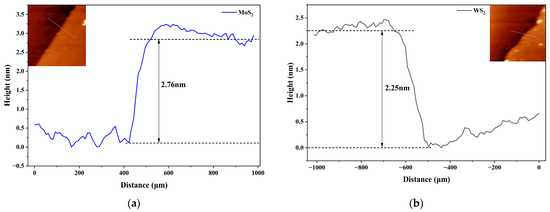
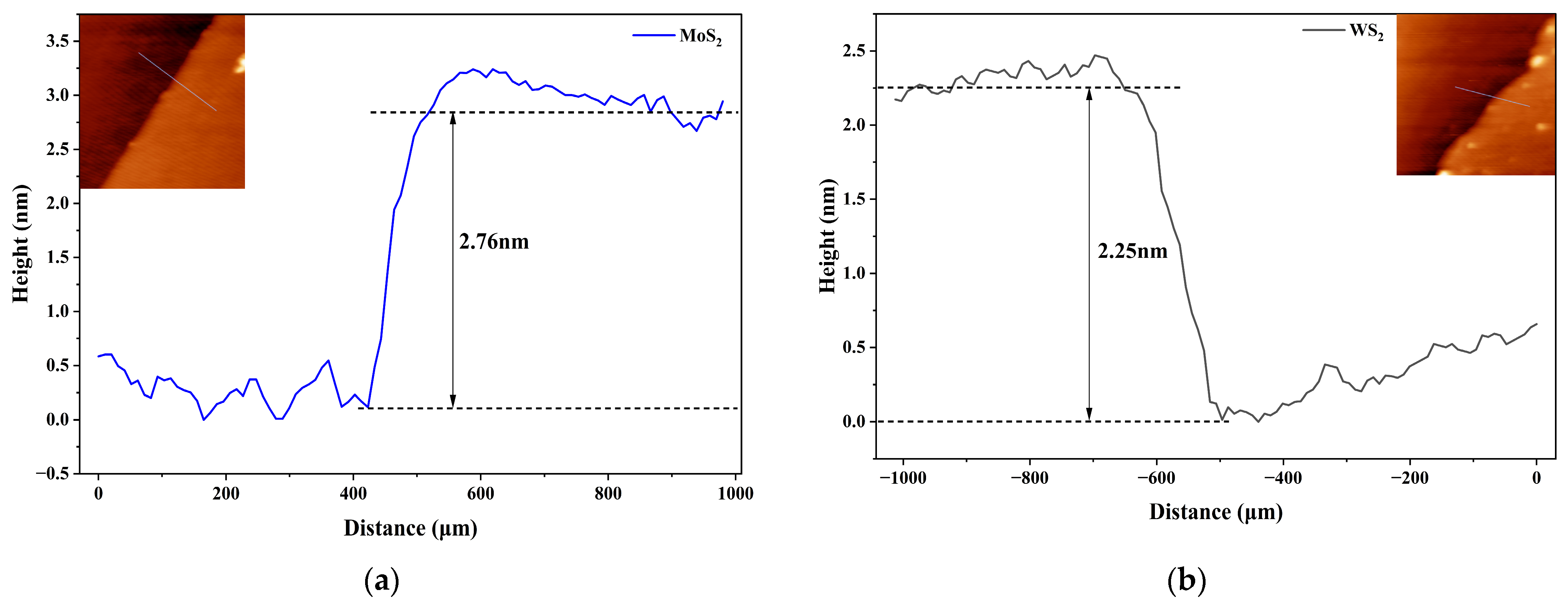
Atomic Force Microscopy (AFM) was employed to measure the thickness and morphology of the MoS2 and WS2 films. The AFM image and corresponding height distribution of the MoS2 film are shown in Figure 1a. The average thickness measured from the height profile was ~2.76 nm, indicating that the MoS2 SA used in the experiment was approximately 4 layers thick. The AFM image and corresponding height distribution of the WS2 film are shown in Figure 1b. The average thickness measured from the height profile was ~2.25 nm, indicating that the WS2 SA used in the experiment was approximately 3 layers thick.
Figure 1.
Characterization of the MoS2 and WS2 films: (a) height distribution and AFM image of the MoS2 film (the inset); (b) height distribution and AFM image of the WS2 film (the inset).
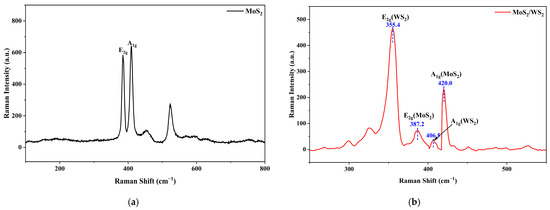
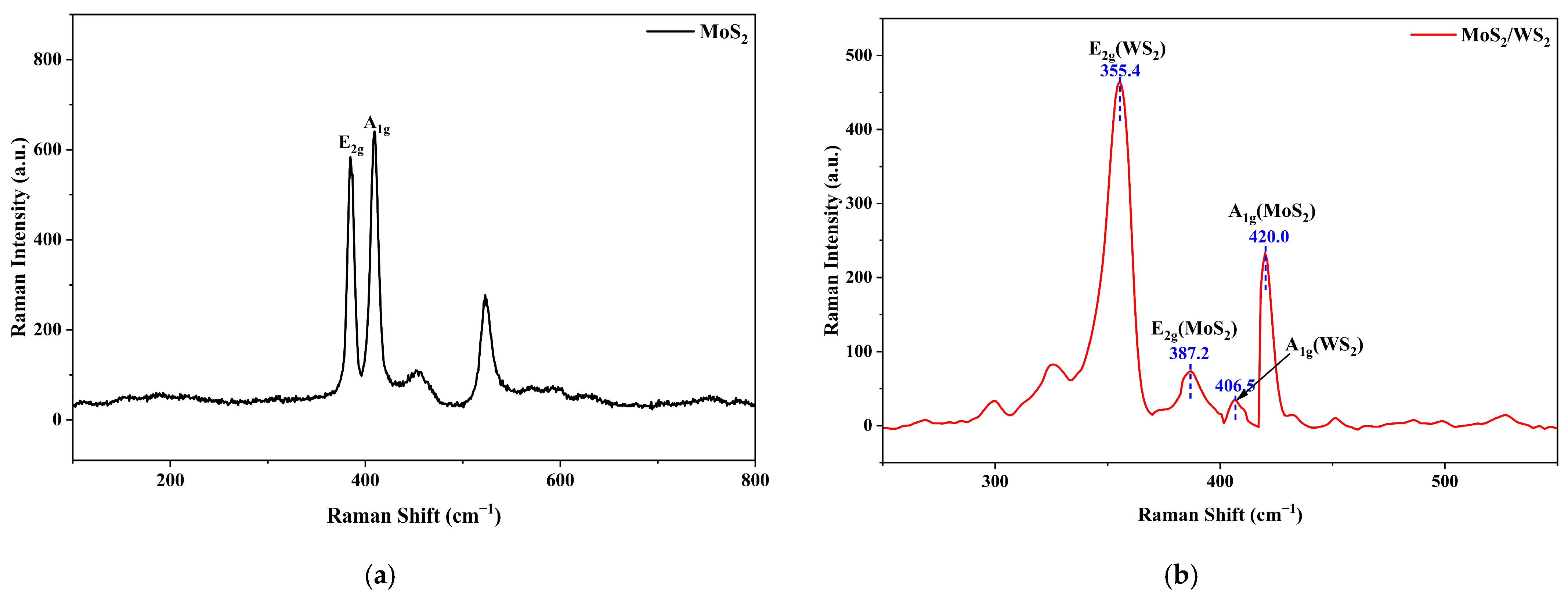
The Raman spectra of the few-layer MoS2 SA and the MoS2/WS2 heterostructure SA used in this experiment are shown in Figure 2. As shown in Figure 2a, the two characteristic peaks E2g and A1g of the few-layer MoS2 SA were located at 384.8 cm−1 and 409.5 cm−1, respectively. In the MoS2/WS2 heterostructure (Figure 2b), the characteristic peak A1g of MoS2 SA was located at 420.0 cm−1, and the characteristic peak E2g was located at 387.2 cm−1. The two peaks centered at 355.4 cm−1 and 406.5 cm−1 are the characteristic peaks of the WS2 SA, which are attributed to the coupling within the heterostructure. According to the results reported in references [24,25], the few-layer MoS2 SA used here was 4 layers thick, and the WS2 SA was 3 layers thick. When the number of layers is small, the modulation depth is low and the pulse compression capability is weak. Although an excessively large number of layers provides a high modulation depth, the non-saturable loss increases significantly, leading to a decrease in output power and a broadening of the pulse width [24].
Figure 2.
Raman spectra of SAs: (a) few-layer MoS2 SA; (b) MoS2/WS2 heterostructure SA.
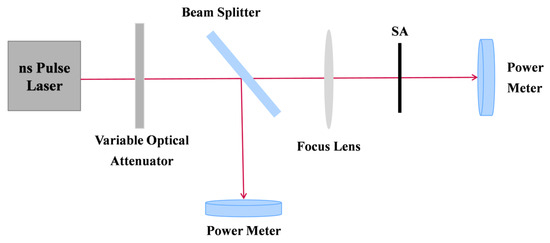
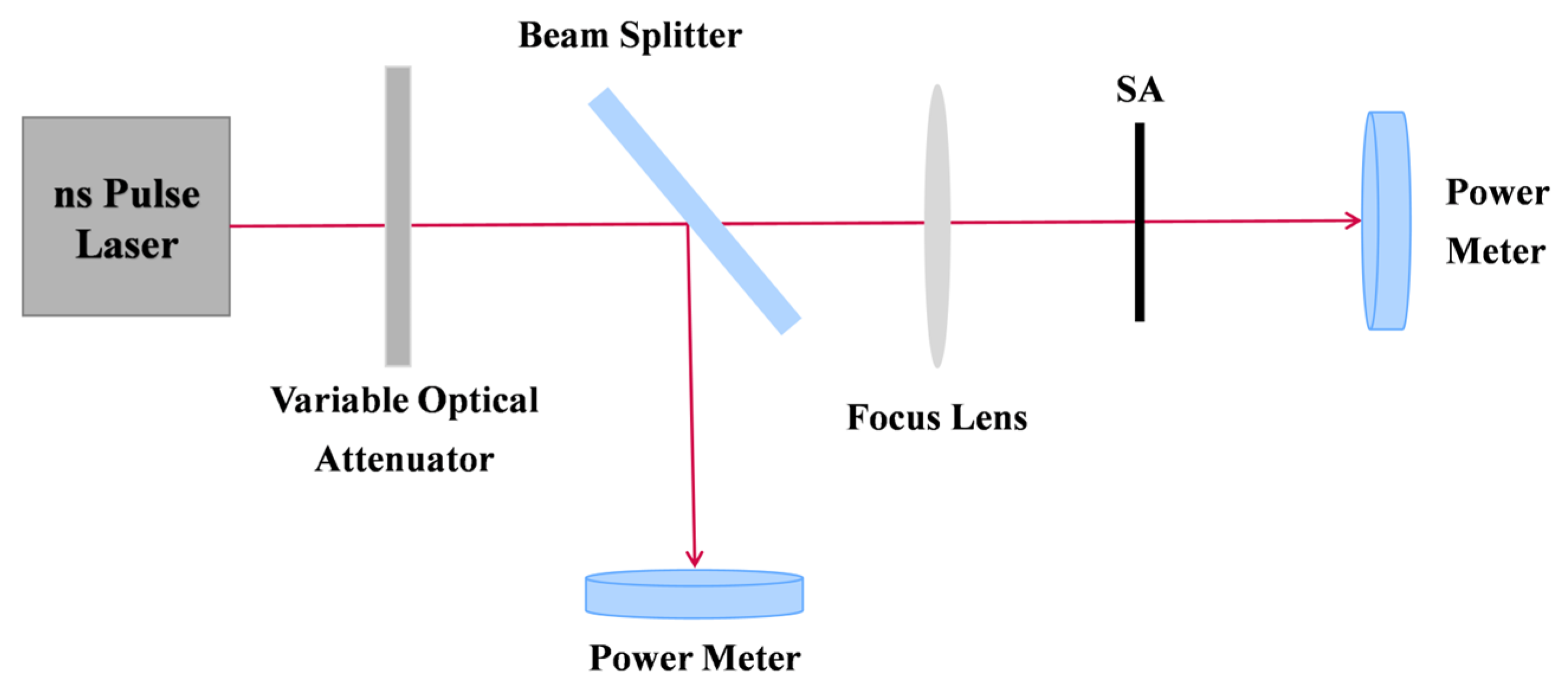
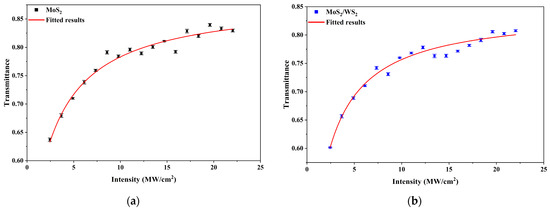
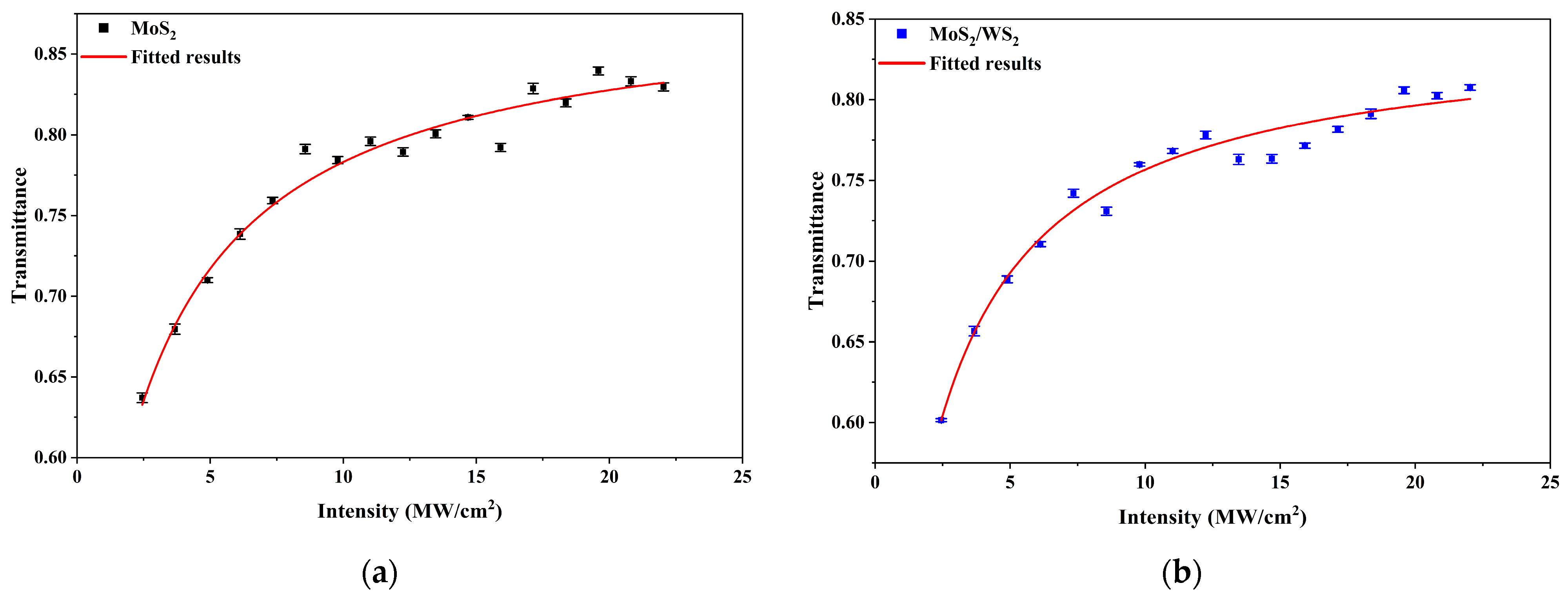
To further determine the saturable absorption properties of the MoS2 SA and MoS2/WS2 heterostructure SA at 1342 nm, a balanced dual-detector measurement system, as shown in Figure 3, was used for detection. The laser source was a homemade electro-optic QS laser with a wavelength of 1342 nm, a pulse duration of 10 ns, and a repetition rate of 60 kHz. The variation of transmittance with incident light intensity is fitted by
where ΔT is the modulation depth, Isat is the saturation intensity, and Tns is the non-saturable loss [26]. The nonlinear transmission curves of the two samples are shown in Figure 4. The saturation intensity and modulation depth of the MoS2 SA were (5.76 ± 0.7) MW/cm2 and (19.2 ± 0.3)%, respectively, while those of the MoS2/WS2 heterostructure SA were (5.42 ± 0.5) MW/cm2 and (20.5 ± 0.2)%, respectively.
Figure 3.
Experimental setup for a balanced dual-detector measurement system.
Figure 4.
Nonlinear transmittance curves: (a) MoS2 SA; (b) MoS2/WS2 heterostructure SA.
The vertical heterostructure formed between MoS2 and WS2 facilitates interlayer charge transfer and enhances light–matter interaction, thereby increasing the modulation depth. Secondly, the type II band alignment in the heterostructure helps suppress the recombination of photogenerated carriers and accelerates the recovery time of the saturable absorber, which is beneficial for generating shorter pulses. Additionally, the higher carrier mobility of WS2 compensates for certain defects in MoS2, reducing the saturation intensity [27]. The modulation depth of the MoS2/WS2 SA is only about 1.3% higher than that of the MoS2 SA, and the saturation intensity is about 5.9% lower. This difference is amplified during the Q-switching process in the actual cavity. A lower saturation intensity means that the SA is more easily bleached, resulting in lower intracavity loss under the same pumping conditions. A slightly higher modulation depth further enhances the amplitude of loss modulation, leading to faster pulse buildup and narrower pulse width [28]. This indicates that the laser with a MoS2/WS2 heterostructure SA has the potential to generate narrower pulses.
3. Experimental Setup
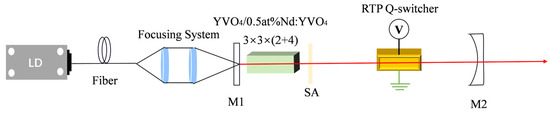
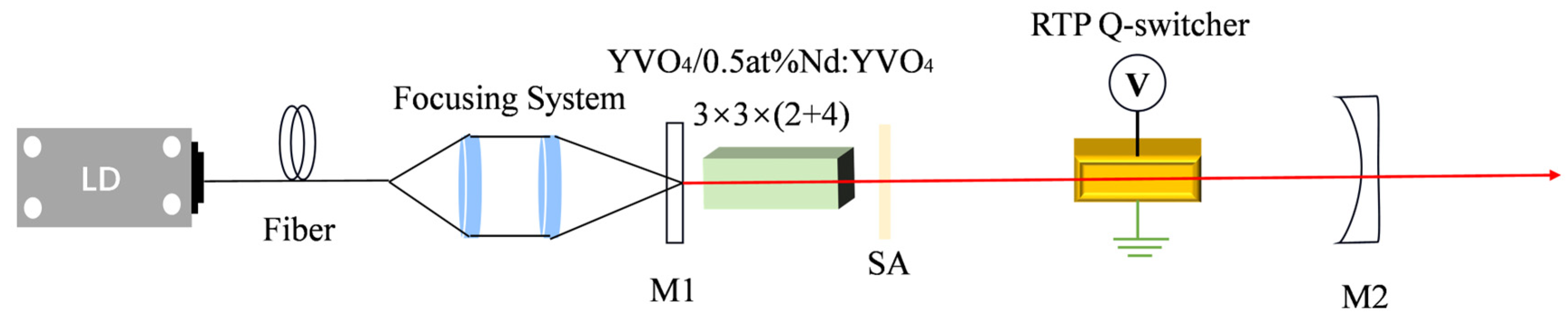
Figure 5 presents a schematic of the QS laser applied in this experiment. A semiconductor laser with a central wavelength of 808 nm was used as the pump source. The gain medium was an YVO4/Nd:YVO4 bonded crystal with a cross-sectional size of 3 mm × 3 mm and a length of (2 + 4) mm, with Nd3+ doping concentrations of 0 at% and 0.5 at%, respectively. The two end faces were both coated with high-transmission (HT) film at 808 nm and 1342 nm. To reduce the thermal effect of the YVO4/Nd:YVO4 crystal, a circulating water-cooling system was used to cool the laser crystal, with a water temperature of 20.6 °C. A RbTiOPO4 (RTP) electro-optic Q-switch (Fastpulse, Saddle Brook, NJ, USA) served as the active modulator. The MoS2 SA and the MoS2/WS2 heterostructure SA served as the passive modulator.
Figure 5.
Schematic of dual-loss-modulated QS YVO4/Nd:YVO4 laser.
A simple plane–concave cavity with a cavity length of 115 mm was adopted. The input mirror M1 was a plane mirror with HT coatings at 808 nm and 1064 nm and a high-reflection (HR) coating at 1342 nm. The output mirror M2 was a concave mirror with a curvature radius of 200 mm and a transmittance of 12% at 1342 nm. The MoS2 SA or the MoS2/WS2 heterostructure SA was vertically (perpendicular to the optical axis) inserted between the gain medium and the RTP Q-switch, close to the gain medium. The optical spectrum characteristics were analyzed by an optical spectrometer (AQ6370D, Yokogawa, Tokyo, Japan). The average powers were given by a laser power meter (LaserPoint, Milan, Italy). The pulses were recorded by an InGaAs fixed-gain amplified detector (PDA015C, Thorlabs, Newton, NJ, USA) with a rise time of 1.0 ns and an oscilloscope (MSO64B, Tektronix, Beaverton, OR, USA) with a bandwidth of 4 GHz, corresponding to a rise time of approximately 100 ps.
4. Experimental Results and Discussion
When the electro-optic Q-switch was off and the SA was not inserted into the resonator, the laser operated in continuous wave (CW) mode with a threshold power of 2.4 W. After the EOM was turned on, an electro-optic QS laser was realized, and the laser output threshold increased to 2.7 W. To optimize the laser output characteristics, the MoS2 SA and the MoS2/WS2 heterostructure SA were introduced into the electro-optic QS laser, forming a dual-loss-modulated QS laser. The introduction of the MoS2 SA or the MoS2/WS2 heterostructure SA increased the loss, thereby raising the laser threshold. Stable pulses were obtained when the threshold power reached 3 W.
To evaluate the long-term stability of the laser, the average output powers were continuously recorded for 2 h at a repetition rate of 60 kHz and a pump power of 11 W, with sampling every 10 min. The results showed that the output power fluctuation was less than ±2.5%. Moreover, after the operation, the nonlinear transmission curve of the SA was remeasured, and no significant changes in modulation depth or saturation intensity were observed, indicating that the MoS2 SA and MoS2/WS2 heterostructure SA had good damage resistance under continuous high-power irradiation.
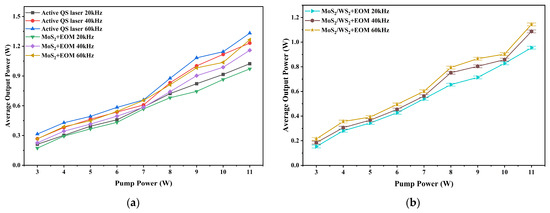
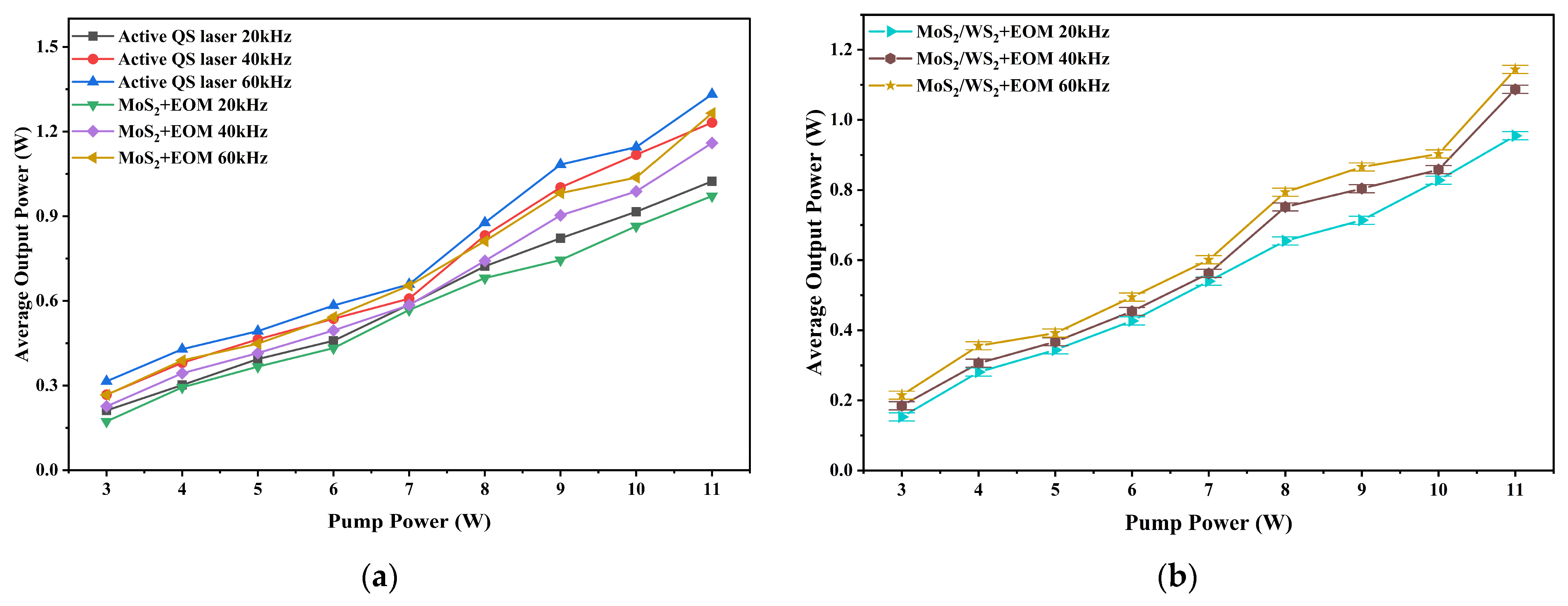
Based on the results of this experiment and previous reports, it can be seen that the stability of QS pulses using only SAs is lower than that of electro-optic QS pulses. Therefore, this experiment focused on the output characteristics of electro-optic QS lasers and dual-loss-modulated QS lasers. In order to understand the influence of the electro-optic modulation frequency on laser output characteristics, QS lasers with different electro-optic modulation rates (20 kHz, 40 kHz, and 60 kHz) were realized. Figure 6 shows that the average output power increased with the pump power. For the dual-loss-modulated laser constructed with the MoS2/WS2 heterojunction SA, systematic error analysis and uncertainty evaluation of the average output power were carried out, and it was determined that the measurement uncertainty of the average output power of the laser did not exceed ±0.011 W. Under otherwise identical conditions, the laser achieved the highest average output power at 60 kHz. Within the tested range, a higher repetition rate led to a higher average output power.
Figure 6.
Relationship between average output power and pump power: (a) active QS laser and dual-loss-modulated QS laser with MoS2 SA; (b) dual-loss-modulated QS laser with MoS2/WS2 SA (with error bars).
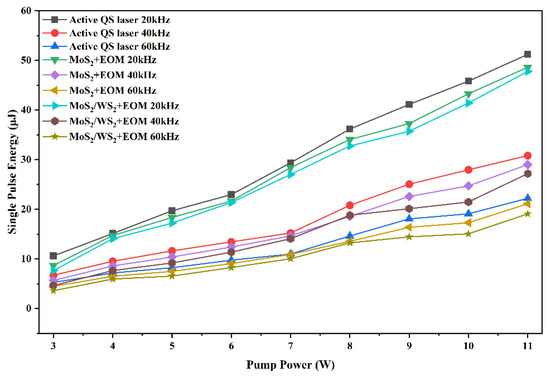
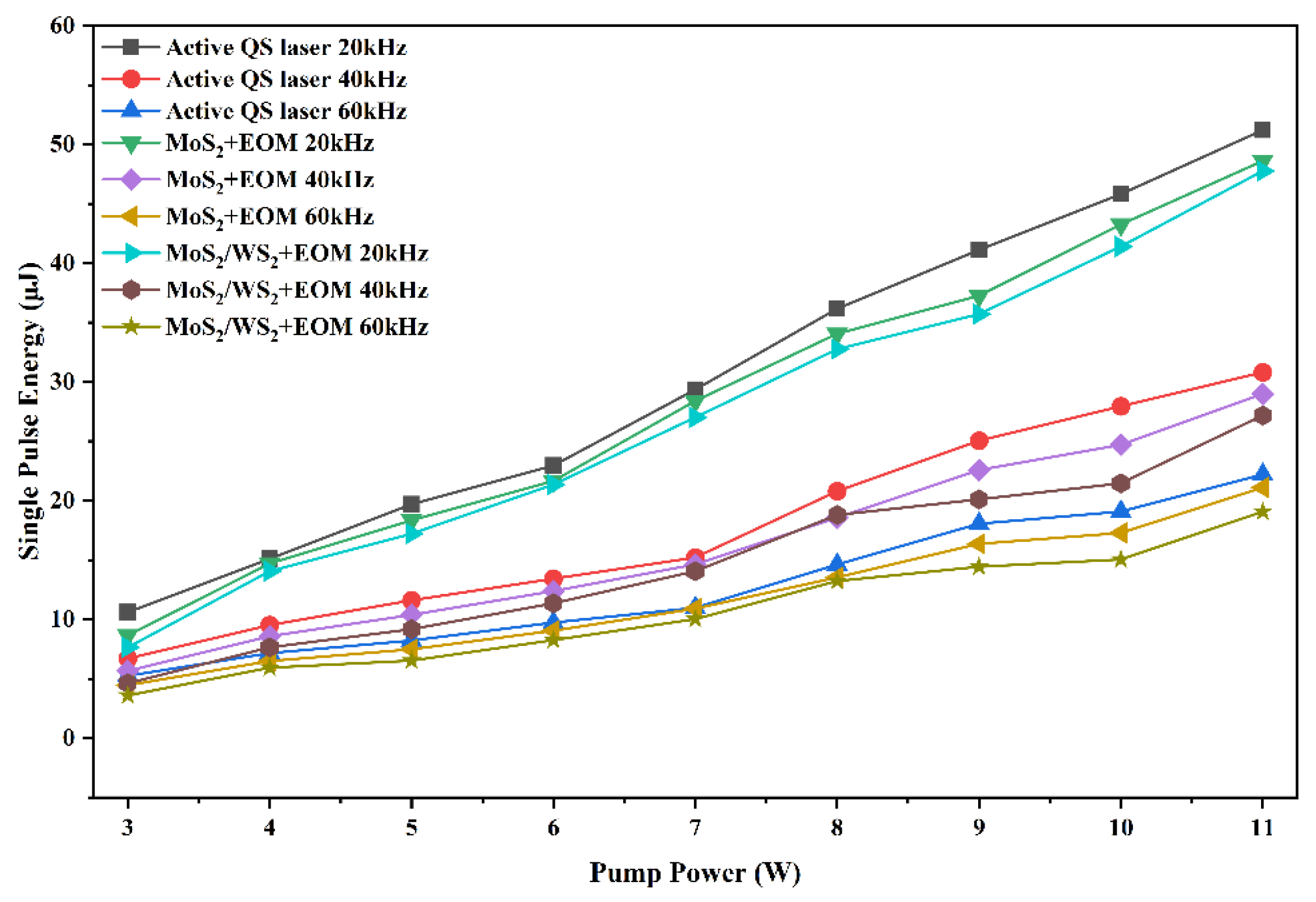
Figure 7 shows the single-pulse energies calculated from the repetition rate and the average output power. It can be seen that a lower repetition rate helped to increase the single-pulse energy, and the pulse energy increased with pump power in the same laser. At a repetition rate of 20 kHz and a pump power of 11 W, 51.2 μJ was obtained in the active QS laser, while about 47.8 μJ was obtained in the dual-loss-modulated QS laser with the MoS2/WS2 SA. Compared with the single-pulse energies obtained at 3 W, the highest single-pulse energies at 20 kHz for the active QS laser, the dual-loss-modulated QS laser with the MoS2 SA, and the dual-loss-modulated QS laser with the MoS2/WS2 heterostructure SA increased by 4.23, 4.74, and 5.23 times, respectively, when the pump power was raised to 11 W.
Figure 7.
Relationship between single-pulse energy and pump power.
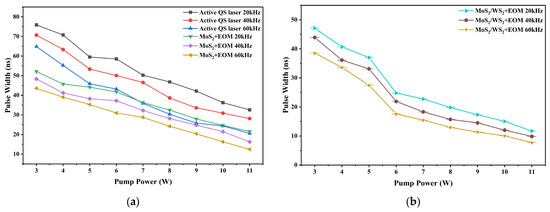
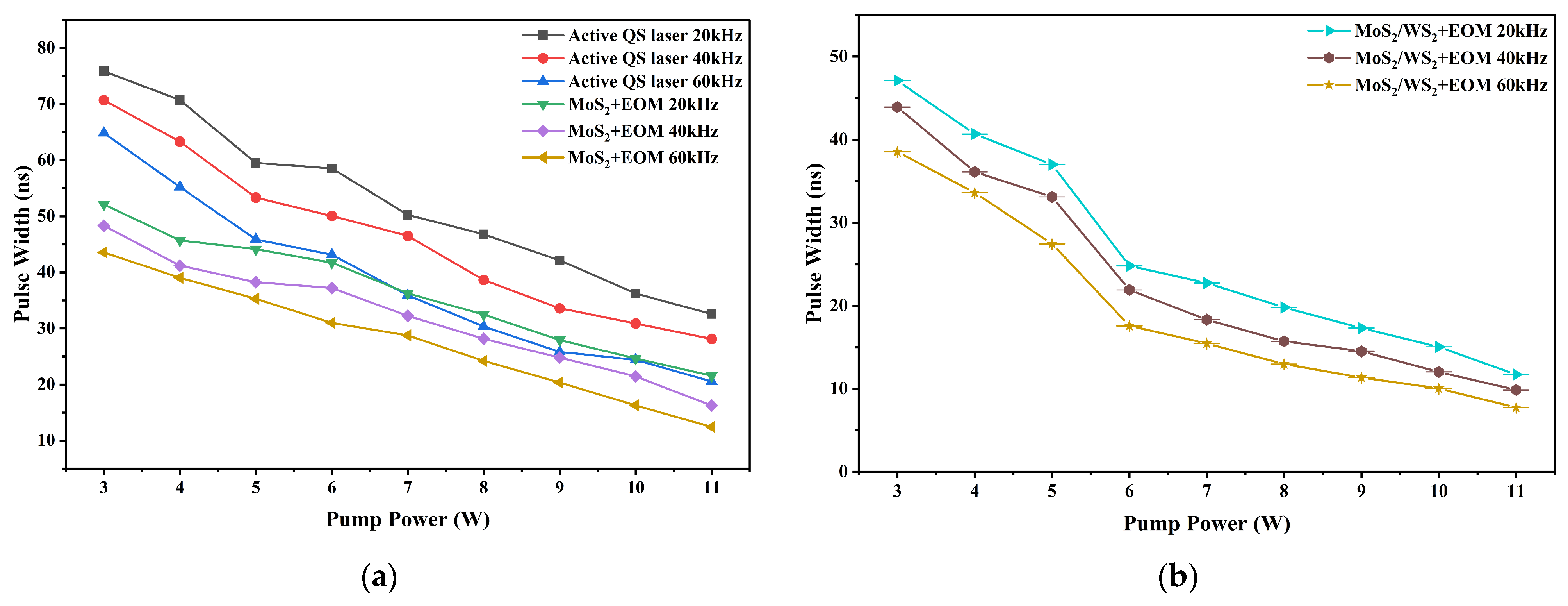
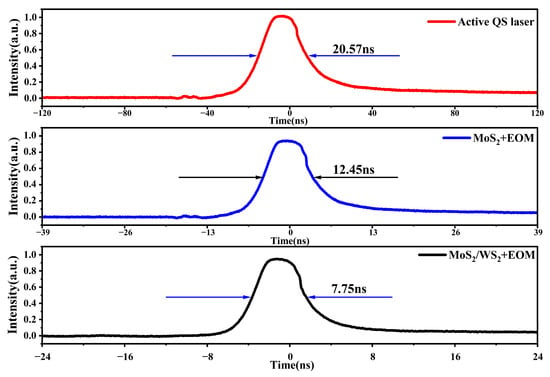
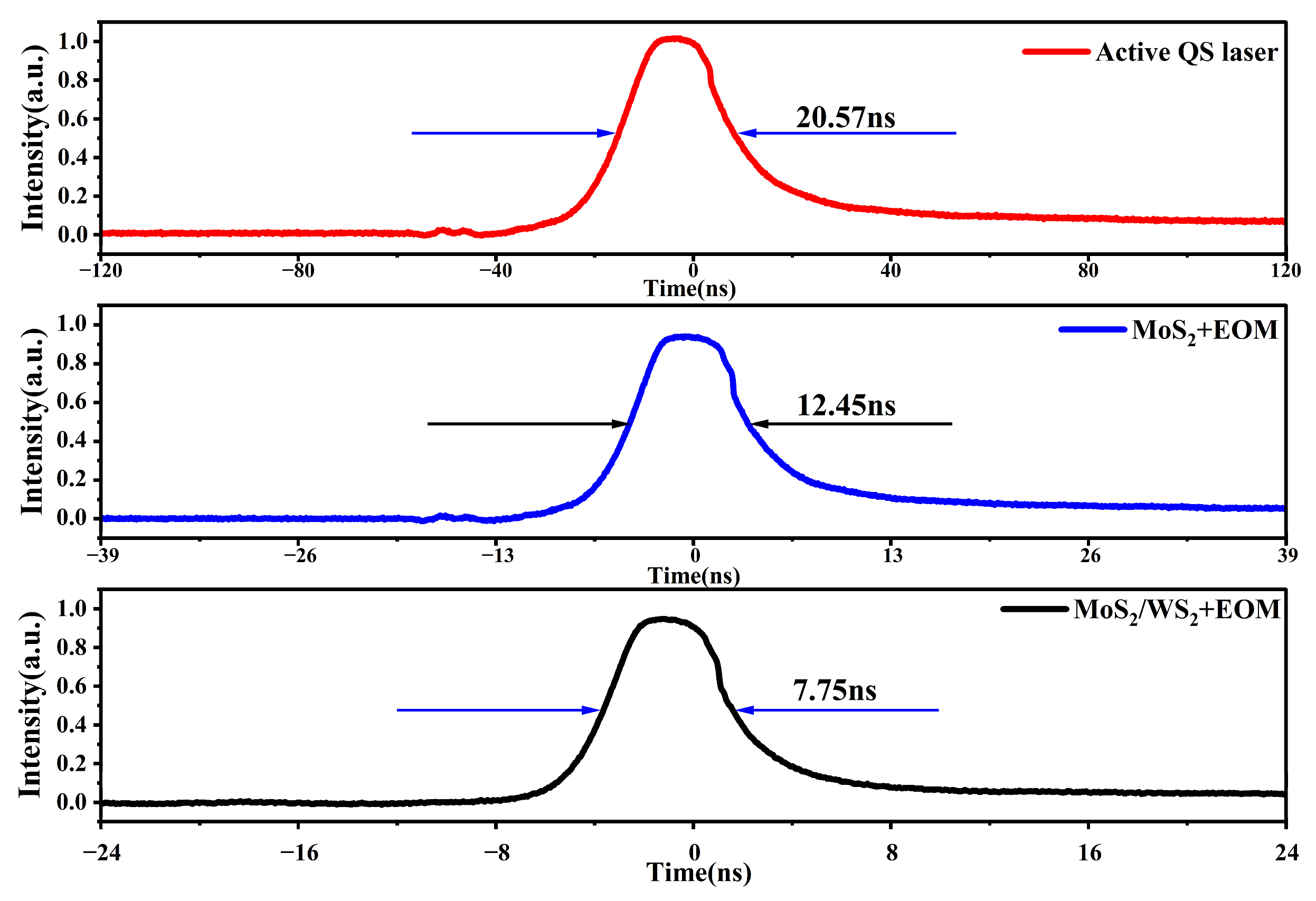
The relationship between the single-pulse width and pump power is shown in Figure 8. The pulse width of the dual-loss-modulated QS laser with the MoS2/WS2 SA was significantly compressed compared with those of the active QS laser and the dual-loss-modulated QS laser with the MoS2 SA. For the dual-loss-modulated laser with the MoS2/WS2 SA, systematic error analysis and uncertainty evaluation of the pulse width were carried out, and it was determined that the measurement uncertainty of the pulse width of the laser did not exceed 0.001 ns. At 11 W and 60 kHz, the narrowest pulse width of approximately 7.75 ns was obtained in the dual-loss-modulated QS laser with the heterostructure SA, compressed by 62.3% compared with that of the active QS laser and by 37.7% compared with that of the dual-loss-modulated QS laser with the MoS2 SA. The results show that dual-loss modulation using both an EOM and a heterostructure SA can significantly compress the pulse width. Figure 9 records the pulse width comparison of the active QS laser and the MoS2 SA and MoS2/WS2 heterostructure SA dual-loss QS lasers at 60 kHz, where the dual-loss modulation exhibits a more stable pulse train. The experimental pulse performance indicates that the interaction between the EOM and the SA is essentially an active–passive synergistic modulation mechanism. This synergistic modulation method compresses the pulse width, improves the symmetry of the pulse waveform, and enhances the stability of the pulse train.
Figure 8.
Relationship between pulse width and pump power: (a) active QS laser and dual-loss-modulated QS laser with MoS2 SA; (b) dual-loss-modulated QS laser with MoS2/WS2 SA (with error bars).
Figure 9.
Pulse comparison of active QS laser and dual-loss-modulated QS lasers.
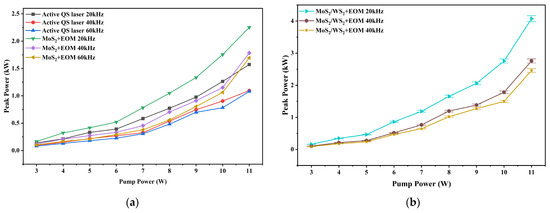
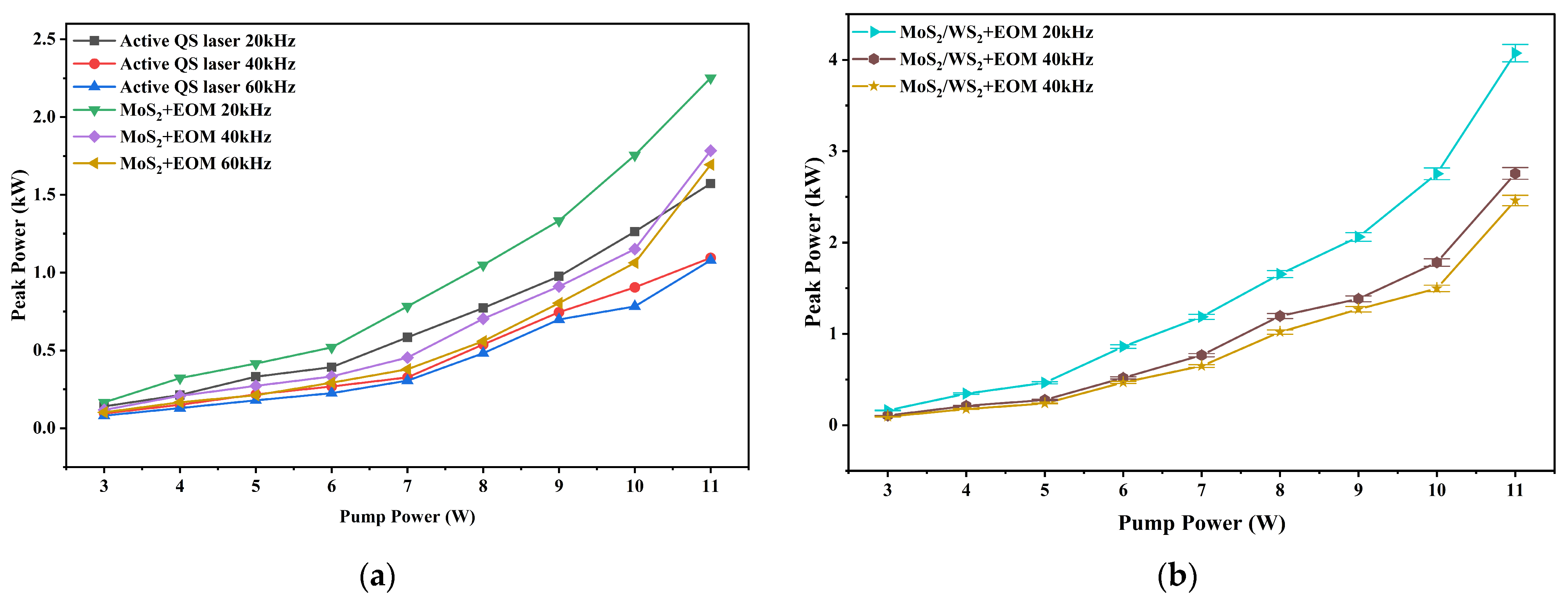
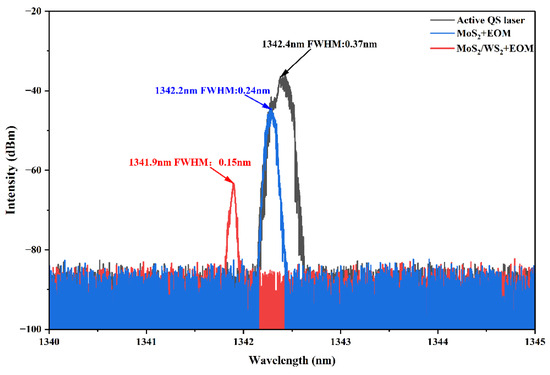
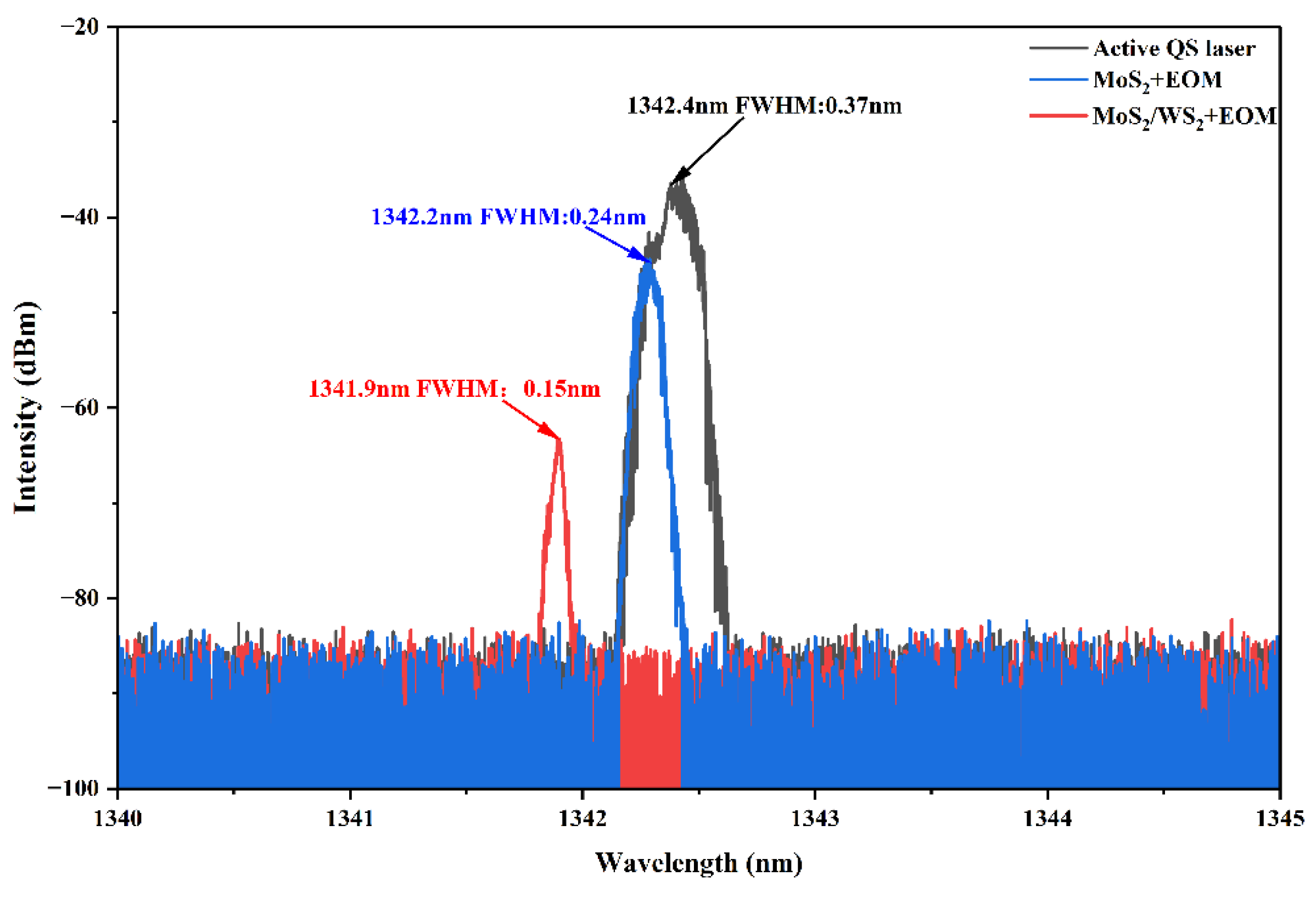
The peak powers were calculated by using the single-pulse energies and pulse durations. The relationship between the peak powers and pump powers is given in Figure 10. At 20 kHz and 11 W, the peak power of the QS laser with both an EOM and the heterostructure SA was 4.07 kW, increasing by 80.9% compared with that of the QS laser with an EOM and the MoS2 SA and by a factor of 1.59 compared with that of the active QS laser. At 60 kHz, the peak power of the QS laser with an EOM and the heterostructure SA increased by 45.2% compared with that of the QS laser with an EOM and the MoS2 SA. The above results indicate that the use of the MoS2/WS2 heterostructure SA can significantly improve the pulse peak power at different repetition rates. The spectra of the active QS laser and dual-loss-modulated QS lasers are shown in Figure 11. The peak wavelengths were 1342.4 nm, 1342.2 nm, and 1341.9 nm. According to references [29,30], the spectral pulse shift is a result of the interaction between the physical properties of the SA and the parameters of the laser resonator. Meanwhile, it can be seen that the full width at half-maximum (FWHM) was 0.15 nm for the dual-loss-modulated QS laser with the heterostructure SA, leading to better monochromaticity compared with the active QS laser and the dual-loss-modulated QS laser with MoS2.
Figure 10.
Relationship between peak power and pump power for different lasers: (a) active QS laser and dual-loss-modulated QS laser with MoS2 SA; (b) dual-loss-modulated QS laser with MoS2/WS2 SA (with error bars).
Figure 11.
Output spectra for different QS lasers.
Table 1 summarizes the performance of 1.3 μm lasers under different modulation methods based on TMDs. The data show that the dual-loss-modulated technique, which combines an EOM with a MoS2/WS2 heterostructure SA, has a significant modulation advantage, enabling narrower pulse widths and higher peak powers.
Table 1.
Output characteristics for lasers with TMDs at 1.3 μm.
5. Theoretical Analysis
For a Nd:YVO4 laser using Nd3+ as the activation ion, the energy levels involved in the laser transition belong to a four-level system [32]. In this study, using YVO4/Nd:YVO4 as the gain medium, the dual-loss-modulated laser based on the MoS2/WS2 heterostructure SA adopts a four-level system, and its dual-loss-modulated rate equations are as follows [33]:
where N is the population inversion density, , RP is the pump rate, ηp is the laser pumping efficiency, and V is the mode volume in the gain medium. is the stimulated emission coefficient of the gain medium, σg is the stimulated emission cross-section of the gain medium, and c is the speed of light in vacuum. ns is the excited-state population density of the absorber, ns0 is the initial population density of the absorber, and τs is the excited-state lifetime of the absorber. ϕ is the photon density, σgs is the ground-state absorption cross-section of the absorber, σes is the excited-state absorption cross-section of the absorber, τ is the upper-state lifetime, and β is the spontaneous emission factor. τc(t) is the cavity photon lifetime (controlled by the electro-optic switch) [34]:
If pumping and spontaneous emission during the pulse are neglected, integration yields the single-pulse energy formula:
is the threshold inversion density for fixed loss, where δT is the total single-pass loss, and lg is the length of the gain medium. hυ is the photon energy, and δoc is the output coupling loss. Ni and Nf represent the inversion population densities at the start and end of the pulse, respectively, satisfying the energy storage equation and the energy extraction equation:
where z is the cross-section ratio. The peak power formula is
where Np is the peak inversion density, satisfying .
The optimal single-pulse energy and peak power at different repetition rates can be calculated from the parameters given in Table 2 at a pump power of 11 W. The theoretical calculation results are shown in Table 3. The calculated values are in good agreement with the experimental results, indicating that dual-loss modulation with both the MoS2/WS2 heterostructure SA and the EOM is reasonable and capable of achieving pulse width compression.
Table 2.
Parameters in theoretical calculations.
Table 3.
Theoretical values and experimental results for output characteristics at different repetition rates with a pump power of 11 W.
6. Conclusions
A dual-loss-modulated QS Nd:YVO4 laser with an EOM and different TMD SAs was demonstrated. The EOM was used to improve the stability of QS pulses, and dual-loss modulation was used to compress their duration. Under the same pumping conditions, narrower pulse widths and higher peak power were realized in the dual-loss-modulated QS laser than in the active QS laser. At a repetition rate of 60 kHz and a pump power of 11 W, the pulse width of the dual-loss-modulated QS laser with the heterostructure SA was compressed to 7.75 ns, with a peak power of 2.46 kW. Compared with the dual-loss-modulated QS laser with the MoS2 SA, the pulse width was reduced by 37.7%, and the peak power increased by 45.2%. The experimental results not only indicate that the combination of an EOM and an SA can achieve stable laser output but also demonstrate that compared with a single-material SA, the heterostructure SA makes it easier to optimize laser output characteristics, leading to a narrow pulse width and high peak power.
Author Contributions
Conceptualization, G.Z.; methodology, G.Z. and F.B.; investigation, L.Y.; data curation, L.Y., W.W. and J.W.; writing—original draft preparation, G.Z. and L.Y.; writing—review and editing, G.Z.; supervision, Z.J.; funding acquisition, G.Z. All authors have read and agreed to the published version of the manuscript.
Funding
This research was funded by the Fundamental Research Funds for the Central Universities, grant numbers 23CX03015A, 25CX03006A.
Data Availability Statement
The original contributions presented in this study are included in the article. Further inquiries can be directed to the corresponding author.
Conflicts of Interest
The authors declare no conflicts of interest.
References
- Feng, C.; Zhang, H.; Fang, J.; Wang, Q. Passively Q-switched Nd:YAG ceramic laser with V3+:YAG saturable absorber at 1357 nm. Appl. Opt. 2015, 54, 9902–9905. [Google Scholar] [CrossRef] [Scilit] [PubMed]
- Botha, R.; Strauss, H.; Bollig, C.; Koen, W.; Collett, O.; Kuleshov, N.; Esser, M.; Combrinck, W.; von Bergmann, H. High average power 1314 nm Nd:YLF laser, passively Q-switched with V:YAG. Opt. Lett. 2013, 38, 980–982. [Google Scholar] [CrossRef] [Scilit]
- Li, P.; Li, Y.; Sun, Y.; Hou, X.; Zhang, H.; Wang, J. Passively Q-switched 1.34 µm Nd:YxGd1−xVO4 laser with Co2+:LaMgAl11O19 saturable absorber. Opt. Express 2006, 14, 7730–7736. [Google Scholar] [CrossRef] [Scilit]
- Li, X.; Li, Y.; Zhao, S.; Li, G.; Zhao, B.; Yin, L. Improvements of pulse energy and symmetry of diode-pumped hybrid Q-switched mode-locked Nd:Lu0.15Y0.85VO4 laser at 1.34 μm. Opt. Laser Technol. 2013, 45, 114–117. [Google Scholar] [CrossRef] [Scilit]
- Xu, C.; Li, G.; Zhao, S.; Li, X.; Cheng, K.; Zhang, G.; Li, T. LD-pumped passively Q-switched Nd:GdVO4 laser at 1342 nm with high initial transmission V:YAG saturable absorber. Laser Phys. 2010, 20, 1335–1340. [Google Scholar] [CrossRef] [Scilit]
- Wang, K.; Wang, J.; Fan, J.; Lotya, M.; O’Neill, A.; Fox, D.; Feng, Y.; Zhang, X.; Jiang, B.; Zhao, Q.; et al. Ultrafast saturable absorption of two-dimensional MoS2 nanosheets. ACS Nano 2013, 7, 9260–9267. [Google Scholar] [CrossRef] [Scilit]
- Zhang, H.; Lu, S.B.; Zheng, J.; Du, J.; Wen, S.C.; Tang, D.Y.; Loh, K.P. Molybdenum disulfide (MoS2) as a broadband saturable absorber for ultra-fast photonics. Opt. Express 2014, 22, 7249–7260. [Google Scholar] [CrossRef] [Scilit]
- Xu, B.; Cheng, Y.; Wang, Y.; Huang, Y.; Peng, J.; Luo, Z.; Xu, H.; Cai, Z.; Weng, J.; Moncorgé, R. Passively Q-switched Nd:YAlO3 nanosecond laser using MoS2 as saturable absorber. Opt. Express 2014, 22, 28934–28940. [Google Scholar] [CrossRef] [Scilit]
- Wang, K.; Yang, K.; Zhang, X.; Zhao, S.; Luan, C.; Liu, C.; Wang, J.; Xu, X.; Xu, J. Passively Q-switched laser at 1.3 μm with few-layered MoS2 saturable absorber. IEEE J. Sel. Top. Quant. 2016, 23, 1600205. [Google Scholar] [CrossRef] [Scilit]
- Zhang, G.; Wang, Y.; Wang, J.; Jiao, Z. Passively Q-switched laser at 1.34 μm using a molybdenum disulfide saturable absorber. Infrared Phys. Technol. 2019, 96, 311–315. [Google Scholar] [CrossRef] [Scilit]
- Zhang, G.; Wang, Y.; Jiao, Z.; Li, D.; Wang, J.; Chen, Z. Tungsten disulfide saturable absorber for passively Q-switched YVO4/Nd:YVO4/YVO4 laser at 1342.2 nm. Opt. Mater. 2019, 92, 95–99. [Google Scholar] [CrossRef] [Scilit]
- Li, Z.; Cheng, C.; Dong, N.; Romero, C.; Lu, Q.M.; Wang, J.; Aldana, J.R.V.; Yang, T.; Feng, C. Q-switching of waveguide lasers based on graphene/WS2 van der Waals heterostructure. Photonics Res. 2017, 5, 406–410. [Google Scholar] [CrossRef] [Scilit]
- Hong, X.; Kim, J.H.; Shi, S.F.; Zhang, Y.; Jin, C.H.; Sun, Y.H.; Tongay, S.; Wu, J.Q.; Zhang, Y.F.; Wang, F. Ultrafast charge transfer in atomically thin MoS2/WS2 heterostructures. Nat. Nanotechnol. 2014, 9, 682–686. [Google Scholar] [CrossRef] [Scilit]
- Xu, Y.M.; Yan, L.H.; Wang, A.Y.; Tian, F.; Huang, X.J.; Liu, J. Nonlinear optical performance and mechanism in MoS2/WS2 van der Waals heterostructures. Opt. Mater. 2023, 143, 114213. [Google Scholar] [CrossRef] [Scilit]
- Zhao, G.; Hou, J.; Wu, Y.; He, J.; Hao, X. Preparation of 2D MoS2/Graphene heterostructure through a monolayer intercalation method and its application as an optical modulator in pulsed laser generation. Adv. Opt. Mater. 2015, 3, 937–942. [Google Scholar] [CrossRef] [Scilit]
- Sun, X.; Zhang, B.; Li, Y.; Luo, X.; Li, G.; Chen, Y.; Zhang, C.; He, J. Tunable ultrafast nonlinear optical properties of graphene/MoS2 van der Waals heterostructures and its application in solid-state bulk laser. ACS Nano 2018, 12, 11376–11385. [Google Scholar] [PubMed]
- Liu, Y.; Zhang, G.; Gao, F.; Jiao, Z.; Li, D. Passively Q-switched mode-locked laser based on a MoS2/MoSe2 heterostructure saturable absorber. Opt. Mater. 2022, 133, 112864. [Google Scholar] [CrossRef] [Scilit]
- Tang, W.; Zhao, J.; Yang, K.; Zhao, S.; Li, G. 1.38 MW peak power dual-loss modulated sub-nanosecond green laser with EO and graphene. Opt. Mater. 2016, 62, 23–27. [Google Scholar] [CrossRef] [Scilit]
- Wang, D.; Zhao, J.; Yang, K.; Zhao, S.; Li, T.; Li, D.; Li, G.; Qiao, W. Doubly Q-switched Nd:GGG laser with a few-layer MoS2 saturable absorber and an acousto-optic modulator. Opt. Mater. 2017, 72, 464–469. [Google Scholar] [CrossRef] [Scilit]
- Niu, Z.; Feng, T.; Li, T.; Yang, K.; Zhao, J.; Li, G.; Li, D.; Zhao, S.; Qiao, W.; Chu, H.; et al. Theoretical and experimental investigations on doubly Q-switched Tm:YAP laser with EOM and Sb2Te3 nanosheets. Opt. Express 2021, 29, 24684–24694. [Google Scholar] [CrossRef] [Scilit]
- Zhang, G.; Cheng, K.; Jiao, Z.; Li, D.; Zhou, X.; Xu, X.; Wang, T.; Liu, P. Doubly Q-switched and mode-locked laser at 1.3 μm using acousto-optic modulator and molybdenum selenide. Opt. Laser Technol. 2022, 148, 107712. [Google Scholar] [CrossRef] [Scilit]
- Gurarslan, A.; Yu, Y.; Su, L.; Yu, Y.; Suarez, F.; Yao, S.; Zhu, Y.; Ozturk, M.; Zhang, Y.; Cao, L. Surface-energy-assisted perfect transfer of centimeter-scale monolayer and few-layer MoS2 films onto arbitrary substrates. ACS Nano 2014, 8, 11522–11528. [Google Scholar] [CrossRef] [Scilit] [PubMed]
- Zhang, G.; Li, J.; Liu, Y.; Gao, F.; Yang, L.; Jiao, Z. Passively Q-switched and mode-locked laser with sandwich-like heterostructure saturable absorber. J. Mod. Opt. 2025, 72, 169–174. [Google Scholar] [CrossRef] [Scilit]
- Yan, Y.; Li, F.; Gong, Y.B.; Yao, M.; Huang, X.; Fu, X. Interlayer coupling affected structural stability in ultrathin MoS2: An investigation by high pressure Raman spectroscopy. J. Phys. Chem. C 2016, 120, 24992–24998. [Google Scholar] [CrossRef] [Scilit]
- Zhao, Y.; Han, S.; Zhang, J.; Tong, L. Helicity-resolved resonant Raman spectroscopy of layered WS2. J. Raman Spectrosc. 2021, 52, 525–531. [Google Scholar] [CrossRef] [Scilit]
- Haris, H.; Batumalay, M.; Tan, S.J.; Markom, A.M.; Muhammad, A.R.; Harun, S.W.; Megat Hasnan, M.M.I.; Saad, I. Mode-locked YDFL using topological insulator bismuth selenide nanosheets as the saturable absorber. Crystals 2022, 12, 489. [Google Scholar] [CrossRef] [Scilit]
- Liu, W.J.; Liu, M.L.; Liu, B.; Quhe, R.; Lei, M.; Fang, S.; Teng, H.; Wei, Z. Nonlinear optical properties of MoS2-WS2 heterostructure in fiber lasers. Opt. Express 2019, 27, 6689–6699. [Google Scholar] [CrossRef] [Scilit] [PubMed]
- Kaertner, F.; Brovelli, L.; Kopf, D.; Kamp, M.; Calasso, I.; Keller, U. Control of solid-state laser dynamics by semiconductor devices. Opt. Eng. 1995, 34, 2024–2036. [Google Scholar] [CrossRef] [Scilit]
- Akhmediev, N.; Soto-Crespo, J.M. Propagation dynamics of ultrashort pulses in nonlinear fiber couplers. Phys. Rev. E 1994, 49, 4519–4529. [Google Scholar] [CrossRef] [Scilit]
- Keller, U.; Weingarten, K.J.; Kartner, F.X.; Kopf, D.; Braun, B.; Jung, I.D. Semiconductor saturable absorber mirrors (SESAM’s) for femtosecond to nanosecond pulse generation in solid-state lasers. IEEE J. Sel. Top. Quant. 1996, 2, 435–453. [Google Scholar] [CrossRef] [Scilit]
- Lin, M.; Peng, Q.; Hou, W.; Fan, X.; Liu, J. 1.3 μm Q-switched solid-state laser based on few-layer ReS2 saturable absorber. Opt. Laser Technol. 2019, 109, 90–93. [Google Scholar] [CrossRef] [Scilit]
- Shen, Y.; Fu, X.; Fu, X.; Yao, C.; Li, W.; Zhang, J.; Ning, Y. Timing jitter reduction of CW-LD-pumped 1.34 μm high-repetition-rate Nd:YVO4/V:YAG laser with optimal spatial overlap rate. Opt. Laser Technol. 2023, 165, 109618. [Google Scholar] [CrossRef] [Scilit]
- Han, C.; Chu, H.; Feng, T.; Zhao, S.; Li, D.; Zhang, H.; Zhao, J.; Huang, W. Sub-nanosecond single mode-locking pulse generation in an idler-resonant intracavity KTA optical parametric oscillator driven by a dual-loss-modulated Q-switched and mode-locked laser with an acousto-optic modulator and MoWS2. Nanomaterials 2024, 14, 1491. [Google Scholar] [CrossRef] [Scilit] [PubMed]
- Jiménez-Morales, F.; Guisado-Lizar, J.L.; Guerra, J.M. A cellular automata model of a laser reproducing laser passive and active Q-switching. Simul. Model. Pract. Theory 2025, 138, 103028. [Google Scholar] [CrossRef] [Scilit]

Disclaimer/Publisher’s Note: The statements, opinions and data contained in all publications are solely those of the individual author(s) and contributor(s) and not of MDPI and/or the editor(s). MDPI and/or the editor(s) disclaim responsibility for any injury to people or property resulting from any ideas, methods, instructions or products referred to in the content. |
© 2026 by the authors. Licensee MDPI, Basel, Switzerland. This article is an open access article distributed under the terms and conditions of the Creative Commons Attribution (CC BY) license.