

Review

Exploring Dynamics of Korea’s Short-Term Energy Transition: A Multi-Level Perspective Approach

Faculty of General Education, Sahmyook University, 815 Hwarang-ro, Nowon-gu, Seoul 01795, Republic of Korea
Energies 2026, 19(4), 1037; https://doi.org/10.3390/en19041037
Submission received: 25 December 2025 / Revised: 1 February 2026 / Accepted: 13 February 2026 / Published: 16 February 2026
(This article belongs to the Special Issue Sustainable Energy Systems: Progress, Challenges and Prospects)

Abstract

The energy transition takes a long time and requires a complex process involving stakeholder consensus. This study aims to explore the political, economic, and sociocultural dynamics that emerged during the short-term energy transition between the Moon and Yoon administrations in Korea, assessing the current energy transition, which stands at a crossroads, and provides conclusions and implications to inform future decisions on the findings. To this purpose, a multi-level perspective analytical framework was applied to investigate the two administrations’ conflicting energy transition mechanisms on the level of actors, technologies, and rules/institutions. According to the results, the Moon administration pursued a reconfiguration pathway of limited changes by attempting to phase out nuclear power plants and expand renewable energy, while the Yoon administration promoted a transformation pathway of partial change by abandoning the policy of phasing out nuclear power plants and further expanding existing nuclear energy. Differences in pathways were found to stem from differentiation based on political ideology and political purposes among key actors, rather than socio-technological innovation. This paper argues that Korea’s short-term energy transition was hastily pursued amidst a lack of public discourse, insufficient technological development, and institutional deficiencies, ultimately blocking the pathway to a desirable energy transition and having Korea locked in its existing energy system. This paper also suggests that no single pathway exists to carbon neutrality, and that future administrations can find desirable pathways by overcoming challenges and dilemmas through continuous improvement and adjustment.

1. Introduction

The International Energy Agency (IEA) has recommended that developed countries, including Korea, achieve net-zero carbon emissions from the power sector by 2035. However, Korea’s renewable energy capacity, which is essential for achieving carbon neutrality, remains significantly lower than that of other developed countries. In particular, the proportion of renewable energy in Korea, centered on solar and wind power generation, is woefully inadequate to achieve energy self-sufficiency [1]. As the global market transitions to a zero-carbon economy, Korea’s industrial competitiveness is expected to inevitably weaken if its energy system fails to achieve carbon neutrality [2,3,4]. For Korea, the energy transition is undoubtedly an urgent mission of the times.
Concrete plans to promote energy transition on a global scale began in earnest in the 1990s, and since then, renewable energy sources such as solar and wind power have been gradually developed, and supporting laws and systems have been established. Energy transition is a process of change driven by long-term, radical structural processes at the energy system level, bringing out the transformation from existing energy systems to new ones. The current global energy transition goes beyond the greenhouse gas-based choice between fossil fuels and renewable fuels, and requires consideration of how to utilize the energy that will power future society within a framework of sustainability. However, despite emphasis on sustainability in the energy transition, most countries are trapped in a centralized and inefficient energy supply and consumption structure focusing on fossil fuels and nuclear power rather than developing alternative energy sources [5,6,7].
Even in countries undergoing energy transition in the 21st century, the direction of energy policy is determined by the components of the energy system and the relationships between those components. The energy transition takes more than a generation and brings about multi-level changes, related policies anticipate and reflect uncertainty, especially from the stage of setting goals and means. In this context, reviewing past and present energy transition pathway is likely to be a critical task, as it may influence future policy directions.
Achieving this transition through simply energy conservation or institutional improvements is realistically very challenging. This is because the energy transition requires the interaction of renewable energy supply, innovative energy technologies, a low-carbon and low-energy consumption economic structure, and a social consensus around these. Some scholars argue that public discourse has been distorted and the energy transition delayed by government officials who resist the energy transition in order to maintain the stability of the existing system [8,9,10,11]. In this respect, Germany is often cited as a country that has succeeded in the long-term energy transition. For centuries, Germany maintained employment and regional economic stability based on a carbon energy system, and coal was the foundation of German industry, the economy, and the lives of its people. The subsequent transition to a decarbonized society required not only a change in energy sources but also a comprehensive system overhaul, a daunting national task for Germany. The 1986 Chernobyl accident in the Soviet Union sparked a widespread debate on nuclear phase-out, prompting Germany to address the energy transition at the policy level. Over several decades, social consensus led to the enactment of relevant laws and regulations for the transition away from fossil fuels, including nuclear power and, today, Germany is recognized globally as a leader in the renewable energy transition [8,9,10]. In contrast, Korea, the subject of this study, has achieved rapid economic growth based on a heavy reliance on fossil fuels. However, it has been criticized for prioritizing the maintenance of existing systems over the development of renewable energy technologies, leading to serious bottlenecks in its energy transition efforts over the past decade [2,11]. Additionally, the lack of an efficient decision-making system capable of coordinating legitimate demands between the Korean government and policy stakeholders has been consistently raised as a problem [2,11].
Renewable energy is a key goal of the global energy transition to address the climate crisis and achieve carbon neutrality. Recent key trends in it show that, driven by record-breaking growth in solar and wind power generation, renewable energy is expected to supply 30% of global electricity by 2023, and investment in renewable energy has also increased significantly. In addition, at a time when the EU’s Carbon Border Mechanism (CBAM) and the US’s Inflation Reduction Act (IRA) require global companies to make large-scale investments in renewable energy development, excessive reliance on fossil fuels can lead to a decline in both corporate and national competitiveness. Ironically, Korea’s 11th Basic Plan for Long Term Electricity Supply and Demand (BPLE) in 2025, which focuses on fostering the semiconductor industry, still aims to meet the growing electricity demand for AI and semiconductors by leveraging fossil fuel-based nuclear power [11,12,13,14,15,16,17].
The world is expected to undergo a great transition in energy policy by reaching multiple international agreements to achieve carbon neutrality by 2050 in response to the climate crisis that has struck in the 21st century. However, the choice of how to achieve this is the responsibility of individual countries, and they must keep their promises and secure international trust. In Korea, Moon administration also, which was launched in 2017, has made efforts to promote renewable energy such as solar and wind power and to expand nuclear phase-out and decarbonized power production at part of the energy transition. In contrast, Yoon administration, began in 2022, set the basic direction of energy policy as “nuclear power plant utilization and appropriate level of renewable energy production” and shifted to expanding nuclear power plants, differently from Moon administration [16,17].
Although it varies by country, given that transition policies commonly aim for sustainable development, Korea’s energy transition seems far off. This is because the pathway of energy policy in the national level has undergone extreme changes over the past decade, and the domestic energy policy has lost its direction as the previous government collapsed due to political issues. Unlike other countries where climate-related laws are implemented alongside energy policies, Korea’s energy transition, due to the unstable energy policy environment, is expected to be a short-term, stopgap measure rather than a response to the climate crisis [11,12,13,14,15,16,17,18,19,20,21]. So, why has Korea’s energy transition, which should have taken decades to establish, fallen into such disarray? And what policy challenges does Korea currently face?
To date, studies on energy transition have interested in a multi-level perspective (MLP) framework to understand system-level changes. This is because the MLP enables a government to understand the interconnectedness between social systems and surrounding environmental factors in the process of implementing energy transition policies and helps identify policy stakeholders and uncover problems and contexts. However, most studies have been cross-national comparative, and studies comparing transition policy cases across administrations within a single country are scarce.
This study assumes that the current bottlenecks impeding Korea’s energy transition stem from the socio-technical system shaped by the political actions of two administrations. In this context, this study focuses on how political actors behind a national regime chose transition pathways and derived solutions to them. Accordingly, the purpose of this paper is to analyze the political, economic, and socio-cultural dynamics that emerged during the energy transition between the Moon Jae-in and Yoon Seok-yeol administrations, to assess the current state of energy transition in Korea, which stands at a critical juncture, and to draw conclusions based on this analysis. Specifically, it analyzes the conflicting energy transition policies pursued by the two administrations since the Paris Agreement through a multi-level perspective analytical framework encompassing actors, technologies, rules, and institutions, and also presents the pathways of the transition and its implications.
The composition of this paper is as follows: The Section 1 addresses the dilemma situation facing Korea, which has been caused by the Moon and Yoon administrations’ conflicting attempts at energy transition, and the necessity and purpose of this study. Next, the Section 2 explores the theories on energy transition studies, multi-level perspective in an energy field and public sphere. The Section 3 examines the rationale for case sampling as a single case study and the descriptive analysis method utilizing a multi-level perspective analytical framework. The Section 4 addresses the dynamics that emerged during the contrasting energy transitions of the Moon and Yoon administrations, based on an analytical framework. The Section 5 explains the energy transitions of the Moon and Yoon administrations in a table and discusses the politicized energy transition processes of the two administrations without public discourse; it also summarizes the research findings and presents implications.

2. A Theoretical Review

2.1. Energy Transition Study

This study focuses on transition theory, which originated from systems theory. While systems theory takes a macro perspective that allows us to understand the structure and dynamics of a system in transition, transition theory takes a meso perspective that explains the unique stages, patterns, and dynamics of how a system changes over time. The latter focuses on the “when” and “how” of change within a system.
The energy transition theory was initiated by Amory Lovins. In his 1976 paper, he asserted that the current energy supply system based on fossil fuels cannot cope with the continuously increasing energy demand, and argued for a transition to a new energy path [20]. He divided the energy paths facing the country into two major ones: a hard energy path that utilizes fossil fuels and a soft energy path that focuses on developing renewable energy. Based on these theoretical concepts, he emphasized that in order to pursue the long-term goal of energy transition, the state must boldly choose a new path, and the socio-political system must also change accordingly. But unfortunately, at the time, his proposal was welcomed by environmentalists, but was criticized by mainstream society.
There is still no consensus on the definition of energy transition yet. However, recent academic research suggests that the elements of energy transition or energy innovation can be broadly divided into three Ds: decarbonization, digitalization, and decentralization [22,23,24,25]. Decarbonization refers to the active reduction in greenhouse gas emissions, suppressing the use of fossil fuels and expanding the supply of renewable energy. Digitalization refers to the use of cutting-edge technologies such as big data, IoT, and block chain in the energy sector to increase energy efficiency. Decentralization refers to increasing the supply of electricity through small-scale power generation facilities rather than large-scale power plants. These three pillars are interconnected. Decentralization encourages consumers to actively participate in the energy supply process, and digitalization drives decarbonization by enabling new technologies to improve energy efficiency ultimately. Since they embody essential transformation pathways for achieving sustainability, countries are focusing on setting and implementing energy transition policy goals based on them [26].
Uniquely, UN established Sustainable Development Goal 7 (SDG 7), which aims to ensure access to affordable, reliable, sustainable, and modern energy for all by 2030. This goal has five specific targets, as seen in Table 1 [25]. Even before Sustainable Development Goal 7, European countries had been actively leading the energy transition to create jobs and economic growth opportunities, and some had even secured significant levels of renewable energy. These UN global energy targets serve as practical guidelines for all countries, including the EU, to implement the energy transition, and each country is encouraged to develop its energy policies based on these targets.
Transition studies assume the co-evolution of socio-technical systems. It means that, as technology advances, social elements also change or adapt, evolving into new systems. Ultimately, the energy system refers to a socio-technical system, and it brings about various levels of social change as well as related technological changes. So, it is necessary to pay attention to the theory of socio-technical transition to explain the energy transition. A socio-technical transition study began in the Netherlands in the 1990s and spread to several European countries in the 2000s. It seeks to explain how various elements of social and technological systems and the relationships between them change. However, rather than adopting a stance of either social or technological determinism, it emphasizes the simultaneous development of society and technology. In particular, the knowledge network and research program of ‘System Innovation and Transition’ promoted by Dutch scholars developed into the international ‘Sustainability Transition Research Network (STRN)’ and continues to today [28,29,30,31,32]. Meanwhile, recent research covers the findings that institutional gaps in the energy transition create resistance from existing systems, that political dynamics drive the transition, and that the transition is a long-term project that cannot be achieved through simple technological expansion [33,34].

2.2. Multi-Level Perspective in Energy Transition

The multi-level perspective in transition studies is an analytical approach suitable for explaining the innovation and transition processes of socio-technical systems, and it is useful for understanding system-level transformational changes. The early multi-level perspective model was criticized for being overly descriptive, neglecting the role of power and politics, and emphasizing only bottom-up processes occurring in the niche. It was also pointed out as a limitation that the resistance of vested interests within the regime was not properly discussed. However, over time, multi-level perspectives have become more sophisticated as attempts to analyze the interaction between politics and economics based on political economic insights have revealed mechanisms of resistance that were not readily apparent in socio-technical analyses [35,36,37,38,39,40].
Typically, to analyze the changing patterns of the socio-technical system transition, multi-level perspective divides three levels into the landscape, regime, and niche, and analyzes the interactions among actors at each level, including their structures, cultures, and practices [35,36,37,38,39,40]. Here, landscape, the macro environment, refers to the background or context that forms the current socio-technical regime, and regime is the institutionalized system consisting of laws, practices, technologies, and actors. Niche refers to protected spaces where radical innovations and new technologies emerge and develop outside the existing regime. Transitions occur when changes in the macro-environment (landscape) put pressure on the dominant system, creating conditions for innovation to occur, and when new niche innovations emerge and grow, changing the dominant system. While global environmental, social, and economic trends influence and exert pressure on regimes, regimes tend to maintain the status quo as a dominant society supported by social norms and integrated systems. Niche markets seek to develop new markets with new ideas and challenge the established system [35,36,37,38,39,40,41].
In a case study of the UK electricity system, Geels observed resistance from political actors and analyzed that this stems from a complex socio-technical system shaped by political, cultural, and economic factors such as path dependency, strategic mobilization, and vested interests [38]. He emphasized that existing actors are resisting the low-carbon system through instrumental power, discursive power, material power, and institutional power, and that the structures from these resistances of existing actors ultimately lead to the lock-in or consolidation of the existing system. On the other side, economics and institutional research have also actively studied lock-in mechanisms, suggesting factors contributing to them such as economies of scale, learning effects, network externalities, cost reduction, increased information revenue, collective action, and power asymmetry [23,39,40,41]. This study will center on cost reduction and power asymmetry among these factors.

2.3. Public Sphere and Public Discourse

Habermas, who first proposed the concept of the “public sphere” in 1962, described modern society as a decentralized society functionally differentiated into various subsystems, such as politics, economy, and culture, based on anonymity. According to his definition, the public sphere is “a space where individuals gather to form a public and freely and rationally discuss public issues” [42].
Academically, the public sphere serves to integrate the fragmented systems of modern society, while also playing its role in fostering discussion of public issues, forming public opinion, and critiquing and restraining state power. For example, when social problems arise in the private sphere of the everyday world, civil society actors seek to influence institutionalized opinions and will through autonomous or voluntary collective action. Habermas viewed these individuals as key players in driving problem-solving discourses surrounding the direction of the universal interests of society as a whole. He also argued that through this process, public discourse reflects, in principle, egalitarian and open characteristics, and state power forms political legitimacy. The modern public sphere, which has expanded beyond physical space into the digital realm, enables broader participation and faster communication. In the digital age, Habermas’ theory of the public sphere has been extended to online communities and social media platforms. Recent studies highlight energy democracy, where public discourse emerges through government-led participatory processes. Comparative analyses of national energy transition policies further emphasize that sustained public discourse is pivotal to successful transitions.” A representative example of a public conflict that was pushed forward without public discourse is the construction of a transmission tower in Miryang, Korea. The issues were only partially resolved after 10 years, and it is still a topic of academic research today [43,44,45,46,47,48,49,50].
Against this backdrop, this paper defines public discourse as the social process of discourse and text that occurs in the public sphere and produces institutionally approved outcomes, encompassing not only media discourse and political communication but also organizational and professional discourse [51].

3. Methodology

3.1. Case Study Approach

Case Selection and Data Collection

This paper employs a single-case study methodology in a limited temporal scope to investigate the conflicting energy transition policies of the Moon Jae-in and Yoon Seok-yeol administrations in Korea. The reason for selecting the two administrations as subjects of study is that the Moon and Yoon administrations pursued opposing pathways in various policy areas, including energy policy, during their ten-year tenures, resulting in significant differences in the direction, goals, and means of Korea’s energy transition.
Thus, the temporal scope for this study is set at 2017–2025, the period of the Moon administration (2017–2022) and the Yoon administration (2022–2025), which have pursued energy transitions in conflicting directions in Korea since the 2015 Paris Agreement (imposing greenhouse gas reduction obligations on all countries). The Section 2 of this paper partially covers the policy-making processes of Korean administrations prior to the Moon and Yoon administrations, but those administrations have not made substantial efforts to transition away from fossil fuels, so they will be excluded from the case study. For in-depth analysis, Korea’s Basic Plan for Energy and the Basic Plan for Energy Supply and Demand from a multi-level perspective is addressed and examined the current state of energy transition based on the related data. In addition, it comprehensively utilizes relevant literature, including theoretical and empirical research papers, professional books, periodicals, yearbooks, statistical yearbooks, media articles, conference proceedings, government reports, and datasets, including technical analyses.
The case study adopts an analytical framework based on the multi-level perspective theory of transition studies to assess the past and present of Korea’s energy transition. The multi-level perspective is a representative theory in transition study, focusing on how to lead and manage transitions. Frequently utilized in energy transition study, it is based on the understanding that diverse transition pathways exist depending on the timing and nature of the interaction between regimes and niches under the pressure of changing macro environment. This approach enables analysis of energy transitions and their pathways at regional, national, and local levels. It is also considered an appropriate methodology for diagnosing, analyzing, and drawing conclusions from the two administrations’ different energy policies [22,23,24]
This paper conducts descriptive analysis. Typically, descriptive research design can use a variety of research methods to examine one or more variables. Unlike empirical research, which aims to establish causal relationships, researchers using this methodology simply observe and measure variables. Accordingly, this paper seeks to answer “what,” “when,” “where,” and “how” questions rather than “why,” questions to provide an accurate and systematic explanation of a situation, population, or phenomenon [52,53].

3.2. Multi-Level Perspective Framework as a Methodology and Research Questions

This study examines a conceptual framework based on the multi-level transition theories of Geels & Schot (2007), Geels (2012, 2014), and Geels et al. (2016) [22,35,36,37,38,39,40]. In particular, Geels et al. (2016), in their research, analyzed the energy transition in Germany and the UK from a multi-level perspective, focusing on institutions and agencies, and reconstructed and proposed a type of transition pathways based on this [40]. They emphasized that the impact of landscapes depends not only on their timing but also on the interpretation and mobilization of actors, and that the effectiveness of niche innovations depends not only on their technological characteristics but also on how such innovations are structured and institutionally embedded. They also cross-analyzed two dimensions how much a niche develops when the macro environment puts pressure on the existing system, and whether the niche is symbiotic or competitive with the existing system, and proposed four types of transition pathways accordingly.
Four types are substitution, transformation, reconfiguration, and de-alignment and re-alignment: (1) Substitution type refers to the replacement of elements of an existing regime when strong pressure from the macro environment arises, and a sufficiently developed technological niche exists. In this situation, the niche and regime technology are developed separately by different actors (new entrants and incumbents including social activists). In situations of increasingly rapid landscape change, direct conflicts between technologies and related actors may also occur. This pathway follows two patterns: one is limited institutional change, i.e., incremental adjustment; the other is fit-and-conform, i.e., niche innovations are developed to fit existing rules and institutions. (2) Transformation type refers to the gradual restructuring of the existing system through coordination by existing actors in the context of landscape pressure, social debate, and institutional reinforcement. In this situation, the existing regime accommodates and adapts when low-level macroeconomic pressures exist, but niche innovations are not sufficiently developed. This can be seen as a path to system improvement by attempting partial changes. The dominant logic here is economics, which is an important criterion not only in energy companies’ competition but also when evaluating alternatives. (3) Reconfiguration type appears when a sufficiently developed niche exists under the pressure of a strong macroeconomic environment, but this niche has a symbiotic nature with the existing regime. The range of change is greater than that of the transformation type, but it does not bring about a comprehensive change. This type of change is likely to begin with limited institutional change (“layering”), followed by larger changes (“drift”, “transition”) as actors face new challenges, shift goals, and seize new opportunities. Institutional change may also entail conflicts of interest between new entrants and incumbents. Here, politics is the dominant logic, and existing regime actors may expand the scale of renewable energy generation by collaborating with policymakers and new technology providers. (4) De-alignment and re-alignment type refers to the emergence of a completely new regime when a major change in the macro environment occurs, causing actors participating in the existing regime to lose trust and break away from the existing regime, competition occurs between niches, and one of the niches becomes dominant. In this situation, the existing system collapses due to an external shock, followed by a complete change in the system, with several niche innovations and supporters emerging, one of which gradually becomes dominant. Socio-cultural logics dominate here, and regionalism, cooperatives, and consumer participation form networks centered on a new energy system, bringing about the most radical changes It is notable that if the landscape pressure takes the form of a destructive change, a transition pathway may occur that begins with a transformation, leads to a reconfiguration, and then leads to substitution or de-alignment and re-alignment [22,40,54,55,56].
Based on the above, Table 2 depicts a conceptual perspective that synthesized transition pathways and three levels of actors, technologies, rules, and institutions, drawing on political economic insights, to analyze the dynamics of energy transitions.
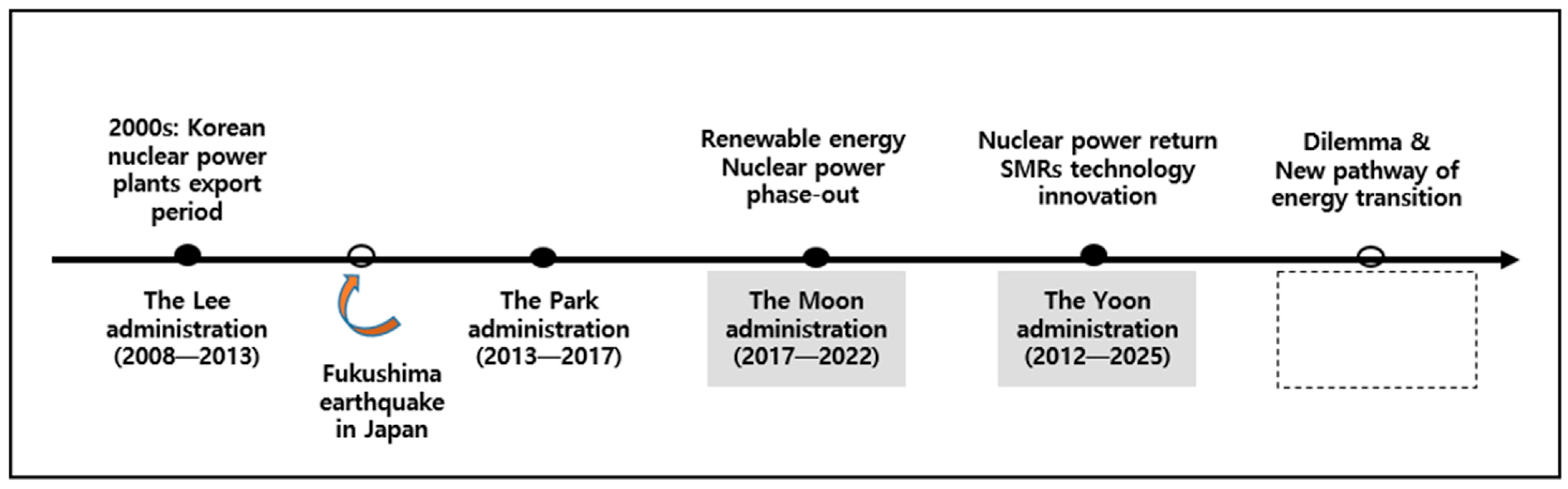
This study aims to examine the political, economic, and socio-cultural dynamics that emerged during the short-term energy transitions of the Moon and Yoon administrations and to assess the current state of energy transition in Korea, which stood at a crossroads, and presents conclusions and implications based on the findings. To this end, this paper applies the reconstructed multi-level perspective analysis framework presented in Table 2 to analyze the conflicting energy transition policies pursued by the two governments since the Paris Agreement at the actor, technology, rule, and institutional levels, and ultimately present a transition pathway type to show the transition situation in a short period. Figure 1 shows the subjects of this study and the research flowchart.
The research questions are as follows:
·
RQ 1: How did the dynamics of energy transition unfold under the Moon and the Yoon administrations at the actors, technologies, and rules/institutions levels?
·
RQ 2: What was the background behind the Moon and Yoon administrations’ contrasting energy transition policies?
·
RQ 3: What type of transition pathway did the Moon and Yoon administrations’ energy transition attempts each fall into?
·
RQ 4: What implications does Korea’s case offer to latecomer countries attempting energy transition?

4. Results

4.1. The Moon Administration’s Manifestation of a Transition to Renewable Energy

4.1.1. The Moon Administration’s Phase-Out for Nuclear Power Plants Devoid of Public Discourse in a Changing Global Energy Landscape

Korea remains one of the world’s largest greenhouse gas emitters. However, the Lee Myung-bak administration, which took office in 2008, pursued low-carbon, green growth initiatives and began a full-scale response to the international climate change trend. Unfortunately, despite efforts, the lack of effective laws or energy policies to reduce greenhouse gases has resulted in limited meaningful results. This appears to be because, following the 2011 Fukushima nuclear accident in Japan, the public began to question the sincerity of the government’s efforts to transition to low-carbon energy, and the Four Major Rivers Project, which the government was pursuing at the time, was criticized for running counter to green growth, weakening its momentum [57,58,59].
Following the impeachment and dissolution of the Park Geun-hye administration, which succeeded the Lee administration, the Moon administration and his progressive party (Democratic Party of Korea), which took office in 2017, declared an energy transition through a reduction in nuclear power plants [59,60,61]. It pledged to close aging nuclear power plants and stop building new ones, including coal-fired power plants. Subsequently, the administration announced a nuclear phase-out roadmap and a renewable energy implementation plan, aiming to generate 20% of electricity from renewable energy by 2030. Accordingly, the transition to renewable energy was specifically included in the 3rd Basic Energy Plan for 2019 and the 9th Basic Electricity Supply and Demand Plan for 2020 [62,63]. At the time, the public enthusiastically supported Moon administration’s energy policy of eliminating nuclear power plants and using renewable energy due to fears over the Fukushima nuclear accident in Japan [19,60,64,65,66]. Actually, plans for new nuclear power plant construction were canceled, life extensions for existing plants were banned, and the country’s first nuclear power plant was shut down ahead of schedule [47,48]. However, before halting construction of Shin-Kori Units 5 and 6, which were 30% complete at the time, Moon administration conducted a public participation survey under the pretext of gathering public opinion. Unexpectedly, the results showed 59.5% of respondents supporting the resumption of construction, while 40.5% opposed, leading to the resumption of construction at the plants [67]. But, from then until the end of his term, there was no further public discourse about the energy transition.
Meanwhile, the pressure for transition from the level of landscape environment, Moon administration accelerated further. At the 48th IPCC General Assembly held in Songdo, Incheon, South Korea in 2018, 195 countries adopted the Special Report on Global Warming of 1.5 °C [68]. That same year, the EU announced “A Clean Planet for All,” a long-term strategy calling for carbon neutrality by 2050. Furthermore, the European Green Deal plan, announced in 2019, included the “Strategy for Carbon Neutrality by 2050,” known as a new economic growth engine, climate protection, and industrial strategy [69,70,71,72,73]. As the EU, the US, Canada, Japan, and China announced their goals for carbon neutrality by 2060, Moon government also announced at the G20 Summit in November 2020 that it would align with the international community [71,72,73].

4.1.2. Moon Government’s Upward Adjustment of NDC Target for Greenhouse Gas Emissions and Its Attempt of Carbon Neutrality

In 2021, as a follow-up to the global carbon economy response, President Moon upgraded the greenhouse gas reduction target from the Nationally Determined Contributions (NDCs) established by Park administration in 2015. The new NDCs set a target of 436 million tons by 2030, a 40% reduction from 2018 levels as shown Table 3. Some have argued that the 40% figure was a one-sided and unrealistic target that did not adequately reflect technological advancements or investment potential [17,61,71,72,73].
Furthermore, in 2020, at the outset of the COVID-19 pandemic, he declared the Green New Deal, an initiative to transition from a carbon-dependent economy to a low-carbon one and from an unequal society to an inclusive one. The core goals of the Green New Deal included expanding eco-friendly mobility, promoting green industries, expanding renewable energy, and achieving zero-energy public facilities. Following this, in response to international demands, the Moon administration declared Carbon Neutrality 2050, proclaiming its commitment to achieving it. In 2021, the National Assembly passed the Framework Act on Carbon Neutrality, Green Growth to legally support the carbon neutrality initiative and launched the Presidential Carbon Neutrality, Green Growth Commission, attempting to make visible efforts to reduce greenhouse gases. At the time, the Presidential Committee on Carbon Neutrality, Green Growth (hereinafter referred to as the Carbon Neutrality Committee) announced two draft scenarios in order for carbon neutrality by 2050, to achieve carbon neutrality by 2050. Both scenarios aimed to achieve net-zero domestic greenhouse gas emissions. Scenario A would completely eliminate thermal power generation, while Scenario B would actively utilize various technologies, such as CCUS, instead of existing thermal power generation [74,75,76]. However, scenarios faced strong criticism from experts and industry, citing the uncertainty and low economic feasibility of carbon capture technology and hydrogen energy proposed to achieve carbon neutrality, as well as the lack of expertise and clarity in future scenarios. Industry, in particular, resisted the plan, citing the burden on companies, and even civil society raised objections, arguing that the scenarios’ objectives were inadequate [45,66,67,73,74,75].
Nonetheless, given the high proportion of manufacturing that generates carbon emissions and the short time remaining to achieve carbon neutrality compared to other countries, President Moon and the ruling party government appear to have clearly reflected their commitment in the 2030 NDC and the 2050 carbon neutrality scenario. The Moon administration’s carbon neutrality efforts have achieved minimal results, but they are significant in that they have presented new challenges and heightened the urgency of the transition.

4.1.3. The Growth of the Renewable Energy Niche Market Without New Technological Innovations

Until the early 2000s, Korea’s renewable energy market was maintained by government subsidies, but the implementation of the Renewable Energy Trading Standard (RTS) in 2012 provided a platform to stimulate the growth of a niche renewable energy market. In 2017, Moon government announced an energy transition roadmap aimed at increasing the proportion of renewable energy in power generation from 7.6% to 20% (48.7 GW) by 2030, and presented the Renewable Energy 3020 Plan as a detailed implementation plan for this roadmap. The main contents included the Renewable Portfolio Standard (RPS) for energy suppliers, the Feed-in Tariff (FIT) for small-scale renewable energy users, the expansion of solar power generation in rural areas and buildings, the creation of an eco-friendly energy fund for public facility-scale renewable energy projects, and the pilot operation of eco-friendly energy self-sufficient cities [19,76,77]
Accordingly, large-scale solar and wind power projects, such as the Saemangeum renewable energy complex and the offshore wind power complex in the Southwest Sea, were promoted primarily by large corporations. In contrast, small, distributed solar power plants have increased shortly, driven by small power businesses and cooperatives that build and operate them. Particularly, Moon government recognized and encouraged, believing that this system could reduce the need for large-scale, long-distance, ultra-high-voltage transmission lines. However, due to the inherent nature of intermittency and volatility of renewable energy sources, the increase in renewable energy generation facilities, such as solar and wind power, placed a burden on the government in terms of power management. Ultimately, it appears that integrating transmission and distribution network technology innovation and distributed renewable energy sources remained unresolved core challenges throughout Moon government [77].
Meanwhile, there had continually been criticism from the public that renewable energy and green new deal projects centered on solar and wind power are actually destroying the land and marine environment of Korea, a country with a small land area [78,79,80,81]. In addition, the government’s nuclear phase-out policy has resulted in unlicensed operators monopolizing solar panel subsidies, sparking controversy over budgetary inefficiency. Unfortunately, the share of renewable energy in the nation’s total power generation has only increased slightly, from 4.8% in 2016 to 7.5% in 2021. Since the inauguration of the Yoon administration, conservative parties and legacy media have criticized that the Moon administration’s renewable energy transition policy has failed to create jobs or achieve carbon neutrality goals despite massive financial support [64,81,82,83].

4.1.4. Insufficient Regimes and Infrastructures for the Renewable Energy Transition

The 9th Basic Plan for Electricity Supply and Demand, established in 2020, is a mid-to-long-term power supply and demand plan and proposal for the next 15 years (2020–2034) and addresses measures to expand renewable energy and LNG power generation and distributed power sources [84,85]. However, the expansion of the power grid to bring electricity generated from wind and solar power in Gyeongbuk-do, Gangwon-do, and Jeollanam-do to the metropolitan area, the main consumer, was not properly implemented. Due to the lack of relevant laws, the national power grid expansion project had been hampered by opposition from environmental groups and residents since the 2008 Miryang transmission tower incident, as well as the lack of cooperation from local governments. Furthermore, projects such as the construction of high-voltage direct current (HVDC) transmission lines have been repeatedly delayed [77,80].
Relating to the Moon administration’s efforts to expand renewable energy technologies, energy experts have argued that delays in the expansion and modernization of transmission and distribution infrastructure have hindered the utilization of renewable energy and its integration into the national power grid. Additionally, structural problems in the energy system, such as strict regulations, high power purchase agreement (PPA) prices due to KEPCO’s monopoly on the power grid, limited renewable energy supply, and indirect obligations through Renewable Energy Certificates (RECs), were pointed out [2,77,80,86].
CCUS technology, which was identified as a key alternative for Scenario B by the Carbon Neutrality Committee in 2021, has also been a field of R&D led by the Korea Electric Power Corporation (KEPCO) since the Lee administration. CCUS technology was not commercialized even during the Moon administration and is still under development as of 2025. The integrated CCUS law was not enacted during the Moon’s term, and it was not until February 2024, during the Yoon administration, that the “Act on Carbon Dioxide Capture, Transport, Storage and Utilization” (hereinafter referred to as the “CCUS Act”), was enacted. Fortunately, the K-CCUS Association, jointly launched in April 2021 by the Ministry of Trade, Industry and Energy and related ministries, has been performing its role to this day as an organization responsible for overseeing CCUS-related policy proposals, technical support, capacity building, international exchanges, and policy promotion [82,83,85,87].
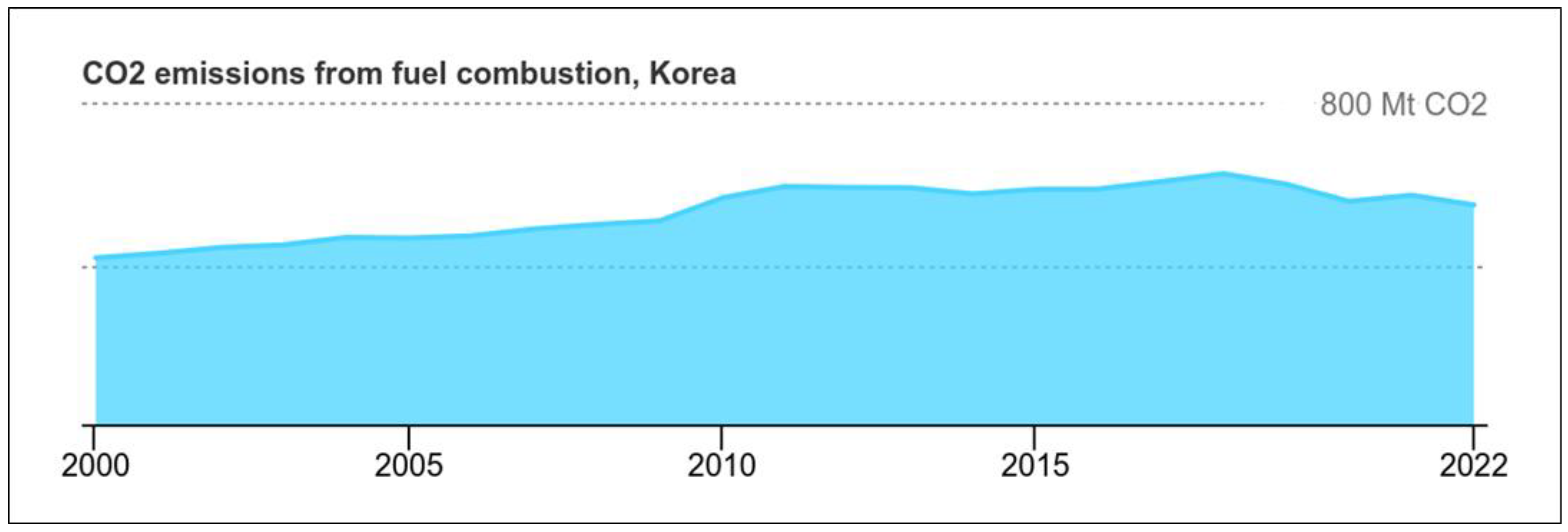
Overall, the Moon administration appears to have pursued a short-term, rapid transition rather than a long-term energy transition. As evidence, despite massive investments in expanding the renewable energy market, the infrastructure to utilize renewable energy was lacking, and carbon dioxide emissions from fuel combustion in 2021, the end of the term, were virtually unchanged from 2015, as shown in Figure 2, and Table 4 [87,88,89].
Some have argued that the Framework Act on Carbon Neutrality and Green Growth, enacted in September 2021 during the Moon’s term, did not specify carbon reduction targets beyond 2030 that the policy’s momentum was limited due to the lack of institutionalization and laws related to nuclear power plant decommissioning [89].
Ironically, the Moon administration excluded nuclear energy from the K-Taxonomy established in 2021, despite being aware of moves by the United States and the European Union to include nuclear energy in their Green Taxonomy. Then, as the next presidential election approached, President Moon’s sincerity about carbon neutrality was thrown into controversy when he said that nuclear power would be Korea’s main source of electricity for the next 60 years [90,91].

4.2. The Yoon Administration’s Declaration of Restoration of Nuclear Power

4.2.1. Yoon Government’s Repeal of Nuclear Phase-Out Policy and Changed Global Energy Landscape

The Yoon administration, aided by the conservative People Power Party and launched in May 2022, began pursuing policies in the energy sector that differed from those of the former Moon administration. President Yoon Seok-yeol, who served as Prosecutor General under the previous Moon administration but transferred to the conservative party, announced 110 key policy tasks, including the abandonment of the nuclear phase-out policy and CCUS technology development, through his presidency transition committee [64,71,72,73,82,92]. The rapidly changing domestic and international situation at the time greatly strengthened the Yoon administration’s argument for abandoning the nuclear phase-out policy. First, energy security began to surface in February 2022 due to Russia’s invasion of Ukraine, the US-China trade conflict, and the COVID-19 pandemic [93,94,95]. Notably, the EU Parliament decided to include nuclear power in the EU taxonomy in February 2022. This means that policies around the world, led by the EU, have shifted to once again increase the use of nuclear power as a means to achieve carbon neutrality by 2050. Furthermore, the EU can be seen as recognizing the need for nuclear power to reduce dependence on external energy sources and increase energy self-sufficiency to hedge against geopolitical risks such as a war between Russia and Ukraine [96,97].
Second, a discussion was formed among the president and government officials that the previous Moon administration’s hasty implementation of renewable energy policies had led to market confusion and that it would be difficult to achieve high-intensity carbon neutrality through renewable energy alone. Accordingly, the Yoon administration began to roll back its renewable energy policies focused on solar and wind power in earnest. It established a plan to reduce the share of solar power, which currently accounts for 87.13% of renewable energy sources, to 60% by 2030, and increase the share of wind power from the current 13% to 40% over the same period. In addition, it declared the expansion of nuclear power plants and promoted the construction of new Shin Hanul Units 3 and 4 [71,73,98]. President Yoon sought to make nuclear power a core driver of the national energy mix by actually resuming construction of nuclear power plants that had been suspended and by taking measures to ensure that reactors with expired operating licenses (10 units by 2030) continue to operate [60,71].

4.2.2. The Yoon Administration’s Reorganization of the Nuclear Ecosystem Without Public Discourse and the Activities of Nuclear Interest Groups

Since taking office, the Yoon administration has been promoting the restoration of the energy ecosystem centered on nuclear power. As part of this effort, the government increased the nuclear power-related policy budget by 1498% for 2023, while reducing the budget for renewable energy sources like solar and wind power by approximately 43% compared to the previous administration [99]. As a result, Korea ranked 5th in the world in terms of nuclear power generation capacity, with nuclear power accounting for 31.69% of its power generation as of 2024 [100,101]. However, like the Moon administration’s push for renewable energy, the nuclear energy issue has failed to secure a proper sphere for public discussion. In fact, the Yoon administration faced a double whammy: solar power faced the environmental and efficiency issues of wind power, coupled with persistent opposition from local residents (“Not in our neighborhood”), hindering the construction of additional nuclear power plants. Nevertheless, the president and regime actors failed to engage in a public discourse on the return to nuclear power beyond internal discussions, raising questions about the government’s ability to achieve its carbon neutrality goal [60,71].
Meanwhile, nuclear power, the core energy source of the Korean nuclear industry, has contributed significantly to maintaining a stable power supply and energy security for decades. Higher education institutions have also cultivated numerous elites. However, due to the expertise and complexity of nuclear technology, these elites have been criticized for forming interest groups that hinder political oversight and complicate nuclear power plant safety assessments. Even before the launch of the Yoon administration took office, competition among nuclear power-related interest groups, including those in industry, academia, and public institutions, to lobby the political establishment intensified. Considering these factors, it is possible that the nuclear power interest groups suppressed during the Moon administration significantly influenced the Yoon administration’s adoption of nuclear power restoration policies. From this view, the argument that the Yoon administration’s energy transition decisions are the result of bottom-up proposals from a small group of elites seems to be also noteworthy [102]. During the Yoon’s term, residents of nuclear power plant areas concentrated in the south and especially southwestern regions of the Korean Peninsula have strongly opposed the construction of additional nuclear power plants, citing concerns about the safety of nuclear waste disposal. This led to expectations that the Yoon administration would face difficulties physically expanding or replacing additional nuclear power plants.
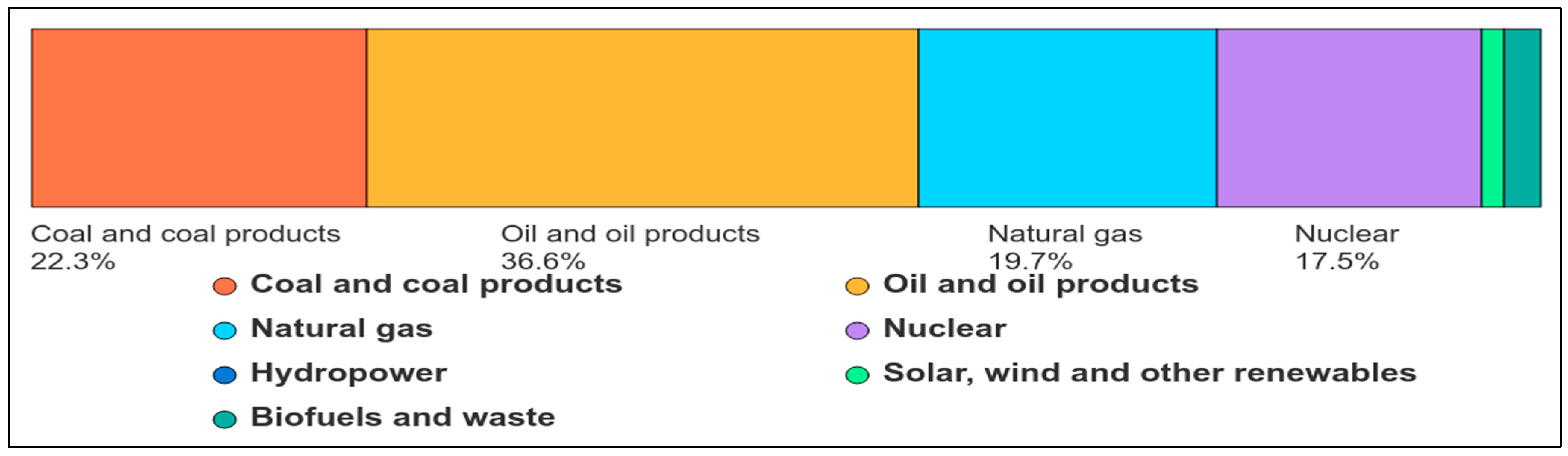
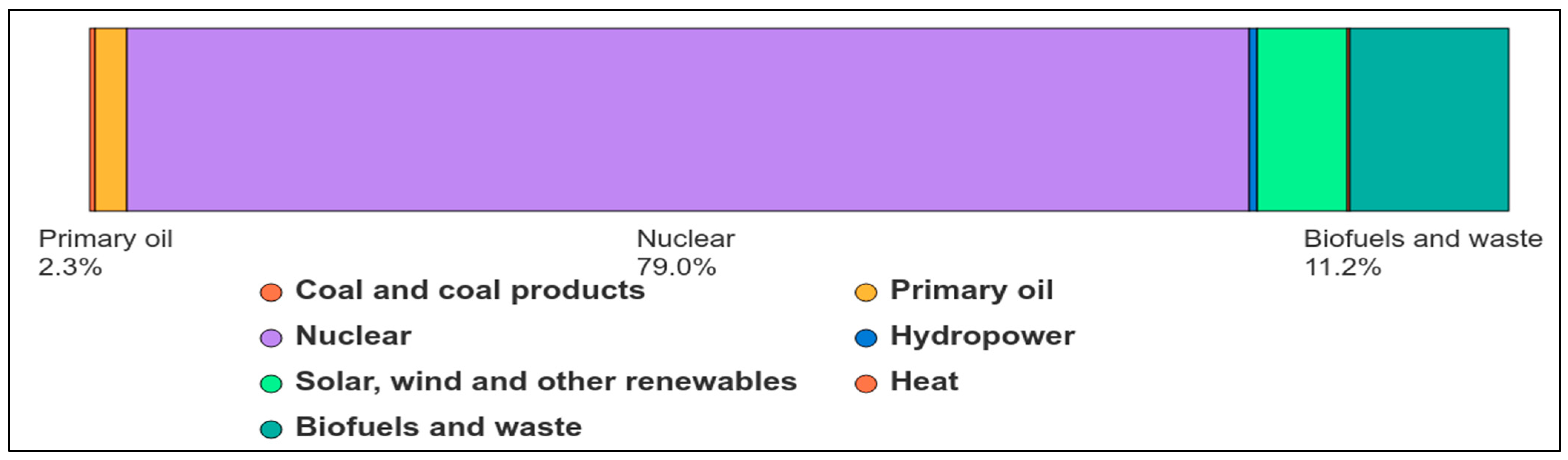
Recognizing these concerns, the Yoon administration and regime actors appear to have actively considered small-scale nuclear power plants, as described in Section 4.2.3, as an alternative to large-scale nuclear power plants, while aiming to strengthen nuclear power. Figure 3 shows that, as a result of the Yoon administration’s energy policy implementation, the share of renewable energy in the total energy supply (TES) has decreased, while the share of fossil fuels, including oil, coal, natural gas, and nuclear power, has increased. Furthermore, Figure 4 illustrates that nuclear power accounts for an overwhelming 79% of domestic energy production. In short, Figure 3 and Figure 4 demonstrate the Yoon administration’s commitment to actively utilizing nuclear power for efficiency and strategic purposes in the energy transition process, and the direction of the energy transition focuses on the gradual restructuring and systemic improvement of the existing fossil fuel system [103].

4.2.3. Pitfalls of the Nuclear Energy System Transition Based on Innovation in SMRs Technology

The Yoon administration established the first draft of the national plan for carbon neutrality in March 2023 in accordance with the enactment of the Framework Act on Carbon Neutrality and Green Growth to respond to the climate crisis (effective March 2022). Starting in August 2022, the government collected opinions from major actors, including a technical working group comprising experts from national research institutes, as well as industry officials, academia, cooperatives, organizations, and local governments [90,104].
CCUS, which the Moon administration touted as a key technology for achieving carbon neutrality but failed to commercialize due to the absence of relevant legislation, became available for technology development support with the enactment of the CCUS Act in January 2024 under the Yoon administration [105]. In contrast, in February of the same year, President Yoon announced plans to invest $3 billion in nuclear energy research and development (R&D) by 2027 and foster the SMRs industry, emphasizing the nuclear industry’s centrality in achieving Korea’s carbon neutrality goal by 2050. This was an official declaration of a move beyond the abandonment of nuclear phase-out policies and a commitment to an energy policy centered on nuclear power expansion [106]. Accordingly, in May 2024, a plan for technological development and demonstration promotion to secure next-generation nuclear energy was developed. Discussions began on revising existing nuclear energy-related laws and enacting a special SMRs law to support SMR development in earnest.
However, there was considerable opposition. SMRs developed in advanced countries over 40 years ago are small in scale and expensive compared to large-scale nuclear power plants for the same electricity production, resulting in little demand. While SMRs gained traction following the nuclear accident in Japan, their economic feasibility, particularly their safety, remained unproven. Continuously, questions have been raised about the appropriateness of expanding SMRs in Korea, a country with a small land area. Despite this, President Yoon did not hesitate to criticize the Moon administration’s nuclear phase-out policy as ideological and unscientific. Reversely, the Democratic Party of Korea and environmental groups argued that strengthening renewable energy would actually be a faster and safer way to boost South Korea’s industrial competitiveness and participate in the global climate crisis [71,107,108]. Furthermore, some experts have raised concerns about unfounded optimism, arguing that SMRs are not a “game changer” that will alter the direction of nuclear power generation. They also argued that it would be better to focus on developing them for export, as public acceptance of additional nuclear power plants is low and the Yoon administration’s goal of commercializing SMRs by 2028 is virtually impossible to achieve due to the short period of time [71].
Unfortunately, while conflicting views were expressed through the media during his term, there was no public discourse involving various stakeholders in order to resolve the conflict surrounding the transition to nuclear energy. Nevertheless, with SMRs emerging as an alternative to the surge in electricity demand driven by the expansion of artificial intelligence (AI) data centers, and Korea Hydro & Nuclear Power winning a 28 trillion won contract to build a nuclear power plant in the Czech Republic in July 2024, the potential for nuclear power to become a catalyst for the energy transition is only growing in Korea [109,110].

4.2.4. The Dilemma in a Nuclear-Centric Energy Regime Institutionalizing and the Unexpected Presidential Vacancy

The Ministry of Trade, Industry and Energy (MOTIE) announced the 10th Basic Plan for Electricity Supply and Demand in January 2023, which included plans to increase the share of nuclear power generation from 23.9% to 32.4% and adjust the share of renewable energy generation from 30.2% to 21.6% by 2030 [111,112,113]. However, unlike the plan to build a new transmission and distribution network for renewable energy by activating distributed generation, the announcement at the time was no specific mention of the small modular reactor project.
Then, in August 2023, the MOTIE announced that the budget for 2024 would be significantly expanded to support nuclear power generation. Key among these is the budget for the Electric Power Industry Infrastructure Development Project, which will be allocated to support nuclear power plants, increasing by more than 14 times from 8.9 billion won in 2024 to 142.1 billion won. Specific projects include KRW 11.2 billion (KRW 2.3 billion increase) for the Nuclear Ecosystem Support Project, KRW 100 million (net increase) for the SMR Manufacturing Support Center Construction Project, KRW 100 billion (net increase) for the Nuclear Ecosystem Financial Support Project, KRW 25 billion (net increase) for the Nuclear Power Plant Export Guarantee Project, and KRW 57.9 billion (net increase) for the Nuclear Power Plant Equipment and Materials Down payment Guarantee Insurance Support Project [98]. Meanwhile, the Ministry of Science and ICT and the MOTIE have decided to jointly pursue a technology development project to secure next-generation nuclear power plants from 2023 to 2028, based on the SMRs development plan announced by the Korea Atomic Energy Promotion Commission in 2020. Accordingly, the budget for the innovative small modular reactor (i-SMR) technology development project has been allocated to 33.3 billion won, a more than sevenfold increase from 3.9 billion won in 2022. The nuclear power plant budget, passed by the National Assembly on 21 December 2023, was 11.5188 trillion won, an increase of 445.2 billion won from the budget proposed by the Ministry of Trade, Industry and Energy, the lead ministry [113,114].
Since President Yoon first proposed the Carbon-Free Energy (CFE) Initiative at the UN General Assembly in September 2023, the government has sought to promote a transition to carbon-free energy, centered on nuclear power, which it believes has a comparative advantage over renewable energy in terms of carbon emissions. The CFE Initiative not only encompasses renewable energy sources but also various carbon-free energy sources, such as nuclear power, CCUS, as means of achieving carbon neutrality. To address the immediate priority of reducing greenhouse gases by 40% by 2030 compared to 2018 levels, the Yoon administration agreed that coal and oil power generation should be replaced with renewable energy and nuclear energy to meet the immediate challenge of reducing greenhouse gases by 40% by 2030 compared to 2018 levels, but in reality, it has accelerated the expansion of nuclear power. According to the International Energy Agency (IEA), nuclear power has the lowest greenhouse gas emissions among major power sources, while solar power emits more than five times more carbon than nuclear power [115]. As shown in Table 4, carbon emissions in 2021 actually increased compared to 2020, despite the Moon administration’s focus on reducing fossil fuel and nuclear power generation and expanding renewable energy. The fact that renewable energy generation entails greater carbon emissions than other energy sources can also be seen as influencing the Yoon administration to strengthen the existing nuclear power system [116].
In the 10 April 2024 general election, President Yoon’s ruling party failed to secure a majority in the National Assembly, losing to the progressive opposition Democratic Party of Korea. The opposition Democratic Party of Korea and its satellite parties secured a majority, suggesting that the Yoon administration’s nuclear energy restoration policy would was expected to face a difficult crossroads [117]. Even though the Yoon administration attempted to secure official support for the CFE from the IEA and build an international consensus, it collapsed before completing its term amidst a political crisis, and the CFE initiative was finally destined to be passed on to the next administration. The Yoon administration’s sudden resignation halted the nuclear-centric energy transition, and like the Moon administration, its hasty and unilateral decision to transition left Korea’s energy transition disoriented and in a dilemma. In short, the Yoon administration’s energy transition can be characterized by a return to nuclear energy, based on the economic feasibility of previous conservative administrations, and partial institutional reforms to promote nuclear technology innovation.

5. Discussion

5.1. The Moon Administration’s Pathway Type of Reconfiguration

The reconfiguration type of MLP framework is characterized by strong macroeconomic pressures, the symbiotic nature of niche technology markets with the existing system, the dominance of political logic, and limited institutional change. Accordingly, the results reveal that the Moon administration’s transition pathway falls into the reconfiguration type. The Moon administration attempted to force an energy transition amidst intense pressure from the global landscape and inadequate infrastructure to support the niche technologies that had developed over time. Moreover, despite the active cooperation between the president and political regime actors and stakeholders to expand renewable energy, institutional changes have been limited due to political logic.
(1)
Actors: President Moon, the government officials surrounding him, the Democratic Party of Korea, their supporters, environmental activists, and related organizations were key actors in this reconfiguration pathway type. They advocated for a nuclear phase-out and expanded renewable energy as tools for a rapid transition to a carbon-neutral society. The government’s shift to renewable energy has also led to conflicts between new market entrants and local residents and existing businesses. Unlike conservative governments in Korea who supported nuclear power and actively promoted the expansion of nuclear power plants, the Moon administration, as a progressive government, appears to have actively utilized the energy transition to differentiate itself from previous administrations that had been in power for the past decade. In particular, it shared environmental ideological values with stakeholders who had influence on regime formation as policy tools to achieve its goals. Relatively, the participation of stakeholders such as government ministries, academia, and interest groups related to nuclear power in the policy making was completely excluded.
(2)
Technologies: The Moon administration established a renewable energy transition roadmap centered on solar and wind power and employed various existing measures to promote technological advancement, including a mandatory supply system, a feed-in tariff system, promotion of solar power generation in rural areas and buildings, creation of an eco-friendly energy fund, and pilot projects for eco-friendly energy self-sufficient cities. As a result, niche markets for renewable energy have grown, but the market has become rather chaotic as small, unlicensed companies, in addition to a few large corporations, have entered the solar and wind energy business. Because the focus was on large-scale investment and expansion to achieve the goal rather than the development of renewable energy technology itself, the actual increase in renewable energy generation was minimal. Among renewable energy sources, the focus has been on solar and wind power technologies, while tidal, small hydro, and hydrogen energy technologies have received relatively less attention and development.
(3)
Rules and institutions: Despite its goal of eliminating nuclear power and expanding renewable energy through the 9th Basic Electricity Supply and Demand Plan, the Moon administration failed to enact relevant laws, delaying the expansion and modernization of power distribution and transmission infrastructure. Furthermore, a lack of cooperation from local governments and residents hindered the proper implementation of the national power grid expansion project, and the structural problems inherent in KEPCO’s monopoly on the power grid remained unresolved. Meanwhile, while the Framework Act on Carbon Neutrality and Green Growth was enacted, it did not specify carbon reduction targets beyond 2030, and there were no systems or laws related to nuclear power plant decommissioning. Legal systems for CCUS technology, a key technology for achieving carbon neutrality, were not established and were passed on to the next administration for processing. Even before the enactment of relevant laws, it presented a vision to seize new opportunities for change by establishing renewable energy transition goals and plans and forming and operating a committee, a move that appears to be a step ahead of the previous administrations.

5.2. The Yoon Administration’s Pathway Type of Transfomation

The transformation type of MLP framework is characterized by the reorganization of the existing system through coordination of existing actors, low-level macroeconomic pressures, underdeveloped niche innovation, the dominance of economic logic, and partial change. The results reveal that the Yoon administration’s pathway can be seen as a transfomation type. This is because, like previous conservative administrations, the Yoon administration pursued a systemic reorganizing centered on nuclear power. The global energy environment at the time was favorable for the coexistence of nuclear and renewable energy, so global macroeconomic pressures were minimal. Additionally, the Yoon administration sought to implement partial reforms of the existing system by adopting the development of SMRs as an economical alternative to large nuclear power plants.
(1)
Actors: President Yoon appears to have pursued a return to the nuclear-centric ecosystem of the previous conservative administrations. He flexibly responded to changing global landscape pressures, including the inclusion of nuclear energy in the EU taxonomy, and by emphasizing the inefficient nature of renewable energy, creating the internal pressure to return the energy system to the level it was before the Moon administration. Key players influencing the pathway to nuclear-centric energy transition at the time included President Yoon, the People Power Party, the nuclear industry, public institutions such as the Korea Hydro & Nuclear Power (KHNP), and academia and research institutes related to nuclear power. Most of these people felt oppressed by the Moon Jae-in administration because they supported nuclear energy.
(2)
Technologies: The Yoon administration was supposed to develop SMR technologies as a new niche innovation for low-carbon energy and attempted to restructure the existing energy system through partial changes. Early in his term, the Yoon administration emphasized balanced development of renewable energy and nuclear power to achieve carbon neutrality. However, by later prioritizing and promoting nuclear power and natural gas over renewable energy, it revealed technological lock-in to previous conservative administrations. It also expanded the power generation capacity of 25 nuclear power plants from 23% during the Moon administration in 2018 to 30.69% by 2024. In 2024, it increased the budget for small modular nuclear power plant technology development nine-fold compared to 2022, setting a goal of completing development by 2028, aiming to build a clean energy ecosystem centered on nuclear power. Conversely, the renewable energy niche market and related technology development, which had been revitalized under the Moon administration, were relegated to a lower priority. Instead, Yoon government sought to develop SMR technologies as a new niche innovation and attempted to improve the existing energy system through partial changes.
(3)
Rules and institutions: In the 10th Basic Plan for Electricity Supply and Demand, established in 2023, the Yoon administration decided to expand the share of nuclear power generation and reduce the share of renewable energy generation. This meant a partial energy transition centered on nuclear power, which has lower carbon emissions than renewable energy. The budget for power industry and infrastructure development projects to support nuclear power generation was significantly increased compared to the previous year. Furthermore, the Yoon administration actively pursued the development of innovative small sized reactor (SMR) technology, a next-generation nuclear power plant, over the next five years, and a special law on SMRs was proposed in the National Assembly. It first proposed the CFE Initiative to the international community and enacted the CCUS Act, but focused on the development of nuclear power throughout its term, and no new laws related to renewable energy were enacted during its term.

5.3. Comparative Analysis of Transition Pathway Types Across Two Administrations

While the two administrations shared the era-defining goal of carbon neutrality, their approaches to achieving it differed markedly, as Table 5 illustrates.

5.4. Implications for Korea’s Short-Term Energy Transition Case

In a multi-level perspective analytical framework, the energy transition goals of the Moon and the Yoon administrations can be summarized as expanding renewable energy and nuclear energy, respectively, but neither administration achieved the energy transition they had aimed for, and they pursued different energy transition pathways. So why did the two administrations pursue the contrasting energy transition pathways, and why did they fail to achieve their goals? As assumed in the Introduction, the answer turned out to lie in the differing socio-technical systems of the two administrations.
The findings provide detailed implications as follows: (1) Current lock-in of Korea’s energy transition stemmed from the two administrations’ conflicting socio-technical systems and their political strategies for differentiation from the previous administration. The differing attempts of energy transition of the Moon and the Yoon administrations were more strongly influenced by political regimes than by external pressures and the development of niche technology innovations, which are fundamental elements of the socio-technical system. For example, President Moon pushed for a transition to renewable energy to differentiate himself politically from former President Park, who was impeached and forced to resign during her term. Conversely, President Yoon seemed to have attempted to revive nuclear energy out of enduring animosity toward President Moon. Due to this politically driven system, Korea has rushed to implement its short-term energy transition, inevitably facing numerous challenges over the past decade. (2) Both administrations were so fixated on specific political ideologies that they neglected to build a social consensus that would ensure a sustainable energy transition, and they even failed to create a public discourse or public sphere. Actually, the Moon administration conducted public opinion polls to halt construction of existing nuclear power plants, but after deciding to resume construction, it made no further efforts to raise public discourse. Throughout its term, the Yoon administration unilaterally declared a return to nuclear power without public discourse and focused on issuing related strategies.
The findings of this paper thus far provide the lesson that while government policy and infrastructure support are essential for a sustainable energy transition, unilaterally transforming socio-technical systems for political purposes by political regime actors without the social capital of citizen participation is bound to fail. Accordingly, to overcome the confusion that has arisen during the energy transition over the past decade, it proposes that the Korean government, political leaders, and stakeholders establish a public sphere based on bipartisan cooperation, not partisan ideology, and establish a longer-term transition roadmap that ensures sustainable energy security for current and future generations.
The key point is that renewable energy and nuclear power are complementary, not competitive, in achieving a stable power supply and carbon neutrality. It underscores that developing an integrated strategy that combines renewable energy, including future innovative energy sources like solar, wind, and hydropower, with nuclear power is the starting point for achieving sustainable carbon neutrality.
In conclusion, energy transition is one of the core strategies for achieving carbon neutrality. Therefore, it is crucial to recognize that there is no single, fixed pathway to carbon neutrality. The Korea’s short-term transition case limited in that the transition was driven by political objectives and intentions, rather than socio-technical transitions. Trial and error are inevitable in any country’s journey to achieving carbon neutrality, so new pathways must be explored through continuous improvement and adjustment. Given the descriptive case study methodology employed in this research, the findings exhibit inherent limitations in terms of generalizability and value neutrality. Future investigations, incorporating more extensive empirical data and quantitative analyses, are anticipated to provide deeper insights.

Funding

This paper was supported by the Sahmyook University Research Fund in 2023.

Data Availability Statement

No new data were created or analyzed in this study.

Conflicts of Interest

The author declares no conflicts of interest.

References

  1. International Energy Agency (IEA). Energy System of Korea. Available online: https://www.iea.org/countries/korea/electricity (accessed on 20 March 2025).
  2. Institute of Energy Economics and Financial Analysis (IEEFA). Bottlenecks to Renewable Energy Integration in South Korea. Available online: https://ieefa.org/resources/bottlenecks-renewable-energy-integration-south-korea (accessed on 20 March 2025).
  3. WWF Korea. Renewable Energy Demand in South Korea: A 2030 Forecast and Policy Recommendations. Available online: https://www.wwfkorea.or.kr/data/file/english_report/1794572195_kxEYelX_94195b5095a108b71036e9c4c62f420beaf0d159.pdf (accessed on 5 May 2025).
  4. Renewable Energy Institute. South Korea: Low Renewable Energy Ambitions Result in High Nuclear and Fossil Power Dependencies. Available online: https://www.renewable-ei.org/en/activities/reports/20231114_kr.php (accessed on 24 March 2025).
  5. Foxon, T. Transition pathways for a UK low carbon electricity future. Energy Policy 2013, 52, 10–24. [Google Scholar] [CrossRef]
  6. Geels, F.W. From Sectoral systems of innovations to socio-technical systems: Insights about dynamics and change from sociology and institutional theory. Res. Policy 2004, 33, 897–920. [Google Scholar] [CrossRef]
  7. OECD. Managing Environmental and Energy Transitions for Regions and Cities. 2020. Available online: https://www.oecd.org/en/publications/managing-environmental-and-energy-transitions-for-regions-and-cities_f0c6621f-en.html (accessed on 4 April 2025).
  8. Böhringer, C.; Cantner, U.; Costard, J.; Kramkowski, L.V.; Gatzen, C.; Pietsch, S. Innovation for the German energy transition-Insights from an expert survey. Energy Policy 2020, 144, 111611. [Google Scholar] [CrossRef]
  9. Selje, T. Comparing the German exit of nuclear and coal: Assessing historical pathways and energy phase-out dimensions. Energy Res. Soc. Sci. 2022, 94, 102883. [Google Scholar] [CrossRef]
  10. Han, M.J.; Park, C.H. A study on the domestic implications of Germany’s energy transition law and policy trends for a sustainable society. Korean Environ. Law Assoc. 2022, 44, 209–245. [Google Scholar]
  11. Jin, S. Political Strife Undermines South Korea’s Nuclear Energy Policy Amid Demand Surge. Available online: https://biz.chosun.com/en/en-industry/2025/03/19/FVBCLMHGPFHXRFNZZLDSWQOAXI (accessed on 7 July 2025).
  12. Business Korea. The 11th Basic Plan for Electricity Supply Passes National Assembly Committee. Available online: https://www.businesskorea.co.kr/news/articleView.html?idxno=235782 (accessed on 20 June 2025).
  13. Kim, D.; Sun, H.; Kim, H. Public perception and VSC-HVDC power transmission adoption: Experiences and lessons learned from past cases. Energy Policy 2025, 202, 114574. [Google Scholar] [CrossRef]
  14. Son, I.S.; Kim, D.K. A Study on the Possibility of Improving Climate and Trade Polices to Respond to Carbon Border Adjustment. Korea Energy Economics Institute. Basic Research Report. Available online: https://www.keei.re.kr/board.es?mid=a20102000000&bid=0028&act=view&list_no=119371&nPage=6 (accessed on 22 August 2025).
  15. Park, H.; Park, H.J. Study on Korean SMEs Policies for the Carbon Border Adjustment Mechanism (CBAM). Available online: https://papers.ssrn.com/sol3/papers.cfm?abstract_id=4062023 (accessed on 22 August 2025).
  16. Institute for Energy Economics and Financial Analysis (IEEFA). South Korea’s 11th Power Plan Makes Partial Progress Towards Decarbonization. Available online: https://ieefa.org/resources/south-koreas-11th-power-plan-makes-partial-progress-towards-decarbonization (accessed on 31 May 2025).
  17. Friedrich Ebert Stiftung. South Korea Has Given Up on Energy Transition: Citizens Must Change The Energy Policy. Available online: https://asia.fes.de/news/south-korea-energy-transition.html (accessed on 29 June 2025).
  18. Ahn, S.H. Republic of Korea’s energy security conundrum: The problems of energy mix and energy diplomacy deadlock. In Power Struggles; Palgrave Macmillan: Singapore, 2022. [Google Scholar] [CrossRef]
  19. Han, J.K. The future of Korea’s energy transition: Exploring the pathways of transition on various scales. The Korean Association of Space And Environment Research. Space Environ. 2020, 30, 214–246. [Google Scholar]
  20. Choi, H.J. Recommendations for a New Energy Policy. Asan Inst. Policy Stud. 2022, 21. Available online: https://www.asaninst.org/data/file/s1_1_eng/f15af67c43af11afd7a990dc4f32fd2b_wzBp62Xv_01cec0bd436a4085f5a4ec09bb14dc62202a7dad.pdf (accessed on 27 June 2025).
  21. Kim, J.H.; Kim, H.J. Analysis on the Outcome of Energy Transition Policy and Further Direction. KEEI, Research Papers. 2021. Available online: https://www.keei.re.kr/board.es?mid=a20102000000&bid=0028&act=view&list_no=119353&cg_code=C01 (accessed on 30 June 2025).
  22. Lovins, A.B. Energy Strategy: The Road Not Taken? Foreign Aff. 1976, 55, 65. [Google Scholar] [CrossRef]
  23. Di Silvestre, M.L.; Favuzza, S.; Riva Sanseverino, E.; Zizzo, G. How decarbonization, digitalization and decentralization are changing key power infrastructure. Renew. Sustain. Energy Rev. 2018, 93, 483–498. [Google Scholar] [CrossRef]
  24. Neofytou, H.; Nikas, A.; Doukas, H. Sustainable energy transition readiness: A multi-criteria assessment index. Renew. Sustain. Energy Rev. 2020, 131, 109988. [Google Scholar] [CrossRef]
  25. Soutar, I. Dancing with complexity: Making sense of decarbonisation, decentralisation, digitalisation and democratization. Energy Res. Soc. Sci. 2021, 80, 102230. [Google Scholar] [CrossRef]
  26. Rosen, M.A. Energy Sustainability with a Focus on Environmental Perspectives. Earth Syst. Environ. 2021, 5, 217–230. [Google Scholar] [CrossRef]
  27. The Global Goals. Available online: https://www.globalgoals.org/goals/7-affordable-and-clean-energy/ (accessed on 10 June 2025).
  28. Sustainability Transitions Research Network. Available online: https://www.transitionsnetwork.org/ (accessed on 6 May 2025).
  29. Han, J.K. Analysis of the Concept of Energy Transition and Implications for Korean Energy Policy. Korea Energy Economics Institute. Energy Focus. 2018. Available online: https://www.keei.re.kr/keei/download/focus/ef1809/ef1809_60.pdf (accessed on 25 March 2025).
  30. Farla, J.; Markard, J.; Raven, R.; Lars, C. Sustainability transitions in the making: A closer look at actors, strategies and resources. Technol. Forecast. Soc. Chang. 2012, 79, 991–998. [Google Scholar] [CrossRef]
  31. Hansmeier, H.; Schiller, K.; Rogge, K.S. Towards methodological diversity in sustainability transitions research? Comparing recent developments (2016–2019) with the past (before 2016). Environ. Innov. Soc. Transit. 2021, 38, 169–174. [Google Scholar] [CrossRef]
  32. Garcia, C.A.; Savilaakso, S.; Verburg, R.W.; Gutierrez, V.; Wilson, S.J.; Krug, C.B.; Sassen, M.; Robinson, B.E.; Moersberger, H.; Naimi, B.; et al. The global forest transition as a human affair. One Earth 2020, 2, 417–428. [Google Scholar] [CrossRef]
  33. Stefes, C.H.; Hager, C. Resistance to Energy Transitions. Rev. Policy Res. 2020, 37, 286–291. [Google Scholar] [CrossRef]
  34. Stokes, L.C.; Breetz, H.L. Politics in the U.S. energy transition: Case studies of solar, wind, biofuels and electric vehicles policy. Energy Policy 2018, 113, 76–86. [Google Scholar] [CrossRef]
  35. Geels, F.W.; Schot, J. Typology of sociotechnical transition pathways. Research Policy 2007, 36, 399–417. [Google Scholar] [CrossRef]
  36. Geels, F.W. A socio-technical analysis of low-carbon transitions: Introducing the multi-level perspective into transport studies. J. Transp. Geogr. 2012, 24, 471–482. [Google Scholar] [CrossRef]
  37. Geels, F.W. The multi-level perspective on sustainability transitions: Responses to seven criticisms. Environ. Innov. Soc. Transit. 2011, 1, 24–40. [Google Scholar] [CrossRef]
  38. Geels, F.W. Regime Resistance against Low-Carbon Transitions: Introducing Politics and Power into the Multi-Level Perspective. Theory Cult. Soc. 2014, 32, 21–40. [Google Scholar] [CrossRef]
  39. Klitkoua, A.; Bolwig, B.S.; Hansen, T.; Wessberg, N. The role of lock-in mechanisms in transition processes: The case of energy for road transport. Environ. Innov. Soc. Transit. 2015, 16, 22–37. [Google Scholar] [CrossRef]
  40. Geels, F.W.; Kern, F.; Fuchs, G.; Hinderer, N.; Kungl, G.; Mylan, J.; Neukirch, M.; Wassermann, S. The enactment of socio-technical transition pathways: A reformulated typology and a comparative multi-level analysis of the German and UK low-carbon electricity transitions (1990–2014). Res. Policy 2016, 45, 896–913. [Google Scholar] [CrossRef]
  41. Zhang, H.; Zhang, X.; Yuan, J. Coal power in China: A multi-level perspective review. WIREs Energy Environ. 2020, 9, e386. Available online: https://wires.onlinelibrary.wiley.com/doi/full/10.1002/wene.386 (accessed on 3 May 2025). [CrossRef]
  42. Habermas, J. The Structural Transformation of the Public Sphere: An Inquiry Into a Category of Bourgeois Society; Burger, T., Translator; MIT Press: Cambridge, MA, USA, 1989. [Google Scholar]
  43. Laakso, S.; Eranti, V.; Lukkarinen, J. Practices and acts of energy citizenship. J. Environ. Policy Plan. 2023, 25, 690–702. [Google Scholar] [CrossRef]
  44. Sung, B.; Chen, H.; Park, S.D. Who Drives Policy Discourse of China’s Energy Transition: Considering Time Series Perspective, Network and Core-Peripheral Analysis. Sage Open 2024, 14, 21582440241240862. [Google Scholar] [CrossRef]
  45. Ha, Y.S.; Joo, J.H.; Kang, M.; Lah, T.J.; Jang, J. Social conflicts and policy-making in Korea: Interpretation of policy failures through a public discourse perspective. Int. Rev. Adm. Sci. 2009, 75, 649–664. [Google Scholar] [CrossRef]
  46. Heo, K.; Joseph, J. The traps and pitfalls of anticipatory governance: Comparative cases of South Korea and the United Kingdom. Futures 2025, 174, 103707. [Google Scholar] [CrossRef]
  47. East Asia Foundation. How to Address Sharply Rising Conflict in South Korea. EAF Policy Debates. 2019. Available online: https://www.keaf.org/en/book/EAF_Policy_Debates/How_to_Address_Sharply_Rising_Conflict_in_South_Korea (accessed on 10 July 2025).
  48. Hankyoreh. Tragedy in Miryang. Available online: https://english.hani.co.kr/arti/english_edition/e_national/614740.html (accessed on 10 November 2025).
  49. Chilvers, J.; Pallett, H. Energy democracies and publics in the making: A relational agenda for research and practice. Front. Commun. 2018, 3, 14. [Google Scholar] [CrossRef]
  50. Xuan, C. The Impact of Public Participation on Energy Policy: A Comparative Study. Int. J. Front. Sociol. 2023, 5, 1–7. [Google Scholar]
  51. Sarangi, S.K. Handbook of Pragmatics. Available online: https://benjamins.com/online/hop/articles/pub1 (accessed on 11 November 2025).
  52. McCombes, S. Descriptive Research. Scribbr. Available online: https://www.scribbr.com/methodology/descriptive-research/ (accessed on 11 May 2025).
  53. EBSCO. Descriptive Research. Available online: https://www.ebsco.com/research-starters/social-sciences-and-humanities/descriptive-research (accessed on 12 May 2025).
  54. Gregory, J.; Geels, F.W. Unfolding low-carbon reorientation in a declining industry: A contextual analysis of changing company strategies in UK oil refining (1990–2023). Energy Res. Soc. Sci. 2024, 107, 103345. [Google Scholar] [CrossRef]
  55. Geels, F.W. The Multi-Level Perspective on Sustainability Transitions: Background, overview, and current research topics. In Introduction to Sustainability Transitions Research, Chapter Book; Cambridge University Press: Cambridge, UK, 2024. [Google Scholar]
  56. Verbong, G.P.J.; Geels, F.W. Future electricity systems: Visions, scenarios and transition pathways. In Governing the Energy Transition: Reality, Illusion or Necessity? Routledge Studies in Sustainability Transitions; Verbong, G.P.J., Loorbach, D., Eds.; Routledge, Taylor & Francis Group: Abingdon, UK, 2012; Volume 4, pp. 203–219. [Google Scholar]
  57. Kim, H.W. Climate and Energy Policies of Korea: Current State and Challenges. Friedrich Ebert Stiftung. 2023. Available online: https://library.fes.de/pdf-files/bueros/seoul/20665.pdf (accessed on 23 May 2025).
  58. Green Growth Korea. National Green Growth Strategy and Five-Year Plan Milestones. Available online: http://17greengrowth.pa.go.kr/?page_id=42450#:~:text=The%20Korean%20government%20has%20created%20an%20institutional,Growth%20and%20Five%2DYear%20Plan%20for%20Green%20Growth (accessed on 3 June 2025).
  59. Lah, T.J.; Park, Y.; Cho, Y.J. The Four Major Rivers Restoration Project of South Korea. J. Environ. Dev. 2015, 24, 375–394. [Google Scholar] [CrossRef]
  60. The Gurdian. New South Korean President Vows to End Use of Nuclear Power. Available online: https://www.theguardian.com/world/2017/jun/19/new-south-korean-president-vows-to-end-use-of-nuclear-power (accessed on 15 June 2025).
  61. Heinrich-Böll-Stiftung. South Korea’s ‘Unstable’ Nuclear Energy Policy: From Lee Through Moon to Yoon Governments. Available online: https://kr.boell.org/en/2023/04/14/south-koreas-unstable-nuclear-energy-policy-lee-through-moon-yoon-governments (accessed on 25 April 2025).
  62. Korea Policy Briefing. Finalization and Announcement of the Third Basic Plan for Energy. Available online: https://www.korea.kr/briefing/pressReleaseView.do?newsId=156334773 (accessed on 3 June 2025).
  63. Korea Policy Briefing. Finalization and Announcement of the 9th Basic Plan for Electricity Supply and Demand (2020–2034). Available online: https://www.korea.kr/briefing/pressReleaseView.do?newsId=156429427 (accessed on 23 May 2025).
  64. Kyung Hyang Newspaper. Will Open an Age of Nuclear Phase-Out and Future Energy. Available online: https://www.khan.co.kr/article/201706201731097 (accessed on 16 May 2025).
  65. The Korea Times. Over 100,000 People Signed Up to Oppose the Nuclear Phase-Out Policy. Available online: https://www.koreaittimes.com/news/articleView.html?idxno=88206&replyAll=&reply_sc_order_by=C (accessed on 22 April 2025).
  66. Chung, S.Y.; Lee, G.E. South Korea’s Climate Change Policy: Achievements and Tasks Ahead. Korea’s Economy. 32. Available online: https://keia.org/publication/south-koreas-climate-change-policy-achievements-and-tasks-ahead/ (accessed on 15 March 2025).
  67. The Hankyoreh. Shin-Kori 5 & 6 Public Task Force Recommends Proceeding with Construction. Available online: https://english.hani.co.kr/arti/english_edition/e_national/815444.html (accessed on 20 March 2025).
  68. IPCC. Global Warming of 1.5 °C. Available online: https://www.ipcc.ch/sr15/ (accessed on 21 February 2025).
  69. Energy Storage Europe. Long Term Strategy for 2050: A Planet for All. Available online: https://energystorageeurope.eu/news/long-term-strategy-2050/ (accessed on 17 May 2025).
  70. Kim, M.H. Rethinking the Smart Green City Project in South Korea: A Critical Juncture Approach. Sustainability 2024, 16, 9864. [Google Scholar] [CrossRef]
  71. Choi, L. Nuclear vs. Renewable Energy and the Alternatives: Conundrum of the ROK’s Main Energy Policy. Korea Eur. Rev. 2025, 8. Available online: https://korea-europe-review.org/index.php/ker/article/download/61/66 (accessed on 11 September 2025).
  72. 2050 Carbon Neutrality and Green Growth Commission. Available online: http://webarchives.pa.go.kr/19th/www.2050cnc.go.kr/eng/contents/view?contentsNo=43&menuLevel=2&menuNo=50#:~:text=2030%20NDC(Nationally%20Determined%20Contribution)%202030%20NDC(2030%20Nationally,2030%2C%20compared%20to%20the%20levels%20in%202018 (accessed on 26 March 2025).
  73. Lee, J.Y. Government’s Commitment to Carbon Neutrality—Carbon Neutrality Framework Act, 2030 NDC, and Carbon Neutrality Scenarios. Available online: https://www.kimchang.com/en/insights/detail.kc?sch_section=4&idx=24319 (accessed on 4 April 2025).
  74. Hong, J.; Kim, J.; Son, W.; Shin, H.; Kim, N.; Lee, W.; Kim, J. Long-term energy strategy scenarios for South Korea: Transition to a sustainable energy system. Energy Policy 2019, 127, 425–437. [Google Scholar] [CrossRef]
  75. International Energy Agency (IEA). Korea Renewable Energy 3020 Plan. Available online: https://www.iea.org/policies/6569-korea-renewable-energy-3020-plan (accessed on 23 May 2025).
  76. Park, R.G.; Koo, M.G. South Korea’s Renewable Energy Policy: Coming Together or Drifting Apart? J. Int. Area Stud. 2018, 25, 61–85. [Google Scholar] [CrossRef]
  77. The Korea Bizwire. Moon Administration’s Renewable Energy Policy Lays Waste to Environment. Available online: http://koreabizwire.com/moon-administrations-renewable-energy-policy-lays-waste-to-environment/183458 (accessed on 21 May 2025).
  78. Energy Transition. Why are Farmers Against Solar Panels in Korea? Available online: https://energytransition.org/2022/01/why-are-farmers-against-solar-panels-in-korea/ (accessed on 1 June 2025).
  79. Foreign Policy Focus. South Korea’s Green New Deal: Myths versus Realities. Available online: https://fpif.org/south-koreas-green-new-deal-myths-versus-realities/ (accessed on 10 June 2025).
  80. Lee, S.J.; Ahn, D.H.; Kim, H.S.; Shin, S.H.; Lee, W.S. Analysis of Conflict Factors and Research on Solutions for Renewable Energy Supply Projects in Rural Areas. KEEI. 2020. Available online: https://www.keei.re.kr/pdfOpen.es?bid=0001&list_no=82061&seq=1 (accessed on 12 June 2025).
  81. K-CCUS Association. Available online: https://kccus.kr/theme/rsp01/sub/intro/outline_en.php (accessed on 9 July 2025).
  82. The Asia Business Daily. Launch of a Carbon Dioxide Capture, Utilization, and Storage (CCUS) Task Force. Available online: https://cm.asiae.co.kr/en/article/2021040708295208380 (accessed on 10 June 2025).
  83. Lee, Y.J.; Choe, G. The National Assembly Enacts Act on the Capture, Transportation, Storage and Utilization of Carbon Dioxide. Available online: https://www.kimchang.com/en/insights/detail.kc?sch_section=4&idx=29115 (accessed on 10 June 2025).
  84. Kwon, C.S. MOTIE Rings in New Year with Long-Awaited Long-Term Energy Plans. Available online: https://www.kimchang.com/en/insights/detail.kc?sch_section=4&idx=22940 (accessed on 2 July 2025).
  85. Korea.net. Private Sector-Led Carbon Neutrality Innovation: Launch of the “Carbon Capture and Utilization (CCU) Initiative”. Available online: https://www.korea.net/Government/Briefing-Room/Press-Releases/view?articleId=7969&type=O&insttCode=A110439 (accessed on 10 July 2025).
  86. Korea Energy Economics Institute. Ratio of Renewable Energy-Based Power Generation Hits New High in 2021. Available online: https://www.keei.re.kr/board.es?mid=a20302000000&bid=0031&act=view&list_no=121144 (accessed on 20 May 2025).
  87. International Energy Agency. South Korea’s Total CO2 Emissions from Energy. Available online: https://www.iea.org/countries/korea/emissions (accessed on 2 August 2025).
  88. International Renewable Energy Agency (IRENA). Republic of Korea 2024. Energy Profile. Available online: https://www.irena.org/-/media/Files/IRENA/Agency/Statistics/Statistical_Profiles/Asia/Republic-of-Korea_Asia_RE_SP.pdf (accessed on 27 July 2025).
  89. The Korea Times. Korea’s Carbon Reduction Law Does Not Conform With Constitution: Court. Available online: https://www.koreatimes.co.kr/southkorea/law-crime/20240829/koreas-carbon-reduction-law-does-not-conform-with-constitution-court (accessed on 3 August 2025).
  90. Business Korea. South Korean Government Against Global Trend as to Nuclear Power Generation. Available online: https://www.businesskorea.co.kr/news/articleView.html?idxno=67373 (accessed on 30 August 2025).
  91. Yonhap News Agency. Moon Calls Nuclear Power Main Source of Electricity Over Next 60 Years. Available online: https://en.yna.co.kr/view/AEN20220225009700315 (accessed on 7 September 2025).
  92. InvestKOREA. Key Policy Tasks Under President Yoon Suk-Yeol. Available online: https://www.investkorea.org/upload/kotraexpress/2022/06/images/Special_Report.pdf (accessed on 5 September 2025).
  93. Cui, L.; Yue, S.; Nghiem, X.; Duan, M. Exploring the risk and economic vulnerability of global energy supply chain interruption in the context of Russo-Ukrainian war. Resour. Policy 2023, 81, 103373. [Google Scholar] [CrossRef]
  94. Kim, Y.J.; Min, K.; Cho, S.H. Energy transitions post–Russia–Ukraine war: Challenges and policy implications in Germany and Italy. Electr. J. 2025, 38, 107518. [Google Scholar] [CrossRef]
  95. Zeler, I.; Rodriguez-Amat, J.R.; Amir, R.M. A computational analysis of the media coverage of the European Parliament’s ‘green’ designation on sustainable energy and climate change. Energy Policy 2025, 202, 114592. [Google Scholar] [CrossRef]
  96. Elsner, C. Shifting discussions to the supranational level: A narrative discourse analysis on nuclear energy sustainability and the EU Taxonomy. Energy Sustain. Soc. 2024, 14, 69. [Google Scholar] [CrossRef]
  97. CNBC. Europe Will Count Natural Gas and Nuclear as Green Energy in Some Circumstances. Available online: https://www.cnbc.com/2022/07/06/europe-natural-gas-nuclear-are-green-energy-in-some-circumstances-.html (accessed on 10 September 2025).
  98. Korea JoongAng Daily. Yoon Tries Canceling Moon’s Renewable Energy Policies. Available online: https://koreajoongangdaily.joins.com/2022/11/03/business/economy/Yoon-Sukyeol-renewable-Solar-energy-WInd-power/20221103155302720.html (accessed on 11 September 2025).
  99. E2News. The Yoon Administration Increased the Nuclear Power Budget by 1498% and Cut Renewable Energy by 43%. Available online: https://www.e2news.com/news/articleView.html?idxno=301592 (accessed on 15 September 2025).
  100. IEA. In Operation & Suspended Operation. Available online: https://pris.iaea.org/pris/worldstatistics/operationalreactorsbycountry.aspx (accessed on 12 September 2025).
  101. KNHP. General Status. Available online: https://www.khnp.co.kr/main/contents.do?key=61 (accessed on 13 September 2025).
  102. Choi, L.; Kim, Y.J. Comparative Research on Nuclear Energy Policies in the Republic of Korea and Germany: The Influence of Demographic Factors, Local Acceptance, and Geopolitical Factors. J. Int. Politics 2023, 29, 169–203. [Google Scholar] [CrossRef]
  103. International Energy Agency. South Korea’s Energy Supply. Available online: https://www.iea.org/countries/korea/energy-mix (accessed on 29 September 2025).
  104. Ministry of Environment. The Yoon Administration’s Blueprint for Achieving Carbon Neutrality and Green Growth Revealed. Press Release. Available online: https://m.me.go.kr/eng/web/board/read.do?pagerOffset=0&maxPageItems=10&maxIndexPages=10&searchKey=titleOrContent&searchValue=methane&menuId=461&orgCd=&boardMasterId=522&boardCategoryId=&boardId=1591210&decorator= (accessed on 26 September 2025).
  105. Lexology. Enactment of the Carbon Dioxide Capture, Utilization and Storage Act. Available online: https://www.lexology.com/library/detail.aspx?g=8af6d8c4-f722-4d52-aad3-247876913016 (accessed on 26 September 2025).
  106. The Korea Economic Daily. South Korea to Up the Ante on Small Modular Reactor Foundry Business. Available online: https://www.kedglobal.com/energy/newsView/ked202402220016 (accessed on 27 September 2025).
  107. Egreen News. RE100: Korea is the Country with the Most Difficulty Procuring Renewable Energy. Available online: https://m.egreen-news.com/14525 (accessed on 28 September 2025).
  108. Segye Ilbo. Low Accident Risk and Low Cost vs. Economic Feasibility and Nuclear Power Aversion Issues. Available online: https://www.segye.com/newsView/20211209520872 (accessed on 28 September 2025).
  109. Data Center Knowledge. South Korea Eyes More Nuclear, Renewable Power as Data Center Demand Surges. Available online: https://www.datacenterknowledge.com/energy-power-supply/south-korea-eyes-more-nuclear-renewable-power-as-data-center-demand-surges (accessed on 1 October 2025).
  110. World Nuclear News. KNHP Selected to Supply New Czech New Units. Available online: https://www.world-nuclear-news.org/articles/khnp-selected-to-supply-new-czech-nuclear-units (accessed on 2 October 2025).
  111. Ministry of Trade, Industry and Energy (MOTIE). The 10th Basic Electricity Supply and Demand Plan (2022–2036). Available online: https://www.korea.kr/briefing/pressReleaseView.do?newsId=156547521 (accessed on 2 October 2025).
  112. Korea Energy Statistics Information System (KESIS). Key Contents of the 10th Basic Electricity Supply and Demand Plan. Available online: https://kesis.keei.re.kr/board.es?mid=a10306000000&bid=0060&act=view&list_no=1888&tag=&nPage=1 (accessed on 3 June 2025).
  113. DongA Science. South Korean Government to Announce Next-Generation Nuclear Energy Plan, Including SMRs, in Early June. Available online: https://www.dongascience.com/en/news/65458 (accessed on 8 July 2025).
  114. Asia Business Daily. Increase Nuclear Power Support Budget by Over 30%. Ministry of Industry Confirms Next Year’s Budget at 11.5188 Trillion Won. Available online: https://cm.asiae.co.kr/en/article/2023122117465328749 (accessed on 7 July 2025).
  115. IEA. Nuclear Power in a Clean Energy System. Available online: https://www.iea.org/reports/nuclear-power-in-a-clean-energy-system (accessed on 8 July 2025).
  116. Maeil Business Newspaper. Decarbonization Limit by Renewable Energy Alone and Expand Nuclear Power to Overcome AI Power Shortage. Available online: https://www.mk.co.kr/en/economy/11108821 (accessed on 11 October 2025).
  117. The Korea Times. Yoon Apologizes for Failing to Heed People’s will Following Election Defeat. Available online: https://www.koreatimes.co.kr/southkorea/society/20240416/south-korean-president-yoon-suk-yeolapologizes-for-failing-to-reflect-peoples-will-after-election-defeat (accessed on 26 June 2025).
Figure 1. Research flowchart of Korea’s recent energy transition process.
Energies 19 01037 g001
Figure 2. CO2 emissions from fuel combustion, Korea. Source: IEA. Korea (2023) [87].
Energies 19 01037 g002
Figure 3. Total energy supply. Source: IEA. Korea (2024) [103].
Energies 19 01037 g003
Figure 4. Domestic energy production, Korea, 2024. Source: IEA. Korea (2024) [103].
Energies 19 01037 g004
Table 1. Five targets on energy in UNSDG 7 [27].
Target 1By 2030, ensure universal access to affordable, reliable and modern energy services
Target 2Double the global share of renewable energy by 2030
Target 3Double the global rate of improvement in energy efficiency
Target 4Enhanced international cooperation and promote investment in clean energy technology
Target 5Expand and upgrade energy services for developing countries
Table 2. Reformulated transition pathways as an analytical framework.
Transition Pathway TypeActorsTechnologiesRules and Institution
Substitution typeNew firms struggle against incumbent firms, leading to overthrow
Different kinds of ‘new entrants’ (e.g., citizens, communities, social movement actors, incumbents from different sectors) replace incumbents
Radical innovation(s) substituting existing tecnhnologyLimited institutional change, implying that niche-innovation needs to compete in existing selection environment (‘fit-and-conform’) (‘Incremental adjustment’, ‘Layering’)
Creation of new rules and institutions to suit the niche-innovation (‘stretch-and-transform’) (‘Disruption’. ‘Displacement’)
Transformation typeIncumbents reorient incrementally by adjusting search routines and procedures
Incumbents reorient substantially, to radically anew technology or, even more deeply, to new belief, mission, and business model
Incremental improvement in existing performance (leading to major performance enhancement over long time period)
Incorporation of symbiotic niche-innovations and add-ons (competent-adding, creative accumulation)
Reorienation towards new technologies: (a) partial reorientation(diversification) with incumbents developing both old and new technologies, (b) full reorientation, leading to technical substitution
Limited institutional change (‘Layering’)
Substantial change in institutions (‘Conversion’, ‘Displacement’)
Reconfiguration typeNew alliances between incumbents and new entrantsFrom initial add-ons to new combination between new and existing technologies: knock-on effects and innovation cascades that change system architectureFrom limited insitutional change (‘Layering’) to more substantial change including operational principles (‘Drift’, ‘Conversion’)
De-alignment and re-alignment typeIncumbents collapse because of landscape pressure, creaing opportunites for new entrantsDecline of old technologies creates space for several innovations which compete with one anotherInstitutions are disrupted by shocks and replaced, possibly after prolonged uncertainty (‘Disruption’)
Source: Geels, F. W. et al. (2016) [40].
Table 3. Enhanced 2030 NDC.
TypeSectorBase Year
(2018)
Current NDC
(Reduction from 2018)
Enhanced 2030 NDC
(Reduction from 2018)
Emission Amount727.6536.1 (∆191.5, ∆26.3%)436.6 (∆291.0, ∆40.0%)
EmissionsEnergy Transformation269.6192.7 (∆28.5%)149.9 (∆4.4%)
Industries260.5243.8 (∆6.4%)226.6 (∆14.5%)
Buildings52.141.9 (∆19.5%)35.0 (∆32.8%)
Transport98.170.6 (∆28.1%)61.0 (∆37.8%)
Agriculture, Livestock, and Fisheries24.719.4 (∆21.6%)18.0 (∆27.1%)
Waste17.111.0 (∆35.6%)9.1 (∆46.8%)
Hydrogen--7.6
Others (Omissions, etc.)5.65.23.9
Absorption and RemovalCarbon Sinks−41.3−22.1−26.7
CCUS-−10.3−10.3
Overseas Reduction-−16.2−33.5
Total 436.6 (∆40%)
Source: 2050 Carbon Neutrality and Green Growth Commission [72].
Table 4. CO2 emissions from fuel combustion, Korea.
YearDetailsUnit
2015588.564Mt CO2
2016590.904Mt CO2
2017612.993Mt CO2
2018635.852Mt CO2
2019608.720Mt CO2
2020565.832Mt CO2
2021588.779Mt CO2
2022570.315Mt CO2
Source: IEA. Korea (2023) [73].
Table 5. Comparative results using the multi-level perspective analytical framework.
The Moon AdministrationThe Yoon Administration
Actors
·
President Moon and his progressive party with their supporters
·
Governmental officials
·
Environmental activists and related organizations
·
New niche market entrants and existing players related to renewable energy
·
President Yoon and his conservative party with their supporters
·
Existing nuclear industries
·
Public institutions such as the Korea Hydro & Nuclear Power (KHNP)
·
Academia and research institutes related to nuclear power.
Technologies
·
Development of solar, wind power centric technologies
·
Insufficient power grid technology and infrastructure for the transmission and distribution of renewable energy
·
Expanding the markets of renewable energy
·
A surge in R&D investment in small-scale nuclear reactor (SMR) technology, driven since mid-term of office
·
Inadequate development of renewable energy-related technologies
·
Nuclear power generation technology exports
Rules/Institutions
·
Renewable energy first and nuclear phase-out in the 9th Basic Electricity Supply and Demand Plan
·
Revision of laws related to renewable energy generation
·
Lack of progress in expanding the national power grid for renewable energy and the issue of KEPCO’s power grid monopoly
·
Enactment of the Framework Act on Carbon Neutrality and Green Growth and failure to set carbon reduction targets beyond 2030.
·
Absence of legislation related to nuclear power plant decommissioning.
·
Lack of legislation to promote CCUS technology.
·
Lack of public discourse on energy transition
·
Nuclear power first in the 10th Basic Electricity Supply and Demand Plan
·
System restructuring initiative for a nuclear-centric energy transition
·
Major funding in SMR R&D starting during the term
·
Establishment of CCUS act
·
CFE initiative proposed to the international society
·
Special Act on SMRs proposed in the National Assembly
·
No new basic laws related to renewable energy
·
No public discourse on energy transition
PathwayReconfiguration typeTransformation type
Disclaimer/Publisher’s Note: The statements, opinions and data contained in all publications are solely those of the individual author(s) and contributor(s) and not of MDPI and/or the editor(s). MDPI and/or the editor(s) disclaim responsibility for any injury to people or property resulting from any ideas, methods, instructions or products referred to in the content.