


Abstract
The increasing adoption of high-power residential appliances and electric vehicles has significantly increased household electricity demand, leading to higher peak loads, increased electricity costs, and greater stress on distribution networks. Although Time-of-Use (TOU) pricing encourages consumers to shift electricity consumption to off-peak periods, practical implementation remains limited due to the lack of integrated, real-time residential load management systems. This paper presents the design, implementation, and experimental validation of a Smart Load Management System (SLMS) for residential energy management. The proposed system integrates current transformer (CT)-based sensing, isolated voltage measurement, an MSP430-based data acquisition unit, a Raspberry Pi supervisory controller, relay-based load control, and a Node-RED monitoring dashboard within a scalable panel-level architecture. Household appliances are classified into critical, essential, and non-essential categories, and a deterministic TOU-based control algorithm automatically schedules load according to electricity pricing while maintaining user comfort. Experimental evaluation demonstrates reliable real-time monitoring, stable SPI-based communication, and automated load switching with a response time of less than one second. A residential case study based on Hydro One winter TOU tariffs estimates that applying the proposed SLMS scheduling strategy to a representative household profile could reduce peak demand from 16.75 kW to 9.9 kW (approximately 41%) while maintaining the daily energy consumption of 87.1 kWh. Furthermore, intelligent load scheduling decreases daily electricity cost by approximately 35%, corresponding to monthly savings of about $143. The results demonstrate that the proposed SLMS provides a practical, scalable, and cost-effective solution for residential demand-side management, enabling significant peak demand reduction and electricity cost savings through intelligent TOU-based load scheduling.
1. Introduction and Literature Review
Rising residential electricity demand driven by electric heating, high-power appliances, and emerging loads such as electric vehicle charging has increased peak demand and stressed distribution networks. Utilities have adopted Time-of-Use (TOU) and other dynamic tariffs to shift consumption away from peak periods, but the effectiveness of these tariffs is often limited by the absence of practical tools that give consumers detailed, real-time feedback. Home Energy Management Systems (HEMS) and Smart Load Management Systems (SLMS) have emerged to address these issues through monitoring, data analytics, and automated load scheduling. However, existing solutions exhibit one or more limitations: (i) they provide only aggregate monitoring without direct control, (ii) they rely on per-appliance smart plugs, which scale poorly, (iii) they use cloud-centric architectures that raise concerns about reliability and privacy, and (iv) they focus on algorithmic scheduling with limited attention to hardware implementation and panel-level scalability. There is thus a clear need for cost-effective, locally controlled, panel-integrated systems that can monitor individual circuits, enforce priority-based TOU control, and remain scalable to a full home while maintaining acceptable installation complexity. This project responds to this need by developing a Smart Load Management System (SLMS) that integrates real-time circuit-level metering, load classification into priority levels, and automated TOU-aware control in a modular architecture built around a microcontroller, a Raspberry Pi, CT-based sensing, and relay switching. This literature review situates such a system within current research, identifies prior work on priority-based TOU scheduling and intelligent HEMS, and clarifies the specific gap addressed: a locally controlled, scalable, panel-based residential SLMS that unifies accurate monitoring with practical, priority-based load and TOU scheduling.
Time-of-Use (TOU) and priority-based demand-side management (DSM) have been investigated as core mechanisms for residential Home Energy Management Systems (HEMS) [1,2]. Numerous studies formulate appliance scheduling under TOU tariffs and user-defined priorities, demonstrating that shifting flexible loads to off-peak periods can reduce both electricity cost and peak demand [3,4,5]. Priority-aware schemes such as pre-emptive load schedulers (e.g., PEPLS) and in-home energy management (iHEM) frameworks classify appliances into critical and deferrable categories and apply TOU-based control or queuing logic to neglect low-priority loads during expensive or capacity-constrained intervals [6,7]. More recent work introduces dynamic load-priority strategies and multi-objective optimization, employing wind-driven optimization, particle swarm optimization, and evolutionary algorithms with transfer learning to jointly minimize cost, peak-to-average ratio, and user discomfort, often in conjunction with rooftop PV [8]. Related microgrid-focused contributions extend these ideas to hybrid renewable buildings and community-level HEMS, using dynamic pricing and clustering to coordinate local generation, storage, and loads [9,10]. A common limitation across this body of work is that evaluation is almost exclusively carried out in simulation with idealized appliances and network models, while the underlying sensing, actuation, and panel-level integration required to enforce these schedules in real homes remains largely unspecified [11,12].
Parallel research on IoT-based monitoring and load control has demonstrated that low-cost embedded platforms can provide accurate, real-time visibility of residential electricity use [13,14]. Custom smart meters and centralized monitoring systems based on Arduino, ESP32, and modules such as PZEM-004T or ACS712 achieve measurement errors on the order of 1–2% and support circuit or appliance-level monitoring with web or mobile dashboards [14,15]. Several prototypes couple these sensing capabilities with relay-based switching to implement basic load management for a limited number of channels, reporting energy savings of 10–12% in residential or small commercial case studies [16,17,18]. Cloud-connected architectures built on platforms such as ThingSpeak, Adafruit IO, and mobile applications provide remote visualization and control, enabling users to monitor consumption and toggle loads via smartphones [19,20,21]. These works clearly validate that inexpensive IoT hardware can deliver appliance-level monitoring and elementary load control in practice [14,16]. However, most of these systems are constrained to small channel counts, depend heavily on cloud connectivity, and do not scale to full breaker-panel integration with structured TOU-based and priority-based control, nor do they systematically address isolation, overcurrent protection, and wiring constraints required for safe residential deployment [13,14,17,18].
A third strand focuses on microgrids, DC, and rule-based energy management. Microgrid EMS designs employ fuzzy logic and rule-based controllers to coordinate PV, battery storage, and aggregated residential loads, maintaining power-quality constraints while improving utilization and cost performance [22]. Prototype DC microgrids implement priority-based load categories (e.g., essential, secondary, tertiary) on microcontrollers such as ESP32 [23], shedding lower-priority DC loads when battery voltage drops to preserve critical services [24]. Post-disaster HEMS frameworks combine mixed-integer linear programming with synthetic load models to prioritize critical appliances, particularly HVAC under severely constrained solar-plus-storage resources, maintaining indoor comfort within specified temperature bands. These contributions underline the value of explicit load prioritization under constrained supply and resilience-oriented scenarios [25]. Nevertheless, they are typically evaluated on small testbeds or non-standard DC architectures and do not directly tackle scalable, code-compliant integration with AC distribution panels in conventional single-family homes [22,23].
Complementing these technical works, a series of reviews and surveys maps the conceptual and methodological landscape of smart home energy management. Early survey articles define smart home EMS concepts, configurations, and scheduling strategies, emphasizing the potential for cost and peak reduction via appliance-level control under tariff signals [26,27]. More recent reviews of IoT-based energy management and smart home platforms discuss architecture, communication technologies, and optimization methods, while highlighting critical challenges such as interoperability, cybersecurity, and user engagement [28,29,30]. AI-focused reviews and state-of-the-art surveys catalogue machine learning, deep learning, and deep reinforcement learning techniques for HEMS [31]. They show that advanced agents can optimize HVAC, lighting, and flexible loads with substantial cost reductions and maintained comfort, particularly when combined with forecasted prices or renewable generation [32,33]. Across these reviews, a recurring observation is that data privacy, computational requirements, and real-time implementation on constrained embedded hardware remain major barriers [34].
The Smart Load Management System (SLMS) proposed in this paper is positioned as a hardware-complete, panel-level residential platform that addresses precisely the missing physical layer assumed in much of the existing literature. The SLMS integrates CT-based current measurement on multiple circuits with an isolated voltage sensing module and a multi-channel Sigma–delta ADC on an MSP430 acquisition controller, enabling per-load and aggregate RMS and real power calculations while explicitly meeting galvanic isolation, creepage/clearance, and filtering requirements suitable for residential panels. At the control layer, a Raspberry Pi serves as a supervisory controller, ingesting measurement data over SPI, applying TOU-aware control based on an actual Hydro One tariff structure, and enforcing user-defined load classes (critical, essential, non-essential) via a multi-channel relay driver. This architecture realizes the priority- and TOU-based scheduling concepts developed in simulation studies within a real embedded system, considering relay wear, switching sequences, response times, and local state management [1,5,7,14,23].
Table 1 summarizes the shortcomings of the conventional work that were overcome by the proposed work.
Table 1.
Comparative Summary of Studies Relevant to Our Research.
2. Methodology
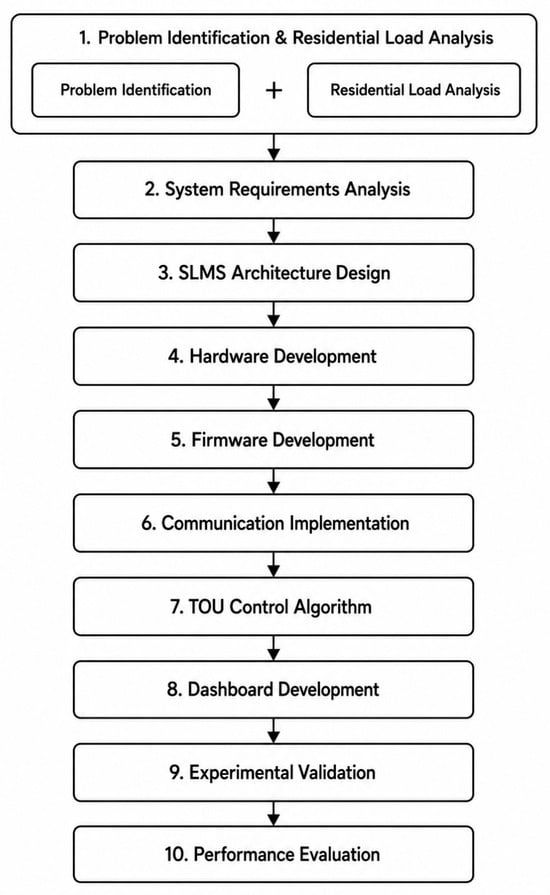
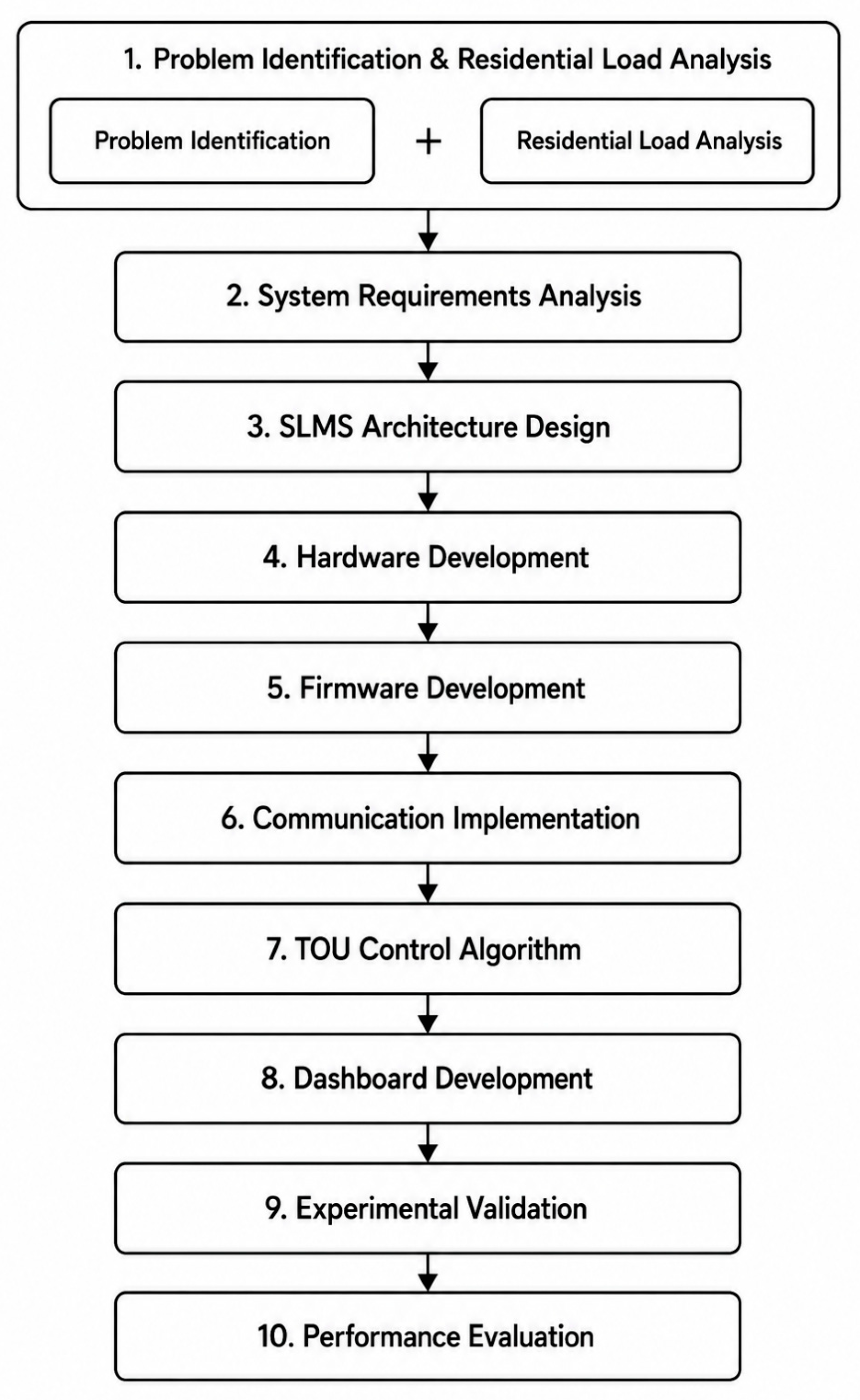
The methodology adopted in this work involved the design, development, and validation of a Smart Load Management System (SLMS) for residential energy management. The research began with a detailed analysis of residential load characteristics, followed by load classification based on operational priority and flexibility. System requirements were then established to support real-time monitoring, Time-of-Use (TOU)-based control, local processing, and user interaction. Hardware and software components were subsequently integrated and evaluated through experimental testing to verify system functionality, communication performance, load control capability, and user-interface operation. Figure 1 shows the flow diagram of the methodology, which presents the sequential methodology followed in this study, starting from problem identification and system requirement analysis through hardware and software development, TOU algorithm implementation, experimental validation, and final performance evaluation.
Figure 1.
Flow diagram of Methodology.
2.1. Problem Identification and Residential Load Analysis
Conventional residential power systems provide limited real-time monitoring and automated load management, making them inefficient under increasing household electricity demand. Consequently, they contribute to higher peak loads, increased electricity costs, and greater stress on the power distribution network.
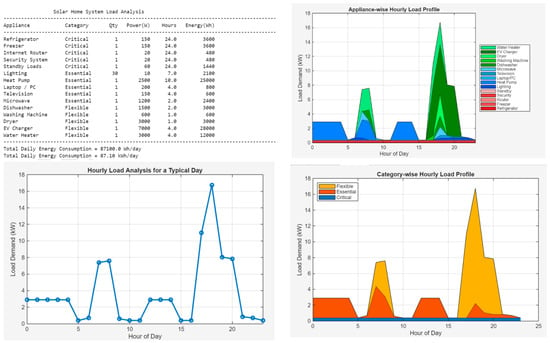
To address these issues, a structured residential load analysis was conducted to characterize typical household electrical loads based on their power ratings, duty cycles, and usage patterns. Loads were systematically classified into three categories, critical, essential, and non-essential, according to their operational priority and flexibility for demand-side control. Critical loads require uninterrupted operation, while essential and non-essential loads allow controlled scheduling and temporal shifting without significant impact on user comfort or functionality. The analysis further evaluated daily consumption profiles and load controllability to identify candidates suitable for automated demand response and Time-of-Use (TOU) optimization. The outcomes of this assessment establish the basis for defining system requirements and implementing a Smart Load Management System (SLMS) aimed at peak load reduction, cost optimization, and improved residential energy utilization efficiency. The hourly load profile, in Figure 2, demonstrates the relationship between individual appliance operation and the corresponding load categories. A relatively constant base demand is maintained throughout the day by critical loads, including the refrigerator, freezer, internet router, security system, and standby loads. During the morning hours (around 7:00–8:00), the load increases due to the operation of essential loads such as the heat pump, lighting, microwave, dishwasher and laptop/PC. The most significant demand occurs during the evening period (17:00–20:00), when flexible loads, primarily the EV charger, water heater, dryer, dishwasher, and washing machine, operate simultaneously. This causes the total household demand to rise sharply and reach a peak of approximately 17 kW. The category-wise profile confirms that while critical and essential loads provide a relatively stable contribution, flexible loads are the dominant drivers of peak electricity demand in the household.
Figure 2.
Hourly load analysis for a typical day of the year for a Canadian home system.
2.2. System Requirements Analysis
Based on the identified problem statement and residential load characterization, the system requirements for the Smart Load Management System (SLMS) were defined to ensure efficient energy monitoring, control, and optimization under residential operating conditions.
A real-time monitoring capability was required to continuously measure electrical parameters such as voltage, current, power, and energy consumption for individual household loads. A Time-of-Use (TOU)-based automated load management function was required to enable dynamic scheduling of appliances according to tariff periods and demand conditions, thereby reducing peak load demand and operational cost.
Provision for manual override and user control was required to ensure user flexibility and safety in case of automated control limitations or emergency conditions. Local operation without dependency on cloud services was specified to enhance system reliability, latency performance, and data security. A scalable and modular system architecture was required to allow integration of additional sensors, loads, and control units without major redesign. High reliability, cost-effectiveness, and safety compliance were required to ensure suitability for residential deployment.
Overall, these requirements were defined to support an intelligent, adaptable, and efficient SLMS capable of optimizing residential energy consumption while maintaining user comfort and operational stability. To ensure that these requirements could be systematically assessed during the design and validation stages, they were translated into measurable engineering criteria and performance metrics. Table 2 presents the system requirements, associated metrics, and the purpose of each criterion used to evaluate the proposed SLMS.
Table 2.
System Requirement analysis.
2.3. System Architecture
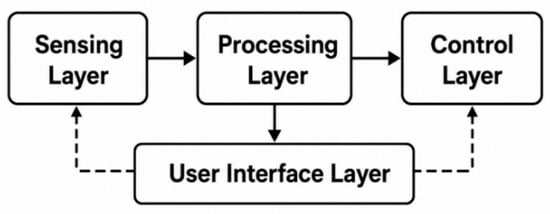
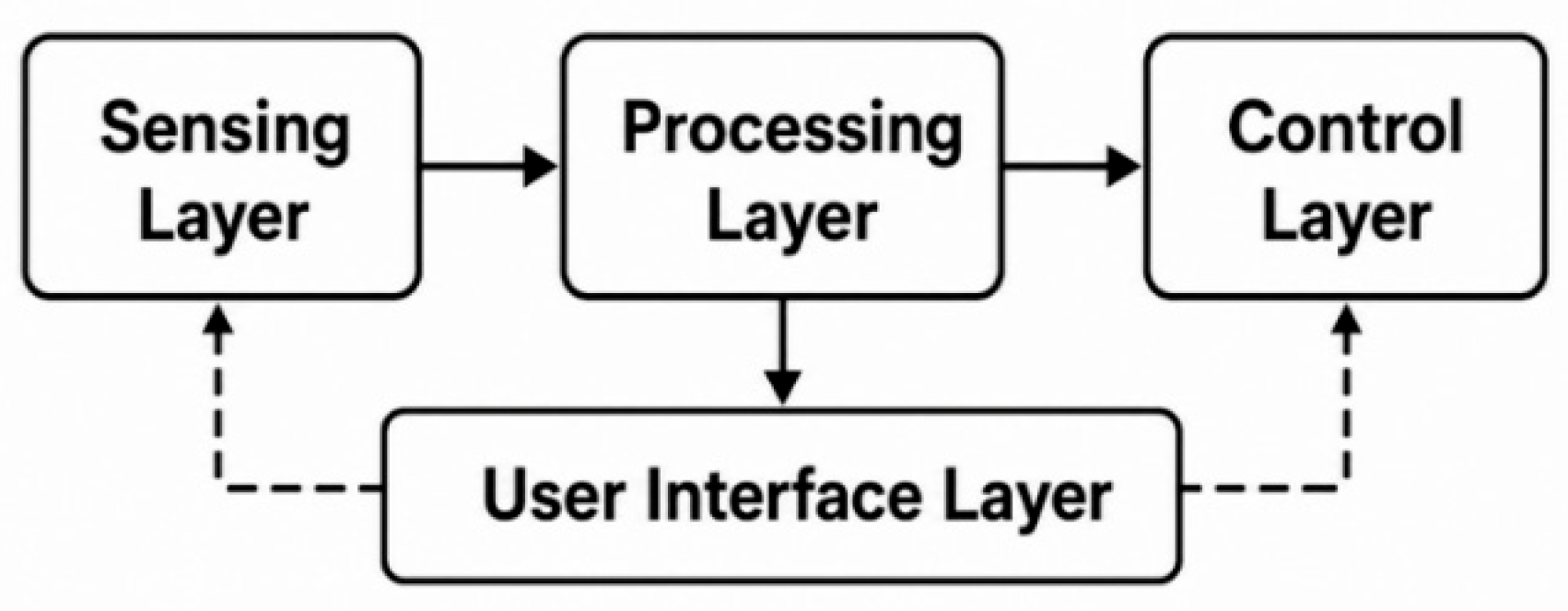
The proposed SLMS was implemented through a prototype design, using a four-layer architecture consisting of sensing, processing, control, and user-interface layers shown in Figure 3. Current and voltage sensing circuits continuously acquired electrical measurements, which were processed by an MSP430 acquisition controller and a Raspberry Pi supervisory controller. Based on predefined load priorities and TOU schedules, the control layer generated relay switching commands to manage connected loads. To validate the proposed architecture, a laboratory-scale prototype was developed integrating sensing hardware, communication interfaces, relay control modules, and a supervisory control platform, enabling real-time monitoring and automated load management.
Figure 3.
Layered architecture of the proposed energy management system.
The proposed Smart Load Management System consists of four major subsystems:
- (a)
- Sensing layer
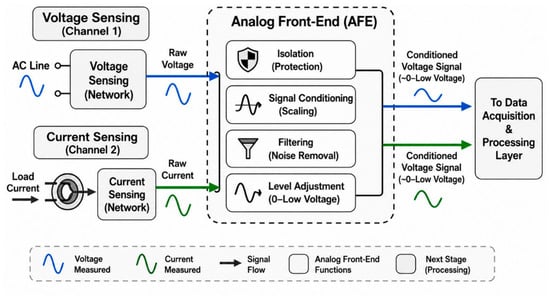
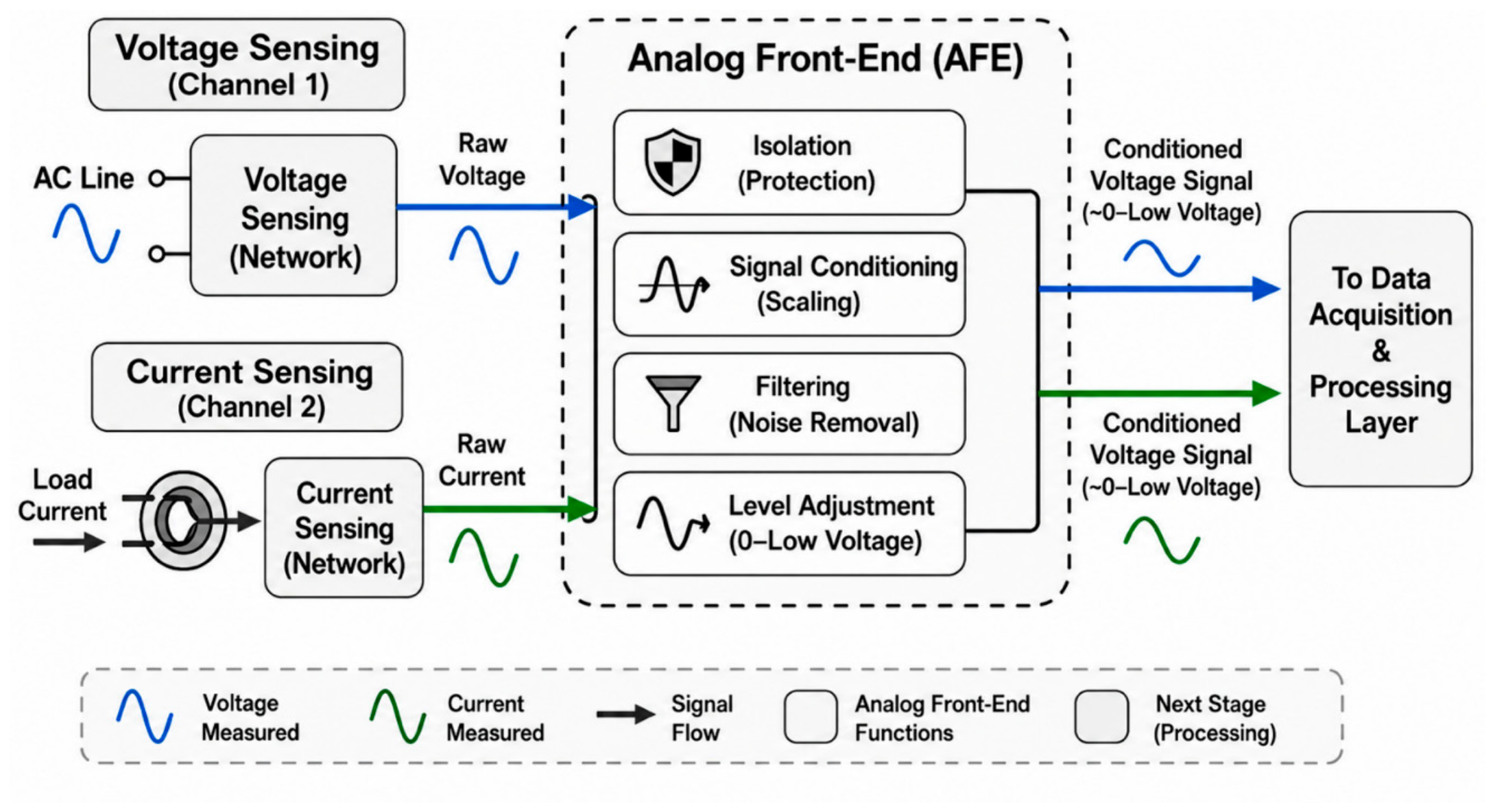
The sensing layer serves as the foundation of the proposed SLMS by continuously acquiring electrical parameters from the residential distribution network, which is shown in Figure 4. Its primary function is to measure voltage and current signals associated with connected loads and convert them into conditioned signals suitable for further processing and analysis. Since raw electrical signals are often characterized by high amplitudes, noise, and potential safety risks, an analog front-end sensing architecture is employed to perform signal attenuation, isolation, filtering, and conditioning. Separate sensing paths are utilized for voltage and current measurements to ensure accurate monitoring of load behavior under varying operating conditions. The conditioned signals are subsequently digitized and forwarded to the data acquisition and processing layer, where electrical parameters such as voltage, current, power consumption, and energy usage are determined. By providing reliable and real-time measurement data, the sensing layer enables effective load monitoring, demand response implementation, and energy management within the proposed system.
Figure 4.
Sensing layer of the proposed SLMS.
- (b)
- Processing Layer
The Processing Layer was designed to receive measurement data from the sensing layer and convert the acquired signals into meaningful electrical parameters. Voltage and current samples were collected through the sensing modules and processed using a microcontroller and a Raspberry Pi. Real-time calculations of power and energy consumption were performed, and the measured data were filtered, organized, and prepared for further analysis. Communication between the controllers was established through the SPI protocol to ensure reliable data transfer. The processed information was subsequently forwarded to the control layer and user interface layer for decision-making and visualization purposes.
- (c)
- Control Layer
The Control Layer was developed to implement intelligent load management based on predefined operating rules and Time-of-Use (TOU) schedules. Processed energy data received from the processing layer were evaluated, and control decisions were generated according to load classifications such as critical, essential, and non-essential loads. Relay switching commands were issued to control connected appliances and optimize energy consumption during different pricing periods. Both automatic and manual operating modes were incorporated, allowing either system-driven or user-driven control of individual loads. Safe and coordinated load operation was ensured through continuous monitoring and control execution.
- (d)
- User Interface Layer
The User Interface Layer was designed to provide real-time visualization and interaction capabilities for system users. Electrical parameters including voltage, current, power, and energy consumption were displayed through a dashboard interface developed using Node-RED. Individual load status, operating modes, and control settings were presented in an organized manner to enhance user awareness of energy usage. User inputs for manual load control and load classification were accepted through the interface and transmitted to the control layer. Real-time monitoring, historical trends, and system status information was made accessible to facilitate informed energy-management decisions.
2.4. Hardware Design
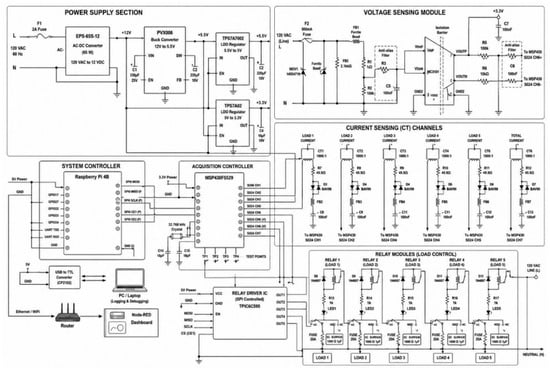
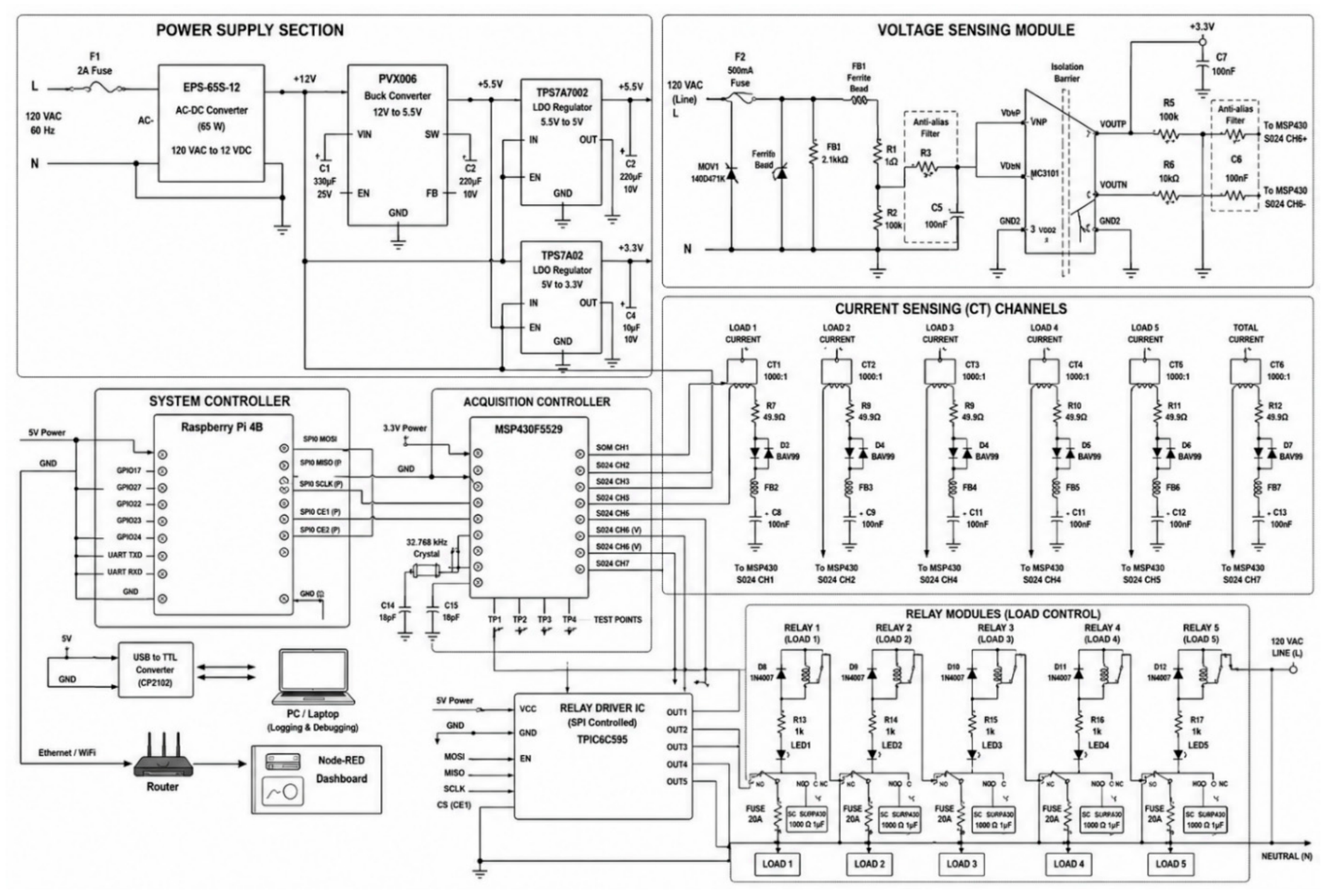
The circuit diagram of the proposed SLMS is shown in Figure 5 and presents the complete hardware architecture of the proposed Smart Load Management System (SLMS). It illustrates the integration of the power supply, voltage and current sensing modules, system controller, acquisition controller, relay control circuits, and communication interface, showing the overall signal flow and interaction among the hardware components.
Figure 5.
Circuit diagram of the proposed SLMS.
- (a)
- Power Supply Section
The power supply section converts the 120 V AC mains input into multiple regulated DC voltage levels required by the SLMS electronics. An EPS-65S-12 AC/DC (MEAN WELL, New Taipei City, Taiwan) converter first generates a 12 V DC rail, which directly powers the relay modules and serves as the primary supply for subsequent regulation stages. A PVX006 buck converter (OmniOn Power, Plano, TX, USA) converts the voltage to 5.5 V. This intermediate voltage is further regulated by TPS7A7002 and TPS7A02 low-dropout regulators (Texas Instruments, Dallas, TX, USA) to produce stable 5 V and 3.3 V rails. The 5 V supply powers the Raspberry Pi, relay driver circuitry, and communication interfaces, while the 3.3 V supply powers the MSP430 acquisition controller (Texas Instruments, Dallas, TX, USA) and analog front-end circuitry. This multi-stage architecture ensures low-noise operation, high efficiency, and reliable power delivery for both digital and analog subsystems.
- (b)
- Voltage Sensing Module
The voltage-sensing module measures the mains voltage while providing galvanic isolation between the high-voltage power network and the low-voltage measurement electronics. The input stage incorporates a fuse, metal oxide varistor (MOV), transient-voltage-suppressor (TVS) diode, and ferrite beads to protect against overcurrent, surges, and electromagnetic interference. A resistor network scales the mains voltage to a level suitable for measurement, while an anti-aliasing filter removes high-frequency noise. The conditioned signal is applied to an AMC3301 isolation amplifier (Texas Instruments, Dallas, TX, USA), which transfers the measurement across an isolation barrier and provides a differential output. A secondary scaling and filtering stage then adjusts the signal to approximately 500 mV RMS before it is delivered to the MSP430 SD24 analog-to-digital converter for digitization.
- (c)
- Current Sensing Module
The current-sensing subsystem monitors the current drawn by each load as well as the total system current. Six CT1020 current transformers (Amgis, LLC, Houston, TX, USA) provide isolated current measurements, with five channels assigned to individual loads and one channel dedicated to total load monitoring. The secondary current produced by each CT is converted into a measurable voltage using precision resistors. Protection diodes safeguard the measurement circuitry from transient overvoltages, while ferrite beads and RC low-pass filters suppress noise and provide anti-aliasing. The resulting conditioned signals are directly connected to the SD24 ADC channels of the MSP430 (Texas Instruments, Dallas, TX, USA), enabling accurate current measurement across all monitored loads.
- (d)
- System Controller
The Raspberry Pi 4B (Raspberry Pi Ltd., Cambridge, UK) functions as the central processing unit of the proposed SLMS. It receives measurement data from the acquisition controller, performs power and energy calculations, executes load management algorithms, and determines appropriate switching actions based on predefined demand response rules. Communication with peripheral devices is achieved through the SPI interface, where dedicated chip-select lines are used to communicate with both the MSP430 acquisition controller and the relay driver IC. The Raspberry Pi also communicates with the Node-RED dashboard through Ethernet or Wi-Fi, enabling real-time monitoring, data visualization, and user interaction. Additionally, a UART interface is provided for debugging, testing, and data logging during development.
- (e)
- Acquisition Controller
The MSP430F5529 serves as the acquisition controller responsible for real-time measurement and data acquisition. Equipped with a high-resolution 24-bit Sigma–Delta ADC (SD24), the microcontroller digitizes voltage and current signals obtained from the analog front-end circuitry. Seven ADC channels are utilized, including one voltage channel, five individual load current channels, and one total current channel. A 32.768 kHz crystal oscillator provides a stable timing reference for synchronized sampling operations. After processing the acquired measurements, the MSP430 transfers the data to the Raspberry Pi via the SPI communication interface, ensuring accurate and continuous monitoring of electrical parameters. The data acquisition system operates at a sampling rate of 7.8 kHz. At a nominal mains frequency of 60 Hz, this corresponds to approximately 130 samples per cycle. The MSP430F5529 organizes the acquired voltage and current measurements into data frames containing 256 samples per channel before transmitting them to the Raspberry Pi through the SPI interface.
- (f)
- Relay Modules and Load Control
The relay control subsystem provides switching functionality for five independently controlled residential loads. Switching commands generated by the Raspberry Pi are transmitted to an SPI-controlled relay driver IC, which energizes the corresponding relay coils. Each relay channel incorporates a flyback diode to suppress inductive voltage transients, an indicator LED for visual status indication, and a 20 A fuse for overcurrent protection. RC snubber circuits are connected across the relay contacts to minimize switching transients and reduce contact arcing. The relay contacts are configured such that loads remain energized in the default state and are disconnected when the corresponding relay is activated. This arrangement allows the SLMS to selectively disconnect lower-priority loads during demand-response events while maintaining operation of critical loads. The prototype uses CIT RELAY J107F1CS2012VDC-45 (CIT Relay & Switch, Rogers, MN, USA) relays with 12 VDC coils and contact ratings of 20 A at 125 VAC and 28 VDC. RC snubber circuits are incorporated to reduce switching transients and contact arcing.
2.5. Software Development and Algorithm
- (a)
- Firmware development
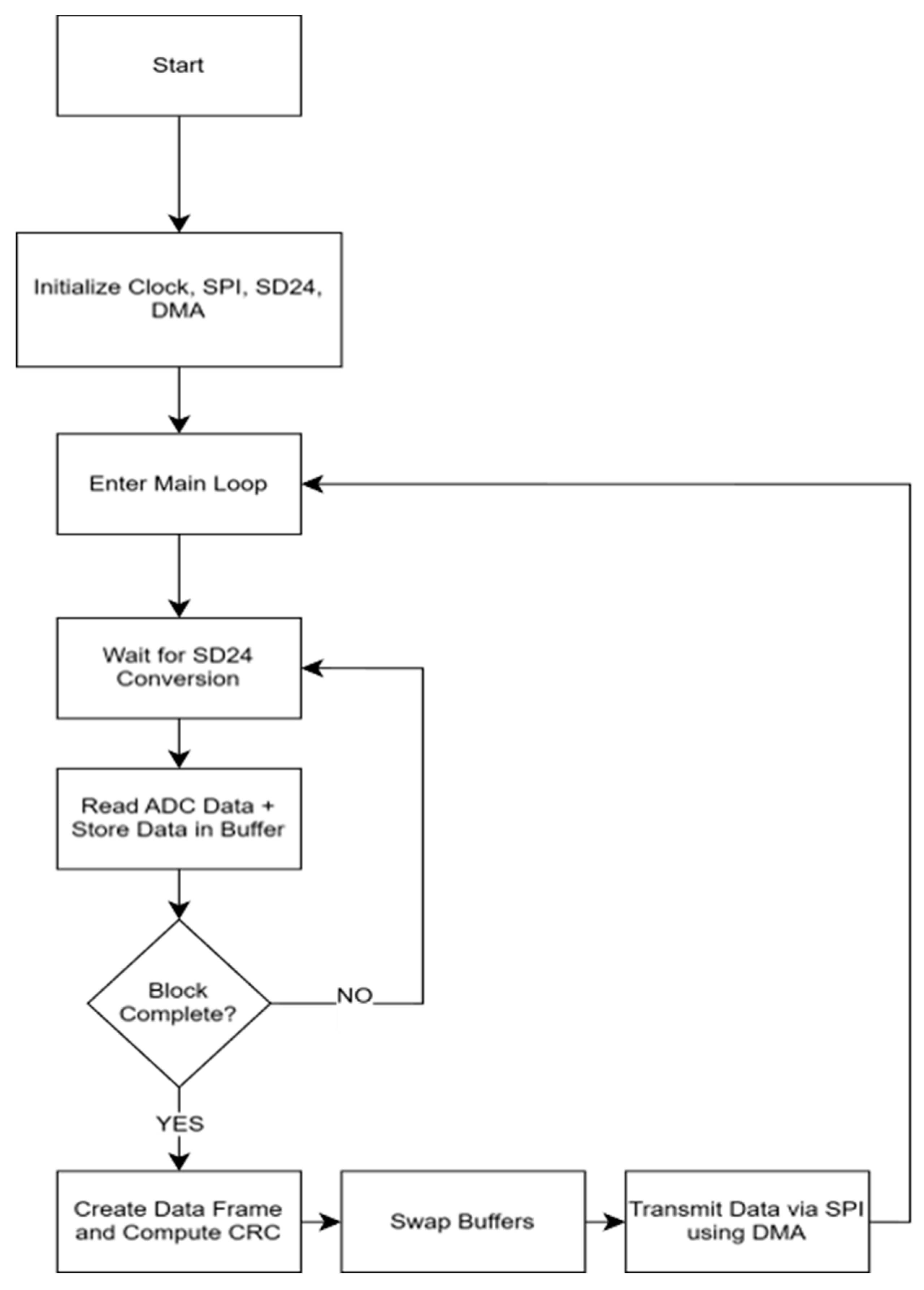
Firmware development for the MSP430 acquisition controller was carried out to support real-time energy metering and data communication. The firmware initializes and manages the system clock, SD24 analog-to-digital converter, SPI interface, and DMA controller. It continuously acquires synchronized voltage and current samples, organizes them into data frames, and transfers the measurement data to the Raspberry Pi. The use of DMA and double buffering ensures efficient, reliable, and uninterrupted operation while minimizing processor overhead. Figure 6 illustrates the overall operation of the MSP430 firmware for data acquisition and communication. After startup, the firmware initializes the system clock, SPI interface, SD24 analog-to-digital converter, and DMA controller before entering the main execution loop. It continuously waits for SD24 conversions, reads and stores the sampled data in a buffer, and checks whether a complete block of samples has been collected. Once the block is complete, the firmware creates a data frame, calculates the CRC for error checking, swaps the buffers, and transmits the data to the Raspberry Pi through the SPI interface using DMA. This process repeats continuously to ensure uninterrupted real-time data acquisition and transfer.
Figure 6.
Firmware Algorithm.
- (b)
- Communication Implementation
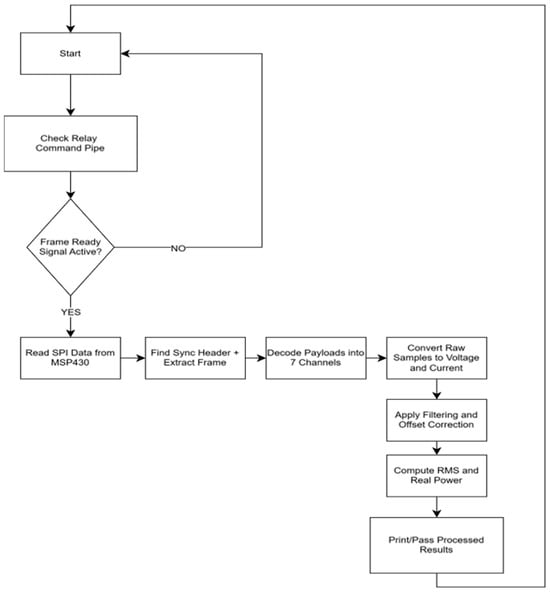
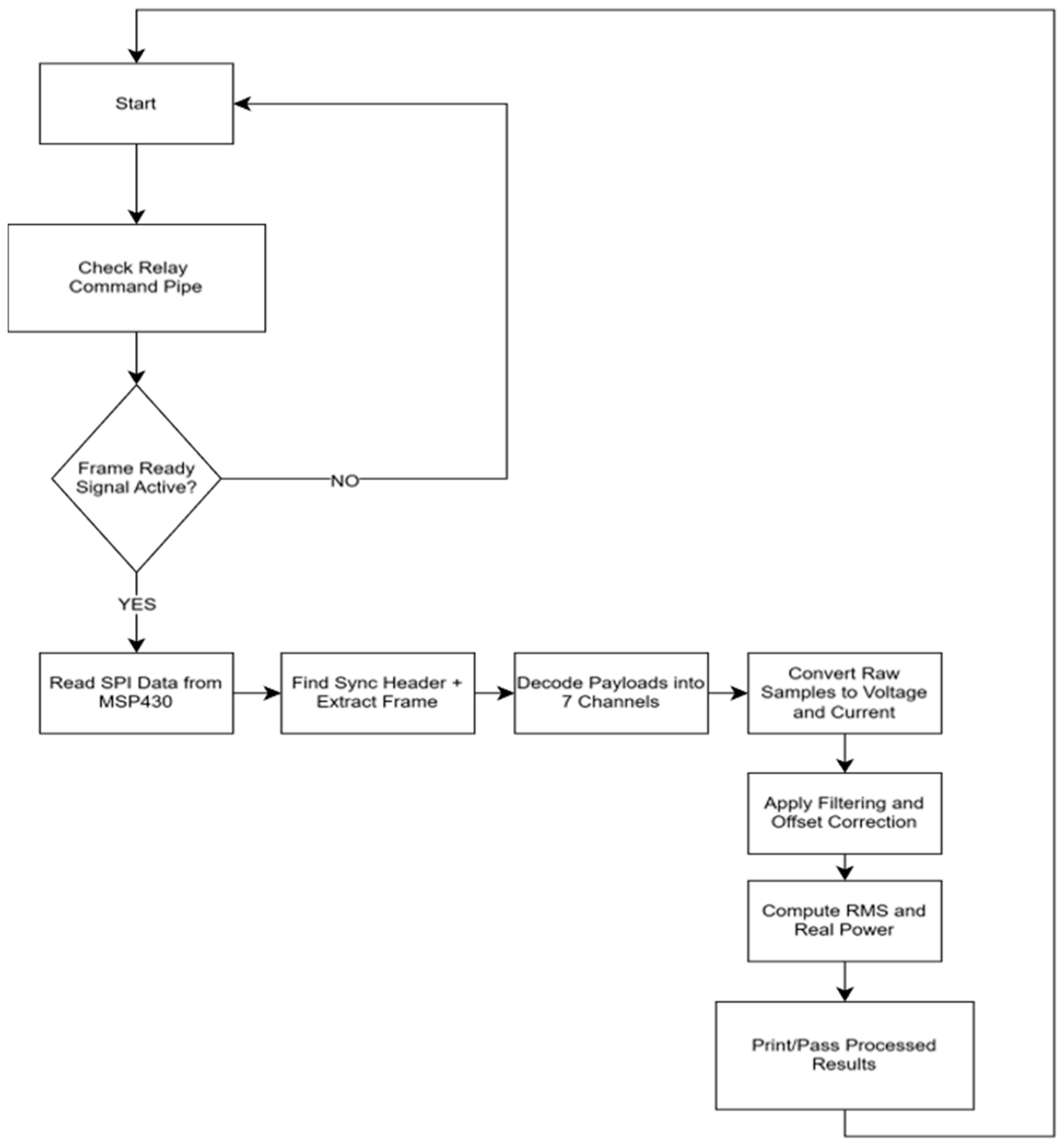
The communication implementation was designed to provide reliable and efficient data exchange between the MSP430 acquisition controller, the Raspberry Pi, and the relay driver. The SPI (Serial Peripheral Interface) was used as the primary communication protocol due to its high speed and low overhead. The MSP430 continuously collects voltage and current measurements, organizes them into data frames with synchronization and error-checking information, and transmits them to the Raspberry Pi. A Python (Python 3)-based communication layer on the Raspberry Pi receives and processes the data while also handling relay control commands. The use of DMA-assisted SPI transfers and frame synchronization ensures stable real-time communication with minimal processor load and reliable system operation. Figure 7, the flowchart, shows the operation of the Raspberry Pi communication layer. The Raspberry Pi continuously checks for relay control commands and waits for a frame-ready signal from the MSP430. When a new frame is available, it reads the data through SPI, identifies the synchronization header, and extracts the measurement payload. The data is then decoded into seven channels, converted into voltage and current values, filtered to remove noise and offsets, and used to calculate RMS voltage, RMS current, and real power. The processed results are then displayed or passed to the control system before the cycle repeats.
Figure 7.
Communication algorithm.
- (c)
- TOU algorithm development
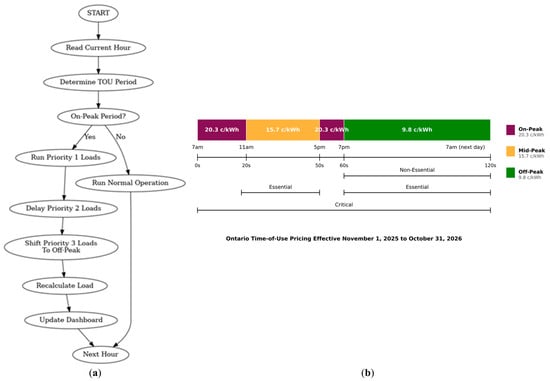
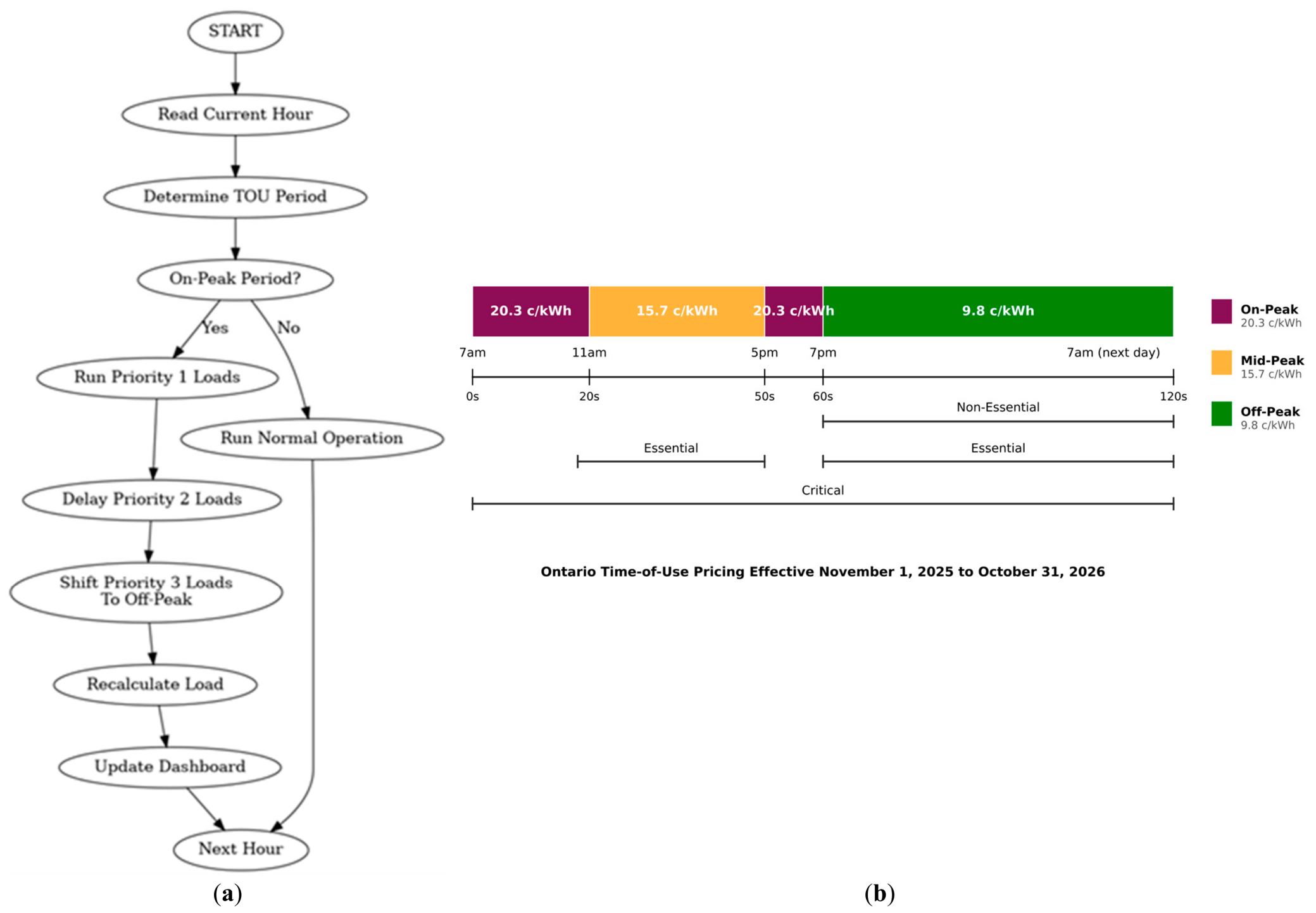
As shown in Figure 8a, the SLMS implements a deterministic, rule-based load control strategy that combines load classification with Time-of-Use (TOU) scheduling to regulate system operation. In this approach, electrical loads are categorized into three groups: critical, essential, and non-essential. Critical loads remain continuously ON regardless of TOU period, essential loads operate during mid-peak and off-peak periods but are disconnected during on-peak periods, while non-essential loads are permitted to operate only during off-peak periods. The corresponding operating schedule is summarized in Table 3, while Figure 8b illustrates the Ontario TOU pricing periods.
Figure 8.
(a) TOU algorithm. (b) Ontario time of use.
Table 3.
Operating schedule.
The control logic follows Hydro One TOU pricing intervals, where system time is mapped into discrete operating states: on-peak (0–30), mid-peak (30–60), and off-peak (60–120). Based on the current operating state, the controller determines the switching status of each load according to its assigned classification using the state-based function
where ui (t) is the switching command for load i, m denotes the current TOU operating mode, ci represents the load classification (critical, essential, or non-essential), and t is the system time. The function implements the scheduling policy described in the figure, ensuring that critical loads remain continuously energized, essential loads operate during mid-peak and off-peak periods, and non-essential loads are enabled only during off-peak periods. Since normally closed relays are used in the hardware implementation, the controller inverts the generated control signals before transmitting them to the relay driver. In addition, the controller compares the required switching state with the current relay status and updates the relay output only when a state transition is detected, thereby avoiding unnecessary relay operations and extending relay service life.
- (d)
- Node-RED dashboard development
A real-time monitoring dashboard was developed using Node-RED to provide visualization and control capabilities for the SLMS. The dashboard displays key electrical parameters, including voltage, current, power, and energy consumption, together with load status, operating modes, and control settings. Interactive controls were incorporated to support both automatic and manual operation of connected loads. The dashboard also presents historical trends and system performance indicators, enabling users to monitor energy usage patterns and make informed energy management decisions.
3. Results and Discussion
3.1. Experimental Setup
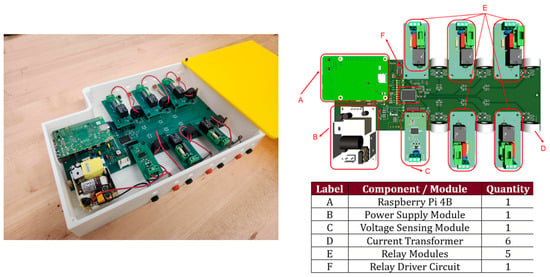
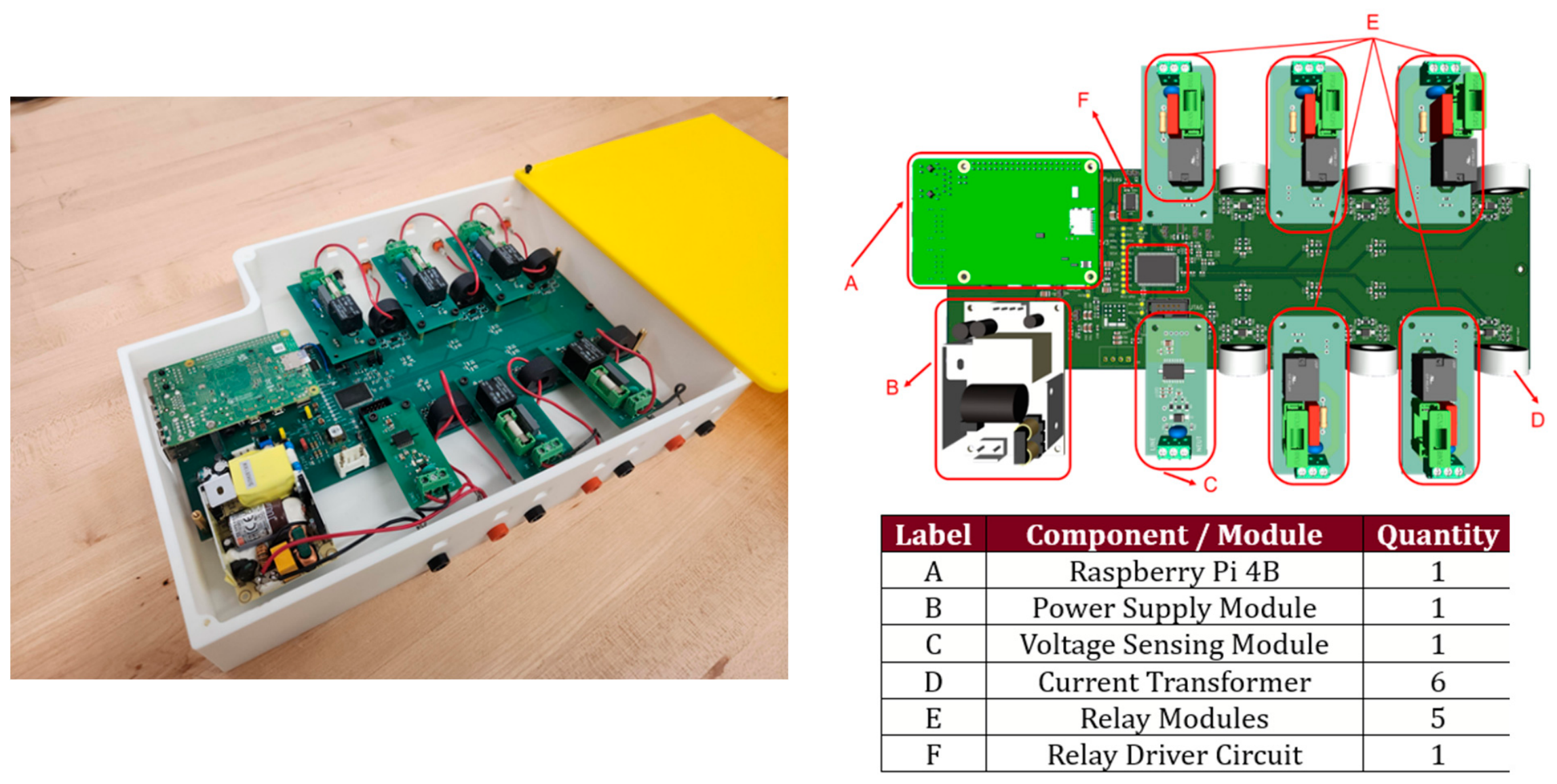
The proposed Smart Load Management System (SLMS) was validated using a laboratory-scale prototype (see Figure 9) designed to demonstrate the key functions of a residential energy management system. The prototype operated from a 120 V AC supply and was tested using laboratory-scale resistive loads representative of common household appliances.
Figure 9.
Prototype Design of the proposed SLMS.
Experimental testing was conducted to evaluate sensing performance, communication reliability, automated load control, user interface functionality, and overall system operation. In addition, a residential Time-of-Use (TOU) case study was performed to assess the potential economic benefits of automated load scheduling. Table 4 summarizes the performance of the proposed SLMS.
Table 4.
Experimental Setup and System Validation Summary.
3.2. Electrical Isolation and Safety Performance
Electrical isolation and user safety were primary design objectives due to the direct interaction of the SLMS with residential electrical structure. The implemented hardware successfully achieved isolation between high-voltage and low-voltage domains using current transformers, an isolated voltage sensing amplifier, relay-based switching, and dedicated protection circuitry. The voltage sensing subsystem utilized the AMC3301 isolation amplifier to provide galvanic isolation from the mains supply, while current transformers inherently isolated the current measurement channels. Additional protective measures included fuses, transient voltage suppressors (TVSs), metal oxide varistors (MOVs), RC snubber circuits, and flyback diodes to protect against overcurrent conditions, voltage surges, and switching transients. Throughout laboratory testing, the system operated safely and reliably without electrical faults or isolation failures. These results demonstrate that the proposed architecture provides a suitable foundation for residential monitoring and control applications.
3.3. Measurement Performance
The sensing subsystem successfully measured voltage, current, power, and cumulative energy consumption in real time. The MSP430 acquisition controller continuously sampled seven measurement channels, including line voltage, total current, and individual load currents. The 24-bit Sigma–Delta ADC enabled synchronized high-resolution acquisition across all channels. Measurement data was transferred to the Raspberry Pi, where RMS voltage, RMS current, real power, and energy consumption were calculated and displayed through the dashboard interface. Each data frame contained 256 samples per channel, representing approximately 32.8 ms (1.97 cycles at 60 Hz). The Raspberry Pi used the sampled data to calculate RMS voltage, RMS current, and real power. Experimental testing demonstrated a measurement accuracy of approximately ±3% relative to nominal values. The results confirm that the sensing architecture can provide meaningful and actionable information for residential energy management while maintaining a relatively low hardware cost.
3.4. Communication and Data Acquisition Performance
Reliable communication between sensing and control subsystems is critical for real-time operation. The SLMS employed an SPI-based communication architecture linking the MSP430 acquisition controller, the Raspberry Pi supervisory controller, and the relay driver. Measurement data was organized into structured frames containing synchronization information, measurement payloads, frame counters, and integrity verification fields. Direct Memory Access (DMA) was utilized to reduce processor overhead and improve transfer reliability. Experimental testing verified successful continuous communication at an SPI clock frequency of approximately 3 MHz. Timing analysis demonstrated that the data acquisition process and communication process operated within acceptable timing margins, allowing uninterrupted measurement transfer during normal operation. The communication architecture successfully supported real-time monitoring, control, and dashboard updates without introducing significant latency. These results demonstrate that the selected architecture is suitable for residential supervisory control applications requiring continuous data acquisition and load management.
3.5. Control System Performance
The proposed TOU-based control strategy successfully demonstrated automated residential load management using appliance prioritization and scheduling logic. Loads were categorized into three operational classes:
- (1)
- Critical loads, which remain energized continuously.
- (2)
- Essential loads, which operate during off-peak and mid-peak periods.
- (3)
- Non-essential loads, which operate only during off-peak periods.
The Raspberry Pi supervisory controller continuously evaluated system time, operating mode, and load classifications to determine the required relay states. Control commands were then transmitted to the relay driver for execution. Testing confirmed that the system correctly enforced the predefined scheduling rules. Critical loads remained continuously active, essential loads were disabled during peak periods, and non-essential loads were automatically shifted to off-peak periods. The measured control response time remained below one second, significantly exceeding the original requirement of one to two minutes. Furthermore, state comparison logic successfully prevented unnecessary relay actuation, reducing relay wear and improving operational stability. These results demonstrate that simple deterministic control strategies can effectively reduce peak demand while maintaining reliable operation and low computational complexity.
3.6. Dashboard Performance
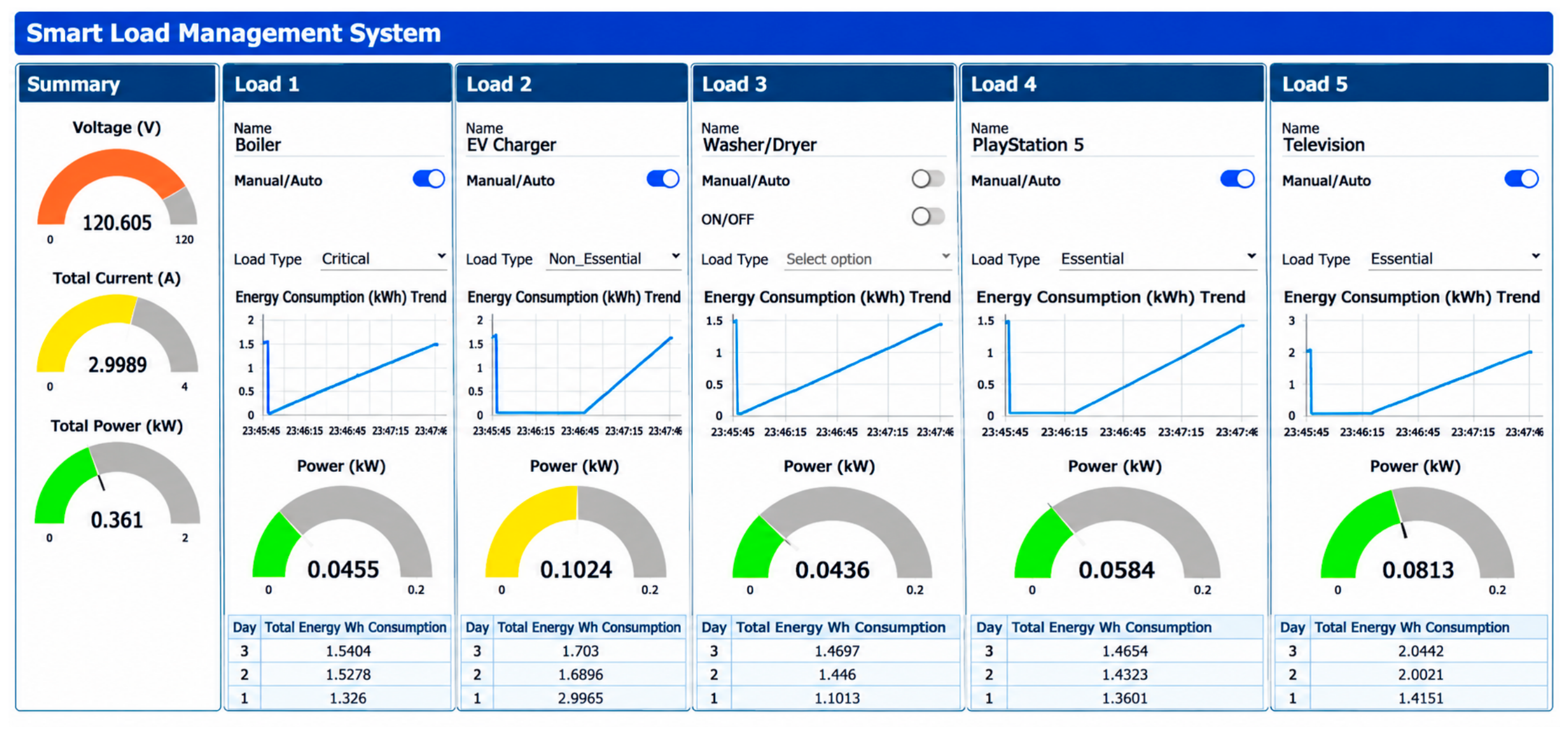
The Node-RED dashboard functioned as the primary human–machine interface for the SLMS and successfully provided centralized monitoring and control capabilities. The dashboard, as shown in Figure 10, provided real-time visualization of the following: 1. Voltage measurements, 2. Current measurements, 3. Real-time power consumption, 4. Energy consumption trends, 5. Load classifications, 6. Relay status, and 7. Operating modes.
Figure 10.
Proposed SLMS dashboard interface.
The interface supported both automatic and manual control modes, allowing users to monitor system performance while retaining direct control when required. Historical trends, gauges, and graphical indicators provided intuitive visualization of energy usage and load behavior.
Throughout testing, the dashboard remained responsive and stable, providing reliable updates without noticeable communication delays. The successful implementation demonstrates the practicality of integrating monitoring, visualization, and control functions into a unified residential energy management interface.
3.7. Cost Savings Analysis
A residential case study was conducted to evaluate the potential electricity-cost savings and peak-demand reduction offered by the proposed Smart Load Management System (SLMS) under a Time-of-Use (TOU) electricity tariff. The analysis was based on a predefined residential appliance schedule, representative appliance power ratings, operating durations, and Hydro One winter TOU tariff rates, with a daily energy consumption of 87.1 kWh. The physical SLMS prototype was experimentally validated for real-time electrical monitoring, communication, and relay-based load control, demonstrating its capability to implement the proposed TOU-based scheduling strategy. Building on this experimental validation, the residential case study assessed the impact of shifting flexible loads from high-priced peak periods to lower-priced off-peak periods while maintaining the same daily energy consumption. The resulting analysis quantified the potential reductions in peak demand and electricity costs under the specified residential operating conditions.
- (a)
- Residential Case Study Assumptions
The residential case study employed a predefined Time-of-Use (TOU)-based scheduling strategy developed for this study. The operating schedules for household appliances were assigned according to their priority class (Critical, Essential, or Flexible) and the Hydro One TOU pricing schedule. Critical loads, including the refrigerator, freezer, internet router, security system, and standby loads, remained continuously energized throughout the day. Essential loads, including lighting, the heat pump, laptop/PC, television, and microwave, were scheduled predominantly during Off-Peak periods, with selected operating intervals allocated to Mid-Peak periods where appropriate to maintain user comfort and normal household operation. Flexible loads, including the dishwasher, washing machine, dryer, EV charger, and water heater, were shifted to Off-Peak periods to take advantage of lower electricity prices while preserving their required daily operating duration. The proposed SLMS prototype provides the capability to implement these scheduling strategies through continuous monitoring of system conditions and automatic execution of the corresponding relay switching commands.
As shown in Table 5, Hydro One Winter TOU pricing was applied using Off-Peak pricing of $0.098/kWh from 07:00 p.m.–07:00 a.m., Mid-Peak pricing of $0.157/kWh from 11:00 a.m.–05:00 p.m., and On-Peak pricing of $0.203/kWh during 07:00 a.m.–11:00 a.m. and 05:00 p.m.–7 p.m.
Table 5.
Residential Appliance Classification and Scheduling by EMS.
- (b)
- Case Study Results
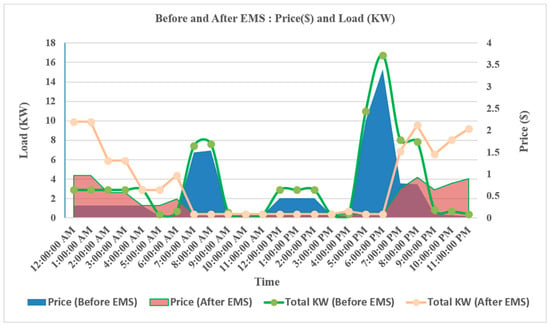
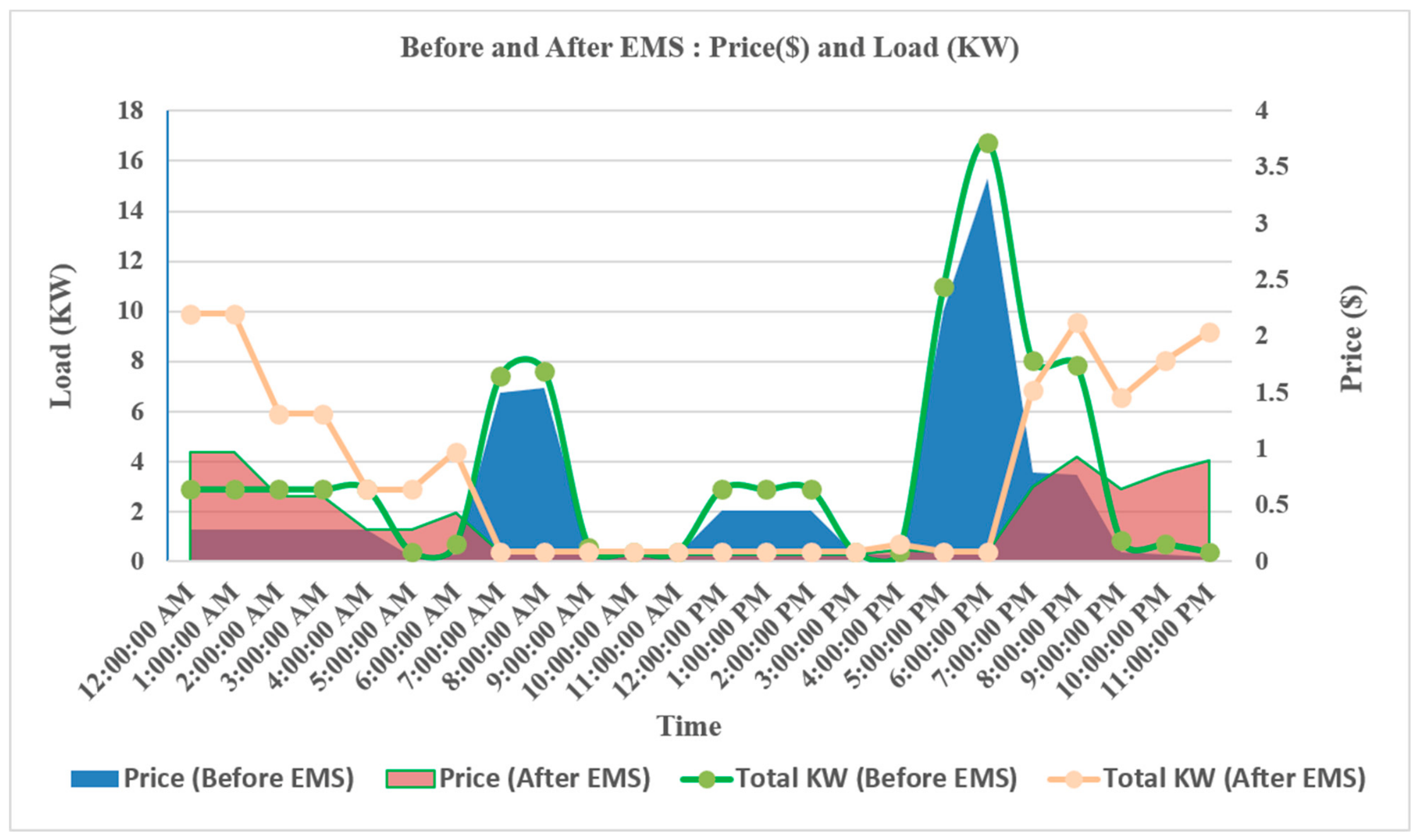
As shown in Figure 11, the baseline residential load profile produced a daily energy consumption of approximately 87.1 kWh with a peak demand of 16.75 kW. After implementing the proposed SLMS control strategy, total daily energy consumption remained unchanged at 87.1 kWh, demonstrating energy conservation. However, flexible loads were shifted from high-cost On-Peak periods to low-cost Off-Peak periods, reducing the daily peak demand to 9.9 kW.
Figure 11.
Daily Load power consumption and Electricity Price before and after EMS.
The daily electricity cost decreased from approximately $13.7 to $8.9, corresponding to a cost reduction of 35%, resulting in daily savings of $4.7 and monthly savings of $143. Peak demand was reduced from 16.75 kW to 9.9 kW, representing a peak reduction of 41%.
The results demonstrate the potential to reduce residential electricity costs and peak demand without affecting total energy consumption. The achieved savings are obtained solely through intelligent scheduling of flexible loads according to Time-of-Use electricity pricing, validating the effectiveness of the proposed control strategy for residential energy management applications.
3.8. Discussion
The experimental results demonstrate the feasibility of integrating sensing, communication, monitoring, control, and user interaction within a unified residential energy management platform. The prototype successfully achieved the major project objectives, including real-time measurement of electrical parameters, automated load control, dashboard-based monitoring, and Time-of-Use (TOU)-based demand management. The communication system provided reliable data transfer, while the control system coordinated load operation according to predefined priorities and scheduling rules. These results demonstrate the potential of the proposed Smart Load Management System (SLMS) as an integrated platform for residential energy monitoring and intelligent load management.
A key outcome of this study is the potential to reduce electricity costs through intelligent load scheduling rather than reducing total energy consumption. This distinction highlights the role of demand-side management in improving energy utilization and managing electricity costs while maintaining occupant comfort and appliance functionality. In the residential case study, the proposed SLMS reduced the estimated daily peak demand from 16.75 kW to 9.9 kW, representing a reduction of approximately 41%, while maintaining daily energy consumption at 87.1 kWh. The estimated daily electricity cost decreased by approximately 35%, demonstrating the potential economic benefits of shifting flexible loads from high-cost on-peak periods to lower-cost off-peak periods.
The proposed SLMS is an intelligent, modular, and algorithm-independent platform. Its sensing, communication, and relay control layers can support different scheduling algorithms, including MILP, MPC, reinforcement learning, and forecast-based optimization, through software updates on the Raspberry Pi. The proposed architecture is also tariff agnostic and can be adapted to different climate zones, regional tariff structures, and multi-household applications by updating the local tariff schedule, appliance classifications, and control rules. Coordinated demand–response programs and PHEV scheduling can reduce distribution network congestion, operating costs, emissions, and power losses, supporting the potential value of extending the proposed single-household SLMS to multi-household aggregation in future work [35]. Researchers’ findings provide relevant context for understanding the potential grid-level implications of residential load management [35]. Future development could improve household privacy by preventing unauthorized access to electricity-use data and protecting the system against cyberattacks, while secure firmware updates could help maintain reliable operation. Expanding the modular architecture with additional sensing and control channels could enable the management of more household loads, while smart-meter integration and improved communication could support coordinated operation across 5–10 households. Evaluating hardware costs, installation complexity, communication reliability, and usability would help determine the system’s practicality, affordability, and suitability for wider residential adoption.
Furthermore, although the hardware experiments validated the system’s operational functions, the residential peak-demand and electricity-cost reductions were estimated using a predefined household load profile rather than measured through a full-scale residential deployment. Future work will focus on validating these estimated benefits through hardware-in-the-loop testing or deployment in a representative residential environment, alongside a formal usability evaluation using user surveys or interviews.
Overall, the results demonstrate that the proposed SLMS provides a practical, scalable, and cost-effective approach to residential energy monitoring and intelligent load management, establishing a strong foundation for future development and deployment.
4. Conclusions
This paper presented the design, implementation, and experimental validation of a Smart Load Management System (SLMS) for residential energy monitoring and demand-side management. The proposed system integrates high-resolution electrical sensing, real-time data acquisition, automated load control, and a user-friendly monitoring interface into a single low-cost platform. The hardware architecture, based on an MSP430 acquisition controller and a Raspberry Pi supervisory controller, successfully demonstrated synchronized measurement of voltage, current, power, and energy consumption while providing reliable communication and real-time visualization through a Node-RED dashboard. Experimental evaluation confirmed that the system operated safely under laboratory conditions using isolated sensing circuits and protected switching hardware. The proposed Time-of-Use (TOU) priority-based control strategy successfully managed five independent residential loads according to predefined operating priorities while maintaining a control response time of less than one second. The communication architecture provided stable high-speed data transfer between sensing and control modules, enabling continuous monitoring without significant communication delays. A residential case study based on Hydro One Winter TOU pricing demonstrated the practical benefits of intelligent load scheduling. Although the total daily energy consumption remained unchanged, the proposed control strategy successfully shifted flexible loads from high-cost peak periods to low-cost off-peak periods. This resulted in a projected reduction in electricity cost of approximately 35%, together with a 41% reduction in peak demand, illustrating the effectiveness of demand-side management through load scheduling rather than energy reduction. Overall, the proposed SLMS demonstrates the technical feasibility of integrating sensing, communication, monitoring, and intelligent control within a scalable residential energy management platform. The results indicate that the system provides an effective and cost-efficient approach for residential demand-side management and establishes a strong foundation for future development toward smart-home and smart-grid applications.
Author Contributions
Conceptualization, M.M.N.C. and A.B.S.; Methodology, S.R. and M.I.N.; Software, S.R., M.M.N.C. and A.B.S.; Validation, S.R., M.I.N., M.M.N.C., M.T. and A.B.S.; Formal analysis, A.A.K., M.T. and S.H.; Investigation, S.R., M.M.N.C., M.T., A.B.S. and S.H.; Resources, A.A.K. and M.T.; Data curation, M.I.N. and M.T.; Writing—original draft, M.I.N., M.M.N.C. and S.H.; Writing—review & editing, M.I.N. and A.B.S.; Visualization, S.H.; Supervision, A.A.K.; Project administration, A.A.K.; Funding acquisition, A.A.K. All authors have read and agreed to the published version of the manuscript.
Funding
This research received no external funding.
Data Availability Statement
The original contributions presented in this study are included in the article. Further inquiries can be directed to the corresponding author.
Conflicts of Interest
The authors declare no conflict of interest.
References
- Muthuselvi, G.; Saravanan, B. Priority-based residential demand side management in smart grid using ToU pricing. In Proceedings of the 2021 Innovations in Power and Advanced Computing Technologies (i-PACT), Kuala Lumpur, Malaysia, 27–29 November 2021; pp. 1–6. [Google Scholar] [CrossRef] [Scilit]
- Alsokhiry, F.; Siano, P.; Annuk, A.; Mohamed, M.A. A novel time-of-use pricing based energy management system for smart home appliances: Cost-effective method. Sustainability 2022, 14, 14556. [Google Scholar] [CrossRef] [Scilit]
- Abushnaf, J.; Rassau, A.; Górnisiewicz, W. Impact on electricity use of introducing time-of-use pricing to a multi-user home energy management system: A multi-user home energy management system. Int. Trans. Electr. Energy Syst. 2016, 26, 993–1005. [Google Scholar] [CrossRef] [Scilit]
- Ahmad, M.; Javaid, N.; Niaz, I.A.; Almogren, A.; Radwan, A. A cost-effective optimization for scheduling of household appliances and energy resources. IEEE Access 2021, 9, 160145–160162. [Google Scholar] [CrossRef] [Scilit]
- Apaydin-Özkan, H. An appliance scheduling system for residential energy management. Sensors 2021, 21, 3287. [Google Scholar] [CrossRef] [Scilit] [PubMed]
- Yang, J.; Sun, Q.; Yao, L.; Liu, Y.; Yang, T.; Chu, C.; Fang, L.; Zhu, L. A novel dynamic load-priority-based scheduling strategy for home energy management system. J. Clean. Prod. 2023, 389, 135978. [Google Scholar] [CrossRef] [Scilit]
- Zhang, X.; Jin, Y.; Wu, P.; Liu, Q. Dynamic multi-objective home appliance scheduling using transfer learning based evolutionary algorithm. In Proceedings of the 2024 6th International Conference on Data-Driven Optimization of Complex Systems (DOCS), Hangzhou, China, 16–18 August 2024; pp. 438–444. [Google Scholar] [CrossRef] [Scilit]
- Shivadasan, E.; Sandhya, A.; Shanmugam, P.K. Optimization of energy consumption cost using particle swarm algorithm under HEMS environment. In Proceedings of the 2024 IEEE 21st India Council International Conference (INDICON), Kharagpur, India, 19–21 December 2024; pp. 1–6. [Google Scholar] [CrossRef] [Scilit]
- Ahmad, N.; Abbasi, A.; Khalid, H.A.; Rehman, H. A dynamic pricing and clustering scheme for efficient home energy management system in a microgrid. IEEE Access 2025, 13, 50411–50427. [Google Scholar] [CrossRef] [Scilit]
- Hua, L.-G.; Shah, S.H.A.; Alghamdi, B.; Hafeez, G.; Ullah, S.; Murawwat, S.; Ali, S.; Khan, M.I. Smart home load scheduling system with solar photovoltaic generation and demand response in the smart grid. Front. Energy Res. 2024, 12, 1322047. [Google Scholar] [CrossRef] [Scilit]
- Prakash, V.; Kumar, S.V. A rule-based energy management system for smart grid-integrated microgrid with time-of-use demand response under Indian grid conditions. Int. J. Multidiscip. Res. 2026, 8, 70294. [Google Scholar] [CrossRef]
- Radhakrishnan, A.; Selvan, M.P. Load scheduling for smart energy management in residential buildings with renewable sources. In Proceedings of the 2014 18th National Power Systems Conference (NPSC), Guwahati, India, 18–20 December 2014; pp. 1–6. [Google Scholar] [CrossRef] [Scilit]
- Munoz, O.; Ruelas, A.; Rosales, P.; Acuña, A.; Suastegui, A.; Lara, F. Design and development of an IoT smart meter with load control for home energy management systems. Sensors 2022, 22, 7536. [Google Scholar] [CrossRef] [Scilit] [PubMed]
- Prasetyo, Y.; Triwijaya, S.; Khakim, A.; Prakoso, D.N.; Winarno, B. Integrated IoT system for real-time electrical load monitoring. J. Geuthee Eng. Energy (JOGE) 2025, 4, 17–23. [Google Scholar] [CrossRef] [Scilit]
- De Azambuja, H.T.; Revoredo, T.C. A low cost open-source energy monitoring and control system for smart homes. In Proceedings of the 2023 Symposium on Internet of Things (SIoT), São Paulo, Brazil, 25–27 October 2023; pp. 1–5. [Google Scholar] [CrossRef] [Scilit]
- Hasan, M.K.; Ahmed, M.M.; Pandey, B.; Gohel, H.; Islam, S.; Khalid, I.F.M.K. Internet of Things-based smart electricity monitoring and control system using usage data. Wirel. Commun. Mob. Comput. 2021, 2021, 6544649. [Google Scholar] [CrossRef] [Scilit]
- Madhunala, S.; Beerla, M.; Peddemoni, A.Y. IoT based load controlling and energy monitoring smart home system. AIP Conf. Proc. 2024, 2942, 020019. [Google Scholar] [CrossRef] [Scilit]
- Condon, F.; Martínez, J.M.; Eltamaly, A.M.; Kim, Y.-C.; Ahmed, M.A. Design and implementation of a cloud-IoT-based home energy management system. Sensors 2022, 23, 176. [Google Scholar] [CrossRef] [Scilit] [PubMed]
- Vistro, D.M.; Rehman, A.U.; Akram, S.; Farooq, M.S. IoT based real time automatic energy management system using Adafruit Cloud. In Proceedings of the 2022 International Conference Knowledge Engineering and Communication Systems (ICKES), Chickballapur, India, 28–29 December 2022; pp. 1–8. [Google Scholar] [CrossRef] [Scilit]
- Bindushree, B.G.T. IoT-based energy management in smart homes: A literature review. World J. Adv. Res. Rev. 2022, 16, 1392–1400. [Google Scholar] [CrossRef] [Scilit]
- Rojek, L.; Islam, S.; Hartmann, M.; Creutzburg, R. IoT-based real-time monitoring system for a smart energy house. Electron. Imag. 2021, 33, 38-1–38-10. [Google Scholar] [CrossRef] [Scilit]
- Sumarmad, K.A.A.; Sulaiman, N.; Wahab, N.I.A.; Hizam, H. Microgrid energy management system based on fuzzy logic and monitoring platform for data analysis. Energies 2022, 15, 4125. [Google Scholar] [CrossRef] [Scilit]
- Rahul, J.; Chary, K.V.; Shreya, M.; Nikhitha, P.; Praveen, K.; Karuppiah, N.R. ESP32-based smart solar DC microgrid with priority load management. In Proceedings of the 2026 International Conference Visual Analytics and Data Visualization (ICVADV), Tirunelveli, India, 24–26 February 2026; pp. 1445–1451. [Google Scholar] [CrossRef] [Scilit]
- Nasser, A.; Ali, A.J.; Mohammed, E.A. Smart energy management system based on load priority. AIP Conf. Proc. 2023, 2862, 020011. [Google Scholar] [CrossRef] [Scilit]
- Ali, A.; Hansen, T.M.; Hussain, T. Post-disaster home energy management with prioritized HVAC and synthetic load modeling. In Proceedings of the 2025 57th North American Power Symposium (NAPS), Hartford, CT, USA, 26–28 October 2025; pp. 1–6. [Google Scholar] [CrossRef] [Scilit]
- Zhou, B.; Li, W.; Chan, K.W.; Cao, Y.; Kuang, Y.; Liu, X.; Wang, X. Smart home energy management systems: Concept, configurations, and scheduling strategies. Renew. Sustain. Energy Rev. 2016, 61, 30–40. [Google Scholar] [CrossRef] [Scilit]
- Kallio, S.; Siroux, M. A review—Home renewable energy management systems in smart grids. IOP Conf. Ser. Earth Environ. Sci. 2022, 1050, 012001. [Google Scholar] [CrossRef] [Scilit]
- Kurde, A.; Kulkarni, V.S. A review on IoT based energy monitoring and controlling system. Int. J. Sci. Res. Publ. 2016, 6, 5757. [Google Scholar] [CrossRef]
- Siswipraptini, P.C.; Aziza, R.N.; Siregar, R.R.A.; Ramadhan, A. Smart home energy management systems: A systematic review of architecture, communication, and algorithmic trends. J. Syst. Manag. Sci. 2024, Epub ahead of printing. [Google Scholar] [CrossRef] [Scilit]
- Kumar, M.; Pandey, K.M. The impact of IoT on smart home energy management. Int. J. Soft Comput. Eng. 2023, 13, 7–12. [Google Scholar] [CrossRef] [Scilit]
- Mohammed, R.A.; Abed, F.T.; Omer, J.S.A.; Hussein, R.R. Artificial intelligence–driven smart home energy management systems: Deep learning–based load forecasting, optimization strategies, and open research challenges. Wasit J. Eng. Sci. 2026, 14, 424–435. [Google Scholar] [CrossRef] [Scilit]
- Ikegwu, A.C.; Obianuju, O.J.; Nwokoro, I.S.; Kama, M.O.; Ebem, D.U. Investigating the impact of AI/ML for monitoring and optimizing energy usage in smart home. Artif. Intell. Evol. 2025, 6, 30–43. [Google Scholar] [CrossRef] [Scilit]
- Ma, Y.; Chen, X.; Wang, L.; Yang, J. Study on smart home energy management system based on artificial intelligence. J. Sens. 2021, 2021, 9101453. [Google Scholar] [CrossRef] [Scilit]
- Gomes, I.; Bot, K.; Ruano, M.G.; Ruano, A. Recent techniques used in home energy management systems: A review. Energies 2022, 15, 2866. [Google Scholar] [CrossRef] [Scilit]
- Salehi, J.; Abdolahi, A. Optimal scheduling of active distribution networks with penetration of PHEV considering congestion and air pollution using DR program. Sustain. Cities Soc. 2019, 51, 101709. [Google Scholar] [CrossRef] [Scilit]

Disclaimer/Publisher’s Note: The statements, opinions and data contained in all publications are solely those of the individual author(s) and contributor(s) and not of MDPI and/or the editor(s). MDPI and/or the editor(s) disclaim responsibility for any injury to people or property resulting from any ideas, methods, instructions or products referred to in the content. |
© 2026 by the authors. Licensee MDPI, Basel, Switzerland. This article is an open access article distributed under the terms and conditions of the Creative Commons Attribution (CC BY) license.