


Abstract
Developing cascade water energy storage potential is an effective way to enhance hydro–wind–solar flexibility and promote the accommodation of variable renewable energy. This study proposes an optimization method for developing cascade water energy storage potential that considers reservoir dredging, energy storage pump station, and reversible pumped-storage unit. Firstly, the characteristics of various measures for developing water energy storage potential are analyzed, and the operating boundaries and constraints of the cascade water energy storage system are determined. Secondly, considering the volatility of grid-connected large-scale green energy, a short-term multi-objective cascade water energy storage system optimization scheduling model is established with the goal of renewable energy generation and peak-shaving benefits. Finally, a multi-objective fuzzy evaluation method is adopted to quantitatively analyze the impact of different measures on the green energy generation and peak-shaving of the cascade water energy storage system. The cascade hydropower system of Gansu section of the Yellow River basin is selected as a case study, and the results indicate that (1) at matched average daily cascade hydropower output, reservoir 2 dredging reduces the residual-load standard deviation by 27.8% on average, whereas the composite evaluation of generation and peak shaving improves it by 18.0%; (2) deployment of energy storage pump station and reversible pumped-storage unit can improve the overall operational performance of the cascade water energy storage system by 11.3% and 41.0%, respectively; (3) Among the schemes evaluated at the specified capacities, reservoir dredging combined with reversible-unit expansion performs best for the modeled generation and peak-shaving objectives.
1. Introduction
With the acceleration of the global energy transition and the increasingly prominent environmental issues, green energy sources such as photovoltaic power and wind energy have ushered in opportunities for rapid development. Despite the rapid growth of wind and solar new energy, the power output of wind turbines and photovoltaic generators is largely affected by climatic conditions and their locations. Their power output is often characterized by randomness, volatility, and high uncertainty, which leads to a deviation between the generating capacity of renewable energy and energy demand, posing enormous challenges to the safe and stable operation of power grids [1,2]. Driven by the policy of building a new power system with renewable energy as the main body, wind power and photovoltaic power, as important components of renewable energy, have seen rapid growth in installed capacity [3]. Renewable energy sources represented by wind energy and solar energy have provided new solutions to energy problems. However, with the gradual expansion of the grid-connected scale of renewable energy, serious problems such as wind curtailment and solar curtailment caused thereby have also posed huge challenges to the safe and reliable operation of power systems and the operation of hydropower. As a “regulator” of the power grid system, cascade hydropower is a flexible resource of the power grid system. It is a new idea to build cascade hydropower energy storage by utilizing cascade hydropower stations, which can increase the absorption of wind and solar power generation to a greater extent, fully tap the potential of hydropower, and effectively support the grid connection and absorption of new wind and solar energy [4,5]. With the further expansion of the scale of renewable energy, the demand for power grid flexibility has also increased accordingly. Therefore, the development of low-carbon, green and flexible regulating power sources is an urgent need to support the construction of a new-type power system [6].
The water storage capacity of hydropower reservoirs is of critical significance to both water resource management and power grid operation. Particularly amid the variability of water resources and the dynamic nature of grid demand, hydro energy storage stands as a currently available energy storage solution that integrates technical maturity with economic viability [7]. Specifically, by leveraging existing large-scale cascade reservoirs, flexible “peak-shaving and valley-filling” regulation can be realized through such measures as the construction of conventional pumped storage hydropower plants [8], the addition of “energy storage plant” pumping stations between cascade reservoirs [9], and the capacity expansion of hybrid units [10]. This not only mitigates the demand for peak-shaving flexibility of the power grid and promotes the integration of renewable energy, but also improves the utilization efficiency of water resources. Conventional pumped storage has tremendous potential in energy storage and regulation. However, the high requirements for site selection constitute a major issue in its construction, which directly affects its economic efficiency, environmental impact, and social acceptability, along with problems such as large project investment and long construction cycles [11,12]. Therefore, cascade hydropower energy storage methods, such as “energy storage plant” pumping stations built relying on existing cascade reservoir groups and the capacity expansion of hybrid units, have received extensive attention. For example, Wang et al. [13], based on the cascade hydropower stations (HP1-HP2-HP3) of Hongjiadu-Dongfeng-Suofengying in Wujiang, China, and the adjacent photovoltaic (PV) power generation, investigated the HPSH-PV system composed of PV and the HPSH stations converted from the traditional cascade hydropower stations with pumping stations. They proposed a coordinated operation model of HPSH-PV considering the seasonal and diurnal energy storage characteristics of the pumping stations, and analyzed the joint operation and capacity optimization issues of the system. Zhang et al. [14] established an operational model for a water-wind-solar-pumped storage (WWSPS) system on an hourly timescale. Simulation results indicate that the integration of water, wind, solar, and pumped storage can effectively reduce curtailment losses. Moreover, the WWSPS system becomes economically viable only when the efficiency of the pumped storage station exceeds 55%. Bhimaraju et al. [15] established a planning model for a hybrid energy system incorporating solar energy, wind energy, and cascaded energy storage based on a techno-economic analysis method. This model was used to determine the optimal configuration scale of the cascaded energy storage and to analyze the impact of runoff uncertainty on the hybrid system. Wang et al. [16] investigated the complementary operation of the water-wind-solar-cascade pumped storage hybrid system across different temporal scales. They formulated a coordinated operation strategy for the cascade pumped storage stations and evaluated the system’s economic benefits and energy efficiency. The results demonstrate that the cascade pumped storage stations can augment the available water volume during the dry season and facilitate the integration of wind and solar renewable energy on a short-term scale. Wang et al. [17] established a short-term coordinated dispatch model for the hydropower-gas-wind-solar-pumped storage hybrid energy system (SHWSSCMM), considering the variable speed unit (VSU) strategy and the minimum start-up number principle of pumped storage hydropower plant (PSHP) units. This model provides an effective solution for the multiple uncertainties associated with the grid integration of multiple wind and solar power plants. Jing et al. [18] investigated the impact of cascade water energy storage on the complementary characteristics of hydro–wind–solar clean energy bases in a river basin. Through an optimization model, they determined the appropriate flow rate ranges for the operation of hydro–wind–solar-pumped storage systems and hydro–wind–solar-reversible unit systems.
On the other hand, hydropower is a significant renewable energy source globally. During the long-term operation of hydropower station reservoirs, reservoir sedimentation occurs in the impoundment area. Reservoir sedimentation can impair the total water storage capacity of the dam and erode turbines, thereby affecting the water level-storage capacity relationship of the reservoir and reducing the contribution of cascade hydropower to hydro–wind–solar flexibility. This is especially true for the Yellow River, which was once the river with the highest sediment content in the world [19,20]. Therefore, rational reservoir desilting measures can also develop the water energy storage potential of cascade reservoirs and enhance intra-day hydro–wind–solar flexibility.
In summary, based on the existing cascade reservoirs, reservoir desilting, expansion of “energy storage plant” pumping stations, and upgrading of reversible unit capacity can all develop cascade water energy storage potential and enhance hydro–wind–solar flexibility. Moreover, these three measures for developing water energy storage potential do not conflict with each other in the same engineering practice and can be implemented in parallel. However, previous studies have mostly focused on individual approaches to developing cascade water energy storage potential, analyzing their feasibility, peak regulation role, and economic benefits, without detailed exploration of the effectiveness of different combinations of water energy storage measures in enhancing hydro–wind–solar flexibility. In particular, the contribution of reservoir desilting to hydro–wind–solar flexibility has been overlooked.
To this end, this paper takes the Gansu section of the Yellow River basin as the research object. Firstly, according to the operational characteristics of different water energy storage measures/hydropower stations, a scheme for developing cascade water energy storage potential for the Gansu section of the Yellow River basin is established. Secondly, considering the large-scale integration of wind and solar renewable energy, a short-term multi-objective optimal dispatch model for cascade reservoirs is constructed for different potential development schemes. Through the optimal dispatch results of typical days in different dispatch periods, the enhancement of hydro–wind–solar flexibility under different schemes for developing cascade water energy storage potential is quantified, and the optimal scheme for developing cascade water energy storage potential for the Gansu section of the Yellow River basin is recommended.
2. Analysis of Cascade Water Energy Storage Measures and Scenario Setting
2.1. Reservoir Desilting
Reservoir desilting is predominantly applied to daily regulation reservoirs with relatively small storage capacities to strengthen the contribution of cascade hydropower to hydro–wind–solar flexibility. The measures mainly encompass hydraulic desilting and mechanical desilting. Given that desilting of small and medium-sized reservoirs can enhance hydro–wind–solar flexibility by improving the operating responsiveness of both the dredged reservoirs and downstream run-of-river power stations, reservoir desilting is considered in this study as one of the measures for developing cascade water energy storage potential, in accordance with the specific case under investigation.
2.2. “Energy Storage Plant” Pumping Stations
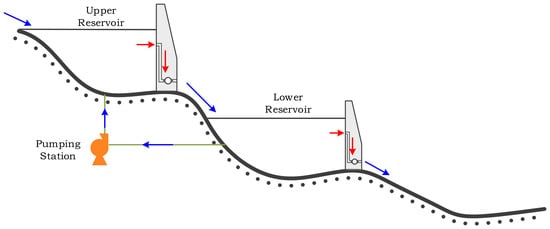
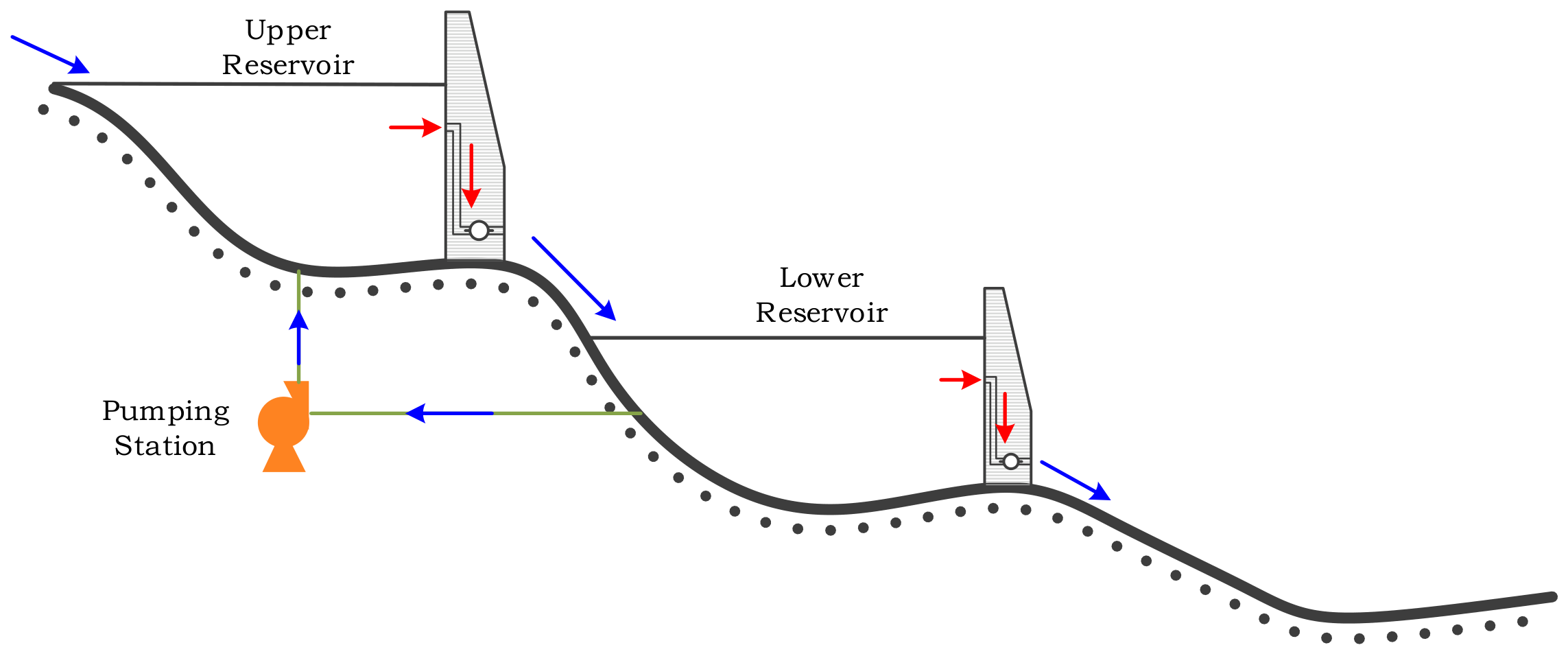
A cascade “energy storage plant” is essentially a large-scale pumping station installed between two cascade reservoirs, typically retrofitted onto existing cascade reservoirs. It features high pumping capacity, long regulation cycles, and strong operational safety, without causing significant ecological and environmental issues. A schematic diagram of the “energy storage plant” pumping station is shown in Figure 1. The fundamental principle of operation involves the joint regulation and storage of water by the cascade reservoirs and the pumping station to achieve the recycling of water resources. Specifically, surplus wind and solar renewable energy from the power grid or system is converted into the potential energy of water in the upper reservoir, thereby facilitating the transfer and storage of electrical energy. This process not only increases the available water volume for power generation in the upper reservoir but also raises the water level in the upper reservoir, thereby enhancing its power generation capacity and efficiency. Importantly, the pumping operations of the energy storage pumping station do not interfere with the normal operation of the conventional cascade hydropower generating units.
Figure 1.
Cascade energy storage power station composition.
2.3. Reversible Unit Capacity Expansion
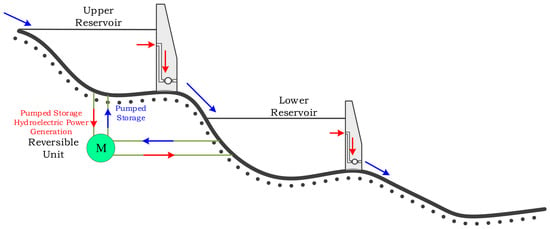
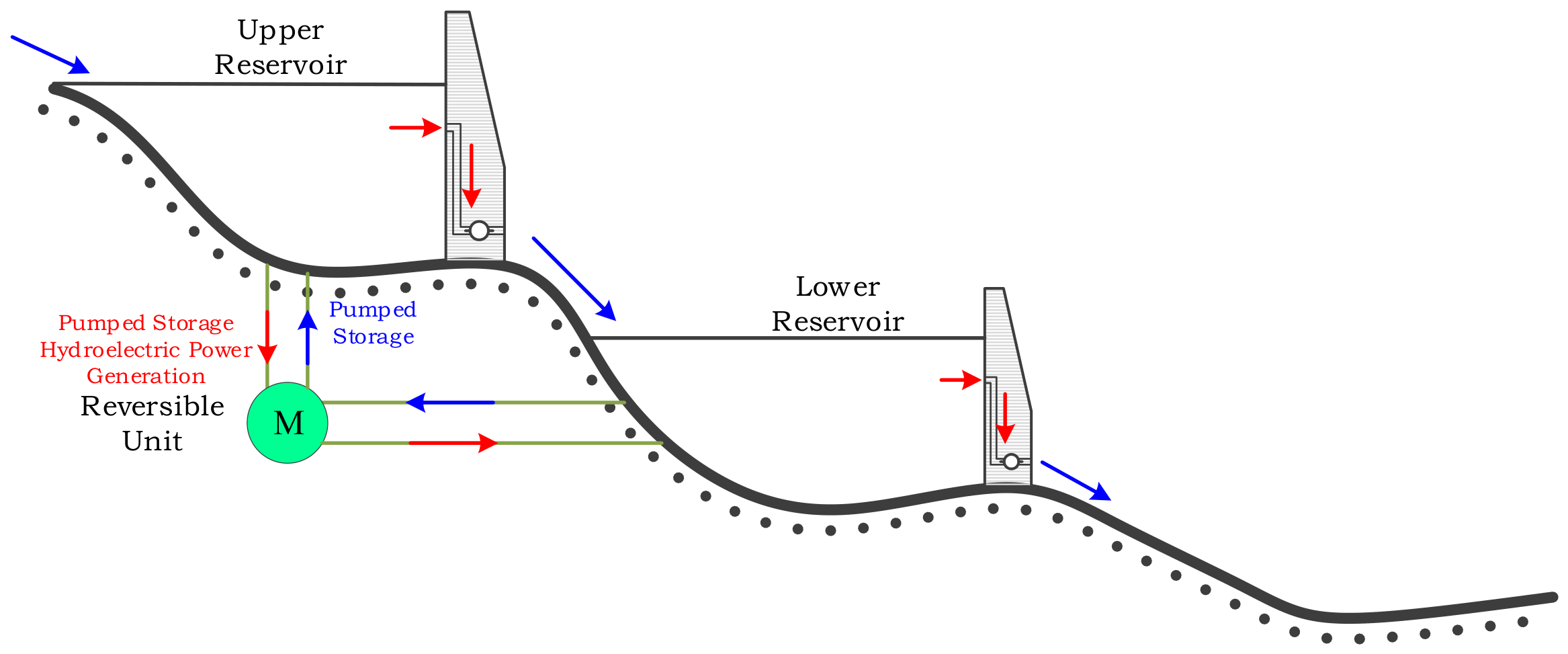
Hydropower reversible units, also known as hybrid pumped storage, refer to the practice of adding reversible units to existing hydropower stations to enhance hydro–wind–solar flexibility, thereby facilitating renewable energy integration. As shown in Figure 2, when wind and solar renewable energy cannot be directly absorbed by the power grid, the reversible units pump water to the upper reservoir, converting the excess renewable energy into the potential energy of water for storage. When there is a significant peak regulation gap in the power grid, the reversible units can generate electricity using the water head of the upper reservoir hydropower station, providing power support to the grid system. Compared to energy storage plant pumping stations, hybrid pumped storage not only smooths out the fluctuations in renewable energy output and achieves energy conversion but also operates more flexibly, offering stronger peak generation capabilities. However, the operation of hybrid pumped storage power stations is more complex, as pumping and power generation cannot be carried out simultaneously.
Figure 2.
Cascade hybrid pumped storage power station composition.
To quantify the impact of different water energy storage measures on hydro–wind–solar flexibility, a multi-objective optimal dispatch model is first established to compare the conditions before and after reservoir desilting. This quantifies the effect of reservoir desilting on cascade hydropower generation and hydro–wind–solar flexibility, referred to as Scenario 1 and Scenario 2, respectively. Subsequently, based on reservoir desilting and considering the large-scale integration of wind and solar renewable energy, the following three scenarios are set up for complementary modeling and analysis of water, wind, and solar energy storage: (1) Scenario 3: Reservoir desilting only. (2) Scenario 4: Reservoir desilting + “Energy Storage Plant” pumping station. (3) Scenario 5: Reservoir desilting + hybrid pumped storage. Table 1 presents the cascade water energy storage scenario settings.
Table 1.
Scenario setting for cascade water energy storage measures.
3. Formulation and Solution of Cascade Water Energy Storage Dispatch Model
In response to the water energy storage measure scenarios set in Section 2, considering the integration of wind and solar renewable energy as well as the peak regulation demands of the power grid, and under the strict constraint of water resource utilization (“determining electricity generation based on water availability”), a short-term multi-objective optimal dispatch model for the cascade water energy storage system in the Gansu section of the Yellow River basin is established with the objectives of increasing the power generation of cascade hydropower and reducing the peak regulation pressure on the power grid. The inputs to the model include: the inflow process of the cascade reservoirs and the interval inflow process, the power grid load process, the output process of wind and solar renewable energy, the parameters and boundary conditions of the cascade hydropower stations, the water use plans of the cascade hydropower stations, and the parameters of the energy storage pumping stations and reversible units, etc.
3.1. Objective Functions
A short-term multi-objective optimal dispatch model for the cascade hydropower stations and water energy storage system is established, considering the power generation benefits and the peak regulation capability of the power grid. The objective functions are as follows:
- (1)
- Maximizing the average daily output of the cascade water energy storage system.
Equation (1) directly maximizes f1; it is not transformed into a minimization objective. Because the summation covers every station and scheduling period, f1 represent the average daily output of the entire cascade, not the output of reservoir 1 alone. The installed capacities listed in Table 2 sum to 3231.2 MW. The optimized daily average need not equal this nameplate total: generation is constrained by natural inflow, stored water, water-use plans, and the need to adjust hydropower output to accommodate wind and PV generation. Outside the flood season, seasonal runoff also makes continuous full-load operation difficult.
Table 2.
Parameters of cascade hydropower plants in the Gansu section of the Yellow River Basin.
- (2)
- Minimizing the Standard Deviation of the Grid’s Remaining Load
For grid-connected cascade hydropower, cascade water energy storage, or wind-solar-cascade water energy storage systems, the smaller the standard deviation of the grid’s remaining load, the stronger the peak regulation capability of the system [21]. Therefore, this paper uses the standard deviation of the remaining load to measure the size of the system’s peak regulation capability. The expression for the second objective function is as follows:
where represents the residual load process of the power grid; L represents the load process of the power grid; and Npower represents the total output process of the system. When only considering the cascade hydropower or cascade water energy storage system, Npower represents the total output process of the hydropower; when considering the large-scale integration of renewable energy, Npower represents the combined total output process of hydropower, wind power, and photovoltaic (PV) power.
3.2. Constraints
- (1)
- Water Balance Constraints
QIt,m+1 = QOt,m + QIt,m:m+1
- (2)
- Reservoir Water Level Constraints
- (3)
- Conventional Hydropower Unit Output Constraints
- (4)
- Downstream Flow Constraints
- (5)
- Reservoir Characteristic Constraints
- (6)
- Dispatch Boundary Constraints
- (7)
- Pumping Station/Reversible Unit Pumping Flow Constraints
- (8)
- Pumping Station/Reversible Unit Renewable Energy Absorption Constraints
At the rated operating point, electrical pumping power is approximated by , where ρ is water density, g is gravitational acceleration, Q is pumping flow, H is pumping head, and η is pumping efficiency. With Q = 160 m3/s, H = 115 m, and η = 0.9, the relation yields approximately 200 MW, consistent with the specified rated power. Equations (13) and (14) impose operating bounds; this short-term comparison uses a fixed-head, fixed-efficiency rated-point approximation rather than head-dependent pump or efficiency curves. The rated-point relation checks parameter consistency; it is not an additional time-varying equality constraint in the optimization.
- (9)
- Reversible Unit Downstream Flow Constraints
- (10)
- Mutually Exclusive Operating-State Constraints for Reversible Units
3.3. Solving Multi-Objective Models
The natural inflow to the reservoirs and the interval inflows are known, and the initial and final water levels of each reservoir are also known. The decision variables of the model include: the water levels of the cascade reservoirs at other times during the dispatch period, the operating status of the energy storage pumping stations/reversible units, and their pumping/discharge flow rates. The Multi-Objective Differential Evolution Algorithm (Non-dominated Sorting Differential Evolution, NSDE) is a population-based intelligent optimization algorithm. Compared with the traditional genetic algorithm (NSGA-II), it has the characteristics of simple structure, fewer control parameters, strong global convergence ability, and robustness [22]. For the detailed steps of the algorithm, please refer to the literature [6]. Therefore, this paper adopts the NSDE algorithm to solve the short-term multi-objective optimal dispatch model of the cascade water energy storage system in the Gansu section of the Yellow River basin, and obtains the corresponding Pareto solution set.
3.4. Multi-Objective Fuzzy Evaluation
According to non-dominated sorting, every solution in the Pareto set is non-dominated and represents a candidate trade-off. A fuzzy decision-making method [23] is therefore used to normalize the objective values, rank the candidate solutions, and identify the best compromise solution.
For each evaluated Pareto set, the membership degree η(k,j) of solution j under objective k is scaled to [0, 1]. A value of 1 denotes the most preferred objective value and 0 the least preferred value. The membership function for a minimization objective is:
When the optimization objective is to minimize the function:
where η(k,j) denotes the membership degree of solution j for objective k; f(k,j) is its objective value; and fmax(k) and fmin(k) are the maximum and minimum values of objective k among the evaluated Pareto solutions.
For a maximization objective, the membership function is:
The aggregate fuzzy decision value of Pareto solution j is then calculated as:
where K is the number of objective functions, and J is the number of solutions in the Pareto set. The numerator sums the membership degrees of solution j across all K objectives, and the denominator normalizes the scores across all J solutions. Because no preference weights are imposed, the objectives enter with equal weight. The solution with the maximum γ(j) is selected as the best compromise solution; a larger γ(j) indicates better overall performance under the two objectives [24].
4. Case Study
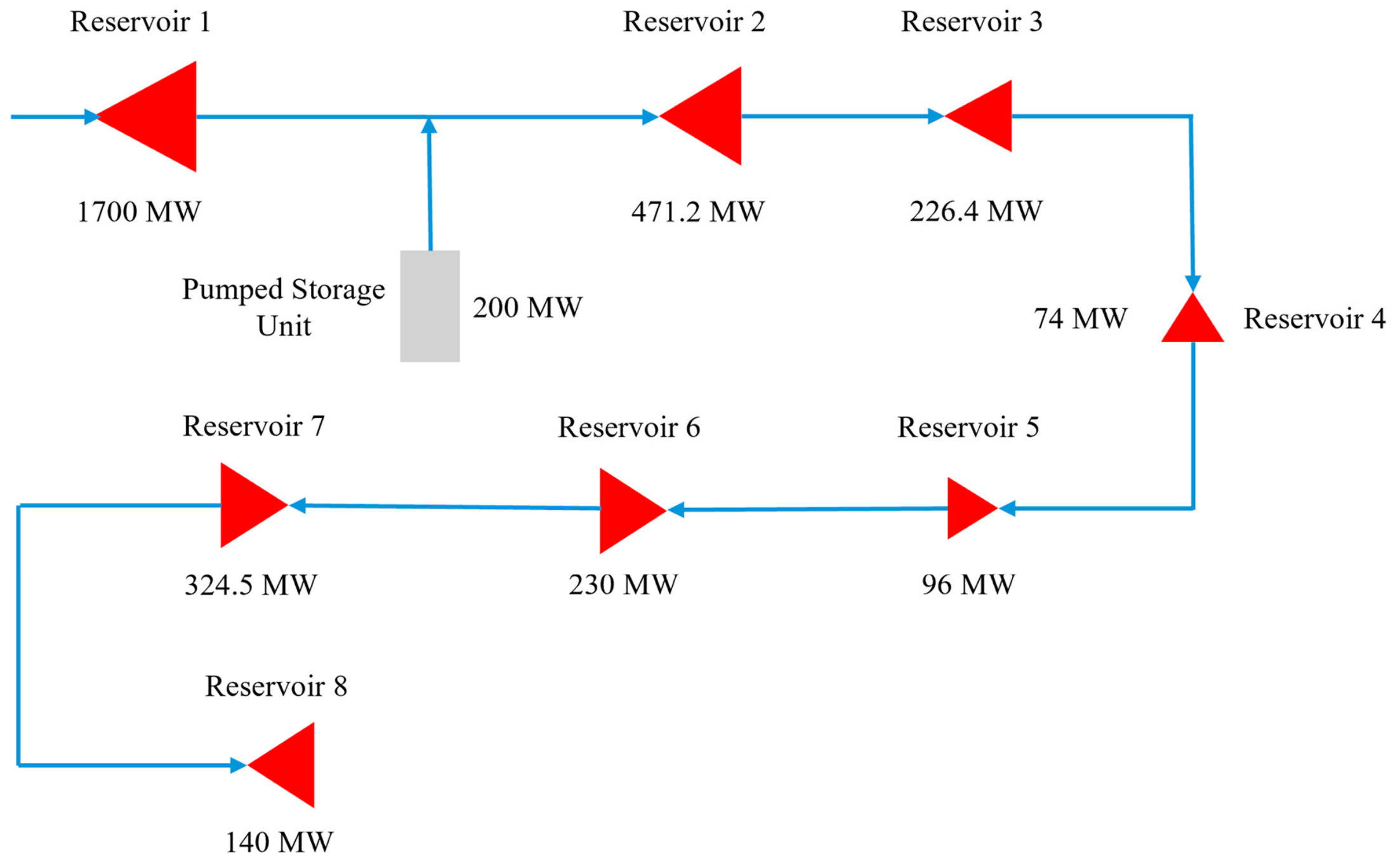
This study takes the cascade hydropower stations in the Gansu section of the Yellow River Basin as a case study, including eight cascade hydropower station reservoirs: reservoir 1, reservoir 2, reservoir 3, reservoir 4, reservoir 5, reservoir 6, reservoir 7, and reservoir 8. These reservoirs are important power supply and peak-regulating power sources in Gansu Province. Among them, reservoir 1, as the “leading reservoir”, has incomplete annual regulation performance. The parameters of the cascade hydropower stations in the Gansu section of the Yellow River Basin are shown in Table 2. Reservoir 2 is located downstream of reservoir 1. It was designed with intraday regulation performance during planning and construction, and controls the inflow process of several downstream reservoirs with poor regulation capacity. However, reservoir sedimentation accumulated during long-term operation has restricted operational responsiveness, thereby seriously constraining intra-day hydro–wind–solar flexibility in the Gansu section of the Yellow River Basin. Therefore, reservoir desilting is mainly targeted at reservoir 2 to strengthen hydro–wind–solar flexibility through the coordinated operation of Yanguoxia and the downstream cascade hydropower stations.
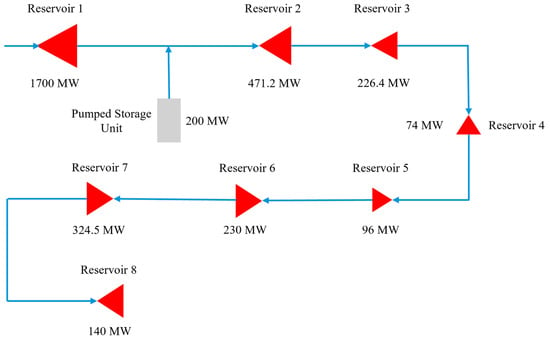
As shown in Table 2, reservoir 1 has a large regulation storage capacity and is located relatively close to reservoir 2 downstream, which also has a certain degree of regulation capability. Therefore, there is potential to install pumped storage/reversible units between reservoir 1 and reservoir 2. The pumping station and reversible units are each assigned a rated power of 200 MW, a rated pumping flow of 160 m3/s, a rated pumping head of 115 m, and an energy conversion efficiency of 0.9. In the scenarios with wind and PV integration, their installed capacities are 4000 MW and 4500 MW, respectively. Their time-varying generation profiles enter as exogenous dispatch inputs; the numerical time series are not tabulated here. A schematic diagram of the cascade water energy storage system in the Gansu section of the Yellow River is shown in Figure 3.
Figure 3.
Cascade pumped storage system of the Gansu section of the Yellow River Basin.
5. Results and Discussion
5.1. Reservoir Desilting Enhances Hydro–Wind–Solar Flexibility
Based on scenarios 1 and 2 set in Section 2, the short-term optimal scheduling model of the cascade water energy storage system in the Gansu section of the Yellow River Basin is established, which is recorded as Model 1 and Model 2, respectively. One representative day from each of the Water Supply Period, Spring Irrigation Period, Flood Season, and Ice Flood Prevention Period was selected using simultaneous backward reduction (SBR) [25] for comparative analysis. This seasonal selection captures contrasting runoff conditions that strongly influence cascade dispatch, but four days cannot span the full range of seasonal and interannual hydrological variability; the findings should therefore be interpreted as representative case comparisons rather than an exhaustive assessment of all operating conditions. The daily average inflow discharges at reservoir 1 on each typical day were: 1320 m3/s, 1100 m3/s, 2160 m3/s, and 982 m3/s, respectively.
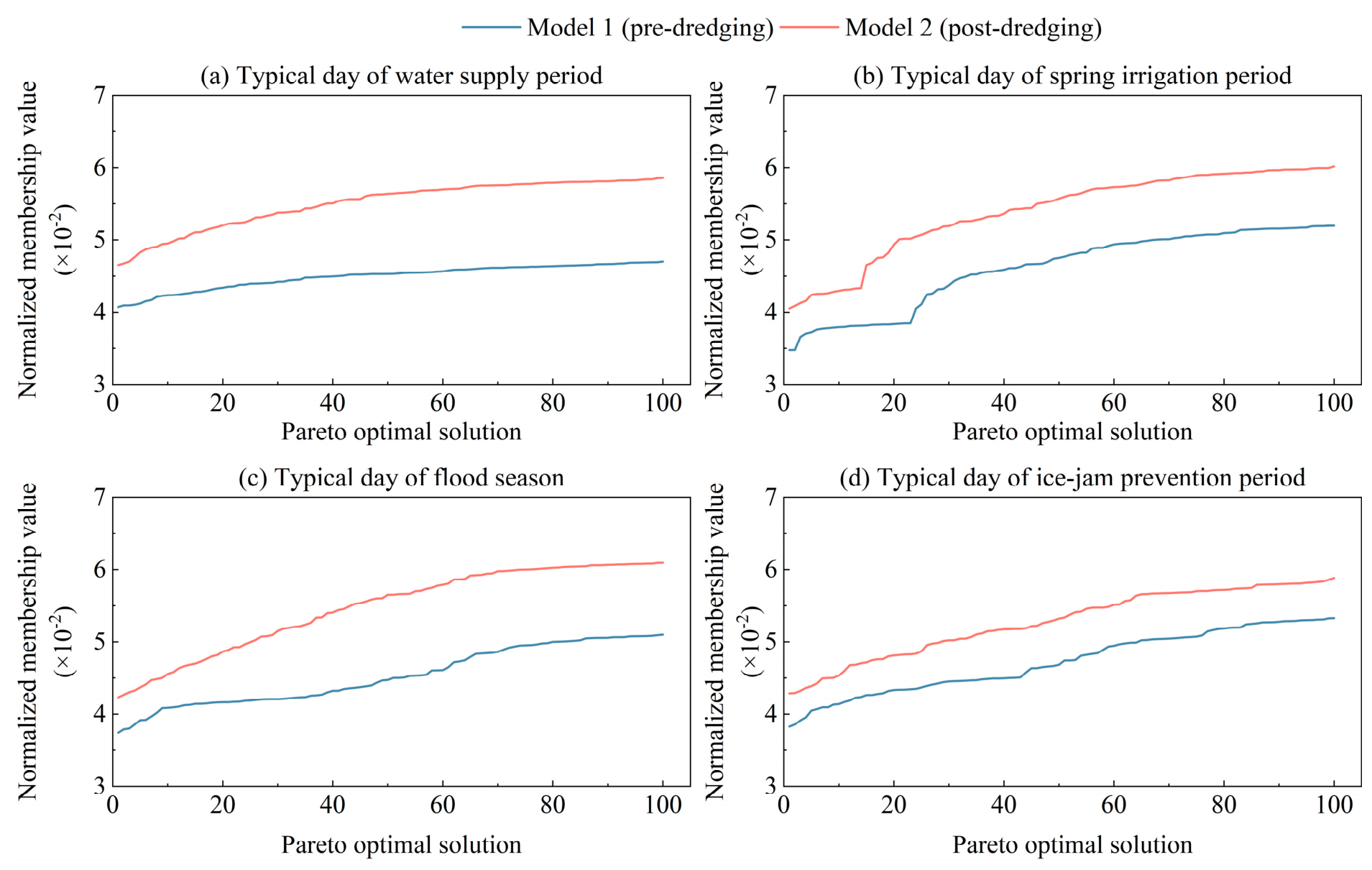
The models were solved for typical days during the Water Supply Period, Spring Irrigation Period, Flood Season, and Ice-jam Flood Prevention Period for Model 1 and Model 2, yielding the Pareto solution sets as shown in Figure 4. As shown in Figure 4, there is a clear trade-off relationship between the power generation of the cascade hydropower stations and their peak-shaving performance: the higher the power generation of the cascade hydropower, the larger the standard deviation of the residual load, indicating a greater peak-shaving deficit that needs to be covered by other power sources in the grid. Compared with the conventional operation of the cascade hydropower stations, the Pareto solutions obtained from Model 2, which is solved after the desilting of reservoir 2, are superior to those of Model 1, especially in terms of hydro–wind–solar flexibility, as reflected by system peak-shaving performance. Further comparison of the overall performance of the Pareto solutions of Model 1 and Model 2 was conducted using normalized membership degree values, with the results shown in Figure 5. As shown in Figure 5, the normalized-membership composite evaluation of generation and peak shaving improves by 18.0% on average after reservoir 2 dredging. This composite measure differs from the 27.8% peak-shaving improvement measured by residual-load standard deviation at matched average daily cascade hydropower output. Specifically, the enhancements for typical days during the Water Supply Period, Spring Irrigation Period, Flood Season, and Ice-jam Flood Prevention Period are 22.6%,17.1%,20.8%, and 11.7%, respectively.
Figure 4.
Pareto solution sets of Model 1 and Model 2 on different typical days.
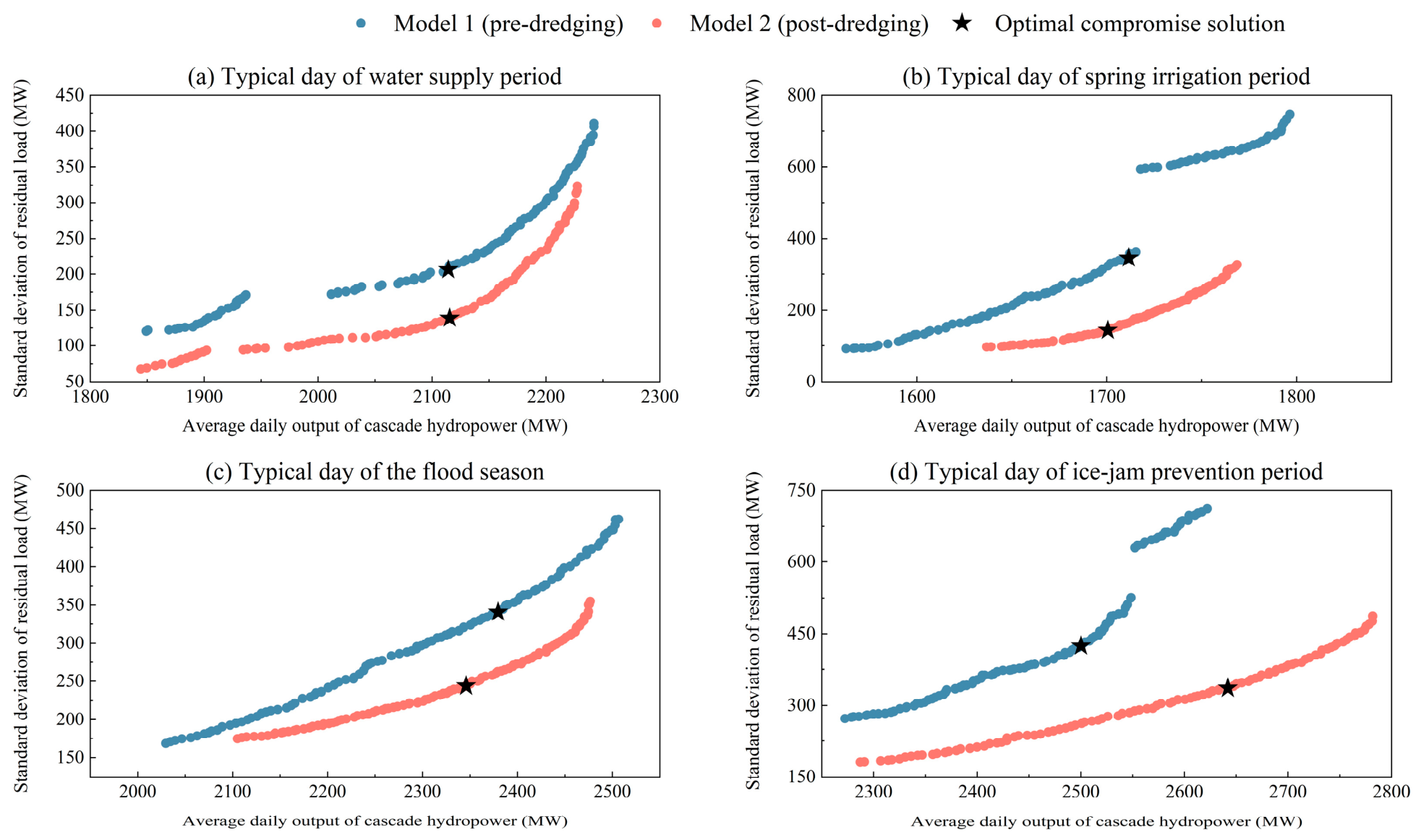
Figure 5.
Comparison of overall performance between Model 1 and Model 2 Pareto solutions on different typical days.
Through multi-objective fuzzy evaluation, the best compromise solution can be selected from the Pareto solution set, as shown in Figure 4. To further quantitatively analyze the enhancement of hydro–wind–solar flexibility by water energy storage measures, the best compromise solutions of each model were taken as typical solutions to compare changes in hydro–wind–solar flexibility, as represented by system peak-shaving performance, at matched average daily cascade hydropower output. The results are shown in Table 3. The analysis results of typical days in each scheduling period show that reservoir 2 dredging reduces the residual-load standard deviation by 27.8% on average, representing a peak-shaving improvement at matched cascade output, with improvements of 23.4% during the Water Supply Period, 34.2% during the Spring Irrigation Period, 31.2% during the Flood Season, and 22.6% during the Ice-jam Prevention Period.
Table 3.
Comparison of typical solutions for Model 1 and Model 2.
5.2. Analysis of Cascade Water Energy Storage Potential Development
Developing cascade water energy storage potential through pumped storage stations or reversible units can further enhance hydro–wind–solar flexibility and support deep renewable energy integration. To this end, considering the large-scale integration of wind and solar new energy, this paper establishes short-term multi-objective optimal operation models for the cascade water energy storage system in the Gansu section of the Yellow River for Scenario 3, Scenario 4, and Scenario 5 set in Section 2 and solves them, which are respectively referred to as Model 3, Model 4, and Model 5. Similarly, typical days during the Water Supply Period, Spring Irrigation Period, Flood Season, and Ice-jam Prevention Period were selected to conduct model optimization and multi-objective evaluation analysis. The Pareto solution sets obtained from the optimization are shown in Figure 6. It can be seen that the addition of a pumped storage station between reservoir 1 and reservoir 2 plays a significant role in peak shaving and valley filling: under the same output of the cascade water energy storage system, hydro–wind–solar flexibility, as reflected by the system’s peak-shaving performance, is significantly enhanced. Moreover, with the same water consumption by the cascade hydropower stations, the pumped storage station achieves a water resource cycle in the upper reservoir. Therefore, when hydro–wind–solar flexibility is held constant, compared with the conventional joint operation of water, wind, and solar energy, the output of the cascade hydropower is significantly increased. Unlike pumped storage stations, which can only pump water for energy storage, reversible units have a more flexible operating mode. They can not only integrate wind and solar energy but also provide power support during peak load periods. While increasing the power generation of the cascade water energy storage system, they significantly enhance hydro–wind–solar flexibility. As shown in Figure 6, the Pareto solutions obtained from solving Model 5 are clearly superior to those of Model 3 and Model 4 in terms of both power generation and hydro–wind–solar flexibility.
Figure 6.
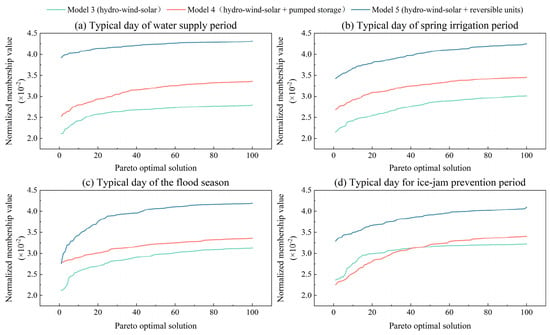
Pareto solution sets of Model 3, Model 4 and Model 5 on different typical days.
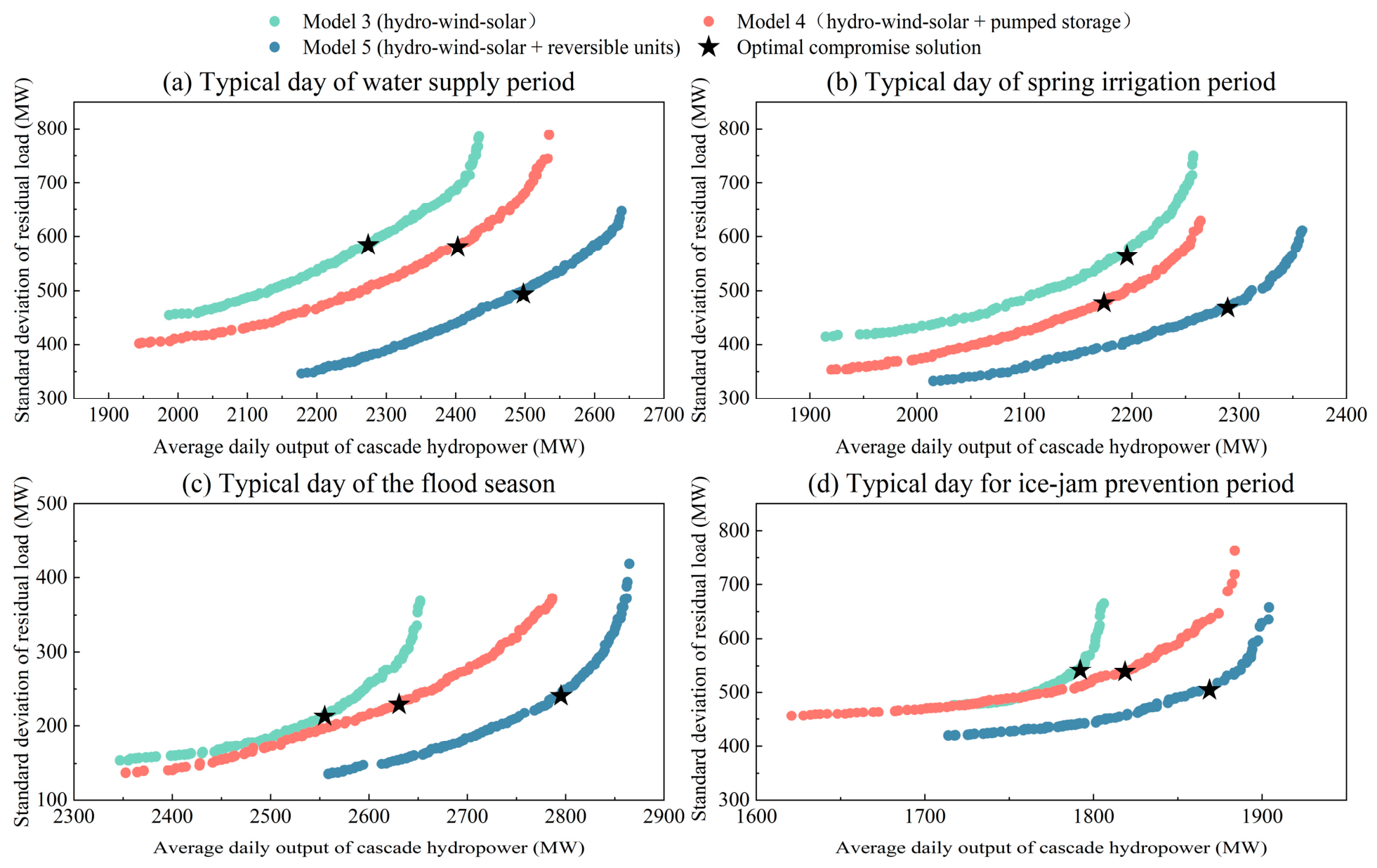
The horizontal axis of Figure 6 likewise shows the total average daily cascade hydropower output defined by Equation (1).
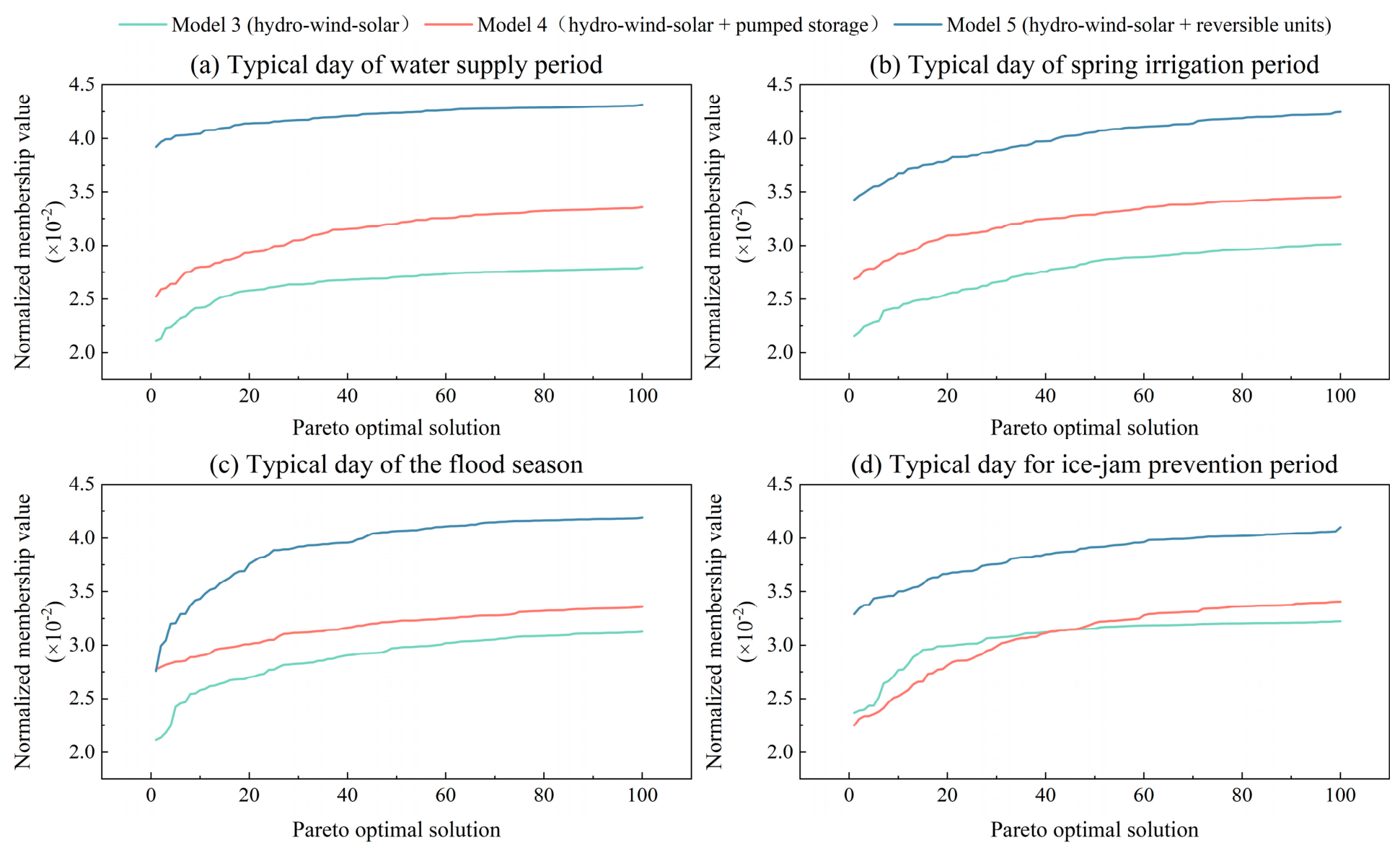
The best compromise solutions obtained by the multi-objective fuzzy decision method for each model are shown in Figure 7. In certain scenarios (typical spring irrigation period days and flood season days), Model 5′s best compromise solution exhibits higher output from the cascade hydro energy storage system. However, no comparable solutions exist in the Pareto solution sets of Model 3 and Model 4. Therefore, the overall performance of different schemes for developing hydro energy storage potential was quantified solely through comparison of normalized membership values, with results presented in Figure 7.
Figure 7.
Comparison of overall performance between Model 3, Model 4 and Model 5 Pareto solutions on different typical days.
As indicated in Figure 7, adding an energy storage pumping station between reservoir 1 and reservoir 2 enhances the overall power-generation performance and hydro–wind–solar flexibility of the system in the Gansu section of the Yellow River Basin by 11.3%. Specifically, improvements of 18.0%, 17.2%, and 9.6% were observed during typical water supply period days, spring irrigation period days, and flood season days, respectively. However, under stricter water resource utilization constraints during the ice prevention period (critical water regulation phase), the increase was only 0.4%. Alternatively, installing reversible units of equivalent capacity at the same location boosts system performance by 41.0%, with enhancements of 58.5%, 44.4%, 36.1%, and 25.2% during typical days of the water supply, spring irrigation, flood, and ice prevention periods, respectively. Consequently, under the specified capacities and the modeled generation and peak-shaving objectives, reservoir dredging coupled with reversible-unit expansion is the best-performing scheme among those evaluated for the Gansu section of the Yellow River Basin.
6. Conclusions
To enhance hydro–wind–solar flexibility and enable deep renewable energy accommodation, this study takes the Gansu section of the Yellow River Basin as the research object. A method is proposed to optimize the development of cascade hydro energy storage potential. A short-term multi-objective optimal scheduling model for cascade hydro energy storage systems was established and solved. Through multi-objective fuzzy evaluation, quantitative analysis was conducted on the impacts of enhancement measures including reservoir dredging, energy storage pumping stations, and reversible units on system power generation and peak-shaving capacities. The principal conclusions are as follows:
- (1)
- Reservoir sedimentation can severely constrain hydro–wind–solar flexibility. Through sediment removal at reservoir 2, releasing its regulation storage capacity, the normalized-membership composite evaluation of generation and peak shaving for the Gansu section of the Yellow River Basin improves by 18.0% on average. At matched average daily cascade hydropower output, peak-shaving performance measured by residual-load standard deviation improves by 27.8% on average.
- (2)
- The construction of a pumped storage station between reservoir 1 and reservoir 2 can enhance overall power-generation performance and hydro–wind–solar flexibility in the Gansu Section of the Yellow River Basin by 11.3%. However, during the ice flood prevention period with stringent water resource constraints, the enhancement effect is not significant.
- (3)
- Under the fixed capacities and operational objectives considered here, reservoir dredging combined with reversible-unit expansion is the best-performing scheme among the evaluated alternatives for the Gansu section of the Yellow River Basin. Compared to a pumped storage station, reversible units not only enable the integration of renewable energy but also provide grid support during peak load periods, significantly enhancing hydro–wind–solar flexibility.
This study focuses on how different forms of cascade water energy storage affect short-term dispatch and does not optimize their installed capacities. The pumping station and reversible unit were each assigned a rated capacity of 200 MW for the scenario comparison. Accordingly, the operational ranking reported here should not be interpreted as an economic optimum. Future work will jointly optimize capacity configuration and dispatch and use techno-economic analysis to assess capital and operating costs, benefits, and payback periods, including comparison with other flexibility resources.
Author Contributions
Methodology, Y.G.; validation, X.G.; investigation, B.Y. and Y.G.; resources, P.Z., K.L. and X.G.; data curation, Y.G., P.Z., K.L. and X.G.; writing—original draft, B.Y., Y.G. and Y.H.; writing—review and editing, Y.H. and Y.L.; visualization, Y.H.; supervision, Y.H. and Y.L.; project administration, B.Y., P.Z., K.L. and Y.L.; funding acquisition, B.Y. All authors have read and agreed to the published version of the manuscript.
Funding
This research was funded by Shaanxi Province Key Research and Development Program Project, grant number [2024SF-ZDCYL-05-10].
Data Availability Statement
Data will be made available on request.
Acknowledgments
This study was supported by the following grants: Shaanxi Province Key Research and Development Program Project [grant number 2024SF-ZDCYL-05-10].
Conflicts of Interest
Author Bo Yi, Ping Zhang, Kunming Lu and Xingtao Guo were employed by the company Power China Northwest Engineering Corporation Limited. The remaining authors declare that the research was conducted in the absence of any commercial or financial relationships that could be construed as a potential conflict of interest.
References
- Zhou, H.; Lu, L.; Shen, L.; Zhang, P.; Wen, Y.; Jiang, H.; Yang, S. Two-stage robust optimal capacity configuration of a wind, photovoltaic, hydropower, and pumped storage hybrid energy system. Front. Energy Res. 2023, 11, 1275232. [Google Scholar] [CrossRef] [Scilit]
- Zhao, D.; Ma, M.; Yuan, C.; Lv, Q. Optimal dispatching of wind turbine-photovoltaic-pumped storage new energies and thermal generators combined distribution network. J. Phys. Conf. Ser. 2024, 2703, 012033. [Google Scholar] [CrossRef] [Scilit]
- Liu, S.; Yan, J.; Yan, Y.; Zhang, H.; Zhang, J.; Liu, Y.; Han, S. Joint operation of mobile battery, power system, and transportation system for improving the renewable energy penetration rate. Appl. Energy 2024, 357, 122455. [Google Scholar] [CrossRef] [Scilit]
- Tian, C.; Tan, Q.; Fang, G.; Wen, X. Hydrogen production to combat power surpluses in hybrid hydro–wind–photovoltaic power systems. Appl. Energy 2024, 371, 123627. [Google Scholar] [CrossRef] [Scilit]
- Liu, Y.; Zhang, H.; Guo, P.; Li, C.; Wu, S. Optimal scheduling of a cascade hydropower energy storage system for solar and wind energy accommodation. Energies 2024, 17, 2734. [Google Scholar] [CrossRef] [Scilit]
- Guo, Y.; Ming, B.; Huang, Q.; Jiang, J.; Yu, M.; San, M.; Cheng, L.; Jia, R. Evaluating the flexibility supply and demand reliability of hydro–wind–PV–battery complementary systems under different consumption modes. Appl. Energy 2025, 379, 124972. [Google Scholar] [CrossRef] [Scilit]
- Hansen, C.; Ghimire, G.R.; Kao, S.C. Evaluation of nominal energy storage at existing hydropower reservoirs in the US. Water Resour. Res. 2022, 58, e2022WR032210. [Google Scholar] [CrossRef] [Scilit]
- Javed, M.S.; Ma, T.; Jurasz, J.; Amin, M.Y. Solar and wind power generation systems with pumped hydro storage: Review and future perspectives. Renew. Energy 2020, 148, 176–192. [Google Scholar] [CrossRef] [Scilit]
- Liu, H.; Shi, L.; Fu, H.; Wu, F. Short-term optimization scheduling method of cascade hydropower and photovoltaic complementary system based on pumping station operation strategy. Front. Energy Res. 2024, 12, 1367135. [Google Scholar] [CrossRef] [Scilit]
- Luo, B.; Liu, X.; Chen, Y.; Zhou, C.; Long, X. Short-term peak shaving model of cascade hybrid pumped storage hydropower station retrofitted from conventional hydropower. Int. J. Electr. Power Energy Syst. 2024, 162, 110226. [Google Scholar] [CrossRef] [Scilit]
- Cheng, X.; Zhao, H.; Zhang, Y.; Hao, X. A study on site selection of pumped storage power plants based on C-OWA-AHP and VIKOR-GRA: A case study in China. J. Energy Storage 2023, 72, 108623. [Google Scholar] [CrossRef] [Scilit]
- Peng, Y.; Yang, Y.; Chen, M.; Wang, X.; Xiong, Y.; Wang, M.; Li, Y.; Zhao, B. Value evaluation method for pumped storage in the new power system. Chin. J. Electr. Eng. 2023, 9, 26–38. [Google Scholar] [CrossRef] [Scilit]
- Wang, Z.; Tan, Q.; Wen, X.; Su, H.; Fang, G.; Wang, H. Capacity optimization of retrofitting cascade hydropower plants with pumping stations for renewable energy integration: A case study. Appl. Energy 2025, 377, 124429. [Google Scholar] [CrossRef] [Scilit]
- Zhang, J.; Cheng, C.; Yu, S.; Shen, J.; Wu, X.; Su, H. Preliminary feasibility analysis for remaking the function of cascade hydropower stations to enhance hydropower flexibility: A case study in China. Energy 2022, 260, 125163. [Google Scholar] [CrossRef] [Scilit]
- Bhimaraju, A.; Mahesh, A.; Joshi, S.N. Techno-economic optimization of grid-connected solar-wind-pumped storage hybrid energy system using improved search space reduction algorithm. J. Energy Storage 2022, 52, 104778. [Google Scholar] [CrossRef] [Scilit]
- Wang, Z.; Fang, G.; Wen, X.; Tan, Q.; Zhang, P.; Liu, Z. Coordinated operation of conventional hydropower plants as hybrid pumped storage hydropower with wind and photovoltaic plants. Energy Convers. Manag. 2023, 277, 116654. [Google Scholar] [CrossRef] [Scilit]
- Wang, H.; Liao, S.; Cheng, C.; Liu, B.; Fang, Z.; Wu, H. Short-term scheduling strategies for hydro-wind-solar-storage considering variable-speed unit of pumped storage. Appl. Energy 2025, 377, 124336. [Google Scholar] [CrossRef] [Scilit]
- Jing, Z.; Wang, Y.; Chang, J.; Wang, X.; Guo, A.; Meng, X. Construction of pumped storage power stations among cascade reservoirs to support the high-quality power supply of the hydro-wind-photovoltaic power generation system. Energy Convers. Manag. 2025, 323, 119239. [Google Scholar] [CrossRef] [Scilit]
- Wu, X.; Yan, Z.; Yang, H.; Wang, S.; Zhang, H.; Shen, Y.; Song, S.; Liu, Y.; Guo, Y.; Yang, D.; et al. Ecological restoration in the Yellow River Basin enhances hydropower potential. Nat. Commun. 2025, 16, 2566. [Google Scholar] [CrossRef] [Scilit] [PubMed]
- Khan, M.A.; Stamm, J.; Haider, S. Simulating the impact of climate change with different reservoir operating strategies on sedimentation of the Mangla Reservoir, Northern Pakistan. Water 2020, 12, 2736. [Google Scholar] [CrossRef] [Scilit]
- Jiang, J.; Ming, B.; Liu, P.; Huang, Q.; Guo, Y.; Chang, J.; Zhang, W. Refining long-term operation of large hydro–photovoltaic–wind hybrid systems by nesting response functions. Renew. Energy 2023, 204, 359–371. [Google Scholar] [CrossRef] [Scilit]
- Storn, R.; Price, K. Differential evolution–a simple and efficient heuristic for global optimization over continuous spaces. J. Glob. Optim. 1997, 11, 341–359. [Google Scholar] [CrossRef] [Scilit]
- Qu, B.Y.; Zhu, Y.S.; Jiao, Y.C.; Wu, M.; Suganthan, P.; Liang, J. A survey on multi-objective evolutionary algorithms for the solution of the environmental/economic dispatch problems. Swarm Evol. Comput. 2018, 38, 1–11. [Google Scholar] [CrossRef] [Scilit]
- Guo, Y.; Ming, B.; Huang, Q.; Liu, P.; Wang, Y.; Fang, W.; Zhang, W. Evaluating effects of battery storage on day-ahead generation scheduling of large hydro–wind–photovoltaic complementary systems. Appl. Energy 2022, 324, 119781. [Google Scholar] [CrossRef] [Scilit]
- Heitsch, H.; Römisch, W. Scenario reduction algorithms in stochastic programming. Comput. Optim. Appl. 2003, 24, 187–206. [Google Scholar] [CrossRef] [Scilit]

Disclaimer/Publisher’s Note: The statements, opinions and data contained in all publications are solely those of the individual author(s) and contributor(s) and not of MDPI and/or the editor(s). MDPI and/or the editor(s) disclaim responsibility for any injury to people or property resulting from any ideas, methods, instructions or products referred to in the content. |
© 2026 by the authors. Licensee MDPI, Basel, Switzerland. This article is an open access article distributed under the terms and conditions of the Creative Commons Attribution (CC BY) license.