


Abstract
The global revival of nuclear power raises questions about whether nuclear energy technology innovation strengthens uranium supply chain security. Using a panel of 42 nuclear-related countries and regions from 2007 to 2025, this study constructs a 16-indicator security index covering domestic production and supply, overseas equity resources, domestic resource reserves, and international trade, and measures nuclear energy technology innovation using lagged forward citations to nuclear patents. The results show that innovation significantly improves domestic uranium supply chain security (the baseline coefficient is 0.011, equivalent to about 8.3% of the sample mean). Mediation analysis identifies domestic resource expansion as the most robust channel, with weaker support for production continuity and less stable evidence for overseas equity access. The innovation–security association is stronger where financial development is lower and initial overseas equity holdings are larger. Cross-border estimates provide suggestive evidence of a positive upstream-supplier spillover and a negative downstream-customer spillover, with both results supported mainly at the 10% level. These findings suggest that nuclear innovation can improve domestic uranium security while potentially redistributing benefits and risks across the international uranium supply chain.
1. Introduction
As the global energy system moves from a singular emphasis on low-carbon transition toward the joint pursuit of decarbonization and energy security, nuclear energy has returned to the center of the energy strategies of major economies. Compared with intermittent renewable sources such as wind and solar power, nuclear power combines a high capacity factor with low life-cycle carbon emissions and stable electricity output. It can therefore provide dispatchable baseload support during deep decarbonization while strengthening energy autonomy, industrial competitiveness, and progress toward climate targets [1,2,3,4]. In recent years, the International Atomic Energy Agency (IAEA) has repeatedly revised its projections for global nuclear power development upward, while leading nuclear countries have advanced multiple technology pathways, including large advanced pressurized-water reactors, small modular reactors, fast reactors, and high-temperature gas-cooled reactors. This renewed expansion raises the requirements placed on uranium mining, conversion, enrichment, fuel fabrication, and spent-fuel management. Uranium is therefore no longer merely an input to nuclear power generation; it has become a critical resource linking nuclear technological capability, the nuclear industrial system, and national energy security [5,6].
Unlike oil and natural gas, the uranium supply chain is characterized by concentrated upstream resources, concentrated midstream technologies, and technology-specific lock-in downstream. Natural uranium production is highly concentrated in a small number of resource-rich countries; conversion and enrichment capacity is controlled by a limited group of countries with long-standing technological and industrial capabilities; and fuel assemblies are constrained by reactor compatibility, licensing, and quality standards [7,8,9]. Consequently, national uranium supply chain security cannot be inferred from domestic reserves or the number of import sources alone. It depends on an integrated capacity that combines domestic production, overseas equity resources, strategic reserves, trade-network position, and the various stages of the nuclear fuel cycle. Recent disruptions associated with the Russia–Ukraine conflict, restrictions on nuclear-fuel trade, the substitution of VVER fuel, and bottlenecks in high-assay low-enriched uranium supply further demonstrate that uranium is not traded through a conventional homogeneous commodity chain. Concentration in critical processing, technology, and service segments can rapidly transmit localized shocks across the industrial chain and turn them into systemic risks [10,11,12,13].
At COP28, more than 20 countries endorsed the Declaration to Triple Nuclear Energy, which sets an aspirational goal of tripling global nuclear-energy capacity by 2050 [14], while the IAEA’s long-term outlook points to sustained expansion [15]. At the same time, nuclear energy innovation is extending beyond incremental improvements in reactor performance to advanced reactor designs, advanced fuels, digital operation and maintenance, and back-end fuel-cycle technologies (the IAEA high-case projection indicates that global nuclear generating capacity could reach approximately 950 GW by 2050, about 2.5 times the 2023 level [15]). Small modular reactors, fast reactors, and other emerging systems impose differentiated requirements on fuel enrichment, fuel forms, fabrication processes, and spent-fuel management [16,17]. Expansion of nuclear generation will also increase uranium demand [18] (the NEA and IAEA project that global reactor uranium demand will rise from about 68,000 tons per year in 2023 to around 86,000 tons per year by 2030, approaching 150,000 tons per year under a high-growth scenario by 2040). More importantly, innovation may reshape the structure and security boundaries of the uranium supply chain by altering exploration and extraction capabilities, fuel-use efficiency, processing-capacity allocation, and cross-border supply relationships. Current challenges involving HALEU availability, VVER fuel substitution, and spent-fuel recycling illustrate how changes in technology pathways affect the entire process from resource acquisition and processing to final utilization. Nuclear energy technology innovation should therefore be viewed not only as an industrial technology variable but also as a structural determinant of uranium supply chain security.
Existing research on uranium resources and supply chain security primarily analyzes these issues from perspectives including resource availability, trade relations, geopolitics, and supply network structures. Some scholars focus on uranium availability and nuclear-fuel assurance by evaluating resource endowments, mining investment, capacity expansion, conversion and enrichment capabilities, and import dependence [19,20,21]. Some scholars approach the topic from the standpoint of the critical minerals and energy security literature to investigate trade-network structure, supply concentration, geopolitical shocks, and supply chain resilience, emphasizing the roles of network centrality, source diversification, institutional conditions, and substitutability [22,23,24,25]. Additionally, some studies focus on nuclear technology innovation and its international diffusion, including technological evolution, patent collaboration, international nuclear-project networks, and technical standards. This literature highlights the cross-organizational and cross-border nature of nuclear innovation and shows that technology exports, project cooperation, and standards can reshape international nuclear-industry relationships [26,27,28,29].
Nevertheless, three gaps remain. First, existing explanations largely treat resource endowments, trade dependence, and geopolitical risk as exogenous conditions, paying insufficient attention to how technological progress endogenously expands the boundaries of economically available resources and resource utilization. They therefore cannot fully explain why countries with comparable endowments exhibit different uranium-security capabilities. Second, research on nuclear innovation has concentrated on technological evolution, patent collaboration, and industrial competitiveness, while the channels through which a technological advantage is converted into supply chain security, uranium-production continuity, domestic resource reserves, and overseas equity resources remain underexamined. Third, prior studies generally assess technological benefits from the innovating country’s perspective and rarely consider external effects transmitted along cross-border supply chains. Because the nuclear industry is characterized by technology specificity, path dependence, and long-term contracts, greater technological capability in one country may improve its own resource security while simultaneously restructuring the dependencies of upstream and downstream partners. Whether nuclear innovation creates broad-based security gains or redistributes security and vulnerability across countries therefore remains an open empirical question.
To address these gaps, this study uses panel data for 42 nuclear-related countries and regions over 2007–2025 to examine the effect of nuclear energy technology innovation on uranium supply chain security, its underlying mechanisms, and its cross-border risk spillovers. The study makes three contributions. First, it incorporates nuclear energy technology innovation into the analytical framework of uranium supply chain security and extends the literature beyond resource endowments, trade relationships, and geopolitical shocks by considering how technological progress changes resource availability and utilization efficiency. Second, it examines three potential mechanisms through which technological innovation may be converted into uranium supply chain security: improved uranium-production continuity, expanded domestic resource reserves, and enhanced access to overseas equity resources. It also tests heterogeneity using pooled interactions for financial development, initial domestic uranium resources, and initial overseas equity holdings; the panel-robust evidence is strongest for financial development and initial overseas equity, while the domestic-resource pattern is treated as suggestive. Third, it embeds the innovating country in the global uranium supply chain and distinguishes downstream customer countries from upstream supplier countries, thereby bringing domestic security gains and international risk redistribution into a unified framework. The remainder of the paper develops the hypotheses, introduces the data and empirical strategy, presents the results, and concludes with policy implications.
2. Theoretical Background and Hypotheses
2.1. Nuclear Energy Technology Innovation and Uranium Supply Chain Security
Mineral-resource availability theory holds that secure mineral supply does not depend solely on fixed geological reserves; it depends on the capacity to transform potential resources into usable resources under prevailing technological, cost, and industrial conditions [30,31]. Technological progress shifts the economic boundary of resource development, enabling deposits previously constrained by grade, depth, geological conditions, or cost to become economically recoverable [32]. Uranium deposits vary substantially in grade, occur under complex geological conditions, and require long development cycles. Advances in exploration, in situ leaching, integrated mining and metallurgy, and digital mining can increase discovery probabilities and recovery rates while reducing the cost of developing low-grade or complex deposits [33]. These resource-expansion innovations open new supply sources by moving additional deposits across the technical and economic boundary of recoverability. Moreover, natural uranium must pass through conversion, enrichment, and fuel fabrication before it can be used in nuclear power generation. Innovation in the relevant processes and equipment can ease these processing constraints. Nuclear energy technology innovation can thus improve effective domestic supply from discovery and development to processing and conversion, converting more potential resources into stable, usable supply and strengthening resilience to external volatility or disruption.
Induced technological change theory further suggests that, when critical inputs become scarce or costly, innovation is directed toward improving input efficiency, extending service life, and developing substitutes [34,35]. The resource value of nuclear fuel depends on the effective energy output obtained from each unit of natural uranium. Processing and fuel-cycle innovation extends this efficiency logic to the stages before and after reactor use: improvements in conversion, enrichment, and fuel fabrication reduce material losses and ease bottlenecks. High-burnup fuel, core optimization, online fuel management, spent-fuel reprocessing and recycling, and fast-reactor closed cycles can improve fuel utilization, lengthen refueling intervals, and recover usable nuclear materials from spent fuel [36,37,38]. For a given level of nuclear electricity output, higher fuel efficiency reduces incremental natural-uranium demand per unit of generation, extends the coverage provided by domestic resources, imports, and strategic inventories, and limits exposure to external procurement and short-term market fluctuations. Nuclear energy technology innovation therefore creates an additional security margin by increasing the usable energy and material services obtained from a given quantity of uranium.
H1.
Nuclear energy technology innovation significantly improves domestic uranium supply chain security through resource expansion and greater processing and fuel-cycle efficiency.
2.2. The Mediating Role of Uranium-Production Continuity
Operational-resilience theory regards continuity as the capacity to maintain critical functions during a disturbance and restore output within an acceptable period, rather than as nominal capacity alone [39]. This is especially important for uranium production, where ore-body heterogeneity, uncertain leaching conditions, equipment failures, and lengthy mine-development cycles can turn geological endowment into volatile realized output. Nuclear energy technology innovation narrows this gap between potential and realized supply. Advances in geological modeling and resource evaluation improve mine planning; improved in situ recovery and metallurgical processes raise recovery and permit flexible capacity adjustment; and intelligent sensing, process control, and production regulation allow operators to identify and correct abnormal conditions before disruptions become prolonged [33,39]. By making extraction and processing more observable, controllable, and adaptable, innovation increases uranium-production continuity.
Greater uranium-production continuity, in turn, strengthens domestic uranium supply chain security. Uranium mines and processing facilities have long development and restart periods, so output lost during a disruption cannot be replaced immediately. Stable domestic production narrows the recurrent gap between output and reactor requirements, supports predictable scheduling of downstream fuel-cycle stages, and allows commercial or strategic inventories to be replenished under normal conditions. It also reduces emergency purchases in concentrated international markets and preserves a domestic supply option when foreign deliveries are delayed. Because the nuclear fuel chain is sequential, fewer and shorter production interruptions also reduce the likelihood that a local shock will propagate downstream [7,39]. We propose:
H2.
Nuclear energy technology innovation indirectly improves uranium supply chain security by increasing uranium-production continuity.
2.3. The Mediating Role of Domestic Uranium Resource Reserves
Mineral-resource classification distinguishes uranium occurrences and potential resources from reserves that can be economically recovered under current technological, cost, and regulatory conditions [18,31]. Domestic reserves are therefore not fixed by geology alone. Innovation in geophysical and geochemical exploration, three-dimensional geological modeling, resource estimation, in situ recovery, and low-grade ore processing improves discovery, reduces uncertainty about grade and hydrogeological conditions, raises recovery rates, and lowers development costs. Previously undiscovered, inferred, technically constrained, or uneconomic deposits can thereby enter identified and recoverable reserve categories [31,32,33,40]. Nuclear energy technology innovation can consequently enlarge the economically recoverable domestic reserve base even when the underlying geological endowment is unchanged.
Larger domestic uranium reserves subsequently improve supply chain security by expanding the country’s long-term production options. Reserves do not provide immediate fuel like above-ground inventories, but they support the replacement of depleted mines, development of new production centers, and higher output when import conditions deteriorate. A larger reserve-to-requirement base lengthens the period for which domestic resources can support reactor demand, reduces structural dependence on foreign resources, and strengthens bargaining power in long-term procurement. It also gives governments and uranium enterprises greater flexibility to sequence mine development rather than commit to projects under adverse prices or geopolitical pressure. Evidence on uranium security likewise treats domestic exploration, recoverable resources, and production capability as complements to imports and overseas supply [5,18]. Accordingly, we propose:
H3.
Nuclear energy technology innovation indirectly improves uranium supply chain security by enlarging domestic uranium resource reserves.
2.4. The Mediating Role of Overseas Equity Uranium Resources
The eclectic paradigm of international production argues that firms invest abroad when their ownership advantages offset the costs and risks of foreign operations [41]. Overseas uranium projects involve substantial geological uncertainty, capital commitments, regulatory requirements, environmental obligations, and political risk. Proprietary capabilities in uranium exploration, resource evaluation, mining, in situ recovery, milling, and fuel-cycle integration reduce project-evaluation and operating costs and make nuclear enterprises more credible partners for host governments and local firms. Technological competence also enables an enterprise to combine resource investment with engineering, processing, safety management, training, and long-term fuel services. It therefore improves access to overseas projects through equity acquisition, joint exploration, mine development, and integrated nuclear cooperation [42,43,44,45,46]. Nuclear energy technology innovation can thereby support a larger portfolio of overseas equity uranium resources.
Overseas equity resources, in turn, enhance the home country’s uranium supply chain security. Unlike ordinary market purchases, an equity interest can provide a durable claim on project output, earlier information on production and investment plans, and a basis for coordinating mine supply with domestic fuel requirements. A geographically diversified equity portfolio reduces reliance on a single exporting country or spot market, stabilizes access to long-term volumes, and adds alternative channels when a trade route is disrupted. Foreign ownership cannot eliminate host-country regulation, resource nationalism, or geopolitical risk, but it increases the home country’s control, information, and bargaining capacity relative to arm’s-length procurement [25,45,46]. Accordingly, we propose:
H4.
Nuclear energy technology innovation indirectly improves uranium supply chain security by expanding access to overseas equity uranium resources.
2.5. Cross-Border Risk Spillovers of Nuclear Energy Technology Innovation
The effects of nuclear energy technology innovation extend beyond the innovating country. Because the nuclear industry combines technological specificity, systemic interdependence, and long-term contracts, stronger capability in one country can alter the availability, reliability, and direction of material flows among trading partners, generating international security spillovers.
For downstream customer countries, uranium supply depends on the realized output and processing capability of upstream suppliers rather than on geological endowments alone. Innovation in upstream resource-supplying countries improves deposit identification, extraction and recovery rates, production control, processing capacity, and product quality. These improvements expand economically available supply, increase production flexibility, and reduce the probability and duration of interruptions. Because international nuclear cooperation and fuel procurement connect uranium production with conversion, enrichment, fabrication, and reactor-specific services, the resulting gains reach downstream customers through long-term trade relationships as more stable deliveries and greater replacement capacity [40,47,48]. Upstream innovators may also acquire greater market power, but downstream security improves when the expansion, continuity, and substitutability effects dominate. Nuclear energy technology innovation in upstream countries can therefore generate a positive supply-side spillover for downstream customers.
For upstream resource-supplying countries, uranium mines require large capital commitments, long construction periods, and extended payback horizons. Production, capacity expansion, and continued exploration therefore depend heavily on stable and predictable long-term demand [21,40]. Innovation in downstream nuclear-consuming countries can improve fuel utilization, extend fuel cycles, and increase the recovery and recycling of usable nuclear materials [36,37]. These changes lower the incremental natural-uranium requirement per unit of nuclear generation. A persistent decline in demand from major importers contracts export markets and long-term procurement for traditional upstream suppliers, weakens expected returns to mine expansion and exploration, and may increase dependence on a smaller set of remaining customers. Security gains achieved by downstream innovators may therefore be transmitted upstream as demand uncertainty and market-contraction risk. We propose:
H5a.
Nuclear energy technology innovation in upstream supplier countries improves uranium supply chain security in downstream customer countries.
H5b.
Nuclear energy technology innovation in downstream nuclear-consuming countries reduces uranium supply chain security in upstream supplier countries by lowering demand for natural-uranium imports.
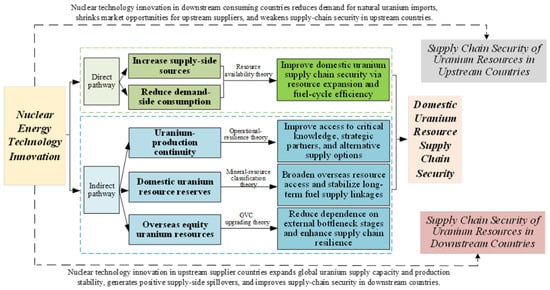
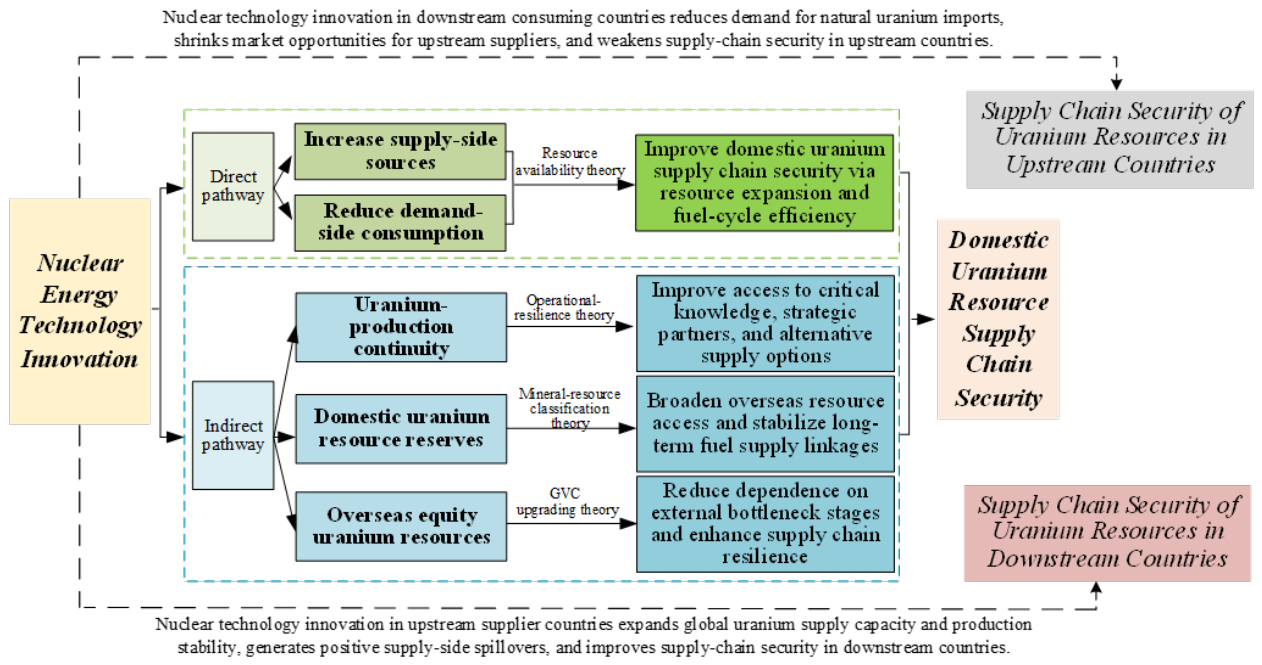
The theoretical framework of this paper is shown in Figure 1.
Figure 1.
Theoretical framework.
3. Research Design
3.1. Data Sources and Sample Selection
The sample covers nuclear-related countries and regions from 2007 to 2025. After jointly considering the availability of data on nuclear power operation, uranium trade, nuclear patents, and fuel-cycle facilities, the full index-innovation panel contains 798 country–year observations for 42 countries and regions. Country names, regional codes, and annual definitions are harmonized across databases; countries with persistent missing values for the core variables are excluded; continuous variables are winsorized at the 1st and 99th percentiles; and monthly and quarterly observations are aggregated into annual averages or totals. A limited number of short annual gaps are filled by linear interpolation or the most recent observable value. Complete-case samples vary with the availability of lagged controls, mediators, moderators, and partner-exposure measures; the preferred baseline contains 725 observations from 41 countries, and every regression table reports both observations and country clusters. Observations containing imputed values are excluded in a robustness test.
Uranium-resource data are obtained from successive editions of the OECD Nuclear Energy Agency and International Atomic Energy Agency’s Uranium: Resources, Production and Demand [18]. Annual mine production is compiled from the World Nuclear Association (WNA) and British Geological Survey, and reactor uranium requirements are taken from the WNA and Red Book archives. Bilateral natural-uranium trade is drawn from reporter-side UN Comtrade records for HS 261210 and HS 284410; HS 284420 is excluded because it covers enriched uranium or plutonium rather than the natural-uranium basket examined here. Overseas equity assets are assembled from the project-level uranium-asset register and checked against national nuclear authorities and company disclosures. Reactor and nuclear-electricity information is obtained from the IAEA Power Reactor Information System. Patent data come from EPO PATSTAT and WIPO PATENTSCOPE. Macroeconomic and electricity-structure variables are obtained from the World Bank’s World Development Indicators and Worldwide Governance Indicators, and world trade uncertainty is taken from the World Uncertainty Index database.
3.2. Model Specification
To estimate the effect of nuclear energy technology innovation on uranium supply chain security, we specify the following country and year two-way fixed-effects model.
where SCSit denotes uranium supply chain security in country i and year t, NTIit−1 denotes the lagged nuclear energy technology innovation, Xit−1 is the vector of one-period-lagged controls, and μi and λt represent country and year fixed effects, respectively. A significantly positive α1 supports the proposition that nuclear energy technology innovation strengthens domestic uranium supply chain security. The baseline control set contains GDP growth, trade openness, foreign direct investment, log GDP per capita, world trade uncertainty, and clean-electricity share. All main static models report CR1 standard errors clustered at the country level. To account for the moderate number of country clusters, we also report restricted wild-cluster bootstrap-t p-values from 99,999 replications, assigning one Rademacher weight to each country’s complete time series. Driscoll–Kraay standard errors with a two-year bandwidth are used as a sensitivity check for residual cross-sectional and temporal dependence.
SCSit = α0 + α1NTIit−1 + βXit−1 + μi + λt + εit
To identify the transmission roles of uranium-production continuity, domestic uranium resources, and overseas equity uranium resources, we further estimate the following mediation models:
where Mit−1 denotes, in turn, uranium-production continuity (PC), domestic uranium resources (DUR), and overseas equity uranium resources (OEUR); NTIit−2 is the single-year citation flow two years before the outcome; and Xit−1 is the vector of one-period-lagged controls. Equation (2) estimates the innovation-to-mediator path, whereas Equation (3) introduces innovation and the mediator jointly into the outcome equation. The indirect effect is θ1 × φ2. Its primary inference uses a recursive country-cluster wild bootstrap in which one country-level Rademacher weight is applied to all years and shared by both equations; a whole-country pairs bootstrap that resamples complete country trajectories is reported as a sensitivity check. Both procedures use 99,999 replications.
Mit−1 = θ0 + θ1NTIit−1 + γXit−1 + μi + λt + εit
SCSit = φ0 + φ1NTIit−2 + φ2Mit−1 + ηXit−1 + μi + λt + εit
3.3. Variable Definitions
3.3.1. Uranium Supply Chain Security
Uranium supply chain security refers to a country’s capacity to obtain and sustain access to natural uranium under ordinary conditions and external disruptions. It is not interpreted as a direct probability of supply interruption and does not claim to measure every conversion, enrichment, fabrication, or spent-fuel risk in the complete nuclear fuel cycle. Following the composite-indicator logic used in mineral-resource security research [49], we measure four distinct capabilities: domestic production assurance, overseas equity assurance, domestic resource assurance, and international trade assurance.
The baseline index contains four indicators in each dimension, for a total of 16 indicators (Table 1). All indicators are first expressed so that a larger value denotes stronger security. Values are winsorized at the pooled 1st and 99th percentiles and then normalized to [0,1] by min–max scaling on a fixed sample. To prevent dimensions with more indicators from receiving mechanical weight, we use hierarchical CRITIC [50]. CRITIC weights are first calculated within each dimension from an indicator’s dispersion and its non-redundancy with the other indicators; the four dimension scores are then weighted by a second CRITIC calculation. The resulting dimension weights are 0.308 for domestic production, 0.197 for overseas equity, 0.271 for domestic resources, and 0.224 for international trade.
Table 1.
Indicator system for uranium supply chain security.
Index sensitivity is assessed with four alternative constructions. We first construct nested 8-indicator and 12-indicator versions containing two and three indicators per dimension, respectively. We then recalculate the 16-indicator index using equal 25% dimension weights and, separately, a single-stage global CRITIC procedure. These alternatives test whether the baseline result depends on indicator breadth, hierarchical weighting, or the allocation of weight across the four dimensions; the corresponding regressions are reported in Table 1.
Table 1 reports the indicators and their expected attributes.
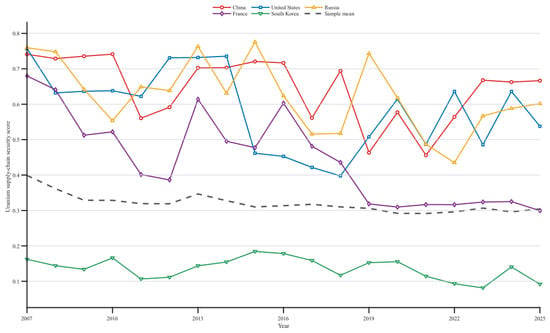
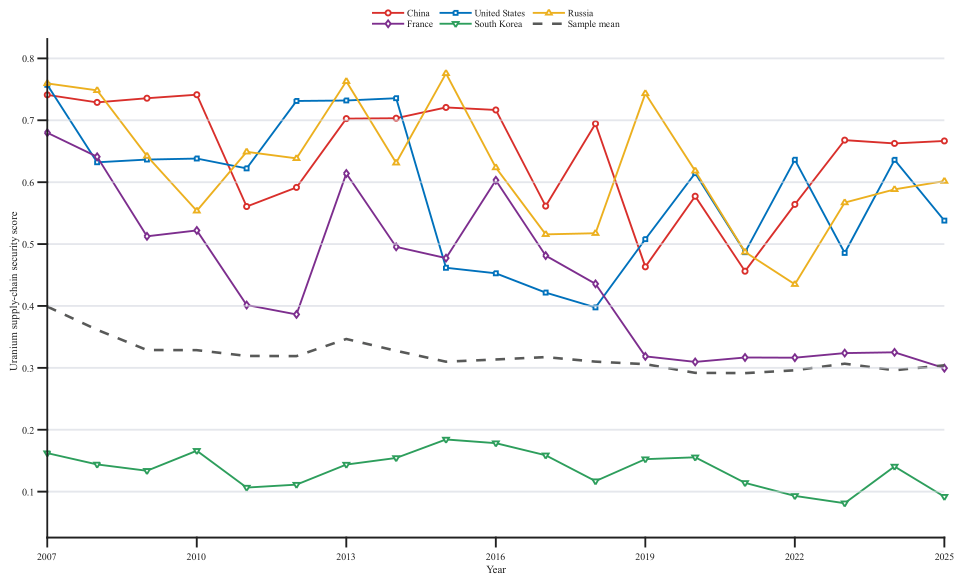
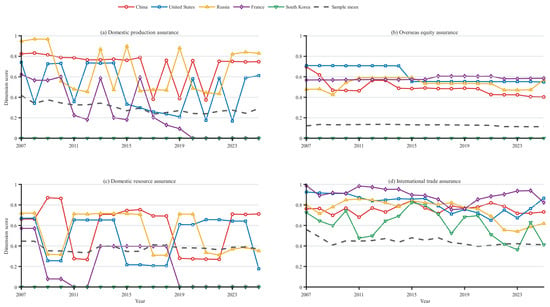
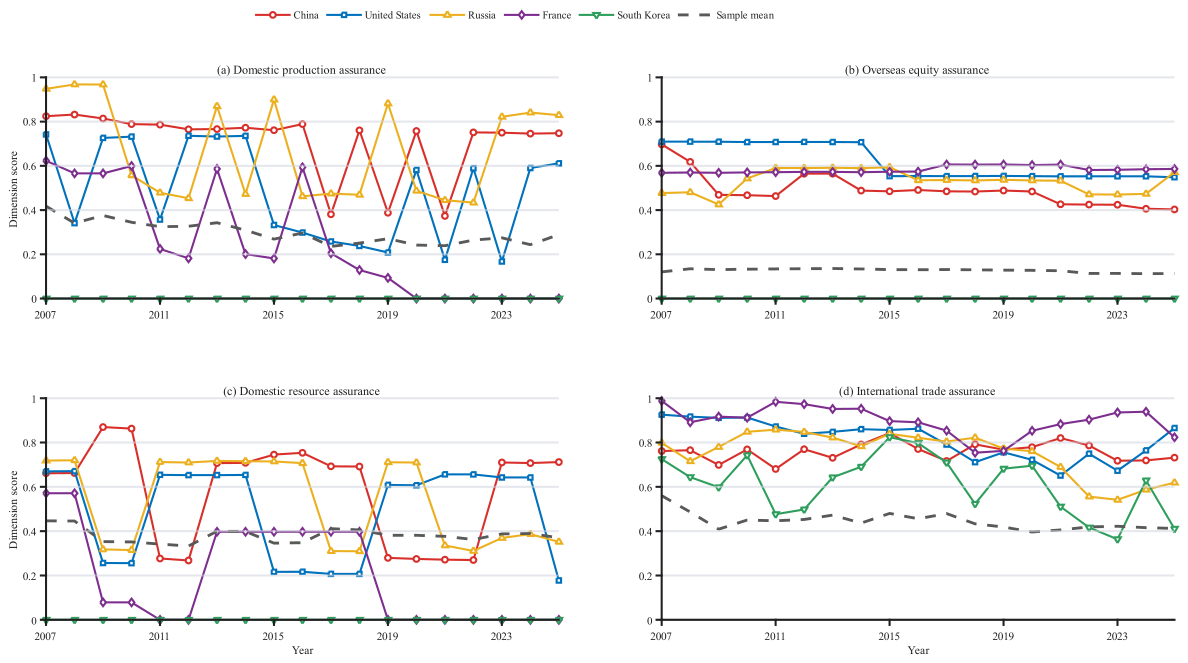
Figure 2 and Figure 3 present, respectively, the evolution of the composite uranium supply chain security index and its four constituent dimensions for the sample mean and five representative nuclear-energy economies: China, the United States, Russia, France and South Korea. (Figure 2 shows that the sample mean falls from 0.399 in 2007 to about 0.30 after 2015 and then stabilizes. China, the United States and Russia remain above the sample mean in most years, although all three fluctuate; France records the clearest long-run decline, whereas South Korea remains comparatively low. Figure 3 reveals distinct security structures: China and Russia receive more visible support from domestic production and resources; the United States and France have stronger overseas-equity and trade components, although the domestic components of France weaken substantially; and South Korea relies mainly on international trade. Across the full sample, the decline is concentrated in domestic production and international trade, while overseas-equity assurance is comparatively stable and domestic-resource assurance fluctuates within a narrower middle range. These patterns are descriptive, not causal. Because each dimension is normalized, a zero score indicates no positive contribution under the adopted indicator definition rather than the literal absence of all relevant capacity.)
Figure 2.
Trends in uranium supply chain security of major nuclear power countries.
Figure 3.
Trends of the four dimensions of uranium supply chain security of major nuclear power countries.
3.3.2. Nuclear Energy Technology Innovation
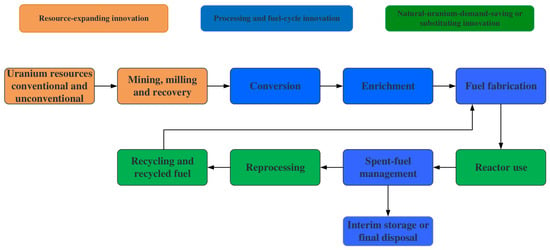
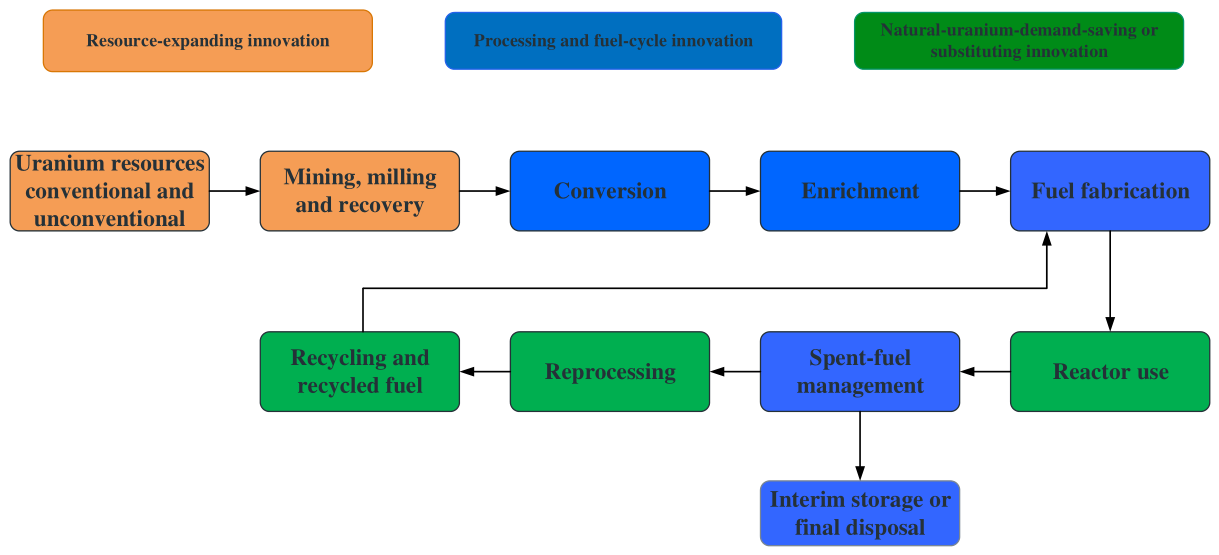
To clarify how the patent-based measures correspond to the physical nuclear fuel cycle, we follow Shang et al. [51] and use Figure 4 to map the chain from uranium resources, mining, milling and recovery through conversion, enrichment, fuel fabrication and reactor use to spent-fuel management, reprocessing and recycling, while marking the stages affected by each innovation category.
Figure 4.
Nuclear fuel cycle and technological coverage of the innovation measures. Note: Colored boxes identify the stages at which each innovation category enters the fuel cycle. A stage may be affected by more than one category, although every patent is assigned to only one category according to its primary technical function.
The patent search is restricted to inventions directly related to nuclear-fission power generation, uranium resources and the nuclear fuel cycle. Identification begins with IPC/CPC groups covering reactors and nuclear-power installations (primarily G21C and G21D), fuel-cycle and radioactive-material technologies (G21F-G21H and Y02E30), and uranium extraction, including C22B60/02. Titles, abstracts and stated technical functions are then screened to exclude medical radiation, isotope tracing and other applications that do not materially affect nuclear power or uranium use. The unit of observation is the PATSTAT application identifier; year is assigned from the earliest reliable priority or filing record, and applicant countries are standardized to ISO3 codes [52].
To capture technological heterogeneity across the fuel-cycle stages, the category analysis distinguishes three substantively different forms of innovation. Resource-expanding innovation (REI) increases the quantity of uranium that can be discovered, recovered or economically accessed, including exploration, in situ leaching, low-grade ore recovery, phosphate-rock recovery and seawater extraction. Processing and fuel-cycle innovation (PFCI) improves the capability, efficiency or reliability of conversion, enrichment, fuel fabrication, fuel inspection, loading, transport, storage, and spent-fuel or waste management without fissile-material recovery. Natural-uranium-demand-saving or -substituting innovation (NUD) lowers fresh natural-uranium requirements per unit of nuclear output or replaces part of those requirements through higher burnup, core optimization, uranium or plutonium recovery and recycling, MOX or thorium use, fast reactors and closed fuel cycles. Each application is assigned to one mutually exclusive category according to its primary technical function. (Each patent application is assigned to one and only one category according to its primary stated function, with the title, abstract and claimed technical purpose taking precedence over broad IPC/CPC codes. Resource-expanding innovation covers technologies that enlarge the accessible uranium resource base, including exploration, conventional and in situ mining, milling, low-grade resources, and uranium recovery from seawater, phosphate rock, tailings and other unconventional sources. Processing and fuel-cycle innovation covers conversion, enrichment, ordinary uranium-fuel manufacture, inspection, loading, transport, storage, and spent-fuel or waste management without uranium or plutonium recovery. Natural-uranium-demand-saving or -substituting innovation covers higher burnup, fuel-utilization and refueling optimization, recovery and recycling of uranium or plutonium, MOX and thorium fuel, fast or breeding reactors, closed cycles, and reuse of depleted uranium or enrichment tails. Thus, ordinary fuel manufacture and non-recovery handling remain in processing and fuel-cycle innovation, whereas recovery or reuse of fissile or fertile material is classified as demand saving or substitution. The mutually exclusive rules ensure that the three category totals add up exactly to total innovation.)
Patent counts alone would assign the same weight to an incremental operating improvement and a potentially transformative fuel-cycle invention. We therefore use forward citations as a proxy for technological influence [53,54]. Citing applications are deduplicated for each target application, and the baseline measure is the natural logarithm of one plus the forward citations received by qualifying applications filed during the three years from t − 3 to t − 1. The same citation principle is applied to the three innovation categories, which are entered separately in the regressions. The mutually exclusive assignment ensures that their country–year totals add up exactly to total nuclear innovation.
Because forward citations mature gradually and are right-truncated for recent patent cohorts, we separate citation maturation from the economic response lag. Robustness tests therefore use patent counts, a fixed two-year forward-citation window, cohort-age adjustments, exclusion of the 2024–2025 cohorts, and alternative two- to five-year knowledge stocks. These tests assess whether the estimated relationship depends on citation opportunity or on a particular accumulation window.
3.3.3. Mediating Variables
Uranium-production continuity (PC) is measured as 1/(1 + CV), where CV is the coefficient of variation of domestic uranium production over the most recent three years. The measure equals zero when the three-year mean production is zero and is lagged by one year in the mediation model. It captures continuity rather than production scale: a country receives a high value when realized output is stable relative to its own mean.
Domestic uranium resources (DUR) are measured as ln(1 + identified recoverable domestic uranium resources in tU), using the most recent Red Book observation available under the one-year carry-forward rule and lagging the measure by one year. This variable represents the economically and technically identified domestic resource base rather than speculative uranium occurrences or above-ground commercial inventories.
Overseas equity uranium resources (OEUR) equal the uranium resources of completed foreign projects multiplied by the ownership shares of home-country enterprises and summed by home country and year. The project-level total is lagged by one year and winsorized at the 1st and 99th percentiles; it is kept in tU rather than logarithmically transformed in the mechanism regression. A zero is assigned only when the project register identifies no qualifying overseas holding. This proxy measures the resource volume to which home-country firms have an equity claim, not merely the number of overseas projects.
3.3.4. Control and Moderating Variables
The preferred baseline includes six theoretically distinct country-level controls, all lagged by one year. GDP growth (GDPG) captures the macroeconomic cycle and investment conditions; trade openness (OPEN) measures access to international markets; net foreign direct investment inflows as a percentage of GDP (FDI) capture cross-border capital exposure; the logarithm of GDP per capita (GDPPC) controls for development and technological capacity; the World Trade Uncertainty Index (WTUI) captures external uncertainty; and the share of clean electricity in total generation (CLEAN) controls for energy-system structure. Using lagged rather than contemporaneous values reduces simultaneous adjustment between uranium security and the controls. Continuous controls are winsorized at the pooled 1st and 99th percentiles. Five- and seven-control variants are retained only as sensitivity tests.
The three moderators are defined consistently with the pooled-interaction design. Financial development is the lagged World Bank measure of domestic credit to the private sector relative to GDP. Initial domestic resources and initial overseas equity holdings are measured as ln(1 + value) in 2007 or the first available pre-treatment observation. Continuous moderators are mean-centered before interaction. Representative low and high values are the 25th and 75th percentiles, except that overseas equity uses zero holdings and the median among countries with positive holdings.
3.4. Descriptive Statistics and Country-Level Transparency
Table 2 reports descriptive statistics for the baseline complete-case sample. The main SCS measure has a mean of 0.323 and ranges from 0 to 0.857. The substantial mass at zero in the citation measures reflects the concentration of influential nuclear patents in a limited set of countries; these are genuine zero counts after applying the technological screen rather than imputed missing observations. The mediation variables are aligned to the outcome year using their one-year lags.
Table 2.
Descriptive statistics.
4. Empirical Results
4.1. Baseline Results
Table 3 reports the baseline estimates of the effect of nuclear energy technology innovation on uranium supply chain security. Column (1) contains neither controls nor fixed effects; column (2) adds country and year fixed effects without controls; column (3) adds the six lagged controls without fixed effects; and column (4) combines these controls with both fixed effects. Columns (5)–(7) enter resource-expanding, processing/fuel-cycle, and natural-uranium-demand-saving or -substituting innovation in three separate two-way fixed-effects regressions. In the preferred column (4), the coefficient on the lagged three-year citation stock is 0.011 and remains significant with country-clustered inference (p = 0.037) and the wild-cluster bootstrap (p = 0.039). A one-standard-deviation increase in the stock (2.445) is associated with a 0.027 increase in SCS, approximately 8.3% of its sample mean. H1 is supported.
Table 3.
Baseline regression results.
4.2. Endogeneity and Robustness Tests
4.2.1. Endogeneity Test
To mitigate dynamic endogeneity, following Hahn et al. [55], Higgins and Jochmans [56], and Mei et al. [57], we estimate a dynamic two-way fixed-effects model with lagged SCS and apply a split-panel jackknife (SPJ) correction. The preferred dynamic model uses one-period-lagged predetermined controls and a balanced 2008–2024 panel. Inference is based on 99,999 recursive country-level wild-bootstrap replications, with one Rademacher weight applied to each country’s complete time series. (Including lagged SCS captures persistence and reduces reverse-timing concerns; SPJ corrects the leading Nickell bias induced by combining a lagged dependent variable with fixed effects [58], while the recursive bootstrap preserves the model’s dynamic structure in finite-sample inference. Thus, coefficient stability after these corrections provides an endogeneity robustness test. GMM is not preferred because, with 42 countries and a moderate time dimension, persistent series may produce weak internal instruments, while instrument proliferation can overfit endogenous variables and weaken Hansen tests.)
Table 4 reports the results. After SPJ correction, the innovation coefficient is 0.010; the recursive country-level bootstrap gives p = 0.053, a 90% interval of [0.002, 0.018], and a 95% percentile interval of [0.001, 0.020]. The result therefore provides supportive evidence at the 10% level after accounting for persistence and dynamic fixed-effects bias. In the lead-placebo model, future innovation remains unrelated to current SCS, whereas the predetermined innovation stock remains positive. These tests reduce concerns about reverse timing and dynamic bias, but they are not interpreted as proof that innovation is fully exogenous.
Table 4.
Dynamic-panel endogeneity and timing tests.
4.2.2. Additional Robustness Tests
Table 5 reports twelve sensitivity tests. Panel A replaces the baseline outcome with the 8- and 12-indicator indices, fixes the four dimensions at equal weights, applies global CRITIC weighting, and uses five- and seven-control variants. Panel B changes the innovation window and sample by using four- and two-year citation stocks ending in t − 1, excluding major shock years, excluding the most recent patent cohorts, removing the United States, and dropping observations with short-gap imputations. All twelve coefficients are positive and remain significant at the 10% level or better under both country clustering and the wild-cluster bootstrap. The result is therefore not driven by a single index construction, control set, innovation window, exceptional period, dominant innovator, or interpolation rule.
Table 5.
Robustness tests.
Taken together, the expanded tests support the sign and statistical stability of the baseline estimate while showing that the coefficient’s magnitude varies with the security index and innovation window. As a further check for cross-sectional and temporal dependence, Driscoll–Kraay inference with a two-year bandwidth gives p < 0.001 for the baseline coefficient, p = 0.021 and p = 0.092 for upstream and downstream exposure in the preferred joint spillover model, and p < 0.001, p = 0.010 and p = 0.002 for the financial-development, initial-domestic-resource and initial-overseas-equity interactions, respectively. These checks do not alter the interpretation based primarily on CR1 and finite-cluster wild-bootstrap inference; in particular, the initial-domestic-resource interaction remains described as suggestive because its wild-cluster p-value is 0.161.
4.3. Mechanism Analysis
To impose a transparent three-wave order, the mechanism regressions use the logarithm of one plus the single-year citation flow in t − 2, the mediator in t − 1, and SCS in t. This avoids placing a multi-year innovation stock and the mediator in the same annual interval. Production continuity and domestic resources use six lagged controls for trade openness, log GDP per capita, government effectiveness, nuclear-electricity share, clean-electricity share, and internet use; overseas equity replaces clean-electricity share with manufacturing value added. The indirect effects are evaluated with 99,999 recursive country-cluster wild-bootstrap replications and a whole-country pairs-bootstrap sensitivity check.
4.3.1. Production Continuity
Columns (1) and (2) of Table 6 show that innovation is positively associated with uranium-production continuity, and continuity is positively related to SCS after innovation is retained in the outcome equation. The indirect effect is 0.003. Its country-cluster wild-bootstrap 90% interval is [0.000, 0.006] (p = 0.072), and the whole-country pairs bootstrap gives p = 0.056; the 95% wild-bootstrap interval includes zero. Technologies for exploration targeting, ore sorting, in situ recovery, hydrometallurgical control, automation, predictive maintenance, and radiation-safe operations can reduce unplanned stoppages and stabilize mine and processing output. More continuous domestic output, in turn, lowers exposure to emergency imports and preserves a reliable domestic supply base. H2 is supported at the 10% level.
Table 6.
Bootstrap mediation test results.
4.3.2. Domestic Identified Resources
Columns (3) and (4) of Table 6 show that innovation expands identified recoverable domestic resources, while a larger resource base improves SCS. The indirect effect is 0.003, and both its 90% [0.001, 0.004] and 95% [0.000, 0.005] country-cluster wild-bootstrap intervals exclude zero (p = 0.012). The whole-country pairs bootstrap also supports the channel (p = 0.038). Advanced prospecting, resource modeling, low-grade-ore recovery, and improved leaching can convert geological occurrences into economically and technically identifiable resources. A larger recoverable base lengthens domestic coverage and provides a physical buffer against external disruptions. H3 is supported.
4.3.3. Overseas Equity Resources
Columns (5) and (6) of Table 6 show a positive innovation-to-overseas-equity path and a positive mediator-to-SCS path. The indirect effect is 0.001; its country-cluster wild-bootstrap 90% interval is [0.000, 0.002] (p = 0.076), whereas the 95% interval includes zero and the whole-country pairs bootstrap does not reject zero (p = 0.139). Technological competence can improve project appraisal, processing design, operating credibility, and bargaining capacity, helping domestic firms acquire or develop foreign uranium assets. Equity claims provide access and optionality that are less exposed than arm’s-length purchases to spot-market scarcity.
4.4. Heterogeneity Analysis
Heterogeneity is tested with the same pooled interaction specification in all four cases. The formal evidence is the coefficient on innovation × moderator, not a comparison of significance levels from separate subsamples. Continuous moderators are mean-centered; marginal effects are reported at representative low and high values. The regression results are shown in Table 7.
Table 7.
Heterogeneity analysis.
4.4.1. Financial Development
The interaction with financial development is negative and significant. The marginal innovation effect is 0.032 at the 25th percentile and 0.004 at the 75th percentile. This pattern is consistent with a compensating role for technological capability where private credit is scarce: innovation can relax engineering and operating constraints that cannot readily be offset by financing, whereas countries with deeper financial systems possess more procurement, inventory-financing, and risk-management alternatives.
4.4.2. Initial Domestic Uranium Resources
The interaction with initial domestic resources is positive and reaches the 10% level with country-clustered inference, but not with the finite-cluster wild bootstrap. The marginal innovation effect is near zero at the 25th percentile and equals 0.016 at the 75th percentile. The pattern is consistent with complementarity between innovation and geological endowment, but it is treated as suggestive rather than as a panel-robust heterogeneity finding.
4.4.3. Initial Overseas Equity Holdings
Initial overseas equity holdings are measured by the logarithm of one plus the equity-weighted number of completed foreign uranium projects at the beginning of the sample. The interaction is positive and remains significant with both country clustering and the wild-cluster bootstrap. The innovation effect is 0.007 for countries without an initial holding and 0.033 at the median among positive holders. Existing overseas assets thus provide an organizational and contractual platform through which technical competence can be converted into additional supply access.
4.5. Further Analysis: Cross-Border Technology Spillovers
The spillover variables are constructed at the focal-country–year level. For focal country i in year t, upstream exposure is the weighted mean of innovation in countries j that supplied i’s natural-uranium imports, and downstream exposure is the weighted mean of innovation in countries k that purchased i’s natural-uranium exports. Bilateral trade is restricted to HS 261210 and HS 284410. Lagged trade-value shares are used as weights, partner innovation is measured before aggregation, and weights are renormalized only when matched partners represent at least 50% of the focal country’s relevant trade value. Patent-count exposure is ln(1 + partner patents) before aggregation; the citation alternative uses ln(1 + partner forward citations). Each SCS observation therefore enters only once per country–year, rather than being repeated for every bilateral pair. The regression includes own innovation, the partner exposure or exposures, the stated controls, and country and year fixed effects.
Table 8 reports the estimates. In the preferred joint patent-count model, upstream innovation exposure has a positive coefficient of 0.005, whereas downstream exposure has a negative coefficient of −0.006. Both coefficients have the expected signs but are supported mainly at the 10% level under country clustering and the finite-cluster bootstrap. The signs are unchanged when the controls are removed and when partner citations replace partner patent counts, although precision varies across these sensitivity specifications. Taken together, the results provide suggestive support for H5a and H5b.
Table 8.
Country–year cross-border technology spillover results.
The positive upstream coefficient is consistent with supplier-side innovation improving the reliability, recoverability, and service quality of uranium available to importing countries. The negative downstream coefficient captures a different transmission direction: innovation among customer countries can raise burnup, recycling, fuel efficiency, or substitution, thereby reducing expected natural-uranium demand and weakening the production incentives and revenue stability of exporting suppliers. The two signs are therefore not contradictory; they correspond to supply-reliability gains moving downstream and demand-contraction pressure moving upstream.
5. Conclusions and Policy Implications
Using a panel of 42 nuclear-related countries and regions from 2007 to 2025, this study finds that nuclear energy technology innovation improves national uranium supply chain security, and the result remains supported by country-clustered, wild-cluster, robustness, and dynamic-bias-corrected inference. Mediation analysis identifies domestic resource expansion as the most robust channel, with weaker support for production continuity and less stable evidence for overseas equity access. The innovation–security association is stronger where financial development is lower and initial overseas equity holdings are larger, while the initial-domestic-resource pattern is suggestive. Cross-border analysis provides suggestive evidence of asymmetric spillovers: upstream supplier-country innovation is positively associated with downstream partners’ security, whereas downstream customer-country innovation is negatively associated with upstream suppliers’ security.
The evidence suggests the following policy priorities.
First, governments should integrate uranium supply-security objectives into nuclear innovation policy. Funding should prioritize resource-expansion and fuel-cycle technologies and link R&D, pilot testing, and industrial deployment through joint roadmaps among research institutes and industry. Evaluation should emphasize resource additions, recovery and fuel-use efficiency, facility reliability, and fewer production interruptions rather than patent counts alone.
Second, policy implementation should focus on the three channels through which innovation is converted into supply security. Operators should strengthen process monitoring and preventive maintenance; resource authorities should sustain geological surveys, reserve reassessment, and low-grade recovery demonstrations; and public financial institutions should combine due diligence, long-term finance, and political-risk insurance for viable overseas equity projects. An interagency mechanism should monitor production continuity, domestic resource additions, and equity supply and address emerging bottlenecks early.
Third, innovation support should be differentiated across countries and coordinated along the international uranium supply chain. Finance-constrained countries need patient capital and risk sharing; resource-endowed countries should connect R&D to deposit-specific constraints; and holders of overseas assets should coordinate production, transport, inventories, and procurement. To manage asymmetric spillovers, suppliers and customers should expand joint technical programs, share medium-term demand information, and use flexible long-term contracts or joint development arrangements.
Several limitations provide directions for future research. Country-level indicators cannot fully capture contracts, spare capacity, or recovery after disruptions, while patents imperfectly reflect commercial deployment. Annual panel estimates also cannot eliminate every source of endogeneity or reveal project-level mechanisms. Future research could combine firm- and project-level data with disruption events and quasi-natural policy shocks.
Author Contributions
Methodology, C.L. and Z.C.; software, C.L.; validation, C.L.; formal analysis, Z.C.; investigation, Y.L.; data curation, Z.C.; writing—original draft, C.L., Z.C. and Y.L.; supervision, Y.L. All authors have read and agreed to the published version of the manuscript.
Funding
This research was funded by the National Social Science Foundation of China grant number 25CGL111.
Data Availability Statement
The data presented in this study are available on request from the corresponding author.
Conflicts of Interest
The authors declare no conflicts of interest.
References
- Bistline, J.; Bragg-Sitton, S.; Cole, W.; Dixon, B.; Eschmann, E.; Ho, J.; Kwon, A.; Martin, L.; Murphy, C.; Namovicz, C.; et al. Modeling nuclear energy’s future role in decarbonized energy systems. iScience 2023, 26, 105952. [Google Scholar] [CrossRef] [Scilit] [PubMed]
- Thellufsen, J.Z.; Lund, H.; Mathiesen, B.V.; Østergaard, P.A.; Sorknæs, P.; Nielsen, S.; Madsen, P.T.; Andresen, G.B. Cost and system effects of nuclear power in carbon-neutral energy systems. Appl. Energy 2024, 371, 123705. [Google Scholar] [CrossRef] [Scilit]
- Price, J.; Keppo, I.; Dodds, P.E. The role of new nuclear power in the UK’s net-zero emissions energy system. Energy 2023, 262, 125450. [Google Scholar] [CrossRef] [Scilit]
- Mathew, M.D. Nuclear energy: A pathway towards mitigation of global warming. Prog. Nucl. Energy 2022, 143, 104080. [Google Scholar] [CrossRef] [Scilit]
- Larsen, L.M.; Kim, J.; Richards, S.; Kim, T.K.; Davidson, E.; Asgari, M.; Bae, J.; Abou-Jaoude, A. Infrastructure and resource development needs to support a significant expansion of US nuclear capacity. Energy Strategy Rev. 2025, 62, 101876. [Google Scholar] [CrossRef] [Scilit]
- Wang, Z.; Song, H.; Chen, Y.; Song, J.; Hou, M.; Li, Q.; Du, Q.; Yu, H. Uranium resource of Europe: Development status, metallogenic provinces and geodynamic setting. Energy Strategy Rev. 2024, 54, 101467. [Google Scholar] [CrossRef] [Scilit]
- Haneklaus, N.; Vlček, T.; Nosko, A.; Brink, H.; Ochmann, J.; Skorek-Osikowska, A.; Gładysz, P.; Gajda, P.; Mišík, M.; Bartela, Ł. Dependencies of the European Union and the world on Russian nuclear fuel cycle services, and how to reduce them. Energy Strategy Rev. 2025, 62, 101923. [Google Scholar] [CrossRef] [Scilit]
- Siddi, M.; Silvan, K. Nuclear Energy and International Relations: The External Strategy of Russia’s Rosatom. Int. Polit 2024. [Google Scholar] [CrossRef] [Scilit]
- Meyer, T. The “Atoms Family”: Using United States export licenses to analyze the geopolitical dynamics of nuclear fuel supplies. Energy Res. Soc. Sci. 2026, 138, 104817. [Google Scholar] [CrossRef] [Scilit]
- Islam, M.M.; Shahbaz, M.; Samargandi, N. The nexus between Russian uranium exports and US nuclear-energy consumption: Do the spillover effects of geopolitical risks matter? Energy 2024, 293, 130481. [Google Scholar] [CrossRef] [Scilit]
- Carlson, L.; Miller, J.; Wu, Z. Implications of HALEU fuel on the design of SMRs and micro-reactors. Nucl. Eng. Des. 2022, 389, 111648. [Google Scholar] [CrossRef] [Scilit]
- Banna, H.; Alam, A.; Chen, X.H.; Alam, A.W. Energy security and economic stability: The role of inflation and war. Energy Econ. 2023, 126, 106949. [Google Scholar] [CrossRef] [Scilit]
- Ullah, S.; Gözgör, G.; Lu, Z. How do conflicts affect energy security risk? Evidence from major energy-consuming economies. Econ. Anal. Policy 2024, 82, 175–187. [Google Scholar] [CrossRef] [Scilit]
- International Atomic Energy Agency. Small Modular Reactors: Advances in SMR Developments 2024; IAEA: Vienna, Austria, 2024. [Google Scholar]
- International Atomic Energy Agency. Energy, Electricity and Nuclear Power Estimates for the Period up to 2050, Reference Data Series No. 1; IAEA: Vienna, Austria, 2024. [Google Scholar]
- Bolukbasi, M.J.; Middleburgh, S.C.; Vrtiska, S.; Lee, W.E. Shifting to a 36-month fuel cycle with advanced moderating burnable absorbers enabling high assay low enriched uranium (HALEU). Prog. Nucl. Energy 2024, 168, 105011. [Google Scholar] [CrossRef] [Scilit]
- Read, N.; Raffuzzi, V. Neutronic analysis of high burnup thorium-HALEU fuels in PHWR. Nucl. Eng. Des. 2024, 422, 113113. [Google Scholar] [CrossRef] [Scilit]
- OECD Nuclear Energy Agency. Uranium 2024: Resources, Production and Demand; OECD Publishing: Paris, France, 2025. [Google Scholar]
- Arnaut, J.L. The importance of uranium prices and structural shocks: Some implications for Greenland. Energy Policy 2022, 161, 112757. [Google Scholar] [CrossRef] [Scilit]
- Lyocsa, S.; Todorova, N. What drives the uranium sector risk? The role of attention, economic and geopolitical uncertainty. Energy Econ. 2024, 140, 107980. [Google Scholar] [CrossRef] [Scilit]
- Bang, R.N.; Trellevik, L.-K.L. Reserve-dependent capital efficiency, cross-sector competition, and mineral security considerations in mineral industry transition. Miner. Econ. 2023, 36, 383–400. [Google Scholar] [CrossRef] [Scilit]
- Liu, W.; Li, X.; Wang, J.; Zhong, J.; Wang, M.; Yang, J. Knowledge mapping of research on securing the supply chain for critical minerals: A scientometrics and text mining approach. J. Clean. Prod. 2024, 434, 140312. [Google Scholar] [CrossRef] [Scilit]
- Zhu, X.; Ding, Q.; Chen, J. How does critical mineral trade pattern affect renewable energy development? The mediating role of renewable energy technological progress. Energy Econ. 2022, 112, 106164. [Google Scholar] [CrossRef] [Scilit]
- Zhu, B.; Deng, Y.; Hu, X. Global energy security: Do internal and external risk spillovers matter? A multilayer network method. Energy Econ. 2023, 126, 106961. [Google Scholar] [CrossRef] [Scilit]
- Dou, S.; Zhu, Y.; Liu, J.; Xu, D. The power of mineral: Shock of the global supply chain from resource nationalism. World Dev. 2024, 184, 106758. [Google Scholar] [CrossRef] [Scilit]
- Liu, W.; Yao, J.; Bi, K. Drifting towards collaborative innovation: Patent collaboration network of China’s nuclear power industry from multidimensional proximity perspective. Prog. Nucl. Energy 2023, 164, 104851. [Google Scholar] [CrossRef] [Scilit]
- Fernández, A.M.; Ferrándiz, E.; Medina, J. The diffusion of energy technologies. Evidence from renewable, fossil, and nuclear energy patents. Technol. Forecast. Soc. Chang. 2022, 178, 121566. [Google Scholar] [CrossRef] [Scilit]
- Meyer, T. Patents for power: Intellectual property and the geopolitics of nuclear energy technologies. Nucl. Eng. Technol. 2025, 57, 103470. [Google Scholar] [CrossRef] [Scilit]
- Zhang, Y.; Chen, K. Network growth dynamics: The simultaneous interaction between network positions and research performance of collaborative organisations. Technovation 2022, 115, 102538. [Google Scholar] [CrossRef] [Scilit]
- Desing, H.; Widmer, R.; Bardi, U.; Beylot, A.; Billy, R.G.; Gasser, M.; Gauch, M.; Monfort, D.; Müller, D.B.; Raugei, M.; et al. Mobilizing materials to enable a fast energy transition: A conceptual framework. Resour. Conserv. Recycl. 2024, 200, 107314. [Google Scholar] [CrossRef] [Scilit]
- Cook, P.J. Resources and reserves in a carbon-constrained world. Miner. Econ. 2022, 35, 361–371. [Google Scholar] [CrossRef] [Scilit]
- Magdalena, R.; Valero, A.; Calvo, G. Limit of recovery: How future evolution of ore grades could influence energy consumption and prices for Nickel, Cobalt, and PGMs. Miner. Eng. 2023, 200, 108150. [Google Scholar] [CrossRef] [Scilit]
- Wang, B.; Luo, Y.; Qian, J.; Liu, J.H.; Li, X.; Zhang, Y.H.; Chen, Q.Q.; Li, L.Y.; Liang, D.Y.; Huang, J. Machine learning-based optimal design of the in-situ leaching process parameter (ISLPP) for the acid in-situ leaching of uranium. J. Hydrol. 2023, 626, 130234. [Google Scholar] [CrossRef] [Scilit]
- Hassler, J.; Krusell, P.; Olovsson, C. Finite resources and the world economy. J. Int. Econ. 2022, 136, 103592. [Google Scholar] [CrossRef] [Scilit]
- Jia, X.; Takeuchi, K. Induced innovation in power generation technologies: Evidence from the Tokyo-Saitama Emissions Trading System. Energy Econ. 2024, 129, 107227. [Google Scholar] [CrossRef] [Scilit]
- Capps, N.; Salko, R.; Asgari, M.; Wysocki, A.; Greenquist, I.; Henderson, S.; Sarikaya, B.; Tusar, J.; Porter, I. High-burnup boiling water reactor steady-state operating conditions and fuel performance analysis. Ann. Nucl. Energy 2025, 215, 111247. [Google Scholar] [CrossRef] [Scilit]
- Fernandes, S.; Chaves, L.; Melo, J.P.C.; Corrêa, K.M.; Gonçalves, N.; Barrachina, T.; Miró, R.; Pereira, C. Reprocessed fuels in a PWR SMR based on NuScale. Ann. Nucl. Energy 2025, 214, 111148. [Google Scholar] [CrossRef] [Scilit]
- Jones, S.; Boxall, C.; Maher, C.; Taylor, R. A review of the reprocessability of uranium nitride based fuels. Prog. Nucl. Energy 2023, 165, 104917. [Google Scholar] [CrossRef] [Scilit]
- Chen, Y.; Li, B.; Huo, B. Building operational resilience through digitalization: The roles of supply chain network position. Technol. Forecast. Soc. Chang. 2025, 211, 123918. [Google Scholar] [CrossRef] [Scilit]
- Weihed, P. How commodity prices and technical development has influenced exploration strategies: A case study from Sweden. Miner. Econ. 2022, 35, 409–427. [Google Scholar] [CrossRef] [Scilit]
- Dunning, J.H. The eclectic paradigm of international production: A restatement and some possible extensions. J. Int. Bus. Stud. 1988, 19, 1–31. [Google Scholar] [CrossRef] [Scilit]
- Bhandari, K.R.; Zámborský, P.; Ranta, M.; Salo, J. Digitalization, internationalization, and firm performance: A resource-orchestration perspective on new OLI advantages. Int. Bus. Rev. 2023, 32, 102135. [Google Scholar] [CrossRef] [Scilit]
- Zha, L.; Cao, D.; Mahamoudou, F. International cooperative network for nuclear power plant projects: A multidimensional proximity perspective. J. Nucl. Sci. Technol. 2025, 62, 795–807. [Google Scholar] [CrossRef] [Scilit]
- Kim, P.; Kim, J.; Yim, M.-S. Assessing proliferation uncertainty in civilian nuclear cooperation under new power dynamics of the international nuclear trade. Energy Policy 2022, 163, 112852. [Google Scholar] [CrossRef] [Scilit]
- Stojcic, N.; Matic, M. A journey toward global value chain upgrading: Exploring the transition from backward to forward integration. Technol. Soc. 2024, 76, 102435. [Google Scholar] [CrossRef] [Scilit]
- Yan, Z.; Wang, Y.; Zhang, J.; Ma, H. Technology transfer and global value chain upgrading of manufacturing firms: Evidence from China. Int. Rev. Econ. Financ. 2024, 96, 103678. [Google Scholar] [CrossRef] [Scilit]
- Pan, Y. Diversification from Russian nuclear fuel requires market-oriented solutions. Bull. At. Sci. 2024, 80, 41–48. [Google Scholar] [CrossRef] [Scilit]
- Szulecki, K.; Overland, I. Russian nuclear energy diplomacy and its implications for energy security in the context of the war in Ukraine. Nat. Energy 2023, 8, 413–421. [Google Scholar] [CrossRef] [Scilit]
- Dou, S.; Xu, D. The security of critical mineral supply chains. Miner. Econ. 2023, 36, 401–412. [Google Scholar] [CrossRef] [Scilit]
- Diakoulaki, D.; Mavrotas, G.; Papayannakis, L. Determining objective weights in multiple criteria problems: The CRITIC method. Comput. Oper. Res. 1995, 22, 763–770. [Google Scholar] [CrossRef] [Scilit]
- Shang, D.; Geissler, B.; Mew, M.; Satalkina, L.; Zenk, L.; Tulsidas, H.; Barker, L.; El-Yahyaoui, A.; Hussein, A.; Taha, M.; et al. Unconventional uranium in China’s phosphate rock: Review and outlook. Renew. Sustain. Energy Rev. 2021, 140, 110740. [Google Scholar] [CrossRef] [Scilit]
- Wang, J.-W.; Li, J. Patent mining and diversity assessment of nuclear power technologies. Nucl. Eng. Technol. 2025, 57, 103272. [Google Scholar] [CrossRef] [Scilit]
- Higham, K.; Contisciani, M.; De Bacco, C. Multilayer patent citation networks: A comprehensive analytical framework for studying explicit technological relationships. Technol. Forecast. Soc. Chang. 2022, 179, 121628. [Google Scholar] [CrossRef] [Scilit]
- Hall, B.H.; Jaffe, A.; Trajtenberg, M. Market value and patent citations. RAND J. Econ. 2005, 36, 16–38. [Google Scholar]
- Hahn, J.; Hughes, D.W.; Kuersteiner, G.; Newey, W.K. Efficient bias correction for cross-section and panel data. Quant. Econ. 2024, 15, 783–816. [Google Scholar] [CrossRef] [Scilit]
- Higgins, A.; Jochmans, K. Bootstrap inference for fixed-effect models. Econometrica 2024, 92, 411–427. [Google Scholar] [CrossRef] [Scilit]
- Mei, Z.; Sheng, L.; Shi, Z. Nickell bias in panel local projection: Financial crises are worse than you think. J. Int. Econ. 2026, 160, 104210. [Google Scholar] [CrossRef] [Scilit]
- Dhaene, G.; Jochmans, K. Split-panel jackknife estimation of fixed-effect models. Rev. Econ. Stud. 2015, 82, 991–1030. [Google Scholar] [CrossRef] [Scilit]

Disclaimer/Publisher’s Note: The statements, opinions and data contained in all publications are solely those of the individual author(s) and contributor(s) and not of MDPI and/or the editor(s). MDPI and/or the editor(s) disclaim responsibility for any injury to people or property resulting from any ideas, methods, instructions or products referred to in the content. |
© 2026 by the authors. Licensee MDPI, Basel, Switzerland. This article is an open access article distributed under the terms and conditions of the Creative Commons Attribution (CC BY) license.