


Abstract
High penetration of wind power increases the need for coordinated frequency support from wind farms and battery energy storage systems (BESSs). To address insufficient power coordination, state-of-charge (SOC) deviation, and suboptimal intra-farm allocation of frequency-regulation power, this paper proposes a hierarchical MPC–QP control strategy for primary frequency regulation of a wind–storage hybrid system. At the upper level, model predictive control (MPC) minimizes system frequency deviation and a composite frequency-regulation cost index subject to wind-farm power, BESS power, and SOC constraints, thereby determining optimal regulation-power references for the wind farm and BESS. At the lower level, quadratic programming (QP) minimizes wind-farm regulation-power tracking error and equivalent torque fluctuations to achieve differentiated power allocation among equivalent turbine clusters. In a representative 1 h simulation with continuously varying wind speed and random load disturbances, the proposed strategy reduces the RMS frequency deviation, maximum absolute frequency deviation, RMS SOC deviation, and cumulative regulation cost index by 24.20%, 24.53%, 93.86%, and 84.72%, respectively, compared with PI control. Compared with equal allocation, it reduces the RMS wind-farm power-tracking error and RMS equivalent torque fluctuation by 87.93% and 15.52%, respectively. Three additional stochastic realizations demonstrate consistent improvements in the selected performance indices, further supporting the effectiveness of the proposed hierarchical strategy under the investigated simulation conditions.
1. Introduction
With the large-scale integration of wind power and other renewable energy sources, the proportion of conventional synchronous generators in power systems has gradually decreased, leading to reduced system inertia and weakened primary frequency-regulation capability. Consequently, frequency stability has become an increasingly critical issue in power systems with high renewable energy penetration [1,2,3]. Modern variable-speed wind turbines can provide frequency support by releasing rotor kinetic energy or reserving active power. However, their regulation capability is strongly dependent on wind speed, rotor speed, and operating conditions, and standalone wind-turbine frequency regulation may also cause rotor-speed recovery problems and secondary frequency drops [4,5,6]. Energy storage systems, owing to their rapid response and flexible bidirectional power regulation capability, can compensate for the operating-state-dependent limitations of wind power. Therefore, coordinated wind–storage participation in primary frequency regulation has become an effective approach to enhancing the frequency support capability of renewable-dominated power systems [7,8,9].
In recent years, considerable efforts have been devoted to coordinated control and power optimization for wind–storage primary frequency regulation. Existing studies have improved coordinated frequency support by considering factors such as wind speed, wind-turbine operating conditions, and the state of charge (SOC) of energy storage systems [10]. In particular, the frequency-regulation capability of wind turbines varies considerably with operating conditions, making it necessary to adapt turbine participation and regulation characteristics to different wind-speed regions. Meanwhile, advanced coordinated control and optimization methods, including model predictive control (MPC), have been increasingly applied to wind-power and wind–storage frequency regulation [11,12,13]. MPC is particularly attractive owing to its capability for receding-horizon optimization and explicit handling of power and SOC constraints. Beyond system-level wind–storage coordination, recent studies have further investigated hierarchical frequency-regulation strategies and wind-farm active-power optimization, including intra-farm power allocation, wake-aware control, and mechanical-load mitigation [14,15,16,17,18]. Reliable wind-farm operation also requires consideration of uncertainty and abnormal turbine conditions. Recent studies have investigated wind-turbine fault diagnosis using structural analysis and uncertainty-aware interval estimation [19], as well as pitch-system fault detection based on adaptive Kalman filtering [20]. These studies highlight the importance of condition monitoring in practical wind-farm control. Related operational considerations have also motivated wind–storage coordination studies addressing asset degradation and wind-cluster effects [21,22]. To clarify the main characteristics of representative recent studies, a comparison is presented in Table 1.
Table 1.
Comparison of representative recent studies and the proposed method on wind–storage frequency regulation and wind-farm power optimization.
As summarized in Table 1, Cai et al. [14] proposed a hierarchical MPC strategy in which the upper level generates a total wind–storage regulation-power reference, while the lower level allocates it among wind turbines and the BESS. In contrast, the proposed upper-level MPC predicts the coupled frequency, wind-farm power, BESS power, and SOC responses and directly optimizes separate power references for the wind farm and BESS. Operating-region-dependent regulation limits are aggregated into wind-farm constraints for the upper level and retained as cluster-specific constraints for the lower level. Unlike the lower-level MPC in [14], the proposed QP allocates the wind-farm reference among equivalent turbine clusters by jointly minimizing power-tracking error and equivalent torque fluctuation. Therefore, the main contribution lies in the constraint-aware hierarchical formulation and its integration of wind–storage coordination with intra-farm power allocation, rather than in developing a new MPC or QP algorithm.
To address these issues, this paper proposes a hierarchical MPC–QP primary frequency-regulation strategy for a wind–storage hybrid system with intra-farm power optimization. The framework links full-wind-speed turbine regulation capability with system-level wind–storage coordination and turbine-level power allocation. The main contributions are as follows:
An operating-region-dependent wind-turbine frequency-regulation strategy is established over the full wind-speed range. Low-, medium-, and high-wind-speed regions are distinguished, with rotor-overspeed deloading and pitch-angle deloading adopted in the corresponding regulation regions. The resulting regulation-power limits are aggregated as wind-farm constraints for the upper-level MPC and retained as cluster-specific bounds for the lower-level QP.
An upper-level MPC-based wind–storage coordination strategy is developed. Frequency deviation and a composite regulation cost index are minimized to determine the wind-farm and BESS regulation-power references under dynamically updated wind-farm power limits and BESS power and SOC constraints.
A QP-based intra-farm power allocation method is proposed. Considering differences in cluster regulation capability, power-tracking error and equivalent torque fluctuation are jointly minimized to achieve differentiated power allocation under cluster-specific regulation-power constraints.
The hierarchical MPC–QP strategy is validated under continuously varying wind speed and random load disturbances, demonstrating improvements in frequency response, SOC regulation, power tracking, and equivalent torque fluctuation under the simulated conditions.
2. Materials and Methods
2.1. Wind–Storage Hybrid System and Hierarchical Control Framework
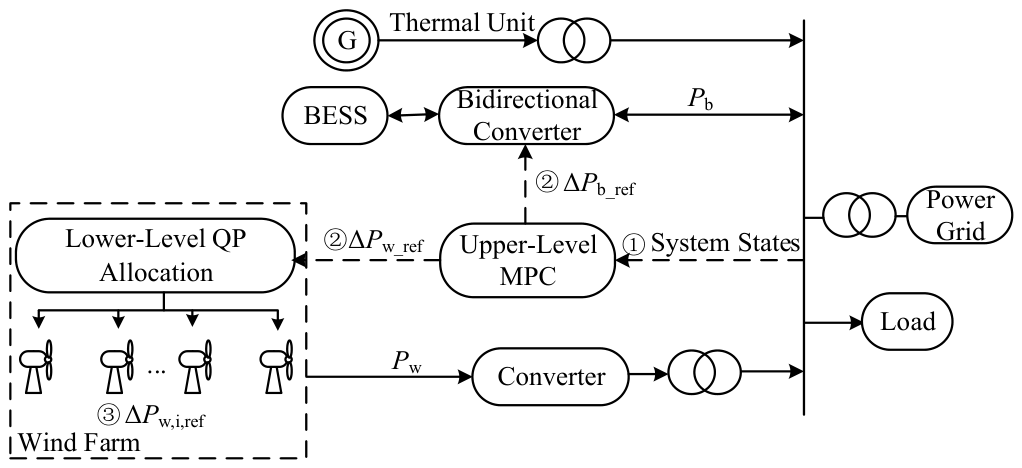
The wind–storage hybrid system considered in this study consists of a thermal power unit, a wind farm, a BESS, and the grid load, as shown in Figure 1. During primary frequency regulation, the thermal power unit, wind farm, and BESS jointly compensate for the active-power imbalance caused by load disturbances. The wind farm and BESS provide complementary frequency support owing to their different dynamic response characteristics.
Figure 1.
Hierarchical MPC–QP control framework of the wind–storage system.
A hierarchical MPC–QP control framework is adopted to coordinate the wind farm and BESS. At the upper level, model predictive control (MPC) determines the regulation-power references of the wind farm, ΔPw_ref, and the BESS, ΔPb_ref, according to the system operating states. At the lower level, quadratic programming (QP) allocates the wind-farm regulation-power reference among individual wind turbines according to their operating states, thereby obtaining the turbine-level power references ΔPw,i,ref.
The feasible regulation-power range of the wind farm varies with wind speed and turbine operating conditions. Therefore, operating-region-dependent turbine frequency-regulation modes and corresponding power limits are first determined and subsequently incorporated into the hierarchical optimization framework as power constraints. The detailed operating-region-dependent regulation strategy, upper-level MPC formulation, and lower-level QP allocation method are presented in the following sections.
2.2. Operating-Region-Dependent Wind-Turbine Frequency Regulation and Power Limits
2.2.1. Wind-Turbine Operating Regions and Frequency-Regulation Modes
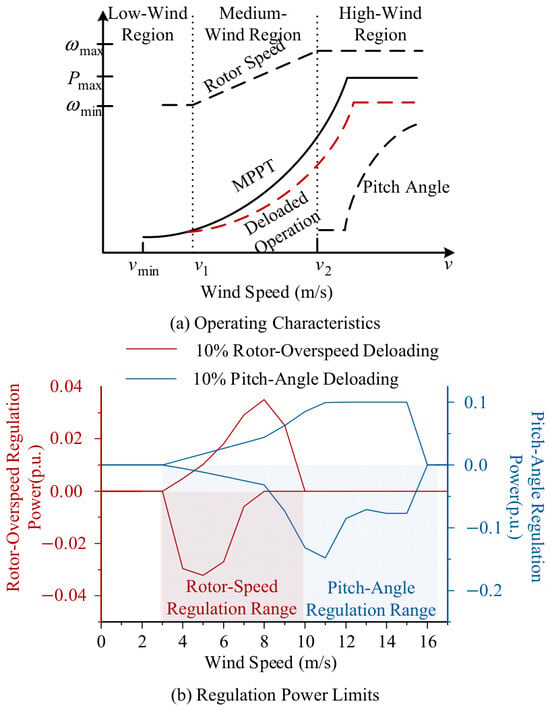
The frequency-regulation capability of a DFIG varies with wind speed and operating condition [23]. To balance regulation capability and operational safety, the turbine operating range is divided into low-, medium-, and high-wind-speed regions, with different regulation modes adopted in each region. Wind-speed-aware MPC and frequency-support feasible-region modeling have also been investigated to account for variations in wind-farm regulation capability [24,25].
Low-wind-speed region: The turbine has limited regulation margin and does not participate in primary frequency regulation; frequency support is mainly provided by the BESS.
Medium-wind-speed region: Rotor-overspeed deloading is adopted for primary frequency regulation, while the BESS provides supplementary support.
High-wind-speed region: Pitch-angle deloading is adopted for primary frequency regulation, with the BESS providing auxiliary frequency support.
Based on the above operating-region classification, the regulation-power limits of the wind turbines and wind farm are further determined and used as constraints in the subsequent MPC and QP optimization.
2.2.2. Regulation-Power Limits Under Different Operating Regions
After the frequency-regulation modes are determined for different wind-speed regions, the feasible regulation-power range of each wind turbine can be further obtained according to its current operating point. Let the upper and lower regulation-power limits of the ith wind turbine be denoted by ΔPi,max and ΔPi,min, respectively.
- (1)
- Low-wind-speed region
In the low-wind-speed region, the wind turbine does not participate in primary frequency regulation. Therefore, both the upper and lower regulation-power limits are set to zero:
ΔPi,max=ΔPi,min = 0
- (2)
- Medium-wind-speed region
In the medium-wind-speed region, rotor-overspeed deloading is adopted [26]. The deloaded power is given by:
where d is the deloading ratio, which is set to 10% in this paper. Taking the deloaded operating point as the reference, the upward regulation power is determined by the reserve margin between the MPPT power and the deloaded power, while the downward regulation power is determined by the minimum allowable output power. Thus, the corresponding regulation-power limits can be expressed as:
Pdel,i = (1 − d)PMPPT,i
- (3)
- High-wind-speed region
In the high-wind-speed region, pitch-angle deloading is adopted to reserve regulation power [27]. Let β_del denote the pitch angle under deloaded operation. With respect to the deloaded operating point, the upward and downward regulation-power limits can be determined from the turbine output power under different pitch angles as:
where β0, βdel, and βmax are the initial pitch angle, the deloaded pitch angle, and the maximum allowable pitch angle, respectively.
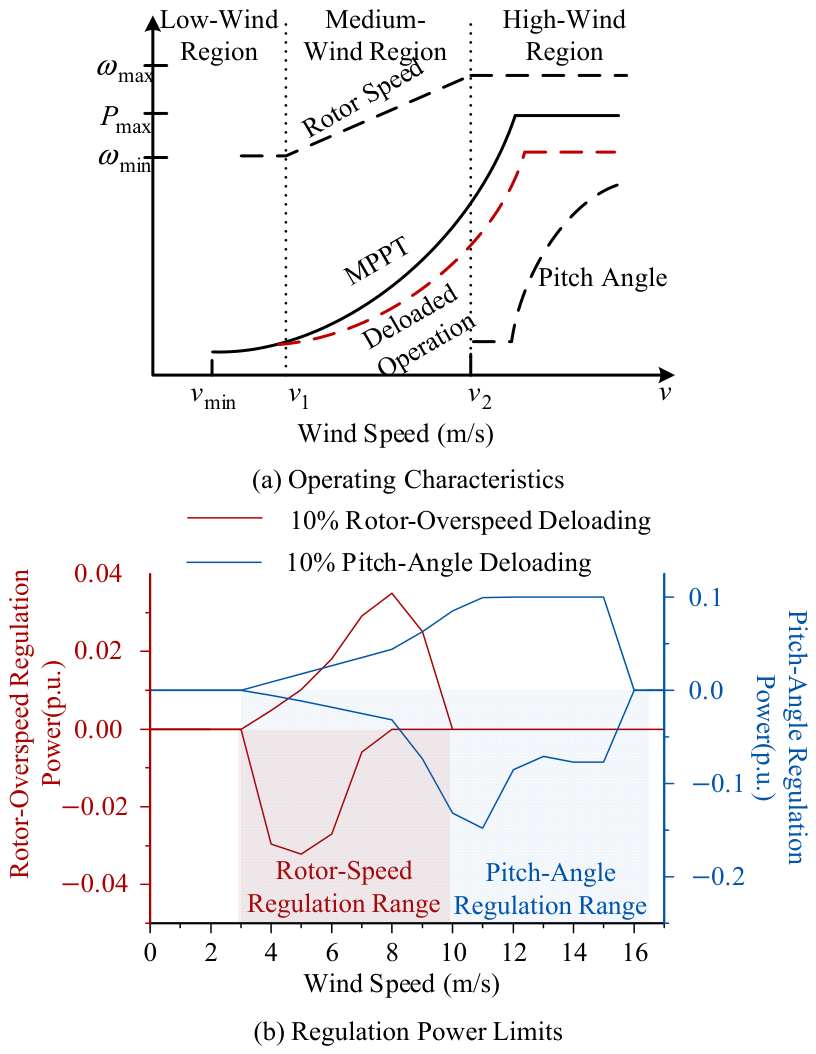
Figure 2 illustrates the operating characteristics and bidirectional regulation-power limits of a representative 1.5 MW DFIG under different wind-speed regions and a 10% deloading ratio. The regulation-power limits in Figure 2b are calculated based on the wind-turbine aerodynamic power characteristics. The overspeed-control limits are determined by the allowable rotor-speed range, while the pitch-control limits are obtained from the power differences at different pitch-angle operating points, with a maximum pitch-angle increment of 5°.
Figure 2.
Operating characteristics and regulation-power limits of the DFIG under different wind-speed regions.
For a wind farm represented by N equivalent turbine clusters, the overall upper and lower regulation-power limits can be obtained by aggregating the feasible regulation-power ranges of all clusters:
2.3. Upper-Level MPC-Based Wind–Storage Coordinated Optimization
To coordinate the regulation power between the wind farm and BESS, an upper-level MPC strategy is adopted. Based on the system states and operating constraints, the optimal regulation-power references of the wind farm and BESS are obtained through receding-horizon optimization.
2.3.1. Prediction Model
To describe the dynamic responses of the wind–storage hybrid system during primary frequency regulation, a discrete state-space prediction model is established. The continuous-time model is discretized using the forward Euler method and expressed as:
where x(k), u(k), d(k), and y(k) denote the state vector, control input, disturbance input, and output vector, respectively.
The state vector is defined as:
where ΔPg, ΔPch, and ΔPth denote the governor output power increment, steam-chest output power increment, and thermal-unit output power increment, respectively. ΔPb and ΔPw denote the regulation-power increments of the BESS and wind farm, respectively. The SOC of the BESS is included in the state vector to characterize its available energy and enable SOC-aware frequency regulation [28].
x(k) = [ΔPg(k),ΔPch(k),ΔPth(k),ΔPb(k),ΔPw(k),SOC(k),Δf(k)]T
The control input and disturbance input are defined as:
The discrete state equations are given by:
The output vector is selected as:
The above discrete equations form the prediction model used for the subsequent MPC-based receding-horizon optimization.
2.3.2. Objective Function
The upper-level MPC aims to suppress system frequency deviation and minimize the composite frequency-regulation cost index. The objective function is defined as:
where Np is the prediction horizon; λf and λc are the weighting coefficients for the frequency-deviation term and the composite frequency-regulation cost term, respectively; Δfk+i|k is the predicted system frequency deviation at time k + i based on the information available at time k; and Cw_k+i∣k and Cb_k+i∣k denote the frequency-regulation cost indices of the wind farm and BESS, respectively.
The wind-farm frequency-regulation cost index is defined as:
The BESS frequency-regulation cost index considers both the charging/discharging power and SOC deviation and is defined as:
where a1, a2, and a3 are the weighting coefficients for wind-farm regulation power, BESS charging/discharging power, and SOC deviation, respectively, and SOCref is the reference SOC of the BESS.
2.3.3. Upper-Level MPC Constraints
To ensure that the upper-level MPC solution satisfies the operating requirements of the wind–storage hybrid system, constraints are imposed on the wind-farm regulation power, BESS power, and SOC [29].
The wind-farm regulation-power constraint is given by:
where ΔPw,min(k) and ΔPw,max(k) are the lower and upper regulation-power limits of the wind farm at time k, respectively, and ΔPw,ref(k + i∣k) is the predicted wind-farm regulation-power reference.
ΔPw,min(k) ≤ ΔPw_ref(k + i|k) ≤ ΔPw,max(k)
At each sampling instant, the wind-farm regulation-power limits are determined from the current operating conditions and held constant over the 2 s prediction horizon. These limits are updated at the next MPC step, while possible operating-region transitions within the prediction horizon are not explicitly predicted. This approximation avoids uncertain short-term wind-speed forecasts and simplifies online optimization; however, operating-region transitions within the prediction horizon may temporarily cause discrepancies between the assumed and actual regulation-power limits.
The BESS power and SOC constraints are expressed as:
where Pb,rated is the rated power of the BESS, and SOCmin and SOCmax are the lower and upper SOC limits, respectively.
2.4. Lower-Level QP-Based Intra-Farm Power Allocation
After the upper-level MPC determines the total wind-farm regulation-power reference, the lower level allocates it among the equivalent turbine clusters according to their operating conditions and available regulation ranges. Considering wind-speed differences, wake effects, and the resulting heterogeneous regulation capabilities of the equivalent turbine clusters [30], QP is employed to improve wind-farm power-tracking accuracy and reduce equivalent torque fluctuations while satisfying cluster-level operating constraints. Related wind-farm dispatch studies have jointly considered power-command tracking and mechanical-load mitigation [31,32].
2.4.1. Power Allocation Objective Function
The wind farm is represented by N equivalent turbine clusters, where N = 5 in this study. The regulation-power reference of each cluster is selected as the lower-level optimization variable. At sampling instant k, the optimization variable is defined as:
where ΔPw,i,ref(k) denotes the regulation-power reference of the i-th equivalent turbine cluster.
Wind-farm power allocation should consider both regulation-power tracking performance and turbine operating smoothness [33]. The lower-level QP objective function is therefore formulated as:
where λp and λT are the weighting coefficients for the power-tracking error and equivalent torque fluctuation, respectively.
The wind-farm regulation-power tracking error is defined as:
where ΔPw_ref(k) is the total wind-farm regulation-power reference generated by the upper-level MPC.
To characterize the torque fluctuation caused by rapid changes in the regulation power of each cluster, the equivalent torque fluctuation of the i-th equivalent turbine cluster is defined as:
where ωi(k) is the equivalent rotor speed of the i-th turbine cluster at sampling instant k, and ΔPw,i,ref(k − 1) is the regulation-power reference of the same cluster at the previous sampling instant. Pb,i denotes the per-unit rated capacity of the i-th equivalent turbine cluster on the system power base. Since each equivalent turbine cluster is rated at 30 MW and the system power base is 100 MW, Pb,i = 0.3 p.u.
2.4.2. Lower-Level QP Constraints
Constraints are imposed on cluster regulation power, rotor speed, and equivalent torque fluctuation to ensure feasible power allocation.
The regulation-power constraint of the i-th equivalent turbine cluster is given by:
where ΔPw,i,min(k) and ΔPw,i,max(k) are the lower and upper regulation-power limits of the i-th equivalent turbine cluster at sampling instant k, respectively.
ΔPw,i,min(k) ≤ ΔPw,i,ref(k) ≤ ΔPw,i,max(k)
The rotor-speed prediction used in the lower-level QP is derived from the incremental rotor dynamics. Over the short allocation interval, the baseline mechanical and electrical powers are assumed to be approximately balanced, and variations in aerodynamic mechanical power are neglected. Therefore, the regulation-power increment is taken as the dominant factor affecting short-term rotor-speed variation, yielding:
where TS is the sampling period, Hi is the equivalent inertia constant of the i-th turbine cluster, and Pb,i is its per-unit rated capacity on the system power base. This equation is used only for short-term rotor-speed prediction in the QP, while the complete rotor dynamics are retained in the simulation model.
The rotor-speed constraint is expressed as:
where ωi,min and ωi,max are the lower and upper allowable rotor-speed limits of the i-th equivalent turbine cluster, respectively.
ωi,min ≤ ωi(k + 1) ≤ ωi,max
The equivalent torque fluctuation is constrained by:
where ΔTi,max is the allowable magnitude of the equivalent torque fluctuation of the i-th equivalent turbine cluster. In this study, ∆Ti,max is adopted to limit excessive instantaneous torque variations.
−ΔTi,max ≤ ΔTi(k) ≤ ΔTi,max
2.5. Hierarchical MPC–QP Control Procedure
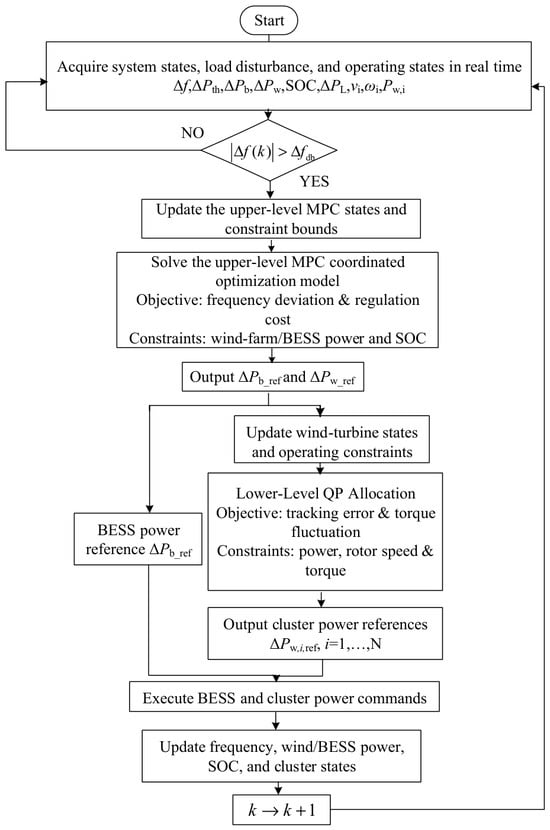
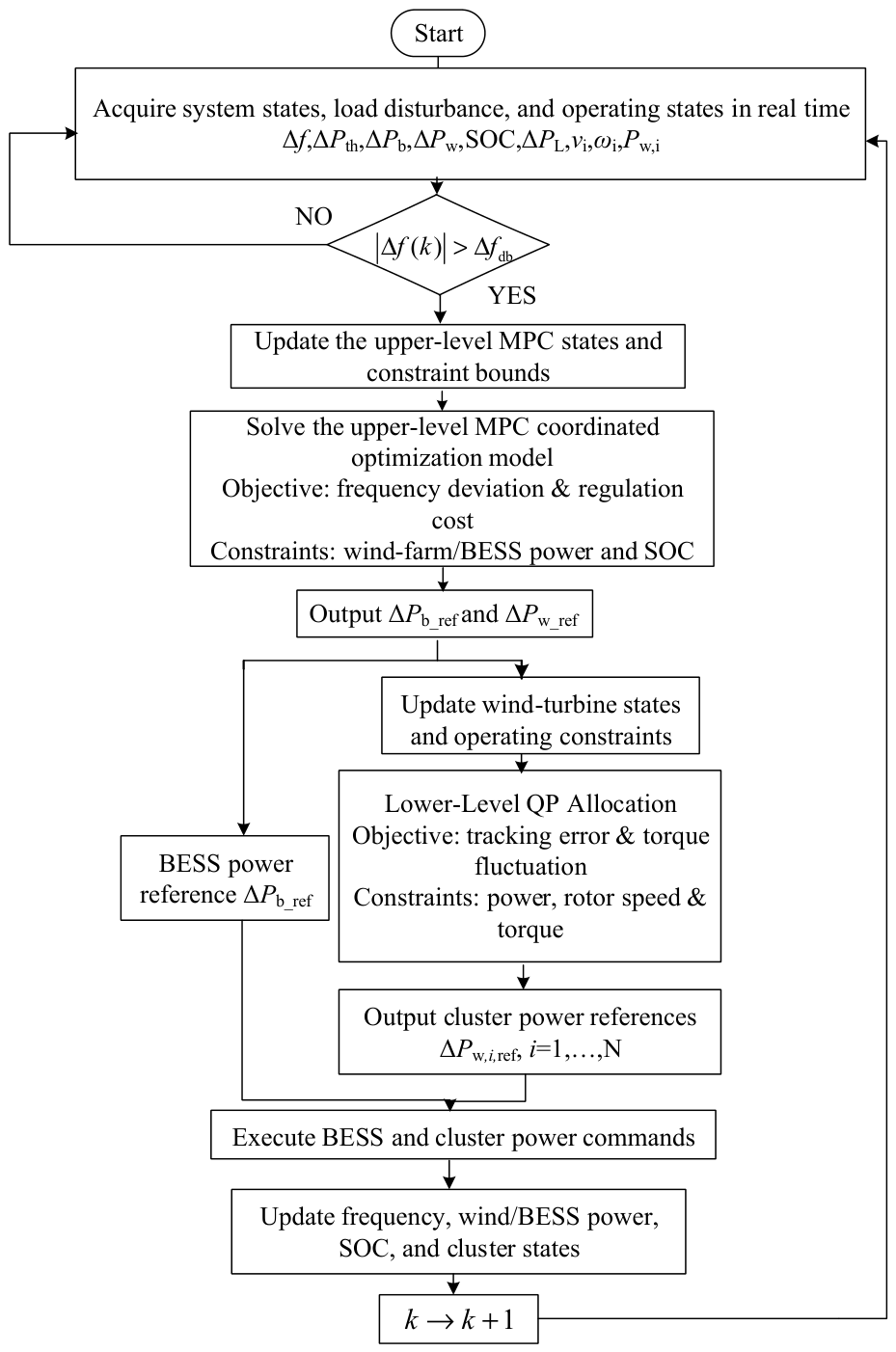
Figure 3 shows the hierarchical MPC–QP control procedure. At each sampling instant, the regulation-power limits are updated according to the system states and wind speed. The upper-level MPC determines the wind-farm and BESS power references, while the lower-level QP allocates the wind-farm reference among the five equivalent turbine clusters.
Figure 3.
Hierarchical MPC–QP control procedure for the wind–storage hybrid system.
3. Results
To verify the effectiveness of the proposed hierarchical MPC–QP primary frequency-regulation strategy, a wind–storage hybrid system is modeled in MATLAB/Simulink R2024a (The MathWorks, Inc., Natick, MA, USA). The system base power is 100 MW, and the rated capacities of the thermal power unit and wind farm are 600 MW and 150 MW, respectively. The wind farm comprises 100 DFIG-based turbines rated at 1.5 MW each, represented by five equivalent turbine clusters of 30 MW each. The BESS has a rated power of 15 MW, an energy capacity of 15 MWh, and an initial SOC of 0.5. The main simulation parameters are listed in Table 2.
Table 2.
Main simulation parameters of the wind–storage hybrid system.
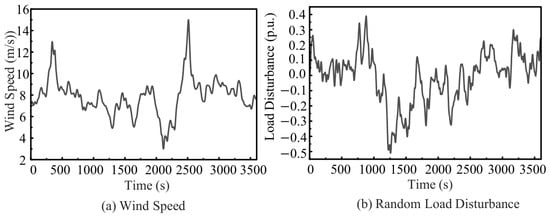
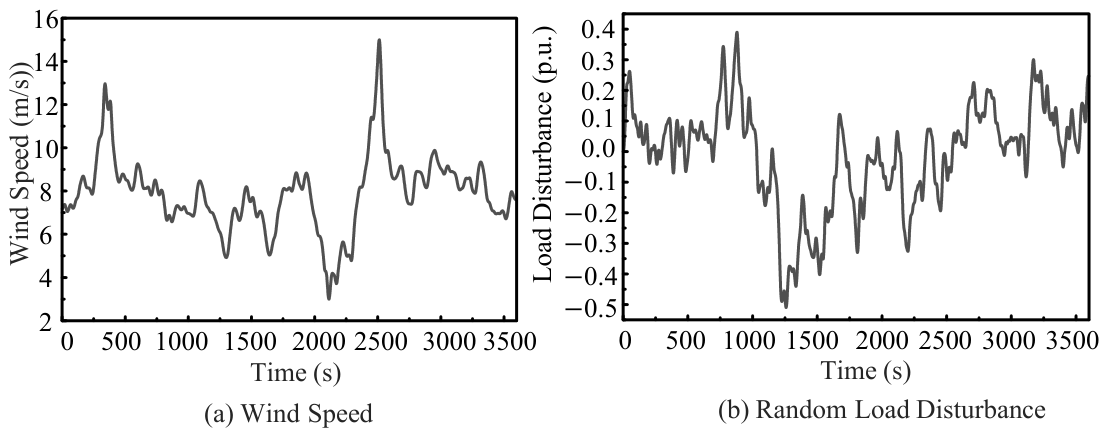
A 1 h simulation with varying wind speed and random load disturbances is conducted at a data sampling interval of 0.2 s. The simulation duration is selected to evaluate repeated primary frequency-regulation responses and associated BESS SOC variations under continuously changing wind-speed and load conditions. The load disturbance is generated by combining three independent Ornstein–Uhlenbeck processes (time constants: 20, 100, and 420 s; weights: 0.25, 0.55, and 0.75), followed by Gaussian smoothing (6 s), mean removal, normalization, and a 30 s cosine startup ramp. To further evaluate performance consistency, three additional stochastic realizations are generated using random seeds of 2066, 3066, and 4066 under identical system and controller settings. The MATLAB script and accompanying README for generating the stochastic wind-speed and load-disturbance inputs are provided in Supplementary File S1. Five equivalent turbine clusters with identical parameters are arranged in a single row at a spacing of five rotor diameters. The first cluster receives the free-stream wind, while downstream wind speeds are calculated using the Jensen wake model with full wake overlap and root-sum-square superposition of velocity deficits. The upper-level MPC uses YALMIP with MATLAB’s quadprog solver, while the lower-level QP employs quadprog with the interior-point-convex algorithm. Figure 4 shows the simulation inputs of the representative case (seed 1066), with the corresponding upper- and lower-level control results presented in Figure 5 and Figure 6, respectively. The statistical results across the three stochastic realizations are reported in Section 3.3.
Figure 4.
Simulation test conditions.
3.1. Upper-Level Wind–Storage Coordinated Control Results
For the upper-level comparison, a PI-based wind–storage coordinated control strategy is adopted as the benchmark. The total regulation-power command generated by the PI controller is initially allocated to the wind farm and BESS at a ratio of 0.6:0.4. When the wind-farm power reference exceeds its feasible regulation limits, the excess regulation demand is transferred to the BESS, subject to its power and SOC constraints. SOC-dependent correction and integral anti-windup are incorporated to mitigate SOC deviation and prevent integrator windup under saturation. Both strategies employ the same lower-level QP allocation method under identical wind-speed and load-disturbance conditions. The corresponding results are presented in Figure 5.
Figure 5.
Comparison of wind–storage coordinated control responses.
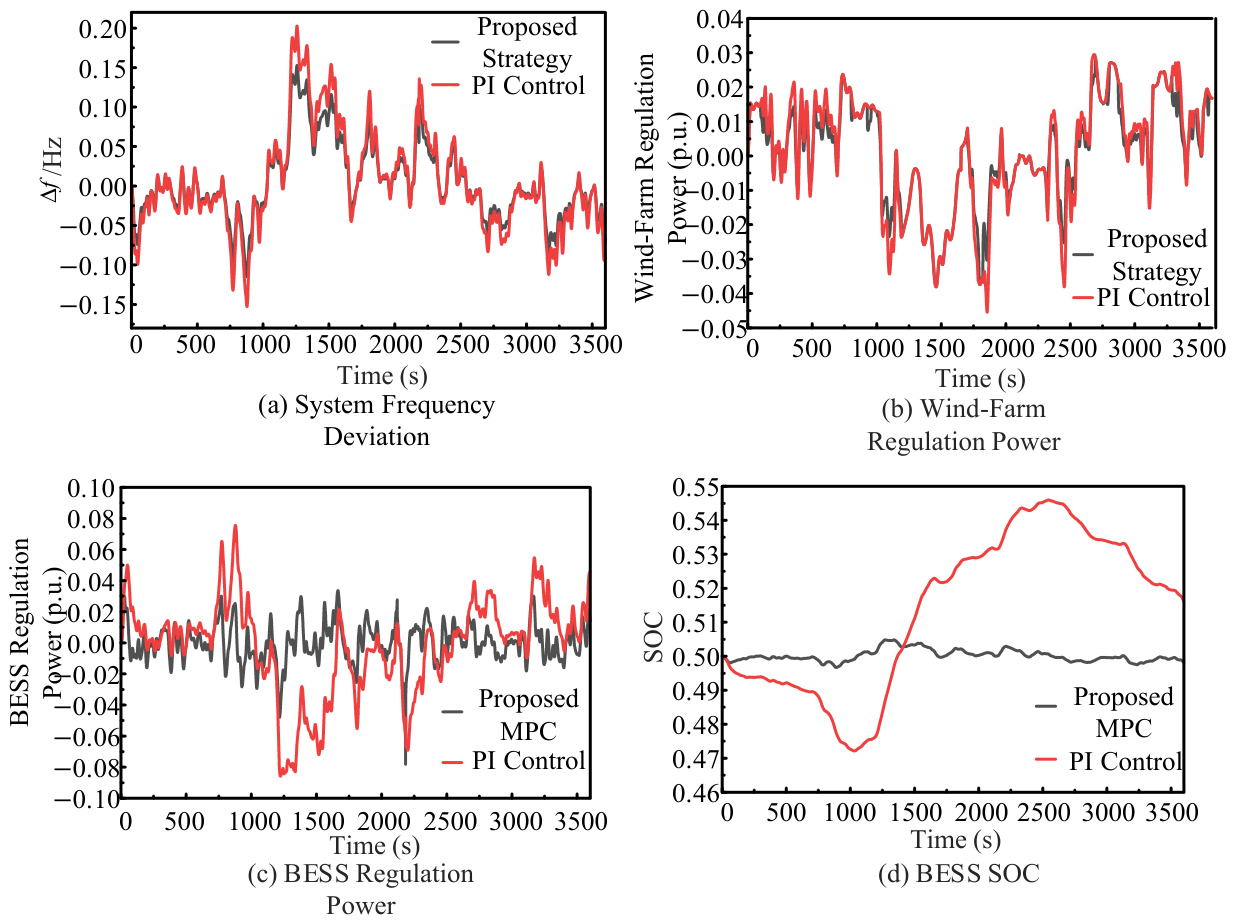
As shown in Figure 5a, both control strategies respond to the continuously varying wind speed and random load disturbances, while the proposed MPC strategy exhibits smaller frequency deviations, particularly during periods of significant load variations. Figure 5b,c illustrate the coordinated regulation-power responses of the wind farm and BESS, with the MPC strategy producing smoother power adjustments. Figure 5d shows that the SOC under PI control deviates noticeably from its initial value, whereas the proposed MPC maintains the SOC close to 0.5 throughout the simulation.
The quantitative results for the representative case are summarized in Table 3. Compared with PI control, the proposed MPC reduces the RMS frequency deviation and maximum absolute frequency deviation by 24.20% and 24.53%, respectively. The RMS SOC deviation decreases by 93.86%, while the cumulative regulation cost index is reduced by 84.72%. These results indicate that the proposed MPC strategy improves frequency regulation performance and SOC management under the representative simulation conditions.
Table 3.
Quantitative comparison of upper-level wind–storage coordinated control performance under the representative case.
3.2. Intra-Farm Power Allocation Results
For the lower-level comparison, a constrained equal-allocation strategy is adopted as the benchmark. The wind-farm regulation-power reference generated by the upper-level MPC is equally divided among the participating turbine clusters, and the resulting individual power references are limited by their respective feasible regulation-power ranges, as expressed by:
where Na(k) denotes the number of participating turbine clusters at sampling instant k. Nonparticipating clusters are assigned zero regulation power. Unlike the proposed QP strategy, equal allocation does not optimize the power distribution according to differences in cluster regulation capability. Consequently, individual power limits and turbine response dynamics may cause deviations between the total actual regulation power and the upper-level reference. Both strategies use the same upper-level MPC reference and turbine power-response dynamics. The comparison results are shown in Figure 6.
Figure 6.
Intra-farm power allocation results under different strategies.
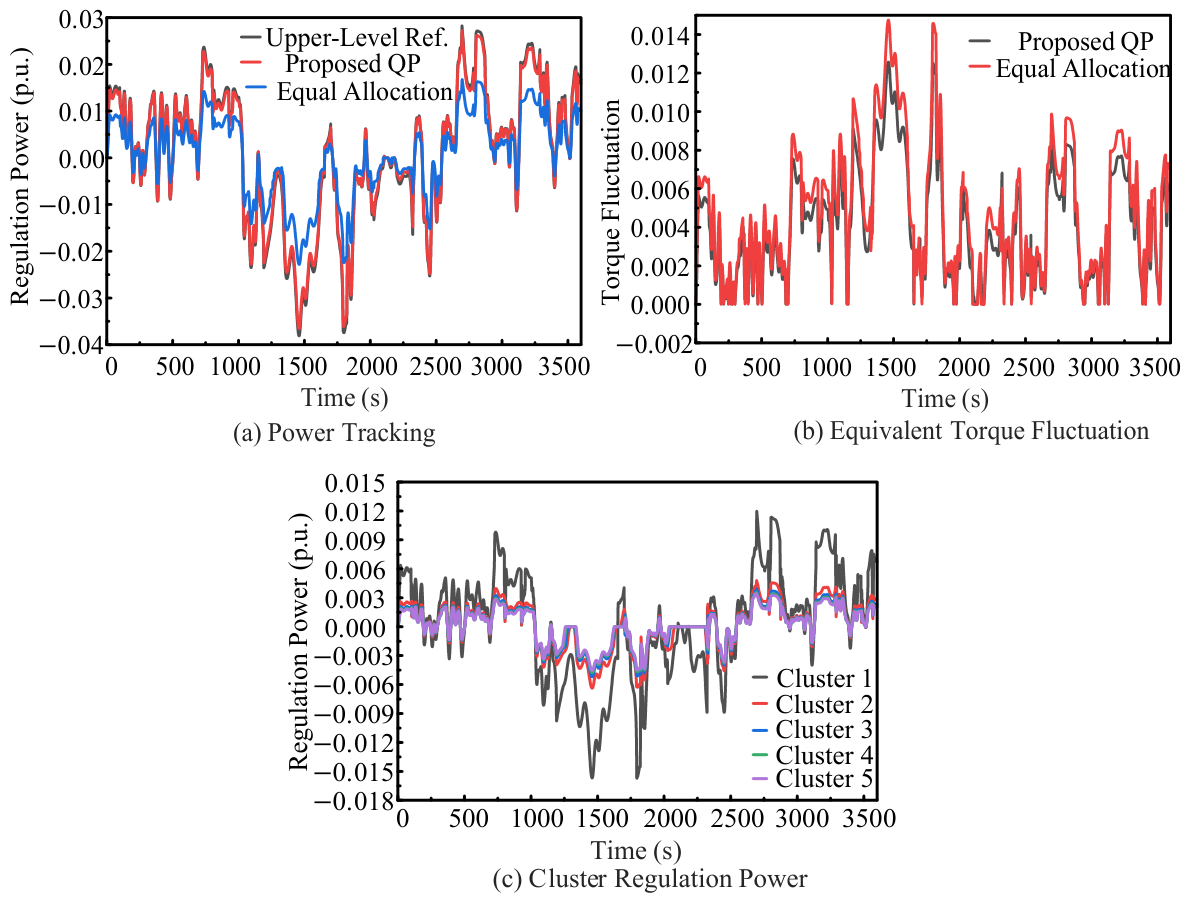
As shown in Figure 6a, the proposed QP strategy closely tracks the wind-farm regulation-power reference generated by the upper-level MPC, whereas equal allocation exhibits larger tracking deviations during certain periods. These deviations can arise from the cluster-specific power limits and turbine response dynamics discussed above. Figure 6b shows that the two strategies exhibit similar trends in equivalent torque fluctuation, while the proposed QP strategy reduces the overall fluctuation level. As illustrated in Figure 6c, the regulation power is distributed nonuniformly among the five equivalent turbine clusters according to their operating conditions and available regulation ranges, with Cluster 1 generally undertaking larger power adjustments.
The quantitative results for the representative case are summarized in Table 4. Compared with equal allocation, the proposed QP strategy reduces the RMS power-tracking error from 0.0058 to 0.0007, corresponding to a reduction of 87.93%, while the RMS equivalent torque fluctuation decreases from 0.0058 to 0.0049, representing a reduction of 15.52%. These results indicate that the proposed QP strategy improves power-tracking accuracy and reduces the overall level of equivalent torque fluctuation under the representative simulation conditions.
Table 4.
Quantitative comparison of intra-farm power allocation performance under the representative case.
3.3. Statistical Evaluation Under Multiple Stochastic Realizations
To further evaluate performance consistency, three additional 1 h stochastic simulations are conducted using random seeds of 2066, 3066, and 4066. All strategies are evaluated under identical system settings and disturbance inputs within each case. Table 5 summarizes the mean, sample standard deviation (SD), and worst observed values of the main performance indices.
Table 5.
Statistical comparison of control performance under three stochastic realizations.
As shown in Table 5, compared with PI control, the proposed MPC reduces the mean RMS frequency deviation, maximum absolute frequency deviation, RMS SOC deviation, and regulation cost index by 15.6%, 16.6%, 90.5%, and 74.1%, respectively. At the lower level, the proposed QP reduces the mean RMS power-tracking error and maximum equivalent torque fluctuation by 95.5% and 10.6%, respectively, compared with equal allocation. The proposed strategies also exhibit lower standard deviations and worst observed values for the reported performance indices. These results indicate consistent performance improvements across the three tested stochastic realizations, although further validation under more diverse operating conditions is required.
4. Discussion
The results indicate that wind–storage primary frequency regulation requires coordination not only between the wind farm and the BESS but also among equivalent turbine clusters within the wind farm. The proposed hierarchical MPC–QP strategy addresses both levels, with improvements in frequency response, SOC regulation, and intra-farm power allocation observed under the simulated conditions.
At the upper level, MPC coordinates the wind-farm and BESS regulation-power references according to the predicted system response and operating constraints. By incorporating the dynamic regulation-power limits of the wind farm together with BESS power and SOC constraints, the controller can redistribute regulation demand between the two resources as operating conditions change. This explains the improved frequency response, reduced SOC deviation, and lower regulation cost index observed in the simulations.
At the lower level, wake effects and wind-speed differences lead to unequal regulation capabilities among the equivalent turbine clusters. Equal allocation does not account for these differences, whereas the proposed QP strategy distributes the wind-farm regulation-power reference according to the available regulation ranges of the clusters while balancing power tracking and equivalent torque fluctuation. Under the simulated conditions, the proposed strategy improves power-tracking accuracy and reduces RMS equivalent torque fluctuation. Equivalent torque fluctuation serves as an indirect indicator of mechanical loading rather than a direct measure of fatigue damage. The three additional stochastic realizations further support the consistency of improvements in the selected performance indices, but do not establish robustness under unmodeled uncertainties or reductions in actual fatigue damage.
The upper- and lower-level optimizations therefore play complementary roles. The upper-level MPC determines coordinated wind–storage power references, while the lower-level QP ensures that the wind-farm reference is reasonably distributed among the turbine clusters. Nevertheless, the present study adopts equivalent turbine clusters, the Jensen wake model, and ideal communication and measurement conditions. Annual energy production and capacity factor are not evaluated in this study, as their reliable estimation requires representative long-term wind-resource data and consideration of turbine availability, deloading operation, and associated energy losses. Future work will consider parameter uncertainty, communication delays, measurement noise, storage degradation, adaptive weighting, and hardware-in-the-loop validation.
5. Conclusions
To improve wind–storage coordination and intra-farm power allocation in primary frequency regulation, this paper proposes a hierarchical MPC–QP control strategy that links operating-region-dependent wind-turbine regulation capability with system-level coordination and turbine-cluster-level power allocation. The main conclusions are as follows:
- (1)
- The upper-level MPC coordinates wind-farm and BESS regulation power under dynamically updated wind-farm power limits. In the representative simulation case, compared with PI control, the RMS frequency deviation and maximum absolute frequency deviation are reduced by 24.20% and 24.53%, respectively, while the RMS SOC deviation and cumulative regulation cost index decrease by 93.86% and 84.72%, respectively, indicating improved frequency regulation and SOC management under the simulated conditions.
- (2)
- The lower-level QP achieves differentiated power allocation among equivalent turbine clusters while balancing power-tracking accuracy and equivalent torque fluctuation. In the representative case, compared with equal allocation, the RMS power-tracking error and RMS equivalent torque fluctuation are reduced by 87.93% and 15.52%, respectively, demonstrating improved tracking accuracy and reduced RMS equivalent torque fluctuation.
- (3)
- Three additional stochastic realizations further demonstrate consistent improvements in the selected performance indices. However, these findings are limited to the equivalent turbine-cluster model, Jensen wake representation, and ideal communication and measurement conditions. Equivalent torque fluctuation is an indirect mechanical-load indicator rather than a direct measure of fatigue damage. Further validation using higher-fidelity models, uncertainty analysis, and hardware-in-the-loop experiments is required.
Supplementary Materials
The following supporting information can be downloaded at: https://www.mdpi.com/article/10.3390/en19204964/s1. Supplementary File S1: MATLAB script and accompanying README for generating the stochastic wind-speed and load-disturbance inputs of the representative simulation case.
Author Contributions
Conceptualization, Q.B. and T.C.; methodology, Q.B.; software, Q.B.; validation, Q.B.; formal analysis, Q.B.; investigation, Q.B.; data curation, Q.B.; writing—original draft preparation, Q.B.; writing—review and editing, T.C.; visualization, Q.B.; supervision, T.C.; project administration, T.C. All authors have read and agreed to the published version of the manuscript.
Funding
This research was funded by the Inner Mongolia Autonomous Region “Revealing the List and Taking Command” Project, grant number 2022JBGS0044.
Data Availability Statement
The raw data supporting the conclusions of this article will be made available by the authors on request.
Conflicts of Interest
The authors declare no conflicts of interest. The funders had no role in the design of the study; in the collection, analyses, or interpretation of data; in the writing of the manuscript; or in the decision to publish the results.
Abbreviations
The following abbreviations are used in this manuscript:
| MPC | Model Predictive Control |
| QP | Quadratic Programming |
| BESS | Battery Energy Storage System |
| SOC | State of Charge |
| DFIG | Doubly Fed Induction Generator |
References
- He, C.; Geng, H.; Rajashekara, K.; Chandra, A. Analysis and control of frequency stability in low-inertia power systems: A review. IEEE/CAA J. Autom. Sin. 2024, 11, 2363–2383. [Google Scholar] [CrossRef] [Scilit]
- Lim, S.; Kim, T.; Lee, K.Y.; Choi, D.; Park, J.-W. Impact of high penetration of renewables on power system frequency response: A review and verification. Renew. Sustain. Energy Rev. 2025, 217, 115728. [Google Scholar] [CrossRef] [Scilit]
- Saleem, M.I.; Saha, S. Assessment of frequency stability and required inertial support for power grids with high penetration of renewable energy sources. Electr. Power Syst. Res. 2024, 229, 110184. [Google Scholar] [CrossRef] [Scilit]
- Han, J.; Zhang, D.; Xie, L.; Luo, C.; Jia, B.; Li, Q.; Chen, Z. Dispatch strategy for power system with high wind power penetration considering secondary frequency drop. IEEE Trans. Power Syst. 2026, 41, 611–625. [Google Scholar] [CrossRef] [Scilit]
- Heidari, M.; Ding, L.; Kheshti, M.; Zhao, X.; Terzija, V. Adaptive inertial control for wind turbine generators in fast frequency response based on the power reduction period assessment. IEEE Trans. Sustain. Energy 2025, 16, 377–391. [Google Scholar] [CrossRef] [Scilit]
- Zhao, T.; Liu, H.; Wang, N.; Su, J.; Luo, Z.; Ma, S. An active power control of DFIG-based wind turbine generators for frequency regulation with expected dynamic performance. Appl. Energy 2025, 391, 125948. [Google Scholar] [CrossRef] [Scilit]
- Hadizade, A.; Moallem, M.; Miller, M.; Wang, J. Fast frequency response in low-inertia grids via integrated supercapacitor energy storage systems and wind turbine generators. IEEE Trans. Sustain. Energy 2026, 17, 230–241. [Google Scholar] [CrossRef] [Scilit]
- Tian, X.; Chi, Y.; Cheng, P.; Zhao, Y.; Liu, H. Optimal frequency response coordinated control strategy for hybrid wind-storage power plant based on state reconstruction. IET Renew. Power Gener. 2024, 18, 2892–2906. [Google Scholar] [CrossRef] [Scilit]
- Zhang, X.; Shao, Z.; Fu, Y.; Cao, Y. Frequency safety demand and coordinated control strategy for power system with wind power and energy storage. IET Gener. Transm. Distrib. 2025, 19, e70018. [Google Scholar] [CrossRef] [Scilit]
- Shu, H.; Wang, G.; Chen, J.; Ma, H.; He, T. Coordinated control of wind-storage combined with primary frequency regulation and variable coefficient based on wind speed and SOC. J. Energy Storage 2024, 87, 111356. [Google Scholar] [CrossRef] [Scilit]
- Lu, P.; Zhang, N.; Ye, L.; Du, E.; Kang, C. Advances in model predictive control for large-scale wind power integration in power systems. Adv. Appl. Energy 2024, 14, 100177. [Google Scholar] [CrossRef] [Scilit]
- Pei, M.; Wang, Q.; Ye, L.; Luo, Y.; Sha, L.; Zhang, Z.; Song, X. Hierarchical control strategy of wind-storage frequency support for SOC recovery optimization and arbitrage revenue. Appl. Energy 2024, 365, 123229. [Google Scholar] [CrossRef] [Scilit]
- Yao, Y.; Shi, Y.; Chen, M.; Xu, B.; Lei, Z.; Gao, W.; Li, D. Frequency regulation strategy of wind storage hybrid system based on effective inertia margin. Int. J. Electr. Power Energy Syst. 2025, 173, 111376. [Google Scholar] [CrossRef] [Scilit]
- Cai, Z.; Liu, X.; Li, C.; Tai, N.; Huang, W.; Huang, S.; Wei, J. Dual alternative iteration algorithm-based hierarchical MPC strategy for frequency regulation control and active power allocation of wind-storage coupling system. Prot. Control Mod. Power Syst. 2025, 10, 160–175. [Google Scholar] [CrossRef] [Scilit]
- Kong, L.; Xiao, F.; Yang, H.; Fang, F.; Qin, S. Distributed optimal control of wind farms with deloading operation for load sharing. Energy 2025, 339, 138985. [Google Scholar] [CrossRef] [Scilit]
- Li, Y.; Huang, S.; Peng, H.; Wei, J.; Yang, Y.; Chen, D.; Huang, X. Bi-level optimal active power dispatch in wind farms for drive train load reduction. Energy 2025, 339, 139047. [Google Scholar] [CrossRef] [Scilit]
- Wang, W.; Kong, X.; Li, G.; Liu, X.; Ma, L.; Liu, W.; Lee, K.Y. Wind farm control using distributed economic MPC scheme under the influence of wake effect. Energy 2024, 309, 132902. [Google Scholar] [CrossRef] [Scilit]
- Zhu, Y.; Shi, Q.; Yao, S.; Wei, Z. Adaptive MPC and power dispersion index based improved hierarchical frequency regulation for wind-storage integrated system. J. Energy Storage 2025, 107, 115006. [Google Scholar] [CrossRef] [Scilit]
- Pérez-Pérez, E.-J.; Puig, V.; Santos-Ruiz, I.; Guzman-Rabasa, J.-A.; Valencia-Palomo, G. Wind turbine fault diagnosis using structural analysis and optimized-Rectangular GPR interval estimation. Control Eng. Pract. 2026, 172, 106940. [Google Scholar] [CrossRef] [Scilit]
- Nakkala, S.; Hur, S.H. Fault detection and diagnosis of the pitch system in a wind turbine using an adaptive Kalman filter and a hybrid deep learning model. Control Eng. Pract. 2027, 178, 107284. [Google Scholar] [CrossRef] [Scilit]
- Huang, J.; Xu, Y. Coordination of Wind Power and Energy Storage for Power Grid Frequency Support Considering Asset Degradation. IEEE Trans. Sustain. Energy 2026, 17, 2616–2632. [Google Scholar] [CrossRef] [Scilit]
- Liu, J.; Jia, Y.; Shi, J.; Wang, Z.; Han, X.; Wang, P.; Yin, X. Stochastic Cooperation Strategy of Multi-Wind Farms with Shared Energy Storage for Primary Frequency Regulation Considering Wind Cluster Effect. Electr. Power Syst. Res. 2026, 252, 112348. [Google Scholar] [CrossRef] [Scilit]
- Huang, J.; Xu, Y. Multi-Timescale Coordinated Control of Wind Power Plant for Supporting Power System Operation. IEEE Trans. Power Syst. 2025, 40, 355–367. [Google Scholar] [CrossRef] [Scilit]
- Ji, S.; Zhuang, J.; Liu, M. An MPC-Based Two-Stage Primary Frequency Regulation Strategy for Grid Integrated Wind Farms. Int. J. Electr. Power Energy Syst. 2025, 172, 111264. [Google Scholar] [CrossRef] [Scilit]
- Zhai, J.; Guo, L.; Wang, Z.; Zhu, J.; Li, X.; Wang, C. Interdependence Modeling of Wind Farm Frequency Support Feasible Region: A Non-Iterative System-Wide Dynamic Characteristics Scheduling. Appl. Energy 2025, 401, 126687. [Google Scholar] [CrossRef] [Scilit]
- Qin, C.; Shi, H.; Ren, J. Coordinated Integration of Wind Turbine Rotor Speed Safety and Overspeed Deloading in Frequency-Constrained Unit Commitment. Sustain. Energy Grids Netw. 2026, 46, 102315. [Google Scholar] [CrossRef] [Scilit]
- Xu, C.; Yin, M.; Chen, Z.; Li, Q.; Li, Q.; Zou, Y. Precise Deloading Optimization Strategy for Wind Farm Based on the Accurate Estimation of Maximum Power. Int. J. Electr. Power Energy Syst. 2025, 168, 110659. [Google Scholar] [CrossRef] [Scilit]
- Afshar, Z.; Bhogaraju, I.; Rahmanei, H.; Farasat, M. Hierarchical Frequency and SOC Control of Power Grids With Battery Energy Storage Systems. IEEE Trans. Power Electron. 2024, 39, 7925–7937. [Google Scholar] [CrossRef] [Scilit]
- Boyle, J.; Littler, T.; Foley, A.M. Aggregator Control of Battery Energy Storage in Wind Power Stations to Maximize Availability of Regulation Service. Energy Convers. Manag. X 2024, 24, 100703. [Google Scholar] [CrossRef] [Scilit]
- Ruan, Y.; Yao, W.; Zong, Q.; Zhou, H.; Gan, W.; Zhang, X.; Li, S.; Wen, J. Online Assessment of Frequency Support Capability of the DFIG-Based Wind Farm Using a Knowledge and Data-Driven Fusion Koopman Method. Appl. Energy 2025, 377, 124518. [Google Scholar] [CrossRef] [Scilit]
- Wang, L.; Huang, S.; Bai, G.; Wang, P.; Zhang, J. A Hybrid-Driven Control Strategy for Optimized Wind Farm Power Dispatch. Renew. Energy 2025, 247, 122940. [Google Scholar] [CrossRef] [Scilit]
- Wang, B.; Ding, L.; Xiao, T.; Chen, Y. An Integrated Multi-Timescale MPC Framework for Coordinated Wind Farm Power Maximization, Load Management, and Grid Support. Renew. Energy 2026, 256, 123903. [Google Scholar] [CrossRef] [Scilit]
- Xiao, J.; Wang, P.; Huang, S.; Wu, Q.; Chen, W.; Wei, L.; Wang, S.; Chen, D. Hierarchical Dynamic Active Wake Control for Wind Farm Power Generation Enhancement and Fatigue Load Suppression with Participation in Secondary Frequency Regulation. Int. J. Electr. Power Energy Syst. 2025, 173, 111365. [Google Scholar] [CrossRef] [Scilit]

Disclaimer/Publisher’s Note: The statements, opinions and data contained in all publications are solely those of the individual author(s) and contributor(s) and not of MDPI and/or the editor(s). MDPI and/or the editor(s) disclaim responsibility for any injury to people or property resulting from any ideas, methods, instructions or products referred to in the content. |
© 2026 by the authors. Licensee MDPI, Basel, Switzerland. This article is an open access article distributed under the terms and conditions of the Creative Commons Attribution (CC BY) license.