


Abstract
Energy materials development remains experimentally intensive because relevant knowledge is dispersed across heterogeneous sources, material formulas and processing parameters are strongly coupled, and experimental data are often incomplete. Although artificial intelligence (AI), including large language models (LLMs), can support knowledge extraction, materials design, experiment planning and data analysis, these capabilities often operate as isolated tools rather than as a computational–experimental loop. This Perspective proposes a conceptual 4E framework—comprising Extraction, Execution, Evolution, and a Generative AI (GAI) Engine—for energy Materials Intelligence and Manufacturing. Extraction converts literature, experimental records, and multimodal data into structured knowledge. Execution translates encoded recipes into machine-executable protocols for robotic synthesis and characterization while returning real-time feedback. Evolution uses robotic experimental feedback to evaluate a domain-specific Recipe Language Model (RLM), which subsequently recommends new material recipes. The GAI Engine coordinates the RLM, materials database, robotic platform, characterization systems, and digital twin within a closed-loop architecture. The framework is further extended conceptually towards intelligent manufacturing through operational data, process monitoring, quality control, and staged translation from laboratory validation to pilot and industrial operation. The 4E framework therefore provides a pathway, grounded in experimentally demonstrated platforms, that links knowledge, formulas and parameters, robotic execution and feedback-driven learning for Materials Intelligence and Manufacturing.
1. Introduction
Energy materials are central to photovoltaics [1], batteries [2], fuel cells [3], thermoelectric devices [4] and other clean-energy technologies [5]. Their development remains experimentally intensive because formulas, parameters, mechanisms and performance are strongly coupled. Learning these coupled relationships across the high-dimensional recipe space is constrained by sparse, heterogeneous and incompletely specified experimental records. Artificial intelligence (AI) for science has introduced new approaches for materials discovery, performance prediction and process optimization [6]. Computational methods, including density functional theory and other first-principles techniques, can screen candidate materials and predict aspects of their structure and properties [7,8]. However, computational predictions cannot fully capture synthesis-dependent factors such as precursor quality, morphology, interfaces and defects. Physical experiments, often referred to as wet experiments, are therefore required to validate predictions and generate reliable data for subsequent model development.
Laboratory automation and robotics have enabled synthesis, characterization, and optimization with improved precision and throughput [9,10]. Robotic platforms have been developed for flow synthesis [11], mobile experimentation [12], autonomous chemical synthesis [13], nanoparticle preparation [14,15], closed-loop batch organic synthesis [9], and LLM-directed cross-coupling synthesis [16]. At the software level, chemical programming languages have enabled experimental procedures to be represented in machine-readable forms [17,18], while Bayesian optimization [19], computational agents [10], graph neural networks [20], and large language models (LLMs) [16,21,22] have expanded the capabilities available for experiment planning and scientific knowledge extraction and discovery [6,23]. These advances, however, do not yet constitute an integrated Materials Intelligence workflow. Existing systems may lack shared machine-readable recipe representations that link formulas and parameters with synthesis sequences, characterization results, and performance metrics. General-purpose AI models may consequently generate chemically or physically implausible recipes that cannot be executed by the available equipment. These limitations are compounded by the shortage of high-quality, machine-readable experimental data and by the difficulty of adapting general-purpose models to specific materials systems and robotic platforms [24,25].
Recent reviews and perspectives have examined the convergence of AI and robotic platforms in Materials Intelligence [26], the opportunities and practical challenges of AI-enabled laboratory automation [27], the accessibility and organization of self-driving laboratories [28], and the integration of robotics and AI for materials discovery [29]. Beyond these surveys, individual laboratory-scale studies have coupled machine-readable recipes with robotic experimentation and feedback-driven learning [17,18,30], and a first such cycle has been demonstrated at pilot scale towards manufacturing workflows [31]. Collectively, these studies describe important components of automated materials research, but an integrated framework is still required to connect heterogeneous scientific knowledge, structured recipe representation, robotic experimentation, feedback-driven model updating and intelligent manufacturing. Accordingly, the central question of this perspective is how heterogeneous knowledge, structured recipe representation, robotic execution, and feedback-driven learning can be integrated into a single closed-loop workflow for energy materials development. To address this question, this perspective proposes a 4E framework for Materials Intelligence in energy-materials development, organized around Extraction, Execution, Evolution, and the Generative AI (GAI) Engine. This paper also explains the 4E framework’s components and potential transition from laboratory research to Materials Intelligence and Manufacturing.
2. Materials Intelligence for Energy Materials Development
Materials Intelligence has emerged from the convergence of AI, materials informatics, and robotic platforms in materials research. Zhang et al. describe this convergence through three interconnected activities: data-guided rational design (Reading), automation-enabled controllable synthesis (Doing), and autonomy-facilitated inverse design (Thinking) [26]. Reading extracts and organizes knowledge from scientific literature, databases, and experimental records into machine-interpretable relationships among formulas and parameters, mechanisms, and performance. Doing translates selected recipes into controlled synthesis and characterization while generating robotic execution results. Thinking evaluates predicted and experimental outcomes, learns formula–parameter–mechanism–performance relationships and recommends subsequent formulas and parameters through inverse design and optimization. Doing produces evidence that updates Thinking, while Thinking redirects subsequent Reading and Doing, forming an iterative Materials Intelligence loop. Table 1 compares these three capabilities with the proposed 4E framework (Extraction, Execution, Evolution, and GAI Engine). The novelty of the 4E framework lies in three architectural additions: a validation gate between knowledge extraction and robotic execution, the domain-specific Recipe Language Model (RLM), and GAI Engine coordination across the closed loop. Where Reading–Doing–Thinking defines what a Materials Intelligence system should do, the 4E framework specifies the components, interfaces, and control gates required for Materials Intelligence in energy materials development.
Table 1.
Comparison between Reading–Doing–Thinking paradigm of Materials Intelligence and the proposed 4E framework.
For energy materials, Materials Intelligence can be understood as an integrated approach that connects scientific knowledge with material formulas, processing parameters, mechanisms, characterization results, and performance evaluation. This perspective is broader than applying a predictive model to an isolated materials recipe. A predicted formula has limited experimental value if the required processing conditions cannot be represented, validated or executed by the available equipment. Conversely, high-throughput robotic experiments provide limited learning value when material identities, process conditions, measurement contexts and unsuccessful outcomes are not recorded consistently. An energy-materials Materials Intelligence system therefore can interpret heterogeneous knowledge, preserve the relationship between materials and processes, generate experimentally meaningful recipes, and learn from robotic experiment outcomes. These representations enable experimental results to remain interpretable and reusable while supporting uncertainty-aware model evaluation and human-supervised decision making.
Existing AI-assisted laboratories demonstrate important elements of knowledge extraction [32], automated experimentation [22], and closed-loop optimization [33], but these capabilities are often developed as separate modules. The proposed 4E framework addresses this fragmentation by positioning structured recipe representation, experimental traceability, feedback-driven model updating, and system-level coordination as connected requirements for energy materials development. Its purpose is not to replace existing AI, robotics, or materials informatics methods, but to provide a framework for connecting them into a more coherent and experimentally grounded Materials Intelligence workflow.
3. The 4E Framework
The 4E framework was derived systematically from a structured analysis of prior work. Relevant studies were grouped into three categories: surveys and perspectives on laboratory automation and Materials Intelligence [26,27,28,29], demonstrated closed-loop systems [30,31,34,35,36], and component-level technologies for knowledge extraction, machine-readable recipes, and robotic experimentation [17,18,22,23,32,37]. Analysis of these categories identified four functions required for a closed computational–experimental loop: knowledge extraction (Extraction), robotic execution (Execution), feedback-driven learning (Evolution), and system-level coordination (GAI Engine).
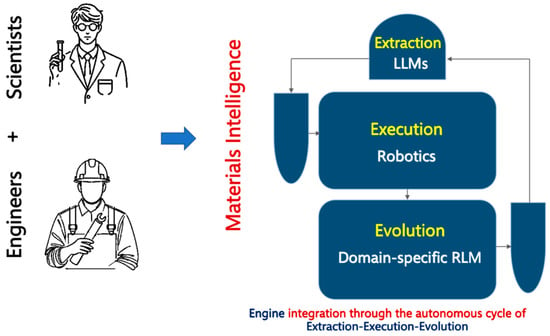
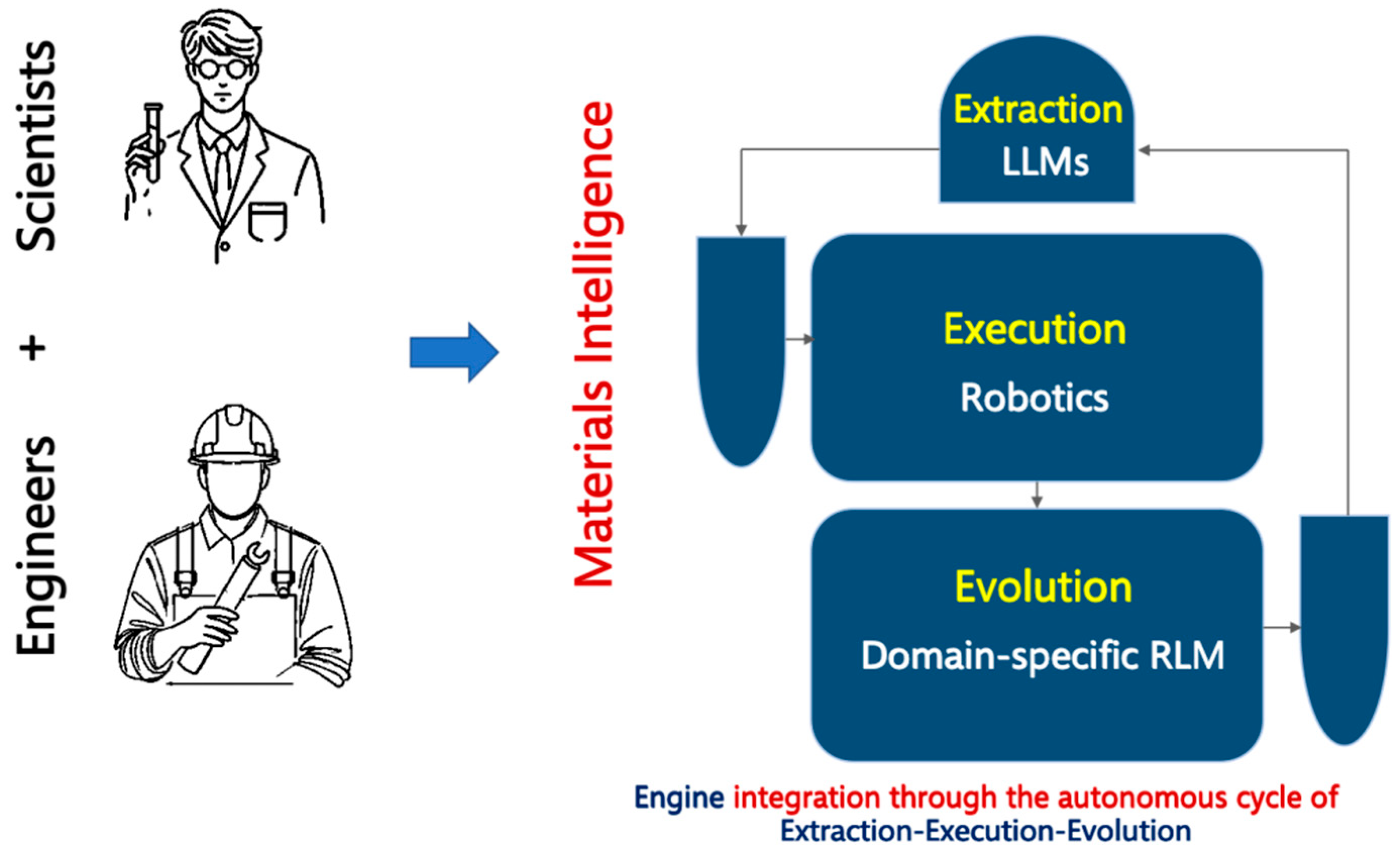
The proposed 4E framework translates the three capabilities of Materials Intelligence, Reading–Doing–Thinking, into an operational architecture for energy materials development. It comprises a domain-specific RLM, a structured materials database, a robotic platform, characterization instruments, and a digital twin of the experimental workflow. The RLM is designed to represent and generate formulas, parameters, synthesis and characterization procedures for specific energy material systems, operating as a hybrid of a fine-tuned, domain-specific generative model and retrieval from the structured materials database. Figure 1 provides a conceptual overview of these connections. Scientists and engineers develop materials by extracting knowledge, conducting experiments and learning from the resulting evidence. The system on the right mirrors this workflow through LLM-based Extraction, robotics-enabled Execution and domain-specific RLM-facilitated Evolution, while the GAI Engine coordinates information and decisions across the cycle to refine subsequent formulas and parameters.
Figure 1.
Conceptual 4E framework of Materials Intelligence in energy materials development.
While the components above are described in concrete terms, the framework itself is intentionally general and can be applied to a variety of energy materials. Each material type requires its own literature sources, synthesis and characterization workflows, and performance objectives. The closed-loop optimization framework nevertheless applies whenever two conditions are met: an objective exists that can be optimized, and a high-throughput method exists to measure it. Suitable objectives can be, for example, power conversion efficiency, energy density, or material yield.
3.1. Extraction: LLM-Guided Rational Design
Extraction converts scientific literature, experimental records, and multimodal materials data into structured, mechanism-grounded records for rational materials design and experimental planning. Literature search agents have been integrated into a multi-agent system for hypothesis generation and scientific discovery [23]. OpenScholar, for example, answers multidisciplinary scientific questions with citations by retrieving evidence from a datastore containing 45 million papers [32]. For Materials Intelligence, LLM-based extraction can identify formulas and parameters, synthesis operations, characterization settings, performance and their relationships.
This extraction of knowledge is necessary because materials information is distributed across different formats and sources. Relevant information may appear in scientific prose, tables, images, spectra, and performance curves, while experimental records often have different levels of detail and inconsistent terminology. These heterogeneous sources should therefore be converted into semantic descriptions that connect material identity, formula, processing parameters, characterization results, and performance. The resulting records should retain links to the original sources, measurement conditions, standardized units, and relevant uncertainty. Such conversion allows information from different experiments to be compared and reused within a common computational framework. ReactionSeek [37] demonstrates this conversion for chemistry through source-specific agents. An image-mining agent identifies molecular labels and their roles as reactants/products using a multimodal LLM (GLM-4V), and an optical character structure recognition (OCSR) tool then converts the graphical structures into SMILES. Meanwhile, a text-mining agent uses prompt-engineered general-purpose LLMs to fill tables with predefined column headings. A standardization module generates canonical SMILES from mined chemical names using cheminformatics tools such as database lookups and name-to-structure converters, producing a structured record for each reaction. Within the Extraction module of the 4E framework, we accordingly propose that heterogeneous data be extracted by specialized agents implemented as engineered prompts on general-purpose LLMs and supported by tools such as OCSR and cheminformatics utilities. Engineered prompts should be tailored to each source to extract the expected information, for example, reactants, products, and conditions such as temperature and equipment type, together with the quantities specific to each characterization technique. Deterministic look-up tables should convert non-standard chemical names (IUPAC names, common names, misspelled variants, and chemical formulas) into standard forms such as canonical SMILES.
The provenance-preserving records created through this conversion should also ground the responses of extraction agents to user queries. Retrieval-augmented generation (RAG) provides such a mechanism, where the LLM searches a structured database of these records with metadata preserved, retrieves the relevant records together with the query as a prompt, and generates a response with links to the cited sources. Citation grounding increases accuracy, allows answers to be verified by humans or separate agents through the cited sources, reduces hallucinations, and identifies which parts of the recipe (formulas and parameters) were generated by the LLM, inferred from the data sources, or quoted from the data sources. It also allows proprietary databases to be used for retrieval without being used to train the expensive LLMs, and supports the identification of recipe components that may be protected by intellectual property rights, since the sources of the proposed recipes are cited explicitly. Quantitative metrics can be used to evaluate the accuracy of the extraction and the rate of hallucination, for example, the proportion of claims supported by citations in the database, citation precision, the proportion of retrieved information relevant to the query, and the proportion of information reported versus information missed. Evaluation can be performed by another LLM or by human experts. In particular, Asai et al. compared LLMs on their percentage of hallucinated citations, and found that the LLM with a retrieval mechanism did not suffer from citation hallucination [32].
Semantic representation and citation grounding alone do not establish the reliability of extracted knowledge. Even when the underlying data comes from reputable sources, the scientific reports may still use inconsistent terminology, omit important processing details, or apply different units and measurement protocols. Each extracted record should therefore retain its source provenance and validation status. A further challenge arises when the information needed to define a complete experimental procedure is distributed across linked sources. For example, a primary article may report the material composition and general synthesis steps, whereas specific concentrations, processing parameters, or characterization conditions may appear in the Supplementary Information, an earlier publication cited by the authors, or laboratory records. Extraction should therefore identify relationships among these sources and support cross-source reconstruction of experimental knowledge, rather than treating each document as an independent record. It should link relevant documents, align compatible information, and assemble a unified, provenance-preserving experimental record or recipe, with each parameter classified as directly reported, transferred from a linked source, inferred, ambiguous, or missing and conflicting values flagged for expert review. In practice, this means that when a paper cites another paper as part of the recipe, the extraction agent should also parse that document and extract the information cited in it. The system should not silently fill missing information or assume that procedures reported in different sources are equivalent. Instead, unresolved gaps and discrepancies should remain explicit, with ambiguous or inconsistent entries flagged and assigned a confidence rating, so that the reconstructed record can be assessed before downstream use in model development or recipe generation. To ensure that the extracted information is accurate, a separate evaluation agent can rate the output of the extraction agent for accuracy and completeness under a predefined rating scheme with score descriptions. Only data receiving high scores enter the database, while low-scoring results trigger re-extraction. Beyond cross-source reconstruction, cross-domain integration may also be required because energy materials development combines chemical, physical, processing, device, and manufacturing information. Together, these reconstruction and validation steps determine whether an extracted record can be used directly for model development or requires further expert review.
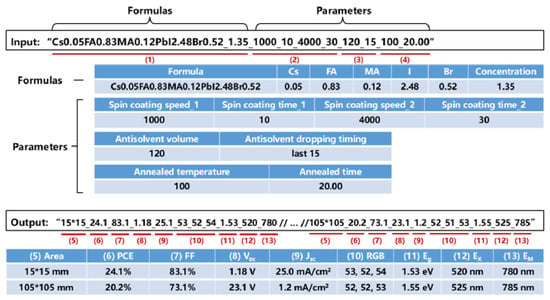
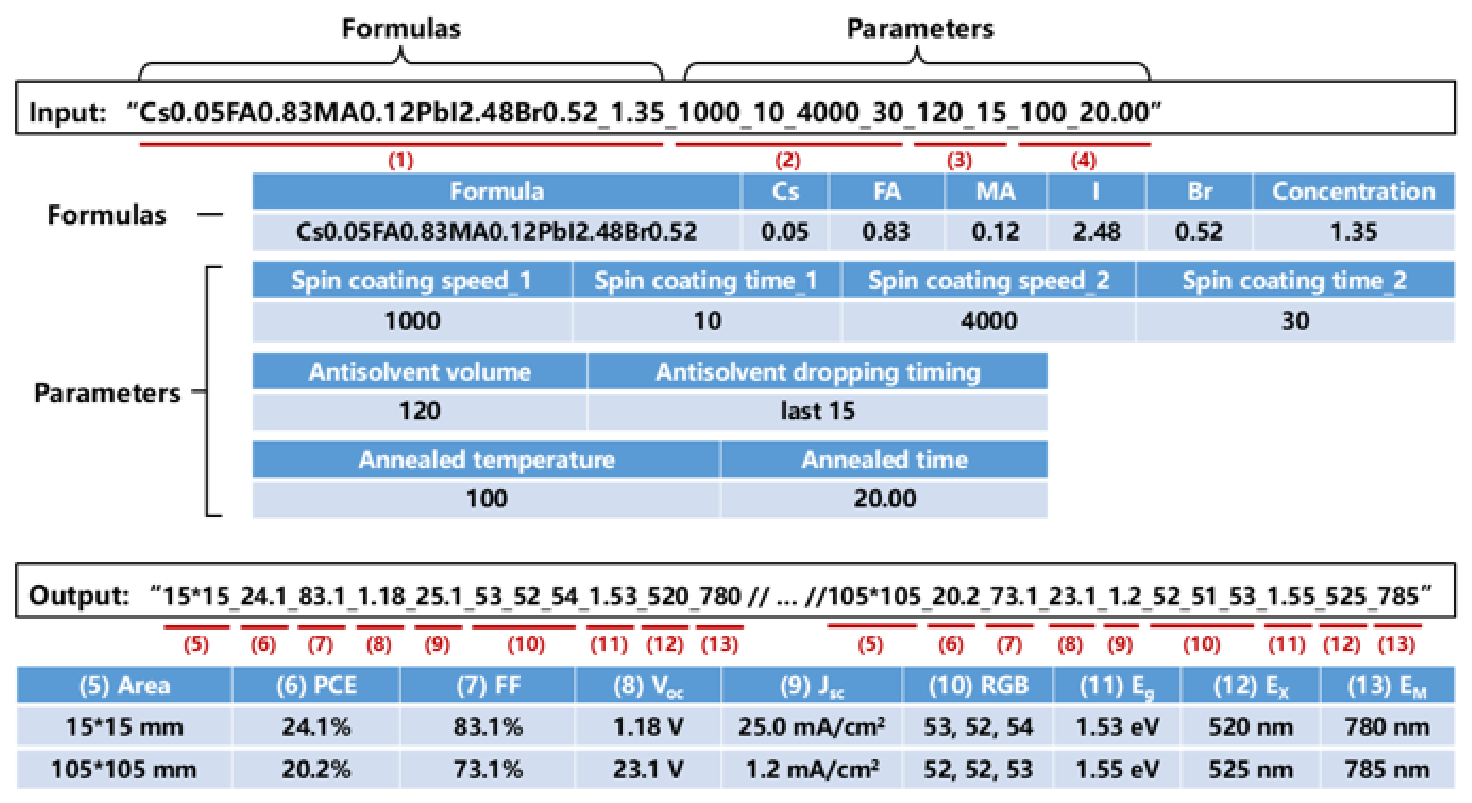
Once extracted information has been validated, it can provide an initial knowledge base for the RLM. The proposed RLM could use this knowledge to generate candidate formulas and parameters. In this role, the RLM is initialized from a pretrained LLM and iteratively fine-tuned on numerical and semantic recipe corpora drawn from the extracted literature and robotic experiments [30]. Its inputs are machine-readable recipes comprising formulas, processing parameters, and synthesis and characterization sequences. Its outputs are candidate recipes, executable protocols, and mechanistic reasoning. A validated knowledge base and well-defined recipe inputs do not, however, guarantee the feasibility of a generated recipe. Model outputs should therefore be checked against chemical, physical, and process constraints, and predictive performance should be evaluated using experimental benchmarks. For this reason, the RLM should operate within a validated Materials Intelligence workflow, with expert review retained when the supporting evidence or experimental feasibility remains uncertain. A materials programming language can provide a platform-independent interface for transferring validated formulas and parameters from the RLM to robotic Execution and returning experimental results to the materials database for Evolution [17,18], as illustrated in Figure 2.
Figure 2.
Conceptual materials programming language for recipe representation and machine-executable protocol encoding. Material formulations and processing parameters are encoded for communication between the RLM, experimental database, and robotic platform. The values shown are illustrative and do not correspond to a specific reported experiment. The example includes (1) material formula, (2) spin coating speed and time, (3) antisolvent volume and drop timing, (4) annealing temperature and time, (5) device area, (6) power conversion efficiency, (7) fill factor, (8) open-circuit voltage, (9) short-circuit current, (10) color, (11) bandgap, (12) excitation wavelength, and (13) emission wavelength.
Before conversion into a machine-executable recipe, each extracted record should pass a validation gate between Extraction and Execution. This gate should assess information completeness, formula and parameter plausibility, unit consistency, measurement conditions, and equipment compatibility, as summarized in Table 2. Inferred, transferred, ambiguous, or missing values, as well as conflicting information, should be flagged for expert review before robotic execution. After Execution, experimental evaluation should assess recipe-to-command fidelity, operation within validated limits, and performance against predefined experimental benchmarks. The resulting evidence should then inform RLM updating. Thus, validation controls the transition to robotic operation, while evaluation provides the feedback required for Evolution.
Table 2.
Validation gate criteria between Extraction and Execution. Thresholds are not universal; they are configured for each material system and platform before the system operates.
3.2. Execution: Robotics-Enabled Controllable Synthesis
Execution begins after the validation gate has been passed. It operationalizes Doing by compiling a validated recipe into a machine-executable protocol and recording how that protocol is physically realized. Robotic systems have been applied to chemical synthesis and characterization [38]. Execution translates encoded recipes into robotically controllable synthesis and characterization procedures, while machine-learning methods can support synthesis planning and the selection of experimental conditions [39,40,41,42]. The robotic platform can be programmed to control variables such as temperature, solution concentration, reaction time, reagent addition, and processing sequence. Automated procedures can improve experimental consistency and throughput only when the equipment is properly calibrated and the operating range has been validated for the relevant material system. In addition, automated synthesis should be combined with characterization methods appropriate to the material system and the properties being evaluated. Possible methods include nuclear magnetic resonance [38], in situ photoluminescence and ultraviolet–visible–near-infrared (UV-Vis) spectroscopy [14], color recognition, image-based defect detection, and X-ray diffraction. The selection of instruments should be determined by the material, process, and measurement requirements rather than by assuming that a single platform can accommodate every energy material system. A modular platform strategy could support such adaptation to different synthesis requirements by allowing individual components to be replaced or reconfigured. At the end of each experimental protocol, the experimental record should cover the formulation, equipment settings, processing sequence, timing, environmental conditions, characterization procedures, and measured outcomes wherever available. These records allow the encoded recipe to be compared with the actual procedure and provide the data required for later model evaluation.
Beyond these technical considerations, adopting robotic execution also involves economic factors. Robotic platforms require significant capital investment, which must be weighed against the recurring cost of personnel performing repetitive tasks in high-throughput experimentation. Robotic synthesis can accelerate experimentation and scientific discovery while freeing researchers for higher-level activities such as planning and interpretation. In addition, robotic components can often be repurposed across areas of materials research, spreading the investment over multiple projects. Robots can also operate continuously, which can increase throughput beyond what manual experimentation achieves for suitable tasks. Robotic automation is already established in many industrial sectors, and per-unit costs may decline as production volumes grow. Nevertheless, a project-specific cost analysis should precede adoption, because the economic case depends on the scale, duration, and repetitiveness of the experimental campaign.
The main output of Execution is not only a synthesized material, but also a traceable experimental record. Important challenges include data volume, metadata consistency, instrument compatibility, equipment calibration, and platform scalability. These challenges become more significant as multiple instruments and material systems are connected to the same experimental database. Beyond these data challenges, the transmission of generated commands to robotic equipment raises safety and failure handling requirements that the validation gate alone cannot cover, because a recipe that passes pre-execution checks can still encounter unsafe conditions during operation. The first safeguard acts at the controller level, where hard constraints such as operating envelopes, interlocks, and limit switches block any generated command exceeding the declared limits, preventing unsafe instructions from reaching the hardware. When an unsafe condition arises despite these constraints, emergency stop functions and fault detection halt the operation, and each interrupted experiment is recorded as an out-of-specification outcome that enters the feedback dataset. Out-of-distribution detection acts earlier, screening generated recipes against the coverage of the data used to fine-tune the RLM, so that recipes with low confidence estimates are routed to expert review rather than execution. Human approval is layered on top of these automatic safeguards. Routine repetition of previously validated recipes proceeds autonomously, inferred recipes require expert approval, and significant process changes or new material systems require explicit human sign-off. Recipes that fail safety screening are handled according to their nature and treated as negative results that inform model updating; hazardous ones are rejected at the validation gate and logged, while physically impossible ones are returned to the RLM for constrained regeneration.
3.3. Evolution: RLM-Facilitated Learning and Generation
Evolution operationalizes Thinking by using experimentally generated data to evaluate the RLM and to generate revised formulas and processing parameters. After each experiment, the intended recipe, characterization data and performance data are returned to the database and associated with the RLM version that generated the recommendation. Automated analysis can convert complex characterization output data into model-ready descriptors. For example, automatic data analysis of high-dimensional photoluminescence (PL) blinking patterns of semiconductor nanocrystals illustrates that complex optical data can be interpreted systematically [43]. These data can be used to compare predictions with observations, identify systematic errors, and improve subsequent recommendations. The database should therefore record formulas and parameters, synthesis conditions, characterization results, experimental outcomes, and model recommendations. The feedback dataset should include unsuccessful, interrupted and out-of-specification experiments and unexpected results. Negative results can define the boundaries of feasible formulas and parameters and reduce the risk that the model repeatedly generates invalid or impractical recipes. These records then form the paired training data (recipe, characterization result, and measured outcome) used to fine-tune the RLM before the next generation cycle.
RLM-facilitated learning depends on the quality and diversity of experimental feedback rather than data volume alone. Repeated experiments under narrow conditions may produce a large database without providing sufficient information about the wider formula and parameter space. Each RLM update should therefore incorporate uncertainty estimation and version control and be evaluated against experimental benchmarks for predictive accuracy, recipe validity, and executability. Predictive accuracy is evaluated on recipes that were not used in fine-tuning. It can be reported, for example, as the mean absolute error between RLM-predicted and experimentally measured efficiency. Recipe validity is quantified as the fraction of generated recipes that pass the validation gate without requiring expert intervention. Executability is measured as the fraction of validated recipes that the robotic platform executes to completion without manual intervention. An updated RLM should guide subsequent generation only when it performs better than the previous version under these predefined evaluation criteria.
3.4. GAI Engine: Autonomous Extraction–Execution–Evolution Cycles
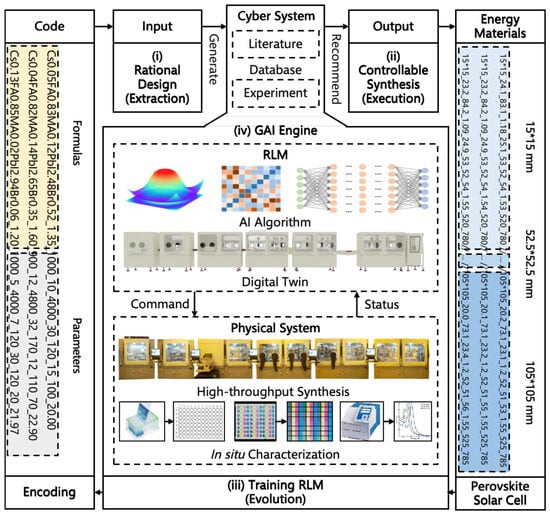
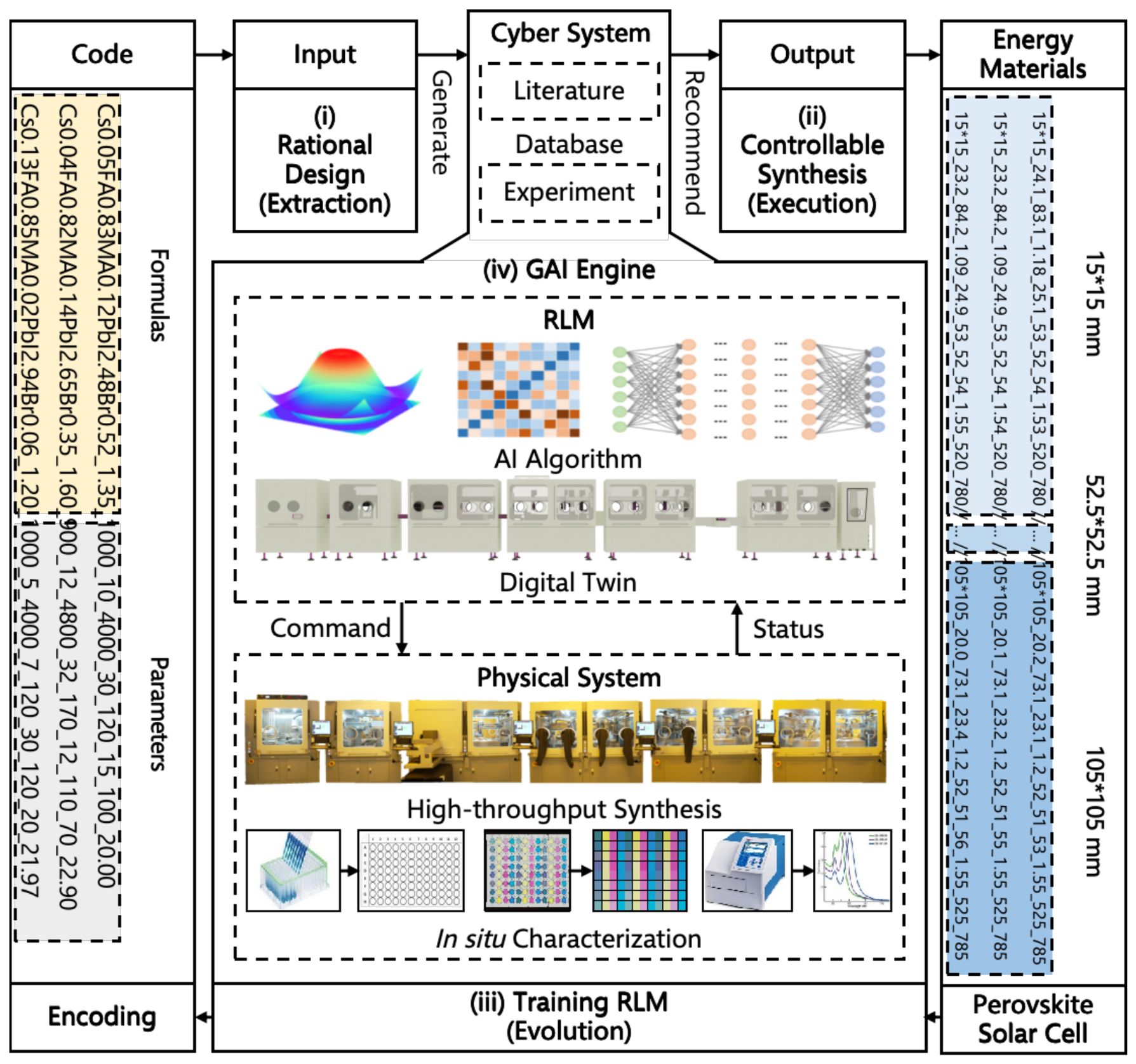
The GAI Engine connects the cyber and physical systems of the 4E framework. The cyber system combines knowledge from literature, databases and experiments with the RLM, AI algorithms and digital twin to convert encoded formulas and parameters into commands for robotic operation. The physical system performs high-throughput synthesis and in situ characterization and returns equipment status, process data and measurement results to the cyber system. These outputs update the digital twin and provide the experimental records used to train and evaluate the RLM, completing the Extraction–Execution–Evolution cycle illustrated in Figure 3.
Figure 3.
Proposed closed-loop architecture of an RLM-assisted robotic platform for energy materials development. The framework integrates (i) extraction of literature and experimental knowledge, (ii) robotic execution of material synthesis and in situ characterization, (iii) evolution of the domain-specific RLM through experimental feedback, and (iv) GAI Engine coordination of the Extraction–Execution–Evolution cycle.
Functionally, the Engine is a software orchestration layer rather than an additional AI model, a separate supervisory controller, or a purely agent-based construction. It does not generate recipes (role of the RLM) or execute them (role of the robotic platform). Instead, it schedules and routes information and decisions among these components: it invokes the RLM and auxiliary AI algorithms when recommendations or analyses are required, forwards validated recipes to Execution, and maintains the state of the digital twin. In practice, it may be realized by a single coordinating agent or a multi-agent system.
The Engine may also support analysis of historical and real-time data, formula refinement, and identification of possible parameter deviations. These functions should be presented as capabilities of the proposed architecture unless they have been demonstrated experimentally. Claims concerning improved efficiency, reduced downtime, or autonomous operation require reproducible benchmarks under relevant experimental or manufacturing conditions.
Closed-loop platforms have demonstrated that experimental measurements can be returned to an optimization algorithm to select subsequent experiments within defined application domains [14]. Related robotic systems have used accumulated experimental data to refine subsequent experimental selections or operating conditions [30,34,35,36]. Table 3 summarizes representative studies that performed closed-loop optimization using robotic platforms. Since closed-loop optimization for material synthesis is still at an early stage of development, human experts are expected to intervene when the loop stalls due to errors on the experimental platform or when the digital twin disagrees with measurements made by the robotic system. By starting the loop from literature-derived recipes, the optimization will begin from feasible regions of the parameter and recipe space. Among these, the perovskite robotic box platform instantiates the complete 4E cycle [30]. Recipes extracted from roughly 60,000 literature reports and robotic records were compiled into machine-executable protocols. Eleven interconnected robotic boxes executed synthesis, fabrication, and characterization under digital-twin synchronization. Characterization and performance data were returned as paired training data for iterative RLM fine-tuning, with a coordinating language agent operating the loop. Across 50,764 fabricated devices, the cycle achieved a certified efficiency of 26.5%, demonstrating that a full 4E cycle can operate with contemporary robotics and generative models. Evaluation of such systems should therefore examine the fidelity of recipe-to-command translation, synchronization between the digital twin and robotic platform, traceability of returned experimental data and evidence that RLM updating improves subsequent formulas and parameters within validated operating conditions.
Table 3.
Representative closed-loop optimization studies, mapped to the four components of the 4E framework.
4. Materials Intelligence and Manufacturing
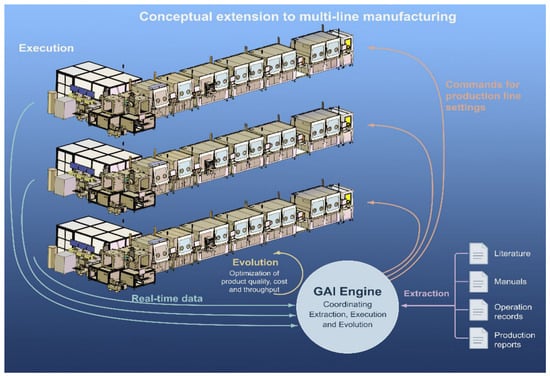
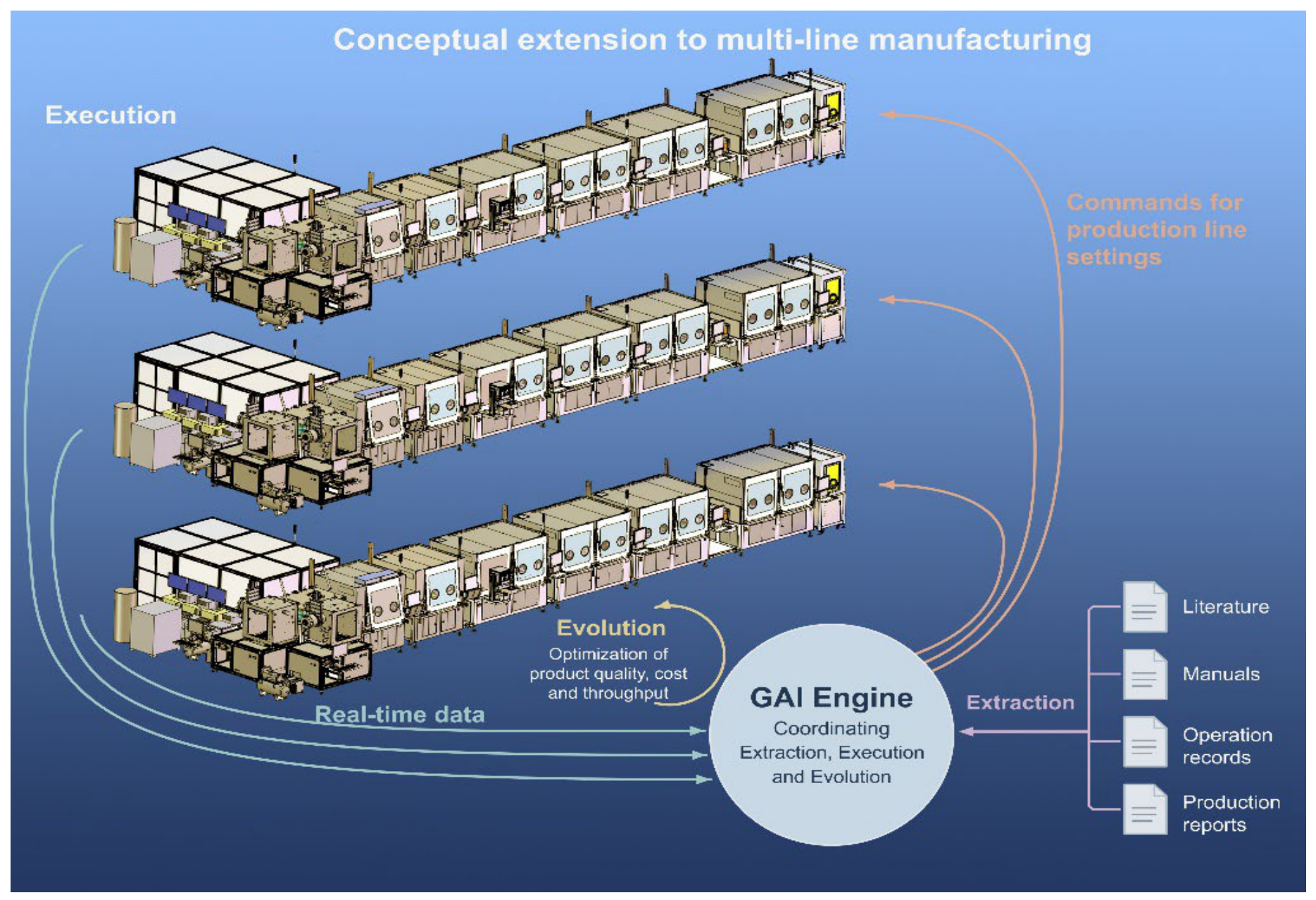
The 4E framework can be extended from laboratory-scale research to the industrial production of energy materials, as illustrated in Figure 4. Such an extension has been done for biology [31], in which the goal was to optimize magnetic particles for extraction of nucleic acids, and the main objective was application- and industry-oriented, namely, the cycle threshold (Ct) value. The paper used industrial datasets instead of scientific literature and demonstrated closed-loop optimization at a pilot scale corresponding to 50,000 tests per batch within three weeks while delivering performance better than commercial products. This provides a demonstrated precedent for the 4E framework at pilot scale, albeit in a different material domain. The extension of the 4E framework to energy materials would require the integration of operational knowledge, manufacturing data, process monitoring, quality assurance, robotic execution, and iterative model updating. In this setting, industrial deployment would not simply involve scaling up laboratory equipment. It would also require attention to continuous operation, equipment variability, production targets, maintenance, safety, and regulatory requirements.
Figure 4.
Conceptual extension of the 4E framework to Materials Intelligence and Manufacturing of energy materials. Multiple production lines can be operated in parallel, with real-time operational data fed back to the GAI Engine, which coordinates the three functions across the manufacturing system. Extraction draws on various sources, including literature, operation manuals, operation records, and production reports. Execution translates the resulting protocols into commands dispatched to the production lines. Evolution updates production line settings to achieve objectives such as minimizing cost, maximizing yield, or improving product quality.
For energy materials, Extraction at the manufacturing scale would incorporate operational knowledge from operation manuals, maintenance records, production reports, machine downtime and process settings. These records could be combined with formula and parameter data to identify relationships between operating conditions and manufacturing outcomes. The resulting models could support recommendations for process settings according to specific objectives such as yield, quality, cost, or material waste. LLM-based extraction of comparable scientific records has been demonstrated [32,37], but its extension to operational manufacturing records remains a proposed capability. Such recommendations would need to be assessed against plant constraints and verified before being applied to production.
Execution would translate a validated laboratory recipe into robust production workflows rather than reproducing laboratory equipment at a larger scale. Automated material processing with process monitoring and in situ characterization has been demonstrated on research platforms [14,38,42]. However, integrating these components with quality assurance and precursor inspection under production constraints remains a future extension. Automation systems could perform routine production tasks, while engineers would retain responsibility for maintenance, exception handling, restart decisions and the approval of significant process changes.
Evolution would take place through the use of real-time production data to identify process deviations, support predictive maintenance, and refine process settings. The GAI Engine could coordinate information across multiple production lines and support multi-objective optimization involving product quality, production cost, throughput, and material waste. These functions are prospective capabilities and should be treated as such until they have been evaluated under representative manufacturing conditions. The transition from laboratory automation to intelligent manufacturing should therefore be staged through laboratory validation, pilot-scale testing, controlled industrial trials, and broader deployment after the models, interfaces, and safety procedures have been evaluated.
Beyond these function-specific considerations, cybersecurity deserves attention when implementing the 4E framework, first at laboratory scale and even more so at industrial scale, because the system connects valuable databases with robotic equipment capable of carrying out real-world processes. Malicious actors may seek to access confidential materials databases or to inject hazardous commands into the robotic platform, for example, through software updates, imported datasets, removable media, local networks, or the internet. Safeguards should therefore include access control, regular backups, independent verification of robotic commands, antivirus software, and verification of software updates. The controller-level operating limits and emergency-stop functions required of laboratory robotics remain equally essential at production scale, where the consequences of compromised commands are greater.
5. Conclusions and Outlook
This Perspective proposes a 4E framework for Materials Intelligence in energy materials development. The framework connects LLM-based knowledge extraction, structured recipe representation, robotic synthesis, automated characterization, feedback-driven RLM updating, and system-level coordination through a GAI Engine. Its contribution lies in establishing traceability across the complete Materials Intelligence loop and defining a pathway from laboratory workflows towards Materials Intelligence and Manufacturing, rather than introducing an isolated AI model or robotic platform. The individual components of this contribution differ in their evidence status. Closed-loop experimentation, machine-readable recipe execution, and feedback-driven model updating have been demonstrated in earlier studies, including a pilot-scale contribution in a different material domain. The 4E framework itself, together with its validation gate, RLM specification, and manufacturing extension, is proposed in this paper. Its realization across diverse energy material systems, and the safety and governance mechanisms required at manufacturing scale, remain to be tested experimentally.
The applicability of the framework also has boundaries that should be acknowledged. Some energy material systems involve search spaces of precursors and parameters so large that the robotic platform cannot access all of the relevant variables, and not every synthesis or characterization process can be adapted to a high-throughput format. When only a limited number of experiments is feasible, the amount of data available to the AI agents is constrained, which in turn limits the performance they can achieve.
Several challenges must be addressed before the framework can support reliable intelligent manufacturing of energy materials. First, the field requires diverse and standardized machine-readable datasets that include experimental conditions, negative results, failed experiments, data provenance, and measurement uncertainty. Second, domain-specific models should combine language-based knowledge extraction with chemical, physical, and process constraints so that generated recipes are both plausible and executable. Third, interoperable interfaces are also needed to connect AI recommendations with robotic protocols, characterization instruments, databases, and digital twins. Most importantly, these interfaces should support model validation, version control, uncertainty estimation, reproducible benchmarking, and controlled human intervention, underpinned by hard constraints, emergency stopping, out-of-distribution detection, and tiered approval procedures at the equipment level.
Future research should leverage simulation software to support the understanding of reaction mechanisms and physical reasoning, and to supply additional training data when experimentally obtained data are limited. Beyond such data generation studies, future studies should also evaluate more than discovery speed. Relevant metrics include reproducibility, synthesis yield, product quality, energy consumption, cost, material waste, safety, process stability, and model performance under changing conditions. Claims of improved efficiency, reduced downtime, or autonomous operation should be supported by transparent benchmarks and experiments conducted under representative conditions. Robotic systems should complement rather than automatically replace materials scientists and engineers, because their suitability will depend on the material system, process requirements, environmental controls, equipment capabilities, and experimental evidence. The 4E framework should therefore be regarded as a research agenda for human-supervised, data-driven, and experimentally validated Materials Intelligence and Manufacturing systems. Its long-term value will depend on whether it can improve the reproducibility, efficiency, sustainability, and decision quality of energy-materials development while maintaining safety and scientific accountability. Complete autonomy should be treated as a possible long-term direction, not as an established property of the proposed framework.
Author Contributions
B.F. and C.C.T.C.: methodology, investigation, writing—original draft preparation. Z.W.: investigation, writing, visualization—original draft preparation. N.M., Y.S., K.Z., K.-T.C. and J.M.: review and editing. F.C. and C.-c.C.: conceptualization, methodology, writing—review and editing, project administration. H.Z.: conceptualization, methodology, writing—review and editing, supervision, project administration. All authors have read and agreed to the published version of the manuscript.
Funding
This work was supported by the National Key R&D Program of China (Grant No. 2025YFE0201700), the SPIN@HSITP Programme from the Hong-Kong Shenzhen Innovation and Technology Park Limited, and the InnoHK initiative of the Innovation and Technology Commission of the Hong Kong Special Administrative Region Government.
Data Availability Statement
No new data were created or analyzed in this study. Data sharing is not applicable to this article.
Conflicts of Interest
The authors declare that this study received funding from Hong-Kong Shenzhen Innovation and Technology Park Limited. The funder was not involved in the study design, collection, analysis, interpretation of data, the writing of this article or the decision to submit it for publication.
Abbreviations
The following abbreviations are used in this manuscript:
| 4E | Extraction, Execution, Evolution, and the GAI Engine |
| AI | Artificial intelligence |
| GAI | Generative artificial intelligence |
| LLM | Large language model |
| PL | Photoluminescence |
| RLM | Recipe Language Model |
| UV-Vis | Ultraviolet–visible–near-infrared |
References
- Gao, D.; Lu, S.; Zhang, C.; Wang, N.; Yu, Z.; Sun, X.; Martin, R.; Vanin, F.; Qian, L.; Long, N.; et al. Autonomous closed-loop framework for reproducible perovskite solar cells. Nature 2026, 653, 707–714. [Google Scholar] [CrossRef] [Scilit]
- Adam, M.L.; Moses, O.A.; Mailoa, J.P.; Hsieh, C.-Y.; Yu, X.-F.; Li, H.; Zhao, H. Navigating materials chemical space to discover new battery electrodes using machine learning. Energy Storage Mater. 2024, 65, 103090. [Google Scholar] [CrossRef] [Scilit]
- Ponnada, S. Machine learning in next-generation AEM fuel cells: A systematic review. RSC Adv. 2026, 16, 7863–7910. [Google Scholar] [CrossRef] [Scilit]
- Long, Y.; Zhong, C.; Ma, X.; Zhang, J.; Yao, H.; Liu, J.; Hu, K.; Zhang, Q.; Lin, X. Inverse design of high-performance thermoelectric materials via a generative model combined with experimental verification. ACS Appl. Mater. Interfaces 2025, 17, 19856–19867. [Google Scholar] [CrossRef] [Scilit]
- Wu, L.; Xu, Z.; Wang, Z.; Chen, Z.; Huang, Z.; Peng, C.; Pei, X.; Li, X.; Mailoa, J.P.; Hsieh, C.-Y.; et al. Machine learning accelerated carbon neutrality research using big data—From predictive models to interatomic potentials. Sci. China Technol. Sci. 2022, 65, 2274–2296. [Google Scholar] [CrossRef] [Scilit]
- Wang, H.; Fu, T.; Du, Y.; Gao, W.; Huang, K.; Liu, Z.; Chandak, P.; Liu, S.; Van Katwyk, P.; Deac, A.; et al. Scientific discovery in the age of artificial intelligence. Nature 2023, 620, 47–60. [Google Scholar] [CrossRef] [Scilit]
- Xi, S.; Yu, J.; Bao, L.; Chen, L.; Li, Z.; Shi, R.; Wang, C.; Liu, X. Machine learning-accelerated first-principles predictions of the stability and mechanical properties of L12-strengthened cobalt-based superalloys. J. Mater. Inform. 2022, 2, 15. [Google Scholar] [CrossRef] [Scilit]
- Yeo, B.C.; Nam, H.; Nam, H.; Kim, M.-C.; Lee, H.W.; Kim, S.-C.; Won, S.O.; Kim, D.; Lee, K.-Y.; Lee, S.Y.; et al. High-throughput computational-experimental screening protocol for the discovery of bimetallic catalysts. NPJ Comput. Mater. 2021, 7, 137. [Google Scholar] [CrossRef] [Scilit]
- Ha, T.; Lee, D.; Kwon, Y.; Park, M.S.; Lee, S.; Jang, J.; Choi, B.; Jeon, H.; Kim, J.; Choi, H.; et al. AI-driven robotic chemist for autonomous synthesis of organic molecules. Sci. Adv. 2023, 9, eadj0461. [Google Scholar] [CrossRef] [Scilit]
- Zhu, Q.; Huang, Y.; Zhou, D.; Zhao, L.; Guo, L.; Yang, R.; Sun, Z.; Luo, M.; Zhang, F.; Xiao, H.; et al. Automated synthesis of oxygen-producing catalysts from Martian meteorites by a robotic AI chemist. Nat. Synth. 2023, 3, 319–328. [Google Scholar] [CrossRef] [Scilit]
- Coley, C.W.; Thomas, D.A., 3rd; Lummiss, J.A.M.; Jaworski, J.N.; Breen, C.P.; Schultz, V.; Hart, T.; Fishman, J.S.; Rogers, L.; Gao, H.; et al. A robotic platform for flow synthesis of organic compounds informed by AI planning. Science 2019, 365, eaax1566. [Google Scholar] [CrossRef] [Scilit]
- Burger, B.; Maffettone, P.M.; Gusev, V.V.; Aitchison, C.M.; Bai, Y.; Wang, X.; Li, X.; Alston, B.M.; Li, B.; Clowes, R.; et al. A mobile robotic chemist. Nature 2020, 583, 237–241. [Google Scholar] [CrossRef] [Scilit]
- Manzano, J.S.; Hou, W.; Zalesskiy, S.S.; Frei, P.; Wang, H.; Kitson, P.J.; Cronin, L. An autonomous portable platform for universal chemical synthesis. Nat. Chem. 2022, 14, 1311–1318. [Google Scholar] [CrossRef] [Scilit]
- Zhao, H.; Chen, W.; Huang, H.; Sun, Z.; Chen, Z.; Wu, L.; Zhang, B.; Lai, F.; Wang, Z.; Adam, M.L.; et al. A robotic platform for the synthesis of colloidal nanocrystals. Nat. Synth. 2023, 2, 505–514. [Google Scholar] [CrossRef] [Scilit]
- Salley, D.; Keenan, G.; Grizou, J.; Sharma, A.; Martin, S.; Cronin, L. A nanomaterials discovery robot for the Darwinian evolution of shape programmable gold nanoparticles. Nat. Commun. 2020, 11, 2771. [Google Scholar] [CrossRef] [Scilit]
- Boiko, D.A.; MacKnight, R.; Kline, B.; Gomes, G. Autonomous chemical research with large language models. Nature 2023, 624, 570–578. [Google Scholar] [CrossRef] [Scilit]
- Rauschen, R.; Guy, M.; Hein, J.E.; Cronin, L. Universal chemical programming language for robotic synthesis repeatability. Nat. Synth. 2024, 3, 488–496. [Google Scholar] [CrossRef] [Scilit]
- Steiner, S.; Wolf, J.; Glatzel, S.; Andreou, A.; Granda, J.M.; Keenan, G.; Hinkley, T.; Aragon-Camarasa, G.; Kitson, P.J.; Angelone, D.; et al. Organic synthesis in a modular robotic system driven by a chemical programming language. Science 2019, 363, eaav2211. [Google Scholar] [CrossRef] [Scilit]
- Li, X.; Che, Y.; Chen, L.; Liu, T.; Wang, K.; Liu, L.; Yang, H.; Pyzer-Knapp, E.O.; Cooper, A.I. Sequential closed-loop Bayesian optimization as a guide for organic molecular metallophotocatalyst formulation discovery. Nat. Chem. 2024, 16, 1286–1294. [Google Scholar] [CrossRef] [Scilit]
- Merchant, A.; Batzner, S.; Schoenholz, S.S.; Aykol, M.; Cheon, G.; Cubuk, E.D. Scaling deep learning for materials discovery. Nature 2023, 624, 80–85. [Google Scholar] [CrossRef] [Scilit]
- Qiu, H.; Liu, L.; Qiu, X.; Dai, X.; Ji, X.; Sun, Z.Y. PolyNC: A natural and chemical language model for the prediction of unified polymer properties. Chem. Sci. 2024, 15, 534–544. [Google Scholar] [CrossRef] [Scilit]
- Darvish, K.; Skreta, M.; Zhao, Y.; Yoshikawa, N.; Som, S.; Bogdanovic, M.; Cao, Y.; Hao, H.; Xu, H.; Aspuru-Guzik, A.; et al. ORGANA: A robotic assistant for automated chemistry experimentation and characterization. Matter 2025, 8, 101897. [Google Scholar] [CrossRef] [Scilit]
- Ghareeb, A.E.; Chang, B.; Mitchener, L.; Yiu, A.; Szostkiewicz, C.J.; Shved, D.; Gyimesi, G.J.; Laurent, J.M.; Wright, S.M.; Razzak, M.T.; et al. A multi-agent system for automating scientific discovery. Nature 2026, 655, 497–505. [Google Scholar] [CrossRef] [Scilit]
- Pyzer-Knapp, E.O.; Pitera, J.W.; Staar, P.W.J.; Takeda, S.; Laino, T.; Sanders, D.P.; Sexton, J.; Smith, J.R.; Curioni, A. Accelerating materials discovery using artificial intelligence, high performance computing and robotics. NPJ Comput. Mater. 2022, 8, 84. [Google Scholar] [CrossRef] [Scilit]
- Wang, Z.; Sun, Z.; Yin, H.; Liu, X.; Wang, J.; Zhao, H.; Pang, C.H.; Wu, T.; Li, S.; Yin, Z.; et al. Data-Driven Materials Innovation and Applications. Adv. Mater. 2022, 34, 2104113. [Google Scholar] [CrossRef] [Scilit]
- Zhang, X.; Chen, Z.; Chen, F.; Fanady, B.; Wang, B.; Ni, Z.; Zhou, S.; Ye, J.; Chen, G.; Liu, J.; et al. Material intelligence by the convergence of artificial intelligence and robotic platforms. Nexus 2025, 2, 100083. [Google Scholar] [CrossRef] [Scilit]
- Cooper, A.I.; Courtney, P.; Darvish, K.; Eckhoff, M.; Fakhruldeen, H.; Gabrielli, A.; Garg, A.; Haddadin, S.; Harada, K.; Hein, J.; et al. Accelerating discovery in natural science laboratories with AI and robotics: Perspectives and challenges. Sci. Robot. 2025, 10, eadv7932. [Google Scholar] [CrossRef] [Scilit]
- Canty, R.B.; Bennett, J.A.; Brown, K.A.; Buonassisi, T.; Kalinin, S.V.; Kitchin, J.R.; Maruyama, B.; Moore, R.G.; Schrier, J.; Seifrid, M.; et al. Science acceleration and accessibility with self-driving labs. Nat. Commun. 2025, 16, 3856. [Google Scholar] [CrossRef] [Scilit]
- Wang, B.; Wang, Z.; Chen, F.; Wu, C.; Ma, N.; Min, G.; Dong, Y.; Contini, C.; Chen, Z.; Wang, F.; et al. Robotics and artificial intelligence accelerated energy materials discovery. Sci. China Mater. 2026. early access. [Google Scholar] [CrossRef]
- Chen, Z.; Yu, W.; Wu, C.; Chen, F.; Wang, Z.; Zhou, C.; You, Y.; Li, S.; Zhu, Q.; Ma, N.; et al. Agentic robotic boxes for perovskite solar cell fabrication with recipe language model. Engineering 2026, 61, 365–374. [Google Scholar] [CrossRef] [Scilit]
- Wang, Z.L.; Ma, Z.; Song, W.; Jiang, G.; Jiang, B.; Jiang, M.; Shu, W.; Wang, B.; Wan, Z.; Geng, S.; et al. AP-Lab: An AI-driven autonomous pilot-scale platform bridging materials discovery and industrial manufacturing. Adv. Sci. 2026, 13, e74293. [Google Scholar] [CrossRef] [Scilit]
- Asai, A.; He, J.; Shao, R.; Shi, W.; Singh, A.; Chang, J.C.; Lo, K.; Soldaini, L.; Feldman, S.; D’Arcy, M.; et al. Synthesizing scientific literature with retrieval-augmented language models. Nature 2026, 650, 857–863. [Google Scholar] [CrossRef] [Scilit]
- Ruan, Y.; Lu, C.; Xu, N.; He, Y.; Chen, Y.; Zhang, J.; Xuan, J.; Pan, J.; Fang, Q.; Gao, H.; et al. An automatic end-to-end chemical synthesis development platform powered by large language models. Nat. Commun. 2024, 15, 10160. [Google Scholar] [CrossRef] [Scilit]
- Szymanski, N.J.; Rendy, B.; Fei, Y.; Kumar, R.E.; He, T.; Milsted, D.; McDermott, M.J.; Gallant, M.; Cubuk, E.D.; Merchant, A.; et al. An autonomous laboratory for the accelerated synthesis of novel materials. Nature 2023, 624, 86–91. [Google Scholar] [CrossRef] [Scilit]
- Wu, T.; Kheiri, S.; Hickman, R.J.; Tao, H.; Wu, T.C.; Yang, Z.-B.; Ge, X.; Zhang, W.; Abolhasani, M.; Liu, K.; et al. Self-driving lab for the photochemical synthesis of plasmonic nanoparticles with targeted structural and optical properties. Nat. Commun. 2025, 16, 1473. [Google Scholar] [CrossRef] [Scilit]
- Shi, T.; Li, Y.; Wang, Z.; Xu, W.; Jiang, G.; Dai, D.; Zhou, J.; Huang, H.; He, R.; Ramakrishna, S.; et al. Knowledge-driven autonomous materials research via collaborative multi-agent and robotic system. Matter 2026, 9, 102577. [Google Scholar] [CrossRef] [Scilit]
- Li, J.; Li, M.; Yang, Q.; Luo, S. ReactionSeek: LLM-powered literature data mining and knowledge discovery in organic synthesis. Nat. Commun. 2026, 17, 3356. [Google Scholar] [CrossRef] [Scilit]
- Dai, T.; Vijayakrishnan, S.; Szczypinski, F.T.; Ayme, J.F.; Simaei, E.; Fellowes, T.; Clowes, R.; Kotopanov, L.; Shields, C.E.; Zhou, Z.; et al. Autonomous mobile robots for exploratory synthetic chemistry. Nature 2024, 635, 890–897. [Google Scholar] [CrossRef] [Scilit]
- Tao, H.; Wu, T.; Aldeghi, M.; Wu, T.C.; Aspuru-Guzik, A.; Kumacheva, E. Nanoparticle synthesis assisted by machine learning. Nat. Rev. Mater. 2021, 6, 701–716. [Google Scholar] [CrossRef] [Scilit]
- Bran, A.M.; Cox, S.; Schilter, O.; Baldassari, C.; White, A.D.; Schwaller, P. Augmenting large language models with chemistry tools. Nat. Mach. Intell. 2024, 6, 525–535. [Google Scholar] [CrossRef] [Scilit]
- Chen, R.; Liu, Y.; Chen, Z.; Li, Y.; Yang, F.; Lin, J.; Ke, Z. Large language model guided automated reaction pathway exploration. Commun. Chem. 2025, 8, 255. [Google Scholar] [CrossRef] [Scilit]
- Wang, C.; Kim, Y.J.; Vriza, A.; Batra, R.; Baskaran, A.; Shan, N.; Li, N.; Darancet, P.; Ward, L.; Liu, Y.; et al. Autonomous platform for solution processing of electronic polymers. Nat. Commun. 2025, 16, 1498. [Google Scholar] [CrossRef] [Scilit]
- Mukherjee, A.; Reynaerts, R.; Pradhan, B.; Seth, S.; Rosch, A.T.; Banerjee, T.; Chouhan, L.; Jin, H.; Sternemann, C.; Paulus, M.; et al. Machine learning for microscopy data analytics targeting real-time optical characterization of semiconductor nanocrystals. Nat. Commun. 2026, 17, 2361. [Google Scholar] [CrossRef] [Scilit]

Disclaimer/Publisher’s Note: The statements, opinions and data contained in all publications are solely those of the individual author(s) and contributor(s) and not of MDPI and/or the editor(s). MDPI and/or the editor(s) disclaim responsibility for any injury to people or property resulting from any ideas, methods, instructions or products referred to in the content. |
© 2026 by the authors. Licensee MDPI, Basel, Switzerland. This article is an open access article distributed under the terms and conditions of the Creative Commons Attribution (CC BY) license.