Beyond Waste: Future Sustainable Insights for Integrating Complex Feedstocks into the Global Energy Mix



Abstract
1. Introduction
- Creating greener and more energy—efficient chemical reactions;
- Integrating renewable resources and waste as viable feedstocks;
- Minimizing harmful emissions, including nitrogen oxides (NOx), sulfur oxides (SOx), particulate matter, and carbon oxides (CO2, CO);
- Realizing closed-loop manufacturing schemes with minimal waste generation.
2. Methodological Framework and Scope of the Review
- −
- Discuss hydrogen addition processes;
- −
- Present novel catalyst design and synthesis techniques applicable to heavy, heteroatom-rich, or waste-derived feedstocks;
- −
- Offer information on product yields, emissions, depth of conversion, coke suppression, and scalability.
- −
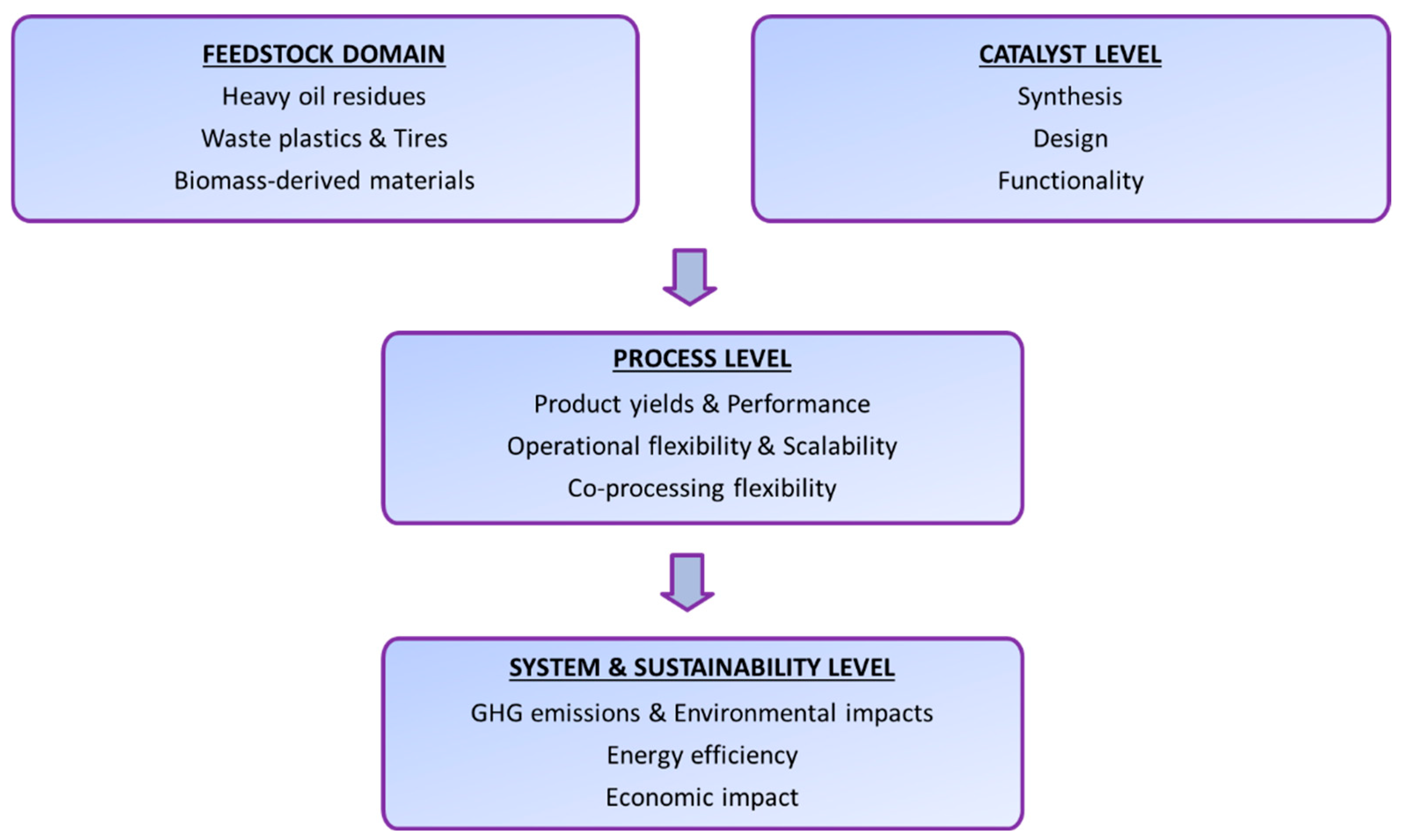
- Catalyst level, which links reaction efficiency to catalyst synthesis technique, composition, structure, and functionality for a particular category of feed;
- −
- Process level: assessing catalytic performance, product slates, operational and feed co-processing flexibility, and scalability;
- −
- The sustainability and economic perspectives evaluate the effects of catalyst and process innovations on the environment and cost.

3. Feedstock Characteristics and Catalytic Challenges
3.1. Heavy Oil Feedstocks
3.2. Waste Tires and Plastics
3.3. Biomass-Derived Feedstocks
4. Evolution of Catalysts for Heavy Oil Feedstock Conversion
4.1. Conventional Catalysts
- Transforming heavy, low-value fractions into lighter, more valuable liquid products such as gasoline, diesel, and petrochemical feedstocks;
- H/C ratio enhancement: increasing the H/C ratio of the hydrocarbon molecules, which improves the fuel’s energy density and reduces the specific CO2 emissions per unit of energy produced upon combustion;
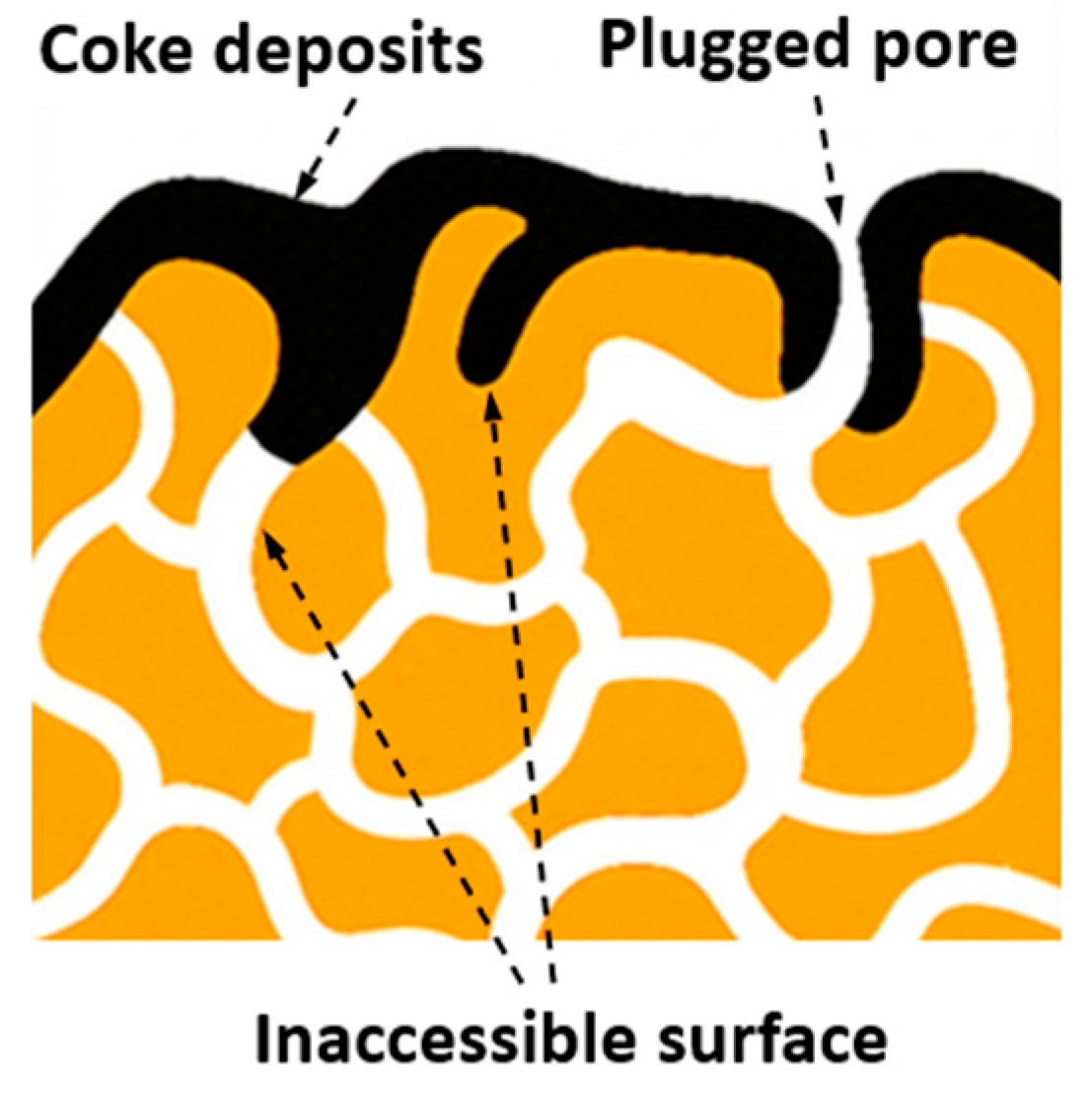
- Coke inhibition: reducing the formation of carbonaceous deposits (coke), which can rapidly deactivate catalysts and foul reactor systems;
- Viscosity reduction: lowering the inherent high viscosity to facilitate easier flow, transportation, and subsequent processing;
- Impurity removal: efficiently eliminating heteroatoms (sulfur, nitrogen, oxygen) and heavy metals to produce cleaner fuels and reduce environmental hazards like air pollution and acid rain.
4.2. The Shift to Dispersed Nanocatalysts
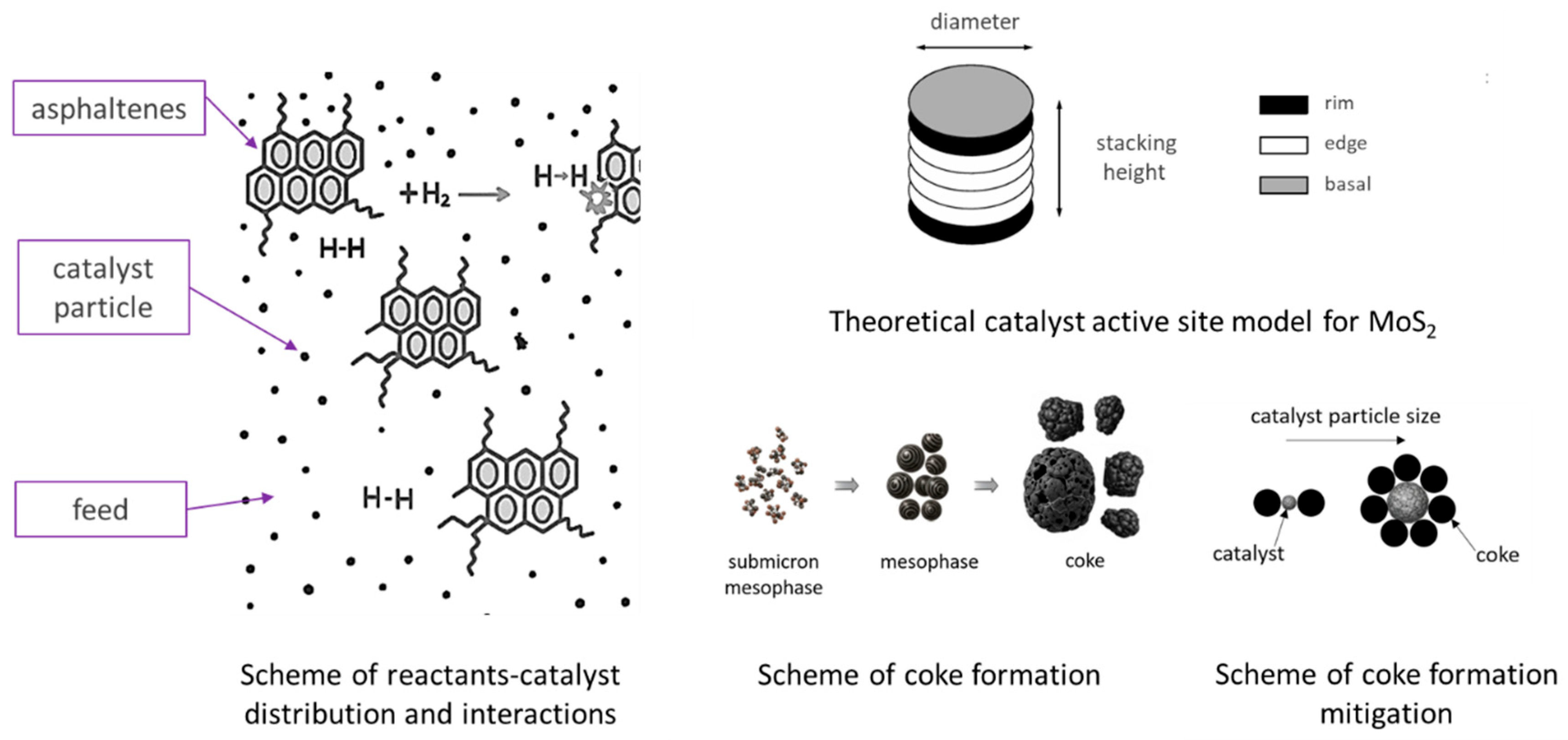
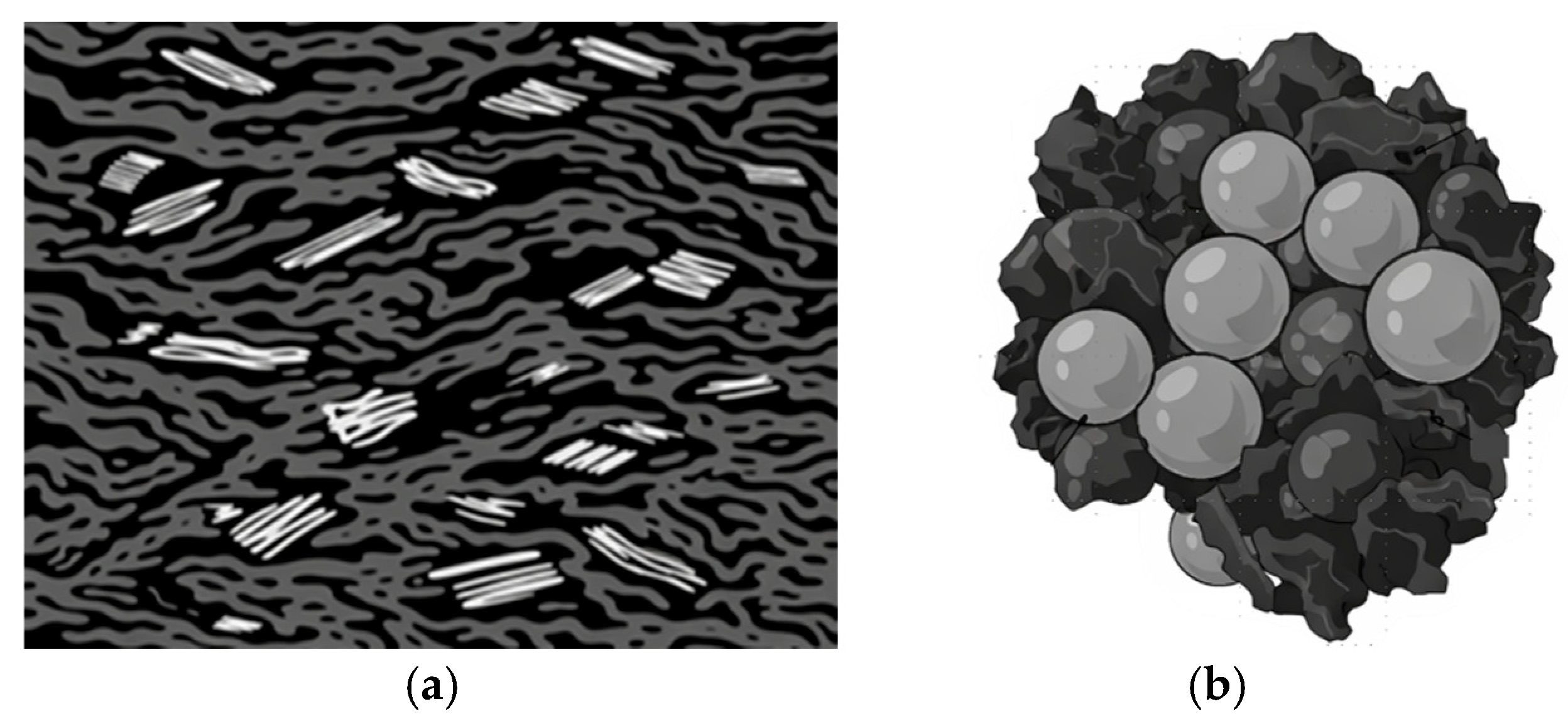
- Composition: the active ingredients are sulfides of Mo, W, Ni, Co, and Fe. While Ni and Co are frequently utilized as promoters to increase hydrogenation and hydrotreating activities, sulfides of Mo and W are more frequently used as primary catalysts.
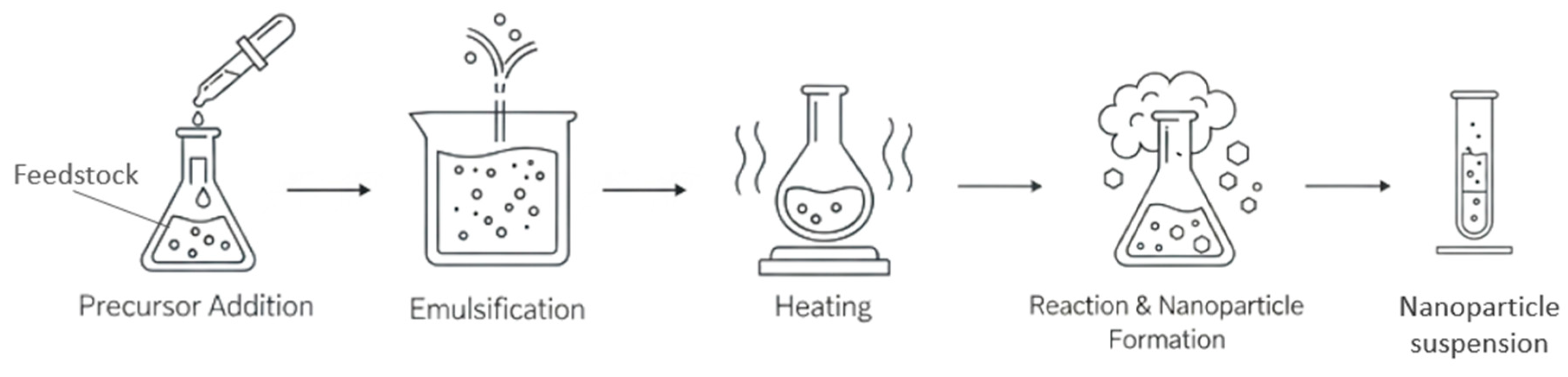
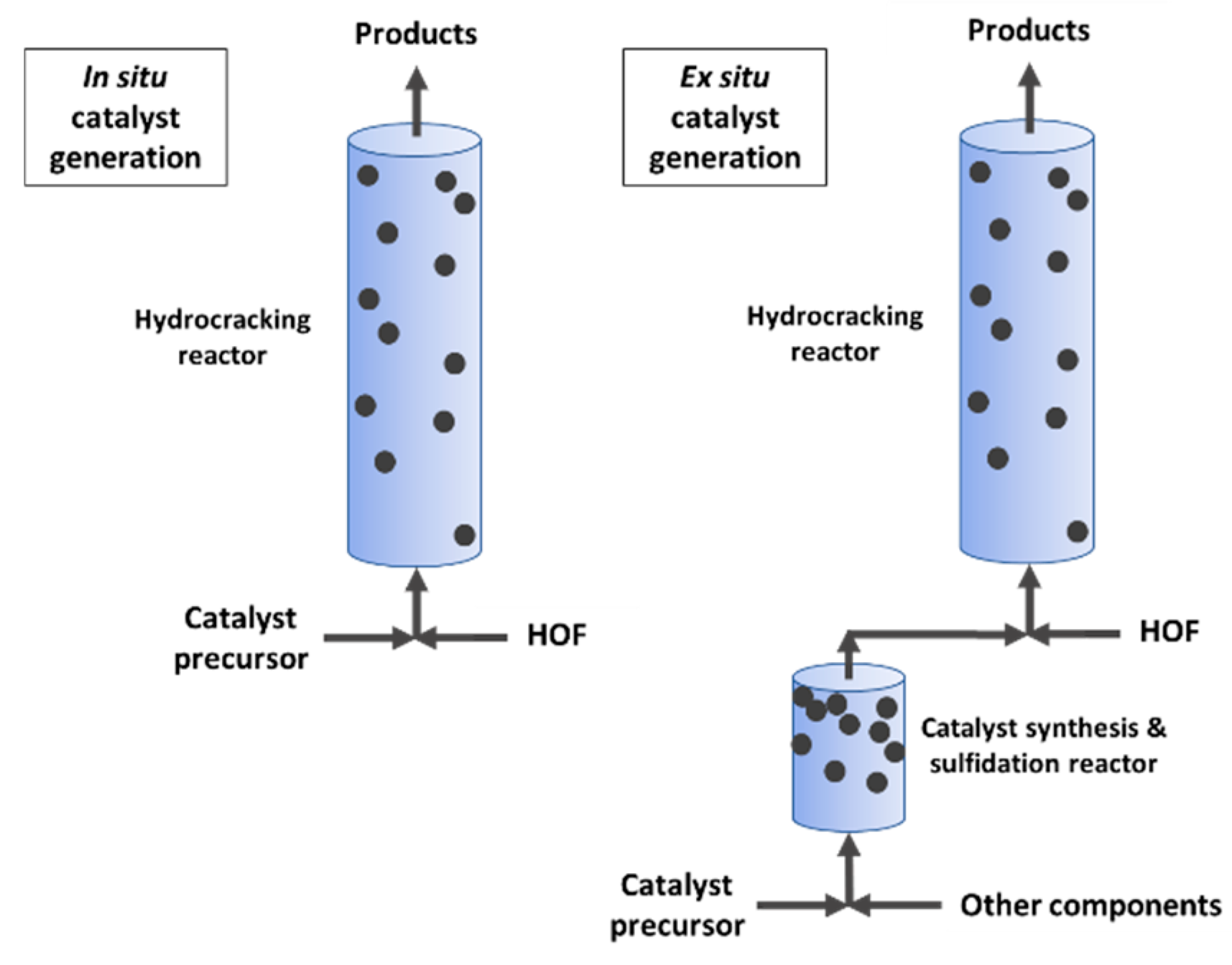
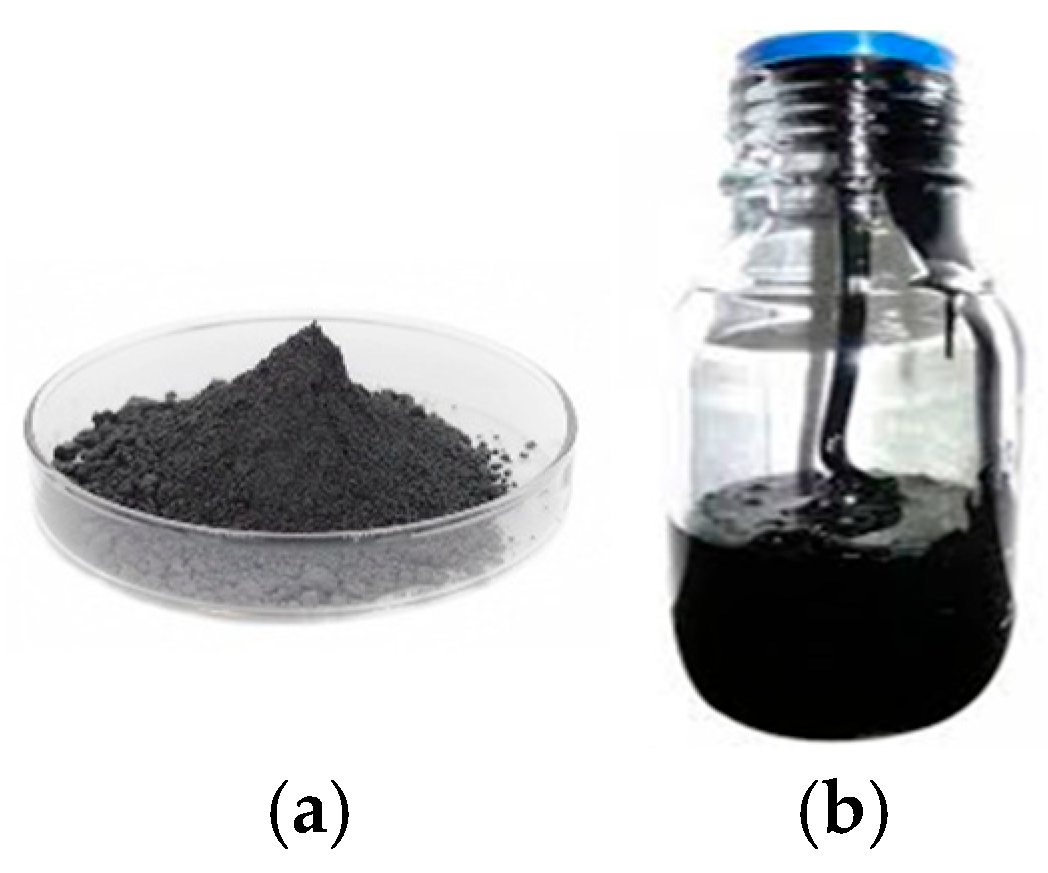
- Structure: metal sulfide particles that are nanoscale or ultra-sized, generated in situ or ex situ, and dispersed throughout the reaction mixture (Figure 3).
- ▪
- Mechanism of catalysis by dispersed nanocatalyst particles

| Type of Catalyst | Composition of Catalyst | Catalyst Synthesis Method | Process Parameters | Process Efficiency | Catalyst Advantages | Challenges |
|---|---|---|---|---|---|---|
| Supported hydroprocessing catalysts (e.g., NiMo/Al2O3, CoMo/Al2O3) [51] | Transition metal sulfides (Mo, W, Ni, Co), acidic carriers (alumina, silica, silica-alumina, zeolite, modified clays) | Oxide precursor synthesis, sulfidation, doping | Fixed-, moving-, ebullated, slurry-bed reactors. Pre-HDS, HDN, hydrodemetallization (HDM), hydrodeasphaltization (HAD) required. High H2 pressure required (up to 20 MPa) | Conversion to lighter, more valuable products. High sulfur removal (viscosity reduction | Versatile for HDS/HDN/HDM. Commercially available globally | Catalyst deactivation, operational limitations (overheating, pressure drop, mass transfer), limited catalyst life/performance |
| Unsupported (dispersed) Mo sulfide nanoparticles [43,49,50,52,53] | MoS2, nanosized particles, nanoslabs, rim/edge active sites, structure diversity depending on synthesis parameters | In situ (thermal decomposition, sulfidation) from precursors (oil-, water-soluble Mo salts) directly in HOF conversion reactor. In situ sulfidation by H2S from feed | Hydroconversion: P = 7 MPa, T = 425–445 °C, H2/feed = 1000–1500 nL/L, LHSV * = 0.4–1.5 h−1, recycle mode. Slurry-phase hydrocracking: T = 400–450 °C, P(H2) = 15 MPa, recycle mode, purge 1–3 wt% | VR conversion per cycle—up to 70–93% wt; coke yield < 0.1% wt, high HDS, HDN, HDM activity (HDN > 90%) | High activity, effective hydrogenation, strong resistance to deactivation, coking inhibition, no diffusion limitation. Low catalyst dosage (~0.05 wt% Mo). Scavenging H2S from feed. Recyclability | In situ synthesis leads to low control over catalyst morphology/particle size, additional units for emulsification/regeneration, catalyst recovery/reuse required |
| Dual-catalyst system: dispersed nano-MoS2 plus cracking catalyst [43] | MoS2 + cracking catalyst (H-Y zeolite/SiO2-Al2O3) | MoS2 generated in situ from oil-soluble precursor; cracking catalyst added batch-wise (30–40 wt% of reactor hold-up) | T = 430 °C, P(H2) = 13 MPa, continuous catalyst replacement/regeneration | 50% higher productivity vs. MoS2, low coke yield (<<0.1% wt), stable activity over 200 h, sustained cracking activity, high HDN/HDS | Combines cracking and hydrogenation function, extends catalyst life, improves nitrogen removal | Rapid deactivation of cracking catalyst without MoS2, regeneration required |
| Dispersed Mo sulfide nanoparticles [54] | MoS2 | In situ from new oil-soluble precursor (cetyltrimethyl ammonium heptamolybdate) | T = 410 °C, P(H2) = 10 MPa, 1 h, Mo dosage = 2000 μg/g | Liquid yield: 96.4 wt%, coke: 0.19 wt%, gas: 3.4 wt%, HDM: 83.4 wt%, HDS: 59.2 wt% | High solubility in oil, small MoS2 particles, high activity, low dosage | Complex synthesis, potential agglomeration, high H2 pressure requirement for optimal performance |
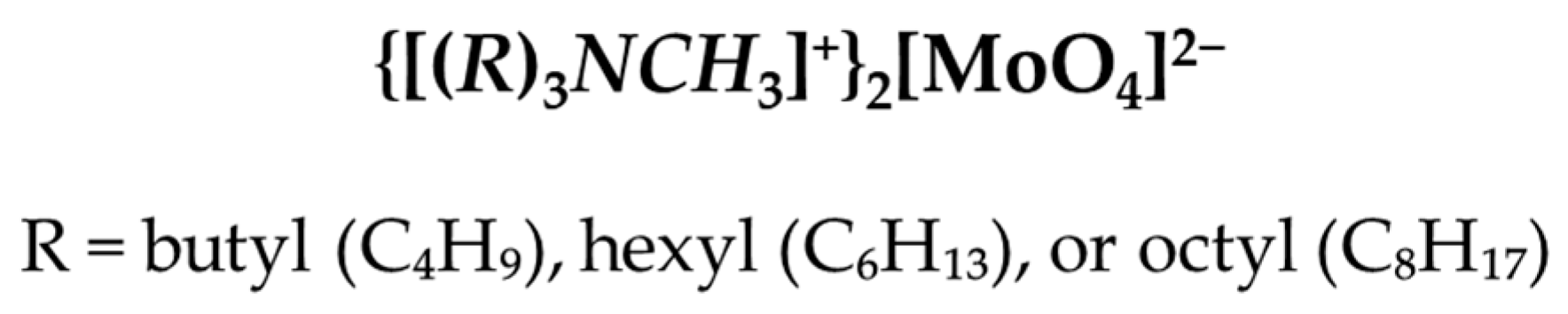
| Dispersed Mo sulfide nanoparticles [55] | MoS2 | In situ from trialkylmethylammonium molybdate ILs | T = 430 °C, P(H2) = 12 MPa, 0.5–6.0 h, catalyst dosage = 600–1200 ppm | High performance: higher feed conversion (71.0 vs. 65.2 wt% for Mo-octoate), low coke yield (0.8 vs. 1.3 wt%) | Activity, compatibility with HOF, viable synthesis | Cost competitiveness vs. commercial precursors, optimization of alkyl chain length, scalability of synthesis |
| Dispersed Mo sulfide nanoparticles [56] | MoS2 | In situ from oil-soluble Mo aryl-alkyl-dithiophosphates (Mo-Ar/Rs), Ar = benzyl, R = n-butyl | T = 430 °C, P(H2) = 70 atm, 1 h, 150 ppm Mo | Higher valuable product yields, lower coke and gas yields compared to Mo-R | Better oil solubility, lower MoS2 particle size, higher hydrogenation activity, improved selectivity | Performance varies with feedstock saturate content, precursor synthesis complexity |
| Dispersed Ni-Mo/V-Mo sulfide nanoparticles [57,58] | Ni3S2-MoS2, V3S4-MoS2 | In situ, sulfidation of oil-soluble precursors (Mo-naphthenate, Ni-octoate, V-acetylacetonate) | T = 450 °C, P(H2) = 16 MPa, 1 h, 300–600 ppm Mo, Ni(V)/(Ni(V) + Mo) = 0.2–0.4 | Ni-Mo synergy: 72.1% conversion (vs. 64% for Mo). V-Mo additive effect: 69.6% conversion. Coke suppression: <0.2 wt% | Ni-Mo: reverse synergy (MoS2 on Ni3S2). V-Mo: high HDS activity | Ni-Mo: limited H2 transfer in batch reactor. Ni-only: poor activity, high coke |
| Dispersed Co/Ni-TBC [6,59] | Co- or Ni-based calixarene | Coordination of metal nitrates with TBC [6] ligand | T = 420 °C, P(H2) = 8.5 MPa H2, 1 h, 500 ppm catalyst | Naphtha yield: 12 wt.% (Co-TBC [6]), VGO conversion: 42.4% (with supported catalyst), negligible coke | Activity, coke suppression | Precursor cost, catalyst recovery difficulties |
| Dispersed Fe-Ni-S nanoparticles [60] | Fe4.5Ni4.5S8 mixed crystal sulfides | In situ, synthesis from oil-soluble Fe, Ni precursors | T = 440 °C, 1 h, P(H2) = 8 MPa, catalyst dosage = 500–1000 μg/g, sulfur powder added ** | Lignite conversion: 97.1 wt%, liquid yield: 92.2 wt%, coke yield: 1.3 wt% (at 1000 μg/g catalyst dosage) | High activity, narrow particle size distribution, cost-effective renewable ligand for precursor synthesis | Control over bimetallic phase formation, scalability of precursor synthesis |
| MoS2 nanoparticles [61] | MoS2 | Ex situ: precipitation from solution with ammonium molybdate and thioacetamide | 1000 ppm Mo, P(H2) = 65 bar, T = 400 °C, 4 h, 1000 rpm | Liquid yield (70% selectivity), deep desulfurization, low aromaticity, high ring opening/depolymerization, high isomerization | High efficiency, mild hydroprocessing conditions, low-cost synthesis, no dependency on feed-derived H2S for sulfidation | Effective distribution in feed, recyclability, scalability |
| Mo-containing composite nanocatalyst [62] | MoO2, MoS2.8, stabilized by low-density polyethylene (LDPE); 22.7 wt% Mo | Ex situ: from (NH4)6Mo7O24 in vacuum oil–LDPE medium, sulfided by dimethyl disulfide at 350 °C under argon | T = 445 °C, P(H2) = 70 atm, H2/feed = 1000 nL/L, LHSV = 2.0 h−1, 0.05 wt% Mo | Feed conversion—50.4–51.8% wt, coke yield—0.2–0.5% wt | High stability, Mo content (22 wt%), low coke yield | Incomplete sulfidation, dispersing method is critical, complex synthesis, requires synthesis/regeneration units |
| Dispersed MoS2 nano-, ultrafine catalyst stabilized in vacuum residue [63] | MoS2, stabilized in vacuum residue, 6–10 wt% Mo | Ex situ: from (NH4)6Mo7O24 and elemental sulfur/thiocarbamide in VR, thermal treatment at 350 °C under H2 | T = 425 °C, P(H2) = 70 atm, H2/feed = 1500 nL/L, LHSV = 0.4–1.4 h−1, 0.05 wt% Mo | Feed conversion—28.0–70.0 wt%, coke yield—0.1–3.4 wt% | High activity, costly precursor, high Mo content (6–10 wt%), no solid carrier, no in situ sulfidation needed, high activity; tunable morphology | Moderate synthesis complexity, polydispersity, requires synthesis/regeneration units |
| NiFe nanocatalysts [64] | NiFe (1:0.33, 1:1, 1:3) | Modified inverse microemulsion method | T = 372 °C, P(H2) = 9.8 MPa, 1 h | API increase from 13.1 to 18.3. Asphaltene conversion: 37.2–43.7%. Sulfur removal: 6.0 to 3.9 wt%. Nitrogen removal: 4687 to 2999 ppm. Viscosity reduced from 9691 to 798 cP | High activity at low loading, mild reaction conditions, abundant, low-cost metals (Ni/Fe), compatibility with feedstock, low particle sizes | Potential deactivation due to sulfur, requires surfactants, complex synthesis, scalability, regeneration |
| Ni nanoparticles dispersed on biochar [65] | Ni nanoparticles on biochar | Ex situ, impregnation of coffee grounds with Ni(NO3)2, calcination in H2 atmosphere at 550 °C for 2 h | T =180 °C, 8 h, N2 atmosphere; oil shale pyrolysis: 35–900 °C | 60.35% viscosity reduction, increased light fractions (C2–C4, saturates), reduced S/N heteroatoms, lowered pyrolysis onset T by 10 °C and peak decomposition T by 8 °C | Low cost, high dispersibility of Ni, sustainable (waste-derived biochar), mesoporous structure | Potential deactivation, scalability of synthesis, residual oil on catalyst post-reaction |
| Disposable red mud catalyst [66] | Mainly Fe2O3, Al2O3, TiO2, with SiO2, CaO, Na2O | Calcined at 550 °C for 2 h; in situ activation into pyrrhotite (Fe(x−1)Sx) | T = 470–500 °C, P(H2) = 150 bar, 1.2–3.0 g of red mud (4–10 wt.%), 2–4 h | VR conversion: 64–66 wt.%; coke yield reduced (1.13–2.40 wt.%; increased VGO yield; less gas and coke compared to thermal cracking | Low-cost waste-derived catalyst, coke suppression, improved selectivity, no need for sulfidation | Lower conversion than thermal cracking; limited control over selectivity; catalyst deactivation at high T; not reusable (disposable) |
| Dispersed magnetic nanohybrids [67,68] | Nano-Fe3O4, Fe3O4-MWCNT, Fe3O4-NiO nanohybrids | Ex situ, co-precipitation from Fe chlorides, commercial hydroxy-MWCNT | Microwave-assisted catalytic upgrading: catalyst—0.01–1.0 wt.%, microwave power—400–1200 W, duration—8–12 min | Viscosity reduction (~12%), API increase (5.6%), sulfur reduction (16.6%) | Ease of catalyst recovery due to magnetic nature, low residence time, high efficiency | Ensuring uniform heating, high catalyst concentration and costs of catalyst regeneration, scalability |

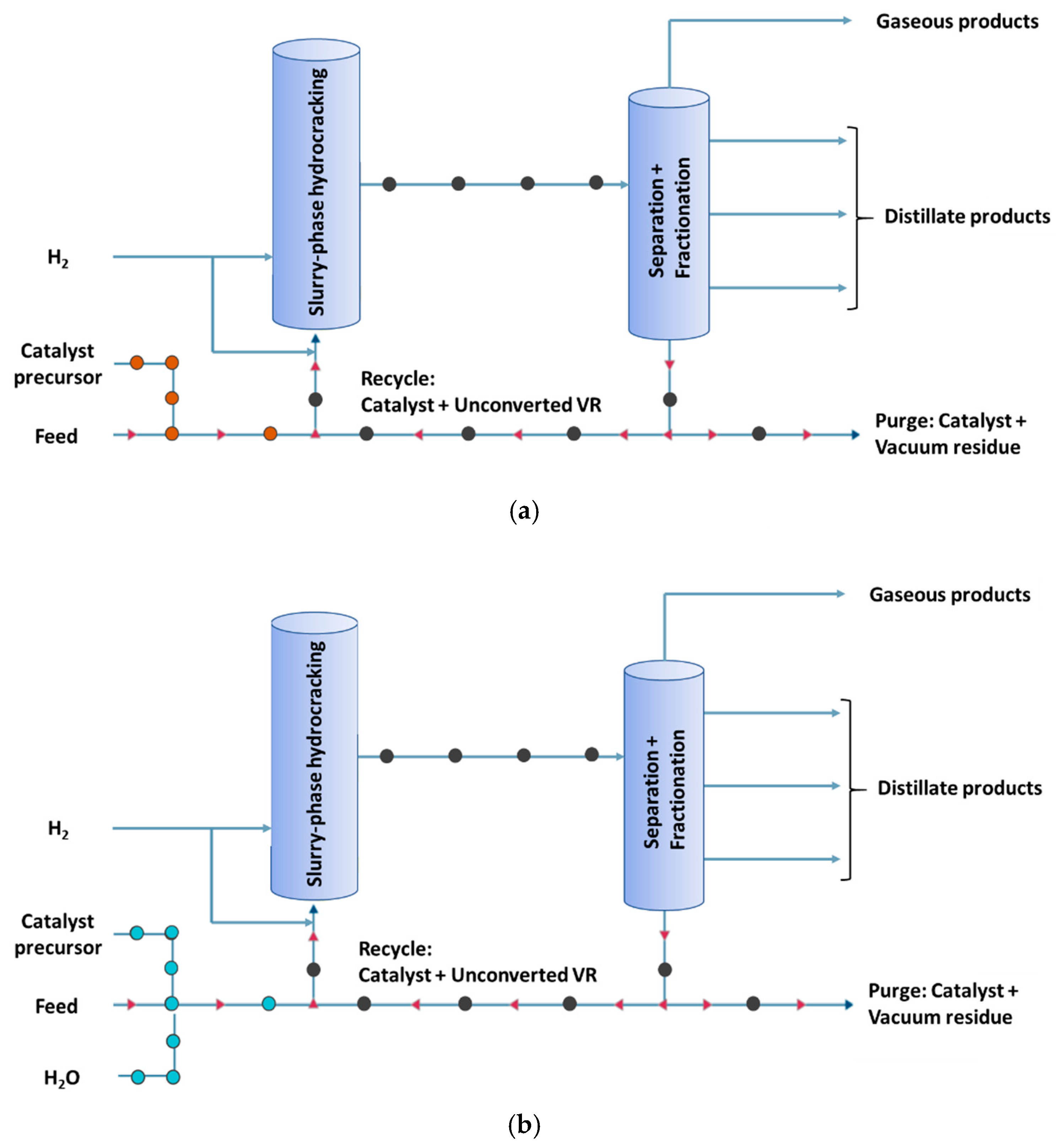
- ▪
- Dispersed nanocatalysts from oil-soluble precursors
- ▪
- Dispersed nanocatalysts from water-soluble precursors
5. Advances in Catalysis by Dispersed Nanoparticles for HOF Processing
- Enhancing catalytic performance through compositional modifications, tailored precursor design, and shifting from in situ generation toward ex situ-prepared, ready-to-use catalysts;
- Reducing costs and improving sustainability by partially or fully replacing expensive transition metals (e.g., Mo) with earth-abundant metals, waste-derived components, or renewable materials;
- Expanding feedstock flexibility by co-processing HOF with other macromolecular materials such as waste plastics, tires, and biomass.
5.1. Novel Precursors and Synthesis Methods
5.2. Ex Situ vs. In Situ Nanocatalysts
- Precision engineering of catalyst properties (size, morphology, sulfidation level) before introducing them into the reactor;
- Decoupling synthesis from reaction conditions, allowing independent optimization of catalyst formation and hydroconversion;
- Eliminating reliance on feedstock sulfur, which is crucial for in situ sulfidation but problematic for low-sulfur residues.

6. System-Level Climate Impacts and Life Cycle Perspectives
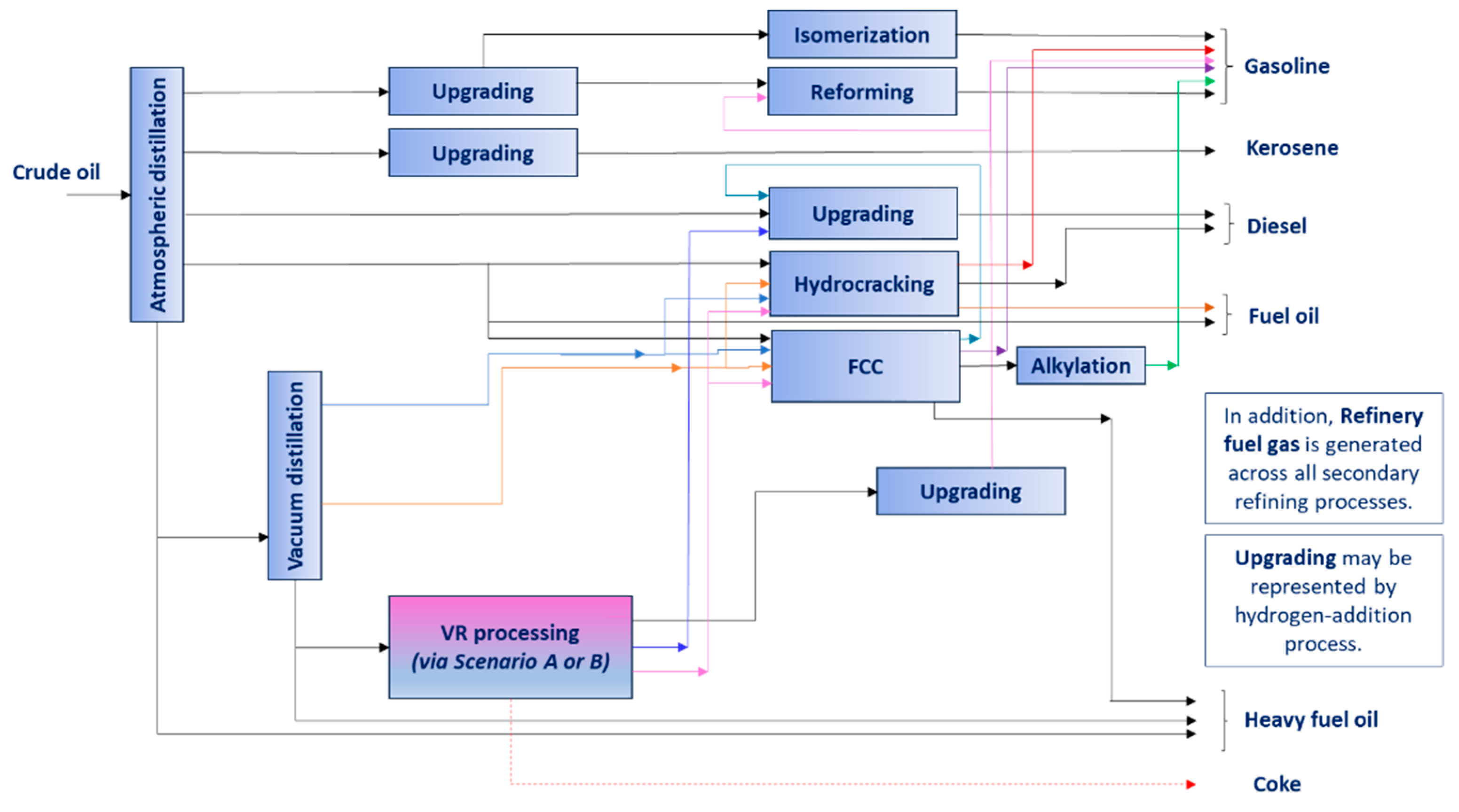
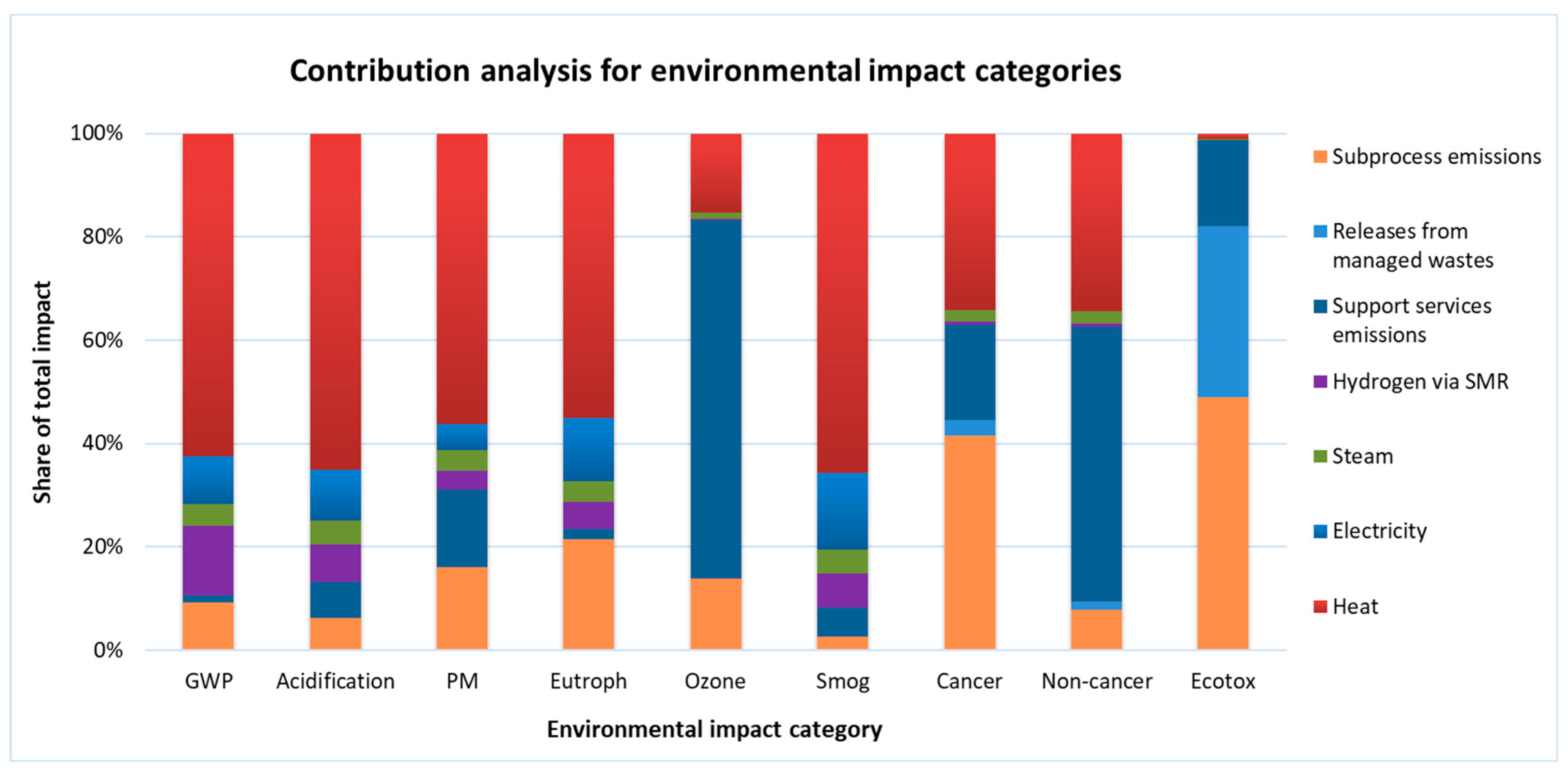
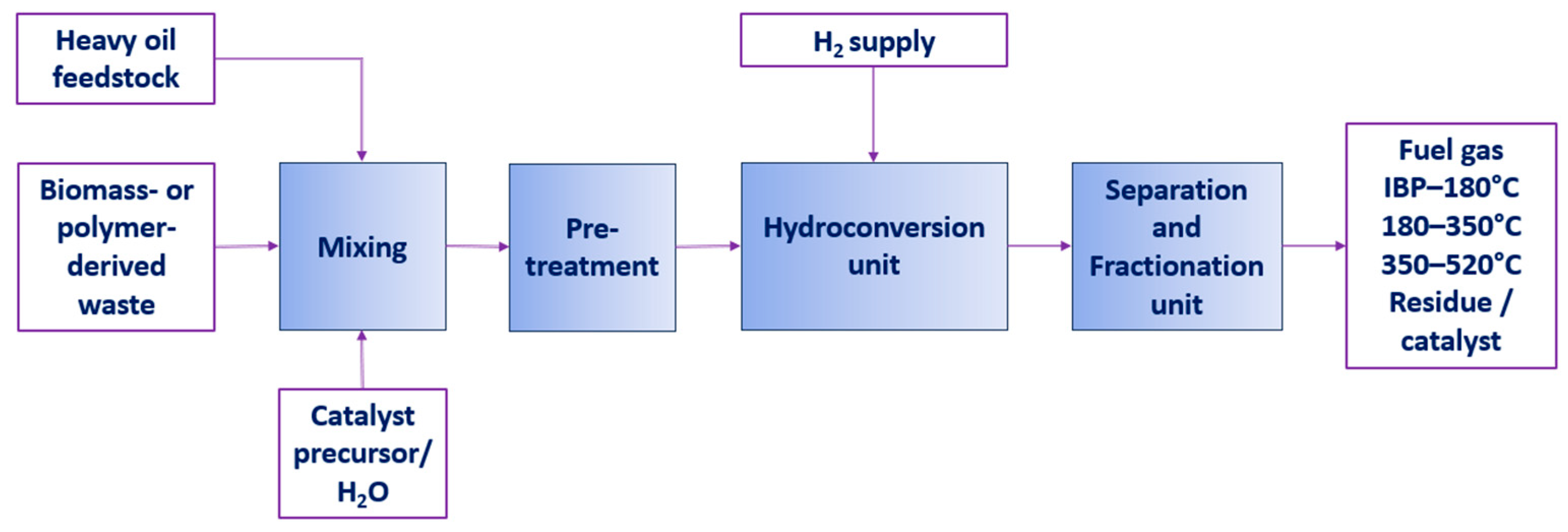
- Scenario A: conventional refinery scheme with a delayed coking unit for processing heavy residue boiling above 525 °C (VR);
- Scenario B: advanced refinery scheme with a residue hydroconversion unit for processing VR.
- Ammonium paramolybdate (APM) production involves mining and roasting molybdenite (MoS2) to molybdenum trioxide (MoO3), followed by leaching and crystallization. Drawing on recent life cycle inventories [90,91], the cradle-to-gate emission factor for APM is 12.1 kg CO2-eq/kg APM. At a refinery throughput of 100,000 bbl/d, this adds 0.76 kg CO2-eq/bbl crude.
7. Co-Processing Heavy Oil Feedstocks with Alternative Feed
7.1. Co-Processing Biomass with Heavy Oil Feedstocks
7.2. Co-Processing Polymer-Derived Feed with Heavy Oil Feedstocks
8. Conclusions
Supplementary Materials
Author Contributions
Funding
Data Availability Statement
Conflicts of Interest
Abbreviations
| AR | atmospheric residue |
| API | American Petroleum Institute |
| bbl | barrel |
| bbl/d | barrels per day |
| BTEX | benzene, toluene, ethylbenzene, xylenes |
| BTX | benzene, toluene, xylenes |
| CCS | carbon capture and storage |
| CFA | coal fly ash |
| CFP | catalytic fast pyrolysis |
| CO2-eq | carbon dioxide equivalent |
| CNR | catalytic naphtha reformer |
| CNT | carbon nanotube |
| CTAB | cetyltrimethyl ammonium bromide |
| CTU | comparative toxic unit |
| CTUcancer | comparative toxic unit for humans (cancer) |
| CTUeco | comparative toxic unit for ecosystems |
| CTUnoncancer | comparative toxic unit for humans (non-cancer) |
| EST | Eni Slurry Technology |
| FCC | fluid catalytic cracking |
| GHGs | greenhouse gases |
| GO | gas oil |
| GREET | Greenhouse gases, Regulated Emissions, and Energy use in Technologies |
| GTL | gas to liquid |
| GWP | global warming potential |
| HAD | hydrodeasphaltenization |
| HDM | hydrodemetallization |
| HDN | hydrodenitrogenation |
| HDO | hydrodeoxygenation |
| HDS | hydrodesulfurization |
| HDPE | high-density polyethylene |
| HFO | heavy fuel oil |
| HOF | heavy oil feedstock |
| HTL | hydrothermal liquefaction |
| HY | faujasite zeolite (Y zeolite) |
| IBP | initial boiling point |
| ILs | ionic liquids |
| ISO | International Organization for Standardization |
| LCA | life cycle assessment |
| LCIA | life cycle impact assessment |
| LDPE | low-density polyethylene |
| LHSV | liquid hourly space velocity |
| LPG | liquefied petroleum gas |
| MENA | Middle East and North Africa |
| ML | machine learning |
| PM2.5 | particulate matter (2.5 μm or smaller) |
| POM | polyoxometalate |
| PP | polypropylene |
| ppm | parts per million |
| PRELIM | Petroleum Refinery Life Cycle Inventory Model |
| PS | polystyrene |
| PTC | phase transfer catalyst |
| R&D | research and development |
| SAF | sustainable aviation fuel |
| SAPO-11 | silicoaluminophosphate-11 |
| SMR | steam methane reforming |
| TBA | tetrabutyl ammonium |
| ULSD | ultra-low-sulfur diesel |
| UN SDGs | United Nations Sustainable Development Goals |
| VGO | vacuum gas oil |
| VR | vacuum residue |
| wt% | weight percent |
| ZSM-5 | Zeolite Socony Mobil-5 |
References
- Abbas, A.; Cross, M.; Duan, X.; Jeschke, S.; Konarova, M.; Huber, G.W.; Lee, A.F.; Lovell, E.C.; Lim, J.Y.C.; Polyzos, A.; et al. Catalysis at the Intersection of Sustainable Chemistry and a Circular Economy. One Earth 2024, 7, 738–741. [Google Scholar] [CrossRef]
- UN Department of Economic and Social Affairs Sustainable Development 17 Sustainable Development Goals. Available online: https://sdgs.un.org/goals (accessed on 8 January 2026).
- Al-Samhan, M.; Al-Fadhli, J.; Al-Otaibi, A.M.; Al-Attar, F.; Bouresli, R.; Rana, M.S. Prospects of Refinery Switching from Conventional to Integrated: An Opportunity for Sustainable Investment in the Petrochemical Industry. Fuel 2022, 310, 122161. [Google Scholar] [CrossRef]
- U.S. Energy Information Administration (EIA). How Much Gasoline and Diesel Fuel Is Made from One Barrel of Oil? Available online: https://www.eia.gov/tools/faqs/faq.php?id=327&t=9 (accessed on 24 November 2025).
- Platts Periodic Table of Oil Prices and Refining Margins. S&P Global Commodity Insights. Available online: https://www.spglobal.com/commodity-insights/en/news-research/infographics/content-design-infographics/platts-periodic-table-of-oil (accessed on 24 November 2025).
- UCube Upstream Analysis Database. Rystad Energy. Available online: https://www.rystadenergy.com/services/upstream-solution (accessed on 24 November 2025).
- Trading Crack Spreads. CME Group. Available online: https://www.cmegroup.com/articles/2024/trading-crack-spreads.html (accessed on 8 January 2026).
- Skrzypczak, D.; Pstrowska, K.; Niciejewska, A.; Mazur-Nowacka, A.; Wilk, Ł.; Chojnacka, K. Catalytic Innovations in Fertilizer Production from Agricultural Waste: Enhancing Soil Health and Sustainability. Appl. Catal. O Open 2025, 206, 207064. [Google Scholar] [CrossRef]
- Eletskii, P.M.; Mironenko, O.O.; Kukushkin, R.G.; Sosnin, G.A.; Yakovlev, V.A. Catalytic Steam Cracking of Heavy Oil Feedstocks: A Review. Catal. Ind. 2018, 10, 185–201. [Google Scholar] [CrossRef]
- Akhtar, M.S.; Ali, S.; Zaman, W. Recent Advancements in Catalysts for Petroleum Refining. Catalysts 2024, 14, 841. [Google Scholar] [CrossRef]
- Adzahar, N.A.; AbdulKareem-Alsultan, G.; Lee, H.V.; Taufiq-Yap, Y.H. Advances in Supported Monometallic and Bimetallic Catalysts towards Green Aviation Fuels: A Review. Energy Adv. 2025, 4, 966–1005. [Google Scholar] [CrossRef]
- Abella, J.P.; Bergerson, J.A. Model to Investigate Energy and Greenhouse Gas Emissions Implications of Refining Petroleum: Impacts of Crude Quality and Refinery Configuration. Environ. Sci. Technol. 2012, 46, 13037–13047. [Google Scholar] [CrossRef]
- Young, B.; Hottle, T.; Hawkins, T.; Jamieson, M.; Cooney, G.; Motazedi, K.; Bergerson, J. Expansion of the Petroleum Refinery Life Cycle Inventory Model to Support Characterization of a Full Suite of Commonly Tracked Impact Potentials. Environ. Sci. Technol. 2019, 53, 2238–2248. [Google Scholar] [CrossRef]
- Motazedi, K.; Abella, J.P.; Bergerson, J.A. Techno-Economic Evaluation of Technologies to Mitigate Greenhouse Gas Emissions at North American Refineries. Environ. Sci. Technol. 2017, 51, 1918–1928. [Google Scholar] [CrossRef]
- Variny, M.; Podolský, S.; Kurák, T. The Valorization of a Crude Refinery’s By-Product: A Case Study on the Heavy Residue Gasifier †. Eng. Proc. 2024, 64, 10. [Google Scholar] [CrossRef]
- Jing, L.; El-Houjeiri, H.M.; Monfort, J.C.; Brandt, A.R.; Masnadi, M.S.; Gordon, D.; Bergerson, J.A. Carbon Intensity of Global Crude Oil Refining and Mitigation Potential. Nat. Clim. Change 2020, 10, 526–532. [Google Scholar] [CrossRef]
- Sleep, S.; Dadashi, Z.; Chen, Y.; Brandt, A.R.; MacLean, H.L.; Bergerson, J.A. Improving Robustness of LCA Results through Stakeholder Engagement: A Case Study of Emerging Oil Sands Technologies. J. Clean. Prod. 2021, 281, 125277. [Google Scholar] [CrossRef]
- Middle East and North Africa Vacuum Bottom Residue (Kerosene, VGO and Bitumen) Market Report and Forecast 2024–2032. Available online: https://www.expertmarketresearch.com/reports/mena-vacuum-bottom-residue-market (accessed on 24 November 2025).
- Kaushik, A. Vacuum Bottom Residue: Turning Refining Waste into Economic Value. Available online: https://www.linkedin.com/pulse/vacuum-bottom-residue-turning-refining-waste-economic-kaushik-f7gbc/ (accessed on 24 November 2025).
- Parkhomchuk, E.V.; Fedotov, K.V.; Lysikov, A.I.; Polukhin, A.V.; Vorobyeva, E.E.; Shamanaeva, I.A.; Sankova, N.N.; Shestakova, D.O.; Reshetnikov, D.M.; Volf, A.V.; et al. Catalytic Hydroprocessing of Oil Residues for Marine Fuel Production. Fuel 2023, 341, 127714. [Google Scholar] [CrossRef]
- Mastry, M.C.; Dorazio, L.; Fu, J.C.; Gómez, J.P.; Sedano, S.; Ail, S.S.; Castaldi, M.J.; Yilmaz, B. Processing Renewable and Waste-Based Feedstocks with Fluid Catalytic Cracking: Impact on Catalytic Performance and Considerations for Improved Catalyst Design. Front. Chem. 2023, 11, 1067488. [Google Scholar] [CrossRef]
- Dewang, Y.; Sharma, V.; Singla, Y.K. A Critical Review of Waste Tire Pyrolysis for Diesel Engines: Technologies, Challenges, and Future Prospects. Sustain. Mater. Technol. 2025, 43, e01291. [Google Scholar] [CrossRef]
- Zaki, S.N.R.M.; Zainal, N.F.A.; Tay, C.C. Global Trends of Waste Tire Pyrolysis Research: A Bibliometric Analysis. Clean. Energy Syst. 2025, 10, 100181. [Google Scholar] [CrossRef]
- Moasas, A.M.; Amin, M.N.; Khan, K.; Ahmad, W.; Al-Hashem, M.N.A.; Deifalla, A.F.; Ahmad, A. A Worldwide Development in the Accumulation of Waste Tires and Its Utilization in Concrete as a Sustainable Construction Material: A Review. Case Stud. Constr. Mater. 2022, 17, e01677. [Google Scholar] [CrossRef]
- Policy Scenarios for Eliminating Plastic Pollution by 2040. Available online: https://www.oecd.org/en/publications/policy-scenarios-for-eliminating-plastic-pollution-by-2040_76400890-en.html (accessed on 25 December 2025).
- Gringolts, M.L.; Dement’ev, K.I.; Kadiev, K.M.; Maksimov, A.L.; Finkel’shtein, E.S. Chemical Conversion of Polymer Wastes into Motor Fuels and Petrochemical Raw Materials (A Review). Pet. Chem. 2020, 60, 751–761. [Google Scholar] [CrossRef]
- Rhokimah, S.; Lee, S.; Kurniawati, I.; Sung, Y. A Review on the Synthesis of Carbon Nanotubes from Plastic Waste: Influence of Manganese as a Catalytic Promoter. Results Eng. 2025, 27, 105764. [Google Scholar] [CrossRef]
- Martín, A.J.; Mondelli, C.; Jaydev, S.D.; Pérez-Ramírez, J. Catalytic Processing of Plastic Waste on the Rise. Chem 2021, 7, 1487–1533. [Google Scholar] [CrossRef]
- Palos, R.; Gutiérrez, A.; Vela, F.J.; Olazar, M.; Arandes, J.M.; Bilbao, J. Waste Refinery: The Valorization of Waste Plastics and End-of-Life Tires in Refinery Units. A Review. Energy Fuels 2021, 35, 3529–3557. [Google Scholar] [CrossRef]
- Faizan, M.; Siddiqui, M.N. Plastic Waste to Hydrogen Fuel: Cutting-Edge Catalytic Technologies for Sustainable Energy Transition. Int. J. Hydrogen Energy 2025, 127, 678–701. [Google Scholar] [CrossRef]
- Ellis, L.D.; Orski, S.V.; Kenlaw, G.A.; Norman, A.G.; Beers, K.L.; Román-Leshkov, Y.; Beckham, G.T. Tandem Heterogeneous Catalysis for Polyethylene Depolymerization via an Olefin-Intermediate Process. ACS Sustain. Chem. Eng. 2021, 9, 623–628. [Google Scholar] [CrossRef] [PubMed]
- Nguyen, B.N.T.; Lim, J.Y.C. Emerging Green Approaches for Valorization of Plastics with Saturated Carbon Backbones. Trends Chem. 2024, 6, 100–114. [Google Scholar] [CrossRef]
- Zielińska, M.; Bułkowska, K. Agricultural Wastes and Their By-Products for the Energy Market. Energies 2024, 17, 2099. [Google Scholar] [CrossRef]
- Mujtaba, M.; Fernandes Fraceto, L.; Fazeli, M.; Mukherjee, S.; Savassa, S.M.; Araujo de Medeiros, G.; do Espírito Santo Pereira, A.; Mancini, S.D.; Lipponen, J.; Vilaplana, F. Lignocellulosic Biomass from Agricultural Waste to the Circular Economy: A Review with Focus on Biofuels, Biocomposites and Bioplastics. J. Clean. Prod. 2023, 402, 136815. [Google Scholar] [CrossRef]
- Lee, K.; Jing, Y.; Wang, Y.; Yan, N. A Unified View on Catalytic Conversion of Biomass and Waste Plastics. Nat. Rev. Chem. 2022, 6, 635–652. [Google Scholar] [CrossRef] [PubMed]
- Antar, M.; Lyu, D.; Nazari, M.; Shah, A.; Zhou, X.; Smith, D.L. Biomass for a Sustainable Bioeconomy: An Overview of World Biomass Production and Utilization. Renew. Sustain. Energy Rev. 2021, 139, 110691. [Google Scholar] [CrossRef]
- Kadiev, K.M.; Khadzhiev, S.N.; Zekel’, L.A.; Temirsultanov, Z.A.; Gyul’Maliev, A.M. Hydroconversion of Wood Biomass in Oil Tar in the Presence of Nanosized Catalysts. Solid Fuel Chem. 2012, 46, 375–384. [Google Scholar] [CrossRef]
- Strizhakov, D.A.; Yurgelevich, Y.G.; Kadiev, K.M.; Sazon, N.I.; Korbut, V.I.; Gyul’maliev, A.M. Hydroconversion of Sawdust in a Mixture with Oil Tar in the Presence of Nanosized Cracking Catalysts. Solid Fuel Chem. 2015, 49, 236–244. [Google Scholar] [CrossRef]
- García-Serna, J.; Piñero-Hernanz, R.; Durán-Martín, D. Inspirational Perspectives and Principles on the Use of Catalysts to Create Sustainability. Catal. Today 2022, 387, 237–243. [Google Scholar] [CrossRef]
- Habib, U.; Ahmad, F.; Awais, M.; Naz, N.; Aslam, M.; Urooj, M.; Moqeem, A.; Tahseen, H.; Waqar, A.; Sajid, M.; et al. Sustainable Catalysis: Navigating Challenges and Embracing Opportunities for a Greener Future. J. Chem. Environ. 2023, 2, 14–53. [Google Scholar] [CrossRef]
- Isahak, W.N.R.W.; Al-Amiery, A. Catalysts Driving Efficiency and Innovation in Thermal Reactions: A Comprehensive Review. Green Technol. Sustain. 2024, 2, 100078. [Google Scholar] [CrossRef]
- Khadzhiev, S.N.; Kadiev, K.M.; Kadieva, M.K. Synthesis and Properties of Nanosized Systems as Efficient Catalysts for Hydroconversion of Heavy Petroleum Feedstock. Pet. Chem. 2014, 54, 323–346. [Google Scholar] [CrossRef]
- Bellussi, G.; Rispoli, G.; Molinari, D.; Landoni, A.; Pollesel, P.; Panariti, N.; Millini, R.; Montanari, E. The Role of MoS2 Nano-Slabs in the Protection of Solid Cracking Catalysts for the Total Conversion of Heavy Oils to Good Quality Distillates. Catal. Sci. Technol. 2013, 3, 176–182. [Google Scholar] [CrossRef]
- Kadiev, K.; Maximov, A.L.; Ancheyta, J. Novel Technologies for Upgrading Heavy and Extra-Heavy Oil. In Catalytic In-Situ Upgrading of Heavy and Extra-Heavy Crude Oils; Wiley: Hoboken, NJ, USA, 2023; pp. 489–520. [Google Scholar]
- Rana, M.S.; Sámano, V.; Ancheyta, J.; Diaz, J.A.I. A Review of Recent Advances on Process Technologies for Upgrading of Heavy Oils and Residua. Fuel 2007, 86, 1216–1231. [Google Scholar] [CrossRef]
- Da Silva, M.W. Hydrocracking Technologies as Residue Upgrading Strategy—Reaching Competitive Differentiation in the Refining Sector. Available online: https://www.linkedin.com/pulse/hydrocracking-technologies-residue-upgrading-strategy-da-silva-mba--jr7tf/ (accessed on 16 August 2025).
- Tye, C.T. Catalysts for Hydroprocessing of Heavy Oils and Petroleum Residues. In Processing of Heavy Crude Oils-Challenges and Opportunities; IntechOpen: London, UK, 2019. [Google Scholar] [CrossRef]
- Pham, P.T.H.; Pham, C.Q.; Dam, T.T.; Nguyen, Q.A.; Nguyen, T.M. A Comprehensive Review of Catalyst Deactivation and Regeneration in Heavy Oil Hydroprocessing. Fuel Process. Technol. 2025, 267, 108170. [Google Scholar] [CrossRef]
- Kadiev, K.M.; Maximov, A.L.; Kadieva, M.K. The Effect of Mos2 Active Site Dispersion on Suppression of Polycondensation Reactions during Heavy Oil Hydroconversion. Catalysts 2021, 11, 676. [Google Scholar] [CrossRef]
- Zhang, X.; Chen, B.; Wang, J.; Zhou, Y.; Huang, X.; Huang, H.; Wang, X.; Li, K. Review of Molybdenum Disulfide Research in Slurry Bed Heavy Oil Hydrogenation. ACS Omega 2023, 8, 18400–18407. [Google Scholar] [CrossRef]
- Liu, Y.; Gao, L.; Wen, L.; Zong, B. Recent Advances in Heavy Oil Hydroprocessing Technologies. Recent Pat. Chem. Eng. 2009, 2, 22–36. [Google Scholar] [CrossRef]
- Kadiev, K.M.; Zekel’, L.A.; Kadieva, M.K.; Gyul’maliev, A.M.; Batov, A.E.; Visaliev, M.Y.; Dandaev, A.U.; Magomadov, E.E.; Kubrin, N.A. Effect of Hydroconversion Conditions on the Composition and Properties of an Ultrafine Mo-Containing Catalyst Formed in Situ. Pet. Chem. 2020, 60, 1154–1163. [Google Scholar] [CrossRef]
- Kadiev, K.M.; Zekel’, L.A.; Kadieva, M.K.; Khadzhiev, S.N. Formation of Polycondensation Products in Heavy Oil Feedstock Hydroconversion in the Presence of Ultrafine Catalyst:Physicochemical Study. Pet. Chem. 2018, 58, 519–527. [Google Scholar] [CrossRef]
- Liu, B.; Zhao, K.; Chai, Y.; Li, Y.; Liu, D.; Liu, Y.; Liu, C. Slurry Phase Hydrocracking of Vacuum Residue in the Presence of Presulfided Oil-Soluble MoS2 Catalyst. Fuel 2019, 246, 133–140. [Google Scholar] [CrossRef]
- Ma, Y.; Zhang, J.; Wu, W.; Cai, Z.; Cao, Y.; Huang, K.; Jiang, L. Trialkylmethylammonium Molybdate Ionic Liquids as Novel Oil-Soluble Precursors of Dispersed Metal Catalysts for Slurry-Phase Hydrocracking of Heavy Oils. Chem. Eng. Sci. 2022, 253, 117516. [Google Scholar] [CrossRef]
- Yang, T.; Zhang, S.; Zhu, Y.; Liu, Y.; Chang, F.; Dai, X.; Chen, J.; Yang, T.; Huang, C. An Oil-Soluble Precursor with Strong Feedstock Adaptability and Excellent Product Selectivity for Heavy Oil Hydrocracking. Chem. Eng. Res. Des. 2023, 192, 593–605. [Google Scholar] [CrossRef]
- Liu, D.; Li, M.; Deng, W.; Que, G. Reactivity and Composition of Dispersed NI Catalyst for Slurry-Phase Residue Hydrocracking. Energy Fuels 2010, 24, 1958–1962. [Google Scholar] [CrossRef]
- Nguyen, T.S.; Tayakout-Fayolle, M.; Lacroix, M.; Gotteland, D.; Aouine, M.; Bacaud, R.; Afanasiev, P.; Geantet, C. Promotion Effects with Dispersed Catalysts for Residue Slurry Hydroconversion. Fuel 2015, 160, 50–56. [Google Scholar] [CrossRef]
- Ibrahim, M.; Al-Zahrani, F.A.; Diaz, F.J.; Al-Attas, T.; Zahir, H.; Ali, S.A.; Siddiqui, M.A.B.; Hossain, M.M. Experimental Investigation of Metal-Based Calixarenes as Dispersed Catalyst Precursors for Heavy Oil Hydrocracking. Catalysts 2022, 12, 1255. [Google Scholar] [CrossRef]
- Luo, H.; Ding, C.; Wang, Z.; Yan, R.; Deng, W.; Li, C. Alloy Effects of Oil-Soluble Bimetallic Fe-Ni-S Catalysts in the Coprocessing of Coal and Petroleum Residue. Fuel 2025, 398, 135498. [Google Scholar] [CrossRef]
- Bano, S.; Ahmad, S.W.; Woo, S.I.; Saleem, F. Heavy Oil Hydroprocessing: Effect of Nanostructured Morphologies of MoS2 as Catalyst. React. Kinet. Mech. Catal. 2015, 114, 473–487. [Google Scholar] [CrossRef]
- Kadieva, M.K.; Magomadov, E.E.; Gusev, D.V.; Kadiev, K.M.; Khadzhiev, S.N. Activity of a Molybdenum-Containing Composite Nanocatalyst in Vacuum Residue Hydroconversion. Pet. Chem. 2017, 57, 1310–1317. [Google Scholar] [CrossRef]
- Kadieva, M.K.; Maximov, A.L.; Kadiev, K.M. Ex-Situ Synthesis and Study of Nanosized Mo-Containing Catalyst for Petroleum Residue Hydro-Conversion. Catalysts 2019, 9, 649. [Google Scholar] [CrossRef]
- Lam-Maldonado, M.; Melo-Banda, J.A.; Macias-Ferrer, D.; Schacht, P.; Mata-Padilla, J.M.; de la Torre, A.I.R.; Meraz Melo, M.A.; Domínguez, J.M. NiFe Nanocatalysts for the Hydrocracking Heavy Crude Oil. Catal. Today 2020, 349, 17–25. [Google Scholar] [CrossRef]
- Hou, L.; Liang, S.; Wang, L.; Luo, D.; Guo, J. Effect of Biochar-Based Nano-nickel Catalyst on Heavy Crude Oil Upgrading and Oil Shale Pyrolysis. Appl. Catal. O Open 2024, 195, 207011. [Google Scholar] [CrossRef]
- Nguyen-Huy, C.; Kweon, H.; Kim, H.; Kim, D.K.; Kim, D.W.; Oh, S.H.; Shin, E.W. Slurry-Phase Hydrocracking of Vacuum Residue with a Disposable Red Mud Catalyst. Appl. Catal. A Gen. 2012, 447–448, 186–192. [Google Scholar] [CrossRef]
- Gharibshahi, R.; Omidkhah, M.; Jafari, A.; Fakhroueian, Z. Hybridization of Superparamagnetic Fe3O4 Nanoparticles with MWCNTs and Effect of Surface Modification on Electromagnetic Heating Process Efficiency: A Microfluidics Enhanced Oil Recovery Study. Fuel 2020, 282, 118603. [Google Scholar] [CrossRef]
- Gharibshahi, R.; Omidkhah, M.; Jafari, A.; Mehrooz, N. Parametric Optimization of In-Situ Heavy Oil Upgrading Using Simultaneous Microwave Radiation and Magnetic Nanohybrids via Taguchi Approach. Fuel 2022, 325, 124717. [Google Scholar] [CrossRef]
- Visaliev, M.Y.; Dandaev, A.U.; Batov, A.E.; Dement’ev, K.I.; Kadiev, K.M. Regeneration of the Slurry-Phase Hydroconversion Catalyst Precursor. Pet. Chem. 2023, 63, 1194–1202. [Google Scholar] [CrossRef]
- Gillis, D.; Zimmerman, P.; VanWees, M. Upgrading Residues for High Levels of Distillate Production. Digit. Refin. PTQ (Petroleum Technology Quarterly), Q4 2009, 1–10. Available online: https://www.digitalrefining.com/article/1000613 (accessed on 24 November 2025).
- KBR Inc. KBR/BP VCC Technology. Available online: https://portfolio-pplus.com/Technologies/Details/318?utm_source (accessed on 24 November 2025).
- Eni Slurry Technology. Available online: https://www.eni.com/assets/documents/eng/operations/EST-Eni-Slurry-Technology.pdf (accessed on 24 November 2025).
- Chabot, J.; Shiflett, W. Residuum Hydrocracking: Chemistry and Catalysis. Digit. Refin. PTQ (Petroleum Technology Quarterly), Q3 2019, 1–9. Available online: https://www.digitalrefining.com/article/1002340 (accessed on 24 November 2025).
- Kang, K.H.; Kim, G.T.; Park, S.; Seo, P.W.; Seo, H.; Lee, C.W. A Review on the Mo-Precursors for Catalytic Hydroconversion of Heavy Oil. J. Ind. Eng. Chem. 2019, 76, 1–16. [Google Scholar] [CrossRef]
- Al-Marshed, A.; Hart, A.; Leeke, G.; Greaves, M.; Wood, J. Effectiveness of Different Transition Metal Dispersed Catalysts for In Situ Heavy Oil Upgrading. Ind. Eng. Chem. Res. 2015, 54, 10645–10655. [Google Scholar] [CrossRef]
- Kadiev, K.M.; Zaytseva, O.V.; Magomadov, E.E.; Chernysheva, E.A.; Oknina, N.V.; Batov, A.E.; Kadieva, M.K.; Kapustin, V.M.; Khadzhiev, S.N. Structural Transformations of Asphaltenes during Hydroconversion of Vacuum Residue with Recycling the Hydroconversion Product Distillation Residue. Pet. Chem. 2015, 55, 487–496. [Google Scholar] [CrossRef]
- Khadzhiev, S.N.; Kadiev, K.M.; Zhigalina, O.M.; Kadieva, M.K.; Khmelenin, D.N. Structure and Properties of Molybdenum Sulfide Nanoparticles Synthesized in Situ in the Hydroconversion Process. Pet. Chem. 2015, 55, 655–662. [Google Scholar] [CrossRef]
- Kadiev, K.M.; Khadzhiev, S.N.; Kadieva, M.K. Synthesis and Use of Polyfunctional Catalyst Nanoparticles for Hydroconversion of Natural Bitumen. Pet. Chem. 2013, 53, 298–308. [Google Scholar] [CrossRef]
- Al-Attas, T.A.; Ali, S.A.; Zahir, M.H.; Xiong, Q.; Al-Bogami, S.A.; Malaibari, Z.O.; Razzak, S.A.; Hossain, M.M. Recent Advances in Heavy Oil Upgrading Using Dispersed Catalysts. Energy Fuels 2019, 33, 7917–7949. [Google Scholar] [CrossRef]
- Brelsford, R. Tatneft Adding New Units at Taneco’s Nizhnekamsk Refinery. Available online: https://www.ogj.com/refining-processing/article/14200178/tatneft-adding-new-units-at-tanecos-nizhnekamsk-refinery (accessed on 24 November 2025).
- Abdrabou, M.K.; Han, X.; Zeng, Y.; Zheng, Y. Recent Developments in the Utilization of Unconventional Resources: A Focus on Partial Upgrading Techniques and Sustainability of Canadian Oil Sand Bitumen. Resour. Chem. Mater. 2025, 4, 100084. [Google Scholar] [CrossRef]
- Alonso, A.; Macanás, J.; Davies, G.L.; Gun’ko, Y.K.; Muñoz, M.; Muraviev, D.N. Environmentally-Safe Polymer-Metal Nanocomposites with Most Favorable Distribution of Catalytically Active and Biocide Nanoparticles. In Advances in Nanocomposite Technology; BoD—Books on Demand: Norderstedt, Germany, 2011; pp. 175–200. [Google Scholar]
- Zhang, L.; Jiang, Z.F.; Shi, Y.C.; Fang, K.M.; Wang, Z.G.; Feng, J.J.; Wang, A.J. Defects-Rich PtRhCoNiMn High-Entropy Alloyed Nanodendrites: A High-Performance and Sustainable Catalyst for Hydrogenation Reactions. J. Colloid Interface Sci. 2025, 688, 298–307. [Google Scholar] [CrossRef] [PubMed]
- ISO E. 14044:2006; Environmental Management—Life Cycle—Requirements and Guidelines. ISO: Geneva, Switzerland, 2006; ISBN 9789815042603.
- Bergerson, J.A.; Brandt, A.; Cresko, J.; Carbajales-Dale, M.; MacLean, H.L.; Matthews, H.S.; McCoy, S.; McManus, M.; Miller, S.A.; Morrow, W.R.; et al. Life Cycle Assessment of Emerging Technologies: Evaluation Techniques at Different Stages of Market and Technical Maturity. J. Ind. Ecol. 2020, 24, 11–25. [Google Scholar] [CrossRef]
- PRELIM v1.6. (Petroleum Refinery Life Cycle Inventory Model). Available online: https://www.ucalgary.ca/energy-technology-assessment/open-source-models/prelim (accessed on 16 September 2025).
- Maganov, N.U.; Rempel, R.D.; Nurmiev, A.A.; Abdrahmanov, R.A.; Salahov, I.I.; Zurbașev, A.V.; Habibrahmanov, I.I.; Suleimanov, I.R.; Gilmanov, F.S.; Rîaskin, A.V.; et al. Method of Hydroconversion of Petroleum Feedstock. EA 046195 B1, 15 February 2024. (In Russian) [Google Scholar]
- Maksimov, A.L.; Kadiev, H.M.; Visaliev, M.I.; Dandaev, A.U.; Kubrin, N.A.; Batov, A.E.; Kadieva, M.H. Method for Hydroconversion of Heavy Carbon-Containing Raw Material. RU 2,838,970 C1, 24 April 2025. (In Russian) [Google Scholar]
- Rahman, M.M.; Canter, C.; Kumar, A. Greenhouse Gas Emissions from Recovery of Various North American Conventional Crudes. Energy 2014, 74, 607–617. [Google Scholar] [CrossRef]
- Life Cycle Inventory of Molybdenum for Metallurgical Applications. Summary Report (for International Molybdenum Association). Available online: https://www.imoa.info/download_files/HSE/LCI/IMOA_LCI_SUMMARY_Report_2024-MoMetallurgicalProducts-_FINAL-19Nov24.pdf (accessed on 24 November 2025).
- Ecoinvent Database (Version 3.11). Available online: https://ecoinvent.org/ecoinvent-v3-11/ (accessed on 24 November 2025).
- GREET® Model. Available online: https://greet.anl.gov/ (accessed on 24 November 2025).
- Average Retail Electricity Price for Industrial Consumers in the United States from 1970 to 2025. Statista. U.S. Energy Information Administration. Available online: https://www.statista.com/statistics/190680/us-industrial-consumer-price-estimates-for-retail-electricity-since-1970/ (accessed on 24 November 2025).
- Weekly U.S. Henry Hub Natural Gas Spot Prices from January 7, 2022 to September 26, Statista. U.S. Energy Information Administration. Available online: https://www.statista.com/statistics/1105300/weekly-henry-hub-natural-gas-prices/ (accessed on 24 November 2025).
- Short-Term Energy Outlook. Natural Gas Intellect. U.S. Energy Information Administration. Available online: https://naturalgasintel.com/news/henry-hub-spot-prices-to-average-310-in-2025-as-us-lng-capacity-increases-says-eia/ (accessed on 24 November 2025).
- Global Hydrogen Review 2024. International Energy Agency. Available online: https://www.iea.org/reports/global-hydrogen-review-2024 (accessed on 24 November 2025).
- Hydrogen Shot Technology Assessment. Office of Energy Efficiency and Renewable Energy. U.S. Department of Energy. Available online: https://netl.doe.gov/projects/files/HydrogenShotTechnologyAssessmentThermalConversionApproaches_120523.pdf (accessed on 24 November 2025).
- Petroleum Marketing Monthly. U.S. Department of Energy. U.S. Energy Information Administration. Available online: https://www.eia.gov/petroleum/marketing/monthly/ (accessed on 24 November 2025).
- Khadzhiev, S.N.; Kadiev, K.M.; Yampolskaya, G.P.; Kadieva, M.K. Trends in the Synthesis of Metal Oxide Nanoparticles through Reverse Microemulsions in Hydrocarbon Media. Adv. Colloid Interface Sci. 2013, 197–198, 132–145. [Google Scholar] [CrossRef] [PubMed]
- Kadiev, K.M.; Dandaev, A.U.; Gyul’maliev, A.M.; Batov, A.E.; Khadzhiev, S.N. Hydroconversion of Polyethylene and Tire Rubber in a Mixture with Heavy Oil Residues. Solid Fuel Chem. 2013, 47, 132–138. [Google Scholar] [CrossRef]
- Namsaraev, Z.B.; Kadiev, K.M.; Dandaev, A.U.; Barkhutova, D.D.; Mel’nikova, A.A.; Ivanov, E.V. Combined Hydrothermal Conversion of Biomass (Algae and Aquatic Vegetation) from Lake Baikal Littoral Zone and Heavy-Oil Resids to Produce Biofuel. Chem. Technol. Fuels Oils 2018, 53, 813–816. [Google Scholar] [CrossRef]
- Cheah, Y.W.; Intakul, R.; Salam, M.A.; Sebastian, J.; Ho, P.H.; Arora, P.; Öhrman, O.; Creaser, D.; Olsson, L. Slurry Co-Hydroprocessing of Kraft Lignin and Pyrolysis Oil over Unsupported NiMoS Catalyst: A Strategy for Char Suppression. Chem. Eng. J. 2023, 475, 146056. [Google Scholar] [CrossRef]
- Lian, L.; Chen, X.; Yi, X.; Liu, Y.; Chen, W.; Zheng, A.; Miras, H.N.; Song, Y.F. Modulation of Self-Separating Molecular Catalysts for Highly Efficient Biomass Transformations. Chem.-A Eur. J. 2020, 26, 11900–11908. [Google Scholar] [CrossRef]
- Ameen, S.; Hussain, Z.; Din, M.I.; Khan, R.U.; Khalid, R. Sustainable Al2O3 Nanoparticles in Catalytic Pyrolysis: Unlocking High-Yield Bio-Oil from Melia Azedarach Fruit Biomass with Comprehensive Physicochemical Analysis. J. Anal. Appl. Pyrolysis 2024, 181, 106635. [Google Scholar] [CrossRef]
- Kohli, K.; Prajapati, R.; Maity, S.K.; Sharma, B.K. Hydrocracking of Heavy Crude/Residues with Waste Plastic. J. Anal. Appl. Pyrolysis 2019, 140, 179–187. [Google Scholar] [CrossRef]
- Kohli, K.; Prajapati, R.; Maity, S.K.; Garg, M.O. Process for Upgradation of Heavy Crude Oil/Residue Using Waste Plastic as Hydrogen Donating Agent. U.S. Patent 10745629 B2, 18 August 2020. [Google Scholar]
- Li, M.; Wang, L.; Wang, W.; Wang, X.; Yu, J. Enhanced Hydrothermal Liquefaction of Tires Using Zinc and MoS2. Process Saf. Environ. Prot. 2024, 192, 557–566. [Google Scholar] [CrossRef]
- Wong, S.L.; Armenise, S.; Nyakuma, B.B.; Bogush, A.; Towers, S.; Lee, C.H.; Wong, K.Y.; Lee, T.H.; Rebrov, E.; Muñoz, M. Plastic Pyrolysis over HZSM-5 Zeolite and Fluid Catalytic Cracking Catalyst under Ultra-Fast Heating. J. Anal. Appl. Pyrolysis 2023, 169, 105793. [Google Scholar] [CrossRef]
- Cocchi, M.; De Angelis, D.; Mazzeo, L.; Nardozi, P.; Piemonte, V.; Tuffi, R.; Ciprioti, S.V. Catalytic Pyrolysis of a Residual Plastic Waste Using Zeolites Produced by Coal Fly Ash. Catalysts 2020, 10, 1113. [Google Scholar] [CrossRef]
- Ge, H.; Gu, Y.; Liu, F.; Huang, Y.; Liu, Y.; Wu, S.; Hu, Y.; Li, Z.; Lin, H. Preparation of MCM-22/ZSM-5 Core–Shell Structured Zeolite for Catalytic Cracking of Polyethylene to Selectively Produce Paraxylene. Fuel 2025, 398, 135550. [Google Scholar] [CrossRef]
- Tang, H.; Chen, D.; Tahir, M.H.; Qian, K.; Hu, Y.; Yin, L.; Feng, Y. Catalytic Pyrolysis of Low-Density Polyethylene to Produce Sustainable Aviation Fuel Fractions: Improving Isomerized Alkane Selectivity via Magnetic Metal-Modified HY Zeolites. Energy 2025, 330, 136908. [Google Scholar] [CrossRef]
- Bergvall, N.; Weiland, C.; Öhrman, O.G.W. Slurry Hydrocracking of Pyrolysis Oil and Hydrocarbon Feedstock, Such as Petroleum Derived Feedstock. U.S. Patent 20230054561 A1, 23 February 2023. [Google Scholar]
- Bergvall, N.; Molinder, R.; Johansson, A.-C.; Sandström, L. Continuous Slurry Hydrocracking of Biobased Fast Pyrolysis Oil. Energy Fuels 2021, 35, 2303–2312. [Google Scholar] [CrossRef]
- Shen, Z.; Yu, X.; Yu, D. Preparation and Applications of Coal Fly Ash-Based Catalysts: A Comprehensive Review. J. Environ. Chem. Eng. 2025, 13, 116782. [Google Scholar] [CrossRef]


| Feedstock | Current Trends in Catalysis | Emerging/Future Trends in Catalysis |
|---|---|---|
| Heavy oil feedstocks (vacuum/atmospheric residues) |
|
|
| Polymer waste (plastics, waste tires) |
|
|
| Biomass |
|
|
| Parameter | [N6661]2MoO4 | Mo-Isooctoate |
|---|---|---|
| Slab length (nm) | ~4 | ~5–6 |
| Layer number | 1–2 | 2–3 |
| Contents of Mo (at.%) | 89.5 | 87.6 |
| Parameter | Mo-Ar/R | Mo-R |
|---|---|---|
| MoS2 morphology | Slab length < 7 nm (57.2%), stacking 1–3 layers (82.1%) | Slab length < 7 nm (53.8%), stacking 1–3 layers (77.4%) |
| H2 consumption | 0.95–1.34 wt% | 0.87–1.13 wt% |
| System | Catalyst | Conversion (wt.%) | Naphtha Yield (wt.%) | Middle Distillates Yield (wt.%) | Total Liquid Yield (wt.%) |
|---|---|---|---|---|---|
| Thermal cracking | None | 34.3 | 10.7 | 19.2 | 29.9 |
| Standalone dispersed | Ni-TBC [6] | 32.4 | 11.7 | 16.7 | 28.4 |
| Co-TBC [6] | 33.0 | 12.0 | 16.8 | 28.8 | |
| Mixed Ni + Co-TBC [6] | 35.0 | 12.1 | 19.6 | 32.0 | |
| Dual-catalytic system | Supported (W–Ni/Al2O3–SiO2) | 39.0 | 10.7 | 22.3 | 33.0 |
| Supported + Ni-TBC [6] | 41.3 | 11.7 | 23.6 | 35.3 | |
| Supported + Co-TBC [6] | 42.4 | 12.0 | 24.4 | 36.4 |
| Parameter | Feedstock | No Catalyst | NiFe Catalyst | ||
|---|---|---|---|---|---|
| Catalyst composition | - | - | NiFe (1:0.33) | NiFe (1:1) | NiFe (1:3) |
| Active phase | - | - | FeS/Ni(OH)2 | FeS/Ni | FeS/Ni |
| API gravity, ° | 13.1 | 14.0 | 17.0 | 18.0 | 18.3 |
| Viscosity, cP | 9691 | 3092 | 1050 | 869 | 798 |
| Asphaltene conversion, %wt | 32.5 | 13.8 | 37.2 | 37.0 | 43.7 |
| Sulfur, wt% | 6.0 | 5.0 | 4.4 | 4.0 | 3.9 |
| Nitrogen, ppm | 4687 | 4280 | 3188 | 3060 | 2999 |
| Parameter | No Catalyst | RM Catalyst | Effect of Catalyst |
|---|---|---|---|
| Yield of products (wt%): | |||
| Coke | 14.07 | 1.13 | ↓ 92% reduction |
| Gas | 14.65 | 9.93 | ↓ 32% reduction |
| Naphtha | 5.52 | 4.30 | Slight decrease |
| Diesel | 27.00 | 27.28 | Minimal change |
| VGO | 11.45 | 21.53 | ↑ 88% increase |
| Unreacted feed | 27.31 | 35.83 | ↑ 31% increase |
| Conversion | 72.69 | 64.17 | ↓ 8.5% reduction |
| Impact Category | Unit | Description |
|---|---|---|
| Global warming potential | kg CO2eq/bbl crude | The total potential contribution to climate change per barrel, expressed as the amount of CO2 that would cause the same warming over 100 years |
| Acidification | kg SO2eq/bbl crude | Potential of emissions to acidify soils and water, expressed relative to sulfur dioxide |
| Particulate matter formation | kg PM2.5eq/bbl crude | Potential to form fine particulate matter (PM2.5) that affects air quality and health |
| Eutrophication | kg Neq/bbl crude | Potential nutrient enrichment of ecosystems (often marine/terrestrial N-limited), expressed as nitrogen equivalents |
| Ozone depletion | kg CFC-11eq/bbl crude | Potential to deplete stratospheric ozone, expressed relative to CFC-11 |
| Smog | kg O3eq/bbl crude | Potential to form ground-level ozone (smog), expressed as ozone mass equivalents |
| Human health, cancer | CTUcancer/bbl crude | Comparative toxic unit for humans (cancer) per barrel; an estimate of incremental cancer cases potential |
| Human health, non-cancer | CTUnoncancer/bbl crude | Comparative toxic unit for humans (non-cancer) per barrel; an estimate of incremental non-cancer disease cases potential |
| Ecotoxicity | CTUeco/bbl crude | Comparative toxic unit for ecosystems per barrel; potential to harm freshwater aquatic life |
| Property | Whole Crude | >525 °C Fraction (Vacuum Residue) |
|---|---|---|
| Sulfur content, wt % | 2.0 | 4.7 |
| Nitrogen content, ppm | 1050 | 3985 |
| API gravity, °API | 31.7 | 6.7 |
| Density, kg/m3 | 863 | 1020 |
| Hydrogen content, wt % | 12.8 | 10.8 |
| Microcarbon content, wt % | 3.8 | 18.0 |
| Stream | % wt. |
|---|---|
| Input: | |
| VR (vacuum residue) | 66.0 |
| Recycle stream (containing recycled catalyst) | 29.5 |
| H2 consumption | 2.4 |
| Water | 2.0 |
| Catalyst precursor (NH4)6Mo7O24·4H2O | 0.1 |
| Total input | 100.0 |
| Output: | |
| Raw gaseous products (C1-C4, H2S, NH3) | 3.8 |
| Distillates, total | 89.7 |
| IBP–180 °C | 14.5 |
| 180–350 °C | 36.7 |
| 350–525 °C | 38.5 |
| Residue (>525 °C), including nanocatalyst * | 6.5 |
| Total output | 100.0 |
| Parameter | Scenario A | Scenario B |
|---|---|---|
| Refinery product yields (wt%): | ||
| Gasoline | 26.0 | 26.9 |
| Naphtha | 4.7 | 5.2 |
| Jet fuel | 12.1 | 12.3 |
| Ultra-low-sulfur diesel | 31.1 | 31.8 |
| Refinery fuel gas | 4.7 | 5.6 |
| Fuel oils | 10.8 | 11.5 |
| Coke | 4.0 | 0 |
| Sulphur | 0.9 | 1.1 |
| Asphalt | 2.2 | 2.2 |
| Lubricants | 0.5 | 0.5 |
| BTX (benzene, toluene, xylenes) | 1.9 | 2.0 |
| VGO (vacuum gas oil) | 1.1 | 0.9 |
| LCA results: | ||
| Total energy consumption (MJ/bbl crude), including: | 549.2 | 581.5 |
| Hydrogen production via SMR | 59.1 (10.8%) | 76.0 (13.1%) |
| Heat (from natural gas) | 341.8 (62.2%) | 349.0 (60.0%) |
| Steam (from natural gas) | 28.5 (5.2%) | 26.6 (4.6%) |
| Electricity | 23.2 (4.2%) | 25.9 (4.5%) |
| Other sources | 96.6 (17.6%) | 104.0 (17.9%) |
| Environmental impact categories: | ||
| Global warming potential (GWP) (kg CO2eq/bbl crude) | 40.4 | 43.5 |
| Acidification (kg SO2eq/bbl crude) | 3.1 × 10⁻² | 3.2 × 10⁻² |
| Particulate matter formation (kg PM2.5eq/bbl crude) | 4.2 × 10⁻³ | 4.4 × 10⁻³ |
| Eutrophication (kg Neq/bbl crude) | 1.6 × 10⁻³ | 1.6 × 10⁻³ |
| Ozone depletion (kg CFC-11eq/bbl crude) | 1.2 × 10⁻⁷ | 1.2 × 10⁻⁷ |
| Smog (kg O3eq/bbl crude) | 0.7 | 0.8 |
| Human health, cancer (CTUcancer/bbl crude) | 3.4 × 10⁻⁹ | 3.5 × 10⁻⁹ |
| Human health, non-cancer (CTUnoncancer/bbl crude) | 2.7 × 10⁻⁷ | 2.7 × 10⁻⁷ |
| Ecotoxicity (CTUeco/bbl crude) | 1.0 | 1.0 |
| Source of Emissions | Scenario A | Scenario B | ||
|---|---|---|---|---|
| Gray H2 (SMR Without CO2 Capture) | Gray H2 (SMR Without CO2 Capture) | Blue H2 (SMR with CO2 Capture) | Green H2 (Electrolysis) | |
| H2 production *, g CO2eq/MJ | 91.0 | 91.0 | 20.4 | 7.7 |
| Crude oil refining, kg CO2eq/bbl crude (via PRELIM; H2 production emissions are taken into account) | 40.4 | 43.5 | 38.9 | 38.1 |
| Additional sources (not accounted for in PRELIM): | ||||
| Crude recovery, kg CO2eq/bbl crude | 41.0 | 41.0 | 41.0 | 41.0 |
| Potential CO2 emissions from coke combustion, kg CO2eq/bbl crude | 15.3 ** | - | - | - |
| Catalyst precursor production for VR hydroconversion unit, kg CO2eq/bbl crude | - | 0.76 | 0.76 | 0.76 |
| Total greenhouse gas emissions, kg CO2eq/bbl crude | 96.7 | 85.3 | 80.7 | 79.9 |
| Operating energy cost, USD/bbl | 2.62 | 2.92 | 3.55 | 5.14 |
| Net value (incl. energy and O&M/catalyst), USD/bbl | 101.68 | 103.81 | 103.17 | 101.59 |
| Marginal abatement costs, USD/tCO2eq | - | −186 | −93 | +6 |
| Parameter | Crude’s °API | ||
|---|---|---|---|
| 23.3 | 31.7 | 41.2 | |
| Refinery product yields (wt%): | |||
| Gasoline | 18.6 | 26.0 | 28.5 |
| Naphtha | 1.7 | 4.7 | 6.7 |
| Jet fuel | 12.4 | 12.1 | 11.6 |
| Ultra-low-sulfur diesel | 37.7 | 31.1 | 29.5 |
| Refinery fuel gas | 5.5 | 4.7 | 4.7 |
| Fuel oil | 13.4 | 10.8 | 10.1 |
| Coke | 4.7 | 4.0 | 3.4 |
| Sulphur | 0.3 | 0.9 | 0 |
| Asphalt | 1.9 | 2.2 | 1.3 |
| Lubricants | 0.7 | 0.5 | 0.5 |
| BTX (benzene, toluene, xylenes) | 0.7 | 1.9 | 0.5 |
| VGO (vacuum gas oil) | 1.3 | 1.1 | 0.8 |
| LCA results: | |||
| Total energy consumption (MJ/bbl crude), including: | 560.2 | 549.2 | 549.4 |
| Hydrogen production via SMR | 141.8 | 59.1 | 34.6 |
| Heat (from natural gas) | 288.3 | 341.8 | 335.9 |
| Steam (from natural gas) | 26.8 | 28.5 | 39.3 |
| Electricity | 25.6 | 23.2 | 21.6 |
| Other sources | 77.5 | 96.6 | 117.7 |
| Global warming potential (GWP) (kg CO2eq/bbl crude) | 46.0 | 40.4 | 37.9 |
| Type of Catalyst | Composition of Catalyst | Catalyst Synthesis Method | Process Parameters | Feedstock | Performance | Catalyst Advantages | Challenges |
|---|---|---|---|---|---|---|---|
| Dispersed Mo sulfide nanoparticles [37] | MoS2 | In situ: from water-soluble precursor | T = 425 °C, P(H2) = 7 MPa, 0.05 wt% Mo, 2–3 h | Pine/fir sawdust (up to 32 wt%) in vacuum residue | Distillate yield < 35–40 wt%, gas yields −16 wt%, coke < 5 wt% | High activity, increases liquid yield, costly precursor, enables direct conversion of raw biomass in HOF | Limited catalyst morphology control, emulsification step and catalyst regeneration required |
| Dispersed Mo sulfide nanoparticles [101] | MoS2 | In situ: from water-soluble precursor | T = 420–460 °C, P(H2) = 5–8 MPa, 0.05 wt% Mo | Lake Baikal algae (10–50 wt%) + heavy oil residue | Distillate yield < 40.7 wt%, reduced H/C ratio in residue. Fuel yield dependent on algae content | Effective for high-oxygen biomass, utilizes feed sulfur | High gas yields, variable product quality with biomass content |
| Unsupported NiMoS [102] | NiMo sulfide | Hydrothermal synthesis (200 °C, 12 h), from thiourea, Ni (II) nitrate, ammonium molybdate (Ni:Mo = 1:2 molar) | T = 400 °C, P(H2) = 75 bar, 6 h, hexadecane solvent, lignin–oil—1:1 | Kraft lignin + pyrolysis oil (from pine sawdust)/4-propylguaiacol | Char suppression (3.7 wt% vs. 14.7 wt% for reference); bio-oil yield, 56.4 wt%; functional group synergy (-OH, -OCH3, -C3H7) | High HDO activity, mesoporous structure, synergistic intermediates stabilization | Catalyst deactivation, oligomerization, high catalyst loading |
| Dawson POM-based PTC (phase transfer catalysts (PTC)), polyoxometalates (POMs) [103] | TBA6-P2W17-SO3H (TBA = tetrabutyl ammonium, P2W17 = Dawson polyoxometalate, -SO3H = sulfonic acid group) | Modification of POM cluster with sulfonic acids via oxidation of (3-mercaptopropyl)trimethoxysilane | Esterification of oleic acid with methanol (70 °C, 20 min); fructose dehydration to 5-Hydroxymethylfurfural (5-HMF) (100 °C, 2 h) | Variety of acids and alcohols, carbohydrates, oleic acid, methanol, fructose | Yield and selectivity for oleic acid and methanol—98.7 and 99.0%, for fructose—5-HMF yield—99.0% | Superacidity (H0 < −11.4), self-separating emulsion, recyclability, high substrate compatibility | Limited efficiency for polysaccharides, requires solvent optimization |
| Al2O3 nanoparticles [104] | Al2O3 | Co-precipitation, Phyllanthus emblica seed extract as reducing and capping agent | Pyrolysis: catalyst dose 0.6 g, T = 450 °C, time = 20 min, N2 medium | Melia azedarach fruit biomass | Bio-oil yield, 64.8 wt%, biochar yield, 29.2 wt%; biogas yield, 6 wt%; bio-oil with improved physicochemical properties | Sustainable synthesis, high bio-oil yield, recyclable catalyst | Potential coke formation, process optimization required |
| Dispersed Mo sulfide nanoparticles [100] | MoS2 | In situ: from water-soluble precursor | P(H2) = 7 MPa, T = 450 °C, 0.05 wt% Mo, 2 h | VR (66.5 wt%) mixture with tire rubber and/or PE (1:1) | Yields of liquid products and solid residues of 40.9–47.1 and 23.1–30.2 | High activity, low Mo loading, activation by native sulfur | Limited control over nanoparticle size, emulsification stage |
| NiMo/γ-Al2O3 [26] | Ni-Mo on γ-alumina support | Impregnation of Al2O3 with Ni/Mo salts, calcination, sulfidation | P(H2) = 8.2 MPa; T = 430 °C; catalyst, 1–5 wt%; 1 h batch | LDPE/HDPE/PP/PS in light Arabian residue (3:2 oil–polymer) | PS: 97.4% conversion; HDPE: 86.9% conversion; LDPE: 84.4% conversion | High conversion, industrial maturity, handles mixed feeds | High catalyst load (1–5 wt%), potential deactivation |
| Zeolite ZSM-5 [26] | ZSM-5 (SiO2/Al2O3 = 30) | Hydrothermal synthesis | FCC at T = 450–500 °C | PE, PS in oil fractions | PE: 50–60 wt% gasoline, PS: >84% styrene recovery | Shape-selective cracking, high aromatics yield | Rapid deactivation |
| Waste plastic (LDPE, HDPE, PP) [105] | Polyethylene, polypropylene | Chopped and mixed with heavy feed | T = 420–450 °C, P(H2) = 6 MPa, 2 h | Heavy crude oil, VR | Increased middle distillate yield (up to 56 wt%), reduced coke formation (8.8–18.3 wt%), improved H/C ratio | Low-cost hydrogen donor, reduces hydrogen demand, environmental benefits (waste plastic utilization) | Requires pre-mixing, variability in plastic composition, coke formation at higher temps |
| Waste plastic [106] | Waste plastic (packaging materials) | No synthesis required (direct use of waste plastic) | T = 390–470 °C, P(H2) = 40–100 kg/cm2, 30–120 min | Heavy crude oil, VR | Conversions: HDM, 95–98%; hydrocracking, 70–84%; middle distillates, 47–56 wt%; coke yield, 8.82–18.27 wt% (vs. 9.84–35.12 wt% for reference); improved H/C ratio and product density/viscosity | Costly material, no pretreatment needed, effective for high-asphaltene feeds, reduces coke formation, enhances H/C ratio | Requires high temperature/pressure, potential variability in waste plastic composition |
| Zinc and MoS2 [107] | Zn metal pellets and unsupported MoS2 | Commercially provided | Hydrothermal liquefaction: T = 360–410 °C, subcritical water, in situ H2 generation from Zn-H2O reaction | Scrap tires | Mitigated O, N, S content, inhibited polyaromatic formation cracking of heavier compounds into lighter ones, preserved oil yield | Synergistic effect: Zn aids hydrogenation, MoS2 maintains catalytic stability, ZnO promotes HDO, HDS, HDN | Reaction between ZnO and H2S; MoS2 may increase N-containing compounds |
| Spent FCC catalyst (FAU-type) [108] | Y-type zeolite with Al2O3 impurities (from FCC) | Spent catalyst calcined at 550 °C to remove coke | Catalytic pyrolysis under induction heating (T = 650 °C, 10 min, N2) | HDPE, LDPE, PP | Moderate gas yield (62.4–75.2 wt%), liquid yield < 35.9 wt%, rich in alkenes (C9–C40) | Lower coke yield (1.32–1.70 wt%), mesoporous structure (147.5 m2/g) | Weak Brønsted acidity (132.5 µmol/g), limited aromatization capability |
| Coal fly ash (CFA) [109] | Amorphous aluminosilicate, quartz, mullite, hematite, magnetite | Used as is, no synthesis required | Pyrolysis: T = 723 K; liquid-phase contact mode; feed to catalyst, 2:1 | Polymers, mainly PE | Oil yield, 36.2 wt %; reduced wax formation; increased light hydrocarbons (28%) | Null cost, no pre-treatment required, waste utilization | Lower selectivity for light hydrocarbons compared to HX/CFA |
| HX/CFA (acid zeolite) [109] | HX zeolite (acidified NaX/CFA | Ion exchange of NaX/CFA with NH4Cl, calcination at 400 °C for 4 h under inert atmosphere | Pyrolysis: T = 723 K; liquid-phase contact mode; feed to catalyst, 2:1 | Polymers, mainly PE | Highest oil yield (44 wt %), 70% gasoline-range hydrocarbons (C6-C9), lowest degradation energy | Strong acidity, high selectivity for light hydrocarbons, reduced energy needs | Higher char yield, complex synthesis process |
| Core–shell MCM-22/ZSM-5 [110] | MCM-22 core, ZSM-5 shell, Si/Al ratios varied (20–120) | Hydrothermal synthesis for MCM-22 core, steam-assisted crystallization for ZSM-5 shell, modification | Catalytic cracking of polyethylene at T = 550 °C, fixed-bed reactor | LDPE | Liquid yield, 23.4%; BTEX selectivity, 79.8%; p-xylene proportion, 49.2% in xylenes | Enhanced shape selectivity, hierarchical porosity, reduced coke formation (2.5% yield) | Complex synthesis; sensitivity to Si/Al ratio in shell layer |
| Magnetic metal-modified HY zeolite (Fe, Co, Ni) [111] | Fe2O3, Co2O3, Ni2O3 on HY zeolite (Si/Al = 12) | Incipient wetness impregnation of metal nitrates, calcination at 700 °C, optional H2 reduction | Pyrolysis: T = 550 °C, P-atmospheric, N2 flow = 60 mL/min, feed–catalyst ratio = 3:2 | LDPE | Oil yield, 74.3 wt%; iso-alkane selectivity, 51.6–54.9%; SAF selectivity, 84.3% | Magnetic recovery, no external H2 required, tunable acidity, costly material | Catalyst deactivation, regeneration required |
| Fe-based catalyst [27] | (Mn + Fe)/MgO | One-step impregnation | Catalytic pyrolysis (two-stage reactor: pyrolysis at T = 450–550 °C, catalytic reforming at 600–800 °C) | PP | Carbon nanotubes yield, 235 mg/g; selectivity 92.6% | Uniform distribution of α-(Fe1−XMnX)2O3, enhanced carbon solubility | Optimal Mn/Fe ratio required to balance yield and purity |
| Feedstock | Conditions | Bio-Oil Yield (wt%) | Main Components (wt%) | Char Yield (wt%) |
|---|---|---|---|---|
| Kraft lignin (KL) | 400 °C, 6 h, NiMoS | 26.9 | Cycloalkanes (21.6%), alkylbenzenes (3.2%) | 14.7 |
| Kraft lignin + Pyrolysis oil (PO) | KL:PO = 1:1, 400 °C, 6 h, NiMoS | 42.8 | Cycloalkanes (>30%), alkylbenzenes | 0 |
| Kraft lignin + 4-Propylguaiacol (PG) | KL:PG = 1:1, 400 °C, 6 h, NiMoS | 56.4 | Cycloalkanes (35%), alkylbenzenes (10.5%) | 3.7 |
| Kraft lignin | 400 °C, 6 h | 17.9 | Phenolics, oxygenates | 54.8 |
| Feedstock | Specific Feedstock | Reaction Type | Conditions | Product | Yield (%) | Time |
|---|---|---|---|---|---|---|
| Free fatty Acids | Oleic acid | Esterification with ethanol | 70 °C, ethanol | Ethyl oleate | 99.2 | 30 min |
| Propionic/ butyric/ valeric acids | Esterification with methanol | 70 °C | Methyl esters | 97.1–97.6 | 20–25 min | |
| Long-chain acids | Lauric acid | Esterification with benzyl alcohol | 70 °C | Benzyl laurate | 96.6 | 120 min |
| Caproic acid | Esterification with benzyl alcohol | 70 °C | Benzyl hexanoate | 97.6 | 120 min | |
| Carbohydrates | Fructose | Dehydration to 5-HMF | 100 °C, 1,4-dioxane | 5-Hydroxymethylfurfural | 99.0 | 2 h |
| Glucose | Dehydration to 5-HMF | 100 °C, 1,4-dioxane | 5-HMF | 57.9 | 2 h |
| Feedstock Composition | 100% VR | 33.5% Rubber + 66.5% VR | 33.5% HDPE + 66.5% VR | 16.75% HDPE + 16.75% Rubber + 66.5% VR |
|---|---|---|---|---|
| Products (wt %): | ||||
| Gas | 24.3 | 24.9 | 29.8 | 35.8 |
| Liquid hydrocarbons | 48.2 | 44.9 | 47.1 | 40.9 |
| Unconverted residue | 27.5 | 30.2 | 23.1 | 23.3 |
| Toluene insolubles | 18.87 | 27.63 | 21.3 | 22.5 |
Disclaimer/Publisher’s Note: The statements, opinions and data contained in all publications are solely those of the individual author(s) and contributor(s) and not of MDPI and/or the editor(s). MDPI and/or the editor(s) disclaim responsibility for any injury to people or property resulting from any ideas, methods, instructions or products referred to in the content. |
© 2026 by the authors. Licensee MDPI, Basel, Switzerland. This article is an open access article distributed under the terms and conditions of the Creative Commons Attribution (CC BY) license.
Share and Cite
Kadieva, M.; Manakhov, A.; Orlov, M.; Babiker, M.; Al-Qasim, A. Beyond Waste: Future Sustainable Insights for Integrating Complex Feedstocks into the Global Energy Mix. Energies 2026, 19, 413. https://doi.org/10.3390/en19020413
Kadieva M, Manakhov A, Orlov M, Babiker M, Al-Qasim A. Beyond Waste: Future Sustainable Insights for Integrating Complex Feedstocks into the Global Energy Mix. Energies. 2026; 19(2):413. https://doi.org/10.3390/en19020413
Chicago/Turabian StyleKadieva, Malkan, Anton Manakhov, Maxim Orlov, Mustafa Babiker, and Abdulaziz Al-Qasim. 2026. "Beyond Waste: Future Sustainable Insights for Integrating Complex Feedstocks into the Global Energy Mix" Energies 19, no. 2: 413. https://doi.org/10.3390/en19020413
APA StyleKadieva, M., Manakhov, A., Orlov, M., Babiker, M., & Al-Qasim, A. (2026). Beyond Waste: Future Sustainable Insights for Integrating Complex Feedstocks into the Global Energy Mix. Energies, 19(2), 413. https://doi.org/10.3390/en19020413