5.1. Key Assumptions and Baseline Settings
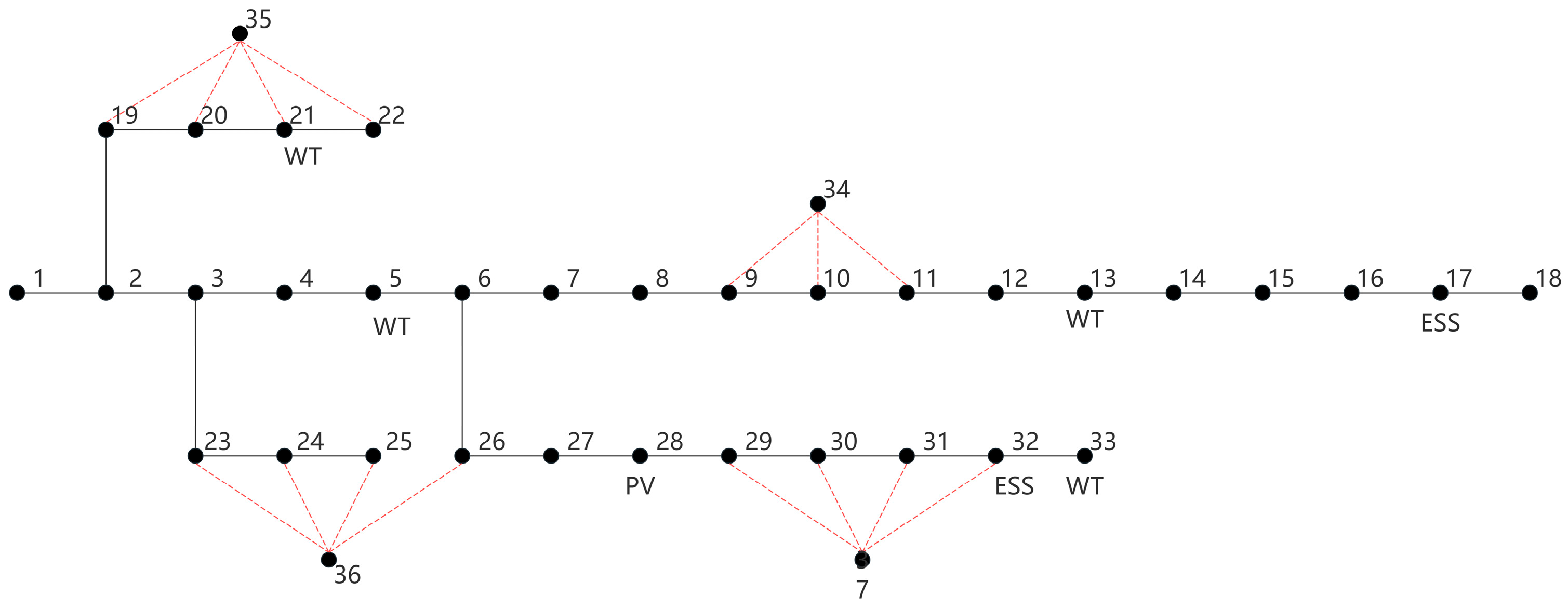
To validate the proposed source–network–load–storage collaborative planning model, a case study is conducted on the IEEE 33-bus distribution system. The original system capacity is 3715 kW + j2300 kvar, and its initial topology is shown in
Figure 3. To accommodate the continuously growing load demand, four new load buses (Bus 34–37) are added in
Table 1. After the expansion, the maximum system load increases to 4175 kW + j2560 kvar. Candidate lines for network reinforcement are marked with red dashed lines; the construction cost is CNY 100,000/km, and the line resistance and reactance are 0.27 Ω/km and 0.40 Ω/km, respectively. The corresponding line lengths and node connections are listed in
Table 1. The purchasing price of electricity from the upper-level grid is set to CNY 0.4/kWh. The planning horizon is 10 years, and the annual discount rate is 6%. The discount rate mainly affects the planning outcomes through the capital recovery factor (CRF), which annualizes the upfront investments of DG, network reinforcement, and ESSs into comparable annual costs, and therefore, influences the payoff evaluation of long-term strategies.
On the demand side, all loads are assumed to be TLs participating in price-based DR. The TOU tariff structure is provided in
Table 2. The parameters of DG and ESSs used in this case study are summarized in
Table 3. The peak–valley price spread determines the strength of the price signal, directly shaping both (i) the arbitrage potential of ESSs (charging at low-price hours and discharging at high-price hours) and (ii) the incentive for demand shifting in the DR module; hence, it is a key driver of benefit allocation among DNOs/ESOs (and the overall coordination effect). Bus 25 is designated as an IL node, with the interruptible period defined as 11:00–22:00 and an IL compensation rate of CNY 0.4/kWh.
The initial time-series data for load and renewable generation are obtained from the operation records of a real distribution network in Northeast China. Specifically, a full-year dataset (January–December, 365 days) is collected, including hourly active-power demand at the feeder/substation level and the aggregated hourly active-power outputs of grid-connected wind and photovoltaic units in the same area (Δt = 1 h). Prior to scenario extraction, the raw data are time-aligned and cleaned by filling occasional missing samples via linear interpolation and filtering abnormal spikes using a standard z-score rule. Finally, the load, wind, and PV series are normalized by their annual maxima to form per-unit profiles for subsequent clustering and planning analysis.
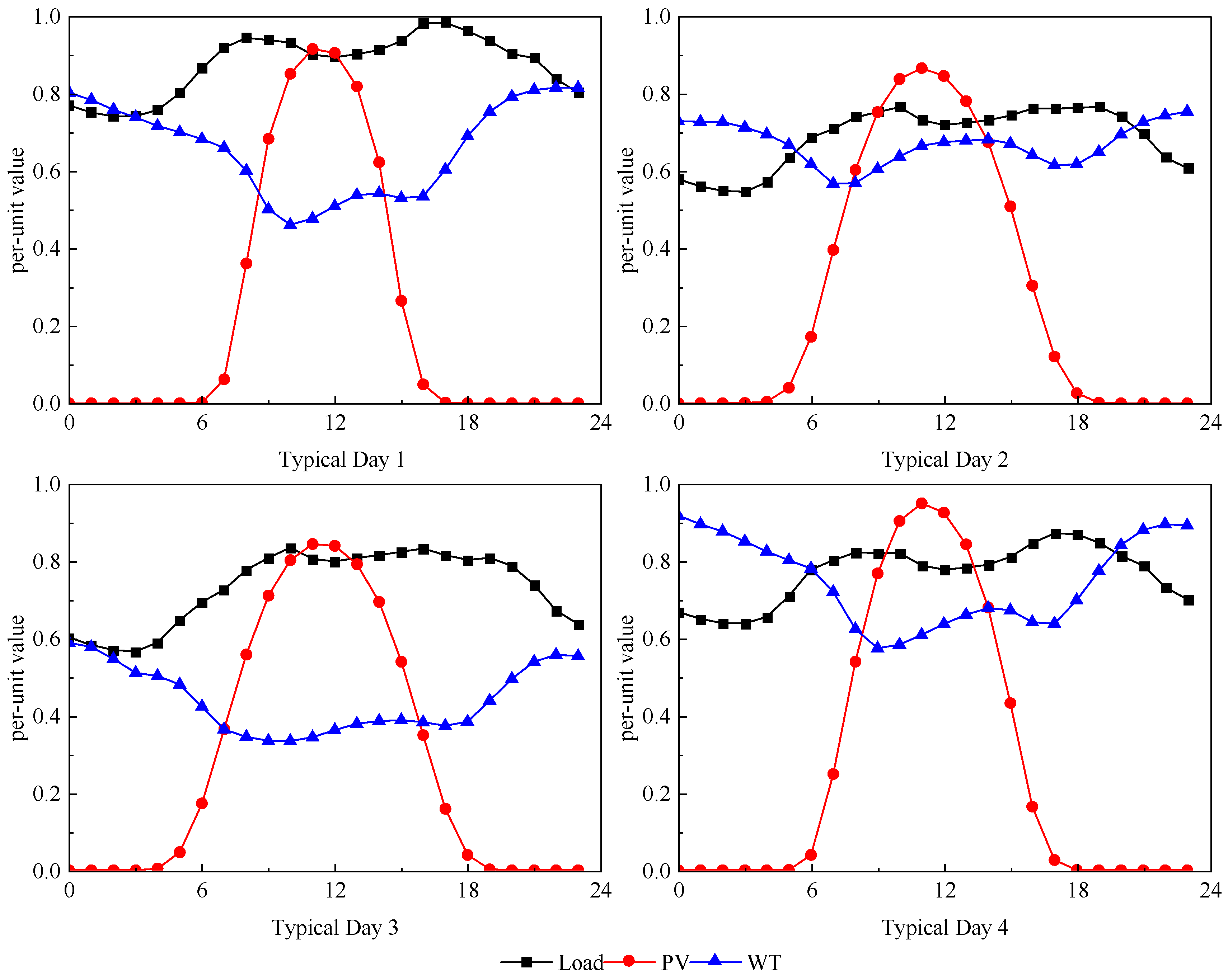
Based on the preprocessed one-year dataset, each day is represented by concatenating the 24 h per-unit profiles of load, wind power, and photovoltaic generation. A Gaussian mixture model (GMM) is employed to cluster these daily vectors into four representative typical-day scenarios. The cluster centroids and their occurrence probabilities are used to construct the typical-day profiles shown in
Figure 4, which are then used for subsequent planning and simulation analysis. In practical operation, such typical-day profiles can also be constructed from short-term forecasts; for example, machine-learning PV forecasting models can provide day-ahead inputs to support operational optimization in decentralized systems [
26].
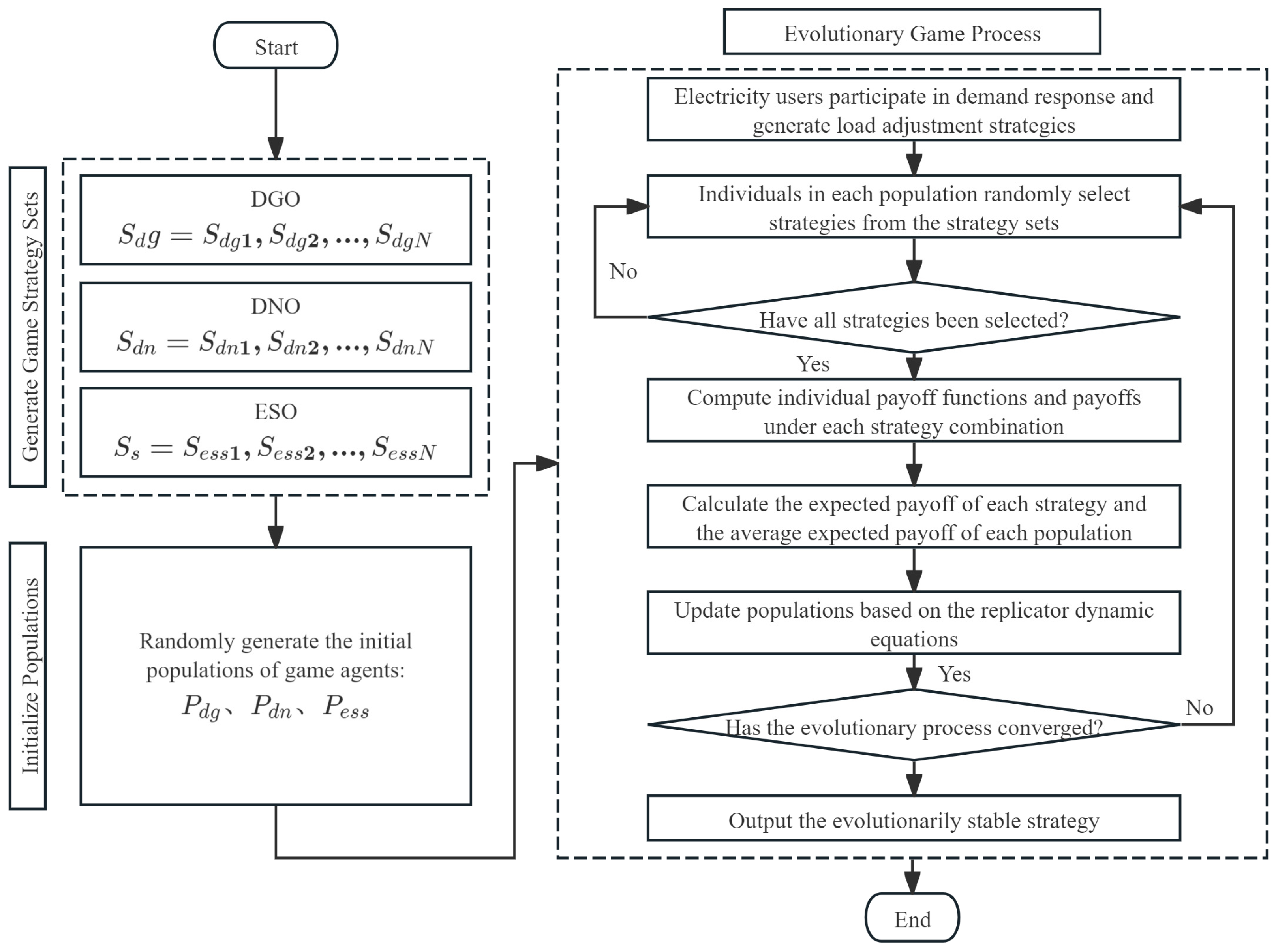
All numerical experiments are implemented in MATLAB 2025b. The demand-response scheduling of electricity users is formulated as a linear programming problem and solved using the Optimization Toolbox solver linprog. The evolutionary-game simulation is performed by a discrete-time replicator-dynamics iteration with Monte Carlo sampling until convergence. Typical-day clustering is conducted via a GMM using the Statistics and Machine Learning Toolbox (
https://ww2.mathworks.cn/products/statistics.html?s_tid=AO_PR_info, accessed on 15 December 2025).
5.2. Results Analysis
Under consideration of user-side DR, the proposed collaborative planning model incorporates the bounded rationality of stakeholders and determines the optimal planning scheme for DN reinforcement, DG deployment, and ESS allocation through an evolutionary game among DGOs, DNOs, and ESOs.
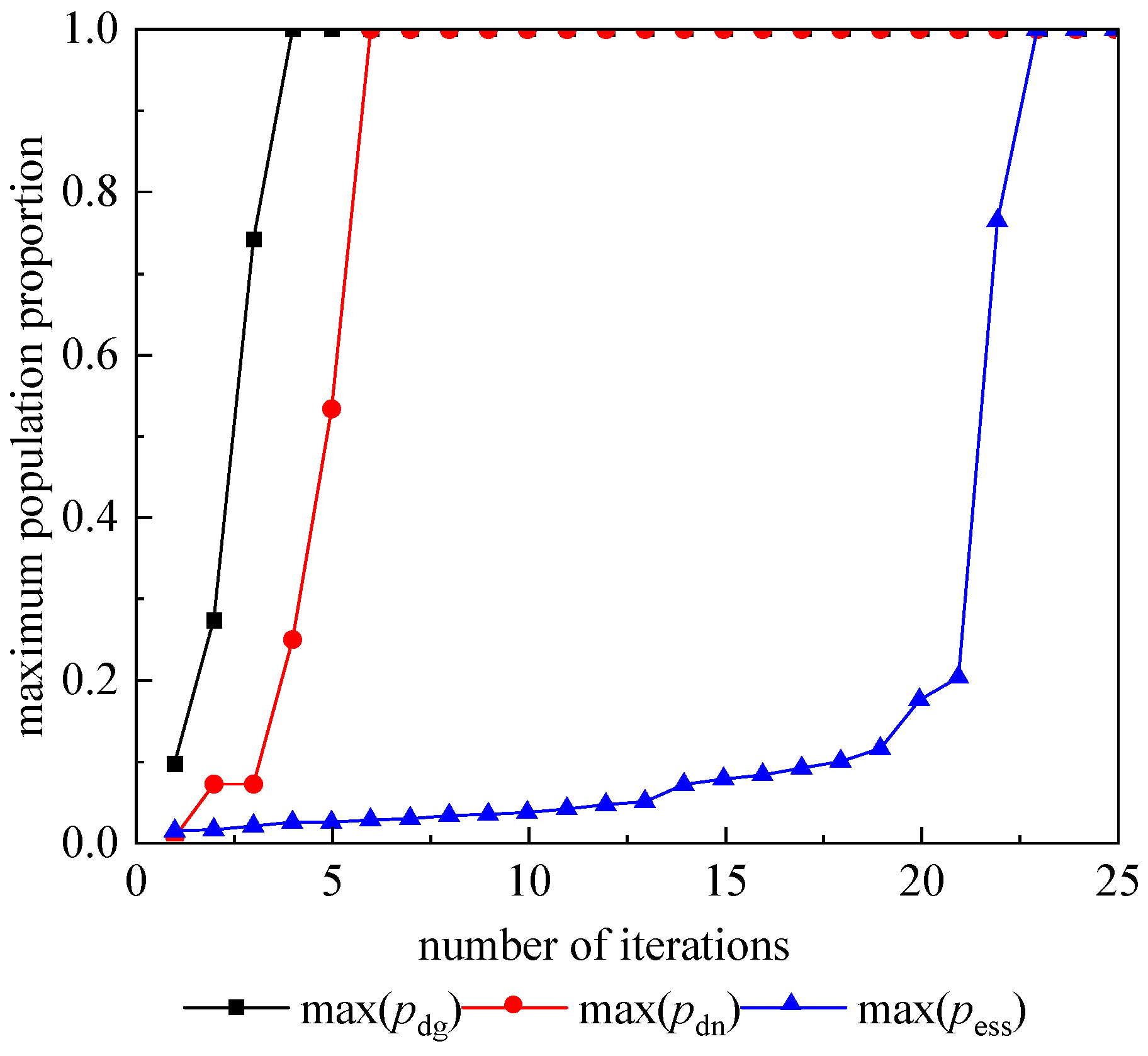
The evolutionary stable strategies emerging from the game, along with the corresponding variations in strategy selection probabilities during the evolution process, are illustrated in
Figure 5.
During the evolutionary process, the strategy selection probabilities of DGOs, DNOs, and ESOs are continuously updated with each iteration. Ultimately, the probability of selecting a single strategy converges to 1, while the probabilities associated with all other strategies converge to 0. This indicates that, as the iterations progress, individuals within each population gradually refine their strategic choices through continuous learning and imitation, eventually reaching an evolutionarily stable state. The evolutionary-game approach effectively captures the bounded rationality of real-world decision-makers and highlights the iterative process through which agents converge by repeatedly learning, imitating, and adjusting strategies.
(1) Allocation and Profit Analysis of Source–Grid–Storage Planning
To further assess how different typical-day scenarios influence the benefit structure of the coordinated SGLS planning model,
Table 4 presents the optimal installation capacities of DG and energy storage under four representative typical days. The ten-year total revenues and corresponding net present values (NPV) for DGOs, DNOs, and ESOs are summarized in
Table 5. The results indicate that the load profiles and renewable output patterns associated with different typical days significantly affect both the overall system economics and the benefit distribution among stakeholders.
As shown in
Table 4, the optimal DG and ESS installation schemes across the four typical days exhibit both consistency and scenario-specific diversity.
First, in Typical Day 1 and Typical Day 3, the model selects the same configuration—1900 kW of wind, 0 kW of PV capacity, and 1600 kWh of storage. This reflects that, under the load–resource conditions represented by these two typical days, wind power provides higher utilization potential than PV. PV generation is not selected because the early-morning and evening load levels are relatively high or the midday load is insufficient to absorb PV output, leading to limited economic benefits. This indicates that the load curves and renewable-resource characteristics of Typical Days 1 and 3 are more compatible with wind power as the primary renewable resource.
Second, in Typical Days 2 and 4, the model deploys a portfolio of 2150 kW of wind, 250 kW of PV capacity, and 1600 kWh of storage. Unlike Typical Days 1 and 3, the appearance of non-zero PV installation in Typical Days 2 and 4 implies that the midday load is higher or the matching between PV output and demand is stronger, allowing PV to provide effective energy substitution during peak periods and thereby improve system economics. The increase in wind capacity from 1900 kW to 2150 kW further suggests that, under these scenarios, the marginal benefit of wind generation increases due to more favorable resource conditions, enabling wind and PV to operate synergistically.
It is noteworthy that the optimal storage capacity remains constant at 1600 kWh across all typical-day scenarios. This indicates that, within this planning context, storage primarily functions to perform peak shaving and valley filling, increase renewable energy accommodation, and reduce power purchase costs. The variations in load shapes across typical days are insufficient to motivate the model to expand storage capacity. Thus, storage sizing is influenced more by price signals and the overall system economic structure than by the characteristics of individual typical days.
These findings demonstrate that typical-day clustering effectively captures the structural differences in annual load patterns and renewable output characteristics. The resulting optimal configurations exhibit clear structural regularities: when PV is poorly aligned with the load profile, the model tends to favor larger wind installations; conversely, when midday loads are higher or wind-PV complementarities are stronger, a combined wind-PV configuration emerges. This validates the capability of the typical-day-based optimization framework to autonomously select economically optimal SGLS configurations under diverse resource and load scenarios.
Analysis of the data in
Table 5 reveals that typical-day variations exert a significant influence on the ten-year total and net revenues of DGOs, the DNO, and ESOs. However, the sensitivity of each stakeholder to these variations differs markedly.
From the perspective of DGOs, revenue exhibits a clear upward trend as the typical-day index increases. The ten-year total revenue rises from CNY 6.15 million in Typical Day 1 to CNY 8.70 million in Typical Day 4, while the corresponding net revenue increases from CNY 4.53 million to CNY 6.42 million. This indicates that typical days characterized by more favorable renewable output conditions significantly enhance DG substitution capability and profitability. The highest DG revenue occurs under Typical Day 4, suggesting that this daily load profile and renewable availability pattern provides the most advantageous conditions for DG utilization.
Note that the unusually low DGO revenue on Typical Day 3 is caused by the renewable-resource condition represented by this typical-day scenario. As shown in
Figure 4, Typical Day 3 corresponds to a low renewable-output (particularly low wind) profile. Since the planning configuration under Typical Day 3 installs wind at only 1900 kW with 0 PV, the DGO’s revenue is almost entirely determined by wind electricity sales. Consequently, the limited wind availability, together with the relatively lower load level indicated by the reduced DNO revenue in
Table 5, results in a much smaller amount of renewable energy being utilized and sold, leading to the sharp decline in DGO revenue, CNY 69 × 10
4.
DNOs consistently achieves the highest revenue among the three stakeholders. Its ten-year total revenue increases from CNY 22.34 million (Typical Day 1) to CNY 26.97 million (Typical Day 4), while net revenue increases from CNY 16.44 million to CNY 19.85 million. The monotonic increase reflects that Typical Day 4 is associated with the highest overall load level and the largest electricity purchase volume, enabling the grid to earn more through retail electricity sales. In contrast, Typical Day 3 results in significantly lower total revenue (CNY 16.28 million) and net revenue (CNY 11.98 million), highlighting the adverse impact of lower load levels on grid-side economic returns.
In comparison, the revenues of the ESS remain highly stable across all four typical days. The ten-year total revenue remains approximately CNY 260,000, with net present values around CNY 190,000, indicating minimal sensitivity to typical-day variation. This stability suggests that, under the current TOU price structure and modest peak–valley price differentials, the profitability of small-scale ESS installations is driven primarily by fixed arbitrage opportunities rather than renewable variability. Moreover, ESS profitability is considerably lower than that of DG and DN, highlighting that the existing market mechanism does not fully compensate for the flexibility value provided by storage in peak shaving, load shifting, and renewable accommodation. To stimulate investment in independent storage, additional incentive mechanisms—such as capacity payments, ancillary-service compensation, or increased peak–valley price spreads—may be needed.
From a market-design perspective, the above mechanisms can be viewed as monetizing different components of the flexibility value provided by ESS. A capacity remuneration scheme can compensate storage for firm capacity and peak support that are not fully reflected by energy arbitrage under a modest peak–valley spread. Ancillary-service markets (e.g., regulation and reserves) provide an additional revenue stream that rewards fast response and ramping capability. Moreover, enlarging the peak–valley spread or adopting more granular time-varying pricing can strengthen the arbitrage signal, thereby improving ESO investment incentives. These measures are complementary and could be implemented through performance-based payments or long-term contracts.
The economic comparison across the four typical days demonstrates that load shapes and renewable generation patterns directly determine the benefit distribution within the SGLS system. Higher peak loads and larger peak–valley price spreads significantly increase DG and DNO revenues. When renewable energy generation aligns more closely with high-price periods, DG profitability improves further due to reduced curtailment and enhanced substitution of grid electricity. Composite wind-PV configurations outperform single-resource configurations in most scenarios, reflecting their superior adaptability to diverse load conditions. Meanwhile, ESS revenue remains stable but relatively low, suggesting that its flexibility value is not fully monetized under current electricity pricing mechanisms.
Overall, the classification and weighting of typical days exert a substantial impact on the economic evaluation of the system. They shape renewable energy utilization, influence the effectiveness of price signals, and determine the revenue distribution among stakeholders. Thus, typical-day selection is a critical component of comprehensive energy system planning.
The behavioral characteristics of the four typical-day scenarios significantly affect the economic performance of the coordinated SGLS planning schemes. Compared with single-source renewable configurations, wind-PV hybrid deployments yield superior economic outcomes, particularly under Typical Day 4, where all stakeholders achieve their highest ten-year revenues. Furthermore, under the existing pricing mechanism, DNOs remain the primary beneficiary, whereas ESO gains limited economic return—underscoring the necessity of refining compensation mechanisms to enhance the attractiveness of ESS investment.
(2) Necessity of Considering Multi-Agent Game Mechanisms
To evaluate the necessity of incorporating a multi-agent evolutionary game into the planning framework, we compare the complex DN planning outcomes and stakeholder revenue distributions with and without the game-theoretic mechanism. The resulting planning decisions are presented in
Table 6, while the revenues of different stakeholders are summarized in
Table 7.
As shown in
Table 6, the incorporation of a multi-agent game mechanism has a substantial impact on both the planning outcomes and the distribution of benefits among stakeholders. When the game-theoretic interaction is considered, the system deploys 1900 kW of WT, 0 kW of PV, and 1600 kWh of energy storage. This allocation enables ESOs to earn stable profits through price arbitrage. In contrast, when the game mechanism is not considered, the storage investment is completely eliminated by the planning model. This indicates that conventional single-objective planning tends to prioritize the interests of DNOs and fails to reflect the investment incentives of ESOs.
In terms of revenues,
Table 7 shows that DG earnings remain unchanged between the two scenarios. DNO’s revenue increases slightly in the non-game scenario due to higher electricity purchases; however, ESO’s revenue drops to zero, resulting in weakened coordination among stakeholders. By comparison, the game-theoretic approach not only enables reasonable storage deployment but also yields a system-wide revenue structure that more closely matches the interactions observed in real electricity markets. These results confirm the necessity and rationality of introducing evolutionary-game mechanisms into SGLS coordinated planning.
(3) Impact of DR on benefit allocation and coordination
To evaluate how DR affects multi-stakeholder coordination, we compare two scenarios—with DR and without DR—across four typical-day cases (
Table 5 and
Table 8), focusing on the 10-year total and net revenues of the DNO, DGO, and ESO.
DNO: In all typical days, the DNO’s revenues decrease after DR is introduced. For Typical Day 1, the 10-year total revenue drops from CNY 25.02 to 22.34 million, and the net revenue decreases from CNY 18.41 to 16.44 million. This indicates that DR suppresses peak demand via load-side regulation, reducing the DNO’s margin associated with high-price periods and high-load operation, and confirming a clear peak-shaving effect.
DGO: The DGO’s revenues remain unchanged under both scenarios for all typical days (e.g., CNY 6.15 million total and CNY 4.53 million net in Typical Day 1). This suggests that, under the current case settings, DR does not directly affect DG output or revenue; system improvements are achieved through load adjustment rather than reducing renewable returns.
ESO: In contrast, the ESO benefits from DR in all typical days. For Typical Day 1, the ESO’s 10-year total revenue increases from CNY 0.21 to 0.26 million, and the net revenue rises from CNY 0.15 to 0.19 million. DR improves the operating environment and provides more stable opportunities for storage, enhancing its economic performance.
Overall, DR reshapes the benefit-allocation structure while keeping DGO revenues stable, indicating a shift in regulation responsibility from the grid side toward the load-and-storage side and clarifying functional coordination among SGLS entities.