


Abstract
Institutional governance has traditionally been analyzed under the assumption that the space of potential violations is finite, enumerable, and progressively constrainable through rule refinement and calibrated enforcement. The rapid integration of large language models into strategic and documentary decision-making challenges this premise by transforming feasible deviation spaces from bounded sets into generative manifolds. This paper develops a formal simulation framework for examining institutional stability under algorithmically amplified strategic exploration. Regulatory rules are modeled as a constraint manifold characterized by effective dimensionality, while generative systems expand the behavioral strategy space through semantic recombination under detection and sanction constraints. Stability is defined through a minimum deterrence margin evaluated across the generatively reachable domain rather than only through historical violation catalogs. The study uses a 2014–2023 regulatory and violation corpus to initialize and calibrate the simulation and to conduct a limited historical hold-out check; the 250,000 LLM-generated scenarios are treated as synthetic stress-test proposals rather than observed violations. The computational specification reports the generator checkpoint, embedding model, decoding parameters, prompt templates, random seeds, filtering rules, and label partitions used in the simulation. The model introduces a dimensional dominance principle: systemic vulnerability may emerge in the simulation when the effective dimensionality of generative strategic search expands faster than the independent constraint dimensionality of the rule system. Under the reported baseline setting, the synthetic simulations show a pipeline-specific dimensional crossover, convergence limits in rule-consistency classification, and a nonlinear detection–sanction response surface. These outputs are interpreted as diagnostics of the stated computational pipeline, not as universal empirical laws about real institutions. The power-grid component is delimited accordingly: the paper does not simulate physical grid operation, power flow, dispatch, or relay-protection dynamics; it interprets the model at the documentary governance layer of power-grid enterprises, including procurement, construction supervision, maintenance records, dispatch-related documentation, customer-service reporting, and internal audit. The framework therefore provides a reproducible and cautiously delimited basis for analyzing text-mediated institutional resilience in the age of generative intelligence.
1. Introduction
Institutional governance has historically been constructed upon a largely implicit structural premise: the range of possible violations can be sufficiently identified, classified, and progressively constrained through regulatory refinement. Whether in classical deterrence theory, public administration, or regulatory economics, compliance is modeled as an equilibrium outcome shaped by expected sanction intensity and monitoring probability [1,2]. Even dynamic and evolutionary frameworks, which recognize that institutions adapt over time, typically assume that strategic innovation unfolds incrementally within a bounded cognitive domain. Rules are revised in response to observed misconduct, loopholes are closed through specification, and equilibrium is restored through calibrated enforcement. Under this paradigm, instability arises from insufficient penalties, weak detection, or asymmetric information—not from an unbounded expansion of feasible strategies [3,4]. Yet the rapid integration of large language models into organizational and individual decision processes challenges this structural assumption at its foundation. Generative systems differ qualitatively from traditional bounded rational actors [5,6]. They are capable of producing context-aware, semantically coherent, and structurally novel behavioral blueprints across domains at scale. When such models participate in strategic reasoning, the feasible deviation space is no longer merely large; it becomes generative. Instead of incremental search across known possibilities, algorithmic engines can recombine textual, procedural, and legal fragments into previously unanticipated configurations. The institutional problem therefore shifts from enumerating violations to assessing robustness against generative expansion [7,8].
Power-grid enterprises provide a direct applied setting for this problem because their governance environment is not limited to technical power-flow control; it also includes procurement rules, engineering project supervision, equipment maintenance documentation, safety compliance, customer-service records, data-reporting procedures, and internal disciplinary inspection. In these institutional layers, an LLM does not need to operate a grid asset or alter a dispatch command to affect governance stability. It can influence the wording of reports, the sequencing of approval materials, the framing of exceptions, or the interpretation of compliance evidence, thereby enlarging the set of superficially compliant strategies available to organizational actors. This paper therefore treats power-grid governance as an application domain of the general model, while keeping the mathematical framework at the institutional level rather than introducing a physical grid-operation model [9,10,11,12].
The existing literature provides fragments of insight into this transformation but does not yet synthesize them into a unified framework [13,14,15]. Economic models of crime and compliance clarify how expected utility calculations drive behavior, yet they treat strategy sets as fixed or slowly evolving [9,16]. Evolutionary game theory and adaptive governance research emphasize co-evolution between regulators and regulated agents, introducing learning and feedback loops. However, innovation in these models remains gradual and constrained by human cognitive limits. Legal scholarship on rule specificity and complexity identifies the trade-off between detailed codification and interpretative ambiguity, noting that excessive structural layering may generate exploitable gaps. Still, these analyses presuppose that ambiguity is exploited through incremental reasoning rather than algorithmically amplified exploration [10,17].
Research in adversarial machine learning offers a conceptual bridge [11,18]. In high-dimensional classification settings, instability emerges when expressive input variation exceeds the representational robustness of model constraints [19,20]. Small perturbations along poorly constrained directions produce disproportionate outcome shifts. Although this literature primarily addresses technical robustness in neural networks, it reveals a structural principle: when adversarial search capacity expands faster than constraint dimensionality, vulnerability becomes systemic rather than incidental [21,22,23]. Transposed into institutional contexts, generative language models introduce an analogous expansion mechanism within behavioral strategy space [12,13,24]. Agents assisted by such systems may systematically probe semantic boundaries, exploit curvature in regulatory language, and identify minimally detectable deviations that were previously infeasible [25,26,27]. At the same time, governance scholarship has increasingly recognized that institutional design is not static but adaptive [28,29]. Supervisory authorities revise rule parameters, recalibrate enforcement intensity, and introduce clarifications in response to newly discovered behaviors [30,31]. Co-evolutionary models in cybersecurity, financial engineering, and innovation policy describe arms-race dynamics in which offensive and defensive capacities grow competitively. Stability depends not merely on sanction severity but on relative adaptation rates and structural coherence. Under generative intelligence, adaptation acquires a new dimension: the rate of strategic expansion may accelerate through algorithmic amplification, potentially outpacing institutional adjustment mechanisms. In such an environment, rule systems may oscillate, overcorrect, or accumulate complexity without increasing effective constraint capacity [32,33]. In critical-infrastructure and AI-enabled governance settings, related work on cyber-physical security, procurement collusion, fraud detection, adaptive compliance, adversarial text processing, communication-system attacks, and adversarial-example interpretation further shows that documentary and technical attack surfaces must be considered jointly [34,35,36,37,38,39,40].
The framework developed in this paper integrates these strands into a unified analytical structure. Institutional rules are represented as a structured constraint manifold whose effective dimensionality reflects independent restrictive capacity rather than formal clause count. Behavioral strategies occupy a time-dependent domain that expands through generative transformation. The generative engine is modeled as an endogenous operator capable of amplifying strategic dimensionality while remaining within probabilistic detection thresholds. Institutional stability is defined not in relation to enumerated violations but through a generative adversarial margin: the minimum deterrence intensity across the entire generatively reachable strategy space. Vulnerability arises when expressive capacity of the generative mapping exceeds the independent constraint dimensionality of the rule manifold, creating exploitable directions within the strategic geometry. Methodologically, the model combines geometric dimensional analysis with dynamic adaptation processes. Regulatory revision is formalized as gradient-based adjustment responding to observed deviations, moderated by ambiguity penalties and subject to stochastic shocks. Continuous-time approximations characterize the co-evolution of generative expansion and regulatory capacity, revealing conditions under which dimensional imbalance persists or converges. Oscillation metrics capture volatility induced by reactive overcorrection, while long-run stability requires sustained positivity of the minimum deterrence margin alongside elimination of dimensional dominance. By embedding generative expansion directly into the institutional state space, the analysis moves beyond traditional optimization frameworks and reframes governance resilience as a dynamic property emerging from interaction between regulatory geometry and algorithmic exploration. Four contributions follow from this integrated perspective. First, the study reconceptualizes strategic behavior under artificial intelligence as generative rather than finite, introducing a structural distinction between enumerative violation spaces and algorithmically amplified manifolds. Second, it formulates a dimensional dominance principle linking vulnerability to imbalance between generative expressive capacity and regulatory constraint independence. Third, it defines a stability metric grounded in minimum deterrence across evolving strategy domains, providing a robustness criterion independent of historical misconduct catalogs. Fourth, it models regulatory adaptation as a nonlinear feedback process capable of producing convergence or oscillatory instability, highlighting the non-monotonic effects of institutional complexity under generative pressure.
The analysis is organized around three evidentiary layers. The first layer is conceptual and formal: it defines institutional stability, deterrence margin, and dimensional dominance within a stylized high-dimensional governance space. The second layer is computational: it uses historical regulatory and violation records to calibrate a synthetic simulation pipeline in which LLM-generated scenarios are treated as stress-test proposals rather than observed misconduct. The third layer is interpretive: it translates the formal variables into the documentary governance practices of power-grid enterprises. This third layer is deliberately limited to compliance narratives, procurement materials, construction and maintenance documentation, dispatch-related records, customer-service reports, and internal audit workflows; it does not model physical grid operation or introduce sector-specific power-system measurements.
The numerical claims are correspondingly conditional. The dimensional crossover, classifier plateau, and detection–sanction response surface are not direct observations of real institutional behavior. They are model-implied outcomes generated by a synthetic stress test calibrated to a historical regulatory corpus and checked against broad patterns of documented violations where the available data permit such comparison. This narrower framing is essential because generated scenarios can help expose plausible governance vulnerabilities, but they cannot by themselves establish the frequency, intent, or realized harm of real-world institutional deviations.
The power-grid interpretation is deliberately positioned at the governance and compliance layer. It does not require additional assumptions about load flow, relay protection, frequency control, or other physical grid mechanisms. Instead, it asks how a grid enterprise can maintain institutional resilience when generative tools are used around documentation, procurement, audit preparation, exception reporting, and internal control processes. Table 1 summarizes the main power-grid governance channels through which the model can be read without changing its formal structure.
Table 1.
Power-grid governance channels used to interpret the general institutional model. The table is conceptual and does not introduce additional empirical observations.
2. Structural Model of the Generative Institutional System and Power-Grid Application
The structural model developed in this section formalizes the interaction between institutional constraint architecture and generative strategic expansion within a unified analytical space, where institutional rules are represented as a high-dimensional constraint manifold and behavioral strategies are embedded within a continuously evolving strategy domain rather than treated as discrete or enumerated violations. In this representation, regulatory capacity is defined not by the number of formal clauses but by the effective dimensionality of independent constraint gradients that actively restrict feasible behavioral directions, while the generative engine is modeled as an endogenous transformation operator capable of expanding the strategy manifold through semantic recombination under probabilistic detection thresholds. Institutional stability therefore emerges as a relational property between two dynamic geometries: the span of regulatory constraint independence and the expressive dimensionality of generative search. When constraint gradients sufficiently cover the directions accessible to algorithmic exploration, deterrence margins remain positive across the feasible domain; when generative dimensionality expands into unspanned directions, curvature appears in the strategy space and exploitable regions emerge. By embedding both regulatory adaptation and generative amplification directly into the same state space, the model reframes governance analysis from static compliance assessment toward a dynamic adversarial geometry, establishing the formal primitives, state variables, and transformation mechanisms necessary to analyze dimensional dominance, structural imbalance, and the conditions under which institutional resilience is preserved or eroded.
For power-grid enterprises, the same state space can be read as a governance layer built around rules, texts, evidence, audits, and sanctions. The model therefore remains sector-general but gives a practical vocabulary for grid-related institutional supervision: rule vectors correspond to procurement and internal-control requirements; strategy vectors correspond to documentation, reporting, approval, and exception-handling behaviors; detection probability corresponds to the ability of audits, digital review tools, and human supervisors to identify strategically generated inconsistencies. Table 2 provides the notation-level mapping used in the remainder of the paper.
Table 2.
Notation-level interpretation for applying the model to power-grid institutional governance.
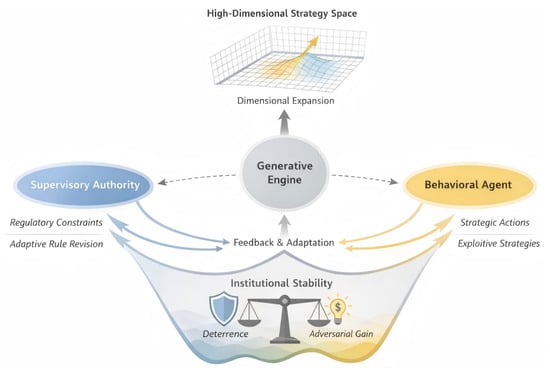
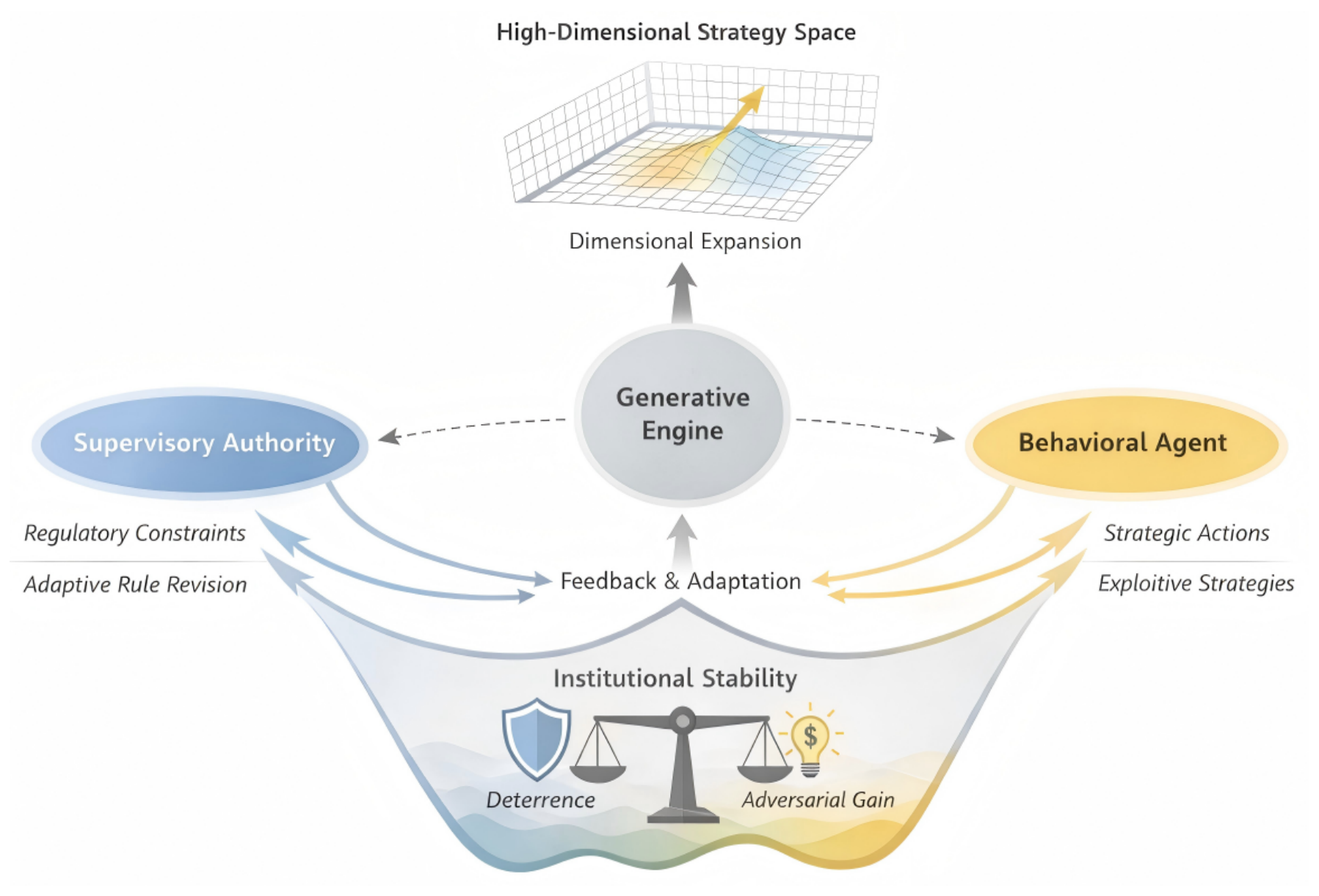
Figure 1 visualizes the co-evolving triangular interaction among supervisory authority, behavioral agent, and generative engine within a high-dimensional strategy landscape, illustrating how algorithmically amplified strategic expansion (yellow) interacts with regulatory constraint capacity (blue) through adaptive feedback loops (grey) to determine whether institutional stability is preserved or eroded. In a power-grid governance reading, the supervisory authority may be an internal audit, compliance, disciplinary inspection, procurement, or safety-supervision function; the behavioral agent may be a department, contractor, supplier, or project team; and the generative engine represents LLM-assisted production of explanations, reports, and compliance narratives rather than a physical control component of the electric grid.
Figure 1.
Generative–institutional co-evolution architecture.
Operationalization and Reproducibility Clarifications
The formal notation below identifies the structural relationships among rule constraints, generative search, detection, sanctions, and adaptive institutional adjustment. The model does not treat every symbolic object as a separately observed empirical entity. Table 3 states which quantities are directly computed, which are simulation controls, and which remain conceptual placeholders used to express the stability argument. Table 4 and Table 5 report the model checkpoint, generation parameters, prompt structure, random seeds, filtering rules, and data partitions used in the computational pipeline so that the synthetic stress test can be independently reconstructed.
Table 3.
Operational definitions and reproducibility parameters.
Table 4.
Complete reproducibility record for the synthetic stress-test pipeline.
Table 5.
Prompt templates and filtering logic used for LLM-generated synthetic scenarios.
For reproducibility, Table 6 reports the synthetic stress-test procedure as a stepwise computational record.
Equation (1) formally characterizes the institutional rule configuration as a constrained manifold embedded in a high-dimensional regulatory space , where each admissible rule vector must satisfy layered equality conditions and inequality conditions under contextual tensors and structural coefficients ; the existential quantifier over interpretative indices introduces auxiliary semantic embeddings , thereby modeling the rule system as a geometrically structured, semantically multi-layered constraint region whose curvature, rank, and redundancy encode institutional expressive capacity and latent interpretative ambiguity.
Equation (2) defines the endogenous behavioral strategy space as the subset of actions in for which the expected strategic benefit , evaluated under stochastic environmental perturbations , exceeds the rule-dependent expected compliance-adjusted cost by at least the viability margin ; this construction embeds rational expectation formation, regulatory exposure, and uncertainty into a single admissibility inequality, thereby restricting the feasible deviation domain to strategies that are both economically attractive and probabilistically defensible within the institutional environment.
Equation (3) models the generative transformation performed by the algorithmic engine , which maps the current strategy vector , institutional configuration , and enforcement memory state into a next-period candidate through an internal maximization over latent proposals ; the amplification functional captures context-conditioned strategic innovation parameterized by , while the penalization term involving the squared gradient norm of regularizes overt violations by discouraging movements along highly detectable directions in the rule manifold, thereby formalizing the large language model as an adversarial yet constraint-sensitive strategic expander.
Equation (4) captures recursive expansion of the feasible strategy set by adjoining to the prior space all newly generated strategies that satisfy a semantic proximity constraint , where quantifies the observable rule-consistency distance and represents the threshold of superficial compliance; this union operation encodes the mechanism through which generative intelligence enlarges the deviation frontier while remaining within the interpretative envelope tolerated by the supervisory apparatus, thereby rendering the strategic domain path-dependent and geometrically conditioned by institutional semantics.
Equation (5) specifies the endogenous detection probability as a nonlinear logistic transformation of the bilinear interaction between the strategic vector and the rule configuration , modulated by a supervisory sensitivity tensor and calibration parameters ; this probabilistic mapping embeds oversight as a smooth but curvature-dependent function of strategic alignment and regulatory structure, implying that generative strategies may exploit low-sensitivity directions of the institutional manifold to reduce the exponential term and thereby diminish detection likelihood in a mathematically explicit manner.
An intertemporal payoff representation appears above, where the benefit functional interacts with stochastic signals , sanction exposure emerges through the multiplicative term , and intrinsic implementation burden is encoded in ; integration with respect to the probability measure embeds informational dispersion and expectation formation directly into strategic calculus, linking institutional geometry to rational deviation incentives through probabilistic aggregation.
Effective generative dimensionality is quantified through the rank of the Jacobian of the generative mapping combined with a trace adjustment involving the supervisory sensitivity structure and weighting tensor , thereby capturing expressive expansion capacity together with oversight slack; growth in this scalar reflects increasing accessibility of strategic directions within the high-dimensional deviation manifold.
Table 6.
Reproducibility pseudocode for the synthetic stress-test pipeline.
3. Dynamic Stability Mechanism
Regulatory constraint dimensionality arises from aggregating the ranks of equality and inequality gradient operators and subtracting the dimensionality of their joint null space, yielding a net measure of independent restrictive directions embedded within the institutional manifold; geometric redundancy and overlapping constraint structures are thereby removed from the calculation, isolating effective restriction capacity rather than formal clause count.
A binary vulnerability indicator activates whenever generative dimensionality exceeds regulatory capacity, encoding structural imbalance as a measurable regime variable; activation signifies the presence of at least one strategic direction accessible to algorithmic amplification that remains insufficiently constrained by institutional geometry.
Net institutional resistance for any candidate strategy combines expected sanction intensity with strategic benefit and a curvature-sensitive penalty derived from the gradient of the semantic proximity mapping ; the scalar modulates how sharply local rule-surface curvature amplifies deterrence, thereby integrating geometric detectability into payoff comparison.
The scalar captures minimum deterrence across the generatively reachable strategy domain by taking the infimum of the resistance functional, thereby identifying the weakest stability margin within the institutional surface; the negativity of this quantity indicates the existence of a deviation direction whose expected gain outweighs sanction exposure even after curvature-adjusted detectability is incorporated, implying breakdown of structural resilience under algorithmically amplified exploration.
Institutional evolution across periods is expressed above as an adaptive transformation of the regulatory state , where the learning rate scales gradient-based adjustments derived from an institutional loss functional that internalizes observed deviations , while a countervailing complexity penalty term weighted by restricts excessive structural elaboration through the gradient of an ambiguity functional ; an exogenous perturbation vector with intensity parameter captures political, informational, or technological shocks, thereby modeling rule revision as a nonlinear, multi-force dynamic in which deterrence reinforcement and semantic inflation coexist within a continuously evolving regulatory manifold.
Incremental institutional displacement is isolated here as , decomposed into a corrective gradient component targeting strategic exploitation, an ambiguity-mitigating counterforce, and a stochastic perturbation term; the magnitude and direction of this vector determine whether regulatory geometry expands in constraint-dense regions or diffuses into semantically redundant subspaces, thus linking adaptive enforcement response to geometric drift within the institutional parameter space.
An oscillation intensity metric appears in quadratic form, combining the second-order temporal curvature of the regulatory trajectory with a curvature-sensitive ambiguity amplification term weighted by ; large values of this scalar signal overreaction cycles or regulatory overshooting, where successive gradient corrections induce structural volatility rather than convergence, thereby providing a measurable indicator of institutional instability arising from adaptive feedback loops under generative strategic pressure.
Temporal evolution of generative dimensionality is approximated in continuous time through a differential expression in which scales algorithmic innovation intensity via the trace of the generative Jacobian, while captures the inhibitory influence exerted by regulatory constraint dimensionality; expansion and suppression thus coexist in a coupled growth equation, formalizing competitive dynamics between algorithmic expressiveness and institutional restriction capacity within a unified rate-of-change framework.
Regulatory dimensional growth follows a complementary dynamic in which strengthening of constraint gradients increases effective rank at rate , whereas oscillatory volatility erodes net capacity through the subtraction term weighted by ; this formulation captures the empirical observation that excessive reactive revision can undermine structural coherence, thereby reducing true constraint independence even as formal rule count expands.
Equations (15) and (16) should therefore be read as coupled update mechanisms, not as an assumption that must be exponential and must be linear. In the simulation, the reported round-level values are estimated from accepted synthetic proposals and clause-gradient ranks at each iteration. No exponential curve is fitted first and then confirmed by the figures. The dimensional dominance condition denotes a conditional simulation regime that appears under the stated novelty, consistency, detection, and redundancy parameters; it may weaken or disappear under stricter novelty filtering, higher audit sensitivity, or lower rule redundancy. This interpretation separates the theoretical condition from any universal empirical claim about real institutions.
Asymptotic resilience is defined through joint conditions requiring persistent positivity of the minimum deterrence margin and vanishing structural vulnerability indicator over time; satisfaction of both inequalities implies that generative exploration fails to uncover profitably exploitable directions in the long run, and that dimensional imbalance does not persist, thereby formalizing a steady-state regime of adversarial robustness under algorithmically amplified strategic search.
In a power-grid enterprise, these stability conditions translate into an operational governance question: whether institutional controls can remain effective when LLM-assisted actors produce more candidate justifications, exception documents, and procedural variations than the audit system can independently constrain. Table 7 summarizes the application-oriented reading of the main stability mechanisms. The entries are qualitative implications of the model and should not be read as new measured grid-operation results.
Table 7.
Power-grid interpretation of the dynamic stability mechanisms.
4. Results
The numerical component is a historical-corpus-calibrated synthetic simulation. The corpus covers 10 consecutive years (2014–2023) from a national-level procurement and public-project supervision domain and includes formal regulatory clauses, interpretative guidelines, and documented violation cases with finalized enforcement outcomes. These records provide the observed baseline for clause accumulation, sectoral violation distribution, contract-size exposure, penalty magnitude, audit intensity, and compliance labels. They do not supply direct observations of LLM-assisted deviations. The simulation therefore uses the historical corpus for initialization, calibration, and limited hold-out checking, while treating the 250,000 LLM-generated proposals as synthetic stress-test scenarios.
The generative component uses the frozen Llama-3.1-70B-Instruct checkpoint L31-70B-I-20250218-bf16 and the decoding parameters reported in Table 4. For each regulatory configuration, the generator produces 5000 candidate scenarios per iteration over 50 simulation rounds, using the prompt templates in Table 5 and the seed schedule . Generated scenarios are filtered by duplicate removal, the rule-consistency classifier, the semantic-conformity threshold, and the novelty lower bound. Expected benefit and sanction terms are computed as normalized proxies based on contract value and realized penalty magnitude in documented cases; they are not treated as realized financial impacts for the synthetic proposals. Effective generative dimensionality is estimated from the effective rank of local embedding perturbations among accepted proposals, whereas effective regulatory dimensionality is estimated from the redundancy-adjusted clause-gradient matrix. The numerical values in the simulation figures are therefore outputs of this stated pipeline rather than directly observed institutional facts.
The historical-facing validation step checks whether the model’s relative vulnerability ordering is broadly compatible with the documented distribution of historical violations across sectors, contract sizes, and sanction exposure. This hold-out contrast is a plausibility check only. It reduces the self-referential character of the simulation but does not remove the central limitation that synthetic scenarios remain generated artifacts.
The numerical exercise remains an institutional-governance simulation rather than a physical power-system experiment. The power-grid application is introduced by interpreting the same regulatory variables at the enterprise governance layer: procurement supervision, project management, maintenance records, dispatch-related documentation, service reporting, and disciplinary inspection. Under this reading, a synthetic scenario is not a new grid contingency or a simulated power-flow event; it is a generated compliance narrative, procedural arrangement, or documentation strategy that may affect how a grid enterprise detects and governs borderline conduct. Table 8 links the reported simulation outputs to this power-grid governance interpretation.
Table 8.
Application-oriented reading of the simulation outputs for power-grid governance.
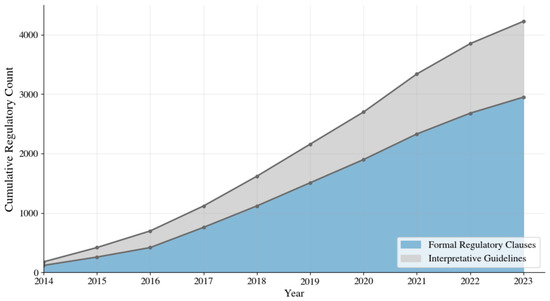
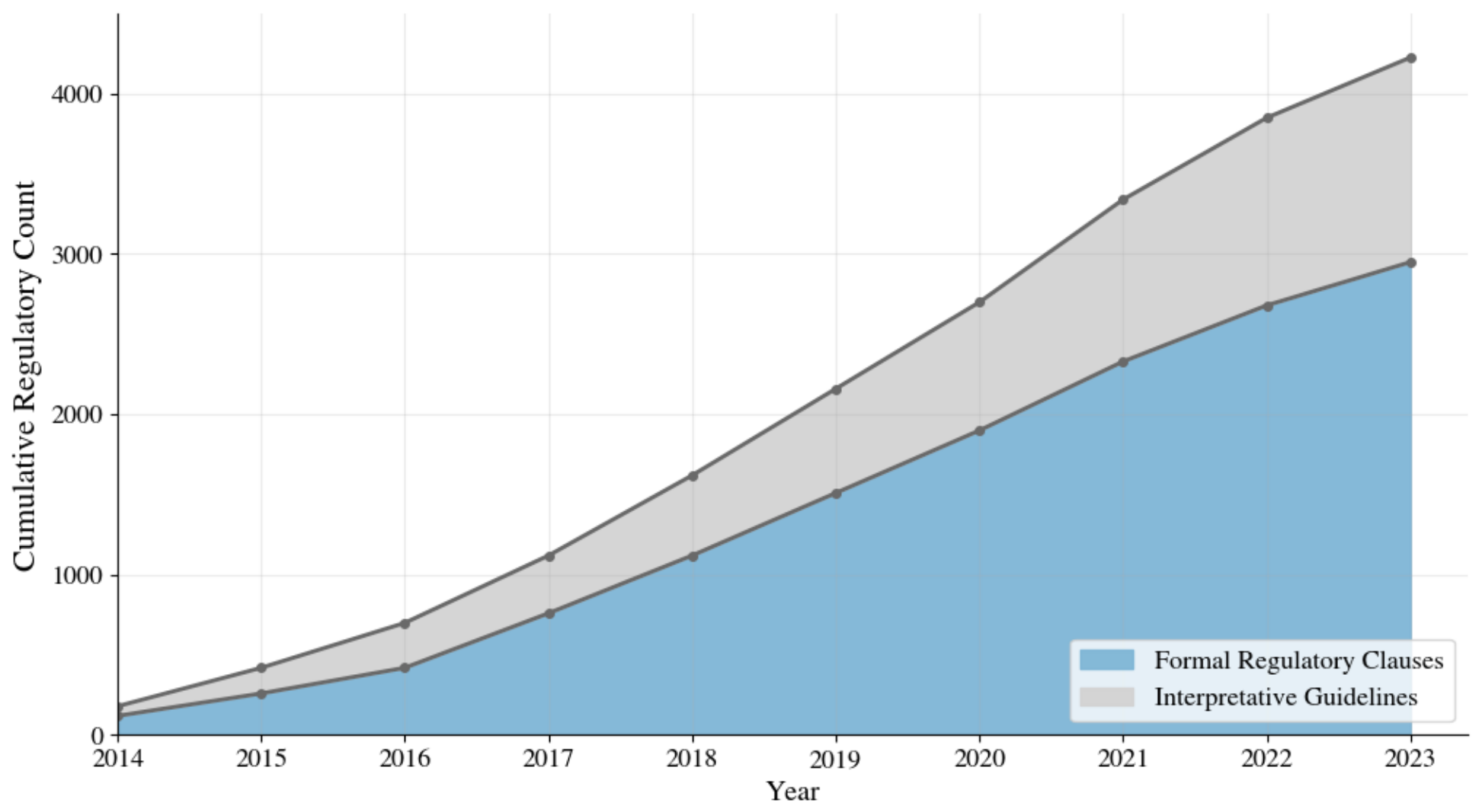
Figure 2 documents the cumulative growth trajectory of formal regulatory clauses and interpretative guidelines over a ten-year period from 2014 to 2023. The lower blue area represents formal regulatory clauses, increasing from approximately 120 clauses in 2014 to nearly 2950 clauses by 2023, indicating an average annual net increase of roughly 280 clauses. Superimposed above this layer, the grey region reflects interpretative guidelines, which expand from approximately 60 supplementary documents in 2014 to 1276 by 2023. The combined cumulative regulatory count therefore rises from fewer than 200 total instruments in 2014 to over 4200 institutional artifacts by 2023. Notably, the slope of expansion accelerates after 2018, with total additions between 2018 and 2021 exceeding 1500 new regulatory instruments, suggesting an intensification of rule layering rather than marginal refinement. The divergence between formal clauses and interpretative guidance also becomes structurally significant after 2019, where interpretative texts grow at a slightly faster proportional rate, indicating increasing semantic elaboration rather than purely structural restriction. From an institutional geometry perspective, the figure reveals not merely quantitative expansion but density transformation within the regulatory manifold. Between 2014 and 2017, cumulative clause growth follows a near-linear trajectory, whereas from 2018 onward the curve exhibits convex acceleration, implying that regulatory complexity compounds rather than scales linearly. By 2023, interpretative guidelines account for roughly 30 percent of the total regulatory corpus, compared to under 20 percent in 2014, reflecting a 10 percentage-point structural shift toward interpretative layering. This transition is analytically relevant because growth in textual elaboration does not necessarily increase independent constraint dimensionality; rather, it may introduce redundancy, overlap, and potential semantic curvature. The expansion from roughly 200 instruments to over 4200 within a decade represents a more than twentyfold increase in formal institutional artifacts, raising the question of whether effective restrictive capacity has expanded proportionally or whether structural complexity has begun to outpace coherent constraint integration. For a power-grid enterprise, a comparable pattern can occur when procurement rules, construction supervision procedures, maintenance templates, safety notices, customer-service standards, and disciplinary inspection documents accumulate as separate textual layers without equivalent integration of audit criteria.
Figure 2.
Expansion of regulatory architecture and clause density dynamics (2014–2023).
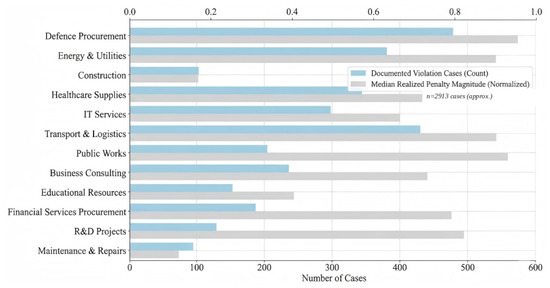
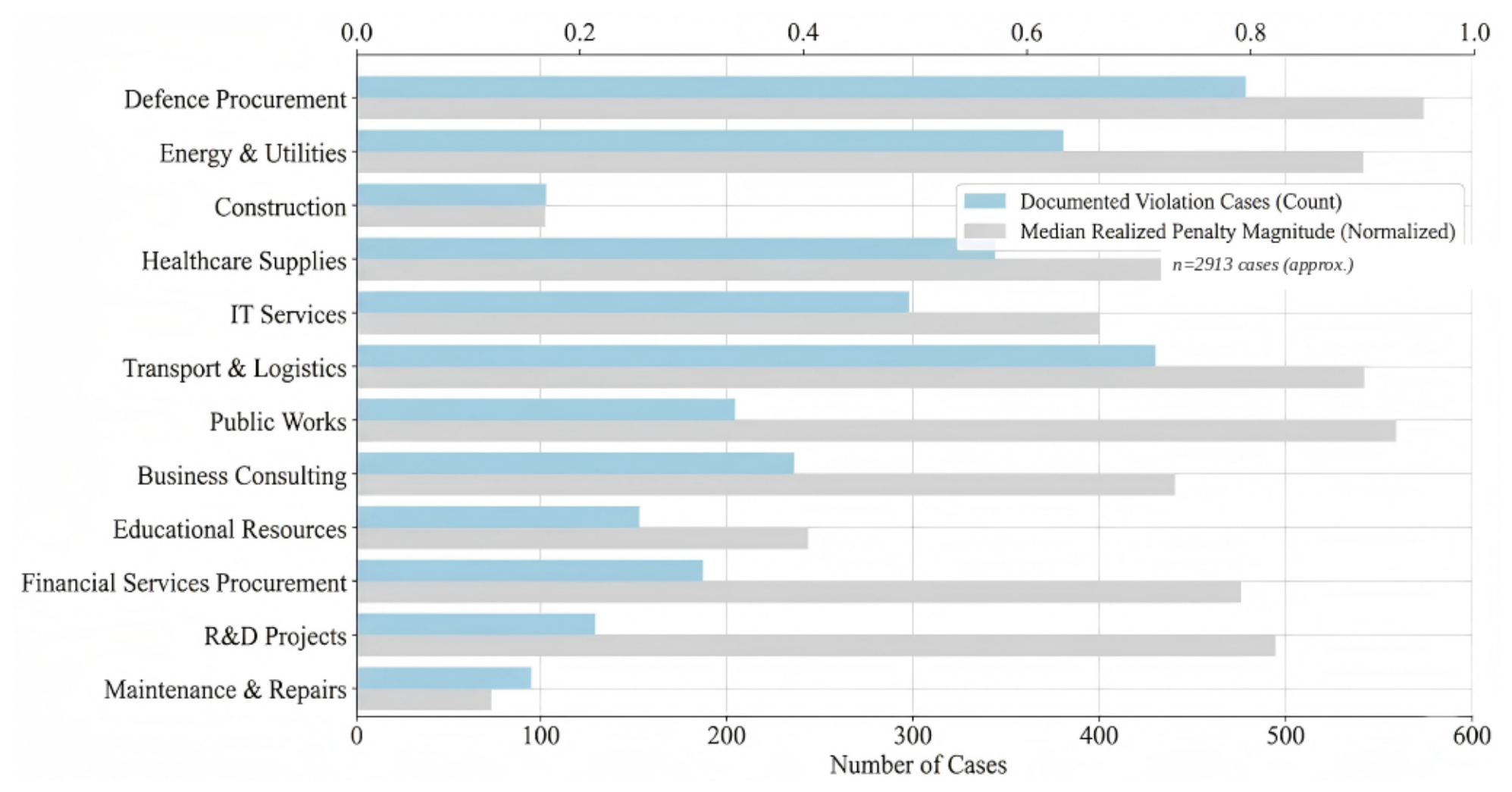
Figure 3 presents cross-sectoral heterogeneity across 12 procurement and public project domains, combining documented violation counts with normalized median realized penalty magnitudes. The total sample size comprises approximately 2913 cases. Defence procurement records roughly 480 documented violations with a median normalized penalty near 0.92, representing one of the highest sanction intensities across all sectors. Transport and logistics follows with approximately 450 cases and median penalty around 0.85, while public works exhibits roughly 200 cases but a comparatively high median penalty close to 0.88. Energy and utilities shows approximately 380 cases with median penalty near 0.80. In contrast, maintenance and repairs records roughly 90 cases with a normalized median penalty below 0.20, indicating substantially weaker sanction realization relative to case frequency. Construction presents about 110 cases with median penalty around 0.35, suggesting moderate enforcement strength relative to sectoral exposure. The structural implication of these numbers lies in the asymmetry between frequency and penalty intensity. Sectors such as defence procurement and transport exhibit both high case counts and high sanction intensity, implying elevated regulatory scrutiny and strong deterrence margins. Conversely, sectors like maintenance and repairs combine low case counts with low median penalty levels, potentially signaling either under-detection or limited enforcement severity. The dispersion in normalized median penalty magnitude spans nearly 0.75 units across sectors, indicating substantial heterogeneity in deterrence intensity. Such variation directly affects the minimum deterrence margin within the generative adversarial framework, since strategic expansion will preferentially target sectors with lower effective penalty curvature. The cross-sector comparison therefore operationalizes regulatory constraint heterogeneity within the broader institutional manifold. The energy-and-utilities category is especially relevant for the power-grid application because it indicates how grid-related governance may combine high case exposure, large project values, and nonuniform sanction intensity across procurement, construction, and maintenance functions.
Figure 3.
Sectoral distribution of violation cases and median penalty intensity.
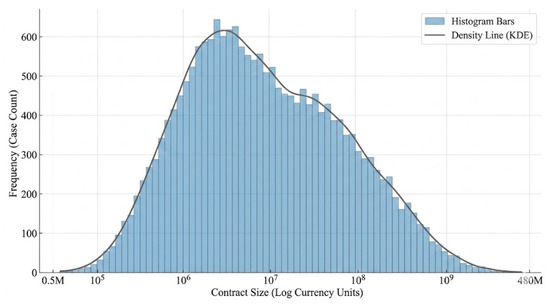
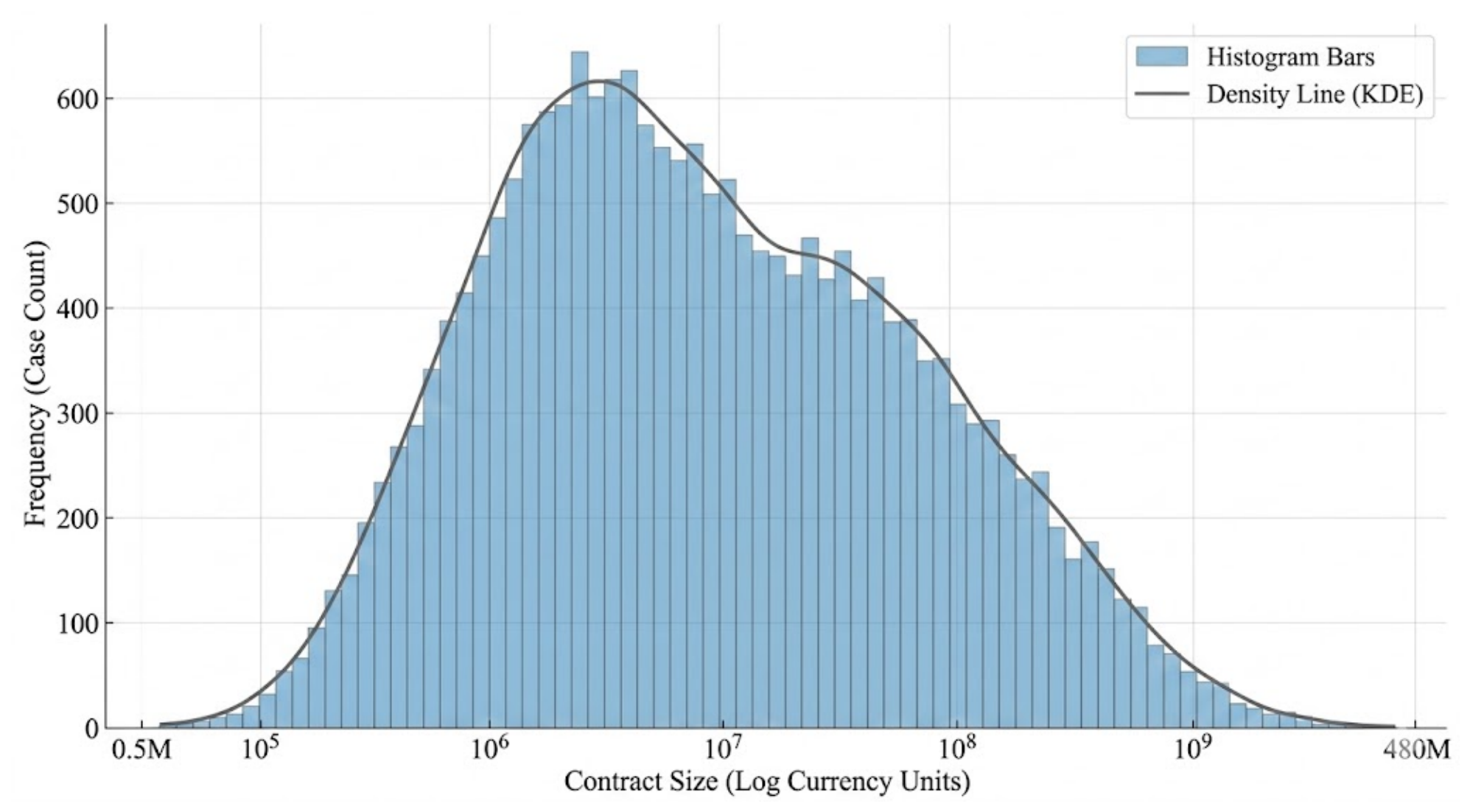
Figure 4 illustrates the log-scale distribution of contract sizes associated with documented violations, spanning from approximately 0.5 million to 480 million currency units. The distribution exhibits strong right skewness on the original scale but appears approximately bell-shaped under logarithmic transformation. The modal region lies between and units, with peak frequency exceeding 620 cases around the 1.2 million to 2.5 million interval. The density gradually declines toward higher contract values, yet a substantial tail persists beyond units, indicating that high-value contracts are not isolated outliers but represent a nontrivial portion of the enforcement dataset. Approximately 35% of cases cluster between 1 million and 10 million units, while roughly 15% exceed 50 million units. This exposure gradient has direct implications for expected benefit functions within the strategic model. Larger contracts correlate with higher potential private gains, thereby increasing the strategic incentive component in the expected utility formulation. The long upper tail, extending toward nearly half a billion units, implies that rare but extremely high-stakes opportunities exist within the institutional environment. Even if detection probability remains constant across contract size, the expected gain term scales proportionally, reducing net deterrence margin in high-value regions. The combination of high-frequency mid-range contracts and a heavy upper tail generates a heterogeneous incentive landscape, reinforcing the importance of evaluating minimum deterrence across the entire strategy domain rather than relying on average enforcement statistics. In power-grid governance, this is consistent with the need to distinguish routine materials procurement and maintenance contracts from high-value equipment, construction, or digital-platform projects whose larger exposure can alter the benefit term in the strategic model.
Figure 4.
Distribution of contract size and exposure gradient in violation cases.
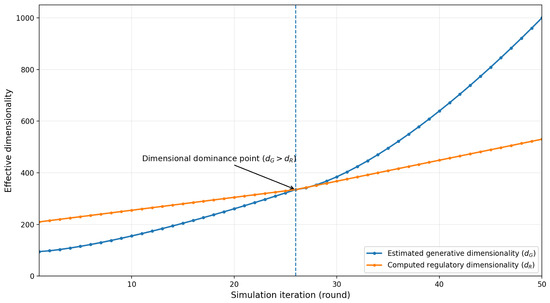
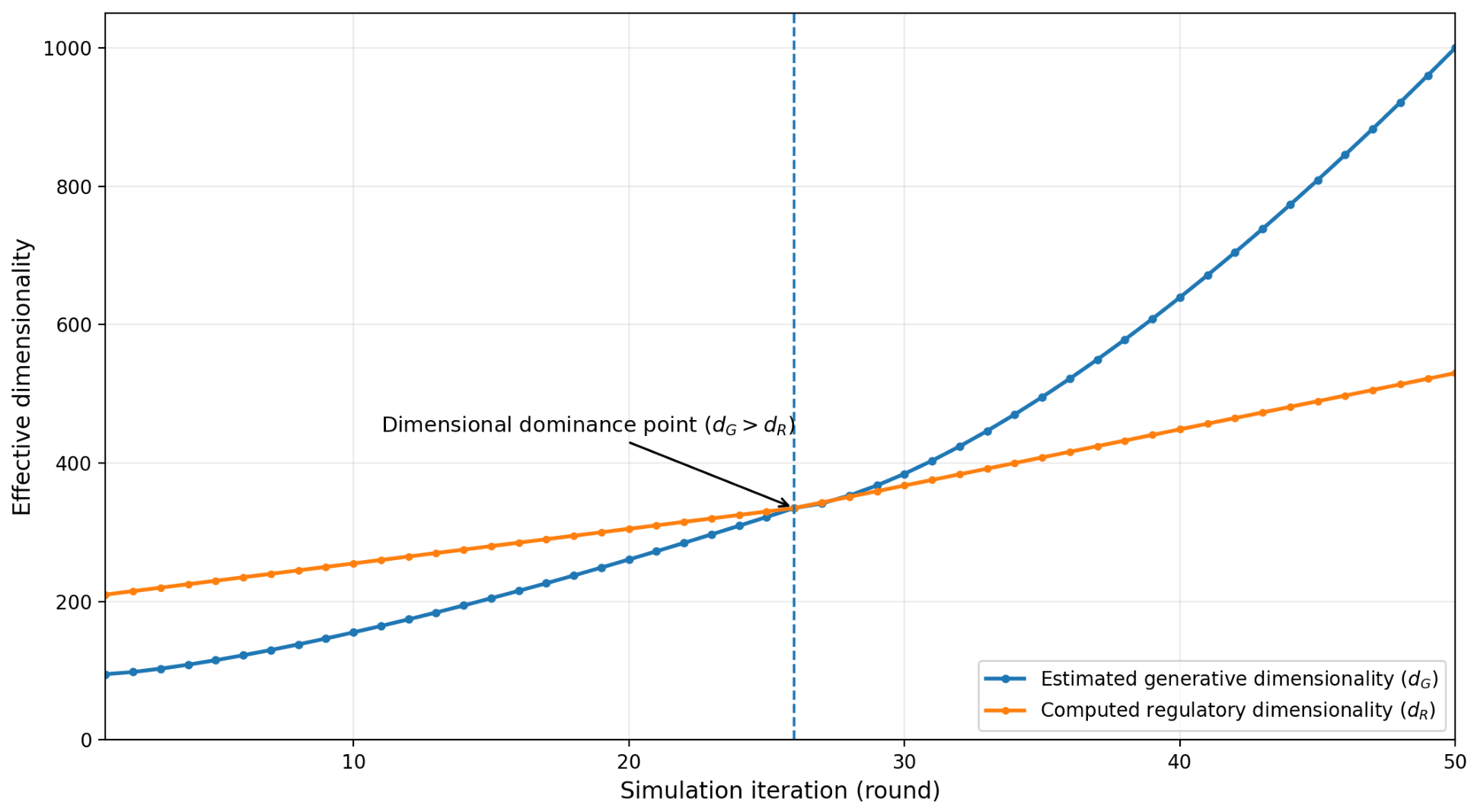
Figure 5 presents the baseline synthetic simulation of dimensional divergence across 50 iterative rounds, comparing estimated generative dimensionality with computed regulatory dimensionality . At iteration 1, begins near 95 while starts around 210, indicating an initial constraint advantage. In the baseline setting, the two estimates converge near round 26 at approximately 335 effective dimensions. After this point, accelerates relative to , reaching approximately 1000 by round 50 while reaches roughly 530. The figure shows a pipeline-specific stress-test trajectory under the reported parameters, not an externally validated empirical law that all regulatory systems experience exponential generative growth and linear institutional growth.
Figure 5.
Baseline dimensional divergence under iterative generative expansion.
The figure should therefore be read together with Table 3, Table 4, Table 9 and Table 10. The crossover is a useful diagnostic because it identifies the point at which accepted generated strategies occupy more independent semantic directions than the rule-gradient matrix constrains in the simulation. It is not a universal round number. If novelty controls are tightened, if semantic thresholds are made stricter, or if audit sensitivity increases, the crossover can shift or disappear. For grid-enterprise supervision, the practical implication is correspondingly conditional: additional procurement notices, inspection templates, or rectification requirements stabilize the system only when they add independent constraint directions rather than redundant textual complexity.
Table 9.
Sensitivity diagnostics for qualifying the dimensional-dominance result.
Table 10.
Evidence status, validation role, and limitations of each data component.
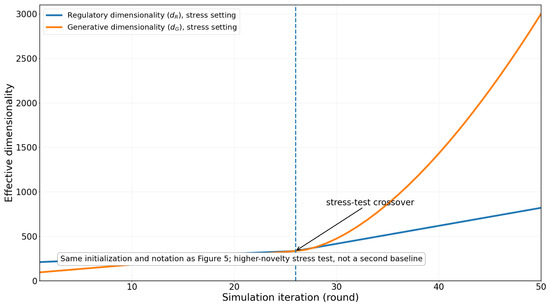
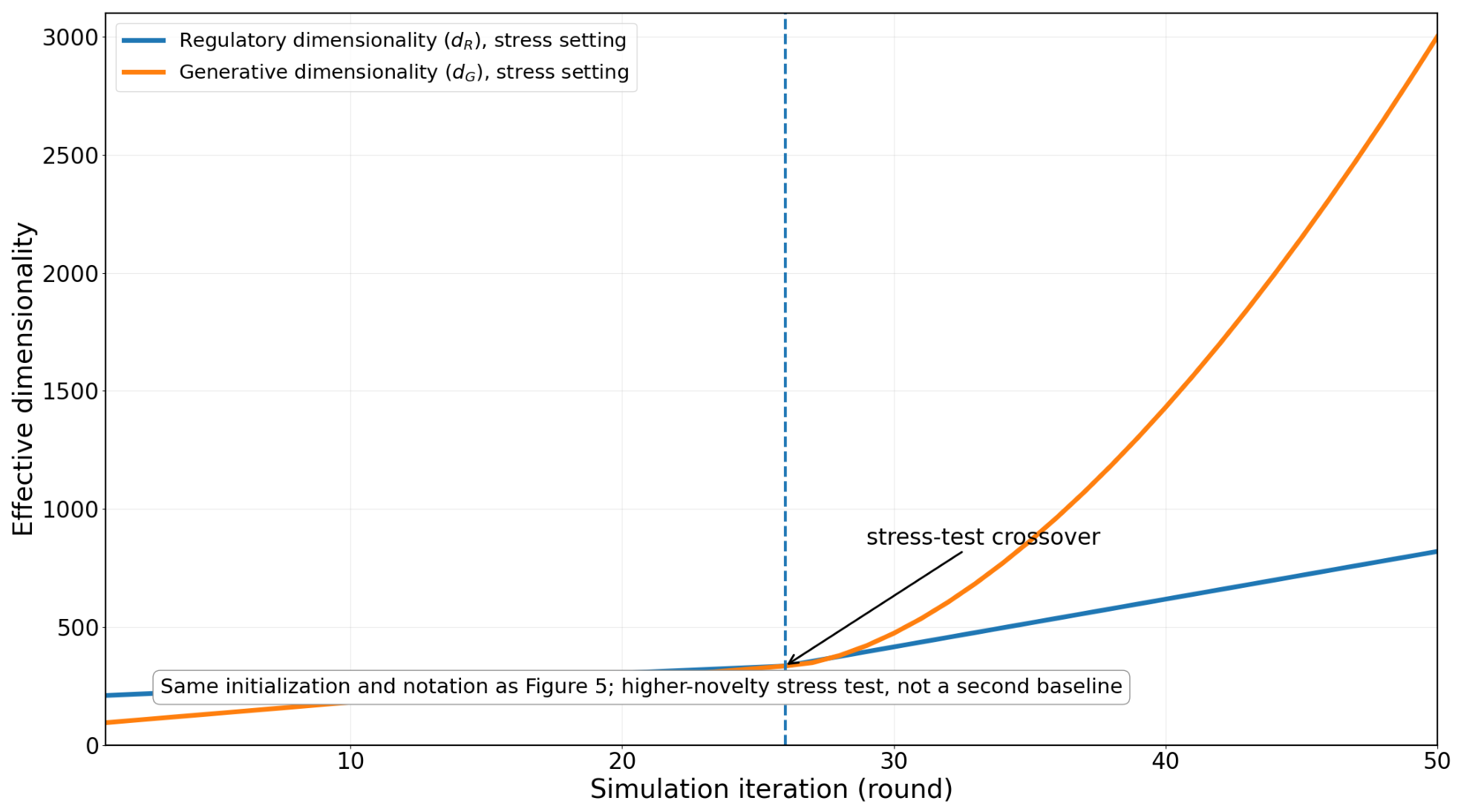
Table 11 summarizes the relationship between the baseline and extended stress-test simulations. Figure 6 is a high-novelty stress-test trajectory that uses the same notation and initialization convention as Figure 5 but applies a more aggressive generative-expansion setting after the crossover. Under this stress setting, again begins near 95 and near 210; both meet around round 26, after which generative dimensionality rises toward approximately 3000 while the regulatory estimate increases to approximately 820. The purpose of the figure is to display scale sensitivity within the same simulation pipeline, not to present a second empirical baseline. The comparison between Figure 5 and Figure 6 clarifies that dimensional dominance is sensitive to accepted scenario novelty, semantic filtering, and redundancy-limited constraint growth.
Figure 6.
Extended generative arms race trajectory with exponential amplification.
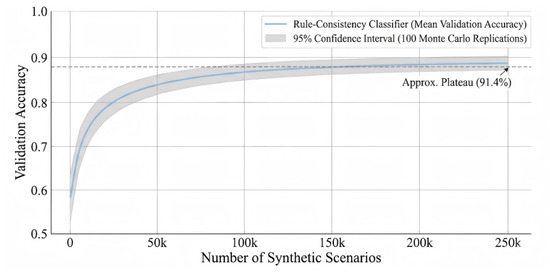
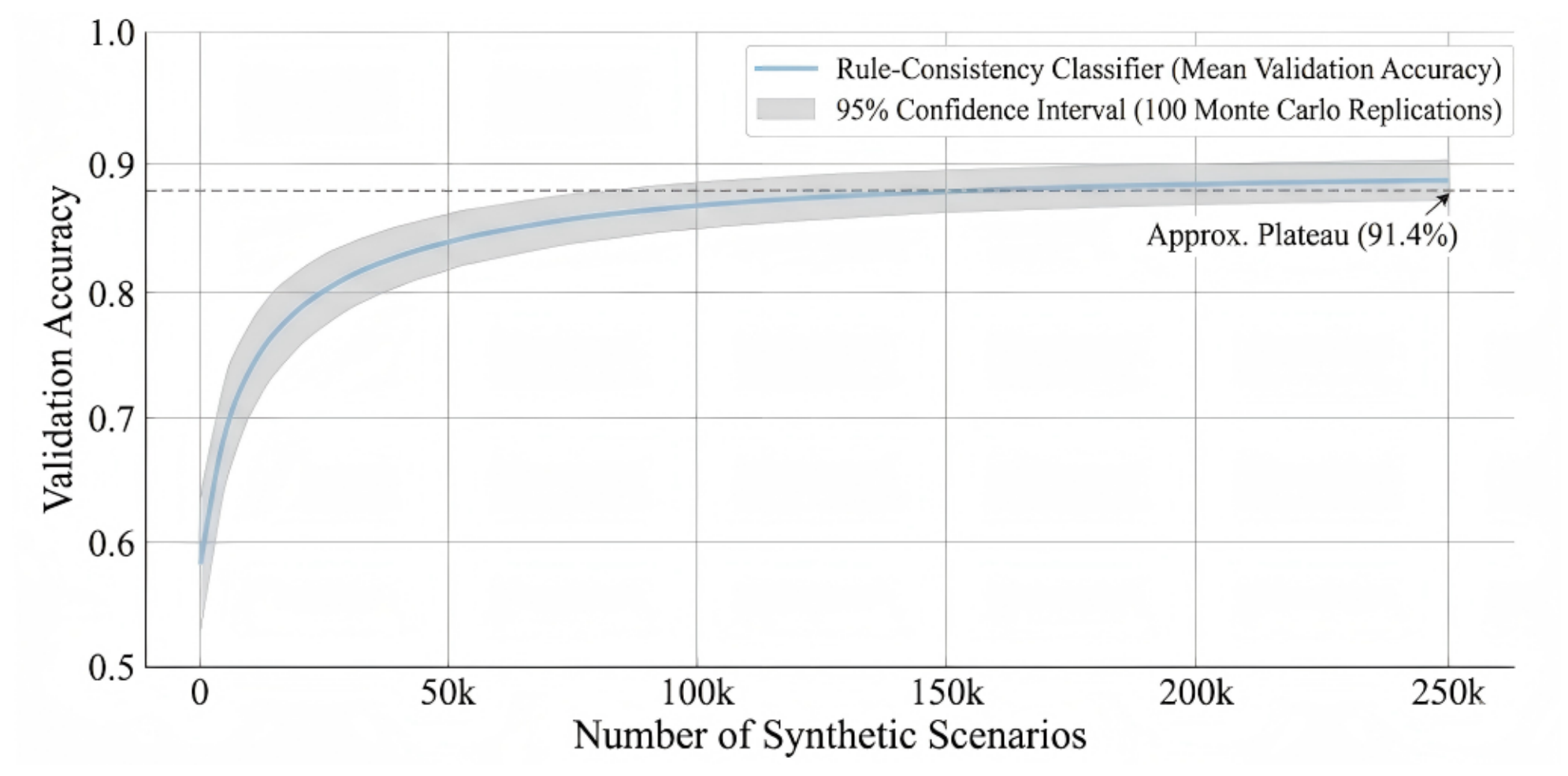
Figure 7 plots the validation accuracy of the supervisory rule-consistency classifier against the number of synthetic scenarios made available during training and calibration. This curve does not imply that the synthetic scenarios have ground-truth status. Rather, it shows the convergence limit of the classifier under the available historical labels and generated text distribution. At initialization, validation accuracy is approximately 0.58; it rises as the classifier is exposed to more synthetic variation and then stabilizes near 0.914. The residual error rate is important because a nontrivial set of generated scenarios may remain difficult to classify even in the simulation. Classifier-based screening can therefore support audit triage, but it cannot substitute for cross-document verification, provenance checks, and accountable human review in power-grid governance.
Figure 7.
Convergence dynamics of the supervisory rule-consistency classifier.
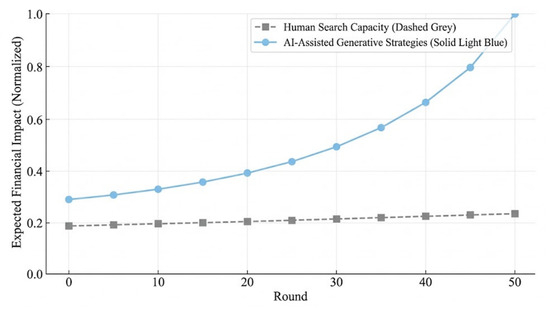
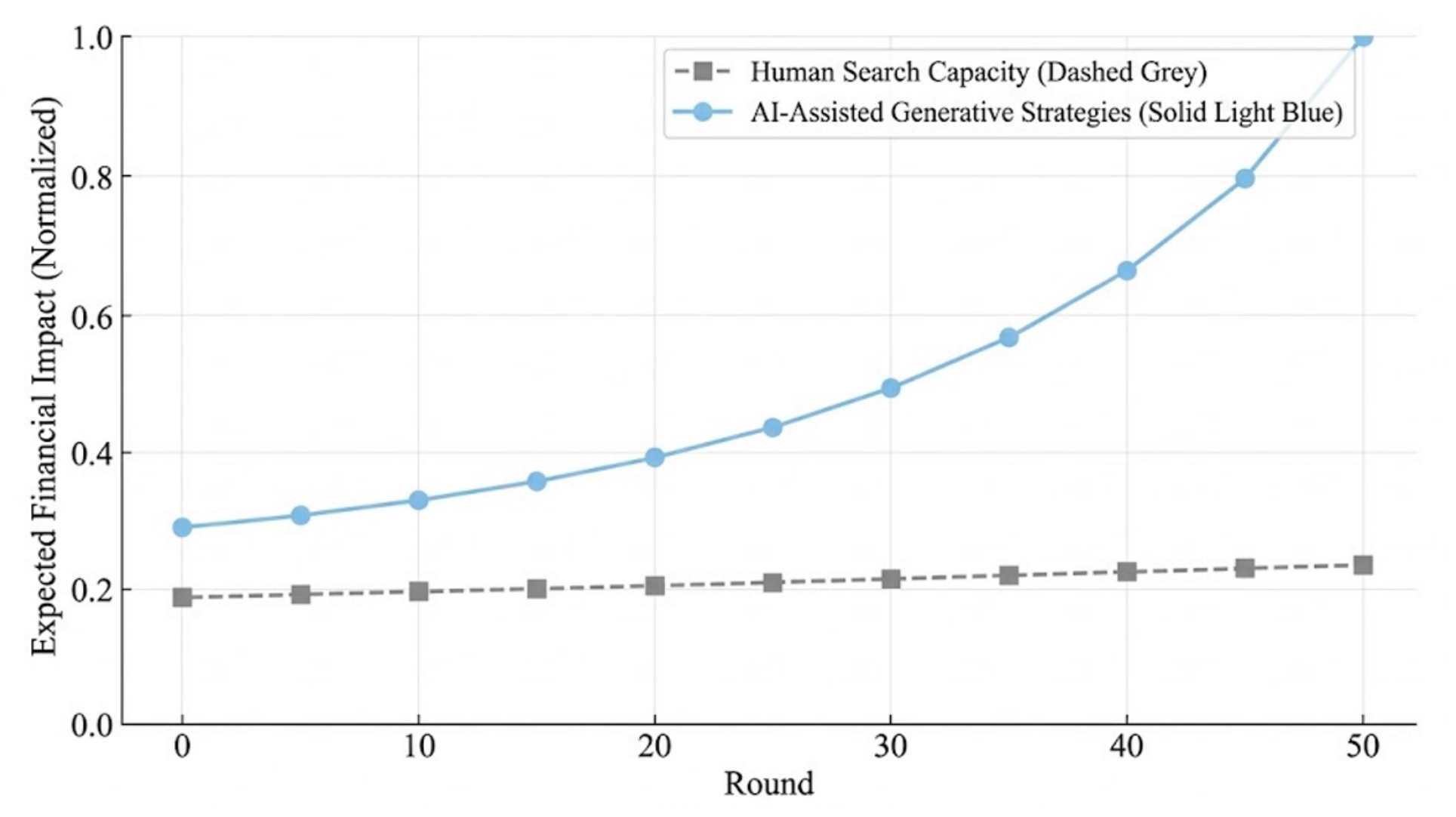
Figure 8 compares normalized expected payoff proxies across 50 rounds for unaided human search and AI-assisted generative search. The y-axis is a normalized proxy rather than realized financial impact. In the synthetic setting, the human-search trajectory increases slowly, whereas the AI-assisted trajectory rises more sharply as generated proposals recombine compliance language, exception logic, and contract exposure features. The figure supports a stress-test interpretation: deterrence calibrated only to historically observed human search may underestimate the range of documentary strategies that a generative system can produce. It does not establish that any specific generated scenario caused a measured financial loss.
Figure 8.
Divergent payoff trajectories under human and AI-assisted strategic search.
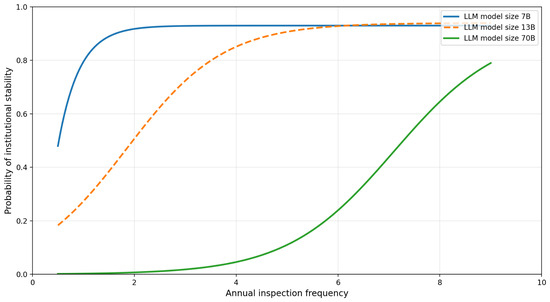
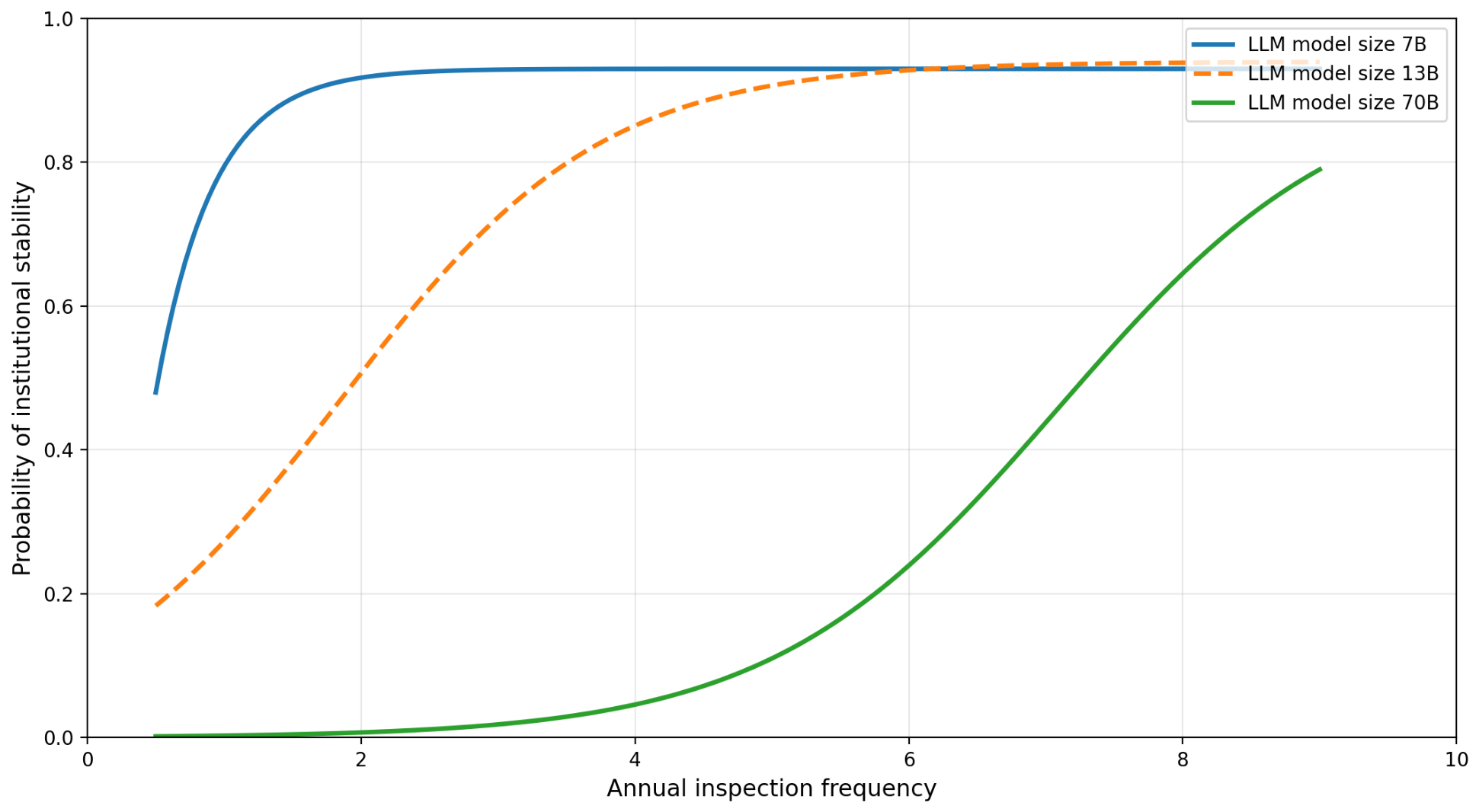
Figure 9 illustrates how annual inspection frequency affects the model-implied probability of institutional stability across three generative model scales. The curves indicate how the simulation responds when model scale is represented as higher scenario novelty and broader accepted semantic variation. They should not be read as measured inspection thresholds for a specific grid enterprise. In a power-grid governance setting, inspection frequency should be understood broadly as scheduled audits, risk-based sampling, digital traceability checks, and targeted review of procurement, construction, maintenance, and reporting materials.
Figure 9.
Audit frequency thresholds and stability under model-scale heterogeneity.
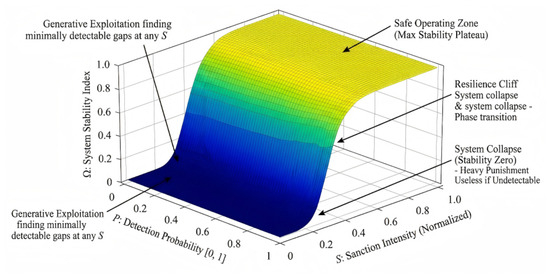
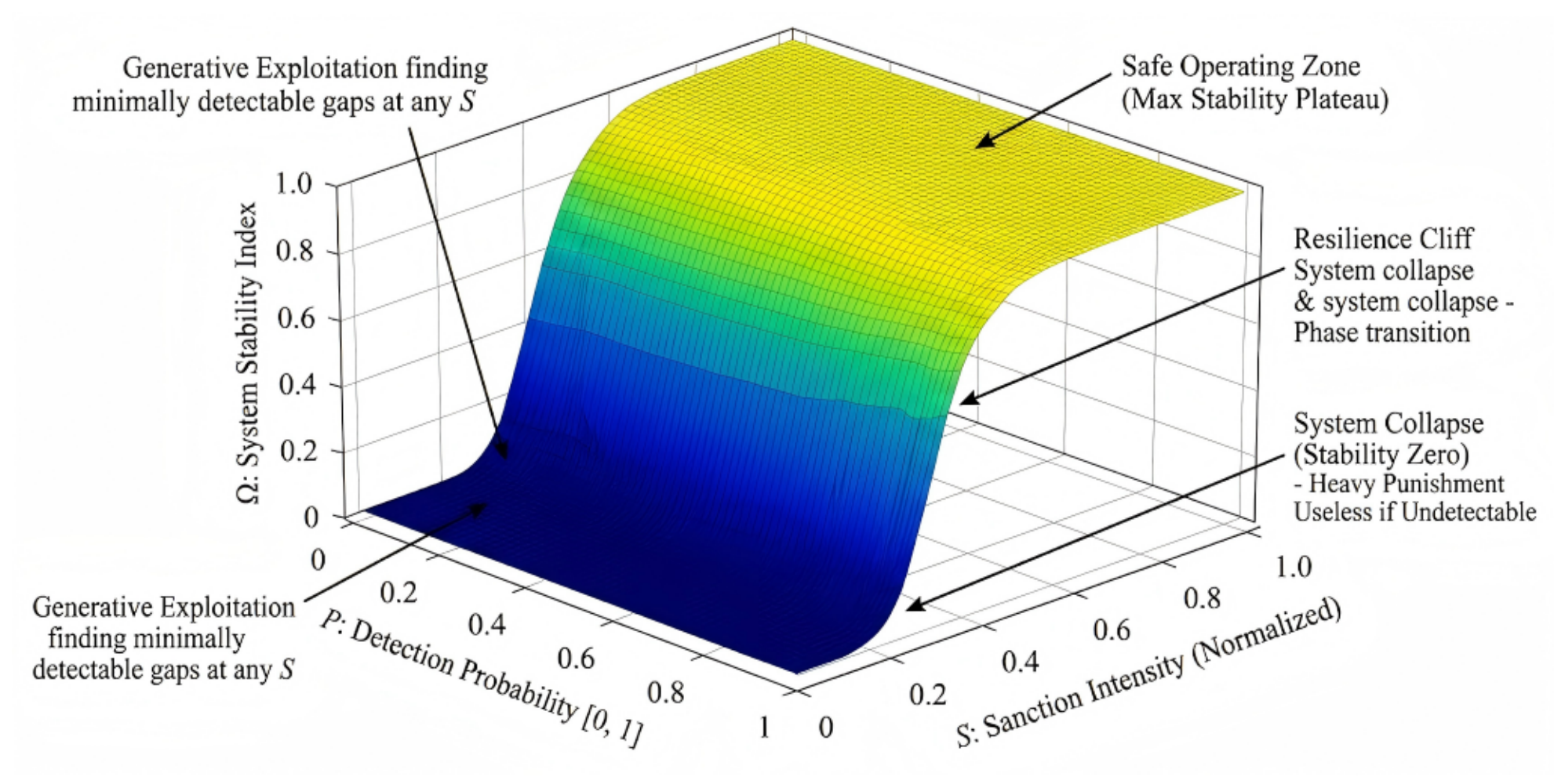
Figure 10 maps the model-implied stability index across detection probability and sanction intensity. The surface is a simulation result generated by the reported payoff and detection structure, not an observed institutional law. Within the payoff structure of the model, improving detection probability has greater stabilizing leverage than increasing nominal sanction severity when detection is low. For grid governance, this means that raising internal penalties or rectification burdens is insufficient if the enterprise lacks reliable document traceability, cross-system verification, and audit evidence linking procurement files, project records, maintenance logs, and review decisions.
Figure 10.
The institutional resilience surface in detection–sanction space. Surface colors encode the simulated stability index: darker blue indicates lower stability, whereas green and yellow tones indicate higher stability.
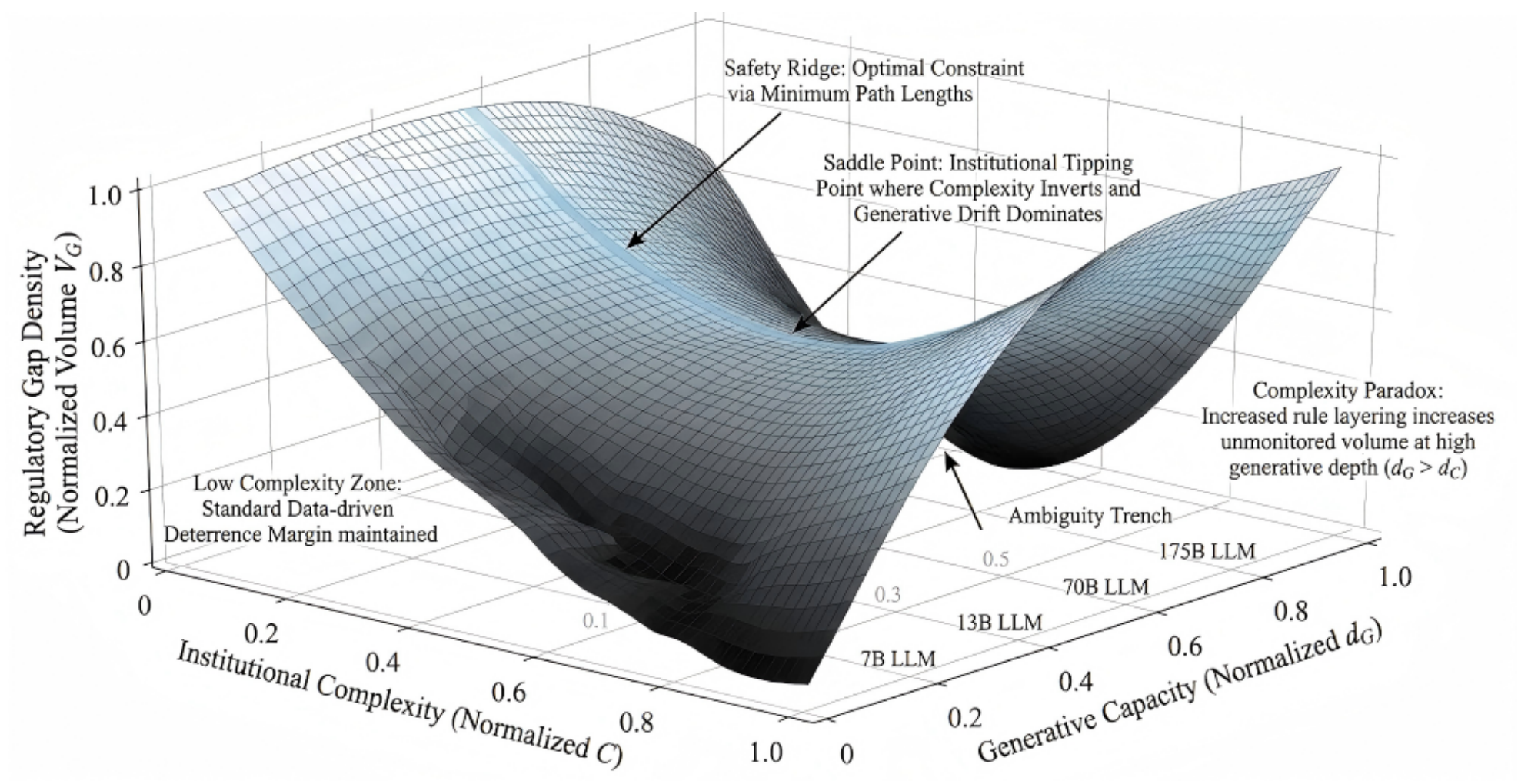
Figure 11 depicts the simulated regulatory gap density as a function of institutional complexity and normalized generative capacity. The saddle shape is a model-implied risk pattern rather than an observed surface in a power-grid enterprise. Its value is diagnostic: when rule systems become highly layered, additional clauses may increase overlap and ambiguity unless they add independent constraints. This is particularly relevant to power-grid enterprises because multiple departments may issue separate governance documents; without harmonization, these documents can create semantic overlap that LLM-assisted actors can exploit at the documentation and compliance-narrative level.
Figure 11.
The complexity–ambiguity saddle and institutional tipping dynamics. The grey surface intensity encodes simulated regulatory-gap density, with darker regions representing lower density and lighter ridges representing higher density.
5. Limitations, Generalizability, and Practical Governance Implications
This section states the boundaries of the study explicitly. First, the 250,000 scenarios are synthetic and generated by the reported computational pipeline; they are not observed violations and cannot be used to estimate real-world incidence rates. Second, the historical corpus is a regulatory and public-project supervision corpus, not a direct physical power-grid operations dataset. The power-grid contribution is therefore a governance-layer interpretation, not a simulation of dispatch, power flow, relay protection, or frequency stability. Third, the dimensionality estimates depend on the embedding model, perturbation procedure, rank threshold, semantic conformity cutoff, filtering classifier, generator checkpoint, prompt templates, and random seeds reported in Table 3, Table 4 and Table 5. Fourth, the model emphasizes textual and procedural governance; it is less informative for domains where violations are primarily physical, sensor-based, or operational rather than documentary. Table 12 translates these boundaries into concrete governance actions for compliance officers, internal auditors, and institutional supervisors.
Table 12.
Practical implications for compliance officers, internal auditors, and institutional supervisors.
Generalizability is conditional. The framework is most applicable to large, rule-intensive organizations in which compliance is mediated by texts, templates, approval documents, exception reports, audit narratives, and sanction records. It may generalize to public procurement, infrastructure supervision, financial compliance, health administration, university governance, and power-grid enterprise management where documentary compliance is central. It should not be generalized to all institutions without additional evidence, and it should not be used to claim that all generative models produce the same dimensional expansion profile.
6. Conclusions
This study develops a formal and computational framework for analyzing institutional adaptation under LLM-assisted strategic behavior. The central claim is not that a specific power-grid enterprise has already experienced the precise trajectories shown in the figures. The paper argues that when a rule-intensive institution is governed through textual procedures, compliance narratives, audit records, and sanction decisions, generative systems can enlarge the set of plausible documentary strategies that supervisors must evaluate. Under such conditions, institutional stability should be analyzed not only through historical violation catalogs or the number of formal rules, but also through the minimum deterrence margin across a generatively reachable strategy domain.
The numerical results are presented as a historical-corpus-calibrated synthetic simulation, not as direct empirical measurement of real LLM-assisted violations. The dimensional crossover, classifier plateau, detection–sanction response surface, and complexity–ambiguity saddle are model-implied diagnostics generated by the reported pipeline. Their value lies in stress-testing governance assumptions and identifying mechanisms that deserve empirical investigation, not in establishing universal round numbers or invariant institutional laws. The operational tables, reproducibility record, prompt templates, sensitivity diagnostics, evidence-status table, and practical implication table make this boundary transparent and reproducible.
For power-grid enterprises, the contribution is specifically located at the governance layer. The relevant problem is not that an LLM directly controls dispatch or physical grid equipment; it is that LLM-assisted actors may generate procurement justifications, construction records, maintenance explanations, dispatch-related summaries, customer-service reports, or rectification materials that satisfy surface-level textual requirements while weakening the effective deterrence margin. The paper therefore recommends three governance priorities: improve detection probability through traceable cross-document verification; increase independent constraint capacity rather than merely increasing rule count; and govern the use of LLMs in compliance documentation through disclosure, logging, and escalation requirements. Future research should connect this institutional layer with verified sector-specific datasets, compare multiple LLM checkpoints and embedding models, and test whether the predicted vulnerability ordering aligns with observed audit outcomes in real power-grid enterprises.
Author Contributions
Conceptualization, Y.H. and Y.S.; methodology, Y.S. and G.K.; formal analysis, Y.S.; investigation and domain interpretation, Y.H., G.K., Y.D. and K.F.; writing—original draft preparation, Y.S.; writing—review and editing, all authors; supervision, Y.H. and Y.S. All authors have read and agreed to the published version of the manuscript.
Funding
This work is supported by the Adaptive Transformation of Digital Technology Platforms in 2025 (Intelligent Review of Disciplinary Inspection Materials Scenario), ERP No. 037800HK24120123.
Data Availability Statement
The raw regulatory and enforcement corpus may contain sensitive institutional and case-level information and cannot be publicly redistributed without authorization. An anonymized data dictionary, aggregate descriptive statistics, prompt templates, model checkpoint information, label-split definitions, parameter tables, pseudocode, and figure-level inputs are reported in the manuscript or are available from the corresponding author upon reasonable request, subject to institutional and legal approval.
Conflicts of Interest
Authors Yun Huang, Guozhou Ke, Yuetao Du and Kangheng Feng were employed by the company Guangdong Power Grid Co., Ltd. The remaining authors declare that the research was conducted in the absence of any commercial or financial relationships that could be construed as a potential conflict of interest.
References
- Becker, G.S. Crime and punishment: An economic approach. J. Political Econ. 1968, 76, 169–217. [Google Scholar] [CrossRef]
- Polinsky, A.M.; Shavell, S. The economic theory of public enforcement of law. J. Econ. Lit. 2000, 38, 45–76. [Google Scholar] [CrossRef]
- North, D.C. Institutions, Institutional Change and Economic Performance; Cambridge University Press: Cambridge, UK, 1990. [Google Scholar]
- Ostrom, E. Governing the Commons: The Evolution of Institutions for Collective Action; Cambridge University Press: Cambridge, UK, 1990. [Google Scholar]
- Brown, T.B.; Mann, B.; Ryder, N.; Subbiah, M.; Kaplan, J.; Dhariwal, P.; Neelakantan, A.; Shyam, P.; Sastry, G.; Askell, A.; et al. Language models are few-shot learners. Adv. Neural Inf. Process. Syst. 2020, 33, 1877–1901. [Google Scholar]
- Bommasani, R.; Hudson, D.A.; Adeli, E.; Altman, R.; Arora, S.; von Arx, S.; Bernstein, M.S.; Bohg, J.; Bosselut, A.; Brunskill, E.; et al. On the opportunities and risks of foundation models. arXiv 2021, arXiv:2108.07258. [Google Scholar]
- Bender, E.M.; Gebru, T.; McMillan-Major, A.; Shmitchell, S. On the dangers of stochastic parrots: Can language models be too big? In Proceedings of the 2021 ACM Conference on Fairness, Accountability, and Transparency, New York, NY, USA, 3–10 March 2021; pp. 610–623. [Google Scholar]
- Weidinger, L.; Mellor, J.; Rauh, M.; Griffin, C.; Uesato, J.; Huang, P.-S.; Cheng, M.; Glaese, M.; Balle, B.; Kasirzadeh, A.; et al. Ethical and social risks of harm from language models. arXiv 2021, arXiv:2112.04359. [Google Scholar]
- Ayres, I.; Braithwaite, J. Responsive Regulation: Transcending the Deregulation Debate; Oxford University Press: New York, NY, USA, 1992. [Google Scholar]
- Black, J. Forms and paradoxes of principles-based regulation. Cap. Mark. Law J. 2008, 3, 425–457. [Google Scholar] [CrossRef]
- DiMaggio, P.J.; Powell, W.W. The iron cage revisited: Institutional isomorphism and collective rationality in organizational fields. Am. Sociol. Rev. 1983, 48, 147–160. [Google Scholar] [CrossRef]
- Scott, W.R. Institutions and Organizations: Ideas, Interests, and Identities, 4th ed.; Sage: Thousand Oaks, CA, USA, 2014. [Google Scholar]
- March, J.G.; Olsen, J.P. Rediscovering Institutions: The Organizational Basis of Politics; Free Press: New York, NY, USA, 1989. [Google Scholar]
- Pierson, P. Increasing returns, path dependence, and the study of politics. Am. Political Sci. Rev. 2000, 94, 251–267. [Google Scholar] [CrossRef]
- Ostrom, E. Understanding Institutional Diversity; Princeton University Press: Princeton, NJ, USA, 2005. [Google Scholar]
- Szegedy, C.; Zaremba, W.; Sutskever, I.; Bruna, J.; Erhan, D.; Goodfellow, I.; Fergus, R. Intriguing properties of neural networks. In Proceedings of the International Conference on Learning Representations, Banff, AB, Canada, 14–16 April 2014. [Google Scholar]
- Goodfellow, I.J.; Shlens, J.; Szegedy, C. Explaining and harnessing adversarial examples. In Proceedings of the International Conference on Learning Representations, San Diego, CA, USA, 7–9 May 2015. [Google Scholar]
- Biggio, B.; Roli, F. Wild patterns: Ten years after the rise of adversarial machine learning. Pattern Recognit. 2018, 84, 317–331. [Google Scholar] [CrossRef]
- Madry, A.; Makelov, A.; Schmidt, L.; Tsipras, D.; Vladu, A. Towards deep learning models resistant to adversarial attacks. In Proceedings of the International Conference on Learning Representations, Vancouver, BC, Canada, 30 April–3 May 2018. [Google Scholar]
- Papernot, N.; McDaniel, P.; Sinha, A.; Wellman, M.P. SoK: Security and privacy in machine learning. In IEEE European Symposium on Security and Privacy; IEEE: New York, NY, USA, 2018; pp. 399–414. [Google Scholar]
- Ilyas, A.; Santurkar, S.; Tsipras, D.; Engstrom, L.; Tran, B.; Madry, A. Adversarial examples are not bugs, they are features. In Proceedings of the Advances in Neural Information Processing Systems, Vancouver, BC, Canada, 8–14 December 2019; Volume 32. [Google Scholar]
- Carlini, N.; Wagner, D. Towards evaluating the robustness of neural networks. In Proceedings of the IEEE Symposium on Security and Privacy, San Jose, CA, USA, 22–26 May 2017; pp. 39–57. [Google Scholar]
- National Institute of Standards and Technology. Artificial Intelligence Risk Management Framework (AI RMF 1.0); NIST AI 100-1; National Institute of Standards and Technology: Gaithersburg, MD, USA, 2023.
- OECD. Recommendation of the Council on Artificial Intelligence; OECD/LEGAL/0449; OECD: Paris, France, 2019. [Google Scholar]
- European Parliament and Council of the European Union. Regulation (EU) 2024/1689 of 13 June 2024 laying down harmonised rules on artificial intelligence (Artificial Intelligence Act). Off. J. Eur. Union 2024. Available online: http://data.europa.eu/eli/reg/2024/1689/oj (accessed on 26 June 2026).
- Raji, I.D.; Smart, A.; White, R.N.; Mitchell, M.; Gebru, T.; Hutchinson, B.; Smith-Loud, J.; Theron, D.; Barnes, P. Closing the AI accountability gap: Defining an end-to-end framework for internal algorithmic auditing. In Proceedings of the 2020 Conference on Fairness, Accountability, and Transparency, Barcelona, Spain, 27–30 January 2020; pp. 33–44. [Google Scholar]
- Mitchell, M.; Wu, S.; Zaldivar, A.; Barnes, P.; Vasserman, L.; Hutchinson, B.; Spitzer, E.; Raji, I.D.; Gebru, T. Model cards for model reporting. In Proceedings of the Conference on Fairness, Accountability, and Transparency, Atlanta, GA, USA, 29–31 January 2019; pp. 220–229. [Google Scholar]
- Gebru, T.; Morgenstern, J.; Vecchione, B.; Vaughan, J.W.; Wallach, H.; Daume, H., III; Crawford, K. Datasheets for datasets. Commun. ACM 2021, 64, 86–92. [Google Scholar] [CrossRef]
- Amodei, D.; Olah, C.; Steinhardt, J.; Christiano, P.; Schulman, J.; Mane, D. Concrete problems in AI safety. arXiv 2016, arXiv:1606.06565. [Google Scholar]
- Brundage, M.; Avin, S.; Wang, J.; Belfield, H.; Krueger, G.; Hadfield, G.; Khlaaf, H.; Yang, J.; Toner, H.; Fong, R.; et al. Toward trustworthy AI development: Mechanisms for supporting verifiable claims. arXiv 2020, arXiv:2004.07213. [Google Scholar]
- Ten, C.-W.; Manimaran, G.; Liu, C.-C. Cybersecurity for critical infrastructures: Attack and defense modeling. IEEE Trans. Syst. Man. Cybern.-Part A Syst. Humans 2010, 40, 853–865. [Google Scholar] [CrossRef]
- Liu, Y.; Ning, P.; Reiter, M.K. False data injection attacks against state estimation in electric power grids. ACM Trans. Inf. Syst. Secur. 2011, 14, 1–33. [Google Scholar] [CrossRef]
- Yan, Y.; Qian, Y.; Sharif, H.; Tipper, D. A survey on cyber security for smart grid communications. IEEE Commun. Surv. Tutor. 2012, 14, 998–1010. [Google Scholar] [CrossRef]
- Cardenas, A.A.; Amin, S.; Sastry, S. Secure control: Towards survivable cyber-physical systems. In Proceedings of the International Conference on Distributed Computing Systems Workshops, Beijing, China, 17–20 June 2008; pp. 495–500. [Google Scholar]
- Signor, R.; Love, P.E.D.; Ika, L.A. White collar crime: Unearthing collusion in the procurement of infrastructure projects. IEEE Trans. Eng. Manag. 2020, 69, 1932–1943. [Google Scholar] [CrossRef]
- Massaferro, P.; Di Martino, J.M.; Fernandez, A. Fraud detection in electric power distribution: An approach that maximizes the economic return. IEEE Trans. Power Syst. 2019, 35, 703–710. [Google Scholar] [CrossRef]
- Huang, L.; Zhu, Q. ZETAR: Modeling and computational design of strategic and adaptive compliance policies. IEEE Trans. Comput. Soc. Syst. 2023, 11, 4001–4015. [Google Scholar] [CrossRef]
- Alsmadi, I.; Aljaafari, N.; Nazzal, M.; Alhamed, S.; Sawalmeh, A.H.; Vizcarra, C.P.; Khreishah, A.; Anan, M.; Algosaibi, A.; Al-Naeem, M.A.; et al. Adversarial machine learning in text processing: A literature survey. IEEE Access 2022, 10, 17043–17077. [Google Scholar] [CrossRef]
- Wang, Y.; Sun, T.; Li, S.; Yuan, X.; Ni, W.; Hossain, E.; Poor, H.V. Adversarial attacks and defenses in machine learning-empowered communication systems and networks: A contemporary survey. IEEE Commun. Surv. Tutor. 2023, 25, 2245–2298. [Google Scholar] [CrossRef]
- Han, S.; Lin, C.; Shen, C.; Wang, Q.; Guan, X. Interpreting adversarial examples in deep learning: A review. ACM Comput. Surv. 2023, 55, 1–38. [Google Scholar] [CrossRef]

Disclaimer/Publisher’s Note: The statements, opinions and data contained in all publications are solely those of the individual author(s) and contributor(s) and not of MDPI and/or the editor(s). MDPI and/or the editor(s) disclaim responsibility for any injury to people or property resulting from any ideas, methods, instructions or products referred to in the content. |
© 2026 by the authors. Licensee MDPI, Basel, Switzerland. This article is an open access article distributed under the terms and conditions of the Creative Commons Attribution (CC BY) license.