


Abstract
Corn stover is an abundant, low-cost, and representative lignocellulosic agricultural residue for bioethanol production, but its recalcitrant structure requires effective pretreatment to improve downstream conversion performance. Ball milling technology has been widely used to pretreat lignocellulosic biomass, where regulating particle size distribution enhances lignin utilization and subsequent ethanol production. However, systematic optimization of ball milling operating parameters remains insufficiently investigated. To bridge the gap between bench-scale experimentation and process-level performance prediction, this study establishes an integrated experimental and simulation framework. Ball milling experiments are conducted to systematically vary key operating parameters, and particle morphology is precisely quantified through optical imaging coupled with digital image analysis. Empirical correlations between these operating conditions and particle size characteristics are derived through polynomial fitting. These correlations are then embedded into an Aspen Plus process model for bioconversion performance evaluation. Evaluation from this integrated framework reveals that system-level optimization of the pretreatment process effectively reduces mean particle size, narrows size distribution, and increases specific surface area. By systematically evaluating the operating space, an optimal window that yields a 2.97% improvement in glucose conversion is identified. This work provides practical guidance and a generalizable framework for optimizing mechanical pretreatment to maximize target product yields.
1. Introduction
Global reliance on fossil fuels continues to drive greenhouse gas emissions and energy supply instability, creating an urgent need for renewable energy alternatives [1]. Lignocellulosic biomass, including corn stover, wheat straw, and forestry residues, is widely distributed and low-cost and does not compete with food production for arable land, making it a promising feedstock for bioethanol and other bio-based products [2]. However, the dense cell wall architecture, in which cellulose, hemicellulose, and lignin are tightly interwoven, renders lignocellulosic biomass highly recalcitrant to enzymatic deconstruction [3]. The lignocellulosic structure is physically broken down by ball milling through particle size reduction. In previous studies, milling conditions are evaluated separately. System interactions, including the competition of particle breakdown against aggregation, are rarely considered. A system-level optimization method connecting mechanical treatment to final yield is lacking. To fill this gap, a systematic optimization method is developed for corn stover ball milling in this work. The pretreatment stage, followed by enzymatic hydrolysis, is analyzed as a whole process. Empirical models relating operating conditions to particle size are established. The optimal operating window is finally identified to maximize the final glucose yield.
The physical disruption of biomass structure by ball milling is documented in recent studies [4]. In these bioconversion investigations, milling time is typically evaluated as the only variable. Prolonged milling is simply observed to cause particle re-aggregation. Unified energy metrics integrating rotational speed and ball characteristics are proposed in some recent frameworks [5]. Their direct translation into downstream saccharification yields remains limited. The true complexity of the ball milling process is better demonstrated in other disciplines, such as pharmaceuticals and materials science. In those fields, final particle characteristics are strictly determined by the interaction of multiple parameters, including rotation speed, ball-to-powder ratio, and jar volume. These complex parameter interactions are largely ignored in current lignocellulose pretreatment research. The combined impact of these operating variables on subsequent enzymatic hydrolysis remains unclear. A systematic multi-parameter evaluation is conducted to achieve higher glucose yields from the milling process.
Beyond cellulose amorphization, lignin microparticles with modified surface properties are produced by mechanical treatment [6]. As demonstrated by Chen et al. [7], the average particle size of corn stover is significantly reduced from 263.00 to 7.18 μm after 60 min of milling, accompanied by a decrease in the crystallinity index from 40.68 to 14.06. Consequently, enzymatic glucose release is improved from 24.6% to over 60%. Furthermore, Xie et al. [8] revealed that structural disruption extends beyond simple size reduction to include chemical bond rearrangements, promoting the formation of water-soluble lignin–carbohydrate complexes. Based on these structural changes, Fortunato et al. [9] investigated the correlation between crystallinity index and yield. However, milling time was evaluated as the sole parameter in their study. Prolonged milling is simply observed to cause particle re-aggregation, which diminishes the benefits of size reduction [7]. To systematically overcome this single-variable limitation, multi-parameter interactions must be examined based on cross-disciplinary findings. During the wet milling of poorly water-soluble drugs, Memarvar et al. [10] identified that particle size distribution is governed by ball size, ball number, and rotation speed. Similarly, Ng et al. [11] found that the particle size evolution of nano-biochar is dictated by mixed grinding media. In nanocomposite synthesis, microstructural uniformity is controlled by milling time, rotation speed, and ball-to-powder ratio, as identified by Joy et al. [12]. Furthermore, in specific material systems such as metal powders and cement clinker, grinding efficiency, powder yield, and product fineness are jointly determined by combined operational factors [13,14]. These cross-disciplinary findings collectively confirm that final particle characteristics and surface morphology are dictated by the synergistic interaction of multiple milling parameters. Targeting maximum enzymatic saccharification, these complex multi-parameter interactions must be systematically optimized for lignocellulose pretreatment.
Chemical and physicochemical pretreatments, including alkaline treatment, steam explosion, and deep eutectic solvents, have been widely applied to disrupt lignocellulosic structure and improve enzymatic hydrolysis efficiency [15,16,17,18]. These methods, while effective, often involve high reagent costs, complex recovery processes, or the formation of undesirable by-products [1]. Consequently, combined pretreatment strategies have been explored to leverage complementary effects. Yang et al. [19] coupled ball milling with wet alkaline pretreatment and reported a glucose yield of 91.9% using 3% NaOH with 10 min of milling, finding that alkali concentration was more influential than milling time. Alizadeh et al. [20] combined ball milling with LiBr pretreatment to achieve a glucose yield of 93.8%. Tan et al. [21] simultaneously treated wheat straw with ball milling and laccase, attaining a cellulose conversion rate of 99.2%. Licari et al. [22] compared planetary, vibrating, and roller ball milling modes combined with enzymatic hydrolysis and demonstrated that planetary ball milling yielded the highest glucose recovery and energy efficiency. Gao et al. [23] further showed that combining mineral salt with ball milling significantly enhanced enzymatic saccharification of corn stover. Despite these advances, most combined approaches essentially represent sequential multi-step operations without systematic optimization within an integrated process flow, leaving the intrinsic effects of operating parameters on overall yield unexplored. Nevertheless, most of these studies employed a limited number of operating parameters, and the effects of ball-to-powder ratio, jar volume, and rotational speed on particle size characteristics and ethanol yield have not been systematically characterized [24]. Moreover, the empirical correlations derived from these laboratory-scale studies have not been embedded into process simulation platforms for system-level sensitivity analysis and Pareto-based parameter optimization [25,26,27]. Empirical correlations from these combined approaches have rarely been integrated into process simulation platforms. Systematic multi-parameter optimization remains unachieved.
To address these gaps, this study develops an integrated experimental–simulation framework for multi-parameter optimization of ball milling pretreatment in lignocellulosic bioethanol production. Ball milling experiments are performed to vary four operating parameters, including milling time, rotational speed, ball-to-powder ratio, and jar volume. Particle size characteristics are adopted as intermediate descriptors, which are quantified through optical imaging, and then data processing is performed by digital image analysis. The resulting empirical models relating operating parameters to particle size are integrated into an Aspen Plus model, which establishes the linkage between pretreatment operations and biomass conversion performance. To facilitate comprehensive multi-parameter optimization, a steady-state sensitivity analysis is first conducted to isolate individual factor effects, followed by Pareto-based global ranking to identify the optimal operating space for glucose conversion. By bridging laboratory-scale experimentation with process-level optimization, this study establishes the optimal operating window for ball milling pretreatment, tailored for high-yield lignin refining.
The remainder of this paper is organized as follows: Section 2 describes the integrated framework, including the ball milling experimental platform, the optical image acquisition system, and the Aspen Plus flowsheet model. Section 3 presents the results and discussion, covering the nonlinear effects of operating conditions on particle size characteristics, the sensitivity analysis and process optimization, and the sample characterization analysis. Finally, Section 4 presents the conclusions.
2. Materials and Methods
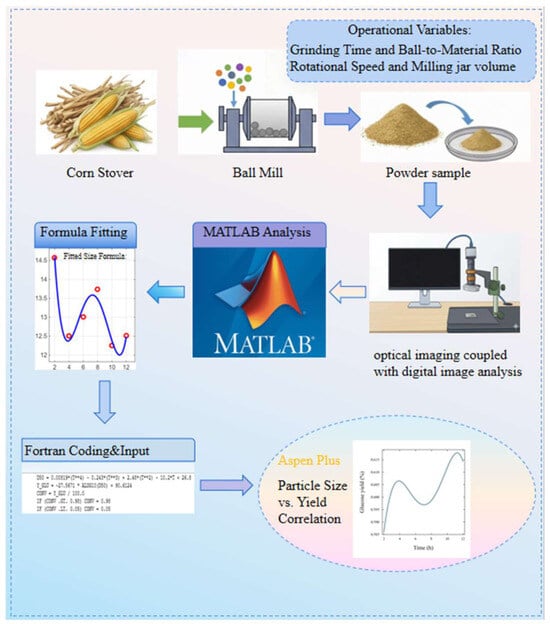
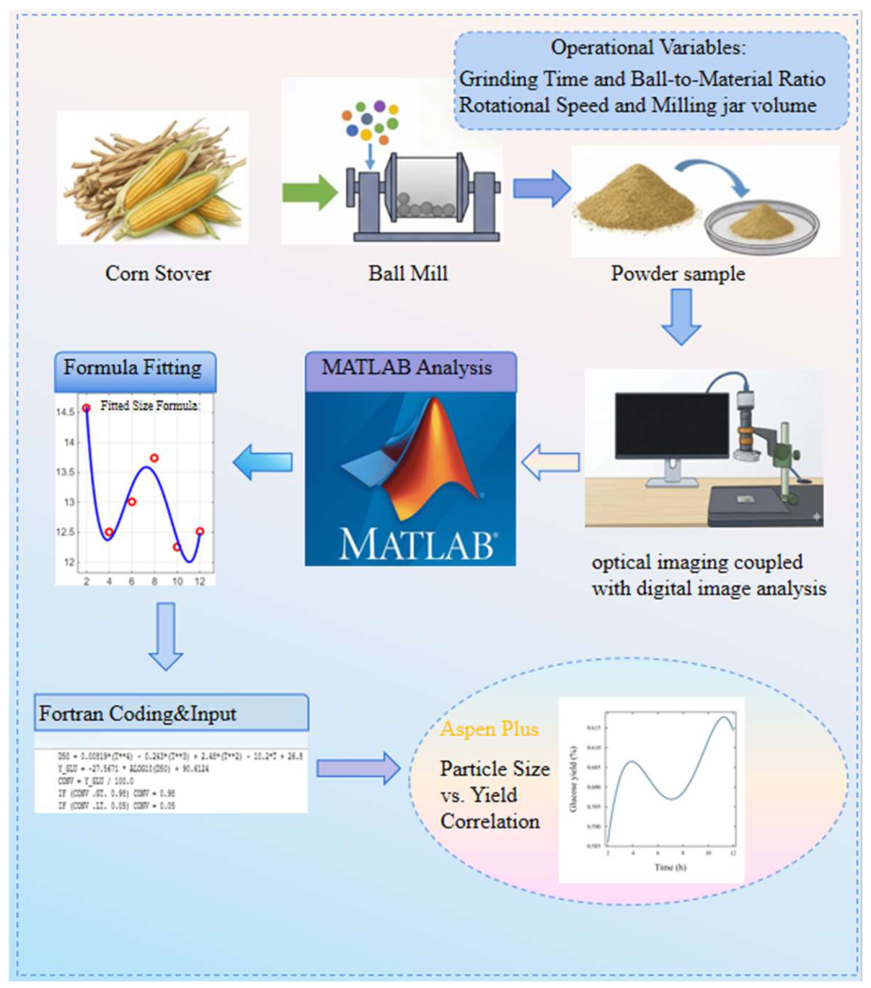
The overall workflow is illustrated in Figure 1. In this study, an integrated experimental–simulation framework is established using corn stover as the feedstock. Pretreatment is executed on a custom-built ball milling platform, where a four-dimensional operating parameter space, which includes milling time, rotational speed, ball-to-powder ratio, and jar volume, is systematically investigated. The resulting particle size distributions are then quantitatively characterized through optical imaging coupled with digital image processing.
Figure 1.
System block diagram.
Polynomial regression is employed to correlate operating parameters with particle size characteristics [28]:
where y represents the mean particle size D50 or the particle size standard deviation σ. x denotes the ball milling time, rotational speed, ball-to-powder ratio, and jar volume. a0, a1, a2, …, ak are the fitting coefficients, and k is the polynomial order. Specifically, polynomial models of order 4 are applied to fit both the mean particle size and the particle size standard deviation for milling time. For rotational speed, both descriptors are represented by polynomial models of order 3. For the ball-to-powder ratio, the mean particle size is fitted by a polynomial model of order 4, whereas the particle size standard deviation is fitted by a polynomial model of order 3. For jar volume, the mean particle size is represented by a polynomial model of order 2, while the particle size standard deviation is described by a polynomial model of order 3. The average particle size D50 is used to characterize the overall particle size level of the sample, and the particle size span is used to quantify the degree of dispersion in the particle size distribution [7]. For each of the four operating parameters, the relationship with D50 and span is fitted independently using the experimental data collected in this study. To bridge the inherent gap between discrete experimental observations and the continuous mathematical requirements of the process simulator, polynomial regression is employed to formulate data-driven surrogate models. The resulting continuous formulations are then incorporated into the Aspen Plus Calculator Module, thereby facilitating subsequent system-level sensitivity analysis.
After completing the fitting between operating conditions and particle size parameters, an empirical relationship between particle size variations and glucose yield is established by extracting data from the work by Chen et al. [7], extending the predictive capability beyond physical pretreatment outcomes. By utilizing mean particle size as an intermediate variable, a cascaded propagation pathway is constructed. Through this pathway, the operational impacts of ball milling are expected to quantitatively propagate through the altered particle size distribution, sequentially modulating enzymatic hydrolysis efficiency and ultimately determining the downstream glucose and ethanol yields. From this, the median particle size D50 is adopted as the representative metric. The empirical correlation establishing the relationship between D50 and glucose yield, as derived from Chen et al. [7], is directly integrated into the Aspen Plus flowsheet. A comparable approach, utilizing a structural descriptor to bridge pretreatment and enzymatic hydrolysis, has been validated in studies involving Napier grass lignin [29].
These fitted relationships enable the Aspen Plus model to predict saccharification performance across varying ball milling conditions. In sensitivity analysis, only one factor varies at a time, whereas the best combination must be identified across all operating windows in process optimization. For this purpose, a normalized parameter-mapping model and a Pareto yield-ranking criterion are introduced based on the multi-objective optimization approach reported by Zitzler et al. [27], and the coupled simulation-and-screening logic is adapted from the process operability strategy demonstrated for modular chemical systems [30]. Each operating variable is mapped from the normalized coding level δ ∈ [0, 1] to its physical value by [26]
where xi is the actual parameter value, and xmin and xmax are the lower and upper bounds of the parameter range. Pareto ranking is then applied to all simulated operating points so that the yields are arranged in descending order, through which the operating condition with the highest glucose yield and the one with the lowest glucose yield are identified. In summary, by integrating the experimentally derived parameter-size relationships and the predictive size-yield correlations, a normalized parameter-mapping pathway is formulated to facilitate the final multi-objective ranking. These relationships are integrated to provide the input foundation for the subsequent Aspen Plus simulation, by which the quantitative coupling between ball milling pretreatment and the saccharification and fermentation process is supported, and the global ranking used for sample selection in the following sections is enabled. Within the Aspen Plus flowsheet, the downstream saccharification and fermentation models are parameterized using benchmark data from optimized ethanol-fermenting Saccharomyces cerevisiae strains [31].
2.1. Ball Milling Experimental Platform
A custom-built laboratory-scale ball milling experimental platform is used in this study, involving a brushless DC motor as the driving core and a digital electronic speed controller as the speed regulation unit. The platform comprises a DC-regulated power supply, a brushless motor, an electronic speed controller, a flight controller, and a 3D-printed ball milling jar assembly. These modules are connected sequentially through standardized interfaces, forming a complete workflow from power supply and control to actuation and milling. The platform design adheres to the core principles of parameter adjustability and structural reproducibility, supporting independent control of key operating parameters including milling speed, milling time, ball-to-powder ratio, and jar volume, thereby meeting the requirements of multi-factor systematic experiments.
The platform utilizes a DC-regulated power supply manufactured by Mean Well (Shenzhen) Hardware Power Supply Technology Co., Ltd. Shenzhen, China, with a rated output voltage of 24 V, a rated output current of 60 A, and a rated output power of 1500 W. This power supply features over-current, over-voltage, and short-circuit protection functions, providing stable DC voltage input to the motor and control system during experiments, effectively preventing speed instability caused by voltage fluctuations.
The drive unit employs an MAD5010 brushless DC motor (JIANGXI MAD MOTOR COMPONENTS Co., Ltd., Nanchang, China) with a KV rating of 240 rpm/V. Under the rated 24 V supply condition, the theoretical no-load maximum speed is approximately 5760 rpm. Under actual loaded conditions, the speed is determined by the duty cycle of the PWM signal output by the electronic speed controller and can be continuously adjusted over a wide range. Compared with brushed motors, brushless motors offer advantages including rapid response, low maintenance requirements, and high-speed control precision, making them well suited for the extended continuous operation demanded by ball milling experiments.
Speed control is achieved using a SpeedyBee F4V3-60-STACK controller kit (Zhuhai SpeedyBee Technology Co., Ltd., Zhuhai, China), which comprises two core modules: a flight controller (model SB-F405-V3) and an electronic speed controller (model SB-BLS-60A). The SB-F405-V3 flight controller is based on the STM32F405 high-performance microcontroller and supports precise configuration of the output PWM signal frequency and duty cycle through host software, enabling digital presetting of the target speed. The SB-BLS-60A electronic speed controller has a continuous current rating of 60 A and a peak current capability sufficient to handle the transient loads encountered during milling operations.
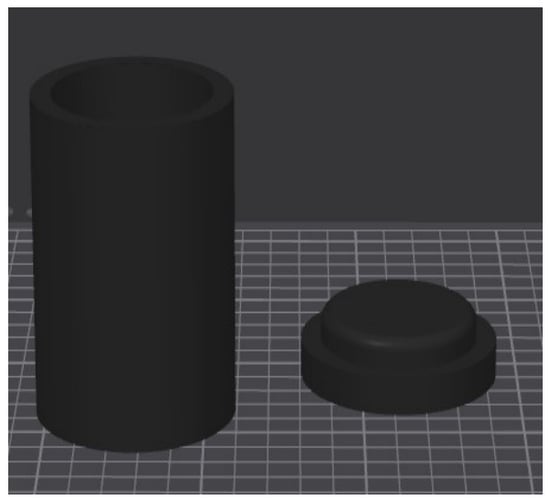
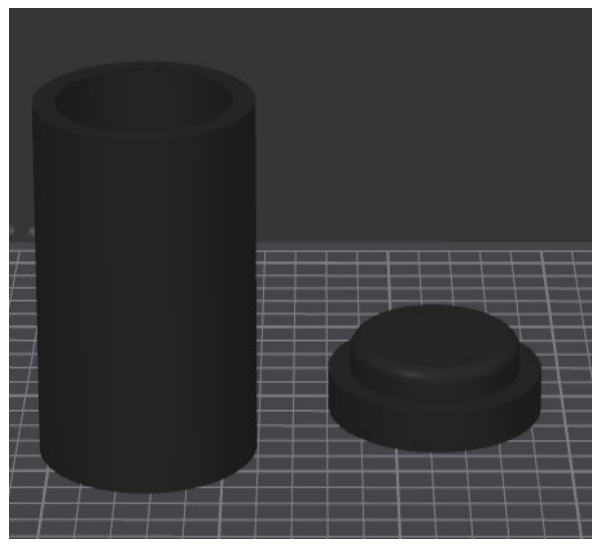
The ball milling jar and motor bracket are fabricated using fused deposition modeling (FDM) 3D printing. The milling jar features a cylindrical, sealed construction in which the lid is connected to the body via a threaded joint, ensuring effective sealing to prevent material leakage during the milling process, as shown in Figure 2. The jar has external dimensions of 89.24 × 146.76 × 84.50 mm and an internal volume of 163.21 cm3, which matches the nominal 150 mL working volume required for the experiments.
Figure 2.
Ball milling jar.
2.2. Optical Image Acquisition Platform
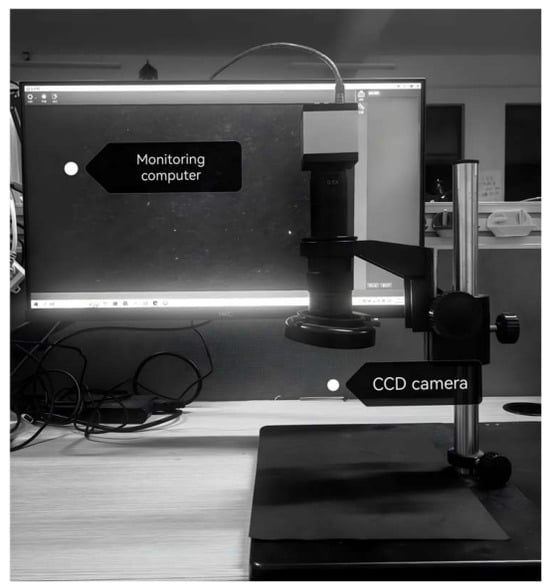
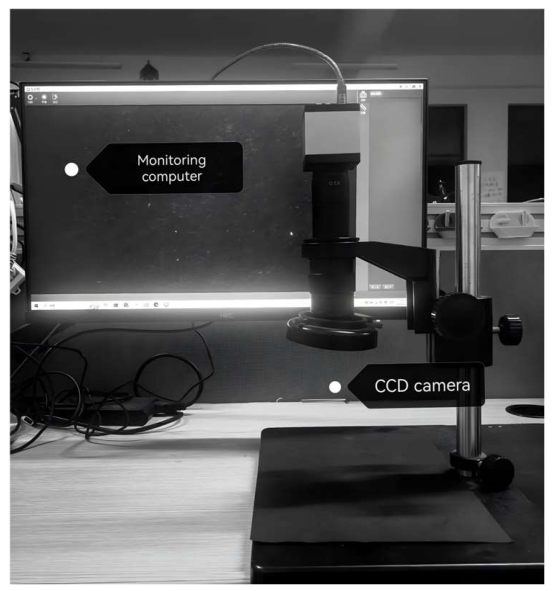
As shown in Figure 3, particle size images are acquired using an H1400 USB camera at a resolution of 1280 × 720 pixels. The camera communicates with the monitoring computer through the DirectShow interface supported by S-EYE software (Version 1.0.0.1). A dedicated optical magnification lens and an adjustable mounting bracket are used to maintain consistent focal distance and illumination across samples. The captured images are transmitted to the monitoring terminal for real-time display and subsequent MATLAB R2025a-based image processing, where for each milling condition, they are homogenized and divided into 10 portions for optical imaging.
Figure 3.
Optical monitoring system.
2.3. Aspen Plus Process Platform
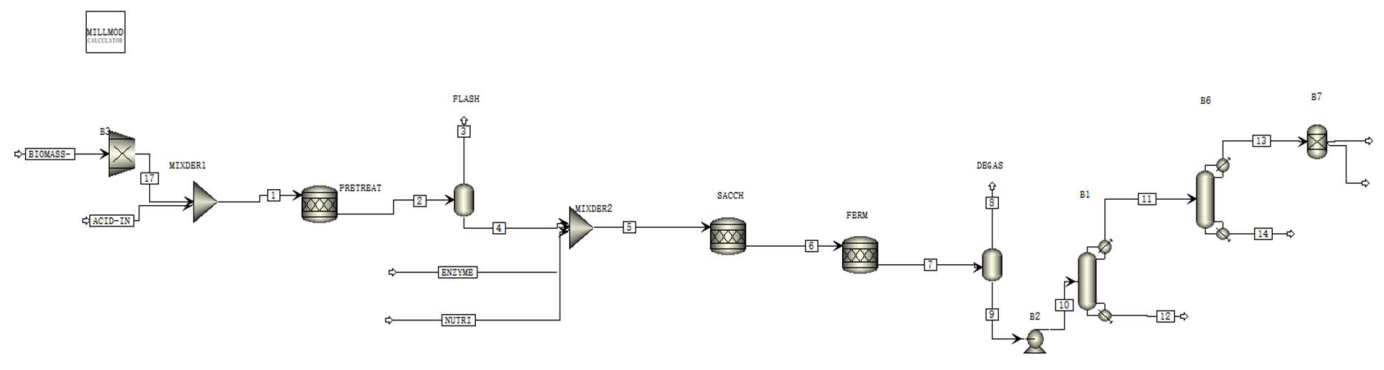
To further evaluate the impact of ball milling pretreatment on lignocellulosic ethanol yield and to couple the experimental fitting results with the process simulation, an Aspen Plus V14 flowsheet is established to simulate a biomass-to-ethanol process in this study. Within this flowsheet, a comprehensive bioethanol process model is constructed, encompassing ball milling, acid pretreatment, flash evaporation, enzymatic hydrolysis, fermentation, degassing, and distillation separation. For the Aspen Plus simulation, the corn stover feedstock composition is adopted from the benchmark basis reported in the referenced process model to maintain consistency with the downstream pretreatment and hydrolysis conditions. The major dry-basis components included glucan, xylan, lignin, extractives, ash, and protein [32]. The raw biomass stream (BIOMASS) first enters the ball milling unit (B3), which characterizes the regulatory effect of the milling process on particle size. The milled material stream (17) and acid input (ACID-IN) are combined in a mixer (MIXDEACID) and directed to the acid pretreatment reactor. Subsequent unit operations sequentially accomplish hemicellulose hydrolysis, solid–liquid separation, enzymatic saccharification of the cellulose-rich residue, fermentation of released sugars, and ethanol recovery through distillation in Figure 4.
Figure 4.
Aspen Plus process flow diagram.
Hydrolysis and pretreatment settings followed the NREL benchmark (NREL/TP-5100-47764) [32]: enzymatic hydrolysis is set at 48 °C, 20 wt% solids, 20 mg protein g−1 cellulose, pH 5.0, and 84 h, while the preceding dilute-acid pretreatment was set at 158 °C for 5 min with 18 mg H2SO4 g−1 dry biomass at 30 wt% solids.
As illustrated in Figure 4, the combined Calculator and Sensitivity modeling approach is employed to incorporate the ball milling experimental results into the Aspen Plus flowsheet. In the Calculator Module (MILLMOD), the relationship between milling conditions and saccharification conversion is encoded in FORTRAN calculation statements. Based on the fitting formula, the post-milling particle size parameter D50 is first computed, then it is converted into glucose yield through the established correlation between particle size and glucose yield, and finally it is translated into the saccharification reaction conversion rate, which is written into the SACCH reactor block.
To execute the sensitivity analysis, the continuous parameter space of the ball milling variables is systematically explored within the Aspen Plus environment. Within the specified operating variable ranges, 50 calculation points are set to examine the system output variation patterns under different milling conditions. The output metrics primarily include the saccharification reaction conversion rate and its corresponding glucose yield, enabling comparison of the effects of different milling conditions on process performance.
At each operating point, the Calculator–Sensitivity workflow solves the Aspen Plus model to a steady-state solution, and the corresponding glucose yield is recorded directly for comparative ranking across the parameter space.
3. Results and Discussion
Raw corn stover sourced from Jining, China, is air-dried and cut into 3 to 5 cm segments prior to pretreatment at ambient temperature in a planetary ball mill featuring 3D-printed jars and 5 mm stainless-steel grinding medium. Single-factor experiments were designed to investigate specific parameters. The initial trials utilizes a fixed sample loading of 3.0 g, where the required substrate-to-ball mass ratio governs the exact number of balls used (for instance, 115 balls corresponded to a 1:20 ratio). These initial tests include varying the milling time between 2 and 12 h at 600 rpm with a 1:20 mass ratio, evaluating rotational speeds from 400 to 600 rpm for 6 h at the same ratio, and examining mass ratios from 1:10 to 1:50 at 600 rpm for 6 h. Furthermore, to assess the impact of jar capacities at 50, 100, 150, and 200 mL, the sample loading was proportionally scaled to 1, 2, 3, and 4 g, respectively. Simultaneously, the number of balls is adjusted to maintain a consistent 1:20 mass ratio while operating at 600 rpm for 4 h.
The particle size distribution of the milled corn stover is systematically analyzed. The standard deviation is utilized to indicate the distribution width. A constant minimum detectable limit of 2.82 μm is maintained across all trials. The distribution variance is primarily governed by maximum particle size fluctuations. The persistence of coarse fractions is dictated by energy input. Unground fibers up to 269.14 μm are retained at 400 rpm. These chunks are effectively disintegrated at 600 rpm. The maximum particle size is compressed to 138.03 μm at 6 h, achieving a minimized standard deviation. Agglomeration of ultrafine particles is triggered by prolonged milling at 12 h, rebounding the maximum size to 180.71 μm. This fluctuation is attributed to the dynamic competition between particle breakage and particle agglomeration during ball milling. At relatively low-to-moderate milling intensity, fragmentation dominates and promotes particle size reduction, whereas excessive milling duration or rotational speed increases the surface activity of ultrafine particles and favors re-agglomeration, leading to a rebound in the apparent particle size. Extended free-fall trajectories are provided by utilizing a 200 mL jar volume, eliminating internal dead zones. A global minimum maximum particle size of 105.13 μm is achieved. The most homogeneous distribution with a 12.98 μm standard deviation is ultimately produced.
3.1. Nonlinear Effects of Ball Milling Operating Conditions on Particle Size Characteristics
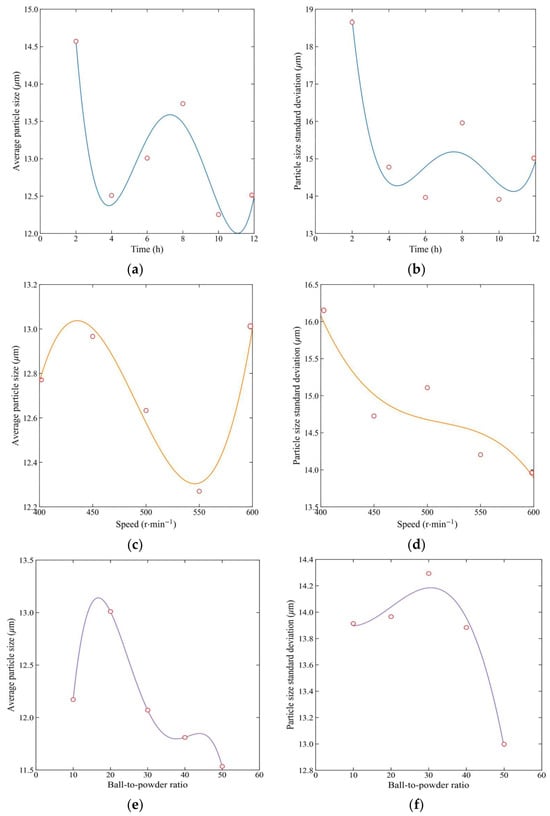
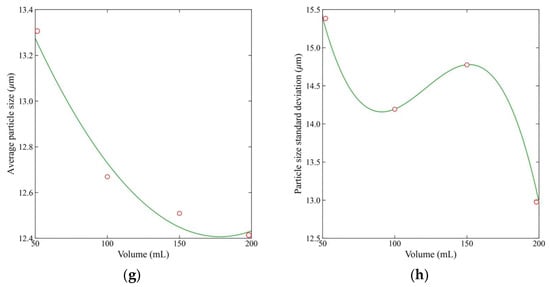
Particle fragmentation, depolymerization and surface agglomeration exist in a dynamic competitive state throughout the milling process. Accordingly, these operational parameters exert no linear influence on the average particle size and particle size standard deviation but present complex evolutionary rules. The corresponding experimental results are shown in Figure 5.
Figure 5.
Effects of different ball milling operating parameters on the mean particle size and particle size standard deviation of corn stover: (a) Average particle size over milling time. (b) Particle size standard deviation over milling time. (c) Average particle size over milling speed. (d) Particle size standard deviation over milling speed. (e) Average particle size over ball-to-powder ratio. (f) Particle size standard deviation over ball-to-powder ratio. (g) Average particle size over milling jar volume. (h) Particle size standard deviation over milling jar volume.
Representative 95% confidence intervals of the mean are provided for the results shown in Figure 5a,c,e,g to improve the statistical transparency of the mean particle size analysis. In the milling-time series, the mean particle size changed from 14.570 ± 0.843 μm at 2 h to 12.253 ± 0.493 μm at 10 h. In the rotational-speed series, the minimum value is 12.270 ± 0.503 μm at 550 rpm. In the ball-to-powder-ratio series, the value decreased to 11.533 ± 0.430 μm at 1:50. In the jar-volume series, the value changed from 13.294 ± 0.598 μm at 50 mL to 12.412 ± 0.446 μm at 200 mL. Here, ± denotes the half-width of the 95% confidence interval of the mean [33].
Figure 5a illustrates the effect of milling time. During the initial 2 and 4 h, kinetic energy impact dominated particle cleavage, leading to a rapid reduction in mean particle size. However, this reduction rate decelerated at approximately 6 h, and by 8 h, a slight increase in mean particle size was observed due to the re-aggregation of freshly generated fine particles under elevated surface energy [9]. Sustained mechanical shearing beyond 8 h disrupted these agglomerates, causing a renewed size reduction until an equilibrium plateau was reached between 11 and 12 h. Notably, while the maximum particle size was compressed to 138.03 μm at 6 h, it rebounded to 180.71 μm by 12 h. Overall, milling time significantly governs both the extent of size reduction and the onset of re-aggregation.
As shown in Figure 5c, rotational speed dictates the energy delivered per impact event. Higher speeds generate greater kinetic energy per collision, consequently delaying re-aggregation. For instance, while an unground fibrous fraction of 269.14 μm remained at 400 rpm, increasing the speed to 600 rpm successfully disintegrated these chunks, minimizing the particle size standard deviation. Figure 5c demonstrates that the ball-to-powder ratio controls both the frequency and spatial uniformity of effective collisions. Although higher ratios generally produce more uniform particle size distributions, the marginal improvement diminishes beyond a 1:20 ratio, suggesting that contact opportunities saturate once the ball count exceeds a critical density.
Figure 5e demonstrates the influence of the ball-to-powder ratio, which controls both the frequency and spatial uniformity of effective collisions within the jar. Although higher ratios generally produced more uniform particle size distributions, the marginal improvement in size reduction diminished beyond a 1:20 ratio. This suggests that once the ball count exceeds a critical density, the contact opportunities per particle become saturated.
The effect of jar volume, which regulates the available impact path length and modulates collision probability through spatial confinement, is depicted in Figure 5g. While smaller volumes increased collision frequency, they simultaneously restricted batch capacity. An optimal volume of 200 mL provided extended free-fall trajectories and eliminated internal dead zones. Consequently, this volume achieved a global minimum for the maximum particle size (105.13 μm) alongside a minimal standard deviation of 12.98 μm.
In summary, each of the four parameters controls distinct milling mechanisms: milling time and rotational speed primarily dictate the total energy input, whereas the ball-to-powder ratio and jar volume regulate the spatial distribution and frequency of effective collisions. Because similar parameter responses have been reported across various milling modes [22], optimizing the particle size distribution for downstream enzymatic saccharification requires joint consideration of all these interacting factors. Even with prolonged milling, further particle size reduction and yield improvement may be achieved under more aggressive conditions, such as extended milling durations beyond 12 h or the use of alternative milling configurations [34,35]. The effectiveness of ball milling is not limited to corn stover; it has also been applied to improve methane yield from horse manure [36].
3.2. Aspen Plus Sensitivity Analysis and Process Optimization
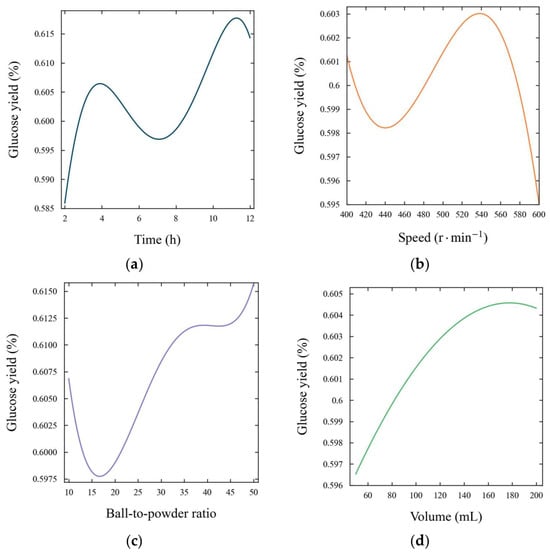
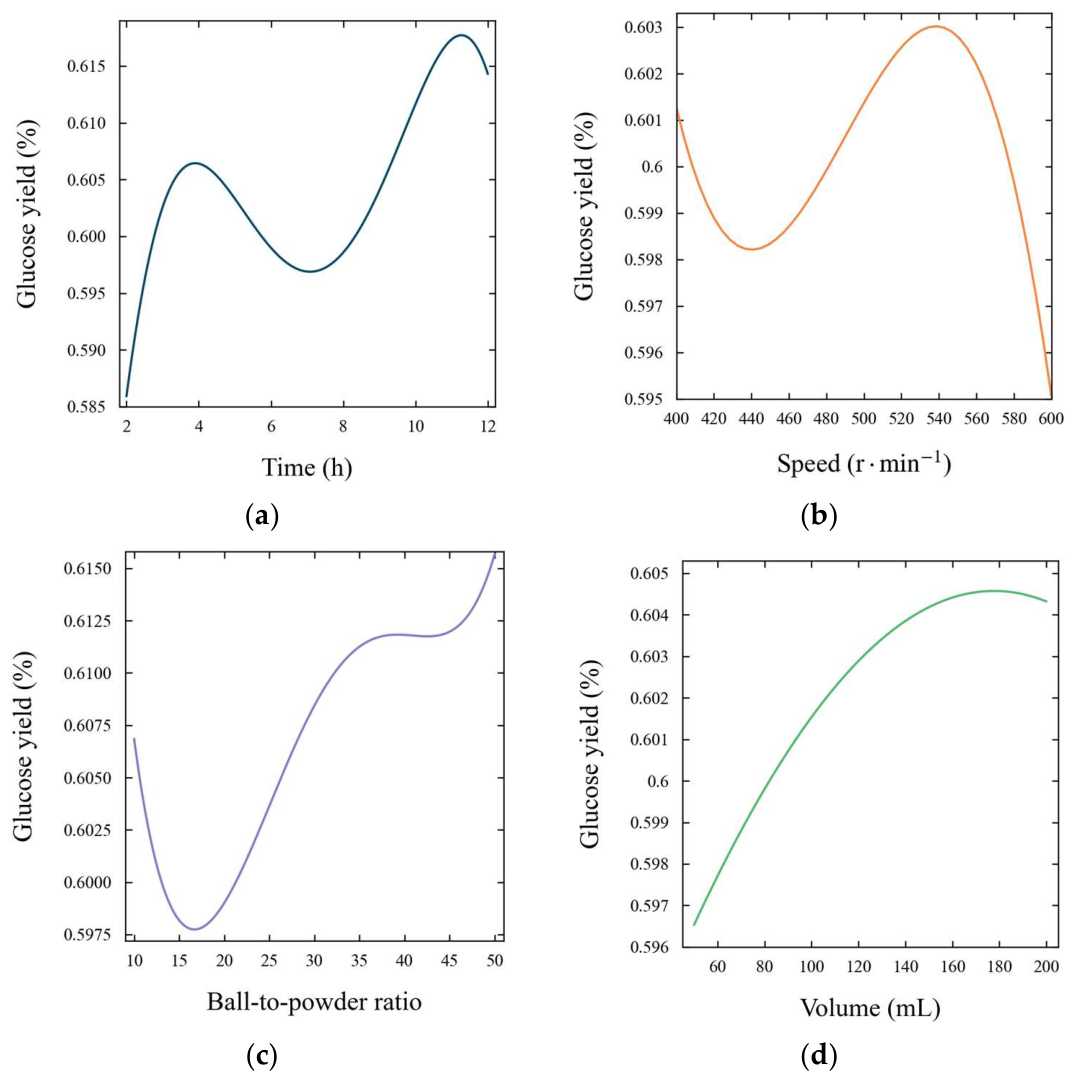
To evaluate the applicability of the particle size regulation patterns at the system process level, the particle size evolution model constructed in Section 3.1 was embedded into the Aspen Plus full-process simulation platform via the Calculator Module, MILLMOD. Through the Sensitivity Module, the effects of the ball milling operating variables on the final glucose yield were systematically examined across continuous variation ranges. The sensitivity analysis results in Figure 6 reveal the complex mapping relationship between the mechanical pretreatment parameters and glucose yield.
Figure 6.
Sensitivity analysis curves of glucose yield under different ball milling operating conditions: (a) Glucose yield over milling time. (b) Glucose yield over milling speed. (c) Glucose yield over ball-to-powder ratio. (d) Glucose yield over milling jar volume.
As illustrated in Figure 6, the mapping relationship between mechanical pretreatment parameters and saccharification performance is highly nonlinear, reflecting a dynamic competition between structural deconstruction and particle re-aggregation. Milling time and rotational speed in Figure 6a,b, which primarily dictate the total energy input, both exhibit pronounced fluctuation patterns. Specifically, the yield curve for milling time displays a characteristic dual-peak trend: an initial increase in yield (peaking at 60.6%) driven by rapid particle size reduction is followed by a notable decline to 59.7% at approximately 7 h. This decline directly corroborates the microscale agglomeration phenomenon, where high-surface-energy ultrafine particles adhere and re-encapsulate the disrupted cellulose structures, thereby impeding enzyme binding. Yield only reaches its global maximum of 61.8% when prolonged milling (near 11 h) or a precisely controlled rotational speed provides sufficient sustained shear to disrupt these agglomerates without inducing severe structural compaction, which would otherwise occur at excessive speeds like 600 rpm.
Concurrently, the ball-to-powder ratio and jar volume in Figure 6c,d, which govern the spatial distribution and frequency of effective collisions, both demonstrate a steady ascent towards a saturation plateau. Expanding the jar volume extends the free-fall trajectories of the grinding medium and eliminates internal dead zones, while raising the ball-to-powder ratio ensures that the contact opportunities per biomass particle are maximized.
By jointly considering these interacting mechanisms, the system overcomes the penalties of insufficient kinetic energy and over-milling agglomeration, ultimately converging on a highly robust and optimal process window: a milling time of 10 to 11 h, a rotational speed of 540 to 560 rpm, a ball-to-powder ratio of 40 to 50, and a jar volume of 160 to 190 mL.
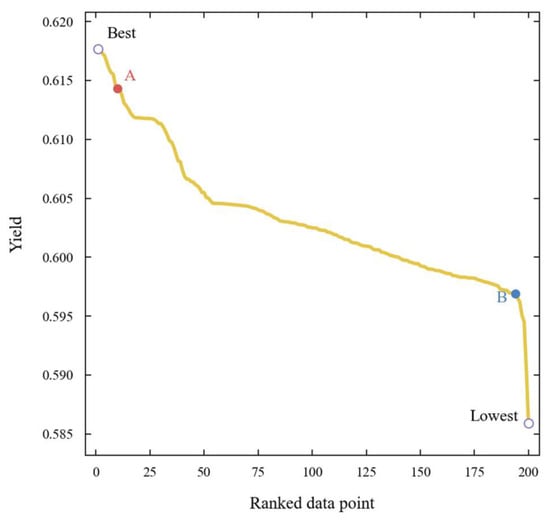
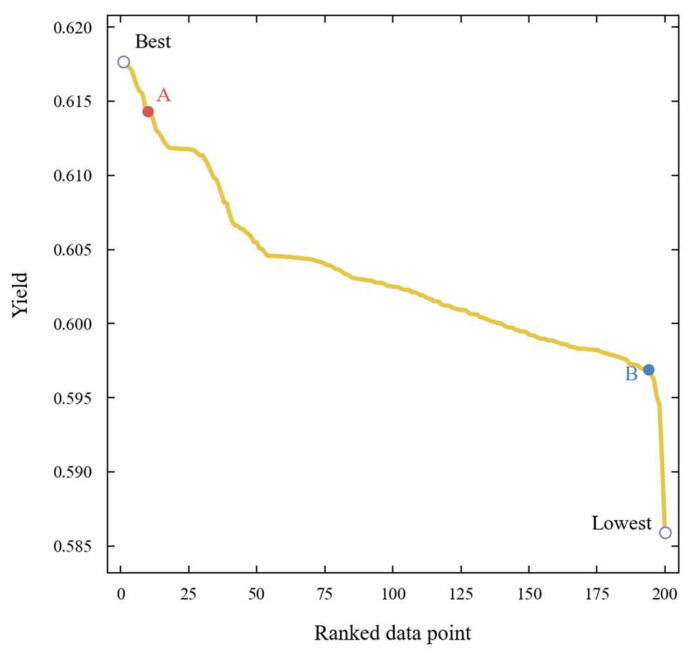
Simulated operating conditions are represented by each point on the curve. The simulated yields are arranged in descending order. As depicted in Figure 7, the global maximum yield of 0.6177 is identified at the left starting point with a milling time of 11.2 h. The global minimum yield of 0.5859 is located at the rightmost endpoint with a milling time of 2.0 h. Guided by these simulated boundaries, representative operating points are extracted. These selected conditions are summarized in Table 1. The points are ranked in descending order based on the final glucose yield. The maximum yield of 0.6143 is obtained at the optimal point Rank 1. The minimum yield of 0.5965 is observed at Rank 5 under restricted milling conditions. An interpolated value is included at Rank 2 to supplement the yield trend. The quantitative variation in glucose yield across different optimization regions is clearly demonstrated by these ranked conditions.
Figure 7.
Pareto-based global ranking profile of glucose yield across the continuous parameter space of ball milling pretreatment.
Table 1.
Ranked ball milling operating conditions and corresponding glucose yields derived from the Pareto frontier.
For validation of the simulation predictions, two extreme operating conditions with the greatest yield difference are selected from the Pareto curve for sample characterization. Sample A at 12 h, 600 rpm, BPR 20, 150 mL with a simulated yield of 0.6143 is located in the high-yield region. It represents effective depolymerization of the cellulose structure under sufficient milling. Sample B at 4 h, 600 rpm, BPR 20, 50 mL with a simulated yield of 0.5965 is located in the low-yield region. It corresponds to insufficient milling under inadequate mechanical energy input. Identical rotational speed together with identical ball-to-powder ratio is shared by the two conditions. The yield difference of approximately 2.97% is therefore attributable entirely to the differences in milling time and in jar volume. This is consistent with the sensitivity analysis finding that these two parameters are the core drivers of yield variation. Validation at operating points predicted by simulation follows the approach used by Ajorloo et al. [37] for biomass conversion.
3.3. Sample Characterization Analysis
Ball-milled pretreatment samples prepared under the above two extreme conditions are subjected to SEM, DTG, and other characterization techniques to elucidate the microstructural differences between high-yield and low-yield conditions, ultimately forming a complete research chain from simulation prediction to experimental validation.
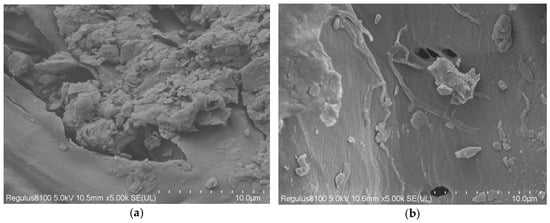
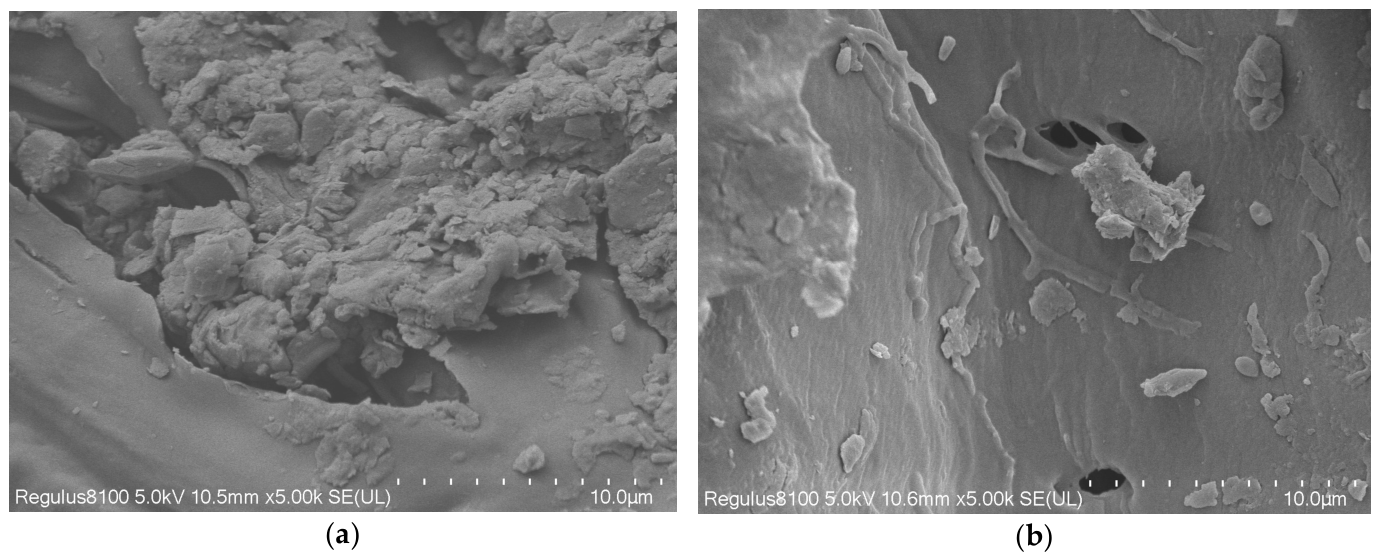
The morphology of ball-milled corn stover was examined using a Hitachi Regulus 8100 scanning electron microscope (Hitachi High-Technologies Corporation, Tokyo, Japan). Prior to observation, the samples were sputter-coated with gold to improve electrical conductivity. As observed from the SEM image of Sample A in Figure 8a, a highly fragmented microstructure is exhibited [7]. The original bundled structure of cellulose in corn stover was essentially disintegrated. Large numbers of irregular particles are visible in the field of view. The milled particles exhibited a highly uniform packing morphology, underpinned by a strictly narrow particle size distribution. Morphologically, the milled particles exhibited substantially reduced dimensions, characterized by highly roughened topographies and the proliferation of abundant porous architectures. An excellent correspondence with the high yield predicted by the Aspen Plus simulation is thereby formed.
Figure 8.
SEM images of corn stover under two ball milling conditions: (a) Sample A (optimal conditions; high glucose yield); (b) Sample B (suboptimal conditions; low glucose yield).
For Sample B in Figure 8b, a markedly different microstructural morphology is presented. The original bundled, layered structure of cellulose remains largely preserved. Parallel-aligned fibrous lamellae are clearly visible in the field of view. The surfaces appear relatively smooth and intact. Fracture is confined to localized regions of the fiber surfaces. A small amount of granular debris is attached. The overall particle size is significantly larger than that of Sample A. The inter-fiber spacing is small. The porosity is low. The effective surface area accessible to cellulase molecules is therefore considerably smaller than that under the high-yield condition.
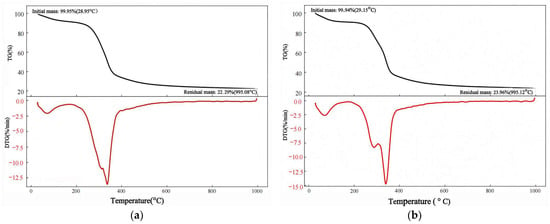
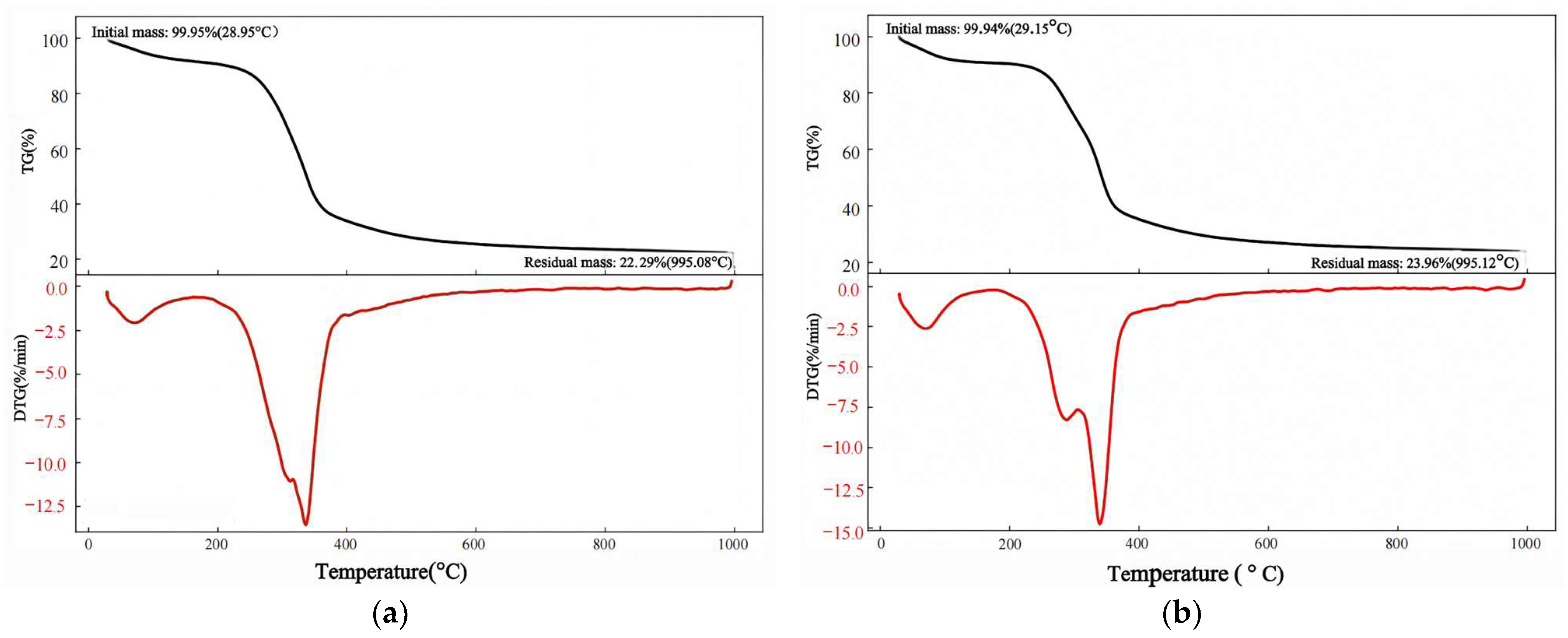
Thermogravimetric analysis is performed on a Netzsch STA 449 F5 instrument (NETZSCH Analyzing & Testing, Selb, Germany). Approximately 5–10 mg of each sample is placed in an alumina crucible. The temperature is ramped from 30 °C to 800 °C at a heating rate of 10 °C/min under a nitrogen atmosphere with a flow rate of 20 mL/min. The TG and DTG curves are recorded simultaneously. The TGA heating condition adopted in this work is selected with reference to the thermogravimetric method reported by Chen et al. [7] for ball-milled corn stover. Mechanical pretreatment not only alters the apparent morphology of the material but also affects its internal chemical bond connectivity and crystallinity [7], which is reflected in differences in thermal stability. As shown in Figure 9, the DTG curves of the two samples show distinct thermal degradation behavior. For the low-yield Sample B, the primary weight loss peak is located at 337.60 °C. The peak shape is relatively sharp, and it exhibits a higher maximum weight loss rate. This sharp degradation profile indicates that an ordered crystalline network is largely retained by the cellulose macromolecules within the sample, conferring strong overall resistance to thermal decomposition. For Sample A, the thermal degradation peak shifts to a lower temperature of 328.75 °C, and the absolute maximum weight loss rate visibly decreases. Furthermore, Sample A exhibits a broader degradation profile. Based on the thermogravimetric step analysis, the mass loss of the main degradation stage for Sample A is 64.90%, whereas the corresponding value for Sample B is 61.93%. The 8.85 °C reduction in the peak temperature and the lower maximum degradation rate, together with the 2.97 percentage point increase in main stage mass loss, indicate that dual structural disruption is achieved under the optimal ball milling conditions. The external physical dense layer is broken down, and the internal crystallinity is reduced [24]. Beyond cellulose and hemicellulose disruption, ball milling has been shown to affect the ethanol fractionation behavior of lignin [38], which may further influence overall biomass conversion efficiency.
Figure 9.
DTG curves of corn stover samples under two ball milling conditions: (a) TG and DTG curves of milled biomass Sample A. (b) TG and DTG curves of milled biomass Sample B.
4. Conclusions
An integrated experimental–simulation framework is developed for multi-parameter optimization of ball milling pretreatment, tailored for high-yield lignin refining. A systematic series of ball milling experiments is conducted to explore a four-dimensional operational space, including milling time, rotational speed, ball-to-powder ratio, and jar volume. Particle size characteristics, quantitatively captured via optical imaging coupled with digital image analysis, serve as the foundation for empirical polynomial models mapping operational parameters to physical outcomes. Integrating these surrogate models into the Aspen Plus simulation environment enables comprehensive system-level optimization, strategically directed toward maximizing final glucose yield.
Unlike previous studies that varied milling parameters in isolation or relied solely on experimental trials, this work establishes an integrated experimental–simulation linkage that connects measurable particle size descriptors to downstream glucose yield. Within the investigated parameter space, the coupled model identifies a favorable operating window for enhanced glucose conversion: when milling time ranges from 10 to 11 h, rotational speed is between 540 and 560 rpm, the ratio of ball to powder is 40 to 50, and jar volume spans 160 to 190 mL, a 2.97% improvement in glucose yield is achieved relative to suboptimal settings. From these results, milling time is identified as the dominant factor governing particle size reduction, followed by ball-to-powder ratio and jar volume, while rotational speed shows the smallest contribution. Optimal milling conditions disintegrate the dense cellulose structure, increase the specific surface area, and reduce the thermal degradation peak temperature to 312 °C. These findings demonstrate that systematic multi-parameter optimization of ball milling, guided by particle size as an intermediate descriptor, can effectively enhance enzymatic convertibility of lignocellulosic biomass. The proposed framework provides a generalizable strategy for systematically optimizing pretreatment parameters to maximize the saccharification yield of lignocellulosic biomass.
Future work will further examine wider parameter intervals and more practically differentiated operating conditions to evaluate whether larger performance differences can be identified beyond the present dense-sampling framework. Additional work could also develop the Aspen Plus Dynamics simulation that captures real-time evolution of particle size during ball milling. Additional control points, such as online particle size monitoring and feedback adjustment of milling parameters, could be integrated into this dynamic framework. Such a dynamic model would enable prediction of glucose yield under time-varying operating conditions, offering a more accurate basis for process control and optimization. Further work could also incorporate energy-integration analysis to evaluate overall process efficiency under different milling conditions. Additional chemical experiments remain necessary in future work to evaluate the optimum conditions identified by the model for the conversion of milled corn stover into glucose. The interaction effects among milling parameters could also be further examined through a more systematic multivariable design.
Author Contributions
Conceptualization, K.X. and S.G.; investigation, K.X. and Y.L.; resources, K.X. and S.G.; data curation, K.X. and Y.L.; writing—original draft preparation, K.X. and J.W.; writing—review and editing, K.X. and S.G.; supervision, J.W., S.G. and C.S.; project administration, S.G.; funding acquisition, S.G. and C.S.; guided the research scheme and revised the manuscript: C.S. All authors have read and agreed to the published version of the manuscript.
Funding
This research study was funded by Natural Science Foundation of China, grants number 22408027 and 52272440, and Suzhou Science Foundation, grant number SYG202323.
Data Availability Statement
Data available upon request from the authors.
Acknowledgments
We are grateful to our co-author Y.L., who single-handedly carried out the Aspen Plus process simulation and also helped with checking the figures and data during manuscript submission. The authors extend their gratitude to Lan Jingheng for providing the CCD apparatus used in this study. The authors extend their gratitude to Chou (Scientific Compass; www.shiyanjia.com) for providing invaluable assistance with the degree of polymerization analysis.
Conflicts of Interest
The authors declare no conflicts of interest.
References
- Dharmaraja, J.; Shobana, S.; Arvindnarayan, S.; Francis, R.R.; Jeyakumar, R.B.; Saratale, R.G.; Ashokkumar, V.; Bhatia, S.K.; Kumar, V.; Kumar, G. Lignocellulosic biomass conversion via greener pretreatment methods towards biorefinery applications. Bioresour. Technol. 2023, 369, 128328. [Google Scholar] [CrossRef] [Scilit] [PubMed]
- Luo, Z.; Qian, Q.; Sun, H.; Wei, Q.; Zhou, J.; Wang, K. Lignin-First Biorefinery for Converting Lignocellulosic Biomass into Fuels and Chemicals. Energies 2023, 16, 125. [Google Scholar] [CrossRef] [Scilit]
- Lisý, A.; Ház, A.; Nadányi, R.; Jablonský, M.; Šurina, I. About Hydrophobicity of Lignin: A Review of Selected Chemical Methods for Lignin Valorisation in Biopolymer Production. Energies 2022, 15, 6213. [Google Scholar] [CrossRef] [Scilit]
- Sitotaw, Y.W.; Habtu, N.G.; Gebreyohannes, A.Y.; Nunes, S.P.; Gerven, T.V. Ball milling as an important pretreatment technique in lignocellulose biorefineries: A review. Biomass Convers. Biorefinery 2023, 13, 15593–15616. [Google Scholar] [CrossRef] [Scilit]
- Kessler, M.; Rinaldi, R. Kinetic Energy Dose as a Unified Metric for Comparing Ball Mills in the Mechanocatalytic Depolymerization of Lignocellulose. Front. Chem. 2022, 9, 816553. [Google Scholar] [CrossRef] [Scilit] [PubMed]
- Begali, D.D.O.; Oliveira, A.C.S.D.; Ferreira, L.F.; Oliveira, C.R.D.; Batista, L.R.; Assis, O.B.G.D.; Yoshida, M.I.; Borges, S.V. Properties of Lignin Microparticles Prepared by Mechanical Treatment. Cellul. Chem. Technol. 2021, 55, 529–537. [Google Scholar] [CrossRef] [Scilit]
- Chen, X.; He, D.; Hou, T.; Lu, M.; Mosier, N.S.; Han, L.; Xiao, W. Structure-property-degradability relationships of varisized lignocellulosic biomass induced by ball milling on enzymatic hydrolysis and alcoholysis. Biotechnol. Biofuels Bioprod. 2022, 15, 36. [Google Scholar] [CrossRef] [Scilit] [PubMed]
- Xie, D.; Liu, Z.; Cao, Y.; Yang, S.; Su, C.; Li, M. Improving antioxidant activities of water-soluble lignin-carbohydrate complex isolated from wheat stalk through prolonging ball-milling pretreatment and homogeneous extraction. J. Bioresour. Bioprod. 2024, 9, 113–125. [Google Scholar] [CrossRef] [Scilit]
- Fortunato, M.R.C.; Silva San Gil, R.A.D.; Borre, L.B.; Barros, R.D.R.O.D.; Ferreira-Leitão, V.S.; Teixeira, R.S.S. Influence of Planetary Ball Milling Pretreatment on Lignocellulose Structure. BioEnergy Res. 2023, 16, 2068–2080. [Google Scholar] [CrossRef] [Scilit]
- Memarvar, D.; Yaqoubi, S.; Hamishehkar, H.; Lam, M.; Nokhodchi, A. Impact of grinding balls on the size reduction of Aprepitant in wet ball milling procedure. Pharm. Dev. Technol. 2024, 29, 353–358. [Google Scholar] [CrossRef] [Scilit] [PubMed]
- Ng, L.Y.F.; Ariffin, H.; Yasim-Anuar, T.A.T.; Farid, M.A.A.; Hassan, M.A. High-energy ball milling for high productivity of nanobiochar from oil palm biomass. Nanomaterials 2022, 12, 3251. [Google Scholar] [CrossRef] [Scilit] [PubMed]
- Joy, J.; Krishnamoorthy, A.; Tanna, A.; Kamathe, V.; Nagar, R.; Srinivasan, S. Recent Developments on the Synthesis of Nanocomposite Materials via Ball Milling Approach for Energy Storage Applications. Appl. Sci. 2022, 12, 9312. [Google Scholar] [CrossRef] [Scilit]
- Kun, J.E.T.S.; Rutherford, A.P.; Learn, R.S.; Atwater, M.A. Parametric Study of Planetary Milling to Produce Cu-CuO Powders for Pore Formation by Oxide Reduction. Materials 2023, 16, 5407. [Google Scholar] [CrossRef] [Scilit] [PubMed]
- Kaya, Y.; Kobya, V.; Mardani, A.; Mardani, N.; Beytekin, H.E. Effect of grinding conditions on clinker grinding efficiency: Ball size, mill rotation speed, and feed rate. Buildings 2024, 14, 2356. [Google Scholar] [CrossRef] [Scilit]
- Sitotaw, Y.W.; Habtu, N.G.; Gerven, T.V. Intensification of low concentration alkaline pretreatment with planetary ball milling for efficient enzymatic saccharification of enset fiber (Ensete ventricosum). Biomass Convers. Biorefinery 2023, 13, 14097–14112. [Google Scholar] [CrossRef] [Scilit]
- Pang, J.; Zheng, M.; Li, X.; Sebastian, J.; Jiang, Y.; Zhao, Y.; Wang, A.; Zhang, T. Unlock the Compact Structure of Lignocellulosic Biomass by Mild Ball Milling for Ethylene Glycol Production. ACS Sustain. Chem. Eng. 2019, 7, 679–687. [Google Scholar] [CrossRef] [Scilit]
- Zhuang, X.; Chen, Y.; Wang, S.; Zhong, K.; Sui, W.; Ma, C.; Wu, M. Steam Explosion Enhances the Powder Property, Instant Solubility, and Diffusivity of Superfine Ground Tea Powder. Foods 2025, 14, 1345. [Google Scholar] [CrossRef] [Scilit] [PubMed]
- Lauren, M.; Han, N.; Yoo, C.G.; Jeong, K.; Koo, B.; Kim, K.H. Novel Biorefinery Approach through a Biocompatible Deep Eutectic Solvent-Mediated One-Pot Mechanochemical Conversion. Energy Fuels 2025, 39, 14645–14653. [Google Scholar] [CrossRef] [Scilit]
- Yang, J.; Gao, C.; Yang, X.; Su, Y.; Shi, S.; Han, L. Effect of combined wet alkaline mechanical pretreatment on enzymatic hydrolysis of corn stover and its mechanism. Biotechnol. Biofuels Bioprod. 2022, 15, 31. [Google Scholar] [CrossRef] [Scilit] [PubMed]
- Alizadeh, H.R.; Kansedo, J.; Tan, I.S.; Tan, Y.H.; Suali, E.; Dini, A. Comparative study of ultrasound-assisted ZnCl2, LiBr, and choline chloride/lactic acid pretreatments for cellulose extraction from sea mango (Cerbera odollam) fibre waste, followed by ball milling: Yield and physicochemical analysis. Cellulose 2025, 32, 7083–7112. [Google Scholar] [CrossRef] [Scilit]
- Tan, X.; Qiu, S.; Xia, A.; Lin, K.; Huang, Y.; Zhu, X.; Cai, K.; Wei, Z.; Zhu, X.; Liao, Q. Simultaneous pretreatment of wheat straw with ball-milling and laccase to improve saccharification and exergy analysis of pretreatment-enzyme hydrolysis process. Energy 2025, 334, 137635. [Google Scholar] [CrossRef] [Scilit]
- Licari, A.; Monlau, F.; Solhy, A.; Buche, P.; Barakat, A. Comparison of various milling modes combined to the enzymatic hydrolysis of lignocellulosic biomass for bioenergy production: Glucose yield and energy efficiency. Energy 2016, 102, 335–342. [Google Scholar] [CrossRef] [Scilit]
- Gao, Y.; Zhang, W.; Asadollahi, M.A.; Liu, C.; Yu, G.; Li, H.; Li, B. The effect of combining mineral salt with ball milling for promoting enzymatic saccharification of cellulose. Biomass Bioenergy 2025, 193, 107577. [Google Scholar] [CrossRef] [Scilit]
- Yang, G.; An, X.; Yang, S. The Effect of Ball Milling Time on the Isolation of Lignin in the Cell Wall of Different Biomass. Front. Bioeng. Biotechnol. 2021, 9, 807625. [Google Scholar] [CrossRef] [Scilit] [PubMed]
- Huang, D.; Song, G.; Gong, Z.; Xu, J.; Xu, K.; Jiang, L.; Wang, Y.; Su, S.; Hu, S.; Xiang, J. Numerical simulation and prediction of fast pyrolysis behavior of biomass pellet based on the coupling of heat and mass transfer characteristics and component reaction kinetics. Energy 2025, 318, 134910. [Google Scholar] [CrossRef] [Scilit]
- Zhao, R.; Li, H.; Li, Q.; Jia, Z.; Li, S.; Zhao, L.; Li, S.; Wang, Y.; Fan, W.; Ren, R.; et al. High titer (>100 g/L) ethanol production from pretreated corn stover hydrolysate by modified yeast strains. Bioresour. Technol. 2024, 391, 129993. [Google Scholar] [CrossRef] [Scilit] [PubMed]
- Zitzler, E.; Thiele, L. Multiobjective optimization using evolutionary algorithms—A comparative case study. In Proceedings of the 5th International Conference on Parallel Problem Solving from Nature (PPSN V), Amsterdam, Netherlands, 27–30 September 1998; SEP: Stanford, CA, USA, 1998; pp. 27–30. [Google Scholar]
- Torres-Hernandez, A.; Ramirez-Melendez, R.; Brambila-Paz, F. Proposal for the Application of Fractional Operators in Polynomial Regression Models to Enhance the Determination Coefficient R2 on Unseen Data. Fractal Fract. 2025, 9, 393. [Google Scholar] [CrossRef] [Scilit]
- Saadon, S.Z.A.H.; Osman, N.B. Effect of Drying Pretreatment on Cellulolytic Enzymatic Hydrolysis of Lignin from Napier Grass. Processes 2023, 11, 1092. [Google Scholar] [CrossRef] [Scilit]
- Dinh, S.; Lima, F.V. Dynamic Operability Analysis for Process Design and Control of Modular Natural Gas Utilization Systems. Ind. Eng. Chem. Res. 2023, 62, 2052–2066. [Google Scholar] [CrossRef] [Scilit] [PubMed]
- Yang, Q.; Zhang, C.; Shang, L.; Wen, J.; Yang, S. An integrated hydrothermal and ball-milling approach for the co-production of glucose, xylose and residual lignin from Moso bamboo. Bioresour. Technol. 2025, 436, 132985. [Google Scholar] [CrossRef] [Scilit] [PubMed]
- Humbird, D.; Davis, R.; Tao, L.; Kinchin, C.; Hsu, D.; Aden, A.; Schoen, P.; Lukas, J.; Olthof, B.; Worley, M.; et al. Process Design and Economics for Biochemical Conversion of Lignocellulosic Biomass to Ethanol: Dilute-Acid Pretreatment and Enzymatic Hydrolysis of Corn Stover; Report No. NREL/TP-5100-47764; National Renewable Energy Laboratory: Golden, CO, USA, 2011. Available online: https://www.osti.gov/bridge (accessed on 3 September 2025).
- Cumming, G.; Fidler, F.; Vaux, D.L. Error bars in experimental biology. J. Cell Biol. 2007, 177, 7–11. [Google Scholar] [CrossRef] [Scilit] [PubMed]
- Chen, Z.; Wang, H.; Wei, W.; Yuan, Z. Enhancing bagasse enzymatic hydrolysis through combination of ball-milling and LiCl/DMSO dissolution and regeneration. Renew. Energy 2021, 171, 994–1001. [Google Scholar] [CrossRef] [Scilit]
- Guan, M.; Liu, Q.; Xin, H.; Jiang, E.; Ma, Q.E. Enhanced glucose production from cellulose and corn stover hydrolysis by molten salt hydrates pretreatment. Fuel Process. Technol. 2021, 215, 106739. [Google Scholar] [CrossRef] [Scilit]
- Heller, R.; Roth, P.; Hülsemann, B.; Böttinger, S.; Lemmer, A.; Oechsner, H. Effects of pretreatment with a ball mill on methane yield of horse manure. Waste Biomass Valorization 2023, 14, 3723–3737. [Google Scholar] [CrossRef] [Scilit]
- Ajorloo, M.; Ghodrat, M.; Scott, J.; Strezov, V. Modeling and experimental validation of the Co-gasification of plastic and biomass waste to estimate product yields. Energy 2025, 317, 134718. [Google Scholar] [CrossRef] [Scilit]
- Blasi, D.; Mesto, D.; Cotugno, P.; Calvano, C.D.; Presti, M.L.; Farinola, G.M. Revealing the effects of the ball milling pretreatment on the ethanosolv fractionation of lignin from walnut and pistachio shells. Green Chem. Lett. Rev. 2022, 15, 893–902. [Google Scholar] [CrossRef] [Scilit]

Disclaimer/Publisher’s Note: The statements, opinions and data contained in all publications are solely those of the individual author(s) and contributor(s) and not of MDPI and/or the editor(s). MDPI and/or the editor(s) disclaim responsibility for any injury to people or property resulting from any ideas, methods, instructions or products referred to in the content. |
© 2026 by the authors. Licensee MDPI, Basel, Switzerland. This article is an open access article distributed under the terms and conditions of the Creative Commons Attribution (CC BY) license.