


Abstract
Maximum power point tracking (MPPT) is essential for improving the energy harvesting performance of grid-connected photovoltaic systems under varying operating conditions. However, the growing diversity of MPPT algorithms has made the selection of suitable control strategies increasingly challenging for researchers. This review presents a comprehensive analysis of MPPT techniques for grid-connected photovoltaic systems, with particular emphasis on dynamic environmental variations, partial shading conditions, and grid-interfacing requirements. The study systematically classifies and evaluates conventional methods, intelligent control approaches, and bio-inspired optimization techniques. In contrast to earlier review articles that mainly emphasize traditional methods such as Perturb and Observe and Incremental Conductance, this work focuses on two distinctive aspects: the comparative literature compilation of modern artificial intelligence and metaheuristic-based MPPT algorithms; and the inclusion of power quality considerations in MPPT performance evaluation. Quantitative assessment metrics derived from various experimental conditions are aggregated to provide a broader comparison of control strategies. In addition, the impact of MPPT methods on power quality parameters, particularly total harmonic distortion and power factor, is examined. The review further summarizes recent advances in metaheuristic optimization for challenging operating scenarios and identifies key research gaps. Finally, practical guidelines are provided for selecting and developing MPPT strategies for residential, commercial, and utility-scale photovoltaic applications, with particular attention to sensorless and grid-aware control solutions for future power networks.
1. Introduction
The global demand for sustainable energy has increased in recent decades, driving advancements in photovoltaic (PV) technology and establishing its role in modern energy generation [1]. Grid-connected PV systems (GPVS) have shown significant growth, marked by annual increases in market share [2,3]. This expansion is credited to the falling prices of PV panels, the introduction of durable system components, and progress in power electronic converters, such as high-efficiency inverters [4,5]. Recent work on asymmetric converter operation has demonstrated methods to improve partial-load efficiency in related energy storage applications, which is an important part of the renewable energy sector [6]. Additionally, improvements in PV cell efficiency and manufacturing have made PV-based electricity generation more economically viable [7]. PV has emerged as the fastest-growing renewable source due to its scalability and decreasing costs [8].
A key area of PV research is optimizing power extraction through Maximum Power Point Tracking (MPPT) techniques [9]. MPPT control algorithms are the industry standard for maximizing energy capture from PV arrays under varying environmental conditions (ECs), making them an important area for research [10]. The integration of PV systems into the grid also presents challenges related to power quality, such as harmonic distortion and leakage currents [11]. These issues require innovative inverter topologies and control strategies to ensure grid stability and compliance [12]. For example, recent studies have compared different hybrid transformer-less inverter designs to minimize common-mode voltage and leakage current [13], while others have used artificial neural networks (ANNs) to reduce harmonics in high-gain multilevel inverters [14]. PV output is highly sensitive to irradiance and temperature, requiring MPPT controllers to continuously track the shifting maximum power point (MPP) [4,15,16]. Many reviews have covered conventional MPPT algorithms like Perturb & Observe (P&O) and Incremental Conductance (INC). However, the field has advanced, creating a need for a review focused on modern techniques and their grid-side impacts.
This review classifies and evaluates MPPT techniques for GPVS, with attention to their performance under dynamic irradiance, partial shading conditions (PSCs), and grid-interfacing challenges [17,18].
The MPP is the operating point on the I-V and P-V curves where the product of voltage and current is maximized, resulting in the highest power output for a given set of conditions, as shown in Figure 1a–c. As ECs change, the MPP also shifts [15]. Partial Shading (PS), caused by clouds, buildings, or other obstructions, poses a significant challenge because it creates multiple local maximum power points (LMPPs) on the P-V curve. When PV panels are connected in series, the P-V curve can show even more complex behavior with multiple peaks.
Figure 1.
PV module characteristics and maximum power point (MPP) behavior under varying ECs: (a) I–V characteristics under different irradiance levels at T = 25 °C, (b) P–V characteristics under different irradiance levels at T = 25 °C, and (c) P–V characteristics under different temperature levels at G = 1.0 kW/m2.
MPPT control has become an important part of PV power generation systems to extract maximum output power from PV panels at all times [19]. The basic architecture of a GPVS is shown in Figure 2. Over time, various MPPT methods have emerged, each with its own benefits and limitations. These methods can be broadly categorized into conventional, intelligent, and hybrid methods, with P&O being the most common [20]. The efficiency of these methods depends on their ability to handle the variability of the P-V characteristic curve and different factors, such as ambient and circuit noise [7,21]. Key MPPT design requirements include rapid response to irradiance changes [22,23], accurate global MPP (GMPP) detection under PS [24,25], robustness to noise, minimal oscillations, and low cost [26,27].
Figure 2.
General structure diagram of a GPVS.
In view of the challenges mentioned above, developing advanced MPPT techniques that can efficiently track the MPP under a wide range of operating conditions is a primary goal. These techniques must fulfill the following criteria:
- Respond quickly to dynamic changes in irradiance and temperature.
- Distinguish between LMPPs and the GMPP under PSC.
- Minimize oscillations around the MPP to maximize energy capture.
- Be robust to noise and measurement errors.
- Be simple and cost-effective to implement.
The control algorithm for MPPT modifies the operating point of the PV array to ensure it consistently operates at its MPP, irrespective of varying atmospheric conditions [28,29,30]. Implementing an effective MPPT controller requires an understanding of the underlying switching converter [26] and a careful selection of the optimal control method for each application. The key challenge is designing algorithms that maintain accurate tracking under uniform and PSCs as well as rapidly changing weather [31].
This review distinguishes itself from existing literature through several unique contributions. First, it provides a quantitative benchmark of modern MPPT algorithms, focusing on AI and metaheuristic methods, with performance metrics for efficiency, convergence speed, and oscillation. Second, it uniquely integrates power quality analysis, evaluating how MPPT strategies impact grid-side parameters like Total Harmonic Distortion (THD) and power factor (PF). Third, it includes a discussion of recent metaheuristic algorithms, such as the Whale Optimization Algorithm and Slime Mould Algorithm, which are absent in many previous surveys. Finally, this work clearly identifies current research gaps and proposes future directions centered on sensor-less, grid-aware controllers.
To clarify the structure of this article, Figure 3 provides a roadmap of the covered topics, spanning conventional algorithms to power quality impacts. Furthermore, Table 1 summarizes how this review differs from the recent literature. Existing reviews often lack integrated discussions on grid compliance and power quality. This paper fills that gap by mapping performance constraints against grid-side parameters.
Figure 3.
Block diagram showing the paper’s structure.
Table 1.
Comparison of Recent MPPT Review Papers.
1.1. Review Methodology
This study compiles literature from databases such as IEEE Xplore, ScienceDirect, and MDPI. The search targeted articles published between 2018 and 2025. Search terms included “Maximum Power Point Tracking”, “Grid-Connected PV Systems”, “Power Quality”, and “Metaheuristic Algorithms”. Initial searches yielded over 400 articles. Inclusion criteria required papers to present original MPPT control strategies, experimental validation, or power quality analysis in grid-tied scenarios. Studies focusing on standalone systems without grid interfacing were excluded. A total of 124 primary sources were selected for detailed evaluation.
1.2. Article Organization
The review is organized as follows. Section 2 presents the fundamentals of MPPT techniques and explains PV characteristics. Section 3 covers GPVS. Section 4 and Section 5 review conventional and intelligent MPPT techniques, respectively, while Section 6 discusses hybrid approaches. Section 7 provides a comparative analysis. Section 8 examines power quality considerations. Section 9 discusses the findings. Section 10 outlines future research priorities, and Section 11 presents the conclusion.
2. Fundamentals of MPPT
The current–voltage (I-V) and power–voltage (P-V) characteristics of PV modules are central to understanding how MPPT algorithms operate. This control strategy allows for the efficient operation of PV systems [39]. The main challenge addressed by MPPT comes from the nonlinear characteristics of PV modules [27]. The relationship between current and voltage in a PV cell is complex, leading to a P-V curve with a single peak known as the MPP [28]. This MPP is not static, varying with ECs, particularly solar irradiance and temperature [40]. The main goal of MPPT is to dynamically adjust the PV system’s operating point to this changing MPP, maximizing power extraction under all conditions. As illustrated in Figure 1a–c, variations in irradiance and temperature shift the P-V curve and the MPP, highlighting the need for dynamic MPPT. Table 2 provides a classification of the major MPPT algorithms discussed in this review.
Table 2.
Classifications of MPPT Algorithms.
2.1. PV Cell Characteristics
The behavior of a PV cell is best understood by examining its I-V curve. At low voltages, the current is nearly constant, approximating the short-circuit current (). As the voltage increases, the current starts to decrease and then drops quickly to zero at the open-circuit voltage (). This nonlinear relationship determines the power output characteristics of the PV system [22]. The P-V curve, derived from the I-V curve, has a parabolic shape with a single, distinct MPP as shown in Figure 1b.
The MPP location is sensitive to external factors. Increased solar irradiance leads to a higher short-circuit current and an increase in the power output at the MPP. Higher irradiance shifts the MPP to higher current and power values. On the other hand, an increase in temperature results in a reduction in open-circuit voltage and a slight decrease in the short-circuit current [41]. This effect shifts the MPP toward lower voltage and power levels. These changes require MPPT algorithms that can adapt to changing conditions [28].
2.2. The Need for MPPT
Without an MPPT controller, a PV system operates at a fixed voltage or current, which is often not the optimal point for maximum power extraction. This misalignment leads to considerable energy waste [42]. For example, a PV module operating at a fixed voltage, which is initially at the MPP under one condition, will produce less than the available power if the solar irradiance decreases and the MPP shifts to a lower voltage. The MPPT controller acts as the bridge between the PV array and the load, using a DC-DC converter to adjust the operating point [26].
2.3. MPPT Control Variables
The primary control variable for MPPT algorithms is the duty cycle of the power electronic converter [41]. This parameter is important because it influences the impedance seen by the PV array. The MPPT controller changes the operating point of the PV array on it’s I-V and P-V curves using duty cycle adjustments. The MPPT algorithm adjusts the duty cycle to track the MPP.
Additional control variables, such as the size of the perturbation step, the sampling rate, and control gains, also impact MPPT performance [22]. The perturbation step size determines how the duty cycle is adjusted in each iteration and is important in determining the algorithm’s tracking speed and accuracy. The sampling rate specifies how often the controller checks the system’s parameters, affecting how quickly it can react to changes in ECs. Control gains, which must be tuned for stable operation, help determine how the controller reacts to changes in input variables.
2.4. Performance Metrics for MPPT Techniques
Assessing MPPT algorithm performance requires considering multiple criteria, including tracking efficiency, convergence speed, steady-state oscillation, robustness, and complexity. The quantitative comparison tables later in this review will use these metrics.
Tracking efficiency, denoted as , is the ratio of the actual power extracted by the MPPT algorithm () to the theoretical maximum available power at the MPP (), as expressed by (1).
Higher tracking efficiency is necessary to maximize the use of PV systems, as this metric indicates how close the algorithm gets to extracting all available power [39]. A transformer-based deep learning MPPT model is used across diverse ECs to demonstrate this performance aspect [43].
Convergence speed, , denotes the time required by the MPPT algorithm to reach and stabilize at the MPP after an abrupt change in conditions. This can be expressed by (2).
where is the moment of irradiance or load change, and is the time when the system output first settles within a predefined tolerance band around the MPP. A fast convergence speed is desirable during abrupt changes in conditions, such as PSCs or irradiance fluctuations.
Steady-state oscillation measures the degree to which the system oscillates around the MPP after convergence. Minimal oscillation is preferred because continuous adjustments can lead to power losses and stress on system components [28]. Robustness reflects the algorithm’s ability to maintain high efficiency under various conditions, including varying temperatures, irradiance levels, and PSC scenarios [32]. Complexity represents the computational burden of the algorithm. Simpler algorithms are easier and less expensive to implement, which is an important consideration for large-scale deployments [39]. These characteristics form the basis for the MPPT methods discussed next.
3. Grid-Connected Photovoltaic System (GPVS)
This section provides background on GPVS and their components, establishing the context for the MPPT techniques discussed later. The configuration of a GPVS can be classified as either single-stage or double-stage. The system is uncomplicated, requires minimal maintenance, and exhibits optimal power tracking and PV power generating efficiency, resulting in a high energy usage rate. Many researchers have contributed to the field of GPVS [44,45,46,47].
The single-stage GPVS (SS-GPVS), shown in Figure 4a, involves a single DC-AC power transformation. In this configuration, the inverter performs multiple tasks, including maximum power tracking and control of the grid-connected current. The double-stage GPVS (DS-GPVS), shown in Figure 4b, includes a DC-DC converter before the inverter. The DC-DC converter optimizes the operational condition of the PV array. The inverter converts the DC output voltage to AC for grid connection, typically aiming for a unity PF.
Figure 4.
Configuration of a GPVS: (a) SS-GPVS and (b) DS-GPVS.
Many research articles have been published on GPVS focusing on control, optimization, and MPPT integration. An asymmetric fuzzy logic self-tuning controller optimized by particle swarm optimization for MPPT in GPVS is presented in [48]. A fuzzy logic-based MPPT system that dynamically changes the voltage, current, and power settings of the PV system to adapt to changes in the environment and the grid is described in [49]. A sliding mode controller (SMC)-based MPPT technique for GPVS shows improved tracking performance by reducing oscillations and improving transient response [50]. A technique for GPVS dynamically modifies tracking parameters using the Horned Lizard Optimized Artificial Neural Network (HLO-ANN) to improve performance under PSC [51]. An ANN-Fuzzy hybrid MPPT controller, which combines the predictive ability of ANNs with the flexibility of fuzzy logic, is applied to battery-storage PV systems to improve efficiency under dynamic irradiance [52]. A study of SS-GPVS methodically assesses PSO versions and the difficulties of their hardware implementation, with a focus on computational efficiency [53]. An improved MPPT technique for grid-integrated PV systems uses model predictive control and adaptive step scaling to maximize tracking efficiency [54]. With the system fundamentals established, the next section focuses on conventional MPPT techniques.
4. Conventional MPPT Techniques
This section focuses on the conventional MPPT methods that remain widely used due to their simplicity and low cost [39]. These methods are often categorized as hill-climbing methods [55], as their operation involves iteratively adjusting the operating point of the PV system and observing the resulting change in power, with the aim of “climbing” the P-V curve to reach the MPP [56]. While effective under uniform conditions, they often struggle with PSCs or abrupt irradiance fluctuations [32]. Among these conventional approaches, the Perturb and Observe (P&O) method is the most commonly adopted. Figure 5 provides a unified comparative diagram summarizing the logic flows of the conventional and advanced MPPT algorithms discussed in this section.
Figure 5.
Comparative Diagram of MPPT Logic Flows.
4.1. Perturb and Observe (P&O)
P&O is the predominant MPPT approach due to its straightforward implementation [40]. The P&O algorithm works by periodically perturbing either the PV array voltage () or the duty cycle of the DC-DC converter, and this choice depends on the system configuration. In a single-stage system, the inverter’s control loop directly adjusts . After each perturbation, the algorithm measures the resulting PV power (). The algorithm then compares the current power with the power measured before the perturbation [22]:
If Power Increases: If , where T is the perturbation period, the algorithm continues perturbing in the same direction. This indicates that the operating point is moving toward the MPP.
If Power Decreases: If , the algorithm reverses the direction of the perturbation. This indicates that the operating point has moved away from the MPP.
This process is repeated continuously, causing the operating point to oscillate around the MPP. The size of the perturbation is an important parameter. A larger perturbation leads to faster tracking but larger oscillations, resulting in power loss. A smaller perturbation reduces oscillations but slows down the tracking speed [56].
P&O’s popularity comes from its simple algorithm, which is easy to implement using analog or digital circuitry, making it suitable for low-cost applications [57]. It requires minimal computational resources, which makes it executable on low-cost microcontrollers [35]. P&O does not depend on the exact parameters of the PV array, as it relies only on real-time measurements of voltage and current [27]. This characteristic makes the method compatible with a wide variety of PV systems. It delivers good tracking performance when solar irradiance is uniform [34].
However, P&O has several limitations. The algorithm inherently oscillates around the MPP, which decreases the extracted power and increases stress on system components [58]. Its tracking speed is relatively slow under rapidly changing conditions [56]. These issues are compounded by the drift phenomenon, where sudden irradiance variations cause the operating point to deviate from the actual MPP [59]. P&O also struggles under PSCs, as multiple peaks in the P-V curve can trap the algorithm at an LMPP instead of the GMPP [60]. The perturbation step size is another critical factor. A larger step size enables faster convergence but results in more pronounced steady-state oscillations, whereas a smaller step size minimizes oscillations but prolongs convergence [61].
Research in [56] suggested that optimizing the P&O parameters and adapting them to the dynamic behavior of the DC-DC converter can reduce oscillations and improve performance during fast-changing ECs. This highlights the importance of considering the entire system, not just the algorithm, for optimal MPPT. While P&O offers simplicity, its limitations have motivated the adoption of INC.
4.2. Incremental Conductance (INC)
The INC method was developed to overcome some limitations of P&O by using the slope of the PV array power curve, which is zero at the MPP. Instead of perturbation, INC uses instantaneous and incremental conductance to determine the MPP direction [39]. When the operating point is to the right of the MPP, the tracker decreases the operating voltage to move toward the MPP. To the right of the MPP, the slope is negative (<0). When the operating point is to the left of the MPP, the tracker increases the operating voltage. To the left of the MPP, the slope is positive (>0) [42,62]. We can expand using the product rule given by (3).
Setting at the MPP results in (4).
From this equation, the MPP can be tracked by comparing the instantaneous conductance () to the incremental conductance (). The conditions for MPPT are given by (5)–(7).
These expressions allow the MPPT controller to adjust the PV array’s operating voltage to reach the MPP.
INC has several advantages. It improves tracking accuracy and dynamic performance, especially under fast-changing conditions. The INC method can determine when the MPP has been reached and stop perturbing the operating point, which reduces oscillations compared to P&O. Moreover, INC can track changing irradiance conditions with higher accuracy than P&O. However, INC is more complex than P&O, increasing computational time. Implementation requires voltage and current sensors, and the method needs ad hoc tuning parameters, creating a trade-off between dynamic and steady-state performance. Some studies suggest that when P&O algorithms are optimized, their efficiency can be similar to that of INC [63,64].
4.3. Other Conventional Techniques
Besides P&O and INC, other conventional MPPT techniques exist, each with their own strengths and limitations. These include:
4.3.1. Fractional Open-Circuit Voltage (FOCV)
This method estimates the MPP voltage based on a fraction (typically around 70–80%) of the open-circuit voltage (). The reference voltage is estimated using , where is a constant obtained analytically. FOCV is simple to implement but its accuracy is limited [65]. It often fails when conditions vary because of the assumption of a constant relationship between and .
4.3.2. Fractional Short-Circuit Current (FSCC)
Similarly to FOCV, this method estimates the MPP current based on a fraction of the short-circuit current (). The reference current is estimated using , where k’ is a constant obtained analytically. It is easy to implement but lacks accuracy as it relies on the assumption of a constant relationship between and [66].
4.3.3. Hill Climbing (HC)
Similarly to P&O, HC adjusts the operating point in the direction of increasing power. The duty cycle is modified repeatedly by . Here, represents the step size, and the sign indicates the direction of the power slope. The HC setup involves carefully adjusting the duty cycle of the converter or the PV voltage/current [67].
4.3.4. Constant Voltage (CV)
The CV method operates the PV array at a fixed voltage close to the MPP. It is straightforward to implement, but its efficiency depends on the voltage set point, and it will not consistently operate at the MPP because the MPP varies with ECs [68]. . Here, is a fixed value established from measurements or manufacturer specifications.
4.4. Comparison & Discussion
The choice of a conventional MPPT approach depends on balancing cost, complexity, tracking speed, and efficiency. P&O remains popular for simple, low-cost applications [39]. However, its oscillations, slow response, and potential for drift make it less suitable for dynamic conditions. INC offers improved accuracy and reduced oscillations but has higher processing demands [65,66]. Hybrid and advanced methodologies are often required for systems operating under PSCs. These advanced methods use soft computing approaches like fuzzy logic control (FLC), ANNs, and meta-heuristic algorithms [69]. Table 3 summarizes the benefits and limitations of these methods, while Table 4 provides quantitative performance data from the cited literature.
Table 3.
Qualitative Comparison of Conventional MPPT Techniques.
Table 4.
Quantitative Performance of Conventional MPPT Techniques (from the literature).
5. Advanced Intelligence-Based MPPT Techniques
Advanced MPPT techniques represent a significant step beyond conventional methods, addressing limitations such as failures under PSCs and changing atmospheric conditions [32]. This section examines techniques that employ soft computing, artificial intelligence (AI), and metaheuristic algorithms to improve the tracking speed, accuracy, and efficiency of PV systems [69]. Among intelligent methods, FLC is widely used for its ability to handle nonlinear PV behavior without requiring an exact mathematical model.
5.1. Fuzzy Logic Control (FLC)
FLC is an intelligent control method that uses fuzzy logic to process inputs and generate control outputs. Unlike traditional control methods that rely on precise mathematical models, FLC uses linguistic rules to mimic human decision-making [52,70]. FLC is useful for PV systems because of their nonlinear characteristics and the variability of EC. In MPPT, FLC takes inputs such as the error in power (E) and change in error (ΔE), or PV voltage/current, and uses a set of defined rules to determine the appropriate adjustment to the duty cycle (ΔD) of the DC-DC converter [46]. The error and its variation can be expressed by (8) and (9).
where and denote the power and voltage at sample k. The values are transformed into linguistic variables (e.g., Negative Big, Zero, Positive Big) and are analyzed using fuzzy inference to determine the adjustment .
FLC handles nonlinearity effectively, making it well-suited for the P-V characteristics of PV arrays [40]. It does not require a detailed mathematical model of the PV system, which makes it adaptable to various PV configurations [71]. FLC can be adapted to different PV systems by modifying the fuzzy rules and membership functions [40]. It also shows good performance in dynamic conditions, ensuring stable MPPT during rapid changes in temperature and irradiation [72,73].
However, the design of an FLC relies on expert knowledge to define membership functions and fuzzy rules, as their quality decides the controller’s efficacy [74,75]. Basic FLCs often lack the ability to self-adjust their parameters, requiring manual tuning. While adaptive FLCs can adjust their parameters, these methods add complexity [76]. FLC execution can be processing-intensive, particularly with a large number of rules [77]. Although less prone than P&O, FLC can still exhibit oscillations around the MPP if not tuned correctly [78]. The complexity of rule design motivates data-driven approaches like ANNs.
5.2. Artificial Neural Networks (ANNs)
ANNs are computational models inspired by biological neural networks. They are used in MPPT to learn the relationship between input parameters (such as solar irradiation and temperature) and the optimal operating point [69]. ANNs consist of interconnected nodes (neurons) organized in layers, where connections are adjusted during a training process. Once trained, the ANN can estimate the optimal operating conditions to control the MPPT [79]. The output of the network is given by (10).
where is the activation function, are the inputs, are the weights, and is the bias term. After training, ANNs directly estimate either or the duty cycle to regulate the converter.
ANNs can learn complex, nonlinear relationships between inputs and outputs, making them effective for MPPT [80]. They are adaptable to changes in PV system characteristics and EC. Well-trained ANNs can achieve high tracking accuracy with minimal oscillations and high convergence speed [81]. They are adept at handling the nonlinear behavior of PV systems [82]. After training, ANNs do not require knowledge of the PV system’s parameters, making them flexible [83].
Nevertheless, ANNs have several limitations. They need a large and diverse set of training data, which can be difficult to collect [84]. Training an ANN is computationally intensive and time-consuming [85]. The implementation of ANN-based MPPT often requires high-cost hardware [69]. Designing the ANN architecture requires expert knowledge [86]. ANNs also function as a “black box”, making it difficult to interpret their decision-making process [87]. There is a risk of overfitting the training data, resulting in poor generalization on new data [88]. Because PV module characteristics can change over time, ANNs may require periodic retraining [80].
5.3. Bio-Inspired and Metaheuristic Optimization Algorithms
Bio-inspired optimization algorithms are a class of metaheuristic algorithms that take inspiration from natural phenomena or swarm behavior [32]. These algorithms are used in MPPT to search for the GMPP under PSCs where multiple LMPPs exist. Common bio-inspired algorithms include particle swarm optimization (PSO), genetic algorithms (GAs), ant colony optimization (ACO), cuckoo search (CS), and grey wolf optimization (GWO) [89].
5.3.1. Particle Swarm Optimization (PSO)
It is a metaheuristic derived from swarm behavior. Each particle modifies its velocity () and position () as denoted by (11) and (12).
where is inertia, and are acceleration coefficients, and are random components, is the particle’s best position, and is the global best.
5.3.2. Whale Optimization Algorithm (WOA)
WOA is inspired by the bubble-net hunting strategy of humpback whales. It balances exploration (searching for prey) and exploitation (encircling prey) phases to locate the GMPP. A hybrid WOA-P&O algorithm was proposed for MPPT in a GPVS [90]. This approach uses WOA’s global search capability to find the GMPP under PSCs. For uniform irradiance, it switches to the faster P&O algorithm to improve convergence speed. Hardware-in-the-loop tests demonstrated that the hybrid method achieved better tracking speed and efficiency than GA, PSO, and GWO, while an associated H∞ controller ensured low THD for grid power injection.
5.3.3. Slime Mould Algorithm (SMA)
SMA is based on the foraging behavior of slime mould. It uses adaptive weights to simulate the positive and negative feedback processes found in the mould’s propagation wave to find optimal paths to food sources, a process adapted for locating the GMPP. A recent enhancement, the Hyperbolic Slime Mould Algorithm (HSMA), was introduced to address standard SMA limitations [91]. The HSMA uses a hyperbolic tangent function to dampen large duty cycle adjustments, leading to smoother tracking and faster convergence. It also employs a region inspection mechanism that focuses the initial search on the most promising power peaks, helping to avoid LMPP. Experimental results confirmed that HSMA had superior performance compared to PSO, GWO, and standard SMA, with an average tracking speed of 0.87s and an efficiency of 99.87%.
Selecting an algorithm dictates the required hardware platform. Conventional methods such as P&O and INC operate well on low-cost microcontrollers. Advanced intelligence-based techniques require higher processing capabilities. Implementations of ANN, Particle Swarm Optimization, and Slime Mould Algorithm demand Digital Signal Processors (DSP) or Field Programmable Gate Arrays (FPGAs) to handle matrix computations and iterative search loops.
A trade-off exists between tracking speed and implementation cost. Metaheuristic methods outperform conventional techniques during complex partial shading conditions by locating the global peak. However, they incur a computational cost that delays the initial convergence speed. For residential single-phase systems, the cost of DSP hardware overrides the minor energy yield gain from metaheuristic algorithms. In contrast, utility-scale setups benefit from deep learning and reinforcement learning algorithms. These data-driven methods justify the hardware cost by preventing high power losses during dynamic shading. Recent experimental validations demonstrate that hybrid metaheuristic frameworks coupled with energy management systems optimize both generation and electric vehicle charging loads [92]. Optimal sizing and techno-economic studies further indicate that advanced tracking mechanisms reduce the long-term levelized cost of energy in hybrid stations [93].
These algorithms excel at global optimization, exploring the search space to avoid entrapment in LMPP [94]. They handle PV system nonlinearities without requiring detailed models [94] and can be adapted through parameter adjustments [95]. However, careful parameter tuning is critical [96], and these techniques can become computationally intensive for large systems [97]. Some exhibit slow convergence [41], oscillations near the MPP [69], or susceptibility to local minima [98]. Their algorithmic complexity also demands expertise, and weak exploitation processes in some variants require tuning of numerous parameters [2].
5.4. Other Advanced Techniques
In addition to FLC, ANNs, and bio-inspired algorithms, various other advanced techniques have been developed for MPPT in PV systems. These include:
5.4.1. Sliding Mode Control (SMC)
SMC is a robust control technique that can handle uncertainties and disturbances [79]. It offers good tracking performance but can be complex to implement. The primary switching control law for SMC can be expressed by and . Here denotes the equivalent control, signifies the switching component, represents a gain, and indicates the sliding surface. SMC has also been applied in current-based MPPT techniques, such as the one proposed in [99], which uses a dual control loop and the capacitor current for fast and robust tracking.
5.4.2. Adaptive Neuro-Fuzzy Inference System (ANFIS)
ANFIS combines the learning capabilities of ANNs with the decision-making of FLC, offering flexible control for MPPT [74]. It can self-tune its parameters but has higher processing requirements than basic FLC. The outputs of ANFIS can be expressed using . Here are normalized firing strengths and are the associated rule-based outputs. This system can self-optimize its parameters. However, it demands greater processing resources compared to a fundamental FLC.
5.4.3. Model Predictive Control (MPC)
MPC uses a predictive model of the system to determine future control actions. The purpose of MPC optimization is generally expressed using , where is the prediction horizon, is the control horizon, is the output, is the reference, is a weighting factor, and is the control action. It can achieve fast and accurate tracking, but its complexity and high calculation requirements limit its practical application for low-cost systems [39].
5.5. Distributed MPPT (DMPPT)
Distributed MPPT (DMPPT) addresses power losses due to mismatch between individual PV modules. In a DMPPT system, each module has its own DC-DC converter and MPPT controller. This allows each module to operate at its individual MPP, even if shading causes variations across the array. The aggregate power is , where is the power from module .
Research in [100] argues that DMPPT alone is insufficient. Optimal performance requires both distributed and central MPPT. The central MPPT, in the main inverter, adjusts the DC input voltage to an optimal range. This coordinated approach is essential for maximizing energy harvest. Work in [101] explores Hybrid MPPT (HMPPT) techniques, which combine distributed and central MPPT for improved system performance.
5.6. Comparative Analysis of MPPT Algorithms for Grid-Connected PV Systems
The choice of an advanced MPPT technique is a balance of complexity, cost, and performance. FLC offers a fast response but relies on expert rule design [70]. ANNs deliver high accuracy but impose heavy training and hardware costs [80]. Bio-inspired algorithms excel in global searches under PSCs but demand computational resources and careful tuning [32]. Hybrid techniques achieve top performance by integrating multiple approaches, though they increase complexity. The comparative performance of these techniques is presented in Table 5.
Table 5.
Comparative Analysis of Advanced MPPT Techniques.
The MPPT algorithms for grid-connected PV systems are comparatively evaluated based on different pratical scenarios such as accuracy of tracking, convergence speed, computational complexity, performance under partial shading, steady-state osciallations, and implementation costs, etc. The traditional methods like P&O and INC are widely adopted as they have simpler structure, implementation is very easy, and hardware requirements are lower. As a matter of fact, P&O method suffers from constant osciallations around the MPP and reduced accuracy because of rapid variations in irradiance. Meanwhile, INC delivers improved dynamic response along with precision in tracking at cost of computational requirements and higher sensing.
The contemporary intelligent methods such as FLC and ANNs are offering improved capability of nonlinear mapping along with enhanced adaptability under changing environmental conditions. Such methods are responsible for reducing the steady-state osciallations and also improves stability in tracking. However, the effectiveness of these intelligent techniques is highly dependent on the rule-based optimization, quality of training, and capability of processing. Meanwhile, the metaheuristic techniques such as PSO, GWO, WHA, and SMA are effective, particularly under partial shading conditions, as these methods identify the global maximum power point by avoiding the local optima. Irrespective of their superior global search capability, the intelligent methods typically involve higher computational burden, challenges in parameter tuning, and longer convergence time issues.
On the other hand, the hybrid MPPT techniques are combining the advantages of intelligent and traditional optimization methods for achieving accurate global tracking and rapid convergence. These approaches have been considered recently because of their suitability for contemporary grid-connected PV applications where system reliability, power quality requirements, and environmental variability is of critial importance. Hence, MPPT selection must not only consider the efficiency of tracking but also other factors like robustness under dynamic operating conditions, computational costs, and implementation complexity with practical grid-connected PV system requirements.
6. Hybrid MPPT Techniques
Hybrid MPPT techniques combine two or more MPPT algorithms to improve the performance of PV systems, especially under complex EC. These methods aim to overcome the limitations of individual algorithms, such as getting trapped at an LMPP during PSCs, slow convergence speed, or high oscillations around the MPP [76]. These strategies can be classified into combinations of traditional methods, intelligent algorithms, or a mix of both.
6.1. Common Hybrid MPPT Approaches
Various hybrid MPPT approaches have been developed to address challenges in PV systems. Table 6 provides a summary of the advantages, limitations, and best conditions for various hybrid approaches. Hybrid MPPT techniques are formed when conventional and soft computing methods, or two or more methods of the same kind, are combined [36]. Hybrid MPPT strategies can be categorized as follows:
6.1.1. Combination of Basic Algorithms
This involves integrating multiple traditional MPPT techniques, such as P&O, INC, or FOCV. The goal is to use the strengths of each method while mitigating their weaknesses. For example, a combination of P&O with INC aims to use the simplicity of P&O with the precise tracking ability of INC [102].
6.1.2. Combination of Soft Computing Algorithms
This approach combines two or more soft computing techniques, such as ANN, FLC, PSO, or GA. These methods benefit from the ability of intelligent algorithms to handle non-linearities and complex search spaces. For example, a combination of PSO with simulated annealing (SA) aims to improve the exploration and exploitation capabilities of the optimization process [69]. An innovative hybrid PSO-based MPPT technique designed to optimize performance under fluctuating conditions resulted in faster tracking and superior efficiency compared to conventional MPPT algorithms [103].
6.1.3. Combination of Conventional and Soft Computing Algorithms
This involves integrating traditional MPPT techniques with intelligent algorithms. This enables the simple implementation of traditional methods while using the adaptability and accuracy of soft computing techniques. For instance, P&O can be combined with an ANN to improve its tracking capabilities under fast-changing conditions.
The primary deployment challenge for hybrid MPPT is its control complexity. Combining two algorithms increases the lines of code, memory footprint, and the number of tuning parameters. A hybrid approach is justified only when a PV array faces frequent partial shading and rapid irradiance transitions. Under uniform conditions, the quantitative performance gain of a hybrid algorithm over a standalone INC controller is negligible. In shading scenarios, a standalone PSO might track the global peak in 0.5 s with high initial power oscillation. A hybrid PSO-P&O method utilizes the PSO to find the vicinity of the peak and the P&O to settle. This reduces the convergence time to under 0.2 s and minimizes steady-state power loss.
Table 6.
Comparison of Hybrid MPPT Techniques.
7. Comparative Analysis and Benchmarking of MPPT Techniques
A thorough comparison of MPPT techniques is required for selecting the best method for a given application. This section provides a comparative analysis based on key performance metrics and discusses factors influencing the choice of an MPPT technique.
Performance Metrics
Tracking Efficiency: The ability of the algorithm to extract the maximum available power from the PV array. It is calculated by comparing the power output achieved to the theoretical maximum power available [34].
Convergence Speed: The time the algorithm takes to reach the MPP after a change in ECs. Faster convergence is preferred to maximize energy capture [9].
Accuracy: How close the operating point of the PV system is to the true MPP. High accuracy minimizes power loss [72].
Oscillation around MPP: Some methods cause the operating point to oscillate around the MPP in steady-state, leading to power losses [28].
Complexity: The algorithmic and implementation complexity, which decides the required hardware and processing resources [57].
Cost: The deployment cost of the technique, including sensors and hardware, which is an important consideration for small-scale applications [105].
Robustness: The ability of a method to perform consistently under different operating conditions, including PSCs and changing weather.
System Dependency: How much a technique depends on certain PV system parameters, which can limit its flexibility [27].
PSC Performance: How well an algorithm can track the GMPP under PSCs, when multiple LMPPs are present [25].
The performance metrics compiled in Table 7 summarize values reported across multiple literature sources. These data points originate from different experimental conditions, hardware platforms, irradiance profiles, and testing protocols. Direct numerical comparisons without standardization can obscure actual algorithm performance. A reported tracking efficiency of 98.6% for P&O in one study versus 96.5% in another reflects differences in step sizes and testbed configurations rather than the superiority of a distinct P&O variant.
Table 7.
Quantitative Performance and Suitability Benchmark of MPPT Techniques.
Table 7 consolidates the performance metrics for major MPPT techniques, providing a clear benchmark for comparison. Table 8 summarizes the qualitative benefits and limitations of each category.
Table 8.
Summary of MPPT Techniques: Benefits and Limitations.
8. Power Quality Considerations in GPVS
GPVS must adhere to strict power quality standards for the stability and reliability of the electrical grid [11]. Inverters, as integral components of GPVS, can introduce disturbances into the grid that require careful management. Key power quality issues include THD, voltage fluctuations, PF, and DC injection.
8.1. Total Harmonic Distortion (THD)
Harmonic distortion is the presence of unwanted frequencies in the current or voltage waveforms that are multiples of the fundamental frequency [110]. These harmonics are primarily generated by the switching action of inverters in GPVS, which is not perfectly sinusoidal and injects high-frequency components into the output [111]. Nonlinear loads connected to the grid can also contribute to harmonic distortion [112]. Harmonics increase current flow, leading to higher I2R losses and heat generation. They can interfere with sensitive electronic equipment and excite resonance in the grid, leading to voltage amplification and potential equipment damage [113]. To mitigate THD, passive filters (inductors and capacitors) or active power filters (APFs) are used [114]. Operating inverters at high switching frequencies or using advanced control algorithms, such as proportional resonant (PR) controllers, can also minimize harmonics [12,17].
8.2. Voltage Fluctuations and Flicker
Voltage fluctuations are variations in the grid voltage, while flicker refers to the visible changes in light intensity they cause [115]. The fluctuating nature of solar irradiance leads to variations in the PV system’s power output, which in turn causes voltage fluctuations [116]. Passing clouds or the switching operations of converters can cause rapid changes [28]. To mitigate this, inverters can be controlled to inject or absorb reactive power (RP) to stabilize the grid voltage [112]. Integrating energy storage devices can also smooth out power fluctuations [2]. Maintaining a stable DC link voltage in two-stage inverters contributes to voltage stability [117].
8.3. Power Factor (PF)
PF is the ratio of real power (W) to apparent power (VA). A PF of one indicates efficient power use, while a lower PF indicates that some power is wasted as RP [118]. Inverters in grid-tied PV systems can produce RP, which reduces the PF [110]. A low PF leads to higher currents in the grid, increasing line losses. Utility companies often penalize consumers with poor PF. To counter this, inverters are commonly controlled to operate at a unity PF by aligning the phase of the output current with the grid voltage. Advanced inverters can also actively inject or absorb RP to improve the PF [112].
8.4. DC Injection
DC injection is the presence of a DC component in the AC output of the inverter. Transformer-less inverters are particularly susceptible to this issue. Such an injection can lead to transformer saturation, increased losses, and malfunction of grid-connected equipment. Mitigation techniques include using transformers for galvanic isolation or properly designed transformer-less inverters with advanced control algorithms to compensate for DC current injection [110].
8.5. Impact of MPPT on Power Quality
MPPT algorithms alter inverter operation and modify the resulting power quality [119]. The perturbation step size in P&O causes continuous oscillations at the DC link. These DC voltage ripples propagate through the inverter and result in low-order harmonics on the AC side, increasing Total Harmonic Distortion. INC algorithms stop perturbing once the peak is reached. This steady DC state reduces the harmonic profile injected into the grid compared to P&O.
Bio-inspired algorithms create distinct power quality challenges. During the exploration phase, particle positions update over wide voltage ranges. This introduces severe transient switching variations. These variations cause short-term voltage flickers and mandate robust DC-link capacitor sizing to prevent the propagation of transient harmonics into the AC grid.
In high-penetration PV networks, MPPT strategies must integrate with grid-side Volt/Var control. Inverters manage reactive power to support local voltage stability. Adjusting the active power operating point impacts the available reactive power capacity of the inverter. Recent models use multi-agent reinforcement learning to embed grid topology into the control framework. This enables coordinated voltage regulation and prevents MPPT actions from violating grid voltage limits [120].
To mitigate these disturbances, low-pass filters can attenuate the ripple, and averaging PV current and voltage values before feeding them to the MPPT algorithm can reduce oscillatory effects. A wide-bandwidth control loop for PV voltage regulation can also suppress oscillations [117]. Modern MPPT development must integrate controllers capable of dynamically regulating PF, THD, and flicker while maximizing energy extraction. Table 9 summarizes these power quality issues, while Table 10 provides quantitative examples from recent literature.
Table 9.
Power Quality Issues in GPVS: Causes, Effects, and Mitigation.
Table 10.
Quantitative Power Quality Performance of GPVS from the Literature.
9. Discussion and Analysis
A synthesis of the literature reveals clear patterns and contradictions in MPPT development. While simulation-based studies report tracking efficiencies above 99% for metaheuristic algorithms, hardware-in-the-loop validations highlight increased convergence delays. The pattern indicates that algorithmic complexity does not scale efficiently for low-cost systems. A contradiction exists in the treatment of oscillations. Many studies claim advanced algorithms eliminate steady-state oscillation. However, experimental evidence shows that parameter drift and sensor noise force continuous recalculations, reintroducing ripple at the DC link.
The dependence on external sensors is a documented limitation. Current and voltage sensors increase hardware costs and introduce calibration errors. In large-scale PV plants, sensor degradation causes control instability and grid fluctuations. Furthermore, the literature exhibits a grid-agnostic trend. Most controllers maximize PV output while neglecting the power stage efficiency profile. As grid codes tighten, the inability to coordinate active power tracking with reactive power injection results in operational penalties.
10. Emerging Research Priorities in MPPT for GPVS
The transition toward next-generation PV systems requires addressing technical gaps. Future MPPT architectures must adopt sensor reduction techniques. Estimator-based models remove the need for physical current sensors, cutting hardware costs and eliminating sensor-induced noise.
Scalability remains a constraint. Centralized metaheuristic algorithms fail to compute optimal points fast enough for large-scale arrays under moving cloud cover. Research must shift toward distributed reinforcement learning. Deep learning and model predictive control offer pathways to handle partial shading without relying on fixed iterative search spaces. These data-driven methods learn optimal voltage points from historical irradiance patterns and adjust the converter duty cycle in milliseconds.
The integration of MPPT with grid-side requirements represents a critical unresolved challenge. Future control designs must implement coordinated action between maximum power tracking and grid support functions. Inverters must evaluate available apparent power and adjust the MPPT operating point to prioritize reactive power injection during grid faults.
Validation protocols require standardization. Hardware-in-the-loop testing must replace pure simulation to verify real-time implementation constraints. Algorithms must be evaluated under standardized EN50530 partial shading profiles while recording grid-side Total Harmonic Distortion. Testing frameworks that unite MPPT efficiency with Volt/Var coordination will define the standard for future PV research.
11. Conclusions
This review analyzed MPPT strategies for GPVS, emphasizing tracking efficiency, dynamic performance, and power quality. This study consolidates recent trends, including AI-metaheuristic hybrids, quantitative benchmarking, and distributed control, and provides a framework for selecting and advancing MPPT strategies. No universal solution meets the needs of all applications. Conventional algorithms like P&O and INC continue to serve cost-sensitive systems, despite limitations under PSC. AI-driven and hybrid strategies have achieved tracking efficiencies exceeding 99% and high resilience, albeit at a greater complexity and cost. Distributed MPPT, when coordinated with central control, has emerged as an effective solution for modular systems.
While much research prioritizes maximizing instantaneous energy extraction, long-term system reliability is equally critical. Future work must integrate durability and fault tolerance with performance metrics, using low-cost, sensor-less adaptive AI controllers. MPPT research is also extending beyond PV, contributing to energy harvesting in fields like piezoelectric and biomechanical systems. As PV penetration rises, future MPPT strategies must also deliver ancillary grid services by mitigating THD and stabilizing voltage, ensuring compliance with evolving grid codes. Standardized benchmarking frameworks, particularly EN50530-based testing, will be essential for fair comparisons and to guide the deployment of scalable and reliable MPPT solutions.
Author Contributions
Conceptualization, K.U., M.I., and A.B.A.; methodology, K.U., M.I., and A.B.A.; software, K.U., M.I., and A.M.S.; validation, K.U., A.B.A., M.I., and A.M.S.; formal analysis, K.U., M.I., and A.B.A.; investigation, K.U., M.I., and A.M.S.; resources, A.B.A.; data curation, K.U. and A.M.S.; writing—original draft preparation, K.U., M.I., A.M.S., and A.B.A.; writing—review and editing, K.U., M.I., and A.B.A.; visualization, M.I.; supervision, A.B.A.; project administration, A.B.A.; funding acquisition, A.B.A. All authors have read and agreed to the published version of the manuscript.
Funding
This research was funded by the Deanship of Research and Graduate Studies, Ajman University under the project grant 2023-IRG-ENIT-42.
Data Availability Statement
No new data were created or analyzed in this study.
Acknowledgments
The authors gratefully acknowledge Ajman University for supporting this research.
Conflicts of Interest
The authors declare no conflicts of interest.
References
- Gupta, P.K.; Pachauri, R.K.; Chauhan, Y.K. Performance Analysis of Neural Network and Fuzzy Logic Based MPPT Techniques for Solar PV Systems. In Proceedings of the 2014 6th IEEE Power India International Conference (PIICON), Delhi, India, 5–7 December 2014. [Google Scholar]
- Abo-Elyousr, F.K.; Abdelshafy, A.M.; Abdelaziz, A.Y. MPPT-based particle swarm and cuckoo search algorithms for PV systems. In Modern Maximum Power Point Tracking Techniques for Photovoltaic Energy Systems; Springer: Cham, Switzerland, 2020; pp. 379–400. [Google Scholar]
- Abdelwahab, S.A.M.; Hamada, A.; Abdellatif, W. Comparative Analysis of the Modified Perturb & Observe with Dif-ferent MPPT Techniques for PV Grid Connected Systems. Int. J. Renew. Energy Res. 2020, 10, 155–164. [Google Scholar]
- Tawalbeh, M.; Al-Othman, M.; Kafiah, F.; Abdelsalam, E.; Almomani, F.; Alkasrawi, M. Environmental impacts of solar photovoltaic systems: A critical review of recent progress and future outlook. Sci. Total Environ. 2021, 759, 143528. [Google Scholar] [CrossRef] [Scilit] [PubMed]
- Ibrahim, N.F.; Mahmoud, M.M.; Alnami, H.; Wapet, D.E.M.; Ardjoun, S.A.E.M.; Mosaad, M.I.; Hassan, A.M.; Abdelfattah, H. A new adaptive MPPT technique using an improved INC algorithm supported by fuzzy self-tuning controller for a grid-linked photovoltaic system. PLoS ONE 2023, 18, e0293613. [Google Scholar] [CrossRef] [Scilit] [PubMed]
- Talluri, M.T.; Karthikeyan, V.; Ramasamy, S.; Muttaqi, K.M.; Gatto, G.; Kumar, A. Asymmetric Operation of DAB Con-verter with Reduced Conduction Devices for Energy Storage Applications. IEEE Trans. Ind. Appl. 2025, 62, 1662–1671. [Google Scholar]
- Hasan, K.; Yousuf, S.B.; Tushar, M.S.H.K.; Das, B.K.; Das, P.; Islam, S. Effects of different environmental and opera-tional factors on the PV performance: A comprehensive review. Energy Sci. Eng. 2022, 10, 656–675. [Google Scholar]
- Zubair, M.; Awan, A.B.; Baseer, M.A.; Khan, M.N.; Abbas, G. Optimization of parabolic trough based concentrated solar power plant for energy export from Saudi Arabia. Energy Rep. 2021, 7, 4540–4554. [Google Scholar] [CrossRef] [Scilit]
- Katche, M.L.; Makokha, A.B.; Zachary, S.O.; Adaramola, M.S. A comprehensive review of maximum power point tracking (mppt) techniques used in solar pv systems. Energies 2023, 16, 2206. [Google Scholar] [CrossRef] [Scilit]
- Amrouche; Belhamel, M.; Guessoum, A. Artificial intelligence-based P&O MPPT method for photovoltaic systems. In Proceedings of the Revue des Energies Renouvelables ICRESD-07, Tlemcen, Algeria, 29–31 May 2007; pp. 11–16. [Google Scholar]
- Infield, G.; Onions, P.; Simmons, A.; Smith, G. Power quality from multiple grid-connected single-phase invert-ers. IEEE Trans. Power Deliv. 2004, 19, 1983–1989. [Google Scholar] [CrossRef]
- Mohamed Hariri, M.H.; Desa, M.K.M.; Masri, S.; Zainuri, M.A.A.M. grid-connected PV generation sys-tem—Components and challenges: A review. Energies 2020, 13, 4279. [Google Scholar] [CrossRef] [Scilit]
- Kumar, A.; Ramasamy, S.; Losito, M.; Gatto, G. Comparative Analysis of Three Phase Hybrid Transformerless Inverters for PV applications. In Proceedings of the 2023 International Conference on Clean Electrical Power (ICCEP), Terrasini, Italy, 27–29 June 2023. [Google Scholar]
- Thangapandi, A.K.; Kumar, A.; Karthigeyan, D.; Ramasamy, S.; Arumugam, V.; Gatto, G. A novel artificial neural network based selection harmonic reduction technique for single source fed high gain switched capacitor coupled multilevel inverter for renewable energy applications. Heliyon 2024, 10, e38550. [Google Scholar] [CrossRef] [Scilit] [PubMed]
- Hernández-Callejo, L.; Gallardo-Saavedra, S.; Alonso-Gómez, V. A review of photovoltaic systems: Design, operation and maintenance. Sol. Energy 2019, 188, 426–440. [Google Scholar] [CrossRef] [Scilit]
- Nasir, M.S.M.; Ab-Kadir, M.Z.A.; Radzi, M.A.M.; Izadi, M.; Ahmad, N.I.; Zaini, N.H. Lightning performance analysis of a rooftop grid-connected solar photovoltaic without external lightning protection system. PLoS ONE 2019, 14, e0219326. [Google Scholar] [CrossRef] [Scilit] [PubMed]
- Priyadarshi, N.; Maroti, P.K.; Khan, B. An adaptive grid integrated photovoltaic system with perturb T–S fuzzy based sliding mode controller MPPT tracker: An experimental realization. IET Renew. Power Gener. 2023, 19, e12738. [Google Scholar] [CrossRef] [Scilit]
- de Brito, M.A.G.; Galotto, L.; Sampaio, L.P.; e Melo, G.D.A.; Canesin, C.A. Evaluation of the Main MPPT Techniques for Photovoltaic Applications. IEEE Trans. Ind. Electron. 2013, 60, 1156–1167. [Google Scholar] [CrossRef] [Scilit]
- Sun, C.; Zou, Y.; Qin, C.; Zhang, B.; Wu, X. Temperature effect of photovoltaic cells: A review. Adv. Compos. Hybrid. Mater. 2022, 5, 2675–2699. [Google Scholar] [CrossRef] [Scilit]
- Lupangu, C.; Saha, A.K.; Bansal, R.C.; Justo, J.J. Critical performance comparison between single-stage and two-stage incremental conductance MPPT algorithms for DC/DC boost-converter applied in PV systems. Electr. Power Compon. Syst. 2022, 50, 207–222. [Google Scholar] [CrossRef] [Scilit]
- Subudhi, B.; Pradhan, R. A Comparative Study on Maximum Power Point Tracking Techniques for Photovoltaic Power Systems. IEEE Trans. Sustain. Energy 2013, 4, 89–98. [Google Scholar] [CrossRef] [Scilit]
- Liu, X.; Lopes, L. An Improved Perturbation and Observation Maximum Power Point Tracking Algorithm for PV Arrays. In Proceedings of the 35th Annual IEEE Power Electronics Specialists Conference, Aachen, Germany, 20–25 June 2004. [Google Scholar]
- Rafikiran, S.; Basha, C.H.; Devadasu, G.; Tom, P.M.; Fathima, F.; Prashanth, V. Design of high voltage gain converter for fuel cell based EV application with hybrid optimization MPPT controller. Mater. Today Proc. 2023, 92, 106–111. [Google Scholar] [CrossRef] [Scilit]
- De Brito, M.A.; Sampaio, L.P.; Luigi, G.; e Melo, G.A.; Canesin, C.A. Comparative Analysis of MPPT Techniques for PV Applications. In Proceedings of the 2011 International Conference on Clean Electrical Power (ICCEP), Ischia, Italy, 14–16 June 2011. [Google Scholar]
- Patel, H.; Agarwal, V. Maximum Power Point Tracking Scheme for PV Systems Operating Under Partially Shaded Con-ditions. IEEE Trans. Ind. Electron. 2008, 55, 1689–1698. [Google Scholar] [CrossRef] [Scilit]
- Blaabjerg, F.; Iov, F.; Teodorescu, R.; Chen, Z. Power Electronics in Renewable Energy Systems. In Proceedings of the 2006 12th International Power Electronics and Motion Control Conference, Portoroz, Slovenia, 30 August–1 September 2006. [Google Scholar]
- Salas, V.; Olías, E.; Barrado, A.; Lázaro, A. Review of the maximum power point tracking algorithms for stand-alone photovoltaic systems. Sol. Energy Mater. Sol. Cells 2006, 90, 1555–1578. [Google Scholar] [CrossRef] [Scilit]
- Femia, N.; Petrone, G.; Spagnuolo, G.; Vitelli, M. A Technique for Improving P&O MPPT Performances of Double-Stage Grid-Connected Photovoltaic Systems. IEEE Trans. Ind. Electron. 2009, 56, 4473–4482. [Google Scholar] [CrossRef] [Scilit]
- Ali, M.H.; Zakaria, M.; El-Tawab, S. A comprehensive study of recent maximum power point tracking techniques for photovoltaic systems. Sci. Rep. 2025, 15, 14269. [Google Scholar] [CrossRef] [Scilit] [PubMed]
- Boussafa, A.; Rabeh, R.; Ferfra, M.; Chennoufi, K. Experimental test of optimizing maximum power point tracking perfor-mance in solar photovoltaic arrays based on backstepping control and optimized by genetic algorithm. Results Eng. 2024, 23, 102746. [Google Scholar] [CrossRef] [Scilit]
- Yang, B.; Li, W.; Zhao, Y.; He, X. Design and analysis of a grid-connected photovoltaic power system. IEEE Trans. Power Electron. 2009, 25, 992–1000. [Google Scholar] [CrossRef] [Scilit]
- Yang, B.; Zhu, T.; Wang, J.; Shu, H.; Yu, T.; Zhang, X.; Yao, W.; Sun, L. Comprehensive overview of maximum power point tracking algorithms of PV systems under partial shad-ing condition. J. Clean. Prod. 2020, 268, 121983. [Google Scholar] [CrossRef] [Scilit]
- Bhukya, L.; Kedika, N.R.; Salkuti, S.R. Enhanced maximum power point techniques for solar photovoltaic system un-der uniform insolation and partial shading conditions: A review. Algorithms 2022, 15, 365. [Google Scholar] [CrossRef] [Scilit]
- Sarvi, M.; Azadian, A. A comprehensive review and classified comparison of MPPT algorithms in PV systems. Energy Syst. 2022, 13, 281–320. [Google Scholar]
- Alharbi, Y.; Darwish, A.; Ma, X. A comprehensive review of distributed MPPT for grid-tied PV systems at the sub-module level. Energies 2023, 16, 5468. [Google Scholar] [CrossRef] [Scilit]
- Liu, H.; Khan, M.Y.A.; Yuan, X. Hybrid Maximum Power Extraction Methods for Photovoltaic Systems: A Comprehensive Review. Energies 2023, 16, 5665. [Google Scholar] [CrossRef] [Scilit]
- Boubaker, O. MPPT techniques for photovoltaic systems: A systematic review in current trends and recent advances in arti-ficial intelligence. Discov. Energy 2023, 3, 9. [Google Scholar]
- Mazumdar, D.; Sain, C.; Biswas, P.K.; Sanjeevikumar, P.; Khan, B. Overview of Solar Photovoltaic MPPT Methods: A State of the Art on Conventional and Artificial Intelligence Control Techniques. Int. Trans. Electr. Energy Syst. 2024, 2024, 1–24. [Google Scholar] [CrossRef] [Scilit]
- Esram, T.; Chapman, P.L. Comparison of Photovoltaic Array Maximum Power Point Tracking Techniques. Energy Convers. IEEE Trans. 2007, 22, 439–449. [Google Scholar] [CrossRef] [Scilit]
- Rezk, H.; Eltamaly, A.M. A comprehensive comparison of different MPPT techniques for photovoltaic systems. Sol. Energy 2015, 112, 1–11. [Google Scholar] [CrossRef] [Scilit]
- Nasri, S.; Nowdeh, S.A.; Davoudkhani, I.F.; Moghaddam, M.J.H.; Kalam, A.; Shahrokhi, S.; Zand, M. Maximum Power Point Tracking of Photovoltaic Renewable Energy System Using a New Method Based on Turbulent Flow of Water-Based Optimization (TFWO) Under Partial Shading Conditions. In Fundamentals and Innovations in Solar Energy; Springer: Cham, Switzerland, 2021; pp. 285–310. [Google Scholar]
- Hohm, D.P.; Ropp, M.E. Comparative study of maximum power point tracking algorithms using an experimental, programmable, maximum power point tracking test bed. In Proceedings of the Conference Record of the Twenty-Eighth IEEE Photovoltaic Specialists Conference, Anchorage, AK, USA, 15–22 September 2000. [Google Scholar]
- Agrawal, P.; Bansal, H.O.; Gautam, A.R.; Mahela, O.P.; Khan, B. Transformer based time series prediction of the maxi-mum power point for solar photovoltaic cells. Energy Sci. Eng. 2022, 10, 3397–3410. [Google Scholar] [CrossRef] [Scilit]
- Kumari, N.; Singh, M. Controlling Grid-Connected PV Array with P&O MPPT. In Proceedings of the 2024 IEEE 4th International Conference on Sustainable Energy and Future Electric Transportation (SEFET), Hyderabad, India, 31 July–3 August 2024. [Google Scholar]
- Jambolkar, S.; Thakur, S.S.; Tomar, S. Emerging Solutions for Enhancing Grid Connectivity in PV Inverter Designs. J. Power Electron. Driv. 2024, 10, 23–31. [Google Scholar] [CrossRef]
- Ullah, K.; Ishaq, M.; Tchier, F.; Ahmad, H.; Ahmad, Z. Fuzzy-based maximum power point tracking (MPPT) control system for photovoltaic power generation system. Results Eng. 2023, 20, 101466. [Google Scholar] [CrossRef] [Scilit]
- Bana, P.R.; D’Arco, S.; Amin, M. ANN-Based Robust Current Controller for Single-Stage Grid-Connected PV With Em-bedded Improved MPPT Scheme. IEEE Access 2024, 12, 100251–100262. [Google Scholar] [CrossRef] [Scilit]
- Naiem-Ur-Rahman, M.; Hasan, M.M.; Raka, A.M.; Rahman, M.F.; Rana, M.M.; Al Mansur, A.; Razzak, M.A. An asymmetric fuzzy-based self-tuned PSO-Optimized MPPT controller for grid-connected solar photovoltaic system. Energy Convers. Manag. X 2025, 26, 100902. [Google Scholar] [CrossRef] [Scilit]
- Sukumar, G.D.; Prasad, R.R.; Vardhan, R.H.; Pakkiraiah, B.; Krishna, C.L. Fuzzy Controlled MPPT to Grid Connected PV Systems. In Proceedings of the E3S Web of Conferences, Hyderabad, India, 21–22 February 2025; Volume 616. [Google Scholar]
- Reddy, D.; Jonnalagadda, V.K.; Hemachandu, P. Sliding Mode Controller-Based Grid-Tied Solar PV System Using a Novel MPPT Technique. In Proceedings of the 2024 International Conference on Computational Intelligence for Green and Sustainable Tech-nologies (ICCIGST), Vijayawada, India, 18–19 July 2024. [Google Scholar]
- Prajapati, S.; Garg, R.; Mahajan, P. Novel adaptive MPPT technique for enhanced performance of grid integrated solar photovoltaic system. Comput. Electr. Eng. 2024, 120, 109648. [Google Scholar] [CrossRef] [Scilit]
- Ahessab, H.; Hakam, Y.; Gaga, A.; Elhaddadi, B. ANN-fuzzy Hybrid Control Strategy for MPPT of Grid-connected PV Sys-tem with Battery Storage under Fast-changing Atmospheric Condition. Recent Adv. Electr. Electron. Eng. 2025, 18, 35–49. [Google Scholar] [CrossRef] [Scilit]
- Lyu, G.; Soomar, A.M.; Shah, S.H.H.; Shaikh, S.; Musznicki, P. Maximum power point tracking strategies for solar PV systems: A review of current methods and future innovations. Results Eng. 2025, 107227. [Google Scholar] [CrossRef] [Scilit]
- Manna, S.; Singh, D.K.; Alsharif, M.H.; Kim, M.-K. Enhanced MPPT approach for grid-integrated solar PV system: Sim-ulation and experimental study. Energy Rep. 2024, 12, 3323–3340. [Google Scholar] [CrossRef] [Scilit]
- Balato, M.; Costanzo, L.; Vitelli, M. Maximum Power Point Tracking Techniques. In Wiley Encyclopedia of Electrical and Electronics Engineering; John Wiley and Sons: Hoboken, NJ, USA, 2016; pp. 1–26. [Google Scholar]
- Femia, N.; Petrone, G.; Spagnuolo, G.; Vitelli, M. Optimization of perturb and observe maximum power point tracking method. IEEE Trans. Power Electron. 2005, 20, 963–973. [Google Scholar] [CrossRef] [Scilit]
- Eshete, F.A.; Samajdar, D.P.; Kumar, A. Implementation of modified P&O and an adaptive fuzzy logic controller based MPPT tracking system under partial shading and variable environmental conditions. Phys. Scr. 2024, 99, 065212. [Google Scholar] [CrossRef] [Scilit]
- Carrasco, M.; Mancilla-David, F. Maximum power point tracking algorithms for single-stage photovoltaic power plants under time-varying reactive power injection. Sol. Energy 2016, 132, 321–331. [Google Scholar] [CrossRef] [Scilit]
- Killi, M.; Samanta, S. Modified Perturb and Observe MPPT Algorithm for Drift Avoidance in Photovoltaic Systems. IEEE Trans. Ind. Electron. 2015, 62, 5549–5559. [Google Scholar] [CrossRef] [Scilit]
- Gurpinar, E.; Yang, Y.; Iannuzzo, F.; Castellazzi, A.; Blaabjerg, F. Reliability-driven assessment of GaN HEMTs and Si IGBTs in 3L-ANPC PV inverters. IEEE J. Emerg. Sel. Top. Power Electron. 2016, 4, 956–969. [Google Scholar] [CrossRef] [Scilit]
- Chen, P.-C.; Chen, P.-Y.; Liu, Y.-H.; Chen, J.-H.; Luo, Y.-F. A comparative study on maximum power point tracking techniques for photovoltaic generation systems operating under fast changing environments. Sol. Energy 2015, 119, 261–276. [Google Scholar] [CrossRef] [Scilit]
- Bendib, B.; Belmili, H.; Krim, F. A survey of the most used MPPT methods: Conventional and advanced algorithms ap-plied for photovoltaic systems. Renew. Sustain. Energy Rev. 2015, 45, 637–648. [Google Scholar] [CrossRef] [Scilit]
- Ullah, K.; Wang, Y.; Zaman, A.; Imtiaz, H.H.; Ahmad, S.M.; Kumar, B. Maximum Power Point Technique (MPPT) for PV System Based on Improved Pert and Observe (P&O) Method with PI Controller. Int. Res. J. Eng. Technol. 2020, 6, 813–819. [Google Scholar]
- Ahmed, J.; Salam, Z. An Enhanced Adaptive P&O MPPT for Fast and Efficient Tracking Under Varying Environmental Conditions. IEEE Trans. Sustain. Energy 2018, 9, 1487–1496. [Google Scholar] [CrossRef] [Scilit]
- Baimel, D.; Tapuchi, S.; Levron, Y.; Belikov, J. Improved Fractional Open Circuit Voltage MPPT Methods for PV Sys-tems. Electronics 2019, 8, 321. [Google Scholar] [CrossRef] [Scilit]
- Fapi, C.N.; Wira, P.; Kamta, M. Real-time experimental assessment of a new MPPT algorithm based on the direct detec-tion of the short-circuit current for a PV system. Parameters 2021, 145, 24. [Google Scholar]
- Liu, F.; Kang, Y.; Zhang, Y.; Duan, S. Comparison of P&O and hill climbing MPPT methods for grid-connected PV con-verter. In Proceedings of the 2008 3rd IEEE Conference on Industrial Electronics and Applications, Singapore, 3–5 June 2008. [Google Scholar]
- Devarakonda, A.K.; Karuppiah, N.; Selvaraj, T.; Balachandran, P.K.; Shanmugasundaram, R.; Senjyu, T. A Comparative Analysis of Maximum Power Point Techniques for Solar Photovoltaic Systems. Energies 2022, 15, 8776. [Google Scholar] [CrossRef] [Scilit]
- Garud, K.S.; Jayaraj, S.; Lee, M. A review on modeling of solar photovoltaic systems using artificial neural networks, fuzzy logic, genetic algorithm and hybrid models. Int. J. Energy Res. 2021, 45, 6–35. [Google Scholar]
- El Telbany, M.E.; Youssef, A.; Zekry, A.A. Intelligent Techniques for MPPT Control in Photovoltaic Systems: A Com-prehensive Review. In Proceedings of the 2014 4th International Conference on Artificial Intelligence with Applications in Engineering and Technology, Kota Kinabalu, Malaysia, 3–5 December 2014. [Google Scholar]
- Napole, C.; Derbeli, M.; Barambones, O. Fuzzy logic approach for maximum power point tracking implemented in a real time photovoltaic system. Appl. Sci. 2021, 11, 5927. [Google Scholar] [CrossRef] [Scilit]
- Alaas, Z.; Elbarbary, Z.; Rezvani, A.; Le, B.N.; Khaki, M. Analysis and enhancement of MPPT technique to increase accuracy and speed in photovoltaic systems under different conditions. Optik 2023, 289, 171208. [Google Scholar] [CrossRef] [Scilit]
- Ali, M.; Ahmad, M.; Koondhar, M.A.; Akram, M.S.; Verma, A.; Khan, B. Maximum power point tracking for grid-connected photovoltaic system using Adaptive Fuzzy Logic Controller. Comput. Electr. Eng. 2023, 110, 108879. [Google Scholar] [CrossRef] [Scilit]
- Pan, Z.; Quynh, N.V.; Ali, Z.M.; Dadfar, S.; Kashiwagi, T. Enhancement of maximum power point tracking technique based on PV-Battery system using hybrid BAT algorithm and fuzzy controller. J. Clean. Prod. 2020, 274, 123719. [Google Scholar] [CrossRef] [Scilit]
- Abdellatif, W.S.E.; Mohamed, M.S.; Barakat, S.; Brisha, A. A Fuzzy Logic Controller Based MPPT Technique for Photo-voltaic Generation System. Int. J. Electr. Eng. Inform. 2021, 13, 394–417. [Google Scholar] [CrossRef] [Scilit]
- Ali, Z.M.; Alquthami, T.; Alkhalaf, S.; Norouzi, H.; Dadfar, S.; Suzuki, K. Novel hybrid improved bat algorithm and fuzzy system based MPPT for photovoltaic under variable atmospheric conditions. Sustain. Energy Technol. Assess. 2022, 52, 102156. [Google Scholar] [CrossRef] [Scilit]
- Chin, C.S.; Chin, Y.K.; Chua, B.L.; Kiring, A.; Teo, K.T.K. Fuzzy Logic Based MPPT for PV Array under Partially Shaded Conditions. In Proceedings of the 2012 International Conference on Advanced Computer Science Applications and Technologies (ACSAT), Kuala Lumpur, Malaysia, 26–28 November 2012. [Google Scholar]
- Patcharaprakiti, N.; Premrudeepreechacharn, S.; Sriuthaisiriwong, Y. Maximum power point tracking using adaptive fuzzy logic control for grid-connected photovoltaic system. Renew. Energy 2005, 30, 1771–1788. [Google Scholar] [CrossRef] [Scilit]
- Touil, S.A.; Boudjerda, N.; Boubakir, A.; Drissi, K.E.K. A sliding mode control and artificial neural network based MPPT for a direct grid-connected photovoltaic source. Asian J. Control 2019, 21, 1892–1905. [Google Scholar] [CrossRef] [Scilit]
- Khan, I.A.; Khan, A.R.; Farooqui, S.A.; Sarfraz, M. Artificial Neural Network-Based Maximum Power Point Tracking Method with the Improved Effectiveness of Standalone Photovoltaic System. In AI and Machine Learning Paradigms for Health Monitoring System; Springer: Singapore, 2021; Volume 86, pp. 459–470. [Google Scholar]
- Ibnelouad, A.; El Kari, A.; Ayad, H.; Mjahed, M. Improved cooperative artificial neural network-particle swarm optimiza-tion approach for solar photovoltaic systems using maximum power point tracking. Int. Trans. Electr. Energy Syst. 2020, 30, e12439. [Google Scholar] [CrossRef] [Scilit]
- Mishra, S.K.; Mohanty, D.; Sahu, J.K.; Mohanty, S. Artificial Neural Network Based MPPT Controller for Stand-Alone Solar PV System. In Proceedings of the 2021 International Conference on System, Computation, Automation and Networking (ICSCAN), Puducherry, India, 30–31 July 2021. [Google Scholar]
- Allahabadi, S.; Iman-Eini, H.; Farhangi, S. Fast artificial neural network based method for estimation of the global maximum power point in photovoltaic systems. IEEE Trans. Ind. Electron. 2021, 69, 5879–5888. [Google Scholar] [CrossRef] [Scilit]
- Elobaid, L.M.; Abdelsalam, A.K.; Zakzouk, E.E. Artificial neural network-based photovoltaic maximum power point tracking techniques: A survey. IET Renew. Power Gener. 2015, 9, 1043–1063. [Google Scholar] [CrossRef] [Scilit]
- Jyothy, L.P.N.; Sindhu, M.R. An Artificial Neural Network based MPPT Algorithm For Solar PV System. In Proceedings of the 2018 4th International Conference on Electrical Energy Systems (ICEES), Chennai, India, 7–9 February 2018; pp. 375–380. [Google Scholar]
- Messalti, S.; Harrag, A.G.; Loukriz, A.E. A New Neural Networks MPPT Controller for PV Systems. In Proceedings of the IREC2015 the sixth international renewable energy congress, Sousse, Tunisia, 24–26 March 2015. [Google Scholar]
- Punitha, K.; Devaraj, D.; Sakthivel, S. Artificial neural network based modified incremental conductance algorithm for maximum power point tracking in photovoltaic system under partial shading conditions. Energy 2013, 62, 330–340. [Google Scholar] [CrossRef] [Scilit]
- Sakthivel, S.S.; Arunachalam, V. Artificial Neural Network Assisted P &O-Based MPPT Controller for a Partially Shad-ed Grid-Connected Solar PV Panel. Arab. J. Sci. Eng. 2022, 48, 14333–14344. [Google Scholar] [CrossRef] [Scilit]
- Águila-León, J.; Vargas-Salgado, C.; Díaz-Bello, D.; Montagud-Montalvá, C. Optimizing Photovoltaic Systems: A Me-ta-Optimization Approach with GWO-Enhanced PSO Algorithm for Improving MPPT Controllers. Renew. Energy 2024, 230, 120892. [Google Scholar] [CrossRef] [Scilit]
- Katta, N.; Kumar, M.P.; Mahender, K.; Santoshi Rupa Priyanka Malla, D.N.; Malla, S.G. Whale Optimization Based MPPT of Single Stage Grid Connected PV System with H∞ Controller. In Proceedings of the 2022 1st IEEE International Conference on Industrial Electronics: Developments & Applications (ICIDeA), Bhubaneswar, India, 15–16 October 2022. [Google Scholar]
- Belmadani, H.; Bradai, R.; Kheldoun, A.; Mohammed, K.K.; Mekhilef, S.; Belkhier, Y.; Oubelaid, A. A new fast and efficient MPPT algorithm for partially shaded PV systems using a hyperbolic slime mould algorithm. Int. J. Energy Res. 2024, 2024, 5585826. [Google Scholar] [CrossRef] [Scilit]
- Aljohani, T.M.; Ebrahim, A.F.; Mohammed, O. Hybrid microgrid energy management and control based on metaheuristic-driven vector-decoupled algorithm considering intermittent renewable sources and electric vehicles charging lot. Energies 2020, 13, 3423. [Google Scholar] [CrossRef] [Scilit]
- Choi, Y.; Bhakta, S. Optimal sizing of grid-tied hybrid solar tracking photovoltaic/hydrogen fuel cell energy systems for electric vehicle charging stations in South Korea: A techno-economic study. J. Clean. Prod. 2025, 486, 144511. [Google Scholar] [CrossRef] [Scilit]
- Harrison, A.; Dieu Nguimfack-Ndongmo, J.d.; Alombah, N.H.; Kazé, C.V.A.; Kuate-Fochie, R.; Asoh, D.A.; Nfah, E.M. Robust Nonlinear MPPT controller for PV energy systems using PSO-based integral backstepping and arti-ficial neural network techniques. Int. J. Dyn. Control 2024, 12, 1598–1615. [Google Scholar]
- Díaz Martínez, D.; Codorniu, R.T.; Giral, R.; Seisdedos, L.V. Evaluation of particle swarm optimization techniques applied to maximum power point tracking in photovoltaic systems. Int. J. Circuit Theory Appl. 2021, 49, 1849–1867. [Google Scholar] [CrossRef] [Scilit]
- Hannan, M.A.; Parvin, K.; Kit, Y.K.; Jern, K.P.; Hoque, M.M. Particle swarm optimization based fuzzy logic mppt in-verter controller for grid connected wind turbine. Int. J. Renew. Energy Res. IJRER 2019, 9, 164–174. [Google Scholar]
- Mai, C.; Zhang, L.; Chao, X.; Hu, X.; Wei, X.; Li, J. A novel MPPT technology based on dung beetle optimization algorithm for PV systems under complex partial shade conditions. Sci. Rep. 2024, 14, 6471. [Google Scholar] [CrossRef] [Scilit] [PubMed]
- Abri, W.A.; Al Abri, R.; Yousef, H.; Al-Hinai, A. A Global MPPT Based on Bald Eagle Search Technique for PV System Operating under Partial Shading Conditions. In Proceedings of the 2022 10th International Conference on Smart Grid (icSmartGrid), Istanbul, Turkey, 27–29 June 2022. [Google Scholar]
- Bianconi, E.; Calvente, J.; Giral, R.; Mamarelis, E.; Petrone, G.; Ramos-Paja, C.A.; Spagnuolo, G.; Vitelli, M. A Fast Current-Based MPPT Technique Employing Sliding Mode Control. IEEE Trans. Ind. Electron. 2013, 60, 1168–1178. [Google Scholar] [CrossRef] [Scilit]
- Vitelli, M. On the necessity of joint adoption of both Distributed Maximum Power Point Tracking and Central Maximum Power Point Tracking in PV systems. Prog. Photovolt. Res. Appl. 2014, 22, 283–299. [Google Scholar]
- Balato, M.; Costanzo, L.; Vitelli, M. Chapter 5—DMPPT PV System: Modeling and Control Techniques. In Advances in Renewable Energies and Power Technologies; Elsevier: New York, NY, USA, 2018; pp. 163–205. [Google Scholar]
- Zaki, M.; Shahin, A.; Eskender, S.; Elsayes, M.A. Hybrid global search with enhanced INC MPPT under partial shading condition. Sci. Rep. 2023, 13, 22197. [Google Scholar] [CrossRef] [Scilit] [PubMed]
- Yousaf, M.Z.; Koondhar, M.A.; Zaki, Z.A.; Ahmed, E.M.; Alaas, Z.M.; Mahariq, I.; Guerrero, J.M. Improved MPPT of solar PV Systems under different Environmental conditions utilizes a Novel Hybrid PSO. Renew. Energy 2025, 244, 122709. [Google Scholar] [CrossRef] [Scilit]
- Ali, D.A.; Li, W.; He, X. Performance Analysis of Incremental Conductance MPPT with Simple Moving Voltage Aver-age Method for Distributed PV System. Open Electr. Electron. Eng. J. 2016, 10, 118–128. [Google Scholar] [CrossRef] [Scilit]
- Costanzo, L.; Liu, M.; Schiavo, A.L.; Vitelli, M.; Zuo, L. Backpack Energy Harvesting System With Maximum Power Point Tracking Capability. IEEE Trans. Ind. Electron. 2022, 69, 506–516. [Google Scholar] [CrossRef] [Scilit]
- Banu, V.; Beniugă, R.; Istrate, M. Comparative Analysis of the Perturb-and-Observe and Incremental Conductance MPPT Methods. In Proceedings of the 2013 8th International Symposium on Advanced Topics in Electrical Engineering (ATEE), Bucharest, Romania, 23–25 May 2013. [Google Scholar]
- Ben Smida, M.; Sakly, A. Genetic Based Algorithm for Maximum Power Point Tracking (MPPT) for Grid Connected PV Systems Operating under Partial Shaded Conditions. In Proceedings of the 2015 7th International Conference on Modelling, Identification and Control (ICMIC), Sousse, Tunisia, 18–20 December 2015. [Google Scholar]
- Fapı, C.B.N.; Tchakounté, H. Enhanced P&O MPPT Algorithm based on Fuzzy Logic for PV System: Brief Review and Experimental Implementation. Int. J. Eng. Sci. Appl. 2023, 7, 105–116. [Google Scholar]
- Rahman, M.M.; Islam, M. PSO and ANN Based Hybrid MPPT Algorithm for Photovoltaic Array under Partial Shading Condition. Eng. Int. 2020, 8, 9–24. [Google Scholar] [CrossRef] [Scilit]
- Zeb, K.; Khan, I.; Uddin, W.; Khan, M.A.; Sathishkumar, P.; Busarello, T.D.C.; Ahmad, I.; Kim, H.J. A Review on Recent Advances and Future Trends of Transformerless Inverter Structures for Single-Phase Grid-Connected Photovoltaic Systems. Energies 2018, 11, 1968. [Google Scholar] [CrossRef] [Scilit]
- Kabalcı, E. Review on novel single-phase grid-connected solar inverters: Circuits and control methods. Sol. Energy 2020, 198, 247–274. [Google Scholar] [CrossRef] [Scilit]
- Li, H.; Wen, C.; Chao, K.-H.; Li, L.-L. Research on Inverter Integrated Reactive Power Control Strategy in the Grid-Connected PV Systems. Energies 2017, 10, 912. [Google Scholar] [CrossRef] [Scilit]
- Erickson, R.W.; Maksimovic, D. Fundamentals of Power Electronics; Kluwer Academic: Berlin/Heidelberg, Germany, 2007. [Google Scholar]
- Ropp, M.E.; Begovic, M.; Rohatgi, A. Prevention of islanding in grid-connected photovoltaic systems. Prog. Photovolt. Res. Appl. 1999, 7, 39–59. [Google Scholar] [CrossRef] [Scilit]
- Çelik, Ö.; Teke, A. A Hybrid MPPT method for grid connected photovoltaic systems under rapidly changing atmos-pheric conditions. Electr. Power Syst. Res. 2017, 152, 194–210. [Google Scholar] [CrossRef] [Scilit]
- Zubair, M.; Awan, A.B.; Ghuffar, S.; Butt, A.D.; Farhan, M. Analysis and Selection Criteria of Lakes and Dams of Pakistan for Floating Photovoltaic Capabilities. ASME J. Sol. Energy Eng. 2020, 143, 031001. [Google Scholar] [CrossRef] [Scilit]
- Prajapati, S.K.; Lairenlakpam, R. Comparative Analysis of Single and Double-Stage Grid-Tied PV Systems. In Proceedings of the 2023 9th International Conference on Electrical Energy Systems (ICEES), Chennai, India, 23–25 March 2023; pp. 46–51. [Google Scholar]
- Al, A.; Zhang, L. Optimal control of a grid-connected PV system for maximum power point tracking and unity power factor. In Proceedings of the 1998 Seventh International Conference on Power Electronics and Variable Speed Drives, London, UK, 21–23 September 1998; pp. 80–85. [Google Scholar]
- Kumar, P.; Ranjan, R.; Yadav, A.K. Comparative power quality performance evaluation of grid-connected solar PV system. J. Inst. Eng. Ser. B 2024, 105, 585–594. [Google Scholar] [CrossRef] [Scilit]
- Luo, F.; Wang, S.; Lv, Y.; Mu, R.; Fo, J.; Zhang, T.; Xu, J.; Wang, C. Domain knowledge-enhanced graph reinforcement learning method for Volt/Var control in distribution networks. Appl. Energy 2025, 398, 126409. [Google Scholar] [CrossRef] [Scilit]
- Wai, R.J.; Wang, W.H. Grid-connected photovoltaic generation system. IEEE Trans. Circuits Syst. Regul. Pap. 2008, 55, 953–964. [Google Scholar] [CrossRef] [Scilit]
- Hafeez, M.A.; Naeem, A.; Akram, M.; Javed, M.Y.; Asghar, A.B.; Wang, Y. A novel hybrid MPPT technique based on Harris hawk optimization (HHO) and perturb and observer (P&O) under partial and complex partial shading conditions. Energies 2022, 15, 5550. [Google Scholar] [CrossRef] [Scilit]
- Mastromauro, R.A.; Liserre, M.; Dell’Aquila, A. Control issues in single-stage photovoltaic systems: MPPT, current and voltage control. IEEE Trans. Ind. Inform. 2012, 8, 241–254. [Google Scholar] [CrossRef] [Scilit]
- Sarwar, S.; Javed, M.Y.; Jaffery, M.H.; Arshad, J.; Rehman, A.U.; Shafiq, M.; Choi, J.-G. A novel hybrid MPPT technique to maximize power harvesting from pv system under partial and complex partial shading. Appl. Sci. 2022, 12, 587. [Google Scholar] [CrossRef] [Scilit]
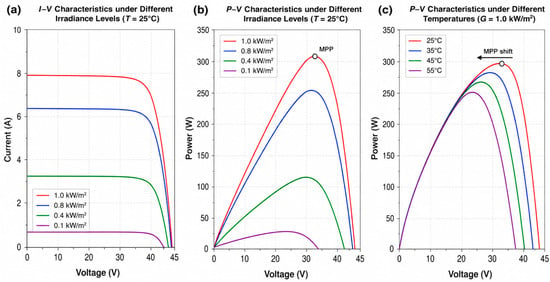
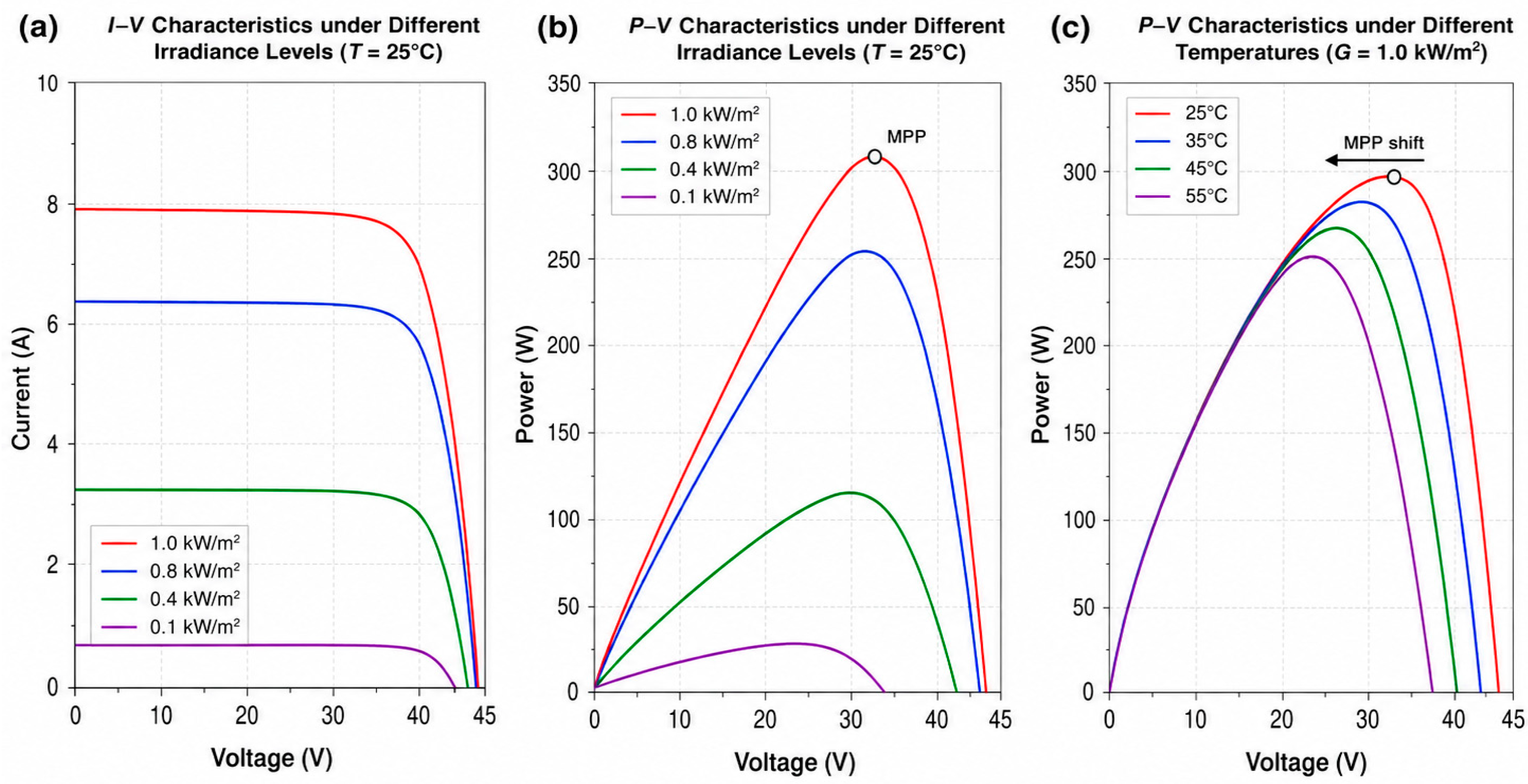
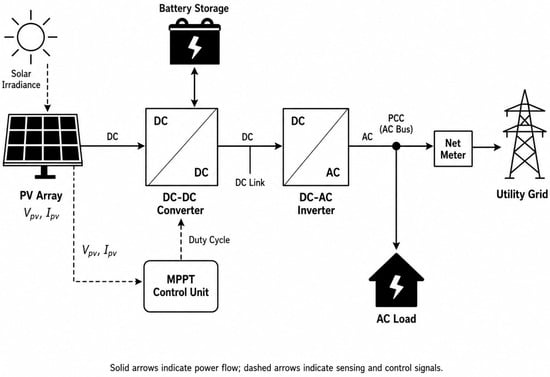
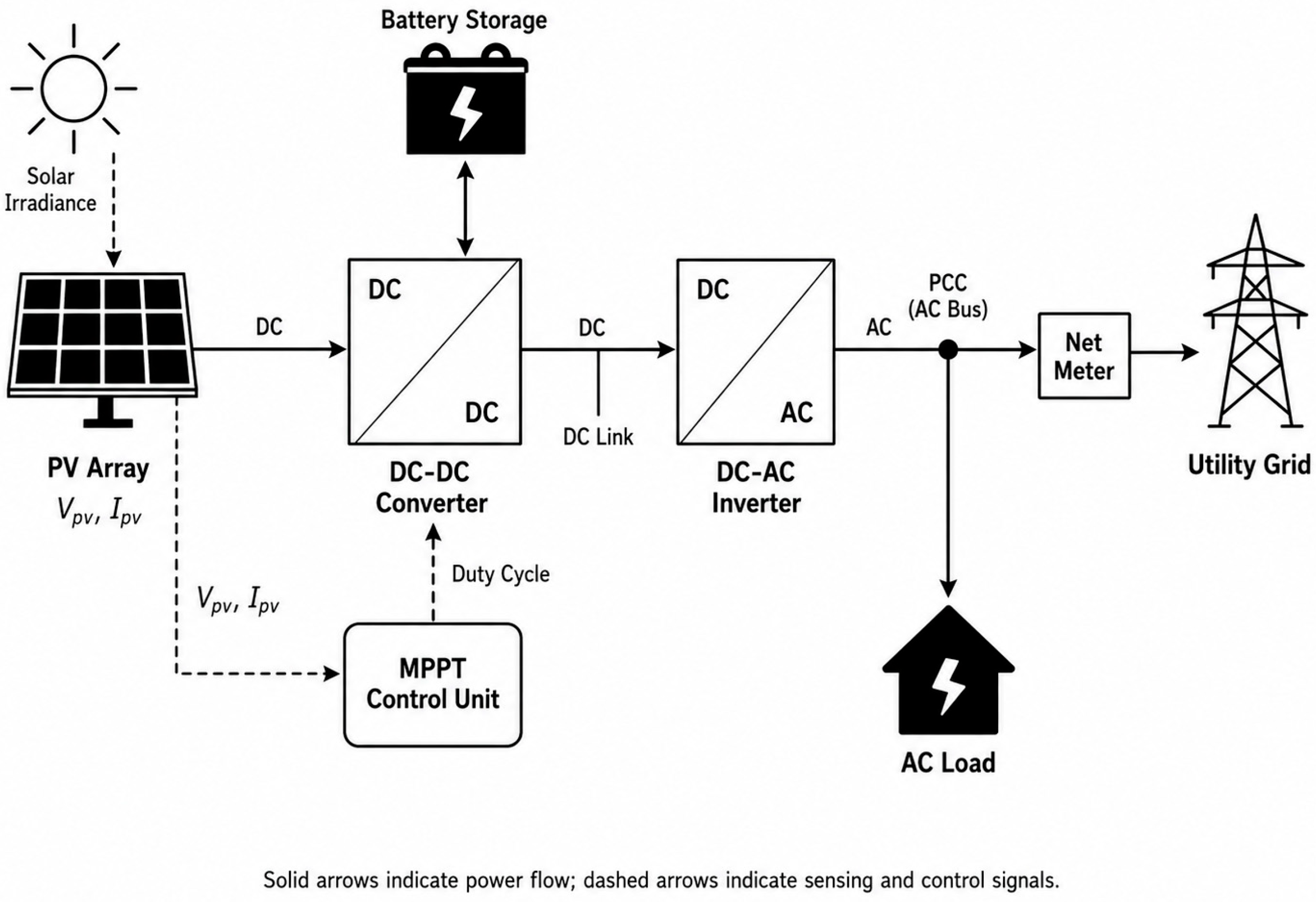
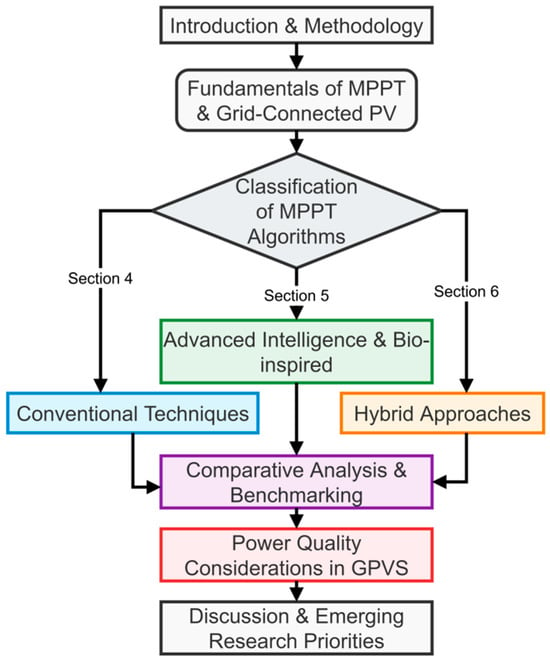
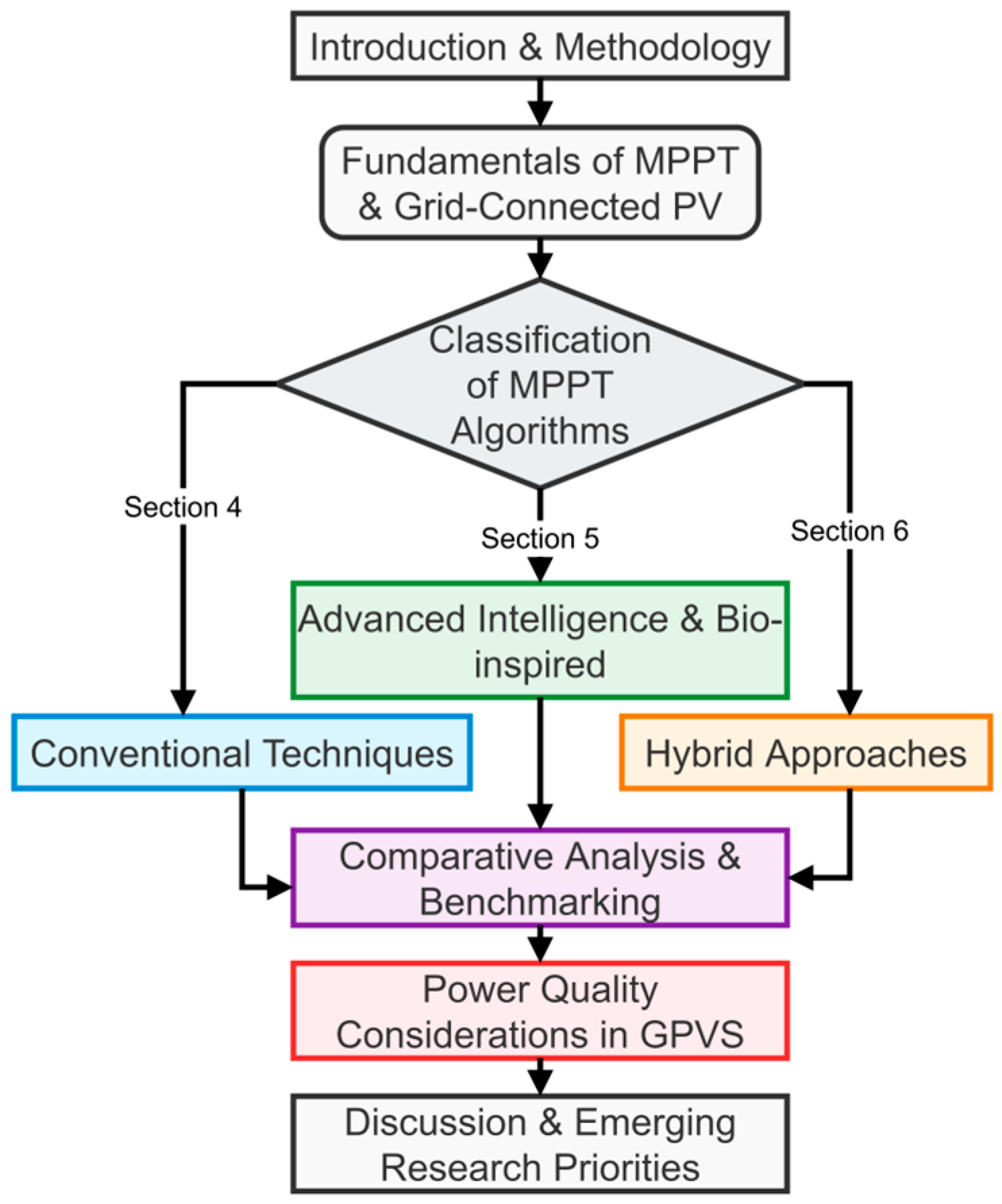
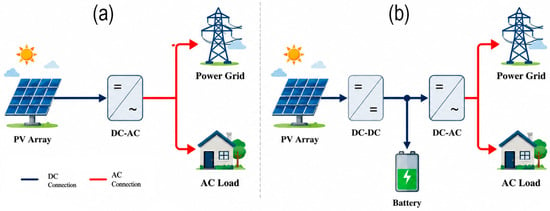
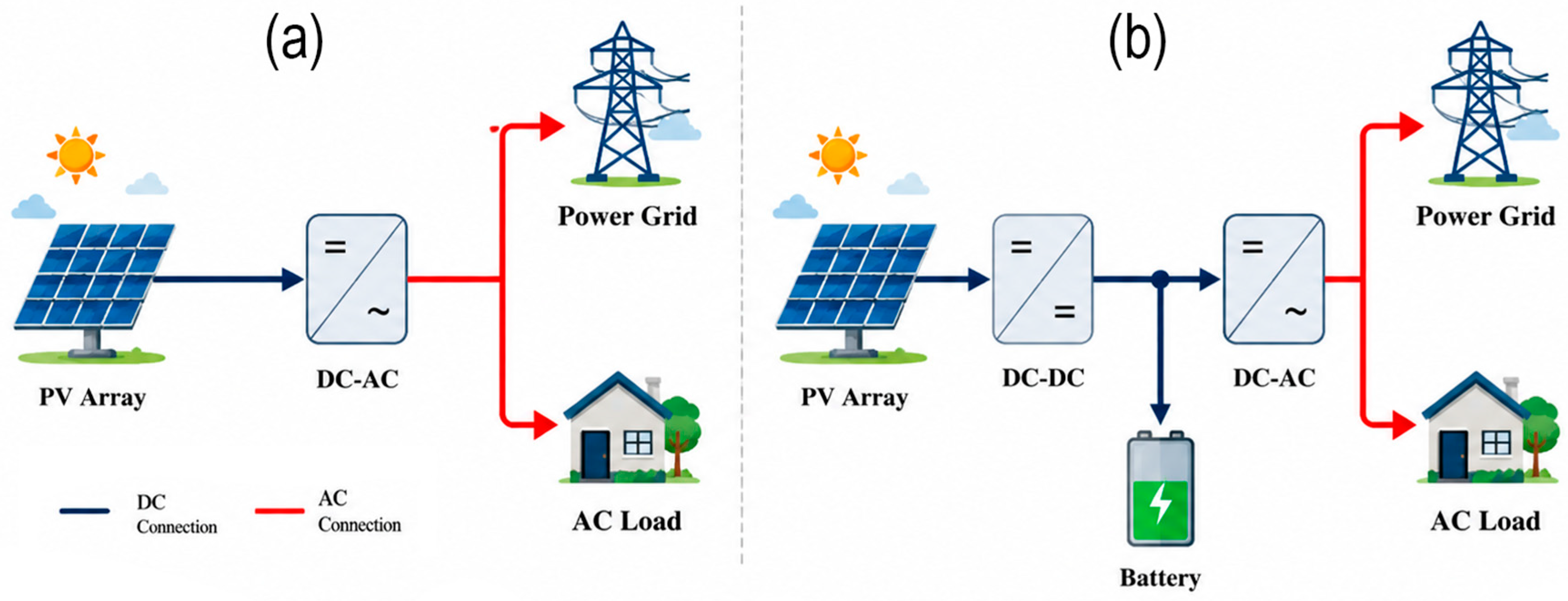
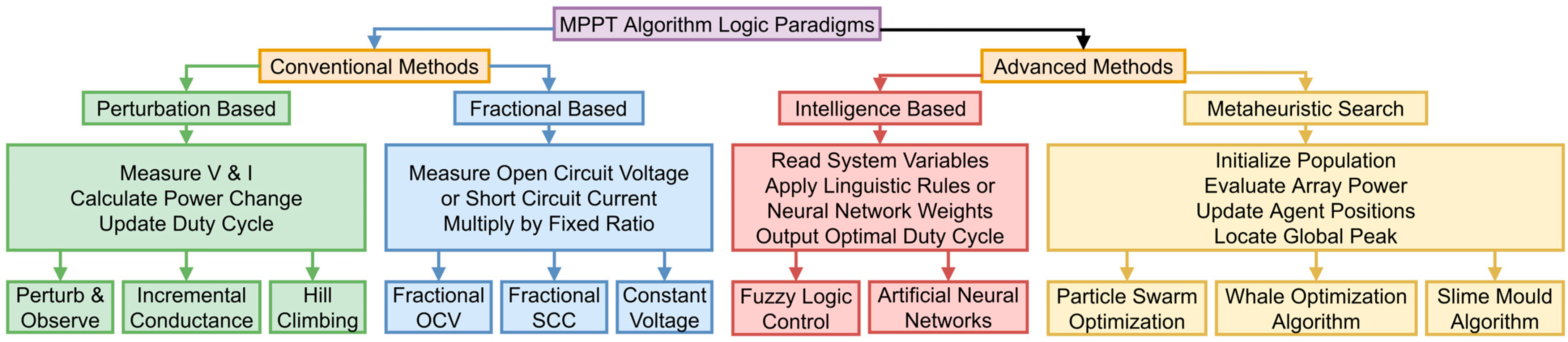

Disclaimer/Publisher’s Note: The statements, opinions and data contained in all publications are solely those of the individual author(s) and contributor(s) and not of MDPI and/or the editor(s). MDPI and/or the editor(s) disclaim responsibility for any injury to people or property resulting from any ideas, methods, instructions or products referred to in the content. |
© 2026 by the authors. Licensee MDPI, Basel, Switzerland. This article is an open access article distributed under the terms and conditions of the Creative Commons Attribution (CC BY) license.