


Abstract
Optimizing the schedule of thermal generators is probably the most important task when the operation of power systems is managed. This issue is known as the unit commitment problem in operational research. It has been profoundly studied in the literature, where several techniques have been proposed to address a computationally tractable solution. In turn, the ongoing changes of paradigms in energy markets focus the attention on the unit commitment problem as a powerful tool to handle new trends, such as the high renewable energy sources penetration or widespread use of non-conventional energy-storage technologies. A review on the unit commitment problem is propo- sed in this paper. The easy understanding of the diverse techniques applied in the literature for new researchers is the main goal of this state-of-art as well as identifying the research gaps that could be susceptible to further developments. Moreover, an overview of the evolution of the Mixed Integer Linear Programming formulation regarding the improvements of commercial solvers is presented, according to its prevailing hegemony when the unit commitment problem is addressed. Finally, an accurate analysis of modeling detail, power system representation, and computational performance of the case studies is presented. This characterization entails a significant development against the conventional reviews, which only offer a broad vision of the modeling scope of their citations at most.
1. Introduction
The unit commitment problem (UC) is a traditional optimization problem where the best schedule for a group of thermal units is obtained. Optimizing the electrical generation entails many advantages for market players and final customers. However, that is not an easy task according to the big size of the problem and the computational limitations.
For that reason, there are many works in the literature where different approaches are proposed to find an optimal solution to this problem, constituting an essential target for the advances in operational research. This paper presents a new review of the state-of-art of the unit commitment problem, where the distinctions between optimization techniques, problem formulations, and resolution algorithms are exposed in order to facilitate their understanding.
This section provides a brief description of the main issues that are frequently considered in the unit commitment problem. Several mathematical approaches have been proposed over the years. The principal modeling ideas are gathered in this paper and referenced for more detailed explanations. There are multiple techniques that have been applied to solve the unit commitment problem, being the most popular its presentation as a conventional optimization problem:
subject to:
The different terms of the objective function (OF) are described below:
- Production cost: This cost is related to the fuel consumption of the thermal units when electricity is generated. Its behavior is usually described through a linear or quadratic function, where there are a fixed term, a linear term concerning the power production, and a quadratic term that multiplies the squared power generation of the unit. The last term can be omitted to work with linear objective functions. Moreover, a piecewise approximation can also be used to linearize the quadratic function. The utilization of integer variables is mandatory for correctly modeling this cost.
- Start-up (SU) cost: This cost is related to the fuel consumption of the starting-up process before a thermal unit is totally committed. It has an exponential behavior according to the number of hours that the unit had been offline. Nevertheless, it is commonly linearized through a stairwise function. Integer variables are also employed for achieving an accurate representation.
- Shut-down (SD) cost: This cost is applied when a thermal unit is shut-down. It is usually modeled as a fixed cost where integer variables are used to define its treatment. Sometimes, this cost is not considered.
- Emission cost: This cost is related to the polluting compounds or the greenhouse gases generated as a consequence of electricity production. It is not linked to the fuel prices, such as those mentioned above, but it is related to fuel consumption and technological efficiency. Its value depends on the local regulation and the emission allowance trading market scheme if it exists. Within the European Union, it relies on CO prices.
- Maintenance cost: This cost represents the increase of the maintenance operations when the thermal unit is running for a longer time. It is modeled as a linear function with respect to power generation, and it is often internalized in the production cost for the sake of simplicity. Integer variables are also associated with this cost.
Fuel consumption is the main cost of the unit commitment problem. The importance of a proper representation of these costs is pointed out in [1], where it is mentioned that saving 0.5% of fuel in electricity generation represents a yearly benefit of millions of euros for a utility. Accordingly, research is focused on improving the modeling detail to increase profitability. In past decades, coal plants were generally the thermal basis of power systems. Meanwhile, combined cycles gas turbines were relegated for high-demand periods, and fast-ramping gas turbines were used to cover demand peaks. This operation was steady over time and did not demand great modeling developments to achieve an efficient asset management.
Nowadays, the trend is changing. The dismantling process of coal plants accounted by many power systems according to greenhouse policies and the loss of their competitiveness due to the implementation of emission-allowance trading markets has brought a paradigm shift. Moreover, the higher renewable-energy source penetration has increased the frequency of the start-up and shut-down processes of the thermal units. Hence, the proper representation of the fuel consumption during these operations is gaining force in current formulations. With regard to the technical constraints used in the unit commitment problem, the following considerations are often assumed:
- Demand constraint: This is a balance equation to assure that the electricity generation meets the load demand for every represented time period. An energy storage term can be added if more accurate management is desired. In turn, it is also possible to introduce a spillage term in the equation to represent situations of production surpluses. It is a linear equation with continuous variables.
- Reserve constraint: This inequality guarantees a technical necessity of power systems, which is the availability of an extra generation capacity reserved for compromising situations, such as a failure in a committed thermal unit, to keep the security of supply. It is a linear inequality that also employs continuous variables.
- Capacity limits: This inequality is used to assure that the electricity generation of each thermal unit respects the minimum and maximum power output according to their technical limits. This inequality is linear and uses integer variables.
- Ramping limits: This inequality assures that the difference between the power generation of a thermal unit during the previous and the current time step does not exceed the ramping rates. It is a linear inequality that uses continuous variables.
- Logic constraint: It establishes logic in the commitment decisions at every time step, indicating the relationships between start-ups, shut-downs, and commitment status along the whole time span. This equation is linear and utilizes integer variables.
- Minimum time up (TU) and time down (TD): This inequality is used to guarantee that the unit is online for a minimum period of time since it is started-up or that it is offline for a minimum time since it is shut-down, in order to accomplish with technical limitations that reduce the risk of failure. It is linear and employs integer variables.
- Operating constraints: This group gathers the constraints that are utilized for a more accurate representation of the operation of the thermal units from a technical point of view. Some examples are situations where some units must run or have a fixed power output, an outage of a unit due to maintenance tasks, or unforeseen problems, etc.
- Emission constraints: They are imposed to bound specific emissions along a time span.
- Network constraints: These constraints are implemented with the aim of representing technical limitations regarding the consideration of the power grid. They increase the accuracy of the unit commitment problem but also the complexity of its resolution. For that reason, the network is frequently disregarded unless a more secure generation schedule is desired. In that case, the capacity of the optimal schedule to overcome an unexpected failure safely is sought. It is known as the Security Constrained Unit Commitment problem (SCUC).
The unit commitment problem is frequently addressed as a minimization problem, where the sum of the total costs constitutes the objective function, and the demand constraint is an equation where the generation meets the power consumption. Sometimes, a non-served energy term is added to the balance equation. If the associated cost is high, there will only be non-served energy situations if the demand exceeds the generation limit. On the contrary, if it is not high enough, there could appear situations in which the electricity production is not profitable.
This representation was suitable before the liberalization of energy markets accomplished in many power systems. Nowadays, the objective function of the unit commitment problem is also represented through the difference between benefits and costs of producing electricity, which is sought to be maximized. In turn, price forecasts are implemented to evaluate profitability, and the demand constraint is transformed into an inequality or omitted. The production of a market player will be based on profitability, which is known as the Price-Based Unit Commitment problem (PBUC). The representation of the competitiveness behavior of market players has also been studied in this problem. Nevertheless, this research topic is out of the scope of this survey.
The following section describes the techniques that can be applied to solve the unit commitment problem further than the optimization problem presentation. However, according to its importance, this methodology is predominantly studied in this paper. The programming options with relation to the formulation are exposed in Section 3.1. In turn, the consideration of uncertainty is addressed in Section 3.2. The decomposition techniques that can be applied to facilitate its resolution are mentioned in Section 3.3. On the other hand, the resolution algorithms that can be applied to find the optimal solution to the optimization problem are exposed in Section 3.4. Section 4.1 describes the modeling trends when the unit commitment problem is formulated as a Mixed Integer Linear Programming (MILP), which is currently the most widespread approach. Meanwhile, Section 4.2 presents an accurate analysis of modeling detail, power system representation, and computational performance of the case studies described in all the references. Finally, Section 5 concludes the article with a brief contribution summary, identifying research gaps for further developments.
2. Optimization Techniques and Unit Commitment
In order to achieve an optimal solution to the unit commitment problem, several optimization techniques have been applied in the literature. These methodologies require a set of input data and return the best thermal schedule obtained after their applications. Figure 1 presents an illustrative diagram where these optimization techniques are classified. In contrast with many other arrangements made in the literature, this layout can help to clarify the differences between optimization techniques, problem formulations, decomposition techniques, and resolution methods, as well as different options of uncertainty management inside the proposed scheme.
Figure 1.
Optimization methodologies applied to the unit commitment problem. At the first level, the optimization techniques are exposed. Later, the most widely used is visually described, underlying the two choices of addressing the optimization problem and its stages. The formulating option and the resolution algorithm that are needed to solve the problem are presented. In turn, the uncertainty representation and the utilization of decomposition techniques are introduced as possible alternatives to enhance the accuracy of the representation of the problem and the performance of its resolution.
Popular optimization methods are described in this section. They constitute different approaches to face the unit commitment problem, whose complexity has often evolved together with the advances in computation. Furthermore, it is also possible to combine them in hybrid methodologies to exploit some of their advantages at once. Regarding the literature, the following classification is made:
- Exhaustive Enumeration (EE): It consists of the evaluation of all the feasible solutions in order to identify the best value as the optimal solution. Exhaustive enumeration is a brute force method that is not computationally affordable. Its scope is very limited [2].
- Expert System (ES): The underlying idea of this method resides in the creation of an algorithm where the good practices and knowledge of proceedings in the resolution of the unit commitment problem are computed. It was employed to save in computational costs [3], but it fell into disuse because of its sub-optimal solutions.
- Priority List (PL): This technique is based on ordering elements of target sets according to their contribution to the objective function. The decisions taken on these target elements during the resolution process will conclude in a better or worse approach to the optimal solution. For that reason, it usually has a mathematical background behind it. Despite returning a sub-optimal solution, it is an attractive optimization technique from a computational perspective due to the obtaining of near-optimal solutions in reasonable run times [4,5,6,7].
- Fuzzy Logic (FL): This method allows the application of abstract reasoning into the computational logic to solve a mathematical problem. It utilizes if–then rules in order to generalize some input data. This information is treated according to a background (if conditions) and output data are obtained consequently (then reactions). The utilization of fuzzy logic techniques helps accelerate the resolution of the unit commitment problems but returns a less accurate solution. They are usually applied at a beginning step and combined with other optimization techniques in hybrid proceedings [8,9,10].
- Neural Networks (NN): This artificial intelligence technique is based on establishing patterns that transform some input data into a near-optimal solution. Its structure consists of a group of interconnected nodes where some mathematical functions are applied to process the information. In order to achieve good results, these processes are trained with a benchmark database. However, it provides sub-optimal solutions, and its implementation and adjustment are quite difficult [11,12]. This machine-learning approach is still being used to solve the unit commitment problem nowadays. For further information about the application of machine learning techniques in the unit commitment, the reader is referred to [13].
- Optimization Problem (OP): The unit commitment problem is frequently addressed as a classical optimization problem, where an objective function is proposed, subject to a set of constraints. This methodology entails the most widespread approach used to solve the unit commitment problem, and it is described in depth in Section 3.
- Hybrid Methodologies (HM): These optimization techniques are sometimes combined in hybrid methodologies in order to improve their performance. Some approaches made in the literature of the unit commitment problem are [14,15,16,17,18,19,20,21].
A comparison of these optimization techniques is presented in Table 1. References are focused on the thermal UC. For representations where the optimization of power systems adds hydro valleys or energy storage facilities, the reader is referred to [22,23], respectively.
Table 1.
Comparison of optimization techniques to solve the unit commitment problem.
3. Unit Commitment as an Optimization Problem
As mentioned, the resolution of the unit commitment problem is frequently addressed as an optimization problem. Two approaches can be differentiated within this technique. Conventional optimization (CO) exposes the objective function and its constraints as is. On the other hand, dynamic programming (DP) utilizes the principle of optimality proposed by Bellman [24], dividing the problem into overlapping subproblems and optimal substructures [25,26,27]. However, the curse of dimensionality forces the implementation of heuristic rules to deal with real-size problems, providing near-optimal solutions. Although nowadays, DP is not as relevant as it was before, it is sometimes used to manage uncertainty [28,29,30]. Furthermore, other distinctions in OP can be made according to their formulation, uncertainty consideration, utilization of decomposition techniques, or the optimization algorithm that is employed to determine an optimal solution.
3.1. Formulating Options
There are different classifications depending on how an OP can be formulated. According to the variables, a distinction can be made between discrete or continuous variables, as well as the utilization of a mix of them. In contrast, the nature of the objective function and constraints can be discriminated into linear, quadratic, or non-linear functions. Combinations of these programming techniques lead to the classification made in Appendix A. In the unit commitment problem, the most popular formulating option is Mixed Integer Linear Programming. In turn, it can also be faced by Mixed Integer Quadratic Programming (MIQP), Mixed Integer Quadratically Constrained Prog. (MIQCP), Mixed Integer Second-Order Cone Programming (MISOCP), and Mixed Integer Non-Linear Programming (MINLP).
3.2. Uncertainty Representation
The operation of real power systems is implicitly subject to uncertainty. The demand forecasts are exposed to inaccuracy or sudden changes according to unexpected situations. Furthermore, the penetration of renewable energy sources in current power markets increases the uncertainty. Wind and solar generation entail the risk of altering the thermal demand at any time. For those reasons, the consideration of uncertainty in the unit commitment problem enhances the reliability of the optimal schedule that is obtained. If the election of representing uncertainty is made, there are several alternatives to transform a deterministic problem into a probabilistic one. The most popular techniques applied to the unit commitment problem are briefly described below and compared in Table 2.
Table 2.
Comparison of uncertainty representation techniques used in the unit commitment problem.
- Stochastic Optimization (SO): This methodology manages the representation of uncertainty through the utilization of probability distributions that are connected to risk variables. These distributions can be directly included in constraints that require some statistical parameters. Nonetheless, the most common practice is to consider different scenarios. These scenarios are obtained through probability-distribution discretizations. Each scenario has an associated weight according to its frequency of occurrence.
- -
- Two-Stage (TS) Stochastic Programming: This technique is based on dividing the problem into two steps, distributing decision variables and constraints in these stages. When the first step is accomplished, the first-stage choices are made. Later, these decisions are considered fixed, and the second stage is solved. The two-stage stochastic programming utilizes scenarios to consider uncertainty. When all the scenarios are solved, a solution to the problem is calculated according to the weight of each scenario. It has been widely applied in the UC literature [31,32,33,34,35,36,37,38,39]. It is widespread to decide which thermal units will be online along the time span in the first stage. Thereafter, the optimal schedule is set in the second stage. Each dispatch obtained in this stage corresponds to a scenario.
- -
- Multi-Stage (MS) Stochastic Programming: This technique uses a combinatorial tree where every combination of scenarios is represented. The tree is divided into successive nodes that are linked. A branch represents the path between the initial node and a final solution. The weights of scenarios are set in the linking connection between nodes. Thus, it is easy to determine the probability of each solution obtained when each branch is solved, which corresponds to a scenario. Some of its applications to the unit commitment problem are [40,41,42]. Robust solutions are provided, since decisions are taken dynamically. However, the associated computational burden requires an excellent scenario sampling and reduction to reach acceptable run times.
- -
- Risk Consideration (RC) Stochastic Programming: This method is based on the addition of some constraints in order to respect the risk exposure of some decisions when the problem is solved. These equations require statistical information of the probability distributions as input and the significant value desired to respect. Thus, a solution is obtained according to the confidence interval that is introduced in the problem. This technique has been applied to the unit commitment problem in order to represent situations such as the expected non served load, loss of load probability, or the variance of the total profit [43,44,45].
- -
- Chance Constrained (CCO) Stochastic Programming: It is considered a particularization of two-stage stochastic programming. This technique allows the solution to violate a set of constraints according to a predefined confidence level. As with the risk consideration stochastic programming, it works with probability distributions instead of scenarios. However, the solution has a probabilistic touch. It will be the optimal solution with a confidence interval, not according to a confidence interval associated with risk variables [46,47,48].
- Robust Optimization (RO): The underlying idea of this methodology is to reach an optimal solution avoiding the worst possible combination of circumstances that can happen according to the uncertainty associated with the presence of risk variables. Robust optimization does not work with probability distributions. It employs a bounded range from which a risk variable can take its value. The bounds imposed on the risk variables are applied in two ways. They are directly used as upper and lower bounds in an inequality that is defined for each dimension in which the variables are formulated and indirectly through the establishment of an uncertainty set. This uncertainty budget is linked to the deviation of the forecasted value associated with each risk variable from their bounds along the evaluated horizon. It can not exceed a predefined value. The more restrictive the uncertainty set is, the more robust the obtained solution. The load demand is used as the target of RO in the unit commitment problem [49,50,51].
- Interval Optimization (IO): This technique handles the uncertainty representation through the creation of bounds according to a predefined confidence interval. Firstly, a forecasted value is provided for each considered risk variable. Later, the confidence interval is used to generate an envelope around the expected value. The higher the value of the confidence interval, the tighter the bounding to the risk variable. Afterwards, the problem is optimized at the expected central value of the interval, being also capable of providing a feasible solution for those deviations from the forecast that are contained inside the interval [52,53,54].
- Monte Carlo Simulation (MCS): The Monte Carlo methodology is frequently employed to achieve an accurate sampling from a set of probabilistic distributions. However, it can be extended to manage a complete uncertainty representation. In that case, the obtained scenarios are optimized as deterministic problems. Later, the output data are processed, and a probabilistic distribution is associated with each result [55,56,57].
- Hybrid Uncertainty Implementation (HUI): These techniques can be combined to improve their performances. Some examples in the unit commitment literature are [58,59,60].
3.3. Decomposition Techniques
Once the formulation of the unit commitment problem is chosen and the decision of considering uncertainty or not is taken, it is time to evaluate if the application of decomposition techniques to the problem is desirable. These techniques can be a powerful tool to solve the unit commitment problem with reasonable run times. Although they were frequently employed when the performance of numerical optimization solvers was computationally limited, particularly the Lagrangian Relaxation, their use has drastically decreased currently because of the advances in commercial solvers and disadvantages such as its difficult implementation and convergence toward an optimal solution. However, the application of decomposition techniques in the unit commitment problem is sometimes addressed nowadays:
- Dantzig-Wolfe Decomposition (DWD): [33,40,61].
- Benders Decomposition (BD): [35,39,48].
- Lagrangian Relaxation (LR): [31,37,62].
3.4. Optimization Algorithms
Finally, when an optimization problem is completely defined, optimization algorithms are applied to find an optimal or near-optimal solution to the problem. The resolution techniques can be classified into numerical methods or meta-heuristic methods.
Numerical optimization (NO) is preferably used to solve the unit commitment problem. In a first step, the improvements in these iterative algorithms were implemented directly by researchers looking to enhance the resolution processes. Currently, commercial solvers have advanced notoriously, and the research is focused on exploiting their properties as best as possible. In order to solve MILP, MIQP, and MIQCP problems, two of the most renowned commercial solvers are Gurobi [63] and CPLEX [64]. In addition, for MISOCP or MINLP problems, MOSEK [65] and BARON [66] respectively offer one of the best performances. For further information about NO, the reader is referred to [67].
On the other hand, evolutionary optimization (EO) is also applied to solve the unit commitment problem. Although these methodologies can not guarantee finding an optimal solution, they can handle more complex formulations without the necessity of utilizing too many simplifications. These meta-heuristic algorithms are based on simulating behaviors that are observed in nature to map the feasible region of an optimization problem looking for the optimal solution. Many of these approaches have been employed to solve the unit commitment problem:
- Genetic Algorithm (GA): [68].
- Simulated Annealing (SA): [69].
- Tabu Search Algorithm (TSA): [70].
- Evolutionary Programming (EP): [71].
- Particle Swarm Optimization (PSO): [72].
- Ant Colony Optimization (ACO): [73].
- Ant Lion Optimizer (ALO): [74].
- Artificial Bee Colony Algorithm (ABCA): [75].
- Artificial Fish Swarm Algorithm (AFSA): [76].
- Artificial Immune System Algorithm (AISA): [77].
- Artificial Sheep Algorithm (ASA): [78].
- Bacterial Foraging Algorithm (BFA): [79].
- Cuckoo Search Algorithm (CSA): [80].
- Differential Evolution Algorithm (DEA): [81].
- Exchange Market Algorithm (EMA): [82].
- Firefly Algorithm (FFA): [83].
- Fireworks Algorithm (FWA): [84].
- Gravitational Search Algorithm (GSA): [85].
- Grey Wolf Optimizer (GWO): [86].
- Imperialist Competitive Algorithm (ICA): [87].
- Intensify Harris Hawks Optimizer (IHHO): [88].
- Memory Management Algorithm (MMA): [89].
- Quantum-Inspired Evolutionary Algorithm (QIEA): [90].
- Quasi-Oppositional Teaching Learning Based Algorithm (QOTLBA): [91].
- Shuffled Frog Leaping Algorithm (SFLA): [92].
- Sine–Cosine Algorithm (SCA): [93].
- Whale Optimization Algorithm (WOA): [94].
In turn, these algorithms can be combined with each other to achieve a better performance, or even with commercial solvers if the problem is divided into multiple resolution stages. Some examples in the unit commitment literature are in [95,96,97,98,99]. Furthermore, an excellent state-of-art on EO is presented in [100].
4. Trends in Computational Efficiency to Solve the Unit Commitment Problem
4.1. Evolution of Unit Commitment Modeling Trends and Current Situation
In spite of the application of advanced evolutionary algorithms to the resolution of the unit commitment problem, the mainstream research trend is the utilization of numerical optimization algorithms to find the global optimum. As it was mentioned in Section 3, the implicit computational burden of this problem limited the scope of numerical optimization.
In the beginning, research was mainly focused on improving optimization algorithms. In turn, decomposition techniques were also deeply studied in order to accelerate the resolution processes. Despite their computational advantages, the utilization of decomposition techniques introduces complexity in the problem, such as difficulties in the implementation or the oscillations in the iterative convergence to the optimal solution.
For that reason, when commercial solvers gained competitiveness, the research in the UC problem started to change its direction. The advances in computation and the huge developments in numerical optimization promoted an exponential enhancement of MIP solvers [101]. Commercial solvers were able to address the unit commitment problem in reasonable run times even if decomposition techniques were not utilized. Then, the research began to focus on the formulation, instead of the decomposition, in order to exploit the properties of the solvers efficiently.
Suddenly, it was possible to think about improving the detail representation in the unit commitment problem. In turn, these advances needed to be in accordance with the solver trends. The performance of MILPs was more developed than MIQPs or MIQCPs and much more than MINLPs. For that reason, even quadratic formulations that were able to be solved as is were linearized in order to achieve a faster resolution.
The foundations of the UC modeling were laid. The detailed representation of the quadratic production costs was assumed through a piecewise linearization. Moreover, the dependence between start-up costs and the offline time steps accounted by the thermal units was modeled by a stairwise function [102]. The importance of convexity was manifested, both for thermal units and hydro generators [103]. Regarding the reserves [104] and power trajectories, efficient formulations were proposed to deal with them [105]. In these formulations, it was usual to employ three binary variables for each thermal unit and time step: one to define the commitment status and the others to represent a start-up or shut-down process. Despite that, binary variables were also utilized for piecewise linearizations, whose performance has been studied as well [106], and for stairwise representations [107].
Nevertheless, despite the improvements accomplished by the commercial solvers, the UC remains a strongly NP-hard problem [108]. For that reason, if greater horizons, thermal portfolios, or technical representations are desired, a trade-off between the modeling detail and the size of the corresponding problem must be chosen.
Modeling simplifications are mandatory when bidding processes are included in the representation [109], even more, if congestion in transmission lines is also desired to be included [110]. In turn, disaggregation methods are studied as an alternative for extending the scope of the representation. Ref. [111] breaks the horizons and solves shorter time spans sequentially. Ref. [112] decomposes the problem according to power market stages to increase the detail and links them heuristically later. Ref. [113] links longer-term with day-ahead decisions. Ref. [114] also uses multiple stages to simulate the competitive behavior of the market players, and in [115], a sequential resolution is proposed, too.
Additionally, the efficiency of the formulations is continuously studied. The optimization of the number of constraints and variables, especially binary variables, to model the same operation is addressed in depth in order to gain accuracy without a high computational cost. Ref. [116] points out the importance of reducing the number of binary variables that are employed per thermal unit and time step. Meanwhile, ref. [117] analyzes the response of the same thermal portfolio when the optimization is addressed as a cost minimization problem and as a PBUC. On the other hand, ref. [118] studies how to increase the flexibility in the operation efficiently, especially regarding fuel consumption.
According to the apparent complications introduced by binary variables, ref. [119] proposed to work with them as relaxed variables and penalize the non-integrality in the OF. On the other hand, ref. [120] uses a formulation with only one bin and imposes constraints to achieve their integrality behavior after a more efficient resolution. This approach reduces the number of branches that are created by the resolution algorithm because of the lower binary variables defined. This philosophy is also adopted in [121], where bidding processes are considered. Despite the defense of their utilization, the results of [121] show that the conventional three-bin formulations achieve practically the same performances.
This issue was further studied in [122,123] where the tightness of a UC formulation was defined as the proximity of the relaxed solution and the integer solution. These solutions are desired to be close in order to enhance the performance of the solver. For that reason, some additional constraints are proposed to tighten the feasible region when the problem is relaxed in the iterations of the Branch & Cut. Moreover, ref. [123] concludes that the advances in commercial solvers cause the obsolescence of the formulation proposed in [120], since the solver can manage the branch creation properly and utilizes integer variables to generate cuts as well. If the integrability is not defined, the cuts will ignore these continuous variables that should be integer ones, hindering the performance of the solver. The Tight formulation proposed in [123] is quite renowned in the literature.
Tight formulations improve the performance of the solver by approximating the gap in the resolution process. However, it is also important for the tightened relaxed problem to be easy to solve. In that way, if many constraints are added, the computational cost of this step will be notably increased. Ref. [124] defines the concept of compactness according to the necessity of the lower number of variables, constraints, and non-zero elements in the problem matrix. For that reason, it is mandatory to evaluate a trade-off between Tightness and Compactness. Ref. [124] proposes a Tight and Compact (T&C) formulation where the importance of power trajectories is exposed, as it is reiterated later in [125]. In [126], the T&C formulation is extended to a thermal portfolio and, in [127], it is analyzed in depth and improved. The T&C formulation with power trajectories is exploited to achieve a proper evaluation of the reserve management in real operations of real power systems, Ref. [128] and their properties are deeply studied in [129]. T&C remains a powerful and renowned formulation nowadays.
Since that moment, UC formulations have tried to be as tight and compact as possible. For this reason, the proposition made in [130] to apply perspective functions in the UC problem was retaken. Perspective reformulations can be utilized to replace quadratic constraints by linear or second-order cone programming [131], enhancing the resolution process. The computational advances of [131] are exploited in [132] to develop an efficient tight formulation. Moreover, this technique is evolved in [133,134,135] towards the proposition of a two-bin formulation. Ref. [135] is a renowned formulation that projects the thermal production in continuous variables that are bounded in [0, 1], and it does not need the utilization of the shut-down binary variables.
On the other hand, the detail representation takes advantage of the computationally advanced formulations, choosing their equations as efficient ways to model technical operations. In turn, they are complemented with aspects that are desired to be submitted to study. That is the case of emission targets. The inclusion of emission targets in the UC problem supposes its transformation to a multi-objective problem, which has to be solved through heuristics [136,137,138]. However, it can be addressed as an MIP problem by giving a penalty to the emissions in the OF, such as [139]. Moreover, non-convex functions that represent emissions targets can be linearized, and the problem can rely on some emission parameters that are introduced as input data [140]. In turn, modeling transmission constraints is also gaining importance in detailed models [141,142], as well as considering non-conventional energy-storage options [143].
Meanwhile, important issues for solving the UC problem are also studied, such as the presence of symmetry [144]. This phenomenon occurs when there are several identical generation units. In that case, the resolution process is slower because the solver does not cut branches that offer the same solution with a different combination of scheduled units. Symmetric-breaking constraints are added to avoid these situations [145], and their performances are compared against the developments in commercial solvers to handle with symmetry [146]. There is not a clear consensus. Apparently, current solvers can deal with symmetry properly, although the constraints seem to be useful in small size problems [147]. Furthermore, this symmetry can be exploited; Ref. [148] solves aggregated units and later decomposes the results after the optimization.
In turn, the current trends of renewable-energy-sources penetration in modern power systems point out an increment in the amount of start-up and shut-down processes accounted by thermal generators [149]. These ongoing changes highlight the necessity of extending the horizon of the UC problem [150] for considering medium-term technical constraints, such as maintenance schedule [151]. This could be achieved through clustering techniques such as [152]. The reduction of variables due to the aggregation of identical generators can be harmonized with an extension of the time span, keeping the run times assumed before the clustering. According to the research gap for enhancing the start-up costs [153], a more accurate stairwise function representation is presented in [154], and a new efficient formulation is proposed in [155]. Furthermore, more detailed generation schedules can be obtained by considering the possible turbine configurations of a power plant. With this purpose, a tight and compact formulation to represent this accurate operation is presented in [156].
The more efficient modeling techniques are translated into more accurate models with a higher scope. Ref. [157] is focused on a more detailed representation of thermal units, hydro generators, and pumped storage with a clear differentiation between turbine-production and pumping processes, as well as upper and lower reservoirs with their respective inflows. Ref. [158] models these issues and a simplified transmission network, too. The transmission representation was enhanced in [159] and later complemented with a simplified natural gas network in [160], where fluctuating natural gas flows in the pipelines toward the thermal unit that consume this fuel are considered.
Finally, it is important to highlight that new efficient formulations have been proposed during the last years. Ref. [161] is specially designed for fast-ramping thermal units. In [162], the commitment status binary variables are replaced by transition state variables, achieving great computational results. These renowned formulations [126,135,162] are compared in [163], manifesting the good performance of [126] despite being proposed a few years earlier than the others. Another comparison and new formulations are exposed in [164], pointing out the importance of this research field nowadays. Additionally, a standardized method to test formulations is employed, and an excellent explanation of the unit commitment evolution since a formulating point of view is described.
4.2. Precise Description of the Modeling Detail Adopted in the Literature
As it was manifested in [164], it is essential to establish a standardized benchmark to compare the efficiency of the unit commitment formulations. Despite traditional thermal portfolios [165] and power systems such as the IEEE 118-bus [166,167], or the IEEE RTS-96 [168] are frequently employed in the literature, it is also desirable to set other relevant issues. These concerns are different modeling details, algorithm performances, solver options, and computational resources to handle the optimization process.
The unit commitment is a widely studied optimization problem, and, as a consequence, there are several good reviews on this topic. Recent publications are [100,169,170,171,172,173,174,175]. There, comparisons about optimization techniques [169,170], uncertainty representation [171,172], and resolution techniques [100,173,174] are presented. However, advantages and disadvantages are usually exposed from a general perspective, as shown in Table 1 and Table 2.
The literature reviews proposed in [100,173,174] gathered hardware specifications (if given), case study systems, run times, and a general explanation about the UC constraints that were employed in their references. Nevertheless, a more exhaustive analysis on modeling detail is necessary if a clear vision of the scope of the citations is required. On the other hand, an intensive description of UC modeling is made in [175], but a literature benchmark with the modeling properties of a set of different case studies and methodologies is not presented.
For that reason, bringing out a structured presentation of the modeling detail achieved through the different techniques referenced in this paper satisfies one of the most urgent requirements of the literature reviews. A general description of the technical and economic aspects represented in the unit commitment problem is made in Section 1. Although the theoretical scope of the representation is practically unlimited, reality demands a tight trade-off between modeling detail, system size, and computational resources to find an optimal or near-optimal solution. Considering that, Table 3 exposes a meticulous characterization of these features.
Table 3.
Technical and economic modeling detail accomplished in the literature to represent power systems and computational performance of the methodologies.
This summary provides the reader with a precise vision of the trade-off decisions assumed by the different authors when presenting their methodologies. An exact idea about the accuracy of the represented power system (detail, size, and horizon) and the corresponding computational tractability (run time and optimality of the solution) is given. In this way, the reader can discern between the scopes of the optimization proceedings presented in this paper, keeping in mind that it is a small collection of the most representative techniques applied to solve the unit commitment problem.
According to the information gathered in Table 3, the following clarifications are done:
- The number of segments in piecewise linearizations is specified when they are reported. If they are not given in the table, it means that quadratic coefficients were presented in the paper, and the author just said that the function was linearized.
- Hourly granularity is considered unless another specification is shown in the time span column. Additionally, time period chronology is also supposed to be respected except if a disaggregation technique is mentioned in that column.
- The symbol (r) means replication. It is shown when the number of units that compose a generation portfolio is repeated to deal with bigger systems in the case study or when the data presented for a shorter time span (typically a day) are imitated to make it longer. It entails computational conditions such as symmetry or identifiable patterns.
- The information presented in the demand constraint column denotes the elements that participate in the balance equation. If it is described as equal or greater, the unit commitment problem is addressed as a cost minimization problem where the load demand has to be matched or exceeded, respectively. In the case of PBUC, it is assumed that the maximization has no generation limits unless a (lower) term is added to show that total generation must not exceed the load demand.
- The information presented in the reserve constraints column is not always consistent. Some systems include spinning reserve in primary, secondary, or tertiary reserves. However, other systems establish different distinctions. The reserve dependence on the regulatory framework is out of the scope of this review. For that reason, reserves are shown as they are specified in each paper.
- The operative constraints column is sometimes used to show miscellaneous information, such as hydro representation, market specifications, etc., for the sake of clarity. Thus, the whole case study information is presented in the same row and table, despite space limitations.
- The optimal column determines the capability of the proposed methodology to assure finding the global optimum. In turn, when the paper reports the value of the relative optimality criterion, which is imposed on MIP solvers, it is also exposed in this column. This optimality gap is the quotient of the difference between primal and dual bound, in absolute value, and the maximum of both. This feature can be specified before solving an MIP problem. It should not be confused with the dual gap (defined when decomposition techniques are applied) or the integrality gap (calculated when the optimization ends). It clarifies the scope of the methodologies, providing a significant idea about their efficiency and the trade-off between modeling detail, run time, and computational performance.
- Executions are made in regular computing machines up to the date of the publications to whom any researcher could have access. If they are run in high efficient clusters, whose affordability is limited to generation companies or universities, it will be specified in the run time column.
- The data used in each case study are supposed to be given or properly cited. If some technical or economic aspect is modeled, but any input data are provided, it is specified with a (*). Moreover, if these data are apparently given, but the link is offline by the date that this review is sent to the publisher or the referenced article does not provide the information, it is specified with a (**).
- The generation limits of the thermal units are always considered to be given, except if the rest of the information is also missing.
- If there is at least one start-up cost represented in the methodology, the logic constraint that establishes commitments, start-ups, and shut-downs is formulated.
5. Conclusions
This article presents a literature review on the different available alternatives to set out and solve the unit commitment problem. One of the main goals is establishing a hierarchical classification of the computational techniques that could be applied to each stage of the problem. This proposal differs from other surveys, which mix identification principles and describe several modeling techniques, resolution algorithms, etc., without any more profound distinction.
The exposed layout allows to quickly acquire a general idea of the different options to represent and optimize the operation of power systems. Furthermore, their advantages and disadvantages are elaborately described, allowing an easy recognition of the research gaps for further developments and introducing a solid basis to implement new improvements.
Some examples of research necessities in this field are enhancing the computational efficiency when handling uncertainty; improving modeling detail, such as a more precise characterization of the start-up processes, or going in-depth with the operational flexibility representation; extending the unit commitment horizon to facilitate coordination with markedly medium-term tasks, such as hydro management, fuel purchases, or financial contracting; representing the real demand variability for thermal generators in current and future electricity markets with high penetration of non-dispatchable energy sources; or studying the most efficient procedure for achieving widespread integration of non-conventional energy-storage technologies in modern power systems.
In order to not provide an immeasurable amount of references, the most popular and recent unit commitment approaches have been cited throughout the different sections. To conclude this review, the historical events and ongoing trends in the most widespread technique applied to the unit commitment problem are introduced. Hence, the current state is presented, focusing on the thermal generation of electricity markets which is optimized through commercial solvers. The reader is referred to recent surveys if interested in obtaining a deeper knowledge of specific problems, such as the hydro unit commitment problem, the operational representation of energy-storage technologies, and evolutionary optimization.
Moreover, the scope of the different methodologies described in the paper is clearly identified through a comparison table, where the modeling detail adopted in the references is analyzed in depth. In turn, the problem sizes are also precisely presented, providing the elements that compound the power systems represented in the case studies. Furthermore, the computational performance of each proceeding can be discerned, too, according to the corresponding run times and optimality of the solutions.
This characterization entails a significant development against the conventional reviews on the unit commitment problem, which only offer a broad vision of the modeling scope of their cites at most. Additionally, this accurate description can also be used as a benchmark to look for different options to model a specific technical or economic aspect, choosing the formulation that apparently offers a greater computational efficiency according to the desired methodology.
Author Contributions
Conceptualization, L.M., A.B. and J.R.; methodology, L.M., A.B. and J.R.; formal analysis, L.M.; investigation, L.M.; resources, L.M.; data curation, L.M.; writing—original draft preparation, L.M.; writing—review and editing, L.M., A.B. and J.R.; visualization, L.M.; supervision, A.B. and J.R. All authors have read and agreed to the published version of the manuscript.
Funding
This research received no external funding.
Institutional Review Board Statement
Not applicable.
Informed Consent Statement
Not applicable.
Conflicts of Interest
The authors declare no conflict of interest.
Abbreviations
The following abbreviations are used in this manuscript:
| ACO | Ant Colony Optimization |
| AGC | Automatic Generation Control |
| ALO | Ant Lion Optimizer |
| ABCA | Artificial Bee Colony Algorithm |
| AFSA | Artificial Fish Swarm Algorithm |
| AISA | Artificial Immune System Algorithm |
| ASA | Artificial Sheep Algorithm |
| BD | Benders Decomposition |
| BFA | Bacterial Foraging Algorithm |
| CAES | Compressed Air Energy Storage |
| CCGT | Combined Cycle Gas Turbine |
| CO | Conventional Optimization |
| CCO | Chance Constrained Optimization |
| CSA | Cuckoo Search Algorithm |
| DEA | Differential Evolution Algorithm |
| DS | Distribution System |
| DSO | Distribution System Operator |
| DP | Dynamic Programming |
| DWD | Dantzig-Wolfe Decomposition |
| EA | Electrolytic Aluminium series |
| EE | Exhaustive Enumeration |
| EF | Electrolytic arc Furnance |
| EIE | Energy Intensive Enterprise |
| EMA | Exchange Market Algorithm |
| EO | Evolutionary Optimization |
| EP | Evolutionary Programming |
| ES | Expert System |
| ESS | Energy Storage System |
| EV | Electric Vehicle |
| FBU | Fuel Blending Unit |
| FFA | Firefly Algorithm |
| FL | Fuzzy Logic |
| FSU | Fuel Switching Unit |
| FWA | Fireworks Algorithm |
| GA | Genetic Algorithm |
| GSA | Gravitational Search Algorithm |
| GWO | Grey Wolf Optimizer |
| HCCP | Hybrid Combined Cycle Plants |
| HM | Hybrid Methodologies |
| HS | Hydro Spillage |
| HR | Head Range |
| HUI | Hybrid Uncertainty Implementation |
| ICA | Imperialist Competitive Algorithm |
| IHHO | Intensify Harris Hawks Optimizer |
| IO | Interval Optimization |
| IP | Integer Programming |
| IPP | Independent Power Producer |
| LNG | Liquefied Natural Gas |
| LP | Linear Programming |
| LR | Lagrangian Relaxation |
| MCS | Monte Carlo Simulation |
| MILP | Mixed Integer Linear Programming |
| MIQP | Mixed Integer Quadratic Programming |
| MIQCP | Mixed Integer Quadratically Constrained Programming |
| MINLP | Mixed Integer Non Linear Programming |
| MIP | Mixed Integer Programming |
| MISOCP | Mixed Integer Second Order Cone Programming |
| MMA | Memory Management Algorithm |
| MS | Multi Stage |
| ND-RES | Non-Dispatchable Renewable Energy Sources |
| ND-RES-C | Non-Dispatchable Renewable Energy Sources Curtailment |
| NLP | Non Linear Programming |
| NN | Neural Network |
| NO | Numerical Optimization |
| NSE | Non-Served Energy |
| OE | Oversupplied Energy |
| OF | Objective Function |
| OP | Optimization Problem |
| QIEA | Quantum-Inspired Evolutionary Algorithm |
| QOTLBA | Quasi-Oppositional Teaching Learning Based Algorithm |
| PBUC | Price-Based Unit Commitment |
| PJM | Pennsylvania, New Jersey, and Maryland |
| PL | Priority List |
| PSO | Particle Swarm Optimization |
| PSU | Pumping Storage Unit |
| QP | Quadratic Programming |
| QCP | Quadratically Constrained Programming |
| RC | Risk Consideration |
| rMILP | Relaxed Mixed Integer Linear Programming |
| rMIQP | Relaxed Mixed Integer Quadratic Programming |
| rMIQCP | Relaxed Mixed Integer Quadratically Constrained Programming |
| rMINLP | Relaxed Mixed Integer Non Linear Programming |
| rMISOCP | Relaxed Mixed Integer Second Order Cone Programming |
| RES | Renewable Energy Sources |
| RO | Robust Optimization |
| SA | Simulated Annealing |
| SCA | Sine–Cosine Algorithm |
| SCUC | Security Constrained Unit Commitment |
| SD | Shut-Down |
| SFLA | Shuffled Frog Leaping Algorithm |
| SO | Stochastic Optimization |
| SOCP | Second Order Cone Programming |
| SU | Start-Up |
| TD | Time Down |
| TL | Transmission Losses |
| TS | Two Stage |
| TSA | Tabu Search Algorithm |
| TSO | Transmission System Operator |
| TU | Time Up |
| UC | Unit Commitment |
| WOA | Whale Optimization Algorithm |
Appendix A. Formulating Options
- Integer Programming (IP): The formulation employs only discrete variables. A discrete variable, that is commonly called an integer variable, accomplishes an integer value after the problem resolution (). According to the numerical methods utilized by computers to solve the problem, the integrality of these variables is related to a tolerance. Formulating exclusive-integer problems is not common. The habitual practice is to utilize continuous variables as well. For that reason, the integer programming term is usually employed as a reference to the usage of integer variables in the unit commitment problem and energy models.
- Mixed Integer Programming (MIP): The formulation uses a mix of integer and continuous variables (). The MIP has several subgroups attending to the mathematical formulation of the OF and constraints. If the OF and all the constraints are linear, the problem is called MILP. If the constraints are linear but the OF is quadratic, it is called MIQP. On the other hand, if there are some quadratic constraints and a linear OF, the problem is an MIQCP. This quadratic constraints can be represented as second-order cones in a MISOCP problem. Finally, if there is any non-linear constraint or OF, that will be an MINLP problem.
- Linear Programming (LP): The formulation only employs continuous variables. In turn, both their objective function and constraints are linear. LP can be a result of relaxing the discrete variables of a MIP. When the integer variables of MILP are relaxed (considered as continuous in order to facilitate the resolution of the problem), the new problem is known as an rMILP and there is not any difference with an LP.
- Non-Linear Programming (NLP): The formulation utilizes continuous variables; meanwhile, the objective function or some constraint is a non-linear function. As well as in LP, the relaxation of an MINLP turns out into a problem which it is solved as an NLP, an rMINLP. Quadratic Programming (QP), Quadratically Constrained Programming (QCP), and Second-Order Cone Programming (SOCP) are non-linear techniques. Nevertheless, they are not frequently included in this group in the literature because their convexity properties allow them to be solved easier than NLP used to be. Relaxing MIQP, MIQCP, or MISOCP converts the problem in an rMIQP, rMIQCP, or rMISOCP that is also solved such as a QP, QCP, or SOCP problem.
References
- Padhy, N. Unit commitment-A bibliographical survey. IEEE Trans. Power Syst. 2004, 19, 1196–1205. [Google Scholar] [CrossRef] [Scilit]
- Hara, K.; Kimura, M.; Honda, N. A method for planning economic unit commitment and maintenance of thermal power systems. IEEE Trans. Power App. Syst. 1966, PAS-85, 427–436. [Google Scholar] [CrossRef] [Scilit]
- Li, S.; Shahidehpour, S.M.; Wang, C. Promoting the application of expert systems in short-term unit commitment. IEEE Trans. Power Syst. 1993, 3, 286–292. [Google Scholar] [CrossRef] [Scilit]
- Delarue, E.; Cattrysse, D.; D’haeseleer, W. Enhanced priority list unit commitment method for power systems with a high share of renewables. Electr. Power Syst. Res. 2013, 105, 115–123. [Google Scholar] [CrossRef] [Scilit]
- Moradi, S.; Khanmohammadi, S.; Hagh, M.T.; Mohammadiivatloo, B. A semi-analytical non-iterative primary approach based on priority list to solve unit commitment problem. Energy 2015, 88, 244–259. [Google Scholar] [CrossRef] [Scilit]
- Elsayed, A.M.; Maklad, A.M.; Farrag, S.M. A New Priority List Unit Commitment Method for Large-Scale Power Systems. In Proceedings of the 2017 Nineteenth International Middle East Power Systems Conference (MEPCON), Cairo, Egypt, 19–21 December 2017. [Google Scholar]
- Shahbazitabar, M.; Abdi, H. A novel priority-based stochastic unit commitment considering renewable energy sources and parking lot cooperation. Energy 2018, 161, 308–324. [Google Scholar] [CrossRef] [Scilit]
- Wang, B.; Li, Y.; Watada, J. Re-Scheduling the Unit Commitment Problem in Fuzzy Environment. In Proceedings of the 2011 IEEE International Conference on Fuzzy Systems (FUZZ-IEEE 2011), Taipei, Taiwan, 27–30 June 2011; pp. 1090–1095. [Google Scholar]
- Leou, R. A Price-Based Unit Commitment Model considering uncertainties with a Fuzzy Regression Model. Int. J. Energy Sci. 2012, 2, 51–58. [Google Scholar]
- Zhang, N.; Hu, Z.; Han, X.; Zhang, J.; Zhou, Y. A fuzzy chance constrained program for unit commitment problem considering demand response, electric vehicle and wind power. Int. J. Electr. Power Energy Syst. 2015, 65, 201–209. [Google Scholar] [CrossRef] [Scilit]
- Shanti-Swarup, K.; Simi, P.V. Neural computation using discrete and continuous Hopfield networks for power system economic dispatch and unit commitment. Neurocomputing 2006, 70, 119–129. [Google Scholar] [CrossRef] [Scilit]
- Jahromi, M.Z.; Bioki, M.M.H.; Nejad, M.R.; Fadaeinedjad, R. Solution to the unit commitment problem using an artificial neural network. Turkish J. Electr. Eng. Comput. Sci. 2013, 21, 198–212. [Google Scholar]
- Yang, Y.; Wu, L. Machine learning approaches to the unit commitment problem: Current trends, emerging challenges, and new strategies. Electr. J. 2021, 34, 369–389. [Google Scholar] [CrossRef] [Scilit]
- Pokharel, B.K.; Shrestha, G.B.; Lie, T.T.; Fleten, S.E. Price based unit commitment for Gencos in deregulated markets. In Proceedings of the Power Engineering Society General Meeting, IEEE, San Francisco, CA, USA, 12–16 June 2005; pp. 428–433. [Google Scholar]
- Kumar, S.S.; Palanisamy, V. A dynamic programming based fast computation Hopfield neural network for unit commitment and economic dispatch. Electr. Power Syst. Res. 2007, 77, 917–925. [Google Scholar] [CrossRef] [Scilit]
- Dieu, V.N.; Ongsakul, W. Ramp rate constrained unit commitment by improved priority list and augmented Lagrange Hopfield network. Electr. Power Syst. Res. 2008, 78, 291–301. [Google Scholar] [CrossRef] [Scilit]
- Silva, I.C.; Carneiro, S.; de Oliveira, E.J.; Pereira, J.L.R.; Garcia, P.A.N.; Marcato, A.L.M. A lagrangian multiplier based sensitive index to determine the unit commitment of thermal units. Int. J. Electr. Power Energy Syst. 2008, 30, 504–510. [Google Scholar] [CrossRef] [Scilit]
- Patra, S.; Goswami, S.K.; Goswami, B. Fuzzy and simulated annealing based dynamic programming for the unit commitment problem. Expert Syst. Appl. 2009, 36, 5081–5086. [Google Scholar] [CrossRef] [Scilit]
- Nascimento, F.R.; Silva, I.C.; Oliveira, E.J.; Dias, B.H.; Marcato, A.L.M. Thermal Unit Commitment Using Improved Ant Colony Optimization Algorithm via Lagrange Multipliers. In Proceedings of the 2011 IEEE Trondheim PowerTech, Trondheim, Norway, 19–23 June 2011; pp. 1–5. [Google Scholar]
- Chen, P.H. Two-level hierarchical approach to unit commitment using expert system and elite PSO. IEEE Trans. Power Syst. 2012, 27, 780–789. [Google Scholar] [CrossRef] [Scilit]
- Najafi, A.; Farshad, M.; Falaghi, H. A new heuristic method to solve unit commitment by using a time-variant acceleration coefficients particle swarm optimization algorithm. Turkish J. Electr. Eng. Comput. Sci. 2015, 23, 354–369. [Google Scholar] [CrossRef] [Scilit]
- Taktak, R.; D’Ambrosio, C. An overview on mathematical programming approaches for the deterministic unit commitment problem in hydro valleys. Energy Syst. 2015, 7, 1–23. [Google Scholar] [CrossRef] [Scilit]
- Howlader, H.; Adewuyi, B.; Hong, Y.Y.; Mandal, P.; Hemeida, A.M.; Senjyu, T. Energy storage system analysis review for optimal unit commitment. Energies 2020, 13, 158. [Google Scholar] [CrossRef] [Scilit]
- Bellman, R. Dynamic Programming; Princeton University Press: Princeton, NJ, USA, 1957. [Google Scholar]
- Frangioni, A.; Gentile, C. Solving nonlinear single-unit commitment problems with ramping constraints. Oper. Res. 2006, 54, 767–775. [Google Scholar] [CrossRef] [Scilit]
- Frangioni, A.; Gentile, C.; Lacalandra, F. Solving unit commitment problems with general ramp constraints. Intl. J. Electr. Power Syst. 2008, 30, 316–326. [Google Scholar] [CrossRef] [Scilit]
- Singhal, P.K.; Sharma, R.N. Dynamic programming approach for large scale unit commitment problem. In Proceedings of the International Conference on Communication Systems and Network Technologies (CSNT), Katra, India, 3–5 June 2011; pp. 714–717. [Google Scholar]
- Analui, B.; Scaglione, A. A dynamic multistage stochastic unit commitment formulation for intraday markets. IEEE Trans. Power Syst. 2018, 33, 3653–3663. [Google Scholar] [CrossRef] [Scilit]
- Zou, J.; Ahmed, S.; Sun, X.A. Multistage stochastic unit commitment using stochastic dual dynamic integer programming. IEEE Trans. Power Syst. 2018, 34, 1814–1823. [Google Scholar] [CrossRef] [Scilit]
- Xu, Y.; Ding, T.; Qu, M.; Du, P. Adaptive dynamic programming for gas-power network constrained unit commitment to accommodate renewable energy with combined-cycle units. IEEE Trans. Sustain. Energy 2019, 11, 2028–2039. [Google Scholar] [CrossRef] [Scilit]
- Papavasiliou, A.; Oren, S.S.; Rountree, B. Applying high performance computing to transmission-constrained stochastic unit commitment for renewable energy integration. IEEE Trans. Power Syst. 2015, 30, 1109–1120. [Google Scholar] [CrossRef] [Scilit]
- Bakirtzis, E.A.; Biskas, P.N. Multiple time resolution stochastic scheduling for systems with high renewable penetration. IEEE Trans. Power Syst. 2017, 32, 1030–1040. [Google Scholar] [CrossRef] [Scilit]
- Schulze, T.; Grothey, A.; McKinnon, K. A stabilised scenario decomposition algorithm applied to stochastic unit commitment problems. Eur. J. Oper. Res. 2017, 261, 247–259. [Google Scholar] [CrossRef] [Scilit]
- Geng, Z.; Conejo, A.J.; Chen, Q. Power generation scheduling considering stochastic emission limits. Int. J. Electr. Power Energy Syst. 2018, 95, 374–383. [Google Scholar] [CrossRef] [Scilit]
- Lopez-Salgado, C.J.; Año, O.; Ojeda-Esteybar, D.M. Stochastic unit commitment and optimal allocation of reserves: A hybrid decomposition approach. IEEE Trans. Power Syst. 2018, 33, 5542–5552. [Google Scholar] [CrossRef] [Scilit]
- Rachunok, B.; Staid, A.; Watson, J.P.; Woodruff, D.L.; Yang, D. Stochastic unit commitment performance considering Monte Carlo wind power scenarios. In Proceedings of the 2018 IEEE International Conference on Probabilistic Methods Applied to Power Systems (PMAPS), Boise, ID, USA, 24–28 June 2018; pp. 1–6. [Google Scholar]
- Scuzziato, M.R.; Finardi, E.C.; Frangioni, A. Comparing spatial and scenario decomposition for stochastic hydrothermal unit commitment problems. IEEE Trans. Sustain. Energy 2018, 9, 1307–1317. [Google Scholar] [CrossRef] [Scilit]
- Shi, J.; Oren, S.S. Flexible line ratings in stochastic unit commitment for power systems with large-scale renewable generation. Energy Syst. 2020, 11, 1–19. [Google Scholar] [CrossRef] [Scilit]
- Vatanpour, M.; Yazdankhah, A.S. The impact of energy storage modeling in coordination with wind farm and thermal units on security and reliability in a stochastic unit commitment. Energy 2018, 162, 476–490. [Google Scholar] [CrossRef] [Scilit]
- Shiina, T.; Birge, J.R. Stochastic unit commitment problem. Int. Trans. Oper. Res. 2004, 11, 19–32. [Google Scholar] [CrossRef] [Scilit]
- Cerisola, S.; Baíllo, A.; Fernández-López, J.M.; Ramos, A.; Gollmer, R. Stochastic power generation unit commitment in electricity markets: A novel formulation and a comparison of solution methods. Oper. Res. 2009, 57, 32–46. [Google Scholar] [CrossRef] [Scilit]
- Hreinsson, K.; Analui, B.; Scaglione, A. Continuous time multi-stage stochastic reserve and unit commitment. In Proceedings of the 2018 Power Systems Computation Conference (PSCC), Dublin, Ireland, 11–15 June 2018; pp. 1–7. [Google Scholar]
- Ahmadi-Khatir, A.; Bozorg, M.; Cherkaoui, R. Probabilistic spinning reserve provision model in multi-control zone power system. IEEE Trans. Power Syst. 2013, 28, 2819–2829. [Google Scholar] [CrossRef] [Scilit]
- Xiong, P.; Jirutitijaroen, P. A stochastic optimization formulation of unit commitment with reliability constraints. IEEE Trans. Smart Grid 2013, 4, 2200–2208. [Google Scholar] [CrossRef] [Scilit]
- Bruninx, K.; Delarue, E. Endogenous probabilistic reserve sizing and allocation in unit commitment models: Cost-effective, reliable, and fast. IEEE Trans. Power Syst. 2017, 32, 2593–2603. [Google Scholar] [CrossRef] [Scilit]
- Hreinsson, K.; Vrakopoulou, M.; Andersson, G. Stochastic security constrained unit commitment and non-spinning reserve allocation with performance guarantees. Int. J. Electr. Power Energy Syst. 2015, 72, 109–115. [Google Scholar] [CrossRef] [Scilit]
- Wu, Z.; Zeng, P.; Zhang, X.P.; Zhou, Q. A solution to the chanceconstrained two-stage stochastic program for unit commitment with wind energy integration. IEEE Trans. Power Syst. 2016, 31, 4185–4196. [Google Scholar] [CrossRef] [Scilit]
- Zhang, Y.; Wang, J.; Zeng, B.; Hu, Z. Chance-constrained two-stage unit commitment under uncertain load and wind power output using bilinear benders decomposition. IEEE Trans. Power Syst. 2017, 32, 3637–3647. [Google Scholar] [CrossRef] [Scilit]
- Jin, H.; Li, Z.; Sun, H.; Guo, Q.; Chen, R.; Wang, B. A robust aggregate model and the two-stage solution method to incorporate energy intensive enterprises in power system unit commitment. Appl. Energy 2017, 206, 1364–1378. [Google Scholar] [CrossRef] [Scilit]
- Morales-Espana, G.; Lorca, A.; de Weerdt, M.M. Robust unit commitment with dispatchable wind power. Electr. Power Syst. Res. 2018, 155, 58–66. [Google Scholar] [CrossRef] [Scilit]
- Razavi, S.E.; Nezhad, A.E.; Mavalizadeh, H.; Raeisi, F.; Ahmadi, A. Robust hydrothermal unit commitment: A mixed-integer linear framework. Energy 2018, 165, 593–602. [Google Scholar] [CrossRef] [Scilit]
- Wu, L.; Shahidehpour, M.; Li, Z. Comparison of scenario-based and interval optimization approaches to stochastic SCUC. IEEE Trans. Power Syst. 2012, 27, 913–921. [Google Scholar] [CrossRef] [Scilit]
- Zhou, M.; Xia, S.; Li, G.; Han, X. Interval optimization combined with point estimate method for stochastic security-constrained unit commitment. Int. J. Electr. Power Energy Syst. 2014, 63, 276–284. [Google Scholar] [CrossRef] [Scilit]
- Pandzic, H.; Dvorkin, Y.; Qiu, T.; Wang, Y.; Kirschen, D.S. Toward cost efficient and reliable unit commitment under uncertainty. IEEE Trans. Power Syst. 2016, 31, 970–982. [Google Scholar] [CrossRef] [Scilit]
- Wang, J.; Shahidehpour, M.; Li, Z. Security-constrained unit commitment with volatile wind power generation. IEEE Trans. Power Syst. 2008, 23, 1319–1327. [Google Scholar] [CrossRef] [Scilit]
- Bello, A.; Bunn, D.W.; Reneses, J.; Muñoz, A. Medium-term probabilistic forecasting of electricity prices: A hybrid approach. IEEE Trans. Power Syst. 2017, 32, 334–343. [Google Scholar] [CrossRef] [Scilit]
- Montero, L.; Bello, A.; Reneses, J. A new methodology to obtain a feasible thermal operation in power systems in a medium-term horizon. Energies 2020, 12, 3056. [Google Scholar] [CrossRef] [Scilit]
- Huang, Y.; Zheng, Q.P.; Wang, J. Two-stage stochastic unit commitment model including non-generation resources with conditional value-at-risk constraints. Electr. Power Syst. Res. 2014, 116, 427–438. [Google Scholar] [CrossRef] [Scilit]
- Dvorkin, Y.; Pandzic, H.; Ortega-Vazquez, M.A.; Kirschen, D.S. A hybrid stochastic/interval approach to transmission-constrained unit commitment. IEEE Trans. Power Syst. 2015, 30, 621–631. [Google Scholar] [CrossRef] [Scilit]
- Blanco, I.; Morales, J.M. An efficient robust solution to the two-stage stochastic unit commitment problem. IEEE Trans. Power Syst. 2017, 32, 4477–4488. [Google Scholar] [CrossRef] [Scilit]
- Shiina, T.; Yurugi, T.; Morito, S.; Imaizumi, J. Unit commitment by column generation. In Operations Research Proceedings 2014; Springer: Cham, Switzerland, February 2016; pp. 559–565. [Google Scholar]
- Kuo, M.T.; Lu, S.D. Random feasible directions algorithm with a generalized Lagrangian relaxation algorithm for solving unit commitment problem. J. Chin. Inst. Eng. 2015, 38, 547–561. [Google Scholar] [CrossRef] [Scilit]
- Gurobi: Gurobi Optimizer. Available online: https://www.gurobi.com/ (accessed on 5 November 2021).
- IBM: CPLEX Optimizer. Available online: https://www.ibm.com/es-es/analytics/cplex-optimizer (accessed on 5 November 2021).
- MOSEK: MOSEK Solver. Available online: https://www.mosek.com/ (accessed on 5 November 2021).
- BARON: BARON Solver. Available online: https://minlp.com/baron-solver (accessed on 5 November 2021).
- Nocedal, J.; Wright, S.J. Numerical Optimization; ser. Springer Series in Operations Research; Springer: New York, NY, USA, 1999. [Google Scholar]
- Jo, K.H.; Kim, M.K. Improved genetic algorithm-based unit commitment considering uncertainty integration method. Energies 2018, 11, 1387. [Google Scholar] [CrossRef] [Scilit]
- Dudek, G. Adaptive simulated annealing schedule to the unit commitment problem. Electr. Power Syst. Res. 2010, 80, 465–472. [Google Scholar] [CrossRef] [Scilit]
- Chang, C.S.; Chen, R.C. Optimal unit commitment decision with risk assessment using tabu search. J. Inf. Optim. Sci. 2007, 28, 965–984. [Google Scholar] [CrossRef] [Scilit]
- Juste, K.A.; Kita, H.; Tanaka, E.; Hasegawa, J. An evolutionary programming solution to the unit commitment problem. IEEE Trans. Power Syst. 1999, 14, 1452–1459. [Google Scholar] [CrossRef] [Scilit]
- Darvishan, A.; Mollashahi, H.; Ghaffari, V.; Lariche, M.J. Unit commitment-based load uncertainties based on improved particle swarm optimisation. Int. J. Ambient Energy 2019, 40, 594–599. [Google Scholar] [CrossRef] [Scilit]
- Jang, S.H.; Roh, J.H.; Kim, W.; Sherpa, T.; Kim, J.H.; Park, J.B. A novel binary ant colony optimization: Application to the unit commitment problem of power systems. J. Electr. Eng. Technol. 2011, 6, 174–181. [Google Scholar] [CrossRef] [Scilit]
- Sam’on, I.N.; Yasin, Z.M.; Zakaria, Z. Ant Lion Optimizer for solving unit commitment problem in smart grid system. Indones. J. Electr. Eng. Comput. Sci. 2017, 8, 129–136. [Google Scholar] [CrossRef] [Scilit]
- Columbus, C.C.; Simon, S.P. Profit based unit commitment: A parallel ABC approach using a workstation cluster. J. Compu. Electr. Eng. 2012, 38, 724–745. [Google Scholar] [CrossRef] [Scilit]
- Singhal, P.K.; Sharma, V.; Naresh, R. Binary fish swarm algorithm for profit-based unit commitment problem in competitive electricity market with ramp rate constraints. IET Gener. Transmiss. Distrib. 2015, 9, 1697–1707. [Google Scholar] [CrossRef] [Scilit]
- Lakshmi, K.; Vasantharathna, S. Genco’s profit based unit commitment using artificial immune system in day ahead competitive electricity markets. J. Appl. Sci. Eng. 2014, 17, 275–282. [Google Scholar]
- Wang, W.; Li, C.; Liao, X.; Qin, H. Study on unit commitment problem considering pumped storage and renewable energy via a novel binary artificial sheep algorithm. Appl. Energy 2017, 187, 612–626. [Google Scholar] [CrossRef] [Scilit]
- Eslamian, M.; Hosseinian, S.H.; Vahidi, B. Bacterial foragingbased solution to the unit-commitment problem. IEEE Trans. Power Syst. 2009, 24, 1478–1488. [Google Scholar] [CrossRef] [Scilit]
- Zhao, J.; Liu, S.; Zhou, M.; Guo, X.; Qi, L. Modified cuckoo search algorithm to solve economic power dispatch optimization problems. IEEE/CAA J. Autom. Sin. 2018, 5, 794–806. [Google Scholar] [CrossRef] [Scilit]
- Datta, D.; Dutta, S. A binary-real-coded differential evolution for unit commitment problem. Int. J. Electr. Power Energy Syst. 2012, 42, 517–524. [Google Scholar] [CrossRef] [Scilit]
- Ghorbani, N.; Babaei, E. Exchange market algorithm for economic load dispatch. Int. J. Electr. Power Energy Syst. 2016, 75, 19–27. [Google Scholar] [CrossRef] [Scilit]
- Koodalsamy, B.; Veerayan, M.B.; Koodalsamy, C.; Simon, S.P. Firefly algorithm with multiple workers for the power system unit commitment problem. Turkish J. Electr. Eng. Comput. Sci. 2016, 24, 4773–4789. [Google Scholar] [CrossRef] [Scilit]
- Reddy, K.S.; Panwar, L.K.; Kumar, R.; Panigrahi, B.K. Binary fireworks algorithm for profit based unit commitment (PBUC) problem. Int. J. Electr. Power Energy Syst. 2016, 83, 270–282. [Google Scholar] [CrossRef] [Scilit]
- Swain, R.K.; Sahu, N.C.; Hota, P.K. Gravitational search algorithm for optimal economic dispatch. Procedia Technol. 2012, 6, 411–419. [Google Scholar] [CrossRef] [Scilit]
- Sakthi, S.S.; Santhi, R.K.; Krishnan, N.M.; Ganesan, S.; Subramanian, S. Wind integrated thermal unit commitment solution using grey wolf optimizer. Int. J. Electr. Comput. Eng. 2017, 7, 2088–8708. [Google Scholar] [CrossRef] [Scilit]
- Aghdam, F.H.; Hagh, M.T. Security Constrained Unit Commitment (SCUC) formulation and its solving with Modified Imperialist Competitive Algorithm (MICA). J. King Saud Univ. Eng. Sci. 2019, 31, 253–261. [Google Scholar] [CrossRef] [Scilit]
- Nandi, A.; Kamboj, V.K. A New Solution to Profit Based Unit Commitment Problem Considering PEVs/BEVs and Renewable Energy Sources. In E3S Web of Conferences; EDP Sciences: Les Ulis, France, 2020; p. 01070. [Google Scholar]
- Amudha, A.; Rajan, C.C.A. Effect of Reserve in Profit Based Unit Commitment Using Worst Fit Algorithm. In Proceedings of the 2011 International Conference on Process Automation, Control and Computing, IEEE, Coimbatore, India, 20–22 July 2011; pp. 1–7. [Google Scholar]
- Chung, C.Y.; Yu, H.; Wong, K.P. An advanced quantum-inspired evolutionary algorithm for unit commitment. IEEE Trans. Power Syst. 2011, 26, 847–854. [Google Scholar] [CrossRef] [Scilit]
- Roy, P.K.; Sarkar, R. Solution of unit commitment problem using quasi-oppositional teaching learning based algorithm. Int. J. Electr. Power Energy Syst. 2014, 60, 96–106. [Google Scholar] [CrossRef] [Scilit]
- Barati, M.; Farsangi, M.M. Solving unit commitment problem by a binary shuffled frog leaping algorithm. IET Gener. Transmiss. Distrib. 2014, 8, 1050–1060. [Google Scholar] [CrossRef] [Scilit]
- Reddy, K.S.; Panwar, L.K.; Panigrahi, B.K.; Kumar, R. A new binary variant of sine–cosine algorithm: Development and application to solve profit-based unit commitment problem. Arab. J. Sci. Eng. 2017, 48, 4041–4056. [Google Scholar] [CrossRef] [Scilit]
- Reddy, K.S.; Panwar, L.K.; Panigrahi, B.K.; Kumar, R. Binary whale optimization algorithm: A new metaheuristic approach for profitbased unit commitment problems in competitive electricity markets. Eng. Optim. 2019, 51, 369–389. [Google Scholar] [CrossRef] [Scilit]
- Elattar, E.E. Adaptive bacterial foraging and genetic algorithm for unit commitment problem with ramp rate constraint. Int. Trans. Electr. Energy Syst. 2016, 26, 1555–1569. [Google Scholar] [CrossRef] [Scilit]
- Bikeri, A.; Kihato, P.; Maina, C. Profit Based Unit Commitment Using Evolutionary Particle Swarm Optimization. In Proceedings of the 2017 IEEE AFRICON, Cape Town, South Africa, 18–20 September 2017; pp. 1137–1142. [Google Scholar]
- Sudhakar, A.; Karri, C.; Laxmi, A.J. Profit based unit commitment for GENCOs using lagrange relaxation—differential evolution. Int. J. Eng. Sci. Technol. 2017, 20, 738–747. [Google Scholar] [CrossRef] [Scilit]
- Nawaz, A.; Wang, H.; Wu, Q.; Ochani, M.K. TSO and DSO with large-scale distributed energy resources: A security constrained unit commitment coordinated solution. Int. Trans. Electr. Energy Syst. 2020, 30, 1–26. [Google Scholar] [CrossRef] [Scilit]
- Zhai, Y.; Liao, X.; Mu, N.; Le, J. A two-layer algorithm based on PSO for solving unit commitment problem. Soft Comput. 2020, 24, 9161–9178. [Google Scholar] [CrossRef] [Scilit]
- Muralikrishnan, N.; Jebaraj, L.; Rajan, C.C.A. A Comprehensive Review on Evolutionary Optimization Techniques Applied for Unit Commitment Problem. IEEE Access 2020, 8, 132980–133014. [Google Scholar] [CrossRef] [Scilit]
- Koch, T.; Achterberg, T.; Andersen, E.; Bastert, O.; Berthold, T.; Bixby, R.E.; Danna, E.; Gamrath, G.; Gleixner, A.M.; Heinz, S.; et al. MIPLIB 2010. Math. Program. Comput. 2011, 3, 103–163. [Google Scholar] [CrossRef] [Scilit]
- Arroyo, J.M.; Conejo, A.J. Optimal response of a thermal unit to an electricity spot market. IEEE Trans. Power Syst. 2000, 15, 1098–1104. [Google Scholar] [CrossRef] [Scilit]
- Yu, Z.; Sparrow, F.T.; Bowen, B.; Smardo, F.J. On convexity issues of short-term hydrothermal scheduling. Electr. Power Energy Syst. 2000, 22, 451–457. [Google Scholar] [CrossRef] [Scilit]
- Arroyo, J.M.; Conejo, A.J. Optimal response of a power generator to energy, AGC, and reserve pool-based markets. IEEE Trans. Power Syst. 2002, 17, 404–410. [Google Scholar] [CrossRef]
- Arroyo, J.M.; Conejo, A.J. Modeling of start-up and shut-down power trajectories of thermal units. IEEE Trans. Power Syst. 2004, 19, 1562–1568. [Google Scholar] [CrossRef] [Scilit]
- Wu, L. A tighter piecewise linear approximation of quadratic cost curves for unit commitment problems. IEEE Trans. Power Syst. 2011, 26, 2581–2583. [Google Scholar] [CrossRef] [Scilit]
- Nowak, M.P.; Römisch, W. Stochastic Lagrangian relaxation applied to power scheduling in a hydro-thermal system under uncertainty. Ann. Oper. Res. 2000, 100, 251–272. [Google Scholar] [CrossRef] [Scilit]
- Bendotti, P.; Fouilhoux, P.; Rottner, C. On the complexity of the unit commitment problem. Ann. Oper. Res. 2019, 274, 119–130. [Google Scholar] [CrossRef] [Scilit]
- de La Torre, S.; Arroyo, J.M.; Conejo, A.J.; Contreras, J. Price-maker self-scheduling in a pool-based electricity market: A mixed- integer LP approach. IEEE Trans. Power Syst. 2002, 17, 1037–1042. [Google Scholar] [CrossRef] [Scilit]
- Li, T.; Shahidehpour, M. Strategic bidding of transmission-constrained GENCOS with incomplete information. IEEE Trans. Power Syst. 2005, 20, 437–447. [Google Scholar] [CrossRef] [Scilit]
- Larsen, T.J.; Wangensteen, I.; Gjengedal, T. Sequential Time Step Unit Commitment. In Proceedings of the 2001 IEEE Power Engineering Society Winter Meeting, Columbus, OH, USA, 28 January–1 February 2001; pp. 1524–1529. [Google Scholar]
- Parrilla, E.; García-González, J. Improving the B&B search for large-scale hydrothermal weekly scheduling problems. Int. J. Electr. Power Electr. Syst. 2006, 28, 339–348. [Google Scholar]
- García-González, J.; Roque, A.M.S.; Campos, F.A.; Villar, J. Connecting the intraday energy and reserve markets by an optimal redispatch. IEEE Trans. Power Syst. 2007, 22, 2220–2231. [Google Scholar] [CrossRef] [Scilit]
- Sharma, D.; Trivedi, A.; Srinivasan, D.; Thillainathan, L. Multiagent modeling for solving profit based unit commitment problem. Appl. Soft Comput. 2013, 13, 3751–3761. [Google Scholar] [CrossRef] [Scilit]
- Hosseini, S.H.; Khodaei, A.; Aminifar, F. A novel straightforward unit commitment method for large-scale power systems. IEEE Trans. Power Syst. 2007, 22, 2134–2143. [Google Scholar] [CrossRef] [Scilit]
- Li, T.; Shahidehpour, M. Price-based unit commitment: A case of lagrangian relaxation versus mixed integer programming. IEEE Trans. Power Syst. 2005, 20, 2015–2025. [Google Scholar] [CrossRef] [Scilit]
- Chang, G.W.; Tsai, Y.D.; Lai, C.Y.; Chung, J.S. A Practical Mixed Integer Linear Programming Based Approach for Unit Commitment. In Proceedings of the IEEE Power Engineering Society General Meeting, Denver, CO, USA, 6–10 June 2004; Volume 221, pp. 221–225. [Google Scholar]
- Lu, B.; Shahidehpour, M. Unit commitment with flexible generating units. IEEE Trans. Power Syst. 2005, 20, 1022–1034. [Google Scholar] [CrossRef] [Scilit]
- Sawa, T.; Sato, Y.; Tsurugai, M. Security Constrained Integrated Unit Commitment Using Quadratic Programming. In Proceedings of the 2007 IEEE Lausanne Power Tech, Lausanne, Switzerland, 1–5 July 2007; pp. 1858–1863. [Google Scholar]
- Carrion, M.; Arroyo, J.M. A computationally efficient mixed-integer linear formulation for the thermal unit commitment problem. IEEE Trans. Power Syst. 2006, 21, 1371–1378. [Google Scholar] [CrossRef] [Scilit]
- Bisanovic, S.; Hajro, M.; Dlakic, M. Mixed integer linear programming based thermal unit commitment problem in deregulated environment. J. Electr. Syst. 2010, 6, 466–479. [Google Scholar]
- Ostrowski, J.; Anjos, M.; Vannelli, A. Tight Mixed-Integer Linear Programming Formulations for Generator Self-Scheduling. In Proceedings of the 2010 23rd Canadian Conference Electrical and Computer Engineering (CCECE), Calgary, AB, Canada, 2–5 May 2010; pp. 1–4. [Google Scholar]
- Ostrowski, J.; Anjos, M.; Vannelli, A. Tight mixed integer linear programming formulations for the unit commitment problem. IEEE Trans. Power Syst. 2012, 27, 39–46. [Google Scholar] [CrossRef] [Scilit]
- Morales-Espana, G.; Latorre, J.M.; Ramos, A. Tight and compact MILP formulation of start-up and shut-down ramping in unit commitment. IEEE Trans. Power Syst. 2013, 28, 1288–1296. [Google Scholar] [CrossRef] [Scilit]
- Morales-España, G.; Ramírez-Elizondo, L.; Hobbs, B.F. Hidden power system inflexibilities imposed by traditional unit commitment formulations. Appl. Energy 2017, 191, 223–238. [Google Scholar] [CrossRef] [Scilit]
- Morales-Espana, G.; Latorre, J.M.; Ramos, A. Tight and compact MILP formulation for the thermal unit commitment problem. IEEE Trans. Power Syst. 2013, 28, 4897–4908. [Google Scholar] [CrossRef] [Scilit]
- Gentile, C.; Morales-Espana, G.; Ramos, A. A tight MIP formulation of the unit commitment problem with start-up and shut-down constraints. EURO J. Comput. Optim. 2016, 5, 1–25. [Google Scholar] [CrossRef] [Scilit]
- Morales-Espana, G.; Ramos, A.; Garcia-Gonzalez, J. An MIP formulation for joint market-clearing of energy and reserves based on ramp scheduling. IEEE Trans. Power Syst. 2014, 29, 476–488. [Google Scholar] [CrossRef] [Scilit]
- Morales-Espana, G.; Gentile, C.; Ramos, A. Tight MIP formulations of the power-based unit commitment problem. OR Spectrum 2015, 37, 929–950. [Google Scholar] [CrossRef] [Scilit]
- Frangioni, A.; Gentile, C.; Lacalandra, F. Tighter approximated MILP formulations for unit commitment problems. IEEE Trans. Power Syst. 2009, 24, 105–113. [Google Scholar] [CrossRef] [Scilit]
- Jabr, R.A. Tight polyhedral approximation for mixed-integer linear programming unit commitment formulations. IET Gener. Transm. Distrib. 2012, 6, 1104–1111. [Google Scholar] [CrossRef] [Scilit]
- Quan, R.; Jian, J.B.; Mu, Y.D. Tighter relaxation method for unit commitment based on second-order cone programming and valid inequalities. Int. J. Electr. Power Energy Syst. 2014, 55, 82–90. [Google Scholar] [CrossRef] [Scilit]
- Yang, L.; Jian, J.; Wang, Y.; Dong, Z. Projected mixed integer programming formulations for unit commitment problem. Int. J. Electr. Power Energy Syst. 2015, 68, 195–202. [Google Scholar] [CrossRef] [Scilit]
- Yang, L.; Jian, J.; Zhu, Y.; Dong, Z. Tight relaxation method for unit commitment problem using reformulation and lift-andproject. IEEE Trans. Power Syst. 2015, 30, 13–23. [Google Scholar] [CrossRef] [Scilit]
- Yang, L.; Zhang, C.; Jian, J.; Meng, K.; Xu., Y.; Dong, Z. A novel projected two-binary-variable formulation for unit commitment in power systems. Appl. Energy 2017, 187, 732–745. [Google Scholar] [CrossRef] [Scilit]
- Catalao, J.P.S.; Mariano, S.J.P.S.; Mendes, V.M.F.; Ferreira, L.A.F.M. A practical approach for profit-based unit commitment with emission limitation. Electr. Power Energy Syst. 2010, 32, 218–224. [Google Scholar] [CrossRef] [Scilit]
- Catalao, J.P.S.; Mendes, V.M.F. Influence of environmental constraints on profit-based short-term thermal scheduling. IEEE Trans. Sustain. Energy 2011, 2, 131–138. [Google Scholar] [CrossRef]
- Shafie-Khah, M.; Moghaddam, M.P.; Sheikh-El-Eslami, M.K. Unified solution of a non-convex SCUC problem using combination of modified branch-and-bound method with quadratic programming. Energy Convers. Manag. 2011, 52, 3425–3432. [Google Scholar] [CrossRef] [Scilit]
- Lotfi, M.M. Short-term price-based unit commitment of hydrothermal gencos: A pre-emptive goal programming approach. Int. J. Eng. 2013, 26, 1017–1030. [Google Scholar] [CrossRef] [Scilit]
- Che, P.; Shi, G. An MILP Approach for a Profit-Based Unit Commitment Problem with Emissions Penalty. In Proceedings of the 26th Chinese Control and Decision Conference (2014 CCDC), Changsha, China, 31 May–2 June 2014; pp. 4474–4477. [Google Scholar]
- Daneshi, H.; Choobbari, A.L.; Shahidehpour, S.M.; Li, Z. Mixed Integer Programming Method to Solve Security Constrained Unit Commitment with Restricted Operating Zone Limits. In Proceedings of the 2008 IEEE International Conference on Electro/Information Technology, IEEE EIT 2008 Conference, Ames, IA, USA, 18–20 May 2008; pp. 187–192. [Google Scholar]
- Alvarez-Lopez, J.; Ceciliano-Meza, J.L.; Guillén-Moya, I.; Nieva-Gómez, R. A MIQCP formulation to solve the unit commitment problem for large-scale power systems. Int. J. Electr. Power Energy Syst. 2012, 36, 68–75. [Google Scholar] [CrossRef] [Scilit]
- Daneshi, H.; Srivastava, A.K. Security-constrained unit commitment with wind generation and compressed air energy storage. IET Gener. Transm. Distrib. 2012, 6, 167–175. [Google Scholar] [CrossRef] [Scilit]
- Ostrowski, J.; Wang, J.; Liu, C. Exploiting symmetry in transmission lines for transmission switching. IEEE Trans. Power Syst. 2012, 27, 1708–1709. [Google Scholar] [CrossRef] [Scilit]
- Alemany, J.; Magnago, F.; Moitre, D.; Pinto, H. Symmetry Issues in Mixed Integer Programming based Unit Commitment. Int. J. Electr. Power Energy Syst. 2014, 54, 86–90. [Google Scholar] [CrossRef] [Scilit]
- Ostrowski, J.; Anjos, M.F.; Vannelli, A. Modified orbital branching for structured symmetry with an application to unit commitment. Math. Program. 2015, 150, 99–129. [Google Scholar] [CrossRef] [Scilit]
- Lima, R.M.; Novais, A.Q. Symmetry breaking in MILP formulations for unit commitment problems. Comput. Chem. Eng. 2016, 85, 162–176. [Google Scholar] [CrossRef] [Scilit]
- Knueven, B.; Ostrowski, J. Exploiting Identical Generators in Unit Commitment. IEEE Trans. Power Syst. 2017, 33, 4496–4507. [Google Scholar] [CrossRef] [Scilit]
- Aliprandi, F.; Stoppato, A.; Mirandola, A. Estimating CO2 emissions reduction from renewable energy use in Italy. Renew. Energy 2016, 96, 220–232. [Google Scholar] [CrossRef] [Scilit]
- Keatley, P.; Shibli, A.; Hewitt, N.J. Estimating power plant start costs in cyclic operation. Appl. Energy 2013, 111, 550–557. [Google Scholar] [CrossRef] [Scilit]
- Hermans, M.; Delarue, E. Impact of Start-Up Mode on Flexible Power Plant Operation and System Cost. In Proceedings of the 2016 13th International Conference on the European Energy Market (EEM), Porto, Portugal, 6–9 June 2016; pp. 1–6. [Google Scholar]
- Morales-Espana, G.; Tejada-Arango, D.A. Modeling the hidden flexibility of clustered unit commitment. IEEE Trans. Power Syst. 2019, 34, 3294–3296. [Google Scholar] [CrossRef] [Scilit]
- Brandenberg, R.; Huber, M.; Silbernagl, M. The summed start-up costs in a unit commitment problem. EURO J. Comput. Optim. 2017, 5, 203–238. [Google Scholar] [CrossRef] [Scilit]
- Brandenberg, R.; Silbernagl, M. Implementing a unit commitment power market model in FICO Xpress-Mosel. arXiv 2014, arXiv:1412.4504. [Google Scholar]
- Knueven, B.; Ostrowski, J.; Watson, J.P. A novel matching formulation for startup costs in unit commitment. Math. Program. Comput. 2017, 12, 225–248. [Google Scholar] [CrossRef] [Scilit]
- Morales-Espana, G.; Correa-Posada, C.M.; Ramos, A. Tight and compact MIP formulation of configuration-based combined-cycle units. IEEE Trans. Power Syst. 2016, 31, 1350–1359. [Google Scholar] [CrossRef] [Scilit]
- Chen, C.H.; Chen, N.; Luh, P.B. Head dependence of pump-storageunit model applied to generation scheduling. IEEE Trans. Power Syst. 2017, 32, 2869–2877. [Google Scholar] [CrossRef] [Scilit]
- Alvarez, G.E.; Marcovecchio, M.G.; Aguirre, P.A. Security constrained unit commitment problem including thermal and pumped storage units: An MILP formulation by the application of linear approximations techniques. Electr. Power Syst. Res. 2018, 154, 67–74. [Google Scholar] [CrossRef] [Scilit]
- Alvarez, G.E.; Marcovecchio, M.G.; Aguirre, P.A. Security constrained unit commitment scheduling: A new MILP formulation for solving transmission constraints. Comput. Chem. Eng. 2018, 115, 455–473. [Google Scholar] [CrossRef] [Scilit]
- Alvarez, G.E.; Marcovecchio, M.G.; Aguirre, P.A. Optimization of the integration among traditional fossil fuels, clean energies, renewable sources, and energy storages: An MILP model for the coupled electric power, hydraulic, and natural gas systems. Comput. Ind. Eng. 2020, 139, 106141. [Google Scholar] [CrossRef] [Scilit]
- Pan, K.; Guan, Y.; Watson, J.P.; Wang, J. Strengthened MILP formulation for certain gas turbine unit commitment problems. IEEE Trans. Power Syst. 2016, 31, 1440–1448. [Google Scholar] [CrossRef] [Scilit]
- Atakan, S.; Lulli, G.; Sen, S. A state transition MIP formulation for the unit commitment problem. IEEE Trans. Power Syst. 2017, 33, 736–748. [Google Scholar] [CrossRef] [Scilit]
- Tejada-Arango, D.A.; Lumbreras, S.; Sánchez-Martín, P.; Ramos, A. Which unit-commitment formulation is best? A comparison framework. IEEE Trans. Power Syst. 2020, 35, 2926–2936. [Google Scholar] [CrossRef] [Scilit]
- Knueven, B.; Ostrowski, J.; Watson, J.P. On mixed-integer programming formulations for the unit commitment problem. INFORMS J. Comput. 2020, 32, 857–876. [Google Scholar] [CrossRef] [Scilit]
- Kazarlis, S.A.; Bakirtzis, A.G.; Petridis, V. A genetic algorithm solution to the unit commitment problem. IEEE Trans. Power Syst. 1996, 11, 83–92. [Google Scholar] [CrossRef] [Scilit]
- IEEE 118-Bus: System Data. Available online: http://motor.ece.iit.edu/Data/ (accessed on 5 November 2021).
- Morales-España, G. Unit Commitment Computational Performance, System Representation and Wind Uncertainty Management. Ph.D. Thesis, Comillas Pontifical University, Madrid, Spain, 2014. [Google Scholar]
- Grigg, C.; Wong, P.; Albrecht, P.; Allan, R.; Bhavaraju, M.; Billinton, R.; Chen, Q.; Fong, C.; Haddad, S.; Kuruganty, S.; et al. The IEEE Reliability Test System—1996. A report prepared by the Reliability Test System Task Force of the Application of Probability Methods Subcommittee. IEEE Trans. Power Syst. 1999, 14, 1010–1020. [Google Scholar] [CrossRef] [Scilit]
- Abujarad, S.Y.; Mustafa, M.; Jamian, J. Recent approaches of unit commitment in the presence of intermittent renewable energy resources: A review. Renew. Sustain. Energy Rev. 2017, 70, 215–223. [Google Scholar] [CrossRef] [Scilit]
- Abdou, I.; Tkiouat, M. Unit commitment problem in electrical power system: A literature review. Int. J. Electr. Comput. Eng. 2018, 8, 1357. [Google Scholar] [CrossRef] [Scilit]
- Håberg, M. Fundamentals and recent developments in stochastic unit commitment. Int. J. Electr. Power Energy Syst. 2019, 109, 38–48. [Google Scholar] [CrossRef] [Scilit]
- Hong, Y.Y.; Apolinario, G.F.D. Uncertainty in Unit Commitment in Power Systems: A Review of Models, Methods, and Applications. Energies 2021, 14, 6658. [Google Scholar] [CrossRef] [Scilit]
- Saravanan, B.; Das, S.; Sikri, S.; Kothari, D.P. A solution to the unit commitment problem—A review. Front. Energy 2013, 7, 223–236. [Google Scholar] [CrossRef] [Scilit]
- Abdi, H. Profit-based unit commitment problem: A review of models, methods, challenges, and future directions. Renew. Sustain. Energy Rev. 2020, 1, 1–28. [Google Scholar] [CrossRef] [Scilit]
- Anjos, M.F.; Conejo, A.J. Unit commitment in electric energy systems. Found. Trends Electr. Energy Syst. 2017, 1, 220–310. [Google Scholar] [CrossRef] [Scilit]
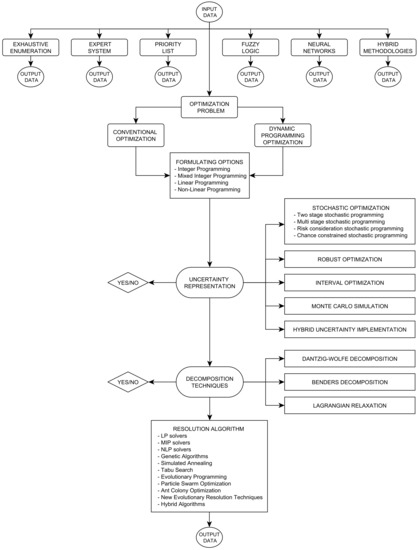
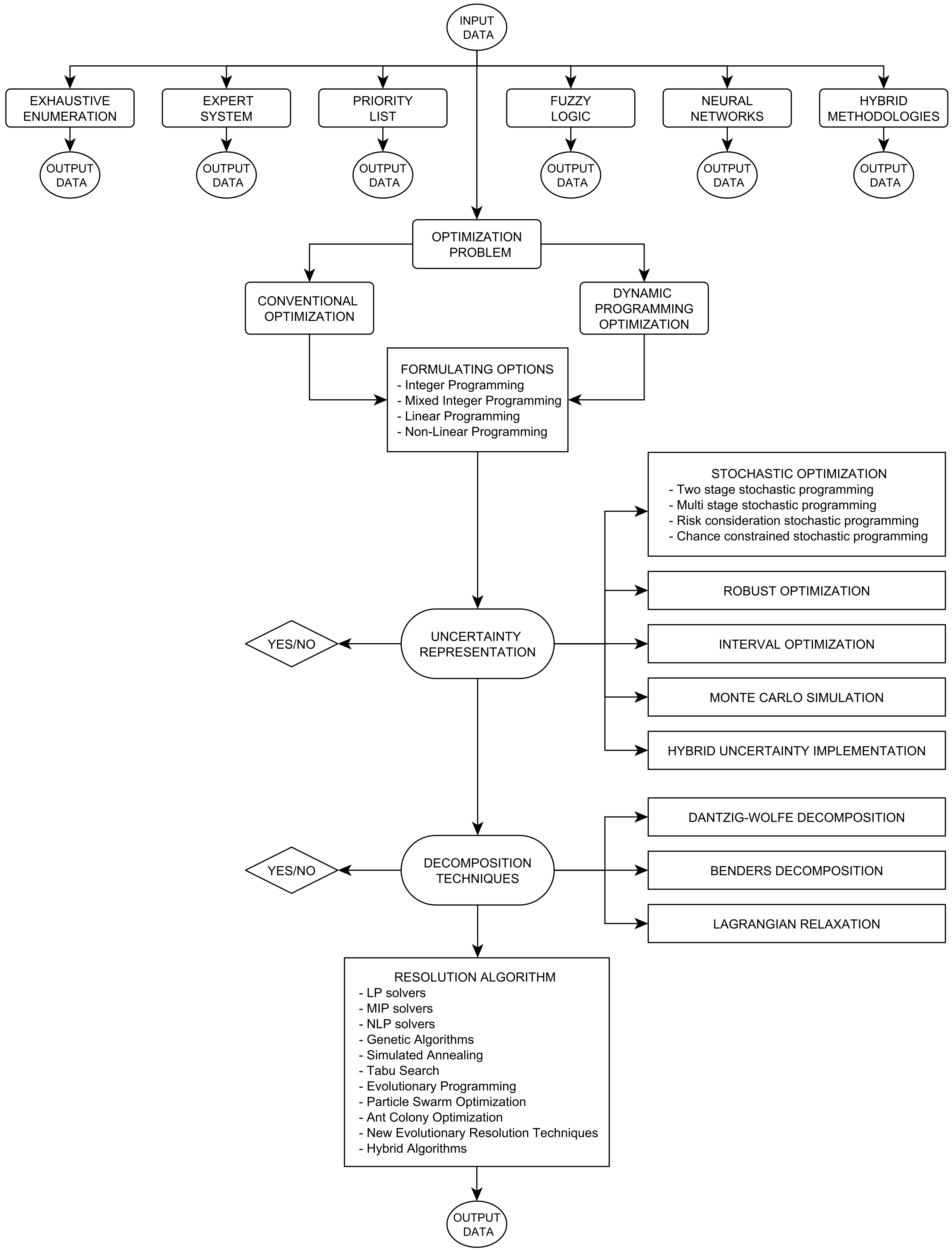

Publisher’s Note: MDPI stays neutral with regard to jurisdictional claims in published maps and institutional affiliations. |
© 2022 by the authors. Licensee MDPI, Basel, Switzerland. This article is an open access article distributed under the terms and conditions of the Creative Commons Attribution (CC BY) license (https://creativecommons.org/licenses/by/4.0/).