


Abstract
Primary cleft palate repair may result in significant pain in the immediate postoperative period, which can lead to vigorous crying resulting in wound dehiscence and pulmonary complications. Effective pain control with opioids is the mainstay but administration on the floor has to be countered with the complications associated with their use, chiefly respiratory depression and sedation. We retrospectively examined the efficacies of intraoperative administration of intravenous (IV) dexmedetomidine (DEX) and ketamine (KET) to prevent early postoperative pain in children undergoing primary cleft palate repair and compared the results against relevant literature. The Texas Children’s Hospital anesthesia database was queried to identify children undergoing a palatal surgery from December 2011 to December 2012. Inclusion criteria permitted completed primary palatal surgery without major complications and intraoperative administration of DEX or KET. The control group (CTRL) received no additional drug. A comprehensive literature review was performed. A total of 71 pediatric patients underwent palatal surgery during the study period with 46 patients qualifying for analysis. Although results were not significant, consistent trends were observed with regards to lower opioid requirements during the first 24 hours for both medications compared with the CTRL. KET also had shorter time to discharge. The literature review resulted in several studies supporting decreased postoperative pain end points for both DEX and KET. In our sample, DEX and KET reduced postoperative opioid requirements. KET seems to have the added benefit of a shorter hospital stay. These finding are supported in the literature. With further investigation, the addition of these drugs may serve to provide improved pain relief without over sedation in patients undergoing cleft palate repair.
Cleft palate abnormalities are among the most common craniofacial abnormalities in the pediatric population. The incidence of cleft palate alone is not easily assessed because cleft lip is concurrently present in many cases; however, the overall incidence of cleft palate is between 0.1 and 1.1 per 1,000 newborns [1]. Although there is no current consensus on the optimal timing and technique for surgical repair, all patients with cleft palate will have to be anesthetized and operated on to correct their abnormality. In the published literature, incidence of airway compromise can reach up to 18% in isolated cleft palate cases and increases in syndromic children [1]. The risk of postoperative airway obstruction necessitates formulation of an ideal perioperative anesthetic that results in adequate pain relief without respiratory depression. Furthermore, it is extremely favorable if such a medication could provide prolonged postoperative analgesia, thus decreasing the need for opioids and other analgesics that may contribute to respiratory depression. In addition to respiratory concerns, postoperative pain can lead to vigorous crying, which in turn increases the risk of wound dehiscence and pulmonary complications that may result in delayed discharge [2]. In this study, we present the results of a retrospective chart review of cleft palate repair cases from our own hospital and summarize the published literature describing the perioperative use of dexmedetomidine (DEX) and ketamine (KET) in children. The purpose of this article is to encourage and pave the way for future research in the quest to identify the optimal anesthetic for the pediatric population undergoing cleft palate repair.
Materials and Methods
Study Design
This is a retrospective chart analysis examining the effect of intraoperative use of intravenous (IV) DEX or IV KET on early postoperative pain and opioid requirements in children who underwent cleft palate repair. In addition, a literature review was performed focusing on the postoperative effects of DEX and KET in pediatric patients.
Retrospective Chart Review
The Institutional Review Board for Human Subject Research for Baylor College of Medicine and affiliated hospitals approved a retrospective chart review of patients undergoing a palatal surgery from December 2011 to December 2012. The Texas Children’s Hospital anesthesia operating room database was queried to identify these patients. Surveyed data included age, gender, weight, American Society of Anesthesiologists (ASA) physical status, comorbidities, procedure type, operating surgeon, choice of intraoperative anesthetic drug, duration of surgery, postanesthesia care unit (PACU) length of stay, surgical complication, estimated blood loss (EBL), postoperative analgesic requirements including time and dosage and number of doses, airway compromise, oxygen use, and length of hospital stay. Patients were further reviewed for inclusion and exclusion criteria. Inclusion criteria for selection and analysis included patients undergoing primary palatal surgery by our two primary surgeons with no major perioperative complications, where either DEX or KET was administered intraoperatively. Major perioperative complications were defined as delayed extubation or complications requiring additional surgical intervention. Excluded patients had one or more of the following conditions: secondary palatal repair, intraoperative administration of both DEX and KET, were not operated on by one of our primary surgeons, or failed to meet inclusion criteria.
Descriptive statistics and two-sample t-tests were used for statistical analysis.
Literature Review
A broad search of the medical literature was performed using PubMed to query the Medline database up to March of 2013 (cutoff date, March 13, 2013) for articles about DEX or KET. The search was limited to clinical trials and review articles published in the English language except for one included article[3] in Chinese. Search terms included multiple combinations of DEX, KET, cleft palate repair, pain, perioperative pain, pediatrics, and children. The articles were reviewed for relevance based on title, abstract, and content. All articles that compared DEX or KET or both to any other anesthetic or analgesic regardless of the surgery performed or the significance of the results published were included.
Results
Retrospective Chart Review
The 71 initially identified charts were assessed to select those that met the study’s inclusion criteria, which led to selection of 46 patients. Patients were allocated to different groups based on whether they received intraoperative DEX group or KET group or neither (control group [CTRL]). Of the 46 patients who qualified for the research, 24 patients were in the CTRL group, 14 in the DEX group, and 8 in the KET group. Demographic data are presented in Table 1.
Table 1.
Demographic data.
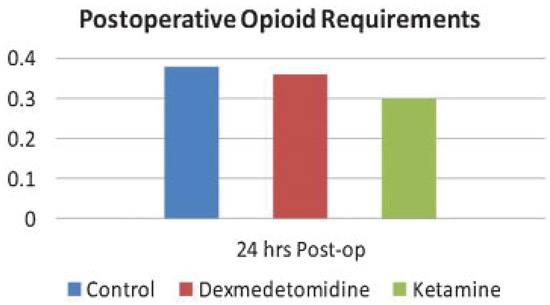
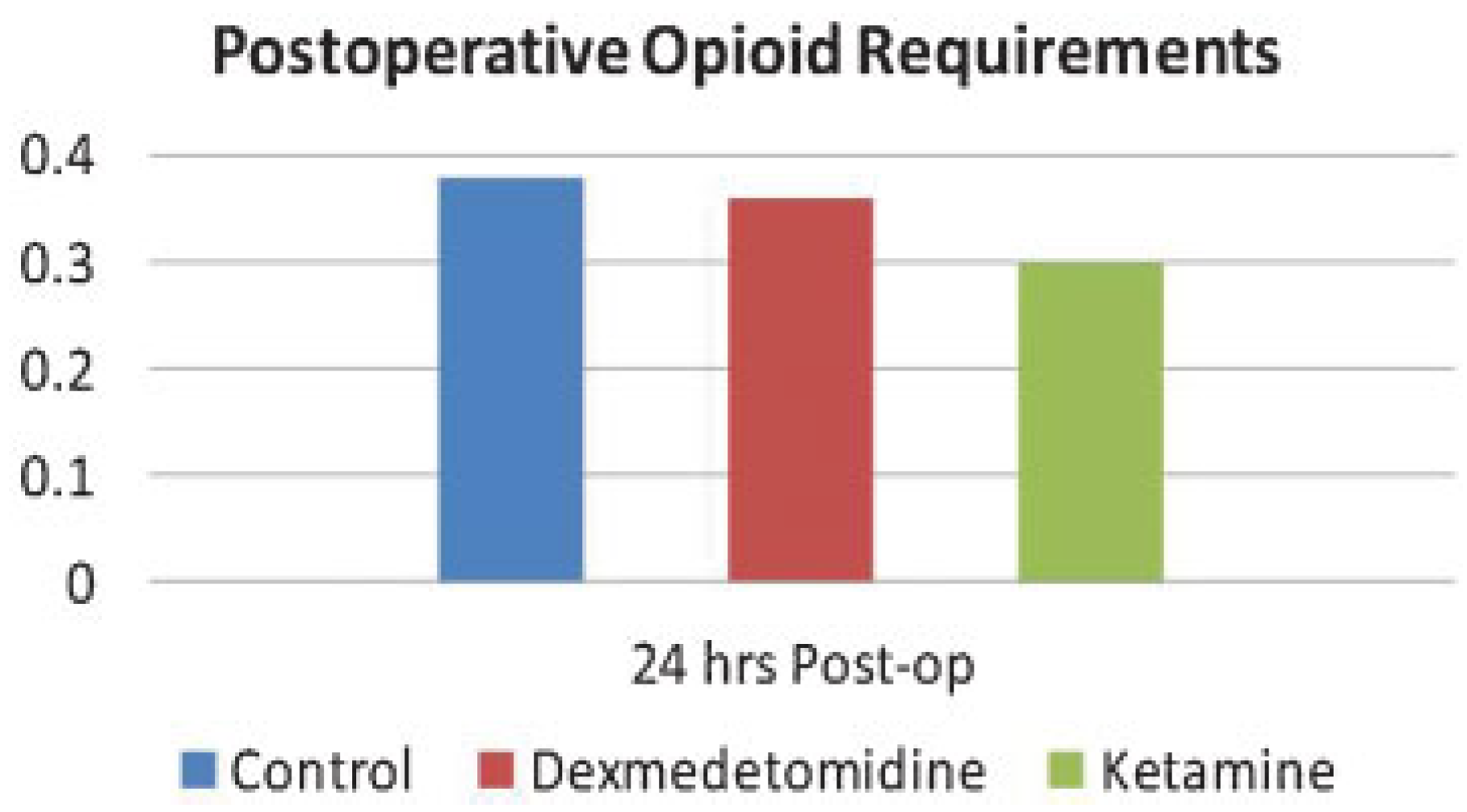
Although not statistically significant, the patients in DEX group and KET group both had lower opioid requirements postoperatively measured by morphine equivalent/kilogram (Meq/kg) (Figure 1). The KET group had a 0.30 Meq/kg and DEX group had a 0.36 Meq/kg compared with 0.38 Meq/kg for the CTRL during the first 24 hour postsurgery. DEX had the longest average time to discharge from both postanesthesia care unit (PACU) and hospital (Table 2). KET had longer average PACU stay than the CTRL, yet a shorter overall hospital stay. Patients in the KET group were discharged after an average of 26.8 versus 27.8 hours for the CTRL group, although this difference was not statistically significant. EBL, average surgical duration, and surgical complications were comparable in all groups.
Figure 1.
Cumulative 24-hour postoperative opioid requirements. The cumulative opioid requirements for the ketamine group (0.30 morphine equivalent/kilogram [Meq/kg]) and dexmedetomidine group (0.36 Meq/kg) compared with the control group (0.38 Meq/kg) with p values of 0.88 and 0.37 for dexmedetomidine and ketamine groups, respectively.
Table 2.
Time to discharge.
Literature Review
The combined literature searches yielded over 1,800 results. The abstracts or articles were reviewed and selected based on relevance to the effects of DEX and KET to postoperative analgesia and anesthetic effects on pediatric population resulting in selection of 41 articles. There were many overlapping articles within each search query. Articles with only caudal anesthesia were excluded. A summarized description of the relevant studies focused on head and neck surgeries can be found in Table 3.
Discussion
Primary cleft palate repair is known to cause significant pain in the immediate postoperative period. This may lead to vigorous crying causing wound dehiscence and pulmonary complications resulting in tardy recovery and late hospital discharge [2]. Because of this, effective pain control in this patient population is imperative. However, pain control should be accomplished without increasing the risk of respiratory depression, especially in children with increased risk of airway obstruction due to the coexistence of congenital anomalies. Currently, there is no consensus on how to best achieve this. In this study, we evaluated cleft palate repair cases from our own hospital and summarize the published literature about the perioperative use of DEX and KET in children.
DEX is a specific and selective α2-adrenoreceptor agonist that was Food and Drug Administration (FDA) approved for adult use in December 1999 [2]. It is well known for its shortterm sedative effects which allows for easy postanesthesia arousal and decreased risk for respiratory depression [2], hence, making its use favorable in patients with increased risk for respiratory arrest. In the literature, there are only two references that studied effect of DEX on cleft palate repair [2,3]. Obayah et al studied DEX effect when administered in combination with Bupivacaine for palatine nerve block versus Bupivacaine injections. There was a significant decrease in pain scores within the first 24 hour and time to first analgesic request postoperatively [2]. Xu et al compared four groups of DEX dosages with a CTRL, where saline was administered. The results proved that DEX administered at 1 µg/kg and a maintenance dose of 0.75 µg × kg1 × h1 had decreased extubation and discharge time [3]. In contrary, our study did not find a shortened discharge time with the addition of intraoperative DEX. Most of the trials conducted on efficacy of DEX for pediatric analgesia were on children undergoing tonsillectomy with or without adenoidectomy [4,5,6,7,8,9]. Other reported surgeries with DEX were spine [10], strabismus [11,12], and hypospadius [13] surgeries. Most results showed consistency in DEX’s ability to decrease postoperative pain, agitation, and analgesic requirements [2,4,6,7,9,11,12,13,14,15]. Our study supports the finding of decreased analgesic requirements, but it was not proven to be significant. These findings are a result of DEX acting on adrenoceptors inhibiting the release of norepinephrine, ultimately terminating the propagation of pain signals [16]. KET, an N-methyl-D-aspartate receptor antagonist, is an IV anesthetic well known for its analgesic properties [17,18]. Many studies have studied the efficacy of KET in pediatric anesthesia; however, only few of those addressed the use of KET in cleft palate surgeries. In one trial, peritonsillar infiltration with KET proved to be significantly more effective in decreasing pain and crying in the first 24-hour postcleft palate repair when compared with Bupivacaine [19]. Most of the KET trials were done on children that underwent tonsillectomy or adenotonsillectomy [20,21,22,23,24,25,26,27,28,29,30,31,32,33,34,35,36,37]. Other surgeries were strabismus [11], appendectomy [38], Nuss procedure [39], hernia repair, circumcision, and orchidopexy [40]. In some studies, KET did not prove to have higher efficacy in controlling postoperative pain in comparison to morphine [20,23,27], magnesium sulfate [22], placebo [33,34,38,40], and tramadol [23,33]. In other trials, KET proved to decrease postoperative pain scores when compared with placebo [21,23,27,28,32,35]. KET administered intravenously was more effective than that administered locally in decreasing postoperative pain intensity and demand for analgesia; however, local infiltration with KET had superior results in the first 6 to 24 hours postoperatively [41]. Our study, using IV KET, demonstrated decreased postoperative demand for analgesia during the first 24 hours postoperative, although it was not statistically significant.
Table 3.
Summary of head and neck literature review.
DEX proved to be significantly more effective than KET in controlling postoperative pain in children undergoing strabismus surgery [11]. This observation was not supported in our study, as KET appeared superior to DEX in all categories surveyed. Despite all the current literature, there is no consensus on the efficacy of KET or DEX in decreasing early postoperative pain and analgesia requirement in children. However, trends toward both agents having these effects are gaining support. A review article by Tobias suggests that combining DEX and KET would result in counteraction of each other’s adverse effects, hence limiting hypertension or hypotension, tachycardia or bradycardia, salivation, and emergence agitation [42]. One patient, excluded from the analysis of our study, received both agents and did not demonstrate any of these reported side effects. A combination of these agents may serve as a useful adjunct to traditional anesthetic management, however more investigation is required.
Because of the retrospective nature of the study, we were not able to control for anesthetic premedication, number of patients in each study group, or for possible confounding variables, such as, age, gender, ASA physical status, etc. In addition, there was no control on intraoperative anesthetic agents, dosages administered, timing of administration, and other analgesics given. The sample size was not large enough to conclude significance. Also with respect to the literature review done, it would have been ideal if the results were presented as a meta-analysis; however, because of variance in the outcomes examined as well as variation in choice of anesthetics, premedication, types of surgery, age, gender, ASA physical status, and other factors in the selected studies a meta-analysis was not feasible. However, the results of this combined chart and literature review call for the need to conduct prospective randomized controlled trials to assess the efficacy and effects of DEX and KET in children undergoing cleft palate repair. Such trials would clearly identify which medication would provide optimal relief of early postoperative pain with fewer side effects, eventually leading to an evidence-based superior benefit-to-risk ratio agent to be used in future cleft palate repairs.
Conclusion
In the literature, effects of DEX and KETon children have been studied. Combined with our results, both agents demonstrate promising results when used in pediatric patients undergoing cleft palate repair. The choice of perioperative analgesia in cleft palate repair surgery is very important especially for children with increased risk for airway obstruction and respiratory depression. It necessitates a synergism between the choice of premedication, intraoperative anesthetic, and postoperative analgesic. We believe that DEX, KET, or a combination of both could potentially resolve this concern by providing effective early postoperative analgesia without the risk of respiratory depression; however, there is a pressing need for prospective randomized trials to further test their effect on pediatric population undergoing cleft palate repair.
Financial Disclosures/Commercial Associations
None.
References
- Liau, J.Y.; Sadove, A.M.; van Aalst, J.A. An evidence-based approach to cleft palate repair. Plast Reconstr Surg 2010, 126, 2216–2221. [Google Scholar] [CrossRef] [Scilit] [PubMed]
- Obayah, G.M.; Refaie, A.; Aboushanab, O.; Ibraheem, N.; Abdelazees, M. Addition of dexmedetomidine to bupivacaine for greater palatine nerve block prolongs postoperative analgesia after cleft palate repair. Eur J Anaesthesiol 2010, 27, 280–284. [Google Scholar] [CrossRef] [Scilit]
- Xu, Y.Y.; Song, X.R.; Lin, Z.M.; Zhang, G.Q.; Zhang, N. [Effect of dexmedetomidine on postoperative analgesia and sedation in pediatric patients undergoing cleft lip and palate repair]. Zhonghua Yi Xue Za Zhi 2012, 92, 878–881. [Google Scholar] [PubMed]
- Meng, Q.T.; Xia, Z.Y.; Luo, T.; et al. Dexmedetomidine reduces emergence agitation after tonsillectomy in children by sevoflurane anesthesia: A case-control study. Int J Pediatr Otorhinolaryngol 2012, 76, 1036–1041. [Google Scholar] [CrossRef] [Scilit] [PubMed]
- Zhuang, P.J.; Wang, X.; Zhang, X.F.; Zhou, Z.J.; Wang, Q. Postoperative respiratory and analgesic effects of dexmedetomidine or morphine for adenotonsillectomy in children with obstructive sleep apnoea. Anaesthesia 2011, 66, 989–993. [Google Scholar] [CrossRef] [Scilit]
- Pestieau, S.R.; Quezado, Z.M.; Johnson, Y.J.; et al. High-dose dexmedetomidine increases the opioid-free interval and decreases opioid requirement after tonsillectomy in children. Can J Anaesth 2011, 58, 540–550. [Google Scholar] [CrossRef] [Scilit] [PubMed]
- Patel, A.; Davidson, M.; Tran, M.C.J.; et al. Dexmedetomidine infusion for analgesia and prevention of emergence agitation in children with obstructive sleep apnea syndrome undergoing tonsillectomy and adenoidectomy. Anesth Analg 2010, 111, 1004–1010. [Google Scholar] [CrossRef] [Scilit]
- Olutoye, O.A.; Glover, C.D.; Diefenderfer, J.W.; et al. The effect of intraoperative dexmedetomidine on postoperative analgesia and sedation in pediatric patients undergoing tonsillectomy and adenoidectomy. Anesth Analg 2010, 111, 490–495. [Google Scholar] [CrossRef] [Scilit]
- Guler, G.; Akin, A.; Tosun, Z.; Ors, S.; Esmaoglu, A.; Boyaci, A. Single-dose dexmedetomidine reduces agitation and provides smooth extubation after pediatric adenotonsillectomy. Paediatr Anaesth 2005, 15, 762–766. [Google Scholar] [CrossRef] [Scilit]
- Sadhasivam, S.; Boat, A.; Mahmoud, M. Comparison of patientcontrolled analgesia with and without dexmedetomidine following spine surgery in children. J Clin Anesth 2009, 21, 493–501. [Google Scholar] [CrossRef] [Scilit]
- Chen, J.Y.; Jia, J.E.; Liu, T.J.; Qin, M.J.; Li, W.X. Comparison of the effects of dexmedetomidine, ketamine, and placebo on emergence agitation after strabismus surgery in children. Can J Anaesth 2013, 60, 385–392. [Google Scholar] [CrossRef] [Scilit]
- Mizrak, A.; Erbagci, I.; Arici, T.; Avci, N.; Ganidagli, S.; Oner, U. Dexmedetomidine use during strabismus surgery in agitated children. Med Princ Pract 2011, 20, 427–432. [Google Scholar] [CrossRef] [Scilit]
- Al-Zaben, K.R.; Qudaisat, I.Y.; Al-Ghanem, S.M.; et al. Intraoperative administration of dexmedetomidine reduces the analgesic requirements for children undergoing hypospadius surgery. Eur J Anaesthesiol 2010, 27, 247–252. [Google Scholar] [CrossRef] [Scilit]
- Mizrak, A.; Karatas, E.; Saruhan, R.; et al. Does dexmedetomidine affect intraoperative blood loss and clotting tests in pediatric adenotonsillectomy patients? J Surg Res 2013, 179, 94–98. [Google Scholar] [CrossRef] [Scilit]
- Schnabel, A.; Reichl, S.U.; Poepping, D.M.; Kranke, P.; Pogatzki-Zahn, E.M.; Zahn, P.K. Efficacy and safety of intraoperative dexmedetomidine for acute postoperative pain in children: A meta-analysis of randomized controlled trials. Paediatr Anaesth 2013, 23, 170–179. [Google Scholar] [CrossRef] [Scilit]
- Gertler, R.; Brown, H.C.; Mitchell, D.H.; Silvius, E.N. Dexmedetomidine: A novel sedative-analgesic agent. Proc (Bayl Univ Med Cent) 2001, 14, 13–21. [Google Scholar] [CrossRef] [Scilit]
- Elia, N.; Tramèr, M.R. Ketamine and postoperative pain—A quantitative systematic review of randomised trials. Pain 2005, 113, 61–70. [Google Scholar] [CrossRef] [Scilit]
- Subramaniam, K.; Subramaniam, B.; Steinbrook, R.A. Ketamine as adjuvant analgesic to opioids: A quantitative and qualitative systematic review. Anesth Analg 2004, 99, 482–495. [Google Scholar] [CrossRef] [Scilit]
- Jha, A.K.; Bhardwaj, N.; Yaddanapudi, S.; Sharma, R.K.; Mahajan, J.K. A randomized study of surgical site infiltration with bupivacaine or ketamine for pain relief in children following cleft palate repair. Paediatr Anaesth 2013, 23, 401–406. [Google Scholar] [CrossRef] [Scilit] [PubMed]
- Aspinall, R.L.; Mayor, A. A prospective randomized controlled study of the efficacy of ketamine for postoperative pain relief in children after adenotonsillectomy. Paediatr Anaesth 2001, 11, 333–336. [Google Scholar] [CrossRef] [Scilit] [PubMed]
- Elhakim, M.; Khalafallah, Z.; El-Fattah, H.A.; Farouk, S.; Khattab, A. Ketamine reduces swallowing-evoked pain after paediatric tonsillectomy. Acta Anaesthesiol Scand 2003, 47, 604–609. [Google Scholar] [CrossRef] [Scilit] [PubMed]
- O’Flaherty, J.E.; Lin, C.X. Does ketamine or magnesium affect posttonsillectomy pain in children? Paediatr Anaesth 2003, 13, 413–421. [Google Scholar] [CrossRef] [Scilit]
- Umuroğlu, T.; Eti, Z.; Ciftçi, H.; Yilmaz Göğüş, F. Analgesia for adenotonsillectomy in children: A comparison of morphine, ketamine and tramadol. Paediatr Anaesth 2004, 14, 568–573. [Google Scholar] [CrossRef] [Scilit] [PubMed]
- DAConceição, M.J.; Bruggemann DAConceição, D.; Carneiro Leão, C. Effect of an intravenous single dose of ketamine on postoperative pain in tonsillectomy patients. Paediatr Anaesth 2006, 16, 962–967. [Google Scholar] [CrossRef] [Scilit]
- Dal, D.; Celebi, N.; Elvan, E.G.; Celiker, V.; Aypar, U. The efficacy of intravenous or peritonsillar infiltration of ketamine for postoperative pain relief in children following adenotonsillectomy. Paediatr Anaesth 2007, 17, 263–269. [Google Scholar] [CrossRef] [Scilit] [PubMed]
- Erhan, O.L.; Göksu, H.; Alpay, C.; Beştaş, A. Ketamine in post-tonsillectomy pain. Int J Pediatr Otorhinolaryngol 2007, 71, 735–739. [Google Scholar] [CrossRef] [Scilit]
- Canbay, O.; Celebi, N.; Uzun, S.; Sahin, A.; Celiker, V.; Aypar, U. Topical ketamine and morphine for post-tonsillectomy pain. Eur J Anaesthesiol 2008, 25, 287–292. [Google Scholar] [CrossRef] [Scilit]
- Honarmand, A.; Safavi, M.R.; Jamshidi, M. The preventative analgesic effect of preincisional peritonsillar infiltration of two low doses of ketamine for postoperative pain relief in children following adenotonsillectomy. A randomized, double-blind, placebo-controlled study. Paediatr Anaesth 2008, 18, 508–514. [Google Scholar] [CrossRef] [Scilit]
- Abu-Shahwan, I. Ketamine does not reduce postoperative morphine consumption after tonsillectomy in children. Clin J Pain 2008, 24, 395–398. [Google Scholar] [CrossRef] [Scilit]
- Inanoglu, K.; Ozbakis Akkurt, B.C.; Turhanoglu, S.; Okuyucu, S.; Akoglu, E. Intravenous ketamine and local bupivacaine infiltration are effective as part of a multimodal regime for reducing post-tonsillectomy pain. Med Sci Monit 2009, 15, CR539–CR543. [Google Scholar]
- Elshammaa, N.; Chidambaran, V.; Housny, W.; Thomas, J.; Zhang, X.; Michael, R. Ketamine as an adjunct to fentanyl improves postoperative analgesia and hastens discharge in children following tonsillectomy - a prospective, double-blinded, randomized study. Paediatr Anaesth 2011, 21, 1009–1014. [Google Scholar] [CrossRef] [Scilit] [PubMed]
- Khademi, S.; Ghaffarpasand, F.; Heiran, H.R.; Yavari, M.J.; Motazedian, S.; Dehghankhalili, M. Intravenous and peritonsillar infiltration of ketamine for postoperative pain after adenotonsillectomy: A randomized placebo-controlled clinical trial. Med Princ Pract 2011, 20, 433–437. [Google Scholar] [CrossRef] [Scilit]
- Ayatollahi, V.; Behdad, S.; Hatami, M.; Moshtaghiun, H.; Baghianimoghadam, B. Comparison of peritonsillar infiltration effects of ketamine and tramadol on post tonsillectomy pain: A double-blinded randomized placebo-controlled clinical trial. Croat Med J 2012, 53, 155–161. [Google Scholar] [CrossRef] [Scilit] [PubMed]
- Batra, Y.K.; Shamsah, M.; Al-Khasti, M.J.; Rawdhan, H.J.; Al-Qattan, A.R.; Belani, K.G. Intraoperative small-dose ketamine does not reduce pain or analgesic consumption during perioperative opioid analgesia in children after tonsillectomy. Int J Clin Pharmacol Ther 2007, 45, 155–160. [Google Scholar] [CrossRef] [Scilit]
- Murray, W.B.; Yankelowitz, S.M.; le Roux, M.; Bester, H.F. Prevention of post-tonsillectomy pain with analgesic doses of ketamine. S Afr Med J 1987, 72, 839–842. [Google Scholar] [PubMed]
- Taheri, R.; Seyedhejazi, M.; Ghojazadeh, M.; Ghabili, K.; Shayeghi, S. Comparison of ketamine and fentanyl for postoperative pain relief in children following adenotonsillectomy. Pak J Biol Sci 2011, 14, 572–577. [Google Scholar] [CrossRef] [Scilit]
- El Sonbaty, M.I.; Abo el Dahab, H.; Mostafa, A.; Abo Shanab, O. Preemptive peritonsillar ketamine infiltration: Postoperative analgesic efficacy versus meperidine. Middle East J Anaesthesiol 2011, 21, 43–51. [Google Scholar]
- Dix, P.; Martindale, S.; Stoddart, P.A. Double-blind randomized placebo-controlled trial of the effect of ketamine on postoperative morphine consumption in children following appendicectomy. Paediatr Anaesth 2003, 13, 422–426. [Google Scholar] [CrossRef] [Scilit]
- Cha, M.H.; Eom, J.H.; Lee, Y.S.; et al. Beneficial effects of adding ketamine to intravenous patient-controlled analgesia with fentanyl after the Nuss procedure in pediatric patients. Yonsei Med J 2012, 53, 427–432. [Google Scholar] [CrossRef] [Scilit]
- Butkovic, D.; Kralik, S.; Matolic, M.; Jakobovic, J.; Zganjer, M.; Radesic, L. Comparison of a preincisional and postincisional small dose of ketamine for postoperative analgesia in children. Bratisl Lek Listy (Tlacene Vyd) 2007, 108, 184–188. [Google Scholar]
- Dahmani, S.; Michelet, D.; Abback, P.S.; et al. Ketamine for perioperative pain management in children: A meta-analysis of published studies. Paediatr Anaesth 2011, 21, 636–652. [Google Scholar] [CrossRef] [Scilit] [PubMed]
- Tobias, J.D. Dexmedetomidine and ketamine: An effective alternative for procedural sedation? Pediatr Crit Care Med 2012, 13, 423–427. [Google Scholar] [CrossRef] [Scilit] [PubMed]

© 2014 by the author. The Author(s) 2014.