


Abstract
Background: Many health-care providers may overlook or be unaware of most drug-to-drug interactions. Recognizing the existence of drug interactions with cigarette smoking and alcohol ingestion can empower a clinician with knowledge to avoid dangerous interactions that may result in hazardous, negative patient outcomes. Cigarette smoking and alcohol use can reduce the efficiency of certain drugs or make drug therapy more unpredictable. Methods: This review offers the physician information regarding prescription drug interactions with cigarette smoking and alcohol use. First, mechanisms found in the medical literature of potential drug interactions in cigarette smokers and alcohol drinkers are presented. Second, the 100 most frequently prescribed medications in 2006 are reviewed regarding cigarette smoking effects and alcohol effects as cited in the medical literature. Lastly, a table of these 100 medications and any reported effects of cigarette smoking or alcohol consumption on each drug is provided. Results: The actual number of different medications reviewed was 78. Drug interactions resulting from the effects of cigarette smoking occurred with 33.3% of the drugs (n = 26), and drug interactions resulting from the effects of alcohol consumption occurred with 76.9% of the drugs (n = 60). Finally, resource information regarding smoking cessation and alcohol abuse recovery is summarized so that physicians may empower their patients to avoid potential drug-interaction events. Conclusions: Cigarette smoke and alcohol may interact with medications through pharmacokinetic or pharmacodynamic mechanisms. Engaging in both of these social activities can reduce the efficiency of certain drugs or can make drug therapy unpredictable. This review offers the health-care provider information regarding potential prescription drug interactions. Empowered with this information, clinicians may assist their patients to maximize pharmacologic outcomes by avoiding these reported harmful interactions.
The process of taking a patient’s history is a very important one. A thorough, complete patient history will help a physician make an accurate diagnosis and develop a treatment plan. Part of such a treatment plan is the prescribing of medications. These decisions are made by the treating clinician who is empowered with a knowledge of pharmacology, medication adverse effects, and drug interactions. The physician realizes that the medication response is not always the same. A given medication may act differently depending on many patient factors. There is a need to explore critical elements of each patient to determine possible mechanisms for medication treatment failures and adverse effects.
Therefore, it is fundamental for a clinician to develop a solid foundation for good medical care when achieving health maintenance or treating an ill patient by fostering a comfortable evolving relationship between patient and physician. To facilitate this relationship, the provider should use permission-giving questions that allow the patient to “admit” something that he or she may not otherwise volunteer. This technique is especially crucial when interviewing a patient regarding their social history, particularly as it pertains to cigarette smoking and alcohol consumption. Clinicians who prescribe and dispense medications should appreciate the existence of drug–cigarette smoke interactions and drug-alcohol interactions that may result in medication treatment failures.
In 2004 in the United States, 23% of men and 19% of women surveyed admitted to being cigarette smokers.[1] According to the Centers for Disease Control and Prevention, alcohol consumption by adults 18 years and older in the United States at the end of 2004 was 60.8% of households surveyed.[1] Littleton et al [2] found that a high proportion of the alcohol-dependent population is also nicotine dependent. Also, this overview shows that the major reason for concurrent alcohol use may reinforce the effects of nicotine and that each drug becomes a pharmacologic cue for the expectation of the other.[2] Grucza and Bierut [3] sought to address whether smokers are more vulnerable to alcohol abuse and dependence than nonsmokers who drink comparable quantities. The database selected for their review was the aggregated information from the 2002 through 2004 US National Survey on Drug Use and Health. Participants were randomly selected adolescents and young adults aged 12 to 20 years. These authors concluded that occasional and daily smokers were at heightened risk for hazardous drinking and alcohol use diagnoses.
Moreover, the most recent data from a sample population survey of civilian, noninstitutionalized individuals in US households reveal that 45.3% of the population consumes at least one prescription drug a month and that 17.7% of the population consumes three or more prescriptions a month.[1] Reflection on these prevalence statistics collectively allows for an inference and summation that an overlapping cross-sectional population may exist as it pertains to the concurrent use of prescription medications, alcohol, and cigarettes. Given that many health-care providers overlook or are unaware of most drug-to-drug interactions, it is important that the clinician be knowledgeable about the existence of drug interactions with cigarette smoking and alcohol ingestion to avoid a dangerous patient outcome.
The purpose of this review is to offer the healthcare professional information regarding prescription drug interactions and cigarette smoking and alcohol use. First, specific mechanisms found in the medical literature describing the potential drug interactions of cigarette smokers and alcohol consumers are offered as a cornerstone. Second, building on the previous foundation of drug-interaction information, the 100 most frequently prescribed medications in 2006 are reviewed regarding cigarette smoking effects and alcohol effects as cited in the medical literature. Finally, resource information regarding smoking cessation and alcohol abuse recovery is summarized so that physicians may empower their patients to avoid potential drug-interaction events.
Overview of Drug Metabolism
One category of drug-to-drug interactions is referred to as pharmacodynamic, defined as one drug altering the biological effect of another therapeutic agent. The other type of drug-to-drug interaction occurs when one therapeutic agent alters the concentration of another therapeutic agent and is defined as a pharmacokinetic interaction. These drug interactions can occur at the level of absorption, distribution, metabolism, or clearance of the affected agent. A variety of medications are eliminated by metabolism either by the liver or other body organs.
Drug metabolism occurs as a result of enzymatic reactions on the medications, resulting in metabolites that may be active or rendered inactive. Body organs such as the gastrointestinal wall, lungs, and liver and the blood possess enzymes that metabolize drugs.[4,5] Metabolism via the smooth endoplasmic reticulum of the liver is the first step in the elimination of many drugs.[5,6] Drug metabolism by the liver occurs through one or both biotransformation reactions classified as either phase I or phase II reactions.[4] Phase I reactions modify the drug by using oxidation, hydrolysis, and reduction. These modifying reactions create a more polar and highly water-soluble drug molecule for elimination by the kidney. Phase II reactions modify the drug pharmacologically to an inactive form using conjugation, which results in glucuronides, acetates, and sulfates. This is accomplished by the formation of a covalent link between a functional group appearing on the parent drug as a result of phase I metabolism and endogenously derived glucuronic acid, sulfate, glutathione, amino acids, or acetate.[6,7] This new drug metabolite may now be eliminated by the kidney.
Some important preventable drug interactions are attributable to their effects on drug-metabolizing enzymes, resulting in either reduced activity of the enzyme (enzyme inhibition) or increased activity of the enzyme (enzyme induction). The major group of enzymes in the liver responsible for metabolizing drugs can be isolated in a subcellular fraction termed microsomes. Cytochrome P450 is a superfamily of enzymes that are the terminal oxidases of this oxidation system. Cytochrome means colored cells; these enzymes contain iron, giving the liver its red color. The name P450 comes from the observation that the enzyme absorbs a very characteristic wavelength (450 nm) of ultraviolet light when it is exposed to carbon monoxide.
These enzymes are named according to families that are defined by the similarity of their amino acid sequence. The nomenclature of each cytochrome isoenzyme follows some simple rules.[8,9] Using CYP3A4 as an example, the root of its name is “CYP.” Its family is noted with the number “3,” and its subfamily is represented with the letter “A.” Its gene is denoted with the last number in the series, “4.” These P450 isoenzymes are denoted with the following numbers and letters: CYP1A2, CYP2A6, CYP2C8, CYP2C9, CYP2C19, CYP2D6, CYP2E1, and CYP3A4.[8,9,10]
The CYP3A subfamily is of particular interest because it is responsible for the metabolism of many clinically important drugs in humans.[9] The CYP3A4 isozyme accounts for more than 25% of hepatic CYP450 content and is responsible for more than half of all CYP450-mediated drug metabolism. Approximately 14% of the adult liver contains a substantial proportion of CYP3A5, but it is proportionally more important in intestinal tissue and is the primary CYP3A enzyme in the kidney.[9,10]
It is appreciated by the medical community that it is impossible to remember all of the drug interactions that can occur. On the other hand, a physician may apply an understanding of the mechanisms of enzyme inhibition and induction to empower themselves to avoid major drug interactions during the prescribing of multiple medications to the same patient. Advances in the understanding of the CYP enzyme system have made it possible to associate specific enzyme activity with the formation of a particular metabolite and, in some cases, to identify the major isoenzyme responsible for the total clearance of a drug.
Drug Interactions in Smokers
Cigarette smoke is known to contain 3,000 different compounds, including aromatic hydrocarbons, N-nitrosamines, and aromatic amines.[11,12] Relative significant drug interactions from cigarette smoke result not from nicotine but from the combustion of products of tobacco smoke. Polycyclic aromatic hydrocarbons in tobacco smoke are believed to be responsible for the induction of cytochrome P450, CYP1A1, CYP1A2, and, possibly, CYP2E1.[13] Among its various biological effects, cigarette smoke creates a pharmacokinetic reaction, resulting in drug induction and a change in drug clearance.[13]
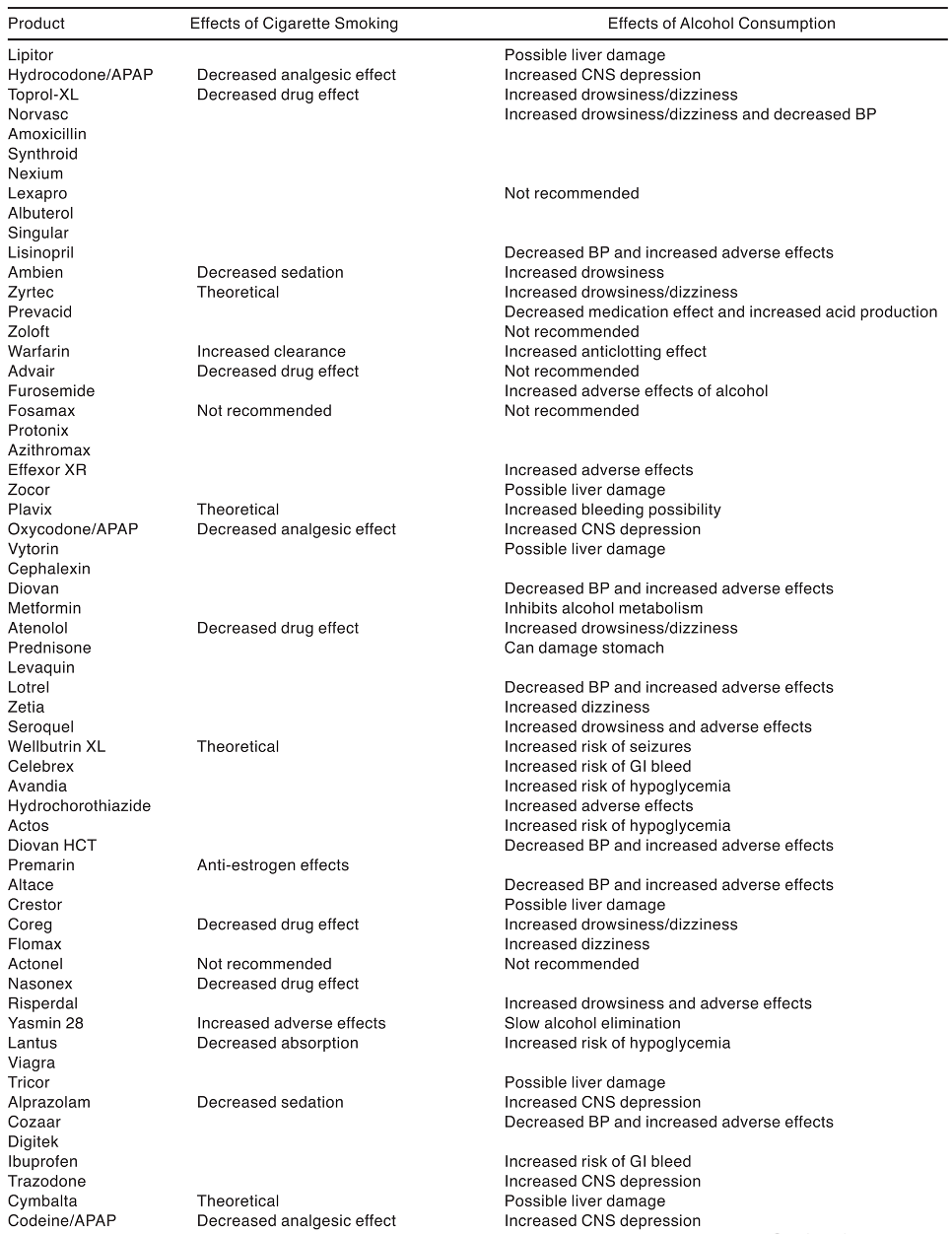
Data regarding pharmacokinetic and pharmacodynamic drug interactions between medications and cigarette smoking from the scientific literature were identified by searching MEDLINE.[12,13,14,15,16,17] A careful review of the available data suggests that only a few drug–cigarette smoke interactions exert a clinically significant effect.[12] The most consistently observed effect of cigarettes on drug metabolism is an increase in clearance of drugs that are substrates of CYP1A2.[11] For this review, observed pharmacokinetic and pharmacodynamic changes resulting from the interaction with cigarette smoking was applied to the 100 most frequently prescribed medications in 2006 (Table 1).
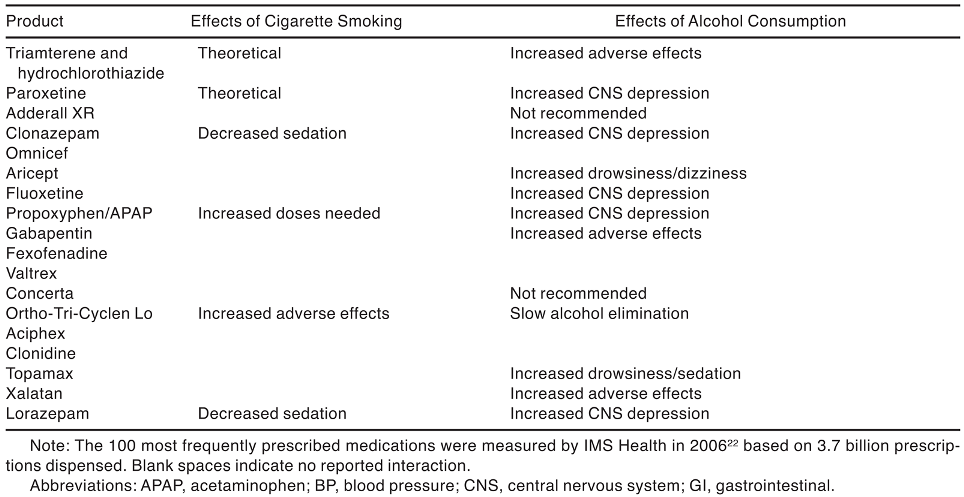
Table 1.
Potential Interactions Between Cigarette Smoking, Alcohol Consumption, and the 100 Most Frequently Prescribed Medications.
Selected medications for which induced metabolism because of cigarette smoking has clinical consequences include theophylline, imipramine, haloperidol, pentazocine, propranolol, flecainide, and estradiol.[13,14,15] Other common drugs metabolized by CYP1A2 are cyclobenzaprine, duloxetine, lidocaine, melatonin, mirtazapine, ondansetron, ramelteon, ropinirole, selegiline, tizanidine, triamterene, and warfarin.[10,15] Although the exact mechanism is unknown, cigarette smoking resulted in faster clearance of heparin and a decreased half-life of heparin.[13] Also, cutaneous vasoconstriction by nicotine may slow the rate of insulin absorption after subcutaneous administration.[13] Zevin and Benowitz[13] reported that cigarette smokers demonstrated a 13% increase in warfarin clearance and a decrease of 13% in the plasma warfarin concentration.
Kroon revealed a difference in alprazolam package insert labeling between Xanax and Niravam by pointing out that the orally disintegrating Niravam insert states that “alprazolam concentrations may be reduced by 50% in smokers compared to nonsmokers.”[14](p57) Although these data do not appear in the Xanax package insert,[14] it can only be speculated that the difference in absorption with the orally disintegrating product may be due to the physiologic effect of smoking by decreasing saliva formation and, hence, decreasing the product disintegration properties. Furthermore, Kroon[14] explains that the published literature does not support pharmacokinetic drug information databases regarding significant drug interactions and differences with alprazolam, chlordiazepoxide, diazepam, lorazepam, and midazolam in smokers and nonsmokers.[13,14]
The pharmacokinetic interaction between lidocaine and smoking may have interesting implications to a clinician performing surgical procedures. This drug is metabolized by and is a substrate of CYP1A2. The oral bioavailability of lidocaine was studied and compared in nine individuals (four smokers and five nonsmokers).[17] The oral clearance of lidocaine was found to be significantly higher in smokers because of alterations in the drug’s area under the curve, with no difference in systemic clearance rates.[17] This particular interaction needs to be explored further in subsequent studies. A surgeon may reflect on these data the next time a cigarette smoker complains of pain after receiving lidocaine as a local anesthetic for a procedure.
Some pharmacodynamic interactions discussed in the medical literature are thought to be caused by the pharmacologic effects of nicotine, which could counteract the effects of other medications.[14] Cited clinically significant pharmacodynamic drug interactions with smoking include a decreased analgesic effect with opioids and decreased sedation and drowsiness with benzodiazepines.[14] Observational studies showed that heavy smokers (>20 cigarettes per day) who received propoxyphene required higher dosages to achieve the same analgesic effect attained in nonsmokers.[12] A decrease in pronounced heart rate and decreased blood pressure effects are observed with concurrent β-blocker use and cigarette smoking.[14]
Drug Interactions and Alcohol
Health-care providers should remember that a drug generally must travel through the bloodstream to its site of action to produce some change in an organ or tissue to exert its effect. As a medication is processed or metabolized by enzymes and eliminated from the body, its effects are diminished. Alcohol behaves similarly, traveling through the bloodstream, acting on the brain to cause intoxication, and, finally, being metabolized and eliminated principally by the liver. In addition, several age-associated factors place older adults at risk for alcohol-related problems: delayed stomach emptying and slowed intestinal movement that allow for greater absorption of alcohol. Changes in body composition because of advanced age also lead to a higher blood alcohol level. Slower metabolic processing of alcohol causes it to remain in the body longer in the elderly individual.
Alcohol-drug interactions include the following. An acute dose of alcohol, as when a single drink or several drinks are ingested over several hours, may inhibit a drug’s metabolism by competing with the drug for the same set of metabolizing enzymes.[18] This interaction prolongs and enhances the drug’s availability, potentially increasing the patient’s risk of experiencing harmful effects from the drug.[18] In contrast, long-term alcohol ingestion may activate drug-metabolizing enzymes, thus decreasing the drug’s availability and diminishing its effects.[18] After these enzymes have been activated, they remain active even in the absence of alcohol, which affects the metabolism of certain drugs for several weeks after cessation of drinking.[19] Enzymes activated by long-term alcohol consumption transform some drugs into toxic chemicals that can damage the liver or other organs.[19] Alcohol can magnify the inhibitory effects of sedative and narcotic drugs at their sites of action in the brain.[19]
Specifically, short-term alcohol consumption enhances the availability of warfarin, increasing the patient’s risk of life-threatening hemorrhages.[18] Longterm alcohol consumption reduces the availability of warfarin, lessening the patient’s protection from the consequences of blood-clotting disorders.[18] Shortterm alcohol consumption interacts with some cardiovascular medications to cause dizziness or fainting on standing. These drugs include nitroglycerin, reserpine, methyldopa (Aldomet), hydralazine (Apresoline), and guanethidine (Ismelin). Long-term alcohol consumption decreases the availability of propranolol (Inderal), used to treat high blood pressure, potentially reducing its therapeutic effect.[18]
Alcohol is pharmacologically classified as a central nervous system depressant. A drug interaction may occur when an individual combines depressant-type medications, such as tranquillizers or narcotic pain killers. Short-term alcohol consumption increases the availability of some tricyclic antidepressants, potentially increasing their sedative effects,[19] whereas longterm alcohol consumption seems to increase the availability of some tricyclic antidepressants and decrease the availability of others.[20,21] Narcotic pain relievers are prescribed for moderate to severe pain. The combination of opioids and alcohol enhances the sedative effect of both substances, increasing the risk of death from an overdose. Benzodiazepines, which are excessively sedating, may cause severe drowsiness in the presence of alcohol.
Potential Interactions Table
The medications selected for review were the 100 most frequently prescribed (brand and generic names) in 2006 as measured by IMS Health based on 3.7 billion prescriptions dispensed.[22] A literature review was conducted to identify intrinsic drug interactions with either cigarette smoking or alcohol consumption. The data obtained were primarily qualitative and were based on reports in the current compendium,[23,24,25] recent journal articles,[11,12,13,14,15,16,17,18,19,20,21] and drug package inserts. Current literature sources were used to resolve conflicting information presented in reference materials.
A table was constructed listing the 100 medications by either brand name or generic name, followed by the information concerning drug interactions (Table 1). During the review, it was noted that duplicates were present owing to listing of medications by both brand name and generic name. Therefore, the actual number of different medications reviewed was 78. Reported drug interactions resulting from the effects of cigarette smoking occurred with 26 of the 78 drugs reviewed (33.3%). Described drug interactions resulting from the effects of alcohol consumption occurred with 60 of the 78 drugs reviewed (76.9%).
The predominant effect of smoking cigarettes on the 26 relevant drugs was a decrease in the drug’s intended effect. Furthermore, some literature sources revealed and described a theoretical basis for a drug interaction, citing the metabolism of the drug and its relationship with CYP1A2 metabolism. On the other hand, the dominant effect of alcohol consumption with these drugs was an increase in central nervous system effects, principally an increase in central nervous system depression. This was followed by a decrease in the drug’s intended effect or an increase in the drug’s adverse effects. A few package inserts recommend avoidance of cigarette smoking and alcohol consumption without explaining the effects that these activities may have on the drug.
Cessation Resources
An estimated 20.9% of American adults smoke.[1,26] Use of tobacco has been found to reduce life expectancy by 15 to 25 years.[26] Smoking is associated with a higher risk of nearly all major lung diseases and has the potential to cause serious drug interactions, as previously discussed. In an attempt to use a buffering approach to change individual health-care beliefs, initiatives have been forged by health-care organizations, business enterprises, and governmental agencies to create a smoke-free environment. Unfortunately, knowledge about health is generally not correlated with appropriate health behaviors. On the other hand, clinical interventions by health-care providers can increase successful cessation efforts by individuals who want to quit smoking cigarettes.[26] Physicians should adopt a buffering approach to provide education to smokers to assist them with appropriate health-care decisions.
As part of a thorough social history, a patient’s smoking status should be documented in the medical record. Then the clinician should assess the patient for readiness to quit and educate the patient about possible drug interactions that may occur if the patient continues to smoke. If the patient is not ready to quit at this point, he or she can be advised and encouraged to discuss their feelings; it is hoped that this discussion will assist the patient to arrive at the point of understanding and a realization of an appreciation of the health, economic, and intangible benefits of tobacco cessation. Once the patient has decided to quit smoking, the clinician may assist with the process by arranging for behavioral counseling and advising the patient of the availability of smoking cessation products.
Behavioral modification steps to prepare a patient to become and stay smoke free should include choosing a firm quit date, finding people who will help the patient quit, being prepared to expect challenges to quitting, and avoiding temptation by establishing a new routine to assist the patient with changing old habits. The clinician can use the mnemonic START to assist the patient with smoking cessation behavioral modification habits [26]: Set a quit date; Tell family, friends, and coworkers that you plan to quit; Anticipate and plan for the challenges you will face while quitting; Remove cigarettes from your home, car, and workplace; and Talk to your physician about getting help to quit.
Pharmacologic therapies found to be effective for treating tobacco dependence include nicotine products and nonnicotine medications. These medications help lessen withdrawal symptoms by slowly lowering nicotine levels in the body. Over-the-counter nicotinecontaining products include patches, gums, and lozenges. Nicotine nasal sprays and nicotine inhalers require a prescription. Because these products contain nicotine, the patient should not continue smoking cigarettes concurrently. Nicotine patches can be used for 8 weeks; gum and lozenges can be used for 12 weeks.
Also, physicians should ask their patients about their alcohol intake. A history may be obtained from the family if the affected person is unwilling or unable to answer questions. The physician has a role in the management of alcohol problems. The clinician can encourage reduction in a patient’s drinking by using more effective compassionate and empathetic counseling techniques as opposed to confrontational methods. Second, they can direct individuals to services for specialist assistance. They can counsel known alcohol abusers on proper and appropriate medication use as it relates to their practice. Finally, the physician can be watchful for signs of alcohol-related disease and withdrawal in their patients.
Alcohol recovery or rehabilitation programs support the affected person after detoxification to maintain abstinence from alcohol. Counseling, psychological support, nursing, and medical care are usually available in these programs. Education about the disease of alcoholism and its effects is part of the therapy. Programs can be either inpatient, with the patient residing in the facility during treatment, or outpatient, with the patient attending the program while living at home. Alcoholics Anonymous is a self-help group of recovering alcoholics that offers emotional support and an effective model of abstinence for people recovering from alcohol dependence. Al-Anon is a support group for spouses and others who are affected by someone else’s alcoholism. Alateen provides support for teenage children of alcoholics.
Once patients have been successful with either smoking cessation or suspending alcohol consumption, clinicians should be mindful that pharmacokinetic changes will occur in these patients. Once discontinuation of smoking has occurred, drugs that have had their metabolism induced will now have their metabolism gradually reduced.[11] The resulting onset of toxic effects may be slow and difficult to evaluate.[11]
Conclusions
Cigarette smoke and alcohol may interact with medications through pharmacokinetic or pharmacodynamic mechanisms. Cigarette smoking and alcohol use can reduce the efficiency of certain drugs or can make drug therapy more unpredictable. Therefore, this review offers the health-care provider information regarding prescription drug interactions caused by cigarette smoking and alcohol use. Mechanisms found in the medical literature of the potential drug interactions of cigarette smokers and alcohol consumers were presented. Second, the 100 most frequently prescribed medications measured by IMS Health for 2006 were reviewed regarding cigarette smoking and alcohol effects as cited in the medical literature. Reported drug interactions resulting from the effects of cigarette smoking were found to occur with 26 drugs (33.3%), and drug interactions resulting from the effects of alcohol consumption occurred with 60 drugs (76.9%). Finally, resource information regarding smoking cessation and alcohol abuse recovery was presented so that clinicians may empower their patients to avoid potential drug-interaction events.
Funding
None reported.
Conflicts of Interest
None reported.
References
- National Center for Health Statistics. Health, United States, 2006, With Chartbook on Trends in the Health of Americans; National Center for Health Statistics: Hyattsville, MD, 2006. [Google Scholar]
- LITTLETON, J.; BARRON, S.; PRENDERGAST, M.; et al. Smoking kills (alcoholics)! Shouldn’t we do something about it? Alcohol Alcohol 2007, 42, 167. [Google Scholar] [CrossRef] [Scilit] [PubMed]
- GRUCZA, R.A.; BIERUT, L.J. Cigarette smoking and risk for alcohol use disorders among adolescent drinkers. Alcohol Clin Exp Res 2006, 30, 2046. [Google Scholar] [CrossRef] [Scilit] [PubMed]
- BAUER LA: “Clinical Pharmacokinetics and Pharmacodynamics,” in Pharmacotherapy: A Pathophysiologic Approach, ed by JT Dipro, p 21, Appleton & Lange, Stamford, CT, 1999.
- HANSTEN PD, HORN JR: “Drug Interaction Mechanisms: Enzyme Induction,” in Hansten and Horn’s Drug Interactions Analysis and Management, p PM1, Facts and Comparisons, St Louis, 2003.
- BENET LZ, KROETZ DL, SHEINER LB: “Pharmacokinetics: The Dynamics of Drug Absorption, Distribution, and Elimination,” in Goodman and Gilman’s The Pharmacological Basis of Therapeutics, ed by JG Hardman, LE Limbird, p 3, McGraw-Hill, New York, 1996.
- LEUCUTA, S.E.; VLASE, L. Pharmacokinetics and metabolic drug interactions. Curr Clin Pharmacol 2006, 1, 5. [Google Scholar] [CrossRef] [Scilit] [PubMed]
- NELSON, D.R.; KOYMANS, L.; KAMATAKI, T.; et al. P450 superfamily: update on new sequences, gene mapping, accession numbers and nomenclature. Pharmacogenetics 1996, 6, 1. [Google Scholar] [CrossRef] [Scilit] [PubMed]
- STREETMAN, D.S. Metabolic differences and pharmacogenetics: implications for anesthesia. Anesthesia Today 2004, 14, 12. [Google Scholar]
- KOCH, I.; WEIL, R.; WOLBOLD, R.; et al. Interindividual variability and tissue-specificity in the expression of cytochrome P450 3A mRNA. Drug Metab Dispos 2002, 30, 1108. [Google Scholar] [CrossRef] [Scilit] [PubMed]
- HORN, J.R.; HANSETEN, P. Potential drug interactions in smokers and quitters. Pharmacy Times 2007, 73, 56. [Google Scholar]
- SCHEIN, J.R. Cigarette smoking and clinically significant drug interaction. Ann Pharmacother 1995, 29, 1139. [Google Scholar] [CrossRef] [Scilit] [PubMed]
- ZEVIN, S.; BENOWITZ, N.L. Drug interactions with tobacco smoking: an update. Clin Pharmacokinet 1999, 36, 425. [Google Scholar] [CrossRef] [Scilit] [PubMed]
- KROON, L.A. Drug interactions and smoking: raising awareness for acute and critical care providers. Crit Care Nurs Clin North Am 2006, 18, 53. [Google Scholar] [CrossRef] [Scilit] [PubMed]
- MCKINNON, R.A.; EVANS, A.M. Cytochrome P450: clinically significant drug interactions. Aust J Hosp Pharm 2000, 30, 146. [Google Scholar] [CrossRef] [Scilit]
- GUENGERICH, F.P.; SHIMADA, T.; YUN, C.; et al. Interactions of ingested food, beverage, and tobacco components involving human cytochrome P450 1A2, 2A6, 2E1, and 3A4 enzymes. Environ Health Perspect 1994, 102, 49. [Google Scholar] [CrossRef] [Scilit] [PubMed]
- HUET, P.M.; LELOIER, J. Effects of smoking and chronic hepatitis B on lidocaine and indocyanine green kinetics. Clin Pharmacol Ther 1980, 28, 208. [Google Scholar] [CrossRef] [Scilit] [PubMed]
- GORDIS E: Alcohol alert: alcohol-medication interactions, National Institute on Alcohol Abuse and Alcoholism No. 27 PH 355 January 1995. Available online: http://pubs.niaaa.nih.gov/publications/aa27.htm (accessed on 16 July 2007).
- GURAM, M.S.; HOWDEN, C.W. HOLT S: Alcohol and drug interactions. Pract Gastroenterol 1992, 16, 47. [Google Scholar]
- DORIAN, P.; SELLERS, E.M.; REED, K.L.; et al. Amitriptyline and ethanol: pharmacokinetic and pharmacodynamic interaction. Eur J Clin Pharmacol 1983, 25, 325. [Google Scholar] [CrossRef] [Scilit] [PubMed]
- BALANT-GORGIA, A.E.; GAY, M.; GEX-FABRY, M.; et al. Persistent impairment of clomipramine demethylation in recently detoxified alcoholic patients. Ther Drug Monit 1992, 14, 119. [Google Scholar] [CrossRef] [Scilit] [PubMed]
- LAMB, E. Top 200 prescription drugs of 2006. Pharmacy Times 2007, 73, 34. [Google Scholar]
- MURRAY L: Physician’s Desk Reference, 61st Ed, Thompson Medical Economics, Montvale, NJ, 2007.
- WICKERSHAM, R.M. Drug Facts and Comparisons 2007; Wolters Kluwer Health: St Louis, 2007. [Google Scholar]
- MCEVOY GK: AHFS Drug Information 2007, American Society of Health-System Pharmacists, Bethesda, MD, 2007.
- CENTERS FOR DISEASE CONTROL AND PREVENTION: Fact sheet: adult cigarette smoking in the United States: current estimates. Available online: http://www.cdc.gov/tobacco/data_ statistics/fact_sheets/adult_data/adult_cig_smoking.htm (accessed on 14 July 2007).

© 2009 American Podiatric Medical Association