


Abstract
Background: Falls in older people are a major public health problem, and there is increasing evidence that foot problems and inappropriate footwear increase the risk of falls. Several multidisciplinary prevention clinics have been established to address the problem of falls; however, the role of podiatry in these clinics has not been clearly defined. The aims of this study were to determine the level of podiatric involvement in multidisciplinary falls clinics in Australia and to describe the assessments undertaken and interventions provided by podiatrists in these settings.
Methods: A database of falls clinics was developed through consultation with departments of health in each state and territory. Clinic managers were contacted and surveyed as to whether the clinic incorporated podiatry services. If so, the podiatrists were contacted and asked to complete a brief questionnaire regarding their level of involvement and the assessment procedures and interventions offered.
Results: Of the 36 clinics contacted, 25 completed the survey. Only four of these clinics reported direct podiatric involvement. Despite the limited involvement of podiatry in these clinics, all of the clinic managers stated that they considered podiatry to have an important role to play in falls prevention. Podiatry service provision in falls clinics varied considerably in relation to eligibility criteria, assessments undertaken, and interventions provided.
Conclusions: Despite the recognition that foot problems and inappropriate footwear are risk factors for falls, podiatry currently has a relatively minor and poorly defined role in multidisciplinary falls-prevention clinics in Australia.
Falls in older people are an increasing public health problem. One in three people older than 65 years fall in any given year,[1–4] and this rate increases to 50% in people 85 years and older.[5] Falls are the leading cause of injury-related hospitalization in older people and account for 14% of emergency department admissions.[6] Half of all falls result in some degree of injury, with 10% to 15% resulting in serious injury, such as hip and wrist fractures.[7] Several studies have confirmed that falls result from a multitude of physiologic risk factors, including impaired vision, reduced muscle strength, diminished peripheral sensation, and slow reaction time.[8]
The multifactorial nature of the risk of falls and the multifaceted interventions required to prevent them has led to the development of specialist “falls clinics” in the United States,[9,10] the United Kingdom,[6] and Australia.[11–13] Staffing of these clinics most commonly includes a physiotherapist, a geriatrician, and an occupational therapist; however, a few clinics have reported podiatric involvement.[9,10,12] Falls are of direct relevance to the podiatric profession not only because of the large number of older people who access podiatric services but also because of the mounting evidence that foot problems[14–16] and inappropriate footwear[17–19] impair balance and increase the risk of falls. In response to these findings, falls-prevention guides commonly recommend that older people have their feet and footwear examined by a podiatrist.[20]
Despite the recognition that podiatry has a significant role to play in falls prevention, very little is known about the number of podiatrists involved in falls clinics. In the United Kingdom, Hughes[21] reported that of the 105 National Health Service Trusts in London currently undertaking falls-prevention activities, formal podiatric involvement was reported in only one organization. Similarly, a survey[12] of 13 falls clinics in Australia in 2001 reported that only two employed podiatrists. Neither study evaluated the assessment or intervention activities undertaken by podiatrists in these settings. To our knowledge, the only published literature pertaining to treatment practices of podiatrists in relation to falls prevention is a brief report outlining the approach taken by an individual private practitioner in the United Kingdom.[22] Therefore, the aims of this study were to determine the level of podiatric involvement in multidisciplinary falls clinics currently operating in Australia and to describe the assessments undertaken and the interventions provided by podiatrists in these settings. In doing so, the objectives were to inform future planning of multidisciplinary clinics and to stimulate efforts to standardize these activities.
Methods
Development of a National List of Falls Clinics
Initially, the departments of health in each of the six states and two territories of Australia were contacted and asked to provide details of currently active falls clinics in their state. Inclusion was restricted to publicly funded clinics in community health centers, hospitals, and universities. This resulted in a list of 45 clinics. Representatives from each of these clinics were then contacted and invited to take part in the study. Six clinics could not be contacted, two were not falls clinics, and one was no longer operational, reducing the number of clinics to 36; of these, 25 responded to the survey (a response rate of 69%).
Questionnaire
A structured questionnaire was developed and distributed by e-mail. The questionnaire consisted of two components. The first component was completed by clinics that did not employ a podiatrist, and it simply requested information regarding the personnel employed in the clinic and whether the clinic manager thought that podiatry had an important role to play in falls prevention. The second component was completed by falls clinic podiatrists. This component requested information regarding the number of podiatrists employed in the falls clinic; the number of podiatry hours per week devoted to the falls clinic; foot and footwear assessment procedures regularly undertaken in the clinic; interventions commonly offered to falls clinic patients, including foot orthoses (classified according to the Australian Podiatry Council guidelines[23]); the clinicians’ perceptions of compliance with these interventions (rated as high, moderate, or low); and the clinicians’ perceptions of the relative importance of a range of foot and footwear risk factors (rated on a 5-point scale from “very important” to “unimportant”). The study protocol was approved by the Faculty Human Ethics Committee of La Trobe University (FHEC04/204), and all of the participants provided informed consent.
Statistical Analysis
Frequencies for each variable were analyzed using SPSS, version 13 for Windows (SPSS Inc, Chicago, Illinois). Owing to the small sample size, clinicians’ perceptions of the relative importance of foot and footwear risk factors are expressed as medians. No inferential statistics were applied.
Results
Falls Clinics by State and Territory
The representative from the department of health in the Northern Territory reported that there were no falls clinics currently operating in the territory. Of the 45 clinics that were initially identified, 24 were based in Victoria, 9 in Western Australia, 4 in New South Wales, 3 in South Australia, 2 in the Australian Capital Territory, 2 in Tasmania, and 1 in Queensland.
Health Professional Staffing of Falls Clinics
The staffing details of the 25 clinics that responded to the survey are shown in Figure 1. The most commonly employed health professional was a physiotherapist (22 clinics), followed by a geriatrician (21 clinics) and an occupational therapist (19 clinics). Only four clinics employed a podiatrist, although four additional clinics stated that they referred appropriate clients to podiatry services in their region. All of the falls clinic representatives stated that they considered podiatry to have an important role to play in falls prevention.
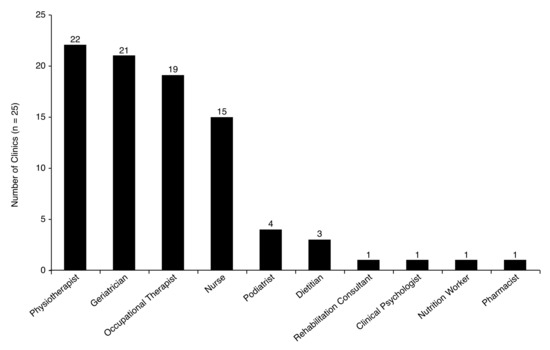
Figure 1.
Health professional staffing of falls-prevention clinics.
Podiatry’s Role in Falls Clinics
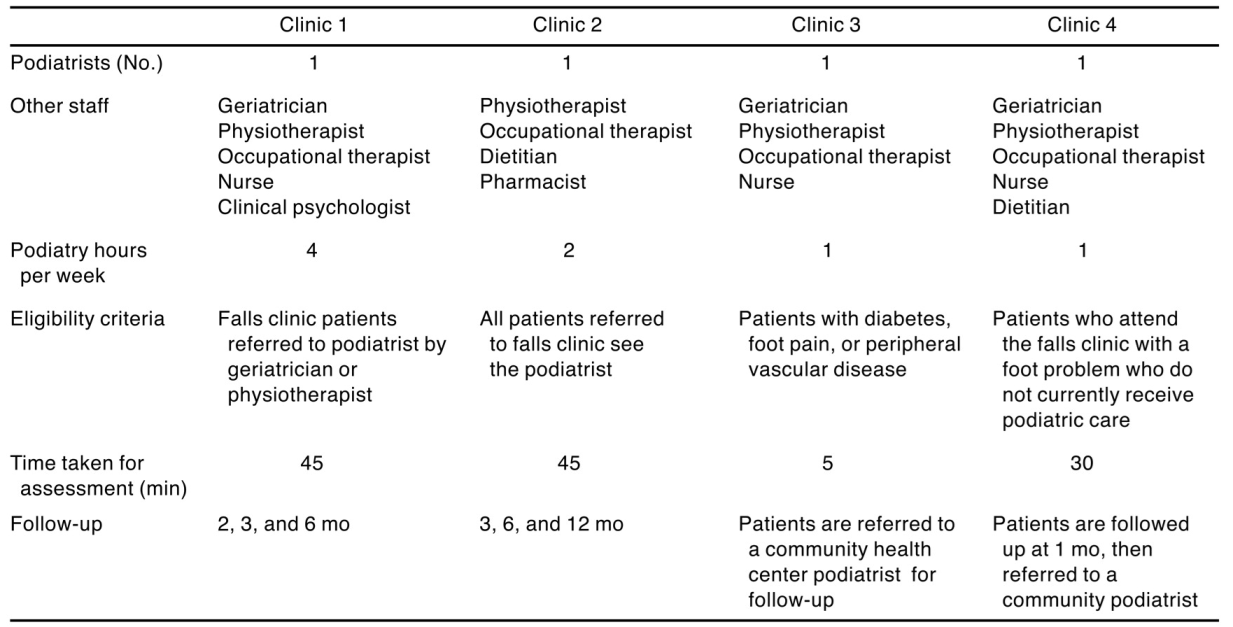
Podiatry service provision characteristics of the four clinics identified are given in Table 1. Staffing for each clinic involved a single podiatric clinician employed for 1 to 4 hours per week. Eligibility criteria and method of follow-up were unique to each falls clinic, and the time taken for the podiatry assessment ranged from 5 to 45 min.

Table 1.
Podiatric Service Provision Characteristics of Falls Clinics
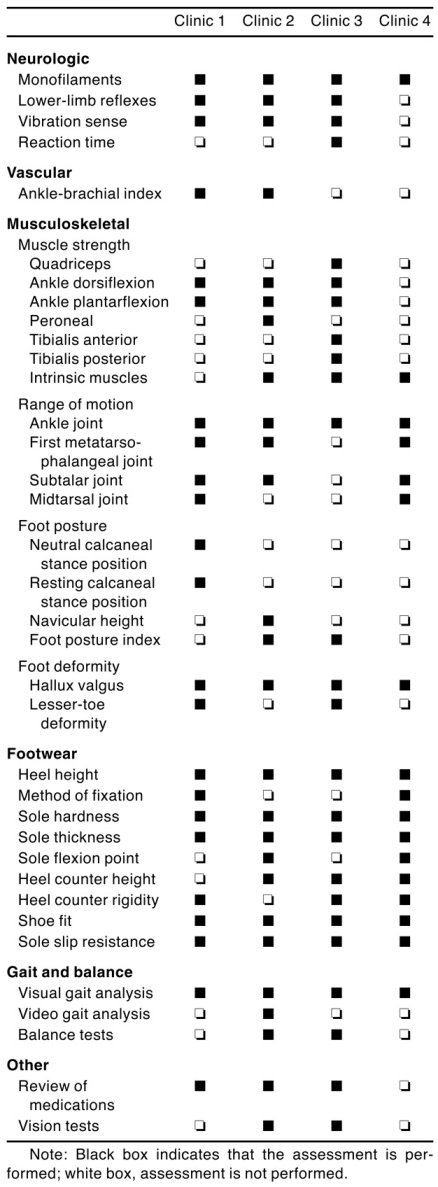
Assessments routinely undertaken in each of the four clinics are given in Table 2. There was a high degree of variability in the assessments undertaken, particularly in relation to musculoskeletal assessment. Consistency across the four clinics was observed only for monofilament testing, ankle joint range of motion, hallux valgus, some components of footwear assessment, and visual gait analysis.
Table 2.
Routine Assessments Performed by Podiatrists in Falls Clinics
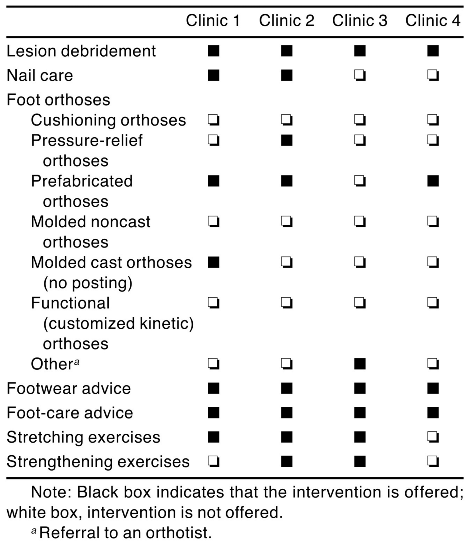
Podiatric interventions provided by the four clinics are given in Table 3. All of the clinics provided lesion debridement, footwear advice, and foot-care advice. The provision of foot orthoses was variable, and no clinics provided customized (kinetic) orthoses to falls clinic patients.
Table 3.
Interventions Offered to Podiatry Patients in Falls Clinics
Podiatry Clinicians’ Perceptions of Compliance with Interventions
Intervention compliance is given in Table 4. The highest compliance was observed with footwear recommendations and the lowest with stretching exercises.
Table 4.
Perceived Patient Compliance with Recommendations

Podiatry Clinicians’ Perceptions of the Importance of Foot and Footwear Risk Factors
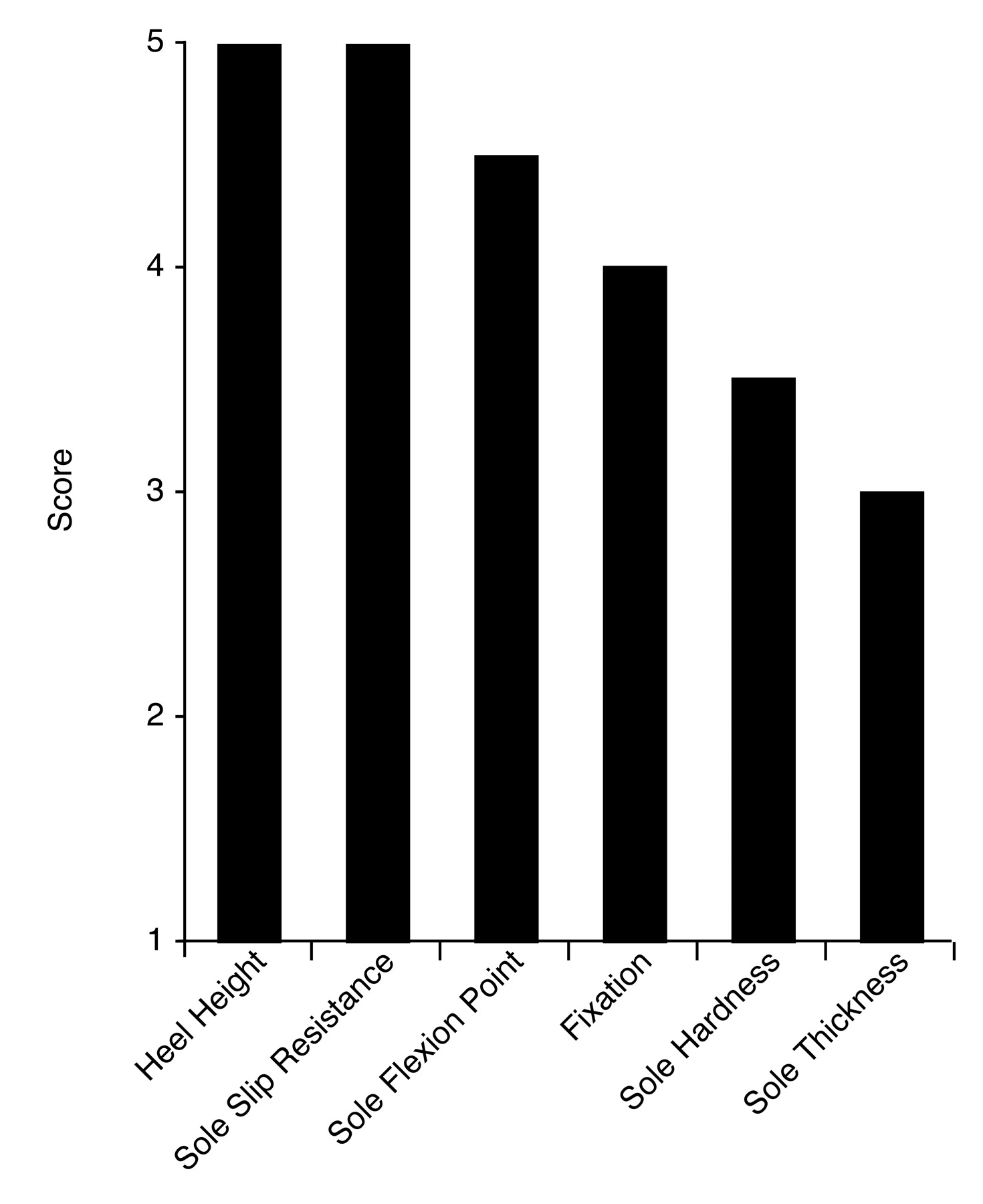
Podiatry clinicians’ perceptions of the relative importance of foot and ankle risk factors for falls are shown in Figure 2. The risk factors with the highest median scores were limited joint range of motion, ankle dorsiflexion weakness, and impaired peripheral sensation. Podiatry clinicians’ perceptions of the relative importance of footwear risk factors for falls are shown in Figure 3. The risk factors with the highest median scores were heel height and sole slip resistance.
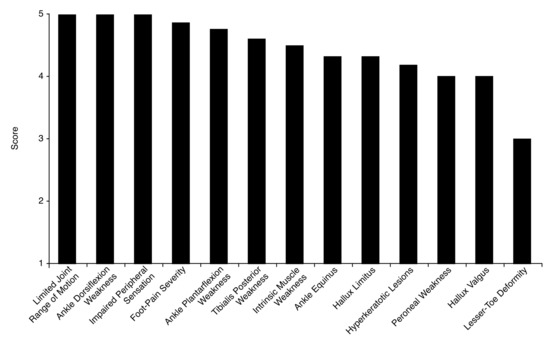
Figure 2.
Podiatry clinicians’ perceptions of the relative importance of various foot and ankle risk factors for falls. Scores range from 1 (unimportant) to 5 (very important). Median scores across the four clinicians are shown.
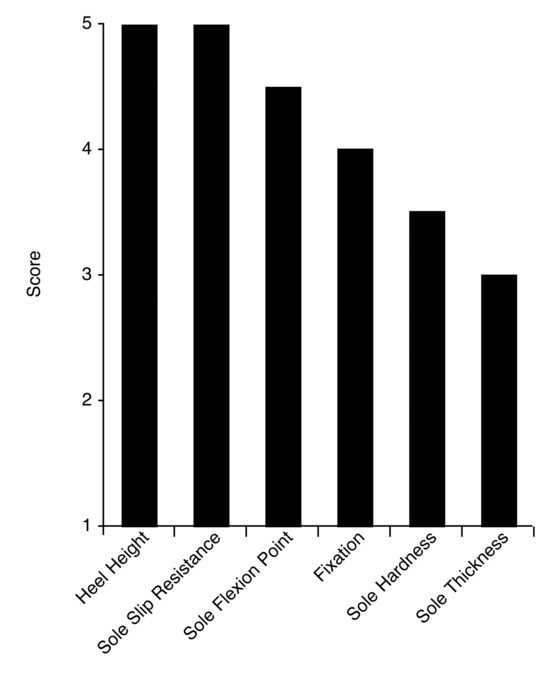
Figure 3.
Podiatry clinicians’ perceptions of the relative importance of various footwear risk factors for falls. Scores range from 1 (unimportant) to 5 (very important). Median scores across the four physicians are shown.
Discussion
The objectives of this study were to determine the level of podiatric involvement in multidisciplinary falls clinics currently operating in Australia and to describe the assessment and intervention activities provided by podiatrists in these settings. Before discussing the findings in detail, it is worth considering the limitations of the study design. First, because there is currently no up-to-date database of falls clinics in Australia, developing a list for this study required contacting individual departments of health in each state and territory. The accuracy of these databases cannot be ascertained. Indeed, there was evidence of some inaccuracy in that some clinics were no longer operational, could not be contacted using available contact information, or did not actually function as multidisciplinary falls clinics. A second limitation was that despite numerous attempts at follow-up, the response rate was somewhat disappointing (69%). Despite these limitations, we believe that the results are of value and provide some useful insights into the role of podiatry in falls clinics.
Of the 25 clinics that responded to the survey, only four had regular podiatric involvement, with an additional four providing podiatry services on a referral basis. This result is similar to that of Hill et al,[12] who reported that 2 of 15 falls clinics in Australia in 2001 employed podiatrists. Despite this low level of involvement, all of the clinic managers stated that they considered podiatry to have an important role to play in falls prevention. Owing to the paucity of published information in this area, it is difficult to compare these results with those from other countries, although a recent report[21] from the United Kingdom found that of the 105 London National Health Service Trusts involved in falls prevention, only one employed a podiatrist. Clearly, there is a degree of disconnect between the widespread recognition of foot problems and footwear as risk factors for falls and the funding of podiatry services to address these issues. However, determining the appropriate level of podiatric involvement is difficult in the absence of accurate data on the prevalence of foot-related risk factors.
Podiatry service provision in the four clinics identified was highly variable in relation to eligibility criteria, frequency of follow-up, assessments undertaken, and interventions offered. This is perhaps not surprising given that falls clinics have been developed largely in an ad hoc manner,[12] and no clinical guidelines have been published in relation to the role of podiatry in these clinics. All of the falls clinic podiatrists assessed footwear, but none reported using a standard approach (such as the Footwear Assessment Form[24]) to do so. Nevertheless, it is encouraging that some of the lower-limb assessments undertaken by falls clinic podiatrists (such as monofilament testing and ankle joint range of motion) are consistent with the published literature regarding foot and ankle risk factors for falls.[16,25] It is also promising that podiatrists are involved in broader aspects of falls risk assessment, such as reviewing medications and evaluating balance.
The range of interventions provided by falls clinic podiatrists was also highly variable. Although all of the clinics offered debridement of hyperkeratotic lesions, footwear advice, and foot-care advice, the type of foot orthoses provided was inconsistent, and only two clinics recommended strengthening exercises for the foot and ankle. Given that there is currently no evidence that foot orthoses improve balance and prevent falls in older people, it is perhaps surprising that all of the clinics offered this service in some form. However, it is possible that falls clinic podiatrists provide foot orthoses to older people to address foot pain and problems with hyperkeratotic lesions rather than as a falls-prevention intervention per se. It is also possible that lower-limb strengthening is adequately addressed by other members of the falls clinic team and so there is no need for podiatrists to initiate this intervention with their patients.
Clinicians’ perceptions of older patients’ compliance with footwear recommendations was somewhat surprising, with three clinicians reporting this as “high” and one as “moderate.” This is inconsistent with findings from Cumming et al,[26] who found that only 48% of older people who were advised to change their footwear by an occupational therapist had done so 1 year later, and from Fortinsky et al,[27] who reported that emergency department physicians considered older people’s compliance with footwear recommendations to be poor owing to “stubbornness and vanity.” However, the results are similar to those of Hill and Black,[28] who conducted a 6-month follow-up of falls clinic patients and reported that 85% had partly or fully complied with footwear advice and that 82% had partly or fully complied with foot-care recommendations. Although in the present study the accuracy of the falls clinic podiatrists’ perceptions of compliance could not be evaluated, it is possible that older people who have chosen to attend a falls clinic are aware of their risk of future falls and are, therefore, more likely to adhere to clinicians’ recommendations regarding footwear and foot care.
Clinicians’ perceptions regarding the relative importance of foot and ankle risk factors were generally consistent with evidence from the published literature,[16,25] with the four most important risk factors reported by the clinicians being limited joint range of motion, ankle dorsiflexion weakness, impaired peripheral sensation, and foot pain. A recent prospective study[16] confirmed that each of these factors, in addition to hallux valgus and toe plantar flexor weakness, were significant independent risk factors for falls. The most important footwear risk factors rated by the podiatrists were heel height and sole slip resistance. Although the available evidence regarding footwear as a risk factor for falls is not as strong,[29] a significant decrement in balance has been demonstrated in older people when wearing high heels[30] or shoes with thick, soft midsoles.[31] In addition, an association between inadequate fixation and trip-related hip fractures has been reported.[17]
Overall, the findings from this study indicate that despite the growing recognition of the importance of foot and footwear problems in increasing the risk of falls, podiatric involvement in multidisciplinary falls clinics is limited and poorly defined. Although it is likely that this is due to funding constraints limiting clinic personnel to those providing interventions of known benefit (such as exercises prescribed by physiotherapists[32]), it is also possible that there is a general lack of awareness that podiatry may have something to offer. Further studies are required to develop a standard approach to foot and footwear screening of older people attending falls clinics and to determine the efficacy of podiatric interventions using falls as an outcome measure.
Conclusion
Only four multidisciplinary falls-prevention clinics in Australia directly involve podiatry, and the service provision in these clinics varies considerably in relation to eligibility criteria, assessments undertaken, and interventions provided. These findings indicate that podiatry currently has a relatively minor and poorly defined role in multidisciplinary falls-prevention clinics in Australia.
Financial Disclosures
Dr. Menz is currently a National Health and Medical Research Council Fellow (Clinical Career Development Award, ID: 433049).
Conflict of Interest
None reported.
References
- O’Loughlin JL, Robitaille Y, Boivin JF, et al: Incidence of and risk factors for falls and injurious falls among the community-dwelling elderly. .Am J Epidemiol137::342. ,1993. .
- Dolinis J, Harrison JE: Factors associated with falling in older Adelaide residents. .Aust N Z J Public Health21::462. ,1997. .
- Hill K, Kerse N, Lentini F, et al: Falls: a comparison of trends in community, hospital and mortality data in older Australians. .Aging Clin Exp Res14::18. ,2002. .
- Gill T, Taylor AW, Pengelly A: A population-based survey of factors relating to the prevalence of falls in older people. .Gerontology51::340. ,2005. .
- Blake A, Morgan K, Bendall M, et al: Falls by elderly people at home: prevalence and associated factors. .Age Ageing17::365. ,1988. .
- Close J, Ellis M, Hooper R, et al: Prevention of falls in the elderly trial (PROFET): a randomised controlled trial. .Lancet353::93. ,1999. .
- Lord SR, Sherrington C, Menz HB, et al: Falls in Older People: Risk Factors and Strategies for Prevention, 2nd Ed, Cambridge University Press, Cambridge, England. ,2007. .
- Lord SR, Menz HB, Tiedemann A: A physiological profile approach to falls risk assessment and prevention. .Phys Ther83::237. ,2003. .
- Wolf-Klein GP, Silverstone FA, Basavaraju N, et al: Prevention of falls in the elderly population. .Arch Phys Med Rehabil69::689. ,1988. .
- Tideiksaar R: “Reducing the Risk of Falls and Injury in Older Persons: Contribution of a Falls and Immobility Clinic,” in Falls, Gait and Balance Disorders in the Elderly: From Successful Aging to Frailty, ed by C La-Font, A Baroni, M Allard, et al, p 162, Springer, New York. ,1996. .
- Hill KD, Dwyer JM, Schwartz JA, et al: A falls and balance clinic for the elderly. .Physiother Can45::20. ,1994. .
- Hill K, Smith R, Schwartz J: Falls Clinics in Australia: a survey of current practice, and recommendations for future development. .Aust Health Rev24::163. ,2001. .
- Houghton S, Birks V, Whitehead CH, et al: Experience of a falls and injuries risk assessment clinic. .Aust Health Rev28::374. ,2004. .
- Menz HB, Lord SR: The contribution of foot problems to mobility impairment and falls in older people. .J Am Geriatr Soc49::1651. ,2001. .
- Menz HB, Morris ME, Lord SR: Foot and ankle characteristics associated with impaired balance and functional ability in older people. .J Gerontol A Biol Sci Med Sci60::1546. ,2005. .
- Menz HB, Morris ME, Lord SR: Foot and ankle risk factors for falls in older people: a prospective study. .J Gerontol A Biol Sci Med Sci61::866. ,2006. .
- Sherrington C, Menz HB: An evaluation of footwear worn at the time of fall-related hip fracture. .Age Ageing32::310. ,2003. .
- Tencer AF, Koepsell TD, Wolf ME, et al: Biomechanical properties of shoes and risk of falls in older adults. .J Am Geriatr Soc52::1840. ,2004. .
- Koepsell TD, Wolf ME, Buchner DM, et al: Footwear style and risk of falls in older adults. .J Am Geriatr Soc52::1495. ,2004. .
- Victorian Quality Council: Minimising the Risk of Falls and Fall-Related Injuries, Metropolitan Health and Aged Care Services Division, Victorian Government Department of Human Services, Melbourne. ,2004. .
- Hughes M: Feet, falling and the Framework: the contribution of podiatry to fall prevention and the National Service Framework for Older People. .Brit J Podiatr5::91. ,2002. .
- Palmer EY: The role of the podiatrist in “falls prevention.”. Podiatry Now (October):20. ,2004. .
- Australian Podiatry Council: Clinical Guidelines for Orthotic Therapy Provided by Podiatrists, Australian Podiatry Council, Collingwood, Victoria. ,1998. .
- Menz HB, Sherrington C: The Footwear Assessment Form: a reliable clinical tool for the evaluation of footwear characteristics of relevance to postural stability in older adults. .Clin Rehabil14::657. ,2000. .
- Menz HB, Lord SR: Foot problems, functional impairment, and falls in older people. .JAPMA89::458. ,1999. .
- Cumming RG, Thomas M, Szonyi G, et al: Adherence to occupational therapist recommendations for home modifications for falls prevention. .Am J Occup Ther55::641. ,2001. .
- Fortinsky RH, Iannuzzi-Sucich M, Baker DI, et al: Fall- risk assessment and management in clinical practice: views from healthcare providers. .J Am Geriatr Soc52::1522. ,2004. .
- Hill K, Black K: Evaluation of a Minimum Data Set for Victorian Falls Clinics: Final Report, National Ageing Research Institute for the Victorian Department of Human Services, Melbourne. ,2004. .
- Menz HB, Lord SR: Footwear and postural stability in older people. .JAPMA89::346. ,1999. .
- Lord SR, Bashford GM: Shoe characteristics and balance in older women. .J Am Geriatr Soc44::429. ,1996. .
- Robbins SE, Gouw GJ, McClaran J: Shoe sole thickness and hardness influence balance in older men. .J Am Geriatr Soc40::1089. ,1992. .
- Sherrington C, Lord SR, Finch C: Physical activity interventions to prevent falls among older people: update of the evidence. .J Sci Med Sport7:(suppl):43. ,2004. .
© 2007 American Podiatric Medical Association