


Abstract
The computerized student-patient encounter log system represents a considerable improvement in terms of efficiency and accuracy over traditional paper-based student-patient encounter reporting systems. The computerized log not only facilitates faculty monitoring of students’ assessment and management of health problems at geographically disparate locations but also provides a rich resource of data for enhancing clinical teaching and learning experiences. However, little is known about podiatric medical students’ experiences with Web-based computerized student-patient encounter log systems. The findings reported in this article suggest that the computerized student-patient encounter log was considered to be useful and effective by most of the podiatric medical students surveyed and represents an improvement over traditional paper-based recording systems. (J Am Podiatr Med Assoc 95(6): 556–563, 2005).
The California College of Podiatric Medicine, now the California School of Podiatric Medicine at Samuel Merritt College, has been responsible for a variety of innovations in medical education in recent years. The neuroscience program used a dedicated intranet site, and the biochemistry program used an asynchronous discussion group to support student learning. [1] In 2001–2002, the California School of Podiatric Medicine implemented a computerized student-patient encounter log (CSPEL) system [2] to replace the handwritten sheets the students used to describe their patient contacts. The handwritten student-patient encounter logs had numerous limitations, as reported previously. [2]
The reliability of medical student–patient encounter logs has been evaluated by various researchers. Patricoski et al [3] argue that medical students underreport patient encounters in their clerkship logbooks, and Sumner [4] suggests that traditional paper-based logs are often incomplete. To enhance the reliability and efficiency of the recording process, a one-page student-patient encounter log form was developed that enables students to record demographic and diagnostic data. [5]
More recently, there has been a move toward the use of handheld computers to record student-patient interactions. This has been investigated independently by Sumner [4] and Lee et al, [6] who observed medical students’ use of handheld computers in documenting student-patient encounters in family-practice and emergency-medicine clerkships at Washington University School of Medicine using a palm computer log designed with Pumatech’s (San Jose, California) Satellite Forms. Students use patient demographic variables to select a diagnosis entry screen that displays many likely diagnoses as checkboxes. Students have access to less likely diagnoses through additional drop-down lists and combinations of drop-down lists.
Sumner [4] found that students in the family-practice clerkship document an average of 2.4 problems per patient and a maximum of 14 problems per patient using the handheld computer log system. According to Sumner, [4] the handheld computer log system helps identify gaps in medical students’ knowledge.
Lee et al [6] evaluated the sensitivity and specificity of the handheld computer log system by comparing log-entry data from an emergency-medicine clerkship with medical chart data. Most students used the handheld computer log system to record 60% or more of their patient encounters and an average of 60% of the patients’ medical problems. The authors reported a 26% false-positive rate associated with documenting patient encounters and a 19% false-positive rate for documenting patient problems. The researchers found that students who used the handheld computer log system documented more diagnoses and provided more information than was available in the patient’s emergency-department chart.
Description of the CSPEL System
The CSPEL system, implemented at the California School of Podiatric Medicine in 2001–2002, [2] is now an important component of the student’s podiatric medical education. The CSPEL captures the data for each student-patient encounter using either a drop-down menu or text. It uses a Web-based delivery system that enables students to record their patient interactions in a database. Figure 1 shows the activity log report screen, where the student can capture the following data: date of patient contact, patient number or abbreviated name, patient age, attending clinician’s name, student participation level, department rotation and location, primary diagnosis, secondary diagnosis, and treatments. This information forms the basis of a student-patient encounter log that represents a step forward from paper- and card-based systems in terms of accuracy and efficiency of data collection and use. The CSPEL allows the diversity and frequency of student-patient interactions to be monitored almost synchronously by distant faculty. Figure 2 shows the rotation evaluation report screen for a hypothetical student that contains the details of six student-patient encounters. The CSPEL system thus provides a means for the college to determine the number of encounters students have with various diagnostic problems and procedures. Accurate, current data on student activity may be used to identify deficiencies in the patient profile to which the student is exposed during a rotation and may also be useful for program accreditation and curriculum review because it helps programs and accrediting bodies assess training experiences objectively.
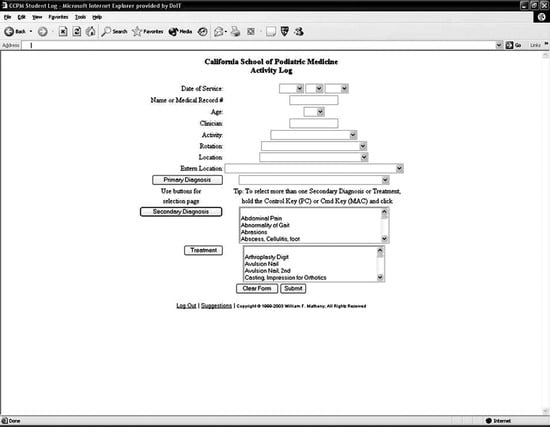
Figure 1.
A sample activity log report screen.
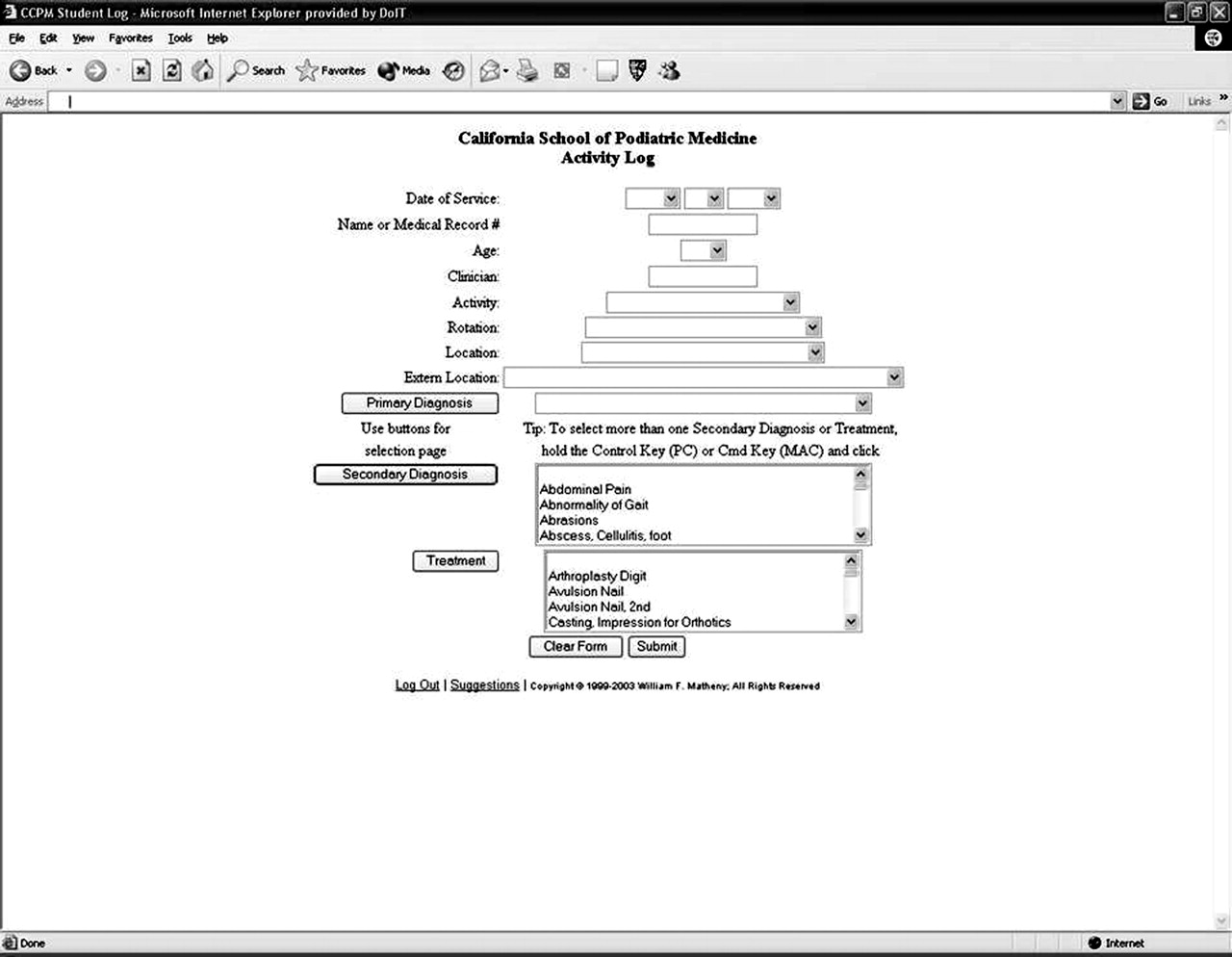
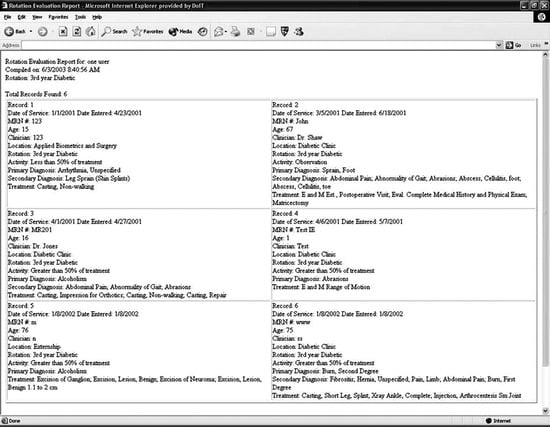
Figure 2.
A sample rotation evaluation report screen.
Survey of Podiatric Medical Students’ Evaluation of the CSPEL
Student and faculty use of the CSPEL is currently being evaluated using the action research method, [7] and initial evaluation data have revealed that the CSPEL system has several advantages over the traditional paper-based system. The advantages of the CSPEL system include improved accessibility, accuracy of data reporting, and reliability; ease of report generation; enhanced security and privacy; and scalability. [2] To date, however, there have been no surveys of health-care students’ evaluation of Web-based CSPEL systems. To inform the development of the CSPEL, further research is needed to determine students’ experiences with the system. It is particularly important to address the following areas: 1) ease of use of the CSPEL, 2) perceived usefulness of the CSPEL in documenting diagnoses and treatment procedures, and 3) perceived benefit to the student in terms of helping their professional development.
Because use of the CSPEL may be inconsistent with the past learning experiences of the podiatric medical student, a negative attitude toward technology may limit use of the system. [8] To optimize use of the CSPEL, it is crucial to identify possible obstacles that may inhibit student use of the system. Such obstacles may include low levels of computer knowledge and skills among podiatric medical students, which have been reported for students in other health-care fields. [9–14]
Low levels of computer use among students have been reported, [9,11,13,14] and this factor may inhibit podiatric medical students from using the CSPEL. In addition, other studies have shown that some students use computers only on a limited basis. [9,10,13] Sancho et al [13] discovered that medical students infrequently use medical database searches and computer laboratories. Limited use of computer software and technology may also inhibit podiatric medical students’ use of the CSPEL.
Further hurdles to using the system may be limited access to computers [6] and a lack of computer training. [6,9,12] Both problems may be compounded by computer anxiety, which can further limit podiatric medical students’ use of the CSPEL. Other researchers have reported that some students feel anxious, [12] nervous, or depressed [15] about using computers in any capacity. Given the ubiquity of Web-based teaching and learning materials, it may be surprising that students continue to report that limited computer access is a problem. However, Vogel and Wood [16] report that a substantial minority of their students do not have a computer and make comments such as “after an 8-hour day at the hospital, I do not feel like coming in to college to use [the computer laboratories].”
Data concerning podiatric medical students’ experiences with the CSPEL can be used to add to or modify the system. Moreover, survey results can be used to enhance medical-informatics instruction for podiatric medical students. Increasing computer literacy will be necessary so that students will be better prepared for their residency training and lifelong learning in clinical practice.
Methods
A research proposal to measure podiatric medical students’ experiences with the CSPEL was submitted to the human subject review board of Samuel Merritt College, and the proposal received exempt status.
Survey Instrument
In 2002, a 32-item voluntary questionnaire [17] was administered to a sample of 66 podiatric medical students in the 2002, 2003, and 2004 class years to assess their background, their previous experiences with computers, and their current experiences with the CSPEL. Students and faculty also were interviewed to obtain feedback about their experiences with using the system. One of the major goals of the survey was to ascertain podiatric medical students’ experiences with the CSPEL. The questionnaire measured students’ views of the usefulness of the various components of the CSPEL: the student log, activity log, rotation evaluation report, contact log, diagnosis listing, and treatment listing. The questionnaire also measured students’ attitudes toward the possible impact of the CSPEL on their professional development and ways to use the system to enhance their podiatric medical training.
Another important goal of the survey was to evaluate students’ perceptions of possible obstacles to using the CSPEL. Questionnaire items were developed to measure students’ self-reported level of computer literacy and its impact on using the system. Questionnaire items also measured students’ attitudes toward two other possible obstacles: insufficient time to use computers and lack of computer access. Users also may face technical difficulties with using computer technology, and a questionnaire item was designed to measure students’ attitudes toward these possible technical problems.
Regarding students’ experiences with the CSPEL, the questionnaire contained 15 closed-ended questionnaire items to measure four areas: 1) overall ease of use and comprehensiveness of the CSPEL system (3 items), 2) perceived impact of the CSPEL on their professional development (1 item), 3) experiences with specific components of the system (4 items), and 4) perceived obstacles to using the CSPEL (7 items).
The 15 closed-ended questionnaire items in the four areas were classified as ordinal variables. In terms of the overall ease of use and comprehensiveness and perceived impact on professional development, students were asked to answer each item on a 5-point scale from “strongly agree” to “strongly disagree.” Concerning specific components of the CSPEL, students were requested to answer each item on a 3-point scale from “not at all useful” to “very useful.” In addition, the questionnaire contained two open-ended questions about ways to improve the CSPEL and the best ways to use the system in their podiatric medical training. These open-ended items supplemented data from the closed-ended items. In terms of students’ demographic and academic characteristics, two nominal variables were included in the questionnaire: sex and class year.
After the questionnaire items were designed, the questionnaire was formatted so that different domain areas (eg, attitudes toward specific components of the CSPEL) would be covered in separate sections. The questionnaire was designed and formatted so that students could complete it in less than 5 min. This is important because longer questionnaires may be less reliable owing to respondent fatigue. [18] The newly developed questionnaire was then pretested with six students who would not participate in the final survey. Questionnaire items and formatting were refined on the basis of these pretest results.
Sample
A sample of 66 podiatric medical students was selected from a random sample of class sessions at the California School of Podiatric Medicine. At the beginning of the class sessions, students were told about the goal of the survey and that the survey data would be presented only anonymously. Students were asked to complete the questionnaire on a voluntary basis and were notified in writing that completing the questionnaire would have no adverse effect on their grade in the course. The survey response rate was 83%.
Study Variables
In this study, there were four dependent variables related to the podiatric medical students’ evaluation of the CSPEL: 1) overall ease of use and comprehensiveness of the CSPEL system, 2) perceived impact of the CSPEL on their professional development, 3) experiences with specific components of the system, and 4) perceived obstacles to using the CSPEL. The independent variables were podiatric medical students’ sex and class year.
Data Analysis
Data entry and cleaning were performed using the Systat computer data-analysis program (Systat Software Inc, Point Richmond, California). One-way cross-tabulations were performed for the variables in the four areas under investigation. Pearson χ2 procedures were used to test the statistical significance of these cross-tabulations. Statistical significance was indicated by P ≤ .05.
Results
Demographic and Academic Characteristics
Of the podiatric medical students surveyed, 70% were men (n = 46) and 30% were women (n = 20) (χ21 = 10.24; P < .001). Forty-seven percent were sophomores (n = 31), 50% were juniors (n = 33), and 3% were seniors (n = 2) (χ22 = 27.36; P < .001).
Overall Ease of Use and Comprehensiveness of the CSPEL System
Nearly half of the students surveyed (47%) agreed or strongly agreed that the CSPEL log system was easy to use (χ24 = 24.48; P < .0001) (Table 1). Thirty-four percent of the students in the sample neither agreed nor disagreed regarding the CSPEL’s ease of use. Twelve percent of the sample disagreed and 9% strongly disagreed that the CSPEL system was easy to use.

Table 1.
Overall Ease of Use and Comprehensiveness of the CSPEL.
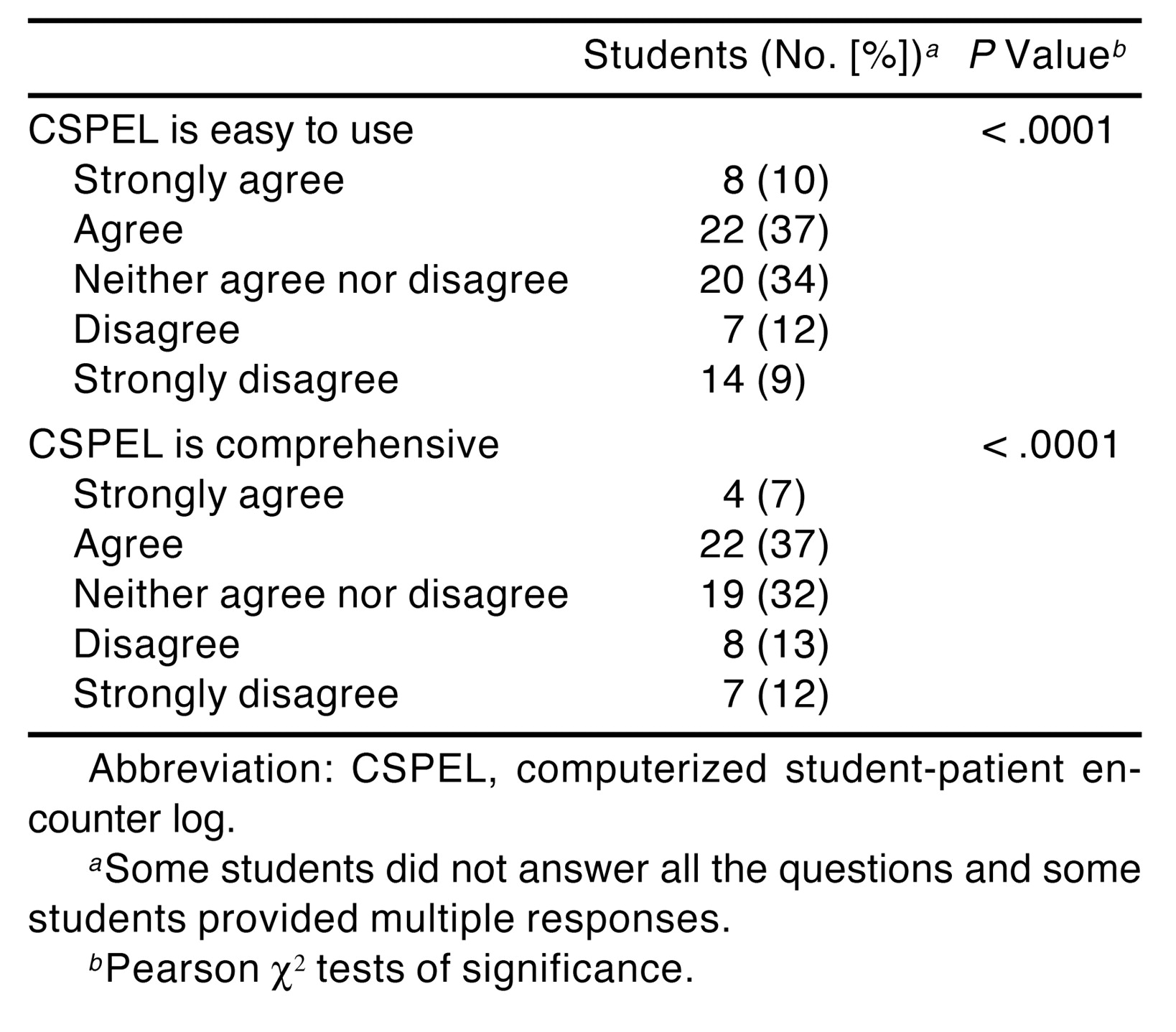
Concerning the perceived comprehensiveness of the system, 44% of the students in the sample agreed or strongly agreed that the CSPEL is comprehensive (χ24 = 21.17; P < .0001), 32% neither agreed nor disagreed, and 13% disagreed and 12% strongly disagreed.
Perceived Impact of the CSPEL on Professional Development
Nearly half of the students sampled (48%) agreed and 19% strongly agreed that the CSPEL is helpful in documenting their podiatric medical education (χ24 = 36.78; P < .0001) (Table 2). Nineteen percent of the students neither agreed nor disagreed, and only 8% disagreed and 6% strongly disagreed.
Table 2.
Perceived Impact of the CSPEL on Professional Development.
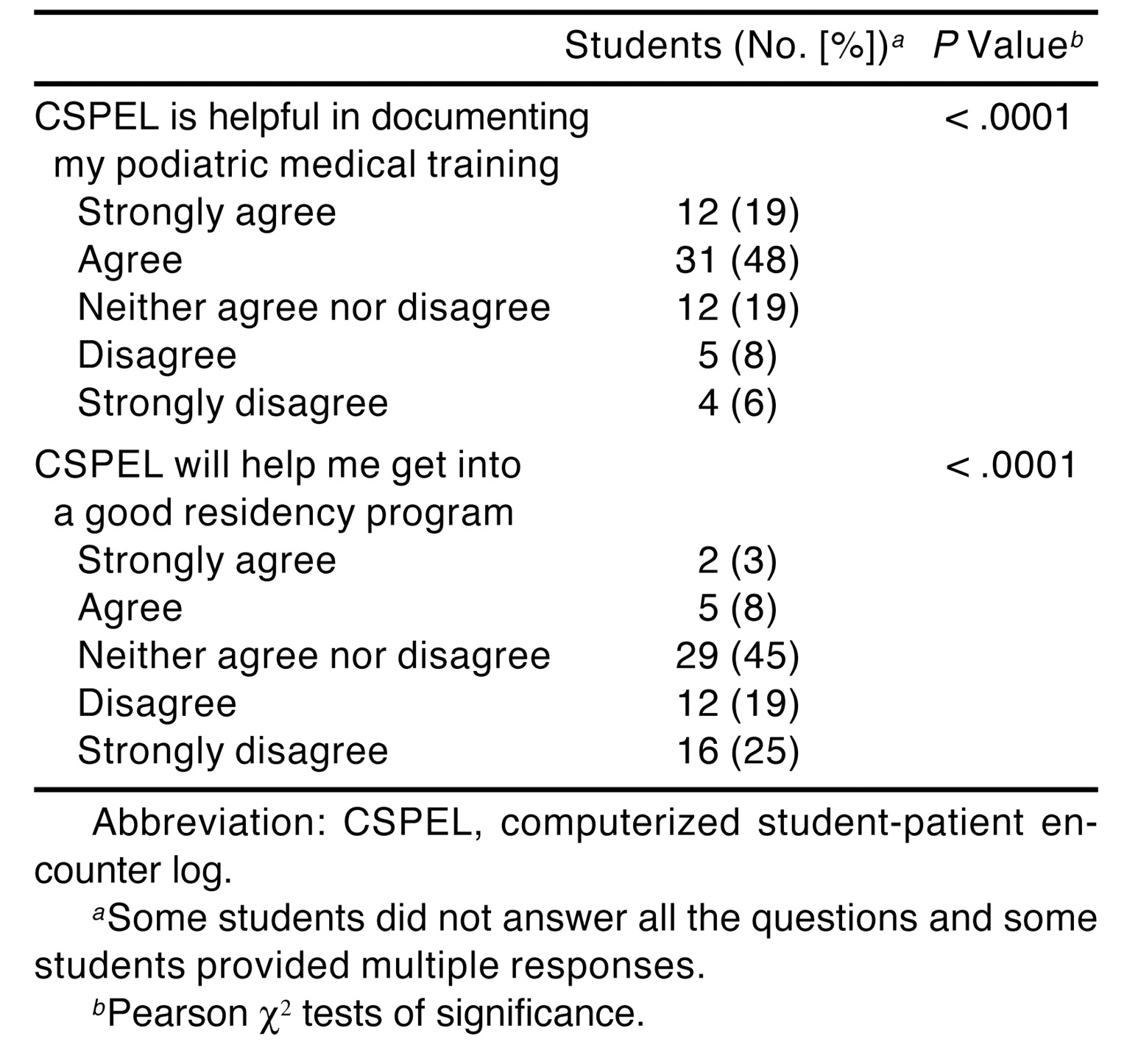
Forty-five percent of the students surveyed neither agreed nor disagreed that the CSPEL will help them get into a good podiatric medicine residency program (χ24 = 35.22; P < .0001). Forty-four percent of the students surveyed disagreed or strongly disagreed, and only 11% agreed or strongly agreed.
Experiences with Specific Components of the CSPEL
Nearly half of the students surveyed (48%) believed that the activity log was moderately useful, and 40% thought that it was very useful (Table 3). Only 12% of the students indicated that the activity log was not useful. Regarding the contact log, 57% thought that it was moderately useful; 27%, very useful; and 12%, not useful. Overall, the distribution of this variable was not statistically significant.
Table 3.
Experiences with Specific Components of the CSPEL.
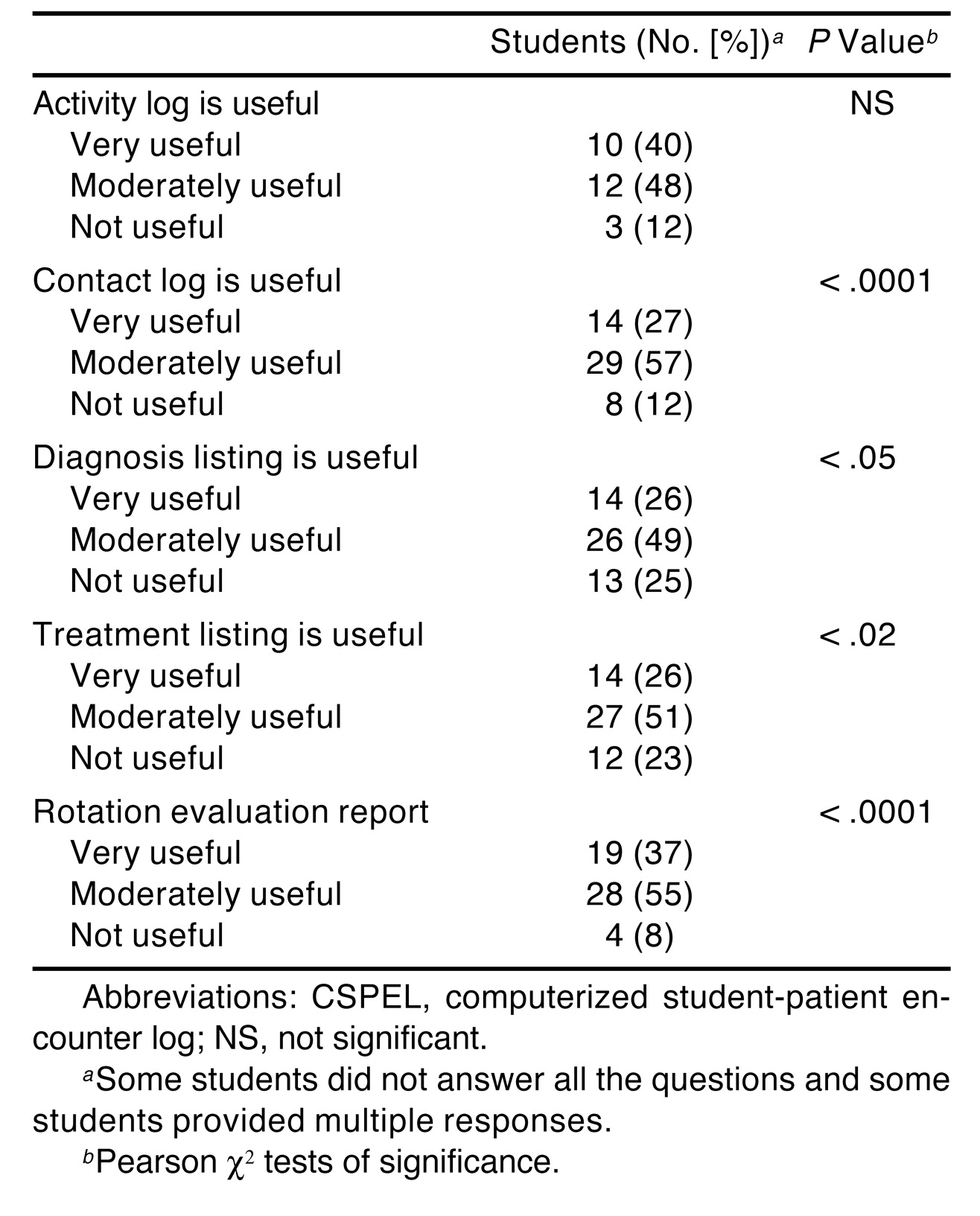
Almost half of the podiatric medical students sampled (49%) reported that the diagnosis listing was moderately useful, and 26% thought that it was very useful (χ22 = 5.93; P < .05). Twenty-five percent of the students surveyed reported that it was not useful. Regarding the treatment listing, 51% reported that it was moderately useful, and 26% believed that it was very useful. Twenty-three percent of the sample reported that it was not useful (χ22 = 7.51; P < .02).
Regarding the rotation evaluation report, 55% of the students surveyed indicated that it was moderately useful, and 37% said that it was very useful (χ22 = 17.29; P < .0001); 8% said that it was not useful.
Perceived Obstacles to Using the CSPEL
Students were asked if they lacked computer training and if this inhibited their use of the CSPEL. Sixty-eight percent of the students in the sample reported that a lack of computer training was not at all a problem for them (χ22 = 28.79; P < .0001) (Table 4). Nineteen percent thought that it was somewhat of a problem, and 13% indicated that it was very much a problem. Another item asked students whether they lacked computer knowledge and whether this inhibited their use of the system. Seventy-seven percent of the students in the sample reported that a lack of computer knowledge was not at all a problem in using the system (χ22 = 47.25; P < .0001). Seventeen percent indicated that it was somewhat of a problem, and only 6% reported that it was very much a problem.
Table 4.
Perceived Obstacles to Using the CSPEL.
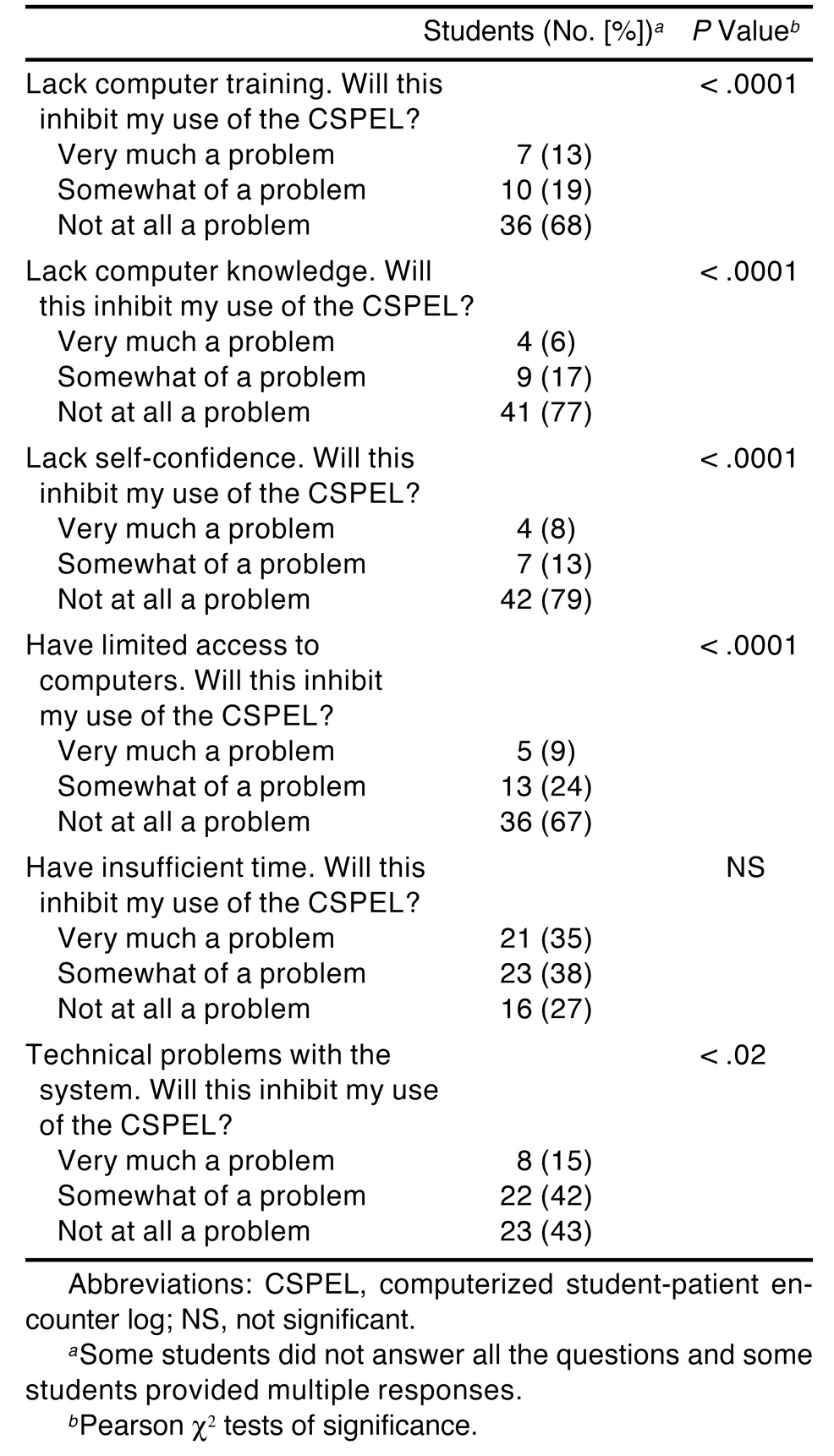
The podiatric medical students’ level of self-confidence in using the CSPEL was investigated. Seventy-nine percent of the students surveyed reported that a lack of self-confidence was not at all a problem in using the CSPEL (χ22 = 50.53; P < .0001). Thirteen percent indicated that it was somewhat of a problem, and 8% reported that it was very much a problem.
Other questionnaire items deal with issues related to the podiatric medical students’ possible limited access to computers and limited time to use the CSPEL. Sixty-seven percent of the students in the sample indicated that limited access to computers was not at all a problem in using the CSPEL, whereas 24% reported that it was somewhat of a problem (χ22 = 28.78; P < .0001). Nine percent believed that limited computer access was very much a problem. Concerning possible insufficient time to use the system, 38% indicated that it was somewhat of a problem in using the CSPEL, 35% viewed it as very much a problem, and 27% believed that it was not at all a problem. The distribution of this variable was not statistically significant.
Another questionnaire item examined the technical problems in using the system. Forty-three percent of the students surveyed reported that technical problems with the system were not at all a problem, and 42% indicated that they were somewhat of a problem (χ22 = 7.96; P < .02). Fifteen percent of the students in the sample indicated that they were very much a problem.
Discussion
Almost half, and in some instances a majority, of the podiatric medical students surveyed found the CSPEL to be useful in documenting student-patient encounters, easy to use, comprehensive, and helpful in documenting their podiatric medical training, although a significant percentage of the students remained undecided. Most students surveyed did not believe that obstacles to using computers, such as a lack of confidence and limited computer knowledge and training, inhibited their use of the system.
The three obstacles to use of the CSPEL most commonly reported by the students in this study were insufficient time, limited access to computers, and possible technical problems with the system. There is no doubt that time is in short supply for medical students on rotation, and these students often comment on the time needed to complete paper-based logs. [19] However, the completion of a report for each student-patient contact using the CSPEL should take only 2 to 3 min. Data-collection procedures have been standardized, most required information can be derived from drop-down menus, and coding decisions are limited.
Overall, these survey findings suggest that the CSPEL was considered to be useful and effective by most of the podiatric medical students surveyed. Because of its acceptability among students and its advantages in efficiency and ease of use in documenting student-patient encounters in geographically disparate settings, the CSPEL represents an improvement over traditional paper-based recording systems.
Acknowledgments
William F. Matheny of William F. Matheny and Associates, Castro Valley, California, who designed and implemented the CSPEL system at the California School of Podiatric Medicine.
References
- Oliver M, Shaw GP: Asynchronous discussion in support of medical education. J Asynchron Learn Ntwk 7: 56, 2003.
- Shaw GP, Clark JR, Morewitz SJ: Implementation of computerized student-patient logs in podiatric medical education. JAPMA 93: 150, 2003.
- Patricoski CT, Shannon K, Doyle GA: The accuracy of patient encounter logbooks used by family medicine clerkship students. Fam Med 30: 487, 1998.
- Sumner W: Student documentation of multiple diagnoses in family practice patients using handheld student encounter log. Proc AMIA Symp687, 2001.
- Withy K: An inexpensive patient-encounter log. Acad Med 76: 860, 2001.
- Lee JS, Sineff SS, Sumner W: Validation of electronic student encounter logs in an emergency medicine clerkship. Proc AMIA Symp425, 2002.
- Retalis S, Makrakis V, Papaspyrou N, et al: A case study of an enriched classroom model based on the World Wide Web. Available at: http://www.softlab.ece.ntua.gr/~retal/papers/JOURNALS/activeLearning/paper_active.pdf. Accessed October 7, 2005.
- Shaw GP, Marlow N: The role of student learning styles, gender, attitudes and perceptions on information and communication technology assisted learning. Comp Educ 33: 223, 1999.
- Asgari-Jirhandeh N, Haywood J: Computer awareness among medical students: a survey. Med Educ 31: 225, 1997.
- Ray NJ, Hannigan A: A survey of the computer literacy of undergraduate dental students at a university dental school in Ireland during the academic year 1997–98. Eur J Dent Educ 3: 56, 1999.
- Gouveia-Oliveira A, Rodrigues T, de Melo FG: Computer education: attitudes and opinions of first-year medical students. Med Educ 28: 501, 1994.
- Kidd MR, Connoley GL, Cesnik B, et al: What do medical students know about computers?. Med J Aust 158: 283, 1993.
- Sancho JJ, Gonzalez JC, Patak A, et al: Introducing medical students to medical informatics. Med Educ 27: 479, 1993.
- Jones RB, Navin LM, Barrie J, et al: Computer literacy among medical, nursing, dental and veterinary undergraduates. Med Educ 25: 191, 1991.
- Shaw GP, Pieter WP: The use of asynchronous learning networks in nutrition education: student attitude, experiences and performance. J Asynchron Learn Ntwk 4: 40, 2000.
- Vogel M, Wood DF: Love it or hate it? medical students’ attitudes to computer-assisted learning. Med Educ 36: 214, 2002.
- Morewitz SJ, Shaw GP, Clark JR, et al: A survey of podiatric medical students’ computer literacy. JAPMA 94: 375, 2004.
- Wolfe RM: “Questionnaire,” in Educational Research, Methodology and Measurement: An International Handbook, ed by JP Keeves, Pergamon Press, Oxford, 1988.
- Dolmans D, Schmidt A, van der Beek J, et al: Does a student log provide a means to better structure clinical education?. Med Educ 33: 89, 1999.
© 2005 American Podiatric Medical Association