

Next Article in Journal
A critical review of the literature on foot orthoses
Previous Article in Journal
Acral-lentiginous melanoma
 
 
Journal of the American Podiatric Medical Association is published by MDPI from Volume 116 Issue 1 (2026). Previous articles were published by another publisher in Open Access under a CC-BY (or CC-BY-NC-ND) licence, and they are hosted by MDPI on mdpi.com as a courtesy and upon agreement with American Podiatric Medical Association.
Article

Velocity of the center of pressure during walking

by
Mark W. Cornwall
and
Thomas G. McPoil
Gait Research Laboratory, Department of Physical Therapy, Box 15105, Northern Arizona University, Flagstaff, AZ 86011
J. Am. Podiatr. Med. Assoc. 2000, 90(7), 334-338; https://doi.org/10.7547/87507315-90-7-334
Published: 1 July 2000

Abstract

The purpose of this study was to describe the velocity of the center of pressure during walking in a sample of young, healthy individuals. The velocity of the center of pressure was recorded in 60 subjects while they walked barefoot over a floor-mounted pressure platform. The results of this study indicate that the velocity of the center of pressure follows a predictable pattern during the stance phase of walking. Intraclass correlation coefficients calculated to measure between-trial reliability for specific parameters of the velocity of the center of pressure ranged from 0.361 to 0.912. These study results suggest that velocity of the center of pressure may be a useful measurement in future gait research.

Elftman [1] was one of the first researchers to describe the center of pressure pattern, or gait line, in normal feet during walking. Measurements of center of pressure (COP) obtained from a modern-day force platform were initially described by Cunningham in 1950. [2] When recorded from a force platform, the COP is defined as the projection on the ground plane of the centroid of the vertical force distribution. [3] Thus the COP is the instantaneous point of application of the resultant foot-floor reaction vector. [4,5] Cavanagh [6] reported that step-to-step variability and the necessity for averaging prevented more extensive use of the COP. To counteract these problems, Cavanagh proposed a technique for averaging the COP obtained from a force platform in which the moment of applied forces was determined about a fixed point in the shoe. Using this technique, the researcher would be required to record the position of the fixed point on the shoe with respect to a force platform reference frame for each trial analyzed. Until the introduction of floor-mounted transducer matrix platforms for the measurement of plantar pressures, the force platform was the primary method of recording the COP. The term “center of pressure,” when the COP is recorded from a force platform, is misleading, as the COP is not related to pressures acting on the plantar surface of the foot, but is a representation of the path of the vertical component of the resultant ground-reaction force.
When measured from a floor-mounted transducer matrix platform, the COP is determined by calculating the centroid of the total number of active transducers for each data sample collected. The use of such equipment avoids the problems associated with a force platform, because the position of the subject’s foot or shoe is always known. As a result of the increased ease with which the COP can be collected from pressure platforms, it has become a popular method of describing normal as well as abnormal foot movement during gait. [7,8,9,10] The COP has also been used as a tool in assessing footwear [11] and the effectiveness of orthoses. [12,13,14,15,16,17,18]
Because of the need for controlled yet rapid progression of a person’s body weight over the supporting limb, overall walking speed has been used extensively as a measure of movement efficiency, stability, and control. [19,20,21] It has also been cited as a measure of the effectiveness of a rehabilitation program following such conditions as lower-limb amputation [22] and stroke. [22,23] To date, most of the studies reported in the literature have focused primarily on the displacement of the COP rather than its velocity. Grundy and associates [10] investigated the velocity of the COP under a variety of conditions in subjects with normal and abnormal feet. They reported that the mean velocity of the COP under the metatarsal heads was increased for those subjects with hallux valgus and metatarsalgia. They also reported that velocity was increased with the use of a metatarsal bar or rigid-soled shoes. Although the findings of this study are noteworthy, the sample size was fairly small and it was unclear exactly how the velocity under the metatarsal heads was determined. A subsequent study by Mann and associates [24] involved ten patients who had undergone amputation of their great toes. They found that the velocity of the COP in these patients was significantly decreased in the metatarsal head region on the operative side. A third study, by Lehmann et al, [25] investigated the progression of the COP during walking in a group of six healthy individuals after tibial nerve paralysis was temporarily induced. Although Lehmann et al. did not actually calculate the velocity of the COP, they reported what they called “delayed advancement” of the COP in these individuals.
None of these early studies included sufficient numbers of subjects to establish normative values for the velocity of the COP during gait. It is important to establish such baseline information before the influence of pathology can be adequately studied. The purpose of the present study was to describe the velocity of the COP during walking in a sample of young, healthy individuals to establish normative baseline values for use in future studies.

Materials and Methods

Subjects

Sixty individuals (24 men, 36 women) between the ages of 19 and 43 years (mean [±SD], 26.3 ± 5.2 years) served as subjects for this study. The subjects had a mean (±SD) weight of 71.2 ± 15.1 kg and a mean (±SD) height of 168.8 ± 17.2 cm. The subjects were randomly selected from a larger pool of volunteers. None of the subjects had a history of congenital deformity, pain, or traumatic injury to either of their lower extremities within the 6 months preceding the start of the study. This study was approved by the institutional review board of Northern Arizona University in Flagstaff, and all subjects provided informed written consent prior to joining the study.

Instrumentation

An EMED-SF floor-mounted capacitance transducer matrix platform (Novel USA, Inc, Minneapolis, Minnesota) with an active sensor area of 23 × 44 cm was positioned at the midpoint of a 6-m walkway to collect barefoot-floor COP measurements. The EMED-SF platform has a matrix of 1944 force transducers, with a density of two sensors per square centimeter and a sampling rate of 70 Hz. Although this sampling rate is lower than that typically used to measure ground-reaction forces, it has been shown to be adequate for the accurate measurement of plantar pressure data (Mittlemeier TWF, Morlock M, unpublished data, 1993). The platform was calibrated by the manufacturer before the start of the study. The velocity of the COP was calculated using the “VELOCITIES” software program supplied by the manufacturer (Novel USA, Inc). Velocity of the COP was defined as the resultant displacement (mediolateral and anteroposterior) of the COP divided by the elapsed time between measurements (14 ms).

Procedure

The height and weight of each subject were determined at the outset of the study. The midgait data-collection method, which has previously been shown to provide reliable results, [26] was employed as subjects walked across the EMED-SF pressure platform. Data from a total of six walking trials (three for each foot) were collected for each subject. Those walking trials that appeared atypical were repeated. Information for both extremities was recorded for each subject, but the data from some of the subjects were not usable, yielding a total of 100 feet from the 60 subjects to be used for further data analysis.

Data Analysis

Plots of the mean resultant COP velocity-time curves for the entire stance phase were created for all subjects. In addition, the plantar pressure outline of the foot of each subject was divided into four distinct regions (rearfoot, midfoot, forefoot, and toes). The rearfoot, midfoot, and forefoot regions were defined as equal thirds of the plantar pressure outline, minus the toes. The variables of maximum velocity, time to maximum velocity, average velocity, and percentage of time spent in each of these foot regions were calculated from the velocity of the COP of each subject. In addition, the stance-phase duration was recorded for each subject. Finally, a mean velocity-time COP curve was calculated using data for all 100 feet.

Statistical Analysis

As a measure of between-trial reliability, type (2,1) intraclass correlation coefficients [27] were calculated for the stance-phase duration and for each of the dependent variables during the entire stance phase, as well as in each of the four plantar foot regions. Descriptive statistics were calculated for all variables to determine the distribution of the variables measured.

Results

Before any variable can be used with confidence in research, it must first be shown to be reliable. Table 1 contains the intraclass correlation coefficient values calculated as a measure of between-trial reliability for each of the dependent variables measured. Using the classification proposed by Landis and Koch, [28] coefficients between 0.20 and 0.40 are considered to demonstrate fair reliability. Only one variable measured for this study, maximum velocity in the forefoot, had a value in this range. Five variables were found to have moderate reliability, with scores between 0.40 and 0.60. Nine variables had substantial reliability, with scores between 0.60 and 0.80. The highest category is considered almost perfect, with a range of 0.80 to 1.0. Four variables were found to exhibit this level of between-trial reliability (Table 1). Burdock et al. [29] suggested that an intraclass correlation coefficient value of at least 0.75 is needed to indicate reliability. Using this criterion, only 8 of the 19 measurements of variables would be considered reliable (Table 1).
Figure 1 plots the mean velocity of the COP for the 100 young, healthy feet in this study. As can be seen, the plot has a characteristic triple-peak pattern. The first peak occurs in the rearfoot region at between 0% and 20% of the stance phase. This would correspond to what Perry [30] has described as the “loading” response of gait. The second peak occurs when the COP is moving from the midfoot to the forefoot, at approximately 35% of the stance phase. The final peak is at 92% of the stance phase and corresponds to the push-off phase of normal walking [30]. Table 2 shows the mean values for the variables measured for each of the plantar regions of the foot in these subjects.

Discussion

The results of the intraclass correlation coefficient analysis of the data for the subjects in this study showed that, for the most part, variables calculated from the velocity of the COP are moderately consistent from one trial to the next. Only one variable, maximum velocity within the forefoot region, showed less than moderate between-trial reliability on the basis of the criteria proposed by Landis and Koch [28] (Table 1). Most variables (68%) had either substantial or almost perfect between-trial reliability scores (Table 1). It would appear that, for all plantar regions, the most reliable variables are the percentage of time spent in each of these foot regions and average velocity, while the least reliable variable is time to maximum velocity. However, using the criterion proposed by Burdock and associates, [29] less than half of the variables would be considered reliable. These findings lead the authors to believe that the velocity of the COP has sufficient between-trial reliability for its use in further research studies. However, caution should be exercised, especially with regard to the variables that have lower reliability.
The results from this study provide a good description of the velocity of the COP during the stance phase of normal walking. Such information can serve as baseline data for future studies that investigate conditions that might influence this variable, such as aging or pathology. The authors stress that use of the velocity of the COP in one healthy population cannot validate or invalidate its use as a general research tool. Further research must be conducted to establish such validity. It does appear, however, from the results of this study that COP velocity is a relatively reliable measure. Thus the validity and clinical usefulness of the measurement can now be investigated. It stands to reason that the velocity of the COP would be a useful measure of gait efficiency in studies of individuals with hallux limitus or rigidus, metatarsalgia, hallux abducto valgus, lower-limb amputation, or neurologic pathology such as stroke. Research investigating these and other pathologies involving alterations in gait should be conducted in the future.

Conclusion

This study reports the velocity of the COP in a group of young, healthy individuals. The results of this study are promising with respect to use of the velocity of the COP as a research tool. These results provide baseline, normative data for use in future validity studies. Further research should be conducted on additional subject populations with a wide variety of pathologies to validate use of the velocity of the COP as a research tool and to determine its potential diagnostic and clinical utility.

References

  1. ELFTMAN H: The force exerted by the ground in walking [in German]. Arbeitphysiologie 1939, 10, 485.
  2. CUNNINGHAM DM: Components of Floor Reactions During Walking; Prosthetic Devices Research Report; Institute of Engineering Research; University of California: Berkeley, 1950; Series 11, Issue 4.
  3. CAVANAGH PR: Forces and Pressures Between the Foot and Floor During Normal Walking and Running. In Proceedings of the Biomechanics Symposium; Cooper, J.M., Haven, B., Eds.; Indiana State Board of Health: Indianapolis, 1980; p. 172. [Google Scholar]
  4. KERR, RF; BENNETT, MB; BIBBY, SR. ET AL: The spring in the arch of the human foot. Nature 1987, 325, 147. [Google Scholar] [CrossRef] [Scilit]
  5. KATOH, Y; CHAO, EY; LAUGHMAN, RK. ET AL: Biomechanical analysis of foot function during gait and clinical applications. Clin Orthop 1983, 177, 23. [Google Scholar] [CrossRef] [Scilit]
  6. CAVANAGH PR: A technique for averaging center of pressure paths from a force platform. J Biomech 1978, 11, 487. [CrossRef] [Scilit] [PubMed]
  7. BRAND, RA; LAAVEG, SJ; CROWNINSHIELD, RD. ET AL: The center of pressure path in treated clubfeet. Clin Orthop 1981, 160, 43. [Google Scholar] [CrossRef] [Scilit]
  8. ADACHI, K; NISHIZAWA, S; ENDO, B. The trajectory of the point of application of the resultant force of body mass at different walking speeds: statistical analysis of human walking. Folia Primatol (Basel) 1996, 66, 160. [Google Scholar] [CrossRef] [Scilit]
  9. KAWAMURA, K; TOKUHIRO, A; TAKECHI, H. Gait analysis of slope walking: a study on step length, stride width, time factors and deviation in the center of pressure. Acta Med Okayama 1991, 45, 179. [Google Scholar]
  10. GRUNDY, M; BLACKBURN, PAT; MCLEISH, RD. ET AL: An investigation of the centres of pressure under the foot while walking. J Bone Joint Surg Br 1975, 57, 98. [Google Scholar] [CrossRef] [Scilit] [PubMed]
  11. SNOW, RE. WILLIAMS KR: High heeled shoes: their effect on center of mass position, posture, three-dimensional kinematics, rearfoot motion, and ground reaction forces. Arch Phys Med Rehabil 1994, 75, 568. [Google Scholar] [CrossRef] [Scilit]
  12. BALMASEDA, MTJ; KOOZEKANANI, SH; FATEHI, MT. ET AL: Ground reaction forces, center of pressure, and duration of stance with and without an ankle-foot orthosis. Arch Phys Med Rehabil 1988, 69, 1009. [Google Scholar]
  13. HESSE, S; LUECKE, D; JAHNKE, MT. ET AL: Gait function in spastic hemiparetic patients walking barefoot, with firm shoes, and with ankle-foot orthosis. Int J Rehabil Res 1996, 19, 13. [Google Scholar] [CrossRef] [Scilit]
  14. MUELLER, K; CORNWALL, MW; MCPOIL, TG; et al. Effect of a tone-inhibiting dynamic ankle-foot orthosis on the foot-loading pattern of a hemiplegic adult: a preliminary study. J Prosthet Orthot 1992, 4, 86. [Google Scholar] [CrossRef] [Scilit]
  15. MCPOIL, TG, JR.; ADRIAN, M. PIDCOE P: Effects of foot orthoses on center-of-pressure patterns in women. Phys Ther 1989, 69, 149. [Google Scholar] [CrossRef] [Scilit]
  16. SCHERER, PR; SOBIESKI, GA. The center of pressure index in the evaluation of foot orthoses in shoes. Clin Podiatr Med Surg 1994, 11, 355. [Google Scholar] [CrossRef] [Scilit] [PubMed]
  17. SCHOENHAUS, HD; JAY, RM. Cavus deformities. JAPA 1980, 70, 235. [Google Scholar]
  18. CORNWALL, MW. MCPOIL TG: The use of an external metatarsal bar in the treatment of hallux limitus: a case report. Lower Extremity 1996, 3, 203. [Google Scholar]
  19. JAEGERS, SM; VOS, LD; RISPENS, P. ET AL: The relationship between comfortable and most metabolically efficient walking speed in persons with unilateral above-knee amputation. Arch Phys Med Rehabil 1993, 74, 521. [Google Scholar] [CrossRef] [Scilit]
  20. WOLFSON, L; WHIPPLE, R; AMERMAN, P. ET AL: Gait assessment in the elderly: a gait abnormality rating scale and its relation to falls. J Gerontol 1990, 45, M12. [Google Scholar] [CrossRef] [Scilit] [PubMed]
  21. FRIEDMAN, PJ; RICHMOND, DE; BASKETT, JJ. A prospective trial of serial gait speed as a measure of rehabilitation in the elderly. Age Ageing 1988, 17, 227. [Google Scholar] [CrossRef] [Scilit]
  22. HERMODSSON, Y; EKDAHL, C; PERSSON, BM. ET AL: Gait in male trans-tibial amputees: a comparative study with healthy subjects in relation to walking speed. Prosthet Orthot Int 1994, 18, 6. [Google Scholar]
  23. WAGENAAR, RC; BEEK, WJ. Hemiplegic gait: a kinematic analysis using walking speed as a basis. J Biomech 1992, 25, 1007. [Google Scholar] [CrossRef] [Scilit]
  24. MANN, RA; POPPEN, NK; O’KONSKI, M. Amputation of the great toe: a clinical and biomechanical study. Clin Orthop 1988, 226, 192. [Google Scholar] [CrossRef] [Scilit]
  25. LEHMANN, JF; CONDON, SM; DE LATEUR, BJ. ET AL: Anklefoot orthoses: effect on gait abnormalities in tibial nerve paralysis. Arch Phys Med Rehabil 1985, 66, 21. [Google Scholar] [CrossRef] [Scilit]
  26. MEYERS-RICE, B; SUGARS, L; MCPOIL, TG. ET AL: Comparison of three methods for obtaining plantar pressures in nonpathologic subjects. JAPMA 1994, 84, 499. [Google Scholar] [CrossRef] [Scilit]
  27. SHROUT, PE; FLEISS, JL. Intraclass correlations: uses in assessing rater reliability. Psychol Bull 1979, 86, 420. [Google Scholar] [CrossRef] [PubMed]
  28. LANDIS, JR. KOCH GG: The measurement of observer agreement for categorical data. Biometrics 1977, 33, 159. [Google Scholar] [CrossRef] [Scilit] [PubMed]
  29. BURDOCK, EI; FLEISS, JL; HARDESTY, AS. A new view of interobserver agreement. Percept Psych 1963, 16, 373. [Google Scholar] [CrossRef] [Scilit]
  30. PERRY, J.; Slack. Gait Analysis: Normal and Pathological Function; Thorofare, NJ, 1992. [Google Scholar]
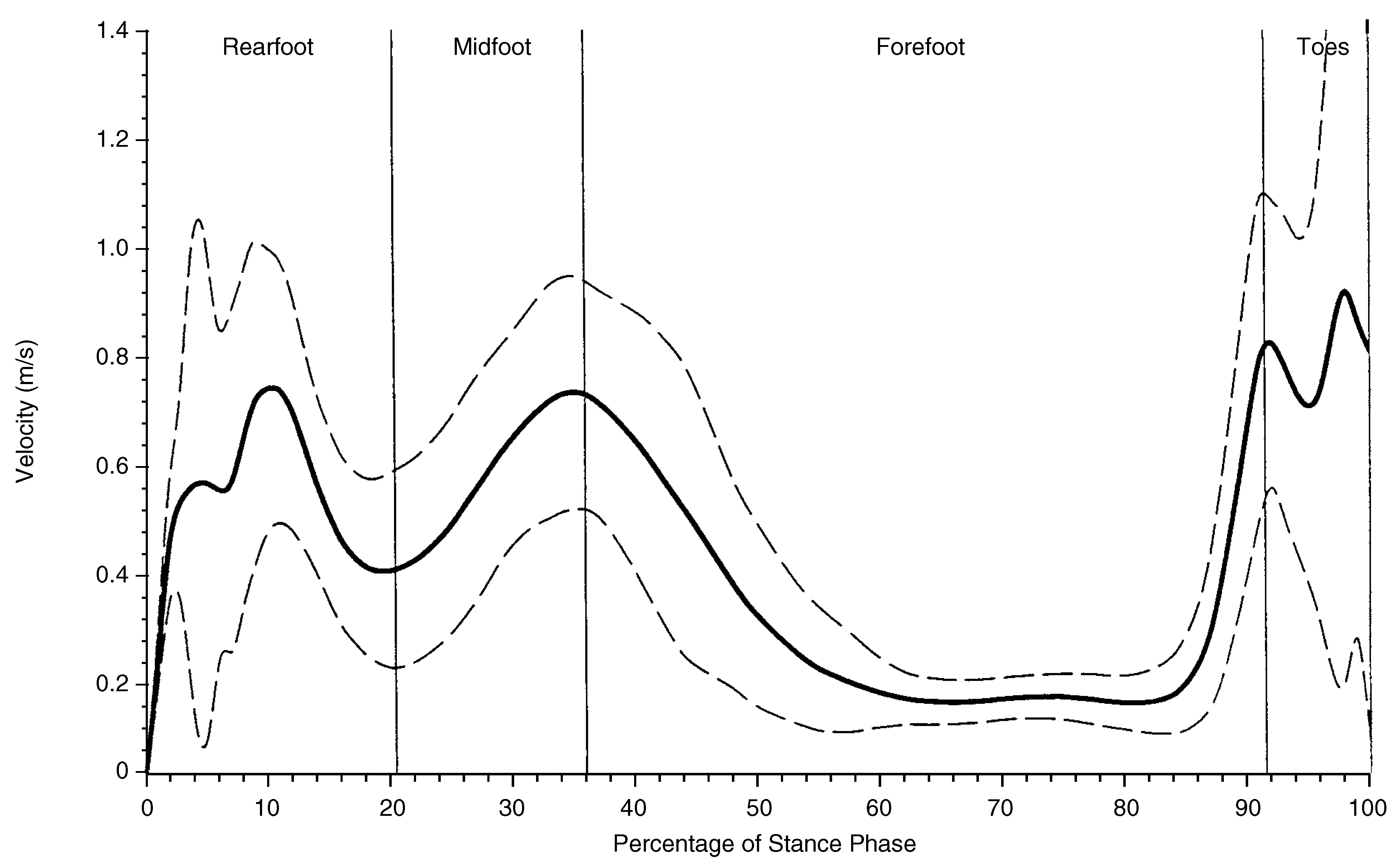
Figure 1. Mean velocity of the COP during the stance phase of gait. Dashed lines represent ± 1 SD.
Japma 90 00334 g001
Table 1. Intraclass Correlation Coefficients for the Dependent Variables in the Plantar Regions of the Foot.
Japma 90 00334 i001
Abbreviation: NA, not applicable.
Table 2. Mean (SD) Values for the Dependent Variables in the Plantar Regions of the Foot.
Japma 90 00334 i002
Abbreviation: NA, not applicable.



